EP0367082A2 - Faltgestell - Google Patents
Faltgestell Download PDFInfo
- Publication number
- EP0367082A2 EP0367082A2 EP89119793A EP89119793A EP0367082A2 EP 0367082 A2 EP0367082 A2 EP 0367082A2 EP 89119793 A EP89119793 A EP 89119793A EP 89119793 A EP89119793 A EP 89119793A EP 0367082 A2 EP0367082 A2 EP 0367082A2
- Authority
- EP
- European Patent Office
- Prior art keywords
- folding frame
- frame according
- scissor
- scissor leg
- folding
- Prior art date
- Legal status (The legal status is an assumption and is not a legal conclusion. Google has not performed a legal analysis and makes no representation as to the accuracy of the status listed.)
- Withdrawn
Links
Images


Classifications
-
- B—PERFORMING OPERATIONS; TRANSPORTING
- B25—HAND TOOLS; PORTABLE POWER-DRIVEN TOOLS; MANIPULATORS
- B25H—WORKSHOP EQUIPMENT, e.g. FOR MARKING-OUT WORK; STORAGE MEANS FOR WORKSHOPS
- B25H3/00—Storage means or arrangements for workshops facilitating access to, or handling of, work tools or instruments
- B25H3/02—Boxes
-
- B—PERFORMING OPERATIONS; TRANSPORTING
- B62—LAND VEHICLES FOR TRAVELLING OTHERWISE THAN ON RAILS
- B62B—HAND-PROPELLED VEHICLES, e.g. HAND CARTS OR PERAMBULATORS; SLEDGES
- B62B2205/00—Hand-propelled vehicles or sledges being foldable or dismountable when not in use
- B62B2205/06—Foldable with a scissor-like mechanism
Definitions
- the invention relates to a folding frame, in particular for larger, but nevertheless manually movable loads, such as a tool case, a grill or the like.
- the folding frame is used to support the load at a comfortable height when unfolded, while the folding position enables space-saving transport or storage.
- Scissor frames with locking devices are known per se, for example for ironing boards.
- the known folding frames have a manually operable organ, such as a push button, when it is actuated in the unfolded position, their catch is released.
- a manually operable organ such as a push button
- the object of the invention is to provide a folding frame with more convenient usability. This object is achieved by the features mentioned in claim 1; the sub-claims define preferred embodiments of this concept.
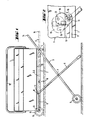
- the transport container here a tool box 1
- the transport container here a tool box 1
- two mutually parallel horizontal supports 2 which can be angled, for example, from a base plate 15.
- a first scissor leg 3 is articulated at 4 on the horizontal supports. Its bottom end carries a pair of rollers 5, its other end protrudes beyond the pivot point and ends in a handle.
- the second scissor leg 6 is articulated at 7 to the first and is guided with a pin 8 in a slot 9 which runs horizontally in the horizontal beam from an outer end 10 and ends at the inner end in a vertically upward elongated hole 11.
- the transport container is provided with a handle 12. If it is lifted by the handle, the pin 8 initially falls to the lower end of the elongated hole. If one now supports the second scissor leg, the pin 8 slides along the horizontal section of the guide slot 9 to its outer end, and the scissor-type frame folds in. However, if the container is supported on the rollers 5, the pin 8 is brought up into its locking position.
- the folded position of the scissor-type frame can be secured by a second locking element, indicated schematically at 13, which can be triggered manually.
- the scissor frame is constructed symmetrically with respect to the vertical central plane in which the handle 12 extends, that is to say that first and second scissor legs are provided in mirror symmetry on both sides of the container. These pairs of legs are preferably connected to one another by cross struts, one of the cross struts forming the handle 14, on which the container can be lifted and dragged while the scissor frame is folded out and engaged.
- the first scissor legs are outside, the second inside the horizontal beam 2.
- the second pair of scissor legs is dimensioned so that it fits just under the bottom of the box.
- the joint pins 7 connecting the two pairs of legs are received by incisions 16 of the horizontal beams when the scissor-type frame is folded in.
- Fig. 2 shows a securing device for the pin 8.
- a clamp 18 with a notch 19 is freely rotatable at 20 and grips like a hook over the pin 8.
- a spot angle 21 enables the clamp to be lifted off for the purpose of unlocking before the folding process; when unfolded, the clamp dodges and is then manually placed in the securing position.
- the detent 13 shown in Fig. 1 is disadvantageous in that manufacturing inaccuracies in the scissor legs can cause it to fail.
- the catch 17, which can be seen in FIG. 3, is more favorable.
- the handle 14 When folded, the handle 14 protrudes quite far beyond the box 1, which takes up more space than necessary for transport. 4, in which the scissor leg 3 protrudes only slightly beyond its joint 4 and is unsuitable as a handle.
- a folding handle 28 is articulated on the carrying handle 12 at 22, which can be folded down from the working position shown. A pin inserted through the hole 23 can lock the handle in both positions. This handle is also better suited for pulling or pushing the frame than handle 14.
Landscapes
- Engineering & Computer Science (AREA)
- Mechanical Engineering (AREA)
- Handcart (AREA)
- Folding Of Thin Sheet-Like Materials, Special Discharging Devices, And Others (AREA)
- Sowing (AREA)
- Cartons (AREA)
Abstract
Description
- Die Erfindung betrifft ein Faltgestell, insbesondere für größere, jedoch gleichwohl von Hand zu bewegende Lasten, wie einen Werkzeugkoffer, einen Grill oder dergleichen. Das Faltgestell dient dazu, im entfalteten Zustand die Last auf bequemer Höhe abzustützen, während die Einfaltstellung den raumsparenden Transport oder raumsparende Unterbringung ermöglicht.
- Scherengestelle mit Rasteinrichtung sind an sich bekannt, etwa für Bügelbretter. Die bekannten Faltgestelle weisen ein manuell betätigbares Organ, etwa einen Druckknopf, auf, bei dessen Betätigung in der Ausfaltstellung deren Rastung gelöst wird. Bei größeren Lasten ist diese Lösung jedoch ungünstig, da gleichzeitig das Gestell noch manuell gehalten werden muß, damit es nicht unkontrolliert kollabiert.
- Aufgabe der Erfindung ist es, ein Faltgestell mit bequemerer Bedienbarkeit zu schaffen. Diese Aufgabe wird durch die im Patentanspruch 1 genannten Merkmale gelöst; die Unteransprüche definieren bevorzugte Ausgestaltungen dieses Konzepts.
- Die beigefügten Zeichnungen dienen der Erläuterung eines Ausführungsbeispiels und seiner Abwandlungen.
- Fig. 1 zeigt in Seitenansicht, weitgehend schematisiert, einen Transportbehälter mit einem Faltgestell gemäß der Erfindung,
- Fig. 2 zeigt in Teilseitenansicht ein Detail,
- Fig. 3 zeigt in Ansicht von unten eine Abwandlung, und
- Fig. 4 zeigt in Teilseitenansicht eine weitere Abwandlung.
- Der Transportbehälter, hier ein Werkzeugkasten 1, ist auf seiner Unterseite mit zwei zueinander parallelen Horizontalträgern 2 versehen, die beispielsweise von einer Bodenplatte 15 abgewinkelt sein können. Ein erstes Scherenbein 3 ist bei 4 an den Horizontalträgern angelenkt. Sein bodenseitiges Ende trägt ein Paar von Rollen 5, sein anderes Ende ragt über den Anlenkpunkt hinaus und läuft in einen Griff aus. Das zweite Scherenbein 6 ist bei 7 an das erste angelenkt und mit einem Zapfen 8 in einem Schlitz 9 geführt, der in dem Horizontalträger von einem äußeren Ende 10 aus horizontal verläuft und am inneren Ende in ein vertikal aufwärts gerichtetes Langloch 11 ausläuft.
- Der Transportbehälter ist mit einem Tragegriff 12 versehen. Wird er an dem Griff angehoben, so fällt der Zapfen 8 zunächst an das untere Ende des Langlochs. Stützt man jetzt das zweite Scherenbein auf, so gleitet der Zapfen 8 längs dem horizontalen Abschnitt des Führungsschlitzes 9 bis an dessen äußeres Ende, und das Scherengestell faltet sich ein. Stützt man jedoch den Behälter auf die Rollen 5, so wird der Zapfen 8 nach oben in seine Raststellung gebracht.
- Die eingefaltete Position des Scherengestells kann durch ein zweites Rastelement, schematisch bei 13 angedeutet, gesichert werden, das manuell auslösbar ist.
- Das Scherengestell ist symmetrisch bezüglich der vertikalen Mittelebene, in der der Tragegriff 12 sich erstreckt, aufgebaut, das heißt, auf beiden Seiten des Behälters sind erste und zweite Scherenbeine spiegelsymmetrisch vorgesehen. Vorzugsweise sind diese Beinpaare durch Querstreben miteinander verbunden, wobei eine der Querstreben den den Griff 14 bildet, an dem der Behälter bei ausgeklapptem und eingerasteten Scherengestell angehoben und rollend geschleppt werden kann.
- Die ersten Scherenbeine liegen außerhalb, die zweiten innerhalb der Horizontalträger 2. Das zweite Scherenbeinpaar ist so bemessen, daß es gerade unter der Kastenboden paßt. Die die beiden Beinpaare verbindenden Gelenkzapfen 7 werden bei eingefaltetem Scherengestell von Einschnitten 16 der Horizontalträger aufgenommen.
- Fig. 2 zeigt eine Sicherungseinrichtung für den Zapfen 8. Eine Schelle 18 mit einem Einschnitt 19 ist bei 20 frei drehbar aufgehangen und greift hakenartig über den Zapfen 8. Ein angepunkteter Winkel 21 ermöglicht das Abheben der Schelle zwecks Entsicherung vor dem Einfaltvorgang; beim Auffalten weicht die Schelle aus und wird dann manuell in die Sicherungsstellung gelegt.
- Die in Fig. 1 dargestellt Raste 13 ist insofern ungünstig, als Fertigungsungenauigkeiten bei den Scherenbeinen dazu führen können, daß sie versagt. Günstiger ist die Raste 17, die man in Fig. 3 erkennt.
- Im eingefalteten Zustand ragt der Griff 14 ziemlich weit über den Kasten 1 hinaus, was für den Transport mehr Raum als nötig beansprucht. Günstiger ist die Gestaltung nach Fig. 4, bei der das Scherenbein 3 nur wenig über sein Gelenk 4 hinausragt und als Griff ungeeignet ist. Dafür ist am Traggriff 12 ein Klappgriff 28 bei 22 angelenkt, der aus der dargestellten Arbeitsposition nach unten abklappbar ist. Ein durch das Loch 23 gesteckter Stift kann den Griff in beiden Stellungen arretieren. Dieser Griff ist auch besser zum Ziehen oder Schieben des Gestells geeignet als der Griff 14.
Claims (15)
Applications Claiming Priority (2)
| Application Number | Priority Date | Filing Date | Title |
|---|---|---|---|
| DE8813597U | 1988-10-29 | ||
| DE8813597U DE8813597U1 (de) | 1988-10-29 | 1988-10-29 | Transportbehälter, insbesondere Werkzeugkasten |
Publications (2)
| Publication Number | Publication Date |
|---|---|
| EP0367082A2 true EP0367082A2 (de) | 1990-05-09 |
| EP0367082A3 EP0367082A3 (de) | 1990-10-24 |
Family
ID=6829390
Family Applications (1)
| Application Number | Title | Priority Date | Filing Date |
|---|---|---|---|
| EP19890119793 Withdrawn EP0367082A3 (de) | 1988-10-29 | 1989-10-25 | Faltgestell |
Country Status (2)
| Country | Link |
|---|---|
| EP (1) | EP0367082A3 (de) |
| DE (1) | DE8813597U1 (de) |
Cited By (1)
| Publication number | Priority date | Publication date | Assignee | Title |
|---|---|---|---|---|
| EP1020258A3 (de) * | 1999-01-14 | 2002-08-07 | Vladimir Rogic | Werkzeugkasten |
Families Citing this family (1)
| Publication number | Priority date | Publication date | Assignee | Title |
|---|---|---|---|---|
| JP4738514B2 (ja) * | 2009-07-13 | 2011-08-03 | 智基 杉本 | 収納かご |
Family Cites Families (5)
| Publication number | Priority date | Publication date | Assignee | Title |
|---|---|---|---|---|
| BE355181A (de) * | 1927-10-25 | |||
| US1881047A (en) * | 1931-07-17 | 1932-10-04 | John P Doman | Folding board |
| US2531856A (en) * | 1949-07-15 | 1950-11-28 | Arthur J Marcouiller | Collapsible cart |
| US3018574A (en) * | 1958-04-28 | 1962-01-30 | Clark J R Co | Ironing table foot construction |
| US3082016A (en) * | 1960-09-28 | 1963-03-19 | William D Pratt | Auto cart |
-
1988
- 1988-10-29 DE DE8813597U patent/DE8813597U1/de not_active Expired
-
1989
- 1989-10-25 EP EP19890119793 patent/EP0367082A3/de not_active Withdrawn
Cited By (1)
| Publication number | Priority date | Publication date | Assignee | Title |
|---|---|---|---|---|
| EP1020258A3 (de) * | 1999-01-14 | 2002-08-07 | Vladimir Rogic | Werkzeugkasten |
Also Published As
| Publication number | Publication date |
|---|---|
| EP0367082A3 (de) | 1990-10-24 |
| DE8813597U1 (de) | 1988-12-22 |
Similar Documents
| Publication | Publication Date | Title |
|---|---|---|
| DE2237817C3 (de) | Werkbank mit einer Schraubstockeinheit | |
| EP0365487B1 (de) | Arbeitstisch | |
| DE3421451C2 (de) | Klapptisch, Werkbank oder dgl. | |
| EP0166910B1 (de) | Zusammenlegbare Bank-Tisch-Kombination | |
| DE1967055B2 (de) | Zusammenklappbare tragbare werkbank | |
| DE20119247U1 (de) | Zusammenklappbarer Tisch | |
| DE2952554A1 (de) | Arbeitsgeraete | |
| DE69604900T2 (de) | Klappares gestell und tragbeinen | |
| DE69818065T2 (de) | Faltbare bühne | |
| DE2904871C2 (de) | ||
| CH661420A5 (de) | Zusammenschiebbarer tisch. | |
| DE68902733T2 (de) | Tapeziertisch fuer anstreicher, zusammenklappbar und mit variablen abmessungen. | |
| DE1109332B (de) | Arbeitstisch in Verbindung mit einem Sitz | |
| EP0367082A2 (de) | Faltgestell | |
| EP0207419B1 (de) | Werkzeugkasten | |
| DE102008029872A1 (de) | Mobiles Gebäude | |
| DE69111808T2 (de) | Vorrichtung für zerlegbare gegenstände. | |
| EP1824747A1 (de) | Zusammenfaltbarer transport- und vorratsbehälter | |
| CH647939A5 (en) | Folding table | |
| EP0446623A1 (de) | Klappgestell zur Abstützung von Tischen, Werkzeugkästen u.dgl. | |
| DE10141555A1 (de) | Tisch | |
| EP0131296A2 (de) | Zusammenklappbare Präsentationseinrichtung, insbesondere für Schriftstücke | |
| EP0668418B1 (de) | Arbeitsbühne | |
| DE29718383U1 (de) | Transportvorrichtung zum Transport von Gegenständen, wie Werkzeugschränke, Materialboxen, Waschmaschinen o.dgl. | |
| DE4418687C2 (de) | Zusammenklappbarer Arbeitstisch, insbesondere Spanntisch |
Legal Events
| Date | Code | Title | Description |
|---|---|---|---|
| PUAI | Public reference made under article 153(3) epc to a published international application that has entered the european phase |
Free format text: ORIGINAL CODE: 0009012 |
|
| AK | Designated contracting states |
Kind code of ref document: A2 Designated state(s): AT BE CH DE ES FR GB IT LI LU NL SE |
|
| PUAL | Search report despatched |
Free format text: ORIGINAL CODE: 0009013 |
|
| AK | Designated contracting states |
Kind code of ref document: A3 Designated state(s): AT BE CH DE ES FR GB IT LI LU NL SE |
|
| 17P | Request for examination filed |
Effective date: 19910423 |
|
| 17Q | First examination report despatched |
Effective date: 19920909 |
|
| STAA | Information on the status of an ep patent application or granted ep patent |
Free format text: STATUS: THE APPLICATION HAS BEEN WITHDRAWN |
|
| 18W | Application withdrawn |
Withdrawal date: 19930313 |