EP0367326A1 - Process for preparing a cycloalkanone and/or cycloalkanol - Google Patents
Process for preparing a cycloalkanone and/or cycloalkanol Download PDFInfo
- Publication number
- EP0367326A1 EP0367326A1 EP89202621A EP89202621A EP0367326A1 EP 0367326 A1 EP0367326 A1 EP 0367326A1 EP 89202621 A EP89202621 A EP 89202621A EP 89202621 A EP89202621 A EP 89202621A EP 0367326 A1 EP0367326 A1 EP 0367326A1
- Authority
- EP
- European Patent Office
- Prior art keywords
- decomposition
- complex
- metal
- catalyst
- mixture
- Prior art date
- Legal status (The legal status is an assumption and is not a legal conclusion. Google has not performed a legal analysis and makes no representation as to the accuracy of the status listed.)
- Granted
Links
- 238000004519 manufacturing process Methods 0.000 title claims abstract description 4
- 238000000354 decomposition reaction Methods 0.000 claims abstract description 24
- 230000003647 oxidation Effects 0.000 claims abstract description 22
- 238000007254 oxidation reaction Methods 0.000 claims abstract description 22
- 239000012876 carrier material Substances 0.000 claims abstract description 15
- 150000001924 cycloalkanes Chemical class 0.000 claims abstract description 12
- IEQIEDJGQAUEQZ-UHFFFAOYSA-N phthalocyanine Chemical compound N1C(N=C2C3=CC=CC=C3C(N=C3C4=CC=CC=C4C(=N4)N3)=N2)=C(C=CC=C2)C2=C1N=C1C2=CC=CC=C2C4=N1 IEQIEDJGQAUEQZ-UHFFFAOYSA-N 0.000 claims abstract description 11
- QVGXLLKOCUKJST-UHFFFAOYSA-N atomic oxygen Chemical compound [O] QVGXLLKOCUKJST-UHFFFAOYSA-N 0.000 claims abstract description 6
- 229910052760 oxygen Inorganic materials 0.000 claims abstract description 6
- 239000001301 oxygen Substances 0.000 claims abstract description 6
- 150000004696 coordination complex Chemical class 0.000 claims abstract description 5
- -1 porphyrin metal complex Chemical class 0.000 claims abstract 2
- 238000000034 method Methods 0.000 claims description 27
- 239000000203 mixture Substances 0.000 claims description 24
- 230000008569 process Effects 0.000 claims description 24
- 229910052751 metal Inorganic materials 0.000 claims description 20
- 239000002184 metal Substances 0.000 claims description 20
- 229910052804 chromium Inorganic materials 0.000 claims description 6
- 229910052742 iron Inorganic materials 0.000 claims description 6
- 229910052748 manganese Inorganic materials 0.000 claims description 5
- 239000002002 slurry Substances 0.000 claims description 3
- 125000004432 carbon atom Chemical group C* 0.000 claims description 2
- MHAJPDPJQMAIIY-UHFFFAOYSA-M hydroperoxide group Chemical group [O-]O MHAJPDPJQMAIIY-UHFFFAOYSA-M 0.000 abstract description 3
- MHAJPDPJQMAIIY-UHFFFAOYSA-N Hydrogen peroxide Chemical compound OO MHAJPDPJQMAIIY-UHFFFAOYSA-N 0.000 abstract description 2
- 239000003054 catalyst Substances 0.000 description 21
- ZMXDDKWLCZADIW-UHFFFAOYSA-N N,N-Dimethylformamide Chemical compound CN(C)C=O ZMXDDKWLCZADIW-UHFFFAOYSA-N 0.000 description 15
- 238000006243 chemical reaction Methods 0.000 description 13
- 150000004032 porphyrins Chemical group 0.000 description 12
- VYPSYNLAJGMNEJ-UHFFFAOYSA-N Silicium dioxide Chemical compound O=[Si]=O VYPSYNLAJGMNEJ-UHFFFAOYSA-N 0.000 description 10
- 150000001875 compounds Chemical class 0.000 description 10
- XEEYBQQBJWHFJM-UHFFFAOYSA-N iron Substances [Fe] XEEYBQQBJWHFJM-UHFFFAOYSA-N 0.000 description 8
- 239000000047 product Substances 0.000 description 8
- 239000011651 chromium Substances 0.000 description 7
- OKKJLVBELUTLKV-UHFFFAOYSA-N Methanol Chemical compound OC OKKJLVBELUTLKV-UHFFFAOYSA-N 0.000 description 6
- 239000011572 manganese Substances 0.000 description 6
- 125000002524 organometallic group Chemical group 0.000 description 6
- 239000002253 acid Substances 0.000 description 5
- 239000000377 silicon dioxide Substances 0.000 description 5
- 229910052723 transition metal Inorganic materials 0.000 description 5
- 150000003624 transition metals Chemical class 0.000 description 5
- QPFMBZIOSGYJDE-UHFFFAOYSA-N 1,1,2,2-tetrachloroethane Chemical compound ClC(Cl)C(Cl)Cl QPFMBZIOSGYJDE-UHFFFAOYSA-N 0.000 description 4
- XDTMQSROBMDMFD-UHFFFAOYSA-N Cyclohexane Chemical compound C1CCCCC1 XDTMQSROBMDMFD-UHFFFAOYSA-N 0.000 description 4
- LFQSCWFLJHTTHZ-UHFFFAOYSA-N Ethanol Chemical compound CCO LFQSCWFLJHTTHZ-UHFFFAOYSA-N 0.000 description 4
- 239000004793 Polystyrene Substances 0.000 description 4
- JHIVVAPYMSGYDF-UHFFFAOYSA-N cyclohexanone Chemical compound O=C1CCCCC1 JHIVVAPYMSGYDF-UHFFFAOYSA-N 0.000 description 4
- 238000004821 distillation Methods 0.000 description 4
- 230000000694 effects Effects 0.000 description 4
- JBKVHLHDHHXQEQ-UHFFFAOYSA-N epsilon-caprolactam Chemical compound O=C1CCCCCN1 JBKVHLHDHHXQEQ-UHFFFAOYSA-N 0.000 description 4
- 238000002474 experimental method Methods 0.000 description 4
- 239000000463 material Substances 0.000 description 4
- 150000002739 metals Chemical class 0.000 description 4
- 229920002223 polystyrene Polymers 0.000 description 4
- 238000002360 preparation method Methods 0.000 description 4
- 239000011541 reaction mixture Substances 0.000 description 4
- 239000000725 suspension Substances 0.000 description 4
- FYSNRJHAOHDILO-UHFFFAOYSA-N thionyl chloride Chemical compound ClS(Cl)=O FYSNRJHAOHDILO-UHFFFAOYSA-N 0.000 description 4
- YMWUJEATGCHHMB-UHFFFAOYSA-N Dichloromethane Chemical compound ClCCl YMWUJEATGCHHMB-UHFFFAOYSA-N 0.000 description 3
- 239000007795 chemical reaction product Substances 0.000 description 3
- 230000000052 comparative effect Effects 0.000 description 3
- 239000010949 copper Substances 0.000 description 3
- 235000019441 ethanol Nutrition 0.000 description 3
- FGGJBCRKSVGDPO-UHFFFAOYSA-N hydroperoxycyclohexane Chemical compound OOC1CCCCC1 FGGJBCRKSVGDPO-UHFFFAOYSA-N 0.000 description 3
- 125000001997 phenyl group Chemical group [H]C1=C([H])C([H])=C(*)C([H])=C1[H] 0.000 description 3
- 125000001424 substituent group Chemical group 0.000 description 3
- 230000007306 turnover Effects 0.000 description 3
- XLYOFNOQVPJJNP-UHFFFAOYSA-N water Substances O XLYOFNOQVPJJNP-UHFFFAOYSA-N 0.000 description 3
- IJGRMHOSHXDMSA-UHFFFAOYSA-N Atomic nitrogen Chemical compound N#N IJGRMHOSHXDMSA-UHFFFAOYSA-N 0.000 description 2
- HEDRZPFGACZZDS-UHFFFAOYSA-N Chloroform Chemical compound ClC(Cl)Cl HEDRZPFGACZZDS-UHFFFAOYSA-N 0.000 description 2
- PXHVJJICTQNCMI-UHFFFAOYSA-N Nickel Chemical compound [Ni] PXHVJJICTQNCMI-UHFFFAOYSA-N 0.000 description 2
- JUJWROOIHBZHMG-UHFFFAOYSA-N Pyridine Chemical compound C1=CC=NC=C1 JUJWROOIHBZHMG-UHFFFAOYSA-N 0.000 description 2
- GWEVSGVZZGPLCZ-UHFFFAOYSA-N Titan oxide Chemical compound O=[Ti]=O GWEVSGVZZGPLCZ-UHFFFAOYSA-N 0.000 description 2
- 150000007513 acids Chemical class 0.000 description 2
- WNLRTRBMVRJNCN-UHFFFAOYSA-N adipic acid Chemical compound OC(=O)CCCCC(O)=O WNLRTRBMVRJNCN-UHFFFAOYSA-N 0.000 description 2
- VSCWAEJMTAWNJL-UHFFFAOYSA-K aluminium trichloride Chemical compound Cl[Al](Cl)Cl VSCWAEJMTAWNJL-UHFFFAOYSA-K 0.000 description 2
- 229910052794 bromium Inorganic materials 0.000 description 2
- 239000000969 carrier Substances 0.000 description 2
- 229910052801 chlorine Inorganic materials 0.000 description 2
- 229910017052 cobalt Inorganic materials 0.000 description 2
- 239000010941 cobalt Substances 0.000 description 2
- GUTLYIVDDKVIGB-UHFFFAOYSA-N cobalt atom Chemical compound [Co] GUTLYIVDDKVIGB-UHFFFAOYSA-N 0.000 description 2
- 238000001816 cooling Methods 0.000 description 2
- 229910052802 copper Inorganic materials 0.000 description 2
- HPXRVTGHNJAIIH-UHFFFAOYSA-N cyclohexanol Chemical compound OC1CCCCC1 HPXRVTGHNJAIIH-UHFFFAOYSA-N 0.000 description 2
- 229960004756 ethanol Drugs 0.000 description 2
- 229910052740 iodine Inorganic materials 0.000 description 2
- 150000002576 ketones Chemical class 0.000 description 2
- 229910001510 metal chloride Inorganic materials 0.000 description 2
- 125000000896 monocarboxylic acid group Chemical group 0.000 description 2
- 238000010992 reflux Methods 0.000 description 2
- 239000011343 solid material Substances 0.000 description 2
- 239000000243 solution Substances 0.000 description 2
- 239000007858 starting material Substances 0.000 description 2
- FOYWCEUVVIHJKD-UHFFFAOYSA-N 2-methyl-5-(1h-pyrazol-5-yl)pyridine Chemical compound C1=NC(C)=CC=C1C1=CC=NN1 FOYWCEUVVIHJKD-UHFFFAOYSA-N 0.000 description 1
- VYZAMTAEIAYCRO-UHFFFAOYSA-N Chromium Chemical compound [Cr] VYZAMTAEIAYCRO-UHFFFAOYSA-N 0.000 description 1
- RYGMFSIKBFXOCR-UHFFFAOYSA-N Copper Chemical compound [Cu] RYGMFSIKBFXOCR-UHFFFAOYSA-N 0.000 description 1
- QOSSAOTZNIDXMA-UHFFFAOYSA-N Dicylcohexylcarbodiimide Chemical compound C1CCCCC1N=C=NC1CCCCC1 QOSSAOTZNIDXMA-UHFFFAOYSA-N 0.000 description 1
- MYMOFIZGZYHOMD-UHFFFAOYSA-N Dioxygen Chemical compound O=O MYMOFIZGZYHOMD-UHFFFAOYSA-N 0.000 description 1
- 238000005727 Friedel-Crafts reaction Methods 0.000 description 1
- 229920002292 Nylon 6 Polymers 0.000 description 1
- 229920002302 Nylon 6,6 Polymers 0.000 description 1
- LGRFSURHDFAFJT-UHFFFAOYSA-N Phthalic anhydride Natural products C1=CC=C2C(=O)OC(=O)C2=C1 LGRFSURHDFAFJT-UHFFFAOYSA-N 0.000 description 1
- 229910006069 SO3H Inorganic materials 0.000 description 1
- 229910006124 SOCl2 Inorganic materials 0.000 description 1
- 229910000831 Steel Inorganic materials 0.000 description 1
- PPBRXRYQALVLMV-UHFFFAOYSA-N Styrene Chemical compound C=CC1=CC=CC=C1 PPBRXRYQALVLMV-UHFFFAOYSA-N 0.000 description 1
- XSQUKJJJFZCRTK-UHFFFAOYSA-N Urea Chemical compound NC(N)=O XSQUKJJJFZCRTK-UHFFFAOYSA-N 0.000 description 1
- 235000011037 adipic acid Nutrition 0.000 description 1
- 239000001361 adipic acid Substances 0.000 description 1
- 229940053991 aldehydes and derivative Drugs 0.000 description 1
- 229910001854 alkali hydroxide Inorganic materials 0.000 description 1
- 150000008044 alkali metal hydroxides Chemical class 0.000 description 1
- 125000003342 alkenyl group Chemical group 0.000 description 1
- 125000000217 alkyl group Chemical group 0.000 description 1
- 239000004411 aluminium Substances 0.000 description 1
- 229910052782 aluminium Inorganic materials 0.000 description 1
- XAGFODPZIPBFFR-UHFFFAOYSA-N aluminium Chemical compound [Al] XAGFODPZIPBFFR-UHFFFAOYSA-N 0.000 description 1
- PNEYBMLMFCGWSK-UHFFFAOYSA-N aluminium oxide Inorganic materials [O-2].[O-2].[O-2].[Al+3].[Al+3] PNEYBMLMFCGWSK-UHFFFAOYSA-N 0.000 description 1
- 150000001412 amines Chemical class 0.000 description 1
- 150000001413 amino acids Chemical class 0.000 description 1
- 125000003277 amino group Chemical group 0.000 description 1
- APUPEJJSWDHEBO-UHFFFAOYSA-P ammonium molybdate Chemical compound [NH4+].[NH4+].[O-][Mo]([O-])(=O)=O APUPEJJSWDHEBO-UHFFFAOYSA-P 0.000 description 1
- 229940010552 ammonium molybdate Drugs 0.000 description 1
- 235000018660 ammonium molybdate Nutrition 0.000 description 1
- 239000011609 ammonium molybdate Substances 0.000 description 1
- 239000008346 aqueous phase Substances 0.000 description 1
- 230000015572 biosynthetic process Effects 0.000 description 1
- JHIWVOJDXOSYLW-UHFFFAOYSA-N butyl 2,2-difluorocyclopropane-1-carboxylate Chemical compound CCCCOC(=O)C1CC1(F)F JHIWVOJDXOSYLW-UHFFFAOYSA-N 0.000 description 1
- 239000004202 carbamide Substances 0.000 description 1
- 125000002843 carboxylic acid group Chemical group 0.000 description 1
- 150000001735 carboxylic acids Chemical class 0.000 description 1
- 229940107218 chromium Drugs 0.000 description 1
- 235000012721 chromium Nutrition 0.000 description 1
- 229910052681 coesite Inorganic materials 0.000 description 1
- 239000008139 complexing agent Substances 0.000 description 1
- 229910052906 cristobalite Inorganic materials 0.000 description 1
- 230000003247 decreasing effect Effects 0.000 description 1
- 210000003298 dental enamel Anatomy 0.000 description 1
- 230000002349 favourable effect Effects 0.000 description 1
- 238000001914 filtration Methods 0.000 description 1
- 229910052731 fluorine Inorganic materials 0.000 description 1
- 239000012634 fragment Substances 0.000 description 1
- 239000011521 glass Substances 0.000 description 1
- 229910052736 halogen Inorganic materials 0.000 description 1
- 150000002367 halogens Chemical class 0.000 description 1
- 229910052739 hydrogen Inorganic materials 0.000 description 1
- 239000011261 inert gas Substances 0.000 description 1
- GWVMLCQWXVFZCN-UHFFFAOYSA-N isoindoline Chemical class C1=CC=C2CNCC2=C1 GWVMLCQWXVFZCN-UHFFFAOYSA-N 0.000 description 1
- 239000007788 liquid Substances 0.000 description 1
- 239000007791 liquid phase Substances 0.000 description 1
- 238000011068 loading method Methods 0.000 description 1
- WPBNNNQJVZRUHP-UHFFFAOYSA-L manganese(2+);methyl n-[[2-(methoxycarbonylcarbamothioylamino)phenyl]carbamothioyl]carbamate;n-[2-(sulfidocarbothioylamino)ethyl]carbamodithioate Chemical compound [Mn+2].[S-]C(=S)NCCNC([S-])=S.COC(=O)NC(=S)NC1=CC=CC=C1NC(=S)NC(=O)OC WPBNNNQJVZRUHP-UHFFFAOYSA-L 0.000 description 1
- 238000006263 metalation reaction Methods 0.000 description 1
- 230000003472 neutralizing effect Effects 0.000 description 1
- 229910052759 nickel Inorganic materials 0.000 description 1
- 229910052757 nitrogen Inorganic materials 0.000 description 1
- 239000012299 nitrogen atmosphere Substances 0.000 description 1
- 239000012074 organic phase Substances 0.000 description 1
- 150000002978 peroxides Chemical class 0.000 description 1
- 239000012071 phase Substances 0.000 description 1
- XKJCHHZQLQNZHY-UHFFFAOYSA-N phthalimide Chemical compound C1=CC=C2C(=O)NC(=O)C2=C1 XKJCHHZQLQNZHY-UHFFFAOYSA-N 0.000 description 1
- XQZYPMVTSDWCCE-UHFFFAOYSA-N phthalonitrile Chemical compound N#CC1=CC=CC=C1C#N XQZYPMVTSDWCCE-UHFFFAOYSA-N 0.000 description 1
- 230000001737 promoting effect Effects 0.000 description 1
- UMJSCPRVCHMLSP-UHFFFAOYSA-N pyridine Natural products COC1=CC=CN=C1 UMJSCPRVCHMLSP-UHFFFAOYSA-N 0.000 description 1
- 238000004064 recycling Methods 0.000 description 1
- 150000003304 ruthenium compounds Chemical class 0.000 description 1
- 235000012239 silicon dioxide Nutrition 0.000 description 1
- 239000007787 solid Substances 0.000 description 1
- 239000010959 steel Substances 0.000 description 1
- 229910052682 stishovite Inorganic materials 0.000 description 1
- 125000000020 sulfo group Chemical group O=S(=O)([*])O[H] 0.000 description 1
- BDHFUVZGWQCTTF-UHFFFAOYSA-N sulfonic acid Chemical compound OS(=O)=O BDHFUVZGWQCTTF-UHFFFAOYSA-N 0.000 description 1
- 230000002459 sustained effect Effects 0.000 description 1
- 229910052905 tridymite Inorganic materials 0.000 description 1
- 229910052720 vanadium Inorganic materials 0.000 description 1
- 238000005406 washing Methods 0.000 description 1
Classifications
-
- C—CHEMISTRY; METALLURGY
- C07—ORGANIC CHEMISTRY
- C07C—ACYCLIC OR CARBOCYCLIC COMPOUNDS
- C07C35/00—Compounds having at least one hydroxy or O-metal group bound to a carbon atom of a ring other than a six-membered aromatic ring
- C07C35/02—Compounds having at least one hydroxy or O-metal group bound to a carbon atom of a ring other than a six-membered aromatic ring monocyclic
- C07C35/08—Compounds having at least one hydroxy or O-metal group bound to a carbon atom of a ring other than a six-membered aromatic ring monocyclic containing a six-membered rings
-
- C—CHEMISTRY; METALLURGY
- C07—ORGANIC CHEMISTRY
- C07C—ACYCLIC OR CARBOCYCLIC COMPOUNDS
- C07C29/00—Preparation of compounds having hydroxy or O-metal groups bound to a carbon atom not belonging to a six-membered aromatic ring
- C07C29/132—Preparation of compounds having hydroxy or O-metal groups bound to a carbon atom not belonging to a six-membered aromatic ring by reduction of an oxygen containing functional group
-
- C—CHEMISTRY; METALLURGY
- C07—ORGANIC CHEMISTRY
- C07C—ACYCLIC OR CARBOCYCLIC COMPOUNDS
- C07C407/00—Preparation of peroxy compounds
-
- C—CHEMISTRY; METALLURGY
- C07—ORGANIC CHEMISTRY
- C07C—ACYCLIC OR CARBOCYCLIC COMPOUNDS
- C07C409/00—Peroxy compounds
- C07C409/02—Peroxy compounds the —O—O— group being bound between a carbon atom, not further substituted by oxygen atoms, and hydrogen, i.e. hydroperoxides
- C07C409/14—Peroxy compounds the —O—O— group being bound between a carbon atom, not further substituted by oxygen atoms, and hydrogen, i.e. hydroperoxides the carbon atom belonging to a ring other than a six-membered aromatic ring
-
- C—CHEMISTRY; METALLURGY
- C07—ORGANIC CHEMISTRY
- C07C—ACYCLIC OR CARBOCYCLIC COMPOUNDS
- C07C45/00—Preparation of compounds having >C = O groups bound only to carbon or hydrogen atoms; Preparation of chelates of such compounds
- C07C45/27—Preparation of compounds having >C = O groups bound only to carbon or hydrogen atoms; Preparation of chelates of such compounds by oxidation
- C07C45/32—Preparation of compounds having >C = O groups bound only to carbon or hydrogen atoms; Preparation of chelates of such compounds by oxidation with molecular oxygen
- C07C45/33—Preparation of compounds having >C = O groups bound only to carbon or hydrogen atoms; Preparation of chelates of such compounds by oxidation with molecular oxygen of CHx-moieties
-
- C—CHEMISTRY; METALLURGY
- C07—ORGANIC CHEMISTRY
- C07C—ACYCLIC OR CARBOCYCLIC COMPOUNDS
- C07C45/00—Preparation of compounds having >C = O groups bound only to carbon or hydrogen atoms; Preparation of chelates of such compounds
- C07C45/51—Preparation of compounds having >C = O groups bound only to carbon or hydrogen atoms; Preparation of chelates of such compounds by pyrolysis, rearrangement or decomposition
- C07C45/53—Preparation of compounds having >C = O groups bound only to carbon or hydrogen atoms; Preparation of chelates of such compounds by pyrolysis, rearrangement or decomposition of hydroperoxides
-
- C—CHEMISTRY; METALLURGY
- C07—ORGANIC CHEMISTRY
- C07C—ACYCLIC OR CARBOCYCLIC COMPOUNDS
- C07C2601/00—Systems containing only non-condensed rings
- C07C2601/06—Systems containing only non-condensed rings with a five-membered ring
- C07C2601/10—Systems containing only non-condensed rings with a five-membered ring the ring being unsaturated
-
- C—CHEMISTRY; METALLURGY
- C07—ORGANIC CHEMISTRY
- C07C—ACYCLIC OR CARBOCYCLIC COMPOUNDS
- C07C2601/00—Systems containing only non-condensed rings
- C07C2601/12—Systems containing only non-condensed rings with a six-membered ring
- C07C2601/14—The ring being saturated
-
- C—CHEMISTRY; METALLURGY
- C07—ORGANIC CHEMISTRY
- C07C—ACYCLIC OR CARBOCYCLIC COMPOUNDS
- C07C2601/00—Systems containing only non-condensed rings
- C07C2601/18—Systems containing only non-condensed rings with a ring being at least seven-membered
-
- C—CHEMISTRY; METALLURGY
- C07—ORGANIC CHEMISTRY
- C07C—ACYCLIC OR CARBOCYCLIC COMPOUNDS
- C07C2601/00—Systems containing only non-condensed rings
- C07C2601/18—Systems containing only non-condensed rings with a ring being at least seven-membered
- C07C2601/20—Systems containing only non-condensed rings with a ring being at least seven-membered the ring being twelve-membered
Definitions
- the invention relates to a process for preparing a cycloalkanone and/or cycloalkanol by oxidation of a cycloalkane with 5-12 carbon atoms using oxygen to form a cycloalkylhydro-peroxide, followed by a decomposition of the cycloalkylhydro-peroxide in the presence of an organic metal complex.
- All sorts of catalyst systems have been proposed for carrying out the said process. They relate to carrying out either the first step, the oxidation, or the second step, the decomposition, or both.
- FR-A-1.530.986 the preparation of a hydroperoxide is described, in which, besides a complexing agent, a transition metal complex may be present.
- EP-A-0.027.937 a transition metal complex of certain iso-indolines is used in the conversion of cyclohexane to a K/A mixture.
- EP-A-0.270.468 describes the use of a soluble ruthenium compound in combination with certain iso-indoline compounds in the decomposition step.
- JP-A-60.126.237 describes the use of an organometallic complex with the metal bonded to a porphyrin structure, the metal used being Co, Mn, Cr or Fe.
- a catalyst Owing to the immobilization on the carrier material, a catalyst is obtained that can easily be separated from the reaction phase and which combines a surprisingly and yet unexplainable good, sustained and stable activity with a good selectivity in respect of the ketone and/or alcohol, compared to a process in which a homogeneously dissolved complex is used, as is done in aforementioned JP-A-60.126.237.
- Phthalocyanine and porphyrin complexes applicable in a process according to the invention are known per se.
- reference can be made to, for instance, the article by J. Manassen in Cat. Rev. Sci. Eng. 9(2), 223-43 (1974), as well as, in so far as porphyrin complexes are concerned, to the above-mentioned JP-A-60.126.237.
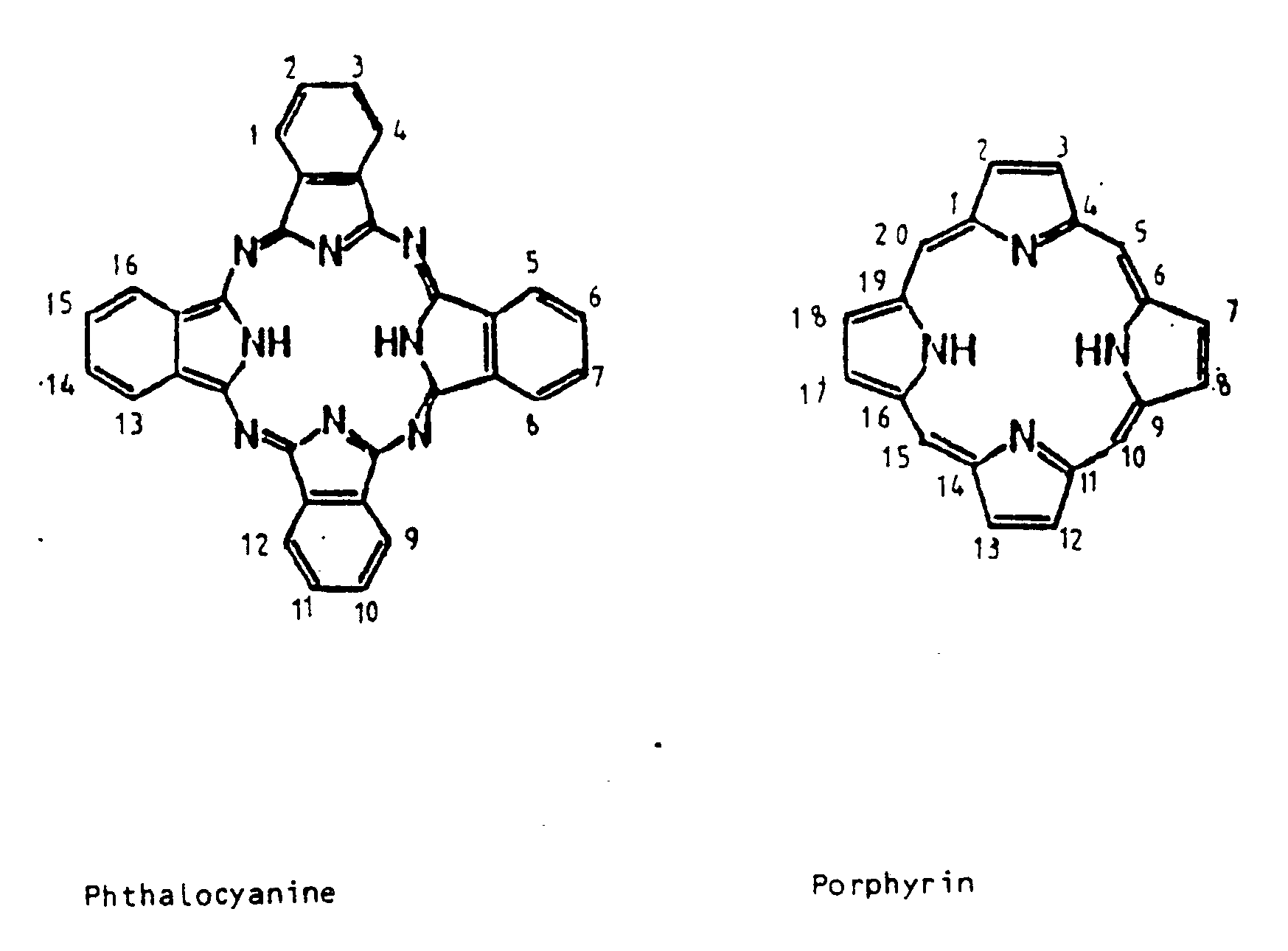
- a porphyrin or a phthalocyanine is proceeded from, which may be substituted.
- the structural formulas of these compounds are as follows: Phthalocyanines may be substituted at the indicated positions 1-16, porphyrins at the indicated positions 1-20, except for positions 1, 4, 6, 9, 11, 14, 16 and 19.
- the substituents applied may be:
- the metalation of a porphyrin can be effected by introducing porphyrin into dimethylformamide (DMF) and adding the metal to be incorporated as metal chloride under reflux.
- DMF dimethylformamide
- Phthalocyanines can be synthesized by proceeding from molecular fragments, such as phthalonitrile, phthalimide and phthalic anhydride.
- metal chlorides can be used as metal source. In some cases urea is used as nitrogen donor and ammonium molybdate as catalyst.
- metals most suited for applying the process can be mentioned: Co, Mn, Cr, Fe and/or V, but in principle any transition metal will qualify that is capable of forming organometallic complexes with said products. Mixtures of the said metals can be applied also.
- the organometallic complexes are bonded to (immobilized on) a carrier material.
- the carrier material applied may be any material with which a bond with the complex can be achieved.
- an ionic bond as well as a covalent bond is applicable.
- the substituted groups of the organometallic complexes must be such as to make such covalent or ionic bond possible. This can be achieved, for instance, by using complexes containing one or more sulphonic acid, amino acid or carboxylic acid groups, or combinations thereof.
- the carrier material to be used may be of an inorganic as well as an organic polymeric nature.
- the carrier material too, must be provided with one or more groups that can bring about the immobilization of the organometallic complex.
- One of the requirements imposed in respect of the carrier material is that the carrier material must have enough reactive groups in order thus to obtain an acceptable degree of loading.
- the suitable reactive groups can be, for instance, COOH, NHR, OH, SO3H, Cl, Br, I, but also phenyl and related groups.
- the material must not dissolve in one of the components present in the process flow, it must be inert to the reactions which occur and it must have sufficient mechanical stability.
- inorganic carriers such as alumina, TiO2, SiO2 or organic carriers, such as modified polystyrene, EVA copolymer, acid- or anhydride-modified PE, are suitable.
- the bonding can be effected, for instance, by starting from a phthalocyanine or porphyrin with one or more halogen (compounds)-containing substituents.
- the starting material can be heated for some time in pyridine together with the silica.
- the solid is subsequently filtered off, washed and dried.
- the bonding can be effected, for instance, by starting from a phthalocyanine or porphyrin with one or more substituents containing COOH groups. By means of a Friedel-Crafts reaction this can be bonded to polystyrene.
- the oxidation of the cycloalkane is carried out as known in the art in the liquid phase at temperatures of 120-200 ⁇ C, particularly 140-180 ⁇ C, using, for instance, air, pure oxygen or a mixture of oxygen and inert gas. In the process an amount of, for instance, 1-12% of the cycloalkane is converted.
- the pressure is not critical in this oxidation process and is mostly between 4 and 50 bar.
- the amount of transition metal should preferably be very small, for instance in the order of 1-10 parts by weight per million.
- the oxidation catalyst used may be a compound of, for instance, cobalt, chromium, manganese, iron, nickel, copper or mixtures thereof.
- the immobilized organometallic complexes described in this application are suitable also.
- the decomposition of the cycloalkylhydroperoxide in the oxidation mixture is effected by means of the immobilized metal complexes based on phthalocyanine or porphyrin.
- the decomposition catalyst can be applied in various ways. As it is immobilized on a carrier, slurry reactors as well as, for instance, packed beds can be used for realizing the conversion of the cycloalkylhydro-peroxide.
- the heat of reaction released in the decomposition must be collected and carried off adequately in order to guarantee a proper process temperature control. This can be well done in particular when using slurry reactors.
- the desired temperature can then, for instance, be maintained by reflux cooling, preferably during a reactifying treatment, for at least a part of the heat to be carried off.
- This has a certain favourable effect on the yield of the desired product.
- the amount of immobilized complex to be used is under such conditions for instance 5-250 ppm metal calculated on the oxidation mixture. Preference is given to the use of 10-150 ppm metal.
- the temperature is generally within the range of 25-120 ⁇ C.
- the chosen pressure is usally somewhat lower than in the oxidation.
- the decomposition is preferably carried out in the presence of oxygen. The yield of K/A mixture is thus improved.
- the oxidation mixture Before the decomposition of the hydroperoxide in the oxidation mixture, the oxidation mixture can be treated, if so desired, with water or with an aqueous alkalihydroxide or alkalicarbonate solution for the purpose of removing and/or neutralizing the acids formed in the oxidation, for instance to a pH of the aqueous phase of 8-13.
- the oxidation mixture can be preconcentrated, for instance by a distillation or a flashing step.
- the reaction mixture obtained as a result of the decomposition of the hydroperoxide can be further processed by subjecting the organic phase, after washing with water if so desired, to a distillation process while recovering cycloalkane for recycling, as well as cycloalkanol and cycloalkanone.
- the process is particularly suited for the oxidation of cyclohexane, the reaction products of which can particularly be used either for the preparation of caprolactam (for nylon 6) or for the preparation of adipic acid (for nylon 6,6).
- the cyclohexanol and cyclohexanone thus obtained have been found without further processing to be pure enough for further conversion into caprolactam.
- Example I was repeated, the compound to be bonded being the Cu-tetrasulphonic acid phthalocyanine.
- Example I was repeated, the compound to be bonded being the Mn-tetrasulphonic acid phthalocyanine.
- Example IV was repeated, the compound to be bonded being Comonochlorophthalocyanine (containing 0.08 wt.% Co).
- Example IV was repeated, the compound to be bonded being 5(4(3-bromo-1-propoxy)phenyl), 10,15,20-tritolylporphyrin.
- Cr, Co, V, Mn and Fe were incorporated as metals, using the DMF method. All these products were analyzed for their metal content. Results: Cr: 0.09 wt.% Co: 0.05 wt.% Mn: 0.06 wt.% Fe: 0.06 wt.% V: 0.04 wt.%
- Example VII was repeated with the same catalyst, but now also air was passed through during the decomposition.
- the selectivity in respect of K + A was 114% with a K/A ratio of 0.59.
- the turnover number in re-use was higher than 50,000.
- Example VIII was repeated with Co-phthalocyanine as catalyst.
- the catalyst did not dissolve completely in the reaction mixture (suspension) and could be recovered again partially by filtration.
- the k was 0.012 min-1.
- the selectivity in respect of K + A was 112% at a K/A ratio of 0.56.
- the turnover number in re-use was about 500.
- Example VII was repeated with the homogeneously dissolved Co-2-ethylhexanoate as catalyst.
- the k was 0.02 min-1 calculated on the first 20 minutes of the decomposition. After these 20 minutes the catalyst activity decreased very strongly.
- the selectivity in respect of K + A was 91.6% with a K/A ratio of 0.45. Re-use of the catalyst was not possible.
- the solid material was filtered, washed with 1,1,2,2-tetrachloroethane, methanol, basic water and 1 N HCL. The resulting solid material was dried at 50oC. The product was analyzed for its metal content (0.43 wt.%).
- Example IX was repeated, the compound to be bonded being Mn-octacarboxyphthalocyanine (0.53 wt.%).
- Example IX was repeated, the compound to be bonded being the 5,10,15,20-tetra(4-carboxyphenyl)porphyrin.
- Example VII was repeated, the catalyst being the polystyrene-bonded Cr-porphyrin of example XI.
- the catalyst could be re-used a plurality of times.
- the k was 0.028 min-1.
- the selectivity in respect of K + A was 96.0% with a K/A ratio of 4.2.
- Example VII was repeated, the catalyst being the polystyrene-bonded Fe-porphyrin of example XI.
- the catalyst could be re-used a plurality of times.
- the k was 0.19 min-1; the K/A ratio was 2.8.
- Example VII was repeated, the catalyst being the polystyrene-bonded Co-porphyrin of example XI.
- the catalyst could be re-used a plurality of times.
- the k was 0.18 min-1; the K/A ratio was 1.0.
- Example VII was repeated, the catalyst being the homogeneously dissolved Cr-2-ethyl-hexanoate.
- the k was 0.008 min-1.
- the selectivity in respect of K + A was 91.7% with a K/A ratio of 4.4. The catalyst could not be used again.
Landscapes
- Chemical & Material Sciences (AREA)
- Organic Chemistry (AREA)
- Organic Low-Molecular-Weight Compounds And Preparation Thereof (AREA)
- Low-Molecular Organic Synthesis Reactions Using Catalysts (AREA)
- Catalysts (AREA)
Abstract
Description
- The invention relates to a process for preparing a cycloalkanone and/or cycloalkanol by oxidation of a cycloalkane with 5-12 carbon atoms using oxygen to form a cycloalkylhydro-peroxide, followed by a decomposition of the cycloalkylhydro-peroxide in the presence of an organic metal complex.
- Such a process is described in JP-A-60.126.237. As a result of such a process, a mixture of a cycloalkanone (or ketone, K) and a cycloalkanol (or alcohol, A) is obtained, which mixture, based on the reaction products, is sometimes described also as K/A mixture.
- In literature, attention is frequently given to the oxidation of cycloalkanes, particularly cyclohexane. Here a distinction can be made between two process steps: first of all the conversion of the cycloalkane to form a mixture substantially containing the corresponding cycloalkylhydroperoxide, followed by a conversion (decomposition) of this cycloalkylhydroperoxide to form the K/A mixture. In this second step, besides the direct conversion of the cycloalkylhydroperoxide, a reaction often takes place also of the cycloalkylhydroperoxide with the cycloalkane still present to a high degree, which again results in the formation of K and A. In a number of cases this so-called "cycloalkane participation" plays an essential part in the total conversion of the cycloalkane and the yield of the K/A mixture that goes with it.
- All sorts of catalyst systems have been proposed for carrying out the said process. They relate to carrying out either the first step, the oxidation, or the second step, the decomposition, or both. For instance, in FR-A-1.530.986 the preparation of a hydroperoxide is described, in which, besides a complexing agent, a transition metal complex may be present. In EP-A-0.027.937 a transition metal complex of certain iso-indolines is used in the conversion of cyclohexane to a K/A mixture. EP-A-0.270.468 describes the use of a soluble ruthenium compound in combination with certain iso-indoline compounds in the decomposition step.
- JP-A-60.126.237 describes the use of an organometallic complex with the metal bonded to a porphyrin structure, the metal used being Co, Mn, Cr or Fe.
- All the processes mentioned use the metal complex in a soluble form, i.e. the complex is present in the oxidation liquid in a homogeneously dissolved state. As a result, the K/A mixture must necessarily be separated from the complex separately, for instance by distillation. Besides the fact that, owing to such thermal action, (a part of) the thermally sensitive complex is lost, it is necessary for the complex to be recovered from the distillation product before it can be used in the process again. In a number of cases the selectivity of the conversion to K and A, too, is not quite satisfactory.
- There is, therefore, a need for a process in which the above and other disadvantages of the known processes are overcome. This is achieved according to the invention in that in the preparation of the cycloalkanol and/or cycloalkanone the decomposition of the cycloalkylhydroperoxide is carried out in the presence of a phthalocyanine or porphyrin complex immobilized on a carrier material. Owing to the immobilization on the carrier material, a catalyst is obtained that can easily be separated from the reaction phase and which combines a surprisingly and yet unexplainable good, sustained and stable activity with a good selectivity in respect of the ketone and/or alcohol, compared to a process in which a homogeneously dissolved complex is used, as is done in aforementioned JP-A-60.126.237.
- Phthalocyanine and porphyrin complexes applicable in a process according to the invention are known per se. In this connection reference can be made to, for instance, the article by J. Manassen in Cat. Rev. Sci. Eng. 9(2), 223-43 (1974), as well as, in so far as porphyrin complexes are concerned, to the above-mentioned JP-A-60.126.237. As starting material for the said complexes a porphyrin or a phthalocyanine is proceeded from, which may be substituted. The structural formulas of these compounds are as follows:
- a. H, F, Cl, Br, I,
- b. alkyl groups, whether or not substituted,
- c. alkenyl groups, whether or not substituted,
- d. phenyl groups, whether or not substituted,
- e. amines, sulphonic acids, carboxylic acids, aldehydes and derivatives thereof.
- The metalation of a porphyrin can be effected by introducing porphyrin into dimethylformamide (DMF) and adding the metal to be incorporated as metal chloride under reflux. Phthalocyanines can be synthesized by proceeding from molecular fragments, such as phthalonitrile, phthalimide and phthalic anhydride. As metal source, metal chlorides can be used. In some cases urea is used as nitrogen donor and ammonium molybdate as catalyst.
- As metals most suited for applying the process can be mentioned: Co, Mn, Cr, Fe and/or V, but in principle any transition metal will qualify that is capable of forming organometallic complexes with said products. Mixtures of the said metals can be applied also.
- According to the invention the organometallic complexes are bonded to (immobilized on) a carrier material. The carrier material applied may be any material with which a bond with the complex can be achieved. In this connection an ionic bond as well as a covalent bond is applicable. In order to achieve an effective bond, the substituted groups of the organometallic complexes must be such as to make such covalent or ionic bond possible. This can be achieved, for instance, by using complexes containing one or more sulphonic acid, amino acid or carboxylic acid groups, or combinations thereof.
- The carrier material to be used may be of an inorganic as well as an organic polymeric nature. The carrier material, too, must be provided with one or more groups that can bring about the immobilization of the organometallic complex. One of the requirements imposed in respect of the carrier material is that the carrier material must have enough reactive groups in order thus to obtain an acceptable degree of loading. The suitable reactive groups can be, for instance, COOH, NHR, OH, SO₃H, Cl, Br, I, but also phenyl and related groups. Further, the material must not dissolve in one of the components present in the process flow, it must be inert to the reactions which occur and it must have sufficient mechanical stability.
- As carrier, inorganic carriers, such as alumina, TiO₂, SiO₂ or organic carriers, such as modified polystyrene, EVA copolymer, acid- or anhydride-modified PE, are suitable.
- When using, for instance, silica as carrier material, the bonding can be effected, for instance, by starting from a phthalocyanine or porphyrin with one or more halogen (compounds)-containing substituents. The starting material can be heated for some time in pyridine together with the silica. The solid is subsequently filtered off, washed and dried.
- When using, for instance, polystyrene as carrier material the bonding can be effected, for instance, by starting from a phthalocyanine or porphyrin with one or more substituents containing COOH groups. By means of a Friedel-Crafts reaction this can be bonded to polystyrene.
- In the process according to the invention the oxidation of the cycloalkane is carried out as known in the art in the liquid phase at temperatures of 120-200¤C, particularly 140-180¤C, using, for instance, air, pure oxygen or a mixture of oxygen and inert gas. In the process an amount of, for instance, 1-12% of the cycloalkane is converted. The pressure is not critical in this oxidation process and is mostly between 4 and 50 bar.
- Preference is given to carrying out the oxidation of the cycloalkane in the absence of materials promoting the decomposition of the cycloalkylhydroperoxide formed, such as compounds of transition metals, and that is why for this oxidation process preference is given to the use of a reactor with an inert inner wall, for instance an inner wall of passivated steel, aluminium, glass, enamel and similar materials. If yet the application of an oxidation catalyst is desired, the amount of transition metal should preferably be very small, for instance in the order of 1-10 parts by weight per million. The oxidation catalyst used may be a compound of, for instance, cobalt, chromium, manganese, iron, nickel, copper or mixtures thereof. The immobilized organometallic complexes described in this application are suitable also.
- The decomposition of the cycloalkylhydroperoxide in the oxidation mixture is effected by means of the immobilized metal complexes based on phthalocyanine or porphyrin. The decomposition catalyst can be applied in various ways. As it is immobilized on a carrier, slurry reactors as well as, for instance, packed beds can be used for realizing the conversion of the cycloalkylhydro-peroxide. The heat of reaction released in the decomposition must be collected and carried off adequately in order to guarantee a proper process temperature control. This can be well done in particular when using slurry reactors. During the decomposition the desired temperature can then, for instance, be maintained by reflux cooling, preferably during a reactifying treatment, for at least a part of the heat to be carried off. This has a certain favourable effect on the yield of the desired product. The amount of immobilized complex to be used is under such conditions for instance 5-250 ppm metal calculated on the oxidation mixture. Preference is given to the use of 10-150 ppm metal.
- During the decomposition the temperature is generally within the range of 25-120¤C. In the decomposition the chosen pressure is usally somewhat lower than in the oxidation. The decomposition is preferably carried out in the presence of oxygen. The yield of K/A mixture is thus improved.
- Before the decomposition of the hydroperoxide in the oxidation mixture, the oxidation mixture can be treated, if so desired, with water or with an aqueous alkalihydroxide or alkalicarbonate solution for the purpose of removing and/or neutralizing the acids formed in the oxidation, for instance to a pH of the aqueous phase of 8-13. In addition, the oxidation mixture can be preconcentrated, for instance by a distillation or a flashing step.
- The reaction mixture obtained as a result of the decomposition of the hydroperoxide can be further processed by subjecting the organic phase, after washing with water if so desired, to a distillation process while recovering cycloalkane for recycling, as well as cycloalkanol and cycloalkanone. The process is particularly suited for the oxidation of cyclohexane, the reaction products of which can particularly be used either for the preparation of caprolactam (for nylon 6) or for the preparation of adipic acid (for nylon 6,6). The cyclohexanol and cyclohexanone thus obtained have been found without further processing to be pure enough for further conversion into caprolactam.
- The invention will be further elucidated by means of the following examples.
- To 35 ml DMF, 5 mmoles dicyclohexylcarbodiimide was added at room temperature. Subsequently, 0.5 mmole Co-tetrasulphonic acid phthalocyanine was added. This mixture was stirred for one hour at room temperature. Subsequently, 1 gramme of a silica containing amine groups was added (Polygosil-NH₃). This mixture was stirred at room temperature for 12 hours, filtered and washed with ethanol and dichloromethane and dried at 60¤C. The resulting product was analyzed for, among other things, its metal content (0.39 wt.% relative to complex plus carrier).
- Example I was repeated, the compound to be bonded being the Cu-tetrasulphonic acid phthalocyanine.
- Example I was repeated, the compound to be bonded being the Mn-tetrasulphonic acid phthalocyanine.
- To a solution of cobalt tetrabromophthalocyanine in pyridine, 10 grammes silica (balls with a diameter of 3mm and a BET surface of about 60m²/gram) was added. The suspension was stirred for 6 hours at 70¤C. After cooling, the suspension was filtered and washed with methanol and chloroform and dried. The reaction product was analyzed for its metal content (0.05 wt.%).
- Example IV was repeated, the compound to be bonded being Comonochlorophthalocyanine (containing 0.08 wt.% Co).
- Example IV was repeated, the compound to be bonded being 5(4(3-bromo-1-propoxy)phenyl), 10,15,20-tritolylporphyrin. After bonding, Cr, Co, V, Mn and Fe were incorporated as metals, using the DMF method. All these products were analyzed for their metal content.
Results: Cr: 0.09 wt.%
Co: 0.05 wt.%
Mn: 0.06 wt.%
Fe: 0.06 wt.%
V: 0.04 wt.% - To a cyclohexane oxidation mixture containing, per kilogramme, 200 mmoles cyclohexylhydroperoxide (CHHP), 60 mmoles cyclohexanol and 30 mmoles cyclohexanone, such an amount of the silica-bonded Co-phthalocyanine from example I was added at 80¤C that the final metal concentration in the mixture was 70 ppm. The mixture was stirred until all CHHP was found, on the grounds of a titrimetric peroxide analysis, to be broken off. The velocity constant k (based on a first order reaction) was 0,15 min-1. The selectivity in respect of K + A was 97.5% with a K/A ratio of 0.67. The turnover number in reuse (being the number of moles of converted product per mole metal in the complex) was higher than 50,000.
- Example VII was repeated with the same catalyst, but now also air was passed through during the decomposition. The selectivity in respect of K + A was 114% with a K/A ratio of 0.59. The turnover number in re-use was higher than 50,000.
- Example VIII was repeated with Co-phthalocyanine as catalyst. The catalyst did not dissolve completely in the reaction mixture (suspension) and could be recovered again partially by filtration. The k was 0.012 min-1. The selectivity in respect of K + A was 112% at a K/A ratio of 0.56. The turnover number in re-use was about 500.
- Example VII was repeated with the homogeneously dissolved Co-2-ethylhexanoate as catalyst. The k was 0.02 min-1 calculated on the first 20 minutes of the decomposition. After these 20 minutes the catalyst activity decreased very strongly. The selectivity in respect of K + A was 91.6% with a K/A ratio of 0.45. Re-use of the catalyst was not possible.
- Comparing examples VII and VIII with experiments A and B, it can be seen, that the presence of a carrier material is essential in order to obtain:
- a) an increased activity towards K + A
- b) a long and stable activity of the catalyst
- c) a good selectivity of the process.
- To 20 ml thionyl chloride, 4 mmoles Co-tetracarboxyphthalocyanine was added. This mixture was stirred for a few hours at room temperature in an N2 atmosphere. Subsequently, a suspension of 1,1,2,2-tetrachloroethane and polystyrene (20 grammes, 3% vinyl benzene, 22-50 mesh, macroporous 8000 nm) was added. The reaction mixture was heated to 135¤C and the excess of SOCl₂ was distilled off. The reactor mass was cooled down to 12¤C, upon which 6 grammes AlCl₃ was added to it. The reaction mixture was stirred for 20 hours. Subsequently, the solid material was filtered, washed with 1,1,2,2-tetrachloroethane, methanol, basic water and 1 N HCL. The resulting solid material was dried at 50oC. The product was analyzed for its metal content (0.43 wt.%).
- Example IX was repeated, the compound to be bonded being Mn-octacarboxyphthalocyanine (0.53 wt.%).
- Example IX was repeated, the compound to be bonded being the 5,10,15,20-tetra(4-carboxyphenyl)porphyrin. After bonding, Cr, Co, Mn, Cu and Fe were incorporated as metals, using the DMF method. All the products were analyzed for their metal content.
Results: Cr= 1.9 wt.%
Co= 0.49 wt.%
Mn= 0.61 wt.%
Cu= 0.50 wt.%
Fe= 0.64 wt.% - Example VII was repeated, the catalyst being the polystyrene-bonded Cr-porphyrin of example XI. The catalyst could be re-used a plurality of times. The k was 0.028 min-1. The selectivity in respect of K + A was 96.0% with a K/A ratio of 4.2.
- Example VII was repeated, the catalyst being the polystyrene-bonded Fe-porphyrin of example XI. The catalyst could be re-used a plurality of times. The k was 0.19 min-1; the K/A ratio was 2.8.
- Example VII was repeated, the catalyst being the polystyrene-bonded Co-porphyrin of example XI. The catalyst could be re-used a plurality of times. The k was 0.18 min-1; the K/A ratio was 1.0.
- Example VII was repeated, the catalyst being the homogeneously dissolved Cr-2-ethyl-hexanoate. The k was 0.008 min-1. The selectivity in respect of K + A was 91.7% with a K/A ratio of 4.4. The catalyst could not be used again.
Claims (7)
Priority Applications (1)
| Application Number | Priority Date | Filing Date | Title |
|---|---|---|---|
| AT89202621T ATE99278T1 (en) | 1988-10-21 | 1989-10-17 | PROCESS FOR PREPARING A CYCLOALKANONE AND/OR CYCLOALKANOL. |
Applications Claiming Priority (2)
| Application Number | Priority Date | Filing Date | Title |
|---|---|---|---|
| NL8802592 | 1988-10-21 | ||
| NL8802592A NL8802592A (en) | 1988-10-21 | 1988-10-21 | METHOD FOR PREPARING A K / A MIXTURE |
Publications (2)
| Publication Number | Publication Date |
|---|---|
| EP0367326A1 true EP0367326A1 (en) | 1990-05-09 |
| EP0367326B1 EP0367326B1 (en) | 1993-12-29 |
Family
ID=19853094
Family Applications (1)
| Application Number | Title | Priority Date | Filing Date |
|---|---|---|---|
| EP89202621A Expired - Lifetime EP0367326B1 (en) | 1988-10-21 | 1989-10-17 | Process for preparing a cycloalkanone and/or cycloalkanol |
Country Status (19)
| Country | Link |
|---|---|
| US (1) | US5004837A (en) |
| EP (1) | EP0367326B1 (en) |
| JP (1) | JPH02164836A (en) |
| KR (1) | KR920000904B1 (en) |
| CN (1) | CN1025025C (en) |
| AR (1) | AR245436A1 (en) |
| AT (1) | ATE99278T1 (en) |
| AU (1) | AU616315B2 (en) |
| BR (1) | BR8905349A (en) |
| CA (1) | CA2001000C (en) |
| DE (1) | DE68911859T2 (en) |
| ES (1) | ES2061948T3 (en) |
| GE (1) | GEP19960458B (en) |
| HU (1) | HU204754B (en) |
| MX (1) | MX172660B (en) |
| NL (1) | NL8802592A (en) |
| PT (1) | PT92027B (en) |
| RU (1) | RU1830060C (en) |
| SK (1) | SK280850B6 (en) |
Cited By (5)
| Publication number | Priority date | Publication date | Assignee | Title |
|---|---|---|---|---|
| EP0453021A1 (en) * | 1990-04-14 | 1991-10-23 | Dsm N.V. | Process for preparing a cycloalkanone and/or cycloalkanol |
| WO1992016487A1 (en) * | 1991-03-25 | 1992-10-01 | Dsm N.V. | Process for preparing an alkanone and/or alkanol |
| EP0522841A3 (en) * | 1991-07-09 | 1993-04-21 | SUN COMPANY, INC. (R&M) | Decomposition of organic hydroperoxides |
| WO2001044153A1 (en) * | 1999-12-17 | 2001-06-21 | Rhodia Polyamide Intermediates | Method for producing alcohol/ketone mixtures |
| US6284927B1 (en) | 1997-02-11 | 2001-09-04 | E. I. Du Pont Nemours And Company | Hydroperoxide decomposition process |
Families Citing this family (14)
| Publication number | Priority date | Publication date | Assignee | Title |
|---|---|---|---|---|
| US5345008A (en) * | 1993-06-09 | 1994-09-06 | Sun Company, Inc. (R&M) | Decomposition of organic hydroperoxides with nitrated porphyrin complexes |
| US5550301A (en) * | 1994-04-04 | 1996-08-27 | Sun Company, Inc. (R&M) | Dried catalytic systems for decomposition of organic hydroperoxides |
| US5395988A (en) * | 1994-04-04 | 1995-03-07 | Sun Company, Inc. (R&M) | Metal-ligand catalyzed decomposition of organic hydroperoxides |
| CN1063419C (en) * | 1994-04-22 | 2001-03-21 | 肖藻生 | process for preparing cyclohexanol and cyclohexanone from cyclohexane |
| IN192732B (en) * | 1995-09-29 | 2004-05-15 | Council Scient Ind Res | |
| US6160183A (en) * | 1998-02-10 | 2000-12-12 | E. I. Du Pont De Nemours And Company | Direct oxidation of cycloalkanes |
| KR20030034145A (en) * | 2000-08-18 | 2003-05-01 | 이 아이 듀폰 디 네모아 앤드 캄파니 | Improved Hydroperoxide Decomposition Catalyst |
| TW200604151A (en) * | 2004-04-30 | 2006-02-01 | Sumitomo Chemical Co | Process for producing cycloalkanol and/or cycloalkanone |
| JP4736368B2 (en) * | 2004-07-22 | 2011-07-27 | 住友化学株式会社 | Process for producing cycloalkanol and / or cycloalkanone |
| JP2006069977A (en) * | 2004-09-03 | 2006-03-16 | Sumitomo Chemical Co Ltd | Process for producing cycloalkanol and / or cycloalkanone |
| US7442841B2 (en) * | 2006-08-18 | 2008-10-28 | Invista North America S.A R.L. | Extraction process |
| CN102671708A (en) * | 2012-03-06 | 2012-09-19 | 广西大学 | Method for grafting solid-borne tetrakis(4-carboxylphenyl) metal porphyrin by utilizing amphoteric boehmite ionic bonds |
| CN105237355B (en) * | 2015-10-28 | 2018-03-27 | 江西科苑生物药业有限公司 | A kind of method that pentamethylene oxidation prepares cyclopentanol and cyclopentanone |
| CN113231105B (en) * | 2021-05-31 | 2022-03-29 | 华中科技大学 | Manganese dioxide supported metal phthalocyanine composites and their preparation and application of degrading antibiotics |
Citations (2)
| Publication number | Priority date | Publication date | Assignee | Title |
|---|---|---|---|---|
| FR1530986A (en) * | 1966-07-11 | 1968-06-28 | Ici Ltd | Hydrocarbon oxidation process |
| US3816548A (en) * | 1971-04-27 | 1974-06-11 | Mobil Oil Corp | Catalytic oxidation process for isoparaffin hydrocarbons |
Family Cites Families (9)
| Publication number | Priority date | Publication date | Assignee | Title |
|---|---|---|---|---|
| US3816348A (en) * | 1972-04-24 | 1974-06-11 | Du Pont | Compositions for stable low resistivity resistors |
| US4326084A (en) * | 1979-10-11 | 1982-04-20 | E. I. Du Pont De Nemours And Company | Process for producing a mixture containing cyclohexanol and cyclohexanone from cyclohexane |
| US4459427A (en) * | 1981-10-31 | 1984-07-10 | The British Petroleum Company P.L.C. | Process for the conversion of an alkane to a mixture of an alcohol and a ketone |
| DE3222143A1 (en) * | 1982-06-11 | 1983-12-15 | Basf Ag, 6700 Ludwigshafen | CARBON CATALYSTS CONTAINING COBALT, THEIR PRODUCTION AND USE |
| US4499305A (en) * | 1983-04-11 | 1985-02-12 | E. I. Du Pont De Nemours And Company | Process for preparation of cyclohexyl hydroperoxide decomposition catalysts |
| US4482746A (en) * | 1983-04-11 | 1984-11-13 | E. I. Du Pont De Nemours & Company | Staged catalyst process for cyclohexyl hydroperoxide decomposition |
| JPS60126237A (en) * | 1983-12-14 | 1985-07-05 | Sumitomo Chem Co Ltd | Production of ketone and alcohol by oxidation of cycloalkane |
| DE3564949D1 (en) * | 1984-01-31 | 1988-10-20 | Inst Francais Du Petrole | Peroxydic metal complexes, their preparation and use in hydrocarbon oxidation reactions to alcohols and/or ketones |
| FR2607805B1 (en) * | 1986-12-05 | 1989-03-24 | Rhone Poulenc Chimie | PROCESS FOR THE PREPARATION OF A MIXTURE CONTAINING CYCLOHEXANOL AND CYCLOHEXANONE FROM CYCLOHEXANE |
-
1988
- 1988-10-21 NL NL8802592A patent/NL8802592A/en not_active Application Discontinuation
-
1989
- 1989-10-17 EP EP89202621A patent/EP0367326B1/en not_active Expired - Lifetime
- 1989-10-17 ES ES89202621T patent/ES2061948T3/en not_active Expired - Lifetime
- 1989-10-17 DE DE68911859T patent/DE68911859T2/en not_active Expired - Fee Related
- 1989-10-17 AT AT89202621T patent/ATE99278T1/en active
- 1989-10-18 AU AU43550/89A patent/AU616315B2/en not_active Ceased
- 1989-10-19 AR AR89315218A patent/AR245436A1/en active
- 1989-10-19 CA CA002001000A patent/CA2001000C/en not_active Expired - Fee Related
- 1989-10-19 PT PT92027A patent/PT92027B/en not_active IP Right Cessation
- 1989-10-19 MX MX018030A patent/MX172660B/en unknown
- 1989-10-20 CN CN89108142A patent/CN1025025C/en not_active Expired - Fee Related
- 1989-10-20 KR KR1019890015190A patent/KR920000904B1/en not_active Expired
- 1989-10-20 JP JP1271914A patent/JPH02164836A/en active Pending
- 1989-10-20 HU HU895393A patent/HU204754B/en not_active IP Right Cessation
- 1989-10-20 RU SU894742257A patent/RU1830060C/en active
- 1989-10-20 US US07/424,706 patent/US5004837A/en not_active Expired - Fee Related
- 1989-10-20 SK SK5962-89A patent/SK280850B6/en unknown
- 1989-10-20 BR BR898905349A patent/BR8905349A/en not_active IP Right Cessation
-
1993
- 1993-06-21 GE GEAP1993908A patent/GEP19960458B/en unknown
Patent Citations (2)
| Publication number | Priority date | Publication date | Assignee | Title |
|---|---|---|---|---|
| FR1530986A (en) * | 1966-07-11 | 1968-06-28 | Ici Ltd | Hydrocarbon oxidation process |
| US3816548A (en) * | 1971-04-27 | 1974-06-11 | Mobil Oil Corp | Catalytic oxidation process for isoparaffin hydrocarbons |
Non-Patent Citations (2)
| Title |
|---|
| J. CHEM. SOC., CHEM. COMMUN., 1986, pages 1521-1522; N. HERRON et al.: "Shape selectivity in hydrocarbon oxidations using zeolite encapsulated iron phtalocyanine catalysts" * |
| PATENT ABSTRACTS OF JAPAN, vol. 9, no. 283 (C-313)[2006], 9th November 1985; & JP-A-60 126 237 (SUMITOMO KAGAKU KOGYO K.K.) 05-07-1985 * |
Cited By (9)
| Publication number | Priority date | Publication date | Assignee | Title |
|---|---|---|---|---|
| EP0453021A1 (en) * | 1990-04-14 | 1991-10-23 | Dsm N.V. | Process for preparing a cycloalkanone and/or cycloalkanol |
| WO1992016487A1 (en) * | 1991-03-25 | 1992-10-01 | Dsm N.V. | Process for preparing an alkanone and/or alkanol |
| US5298665A (en) * | 1991-03-25 | 1994-03-29 | Dsm N.V. | Process for preparing an alkanone and/or alkanol |
| EP0522841A3 (en) * | 1991-07-09 | 1993-04-21 | SUN COMPANY, INC. (R&M) | Decomposition of organic hydroperoxides |
| US6284927B1 (en) | 1997-02-11 | 2001-09-04 | E. I. Du Pont Nemours And Company | Hydroperoxide decomposition process |
| WO2001044153A1 (en) * | 1999-12-17 | 2001-06-21 | Rhodia Polyamide Intermediates | Method for producing alcohol/ketone mixtures |
| FR2802526A1 (en) * | 1999-12-17 | 2001-06-22 | Rhodia Polyamide Intermediates | PROCESS FOR THE PREPARATION OF ALCOHOL / KETONE MIXTURES |
| US6677490B2 (en) | 1999-12-17 | 2004-01-13 | Rhodia Polyamide Intermediates | Method for producing alcohol/ketone mixtures |
| RU2233830C2 (en) * | 1999-12-17 | 2004-08-10 | Родиа Полиамид Интермедиэйтс | Method for preparing mixture of alcohols with ketones |
Also Published As
| Publication number | Publication date |
|---|---|
| CN1025025C (en) | 1994-06-15 |
| BR8905349A (en) | 1990-05-22 |
| JPH02164836A (en) | 1990-06-25 |
| RU1830060C (en) | 1993-07-23 |
| ATE99278T1 (en) | 1994-01-15 |
| GEP19960458B (en) | 1996-05-13 |
| SK596289A3 (en) | 2000-08-14 |
| AU616315B2 (en) | 1991-10-24 |
| ES2061948T3 (en) | 1994-12-16 |
| HU895393D0 (en) | 1990-01-28 |
| CN1041937A (en) | 1990-05-09 |
| MX172660B (en) | 1994-01-06 |
| PT92027A (en) | 1990-04-30 |
| PT92027B (en) | 1995-08-09 |
| AU4355089A (en) | 1990-04-26 |
| US5004837A (en) | 1991-04-02 |
| KR900006268A (en) | 1990-05-07 |
| CA2001000C (en) | 1999-12-14 |
| AR245436A1 (en) | 1994-01-31 |
| SK280850B6 (en) | 2000-08-14 |
| CA2001000A1 (en) | 1990-04-21 |
| EP0367326B1 (en) | 1993-12-29 |
| DE68911859D1 (en) | 1994-02-10 |
| NL8802592A (en) | 1990-05-16 |
| KR920000904B1 (en) | 1992-01-31 |
| HU204754B (en) | 1992-02-28 |
| DE68911859T2 (en) | 1994-07-14 |
| HUT52747A (en) | 1990-08-28 |
Similar Documents
| Publication | Publication Date | Title |
|---|---|---|
| EP0367326B1 (en) | Process for preparing a cycloalkanone and/or cycloalkanol | |
| JP3386827B2 (en) | Process for producing alkanone and / or alkanol-containing mixture | |
| JP4464476B2 (en) | Oxidation method | |
| JPH01146837A (en) | Method for dehydrating cyclohexenone | |
| JP3073961B2 (en) | Cycloalkane oxidation method | |
| RU2233830C2 (en) | Method for preparing mixture of alcohols with ketones | |
| RU2208605C1 (en) | Method for oxidation of hydrocarbons, alcohols, and/or ketones | |
| CA2040378A1 (en) | Process for preparing a cycloalkanone and/or cycloalkanol | |
| US5686638A (en) | Process for the preparation of mono- or dicarboxylic acids from aldehydes, from their full acetals or hemiacetals or from mixtures thereof | |
| US12023649B2 (en) | Plant leaves-derived carbon material doped with two metals and preparation and use thereof | |
| JPH0557250B2 (en) | ||
| JP2000103760A (en) | Method for producing adipic acid | |
| JP4396113B2 (en) | Cycloalkane oxidation method | |
| JP3937693B2 (en) | Method for producing aliphatic aldehyde acid | |
| JP3838001B2 (en) | Process for producing aliphatic aldehyde acid acetal and / or aliphatic dicarboxylic acid | |
| JPS5817446B2 (en) | Alpha Beta - Fuhouwa Aldehydono Suisokahouhou | |
| JPH11509859A (en) | Method for producing cyclohexanol and cyclohexanone | |
| JP2002193855A (en) | Organic substrate oxidation method | |
| JPH06157399A (en) | Production of glyoxylic acid | |
| JPH0977704A (en) | Process for producing cycloalkanol and cycloalkanone | |
| JPS6210496B2 (en) | ||
| JP2001072641A (en) | Method for producing aliphatic aldehyde acid and catalyst for producing the same | |
| KR20010042817A (en) | Oxidation Method | |
| JPH01175957A (en) | Production of acyloxynaphthoic acid | |
| JPH06293749A (en) | Production of lactones |
Legal Events
| Date | Code | Title | Description |
|---|---|---|---|
| PUAI | Public reference made under article 153(3) epc to a published international application that has entered the european phase |
Free format text: ORIGINAL CODE: 0009012 |
|
| AK | Designated contracting states |
Kind code of ref document: A1 Designated state(s): AT BE CH DE ES FR GB GR IT LI NL SE |
|
| 17P | Request for examination filed |
Effective date: 19901017 |
|
| RAP1 | Party data changed (applicant data changed or rights of an application transferred) |
Owner name: DSM N.V. |
|
| 17Q | First examination report despatched |
Effective date: 19920724 |
|
| GRAA | (expected) grant |
Free format text: ORIGINAL CODE: 0009210 |
|
| AK | Designated contracting states |
Kind code of ref document: B1 Designated state(s): AT BE CH DE ES FR GB GR IT LI NL SE |
|
| PG25 | Lapsed in a contracting state [announced via postgrant information from national office to epo] |
Ref country code: SE Effective date: 19931229 Ref country code: IT Free format text: LAPSE BECAUSE OF FAILURE TO SUBMIT A TRANSLATION OF THE DESCRIPTION OR TO PAY THE FEE WITHIN THE PRE;WARNING: LAPSES OF ITALIAN PATENTS WITH EFFECTIVE DATE BEFORE 2007 MAY HAVE OCCURRED AT ANY TIME BEFORE 2007. THE CORRECT EFFECTIVE DATE MAY BE DIFFERENT FROM THE ONE RECORDED.SCRIBED TIME-LIMIT Effective date: 19931229 Ref country code: AT Effective date: 19931229 Ref country code: LI Effective date: 19931229 Ref country code: NL Effective date: 19931229 Ref country code: GR Free format text: LAPSE BECAUSE OF FAILURE TO SUBMIT A TRANSLATION OF THE DESCRIPTION OR TO PAY THE FEE WITHIN THE PRESCRIBED TIME-LIMIT Effective date: 19931229 Ref country code: CH Effective date: 19931229 |
|
| REF | Corresponds to: |
Ref document number: 99278 Country of ref document: AT Date of ref document: 19940115 Kind code of ref document: T |
|
| REF | Corresponds to: |
Ref document number: 68911859 Country of ref document: DE Date of ref document: 19940210 |
|
| ET | Fr: translation filed | ||
| REG | Reference to a national code |
Ref country code: CH Ref legal event code: PL |
|
| NLV1 | Nl: lapsed or annulled due to failure to fulfill the requirements of art. 29p and 29m of the patents act | ||
| PLBE | No opposition filed within time limit |
Free format text: ORIGINAL CODE: 0009261 |
|
| STAA | Information on the status of an ep patent application or granted ep patent |
Free format text: STATUS: NO OPPOSITION FILED WITHIN TIME LIMIT |
|
| REG | Reference to a national code |
Ref country code: ES Ref legal event code: FG2A Ref document number: 2061948 Country of ref document: ES Kind code of ref document: T3 |
|
| 26N | No opposition filed | ||
| PGFP | Annual fee paid to national office [announced via postgrant information from national office to epo] |
Ref country code: BE Payment date: 19990909 Year of fee payment: 11 |
|
| PGFP | Annual fee paid to national office [announced via postgrant information from national office to epo] |
Ref country code: GB Payment date: 19990923 Year of fee payment: 11 |
|
| PGFP | Annual fee paid to national office [announced via postgrant information from national office to epo] |
Ref country code: FR Payment date: 19990927 Year of fee payment: 11 |
|
| PGFP | Annual fee paid to national office [announced via postgrant information from national office to epo] |
Ref country code: ES Payment date: 19991005 Year of fee payment: 11 |
|
| PGFP | Annual fee paid to national office [announced via postgrant information from national office to epo] |
Ref country code: DE Payment date: 19991223 Year of fee payment: 11 |
|
| PG25 | Lapsed in a contracting state [announced via postgrant information from national office to epo] |
Ref country code: GB Free format text: LAPSE BECAUSE OF NON-PAYMENT OF DUE FEES Effective date: 20001017 |
|
| PG25 | Lapsed in a contracting state [announced via postgrant information from national office to epo] |
Ref country code: ES Free format text: LAPSE BECAUSE OF NON-PAYMENT OF DUE FEES Effective date: 20001018 |
|
| PG25 | Lapsed in a contracting state [announced via postgrant information from national office to epo] |
Ref country code: BE Free format text: LAPSE BECAUSE OF NON-PAYMENT OF DUE FEES Effective date: 20001031 |
|
| BERE | Be: lapsed |
Owner name: DSM N.V. Effective date: 20001031 |
|
| GBPC | Gb: european patent ceased through non-payment of renewal fee |
Effective date: 20001017 |
|
| PG25 | Lapsed in a contracting state [announced via postgrant information from national office to epo] |
Ref country code: FR Free format text: LAPSE BECAUSE OF NON-PAYMENT OF DUE FEES Effective date: 20010629 |
|
| PG25 | Lapsed in a contracting state [announced via postgrant information from national office to epo] |
Ref country code: DE Free format text: LAPSE BECAUSE OF NON-PAYMENT OF DUE FEES Effective date: 20010703 |
|
| REG | Reference to a national code |
Ref country code: FR Ref legal event code: ST |
|
| REG | Reference to a national code |
Ref country code: ES Ref legal event code: FD2A Effective date: 20011113 |