EP0367391A2 - Verfahren zur Herstellung von linearen Curdlan-Gelen - Google Patents
Verfahren zur Herstellung von linearen Curdlan-Gelen Download PDFInfo
- Publication number
- EP0367391A2 EP0367391A2 EP19890309260 EP89309260A EP0367391A2 EP 0367391 A2 EP0367391 A2 EP 0367391A2 EP 19890309260 EP19890309260 EP 19890309260 EP 89309260 A EP89309260 A EP 89309260A EP 0367391 A2 EP0367391 A2 EP 0367391A2
- Authority
- EP
- European Patent Office
- Prior art keywords
- curdlan
- gels
- aqueous suspension
- sec
- small
- Prior art date
- Legal status (The legal status is an assumption and is not a legal conclusion. Google has not performed a legal analysis and makes no representation as to the accuracy of the status listed.)
- Ceased
Links
Images
Classifications
-
- C—CHEMISTRY; METALLURGY
- C08—ORGANIC MACROMOLECULAR COMPOUNDS; THEIR PREPARATION OR CHEMICAL WORKING-UP; COMPOSITIONS BASED THEREON
- C08L—COMPOSITIONS OF MACROMOLECULAR COMPOUNDS
- C08L5/00—Compositions of polysaccharides or of their derivatives not provided for in groups C08L1/00 or C08L3/00
-
- A—HUMAN NECESSITIES
- A23—FOODS OR FOODSTUFFS; TREATMENT THEREOF, NOT COVERED BY OTHER CLASSES
- A23L—FOODS, FOODSTUFFS OR NON-ALCOHOLIC BEVERAGES, NOT OTHERWISE PROVIDED FOR; PREPARATION OR TREATMENT THEREOF
- A23L29/00—Foods or foodstuffs containing additives; Preparation or treatment thereof
- A23L29/20—Foods or foodstuffs containing additives; Preparation or treatment thereof containing gelling or thickening agents
- A23L29/269—Foods or foodstuffs containing additives; Preparation or treatment thereof containing gelling or thickening agents of microbial origin, e.g. xanthan or dextran
- A23L29/271—Curdlan; beta-1-3 glucan; Polysaccharides produced by agrobacterium or alcaligenes
Definitions
- the present invention relates to a method for continuous production of gels in linear forms simulating conjak (devil's tongue) noodles, gelidium jelly noodles or "mozuku” (a seaweed of the family Spermatochnaceae highly ramified into thready filaments, a delicacy served as seasoned with vinegar) from curdlan which is a heat-gelable polysaccharide.
- the hithereto-known techniques for production of thready or filamentous products from curdlan include the process in which an alkaline solution of curdlan is extruded from a spinneret nozzle into an acid bath to obtain thread-like gels (Japanese Patent Publication No. 16618/1973), the process in which a certain mixture of protein and curdlan preadjusted to pH 9 to 13.5 is extruded through a nozzle into an acid coagulation bath to give a qualitatively improved edible protein fiber in filamentous form (Japanese Patent Publication No.
- curdlan fiber which comprises extruding a solution of curdlan in water containing sodium hydroxide or potassium hydroxide continuously into a sulfuric acid or hydrochloric acid bath supplemented with alcohol or acetone and taking up the filamentous gels under tension
- Japanese Patent Publication No. 29527/1987 Japanese Patent Publication No. 29527/1987.
- the main object of the present invention is to provide an industrial advantageous method of producing linear curdlan gels.
- elongated curdlan gels can be continuously produced and, as the gels can be seasoned as desired in the course of production, gels simulating conjak noodles, "mozuku” or gelidium jellies can be obtained with advantage and at low cost.
- the inventors of the present invention did assiduous and diligent studies to overcome the problems involved in the continuous production of comparatively small-diameter elongated curdlan gel foods simulating conjak noodles, gelidium jelly noodles, "mozuku”, etc. and have ultimately accomplished the present invention.
- the present invention is directed to a method of producing linear curdlan gels, which comprises heating to gel an aqueous suspension of curdlan at a temperature not lower than 85°C during and/or after passage through a small-diameter tubing with a sectional area of 0.1 to 30 mm2 at a discharge rate not exceeding 500 cm/sec.
- the "curdlan” is a general name of thermo-gelable ⁇ -1,3-glucan type polysaccharides, and the species elaborated by microorganisms of the Alcaligenes or of the Agrobacterium can for example be employed. Specifically, there can be employed the thermo-gelable polysaccharide produced by Alcaligenes faecalis var. myxogenes 10C3K (Agricultural Biological chemistry, Vol. 30, page 196, 1966), the thermo-gelable polysaccharide produced by NTK- ⁇ (IFO 13140), a mutant strain of said Alcaligenes faecalis var. myxogenes 10C3K (Japanese Patent Publication No. 32673/1973), the thermo-gelable polysaccharide produced by Agrobacterium radiobacter (IFO 13127) and that produced by its mutant strain u-19 (IFO 13126).
- the concentration is generally about 1 to 10 percent (w/v) and preferably about 2 to 7 % (w/v).
- curdlan may be simply dispersed in water, pretreatment such as mechanical homogenization followed by degassing often results in homogenous gelation in the heating stage to give gels of improved quality.
- This aqueous suspension may be prepared using curdlan alone but gels having optional flavors and appearances can be produced by adding various subsidiary materials in preparation of the aqueous suspension. For example, flavored or seasoned gels can be obtained by incorporating appropriate amounts of sucrose, table salt, soy sauce, condiments and so on.
- various extracts such as seaweed extract, fish extract, meat extract, etc., flavors such as citron flavor, mushroom flavor, etc., proteinous materials such as egg yolk, egg white, soybean protein, soya milk, etc., oleaginous materials such as butter, margarine, salad oil, etc., and/or fruit and vegetable pastes can also be incorporated.
- These auxiliary materials can be added in suitable amounts not detrimental to the thermal gelation of curdlan.
- the aqueous suspension of curdlan is heated to gel at a temperature not lower than 85°C during and/or after passage through a small-diameter tubing with a sectional area of 0.1 to 30 mm2 at a discharge rate not exceeding 500 cm/sec.
- the feed aqueous suspension may be supplied at room temperature or preheated to a temperature up to about 70°C, preferably in the range of about 55 to 70°C.
- Process A a process in which an aqueous suspension of curdlan is fed into a small-diameter tube preheated at a temperature not lower than 85°C
- Process B a process in which an aqueous suspension of curdlan is passed through a small-diameter tubing and, then, heated
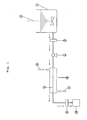
- aqueous suspension of curdlan of proper concentration is prepared in a storage tank 1.
- this suspension is preferably kept stirred by means of a stirrer 2 during operation of the process handware.
- This suspension is usually passed through a homogenizer 3 for improved blending between curdlan and water.
- the homogenizer may be of the stirring type, mill type or pressure type, for instance.
- the suspension is thereafter generally subjected to degassing treatment but this treatment may be omitted when the homogenizer used is of the type which does not cause incorporation of any appreciable amount of air in the suspension.
- the homogenized aqueous suspension of curdlan is fed by a constant-rate pump to a gelation tubing 5, in which it is heated to a temperature not less than 85°C.
- This heating can be accomplished by admitting steam from an outlet 5 to heat the small-diameter tubing and withdrawing it from an outlet 7, although other heating schemes such as the use of a water bath or an oil bath or electric heating can also be employed. While the heating temperature should not be lower than 85°C as mentioned hereinbefore, it is preferably not lower than 90°C and may range up to about 120°C. Generally speaking, however, a temperature up to 100°C is sufficient.
- a plurality of tubes is preferably employed for efficiency's sake. While the cross-sectional area of the tubing has already been defined hereinbefore, it is preferable that the maximum linear dimension of the section (for example, the diameter when the sectional configuration is circular or the length of the diagonal line in the case of a square section) should be 0.4 to 10 mm .
- the sectional geometry of the tubing is optional and may for example be round, oblong, rectangular or triangular.
- the heated segment of the tubing may be longer than about 50 mm and there is no upper limit but it would be obviously meaningless to use tubes longer than 600 mm for purposes of causing gelation of curdlan.
- the material of the tubing is also virtually optional, only if it is heat-resistant and presents no problem in food hygienics, and may thus be stainless steel, hard glass, synthetic resin or the like.
- an aqueous suspension of curdlan is passed through a small-diameter tubing with a sectional area of 0.1 to 30 mm2 and discharged into a hot water bath at a temperature not lower than 85°C for gelation.
- the discharge end of the small-diameter tubing is generally disposed at a distance not greater than about 200 mm, preferably about 1 to 50 mm, from the liquid level of the water bath but, if desired, may be submerged in the bath to a limited extent.
- Process B does not require a lengthy tube which is essential to process A but all that is required is that the tip portion of the tube from which the aqueous suspension of curdlan is discharged have a small-diameter geometry with a cross-sectional area of 0.1 to 30 mm2.
- the required length of the portion of the tube through which the curdlan suspension is discharged may generally be at least about 0.5 mm and preferably be about 0.5 to 15 mm.
- the tube having such a tip geometry is also included in the definition of small-diameter tubing.
- the specific equipment may for example comprise a multiplicity of such small-diameter tubes connected to the delivery ports of a snake pump and a hot water bath into which the aqueous suspension of curdlan is extruded from said small-diameter tubes.
- this equipment By means of this equipment, the desired gelation can be achieved with efficiency.
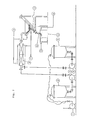
- the flow diagram for the production of linear curdlan gels by Process B is shown in Fig. 2.
- the discharge speed of the curdlan gels or the curdlan suspension at the discharge end of the small-diameter tubing in the practice of the present invention is controlled at a maximum of 500 cm/sec. If the discharge rate is increased beyond 500 cm/sec., the thermal gelation will not be sufficient. On the other hand, retarding the discharge of gels will not affect the gelation so much and it may be possible, if necessary, to use an intermittent discharge scheme. In the case of Process A, where the aqueous curdlan suspension is not preheated but fed at room temperature, very satisfactory gels can generally be obtained at a discharge rate of 1 to 5 cm/sec. The discharge rate may be increased by preheating the aqueous suspension of curdlan at a temperature of about 55 to 70°C.
- the discharge rate can be increased up to 500 cm/sec. and linear curdlan gels of excellent quality can be obtained particularly in the range of 1 to 300 cm/sec, more preferably 10 to 300 cm/sec..
- the curdlan concentration is as low as about 3% or less, it is advantageous, in terms of processability and product quality, to preheat the curdlan suspension at the above-mentioned temperature.
- linear gels of the shape complementary to the inner geometry of the tubing can be continuously produced.
- the gels may be discharged into water or alternatively into air and be taken up directly or cut to length before being taken up.
- linear curdlan gels obtainable by the method of this invention can be utilized as jelly-like foods, similar to conjak noodles, "mozuku", gelidium jelly noodles, etc., thanks to the aforementioned geometric feature and incorporation of various subsidiary materials.
- the curdlan gels do not collapse upon reheating and are therefore compatible with various cooking methods.
- the gels are amenable to post-packaging heat sterilization and retort cooking because they are sparingly degraded by heat. Furthermore, the gels are stable against pH change, can be preserved in acidic seasoning liquors, or can even be salted or frozen for storage.
- linear curdlan gels containing seaweed extract were continuously obtained at the outlet end of the stainless steel tube.
- the linear gels were cut in a length of about 20 cm.
- the thus obtained "mozuku”-like gels had a seaweed flavor and a good palatability or mouth-feel.
- a multitubular heat exchanger comprising a drum having an open space 10 cm in diameter and 1 m in length and, as disposed therein, 10 parallel tubes with an inner diameter of 3 mm, with open ends, was provided.
- the tubes were heated by feeding steam into the drum space of the heat exchanger.
- a constant-rate pump was set at the ends of the tubes and a 3% (w/v) aqueous suspension of curdlan was fed into the tubes at a discharge speed of 2 mm/sec.
- linear curdlan gels were continuously obtained at the outlet ends of the tubes.
- the linear gels were cut in a length of about 25 cm to give gels simulating gelidium jelly noodles.
- soya milk was fed to a storage tank 2.
- 120 g of a soybean curding agent (Tatsujin® No. 5, Riken Vitamin Co., Ltd.) composed of glucono- ⁇ -lactone 64%, magnesium chloride 20%, citric acid 14% and others 2% was dissolved in 1.7 kg of water and the solution was mixed with a curdlan homogenate prepared by milling 1.2 kg of curdlan with 17 kg of water in a cutter-mixer (Stephan Co., Model UMM-24). The mixture was fed to a storage tank 5 in which it was degassed by means of a vacuum pump 1.
- the liquor in storage tank 2 and the liquor in storage tank 5 were simultaneously fed to a mixer-heater 6 by means of a pump 3 (18 l/hr) and a pump 4 (12 l/hr), respectively.
- the mixture was blended under heating at 60°C to give a viscous slurry.
- This slurry was fed to a snake pump 9 equipped with nozzles 10 (ten nozzles, 1 mm in diameter and 10 mm in length each) which was positioned in such a manner that the tips of the nozzles were apart by 10 mm from the liquid level of a hot water bath 11.
Landscapes
- Chemical & Material Sciences (AREA)
- Polymers & Plastics (AREA)
- Health & Medical Sciences (AREA)
- Food Science & Technology (AREA)
- Life Sciences & Earth Sciences (AREA)
- Engineering & Computer Science (AREA)
- Nutrition Science (AREA)
- Dispersion Chemistry (AREA)
- Chemical Kinetics & Catalysis (AREA)
- Medicinal Chemistry (AREA)
- Organic Chemistry (AREA)
- Jellies, Jams, And Syrups (AREA)
- Polysaccharides And Polysaccharide Derivatives (AREA)
Applications Claiming Priority (6)
| Application Number | Priority Date | Filing Date | Title |
|---|---|---|---|
| JP23811988 | 1988-09-22 | ||
| JP238119/88 | 1988-09-22 | ||
| JP271838/88 | 1988-10-27 | ||
| JP27183888 | 1988-10-27 | ||
| JP203636/89 | 1989-08-04 | ||
| JP20363689 | 1989-08-04 |
Publications (2)
| Publication Number | Publication Date |
|---|---|
| EP0367391A2 true EP0367391A2 (de) | 1990-05-09 |
| EP0367391A3 EP0367391A3 (de) | 1991-04-24 |
Family
ID=27328261
Family Applications (1)
| Application Number | Title | Priority Date | Filing Date |
|---|---|---|---|
| EP19890309260 Ceased EP0367391A3 (de) | 1988-09-22 | 1989-09-12 | Verfahren zur Herstellung von linearen Curdlan-Gelen |
Country Status (4)
| Country | Link |
|---|---|
| US (1) | US4946700A (de) |
| EP (1) | EP0367391A3 (de) |
| JP (1) | JP2749390B2 (de) |
| CA (1) | CA1317933C (de) |
Cited By (2)
| Publication number | Priority date | Publication date | Assignee | Title |
|---|---|---|---|---|
| EP0520747A1 (de) * | 1991-06-24 | 1992-12-30 | Takeda Chemical Industries, Ltd. | Nahrungsmittel vom Emulsionstyp |
| CN103897073A (zh) * | 2014-03-12 | 2014-07-02 | 山东省食品发酵工业研究设计院 | 一种利用絮凝剂分离纯化可得然胶的方法 |
Families Citing this family (9)
| Publication number | Priority date | Publication date | Assignee | Title |
|---|---|---|---|---|
| US5614203A (en) * | 1995-01-30 | 1997-03-25 | Environmentally Safe Systems, Inc. | Environmentally safe pesticide and plant growth accelerator |
| JP3860091B2 (ja) * | 2002-07-30 | 2006-12-20 | 武田キリン食品株式会社 | カードランのゲル皮膜で被覆された食肉または食肉加工品およびその製造方法 |
| US20090246325A1 (en) * | 2007-02-02 | 2009-10-01 | Toshitaka Yasuda | Instant noddles and method for producing instant noddles |
| US9334584B2 (en) * | 2011-12-21 | 2016-05-10 | E I Du Pont De Nemours And Company | Process for preparing polysaccharide fibers from aqueous alkali metal hydroxide solution |
| US11351104B2 (en) | 2015-02-06 | 2022-06-07 | Nutrition & Biosciences USA 4, Inc. | Colloidal dispersions of poly alpha-1,3-glucan based polymers |
| US10738266B2 (en) | 2015-06-01 | 2020-08-11 | Dupont Industrial Biosciences Usa, Llc | Structured liquid compositions comprising colloidal dispersions of poly alpha-1,3-glucan |
| JP6599157B2 (ja) * | 2015-07-31 | 2019-10-30 | 株式会社ダイゾー | エアゾール製品および麺線状吐出物の製造方法 |
| JP6765764B2 (ja) * | 2017-03-21 | 2020-10-07 | 日清食品ホールディングス株式会社 | かき玉子の製造方法 |
| EP4303260A4 (de) * | 2021-03-01 | 2025-03-05 | Nitto Denko Corporation | Film und klebeband |
Family Cites Families (2)
| Publication number | Priority date | Publication date | Assignee | Title |
|---|---|---|---|---|
| US3754925A (en) * | 1970-03-24 | 1973-08-28 | Takeda Chemical Industries Ltd | New thermo gelable polysaccharide containing foodstuffs |
| JPS5324504B2 (de) * | 1974-04-09 | 1978-07-21 |
-
1989
- 1989-09-12 EP EP19890309260 patent/EP0367391A3/de not_active Ceased
- 1989-09-13 JP JP1237735A patent/JP2749390B2/ja not_active Expired - Lifetime
- 1989-09-21 CA CA000612234A patent/CA1317933C/en not_active Expired - Fee Related
- 1989-09-21 US US07/410,500 patent/US4946700A/en not_active Expired - Lifetime
Cited By (3)
| Publication number | Priority date | Publication date | Assignee | Title |
|---|---|---|---|---|
| EP0520747A1 (de) * | 1991-06-24 | 1992-12-30 | Takeda Chemical Industries, Ltd. | Nahrungsmittel vom Emulsionstyp |
| US5360624A (en) * | 1991-06-24 | 1994-11-01 | Takeda Chemical Industries, Ltd. | Emulsion-type food |
| CN103897073A (zh) * | 2014-03-12 | 2014-07-02 | 山东省食品发酵工业研究设计院 | 一种利用絮凝剂分离纯化可得然胶的方法 |
Also Published As
| Publication number | Publication date |
|---|---|
| US4946700A (en) | 1990-08-07 |
| CA1317933C (en) | 1993-05-18 |
| JPH03157401A (ja) | 1991-07-05 |
| JP2749390B2 (ja) | 1998-05-13 |
| EP0367391A3 (de) | 1991-04-24 |
Similar Documents
| Publication | Publication Date | Title |
|---|---|---|
| US3986890A (en) | Method of producing starch hydrolysis products for use as food additives | |
| US4946700A (en) | Method of producing linear curdlan gels | |
| JP2648175B2 (ja) | 繊維構造を有するグルテン及びそれによって得られた食肉様製品 | |
| WO2001017376A1 (de) | Verfahren zur herstellung von ballaststoffen mit hohem wasserbindevermögen und deren anwendung | |
| KR20010033838A (ko) | 셀룰로즈-함유 복합체 | |
| CN104509837A (zh) | 一种无蛋低脂沙拉酱及其制备方法 | |
| EP0482228B1 (de) | Herstellungsverfahren von cholesterolfreien Eiprodukten mit verlängerter Kühlhaltbarkeit und so hergestellte Produkte | |
| CA2072060A1 (en) | Emulsion-type food | |
| CA2434026C (en) | Acidic oil-in-water type emulsified compositions | |
| DE1667959A1 (de) | Verfahren zur Herstellung von Sojaproteinen mit Gelbildungsfaehigkeit | |
| JP4698038B2 (ja) | βグルカン含有油脂組成物を含有するベーカリー製品 | |
| CN108703339A (zh) | 一种榴莲酱及其制作方法 | |
| EP0477827B1 (de) | Mayonnaise mit niedrigem Fettgehalt und Verfahren zur Herstellung | |
| DE2305494C3 (de) | Verfahren zur enzymatischen Herstellung von Stärkehydrolysenprodukten | |
| EP0516107A1 (de) | Verwendung von Stärke als Fett- und Öl-Ersatz in Nahrungsmitteln | |
| CN112741202A (zh) | 一种新型核桃拉丝蛋白产品及其制作方法 | |
| US4251567A (en) | Process for producing a fibrous milk protein product | |
| JP2915044B2 (ja) | 食品組成物および低カロリー食物製品の製造法 | |
| RU2163770C1 (ru) | Способ получения пищевой эмульсии | |
| JPH0678704A (ja) | ホイップクリーム | |
| JP2812507B2 (ja) | 豆乳凝固食品 | |
| JPH07135911A (ja) | 成形食品及びその製造法 | |
| JPH08238075A (ja) | かに・えび・貝柱様食品およびその製造法 | |
| SU1648322A1 (ru) | Майонез и способ его получени | |
| JPS6019980B2 (ja) | 水中油滴型乳化食品及びその製造法 |
Legal Events
| Date | Code | Title | Description |
|---|---|---|---|
| PUAI | Public reference made under article 153(3) epc to a published international application that has entered the european phase |
Free format text: ORIGINAL CODE: 0009012 |
|
| AK | Designated contracting states |
Kind code of ref document: A2 Designated state(s): AT BE CH DE ES FR GB GR IT LI LU NL SE |
|
| PUAL | Search report despatched |
Free format text: ORIGINAL CODE: 0009013 |
|
| AK | Designated contracting states |
Kind code of ref document: A3 Designated state(s): AT BE CH DE ES FR GB GR IT LI LU NL SE |
|
| 17P | Request for examination filed |
Effective date: 19910815 |
|
| RAP3 | Party data changed (applicant data changed or rights of an application transferred) |
Owner name: TAKEDA CHEMICAL INDUSTRIES, LTD. |
|
| 17Q | First examination report despatched |
Effective date: 19920819 |
|
| STAA | Information on the status of an ep patent application or granted ep patent |
Free format text: STATUS: THE APPLICATION HAS BEEN REFUSED |
|
| 18R | Application refused |
Effective date: 19930829 |