EP0367547A1 - Ecran pare-soleil pour un véhicule à déploiement convertible dans le sens horizontal ou vertical - Google Patents
Ecran pare-soleil pour un véhicule à déploiement convertible dans le sens horizontal ou vertical Download PDFInfo
- Publication number
- EP0367547A1 EP0367547A1 EP89311209A EP89311209A EP0367547A1 EP 0367547 A1 EP0367547 A1 EP 0367547A1 EP 89311209 A EP89311209 A EP 89311209A EP 89311209 A EP89311209 A EP 89311209A EP 0367547 A1 EP0367547 A1 EP 0367547A1
- Authority
- EP
- European Patent Office
- Prior art keywords
- elements
- window shade
- accordion fold
- hinge
- accordion
- Prior art date
- Legal status (The legal status is an assumption and is not a legal conclusion. Google has not performed a legal analysis and makes no representation as to the accuracy of the status listed.)
- Granted
Links
- 239000007787 solid Substances 0.000 claims description 9
- 239000000463 material Substances 0.000 claims description 5
- 230000007246 mechanism Effects 0.000 description 4
- 230000000903 blocking effect Effects 0.000 description 3
- 230000003247 decreasing effect Effects 0.000 description 2
- 230000001419 dependent effect Effects 0.000 description 2
- 230000009429 distress Effects 0.000 description 1
- 239000003562 lightweight material Substances 0.000 description 1
- 230000004048 modification Effects 0.000 description 1
- 238000012986 modification Methods 0.000 description 1
Images



Classifications
-
- B—PERFORMING OPERATIONS; TRANSPORTING
- B60—VEHICLES IN GENERAL
- B60J—WINDOWS, WINDSCREENS, NON-FIXED ROOFS, DOORS, OR SIMILAR DEVICES FOR VEHICLES; REMOVABLE EXTERNAL PROTECTIVE COVERINGS SPECIALLY ADAPTED FOR VEHICLES
- B60J1/00—Windows; Windscreens; Accessories therefor
- B60J1/20—Accessories, e.g. wind deflectors, blinds
- B60J1/2011—Blinds; curtains or screens reducing heat or light intensity
- B60J1/2091—Foldable sunscreens
Definitions
- the present invention relates to an automobile window shade and particularly to a shade that can be horizontally expanded to cover the front windshield and can be vertically expanded, in another mode, to cover the rear windshield.
- One foldable automobile window shade generally includes a first plurality of substantially rigid, planar elements joined together by hinges such that they form a first accordion fold portion of the shade.
- the shade also includes a second plurality of rigid, planar elements forming a second accordion fold portion of the shade.
- the shade also includes a hinge that links the first and second accordion fold portions.
- the entire shade is made of cardboard and is an integral structure.
- the single hinge links end elements of the first and second accordion fold portions.
- the first and second end elements In a horizontal expansion mode, the first and second end elements have planar surfaces that are adjacent to each other and the first and second accordion fold portions extend outboard from either side of the adjacent end elements.
- the end elements are coplanar with respect to each other.
- the first and second accordion fold portions are disposed above the respective first and second end elements and therefore the shade can be vertically expandable as desired to cover the interior of the automobile window. Since the first and second accordion fold portions are substantially independent of each other, with the exception of the hinge linking the end elements, in the vertical expansion mode, the accordion fold portions can be operated separately such that only part of the window is shaded as compared with the other part of the window.
- Another foldable automobile window shade generally includes a first plurality of substantially rigid, planar elements joined together by hinges such that they form a first accordion fold portion of the shade.
- the shade also includes a second plurality of rigid, planar elements forming a second accordion fold portion of the shade.
- the shade also includes a hinge that links the first and second accordion fold portions.
- the hinge may be a pop-out tab in one of the elements forming the first accordion fold portion which cooperates with a through passage in one of the elements forming the second accordion fold portion.
- the hinge may be a clip having depending and upstanding U-shaped legs that grip the elements in either the horizontal expansion mode or the vertical expansion mode.
- the planar elements forming the accordion fold portions may be triangularly shaped such that the hinge linking the first and second fold portions is angularly displaced with respect to the fold lines in the fold portions.
- one of the fold portions can be configured to form a solid triangular body or pyramid that notifies others of an emergency situation.
- the further hinge cooperates with a through passage in a remote triangular element thereby forming the solid, triangular body.
- the present invention relates to an automobile window shade that is convertible to a vertically expandable mode and a horizontally expandable mode.
- FIGS. 1A, 1B, 2, 3, 4, 5A, 5B and 5C show window shade 10 in a horizontally expandable mode.
- FIGS. 1A and 5A show, respectively, the front and rear elevational views of window shade 10.
- Shade 10 includes a first accordion fold portion 12 and a second accordion fold portion 14 best illustrated in FIG. 2.
- Portion 12 includes rigid, planar elements 16, 18, 20, 22 and 24. These planar elements are joined together along longitudinal edges by accordion folds. In other words, planar elements 16 or 18 are joined along accordion fold 26; elements 18 or 20 are joined by fold 28; elements 20 and 22 are joined by fold 30; and elements 22 and 24 are joined by fold 32.
- accordion folds enable portion 12 to be expanded in the direction of arrow 34, i.e., outboard from the center, by increasing the angle 36, which is called herein the "accordion angle".
- Accordion fold portion 12 can be collapsed by decreasing angle 36 by moving the elements in the direction of arrow 38.
- Accordion fold portion 12 also includes planar end element 40.
- Accordion fold portion 14 includes a plurality of rigid, planar elements and an end element 42. End elements 40 and 42 are joined together by single, modal hinge 44 which is illustrated in the bottom view of shade 10 in FIG. 3.
- FIG. 5A illustrates the rear elevational view of the window shade in the first or horizontally expandable mode.
- End elements 40 and 42 and adjacent elements 16 and 48 have a length that is less than the length of the remaining elements, such as element 18, in their respective accordion fold portions 12 and 14.
- the shorter length of elements 16 and 48 form a cutout 50.
- the inboard edges 52 and 54 of elements 16 and 48 are further trimmed to define nose cutout 52.
- FIG. 1B illustrates foldable window shade 10 disposed in the interior of an automobile 60.
- Shade 10 includes seven planar elements inclusive of the end planar element, one of which is end element 62 shown in FIG. 5C.
- FIG. 5C is a cross-sectional view of the window shade from the perspective of section line 5C′-5C ⁇ in FIG. 1B.
- Rear view mirror 70 is disposed in cutout 50 of window shade 10 and the nose portion of the cutout is close to stem 72 of rear view mirror 70.
- FIG. 5B illustrates a detail perspective view of the bottom region of the adjacent end elements from the perspective of section line 5B′ in FIG. 5A.
- End elements 40 and 42 have planar surfaces 74 and 76, respectively. These planar surfaces are adjacent each other when the window shade is in the horizontally expandable mode.
- Elements 40 and 42 have longitudinal edges that are joined, via accordion hinges 78 and 80, to elements 16 and 82, respectively.
- End elements 40 and 42 are joined together via a single modal hinge 44. Hinge 44 enables the shade to be converted into different modes, hence the term "modal hinge".
- window shade 10 is an integral structure made of a cardboard material. Therefore, elements 40 and 42 are part of a common element that is associated with the first accordion fold portion 12 and the second accordion fold portion 14.
- a means for biasing in this embodiment a rubberband 90, encircles the outboard surfaces 92 and 94 of end elements 40 and 42.
- Rubberband 90 could be replaced by a coil spring or any other attachment mechanism such that surfaces 74 and 76 are brought adjacent each other. This could include snaps, velcro or any other type of easily removable attachment mechanism.
- window shade 10 is illustrated as being close to the interior surface of windshield 96. Sunlight, shown by arrow 98, would pass through window 96 but would be reflected or deflected by window shade 10.
- the inward protrusion of end elements 40 and 42 provide a stand such that in the horizontally expandable mode, the window shade stands upright and supports itself.
- FIGS. 6A, 6B, 7, 8, 9, 10A, 10B and 10C show shade 10 in the second or vertically expandable mode.
- An important feature of the invention is the modal hinge 44 that enables the window shade to be converted from the horizontal mode to the vertical mode.
- end elements 40 and 42 are substantially co-planar with respect to each other. See, for example, FIGS. 8, 9 and 10B. Therefore, in order to convert the shade from the horizontal to the vertical mode, planar surfaces 74 and 76 are moved apart until end elements 40 and 42 are generally coplanar.
- elements 16, 18, 20, 22 and 24 of accordion fold portion 12 are disposed above end element 40. The same is true with respect to accordion fold portion 14 and end element 41; element 18 is disposed above end element 42 in FIG. 6A.
- FIG. 6B illustrates window shade 10 blocking the interior surface of rear windshield 110 of automobile 60.
- the shade includes a mounting means 112.
- Mounting means 112 extends through hole 114, shown in FIG. 6A, in element 24.
- FIG. 10C A detailed, cross-sectional view of one type of mounting means 112 is shown in FIG. 10C.
- mounting means 112 is a suction cup 116 that attaches to the interior surface 118 of window 110.
- Other mountings could be utilized.
- element 24 could be connected via a velcro attachment to the interior liner of the automobile.
- a hook and eye combination could be utilized with respect to the window (using a suction cup) or with respect to the interior roof of the automobile.
- FIG. 7 shows that hole 114 and hole 120 are available for mounting the elements most remote from end elements 40 and 42.
- FIG. 8 illustrates the commonality between elements 40 and 42 via modal hinge 44.
- End elements 40 and 42 also include mounting holes 124 and 126 which enable these end elements to be secured to the rear dashboard below rear window 110.
- FIG. 10A illustrates a rear elevational view of shade 10 in the vertically expandable mode.
- the separated cutout sections 50a and 50b do not present a significant problem in blocking light entering through rear window 110 shown in FIG. 6B due to their low position in the shade.
- FIG. 9 illustrates a side view of shade 10 from the perspective of section line 9′-9 ⁇ in FIG. 10A.
- FIG. 10B illustrates a detail, perspective view of modal hinge 44 from the perspective of section line 10B′ in FIG. 6B.
- FIG. 10B shows that end elements 40 and 42 are co-planar. Adjoining elements 16 and 18 extend above end elements 40 and 42 due to accordion folds 78 and 80. In the vertically expandable mode, edges 120 of accordion fold portion 12 and edges 122 of accordion fold portion 14 (see FIGS. 6B and 10B) are closely adjacent to each other.
- FIG. 11 shows that window shade 10 can be partially collapsed in the vertical expansion mode.
- accordion fold portion 12 has been collapsed on top of end element 40 but accordion fold portion 14 is still vertically expanded above end element 42.
- This capability of the shade enables the automobile driver to have limited vision out of the rear window and yet still block or screen a significant portion of the sunlight entering the window.
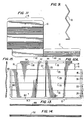
- FIGS. 12A, 12B, 13, 14 and 15 illustrate various views of window shade 10 in a substantially flat and laid out position. Elements 40 and 42 are shown as being common and being joined by modal hinge 44.
- FIG. 12B is a detail view of modal hinge 44. Modal hinge 44 is shown by dashed lines, as are accordion folds 78 and 80.
- FIGS. 13, 14 and 15, respectively, show upper edge 150, lower edge 152 and side edge 160 of the substantially flat and laid out views of shade 10.
- a sheet of cardboard is cut to form accordion fold portion 12 and accordion fold portion 14, thereby forming edge 122 and edge 120.
- the common element consisting of end elements 40 and 42 and modal hinge 44 is not cut. See FIG. 12B for a detailed view. Fold lines are placed in the cardboard to achieve accordion folds 78, 26, 28, 30, 32 in fold portion 12, as well as accordion fold 80 and the other unnumbered folds in fold portion 14.
- the shade is made of a cardboard material.
- the hinges both modal hinge 44 and the accordion hinges, may be integral or may be a separate structure.
- FIG. 16 is a front elevational view of window shade 10 having a laterally extending crease 210 that is impressed into accordion portion 212 as well as accordion portion 214. With laterally extending crease 210, automobile shade 10 can be folded about the crease and then the accordion folds can be retracted to form compact shade 216 (FIG. 17).
- FIG. 18 illustrates another embodiment of the present invention.
- Automobile shade 218 is defined by accordion fold portion 220 and accordion fold portion 222.
- FIG. 18 is a front elevational view of shade 218.
- Accordion fold portion 218 includes adjacent element 224 and fold portion 222 includes adjacent element 226.
- Adjacent elements 224 and 226 are initially joined together by separable seam 228.
- Seam 228 can be a score line such that the person using the shade can cut it or it can be a perforated line.
- the separable seam when opened, would enable planar faces 230 and 232 to be facing each other when shade 218 is in a horizontal expansion mode. This would be generally similar to adjacent elements 40 and 42 illustrated in FIG. 2 above.
- Shade 218 may further include a hinge similar to modal hinge 44 shown in FIG. 3 above. However, in the illustrated embodiment, modal hinge 44 is replaced by a different type of hinge that is shown in detail in FIG. 19.
- FIG. 19 is a detailed view of adjacent planar elements 224 and 226 showing a pop-out tab 230 that operates as the further or modal hinge.
- Pop-out tab 230 includes tab body 232 and tab head 234.
- Tab head 234 is distinguished from tab body 232 by fold or crease line 236.
- Tab body 232 is attached to planar element 224 by crease 238.
- the remainder of the periphery of tab 230 is perforated or scored such that tab 230 can be popped-out of planar element 224.
- the tab is hinged to element 224 via fold crease 238.
- On planar element 226 is a through passage that is formed by pop-out section 240. Pop-out section 240 is completely removable and, hence, is distinguished from planar section 226 by perforations or score lines.
- FIG. 20 diagrammatically illustrates adjacent planar elements 224 and 226 disposed next to each other and held by tab 230.
- Tab head 234 is folded along crease 236 and is not sandwiched between elements 224 and 226 but tab body 232 is disposed between elements 224 and 226.
- the other elements or sections of the accordion fold portions extend laterally or horizontally on either side of planar elements 224 and 226.
- FIG. 21 diagrammatically illustrates the vertical expansion mode of the shade wherein planar elements 224 and 226 are substantially co-planar with respect to each other.
- tab 230 has a tab body 232 that extends between and generally links planar sections 224 and 226.
- FIG. 22 illustrates another embodiment, and particularly illustrates the hinge being a distinct item or component.
- FIG. 22 diagrammatically illustrates the vertical expansion mode of the invention with planar elements 224 and 226 substantially co-planar.
- a hinge element 260 couples elements 224 and 226 together.
- Hinge element 260 has a foldable seam 262 such that planar element 226 can be moved counterclockwise in direction A and planar element 224 can be moved clockwise in direction B such that hinge element 260 folds upon itself.
- Hinge element 260 is attached to the planar elements via clips or snaps 264 and 266.
- FIGS. 23, 24 and 25 illustrate another embodiment of the present invention utilizing a clip 270 as the further modal hinge.
- Clip 270 has two, oppositely extending, U-shaped legs 272 and 274 (FIG. 25). When the shade is in the horizontal expansion mode, and planar elements 224 and 226 have planar surfaces that are adjacently disposed next to each other, only one pair of the U-shaped legs of clip 270 retains the planar elements as shown in FIG. 24. When the shade is in the vertical expansion mode, each pair of U-shaped legs 272 and 274 grips oppositely and co-planarly disposed shade elements 226 and 224.
- Clip 270 may be flexible and operate as the hinge in FIG. 22. In that case, the legs would resiliently grip the shade elements.
- FIG. 26 illustrates another embodiment of the automobile shade wherein the shade is made of triangularly shaped elements 300, 302, 306, 308 and 309.
- the first plurality of elements consists of triangular sections 300, 302, 304 and 306.
- the second plurality of elements consists of triangular sections 308 and 309. These elements interact in an accordion fold fashion since the elements can be horizontally expanded and retracted by increasing or decreasing the angle between the various folds.
- Other shapes for the accordion fold portions are possible, such as octagonally shaped elements.
- the further hinge is angularly disposed with respect to the accordion folds.
- FIG. 27 illustrates a partial, detailed view of the interfacing portions of two adjacent accordion fold sections 306 and 308.
- triangular section 306 includes interfacing planar element 310 that has a tab 312 extending therefrom.
- Triangular section 308 includes interfacing element 314 that has a through passage which cooperates with tab 312.
- Tab 312 forms the hinge as described above with respect to tab 230.
- a rubberband 316 ensures that interfacing surfaces of planar elements 310 and 314 are kept adjacent each other.
- one of the accordion fold portions can be detached from the other (by detaching tab 312) and can be configured as a solid triangular shape 410, shown in FIG. 28.
- Triangular sections 302, 304 and 306 form a solid triangle or pyramid and triangular section 300 is disposed in the interior or on the bottom of the solid triangular shape.
- Tab 312 cooperates with a through passage 370 (see FIG. 26) to link remote triangular section 302 with triangular section 306.
- the solid triangle could carry indicia such as "stop", "emergency” or "vehicle in distress".
- Other mechanisms, such as clips or straps, for attaching the adjacent triangular element to the remote triangular element are possible and these embodiments are meant to be encompassed by the claims.
Landscapes
- Engineering & Computer Science (AREA)
- Mechanical Engineering (AREA)
- Blinds (AREA)
Applications Claiming Priority (4)
| Application Number | Priority Date | Filing Date | Title |
|---|---|---|---|
| US07/266,068 US4838335A (en) | 1988-11-02 | 1988-11-02 | Automobile window shade convertible to horizontal expansion or vertical expansion |
| US266068 | 1988-11-02 | ||
| US07/350,223 US4913211A (en) | 1988-11-02 | 1989-05-11 | Automobile window shade convertible to horizontal expansion or vertical expansion |
| US350223 | 1994-12-06 |
Publications (2)
| Publication Number | Publication Date |
|---|---|
| EP0367547A1 true EP0367547A1 (fr) | 1990-05-09 |
| EP0367547B1 EP0367547B1 (fr) | 1994-06-29 |
Family
ID=26951611
Family Applications (1)
| Application Number | Title | Priority Date | Filing Date |
|---|---|---|---|
| EP89311209A Expired - Lifetime EP0367547B1 (fr) | 1988-11-02 | 1989-10-31 | Ecran pare-soleil pour un véhicule à déploiement convertible dans le sens horizontal ou vertical |
Country Status (4)
| Country | Link |
|---|---|
| US (1) | US4913211A (fr) |
| EP (1) | EP0367547B1 (fr) |
| CA (1) | CA2002006C (fr) |
| DE (1) | DE68916510D1 (fr) |
Cited By (3)
| Publication number | Priority date | Publication date | Assignee | Title |
|---|---|---|---|---|
| DE9202776U1 (de) * | 1991-07-17 | 1992-11-26 | Bawemo-Barnickel GmbH, 8520 Erlangen | Busartiges Wohnmobil mit isolierbarer Frontscheibe |
| DE4206616A1 (de) * | 1991-07-17 | 1993-01-21 | Bawemo Barnickel Gmbh | Busartiges wohnmobil mit isolierbarer frontscheibe |
| CN107719079A (zh) * | 2017-10-12 | 2018-02-23 | 芜湖挺优机电技术有限公司 | 一种便收纳车用车窗遮光装置 |
Families Citing this family (7)
| Publication number | Priority date | Publication date | Assignee | Title |
|---|---|---|---|---|
| US5575524A (en) * | 1994-09-29 | 1996-11-19 | Cronk; Peter J. | Discreet motor vehicle window shade |
| US5762124A (en) * | 1997-03-21 | 1998-06-09 | Tseytlin; Alexander A. | Compact collapsible sunshade |
| US6959752B2 (en) * | 1998-10-19 | 2005-11-01 | Sunny En Liung Huang | Collapsible auto shade |
| DE102005013643A1 (de) * | 2005-03-24 | 2006-09-28 | GM Global Technology Operations, Inc., Detroit | Sonnenschutzsystem für ein Kraftfahrzeug |
| US7806461B2 (en) * | 2007-05-01 | 2010-10-05 | Christopher Patterson | Apparatus and method for providing tinted windows |
| US20090301671A1 (en) * | 2008-06-06 | 2009-12-10 | Dino Locklear | Window cover for vehicles |
| FR3097199A1 (fr) * | 2019-06-14 | 2020-12-18 | Airbus (S.A.S.) | Cache et ensemble de glissieres de guidage et de maintien du cache pour obturer une surface transparente |
Citations (4)
| Publication number | Priority date | Publication date | Assignee | Title |
|---|---|---|---|---|
| DE1199165B (de) * | 1961-04-12 | 1965-08-19 | Rudolf Dittlein | Warnkoerper fuer Verkehrszwecke |
| US4202396A (en) * | 1973-06-20 | 1980-05-13 | Abraham Levy | Motor vehicles and sunshields |
| FR2531382A1 (fr) * | 1982-08-04 | 1984-02-10 | Gurvitsch Sergio | Dispositif anti-rayons solaires et a usage publicitaire pour vehicules |
| US4671334A (en) * | 1986-03-19 | 1987-06-09 | George Yadegar | Vehicular sunshade |
Family Cites Families (1)
| Publication number | Priority date | Publication date | Assignee | Title |
|---|---|---|---|---|
| US4777994A (en) * | 1987-07-09 | 1988-10-18 | Packaging Corporation Of America | Sunshielding device for a motor vehicle |
-
1989
- 1989-05-11 US US07/350,223 patent/US4913211A/en not_active Expired - Lifetime
- 1989-10-31 DE DE68916510T patent/DE68916510D1/de not_active Expired - Lifetime
- 1989-10-31 EP EP89311209A patent/EP0367547B1/fr not_active Expired - Lifetime
- 1989-11-01 CA CA002002006A patent/CA2002006C/fr not_active Expired - Fee Related
Patent Citations (5)
| Publication number | Priority date | Publication date | Assignee | Title |
|---|---|---|---|---|
| DE1199165B (de) * | 1961-04-12 | 1965-08-19 | Rudolf Dittlein | Warnkoerper fuer Verkehrszwecke |
| US4202396A (en) * | 1973-06-20 | 1980-05-13 | Abraham Levy | Motor vehicles and sunshields |
| US4202396B1 (en) * | 1973-06-20 | 1996-06-04 | Levy Amnon | Motor vehicles and sunshields |
| FR2531382A1 (fr) * | 1982-08-04 | 1984-02-10 | Gurvitsch Sergio | Dispositif anti-rayons solaires et a usage publicitaire pour vehicules |
| US4671334A (en) * | 1986-03-19 | 1987-06-09 | George Yadegar | Vehicular sunshade |
Cited By (4)
| Publication number | Priority date | Publication date | Assignee | Title |
|---|---|---|---|---|
| DE9202776U1 (de) * | 1991-07-17 | 1992-11-26 | Bawemo-Barnickel GmbH, 8520 Erlangen | Busartiges Wohnmobil mit isolierbarer Frontscheibe |
| DE4206616A1 (de) * | 1991-07-17 | 1993-01-21 | Bawemo Barnickel Gmbh | Busartiges wohnmobil mit isolierbarer frontscheibe |
| DE4206616C2 (de) * | 1991-07-17 | 2001-05-17 | Bawemo Barnickel Gmbh | Busartiges Wohnmobil mit isolierbarer Frontscheibe |
| CN107719079A (zh) * | 2017-10-12 | 2018-02-23 | 芜湖挺优机电技术有限公司 | 一种便收纳车用车窗遮光装置 |
Also Published As
| Publication number | Publication date |
|---|---|
| CA2002006C (fr) | 1995-01-17 |
| EP0367547B1 (fr) | 1994-06-29 |
| DE68916510D1 (de) | 1994-08-04 |
| US4913211A (en) | 1990-04-03 |
| CA2002006A1 (fr) | 1990-05-02 |
Similar Documents
| Publication | Publication Date | Title |
|---|---|---|
| US5632318A (en) | Multi-window sun shield | |
| US6192967B1 (en) | Collapsible auto shade | |
| US4570991A (en) | Sun visor stowed on pillar | |
| US5452934A (en) | Automobile sunshield having figure-8 support loop | |
| CA2027575C (fr) | Pare-soleil pour vehicules | |
| US5553908A (en) | Sun shield assembly | |
| US4913211A (en) | Automobile window shade convertible to horizontal expansion or vertical expansion | |
| US6976523B2 (en) | Collapsible auto shade | |
| US6155329A (en) | Sunshield and method for attaching to window | |
| US5375901A (en) | Convertible top with fold-down rear window | |
| US4838335A (en) | Automobile window shade convertible to horizontal expansion or vertical expansion | |
| US4021948A (en) | Foldable warning device | |
| US6691762B2 (en) | Collapsible auto shade | |
| US6705661B2 (en) | Unitary visor attachment | |
| US5038844A (en) | Auto window shade | |
| US6959752B2 (en) | Collapsible auto shade | |
| US4976487A (en) | Collapsible car window canopy apparatus | |
| US5253695A (en) | Vehicle visor supported interior curtain | |
| US4838334A (en) | Sunshield with openings | |
| US5762124A (en) | Compact collapsible sunshade | |
| US6231108B1 (en) | Sun visor extension | |
| US4801170A (en) | Sun screen for attachment to a vehicle windshield | |
| US6354355B1 (en) | Flexible window tether system | |
| US6264265B1 (en) | Vehicle sun visor extension | |
| US20050073168A1 (en) | Visor gap shade |
Legal Events
| Date | Code | Title | Description |
|---|---|---|---|
| PUAI | Public reference made under article 153(3) epc to a published international application that has entered the european phase |
Free format text: ORIGINAL CODE: 0009012 |
|
| AK | Designated contracting states |
Kind code of ref document: A1 Designated state(s): DE ES FR GB IT |
|
| 17P | Request for examination filed |
Effective date: 19900913 |
|
| 17Q | First examination report despatched |
Effective date: 19910611 |
|
| GRAA | (expected) grant |
Free format text: ORIGINAL CODE: 0009210 |
|
| AK | Designated contracting states |
Kind code of ref document: B1 Designated state(s): DE ES FR GB IT |
|
| PG25 | Lapsed in a contracting state [announced via postgrant information from national office to epo] |
Ref country code: FR Effective date: 19940629 Ref country code: ES Free format text: THE PATENT HAS BEEN ANNULLED BY A DECISION OF A NATIONAL AUTHORITY Effective date: 19940629 Ref country code: IT Free format text: LAPSE BECAUSE OF FAILURE TO SUBMIT A TRANSLATION OF THE DESCRIPTION OR TO PAY THE FEE WITHIN THE PRE;WARNING: LAPSES OF ITALIAN PATENTS WITH EFFECTIVE DATE BEFORE 2007 MAY HAVE OCCURRED AT ANY TIME BEFORE 2007. THE CORRECT EFFECTIVE DATE MAY BE DIFFERENT FROM THE ONE RECORDED.SCRIBED TIME-LIMIT Effective date: 19940629 |
|
| REF | Corresponds to: |
Ref document number: 68916510 Country of ref document: DE Date of ref document: 19940804 |
|
| PG25 | Lapsed in a contracting state [announced via postgrant information from national office to epo] |
Ref country code: DE Effective date: 19940930 |
|
| PG25 | Lapsed in a contracting state [announced via postgrant information from national office to epo] |
Ref country code: GB Effective date: 19941031 |
|
| EN | Fr: translation not filed | ||
| PLBE | No opposition filed within time limit |
Free format text: ORIGINAL CODE: 0009261 |
|
| STAA | Information on the status of an ep patent application or granted ep patent |
Free format text: STATUS: NO OPPOSITION FILED WITHIN TIME LIMIT |
|
| 26N | No opposition filed | ||
| GBPC | Gb: european patent ceased through non-payment of renewal fee |
Effective date: 19941031 |