EP0367554B1 - Insulinbindende Wirkstoffe und Hemmer der Insulinbindung - Google Patents
Insulinbindende Wirkstoffe und Hemmer der Insulinbindung Download PDFInfo
- Publication number
- EP0367554B1 EP0367554B1 EP89311220A EP89311220A EP0367554B1 EP 0367554 B1 EP0367554 B1 EP 0367554B1 EP 89311220 A EP89311220 A EP 89311220A EP 89311220 A EP89311220 A EP 89311220A EP 0367554 B1 EP0367554 B1 EP 0367554B1
- Authority
- EP
- European Patent Office
- Prior art keywords
- insulin
- binding
- collagen
- polypeptide
- chain
- Prior art date
- Legal status (The legal status is an assumption and is not a legal conclusion. Google has not performed a legal analysis and makes no representation as to the accuracy of the status listed.)
- Expired - Lifetime
Links
Images


Classifications
-
- C—CHEMISTRY; METALLURGY
- C07—ORGANIC CHEMISTRY
- C07K—PEPTIDES
- C07K14/00—Peptides having more than 20 amino acids; Gastrins; Somatostatins; Melanotropins; Derivatives thereof
- C07K14/435—Peptides having more than 20 amino acids; Gastrins; Somatostatins; Melanotropins; Derivatives thereof from animals; from humans
- C07K14/78—Connective tissue peptides, e.g. collagen, elastin, laminin, fibronectin, vitronectin or cold insoluble globulin [CIG]
-
- A—HUMAN NECESSITIES
- A61—MEDICAL OR VETERINARY SCIENCE; HYGIENE
- A61P—SPECIFIC THERAPEUTIC ACTIVITY OF CHEMICAL COMPOUNDS OR MEDICINAL PREPARATIONS
- A61P3/00—Drugs for disorders of the metabolism
-
- A—HUMAN NECESSITIES
- A61—MEDICAL OR VETERINARY SCIENCE; HYGIENE
- A61P—SPECIFIC THERAPEUTIC ACTIVITY OF CHEMICAL COMPOUNDS OR MEDICINAL PREPARATIONS
- A61P3/00—Drugs for disorders of the metabolism
- A61P3/08—Drugs for disorders of the metabolism for glucose homeostasis
-
- A—HUMAN NECESSITIES
- A61—MEDICAL OR VETERINARY SCIENCE; HYGIENE
- A61P—SPECIFIC THERAPEUTIC ACTIVITY OF CHEMICAL COMPOUNDS OR MEDICINAL PREPARATIONS
- A61P3/00—Drugs for disorders of the metabolism
- A61P3/08—Drugs for disorders of the metabolism for glucose homeostasis
- A61P3/10—Drugs for disorders of the metabolism for glucose homeostasis for hyperglycaemia, e.g. antidiabetics
-
- A—HUMAN NECESSITIES
- A61—MEDICAL OR VETERINARY SCIENCE; HYGIENE
- A61P—SPECIFIC THERAPEUTIC ACTIVITY OF CHEMICAL COMPOUNDS OR MEDICINAL PREPARATIONS
- A61P43/00—Drugs for specific purposes, not provided for in groups A61P1/00-A61P41/00
-
- A—HUMAN NECESSITIES
- A61—MEDICAL OR VETERINARY SCIENCE; HYGIENE
- A61P—SPECIFIC THERAPEUTIC ACTIVITY OF CHEMICAL COMPOUNDS OR MEDICINAL PREPARATIONS
- A61P5/00—Drugs for disorders of the endocrine system
-
- C—CHEMISTRY; METALLURGY
- C07—ORGANIC CHEMISTRY
- C07K—PEPTIDES
- C07K14/00—Peptides having more than 20 amino acids; Gastrins; Somatostatins; Melanotropins; Derivatives thereof
- C07K14/435—Peptides having more than 20 amino acids; Gastrins; Somatostatins; Melanotropins; Derivatives thereof from animals; from humans
- C07K14/575—Hormones
- C07K14/62—Insulins
-
- A—HUMAN NECESSITIES
- A61—MEDICAL OR VETERINARY SCIENCE; HYGIENE
- A61K—PREPARATIONS FOR MEDICAL, DENTAL OR TOILETRY PURPOSES
- A61K38/00—Medicinal preparations containing peptides
Definitions
- This invention relates to a protein or polypeptide which has insulin-binding activity, to a composition for use as an insulin-binding carrier which has, as its active component, said protein or polypeptide, and also to an inhibitor of the binding of insulin with collagen.
- proteins and polypeptides known to bind with insulin have included insulin receptors located on the surfaces of cells.
- non-receptor proteins we have earlier discovered that fibronectin, laminin, chondronectin, fibrinogen, vitronectin, and fibrin can bind with insulin, and have suggested a composition for use as an insulin-binding carrier (Japanese Laid-Open Patent Application No. 85934/89).
- IGF-I insulin-like growth factor
- somatomedin C insulin-like growth factor
- the present invention provides a novel insulin-binding polypeptide and a composition for use as an insulin-binding carrier, both of which have insulin-binding activity and also an inhibitor of the binding of insulin to the said insulin-binding carrier.
- Insulin-binding polypeptide of this invention has in its structure at least the amino acid sequence represented by the following Formula (I):
- Formula (I) In considering the problem of insulin binding we felt that there might be proteins which have insulin-binding activity and that there might be proteins which can be used as carriers of insulin.
- Such a protein or polypeptide might participate in the regulation of the homeostasis of insulin, which acts both as a growth factor and as a hormone; when insulin is administered to patients with a variety of disorders, of which diabetics are representative, it might be possible to use such a protein or polypeptide as part of a drug delivery system or in a new pharmaceutical preparation designed to act on the target of the insulin, and with longer-term drug effectiveness, greater safety, and no immunogenicity, by which means the efficacy of the insulin would be enhanced and side effects would be few.
- collagen type I, type II, type III, type IV, and type V can bind with insulin, and that collagen V has a specific insulin-binding site.
- the binding of insulin with the said collagen can be inhibited by insulin A chain, insulin B chain, and a polypeptide of decomposed insulin B chain which has a collagen-binding active site.
- the present invention also provides the use of a composition for the preparation of an insulin-binding carrier which has as its active component at least one kind of protein or polypeptide selected from the group of collagen type I, type II, type III, type IV, type V and polypeptides of decomposed collagen V which contain the insulin-binding active site; and further provides the use as active component of at least one kind of polypeptide selected from the group consisting of insulin A chain, insulin B chain and polypeptides of decomposed insulin B chain which contain the collagen-binding active site in an inhibitor of the binding of insulin with collagen.
- Collagen is the main protein which makes up connective tissue, and the collagen molecule is composed of three alpha chains intertwined in a right-handed helix.
- the structure of the alpha chains varies somewhat in different tissues, and collagen is classified as type I, type II, type III, type IV, or type V depending on these differences.
- the peptide hormone made of insulin A chain and B chain is known to have a variety of physiological functions.
- the collagen molecule was fragmented, and the various fragments were separated and analyzed with the use of the peroxidase-labelled insulin mentioned above, by which means it was possible to identify the polypeptide that had insulin-binding activity, that is, the insulin-binding site of collagen.
- the insulin-binding active side of collagen type V when collagen type V was decomposed, was in the ⁇ 1 chain and in a polypeptide with the molecular mass of 30 kDa that was produced when, for example, the collagen type V was decomposed with cyanogen bromide.
- This polypeptide also had heparin-binding activity, and could be effectively purified on a heparin column.
- the 30-kDa polypeptide was separated into a 16-kDa polypeptide and a 6-kDa polypeptide by treatment with endoprotease-Glu-C (Protease V8, Boehringer Mannheim-Yamanouchi) and by applying the digest obtained to a heparin column and then an ODS reverse-phase column, or the like.
- endoprotease-Glu-C Protease V8, Boehringer Mannheim-Yamanouchi
- the 16-kDa polypeptide was further decomposed by the use of lysyl endopeptidase (Wako Pure Chemical Industries, Ltd.) into three smaller polypeptides, and these polypeptides were separated by the use of an ODS reverse-phase column.
- the amino acid sequence of collagen type V has not yet been determined completely, but the amino acid sequences of the various polypeptides obtained from it and the amino acid sequence of the 6-kDa polypeptide have been determined.
- By comparative analysis of these with the amino acid sequence of collagen type XI J. Biol. Chem., 263 , 17159-17166, 1988), which resembles collagen type V, it was possible to determine the amino acid sequence of the 30-kDa polypeptide.
- any polypeptide is suitable provided that it contains the amino acid sequence of the Formula (I), and the polypeptide can be prepared by chemical synthetic methods or genetic engineering methods as well as by use of chemical methods such as cyanogen bromide decomposition, or enzymatic methods such as the use of endopeptidase Glu-C.
- peroxidase-labelled insulin For the investigation into an inhibitor of the binding of insulin with collagen, peroxidase-labelled insulin can again be used.
- the sample and the said insulin can be allowed to react with collagen type V at the same time, and the peroxidase activity of the complexes with collagen can be measured after this reaction, by which means the inhibition by the sample of the binding of insulin with collagen can be evaluated.
- insulin A chain, B chain, and polypeptides of decomposed insulin B chain can inhibit the binding of insulin with collagen.
- insulin was fragmented enzymatically, and these fragments were allowed to react with collagen type V at the same time as peroxidase-labelled insulin, by which means it was possible to identify the fragment of insulin that bound with collagen.
- Insulin chain B was decomposed with the use of endopeptidase Glu-C, and from among the three kinds of fragments that were produced, fragments containing the collagen-binding active site were identified.
- any polypeptides are suitable provided that they contain the active sites of collagen-binding activity of these polypeptides, and the polypeptide can be prepared by chemical synthetic methods or genetic engineering methods as well as by the chemical or enzymatic decomposition of insulin B chain.
- the insulin-binding carrier and inhibitor of the binding of insulin with collagen of this invention can themselves be in the form of, or can be given in ordinary pharmaceutical preparations in the form of, for example, a solution, lotion, ointment, gel, tablet, or capsule, or can be a form that is attached, bound, or contained in a solid substrate, percutaneous apparatus, implant piece and the like.
- Example 1 Insulin-binding carrier.
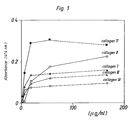
- bovine collagen type I, type II, type III, type IV, and type V were separately dissolved to a concentration of 180 ⁇ g/ml in a solution of 150 mM acetic acid which contained 50 mM NaCl.
- Each preparation was diluted stepwise, and a 50- ⁇ l portion of each was put into a well of a 96-weel micro-plate. This plate was left for 2 hours at 37°C. Then each well was washed with phosphate-buffered saline that did not contain bivalent metal ions [PBS (-) ], and then blocking was done with the use of bovine serum albumin (BSA).
- PBS (-) phosphate-buffered saline that did not contain bivalent metal ions
- peroxidase-labelled insulin Sigma was dissolved in PBS (-) to a concentration of 5 ⁇ g/ml, and 50 ⁇ l of this solution was put into each well. The plate was left for 2 hours at 37°C to allow the reaction to proceed, and then peroxidase-labelled insulin that had not formed a complex was washed away. The peroxidase activity of insulin binding and collagen binding was measured with 2,2′-azino-bis-(3-ethylbenzothiazoline-6-sulfonic acid) (ABTS) and hydrogen peroxide as substrates.
- ABTS 2,2′-azino-bis-(3-ethylbenzothiazoline-6-sulfonic acid
- the collagen type V mentioned above was dissolved to a concentration of 1 mg/ml, and 10 ⁇ l of this solution was treated by SDS-polyacrylamide gel electrophoresis. After transfer to a nitrocellulose membrane by Western blotting, the membrane was immersed in PBS that contained 5 ⁇ g/ml peroxidase-labelled insulin and 0.05% Tween 20 at room temperature for 2 hours to allow the reaction to proceed. The peroxidase activity that was bound to the nitrocellulose membrane was detected with 4-chloro-1-naphthol and hydrogen peroxide as substrate.
- collagen type V was dissolved in 70% formic acid that contained 20 mg/ml cyanogen bromide to a concentration of 5 mg/ml, and the reaction was allowed to proceed for 24 hours at room temperature, resulting in fragmentation of the collagen type V.
- the fragments of collagen type V were treated by electrophoresis as described above, and then treated with peroxidase-labelled insulin.
- the fragment with a molecular mass of about 30 kDa (30-kDa polypeptide) was found to have the insulin-binding activity.
- the collagen type V treated above with cyanogen bromide was separated by use of high-pressure liquid chromatography (HPLC) with a heparin column (TSK Gel Heparin 5PW, Tosoh Corp.) equilibrated with PBS (-) that contained 2 M urea. An excess of solvent was used to wash the column, and then the 30-kDa polypeptide mentioned above was eluted with solvent to which 1 M NaCl had been added. Next, water was used to remove the solvent from the eluant by dialysis, and the resultant dialysate was lyophilized.
- HPLC high-pressure liquid chromatography
- Insulin-binding activity was tested by the dot-blotting method with use of peroxide-labelled insulin, and both fragments had insulin-binding activity that was somewhat weaker than that of the 30-kDa fragment.
- the 16-kDa polypeptide was decomposed by the use of lysyl endopeptidase.
- the lysyl endopeptidase was dissolved in 50 mM ammonium hydrogen-carbonate solution (pH 7.8) to a concentration of 10 ⁇ g/ml, and the 16-kDa polypeptide was digested overnight at 37°C.
- the fragments were treated as described above by HPLC on an ODS reverse-phase column, and three fragments (L-1, L-2, and L-3) were obtained. Next, these fragments were lyophilized and the solvent was removed.
- the fragments of insulin B chain were eluted from the reverse-phase column in the order of 1Phe-Val-Asn-Glu-His-Leu-Cys-Gly-Ser-His-Leu-Val-13Glu (B-1), 14Ala-Leu-Tyr-Leu-Val-Cys-Gly-Glu21 (B-2), and 22Arg-Gly-Phe-Phe-Tyr-Thr-Pro-Lys-30Thr (B-3).
- B-1 1Phe-Val-Asn-Glu-His-Leu-Cys-Gly-Ser-His-Leu-Val-13Glu
- B-2 14Ala-Leu-Tyr-Leu-Val-Cys-Gly-Glu21
- B-3 22Arg-Gly-Phe-Phe-Tyr-Thr-Pro-Lys-30Thr
- the novel composition for use as an insulin-binding carrier and the insulin-binding polypeptide of this invention have the ability to bind insulin, and the results of studies of these substances suggested that they could be used in newly discovered applications when insulin is used in the fields of biochemistry and medicine by making possible the more effective use of insulin. In particular, they would be useful in new preparations of insulin and as part of drug delivery systems. Also, they might be used to control the growth of cells (including cancer cells) that require insulin as a growth factor.
- the inhibitors of the binding of insulin with collagen of this invention are novel uses of insulin components and help ensure that the insulin-binding polypeptide will be effective and useful in applications of biochemical and medical significance in thc field of biochemistry and medicine in which insulin is used. In particular, they would be useful in new preparations of insulin and when drug delivery systems are being employed. Also, they could be useful in the prevention and treatment of transitory insulin deficiency in the diabetes that arises as a response to the invasiveness of surgery.
- Figure 1 shows the insulin binding of the various kinds of collagen
- Figure 2 is a graph that shows the structure and the partial amino acid sequence of the 30-kDa polypeptide
- Figure 3 is a graph of the ability of insulin and related compounds to inhibit insulin binding and collagen binding.
Landscapes
- Health & Medical Sciences (AREA)
- Chemical & Material Sciences (AREA)
- Life Sciences & Earth Sciences (AREA)
- Organic Chemistry (AREA)
- Diabetes (AREA)
- General Health & Medical Sciences (AREA)
- Medicinal Chemistry (AREA)
- Engineering & Computer Science (AREA)
- Public Health (AREA)
- Chemical Kinetics & Catalysis (AREA)
- General Chemical & Material Sciences (AREA)
- Bioinformatics & Cheminformatics (AREA)
- Nuclear Medicine, Radiotherapy & Molecular Imaging (AREA)
- Pharmacology & Pharmacy (AREA)
- Veterinary Medicine (AREA)
- Animal Behavior & Ethology (AREA)
- Endocrinology (AREA)
- Obesity (AREA)
- Hematology (AREA)
- Biophysics (AREA)
- Toxicology (AREA)
- Zoology (AREA)
- Gastroenterology & Hepatology (AREA)
- Biochemistry (AREA)
- Emergency Medicine (AREA)
- Genetics & Genomics (AREA)
- Molecular Biology (AREA)
- Proteomics, Peptides & Aminoacids (AREA)
- Medicines That Contain Protein Lipid Enzymes And Other Medicines (AREA)
- Peptides Or Proteins (AREA)
- Cosmetics (AREA)
Claims (4)
- Polypeptid, welches eine Insulinbindungsaktivität aufweist und welches zumindest als Teil seiner Struktur die Aminosäuresequenz der folgenden Formel (I):besitzt.

- Polypeptid nach Anspruch 1, welches eine Molekularmasse von 30 kDa besitzt und welches durch Zersetzung von Kollagen des Typus V durch Behandlung mit Cyanbromid erhältlich ist.
- Verwendung von mindestens einem Protein oder Polypeptid, gewählt aus Kollagen der Typen I, II, III, IV und V, und Polypeptiden von zersetztem Kollagen V, welche die aktive Insulinbindungsstelle enthalten, bei der Herstellung eines Insulin-bindenden Trägers.
- Verwendung von mindestens einem Polypeptid, gewählt aus Insulin A-Kette, Insulin B-Kette; und Polypeptiden von zersetzter Insulin B-Kette, welche die Kollagenbindungsstelle enthalten, als aktive Komponente bei der Herstellung eines Inhibitors für die Bindung von Insulin mit Kollagen.
Applications Claiming Priority (4)
| Application Number | Priority Date | Filing Date | Title |
|---|---|---|---|
| JP273139/88 | 1988-10-31 | ||
| JP27313988 | 1988-10-31 | ||
| JP1243513A JP2918922B2 (ja) | 1988-10-31 | 1989-09-21 | インスリン結合活性を有するポリペプチド |
| JP243513/89 | 1989-09-21 |
Publications (3)
| Publication Number | Publication Date |
|---|---|
| EP0367554A2 EP0367554A2 (de) | 1990-05-09 |
| EP0367554A3 EP0367554A3 (de) | 1991-11-13 |
| EP0367554B1 true EP0367554B1 (de) | 1995-09-06 |
Family
ID=26536297
Family Applications (1)
| Application Number | Title | Priority Date | Filing Date |
|---|---|---|---|
| EP89311220A Expired - Lifetime EP0367554B1 (de) | 1988-10-31 | 1989-10-31 | Insulinbindende Wirkstoffe und Hemmer der Insulinbindung |
Country Status (3)
| Country | Link |
|---|---|
| EP (1) | EP0367554B1 (de) |
| JP (2) | JP2918922B2 (de) |
| DE (1) | DE68924127T2 (de) |
-
1989
- 1989-09-21 JP JP1243513A patent/JP2918922B2/ja not_active Expired - Fee Related
- 1989-10-31 EP EP89311220A patent/EP0367554B1/de not_active Expired - Lifetime
- 1989-10-31 DE DE68924127T patent/DE68924127T2/de not_active Expired - Fee Related
-
1998
- 1998-07-16 JP JP21654398A patent/JP2996954B2/ja not_active Expired - Fee Related
Also Published As
| Publication number | Publication date |
|---|---|
| DE68924127D1 (de) | 1995-10-12 |
| EP0367554A2 (de) | 1990-05-09 |
| EP0367554A3 (de) | 1991-11-13 |
| JPH1192396A (ja) | 1999-04-06 |
| JPH02209899A (ja) | 1990-08-21 |
| JP2996954B2 (ja) | 2000-01-11 |
| JP2918922B2 (ja) | 1999-07-12 |
| DE68924127T2 (de) | 1996-05-02 |
Similar Documents
| Publication | Publication Date | Title |
|---|---|---|
| Thomas et al. | Pure brain-derived acidic fibroblast growth factor is a potent angiogenic vascular endothelial cell mitogen with sequence homology to interleukin 1. | |
| EP2409988B1 (de) | Peptidfragmente zur Induzierung der Synthese extrazellulärer Matrixproteine | |
| HK121293A (en) | Desulfatohirudine, process for its preparation and pharmaceutical agent | |
| AU2018216033B2 (en) | Peptide modulators of the interaction between human C-peptide and human elastin receptor for therapeutic use | |
| Darrington et al. | Evidence for a common intermediate in insulin deamidation and covalent dimer formation: effects of pH and aniline trapping in dilute acidic solutions | |
| WO1988007863A1 (en) | Human somatomedin carrier protein subunits and process for producing them | |
| JPS62502544A (ja) | アンギオゲニン活性を有する精製蛋白及びその製造方法 | |
| Belew et al. | Structure-activity relationships of vasoactive peptides derived from fibrin or fibrinogen degraded by plasmin | |
| EP0367554B1 (de) | Insulinbindende Wirkstoffe und Hemmer der Insulinbindung | |
| WO1992018154A1 (en) | Human bone derived insulin like growth factor binding protein | |
| US5807982A (en) | Affinity purified heparin | |
| DK175408B1 (da) | Isohirudiner, fremgangsmåde til deres fremstilling, pharmaceutisk middel samt fremgangsmåde til dets fremstilling | |
| Abercrombie et al. | Effects of limited tryptic proteolysis of bovine neurophysins on molecular properties of hormone binding, self-association, and antigenicity | |
| Wei et al. | Effects of interaction with calcineurin on the reactivities of calmodulin lysines. | |
| EP0858808B1 (de) | Peptide zur Verwendung in Wundbehandlung | |
| JPH0782172A (ja) | 創傷治療剤 | |
| JP2915907B2 (ja) | インスリン結合用担体 | |
| US5514775A (en) | Chromogranin peptides | |
| RU2078769C1 (ru) | Пептидный фрагмент, обладающий биологической активностью инсулина | |
| JPH0774240B2 (ja) | ポリペプチド | |
| US5747454A (en) | Chromogranin peptides | |
| JP2562892B2 (ja) | インスリン結合活性を有するポリペプチド | |
| JP2623457B2 (ja) | インスリン結合活性を有するポリペプチド | |
| EP0771877A1 (de) | Modifizierten morphogenen proteinrezeptor in knochen kodierendes gen | |
| Baumann | Molecular heterogeneity of circulating growth hormone in acromegaly |
Legal Events
| Date | Code | Title | Description |
|---|---|---|---|
| PUAI | Public reference made under article 153(3) epc to a published international application that has entered the european phase |
Free format text: ORIGINAL CODE: 0009012 |
|
| AK | Designated contracting states |
Kind code of ref document: A2 Designated state(s): DE FR GB |
|
| 17P | Request for examination filed |
Effective date: 19901127 |
|
| PUAL | Search report despatched |
Free format text: ORIGINAL CODE: 0009013 |
|
| AK | Designated contracting states |
Kind code of ref document: A3 Designated state(s): DE FR GB |
|
| 17Q | First examination report despatched |
Effective date: 19940203 |
|
| GRAA | (expected) grant |
Free format text: ORIGINAL CODE: 0009210 |
|
| AK | Designated contracting states |
Kind code of ref document: B1 Designated state(s): DE FR GB |
|
| REF | Corresponds to: |
Ref document number: 68924127 Country of ref document: DE Date of ref document: 19951012 |
|
| ET | Fr: translation filed | ||
| PLBE | No opposition filed within time limit |
Free format text: ORIGINAL CODE: 0009261 |
|
| STAA | Information on the status of an ep patent application or granted ep patent |
Free format text: STATUS: NO OPPOSITION FILED WITHIN TIME LIMIT |
|
| 26N | No opposition filed | ||
| REG | Reference to a national code |
Ref country code: GB Ref legal event code: IF02 |
|
| REG | Reference to a national code |
Ref country code: GB Ref legal event code: 732E |
|
| REG | Reference to a national code |
Ref country code: FR Ref legal event code: TP |
|
| PGFP | Annual fee paid to national office [announced via postgrant information from national office to epo] |
Ref country code: FR Payment date: 20041008 Year of fee payment: 16 |
|
| PGFP | Annual fee paid to national office [announced via postgrant information from national office to epo] |
Ref country code: GB Payment date: 20041027 Year of fee payment: 16 |
|
| PGFP | Annual fee paid to national office [announced via postgrant information from national office to epo] |
Ref country code: DE Payment date: 20041028 Year of fee payment: 16 |
|
| PG25 | Lapsed in a contracting state [announced via postgrant information from national office to epo] |
Ref country code: GB Free format text: LAPSE BECAUSE OF NON-PAYMENT OF DUE FEES Effective date: 20051031 |
|
| PG25 | Lapsed in a contracting state [announced via postgrant information from national office to epo] |
Ref country code: DE Free format text: LAPSE BECAUSE OF NON-PAYMENT OF DUE FEES Effective date: 20060503 |
|
| GBPC | Gb: european patent ceased through non-payment of renewal fee |
Effective date: 20051031 |
|
| PG25 | Lapsed in a contracting state [announced via postgrant information from national office to epo] |
Ref country code: FR Free format text: LAPSE BECAUSE OF NON-PAYMENT OF DUE FEES Effective date: 20060630 |
|
| REG | Reference to a national code |
Ref country code: FR Ref legal event code: ST Effective date: 20060630 |