EP0367654B2 - Process for producing synthesis gas by partial oxidation of light hydrocarbons - Google Patents
Process for producing synthesis gas by partial oxidation of light hydrocarbons Download PDFInfo
- Publication number
- EP0367654B2 EP0367654B2 EP19890402906 EP89402906A EP0367654B2 EP 0367654 B2 EP0367654 B2 EP 0367654B2 EP 19890402906 EP19890402906 EP 19890402906 EP 89402906 A EP89402906 A EP 89402906A EP 0367654 B2 EP0367654 B2 EP 0367654B2
- Authority
- EP
- European Patent Office
- Prior art keywords
- charge
- catalyst
- partial oxidation
- oxygen
- hydrocarbon
- Prior art date
- Legal status (The legal status is an assumption and is not a legal conclusion. Google has not performed a legal analysis and makes no representation as to the accuracy of the status listed.)
- Expired - Lifetime
Links
Images
Classifications
-
- C—CHEMISTRY; METALLURGY
- C01—INORGANIC CHEMISTRY
- C01B—NON-METALLIC ELEMENTS; COMPOUNDS THEREOF; METALLOIDS OR COMPOUNDS THEREOF NOT COVERED BY SUBCLASS C01C
- C01B3/00—Hydrogen; Gaseous mixtures containing hydrogen; Separation of hydrogen from mixtures containing it; Purification of hydrogen; Reversible storage of hydrogen
- C01B3/02—Production of hydrogen; Production of gaseous mixtures containing hydrogen
- C01B3/32—Production of hydrogen; Production of gaseous mixtures containing hydrogen by reaction of gaseous or liquid organic compounds with gasifying agents, e.g. water, carbon dioxide or air
- C01B3/34—Production of hydrogen; Production of gaseous mixtures containing hydrogen by reaction of gaseous or liquid organic compounds with gasifying agents, e.g. water, carbon dioxide or air by reaction of hydrocarbons with gasifying agents
- C01B3/38—Production of hydrogen; Production of gaseous mixtures containing hydrogen by reaction of gaseous or liquid organic compounds with gasifying agents, e.g. water, carbon dioxide or air by reaction of hydrocarbons with gasifying agents using catalysts
- C01B3/382—Processes with two or more reaction steps, of which at least one is catalytic, e.g. steam reforming and partial oxidation
-
- B—PERFORMING OPERATIONS; TRANSPORTING
- B01—PHYSICAL OR CHEMICAL PROCESSES OR APPARATUS IN GENERAL
- B01J—CHEMICAL OR PHYSICAL PROCESSES, e.g. CATALYSIS OR COLLOID CHEMISTRY; THEIR RELEVANT APPARATUS
- B01J8/00—Chemical or physical processes in general, conducted in the presence of fluids and solid particles; Apparatus for such processes
- B01J8/02—Chemical or physical processes in general, conducted in the presence of fluids and solid particles; Apparatus for such processes with stationary particles, e.g. in fixed beds
- B01J8/0242—Chemical or physical processes in general, conducted in the presence of fluids and solid particles; Apparatus for such processes with stationary particles, e.g. in fixed beds the fluid flow within the bed being predominantly vertical
- B01J8/025—Chemical or physical processes in general, conducted in the presence of fluids and solid particles; Apparatus for such processes with stationary particles, e.g. in fixed beds the fluid flow within the bed being predominantly vertical in a cylindrical shaped bed
-
- B—PERFORMING OPERATIONS; TRANSPORTING
- B01—PHYSICAL OR CHEMICAL PROCESSES OR APPARATUS IN GENERAL
- B01J—CHEMICAL OR PHYSICAL PROCESSES, e.g. CATALYSIS OR COLLOID CHEMISTRY; THEIR RELEVANT APPARATUS
- B01J8/00—Chemical or physical processes in general, conducted in the presence of fluids and solid particles; Apparatus for such processes
- B01J8/02—Chemical or physical processes in general, conducted in the presence of fluids and solid particles; Apparatus for such processes with stationary particles, e.g. in fixed beds
- B01J8/0278—Feeding reactive fluids
-
- B—PERFORMING OPERATIONS; TRANSPORTING
- B01—PHYSICAL OR CHEMICAL PROCESSES OR APPARATUS IN GENERAL
- B01J—CHEMICAL OR PHYSICAL PROCESSES, e.g. CATALYSIS OR COLLOID CHEMISTRY; THEIR RELEVANT APPARATUS
- B01J2208/00—Processes carried out in the presence of solid particles; Reactors therefor
- B01J2208/00008—Controlling the process
- B01J2208/00017—Controlling the temperature
- B01J2208/00477—Controlling the temperature by thermal insulation means
- B01J2208/00495—Controlling the temperature by thermal insulation means using insulating materials or refractories
-
- B—PERFORMING OPERATIONS; TRANSPORTING
- B01—PHYSICAL OR CHEMICAL PROCESSES OR APPARATUS IN GENERAL
- B01J—CHEMICAL OR PHYSICAL PROCESSES, e.g. CATALYSIS OR COLLOID CHEMISTRY; THEIR RELEVANT APPARATUS
- B01J2208/00—Processes carried out in the presence of solid particles; Reactors therefor
- B01J2208/00008—Controlling the process
- B01J2208/00017—Controlling the temperature
- B01J2208/00504—Controlling the temperature by means of a burner
-
- C—CHEMISTRY; METALLURGY
- C01—INORGANIC CHEMISTRY
- C01B—NON-METALLIC ELEMENTS; COMPOUNDS THEREOF; METALLOIDS OR COMPOUNDS THEREOF NOT COVERED BY SUBCLASS C01C
- C01B2203/00—Integrated processes for the production of hydrogen or synthesis gas
- C01B2203/14—Details of the flowsheet
- C01B2203/142—At least two reforming, decomposition or partial oxidation steps in series
-
- C—CHEMISTRY; METALLURGY
- C01—INORGANIC CHEMISTRY
- C01B—NON-METALLIC ELEMENTS; COMPOUNDS THEREOF; METALLOIDS OR COMPOUNDS THEREOF NOT COVERED BY SUBCLASS C01C
- C01B2203/00—Integrated processes for the production of hydrogen or synthesis gas
- C01B2203/80—Aspect of integrated processes for the production of hydrogen or synthesis gas not covered by groups C01B2203/02 - C01B2203/1695
- C01B2203/82—Several process steps of C01B2203/02 - C01B2203/08 integrated into a single apparatus
Definitions
- the present invention relates to a process for the production of synthesis gas by partial oxidation light hydrocarbons, that is to say containing from 1 to 4 carbon atoms.
- the drawback of the water quenching process comes from the almost total loss of the sensible heat contained in the burnt gases at the exit of the flame.
- US Pat. No. 4,582,630 represents an improvement in that the proportion of water vapor is reduced, but the process requires an intermediate step of steam reforming part of the load of hydrocarbons.
- the object of the invention is to propose a process which operates without significant formation of soot and at a cost reduced since the proportions of oxygen or air and water can be relatively low. This process avoids the use of a prior step of steam reforming.
- the method of the invention is a
- Process for the production of synthesis gas without significant presence of soot in the outgoing gases in which, in a first step, the charge of light hydrocarbons is subjected to partial oxidation in the presence of water vapor and, in a second stage, the burnt gases obtained are brought into contact with a catalyst at a temperature of 900 to 1500 ° C., said process being characterized in that the mixture subjected to partial oxidation in the first stage under conditions where the 0.01 to 10 g of solid carbonaceous material are formed per Nm 3 equivalent of the hydrocarbon charge, consists of the charge, of water vapor and of gas containing oxygen, mixture in which the quantity of vapor of water, introduced into the burner, is less than 1.5 moles per gram atom of carbon of the charge and the quantity of oxygen is at most equal to 50% of the stoichiometric proportion, the residence time of the gases in partial oxidation being co between 0.1 and 10 s, that the catalyst used in the second step contains at least one metal or a metal compound of at least one of groups
- stoichiometric proportion of oxygen is meant the theoretical proportion which ensures combustion total of the hydrocarbon charge, for example 2 moles of oxygen for one mole of methane, transforming this load exclusively of water and carbon dioxide.
- Nm 3 we mean the flow rate of the hydrocarbon charge, counted in cubic meters under normal conditions of temperature and pressure, multiplied by the number of average carbon atoms per molecule of the hydrocarbon charge.
- the fuel and the fuel are sent to meet each other in an efficient mixing device, for example a multi-channel burner.
- the pressure is between 0.5 and 20 MPa, preferably between 1 and 20 MPa, and the temperature of the catalytic zone is between 900 and 1500 degrees centigrade.
- VVH volume of hydrocarbon (s) of the feedstock / volume of catalyst / hour
- VVH corrected conventional HLV x average number of carbon atoms in the feed.
- One operates with a corrected VVH of 500 to 5000, preferably 500 to 2500.
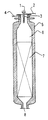
- Fuel and oxidizer are sent via lines 1 and 2, respectively, or vice versa the concentric channel burner 3, allowing the gases to be mixed quickly and efficiently.
- the reagent having the lowest flow rate is passed through channel 1.
- this gas is preferably introduced into the burner through line 1.
- the reactor 5 of substantially cylindrical shape and whose wall is protected by refractory, comprises two interior volumes 6 and 7.
- the burner 3 is arranged at its top.
- Volume 6 is an empty space where the burner flame develops 3.
- the volume that determines the time of residence of the burnt gases before the catalytic treatment plays an important role in the process. If it's too much weak, the catalyst deactivates fairly quickly. If it is too large, there are deposits of soot on the wall of 6 and the entrance of 7.
- the enclosure 7 is filled with catalyst.
- This catalyst can be metal-based or a combination of Group VIII metals used either in bulk form or in the form of a deposit on a refractory support. It is also possible to use oxides, for example chromium oxide, alone or on a support.
- the catalyst is used in the form of a packing, for example in rings Raschig, Pall or Berg, diameter between 5 and 500 mm, preferably between 10 and 200 mm.
- the catalyst is made of at least one fabric of platinum wire, preferably of several platinum fabrics separated by ceramic packing beds.
- the combustion gases are evacuated through opening 8.
- the carbon index of the gas is 1.17 (average number of carbon atoms in the hydrocarbons of the charge).
- oxygen at 98% molar purity is brought.
- the flow of oxygen counted pure is 235 Nm 3 / h, which corresponds to an O 2 / C ratio of 0.67 (number of moles of oxygen per gram atom of carbon).
- gases are discharged through the opening 8. A fraction of these gases is cooled by quenching with water for the purpose of analysis. These gases have the following measured characteristics: H 2 60.4 CO 36.0 CO 2 3.3 CH 4 0.2 Inert 0.1 100.00
- the soot collected by the cooling and washing water of the fraction taken for analysis represent a production of around 70 g per hour.
- the latter figure corresponds to a content of approximately 80 mg per m 3 of dry gas produced.
- the cooling water at the outlet of the catalyst bed remained clear, free of any trace of soot.
- the soot gas content is therefore evaluated at less than 1 mg per Nm 3 .
- the VVH with respect to the flow rate of natural gas used is 1200 (Nm 3 / h of gas per m 3 of catalyst).
- the VVH relative to the synthesis gas obtained is 3560.
Landscapes
- Chemical & Material Sciences (AREA)
- Chemical Kinetics & Catalysis (AREA)
- Organic Chemistry (AREA)
- Physics & Mathematics (AREA)
- Fluid Mechanics (AREA)
- Health & Medical Sciences (AREA)
- General Health & Medical Sciences (AREA)
- Engineering & Computer Science (AREA)
- Combustion & Propulsion (AREA)
- Inorganic Chemistry (AREA)
- Hydrogen, Water And Hydrids (AREA)
- Catalysts (AREA)
Description
La présente invention concerne un procédé pour la production de gaz de synthèse par oxydation partielle d'hydrocarbures légers, c'est-à-dire renfermant de 1 à 4 atomes de carbone.The present invention relates to a process for the production of synthesis gas by partial oxidation light hydrocarbons, that is to say containing from 1 to 4 carbon atoms.
Elle a pour objet de produire de manière économique du gaz de synthèse exempt de suie à la sortie.Its purpose is to economically produce synthesis gas free of soot at the outlet.
On sait, d'après le brevet US n° 3989444, que pour pouvoir brûler sans formation de suie des mélanges d'hydrocarbures, il est nécessaire d'opérer avec une quantité d'oxygène supérieure à un minimum qui est d'environ 62% de la quantité stoechiométrique, lorsqu'on a affaire à du gaz naturel, et d'environ 64%, quand le combustible est du propane par exempte. L'emploi d'une proportion aussi élevée d'oxygène est coûteuse, aussi opère-t-on le plus souvent avec une plus faible proportion d'oxygène et tolère-t-on la formation de suie.It is known, from US Patent No. 3,989,444, that to be able to burn without soot formation of the mixtures of hydrocarbons, it is necessary to operate with an amount of oxygen greater than a minimum which is approximately 62% of the stoichiometric quantity, when dealing with natural gas, and approximately 64%, when the fuel is propane for example. Using such a high proportion of oxygen is expensive, we therefore operate most often with a lower proportion of oxygen and tolerate the formation of soot.
La séparation et la manipulation des suies étant peu pratiques et très onéreuses, le brevet US 4704137 enseigne de les récupérer au moyen d'une trempe à l'eau puis de les réinjecter, en mélange avec la phase liquide où elles se trouvent en suspension, directement dans la flamme du brûleur, en empruntant, à cet effet, le conduit réservé au combustible.The separation and handling of soot being impractical and very expensive, US Pat. No. 4,704,137 teaches to recover them by means of a water quenching then to reinject them, in mixture with the phase liquid in which they are in suspension, directly in the burner flame, using, for this purpose, the fuel line.
L'inconvénient du procédé de trempe à l'eau provient de la perte quasi totale de la chaleur sensible contenue dans les gaz brûlés à la sortie de la flamme.The drawback of the water quenching process comes from the almost total loss of the sensible heat contained in the burnt gases at the exit of the flame.
Un autre procédé largement utilisé dans l'industrie est le réformage à l'eau des hydrocarbures, couramment effectué en deux étapes de réaction (US 3278452). L'inconvénient de ce procédé est de requérir l'emploi d'une proportion très élevée de vapeur d'eau, ce qui est coûteux, comme souligné dans le brevet US 4296085. Ce dernier brevet propose de remédier à cet inconvénient, et donc de permettre l'emploi d'une quantité limitée de vapeur d'eau, par ajout d'une quantité notable d'hydrogène, au moins 5% molaire calculé sur le gaz sec, au gaz envoyé à la seconde étape de reforming effectuée en présence d'oxygène. Cet ajout d'hydrogène accroit le coût du procédé. Le brevet précité reconnait également l'utilité de mélanger rapidement et efficacement le courant d'hydrocarbure avec le courant d'oxygène ou d'air pour réduire les réactions indésirables de craquage de l'hydrocarbure.Another process widely used in industry is the water reforming of hydrocarbons, commonly carried out in two reaction steps (US 3278452). The disadvantage of this process is that it requires the use of a very high proportion of water vapor, which is expensive, as pointed out in US Patent 4,296,085. latest patent proposes to remedy this drawback, and therefore to allow the use of a limited amount of water vapor, by adding a significant amount of hydrogen, at least 5 mol% calculated on the dry gas, at gas sent to the second reforming step carried out in the presence of oxygen. This addition of hydrogen increases the cost of the process. The aforementioned patent also recognizes the usefulness of quickly and effectively mixing the hydrocarbon stream with oxygen or air stream to reduce unwanted cracking reactions of the hydrocarbon.
Le brevet US 4582630 représente un perfectionnement en ce sens que la proportion de vapeur d'eau est réduite, mais le procédé requiert une étape intermédiaire de réformage à la vapeur d'eau d'une partie de la charge d'hydrocarbures.US Pat. No. 4,582,630 represents an improvement in that the proportion of water vapor is reduced, but the process requires an intermediate step of steam reforming part of the load of hydrocarbons.
Dans d'autres procédés connus, on introduit séparément l'oxygène ou l'air et la charge d'hydrocarbures (GB-2216573 et EP-212889) de sorte que l'oxygène moléculaire ne réagit qu'avec une partie du combustible, celle qui se trouve dans son environnement immédiat. Là aussi la proportion de vapeur d'eau demeure très élevée pour éviter la formation de suie.In other known methods, oxygen or air and the hydrocarbon feedstock are introduced separately. (GB-2216573 and EP-212889) so that molecular oxygen only reacts with part of the fuel, that which is in its immediate environment. Here too the proportion of water vapor remains very high to avoid soot formation.
L'objet de l'invention est de proposer un procédé qui opère sans formation notable de suie et à un coût réduit puisque les proportions d'oxygène ou d'air et d'eau peuvent être relativement faibles. Ce procédé évite l'emploi d'une étape préalable de réformage à la vapeur d'eau.The object of the invention is to propose a process which operates without significant formation of soot and at a cost reduced since the proportions of oxygen or air and water can be relatively low. This process avoids the use of a prior step of steam reforming.
Le procédé de l'invention est un The method of the invention is a
Procédé de production de gaz de synthèse sans presence notable de suie dans les gaz sortant, procédé dans lequel, dans une première étape, la charge d'hydrocarbures légers est soumise à une oxydation partielle en présence de vapeur d'eau et, dans une seconde étape, les gaz brûlés obtenus sont mis au contact d'un catalyseur à une température de 900 à 1500°C, ledit procédé étant caractérisé en ce que, le mélange soumis à l'oxydation partielle dans la première étape dans des conditions où l'on forme 0,01 à 10 g de matière carbonée solide par Nm3 équivalent de la charge d'hydrocarbure, est constitué de la charge, de vapeur d'eau et de gaz contenant de l'oxygène, mélange dans lequel la quantité de vapeur d'eau, introduite dans le brûleur, est inférieure à 1,5 mole par atome-gramme de carbone de la charge et la quantité d'oxygène est au plus égale à 50 % de la proportion stoechiométrique, le temps de séjour des gaz en oxydation partielle étant compris entre 0,1 et 10 s, que le catalyseur utilisé dans la seconde étape renferme au moins un métal ou un composé de métal d'au moins l'un des groupes VI et VIII, que la VVH (volume d'hydrocarbure par volume de catalyseur par heure) corrigée est comprise entre 500 et 5000 h-1 et que l'ensemble du procédé opère sous une pression comprise entre 5 et 200 bars. Process for the production of synthesis gas without significant presence of soot in the outgoing gases, process in which, in a first step, the charge of light hydrocarbons is subjected to partial oxidation in the presence of water vapor and, in a second stage, the burnt gases obtained are brought into contact with a catalyst at a temperature of 900 to 1500 ° C., said process being characterized in that the mixture subjected to partial oxidation in the first stage under conditions where the 0.01 to 10 g of solid carbonaceous material are formed per Nm 3 equivalent of the hydrocarbon charge, consists of the charge, of water vapor and of gas containing oxygen, mixture in which the quantity of vapor of water, introduced into the burner, is less than 1.5 moles per gram atom of carbon of the charge and the quantity of oxygen is at most equal to 50% of the stoichiometric proportion, the residence time of the gases in partial oxidation being co between 0.1 and 10 s, that the catalyst used in the second step contains at least one metal or a metal compound of at least one of groups VI and VIII, than the VVH (volume of hydrocarbon per volume of catalyst per hour) corrected is between 500 and 5000 h -1 and that the whole process operates under a pressure between 5 and 200 bar.
Par proportion stoechimétrique d'oxygéne, on entend la proportion théorique qui assure la combustion totale de la charge d'hydrocarbures, par exemple 2 moles d'oxygène pour une mole de méthane, transformant cette charge exclusivement en eau et en dioxyde de carbone.By stoichiometric proportion of oxygen is meant the theoretical proportion which ensures combustion total of the hydrocarbon charge, for example 2 moles of oxygen for one mole of methane, transforming this load exclusively of water and carbon dioxide.
Par Nm3 équivalent, on entend le débit de la charge d'hydrocarbures, compté en mètres cubes dans les conditions normales de température et de pression, multiplié par le nombre d'atomes de carbone moyen par molécule de la charge d'hydrocarbures.By equivalent Nm 3 , we mean the flow rate of the hydrocarbon charge, counted in cubic meters under normal conditions of temperature and pressure, multiplied by the number of average carbon atoms per molecule of the hydrocarbon charge.
Ainsi, dans le procédé de l'invention, il est inutile d'ajouter de l'hydrogène aux réactifs et l'on obtiendra d'excellents résultats sans hydrogène ou avec des teneurs en hydrogène faibles, inférieures par exemple à 3% molaire, comptées sur gaz sec. Pour régulariser les débits et éviter un retour éventuel de l'oxygène dans le conduit des hydrocarbures il est de bonne pratique d'ajouter de la vapeur d'eau à la charge d'hydrocarbures. De la même façon, pour empêcher l'oxygène de s'accumuler dans les zones mortes, on les balaie avec des dérivations de vapeur d'eau. En tous les cas, la rapport moles de vapeur d'eau par atome-gramme de carbone de la charge doit être inférieur à 1,5.Thus, in the process of the invention, it is useless to add hydrogen to the reactants and one will obtain excellent results without hydrogen or with low hydrogen contents, for example less than 3% molar, counted on dry gas. To regulate the flow rates and avoid a possible return of oxygen in the hydrocarbon pipe it is good practice to add steam to the hydrocarbon charge. Likewise, to prevent oxygen from accumulating in dead areas, they are swept with water vapor diversions. In any case, the ratio moles of water vapor per gram atom of carbon load must be less than 1.5.
Dans le procédé de l'invention, le carburant et le combustible sont envoyés à la rencontre l'un de l'autre dans un dispositif de mélange efficace, par exemple un brûleur à canaux multiples.In the method of the invention, the fuel and the fuel are sent to meet each other in an efficient mixing device, for example a multi-channel burner.
La pression est comprise entre 0,5 et 20 MPa, de préférence entre 1 et 20 MPa, et la température de la zone catalytique est comprise entre 900 et 1500 degrés centigrades.The pressure is between 0.5 and 20 MPa, preferably between 1 and 20 MPa, and the temperature of the catalytic zone is between 900 and 1500 degrees centigrade.
Pour mieux comprendre la description qui suit, on se référera à la figure jointe. To better understand the description which follows, reference is made to the attached figure.
La VVH (volume d'hydrocarbure(s) de la charge/volume de catalyseur/heure) peut être exprimée en VVH corrigée. VVH corrigée = VVH conventionnelle x nombre moyen d'atomes de carbone de la charge.The VVH (volume of hydrocarbon (s) of the feedstock / volume of catalyst / hour) can be expressed in VVH corrected. Corrected HLV = conventional HLV x average number of carbon atoms in the feed.
On opère avec une VVH corrigée de 500 à 5000, de préférence 500 à 2500.One operates with a corrected VVH of 500 to 5000, preferably 500 to 2500.
On envoie par les conduits 1 et 2, respectivement du combustible et du comburant, ou inversement, dans
le brûleur à canaux concentriques 3, permettant de mélanger les gaz rapidement et efficacement.Fuel and oxidizer are sent via
Un exemple de brûleur 3 utilisable dans le procédé de l'invention est décrit dans la demande de brevet
français n° 26 17 577.An example of a
De préférence, on fait passer dans le canal 1 le réactif ayant le plus petit débit.Preferably, the reagent having the lowest flow rate is passed through channel 1.
Ainsi qu'on peut le voir dans les exemples I et II, lorsque le comburant est de l'oxygène pur, ce gaz est de préférence introduit dans le brûleur par le conduit 1.As can be seen in Examples I and II, when the oxidant is pure oxygen, this gas is preferably introduced into the burner through line 1.
Le réacteur 5, de forme sensiblement cylindrique et dont la paroi est protégée par du réfractaire, comporte
deux volumes intérieurs 6 et 7. Le brûleur 3 est disposé à son sommet.The reactor 5, of substantially cylindrical shape and whose wall is protected by refractory, comprises
two
Le volume 6 est un espace vide où se développe la flamme du brûleur 3. Le volume qui détermine te temps
de séjour des gaz brûlés avant le traitement catalytique joue un rôle important dans le procédé. S'il est trop
faible, le catalyseur se dés active assez rapidement. S'il est trop important, on constate des dépôts de suie sur
la paroi de 6 et à l'entrée de 7.
On opère donc avec un temps de séjour dans la chambre de combustion 6 (avant le lit catalytique) de 0,1 à 10 secondes.We therefore operate with a residence time in the combustion chamber 6 (before the bed catalytic) from 0.1 to 10 seconds.
L'enceinte 7 est remplie de catalyseur. Ce catalyseur peut être à base de métal ou de combinaison de métaux du groupe VIII mis en oeuvre soit sous forme massique, soit sous forme de dépôt sur support réfractaire. On peut aussi utiliser des oxydes, par exemple l'oxyde de chrome, seul ou sur support.The enclosure 7 is filled with catalyst. This catalyst can be metal-based or a combination of Group VIII metals used either in bulk form or in the form of a deposit on a refractory support. It is also possible to use oxides, for example chromium oxide, alone or on a support.
Selon une variante préférée, le catalyseur est utilisé sous forme de garnissage, par exemple en anneaux de Raschig, de Pall ou de Berg, de diamètre compris entre 5 et 500 mm, de préférence entre 10 et 200 mm.According to a preferred variant, the catalyst is used in the form of a packing, for example in rings Raschig, Pall or Berg, diameter between 5 and 500 mm, preferably between 10 and 200 mm.
Selon une autre variante, le catalyseur est fait d'au moins une toile en fil de platine, de préférence de plusieurs toiles de platine séparées par des lits de garnissage en céramique.According to another variant, the catalyst is made of at least one fabric of platinum wire, preferably of several platinum fabrics separated by ceramic packing beds.
Les gaz de combustion sont évacués par l'ouverture 8.The combustion gases are evacuated through opening 8.
Dans un réacteur conforme à la figure jointe, mais vide de catalyseur, on envoie sur le canal 2 du brûleur
3, 300 Nm3/h d'un gaz naturel dont la composition est la suivante :
On note que l'indice de carbone du gaz est de 1,17 (nombre moyen des atomes de carbone des hydrocarbures de la charge). Par le même canal on injecte 56,5 kg/h d'eau représentant 70,3 Nm3/h de vapeur d'eau correspondant à un taux de vapeur sur carbone de 0,2 (nombre de moles d'eau par atome-gramme de carbone).It is noted that the carbon index of the gas is 1.17 (average number of carbon atoms in the hydrocarbons of the charge). By the same channel we inject 56.5 kg / h of water representing 70.3 Nm 3 / h of water vapor corresponding to a rate of vapor on carbon of 0.2 (number of moles of water per atom- gram of carbon).
Par le canal 1 du même brûleur 3, on amène de l'oxygène à 98% de pureté molaire. Le débit d'oxygène
compté pur est de 235 Nm3/h ce qui correspond à un rapport O2/C de 0,67 (nombre de moles d'oxygène par
atome-gramme de carbone).Via channel 1 of the
Les conditions opératoires sont les suivantes :
Les gaz sont évacués par l'ouverture 8. Une fraction de ces gaz est refroidie par trempe à l'eau aux fins
d'analyse. Ces gaz ont les caractéristiques mesurées suivantes :
Les suies collectées par les eaux de refroidissement et de lavage de la fraction prélevée pour analyse représentent une production d'environ 70 g à l'heure.The soot collected by the cooling and washing water of the fraction taken for analysis represent a production of around 70 g per hour.
Ce dernier chiffre correspond a une teneur d'environ 80 mg par m3 de gaz sec produit.The latter figure corresponds to a content of approximately 80 mg per m 3 of dry gas produced.
On utilise le même réacteur qu'à l'exemple 1, mais on remplit maintenant le bas de ce réacteur avec 250 l d'un catalyseur au chrome défini comme suit :
- Elément actif :
- chrome
- Teneur :
- 4% en poids
- Support :
- alumine
- Forme :
- anneau
- Dimensions :
- 25 × 25 mm
- Active element:
- chromium
- Content:
- 4% by weight
- Support:
- alumina
- Form:
- ring
- Dimensions:
- 25 × 25 mm
Dans le brûleur 3, on effectue la même combustion qu'à l'exemple 1, c'est-à-dire :
On a pratiquement les mêmes conditions opératoires que précédemment, à savoir :
L'eau de refroidissement à la sortie du lit de catalyseur est restée claire, exempte de toute trace de suie. On évalue donc la teneur du gaz en suie à moins de 1 mg par Nm3.The cooling water at the outlet of the catalyst bed remained clear, free of any trace of soot. The soot gas content is therefore evaluated at less than 1 mg per Nm 3 .
La VVH par rapport au débit de gaz naturel utilisé est de 1200 (Nm3/h de gaz par m3 de catalyseur).The VVH with respect to the flow rate of natural gas used is 1200 (Nm 3 / h of gas per m 3 of catalyst).
La VVH corrigée, produit de la VVH par l'indice de carbone du gaz (dans le cas présent i = 1,17) est égale à 1406.The corrected VVH, product of VVH by the carbon index of the gas (in this case i = 1.17) is equal to 1406.
La VVH par rapport au gaz de synthèse obtenu est de 3560.The VVH relative to the synthesis gas obtained is 3560.
Claims (2)
- Process for the production of synthesis gas without notable presence of soot in the discharge gases, process in which in a first stage the charge of light hydrocarbons is subjected to a partial oxidation in the presence of steam and in a second stage the obtained burned gases are brought into contact with a catalyst at a temperature of 900 to 1500°C, process characterized in that the mixture subjected to partial oxidation in the first stage under conditions where 0,01 to 10 g solid carbon containing material per Nm3 equivalent of a hydrocarbon charge is formed, is constituted by the charge, by steam and gas containing oxygen, mixture in which the steam quantity introduced into the burner is lower than 1,5 mole per gramme atom of hydrocarbon of the charge and the quantity of oxygen is at most equal to 50% of the stoichiometric proportion, the retention time of the gases in partial oxidation being comprised in between 0,1 and 10 seconds, that the catalyst used in the second stage comprises at least one metal or metal compound of at least one of the groups VI and VIII, that the corrected VVH (volume hydrocarbon per volume catalyst per hour) is comprised in between 500 and 5000 h-1 and that the process in total operates under a pressure comprised in between 5 und 200 bars.
- Process according to claim 1, characterized in that the catalyst contains at least one metal or metal compound of the group VI.
Applications Claiming Priority (2)
| Application Number | Priority Date | Filing Date | Title |
|---|---|---|---|
| FR8814481A FR2638443B1 (en) | 1988-11-03 | 1988-11-03 | PROCESS FOR THE PRODUCTION OF SYNTHESIS GAS BY PARTIAL OXIDATION OF LIGHT HYDROCARBONS |
| FR8814481 | 1988-11-03 |
Publications (3)
| Publication Number | Publication Date |
|---|---|
| EP0367654A1 EP0367654A1 (en) | 1990-05-09 |
| EP0367654B1 EP0367654B1 (en) | 1992-01-29 |
| EP0367654B2 true EP0367654B2 (en) | 1998-09-09 |
Family
ID=9371619
Family Applications (1)
| Application Number | Title | Priority Date | Filing Date |
|---|---|---|---|
| EP19890402906 Expired - Lifetime EP0367654B2 (en) | 1988-11-03 | 1989-10-20 | Process for producing synthesis gas by partial oxidation of light hydrocarbons |
Country Status (4)
| Country | Link |
|---|---|
| EP (1) | EP0367654B2 (en) |
| JP (1) | JP2840774B2 (en) |
| DE (1) | DE68900797D1 (en) |
| FR (1) | FR2638443B1 (en) |
Families Citing this family (6)
| Publication number | Priority date | Publication date | Assignee | Title |
|---|---|---|---|---|
| FR2679217B1 (en) * | 1991-07-18 | 1994-04-01 | Institut Francais Petrole | PROCESS AND DEVICE FOR THE MANUFACTURE OF SYNTHESIS GAS AND APPLICATION THEREOF. |
| FR2684313B1 (en) * | 1991-12-03 | 1994-01-28 | Institut Francais Petrole | PROCESS AND DEVICE FOR THE MANUFACTURE OF SYNTHESIS GAS AND APPLICATION THEREOF. |
| CO4180614A1 (en) * | 1993-09-23 | 1995-06-07 | Shell Int Research | PROCESS FOR THE PREPARATION OF CARBON MONOXIDE AND HYDROGEN |
| US5985178A (en) * | 1997-10-31 | 1999-11-16 | Exxon Research And Engineering Co. | Low hydrogen syngas using CO2 and a nickel catalyst |
| AU7765200A (en) * | 1999-10-05 | 2001-05-10 | Ballard Power Systems Inc. | Autothermal reformer |
| WO2010107332A1 (en) * | 2009-03-20 | 2010-09-23 | Институт Катализа Имени Г.К.Борескова Сибирского Отделения Российской Академии Наук | Catalyst, a method for the preparation thereof and a method for producing a synthesis gas from methane |
Family Cites Families (1)
| Publication number | Priority date | Publication date | Assignee | Title |
|---|---|---|---|---|
| US4650651A (en) * | 1983-06-09 | 1987-03-17 | Union Carbide Corporation | Integrated process and apparatus for the primary and secondary catalytic steam reforming of hydrocarbons |
-
1988
- 1988-11-03 FR FR8814481A patent/FR2638443B1/en not_active Expired - Lifetime
-
1989
- 1989-10-20 EP EP19890402906 patent/EP0367654B2/en not_active Expired - Lifetime
- 1989-10-20 DE DE8989402906T patent/DE68900797D1/en not_active Expired - Lifetime
- 1989-11-02 JP JP1287250A patent/JP2840774B2/en not_active Expired - Fee Related
Also Published As
| Publication number | Publication date |
|---|---|
| FR2638443B1 (en) | 1991-01-11 |
| JPH02283601A (en) | 1990-11-21 |
| FR2638443A1 (en) | 1990-05-04 |
| DE68900797D1 (en) | 1992-03-12 |
| EP0367654B1 (en) | 1992-01-29 |
| JP2840774B2 (en) | 1998-12-24 |
| EP0367654A1 (en) | 1990-05-09 |
Similar Documents
| Publication | Publication Date | Title |
|---|---|---|
| CA1338791C (en) | Process and apparatus for hydrocarbon transformation | |
| EP0545275B1 (en) | Process and device for manufacturing synthesis gas and their application | |
| EP0406071B1 (en) | Device and process for the fabrication of synthese gas by combustion and its application | |
| EP0148684B2 (en) | Process for preparing a synthesis gas for producing methanol | |
| EP0155867B1 (en) | Process for preparing synthesis gas by indirect oxidation of hydrocarbons | |
| FR2488678A1 (en) | METHOD AND APPARATUS FOR COMBUSTION TO SIGNIFICANTLY REDUCE THE EMISSION OF NITROGEN COMPOUNDS FORMED DURING COMBUSTION | |
| EP1259458A1 (en) | Method for producing hydrogen by partial oxidation of hydrocarbons | |
| FR2872149A1 (en) | PLASMA-CATALYTIC CONVERSION OF CARBON MATERIALS | |
| EP0367654B2 (en) | Process for producing synthesis gas by partial oxidation of light hydrocarbons | |
| EP0679709B1 (en) | Process for the conversion of natural gas into hydrocarbons | |
| FR2679217A1 (en) | METHOD AND DEVICE FOR THE MANUFACTURE OF SYNTHESIS GAS AND. | |
| CA2199056A1 (en) | Procedure for cracking ammonia present in a gas containing hydrosulphuric acid | |
| EP1575698B1 (en) | Method for generation of a synthesis gas mixture co/h sb 2 /sb under pressure by catalytic partial oxidation with minimisation of the formation of soot | |
| FR2796932A1 (en) | Plant for production of synthesis gas from natural gas and air or oxygen diluted with inert gas comprises at least one reactor for preparation of synthesis gas and at least one compressor with power turbine | |
| EP0318342A1 (en) | Process for reforming impure methanol and device for its application | |
| FR2546154A1 (en) | PROCESS FOR OBTAINING CO FROM A CARBON SOURCE BY HYDROGEN REDUCTION AND DEVICE FOR ITS IMPLEMENTATION AND APPLICATION | |
| FR2811976A1 (en) | PROCESS AND DEVICE FOR PRODUCING A GASEOUS MIXTURE CONTAINING HYDROGEN AND CO BY STAGE OXIDATION OF A HYDROCARBON | |
| FR2554433A1 (en) | PROCESS FOR THE PREPARATION OF A HYDROGEN-RICH GAS | |
| FR2534926A1 (en) | Process for the manufacture of fuel gas or synthesis gas from divided biomass. | |
| CA2039113A1 (en) | Saturated hydrocarbons converter and process thereof | |
| BE550846A (en) | ||
| BE505381A (en) | ||
| CH119980A (en) | Process for manufacturing methanol from methane. | |
| BE486521A (en) | ||
| BE331465A (en) |
Legal Events
| Date | Code | Title | Description |
|---|---|---|---|
| PUAI | Public reference made under article 153(3) epc to a published international application that has entered the european phase |
Free format text: ORIGINAL CODE: 0009012 |
|
| AK | Designated contracting states |
Kind code of ref document: A1 Designated state(s): DE GB IT NL |
|
| 17P | Request for examination filed |
Effective date: 19901024 |
|
| 17Q | First examination report despatched |
Effective date: 19910220 |
|
| ITF | It: translation for a ep patent filed | ||
| GRAA | (expected) grant |
Free format text: ORIGINAL CODE: 0009210 |
|
| AK | Designated contracting states |
Kind code of ref document: B1 Designated state(s): DE GB IT NL |
|
| RAP1 | Party data changed (applicant data changed or rights of an application transferred) |
Owner name: INSTITUT FRANCAIS DU PETROLE |
|
| REF | Corresponds to: |
Ref document number: 68900797 Country of ref document: DE Date of ref document: 19920312 |
|
| GBT | Gb: translation of ep patent filed (gb section 77(6)(a)/1977) | ||
| PLBI | Opposition filed |
Free format text: ORIGINAL CODE: 0009260 |
|
| PLBI | Opposition filed |
Free format text: ORIGINAL CODE: 0009260 |
|
| 26 | Opposition filed |
Opponent name: METALLGESELLSCHAFT AG Effective date: 19921022 |
|
| 26 | Opposition filed |
Opponent name: SHELL INTERNATIONALE RESEARCH MAATSCHAPPIJ B.V. PA Effective date: 19921029 Opponent name: METALLGESELLSCHAFT AG Effective date: 19921022 |
|
| NLR1 | Nl: opposition has been filed with the epo |
Opponent name: METALLGESELLSCHAFT AG. |
|
| NLR1 | Nl: opposition has been filed with the epo |
Opponent name: SHELL INTERNATIONALE RESEARCH MAATSCHAPPIJ B.V. |
|
| APAC | Appeal dossier modified |
Free format text: ORIGINAL CODE: EPIDOS NOAPO |
|
| APAC | Appeal dossier modified |
Free format text: ORIGINAL CODE: EPIDOS NOAPO |
|
| APAE | Appeal reference modified |
Free format text: ORIGINAL CODE: EPIDOS REFNO |
|
| APAC | Appeal dossier modified |
Free format text: ORIGINAL CODE: EPIDOS NOAPO |
|
| PLAW | Interlocutory decision in opposition |
Free format text: ORIGINAL CODE: EPIDOS IDOP |
|
| PUAH | Patent maintained in amended form |
Free format text: ORIGINAL CODE: 0009272 |
|
| STAA | Information on the status of an ep patent application or granted ep patent |
Free format text: STATUS: PATENT MAINTAINED AS AMENDED |
|
| 27A | Patent maintained in amended form |
Effective date: 19980909 |
|
| AK | Designated contracting states |
Kind code of ref document: B2 Designated state(s): DE GB IT NL |
|
| NLR2 | Nl: decision of opposition | ||
| GBTA | Gb: translation of amended ep patent filed (gb section 77(6)(b)/1977) | ||
| NLR3 | Nl: receipt of modified translations in the netherlands language after an opposition procedure | ||
| PGFP | Annual fee paid to national office [announced via postgrant information from national office to epo] |
Ref country code: GB Payment date: 20010925 Year of fee payment: 13 |
|
| PGFP | Annual fee paid to national office [announced via postgrant information from national office to epo] |
Ref country code: DE Payment date: 20011116 Year of fee payment: 13 |
|
| REG | Reference to a national code |
Ref country code: GB Ref legal event code: IF02 |
|
| PG25 | Lapsed in a contracting state [announced via postgrant information from national office to epo] |
Ref country code: GB Free format text: LAPSE BECAUSE OF NON-PAYMENT OF DUE FEES Effective date: 20021020 |
|
| PG25 | Lapsed in a contracting state [announced via postgrant information from national office to epo] |
Ref country code: DE Free format text: LAPSE BECAUSE OF NON-PAYMENT OF DUE FEES Effective date: 20030501 |
|
| GBPC | Gb: european patent ceased through non-payment of renewal fee |
Effective date: 20021020 |
|
| PGFP | Annual fee paid to national office [announced via postgrant information from national office to epo] |
Ref country code: NL Payment date: 20031031 Year of fee payment: 15 |
|
| PG25 | Lapsed in a contracting state [announced via postgrant information from national office to epo] |
Ref country code: NL Free format text: LAPSE BECAUSE OF NON-PAYMENT OF DUE FEES Effective date: 20050501 |
|
| NLV4 | Nl: lapsed or anulled due to non-payment of the annual fee |
Effective date: 20050501 |
|
| APAH | Appeal reference modified |
Free format text: ORIGINAL CODE: EPIDOSCREFNO |
|
| PG25 | Lapsed in a contracting state [announced via postgrant information from national office to epo] |
Ref country code: IT Free format text: LAPSE BECAUSE OF NON-PAYMENT OF DUE FEES;WARNING: LAPSES OF ITALIAN PATENTS WITH EFFECTIVE DATE BEFORE 2007 MAY HAVE OCCURRED AT ANY TIME BEFORE 2007. THE CORRECT EFFECTIVE DATE MAY BE DIFFERENT FROM THE ONE RECORDED. Effective date: 20051020 |