EP0367687A1 - Verfahren zum Hochfrequenzschweissen von Polycarbonat - Google Patents
Verfahren zum Hochfrequenzschweissen von Polycarbonat Download PDFInfo
- Publication number
- EP0367687A1 EP0367687A1 EP19890420398 EP89420398A EP0367687A1 EP 0367687 A1 EP0367687 A1 EP 0367687A1 EP 19890420398 EP19890420398 EP 19890420398 EP 89420398 A EP89420398 A EP 89420398A EP 0367687 A1 EP0367687 A1 EP 0367687A1
- Authority
- EP
- European Patent Office
- Prior art keywords
- sandwich
- sheets
- welding
- polycarbonate
- press
- Prior art date
- Legal status (The legal status is an assumption and is not a legal conclusion. Google has not performed a legal analysis and makes no representation as to the accuracy of the status listed.)
- Pending
Links
Images

Classifications
-
- B—PERFORMING OPERATIONS; TRANSPORTING
- B32—LAYERED PRODUCTS
- B32B—LAYERED PRODUCTS, i.e. PRODUCTS BUILT-UP OF STRATA OF FLAT OR NON-FLAT, e.g. CELLULAR OR HONEYCOMB, FORM
- B32B37/00—Methods or apparatus for laminating, e.g. by curing or by ultrasonic bonding
- B32B37/14—Methods or apparatus for laminating, e.g. by curing or by ultrasonic bonding characterised by the properties of the layers
- B32B37/26—Methods or apparatus for laminating, e.g. by curing or by ultrasonic bonding characterised by the properties of the layers with at least one layer which influences the bonding during the lamination process, e.g. release layers or pressure equalising layers
-
- B—PERFORMING OPERATIONS; TRANSPORTING
- B29—WORKING OF PLASTICS; WORKING OF SUBSTANCES IN A PLASTIC STATE IN GENERAL
- B29C—SHAPING OR JOINING OF PLASTICS; SHAPING OF MATERIAL IN A PLASTIC STATE, NOT OTHERWISE PROVIDED FOR; AFTER-TREATMENT OF THE SHAPED PRODUCTS, e.g. REPAIRING
- B29C59/00—Surface shaping of articles, e.g. embossing; Apparatus therefor
- B29C59/02—Surface shaping of articles, e.g. embossing; Apparatus therefor by mechanical means, e.g. pressing
-
- B—PERFORMING OPERATIONS; TRANSPORTING
- B29—WORKING OF PLASTICS; WORKING OF SUBSTANCES IN A PLASTIC STATE IN GENERAL
- B29C—SHAPING OR JOINING OF PLASTICS; SHAPING OF MATERIAL IN A PLASTIC STATE, NOT OTHERWISE PROVIDED FOR; AFTER-TREATMENT OF THE SHAPED PRODUCTS, e.g. REPAIRING
- B29C65/00—Joining or sealing of preformed parts, e.g. welding of plastics materials; Apparatus therefor
- B29C65/02—Joining or sealing of preformed parts, e.g. welding of plastics materials; Apparatus therefor by heating, with or without pressure
- B29C65/04—Dielectric heating, e.g. high-frequency welding, i.e. radio frequency welding of plastic materials having dielectric properties, e.g. PVC
-
- B—PERFORMING OPERATIONS; TRANSPORTING
- B29—WORKING OF PLASTICS; WORKING OF SUBSTANCES IN A PLASTIC STATE IN GENERAL
- B29C—SHAPING OR JOINING OF PLASTICS; SHAPING OF MATERIAL IN A PLASTIC STATE, NOT OTHERWISE PROVIDED FOR; AFTER-TREATMENT OF THE SHAPED PRODUCTS, e.g. REPAIRING
- B29C66/00—General aspects of processes or apparatus for joining preformed parts
- B29C66/01—General aspects dealing with the joint area or with the area to be joined
- B29C66/03—After-treatments in the joint area
- B29C66/034—Thermal after-treatments
- B29C66/0342—Cooling, e.g. transporting through welding and cooling zone
-
- B—PERFORMING OPERATIONS; TRANSPORTING
- B29—WORKING OF PLASTICS; WORKING OF SUBSTANCES IN A PLASTIC STATE IN GENERAL
- B29C—SHAPING OR JOINING OF PLASTICS; SHAPING OF MATERIAL IN A PLASTIC STATE, NOT OTHERWISE PROVIDED FOR; AFTER-TREATMENT OF THE SHAPED PRODUCTS, e.g. REPAIRING
- B29C66/00—General aspects of processes or apparatus for joining preformed parts
- B29C66/01—General aspects dealing with the joint area or with the area to be joined
- B29C66/03—After-treatments in the joint area
- B29C66/034—Thermal after-treatments
- B29C66/0346—Cutting or perforating, e.g. burning away by using a laser or using hot air
-
- B—PERFORMING OPERATIONS; TRANSPORTING
- B29—WORKING OF PLASTICS; WORKING OF SUBSTANCES IN A PLASTIC STATE IN GENERAL
- B29C—SHAPING OR JOINING OF PLASTICS; SHAPING OF MATERIAL IN A PLASTIC STATE, NOT OTHERWISE PROVIDED FOR; AFTER-TREATMENT OF THE SHAPED PRODUCTS, e.g. REPAIRING
- B29C66/00—General aspects of processes or apparatus for joining preformed parts
- B29C66/01—General aspects dealing with the joint area or with the area to be joined
- B29C66/05—Particular design of joint configurations
- B29C66/10—Particular design of joint configurations particular design of the joint cross-sections
- B29C66/11—Joint cross-sections comprising a single joint-segment, i.e. one of the parts to be joined comprising a single joint-segment in the joint cross-section
- B29C66/112—Single lapped joints
- B29C66/1122—Single lap to lap joints, i.e. overlap joints
-
- B—PERFORMING OPERATIONS; TRANSPORTING
- B29—WORKING OF PLASTICS; WORKING OF SUBSTANCES IN A PLASTIC STATE IN GENERAL
- B29C—SHAPING OR JOINING OF PLASTICS; SHAPING OF MATERIAL IN A PLASTIC STATE, NOT OTHERWISE PROVIDED FOR; AFTER-TREATMENT OF THE SHAPED PRODUCTS, e.g. REPAIRING
- B29C66/00—General aspects of processes or apparatus for joining preformed parts
- B29C66/40—General aspects of joining substantially flat articles, e.g. plates, sheets or web-like materials; Making flat seams in tubular or hollow articles; Joining single elements to substantially flat surfaces
- B29C66/41—Joining substantially flat articles ; Making flat seams in tubular or hollow articles
- B29C66/45—Joining of substantially the whole surface of the articles
-
- B—PERFORMING OPERATIONS; TRANSPORTING
- B29—WORKING OF PLASTICS; WORKING OF SUBSTANCES IN A PLASTIC STATE IN GENERAL
- B29C—SHAPING OR JOINING OF PLASTICS; SHAPING OF MATERIAL IN A PLASTIC STATE, NOT OTHERWISE PROVIDED FOR; AFTER-TREATMENT OF THE SHAPED PRODUCTS, e.g. REPAIRING
- B29C66/00—General aspects of processes or apparatus for joining preformed parts
- B29C66/70—General aspects of processes or apparatus for joining preformed parts characterised by the composition, physical properties or the structure of the material of the parts to be joined; Joining with non-plastics material
- B29C66/71—General aspects of processes or apparatus for joining preformed parts characterised by the composition, physical properties or the structure of the material of the parts to be joined; Joining with non-plastics material characterised by the composition of the plastics material of the parts to be joined
-
- B—PERFORMING OPERATIONS; TRANSPORTING
- B29—WORKING OF PLASTICS; WORKING OF SUBSTANCES IN A PLASTIC STATE IN GENERAL
- B29C—SHAPING OR JOINING OF PLASTICS; SHAPING OF MATERIAL IN A PLASTIC STATE, NOT OTHERWISE PROVIDED FOR; AFTER-TREATMENT OF THE SHAPED PRODUCTS, e.g. REPAIRING
- B29C66/00—General aspects of processes or apparatus for joining preformed parts
- B29C66/70—General aspects of processes or apparatus for joining preformed parts characterised by the composition, physical properties or the structure of the material of the parts to be joined; Joining with non-plastics material
- B29C66/72—General aspects of processes or apparatus for joining preformed parts characterised by the composition, physical properties or the structure of the material of the parts to be joined; Joining with non-plastics material characterised by the structure of the material of the parts to be joined
- B29C66/723—General aspects of processes or apparatus for joining preformed parts characterised by the composition, physical properties or the structure of the material of the parts to be joined; Joining with non-plastics material characterised by the structure of the material of the parts to be joined being multi-layered
-
- B—PERFORMING OPERATIONS; TRANSPORTING
- B29—WORKING OF PLASTICS; WORKING OF SUBSTANCES IN A PLASTIC STATE IN GENERAL
- B29C—SHAPING OR JOINING OF PLASTICS; SHAPING OF MATERIAL IN A PLASTIC STATE, NOT OTHERWISE PROVIDED FOR; AFTER-TREATMENT OF THE SHAPED PRODUCTS, e.g. REPAIRING
- B29C66/00—General aspects of processes or apparatus for joining preformed parts
- B29C66/80—General aspects of machine operations or constructions and parts thereof
-
- B—PERFORMING OPERATIONS; TRANSPORTING
- B29—WORKING OF PLASTICS; WORKING OF SUBSTANCES IN A PLASTIC STATE IN GENERAL
- B29C—SHAPING OR JOINING OF PLASTICS; SHAPING OF MATERIAL IN A PLASTIC STATE, NOT OTHERWISE PROVIDED FOR; AFTER-TREATMENT OF THE SHAPED PRODUCTS, e.g. REPAIRING
- B29C66/00—General aspects of processes or apparatus for joining preformed parts
- B29C66/80—General aspects of machine operations or constructions and parts thereof
- B29C66/81—General aspects of the pressing elements, i.e. the elements applying pressure on the parts to be joined in the area to be joined, e.g. the welding jaws or clamps
- B29C66/812—General aspects of the pressing elements, i.e. the elements applying pressure on the parts to be joined in the area to be joined, e.g. the welding jaws or clamps characterised by the composition, by the structure, by the intensive physical properties or by the optical properties of the material constituting the pressing elements, e.g. constituting the welding jaws or clamps
- B29C66/8122—General aspects of the pressing elements, i.e. the elements applying pressure on the parts to be joined in the area to be joined, e.g. the welding jaws or clamps characterised by the composition, by the structure, by the intensive physical properties or by the optical properties of the material constituting the pressing elements, e.g. constituting the welding jaws or clamps characterised by the composition of the material constituting the pressing elements, e.g. constituting the welding jaws or clamps
-
- B—PERFORMING OPERATIONS; TRANSPORTING
- B29—WORKING OF PLASTICS; WORKING OF SUBSTANCES IN A PLASTIC STATE IN GENERAL
- B29C—SHAPING OR JOINING OF PLASTICS; SHAPING OF MATERIAL IN A PLASTIC STATE, NOT OTHERWISE PROVIDED FOR; AFTER-TREATMENT OF THE SHAPED PRODUCTS, e.g. REPAIRING
- B29C66/00—General aspects of processes or apparatus for joining preformed parts
- B29C66/80—General aspects of machine operations or constructions and parts thereof
- B29C66/81—General aspects of the pressing elements, i.e. the elements applying pressure on the parts to be joined in the area to be joined, e.g. the welding jaws or clamps
- B29C66/814—General aspects of the pressing elements, i.e. the elements applying pressure on the parts to be joined in the area to be joined, e.g. the welding jaws or clamps characterised by the design of the pressing elements, e.g. of the welding jaws or clamps
- B29C66/8145—General aspects of the pressing elements, i.e. the elements applying pressure on the parts to be joined in the area to be joined, e.g. the welding jaws or clamps characterised by the design of the pressing elements, e.g. of the welding jaws or clamps characterised by the constructional aspects of the pressing elements, e.g. of the welding jaws or clamps
- B29C66/81457—General aspects of the pressing elements, i.e. the elements applying pressure on the parts to be joined in the area to be joined, e.g. the welding jaws or clamps characterised by the design of the pressing elements, e.g. of the welding jaws or clamps characterised by the constructional aspects of the pressing elements, e.g. of the welding jaws or clamps comprising a block or layer of deformable material, e.g. sponge, foam, rubber
-
- B—PERFORMING OPERATIONS; TRANSPORTING
- B29—WORKING OF PLASTICS; WORKING OF SUBSTANCES IN A PLASTIC STATE IN GENERAL
- B29C—SHAPING OR JOINING OF PLASTICS; SHAPING OF MATERIAL IN A PLASTIC STATE, NOT OTHERWISE PROVIDED FOR; AFTER-TREATMENT OF THE SHAPED PRODUCTS, e.g. REPAIRING
- B29C66/00—General aspects of processes or apparatus for joining preformed parts
- B29C66/80—General aspects of machine operations or constructions and parts thereof
- B29C66/83—General aspects of machine operations or constructions and parts thereof characterised by the movement of the joining or pressing tools
- B29C66/832—Reciprocating joining or pressing tools
- B29C66/8322—Joining or pressing tools reciprocating along one axis
-
- B—PERFORMING OPERATIONS; TRANSPORTING
- B29—WORKING OF PLASTICS; WORKING OF SUBSTANCES IN A PLASTIC STATE IN GENERAL
- B29C—SHAPING OR JOINING OF PLASTICS; SHAPING OF MATERIAL IN A PLASTIC STATE, NOT OTHERWISE PROVIDED FOR; AFTER-TREATMENT OF THE SHAPED PRODUCTS, e.g. REPAIRING
- B29C66/00—General aspects of processes or apparatus for joining preformed parts
- B29C66/90—Measuring or controlling the joining process
- B29C66/92—Measuring or controlling the joining process by measuring or controlling the pressure, the force, the mechanical power or the displacement of the joining tools
- B29C66/929—Measuring or controlling the joining process by measuring or controlling the pressure, the force, the mechanical power or the displacement of the joining tools characterized by specific pressure, force, mechanical power or displacement values or ranges
-
- B—PERFORMING OPERATIONS; TRANSPORTING
- B29—WORKING OF PLASTICS; WORKING OF SUBSTANCES IN A PLASTIC STATE IN GENERAL
- B29C—SHAPING OR JOINING OF PLASTICS; SHAPING OF MATERIAL IN A PLASTIC STATE, NOT OTHERWISE PROVIDED FOR; AFTER-TREATMENT OF THE SHAPED PRODUCTS, e.g. REPAIRING
- B29C66/00—General aspects of processes or apparatus for joining preformed parts
- B29C66/90—Measuring or controlling the joining process
- B29C66/94—Measuring or controlling the joining process by measuring or controlling the time
- B29C66/949—Measuring or controlling the joining process by measuring or controlling the time characterised by specific time values or ranges
-
- B—PERFORMING OPERATIONS; TRANSPORTING
- B29—WORKING OF PLASTICS; WORKING OF SUBSTANCES IN A PLASTIC STATE IN GENERAL
- B29C—SHAPING OR JOINING OF PLASTICS; SHAPING OF MATERIAL IN A PLASTIC STATE, NOT OTHERWISE PROVIDED FOR; AFTER-TREATMENT OF THE SHAPED PRODUCTS, e.g. REPAIRING
- B29C66/00—General aspects of processes or apparatus for joining preformed parts
- B29C66/01—General aspects dealing with the joint area or with the area to be joined
- B29C66/02—Preparation of the material, in the area to be joined, prior to joining or welding
- B29C66/024—Thermal pre-treatments
- B29C66/0242—Heating, or preheating, e.g. drying
-
- B—PERFORMING OPERATIONS; TRANSPORTING
- B29—WORKING OF PLASTICS; WORKING OF SUBSTANCES IN A PLASTIC STATE IN GENERAL
- B29C—SHAPING OR JOINING OF PLASTICS; SHAPING OF MATERIAL IN A PLASTIC STATE, NOT OTHERWISE PROVIDED FOR; AFTER-TREATMENT OF THE SHAPED PRODUCTS, e.g. REPAIRING
- B29C66/00—General aspects of processes or apparatus for joining preformed parts
- B29C66/90—Measuring or controlling the joining process
- B29C66/91—Measuring or controlling the joining process by measuring or controlling the temperature, the heat or the thermal flux
- B29C66/919—Measuring or controlling the joining process by measuring or controlling the temperature, the heat or the thermal flux characterised by specific temperature, heat or thermal flux values or ranges
-
- B—PERFORMING OPERATIONS; TRANSPORTING
- B29—WORKING OF PLASTICS; WORKING OF SUBSTANCES IN A PLASTIC STATE IN GENERAL
- B29K—INDEXING SCHEME ASSOCIATED WITH SUBCLASSES B29B, B29C OR B29D, RELATING TO MOULDING MATERIALS OR TO MATERIALS FOR MOULDS, REINFORCEMENTS, FILLERS OR PREFORMED PARTS, e.g. INSERTS
- B29K2069/00—Use of PC, i.e. polycarbonates or derivatives thereof, as moulding material
-
- B—PERFORMING OPERATIONS; TRANSPORTING
- B29—WORKING OF PLASTICS; WORKING OF SUBSTANCES IN A PLASTIC STATE IN GENERAL
- B29K—INDEXING SCHEME ASSOCIATED WITH SUBCLASSES B29B, B29C OR B29D, RELATING TO MOULDING MATERIALS OR TO MATERIALS FOR MOULDS, REINFORCEMENTS, FILLERS OR PREFORMED PARTS, e.g. INSERTS
- B29K2909/00—Use of inorganic materials not provided for in groups B29K2803/00 - B29K2807/00, as mould material
- B29K2909/08—Glass
-
- B—PERFORMING OPERATIONS; TRANSPORTING
- B29—WORKING OF PLASTICS; WORKING OF SUBSTANCES IN A PLASTIC STATE IN GENERAL
- B29L—INDEXING SCHEME ASSOCIATED WITH SUBCLASS B29C, RELATING TO PARTICULAR ARTICLES
- B29L2009/00—Layered products
-
- B—PERFORMING OPERATIONS; TRANSPORTING
- B32—LAYERED PRODUCTS
- B32B—LAYERED PRODUCTS, i.e. PRODUCTS BUILT-UP OF STRATA OF FLAT OR NON-FLAT, e.g. CELLULAR OR HONEYCOMB, FORM
- B32B2310/00—Treatment by energy or chemical effects
- B32B2310/12—Treatment by energy or chemical effects using dielectric properties
-
- B—PERFORMING OPERATIONS; TRANSPORTING
- B32—LAYERED PRODUCTS
- B32B—LAYERED PRODUCTS, i.e. PRODUCTS BUILT-UP OF STRATA OF FLAT OR NON-FLAT, e.g. CELLULAR OR HONEYCOMB, FORM
- B32B2425/00—Cards, e.g. identity cards, credit cards
-
- B—PERFORMING OPERATIONS; TRANSPORTING
- B32—LAYERED PRODUCTS
- B32B—LAYERED PRODUCTS, i.e. PRODUCTS BUILT-UP OF STRATA OF FLAT OR NON-FLAT, e.g. CELLULAR OR HONEYCOMB, FORM
- B32B2429/00—Carriers for sound or information
Definitions
- the object of the present invention is a high frequency welding process of sheets together, at least one of which is made of polycarbonate.
- High frequency welding results from the heating of the material to be welded by application of a high frequency alternating voltage of high amplitude.
- a plastic material must have a permanent dipolar character and must consist of mobile molecular chains which can oscillate, this mobility depending on many parameters and in particular the manufacturing conditions, internal and external plasticization, temperature, of the frequency and the amplitude of the high frequency.
- PVC is a material particularly suitable for being welded by high frequency. This welding is carried out between two metal electrodes which are kept under pressure during the application of the high frequency.
- tests have shown that such technique could not be applied for polycarbonate, one reason being that the reaction initiation temperature for polycarbonate is too high (of the order of 100 ° C or more).
- application JP-A-55 150 321 also shows that polycarbonate is one of the materials with low dielectric dissipation factor which cannot, on their own, be welded dielectrically. Also, a layer of a plastic resin with a high dielectric dissipation factor is added to these materials, allowing materials with a low dissipation factor to be able to be welded by high frequency.
- the invention therefore relates to a process for welding polycarbonate sheets in a time considerably less than that obtained by the processes of the prior art.
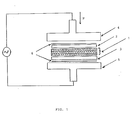
- FIG. 1 schematically showing the general device for implementing the method according to the present invention.
- This sandwich (1) can be composed entirely of polycarbonate sheets or else composed of polycarbonate sheets mixed with sheets of another material such as PVC for example.
- the sandwich thus produced is then preferably placed between two glass plates (2), (3), but in reality it is sufficient for one of the faces of the sandwich to be in contact with a glass plate.
- This glass must have certain characteristics; it must indeed be able to withstand thermal shock as well as compression. You can use a tempered glass or a glass ceramic of the type: vision of Corninge® for this purpose.
- the thickness of the plates varies according to the thickness of the layers to be assembled and can be of the order of 2 to 5 mm.
- the assembly formed of the polycarbonate sandwich surrounded by the two glass plates is then placed between the jaws (4), (5) of the press constituted by two metal blocks. These two metal blocks simultaneously play the role of electrodes for the application of high frequency.
- a sheet (6) of a flexible material is placed between the glass plates and the metal forming each electrode in order to absorb the defects due improper flatness of the electrode surface or the surface of the glass plates in contact with the metal electrode. Indeed, due to the pressure exerted, it is absolutely essential that there is no bending force exerted on the glass plates when they are under pressure.
- cardboard or Teflon® can be used.
- the pressure is established (between 100 and 1000 N / cm2) and the welding is carried out by application of a high frequency.
- the high frequency must have a value capable of exciting the molecular bonds of the polycarbonate and is generally between 25 and 30 MHz and preferably 27.12 MHz. Under these conditions, the application time of the high frequency can be of the order of 5 to 20 s and is generally less than 10 s. After that, it is necessary to wait for the assembly to cool down before separating the polycarbonate sandwich from the glass plates.
- the cooling is carried out by maintaining the sandwich under pressure.
- FIG. 2 schematically illustrates an example of a device for implementing the method for the manufacture of high density magnetic cards.
- the magnetic card that one wishes to produce is a high density magnetic card consisting of a semi-rigid and dimensionally stable support carrying on the major part of at least one of its surfaces a magnetic recording medium formed of particles. magnetic.
- the card support and the magnetic medium itself must have an elastic deformation, that is to say, be able to regain their initial shape, even after repeated bending.
- the card must also be thermally stable to withstand normal environmental temperatures without deformation. For these reasons, we chose to make this polycarbonate card from several superimposed layers.
- This card therefore consists of a number of polycarbonate sheets between 2 and 10 so as to produce a sandwich whose thickness is between 400 ⁇ m and 1000 ⁇ m, at least one of these sheets supporting a magnetic layer.
- These polycarbonate sheets can, for example, be made of LEXA-® (manufactured by General Electric Co).
- the thickness of each sheet varies between 25 and 200 ⁇ m. In fact, better weldability is observed in the case of thin sheets than in the case of thicker sheets, one reason being that the thinner the sheets, the greater the heat losses by conduction through the electrodes will be significant; this implies a greater amount of energy required to weld thin sheets.
- the magnetic layer is also coated on a polycarbonate support whose thickness varies between 25 and 75 ⁇ m.
- the thickness of the magnetic layer is around 5 ⁇ m.
- the card is made from 4 layers of polycarbonate (7), (8), (9), (10), including the one that supports the magnetic layer.
- a first cutting is then carried out by appropriate means (11) so as to have a sandwich having the surface necessary to make 3 cards (or more depending on the dimensions of the press).
- a first weld (12) is made at each corner of the sandwich. This welding can be carried out for example by means of ultrasound.
- the sandwich is then introduced into a device with several stations essentially comprising a press for applying the high frequency (13), a press provided with a cooling circuit (14) and a device for cutting individual cards (15).
- the sandwich passes first between the jaws of the press (13) allowing the high frequency to be applied.
- the pressure is then established and finally welded by applying the high frequency.
- the operating conditions are as follows: - Surface of the sandwich to be welded: 200 mm x 90 mm - Press power: 6 KW - HF frequency: 27.12 MHz. - Pressure on the sandwich: 100 to 200 N / cm2 - Current supplied by the generator: 1.5 A - HF application time: ⁇ 10 s.
- the welding temperature must be higher than the glass transition temperature of the polycarbonate and is generally between 130 and 190 ° C.
- This cooling due to the flatness of the surfaces required for such an application, is done while maintaining the pressure used during welding. This can be done in the press that is used for welding. It then takes about 30 s to go back down to the desired temperature (around 30 to 35 ° C).
- another press (14) is provided with a cooling circuit, an appropriate system being provided for ensuring the transfer of the sandwich under pressure into said press. cooling.
- the sandwich is removed to a cutting station (15) where the individual cards are then produced.
- a preheating device Before introducing the sandwich between the jaws of the high-frequency press, it is passed through a preheating device. It may, for example, be a thermal press, the upper and lower jaws of which are brought to a temperature above 100 ° C. and preferably of the order of 150 ° C. In one embodiment, the duration of this preheating will be between 5 and 10 s. In fact this preheating will allow the polycarbonate to react more quickly to the next station when it is subjected to the high frequency. Indeed, the dielectric losses of the material which allow it to heat up under the effect of the high frequency are very low below a certain temperature (for polycarbonate, this temperature is of the order of 100 ° C) and increase rapidly above this temperature.
- This thermal preheating system performed on a first station (not shown) allows a significant time saving when going to the high frequency welding station.
- This device at successive stations thus makes it possible to manufacture such cards in series and in a completely automated manner.
- this device for welding by means of glass plates has an additional advantage in the case of high density magnetic supports.
Landscapes
- Engineering & Computer Science (AREA)
- Mechanical Engineering (AREA)
- Physics & Mathematics (AREA)
- Thermal Sciences (AREA)
- Lining Or Joining Of Plastics Or The Like (AREA)
- Laminated Bodies (AREA)
- Credit Cards Or The Like (AREA)
Applications Claiming Priority (2)
| Application Number | Priority Date | Filing Date | Title |
|---|---|---|---|
| FR8814222A FR2637837B1 (fr) | 1988-10-18 | 1988-10-18 | Procede de soudage par haute frequence de feuilles thermosoudables dont au moins une est en polycarbonate |
| FR8814222 | 1988-10-18 |
Publications (1)
| Publication Number | Publication Date |
|---|---|
| EP0367687A1 true EP0367687A1 (de) | 1990-05-09 |
Family
ID=9371447
Family Applications (2)
| Application Number | Title | Priority Date | Filing Date |
|---|---|---|---|
| EP19890420398 Pending EP0367687A1 (de) | 1988-10-18 | 1989-10-17 | Verfahren zum Hochfrequenzschweissen von Polycarbonat |
| EP89912247A Revoked EP0439530B1 (de) | 1988-10-18 | 1989-10-17 | Verfahren zum hochfrequenzschweissen von polycarbonat |
Family Applications After (1)
| Application Number | Title | Priority Date | Filing Date |
|---|---|---|---|
| EP89912247A Revoked EP0439530B1 (de) | 1988-10-18 | 1989-10-17 | Verfahren zum hochfrequenzschweissen von polycarbonat |
Country Status (6)
| Country | Link |
|---|---|
| US (1) | US5435878A (de) |
| EP (2) | EP0367687A1 (de) |
| JP (1) | JPH0671764B2 (de) |
| DE (1) | DE68914998T2 (de) |
| FR (1) | FR2637837B1 (de) |
| WO (1) | WO1990004510A1 (de) |
Cited By (1)
| Publication number | Priority date | Publication date | Assignee | Title |
|---|---|---|---|---|
| ES2049559A2 (es) * | 1991-04-15 | 1994-04-16 | Martinez Vela | Sistema para el tratamiento termico de materiales termoplasticos. |
Families Citing this family (10)
| Publication number | Priority date | Publication date | Assignee | Title |
|---|---|---|---|---|
| US20010037978A1 (en) * | 1999-04-20 | 2001-11-08 | Daryl R. Calhoun | Filter assembly having a flexible housing and method of making same |
| US6422397B1 (en) * | 1993-12-22 | 2002-07-23 | Baxter International, Inc. | Blood collection systems including an integral, flexible filter |
| US6367634B1 (en) | 1993-12-22 | 2002-04-09 | Baxter International Inc. | Blood collection systems including an integral, flexible filter |
| DE9408396U1 (de) * | 1994-05-20 | 1994-09-08 | Paul Kiefel GmbH, 83395 Freilassing | Vorrichtung zum HF-Kaschieren von Verkleidungsteilen mit Vakuumunterstützung |
| DE19852633A1 (de) * | 1998-11-14 | 2000-05-18 | Edgar Asmussen | Holzrahmenelement-Produktionsstraße und Verfahren zur beidseitigen flächigen Verleimung von Fertighauselementen |
| TW459225B (en) * | 1999-02-01 | 2001-10-11 | Origin Electric | Bonding system and method |
| US6482330B1 (en) | 1999-10-01 | 2002-11-19 | Komag, Inc. | Method for manufacturing a data storage card |
| DE10016953A1 (de) * | 2000-04-06 | 2001-10-11 | Helinova Ag | Verfahren zur Herstellung einer Verbundplatte |
| US20030209479A1 (en) * | 2000-07-10 | 2003-11-13 | Lynn Daniel R | Blood filters, blood collection and processing systems, and methods therefore |
| US6558491B2 (en) * | 2001-01-09 | 2003-05-06 | Ford Global Technologies, Inc. | Apparatus for ultrasonic welding |
Citations (4)
| Publication number | Priority date | Publication date | Assignee | Title |
|---|---|---|---|---|
| FR2120070A1 (en) * | 1970-12-28 | 1972-08-11 | Ppg Industries Inc | Impact resistant windows - by hot pressing polycarbonate polyacrylate sheets |
| DE2312629B1 (de) * | 1973-03-14 | 1974-01-17 | Hassia Verpackung Ag, 6479 Ranstadt | Vorrichtung zum dielektrischen Schweißen von thermoplastischen Kunststoffen |
| JPS55150321A (en) | 1979-12-20 | 1980-11-22 | Sumitomo Bakelite Co Ltd | High-frequency sealing method of composite film |
| US4678713A (en) | 1984-08-31 | 1987-07-07 | The Dow Chemical Company | Co-extruded laminates containing carbon monoxide interpolymers |
Family Cites Families (6)
| Publication number | Priority date | Publication date | Assignee | Title |
|---|---|---|---|---|
| US1806846A (en) * | 1931-05-26 | Vania | ||
| US2806116A (en) * | 1954-11-01 | 1957-09-10 | Standard Safety Equipment Co | Die |
| US3291671A (en) * | 1962-09-04 | 1966-12-13 | Myer H Hecht | Dielectric fusing of plastic films |
| US3654013A (en) * | 1969-04-14 | 1972-04-04 | Uniroyal Inc | Method of making a formed and bonded plastic sheet structure |
| JPS5211995A (en) * | 1975-07-18 | 1977-01-29 | Fuji Photo Film Co Ltd | Plastic card making process |
| JPS62151323A (ja) * | 1985-12-26 | 1987-07-06 | Nippon Shigyo Kk | 合成樹脂フイルムでラミネ−トされた板紙の接着方法 |
-
1988
- 1988-10-18 FR FR8814222A patent/FR2637837B1/fr not_active Expired - Fee Related
-
1989
- 1989-10-17 WO PCT/FR1989/000541 patent/WO1990004510A1/fr not_active Ceased
- 1989-10-17 DE DE68914998T patent/DE68914998T2/de not_active Revoked
- 1989-10-17 EP EP19890420398 patent/EP0367687A1/de active Pending
- 1989-10-17 JP JP51137589A patent/JPH0671764B2/ja not_active Expired - Fee Related
- 1989-10-17 EP EP89912247A patent/EP0439530B1/de not_active Revoked
-
1991
- 1991-04-18 US US07/678,255 patent/US5435878A/en not_active Expired - Lifetime
Patent Citations (4)
| Publication number | Priority date | Publication date | Assignee | Title |
|---|---|---|---|---|
| FR2120070A1 (en) * | 1970-12-28 | 1972-08-11 | Ppg Industries Inc | Impact resistant windows - by hot pressing polycarbonate polyacrylate sheets |
| DE2312629B1 (de) * | 1973-03-14 | 1974-01-17 | Hassia Verpackung Ag, 6479 Ranstadt | Vorrichtung zum dielektrischen Schweißen von thermoplastischen Kunststoffen |
| JPS55150321A (en) | 1979-12-20 | 1980-11-22 | Sumitomo Bakelite Co Ltd | High-frequency sealing method of composite film |
| US4678713A (en) | 1984-08-31 | 1987-07-07 | The Dow Chemical Company | Co-extruded laminates containing carbon monoxide interpolymers |
Non-Patent Citations (2)
| Title |
|---|
| JAPANESE PATENTS GAZETTE, semaine 8732, 23 septembre 1987, section CH, classe A, page 26, résumé no. 87-225838/32, Derwent Publications Ltd, Londres, GB; & JP-A-62 151 323 (NIPPON SHIGYO K.K.) 06-07-1987 * |
| JAPANESE PATENTS GAZETTE, semaine D05, 11 mars 1981, section CH, classe A, page 2, résumé no. 06553, Derwent Publications Ltd, Londres, GB; & JP-A-55 150 321 (SUMITOMO BAKELITE K.K.) 22-11-1980 * |
Cited By (1)
| Publication number | Priority date | Publication date | Assignee | Title |
|---|---|---|---|---|
| ES2049559A2 (es) * | 1991-04-15 | 1994-04-16 | Martinez Vela | Sistema para el tratamiento termico de materiales termoplasticos. |
Also Published As
| Publication number | Publication date |
|---|---|
| WO1990004510A1 (fr) | 1990-05-03 |
| DE68914998D1 (de) | 1994-06-01 |
| FR2637837A1 (fr) | 1990-04-20 |
| US5435878A (en) | 1995-07-25 |
| JPH03504702A (ja) | 1991-10-17 |
| EP0439530B1 (de) | 1994-04-27 |
| JPH0671764B2 (ja) | 1994-09-14 |
| EP0439530A1 (de) | 1991-08-07 |
| FR2637837B1 (fr) | 1990-12-14 |
| DE68914998T2 (de) | 1994-08-11 |
Similar Documents
| Publication | Publication Date | Title |
|---|---|---|
| EP0439530B1 (de) | Verfahren zum hochfrequenzschweissen von polycarbonat | |
| EP0938412B1 (de) | Verfahren zum Herstellen von Karten | |
| JP4990261B2 (ja) | シート部材の接合方法 | |
| FR2616997A1 (fr) | Support pour circuit imprime, formant drain thermique a dilatation controlee, et procede de fabrication | |
| CN102420114A (zh) | 层压体以及用该层压体制造超薄基片的方法和设备 | |
| TWI309870B (en) | Method and apparatus for peeling surface protective film | |
| WO1999018540A1 (fr) | Procede pour la fabrication d'un dispositif electronique a puce et/ou a antenne et dispositif obtenu par le procede | |
| FR2830983A1 (fr) | Procede de fabrication de couches minces contenant des microcomposants | |
| EP0035425B1 (de) | Verfahren zur Herstellung elektromechanischer Wandler unter Verwendung mindestens einer Polymerfolie und Vorrichtung zur Durchführung dieses Verfahrens | |
| EP0545781A1 (de) | Feder für fliegenden Kopf, Herstellungsverfahren und Maschine dafür | |
| TW201539584A (zh) | 構件剝離方法、構件處理方法、及用於製造半導體晶片之方法 | |
| JP2004246084A (ja) | 加熱定着装置 | |
| JP4393096B2 (ja) | 貼合ローラー | |
| FR2638016A1 (fr) | Procede de traitement de surface de couches magnetiques | |
| JPH06198530A (ja) | 複数枚の板状材の加工方法及び複数枚の板状材の重ね合 わせ方法 | |
| CN106469670A (zh) | 保护带粘贴方法 | |
| FR2763015A1 (fr) | Procede de soudage de feuilles thermoformees de matiere plastique et machine pour la mise en oeuvre de ce procede | |
| KR100227247B1 (ko) | 광 디스크 제조방법 | |
| FR2733553A1 (fr) | Dispositif de contre-collage pour la solidarisation d'une bande metallique et d'une bande de materiau isolant | |
| US20050167866A1 (en) | Method of reducing web distortion | |
| JP5378556B2 (ja) | シート部材の接合方法 | |
| CA2337809A1 (fr) | Procede de realisation d'un contact entre deux couches conductrices separees par une couche isolante | |
| JP3924240B2 (ja) | 光ディスクの製造装置 | |
| JP2023170986A (ja) | ウエーハの生成方法およびウエーハ生成装置 | |
| JP3924230B2 (ja) | 光ディスクの製造方法 |
Legal Events
| Date | Code | Title | Description |
|---|---|---|---|
| PUAI | Public reference made under article 153(3) epc to a published international application that has entered the european phase |
Free format text: ORIGINAL CODE: 0009012 |
|
| AK | Designated contracting states |
Kind code of ref document: A1 Designated state(s): ES |
|
| STAA | Information on the status of an ep patent application or granted ep patent |
Free format text: STATUS: REQUEST FOR EXAMINATION WAS MADE |
|
| 17P | Request for examination filed |
Effective date: 19901102 |
|
| XX | Miscellaneous (additional remarks) |
Free format text: VERFAHREN ABGESCHLOSSEN INFOLGE VERBINDUNG MIT 89912247.7/0439530 (EUROPAEISCHE ANMELDENUMMER/VEROEFFENTLICHUNGSNUMMER) VOM 12.02.93. |