EP0367722A1 - Verfahren zur Herstellung von optisch aktiven Acyloxyazetidinonen - Google Patents
Verfahren zur Herstellung von optisch aktiven Acyloxyazetidinonen Download PDFInfo
- Publication number
- EP0367722A1 EP0367722A1 EP89810804A EP89810804A EP0367722A1 EP 0367722 A1 EP0367722 A1 EP 0367722A1 EP 89810804 A EP89810804 A EP 89810804A EP 89810804 A EP89810804 A EP 89810804A EP 0367722 A1 EP0367722 A1 EP 0367722A1
- Authority
- EP
- European Patent Office
- Prior art keywords
- formula
- hydrogen
- lower alkyl
- compound
- group
- Prior art date
- Legal status (The legal status is an assumption and is not a legal conclusion. Google has not performed a legal analysis and makes no representation as to the accuracy of the status listed.)
- Granted
Links
- 238000004519 manufacturing process Methods 0.000 title 1
- 150000001875 compounds Chemical class 0.000 claims abstract description 80
- 125000000217 alkyl group Chemical group 0.000 claims abstract description 38
- 125000002887 hydroxy group Chemical group [H]O* 0.000 claims abstract description 38
- 239000001257 hydrogen Substances 0.000 claims abstract description 33
- 229910052739 hydrogen Inorganic materials 0.000 claims abstract description 33
- 238000000034 method Methods 0.000 claims abstract description 32
- UFHFLCQGNIYNRP-UHFFFAOYSA-N Hydrogen Chemical compound [H][H] UFHFLCQGNIYNRP-UHFFFAOYSA-N 0.000 claims abstract description 24
- 125000001997 phenyl group Chemical group [H]C1=C([H])C([H])=C(*)C([H])=C1[H] 0.000 claims abstract description 21
- 239000007858 starting material Substances 0.000 claims abstract description 16
- -1 lead tetraacetate Chemical compound 0.000 claims description 78
- 125000006239 protecting group Chemical group 0.000 claims description 27
- 238000006243 chemical reaction Methods 0.000 claims description 23
- 125000002496 methyl group Chemical group [H]C([H])([H])* 0.000 claims description 19
- 238000002360 preparation method Methods 0.000 claims description 11
- 230000002378 acidificating effect Effects 0.000 claims description 8
- 125000005103 alkyl silyl group Chemical group 0.000 claims description 8
- KFSLWBXXFJQRDL-UHFFFAOYSA-N Peracetic acid Chemical compound CC(=O)OO KFSLWBXXFJQRDL-UHFFFAOYSA-N 0.000 claims description 7
- 150000002431 hydrogen Chemical class 0.000 claims description 6
- 125000004029 hydroxymethyl group Chemical group [H]OC([H])([H])* 0.000 claims description 5
- ODIGIKRIUKFKHP-UHFFFAOYSA-N (n-propan-2-yloxycarbonylanilino) acetate Chemical compound CC(C)OC(=O)N(OC(C)=O)C1=CC=CC=C1 ODIGIKRIUKFKHP-UHFFFAOYSA-N 0.000 claims description 4
- NHQDETIJWKXCTC-UHFFFAOYSA-N 3-chloroperbenzoic acid Chemical compound OOC(=O)C1=CC=CC(Cl)=C1 NHQDETIJWKXCTC-UHFFFAOYSA-N 0.000 claims description 4
- 108090000371 Esterases Proteins 0.000 claims description 4
- 125000002485 formyl group Chemical group [H]C(*)=O 0.000 claims description 4
- 125000004435 hydrogen atom Chemical group [H]* 0.000 claims description 4
- 150000004965 peroxy acids Chemical class 0.000 claims description 4
- GLVYLTSKTCWWJR-UHFFFAOYSA-N 2-carbonoperoxoylbenzoic acid Chemical compound OOC(=O)C1=CC=CC=C1C(O)=O GLVYLTSKTCWWJR-UHFFFAOYSA-N 0.000 claims description 3
- 241001468213 Amycolatopsis mediterranei Species 0.000 claims description 3
- 108010055297 Sterol Esterase Proteins 0.000 claims description 3
- 150000004966 inorganic peroxy acids Chemical class 0.000 claims description 3
- 150000004967 organic peroxy acids Chemical class 0.000 claims description 3
- VYZAMTAEIAYCRO-UHFFFAOYSA-N Chromium Chemical compound [Cr] VYZAMTAEIAYCRO-UHFFFAOYSA-N 0.000 claims description 2
- 229910052804 chromium Inorganic materials 0.000 claims description 2
- 239000011651 chromium Substances 0.000 claims description 2
- LXMQZGGLHVSEBA-UHFFFAOYSA-N chromium;trihydrate Chemical compound O.O.O.[Cr] LXMQZGGLHVSEBA-UHFFFAOYSA-N 0.000 claims description 2
- SCKXCAADGDQQCS-UHFFFAOYSA-N Performic acid Chemical compound OOC=O SCKXCAADGDQQCS-UHFFFAOYSA-N 0.000 claims 1
- 102000000019 Sterol Esterase Human genes 0.000 claims 1
- JEHCHYAKAXDFKV-UHFFFAOYSA-J lead tetraacetate Chemical compound CC(=O)O[Pb](OC(C)=O)(OC(C)=O)OC(C)=O JEHCHYAKAXDFKV-UHFFFAOYSA-J 0.000 claims 1
- 150000003952 β-lactams Chemical class 0.000 abstract description 2
- YMWUJEATGCHHMB-UHFFFAOYSA-N Dichloromethane Chemical compound ClCCl YMWUJEATGCHHMB-UHFFFAOYSA-N 0.000 description 102
- XEKOWRVHYACXOJ-UHFFFAOYSA-N Ethyl acetate Chemical compound CCOC(C)=O XEKOWRVHYACXOJ-UHFFFAOYSA-N 0.000 description 57
- VLKZOEOYAKHREP-UHFFFAOYSA-N n-Hexane Chemical compound CCCCCC VLKZOEOYAKHREP-UHFFFAOYSA-N 0.000 description 40
- 239000000243 solution Substances 0.000 description 37
- ZMXDDKWLCZADIW-UHFFFAOYSA-N N,N-Dimethylformamide Chemical compound CN(C)C=O ZMXDDKWLCZADIW-UHFFFAOYSA-N 0.000 description 30
- RTZKZFJDLAIYFH-UHFFFAOYSA-N Diethyl ether Chemical compound CCOCC RTZKZFJDLAIYFH-UHFFFAOYSA-N 0.000 description 28
- 239000000203 mixture Substances 0.000 description 27
- QTBSBXVTEAMEQO-UHFFFAOYSA-N Acetic acid Chemical compound CC(O)=O QTBSBXVTEAMEQO-UHFFFAOYSA-N 0.000 description 26
- HEDRZPFGACZZDS-UHFFFAOYSA-N Chloroform Chemical compound ClC(Cl)Cl HEDRZPFGACZZDS-UHFFFAOYSA-N 0.000 description 26
- XLYOFNOQVPJJNP-UHFFFAOYSA-N water Substances O XLYOFNOQVPJJNP-UHFFFAOYSA-N 0.000 description 26
- 239000002253 acid Substances 0.000 description 23
- UIIMBOGNXHQVGW-UHFFFAOYSA-M Sodium bicarbonate Chemical compound [Na+].OC([O-])=O UIIMBOGNXHQVGW-UHFFFAOYSA-M 0.000 description 22
- WYURNTSHIVDZCO-UHFFFAOYSA-N Tetrahydrofuran Chemical compound C1CCOC1 WYURNTSHIVDZCO-UHFFFAOYSA-N 0.000 description 22
- 239000002904 solvent Substances 0.000 description 17
- LFQSCWFLJHTTHZ-UHFFFAOYSA-N Ethanol Chemical compound CCO LFQSCWFLJHTTHZ-UHFFFAOYSA-N 0.000 description 13
- 239000002585 base Substances 0.000 description 13
- 239000011541 reaction mixture Substances 0.000 description 13
- HEMHJVSKTPXQMS-UHFFFAOYSA-M sodium hydroxide Inorganic materials [OH-].[Na+] HEMHJVSKTPXQMS-UHFFFAOYSA-M 0.000 description 13
- ZMANZCXQSJIPKH-UHFFFAOYSA-N Triethylamine Chemical compound CCN(CC)CC ZMANZCXQSJIPKH-UHFFFAOYSA-N 0.000 description 12
- KRKNYBCHXYNGOX-UHFFFAOYSA-N citric acid Chemical compound OC(=O)CC(O)(C(O)=O)CC(O)=O KRKNYBCHXYNGOX-UHFFFAOYSA-N 0.000 description 12
- 229910052736 halogen Inorganic materials 0.000 description 11
- 150000002367 halogens Chemical group 0.000 description 11
- 235000017557 sodium bicarbonate Nutrition 0.000 description 11
- 229910000030 sodium bicarbonate Inorganic materials 0.000 description 11
- YLQBMQCUIZJEEH-UHFFFAOYSA-N tetrahydrofuran Natural products C=1C=COC=1 YLQBMQCUIZJEEH-UHFFFAOYSA-N 0.000 description 11
- QAOWNCQODCNURD-UHFFFAOYSA-N Sulfuric acid Chemical compound OS(O)(=O)=O QAOWNCQODCNURD-UHFFFAOYSA-N 0.000 description 10
- 150000007513 acids Chemical class 0.000 description 10
- 125000001181 organosilyl group Chemical group [SiH3]* 0.000 description 10
- WEVYAHXRMPXWCK-UHFFFAOYSA-N Acetonitrile Chemical compound CC#N WEVYAHXRMPXWCK-UHFFFAOYSA-N 0.000 description 9
- 229960000583 acetic acid Drugs 0.000 description 9
- 150000001412 amines Chemical class 0.000 description 9
- 239000012043 crude product Substances 0.000 description 9
- RAXXELZNTBOGNW-UHFFFAOYSA-N imidazole Natural products C1=CNC=N1 RAXXELZNTBOGNW-UHFFFAOYSA-N 0.000 description 9
- VYPSYNLAJGMNEJ-UHFFFAOYSA-N Silicium dioxide Chemical compound O=[Si]=O VYPSYNLAJGMNEJ-UHFFFAOYSA-N 0.000 description 8
- 239000000543 intermediate Substances 0.000 description 8
- 229920006395 saturated elastomer Polymers 0.000 description 8
- ZAMOUSCENKQFHK-UHFFFAOYSA-N Chlorine atom Chemical compound [Cl] ZAMOUSCENKQFHK-UHFFFAOYSA-N 0.000 description 7
- VEXZGXHMUGYJMC-UHFFFAOYSA-N Hydrochloric acid Chemical compound Cl VEXZGXHMUGYJMC-UHFFFAOYSA-N 0.000 description 7
- DGAQECJNVWCQMB-PUAWFVPOSA-M Ilexoside XXIX Chemical compound C[C@@H]1CC[C@@]2(CC[C@@]3(C(=CC[C@H]4[C@]3(CC[C@@H]5[C@@]4(CC[C@@H](C5(C)C)OS(=O)(=O)[O-])C)C)[C@@H]2[C@]1(C)O)C)C(=O)O[C@H]6[C@@H]([C@H]([C@@H]([C@H](O6)CO)O)O)O.[Na+] DGAQECJNVWCQMB-PUAWFVPOSA-M 0.000 description 7
- PMZURENOXWZQFD-UHFFFAOYSA-L Sodium Sulfate Chemical compound [Na+].[Na+].[O-]S([O-])(=O)=O PMZURENOXWZQFD-UHFFFAOYSA-L 0.000 description 7
- 125000003545 alkoxy group Chemical group 0.000 description 7
- 229910052799 carbon Inorganic materials 0.000 description 7
- 239000000460 chlorine Substances 0.000 description 7
- 229910052801 chlorine Inorganic materials 0.000 description 7
- 239000012074 organic phase Substances 0.000 description 7
- 230000003647 oxidation Effects 0.000 description 7
- 238000007254 oxidation reaction Methods 0.000 description 7
- 150000003839 salts Chemical class 0.000 description 7
- 239000000741 silica gel Substances 0.000 description 7
- 229910002027 silica gel Inorganic materials 0.000 description 7
- 229910052938 sodium sulfate Inorganic materials 0.000 description 7
- 235000011152 sodium sulphate Nutrition 0.000 description 7
- 238000003756 stirring Methods 0.000 description 7
- OKKJLVBELUTLKV-UHFFFAOYSA-N Methanol Chemical compound OC OKKJLVBELUTLKV-UHFFFAOYSA-N 0.000 description 6
- SJRJJKPEHAURKC-UHFFFAOYSA-N N-Methylmorpholine Chemical compound CN1CCOCC1 SJRJJKPEHAURKC-UHFFFAOYSA-N 0.000 description 6
- 125000002252 acyl group Chemical group 0.000 description 6
- 229910052783 alkali metal Inorganic materials 0.000 description 6
- CTSLXHKWHWQRSH-UHFFFAOYSA-N oxalyl chloride Chemical compound ClC(=O)C(Cl)=O CTSLXHKWHWQRSH-UHFFFAOYSA-N 0.000 description 6
- 239000000725 suspension Substances 0.000 description 6
- FPGGTKZVZWFYPV-UHFFFAOYSA-M tetrabutylammonium fluoride Chemical compound [F-].CCCC[N+](CCCC)(CCCC)CCCC FPGGTKZVZWFYPV-UHFFFAOYSA-M 0.000 description 6
- 125000000026 trimethylsilyl group Chemical group [H]C([H])([H])[Si]([*])(C([H])([H])[H])C([H])([H])[H] 0.000 description 6
- RYHBNJHYFVUHQT-UHFFFAOYSA-N 1,4-Dioxane Chemical compound C1COCCO1 RYHBNJHYFVUHQT-UHFFFAOYSA-N 0.000 description 5
- 125000003342 alkenyl group Chemical group 0.000 description 5
- 150000008064 anhydrides Chemical class 0.000 description 5
- 239000008346 aqueous phase Substances 0.000 description 5
- 230000015572 biosynthetic process Effects 0.000 description 5
- 150000001732 carboxylic acid derivatives Chemical class 0.000 description 5
- 238000001816 cooling Methods 0.000 description 5
- IJKVHSBPTUYDLN-UHFFFAOYSA-N dihydroxy(oxo)silane Chemical compound O[Si](O)=O IJKVHSBPTUYDLN-UHFFFAOYSA-N 0.000 description 5
- 238000011065 in-situ storage Methods 0.000 description 5
- 239000011261 inert gas Substances 0.000 description 5
- KWYUFKZDYYNOTN-UHFFFAOYSA-M potassium hydroxide Inorganic materials [OH-].[K+] KWYUFKZDYYNOTN-UHFFFAOYSA-M 0.000 description 5
- 229910052708 sodium Inorganic materials 0.000 description 5
- MTCFGRXMJLQNBG-REOHCLBHSA-N (2S)-2-Amino-3-hydroxypropansäure Chemical compound OC[C@H](N)C(O)=O MTCFGRXMJLQNBG-REOHCLBHSA-N 0.000 description 4
- OKTJSMMVPCPJKN-UHFFFAOYSA-N Carbon Chemical compound [C] OKTJSMMVPCPJKN-UHFFFAOYSA-N 0.000 description 4
- BVKZGUZCCUSVTD-UHFFFAOYSA-L Carbonate Chemical compound [O-]C([O-])=O BVKZGUZCCUSVTD-UHFFFAOYSA-L 0.000 description 4
- IAZDPXIOMUYVGZ-UHFFFAOYSA-N Dimethylsulphoxide Chemical compound CS(C)=O IAZDPXIOMUYVGZ-UHFFFAOYSA-N 0.000 description 4
- MHAJPDPJQMAIIY-UHFFFAOYSA-N Hydrogen peroxide Chemical compound OO MHAJPDPJQMAIIY-UHFFFAOYSA-N 0.000 description 4
- KFZMGEQAYNKOFK-UHFFFAOYSA-N Isopropanol Chemical compound CC(C)O KFZMGEQAYNKOFK-UHFFFAOYSA-N 0.000 description 4
- AYFVYJQAPQTCCC-GBXIJSLDSA-N L-threonine Chemical compound C[C@@H](O)[C@H](N)C(O)=O AYFVYJQAPQTCCC-GBXIJSLDSA-N 0.000 description 4
- JUJWROOIHBZHMG-UHFFFAOYSA-N Pyridine Chemical compound C1=CC=NC=C1 JUJWROOIHBZHMG-UHFFFAOYSA-N 0.000 description 4
- FAPWRFPIFSIZLT-UHFFFAOYSA-M Sodium chloride Chemical compound [Na+].[Cl-] FAPWRFPIFSIZLT-UHFFFAOYSA-M 0.000 description 4
- DTQVDTLACAAQTR-UHFFFAOYSA-N Trifluoroacetic acid Chemical compound OC(=O)C(F)(F)F DTQVDTLACAAQTR-UHFFFAOYSA-N 0.000 description 4
- 239000007864 aqueous solution Substances 0.000 description 4
- 239000012300 argon atmosphere Substances 0.000 description 4
- 150000001721 carbon Chemical group 0.000 description 4
- BVKZGUZCCUSVTD-UHFFFAOYSA-N carbonic acid Chemical compound OC(O)=O BVKZGUZCCUSVTD-UHFFFAOYSA-N 0.000 description 4
- 239000003054 catalyst Substances 0.000 description 4
- 238000004587 chromatography analysis Methods 0.000 description 4
- 238000003776 cleavage reaction Methods 0.000 description 4
- 239000003480 eluent Substances 0.000 description 4
- 125000001495 ethyl group Chemical group [H]C([H])([H])C([H])([H])* 0.000 description 4
- 239000000284 extract Substances 0.000 description 4
- 238000003818 flash chromatography Methods 0.000 description 4
- YNESATAKKCNGOF-UHFFFAOYSA-N lithium bis(trimethylsilyl)amide Chemical compound [Li+].C[Si](C)(C)[N-][Si](C)(C)C YNESATAKKCNGOF-UHFFFAOYSA-N 0.000 description 4
- 150000002924 oxiranes Chemical class 0.000 description 4
- SCVFZCLFOSHCOH-UHFFFAOYSA-M potassium acetate Chemical compound [K+].CC([O-])=O SCVFZCLFOSHCOH-UHFFFAOYSA-M 0.000 description 4
- 238000001953 recrystallisation Methods 0.000 description 4
- 230000007017 scission Effects 0.000 description 4
- BCNZYOJHNLTNEZ-UHFFFAOYSA-N tert-butyldimethylsilyl chloride Chemical compound CC(C)(C)[Si](C)(C)Cl BCNZYOJHNLTNEZ-UHFFFAOYSA-N 0.000 description 4
- VEPTXBCIDSFGBF-UHFFFAOYSA-M tetrabutylazanium;fluoride;trihydrate Chemical compound O.O.O.[F-].CCCC[N+](CCCC)(CCCC)CCCC VEPTXBCIDSFGBF-UHFFFAOYSA-M 0.000 description 4
- JOXIMZWYDAKGHI-UHFFFAOYSA-N toluene-4-sulfonic acid Chemical compound CC1=CC=C(S(O)(=O)=O)C=C1 JOXIMZWYDAKGHI-UHFFFAOYSA-N 0.000 description 4
- RIOQSEWOXXDEQQ-UHFFFAOYSA-N triphenylphosphine Chemical compound C1=CC=CC=C1P(C=1C=CC=CC=1)C1=CC=CC=C1 RIOQSEWOXXDEQQ-UHFFFAOYSA-N 0.000 description 4
- 125000003903 2-propenyl group Chemical group [H]C([*])([H])C([H])=C([H])[H] 0.000 description 3
- CSCPPACGZOOCGX-UHFFFAOYSA-N Acetone Chemical compound CC(C)=O CSCPPACGZOOCGX-UHFFFAOYSA-N 0.000 description 3
- UHOVQNZJYSORNB-UHFFFAOYSA-N Benzene Chemical compound C1=CC=CC=C1 UHOVQNZJYSORNB-UHFFFAOYSA-N 0.000 description 3
- XBPCUCUWBYBCDP-UHFFFAOYSA-N Dicyclohexylamine Chemical class C1CCCCC1NC1CCCCC1 XBPCUCUWBYBCDP-UHFFFAOYSA-N 0.000 description 3
- 239000004593 Epoxy Substances 0.000 description 3
- LYCAIKOWRPUZTN-UHFFFAOYSA-N Ethylene glycol Chemical compound OCCO LYCAIKOWRPUZTN-UHFFFAOYSA-N 0.000 description 3
- KRHYYFGTRYWZRS-UHFFFAOYSA-M Fluoride anion Chemical compound [F-] KRHYYFGTRYWZRS-UHFFFAOYSA-M 0.000 description 3
- PXGOKWXKJXAPGV-UHFFFAOYSA-N Fluorine Chemical compound FF PXGOKWXKJXAPGV-UHFFFAOYSA-N 0.000 description 3
- WMFOQBRAJBCJND-UHFFFAOYSA-M Lithium hydroxide Chemical compound [Li+].[OH-] WMFOQBRAJBCJND-UHFFFAOYSA-M 0.000 description 3
- ZLMJMSJWJFRBEC-UHFFFAOYSA-N Potassium Chemical compound [K] ZLMJMSJWJFRBEC-UHFFFAOYSA-N 0.000 description 3
- YXFVVABEGXRONW-UHFFFAOYSA-N Toluene Chemical compound CC1=CC=CC=C1 YXFVVABEGXRONW-UHFFFAOYSA-N 0.000 description 3
- 239000000370 acceptor Substances 0.000 description 3
- MNFORVFSTILPAW-UHFFFAOYSA-N azetidin-2-one Chemical class O=C1CCN1 MNFORVFSTILPAW-UHFFFAOYSA-N 0.000 description 3
- 125000001584 benzyloxycarbonyl group Chemical group C(=O)(OCC1=CC=CC=C1)* 0.000 description 3
- 125000004432 carbon atom Chemical group C* 0.000 description 3
- 239000003153 chemical reaction reagent Substances 0.000 description 3
- 239000003795 chemical substances by application Substances 0.000 description 3
- 239000000706 filtrate Substances 0.000 description 3
- 229910052731 fluorine Inorganic materials 0.000 description 3
- 239000011737 fluorine Substances 0.000 description 3
- 239000011521 glass Substances 0.000 description 3
- 150000008282 halocarbons Chemical class 0.000 description 3
- 238000010438 heat treatment Methods 0.000 description 3
- ACKFDYCQCBEDNU-UHFFFAOYSA-J lead(2+);tetraacetate Chemical compound [Pb+2].CC([O-])=O.CC([O-])=O.CC([O-])=O.CC([O-])=O ACKFDYCQCBEDNU-UHFFFAOYSA-J 0.000 description 3
- 229910052744 lithium Inorganic materials 0.000 description 3
- 239000000155 melt Substances 0.000 description 3
- 125000004108 n-butyl group Chemical group [H]C([H])([H])C([H])([H])C([H])([H])C([H])([H])* 0.000 description 3
- 125000000449 nitro group Chemical group [O-][N+](*)=O 0.000 description 3
- 229910052757 nitrogen Inorganic materials 0.000 description 3
- 239000012299 nitrogen atmosphere Substances 0.000 description 3
- 239000003960 organic solvent Substances 0.000 description 3
- 239000007800 oxidant agent Substances 0.000 description 3
- TWNQGVIAIRXVLR-UHFFFAOYSA-N oxo(oxoalumanyloxy)alumane Chemical compound O=[Al]O[Al]=O TWNQGVIAIRXVLR-UHFFFAOYSA-N 0.000 description 3
- 239000012071 phase Substances 0.000 description 3
- UYWQUFXKFGHYNT-UHFFFAOYSA-N phenylmethyl ester of formic acid Natural products O=COCC1=CC=CC=C1 UYWQUFXKFGHYNT-UHFFFAOYSA-N 0.000 description 3
- 150000003254 radicals Chemical class 0.000 description 3
- 238000006798 ring closing metathesis reaction Methods 0.000 description 3
- 239000011734 sodium Substances 0.000 description 3
- 125000000999 tert-butyl group Chemical group [H]C([H])([H])C(*)(C([H])([H])[H])C([H])([H])[H] 0.000 description 3
- WHHCYVBJDLSCRH-AUUYWEPGSA-N (2r,3r)-3-methyl-n,n-diphenacyloxirane-2-carboxamide Chemical compound C[C@H]1O[C@H]1C(=O)N(CC(=O)C=1C=CC=CC=1)CC(=O)C1=CC=CC=C1 WHHCYVBJDLSCRH-AUUYWEPGSA-N 0.000 description 2
- SEDGGCMDYFKAQN-PWNYCUMCSA-N (2r,3r)-3-methyloxirane-2-carboxylic acid Chemical compound C[C@H]1O[C@H]1C(O)=O SEDGGCMDYFKAQN-PWNYCUMCSA-N 0.000 description 2
- OISVCGZHLKNMSJ-UHFFFAOYSA-N 2,6-dimethylpyridine Chemical compound CC1=CC=CC(C)=N1 OISVCGZHLKNMSJ-UHFFFAOYSA-N 0.000 description 2
- KWPQTFXULUUCGD-UHFFFAOYSA-N 3,4,5,7,8,9,10,10a-octahydropyrido[1,2-a][1,4]diazepine Chemical compound C1CCN=CC2CCCCN21 KWPQTFXULUUCGD-UHFFFAOYSA-N 0.000 description 2
- BVKZGUZCCUSVTD-UHFFFAOYSA-M Bicarbonate Chemical compound OC([O-])=O BVKZGUZCCUSVTD-UHFFFAOYSA-M 0.000 description 2
- 102100035687 Bile salt-activated lipase Human genes 0.000 description 2
- LSNNMFCWUKXFEE-UHFFFAOYSA-M Bisulfite Chemical compound OS([O-])=O LSNNMFCWUKXFEE-UHFFFAOYSA-M 0.000 description 2
- WKBOTKDWSSQWDR-UHFFFAOYSA-N Bromine atom Chemical compound [Br] WKBOTKDWSSQWDR-UHFFFAOYSA-N 0.000 description 2
- KRHYYFGTRYWZRS-UHFFFAOYSA-N Fluorane Chemical compound F KRHYYFGTRYWZRS-UHFFFAOYSA-N 0.000 description 2
- WHXSMMKQMYFTQS-UHFFFAOYSA-N Lithium Chemical compound [Li] WHXSMMKQMYFTQS-UHFFFAOYSA-N 0.000 description 2
- YNAVUWVOSKDBBP-UHFFFAOYSA-N Morpholine Chemical compound C1COCCN1 YNAVUWVOSKDBBP-UHFFFAOYSA-N 0.000 description 2
- SECXISVLQFMRJM-UHFFFAOYSA-N N-Methylpyrrolidone Chemical compound CN1CCCC1=O SECXISVLQFMRJM-UHFFFAOYSA-N 0.000 description 2
- PXHVJJICTQNCMI-UHFFFAOYSA-N Nickel Chemical compound [Ni] PXHVJJICTQNCMI-UHFFFAOYSA-N 0.000 description 2
- KDLHZDBZIXYQEI-UHFFFAOYSA-N Palladium Chemical compound [Pd] KDLHZDBZIXYQEI-UHFFFAOYSA-N 0.000 description 2
- NBIIXXVUZAFLBC-UHFFFAOYSA-N Phosphoric acid Chemical compound OP(O)(O)=O NBIIXXVUZAFLBC-UHFFFAOYSA-N 0.000 description 2
- AYFVYJQAPQTCCC-UHFFFAOYSA-N THREONINE Chemical compound CC(O)C(N)C(O)=O AYFVYJQAPQTCCC-UHFFFAOYSA-N 0.000 description 2
- 239000004473 Threonine Substances 0.000 description 2
- YRKCREAYFQTBPV-UHFFFAOYSA-N acetylacetone Chemical compound CC(=O)CC(C)=O YRKCREAYFQTBPV-UHFFFAOYSA-N 0.000 description 2
- 239000012445 acidic reagent Substances 0.000 description 2
- 125000004423 acyloxy group Chemical group 0.000 description 2
- 125000001931 aliphatic group Chemical group 0.000 description 2
- 150000001340 alkali metals Chemical class 0.000 description 2
- 150000003973 alkyl amines Chemical class 0.000 description 2
- 150000001409 amidines Chemical class 0.000 description 2
- 125000005279 aryl sulfonyloxy group Chemical group 0.000 description 2
- 125000004104 aryloxy group Chemical group 0.000 description 2
- 239000012298 atmosphere Substances 0.000 description 2
- 150000001558 benzoic acid derivatives Chemical group 0.000 description 2
- HTZCNXWZYVXIMZ-UHFFFAOYSA-M benzyl(triethyl)azanium;chloride Chemical compound [Cl-].CC[N+](CC)(CC)CC1=CC=CC=C1 HTZCNXWZYVXIMZ-UHFFFAOYSA-M 0.000 description 2
- GDTBXPJZTBHREO-UHFFFAOYSA-N bromine Substances BrBr GDTBXPJZTBHREO-UHFFFAOYSA-N 0.000 description 2
- 229910052794 bromium Inorganic materials 0.000 description 2
- GRWVQDDAKZFPFI-UHFFFAOYSA-H chromium(III) sulfate Chemical compound [Cr+3].[Cr+3].[O-]S([O-])(=O)=O.[O-]S([O-])(=O)=O.[O-]S([O-])(=O)=O GRWVQDDAKZFPFI-UHFFFAOYSA-H 0.000 description 2
- NPOMSUOUAZCMBL-UHFFFAOYSA-N dichloromethane;ethoxyethane Chemical compound ClCCl.CCOCC NPOMSUOUAZCMBL-UHFFFAOYSA-N 0.000 description 2
- XBDQKXXYIPTUBI-UHFFFAOYSA-N dimethylselenoniopropionate Natural products CCC(O)=O XBDQKXXYIPTUBI-UHFFFAOYSA-N 0.000 description 2
- YADSGOSSYOOKMP-UHFFFAOYSA-N dioxolead Chemical compound O=[Pb]=O YADSGOSSYOOKMP-UHFFFAOYSA-N 0.000 description 2
- 150000002148 esters Chemical class 0.000 description 2
- 150000002170 ethers Chemical class 0.000 description 2
- FFUAGWLWBBFQJT-UHFFFAOYSA-N hexamethyldisilazane Chemical compound C[Si](C)(C)N[Si](C)(C)C FFUAGWLWBBFQJT-UHFFFAOYSA-N 0.000 description 2
- GNOIPBMMFNIUFM-UHFFFAOYSA-N hexamethylphosphoric triamide Chemical compound CN(C)P(=O)(N(C)C)N(C)C GNOIPBMMFNIUFM-UHFFFAOYSA-N 0.000 description 2
- 238000004128 high performance liquid chromatography Methods 0.000 description 2
- SHFJWMWCIHQNCP-UHFFFAOYSA-M hydron;tetrabutylazanium;sulfate Chemical compound OS([O-])(=O)=O.CCCC[N+](CCCC)(CCCC)CCCC SHFJWMWCIHQNCP-UHFFFAOYSA-M 0.000 description 2
- 239000012442 inert solvent Substances 0.000 description 2
- 229910052500 inorganic mineral Inorganic materials 0.000 description 2
- 125000000959 isobutyl group Chemical group [H]C([H])([H])C([H])(C([H])([H])[H])C([H])([H])* 0.000 description 2
- 125000001449 isopropyl group Chemical group [H]C([H])([H])C([H])(*)C([H])([H])[H] 0.000 description 2
- ZCSHNCUQKCANBX-UHFFFAOYSA-N lithium diisopropylamide Chemical compound [Li+].CC(C)[N-]C(C)C ZCSHNCUQKCANBX-UHFFFAOYSA-N 0.000 description 2
- 125000005948 methanesulfonyloxy group Chemical group 0.000 description 2
- 125000000956 methoxy group Chemical group [H]C([H])([H])O* 0.000 description 2
- 125000004184 methoxymethyl group Chemical group [H]C([H])([H])OC([H])([H])* 0.000 description 2
- 235000010755 mineral Nutrition 0.000 description 2
- 239000011707 mineral Substances 0.000 description 2
- 125000004123 n-propyl group Chemical group [H]C([H])([H])C([H])([H])C([H])([H])* 0.000 description 2
- 150000002825 nitriles Chemical class 0.000 description 2
- 125000004433 nitrogen atom Chemical group N* 0.000 description 2
- 230000001590 oxidative effect Effects 0.000 description 2
- 125000000636 p-nitrophenyl group Chemical group [H]C1=C([H])C(=C([H])C([H])=C1*)[N+]([O-])=O 0.000 description 2
- NFHFRUOZVGFOOS-UHFFFAOYSA-N palladium;triphenylphosphane Chemical compound [Pd].C1=CC=CC=C1P(C=1C=CC=CC=1)C1=CC=CC=C1.C1=CC=CC=C1P(C=1C=CC=CC=1)C1=CC=CC=C1.C1=CC=CC=C1P(C=1C=CC=CC=1)C1=CC=CC=C1.C1=CC=CC=C1P(C=1C=CC=CC=1)C1=CC=CC=C1 NFHFRUOZVGFOOS-UHFFFAOYSA-N 0.000 description 2
- 210000000496 pancreas Anatomy 0.000 description 2
- 239000008363 phosphate buffer Substances 0.000 description 2
- XHXFXVLFKHQFAL-UHFFFAOYSA-N phosphoryl trichloride Chemical compound ClP(Cl)(Cl)=O XHXFXVLFKHQFAL-UHFFFAOYSA-N 0.000 description 2
- BASFCYQUMIYNBI-UHFFFAOYSA-N platinum Chemical compound [Pt] BASFCYQUMIYNBI-UHFFFAOYSA-N 0.000 description 2
- 229910052700 potassium Inorganic materials 0.000 description 2
- 239000011591 potassium Substances 0.000 description 2
- 235000011056 potassium acetate Nutrition 0.000 description 2
- BWHMMNNQKKPAPP-UHFFFAOYSA-L potassium carbonate Chemical compound [K+].[K+].[O-]C([O-])=O BWHMMNNQKKPAPP-UHFFFAOYSA-L 0.000 description 2
- 239000000047 product Substances 0.000 description 2
- UMJSCPRVCHMLSP-UHFFFAOYSA-N pyridine Natural products COC1=CC=CN=C1 UMJSCPRVCHMLSP-UHFFFAOYSA-N 0.000 description 2
- 238000007363 ring formation reaction Methods 0.000 description 2
- 229960001153 serine Drugs 0.000 description 2
- 239000001632 sodium acetate Substances 0.000 description 2
- 235000017281 sodium acetate Nutrition 0.000 description 2
- 239000011780 sodium chloride Substances 0.000 description 2
- PUZPDOWCWNUUKD-UHFFFAOYSA-M sodium fluoride Chemical compound [F-].[Na+] PUZPDOWCWNUUKD-UHFFFAOYSA-M 0.000 description 2
- 239000011877 solvent mixture Substances 0.000 description 2
- 238000003797 solvolysis reaction Methods 0.000 description 2
- 125000001424 substituent group Chemical group 0.000 description 2
- LLRUTAYHFGZYII-ZWNOBZJWSA-N tert-butyl 2-[[(2r,3r)-3-methyloxirane-2-carbonyl]-[2-[(2-methylpropan-2-yl)oxy]-2-oxoethyl]amino]acetate Chemical compound C[C@H]1O[C@H]1C(=O)N(CC(=O)OC(C)(C)C)CC(=O)OC(C)(C)C LLRUTAYHFGZYII-ZWNOBZJWSA-N 0.000 description 2
- 238000004809 thin layer chromatography Methods 0.000 description 2
- FYSNRJHAOHDILO-UHFFFAOYSA-N thionyl chloride Chemical compound ClS(Cl)=O FYSNRJHAOHDILO-UHFFFAOYSA-N 0.000 description 2
- 229960002898 threonine Drugs 0.000 description 2
- QAEDZJGFFMLHHQ-UHFFFAOYSA-N trifluoroacetic anhydride Chemical compound FC(F)(F)C(=O)OC(=O)C(F)(F)F QAEDZJGFFMLHHQ-UHFFFAOYSA-N 0.000 description 2
- NGCRXXLKJAAUQQ-UHFFFAOYSA-N undec-5-ene Chemical compound CCCCCC=CCCCC NGCRXXLKJAAUQQ-UHFFFAOYSA-N 0.000 description 2
- FMAZQSYXRGRESX-UWTATZPHSA-N (2r)-oxirane-2-carboxamide Chemical compound NC(=O)[C@H]1CO1 FMAZQSYXRGRESX-UWTATZPHSA-N 0.000 description 1
- NRNIEDYEYVBIMW-PWNYCUMCSA-N (2r,3r)-3-methyloxirane-2-carboxamide Chemical compound C[C@H]1O[C@H]1C(N)=O NRNIEDYEYVBIMW-PWNYCUMCSA-N 0.000 description 1
- NXLNNXIXOYSCMB-UHFFFAOYSA-N (4-nitrophenyl) carbonochloridate Chemical compound [O-][N+](=O)C1=CC=C(OC(Cl)=O)C=C1 NXLNNXIXOYSCMB-UHFFFAOYSA-N 0.000 description 1
- BDNKZNFMNDZQMI-UHFFFAOYSA-N 1,3-diisopropylcarbodiimide Chemical group CC(C)N=C=NC(C)C BDNKZNFMNDZQMI-UHFFFAOYSA-N 0.000 description 1
- SGUVLZREKBPKCE-UHFFFAOYSA-N 1,5-diazabicyclo[4.3.0]-non-5-ene Chemical compound C1CCN=C2CCCN21 SGUVLZREKBPKCE-UHFFFAOYSA-N 0.000 description 1
- 125000004066 1-hydroxyethyl group Chemical group [H]OC([H])([*])C([H])([H])[H] 0.000 description 1
- 125000000453 2,2,2-trichloroethyl group Chemical group [H]C([H])(*)C(Cl)(Cl)Cl 0.000 description 1
- XYPISWUKQGWYGX-UHFFFAOYSA-N 2,2,2-trifluoroethaneperoxoic acid Chemical compound OOC(=O)C(F)(F)F XYPISWUKQGWYGX-UHFFFAOYSA-N 0.000 description 1
- JKTCBAGSMQIFNL-UHFFFAOYSA-N 2,3-dihydrofuran Chemical compound C1CC=CO1 JKTCBAGSMQIFNL-UHFFFAOYSA-N 0.000 description 1
- IKELPXYKMZNKBY-UHFFFAOYSA-N 2-[(1-carboxy-2,2-dimethylpropyl)amino]-3,3-dimethylbutanoic acid Chemical compound C(C)(C)(C)C(C(=O)O)NC(C(=O)O)C(C)(C)C IKELPXYKMZNKBY-UHFFFAOYSA-N 0.000 description 1
- 125000004182 2-chlorophenyl group Chemical group [H]C1=C([H])C(Cl)=C(*)C([H])=C1[H] 0.000 description 1
- CRPFKUKPDCBUIX-UHFFFAOYSA-N 2-ethyl-5-phenyl-1,2-oxazol-2-ium-3-sulfonate Chemical compound [O-]S(=O)(=O)C1=[N+](CC)OC(C=2C=CC=CC=2)=C1 CRPFKUKPDCBUIX-UHFFFAOYSA-N 0.000 description 1
- MPSXGPCFLAGJOM-UHFFFAOYSA-M 2-tert-butyl-5-methyl-1,2-oxazol-2-ium;perchlorate Chemical compound [O-]Cl(=O)(=O)=O.CC1=CC=[N+](C(C)(C)C)O1 MPSXGPCFLAGJOM-UHFFFAOYSA-M 0.000 description 1
- MGADZUXDNSDTHW-UHFFFAOYSA-N 2H-pyran Chemical compound C1OC=CC=C1 MGADZUXDNSDTHW-UHFFFAOYSA-N 0.000 description 1
- BVXMSQWCZAGNTO-UHFFFAOYSA-N 3,5-dinitrobenzenecarboperoxoic acid Chemical compound OOC(=O)C1=CC([N+]([O-])=O)=CC([N+]([O-])=O)=C1 BVXMSQWCZAGNTO-UHFFFAOYSA-N 0.000 description 1
- YNJSNEKCXVFDKW-UHFFFAOYSA-N 3-(5-amino-1h-indol-3-yl)-2-azaniumylpropanoate Chemical compound C1=C(N)C=C2C(CC(N)C(O)=O)=CNC2=C1 YNJSNEKCXVFDKW-UHFFFAOYSA-N 0.000 description 1
- 125000004179 3-chlorophenyl group Chemical group [H]C1=C([H])C(*)=C([H])C(Cl)=C1[H] 0.000 description 1
- OSWFIVFLDKOXQC-UHFFFAOYSA-N 4-(3-methoxyphenyl)aniline Chemical compound COC1=CC=CC(C=2C=CC(N)=CC=2)=C1 OSWFIVFLDKOXQC-UHFFFAOYSA-N 0.000 description 1
- 125000001999 4-Methoxybenzoyl group Chemical group [H]C1=C([H])C(=C([H])C([H])=C1OC([H])([H])[H])C(*)=O 0.000 description 1
- 125000000242 4-chlorobenzoyl group Chemical group ClC1=CC=C(C(=O)*)C=C1 0.000 description 1
- ZJAFQAPHWPSKRZ-UHFFFAOYSA-N 4-nitrobenzenecarboperoxoic acid Chemical compound OOC(=O)C1=CC=C([N+]([O-])=O)C=C1 ZJAFQAPHWPSKRZ-UHFFFAOYSA-N 0.000 description 1
- YSPMLLKKKHCTBN-UHFFFAOYSA-N 4-oxoazetidine-2-carboxylic acid Chemical compound OC(=O)C1CC(=O)N1 YSPMLLKKKHCTBN-UHFFFAOYSA-N 0.000 description 1
- QTBSBXVTEAMEQO-UHFFFAOYSA-M Acetate Chemical compound CC([O-])=O QTBSBXVTEAMEQO-UHFFFAOYSA-M 0.000 description 1
- 108010013043 Acetylesterase Proteins 0.000 description 1
- XKRFYHLGVUSROY-UHFFFAOYSA-N Argon Chemical compound [Ar] XKRFYHLGVUSROY-UHFFFAOYSA-N 0.000 description 1
- IJGRMHOSHXDMSA-UHFFFAOYSA-N Atomic nitrogen Chemical compound N#N IJGRMHOSHXDMSA-UHFFFAOYSA-N 0.000 description 1
- 238000006220 Baeyer-Villiger oxidation reaction Methods 0.000 description 1
- 239000005711 Benzoic acid Substances 0.000 description 1
- WPYMKLBDIGXBTP-UHFFFAOYSA-N Benzoic acid Natural products OC(=O)C1=CC=CC=C1 WPYMKLBDIGXBTP-UHFFFAOYSA-N 0.000 description 1
- CPELXLSAUQHCOX-UHFFFAOYSA-M Bromide Chemical compound [Br-] CPELXLSAUQHCOX-UHFFFAOYSA-M 0.000 description 1
- 0 CCC(C)(CC)C(C)(CC*1)C1C(C)C Chemical compound CCC(C)(CC)C(C)(CC*1)C1C(C)C 0.000 description 1
- BYPMTMVJKDCBPI-QLVNRRSVSA-N CCN(C)C[C@@H](C1)[C@@H]2C1C2C Chemical compound CCN(C)C[C@@H](C1)[C@@H]2C1C2C BYPMTMVJKDCBPI-QLVNRRSVSA-N 0.000 description 1
- QOSSAOTZNIDXMA-UHFFFAOYSA-N Dicylcohexylcarbodiimide Chemical compound C1CCCCC1N=C=NC1CCCCC1 QOSSAOTZNIDXMA-UHFFFAOYSA-N 0.000 description 1
- XTHFKEDIFFGKHM-UHFFFAOYSA-N Dimethoxyethane Chemical compound COCCOC XTHFKEDIFFGKHM-UHFFFAOYSA-N 0.000 description 1
- 108090000790 Enzymes Proteins 0.000 description 1
- 102000004190 Enzymes Human genes 0.000 description 1
- 108090000604 Hydrolases Proteins 0.000 description 1
- 102000004157 Hydrolases Human genes 0.000 description 1
- VQTUBCCKSQIDNK-UHFFFAOYSA-N Isobutene Chemical group CC(C)=C VQTUBCCKSQIDNK-UHFFFAOYSA-N 0.000 description 1
- 239000005909 Kieselgur Substances 0.000 description 1
- FYYHWMGAXLPEAU-UHFFFAOYSA-N Magnesium Chemical compound [Mg] FYYHWMGAXLPEAU-UHFFFAOYSA-N 0.000 description 1
- 102100036617 Monoacylglycerol lipase ABHD2 Human genes 0.000 description 1
- 229920000557 Nafion® Polymers 0.000 description 1
- XYFCBTPGUUZFHI-UHFFFAOYSA-N Phosphine Natural products P XYFCBTPGUUZFHI-UHFFFAOYSA-N 0.000 description 1
- 239000004721 Polyphenylene oxide Substances 0.000 description 1
- 229930189077 Rifamycin Natural products 0.000 description 1
- UIIMBOGNXHQVGW-DEQYMQKBSA-M Sodium bicarbonate-14C Chemical compound [Na+].O[14C]([O-])=O UIIMBOGNXHQVGW-DEQYMQKBSA-M 0.000 description 1
- 241000534944 Thia Species 0.000 description 1
- 229910001069 Ti alloy Inorganic materials 0.000 description 1
- DTQVDTLACAAQTR-UHFFFAOYSA-M Trifluoroacetate Chemical compound [O-]C(=O)C(F)(F)F DTQVDTLACAAQTR-UHFFFAOYSA-M 0.000 description 1
- HCHKCACWOHOZIP-UHFFFAOYSA-N Zinc Chemical compound [Zn] HCHKCACWOHOZIP-UHFFFAOYSA-N 0.000 description 1
- AZFNGPAYDKGCRB-XCPIVNJJSA-M [(1s,2s)-2-amino-1,2-diphenylethyl]-(4-methylphenyl)sulfonylazanide;chlororuthenium(1+);1-methyl-4-propan-2-ylbenzene Chemical compound [Ru+]Cl.CC(C)C1=CC=C(C)C=C1.C1=CC(C)=CC=C1S(=O)(=O)[N-][C@@H](C=1C=CC=CC=1)[C@@H](N)C1=CC=CC=C1 AZFNGPAYDKGCRB-XCPIVNJJSA-M 0.000 description 1
- 125000002777 acetyl group Chemical group [H]C([H])([H])C(*)=O 0.000 description 1
- 125000003668 acetyloxy group Chemical group [H]C([H])([H])C(=O)O[*] 0.000 description 1
- 150000001298 alcohols Chemical class 0.000 description 1
- 150000001335 aliphatic alkanes Chemical class 0.000 description 1
- 239000003513 alkali Substances 0.000 description 1
- 229910001854 alkali hydroxide Inorganic materials 0.000 description 1
- 150000001339 alkali metal compounds Chemical class 0.000 description 1
- 229910001515 alkali metal fluoride Inorganic materials 0.000 description 1
- 229910001508 alkali metal halide Inorganic materials 0.000 description 1
- 150000008045 alkali metal halides Chemical class 0.000 description 1
- 150000008044 alkali metal hydroxides Chemical class 0.000 description 1
- 229910052784 alkaline earth metal Inorganic materials 0.000 description 1
- 229910001860 alkaline earth metal hydroxide Inorganic materials 0.000 description 1
- 125000005092 alkenyloxycarbonyl group Chemical group 0.000 description 1
- 125000004453 alkoxycarbonyl group Chemical group 0.000 description 1
- 125000005210 alkyl ammonium group Chemical group 0.000 description 1
- 125000004390 alkyl sulfonyl group Chemical group 0.000 description 1
- 125000005278 alkyl sulfonyloxy group Chemical group 0.000 description 1
- 150000001408 amides Chemical class 0.000 description 1
- 125000003277 amino group Chemical group 0.000 description 1
- 239000003242 anti bacterial agent Substances 0.000 description 1
- 229940088710 antibiotic agent Drugs 0.000 description 1
- 229910052786 argon Inorganic materials 0.000 description 1
- 125000003435 aroyl group Chemical group 0.000 description 1
- 125000003118 aryl group Chemical group 0.000 description 1
- 125000004391 aryl sulfonyl group Chemical group 0.000 description 1
- 235000010233 benzoic acid Nutrition 0.000 description 1
- 125000003236 benzoyl group Chemical group [H]C1=C([H])C([H])=C(C([H])=C1[H])C(*)=O 0.000 description 1
- 125000001231 benzoyloxy group Chemical group C(C1=CC=CC=C1)(=O)O* 0.000 description 1
- 125000000051 benzyloxy group Chemical group [H]C1=C([H])C([H])=C(C([H])=C1[H])C([H])([H])O* 0.000 description 1
- 238000009835 boiling Methods 0.000 description 1
- 239000000872 buffer Substances 0.000 description 1
- 239000007853 buffer solution Substances 0.000 description 1
- 244000309464 bull Species 0.000 description 1
- 125000004106 butoxy group Chemical group [*]OC([H])([H])C([H])([H])C(C([H])([H])[H])([H])[H] 0.000 description 1
- 239000006227 byproduct Substances 0.000 description 1
- 125000001589 carboacyl group Chemical group 0.000 description 1
- 150000001718 carbodiimides Chemical class 0.000 description 1
- PFKFTWBEEFSNDU-UHFFFAOYSA-N carbonyldiimidazole Chemical compound C1=CN=CN1C(=O)N1C=CN=C1 PFKFTWBEEFSNDU-UHFFFAOYSA-N 0.000 description 1
- 238000009903 catalytic hydrogenation reaction Methods 0.000 description 1
- 239000003638 chemical reducing agent Substances 0.000 description 1
- KIGALSBMRYYLFJ-UHFFFAOYSA-N chloro-(2,3-dimethylbutan-2-yl)-dimethylsilane Chemical compound CC(C)C(C)(C)[Si](C)(C)Cl KIGALSBMRYYLFJ-UHFFFAOYSA-N 0.000 description 1
- IJOOHPMOJXWVHK-UHFFFAOYSA-N chlorotrimethylsilane Chemical compound C[Si](C)(C)Cl IJOOHPMOJXWVHK-UHFFFAOYSA-N 0.000 description 1
- 238000013375 chromatographic separation Methods 0.000 description 1
- 238000011097 chromatography purification Methods 0.000 description 1
- 229940117975 chromium trioxide Drugs 0.000 description 1
- WGLPBDUCMAPZCE-UHFFFAOYSA-N chromium trioxide Inorganic materials O=[Cr](=O)=O WGLPBDUCMAPZCE-UHFFFAOYSA-N 0.000 description 1
- GAMDZJFZMJECOS-UHFFFAOYSA-N chromium(6+);oxygen(2-) Chemical compound [O-2].[O-2].[O-2].[Cr+6] GAMDZJFZMJECOS-UHFFFAOYSA-N 0.000 description 1
- 239000004927 clay Substances 0.000 description 1
- 150000003983 crown ethers Chemical class 0.000 description 1
- 238000006114 decarboxylation reaction Methods 0.000 description 1
- 238000007257 deesterification reaction Methods 0.000 description 1
- 150000001990 dicarboxylic acid derivatives Chemical class 0.000 description 1
- FBCCMZVIWNDFMO-UHFFFAOYSA-N dichloroacetyl chloride Chemical compound ClC(Cl)C(Cl)=O FBCCMZVIWNDFMO-UHFFFAOYSA-N 0.000 description 1
- 150000005690 diesters Chemical class 0.000 description 1
- BADXJIPKFRBFOT-UHFFFAOYSA-N dimedone Chemical compound CC1(C)CC(=O)CC(=O)C1 BADXJIPKFRBFOT-UHFFFAOYSA-N 0.000 description 1
- HPYNZHMRTTWQTB-UHFFFAOYSA-N dimethylpyridine Natural products CC1=CC=CN=C1C HPYNZHMRTTWQTB-UHFFFAOYSA-N 0.000 description 1
- ZPWVASYFFYYZEW-UHFFFAOYSA-L dipotassium hydrogen phosphate Chemical compound [K+].[K+].OP([O-])([O-])=O ZPWVASYFFYYZEW-UHFFFAOYSA-L 0.000 description 1
- 229910000396 dipotassium phosphate Inorganic materials 0.000 description 1
- 235000019797 dipotassium phosphate Nutrition 0.000 description 1
- 238000005868 electrolysis reaction Methods 0.000 description 1
- 230000008030 elimination Effects 0.000 description 1
- 238000003379 elimination reaction Methods 0.000 description 1
- 238000010828 elution Methods 0.000 description 1
- 230000002255 enzymatic effect Effects 0.000 description 1
- ZKQFHRVKCYFVCN-UHFFFAOYSA-N ethoxyethane;hexane Chemical compound CCOCC.CCCCCC ZKQFHRVKCYFVCN-UHFFFAOYSA-N 0.000 description 1
- XYIBRDXRRQCHLP-UHFFFAOYSA-N ethyl acetoacetate Chemical compound CCOC(=O)CC(C)=O XYIBRDXRRQCHLP-UHFFFAOYSA-N 0.000 description 1
- 238000001914 filtration Methods 0.000 description 1
- 150000002222 fluorine compounds Chemical class 0.000 description 1
- BDAGIHXWWSANSR-UHFFFAOYSA-N formic acid Substances OC=O BDAGIHXWWSANSR-UHFFFAOYSA-N 0.000 description 1
- 239000012362 glacial acetic acid Substances 0.000 description 1
- 229910021397 glassy carbon Inorganic materials 0.000 description 1
- 239000010439 graphite Substances 0.000 description 1
- 229910002804 graphite Inorganic materials 0.000 description 1
- 150000004820 halides Chemical class 0.000 description 1
- 125000005843 halogen group Chemical group 0.000 description 1
- 230000002140 halogenating effect Effects 0.000 description 1
- 238000005984 hydrogenation reaction Methods 0.000 description 1
- 230000007062 hydrolysis Effects 0.000 description 1
- 238000006460 hydrolysis reaction Methods 0.000 description 1
- 230000003301 hydrolyzing effect Effects 0.000 description 1
- 239000005457 ice water Substances 0.000 description 1
- PNDPGZBMCMUPRI-UHFFFAOYSA-N iodine Chemical compound II PNDPGZBMCMUPRI-UHFFFAOYSA-N 0.000 description 1
- 238000005342 ion exchange Methods 0.000 description 1
- ZACYQVZHFIYKMW-UHFFFAOYSA-N iridium titanium Chemical compound [Ti].[Ir] ZACYQVZHFIYKMW-UHFFFAOYSA-N 0.000 description 1
- 238000006317 isomerization reaction Methods 0.000 description 1
- CTAPFRYPJLPFDF-UHFFFAOYSA-N isoxazole Chemical class C=1C=NOC=1 CTAPFRYPJLPFDF-UHFFFAOYSA-N 0.000 description 1
- 239000010410 layer Substances 0.000 description 1
- UBJFKNSINUCEAL-UHFFFAOYSA-N lithium;2-methylpropane Chemical compound [Li+].C[C-](C)C UBJFKNSINUCEAL-UHFFFAOYSA-N 0.000 description 1
- 239000011777 magnesium Substances 0.000 description 1
- 229910052749 magnesium Inorganic materials 0.000 description 1
- 159000000003 magnesium salts Chemical class 0.000 description 1
- 238000002844 melting Methods 0.000 description 1
- 230000008018 melting Effects 0.000 description 1
- 150000002736 metal compounds Chemical class 0.000 description 1
- GPKUICFDWYEPTK-UHFFFAOYSA-N methoxycyclohexatriene Chemical compound COC1=CC=C=C[CH]1 GPKUICFDWYEPTK-UHFFFAOYSA-N 0.000 description 1
- 125000004170 methylsulfonyl group Chemical group [H]C([H])([H])S(*)(=O)=O 0.000 description 1
- 150000007522 mineralic acids Chemical class 0.000 description 1
- UHAAFJWANJYDIS-UHFFFAOYSA-N n,n'-diethylmethanediimine Chemical group CCN=C=NCC UHAAFJWANJYDIS-UHFFFAOYSA-N 0.000 description 1
- CATWEXRJGNBIJD-UHFFFAOYSA-N n-tert-butyl-2-methylpropan-2-amine Chemical compound CC(C)(C)NC(C)(C)C CATWEXRJGNBIJD-UHFFFAOYSA-N 0.000 description 1
- 230000007935 neutral effect Effects 0.000 description 1
- 229910052759 nickel Inorganic materials 0.000 description 1
- 150000002826 nitrites Chemical class 0.000 description 1
- 229910000510 noble metal Inorganic materials 0.000 description 1
- 239000012044 organic layer Substances 0.000 description 1
- 125000001477 organic nitrogen group Chemical group 0.000 description 1
- MUMZUERVLWJKNR-UHFFFAOYSA-N oxoplatinum Chemical compound [Pt]=O MUMZUERVLWJKNR-UHFFFAOYSA-N 0.000 description 1
- 125000003854 p-chlorophenyl group Chemical group [H]C1=C([H])C(*)=C([H])C([H])=C1Cl 0.000 description 1
- 125000003232 p-nitrobenzoyl group Chemical group [N+](=O)([O-])C1=CC=C(C(=O)*)C=C1 0.000 description 1
- 125000001037 p-tolyl group Chemical group [H]C1=C([H])C(=C([H])C([H])=C1*)C([H])([H])[H] 0.000 description 1
- 229910052763 palladium Inorganic materials 0.000 description 1
- HHXMXAQDOUCLDN-RXMQYKEDSA-N penem Chemical compound S1C=CN2C(=O)C[C@H]21 HHXMXAQDOUCLDN-RXMQYKEDSA-N 0.000 description 1
- 239000003208 petroleum Substances 0.000 description 1
- 239000003444 phase transfer catalyst Substances 0.000 description 1
- LIGACIXOYTUXAW-UHFFFAOYSA-N phenacyl bromide Chemical compound BrCC(=O)C1=CC=CC=C1 LIGACIXOYTUXAW-UHFFFAOYSA-N 0.000 description 1
- IMACFCSSMIZSPP-UHFFFAOYSA-N phenacyl chloride Chemical compound ClCC(=O)C1=CC=CC=C1 IMACFCSSMIZSPP-UHFFFAOYSA-N 0.000 description 1
- CVXGFPPAIUELDV-UHFFFAOYSA-N phenacylazanium;chloride Chemical compound [Cl-].[NH3+]CC(=O)C1=CC=CC=C1 CVXGFPPAIUELDV-UHFFFAOYSA-N 0.000 description 1
- 239000008055 phosphate buffer solution Substances 0.000 description 1
- 235000011007 phosphoric acid Nutrition 0.000 description 1
- 229910000073 phosphorus hydride Inorganic materials 0.000 description 1
- 229910052697 platinum Inorganic materials 0.000 description 1
- 229910003446 platinum oxide Inorganic materials 0.000 description 1
- 239000002798 polar solvent Substances 0.000 description 1
- 229920000570 polyether Polymers 0.000 description 1
- 229920000915 polyvinyl chloride Polymers 0.000 description 1
- 239000004800 polyvinyl chloride Substances 0.000 description 1
- 235000015277 pork Nutrition 0.000 description 1
- IUBQJLUDMLPAGT-UHFFFAOYSA-N potassium bis(trimethylsilyl)amide Chemical compound C[Si](C)(C)N([K])[Si](C)(C)C IUBQJLUDMLPAGT-UHFFFAOYSA-N 0.000 description 1
- 229910000027 potassium carbonate Inorganic materials 0.000 description 1
- 239000004304 potassium nitrite Substances 0.000 description 1
- 235000010289 potassium nitrite Nutrition 0.000 description 1
- ITLLFVIOXCEGQS-UHFFFAOYSA-L potassium sodium hydroxy-oxido-oxo-sulfanylidene-lambda6-sulfane iodide Chemical compound S(=S)(=O)([O-])O.[Na+].[I-].[K+] ITLLFVIOXCEGQS-UHFFFAOYSA-L 0.000 description 1
- 235000019260 propionic acid Nutrition 0.000 description 1
- 125000004309 pyranyl group Chemical group O1C(C=CC=C1)* 0.000 description 1
- IUVKMZGDUIUOCP-BTNSXGMBSA-N quinbolone Chemical compound O([C@H]1CC[C@H]2[C@H]3[C@@H]([C@]4(C=CC(=O)C=C4CC3)C)CC[C@@]21C)C1=CCCC1 IUVKMZGDUIUOCP-BTNSXGMBSA-N 0.000 description 1
- 239000000376 reactant Substances 0.000 description 1
- 230000000717 retained effect Effects 0.000 description 1
- 229960003292 rifamycin Drugs 0.000 description 1
- HJYYPODYNSCCOU-ODRIEIDWSA-N rifamycin SV Chemical compound OC1=C(C(O)=C2C)C3=C(O)C=C1NC(=O)\C(C)=C/C=C/[C@H](C)[C@H](O)[C@@H](C)[C@@H](O)[C@@H](C)[C@H](OC(C)=O)[C@H](C)[C@@H](OC)\C=C\O[C@@]1(C)OC2=C3C1=O HJYYPODYNSCCOU-ODRIEIDWSA-N 0.000 description 1
- 125000006413 ring segment Chemical group 0.000 description 1
- DCKVNWZUADLDEH-UHFFFAOYSA-N sec-butyl acetate Chemical compound CCC(C)OC(C)=O DCKVNWZUADLDEH-UHFFFAOYSA-N 0.000 description 1
- 125000004469 siloxy group Chemical group [SiH3]O* 0.000 description 1
- 125000003808 silyl group Chemical group [H][Si]([H])([H])[*] 0.000 description 1
- 239000011775 sodium fluoride Substances 0.000 description 1
- 235000013024 sodium fluoride Nutrition 0.000 description 1
- 150000003431 steroids Chemical class 0.000 description 1
- 150000003460 sulfonic acids Chemical class 0.000 description 1
- 150000003462 sulfoxides Chemical class 0.000 description 1
- VSSLEOGOUUKTNN-UHFFFAOYSA-N tantalum titanium Chemical compound [Ti].[Ta] VSSLEOGOUUKTNN-UHFFFAOYSA-N 0.000 description 1
- 125000004213 tert-butoxy group Chemical group [H]C([H])([H])C(O*)(C([H])([H])[H])C([H])([H])[H] 0.000 description 1
- YBRBMKDOPFTVDT-UHFFFAOYSA-N tert-butylamine Chemical compound CC(C)(C)N YBRBMKDOPFTVDT-UHFFFAOYSA-N 0.000 description 1
- 125000001981 tert-butyldimethylsilyl group Chemical group [H]C([H])([H])[Si]([H])(C([H])([H])[H])[*]C(C([H])([H])[H])(C([H])([H])[H])C([H])([H])[H] 0.000 description 1
- 150000005621 tetraalkylammonium salts Chemical class 0.000 description 1
- BRNULMACUQOKMR-UHFFFAOYSA-N thiomorpholine Chemical compound C1CSCCN1 BRNULMACUQOKMR-UHFFFAOYSA-N 0.000 description 1
- 125000005147 toluenesulfonyl group Chemical group C=1(C(=CC=CC1)S(=O)(=O)*)C 0.000 description 1
- 125000004665 trialkylsilyl group Chemical group 0.000 description 1
- IMFACGCPASFAPR-UHFFFAOYSA-N tributylamine Chemical compound CCCCN(CCCC)CCCC IMFACGCPASFAPR-UHFFFAOYSA-N 0.000 description 1
- 238000010626 work up procedure Methods 0.000 description 1
- 229910052725 zinc Inorganic materials 0.000 description 1
- 239000011701 zinc Substances 0.000 description 1
Classifications
-
- C—CHEMISTRY; METALLURGY
- C07—ORGANIC CHEMISTRY
- C07D—HETEROCYCLIC COMPOUNDS
- C07D303/00—Compounds containing three-membered rings having one oxygen atom as the only ring hetero atom
- C07D303/02—Compounds containing oxirane rings
- C07D303/48—Compounds containing oxirane rings with hetero atoms or with carbon atoms having three bonds to hetero atoms with at the most one bond to halogen, directly attached to ring carbon atoms, e.g. ester or nitrile radicals
-
- C—CHEMISTRY; METALLURGY
- C07—ORGANIC CHEMISTRY
- C07D—HETEROCYCLIC COMPOUNDS
- C07D205/00—Heterocyclic compounds containing four-membered rings with one nitrogen atom as the only ring hetero atom
- C07D205/02—Heterocyclic compounds containing four-membered rings with one nitrogen atom as the only ring hetero atom not condensed with other rings
- C07D205/06—Heterocyclic compounds containing four-membered rings with one nitrogen atom as the only ring hetero atom not condensed with other rings having one double bond between ring members or between a ring member and a non-ring member
- C07D205/08—Heterocyclic compounds containing four-membered rings with one nitrogen atom as the only ring hetero atom not condensed with other rings having one double bond between ring members or between a ring member and a non-ring member with one oxygen atom directly attached in position 2, e.g. beta-lactams
-
- Y—GENERAL TAGGING OF NEW TECHNOLOGICAL DEVELOPMENTS; GENERAL TAGGING OF CROSS-SECTIONAL TECHNOLOGIES SPANNING OVER SEVERAL SECTIONS OF THE IPC; TECHNICAL SUBJECTS COVERED BY FORMER USPC CROSS-REFERENCE ART COLLECTIONS [XRACs] AND DIGESTS
- Y02—TECHNOLOGIES OR APPLICATIONS FOR MITIGATION OR ADAPTATION AGAINST CLIMATE CHANGE
- Y02P—CLIMATE CHANGE MITIGATION TECHNOLOGIES IN THE PRODUCTION OR PROCESSING OF GOODS
- Y02P20/00—Technologies relating to chemical industry
- Y02P20/50—Improvements relating to the production of bulk chemicals
- Y02P20/55—Design of synthesis routes, e.g. reducing the use of auxiliary or protecting groups
Definitions
- the present invention relates to a process for the preparation of 3,4-trans-disubstituted azetidinones of the formula wherein R, hydrogen or lower alkyl, R 2 is hydrogen or a hydroxy protecting group R2, and R 3 is optionally substituted phenyl or lower alkyl.
- Groups or compounds denoted by “lower” preferably contain up to and with 7, primarily up to and with 4 carbon atoms.
- Lower alkyl R is preferably methyl, furthermore ethyl, n-propyl, isopropyl, n-butyl, isobutyl or tert-butyl.
- R. stands primarily for methyl, also for hydrogen.
- Hydroxy protective groups R 2 including their introduction and cleavage, are described, for example, in “Protective Groups in Organic Chemistry", Plenum Press, London and New York 1973, and in “Protective Groups in Organic Chemistry", Wiley, New York 1974.
- a hydroxy protecting group is, for example, the acyl radical of a carboxylic acid, such as, for example, lower alkanoyl substituted by halogen, such as fluorine or chlorine, for example 2,2-dichloro- or 2,2,2-trifluoroacetyl, or one optionally, for example by nitro.
- Halogen such as chlorine, or lower alkoxy, such as methoxy, substituted benzoic acid, for example benzoyl or 4-nitro, 3,5-dinitro, 4-chloro or 4-methoxybenzoyl, furthermore the acyl radical, optionally by, for example, halogen, such as chlorine , or phenyl which may contain substituents, such as 4-nitrophenyl, substituted carbonic acid-lower alkyl or lower alkenyl half-ester, for example 2,2,2-trichloroethoxycarbonyl, allyloxycarbonyl, benzyloxycarbonyl or 4-nitrobenzyloxycarbonyl, or an organic sulfonic acid, for example lower alkanesulfonyl, such as methanesulfonyl or arylsulfonyl such as toluenesulfonyl.
- substituents such as 4-nitrophenyl, substituted carbonic acid-lower alkyl or lower alkenyl half-
- Hydroxy protecting groups are also 2-oxa or 2-thiacycloalkyl with 5 or 6 ring atoms, for example 2-tetrahydrofuryl or 2-tetrahydropyranyl, furthermore a thia analogue thereof, 1-lower alkoxy lower alkyl, for example methoxymethyl or 1-ethoxyethyl, or in particular by lower alkyl, aryl-lower alkyl and / or aryloxy trisubstituted silyl, for example tri-lower alkylsilyl such as trimethylsilyl, triethylsilyl, dimethyl- or diethyl- (2-ethyl-2-propyl) silyl, dimethyl- (tert-butyl) silyl, or dimethyl- (2.3-dimethyl-2-butyl) ) silyl, diaryl- (lower alkyl) silyl, for example diphenyl- (tert-butyl) silyl, aryl- (
- protective groups R2 are trialkylsilyl, in particular trimethylsilyl, tert-butyldimethylsilyl or dimethyl- (2,3-dimethyl-2-butyl) silyl, because of their base and hydrolase stability.
- Substituted phenyl R 3 is, for example, substituted by lower alkoxy, for example methoxy, lower alkyl, for example methyl, and / or halogen, for example chlorine, preferably mono- to trisubstituted, phenyl, for example 4-methoxy- or 4-nitrophenyl, 2-, 3- or 4-chlorophenyl, or 4-tolyl.
- Lower alkyl R 3 is, for example, ethyl, n-propyl, isopropyl, n-butyl, isobutyl or tert-butyl, in particular methyl.
- R 3 is preferably phenyl and methyl.
- R hydrogen or methyl
- R 2 is hydrogen or a hydroxyl protective group R 2 , such as dimethyl-tert-butylsilyl or dimethyl- (2,2-dimethyl-2-butyl) silyl
- R 3 and R 4 both preferably identical, are phenyl or methyl.
- organic or inorganic peracids or salts thereof such as alkali metal or alkaline earth metal salts 7 e.g. Sodium, potassium or magnesium salts can be used.
- Organic peracids are in particular corresponding percarboxylic acids, among others. optionally, e.g. halogen substituted lower alkane percarboxylic acids such as peracetic acid or trifluoroperacetic acid, trihalimiminoperacetic acid e.g. Trichloro or trifluorimino peracetic acid, optionally, e.g.
- aromatic peracids substituted by nitro and / or halogen such as perbenzoic acid, 4-nitroperbenzoic acid, 3-chloroperbenzoic acid, 3,5-dinitroperbenzoic acid or monoperphthalic acid, or a salt thereof, e.g. Magnesium monoperphthalate.
- Inorganic peracids are e.g. Peroxosulfuric acids, such as peroxosulfuric acid. Peracetic acid, 3-chloroperbenzoic acid and monoperphthalic acid are preferred.
- the peracids can also be formed in situ, e.g. from the corresponding acids or acid salts thereof and hydrogen peroxide.
- the iminopercarboxylic acids are usually prepared in situ, e.g. from the corresponding nitriles and hydrogen peroxide, preferably in the presence of a weakly acidic buffer, e.g. Potassium hydrogen phosphate.
- the reaction is usually carried out in a suitable solvent, such as a halogenated hydrocarbon, e.g. Methylene chloride or chloroform, an ester such as ethyl acetate, an acid such as acetic acid e.g. in the form of glacial acetic acid or an alcohol such as a lower alkanol e.g. Ethanol, at temperatures between about 0 ° and about 100 ° C, optionally in an inert gas atmosphere and optionally under pressure, e.g. at about up to 10 bar.
- a suitable solvent such as a halogenated hydrocarbon, e.g. Methylene chloride or chloroform, an ester such as ethyl acetate, an acid such as acetic acid e.g. in the form of glacial acetic acid or an alcohol such as a lower alkanol e.g. Ethanol
- Suitable lead IV acylates are corresponding, optionally, e.g. through halogen. such as fluorine, substituted lower alkanoates, e.g. Lead tetraacetate, lead tetrapropionate or lead tetra (trifluoroacetate), or optionally, e.g. benzoates substituted by lower alkyl such as methyl, lower alkoxy such as methoxy and / or halogen such as fluorine or chlorine, e.g. Lead trabenzoate.
- a suitable solvent such as an inert polar solvent, e.g.
- an alkali metal acylate e.g. Sodium or potassium acetate
- an amine e.g. Pyridine or lutidine
- cooling or heating e.g. at temperatures from about 20 ° C to about 80 ° C, and / or in an inert gas, e.g. Argon atmosphere.
- the anodic oxidation is usually available in a mono cell or in a split cell with a mechanical diaphragm, for example made of porous clay, glass or polyvinyl chloride, or with an ion exchange diaphragm, for example under the trade name Nafion @, and electrodes made of noble metal, such as platinum , Titanium alloys. for example titanium iridium or titanium tantalum, furthermore nickel, lead dioxide, glassy carbon and / or graphite.
- the reaction is carried out in the presence of an acylate. such as acetate donors, for example in acetic acid.
- acetic acid or in a mixture of acetic acid and an inert organic solvent, such as acetonitrile, dioxane or dimethylformamide, an amine.
- an amine such as a tri-lower alkylamine, for example triethylamine or tri-n-butylamine, or pyridine.
- alkali metal acylate for example sodium or potassium acetate
- conductive salt such as a lithium, sodium, potassium or tetraalkylammonium salt, for example the corresponding tetrafluoroborate
- Suitable current densities for the electrolysis are between about 10 and about 400 mA / cm 2 , for example about 40 mA / cm 2 .
- the reaction temperature is between about 0 ° and about 50 ° C., preferably between room temperature and about 30 ° C.
- Both the reaction with a lead IV acylate and the anodic oxidation in the presence of an acylate-donating agent preferably lead to a compound of the formula III in which the 1-hydroxyalkyl group on the C (3) ring carbon atom and the acyloxy group on the C ( 4) -Ring carbon atom are arranged trans to each other, ie to a diastereomer with the (3R, 4R) or with the (3S, 4S) configuration.
- esterases are used which are particularly suitable for cleaving esterified primary hydroxy groups.
- the esterase from Nocardia mediterranei an organism used to produce rifamycin (Schär et al., Appl. Microbiol. Biotechnol. Bd.), Is used to split off an acetyl group in an intermediate of the formula III in which R 4 is methyl. 27, p. 451 (1988)).
- a benzoyloxy group in an intermediate of formula III, wherein R 4 is phenyl. is cleaved, for example, using cholesterol esterase (Sigma C9530 from pig pancreas, which is commercially available).
- the reaction is carried out in a manner known per se, preferably under neutral conditions, e.g. in a suitable aqueous phosphate buffer solution, and at temperatures from about 10 ° C to about 30 C, usually below room temperature.
- the hydroxymethyl group substituted for the ring nitrogen atom can be split off in a manner known per se, e.g. hydrolytically or by treatment with an acidic reagent, preferably after previous oxidation of the hydroxymethyl to formyl group.
- the latter can e.g. by treating a compound of formula IV with a suitable oxidizing metal compound, such as a corresponding chromium VI compound, e.g. Chromium VI oxide, or an analogous oxidant, preferably under the conditions of Killiani oxidation, e.g. with an approximately 8-n. Solution of chromium trioxide in aqueous sulfuric acid.
- a suitable oxidizing metal compound such as a corresponding chromium VI compound, e.g. Chromium VI oxide, or an analogous oxidant, preferably under the conditions of Killiani oxidation, e.g. with an approximately 8-n.
- the N-hydroxymethyl or, in particular, the N-formyl group can preferably be cleaved under acidic conditions, primarily inorganic acids, such as mineral acids, for example hydrochloric acid or sulfuric acid, usually in the form of dilute aqueous solutions, and also organic carbon or sulfonic acids, for example p-toluenesulfonic acid, can be used.
- the N-formyl group which, for example, also by treatment with an acid-reacting aluminum oxide preparation, can be split off, for example, under chromatographic conditions. can also be removed under mild basic conditions, for example in the presence of an alkali or alkaline earth metal hydroxide or carbonate or bicarbonate, which is usually present in aqueous solution.
- the hydrolytic cleavage of the N-hydroxymethyl or N-formyl group is usually carried out at room temperature or slightly elevated temperature, e.g. between about 15 ° C and about 50 ° C. carried out, optionally with additional organic solvents, such as suitable alcohols, e.g. water-soluble lower alkanols, or ether compounds, can be used.
- suitable alcohols e.g. water-soluble lower alkanols, or ether compounds
- a protective group R2 can be carried out in a manner known per se, e.g. by solvolysis, such as acidolysis. Reduction or oxidation.
- An acyl group RZ can be split off under acidic or mild alkaline conditions, depending on the meaning of R2, e.g. by treatment with acids such as formic or trifluoroacetic acid, or with bases such as an alkali metal hydroxide, carbonate or bicarbonate, e.g. Sodium bicarbonate, a bicyclic amidine such as 1,5-diazabicyclo [5.4.0] undec-5-ene, or an alkali metal halide.
- acids such as formic or trifluoroacetic acid
- bases such as an alkali metal hydroxide, carbonate or bicarbonate, e.g. Sodium bicarbonate, a bicyclic amidine such as 1,5-diazabicyclo [5.4.0] undec-5-ene, or an alkali metal halide.
- acyl residues of half-esters of carbonic acid can be reductively, e.g. by means of catalytic hydrogenation in the presence of a suitable hydrogenation catalyst, e.g. Platinum oxide or palladium, or by treatment with chemical reducing agents, such as zinc in the presence of aqueous acetic acid, are split off and replaced by hydrogen.
- a suitable hydrogenation catalyst e.g. Platinum oxide or palladium
- chemical reducing agents such as zinc in the presence of aqueous acetic acid
- Cleavage of a lower alkenyloxycarbonyl group, in which lower alkenyl is in particular allyl can preferably be carried out by treatment with a lower alkenyl group acceptor in the presence of a suitable catalyst, such as a metallic phosphine compound, e.g. Tetrakis-triphenyl-phosphine-palladium, optionally in the presence of triphenylphosphine.
- Suitable acceptors for lower alkenyl groups, such as the allyl group are e.g. Amines, especially sterically hindered amines, e.g. tert-butylamine, also tri-lower alkylamines, e.g.
- Triethylamine, morpholine or thiomorpholine also aliphatic or cycloaliphatic ß-dicarbonyl compounds, e.g. Acetylacetone, ethyl acetoacetate or preferably dimedone, and lower alkanecarboxylic acids, e.g. Acetic acid or propionic acid.
- aliphatic or cycloaliphatic ß-dicarbonyl compounds e.g. Acetylacetone, ethyl acetoacetate or preferably dimedone
- lower alkanecarboxylic acids e.g. Acetic acid or propionic acid.
- the reaction is usually carried out by treating the compound of the formula I with an appropriately protected hydroxyl group with 1.5 to 10 molar equivalents of the lower alkenyl group acceptor in the presence of 2 to 10 mol%, in particular 5 to 8 mol% (based on the starting compound) of the Catalyst, in particular tetrakistriphenylphosphine-palladium catalyst, optionally in the presence of up to 50 mol% of triphenylphosphine, in an inert solvent, such as an ether, for example Dioxane or especially tetrahydrofuran, a halogenated hydrocarbon, e.g. Methylene chloride, a lower alkanol, e.g.
- Ethanol an ester, e.g. Ethyl acetate, or in a mixture of such solvents, at temperatures from about 0 C to about 40 C, preferably at about 20 to about 25 C. and if necessary in an inert gas atmosphere, such as in a nitrogen or argon atmosphere.
- an inert gas atmosphere such as in a nitrogen or argon atmosphere.
- a 2-oxa or 2-thiacycloalkyl group R 2 can by exposure to an acid such as a mineral acid, e.g. B. hydrochloric acid or sulfuric acid.
- an acid such as a mineral acid, e.g. B. hydrochloric acid or sulfuric acid.
- a silyl group R2 substituted as indicated can be prepared in the presence of suitable, preferably polar, hydroxyl-containing solvents, optionally under acidic conditions, or in particular by treatment with a salt of hydrofluoric acid providing fluoride anions, such as with an alkali metal fluoride, e.g. Sodium fluoride, optionally in the presence of a macrocyclic polyether ("crown ether"), or with the fluoride of an organic quaternary base such as tetraniederalkylammonium fluoride, e.g. Tetrabutylammonium fluoride, optionally in the presence of an acidic reagent, are split off.
- suitable, preferably polar, hydroxyl-containing solvents optionally under acidic conditions, or in particular by treatment with a salt of hydrofluoric acid providing fluoride anions, such as with an alkali metal fluoride, e.g. Sodium fluoride, optionally in the presence of a macrocyclic polyether (“
- the protective group can be treated, for example, by treatment with a suitable halosilane, for example a tri-lower alkyl halosilane, such as trimethylchloro- or dimethyl-tert-butylchlorosilane, or a suitable silazane compound, such as hexamethyldisilazane, or by treatment with a reactive derivative of an acid whose acyl radical serves as a hydroxy protecting group, for example by reacting with an anhydride, for example trifluoroacetic anhydride, a mixed anhydride, for example an acid halide, such as 2,2-dichloroacetyl chloride, a mixed anhydride of a carbonic acid semi-ester, for example 2,2,2-trichloroethyl, allyl or phenyl or p-nitrophenyl chloroformate, or by reaction with 1,2-dihydrofuran or 1,2-dihydropyran in the presence of an acid, e.g. p-to
- the present invention preferably relates to a process for the preparation of compounds of the formula I in which R, hydrogen or in particular methyl, R 2 is hydrogen or a Hydroxy protecting group R 2 .
- R hydrogen or in particular methyl
- R 2 is hydrogen or a Hydroxy protecting group R 2 .
- acyl radical of a carbonic acid semi-ester for example 2.2.2-chloroethoxycarbonyl, allyloxycarbonyl, benzyloxycarbonyl or p-nitrobenzyloxycarbonyl
- the acyl radical of an optionally substituted benzoic acid for example 4-nitro- or 3,5-dinitrobenzoyl, or in particular tri-lower alkylsilyl, for example trimethylsilyl, tert.
- the invention relates primarily to a process for the preparation of (3R, 4R.1 R) -4-acetyloxy-3- (1-hydroxy-ethyl) -azetidin-2-one or (3R.4R, 1 R) -4 -Benzoyloxy-3- (1-hydroxy-ethyl) -azetidin-2-one and their 1 - O-tri-lower alkylsilyl, such as 1'-O-tert-butyl-dimethylsilyl- or 1-O-dimethyl- (2, 3-dimethyl-2-butyl) silyl derivatives.
- compounds of the formula II can be obtained by d) the carbanion of a compound of the formula wherein R 3 has the meaning of R 3 or represents etherified hydroxy, and R 4 has the meaning of R 4 or represents etherified hydroxy, where R 3 and R 4 either have the meaning of R 3 or R 4 or both represent etherified hydroxy, and wherein, if R 1 is lower alkyl, the 3-C atom has the R or the S configuration, or the carbanion of a compound of the formula in which R2 represents a hydroxyl protective group which cannot be split off under the conditions of the ring closure process, and X represents a nucleofugic leaving group, and the 3-C atom, if R 1 denotes lower alkyl, has the R or the S configuration, cyclizes, or e) one cis compound of the formula isomerizes and, if desired, converts a compound of the formula II obtainable according to the invention into another compound of the formula II.
- a hydroxyl protective group R] which cannot be split off under the conditions of the ring closure process is one of the acyl groups mentioned under R2 of a substituted carbon or sulfonic acid, e.g. 2,2,2-trifluoroacetyl, also the acyl residue of a carbonic acid semi-ester, e.g. p-nitrobenzyloxycarbonyl. or 2-tetrahydrofuryl or pyranyl, as well as 1-lower alkoxy lower alkyl, e.g. Methoxymethyl or 1-ethoxyethyl, or optionally substituted aroyl. e.g. 4-nitrobenzoyl or 3.5-dinitrobenzoyl.
- a suitable nucleofugic leaving group X is preferably reactive esterified hydroxy, e.g. halogen, e.g. Chlorine, bromine or iodine, lower alkanoyloxy, e.g. Acetoxy, arylsulfonyloxy, e.g. Phenylsulfonyloxy or p-toluenesulfonyloxy, or lower alkylsulfonyloxy, e.g. Methanesulfonyloxy.
- halogen e.g. Chlorine, bromine or iodine
- lower alkanoyloxy e.g. Acetoxy
- arylsulfonyloxy e.g. Phenylsulfonyloxy or p-toluenesulfonyloxy
- lower alkylsulfonyloxy e.g. Methanesulfonyloxy.
- An etherified hydroxy group R3 or R 4 is in particular an aliphatic, aromatic or araliphatic etherified hydroxy group, such as lower alkoxy, for example methoxy, ethoxy, n-propyloxy, isopropyloxy or primarily tert.butyloxy, aryloxy, for example phenyloxy, or aryl-lower alkoxy, for example benzyloxy ,
- carbanions of compounds of the formula V or VI the negative charge on the carbon atom is in the a position to the group of the formula -CO-R3; ie the corresponding compound has the partial formula ⁇ N-CH ⁇ -CO-R 3 .
- Such carbanion compounds are prepared in situ by treating a compound of formula V or VI in a suitable solvent with a carbanion-forming base, the process d) being cyclized.
- alkali metal bases for example sodium, potassium or lithium hydroxide or carbonate
- organic alkali metal compounds for example lower alkyl lithium, such as n-butyl or tert-butyllithium
- alkali metal amides for example lithium diisopropylamide or di-tert-butylamine
- Alkali metal amides where two hydrogen atoms are replaced by organic silyl, for example trimethylsilyl, for example lithium.
- Sodium or potassium bis (trimethylsilyl) amide including lithium hexamethyl disilazide, and also suitable organic nitrogen bases, such as cyclic amidines, for example 1,5-diazabicyclo [4.3.0] non-5-ene or 1,5-diazabicyclo [5.4.
- cyclic amidines for example 1,5-diazabicyclo [4.3.0] non-5-ene or 1,5-diazabicyclo [5.4.
- Undec-5-ene, and fluorine compounds which give off fluoride ions in an aprotic, organic solvent and which are particularly suitable for the preparation of carbanions of compounds of the formula V, preferably tetra-lower alkylammonium fluorides, in particular tetra-n-butylammonium fluoride.
- a suitable silyl reagent for example lithium hexamethyldisilazide
- a compound of the formula Ia in which R 2 is a silyl protective group, for example trimethylsilyl can be obtained directly, under certain circumstances, for example with careful work.
- Suitable solvents for carbanion formation are e.g. optionally halogenated hydrocarbons, such as benzene, toluene, methylene chloride or chloroform, ethers, such as dioxane, tetrahydrofuran or dimethoxyethane, amides, such as dimethylformamide, or hexamethylphosphoric triamide, sulfoxides, such as dimethyl sulfoxide, or nitriles, such as acetonitrile, or mixtures thereof.
- the reaction can also be carried out under phase transfer conditions, e.g.
- reaction temperature which depends on the choice of base used, is between about -80 ° C and about 80 ° C. preferably under inert gas, e.g. Argon or nitrogen atmosphere works.
- a compound of formula VII can take place in a suitable solvent or solvent mixture in the presence of a base.
- Suitable solvents and bases, as well as the reaction conditions are the same. which can be used for the cyclization process d).
- Aprotic dipolar solvents such as dimethylformamide, N-methylpyrrolidone or dimethyl sulfoxide, and, in particular, potassium carbonate or 1,5-diazabicyclo- [5.4.0] undec-5-ene are preferably used as bases, it also being possible to work under the phase transfer conditions described.
- Starting materials of the formula IIb can be prepared in a manner known per se, e.g. can be obtained by means of solvolysis from the diesters of the compounds of the formula IIb obtainable according to the invention.
- the cis compounds of the formula VII can be formed as by-products in the course of the cyclization reaction (d) and in a conventional manner, e.g. by means of chromatography, separated from the products with the desired configuration.
- Compounds of the formula V can be prepared in a manner known per se, for example by reacting an epoxy acid compound of the formula or a suitable salt thereof with an amine compound of the formula be preserved.
- the reaction can be carried out under conditions which are analogous to the process for the preparation of compounds of the formula VIla described below.
- the compounds of formula VIII are known or can be prepared by processes known per se.
- the starting materials of the formula V are preferably derived from compounds of the formula wherein R2 represents hydrogen or a hydroxy protective group which can be split off under the conditions of epoxide formation. and wherein the 3-C atom, when R is lower alkyl, has the R or S configuration, is prepared in situ under the aforementioned carbanion-forming conditions and under Walder's inversion at the 2-C atom, wherein the elements of a compound of formula R 2 are split off.
- a hydroxy protective group R 2 which can be split off under the conditions of epoxide formation is a tri-lower alkylsilyl group, e.g. B. dimethyl-tert-butylsilyl or trimethylsilyl.
- X preferably denotes halogen, for example chlorine or bromine, lower alkanesulfonyloxy, for example methanesulfonyloxy, or arylsulfonyloxy, for example p-toluenesulfonyloxy.
- R 2 -X in which R 2 is hydrogen, is eliminated in the treatment with one of the carbanion-forming bases mentioned, for example sodium or potassium hydroxide or carbonate, preferably with an amidine, for example 1,5-diazabicycto [5.4.0] undec-5-ene, or also with a tetraniederalkylammonium fluoride, for example dewatered tetra-n-butylammonium fluoride, for example under the reaction conditions described by Djerassi et al., "Steroid Reactions", p. 606 (Holden Day, San Francisco, 1963).
- R 2 is a tri-lower alkylsilyl group which can be split off under the conditions of epoxide formation
- a tetran-lower alkyl ammonium fluoride is preferably used.
- reaction of a compound of the formula Via to an epoxy compound of the formula V is preferably carried out in an inert, usually anhydrous solvent or solvent mixture, if necessary with cooling or heating, e.g. in a temperature range from about -40C to about + 100 ° C. preferably from about -10 ° C to about + 50 ° C, and / or under inert gas, e.g. Nitrogen atmosphere.
- inert usually anhydrous solvent or solvent mixture
- the epoxide of the formula V can be isolated after its preparation by elimination of R 2 -X from a compound of the formula Vla by using the amidine used as the reagent in approximately equimolar amounts.
- the above compounds of the formula VIa can be prepared, for example, by using a compound of the formula or a reactive functional derivative thereof, with an amine of formula IX.
- This reaction can be carried out in a manner known per se, for example by condensing the two reactants together in the presence of a condensing agent, for example the free acid in the presence of carbodiimides, such as diethyl-, diisopropyl- or dicyclohexylcarbodiimide, or di- (N-heterocyclyl) - carbonyl compounds, such as carbonyldiimidazole, or 1,2-oxazolium compounds, such as 2-ethyl-5-phenyl-1,2-oxazolium-3-sulfonate or 2-tert-butyl-5-methyl-1,2-oxazolium perchlorate, in the presence an inert solvent, such as dimethylformamide, if necessary at a slightly reduced or elevated temperature, dehydrated.
- Reactive functional derivatives of a carboxylic acid of the formula X are primarily anhydrides, in particular mixed anhydrides, such as the corresponding carboxylic acid chloride or bromide, which are preferably obtained by reacting a salt, for example the dicyclohexylamine salt of epoxy acids of the formula VIII, with suitable halogenating agents, such as phosphorus oxychloride or Thionyl chloride, in particular with oxalyl chloride, are formed in situ and, if appropriate, are reacted with the amine of the formula IX in the presence of a base, such as, for example, N-methylmorpholine.
- a base such as, for example, N-methylmorpholine.
- Amines of the formula IX are known or, if new, can be prepared in a manner known per se.
- a compound of formula IX, wherein R3 and R4 are tert-butoxy by the action of isobutylene on the corresponding acid, usually in dioxane in the presence of 95-98% sulfuric acid at room temperature.
- a preferred method for the preparation of compounds of formula IX, wherein R3 and RQ are phenyl is the reaction of phenacylamine hydrochloride with phenacyl chloride or phenacyl bromide in the presence of a suitable base, e.g. Triethylamine, and in methylene chloride.
- the present invention also encompasses those embodiments of the method in which a connection which can be obtained at any preliminary stage of the method is assumed and which follow the process steps are carried out. It also includes a combination of process stages. for example starting from one of the compounds of the formulas VI to X to a compound of the formula I or starting from one of the compounds of the formula IX and X or Xa to a compound of the formula VI or IVa.
- the process according to the invention has the advantage that the compounds of the formula I can be prepared stereospecifically in a high yield and economically, and that the easily accessible and inexpensive, symmetrically substituted amines of the formula IX, the substituents of which, on the one hand, form a ring to form the ⁇ -lactam Connections and on the other hand as a preliminary.
- N protective group that can be split off under mild conditions can be used.
- the crude product is purified by means of medium pressure chromatography (solvent: 2: 3 mixture of hexane and ethyl acetate). After recrystallization of the main fraction from methylene chloride; diethyl ether, the (3R, 4R, 1'R) -4-benzoyloxy-1-benzoyloxymethyl-3- (1-hydroxy-ethyl) -azetidin-2-one, mp. 136-138 ° , receive.
- reaction mixture is again mixed with 0.015 g imidazole and 0.022 g tert-butyl-dimethyl-chlorosilane, stirred for a further 6 hours at room temperature, then poured onto ice and a saturated aqueous sodium hydrogen carbonate solution, taken up in diethyl ether and the organic phase once washed with aqueous sodium hydrogen carbonate solution, 1% aqueous citric acid, water, aqueous sodium hydrogen carbonate solution and water.
- the aqueous phases are washed with diethyl ether; the combined organic extracts are dried with sodium sulfate and evaporated in a water jet vacuum.
- reaction is monitored by thin layer chromatography (solvent: 1: 1 mixture of ethyl acetate and hexane) and high pressure liquid chromatography (solvent: 85:15 mixture of acetonitrile and water). After 20 hours, the reaction mixture is extracted six times with 100 ml of chloroform. The organic extract produces a light yellow oil, which according to high pressure liquid chromatography still contains about 10% of the starting material.
- the (3R, 4R, 1 R) -4-benzoyloxy-3- [1 - (tert-butyl-dimethylsilyloxy) -ethyl] -azetidin-2-one can ( 3R, 4R, 1 R) -4- Benzoyloxy-3- (1'-hydroxy-ethyl) -azetidin-2-one, mp. 145-147 ° (from methylene chloride-diethyl ether).
- the starting material can be produced as follows:
- the reaction mixture is stirred at the same temperature for a further 20 minutes, then 8.7 ml of triethylamine and then 7.29 g of diphenacylamine hydrochloride are added in portions.
- the cooling bath is removed and the reaction mixture is stirred at room temperature for 21 hours.
- the yellow suspension is then filtered through a glass suction filter and the residue is washed exhaustively with methylene chloride.
- the filtrate is diluted with methylene chloride and washed successively with water 5% aqueous citric acid, saturated aqueous sodium hydrogen carbonate solution and water.
- the aqueous phases are extracted twice with methylene chloride, the combined organic phases are dried over sodium sulfate and evaporated in a water jet vacuum.
- the crude product obtained is purified by flash chromatography on 750 g of silica gel (Merck 9385; eluent: 2: 1 mixture of hexane and ethyl acetate) and the (2R, 3R) -2,3-epoxy-N, N-bis-phenacyl -butyric acid amide obtained as a yellowish oil.
- the organic extracts are washed with saturated aqueous sodium chloride solution, dried with sodium sulfate and evaporated in a water jet vacuum.
- the crude product obtained is by means of medium pressure chromatography on a 100-fold amount of a silica gel preparation [LiChroprep @ Si 60 from Merck AG, Darmstadt (Federal Republic of Germany); Grain size 25-40 u.m; Solvent: 4: 1 mixture of hexane and ethyl acetate] separated into three components.
- the starting material can be obtained as follows:
- reaction mixture is stirred at the same temperature for a further 20 minutes and then a solution of 17.87 g of di-tert-butyl iminodiacetic acid in 90 ml of methylene chloride and 9.22 ml of N-methylmorpholine is simultaneously added dropwise within 15 minutes.
- the cooling bath is removed and the reaction mixture is stirred at room temperature for 3 hours.
- the white suspension is then filtered through a glass suction filter, the residue washed with methylene chloride, the filtrate diluted with methylene chloride and washed successively with water, 5% aqueous citric acid, saturated aqueous sodium hydrogen carbonate solution and water.
- reaction mixture is diluted with methylene chloride, poured onto ice, and the organic layer successively with water, twice with 0.1N. Hydrochloric acid, water, saturated aqueous sodium hydrogen carbonate solution and water. The wash water is extracted twice with methylene chloride, the combined organic phases are dried over sodium sulfate and evaporated under a water jet vacuum.
- the organic phase is washed once each with aqueous sodium bicarbonate solution, 1% aqueous citric acid, water, aqueous sodium bicarbonate solution and water.
- the aqueous phases are extracted with diethyl ether, the combined organic phases are dried over sodium sulfate and evaporated under a water jet vacuum.
- the reaction mixture is then stirred at 0 to 5 ° for 14 hours, then concentrated on a rotary evaporator (bath temperature 30 °) under a water jet vacuum to a volume of about 30 ml and extracted twice with ethyl acetate.
- the separated aqueous phase is mixed with ethyl acetate, cooled again to about 0 to 5 ° and adjusted to pH 2.0 with stirring and ice cooling by adding orthophosphoric acid dropwise.
- the phases are separated off, the aqueous layer is extracted three times with ethyl acetate, the combined organic phases are dried with sodium sulfate and evaporated in a water jet vacuum.
Landscapes
- Chemical & Material Sciences (AREA)
- Organic Chemistry (AREA)
- Organic Low-Molecular-Weight Compounds And Preparation Thereof (AREA)
- Plural Heterocyclic Compounds (AREA)
- Pharmaceuticals Containing Other Organic And Inorganic Compounds (AREA)
- Nitrogen Condensed Heterocyclic Rings (AREA)
- Epoxy Compounds (AREA)
Abstract
Description
- Die vorliegende Erfindung betrifft ein Verfahren zur Herstellung von 3,4-trans-disubstituierten Azetidinonen der Formel

- Die im Rahmen dieser Erfindung verwendeten allgemeinen Definitionen haben vorzugsweise die folgenden Bedeutungen:
- Mit "nieder" bezeichnete Gruppen oder Verbindungen enthalten vorzugsweise bis und mit 7, in erster Linie bis und mit 4 Kohlenstoffatome.
- Niederalkyl R, ist vorzugsweise Methyl, ferner Ethyl, n-Propyl, Isopropyl, n-Butyl, Isobutyl oder tert-Butyl. R. steht in erster Linie für Methyl, ferner für Wasserstoff.
- Hydroxyschutzgruppen R2, inkl. deren Einführung und Abspaltung, sind beispielsweise in "Protective Groups in Organic Chemistry", Plenum Press, London und New York 1973, sowie in "Protective Groups in Organic Chemistry", Wiley, New York 1974. beschrieben. Eine Hydroxyschutzgruppe ist beispielsweise der Acylrest einer Carbonsäure, wie z.B. durch Halogen, wie Fluor oder Chlor, substituiertes Niederalkanoyl, z.B. 2,2-Dichlor- oder 2.2,2-Trifluoracetyl, oder einer gegebenenfalls, z.B. durch Nitro. Halogen, wie Chlor, oder Niederalkoxy, wie Methoxy, substituierten Benzoesäure, z.B. Benzoyl oder 4-Nitro-, 3,5-Dinitro-, 4-Chlor-oder 4-Methoxybenzoyl, ferner der Acylrest eines gegebenenfalls, z.B. durch Halogen, wie Chlor, oder durch gegebenenfalls Substituenten enthaltendes Phenyl, wie 4-Nitrophenyl, substituierten Kohlensäureniederalkyl- oder -niederalkenyl-halbesters, z.B. 2,2,2-Trichlorethoxycarbonyl, Allyloxycarbonyl, Benzyloxycarbonyl oder 4-Nitrobenzyloxycarbonyl, oder einer organischen Sulfonsäure, z.B. Niederalkansulfonyl, wie Methansulfonyl, oder Arylsulfonyl, wie Toluolsulfonyl. Hydroxyschutzgruppen sind auch 2-Oxa-oder 2-Thiacycloalkyl mit 5 oder 6 Ringatomen, z.B. 2-Tetrahydrofuryl oder 2-Tetrahydropyranyl, ferner ein Thiaanaloges davon, 1-Niederalkoxyniederalkyl, z.B. Methoxymethyl oder 1-Ethoxyethyl, oder insbesondere durch Niederalkyl, Arylniederalkyl und/oder Aryloxy dreifach substituiertes Silyl, z.B. Triniederalkylsilyl, wie Trimethylsilyl, Triethylsilyl, Dimethyl- oder Diethyl-(2-ethyl-2-propyl)silyl, Dimethyl-(tert-butyl)silyl, oder Dimethyl-(2.3-dimethyl-2-butyl)silyl, Diaryl-(niederalkyl)silyl, z.B. Diphenyl-(tert-butyl)silyl, Aryl-(diniederalkyl)silyl, z.B. tert-Butyl-methyl-phenylsilyl. sowie Diniederalkyl-(niederalkylphenyloxy)-silyl, z.B. Dimethyl-(2,4,6-tri-tert-butylphenoxy)silyl. Besonders bevorzugte Schutzgruppen R2 sind, wegen ihrer Basen- und Hydrolasenstabilität, Trialkylsilyl, insbesondere Trimethylsilyl, tert.-Butyl-dimethylsilyl oder Dimethyl-(2,3-dimethyl-2-butyl)silyl.
- Substituiertes Phenyl R3 ist beispielsweise durch Niederalkoxy, z.B. Methoxy, Niederalkyl, z.B. Nethyl, und/oder Halogen, z.B. Chlor, substituiertes, bevorzugt mono- bis trisubstituiertes, Phenyl, z.B. 4-Methoxy-oder 4-Nitrophenyl, 2-, 3- oder 4-Chlorphenyl, oder 4-Tolyl. Niederalkyl R3 ist beispielsweise Ethyl, n-Propyl, Isopropyl, n-Butyl, Isobutyl oder tert.-Butyl, insbesondere Methyl. R3 ist bevorzugt Phenyl und Methyl.
- Das erfindungsgemässe Verfahren ist dadurch gekennzeichnet, dass man (a) eine Verbindung der Formel
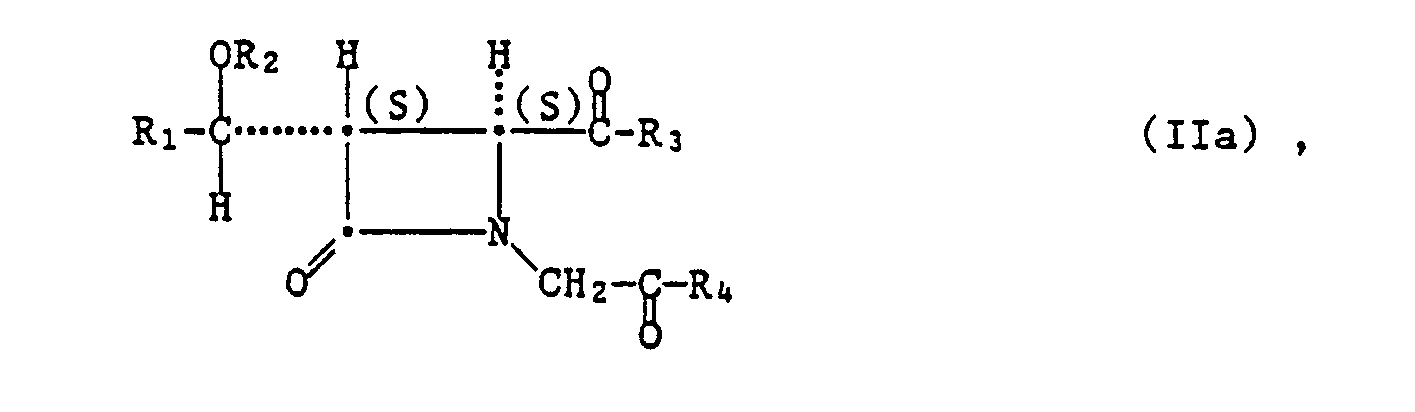
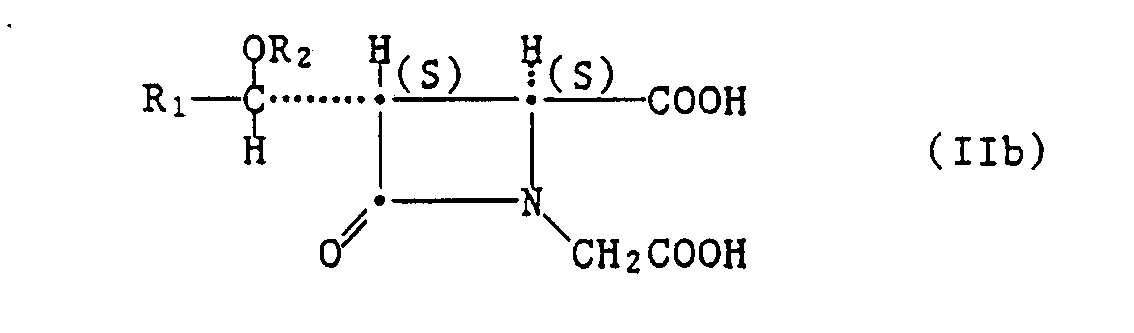


- Bevorzugt sind Ausgangsstoffe der Formeln Ila bzw. llb, worin R, Wasserstoff oder Methyl, R2 Wasserstoff oder eine Hydroxyschutzgruppe R2 , wie Dimethyl-tert-butylsilyl oder Dimethyl-(2,2-dimethyl-2-butyl)silyl, und R3 und R4, beide vorzugsweise identisch, Phenyl oder Methyl bedeuten.
- Die Behandlung des Ausgangsmaterials der Formel Ila mit einer Persäure wird vorzugsweise nach der Baeyer-Villiger-Reaktion durchgeführt, wobei organische oder anorganische Persäuren oder Salze davon, wie Alkalimetall- oder Erdalkalimetallsalze7 z.B. Natrium-, Kalium- oder Magnesium salze, eingesetzt werden können. Organische Persäuren sind insbesondere entsprechende Percarbonsäuren, u.a. gegebenenfalls, z.B. durch Halogen, substituierte Niederalkanpercarbonsäuren, wie Peressigsäure oder Trifluorperessigsäure, Trihalogeniminoperessigsäure, z.B. Trichlor- oder Trifluoriminoperessigsäure, gegebenenfalls, z.B. durch Nitro und/oder Halogen, substituierte aromatische Persäuren, wie Perbenzoesäure, 4-Nitroperbenzoesäure, 3-Chlorperbenzoesäure, 3,5-Dinitroperbenzoesäure oder Monoperphthalsäure, oder ein Salz davon, z.B. Magnesium-monoperphthalat. Anorganische Persäuren sind z.B. Peroxoschwefelsäuren, wie Peroxoschwefelsäure. Bevorzugt sind Peressigsäure, 3-Chlor-perbenzoesäure und Monoperphthalsäure.
- Die Persäuren können auch in situ gebildet werden, z.B. aus den entsprechenden Säuren oder sauren Salzen davon und Wasserstoffperöxid. Inbesondere die Iminopercarbonsäuren werden üblicherweise in situ hergestellt, z.B. aus den entsprechenden Nitrilen und Wasserstoffperoxid, bevorzugt in Gegenwart eines schwach sauren Puffers, z.B. Kaliumhydrogenphosphat.
- Die Reaktion wird üblicherweise in einem geeigneten Lösungsmittel, wie einem halogenierten Kohlenwasserstoff, z.B. Methylenchlorid oder Chloroform, einem Ester, wie Essigsäureethylester, einer Säure, wie Essigsäure, z.B. in Form von Eisessig, oder einem Alkohol, wie einem niederen Alkanol, z.B. Ethanol, bei Temperaturen zwischen etwa 0° und etwa 100°C, gegebenenfalls in einer Inertgasatmosphäre und gegebenenfalls unter Druck, z.B. bei etwa bis zu 10 bar, durchgeführt.
- Die unter Einführung der Acylgruppen R3-C(=0)- bzw. R4-C(=O)- verlaufende acyloxylierende Decarboxylierung einer Verbindung der Formel Ilb wird in an sich bekannter Weise,.wie z.B. durch Behandeln mit Blei-IV-acylaten oder mittels anodischer Oxidation in Gegenwart einer Carbonsäure durchgeführt. Dabei entsprechen die Acylreste in einem Blei-IV-acylat den Resten R3-C(=0)- bzw. R4-C(=O)-, und die bei der anodischen Oxidation anwesende Carbonsäure den Säuren der Formel R3-C(=O)-OH bzw. R4-C(=O)-OH: d.h. in einem Zwischenprodukt der Formel III, das aus einem Ausgangsmaterial der Formel Ilb hergestellt wird, sind die Reste R3 und R4 identisch.
- Geeignete Blei-IV-acylate sind entsprechende, gegebenenfalls, z.B. durch Halogen. wie Fluor, substituierte Niederalkanoate, z.B. Bleitetraacetat, Bleitetrapropionat oder Blei-tetra-(trifluoracetat), oder gegebenenfalls, z.B. durch Niederalkyl, wie Methyl, Niederalkoxy, wie Methoxy, und/oder Halogen, wie Fluor oder Chlor, substituierte Benzoate, z.B. Bleitetrabenzoat. Diese Reagentien werden in üblicher Weise verwendet, z.B. in Gegenwart eines geeigneten Lösungsmittels, wie eines inerten, polaren Lösungsmittels, z.B. Tetrahydrofuran, Dioxan, Essigsäure, Dimethylformamid, N-Methyl-pyrrolidon oder Hexamethylphosphorsäuretriamid, oder Lösungsmittelgemisches, falls notwendig unter Zusatz eines Alkalimetallacylats, z.B. Natrium- oder Kaliumacetat, und/oder eines Amins, z.B. Pyridin oder Lutidin, unter Kühlen oder Erwärmen, z.B. bei Temperaturen von etwa 20°C bis etwa 80°C, und/oder in einer Inertgas-, z.B. Argonatmosphäre.
- Die anodische Oxidation wird üblicherweise in einer Monozelle oder in einer geteilten Zelle mit einem mechanischen Diaphragma, z.B. aus porösem Ton, Glas oder Polyvinylchlorid, oder mit einem lonenaustauscher-Diaphragma, wie z.B. unter dem Handelsnamen Nafion@ erhältlich, und Elektroden aus Edelmetall, wie Platin, Titaniegierungen. z.B. Titan-Iridium oder Titan-Tantal, ferner Nickel, Bleidioxid, Glaskohlenstoff und/oder Graphit durchgeführt. Die Reaktion wird in Gegenwart eines Acylat-. wie Acetatabgebenden Mittels, z.B. in Essigsäure. oder in einem Gemisch von Essigsäure und einem inerten organischen Lösungsmittel, wie Acetonitril, Dioxan oder Dimethylformamid, durchgeführt, wobei ein Amin. wie ein Triniederalkylamin, z.B. Triethylamin oder Tri-n-butylamin, oder Pyridin. und/oder ein Alkalimetalacylat, z.B. Natrium- oder Kaliumacetat, und gewünschtenfalls ein zusätzliches, die Leitfähigkeit erhöhendes, sog. Leitsalz, wie ein Lithium-, Natrium-, Kalium- oder Tetraalkylammoniumsalz, z.B. das entsprechende Tetrafluorborat, zugesetzt wird. Geeignete Stromdichten für die Elektrolyse liegen zwischen etwa 10 und etwa 400 mA/cm2, beispielsweise um etwa 40 mA/cm2. Die Reaktionstemperatur liegt zwischen etwa 0° und etwa 50 C, vorzugsweise zwischen Raumtemperatur und etwa 30°C.
- Sowohl die Reaktion mit einem Blei-IV-acylat, als auch die anodische Oxidation in Gegenwart eines Acylat-abgebenden Mittels führen bevorzugterweise zu einer Verbindung der Formel III, worin die 1-Hydroxyalkylgruppe am C(3)-Ringkohlenstoffatom und die Acyloxygruppe am C(4)-Ringkohlenstoffatom trans zueinander angeordnet sind, d.h. zu einem Diastereomeren mit der (3R,4R)- oder mit der (3S,4S)-Konfiguration.
- Die selektive Abspaltung der Acylgruppe R4-C(=O)- in einem Zwischenprodukt der Formel III unter Bildung der Hydroxygruppe wird bevorzugt mittels enzymatischer Esterspaltung durchgeführt. Dabei verwendet man bekannte Esterasen, die sich insbesondere zur Spaltung von veresterten pnmären Hydroxygruppen eignen. So verwendet man z.B. zur Abspaltung einer Acetylgruppe in einem Zwischenprodukt der Formel III, worin R4 für Methyl steht, vorzugsweise die Esterase aus Nocardia mediterranei, einem zur Herstellung von Rifamycin verwendeten Organismus (Schär et al., Appl. Microbiol. Biotechnol. Bd. 27, S. 451 (1988)). Eine Benzoyloxygruppe in einem Zwischenprodukt der Formel III, worin R4 für Phenyl steht. wird z.B. mittels Cholesterinesterase (Sigma C9530 aus Schweinepankreas, die käuflich zugänglich ist) gespalten.
- Die Reaktion wird in an sich bekannter Weise durchgeführt, vorzugsweise unter neutralen Bedingungen, z.B. in einer geeigneten wässrigen Phosphatpufferlösung, und bei Temperaturen von etwa 10°C bis etwa 30 C, üblicherweise unter Raumtemperatur.
- Die Abspaltung der das Ringstickstoffatom substituiertenden Hydroxymethylgruppe kann in an sich bekannter Weise, z.B. hydrolytisch oder durch Behandeln mit einem sauren Reagens, vorzugsweise nach vorangegangener Oxidation der Hydroxymethyl- zur Formylgruppe, erfolgen.
- Letztere kann z.B. durch Behandeln einer Verbindung der Formel IV mit einer geeigneten oxidierenden Metallverbindung, wie einer entsprechenden Chrom-VI-verbindung, z.B. Chrom-VI-oxid, oder einem analogen Oxidationsmittel, vorzugsweise unter den Bedingungen der Killiani-Oxidation, z.B. mit einer etwa 8-n. Lösung von Chromtrioxid in wässriger Schwefelsäure, durchgeführt werden.
- Die Abspaltung der N-Hydroxymethyl- bzw. insbesondere der N-Formylgruppe kann vorzugsweise unter sauren Bedingungen vorgenommen werden, wobei in erster Linie anorganische Säuren, wie Mineralsäuren z.B. Chlorwasserstoffsäure oder Schwefelsäure, üblicherweise in Form von verdünnten, wässrigen Lösungen, ferner auch organische Carbon- oder Sulfonsäuren, z.B. p-Toluolsulfonsäure, verwendet werden. Die N-Formylgruppe, die z.B. auch durch Behandeln mit einem sauer reagierenden Aluminiumoxid-Präparat, z.B. unter chromatographischen Bedingungen, abgespalten werden kann. lässt sich ferner unter milden basischen Bedingungen, z.B. in Gegenwart eines Alkali- oder Erdalkalimetallhydroxids oder -carbonats oder -hydrogencarbonats, das üblicherweise in wässriger Lösung vorliegt, entfernen.
- Die hydrolytische Abspaltung der N-Hydroxymethyl- bzw. N-Formylgruppe wird üblicherweise bei Raumtemperatur oder leicht erhöhter Temperatur, z.B. zwischen etwa 15°C und etwa 50 °C. durchgeführt, wobei gegebenenfalls zusätzlich organische Lösungsmittel, wie geeignete Alkohole, z.B. wasserlösliche Niederalkanole, oder Aetherverbindungen, verwendet werden können.
- In einer erfindungsgemäss erhältlichen Verbindung der Formel I, ferner in einem Zwischenprodukt auf irgendeiner Stufe des erfindungsgemässen Verfahrens, kann die Abspaltung einer Schutzgruppe R2 in an sich bekannter Weise, z.B. durch Solvolyse, wie Acidolyse. Reduktion oder Oxidation, erfolgen.
- Eine Acylgruppe RZ kann unter sauren oder milden alkalischen Bedingungen abgespalten werden, je nach der Bedeutung von R2 , z.B. durch Behandeln mit Säuren, wie Ameisen- oder Trifluoressigsäure, oder mit Basen, wie einem Alkalimetallhydroxid, -carbonat oder -hydrogencarbonat, z.B. Natriumbicarbonat, einem bicyclischen Amidin, wie 1,5-Diazabicyclo[5.4.0]undec-5-en, oder einem Alkalimetallhalogenid.
- Gewisse Acylreste von Halbestern der Kohlensäure, wie Halogenniederalkoxycarbonyl und gegebenenfalls durch Nitro substituiertes Benzyloxycarbonyl, können reduktiv, z.B. mittels katalytischem Hydrieren in Gegenwart eines geeigneten Hydrierkatalysators, z.B. Platinoxid oder Palladium, oder durch Behandeln mit chemischen Reduktionsmitteln, wie Zink in Gegenwart von wässriger Essigsäure, abgespalten und durch Wasserstoff ersetzt werden.
- Die Abspaltung einer Niederalkenyloxycarbonylgruppe, worin Niederalkenyl insbesondere für Allyl steht, kann bevorzugt durch Behandeln mit einem Niederalkenylgruppen-Akzeptor in Gegenwart eines geeigneten Katalysators, wie einer metallischen Phosphinverbindung, z.B. Tetrakis-triphenyl-phosphin-palladium, gegebenenfalls in Gegenwart von Triphenylphosphin, erfolgen. Geeignete Akzeptoren für Niederalkenylgruppen, wie die Allylgruppe, sind z.B. Amine, insbesondere sterisch gehinderte Amine, z.B. tert-Butylamin, ferner Triniederalkylamine, z.B. Triethylamin, Morpholin oder Thiomorpholin, ferner aliphatische oder cycloaliphatische ß-Dicarbonylverbindungen, z.B. Acetylaceton, Acetessigsäureethylester oder bevorzugt Dimedon, sowie Niederalkancarbonsäuren, z.B. Essigsäure oder Propionsäure. Die Reaktion wird üblicherweise durch Behandeln der Verbindung der Formel I mit entsprechend geschützter Hydroxygruppe mit 1,5 bis 10 Moläquivalenten des Niederalkenylgruppen-Akzeptors in Gegenwart von 2 bis 10 Mol-%, insbesondere 5 bis 8 Mol-% (bezogen auf die Ausgangsverbindung) des Katalysators, insbesondere Tetrakistriphenylphosphin-palladium-Katalysators, gegebenenfalls in Gegenwart von bis zu 50 Mol-% Triphenyl- phosphin, in einem inerten Lösungsmittel, wie einem Ether, z.B. Dioxan oder insbesondere Tetrahydrofuran, einem Halogenkohlenwasserstoff, z.B. Methylenchlorid, einem Niederalkanol, z.B. Ethanol, einem Ester, z.B. Essigsäureethylester, oder in einem Gemisch von solchen Lösungsmitteln, bei Temperaturen von etwa 0 C bis etwa 40 C, bevorzugt bei etwa 20 bis etwa 25 C. und erforderlichenfalls in einer Inertgasatmosphäre, wie in einer Stickstoff- oder Argonatmosphäre, durchgeführt.
- Eine 2-Oxa- oder 2-Thiacycloalkylgruppe R2. kann durch Einwirken einer Säure, wie einer Mineralsäure, z . B. Chlorwasserstoff- oder Schwefelsäure, abgespalten werden.
- Eine wie angegeben substituierte Silylgruppe R2 kann in Gegenwart geeigneter, vorzugsweise polarer, wie hydroxylgruppenhaltiger Lösungsmittel, gegebenenfalls unter sauren Bedingungen, oder insbesondere durch Behandeln mit einem Fluoridanionen liefernden Salz der Fluorwasserstoffsäure, wie mit einem Alkalimetallfluorid, z.B. Natriumfluorid, gegebenenfalls in Anwesenheit eines makrocyclischen Polyethers ("Kronenether"), oder mit dem Fluorid einer organischen quaternären Base, wie Tetraniederalkylammoniumfluorid, z.B. Tetrabutylammoniumfluorid, gegebenenfalls in Gegenwart eines sauren Reagens, abgespalten werden.
- In einer erfindungsgemäss erhältlichen Verbindung der Formel 1, ferner in einem Zwischenprodukt auf irgendeiner Stufe des Verfahrens, worin R2 für Wasserstoff steht, kann die freie Hydroxygruppe in an sich bekannter Weise geschützt werden, wobei ein unsubstituiertes Ringstickstoffatom gegebenenfalls vorübergehend geschützt sein kann. Die Schutzgruppe kann z.B. durch Behandeln mit einem geeigneten Halogensilan, z.B. einem Triniederalkyl-halogensilan, wie Trimethylchlor- oder Dimethyl-tert.-butyl-chlorsilan, oder einer geeigneten Silazanverbindung, wie Hexamethyldisilazan, oder durch Behandeln mit einem reaktionsfähigen Derivat einer Säure, deren Acylrest als Hydroxyschutzgruppe dient, z.B. durch Umsetzen mit einem Anhydrid, z.B. Trifluoressigsäureanhydrid, einem gemischten Anhydrid, z.B. einem Säurehalogenid, wie 2,2-Dichloracetylchlorid, einem gemischten Anhydrid eines Kohlensäurehalbesters, z.B. 2,2,2-Trichlorethyl-, Allyl-, Phenyl- oder p-Nitrophenylchlorformiat, oder durch Reaktion mit 1,2-Dihydrofuran oder 1,2-Dihydropyran in Gegenwart einer Säure, z B. p-Toluolsulfonsäure, eingeführt werden.
- Die vorliegende Erfindung hat vorzugsweise ein Verfahren zur Herstellung von Verbindungen der Formel I zum Gegenstand, worin R, Wasserstoff oder insbesondere Methyl, R2 Wasserstoff oder eine Hydroxyschutzgruppe R2 . wie den Acylrest eines Kohlensäurehalbesters, z.B. 2.2.2-Tnchlorethoxycarbonyl, Allyloxycarbonyl, Benzyloxycarbonyl oder p-Nitrobenzyloxycarbonyl, den Acylrest einer gegebenenfalls substituierten Benzoesäure, z.B. 4-Nitro- oder 3,5-Dinitrobenzoyl, oder insbesondere Triniederalkylsilyl, z.B. Trimethylsilyl, tert.-Butyl-dimetylsilyl, oder Dimethyl(2,3-dimethyl-2-butyl)silyl, und R3 Phenyl oder Methyl bedeuten, und worin das 1 -C-Atom der Seitenkette die S- oder vorzugsweise die R-Konfiguration haben kann, falls R, Methyl bedeutet.
- Die Erfindung betrifft in erster Linie ein Verfahren zur Herstellung von (3R,4R.1 R)-4-Acetyloxy-3-(1-hydroxy-ethyl)-azetidin-2-on oder (3R.4R,1 R)-4-Benzoyloxy-3-(1 -hydroxy-ethyl)-azetidin-2-on und deren 1 - O-Triniederalkylsilyl-, wie 1'-O-tert.-Butyl-dimethylsilyl- oder 1-O-Dimethyl-(2,3-dimethyl-2-butyl)silyl-Derivate.
- Verbindungen der Formel 1, insbesondere solche, worin R1 Wasserstoff oder Methyl ist, R2 Wasserstoff oder eine Hydroxyschutzgruppe R2 darstellt, und R3 Methyl oder Phenyl ist, sind wertvolle Zwischenprodukte, die in an sich bekannter Weise zu antibiotisch wirksamen Penem- oder Carbapenemverbindungen weiterverarbeitet werden können. Die Weiterverarbeitung erfolgt analog derjenigen von bekannten Azetidinonverbindungen der Formel I, worin R3 Methyl ist, z.B. wie von T. Hayashi et al., Chem. Pharm. Bull. 29, 3158, 1981, oder in den Europäischen Patentanmeldungen Publ. Nr. 42026 (für Peneme) oder Publ. Nr. 78026 (für Carbapeneme) beschrieben wird.
- Die im erfindungsgemässen Verfahren verwendeten Ausgangsstoffe und Zwischenprodukte sind zum Teil neu. Sie können in an sich bekannter Weise hergestellt werden.
- So kann man z.B. Verbindungen der Formel II (a und b) dadurch erhalten, dass man d) das Carbanion einer Verbindung der Formel


- In einem Ausgangsmaterial der Formel VI ist eine unter den Bedingungen des Ringschlussverfahrens nicht abspaltbare Hydroxyschutzgruppe R] eine der unter R2 genannten Acylgruppen einer substituierten Carbon- oder Sulfonsäure, z.B. 2,2,2-Trifluoracetyl, ferner der Acylrest eines Kohlensäurehalbesters, z.B. p-Nitrobenzyloxycarbonyl. oder 2-Tetrahydrofuryl oder -pyranyl, sowie 1-Niederalkoxyniederalkyl, z.B. Methoxymethyl oder 1-Ethoxyethyl, oder gegebenenfalls substituiertes Aroyl. z.B. 4-Nitrobenzoyl oder 3.5-Dinitrobenzoyl. Eine geeignete nukleofuge Abgangsgruppe X ist vorzugsweise reaktionsfähiges verestertes Hydroxy, beispielsweise Halogen, z.B. Chlor, Brom oder Jod, Niederalkanoyloxy, z.B. Acetoxy, Arylsulfonyloxy, z.B. Phenylsulfonyloxy oder p-Toluolsulfonyloxy, oder Niederalkylsulfonyloxy, z.B. Methansulfonyloxy.
- Eine veretherte Hydroxygruppe R3 bzw. R4 ist insbesondere eine aliphatisch, aromatisch oder araliphatisch veretherte Hydroxygruppe, wie Niederalkoxy, z.B. Methoxy, Ethoxy, n-Propyloxy, Isopropyloxy oder in erster Linie tert.Butyloxy, Aryloxy, z.B. Phenyloxy, oder Arylniederalkoxy,z.B. Benzyloxy,
- In Carbanionen von Verbindungen der Formel V oder VI befindet sich die negative Ladung auf dem Kohlenstoffatom in a-Stellung zur Gruppe der Formel -CO-R3 ; d.h. die entsprechende Verbindung weist die Teilformel N-CH⊖-CO-R3 auf. Solche Carbanionverbindungen werden in situ hergestellt, indem man eine Verbindung der Formel V oder VI in einem geeigneten Lösungsmittel mit einer Carbanionen-bildenden Base behandelt, wobei die Zyklisierung des Verfahrens d) eintritt. Solche sind u.a. Alkalimetallbasen, z.B. Natrium-, Kalium- oder Lithium-hydroxid oder -carbonat, oder organische Alkalimetallverbindungen, z.B. Niederalkyllithium, wie n-Butyl- oder tert-Butyllithium, Alkalimetallamide, z.B. Lithiumdiisopropylamid oder -di-tert-butylamind, und insbesondere Alkalimetallamide, wonn zwei Wasserstoffatome durch organische Silyl-, z.B. Trimethylsilylgruppen, ersetzt sind, z.B. Lithium-. Natrium- oder Kalium-bis-(trimethylsilyl)-amid, u.a. Lithiumhexamethyldisilazid, ferner geeignete organische Stickstoffbasen, wie cyclische Amidine, z.B. 1,5-Diazabicyclo[4.3.0]non-5-en oder 1,5-Diazabicyclo[5.4.0]undec-5-en, sowie Fluorverbindungen, die in einem aprotischen, organischen Lösungsmittel Fluoridionen abgeben, und die besonders zur Herstellung von Carbanionen von Verbindungen der Formel V geeignet sind, vorzugsweise Tetra-niederalkylammoniumfluoride, insbesondere Tetra-n-butylammoniumfluorid.
- Bei Verwendung eines geeigneten Silylreagens, z.B. von Lithiumhexamethyldisilazid, für den Ringschluss einer Verbindung der Formel V oder VI kann unter Umständen, z.B. bei vorsichtigem Arbeiten, direkt eine Verbindung der Formel lia erhalten, worin R2 für eine Silylschutzgruppe, z.B. Trimethylsilyl, steht.
- Geeignete Lösungsmittel für die Carbanionbildung sind z.B. gegebenenfalls halogenierte Kohlenwasserstoffe, wie Benzol, Toluol, Methylenchlorid oder Chloroform, Ether, wie Dioxan, Tetrahydrofuran oder Dimethoxyethan, Amide, wie Dimethylformamid, oder Hexamethylphosphorsäuretriamid, Sulfoxide, wie Dimethylsulfoxid, oder Nitrile, wie Acetonitril, oder Mischungen davon. Die Reaktion kann auch unter Phasentransferbedingungen vorgenommen werden, z.B. in einem System bestehend aus Methylenchlorid und 50%-iger wässriger Natriumhydroxidlösung in Gegenwart eines Phasentransferkatalysators, wie Benzyltriethylammoniumchlorid oder Tetrabutylammoniumhydrogensulfat. Die Reaktionstemperatur, die u.a. von der Wahl der verwendeten Base abhängt, liegt zwischen etwa -80°C und etwa 80°C. wobei man vorzugsweise unter Inertgas-, z.B. Argon- oder Stickstoffatmosphäre arbeitet.
- Unter den Bedingungen des Verfahrens findet eine Umkehrung der Konfiguration am 2-C-Atom des Ausgangsmaterials statt, so dass aus einer 2R-Verbindung der Formel V bzw. VI eine 3S-Verbindung der Formel IIa entsteht; die Konfiguration des 1 -C-Atoms in der Seitenkette, falls R, für Niederalkyl steht, bleibt unverändert. Beispielsweise erhält man aus R-Glycidsäureamiden der Formel V 3S-Azetidinone der Formel IIa oder aus (2R,3R)-2,3-Epoxybuttersäureamiden der Formel V (3S,1R)-3-Hydroxyethylazetidinone der Formel IIa.
- Die Isomerisierung einer Verbindung der Formel VII (Verfahrensvariante e) kann in einem geeigneten Lösungsmittel oder Lösungsmittelgemisch in Gegenwart einer Base stattfinden. Geeignete Lösungsmittel und Basen, sowie auch die Reaktionsbedingungen sind die gleichen. die für das Zyklisierungsverfahren d) verwendet werden können. Bevorzugt werden aprotische dipolare Lösungsmittel, wie Dimethylformamid, N-Methylpyrrolidon oder Dimethylsulfoxid, und als Basen vor allem Kaliumcarbonat oder 1,5-Diazabicyclo-[5.4.0]undec-5-en eingesetzt, wobei ebenfalls unter den beschriebenen Phasentransferbedingungen gearbeitet werden kann.
- Ausgangsstoffe der Formel Ilb können in an sich bekannter Weise, z.B. mittels Solvolyse aus den erfindungsgemäss erhältlichen Diestern der Verbindungen der Formel IIb erhalten werden. Man kann die entsprechenden Diesterverbindungen z.B. mittels saurer oder basischer Hydrolyse in die freien Dicarbonsäureverbindungen umwandeln, einen Di-tert . -butylester (R3 = R4 = tert.-Butyloxy) z.B. durch Behandeln mit verdünnter, z.B. 1-n., Natriumhydroxidlösung in einem Niederalkanol, z.B. Methanol oder Ethanol, oder mit Trifluoressigsäure unter Erwärmen.
- Die cis-Verbindungen der Formel VII können im Verlauf der Zyklisierungsreaktion (d) als Nebenprodukte gebildet und in üblicher Weise, z.B. mittels Chromatographie, von den Produkten mit der gewünschten Konfiguration abgetrennt werden.
- Verbindungen der Formel V können in an sich bekannter Weise, z.B. durch Umsetzen einer Epoxysäureverbindung der Formel


- Die Reaktion kann unter Bedingungen durchgeführt werden, die dem unten näher beschriebenen Verfahren zur Herstellung von Verbindungen der Formel Vla analog sind. Die Verbindungen der Formel VIII sind bekannt oder können nach an sich bekannten Verfahren hergestellt werden.
- Vorzugsweise werden die Ausgangsstoffe der Formel V aus Verbindungen der Formel

- In einer Verbindung der Formel Vla ist eine unter den Bedingungen der Epoxidbildung abspaltbare Hydroxyschutzgruppe R2 eine Triniederalkylsilylgruppe, z. B. Dimethyl-tert-butylsilyl oder Trimethylsilyl. X bedeutet bevorzugt Halogen, z.B. Chlor oder Brom, Niederalkansulfonyloxy, z.B. Methansulfonyloxy, oder Arylsulfonyloxy, z.B. p-Toluolsulfonyloxy.
- Die Abspaltung von R2 -X, worin R2 Wasserstoff ist, erfolgt bei der Behandlung mit einer der genannten carbanionbildenden Basen, z.B. Natrium- oder Kaliumhydroxid oder -carbonat, vorzugsweise mit einem Amidin, z.B. 1,5-Diazabicycto[5.4.0]undec-5-en, oder auch mit einem Tetraniederalkylammoniumfluorid, z.B. entwässertem Tetra-n-butylammoniumfluorid, z.B. unter den von Djerassi et al., "Steroid Reactions", S. 606 (Holden Day, San Francisco, 1963) beschriebenen Reaktionsbedingungen. Wenn R2 z.B. eine unter den Bedingungen der Epoxidbildung abspaltbare Triniederalkylsilylgruppe ist, wird bevorzugt ein Tetraniederalkylammoniumfluorid verwendet.
- Die Umsetzung einer Verbindung der Formel Via zu einer Epoxyverbindung der Formel V wird vorzugsweise in einem inerten, üblicherweise wasserfreien Lösungsmittel oder Lösungsmittelgemisch vorgenommen, wenn notwendig unter Kühlen oder Erwärmen z.B. in einem Temperaturbereich von etwa -40C bis etwa +100°C. bevorzugt von etwa -10°C bis etwa +50°C, und/oder unter Inertgas-, z.B. Stickstoffatmosphäre.
- Im Verlauf dieses Verfahrens wird die Konfiguration am 2-C-Atom umgekehrt, während die Konfiguration des 3-C-Atoms, falls R, für Niederalkyl steht, erhalten bleibt. So entstehen aus 2S-Halogen-3R-hydroxyVerbindungen der Formel Vla die (2R,3R)-, aus 2S-Halogen-3S-hydroxy-Verbindungen die (2R,3S)-Verbindungen der Formel V.
- Das Epoxid der Formel V kann, wenn erwünscht nach seiner Herstellung durch Abspaltung von R2 -X aus einer Verbindung der Formel Vla isoliert werden, indem man das als Reagens verwendete Amidin in etwa äquimolaren Mengen einsetzt.
- Die obigen Verbindungen der Formel Vla lassen sich z.B. herstellen, indem man eine Verbindung der Formel

- Analog lassen sich, ausgehend von Verbindungen der Formel IX und von Verbindungen der Formel
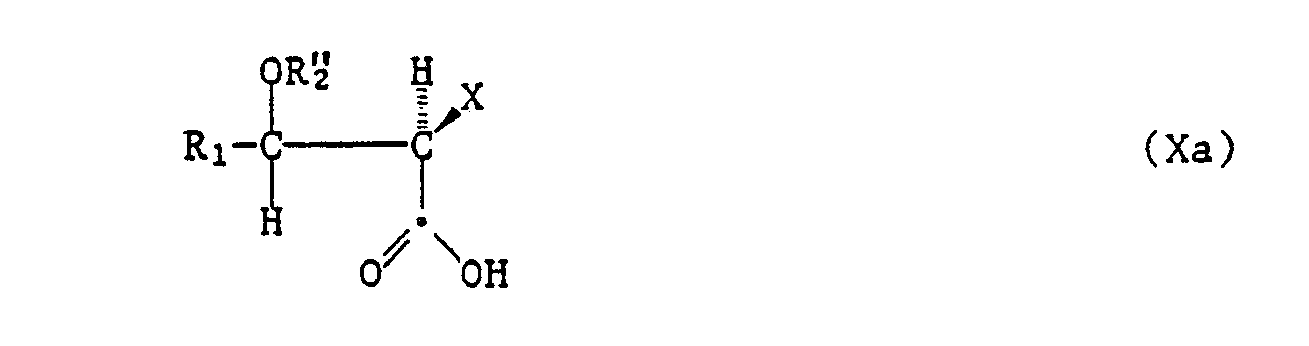
- Verbindungen der Formel X und Xa, worin X Halogen ist, sind bekannt. Sie lassen sich z.B. in an sich bekannter Weise aus L-Serin oder L-Threonin bzw. deren D-Isomeren durch Diazotieren der Aminogruppe mit einem Nitritsalz, z.B. Kaliumnitrit, in Gegenwart eine Halogenwasserstoffsäure herstellen.
- Bei Verwendung von L-Serin lassen sich, ausgehend von Verbindungen der Formel VI. solche der Formel I erhalten, worin der Kohlenstoff in 3-Stellung des Azetidinonrings die R-Konfiguration hat. Bei Verwendung von L-Threonin erhält man Verbindungen der Formel I, worin das C-Atom in 3-Stellung des Azetidinonrings die R-Konfiguration und das 1 -C-Atom einer Hydroxyethyl-Seitenkette (R1 steht für Methyl) die R-Konfiguration hat. Ist die Herstellung von Verbindungen der Formel I beabsichtigt, worin das 3-C-Atom die R-Konfiguration und das 1 -C-Atom z.B. einer 1-Hydroxy-ethylseitenkette die S-Konfiguration hat, geht man von Allothreonin aus. Bei allen beschriebenen Umsetzungen bleibt die Konfiguration des C-Atoms, welches in Verbindungen der Formel I dem 1'-C-Atom einer 1-0R2-Niederalkylseitenkette mit mehr als einem Kohlenstoff im Niederalkylteil entspricht, unverändert.
- Amine der Formel IX, insbesondere die symmetrisch substituierten Amine, sind bekannt oder lassen sich, falls neu, in an sich bekannter Weise herstellen. So kann z.B. eine Verbindung der Formel IX, worin R3 und R4 tert-Butoxy bedeuten, durch Einwirken von Isobutylen auf die entsprechende Säure, üblicherweise in Dioxan in Gegenwart von 95-98%-iger Schwefelsäure bei Raumtemperatur, hergestellt werden. Ein bevorzugtes Verfahren zur Herstellung von Verbindungen der Formel IX, worin R3 und RQ für Phenyl stehen, besteht in der Reaktion von Phenacylamin-hydrochlorid mit Phenacylchlorid oder Phenacylbromid in Gegenwart einer geeigneten Base, z.B. Triethylamin, und in Methylenchlorid.
- Die vorliegende Erfindung umfasst auch solche Ausführungsformen des Verfahrens, in denen von einer, auf irgendeiner Vorstufe des Verfahrens erhältlichen Verbindung ausgegangen wird, und die anschliessenden Verfahrensschritte ausgeführt werden. Sie umfasst auch Kombination von Verfahrensstufen. z.B. ausgehend von einer der Verbindungen der Formeln VI bis X bis zu einer Verbindung der Formel I oder ausgehend von einer der Verbindungen der Formel IX und X oder Xa bis zu einer Verbindung der Formel VI bzw. IVa.
- Das erfindungsgemässe Verfahren hat den Vorteil, das man die Verbindungen der Formel I in hoher Ausbeute und wirtschaftlicher Weise stereospezifisch herstellen kann, und dass die leicht zugänglichen und billigen, symmetrisch substituierten Amine der Formel IX, deren Substituenten einerseits zum Ringschluss zu den β-Lactam-Verbindungen und andererseits als vorläufige. unter milden Bedingungen abspaltbare N-Schutzgruppe dienen, verwendet werden können.
- Die folgenden Beispiele dienen zur Illustration der Erfindung. Temperaturen werden in Celsiusgraden angegeben. Die spezifischen Drehwerte sind

- 1.1. Eine Lösung von 0,866 g (3S,4S,1'R)-4-Benzoyl-3-(1'-hydroxy-ethyl)-1-phenacyl-azetidin-2-on und 5,7 g 3-Chlorperbenzoesäure in 30 ml Methylenchlorid wird 8 Stunden bei Raumtemperatur gerührt. Die weisse Suspension wird mit Methylenchlorid verdünnt und nacheinander mit einer 5%-igen wässrigen Lösung von NatriumthiosulfattKaliumjodid, Wasser, wässriger Natriumhydrogencarbonatlösung und Wasser gewaschen, getrocknet und unter Wasserstrahlvakuum eingedampft. Das Rohprodukt wird mittels Mitteldruckchromatographie (Lösungsmittel: 2:3-Gemisch von Hexan und Essigsäurethylester) gereinigt. Nach Umkristallisieren der Hauptfraktion aus Methylenchlorid;Diethylether wird das (3R,4R,1'R)-4-benzoyloxy-1-benzoyloxymethyl-3-(1 -hydroxy-ethyl)-azetidin-2-on, Smp. 136-138°, erhalten.
- 1.2. Eine Lösung von 0,18 g (3R,4R,1R)-4-benzoyloxy-1-benzoyloxymethyl-3-(1-hydroxy-ethyl)-azetidin -2-on in 1 ml Dimethylformamid wird mit 0,06 g Imidazol und 0,088 g tert.-Butyl-dimethyl-chlorsilan versetzt und 24 Stunden bei Raumtemperatur gerührt. Das Reaktionsgemisch wird erneut mit 0,015 g Imidazol und 0,022 g tert.-Butyl-dimethyl-chlorsilan versetzt, weitere 6 Stunden bei Raumtemperatur gerührt, anschliessend auf Eis und eine gesättigte wässrige Natriumhydrogencarbonat-Lösung ausgetragen, in Diethylether aufgenommen, und die organische Phase je einmal mit wässriger Natriumhydrogencarbonatlösung, 1%-iger wässriger Zitronensäure, Wasser, wässriger Natriumhydrogencarbonatlösung und Wasser gewaschen. Die wässrigen Phasen werden mit Diethylether nachgewaschen; die vereinigten organischen Extrakte werden mit Natriumsulfat getrocknet und im Wasserstrahlvakuum eingedampft. Das Rohprodukt wird in einem 3:2-Gemisch von Hexan und Essigsäureethylester gelöst und durch Kieselgel 60 filtriert. Nach Umkristallisieren aus Methylenchlorid/Diethylether erhält man reines (3R,4R,1 R)-4-Benzoyloxy-1-benzoyloxymethyl-3-[1'-(tert.-butyl-dimethylsilyloxy)-ethyl]-azetidin-2-on. Smp. 109-110°; [α]D = -14.1°(c = 0,545 % in Chloroform).
- 1.3. In einem auf 30 thermostatierten 50 ml-Rundkolben wird 0,03 g (30 U) Cholesterinesterase (Sigma C 9530, aus Schweinepankreas) in 33 ml Phosphatpuffer pH 7 gelöst und während 10 Stunden portionenweise mit 0,05 g (3R,4R,1'R)-4-Benzoyloxy-1-benzoyloxymethyl-3-[1'-(tert.-butyldimethylsilyloxy)-ethyl]-azetidin-2-on, gelöst in 6 ml Aceton, versetzt. Die Reaktion wird mittels Dünnschichtchromatographie (Lösungsmittel: 1:1-Gemisch von Essigsäureethylester und Hexan) und Hochdruckflüssigkeitschromatographie (Lösungsmittel: 85:15-Gemisch von Acetonitril und Wasser) verfolgt. Nach 20 Stunden wird das Reaktionsgemisch sechsmal mit je 100 ml Chloroform extrahiert. Der organische Extrakt ergibt ein leicht gelbes Oel, das gemäss Hochdruckflüssigkeitschromatographie noch etwa 10 % Ausgangsmaterial enthält. Mittels Chromatographie an Kieselgel (Elutionsmittel: 4:1-Gemisch von Methylenchlorid und Essigsäureethylester) erhält man das (3R,4R,1'R)-4-Benzoytoxy-1-hydroxymethyl-3-[1'-(tert.-butyl-dimethylsilyloxy)-ethyl]-azetidin-2-on, das nach Umkristallisieren aus Methylenchlorid/Diethylether/Hexan bei 83-85° schmilzt; [α]D = +68.5° (c = 0.672 % in Chloroform).
- 1.4. Eine Lösung von 0,16 g (3R,4R,1'R)-4-Benzoyloxy-1-hydroxymethyl-3-[1 -(tert.-butyl-dimethylsily- loxy)-ethyl]-azetidin-2-on in 10 ml Methylenchlorid wid mit 0,21 ml 8-n. Chromschwefelsäure (Killiani-Mischung) versetzt und 5 Stunden bei Raumtemperatur gerührt. Durch Zugabe von 1 ml Isopropanol wird der Ueberschuss an Oxidationsmittel zerstört und das Reaktionsgemisch direkt auf eine Säule von 80 g Aluminiumoxid (Alox II, sauer) aufgetragen und mit Essigsäureethylester eluiert. Man erhält dabei das praktisch reine (3R,4R,1-R)-4-Benzoyloxy-3-[1'-(tert.-butyl-dimethylsilyloxy)-ethyl]-azetidin-2-on, Smp. 125-126°; [α]D = 71,1 ° (c = 0,85 % in Chloroform), nach Umkristallisieren aus DiethyletheriHexan.
- Durch Behandeln mit Tetrabutylammoniumfluorid-trihydrat in Tetrahydrofuran und Essigsäure kann aus dem (3R,4R,1 R)-4-Benzoyloxy-3-[1 -(tert.-butyl-dimethylsilyloxy)-ethyl]-azetidin-2-on das (3R,4R,1 R)-4-Benzoyloxy-3-(1'-hydroxy-ethyl)-azetidin-2-on, Smp. 145-147° (aus Methylenchlorid-Diethylether), erhalten werden.
- Das Ausgangsmaterial kann wie folgt hergestellt werden:
- 1.5. Zu einem auf -25 abgekühlten Gemisch von 6.86 g Dimethylformamid und 40 ml Methylenchlorid wird innerhalb von 15 Minuten eine Lösung von 2,7 ml Oxalylchlorid in 8,5 ml Methylenchlorid zugetropft. Die weisse Suspension wird weitere 20 Minuten bei -25 gerührt und anschliessend innerhalb von 10 Minuten mit einer Lösung von 9.87 g des Dicyclohexylammoniumsalzes der (2R,3R)-2,3-Epoxybuttersäure in 40 ml Methylenchlorid versetzt. Das Reaktionsgemisch wird bei gleicher Temperatur weitere 20 Minuten gerührt, dann setzt man 8,7 ml Triethylamin und anschliessend portionenweise 7,29 g Diphenacylaminhydrochlorid zu. Das Kühlbad wird entfernt und das Reaktionsgemisch bei Raumtemperatur 21 Stunden gerührt. Die gelbe Suspension wird darauf durch eine Glassinternutsche filtriert und der Rückstand erschöpfend mit Methylenchlorid nachgewaschen. Das Filtrat wrid mt Methylenchlorid verdünnt und nacheinander mit Wasser 5%-iger wässriger Zitronensäure, gesättigter wässriger Natriumhydrogencarbonatlösung und Wasser gewaschen. Die wässrigen Phasen werden zweimal mit Methylenchlorid nachextrahiert, die vereinigten organischen Phasen über Natriumsulfat getrocknet und im Wasserstrahlvakuum eingedampft. Das erhaltene Rohprodukt wird mittels Flash-Chromatographie an 750 g Kieselgel (Merck 9385; Elutionsmittel: 2:1-Gemisch von Hexan und Essigsäureethylester) gereinigt und das (2R,3R)-2,3-Epoxy-N,N-bis-phenacyl-buttersäureamid als gelbliches Oel erhalten.
- 1.6. Eine Lösung von 3,48 g (2R,3R)-2,3-Epoxy-N,N-bis-phenacyl-buttersäureamid in 100 ml Tetrahydrofuran wird unter Rühren auf -15° abgekühlt und bei einer Temperatur zwischen -10 und -15 mit 20,6 ml einer 0,5 molaren Lithiumhexamethyldisilazid-Lösung in Tetrahydrofuran versetzt; nach etwa 4-stündigem Rühren im gleichen Temperaturintervall ist die Reaktion beendet. Das dunkelrote Reaktionsgemisch wird auf 100 ml einer eiskalten Pufferlösung (pH 6.0) gegossen und dreimal mit Methylenchlorid extrahiert. Die organischen Extrakte werden mit gesättigter wässriger Natriumchloridlösung gewaschen, mit Natriumsulfat getrocknet und im Wasserstrahlvakuum eingedampft. Das erhaltene Rohprodukt wird mittels Mitteldruckchromatographie an einer 100-fachen Menge eines Silikagelpräparates [LiChroprep@ Si 60 der Firma Merck AG, Darmstadt (Bundesrep. Deutschland); Korngrösse 25-40 u.m; Lösungsmittel: 4:1-Gemisch von Hexan und Essigsäureethylester] in drei Bestandteile aufgetrennt. Man erhält dabei als unpolarste Fraktion das (3S,4S,1'R)-4-Benzoyl-3-(1'-trimethylsilyloxy-ethyl)-1-phenacyl-azetidin-2-on, als Produkt mittlerer Polarität das (3S,4R,1 'R)-4-Benzoyl-3-(1'-hydroxy-ethyl)-1-phenacyl-azetidin-2-on ("cis-Verbindung") vom Smp. 128-129° (aus Methylenchlorid-Diethylether-Hexan) und schliesslich das amorphe (3S,4S,1'R)-4-Benzoyl-3-(1'-hydroxy-ethyl)-1-phenacyl-azetidin-2-on.
- 2.1. Zu einer Lösung von 2,9 g (3S,4S,1'R)-1-Carboxymethyl-3-[1'-(tert.-butyl-dimethylsilyloxy)-ethyl]-2-oxo-azetidin-4-carbonsäure in 90 ml Tetrahydrofuran und 13 ml Dimethylformamid werden unter einer Argonatmosphäre und unter Rühren bei Raumtemperatur 8,95 g Bleitetraacetat zugegeben. Nach 75 Minuten bei 25° wird der Ueberschuss Bleitetraacetat durch Zutropfen von 2,2 ml Ethylenglykol zerstört, die resultierende weisse Suspension über einem Kieselgur-Präparat (Hyflo) filtriert, der Filterrückstand gut mit Tetrahydrofuran nachgewaschen, und das Filtrat im Wasserstrahlvakuum eingedampft. Der ölige Rückstand wird mittels Flash-Chromatographie an 250 ml Silicagel (Kieselgel 60; 0,040-0,63 mm; Lösungsmittel: 60:4-Gemisch von Hexan und Essigsäureethylester) gereinigt. Man erhält so das (3R,4R,1 R)-4-Acetyloxy-1-acetyloxymethyl-3-[1 '-(tert.-butyl-dimethylsilyloxy)-ethyl]-azetidin-2-on in öliger Form, [α]D = +9,4° (c = 0,287 % in Chloroform).
- In analoger Weise wird ausgehend von (3S,4S,1'R)-N-carboxymethyl-3-[1'-(dimethyl-(2,3-dimethyl-2-butyl)silyloxy)-ethyl]-2-oxo-azetidin-4-carbonsäure das (3R,4R,1 'R)-4-Acetyloxy-1-acetyloxymethyl-3-[1'-(dimethyl-(2,3-dimethyl-2-butyl)silyloxy)-ethyl]-azetidin-2-on in amorpher Form erhalten, [α]D = +3,3° (c = 2,1 in Chloroform).
- 2.2. Zu 0,92 g von (3R,4R,1'R)-4-Acetyloxy-1-acetyloxymethyl-3-[1'-(tert.-butyl-dimethylsilyloxy)-ethyl]-azetidin-2-on in 70 ml Phosphatpuffer pH 7 werden 3 ml einer Lösung von Acetylesterase (wässrige Lösung enthaltend 723 U/mi) aus Nocardia mediterranei [siehe: H.P. Schär, D. Gygax, G.M. Ramos Tombo and O. Ghisalba, Appl. Microbiol. Biotechnol., Bd. 27, S. 451 (1988)] zugegeben. Die Lösung wird 24 Stunden bei Raumtemperatur gerührt, darauf erneut mit 2 ml der obigen Enzymlösung vesetzt und nach weiteren zwei Tagen mit Methylenchlorid extrahiert. Man erhält ein Rohprodukt, das nur noch kleine Mengen Ausgangsmaterial enthält. Nach chromatographischer Reinigung (Kieselgel; Elutionsmittel: 96:4-Gemisch von Methylenchlorid und Methanol) erhält man das (3R,4R,1'R)-4-Acetyloxy-1-hydroxymethyl-3-[1'-(tert.-butyl-dime- thylsilyloxy)-ethyl]-azetidin-2-Qn, das spontan kristallisiert und bei 51-53' schmilzt.
- 2.3. Eine Lösung von 0.317 g (3R.4R.1 R)-4-Acetyloxy-1-hydroxymethyl-3-[1'-(tert.-butyl-dimethylsily- loxy)-ethyll-azetidin-2-on in 2 ml Methylenchlorid wird mit 2 ml 8-n. Chromschwefelsäure (Killiani-Mischung) versetzt und 4 Stunden bei Raumtemperatur gerührt. Nach erneuter Zugabe von 0,25 ml Chromschwefelsäure wird 24 Stunden weitergerührt. Durch Zugabe von 1 ml Isopropanol wird der Ueberschuss an Oxidationsmittel zerstört, und das Reaktionsgemisch direkt auf eine Säule von 10 g Aluminiumoxid (Alox II, sauer) aufgetragen und mit einem 1:1-Gemisch von Hexan und Essigsäureethylester eluiert. Man erhält dabei das (3R.4R.1'R)-4-Acetyloxy-3-[1'-(tert.-butyl-dimethylsilyloxy)-ethyl]-azetidin-2-on, Smp. 107-109 (aus tiefsiedendem Petrolether).
- 2.4. Eine Lösung von 0,63 g Tetrabutylammoniumfluorid-trihydrat in 10 ml Tetrahydrofuran und 0,8 ml Essigsäure wird unter Rühren mit 0,3 g (3R,4R,1'R)-4-Acetyloxy-3-[1'-(tert.-butyl-dimethylsilyloxy)-ethyl]-azetidin-2-on versetzt und während 16 Stunden bei Raumtemperatur gerührt. Das Reaktionsgemisch wird auf Eiswasser ausgetragen und dreimal mit Methylenchlorid extrahiert. Die vereinigten organischen Extrakte werden nacheinander mit einer gesättigten wässrigen Natriumhydrogencarbonatlösung und einer gesättigten, wässrigen Natriumchloridlösung gewaschen, über Natriumsulfat getrocknet und bei 35' Badtemperatur unter Wasserstrahlvakuum eingedampft. Der Rückstand wird aus Methylenchlorid/Diethylether/Hexan umkristallisiert und ergibt das (3R,4R,1'R)-4-Acetyloxy-3-(1-hydroxy-ethyl)-azetidin-2-on, Smp. 110-112°.
- Das Ausgangsmaterial kann wie folgt erhalten werden:
- 2.5. Zu einem auf -25° abgekühlten Gemisch von 20 g Dimethylformamid und 115 ml Methylenchlorid wird innerhalb 15 Minuten eine Lösung von 11,6 g Oxalylchlorid in 25 ml Methylenchlorid zugetropft. Die weisse Suspension wird weitere 20 Minuten bei -25° gerührt und anschliessend, innerhalb 10 Minuten, mit einer Lösung von 28,5 g des Dicyclohexylammoniumsalzes der (2R,3R)-2.3-Epoxy-buttersäure in 115 ml Methylenchlorid versetzt. Das Reaktionsgemisch wird bei gleicher Temperatur weitere 20 Minuten gerührt und dann innerhalb 15 Minuten gleichzeitig tropfenweise mit einer Lösung von 17.87 g Iminodiessigsäure- di-tert.-butylester in 90 ml Methylenchlorid und 9,22 ml N-Methylmorpholin versetzt. Das Kühlbad wird entfernt und das Reaktionsgemisch bei Raumtemperatur 3 Stunden gerührt. Die weisse Suspension wird darauf durch eine Glassinternutsche filtriert, der Rückstand mit Methylenchlorid nachgewaschen, das Filtrat mit Methylenchlorid verdünnt und nacheinander mit Wasser, 5%-iger wässriger Zitronensäure, gesättigter wässriger Natriumhydrogencarbonatlösung und Wasser gewaschen. Die wässrigen Phasen werden zweimal mit Methylenchlorid nachextrahiert, die vereinigten organischen Phasen getrocknet und im Wasserstrahlvakuum eingedampft. Das gelb-braune Rohprodukt wird mittels Flash-Chromatographie an Kieselgel (Merck 9385) mit einem 9:1-Gemisch von Methylenchlorid und Essigsäureethylester als Elutionsmittel gereinigt. Das (2R,3R)-N,N-bis-(tert.-Butyloxycarbonylmethyl)-2,3-epoxy-buttersäureamid wird als hellgelbes Oel erhalten, [αα]D = +52° (c = 1,250 % in Chloroform).
- 2.6. Eine Lösung von 13,18 g (2R,3R)-N,N-bis-(tert.-butoxycarbonylmethyl)-2.3-epoxy-buttersäureamid in 100 ml Tetrahydrofuran wird unter Rühren auf -15' abgekühlt und bei Temperaturen zwischen -15° und -10' mit 100 ml einer 0,5 molaren Lösung von Lithiumhexamethyldisilazid in Tetrahydrofuran versetzt. Der Verlauf der Reaktion wird mittels Dünnschichtchromatographie (Lösungsmittel: 1:1-Gemisch von Hexan und Essigsäureethylester) verfolgt; nach etwa 4-stündigem Rühren bei der oben angegebenen Temperatur ist die Reaktion beendet. Das Reaktionsgemisch wird mit Methylenchlorid verdünnt, auf Eis ausgegossen, und die organische Schicht nacheinander mit Wasser, zweimal mit 0,1-n. Salzsäure, Wasser, gesättigter wässriger Natriumhydrogencarbonatlösung und Wasser gewaschen. Die Waschwasser extrahiert man zweimal mit Methylenchlorid nach, trocknet die vereinigten organischen Phasen über Natriumsulfat und dampft unter Wasserstrahlvakuum ein. Das erhaltene Rohprodukt ergibt nach Flashchromatographie an 750 g Kieselgel 60 (0,040-0,063 mm, Merck; Elution mit einem 6:4-Gemisch von Hexan und Essigsäureethylester) das (3S,4S,1'R)-4-tert.-Butyloxycarbonyl-1-tert.-butyloxycarbonylmethyl-3-(1'-hydroxyethyl)-azetidin-2- on, das bei 79-81 schmilzt; [a]o = -22,6 (c = 0,574 % in Chloroform).
- 2.7. Eine Lösung von 6,59 g (3S,4S,1'R)-4-tert.-Butyloxycarbonyl-1-tert.-butyloxycarbonylmethyl-3-(1'-hydroxyethyl)-azetidin-2-on in 25 ml Dimethylformamid wird mit 2,45 g Imidazol und 3,61 g tert.-Butyl- dimethyl-chlorsilan versetzt und 6 Stunden bei Raumtemperatur gerührt. Das Reaktionsgemisch wird auf Eis und eine gesättigte wässrige Natriumhydrogencarbonatlösung ausgetragen und in Diethylether aufgenommen. Die organische Phase wird je einmal mit wässriger Natriumhydrogencarbonatlösung, 1%-iger wässriger Zitronensäure, Wasser, wässriger Natriumhydrogencarbonatlösung und Wasser gewaschen. Die wässrigen Phasen werden mit Diethylether extrahiert, die vereinigten organischen Phasen über Natriumsulfat getrocknet und unter Wasserstrahlvakuum eingedampft. Filtration des in einem 80:20-Gemisch von Hexan und Essigestersäureethylester gelöst Rohproduktes durch 200 g Silikagel (Kieselgel 60) ergibt das (3S,4S,1'R)-4-tert.-Butyloxycarbonyl-1-tert.-butyloxycarbonylmethyl-3-[1 '-(tert.-butyl-dimethylsilyloxy)-ethyl]-azetidin-2-on als öliges Produkt. [α]D = -14.6° (c = 0,553 in Chloroform).
- In analoger Weise wird bei Verwendung von Dimethyl-(2,3-dimethyl-2-butyl)-chlorsilan das (3S,3S.1 R)-4-tert.-butyloxycarbonyl-1-tert.-butyloxycarbonylmethyl-3-[1 -(dimethyl-(2,3-dimethyl-2-butyl)silyloxy-ethyl]-azetidin-2-on, [α]D = -16.8° (c = 2,5 % in Chloroform), erhalten.
- 2.8. Zu einer auf -5° abgekühlten Lösung von 5,4 g (3S,4S,1'R)-4-tert.-butyloxycarbonyl-1-tert.-butyloxycarbonylmethyl-3-[1 -( tert.-butyl-dimethylsilyloxy)-ethyl]-azetidin-2-on in 120 ml Ethanol werden unter Eiskühlung 29,3 ml 1-n. wässriger Natriumhydroxidlösung zugetropft. Das Reaktionsgemisch wird anschliessend 14 Stunden bei 0 bis 5° gerührt, dann am Rotationsverdampfer (Badtemperatur 30°) unter Wasserstrahlvakuum auf ein Volumen von etwa 30 ml eingeengt und zweimal mit Essigsäureethylester extrahiert. Die abgetrennte wässrige Phase wird mit Essigsäureethylester versetzt, erneut auf etwa 0 bis 5° abgekühlt und unter Rühren und Eiskühlung durch Zutropfen von Orthophosphorsäure auf pH 2,0 gestellt. Man trennt die Phasen ab, extrahiert die wässrige Schicht dreimal mit Essigsäureethylester, trocknet die vereinigten organischen Phasen mit Natriumsulfat und dampft im Wasserstrahlvakuum ein. Das anfallende Rohprodukt wird aus Essigsäureethylester/Hexan kristallisiert und ergibt die bei 134-135° schmelzende (3S,4S,1'R)-1-Carboxymethyl-3-[1'-(tert.-butyl-dimethylsilyloxy)-ethyl]-2-oxo-azetidin-4-carbonsäure; [α]D = -32.9° (c = 1,058 in Chloroform).
- In analoger Weise erhält man, ausgehend von (3S,4S,1'R)-4-tert.-Butyloxycarbonyl-1-tert.-butyloxycarbonylmethyl-3-[1 -(dimethyl-(2,3-dimethyl-2-butyl)silyloxy)-ethyl]-azetidin-2-on, die entsprechende (3S,4S,1'R)-1-Carboxymethyl-3-[1'-(dimethyl-(2,3-dimethyl-2-butyl)silyloxy)-ethyl]-2-oxo-azetidin-4-carbonsäure.
Claims (14)


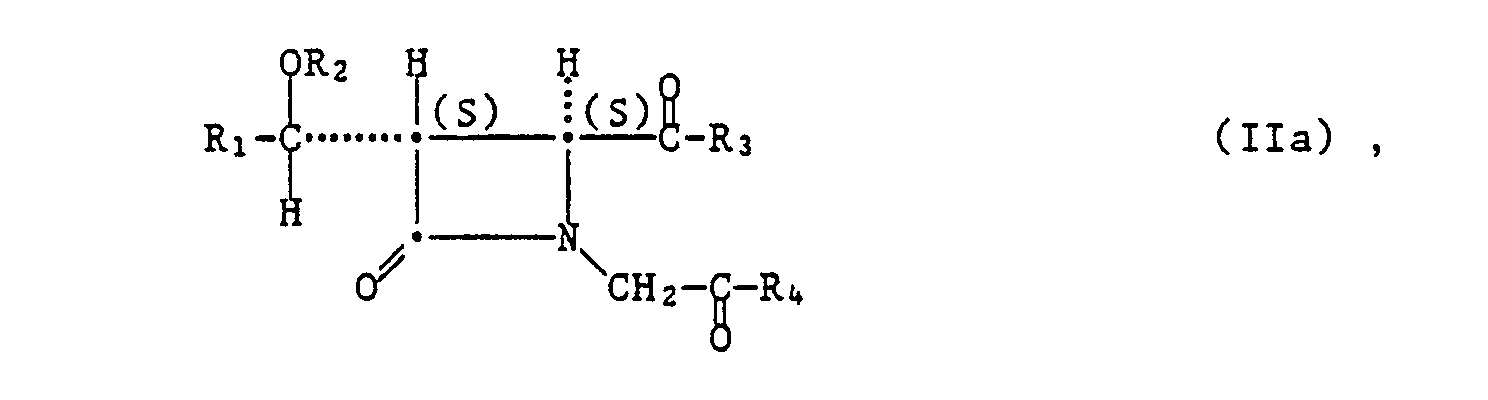

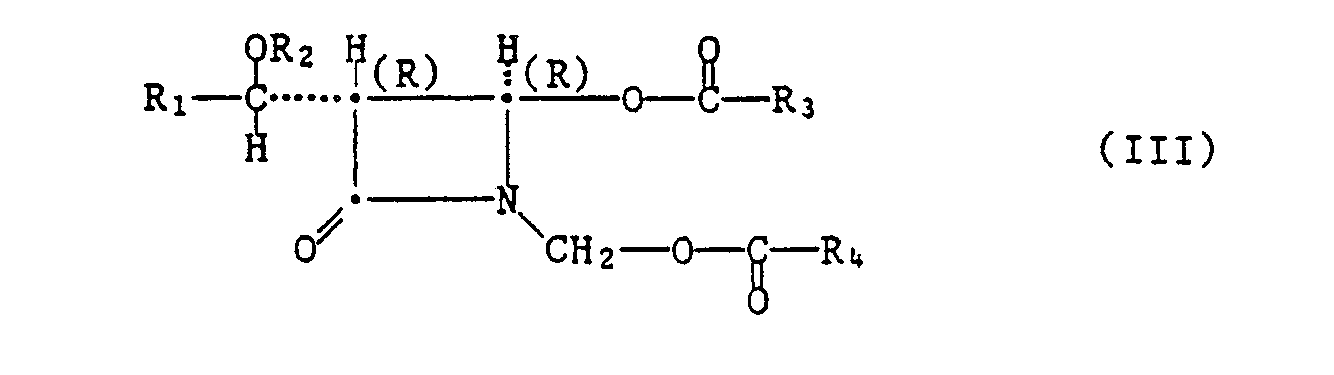


Priority Applications (1)
| Application Number | Priority Date | Filing Date | Title |
|---|---|---|---|
| AT89810804T ATE89551T1 (de) | 1988-11-04 | 1989-10-25 | Verfahren zur herstellung von optisch aktiven acyloxyazetidinonen. |
Applications Claiming Priority (2)
| Application Number | Priority Date | Filing Date | Title |
|---|---|---|---|
| CH4115/88 | 1988-11-04 | ||
| CH411588 | 1988-11-04 |
Publications (2)
| Publication Number | Publication Date |
|---|---|
| EP0367722A1 true EP0367722A1 (de) | 1990-05-09 |
| EP0367722B1 EP0367722B1 (de) | 1993-05-19 |
Family
ID=4270094
Family Applications (1)
| Application Number | Title | Priority Date | Filing Date |
|---|---|---|---|
| EP89810804A Expired - Lifetime EP0367722B1 (de) | 1988-11-04 | 1989-10-25 | Verfahren zur Herstellung von optisch aktiven Acyloxyazetidinonen |
Country Status (7)
| Country | Link |
|---|---|
| EP (1) | EP0367722B1 (de) |
| JP (1) | JPH02172971A (de) |
| AT (1) | ATE89551T1 (de) |
| CA (1) | CA2002045A1 (de) |
| DE (1) | DE58904420D1 (de) |
| DK (1) | DK549789A (de) |
| ES (1) | ES2055155T3 (de) |
Cited By (1)
| Publication number | Priority date | Publication date | Assignee | Title |
|---|---|---|---|---|
| WO2007004028A3 (en) * | 2005-06-30 | 2007-03-29 | Ranbaxy Lab Ltd | Processes for the preparation of penems and its intermediate |
Citations (4)
| Publication number | Priority date | Publication date | Assignee | Title |
|---|---|---|---|---|
| DE1595901A1 (de) * | 1965-04-26 | 1970-02-12 | Lepetit Spa | Verfahren zur Herstellung von 2-Azetidinonen |
| DE2046823A1 (de) * | 1970-09-23 | 1972-03-30 | Farbwerke Hoechst AG vormals Meister Lucius & Brüning, 6000 Frankfurt | Neue Azetidinone-(2) und Verfahren zu deren Herstellung |
| DE2842466A1 (de) * | 1977-09-30 | 1979-04-12 | Kyowa Hakko Kogyo Kk | 2-azetidinon-derivate und verfahren zu ihrer herstellung |
| EP0240164A2 (de) * | 1986-03-03 | 1987-10-07 | Schering Corporation | Herstellung von Azetidinonen |
Family Cites Families (1)
| Publication number | Priority date | Publication date | Assignee | Title |
|---|---|---|---|---|
| DE3587546D1 (de) * | 1984-10-01 | 1993-09-30 | Ciba Geigy | Verfahren zur Herstellung von optisch aktiven Acyloxyazetidinonen. |
-
1989
- 1989-10-25 EP EP89810804A patent/EP0367722B1/de not_active Expired - Lifetime
- 1989-10-25 AT AT89810804T patent/ATE89551T1/de not_active IP Right Cessation
- 1989-10-25 DE DE8989810804T patent/DE58904420D1/de not_active Expired - Fee Related
- 1989-10-25 ES ES89810804T patent/ES2055155T3/es not_active Expired - Lifetime
- 1989-11-02 CA CA002002045A patent/CA2002045A1/en not_active Abandoned
- 1989-11-02 JP JP1285120A patent/JPH02172971A/ja active Pending
- 1989-11-03 DK DK549789A patent/DK549789A/da not_active Application Discontinuation
Patent Citations (4)
| Publication number | Priority date | Publication date | Assignee | Title |
|---|---|---|---|---|
| DE1595901A1 (de) * | 1965-04-26 | 1970-02-12 | Lepetit Spa | Verfahren zur Herstellung von 2-Azetidinonen |
| DE2046823A1 (de) * | 1970-09-23 | 1972-03-30 | Farbwerke Hoechst AG vormals Meister Lucius & Brüning, 6000 Frankfurt | Neue Azetidinone-(2) und Verfahren zu deren Herstellung |
| DE2842466A1 (de) * | 1977-09-30 | 1979-04-12 | Kyowa Hakko Kogyo Kk | 2-azetidinon-derivate und verfahren zu ihrer herstellung |
| EP0240164A2 (de) * | 1986-03-03 | 1987-10-07 | Schering Corporation | Herstellung von Azetidinonen |
Cited By (1)
| Publication number | Priority date | Publication date | Assignee | Title |
|---|---|---|---|---|
| WO2007004028A3 (en) * | 2005-06-30 | 2007-03-29 | Ranbaxy Lab Ltd | Processes for the preparation of penems and its intermediate |
Also Published As
| Publication number | Publication date |
|---|---|
| EP0367722B1 (de) | 1993-05-19 |
| DK549789A (da) | 1990-05-05 |
| ATE89551T1 (de) | 1993-06-15 |
| JPH02172971A (ja) | 1990-07-04 |
| DE58904420D1 (de) | 1993-06-24 |
| ES2055155T3 (es) | 1994-08-16 |
| CA2002045A1 (en) | 1990-05-04 |
| DK549789D0 (da) | 1989-11-03 |
Similar Documents
| Publication | Publication Date | Title |
|---|---|---|
| EP0181831B1 (de) | Verfahren zur Herstellung von optisch aktiven Acyloxyazetidinonen | |
| EP0126709B1 (de) | Verfahren zur Herstellung von optisch aktiven Azetidinonen | |
| EP0290385B1 (de) | Neues Verfahren zur Herstellung von 4-Acyloxy-3-hydroxyethyl-azetidinonen | |
| DE3787815T2 (de) | Azetidinonderivate. | |
| CH634579A5 (en) | Process for preparing cephem compounds | |
| US4997829A (en) | Penem compounds, and use thereof | |
| DE69723864T2 (de) | Ethyliden-derivate tricyclyscher carbapenems | |
| DE3588039T2 (de) | Azetidinonderivate und Verfahren zu ihrer Herstellung. | |
| DE3785878T2 (de) | 3,4-disubstituierte-2-azetidinon-derivate und verfahren zu ihrer herstellung. | |
| EP0167154B1 (de) | Verfahren zur Herstellung von 4-Acetoxy-3-hydroxyethylazetizin-2-on Derivaten | |
| CH665420A5 (de) | Heterocyclische verbindung und stereoselektive verfahren zu ihrer herstellung. | |
| EP0110826B1 (de) | 6-Hydroxyniederalkyl-penem-Verbindungen, Verfahren zu ihrer Herstellung, pharmazeutische Präparate, welche diese Verbindungen enthalten, und Verwendung von letzteren | |
| DE3344317C2 (de) | ||
| DE3610581A1 (de) | Alkenamidocephalosporinester | |
| US4347355A (en) | Inhibitors of transpeptidase | |
| EP0195963A1 (de) | Verfahren zur Herstellung von Carbapenemzwischenprodukten | |
| DE69031222T2 (de) | Verfahren zur herstellung einer 3-substituierten thio-3-cephemverbindung | |
| EP0367722B1 (de) | Verfahren zur Herstellung von optisch aktiven Acyloxyazetidinonen | |
| EP0273747A1 (de) | Penem-Derivate, ihre Herstellung und Verwendung | |
| EP0179318A1 (de) | Sterisch einheitliche 2-Azetidinone | |
| EP0112283B1 (de) | Heterocyclylthioverbindungen, Verfahren zu ihrer Herstellung, pharmazeutische Präparate, welche diese Verbindungen enthalten, und Verwendung von letzteren | |
| DE69329939T2 (de) | Verfahrenzur Abspaltung von Silylschutzgruppen aus geschützten HO-Gruppen | |
| US5317100A (en) | Process for the preparation of optically active acyloxyazetidinones | |
| US4341705A (en) | Thienamycin derivatives | |
| US4356122A (en) | 6-Perhaloalkylsulfonyloxy-penicillanic acids and derivatives thereof |
Legal Events
| Date | Code | Title | Description |
|---|---|---|---|
| PUAI | Public reference made under article 153(3) epc to a published international application that has entered the european phase |
Free format text: ORIGINAL CODE: 0009012 |
|
| 17P | Request for examination filed |
Effective date: 19891028 |
|
| AK | Designated contracting states |
Kind code of ref document: A1 Designated state(s): AT BE CH DE ES FR GB IT LI NL SE |
|
| 17Q | First examination report despatched |
Effective date: 19910925 |
|
| GRAA | (expected) grant |
Free format text: ORIGINAL CODE: 0009210 |
|
| AK | Designated contracting states |
Kind code of ref document: B1 Designated state(s): AT BE CH DE ES FR GB IT LI NL SE |
|
| REF | Corresponds to: |
Ref document number: 89551 Country of ref document: AT Date of ref document: 19930615 Kind code of ref document: T |
|
| ITF | It: translation for a ep patent filed | ||
| REF | Corresponds to: |
Ref document number: 58904420 Country of ref document: DE Date of ref document: 19930624 |
|
| ET | Fr: translation filed | ||
| GBT | Gb: translation of ep patent filed (gb section 77(6)(a)/1977) |
Effective date: 19930709 |
|
| PGFP | Annual fee paid to national office [announced via postgrant information from national office to epo] |
Ref country code: FR Payment date: 19930826 Year of fee payment: 5 |
|
| PGFP | Annual fee paid to national office [announced via postgrant information from national office to epo] |
Ref country code: DE Payment date: 19930902 Year of fee payment: 5 |
|
| PGFP | Annual fee paid to national office [announced via postgrant information from national office to epo] |
Ref country code: GB Payment date: 19930915 Year of fee payment: 5 Ref country code: AT Payment date: 19930915 Year of fee payment: 5 |
|
| PGFP | Annual fee paid to national office [announced via postgrant information from national office to epo] |
Ref country code: ES Payment date: 19930920 Year of fee payment: 5 |
|
| PGFP | Annual fee paid to national office [announced via postgrant information from national office to epo] |
Ref country code: BE Payment date: 19931027 Year of fee payment: 5 |
|
| PGFP | Annual fee paid to national office [announced via postgrant information from national office to epo] |
Ref country code: SE Payment date: 19931029 Year of fee payment: 5 |
|
| PGFP | Annual fee paid to national office [announced via postgrant information from national office to epo] |
Ref country code: NL Payment date: 19931031 Year of fee payment: 5 |
|
| PGFP | Annual fee paid to national office [announced via postgrant information from national office to epo] |
Ref country code: CH Payment date: 19931122 Year of fee payment: 5 |
|
| PLBE | No opposition filed within time limit |
Free format text: ORIGINAL CODE: 0009261 |
|
| STAA | Information on the status of an ep patent application or granted ep patent |
Free format text: STATUS: NO OPPOSITION FILED WITHIN TIME LIMIT |
|
| 26N | No opposition filed | ||
| REG | Reference to a national code |
Ref country code: ES Ref legal event code: FG2A Ref document number: 2055155 Country of ref document: ES Kind code of ref document: T3 |
|
| PG25 | Lapsed in a contracting state [announced via postgrant information from national office to epo] |
Ref country code: GB Effective date: 19941025 Ref country code: AT Effective date: 19941025 |
|
| PG25 | Lapsed in a contracting state [announced via postgrant information from national office to epo] |
Ref country code: SE Effective date: 19941026 Ref country code: ES Free format text: LAPSE BECAUSE OF THE APPLICANT RENOUNCES Effective date: 19941026 |
|
| PG25 | Lapsed in a contracting state [announced via postgrant information from national office to epo] |
Ref country code: LI Effective date: 19941031 Ref country code: CH Effective date: 19941031 Ref country code: BE Effective date: 19941031 |
|
| EAL | Se: european patent in force in sweden |
Ref document number: 89810804.8 |
|
| BERE | Be: lapsed |
Owner name: CIBA-GEIGY A.G. Effective date: 19941031 |
|
| PG25 | Lapsed in a contracting state [announced via postgrant information from national office to epo] |
Ref country code: NL Effective date: 19950501 |
|
| NLV4 | Nl: lapsed or anulled due to non-payment of the annual fee | ||
| GBPC | Gb: european patent ceased through non-payment of renewal fee |
Effective date: 19941025 |
|
| PG25 | Lapsed in a contracting state [announced via postgrant information from national office to epo] |
Ref country code: FR Effective date: 19950630 |
|
| REG | Reference to a national code |
Ref country code: CH Ref legal event code: PL |
|
| PG25 | Lapsed in a contracting state [announced via postgrant information from national office to epo] |
Ref country code: DE Effective date: 19950701 |
|
| EUG | Se: european patent has lapsed |
Ref document number: 89810804.8 |
|
| REG | Reference to a national code |
Ref country code: FR Ref legal event code: ST |
|
| REG | Reference to a national code |
Ref country code: ES Ref legal event code: FD2A Effective date: 19991007 |
|
| PG25 | Lapsed in a contracting state [announced via postgrant information from national office to epo] |
Ref country code: IT Free format text: LAPSE BECAUSE OF NON-PAYMENT OF DUE FEES;WARNING: LAPSES OF ITALIAN PATENTS WITH EFFECTIVE DATE BEFORE 2007 MAY HAVE OCCURRED AT ANY TIME BEFORE 2007. THE CORRECT EFFECTIVE DATE MAY BE DIFFERENT FROM THE ONE RECORDED. Effective date: 20051025 |