EP0367737B1 - Mechanismus für faseroptischen Stecker - Google Patents
Mechanismus für faseroptischen Stecker Download PDFInfo
- Publication number
- EP0367737B1 EP0367737B1 EP89850328A EP89850328A EP0367737B1 EP 0367737 B1 EP0367737 B1 EP 0367737B1 EP 89850328 A EP89850328 A EP 89850328A EP 89850328 A EP89850328 A EP 89850328A EP 0367737 B1 EP0367737 B1 EP 0367737B1
- Authority
- EP
- European Patent Office
- Prior art keywords
- carriage
- cam
- grooves
- end portions
- array
- Prior art date
- Legal status (The legal status is an assumption and is not a legal conclusion. Google has not performed a legal analysis and makes no representation as to the accuracy of the status listed.)
- Expired - Lifetime
Links
- 239000013307 optical fiber Substances 0.000 title claims description 29
- 230000007246 mechanism Effects 0.000 title description 33
- 239000000835 fiber Substances 0.000 claims description 55
- 230000033001 locomotion Effects 0.000 claims description 28
- 239000000758 substrate Substances 0.000 claims description 14
- 238000003491 array Methods 0.000 claims description 10
- 238000005530 etching Methods 0.000 claims description 3
- 230000013011 mating Effects 0.000 claims description 2
- 230000003287 optical effect Effects 0.000 description 6
- 229920003023 plastic Polymers 0.000 description 4
- 238000003780 insertion Methods 0.000 description 3
- 230000037431 insertion Effects 0.000 description 3
- XUIMIQQOPSSXEZ-UHFFFAOYSA-N Silicon Chemical compound [Si] XUIMIQQOPSSXEZ-UHFFFAOYSA-N 0.000 description 2
- 230000000712 assembly Effects 0.000 description 2
- 238000000429 assembly Methods 0.000 description 2
- 230000006835 compression Effects 0.000 description 2
- 238000007906 compression Methods 0.000 description 2
- 230000008878 coupling Effects 0.000 description 2
- 238000010168 coupling process Methods 0.000 description 2
- 238000005859 coupling reaction Methods 0.000 description 2
- 230000000994 depressogenic effect Effects 0.000 description 2
- 230000000694 effects Effects 0.000 description 2
- 238000000034 method Methods 0.000 description 2
- 238000000206 photolithography Methods 0.000 description 2
- 229910052710 silicon Inorganic materials 0.000 description 2
- 239000010703 silicon Substances 0.000 description 2
- 239000000969 carrier Substances 0.000 description 1
- 150000001875 compounds Chemical class 0.000 description 1
- 239000004020 conductor Substances 0.000 description 1
- 229920002457 flexible plastic Polymers 0.000 description 1
- 230000003116 impacting effect Effects 0.000 description 1
- 238000002955 isolation Methods 0.000 description 1
- 239000000463 material Substances 0.000 description 1
- 230000008439 repair process Effects 0.000 description 1
- 238000000926 separation method Methods 0.000 description 1
Images




Classifications
-
- G—PHYSICS
- G02—OPTICS
- G02B—OPTICAL ELEMENTS, SYSTEMS OR APPARATUS
- G02B6/00—Light guides; Structural details of arrangements comprising light guides and other optical elements, e.g. couplings
- G02B6/24—Coupling light guides
- G02B6/36—Mechanical coupling means
- G02B6/38—Mechanical coupling means having fibre to fibre mating means
- G02B6/3807—Dismountable connectors, i.e. comprising plugs
- G02B6/3833—Details of mounting fibres in ferrules; Assembly methods; Manufacture
- G02B6/3834—Means for centering or aligning the light guide within the ferrule
- G02B6/3838—Means for centering or aligning the light guide within the ferrule using grooves for light guides
- G02B6/3839—Means for centering or aligning the light guide within the ferrule using grooves for light guides for a plurality of light guides
-
- G—PHYSICS
- G02—OPTICS
- G02B—OPTICAL ELEMENTS, SYSTEMS OR APPARATUS
- G02B6/00—Light guides; Structural details of arrangements comprising light guides and other optical elements, e.g. couplings
- G02B6/24—Coupling light guides
- G02B6/36—Mechanical coupling means
- G02B6/38—Mechanical coupling means having fibre to fibre mating means
- G02B6/3807—Dismountable connectors, i.e. comprising plugs
- G02B6/3833—Details of mounting fibres in ferrules; Assembly methods; Manufacture
- G02B6/3847—Details of mounting fibres in ferrules; Assembly methods; Manufacture with means preventing fibre end damage, e.g. recessed fibre surfaces
-
- G—PHYSICS
- G02—OPTICS
- G02B—OPTICAL ELEMENTS, SYSTEMS OR APPARATUS
- G02B6/00—Light guides; Structural details of arrangements comprising light guides and other optical elements, e.g. couplings
- G02B6/24—Coupling light guides
- G02B6/36—Mechanical coupling means
- G02B6/38—Mechanical coupling means having fibre to fibre mating means
- G02B6/3807—Dismountable connectors, i.e. comprising plugs
- G02B6/389—Dismountable connectors, i.e. comprising plugs characterised by the method of fastening connecting plugs and sockets, e.g. screw- or nut-lock, snap-in, bayonet type
-
- G—PHYSICS
- G02—OPTICS
- G02B—OPTICAL ELEMENTS, SYSTEMS OR APPARATUS
- G02B6/00—Light guides; Structural details of arrangements comprising light guides and other optical elements, e.g. couplings
- G02B6/24—Coupling light guides
- G02B6/36—Mechanical coupling means
- G02B6/38—Mechanical coupling means having fibre to fibre mating means
- G02B6/3807—Dismountable connectors, i.e. comprising plugs
- G02B6/3897—Connectors fixed to housings, casing, frames or circuit boards
-
- G—PHYSICS
- G02—OPTICS
- G02B—OPTICAL ELEMENTS, SYSTEMS OR APPARATUS
- G02B6/00—Light guides; Structural details of arrangements comprising light guides and other optical elements, e.g. couplings
- G02B6/24—Coupling light guides
- G02B6/42—Coupling light guides with opto-electronic elements
-
- H—ELECTRICITY
- H01—ELECTRIC ELEMENTS
- H01R—ELECTRICALLY-CONDUCTIVE CONNECTIONS; STRUCTURAL ASSOCIATIONS OF A PLURALITY OF MUTUALLY-INSULATED ELECTRICAL CONNECTING ELEMENTS; COUPLING DEVICES; CURRENT COLLECTORS
- H01R12/00—Structural associations of a plurality of mutually-insulated electrical connecting elements, specially adapted for printed circuits, e.g. printed circuit boards [PCB], flat or ribbon cables, or like generally planar structures, e.g. terminal strips, terminal blocks; Coupling devices specially adapted for printed circuits, flat or ribbon cables, or like generally planar structures; Terminals specially adapted for contact with, or insertion into, printed circuits, flat or ribbon cables, or like generally planar structures
- H01R12/70—Coupling devices
- H01R12/82—Coupling devices connected with low or zero insertion force
- H01R12/85—Coupling devices connected with low or zero insertion force contact pressure producing means, contacts activated after insertion of printed circuits or like structures
- H01R12/89—Coupling devices connected with low or zero insertion force contact pressure producing means, contacts activated after insertion of printed circuits or like structures acting manually by moving connector housing parts linearly, e.g. slider
-
- G—PHYSICS
- G02—OPTICS
- G02B—OPTICAL ELEMENTS, SYSTEMS OR APPARATUS
- G02B6/00—Light guides; Structural details of arrangements comprising light guides and other optical elements, e.g. couplings
- G02B6/24—Coupling light guides
- G02B6/36—Mechanical coupling means
- G02B6/3628—Mechanical coupling means for mounting fibres to supporting carriers
- G02B6/3648—Supporting carriers of a microbench type, i.e. with micromachined additional mechanical structures
- G02B6/3652—Supporting carriers of a microbench type, i.e. with micromachined additional mechanical structures the additional structures being prepositioning mounting areas, allowing only movement in one dimension, e.g. grooves, trenches or vias in the microbench surface, i.e. self aligning supporting carriers
-
- G—PHYSICS
- G02—OPTICS
- G02B—OPTICAL ELEMENTS, SYSTEMS OR APPARATUS
- G02B6/00—Light guides; Structural details of arrangements comprising light guides and other optical elements, e.g. couplings
- G02B6/24—Coupling light guides
- G02B6/36—Mechanical coupling means
- G02B6/3628—Mechanical coupling means for mounting fibres to supporting carriers
- G02B6/3684—Mechanical coupling means for mounting fibres to supporting carriers characterised by the manufacturing process of surface profiling of the supporting carrier
- G02B6/3692—Mechanical coupling means for mounting fibres to supporting carriers characterised by the manufacturing process of surface profiling of the supporting carrier with surface micromachining involving etching, e.g. wet or dry etching steps
Definitions
- This invention relates to connector mechanisms for releasably connecting optical connectors, and more particularly to connector assemblies for interconnecting a first plurality of optical fibers with a second plurality of optical fibers and accommodating both the damage-free engagement/disengagement of two separate portions of the connector assemblies as well as establishing the positive and accurate internal coupling required.
- ZIF Zero Insertion Force
- the present invention relates to the extension of such a connector mechanism for interconnecting a plurality of optical fibers with another plurality of optical fibers.
- a copy of the previously mentioned patent is incorporated herewith as part of the present invention.
- U.S. Patent 4,626,056 of Andrews et al. and entitled “Card Edge Connector” and U.S. Patent 4,629,270 of Andrews et al. entitled “Zero Insertion Force Card Edge Connector with Flexible Film Circuitry” propose similar type card connectors for use with multiple conductor lines and making zero insertion force connection with flexible film circuitry.
- an optical fiber connector assembly for interconnecting a first plurality of optical fibers with a second plurality of optical fibers, said connector assembly comprising: a first structure including a body provided with grooves in which the end portions of the first plurality of fibers are carried to form a fixed array of parallel fiber end portions, the grooves continuing beyond the end of the array; a second structure including a movable carriage with a body provided with grooves carrying the end portions of the second plurality of fibers to form a movable array of parallel fiber end portions, the grooves continuing beyond the end of the array and said grooves being spaced and dimensioned with respect to those of the first structure so as to enable the optical fiber end portions of the movable array to be received in the groove parts of the first structure which extend beyond the fixed array in order to be aligned and mated with the optical fiber end portions of the fixed array upon movement of the carriage, with the fibers of both arrays being encapsulated between the grooved bodies upon mating of the arrays;
- Figs. 1 and 2 show one complete connector mechanism 20 and a plurality of partial connector mechanisms according to the present invention. Some component parts are detailed on the complete connector mechanism, which is located in the positive octant delineated by the co-ordinate axes shown in Fig. 1 and some on the partial mechanisms for clarity since they are located on surfaces of the complete mechanism that are obscured.
- the single connector mechanism optically connects the fixed structure 22 and the movable structure 24 carrying each optical fiber lines 26, 30, the optical fiber lines 30 on structure 24 being embedded in plastic ribbon 34 and the optical fiber lines 26 on structure 22 being embedded in substrate 25 on card or board 23.
- the ribbon 34 is a ribbon of flexible plastic material with parallel optical fibers 30 embedded therein as shown in Fig. 4.
- the plastic covering is stripped near the ends as shown leaving optical fiber bare end portions 30a extending parallel part way up a substrate pad 34a.
- the pad 34a is rigid and is fixed to or backs up to unstripped part of the ribbon 34.
- the pad 34a has V-grooves 33 that extend to the free end 34b and that are colinear with the fiber end portions 30a.
- the V-grooves may consist of preferentially etched grooves in a silicon substrate.
- the plastic covering may serve as the pad with the V-grooves in the plastic covering and one face of the ribbon stripped away.
- the optical fibers 26 on the fixed structure 22 extend along V-grooves 25a formed on substrate 25 on the board or card 23.
- These grooves 25a and 33 can be closely controlled by photolithography etching techniques to form very precisely defined and straight grooves in a silicon substrate. Also these grooves can be of a defined depth.
- the optical fibers extend part way only. The depth of the grooves and the shape of the grooves is defined such that the optical fibers of the same diameters as those on the card when pressed against the grooves are aligned with the fixed fibers on the card. Both optical fibers on the ribbon and the card are cut at right angles and polished to be mated end to end by the movement of the actuator 32.
- the optical fiber lines 26 extend only part way down the substrate 25 with the grooves continuing onto the bottom edge 25b of the substrate 25.
- the grooves 25a are co-linear with the lines 26 and are precisely formed such as by the photolithography etching techniques to align the half bare optical fiber end portions 30a on the flexible ribbon 34 with these grooves 25a at the lower end.
- the flexible ribbon 34 likewise has in the rigid pad 34a the vertical grooves 33 therein to receive the bare ends of the fiber lines 26.
- the grooves in the substrates 34a and 25 are such that when the fibers are packed therein and when the fibers are placed together end to end the fibers are tightly packed by movement of the actuator 32 and the fibers are encapsulated between the substrates 34a and 25.
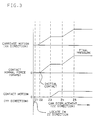
- the common actuator 32 is a compound camming mechanism, able to produce time separated motion in different directions (as illustrated in Fig. 3) in a single actuation, the floating substrate 34a being carried by resilient interposer 38, fixed to a carriage 50 which carries cam followers 54a and 54b engaging a linear cam 52.
- the fixed fiber structure 22 of the two structures shown in Figs. 1 and 2 carries a rigidly attached shroud 46.
- the shroud 46 locates the cam 52 in the XX and YY directions with respect to the fixed fiber end portions 26 on initial assembly of the connector mechanisms and carries locating grooves and notches 48a, 48b which are registered with the fixed fiber end portions 26.
- the actuator 32 is initially actuated, by means of a handle (not shown) the carriage 50 is moved in the YY direction into engagement with the locating notches 48b of the shroud 46, locating the carriage in the ZZ direction.
- the initial and terminal phases of the actuator 32 operation are relatively idle, and resetting of the actuator 32 returns the floating fibers 30 to their starting positions, retracing the listed motions in reverse order.
- Shroud 46 overhangs the back portion of the card 23 with the fibers 26 and is formed to substantially equally perpendicular extents 46a and 46b.
- Extent 46a is perpendicular to the face of the card which it extends from and parallel to card edge.
- Extent 46b extends parallel to the card face beyond the card edge and has a T-cross section groove 48a set into its inner surface facing the card.
- Extent 46b has notches 48b let into the exposed edge. Selected surfaces of the groove and notches are accurately registered with the fiber array connectors.
- Linear cam 52 has an integral longitudinal rail 52a which fits into the groove 48a in the shroud to align the path direction of linear cam relative to the fixed array of fiber end portions in a ZZ direction.
- the cam 52 has multiple pair of camming surfaces providing throws in both the XX and YY directions but these are arranged, relative to the cam follower 54a, 54b so that the currently effective throw is either entirely in the XX direction or entirely in the YY direction. The effect of these throws for a single pass linear cam is illustrated in Fig. 3.
- the linear cam 52 In addition to fitting in the groove 48a in the shroud, the linear cam 52 also fits into the carriage 50 which is a generally rectangular channel, open at the ends for access in the ZZ direction and having walls extending in the XX direction. Eight cam followers are located in the inner surfaces of the carriage channel. The four followers 54a cooperate with the cam 52 to move the carriage in the YY direction, while the four followers 54b cooperate with the cam to move the carriage in the XX direction. It is pointed out that the recited relative orientation of the component parts holds for the connector mechanisms when assembled. Clearly, since each mechanism can be dis-assembled and handled in isolation there is no absolute significance in the recited orientations. The object of the exercise is to locate the cam in the shroud and, by moving the cam 52 in the carriage 50 in the ZZ direction, move the carriage 50 in both the XX direction and the YY direction while keeping these motions quite separate.
- the (vertical) base of the carriage channel thus aligns with the extent 46b of the shroud and resilient interposer 38 is fixed to the exposed surface of the base.
- the end of the flexible ribbon that carries the substrate 34a of fibers 30a is fixed to the exposed surface of the interposer with the fibers exposed and aligned with the carriage as the fibers 26 on the substrate 25 is aligned with the shroud. Intention is to center, butt and align the end of the fibers 30a on the substrate 34a on the end of the ribbon with the fibers 26 on the card 23 and with the fibers 26 in V-grooves 33 and fibers 30a in V-grooves 25a.
- the ribbon 34 passes under the carriage and is locked under the guide 70 fixed to a mother board 72, and the lines in the film may be coupled to mother board lines (not shown).
- a single basic floating structure of fiber end portions in the arrangement comprises a cam 52, the carriage 50, interposer 38, the ribbon 34, the guide 70 and the mother board 72 (along with a plurality of connector mechanisms as are indicated in Figs. 1 and 2 and certain component elements are shared).
- the ribbon 34 may simply hang as a cable in the YY direction rather than turn 90 degrees and be fixed under guide 70.
- the cam and carriage combination is connected to the mother board 72 in Fig. 1 by the guide 70.
- the inherent flexibility of the ribbon 34 is enhanced by the longitudinal apertures 44 therein, but the combination can move relatively freely away from and across the mother board due to the fiber's flexibility and also due to a certain amount of ribbon length which is surplus to minimal requirements.
- This freedom of movement of the combination is necessary to permit interlocking of the actuator, shroud and guide rail to establish registration in a manner to be described and to permit the cam driven motion sequence of the floating fiber end portions.
- the connector mechanisms of this invention are designed to be optical connectors not physical locking mechanisms. They permit the card structures to be assembled and held mechanically together, without the need for registration to a certain degree of precision, since the fine adjustment is internal, using the slack in the ribbon.
- Interlocking of the component elements is partly a function of the engagement of the cam rail 52a in the groove 48a of the shroud 46 and partly a function of the engagement of a pair of lugs 55 extending outwardly and downwardly from the lower wall of the carriage, in the notches 48b in the shroud, as well as in a corresponding pair of cut-aways 73 in the guide 70.
- the lugs 55 essentially remain engaged in the cut-aways 73 but, being of smaller dimensions, can move within the cut-aways in all three indicated directions, and, in particular, can move downwardly in the YY direction by at least the depth of the notches 48b without impacting the ribbon 34. If one considers the rail of the cam to be fixed in the YY direction relative to the mother board, which is effectively correct in all operative conditions, and the cam to be fully retracted, the cam maintains the carriage depressed sufficiently in the YY direction for the bottom of the shroud, when sliding forwardly in the ZZ direction with the cam rail engaged in the shroud groove, to clear the tops of the lugs. In this way, the notches 48b can be brought into position over the lugs.
- the cam 52 is pulled steadily in the ZZ direction for a fixed distance, moving the carriage 50 alternately in the YY direction and in the XX direction relative to the shroud 46 and hence correspondingly moving or attempting to move the floating fibers 30a relative to the fixed fibers 26.
- This activity is illustrated to the right of the origins in Fig. 3.
- the cam moves in the Z2 direction from its retracted position corresponding to the origin in Fig. 3 to a position indicated by Z1
- the carriage is raised in the YY direction relative to the shroud, moving the lugs upwardly in the YY direction into the notches 48b.
- the notches have tapered sides and serve to register the carriage 50 with the shroud 46 in the ZZ direction, consequently, similarly registering the fiber end portions in the ZZ direction.
- the basic connector mechanism connects to one area of one side of the card.
- the cam and shroud, on each side of the card can be common to all the connector mechanisms of the respective side and it is recommended that, with connector mechanisms on both sides of the card, the cams are loosely interconnected as illustrated in Fig. 7 by a coupling yoke 64.
- the illustrated connector mechanism will repeat the described sequence of operations, but in the reverse order, leaving the card and shroud free to be disengaged by being slid backwardly in the ZZ direction. It is possible, however, by use of a differently constructed cam to alter the sequence of relative motions on retraction the cam so that the first action is complete separation of the fiber end portions in the XX direction, followed by direct passage of the carriage to the point at which the carriage is depressed sufficiently to disengage the lugs from the notches 48b.
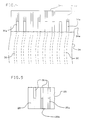
- the card edge connector can be of other similar type structures such as shown in U.S. Patent 4,626,056 or U.S. Patent 4,629,270. If, like U.S. Patent 4,629,270, the cam and groove carriers may be like that of Figs. 8 and 9 and the operation be like that shown in Fig. 10.
Landscapes
- Physics & Mathematics (AREA)
- General Physics & Mathematics (AREA)
- Optics & Photonics (AREA)
- Mechanical Coupling Of Light Guides (AREA)
- Optical Couplings Of Light Guides (AREA)
Claims (5)
- Eine faseroptische Steckervorrichtung zum Verbinden einer ersten Anzahl von Lichtwellenleitern (26) mit einer zweiten Anzahl von Lichtwellenleitern (30), wobei die Steckervorrichtung folgendes umfaßt:
eine erste Struktur (22) mit einer Einheit (25), die über Rillen (25a) verfügt, in denen die Endteile einer ersten Anzahl von Lichtwellenleitern (26) liegen, um eine feste Gruppe von parallelen Lichtwellenleiterendteilen zu bilden, wobei die Rillen (25a) über das Ende der Gruppe hinausgehen;
eine zweite Struktur (24) mit einem beweglichen Wagen (50), der über eine Einheit (34a) mit Rillen (33) verfügt, in denen sich die Endteile (30a) der zweiten Anzahl von Lichtwellenleitern (30) befinden, um eine bewegliche Gruppe von parallelen Lichtwellenleiterendteilen zu bilden, wobei die Rillen (33) über das Ende der Gruppe hinausgehen und im Hinblick auf die Rillen (25a) der ersten Struktur so voneinander entfernt und angeordnet sind, daß die Lichtwellenleiterendteile (30a) der beweglichen Gruppe in den Rillenteilen der ersten Struktur (22), die über die feste Gruppe hinausgeht, aufgenommen werden können, um mit den Lichtwellenleiterendteilen der festen Gruppe nach der Bewegung des Wagens (50) ausgerichtet und angepaßt zu werden, wobei die Lichtwellenleiter beider Gruppen nach der Anpassung zwischen den Einheiten mit Rillen eingekapselt werden;
ein beweglicher Nocken (52) auf einer ersten Struktur (22), um den Wagen (50) auszulösen und zu bewegen, wobei der Wagen (50) über Nockenstößel (54A, 54B) verfügt, die der Nocke folgen, und der Wagen im Hinblick auf die erste Struktur so angeordnet ist, daß die Rillen (33) auf dem Wagen parallel zu den Rillen (25a) auf der ersten Struktur ausgerichtet sind; und
der Nocken ein Profil hat, so daß sich der Wagen in einer ersten Richtung (XX) bewegt, um die beweglichen und festen Gruppen auszurichten, sowie in einer zweiten Richtung orthogonal zur ersten Richtung (YY), um die bewegliche Gruppe der festen Gruppe nach der Bewegung in die erste Richtung (XX) anzupassen. - Eine Steckervorrichtung nach Anspruch 1, bei der der Nocken (52) in Längsrichtung (ZZ) orthogonal zur Ausdehnungsrichtung (YY) der Lichtwellenleiterendteile beider Gruppen beweglich ist, und bei der der Wagen (50) in der Längsrichtung (ZZ) der Nockenbewegung befestigt ist und sich in zwei Querrichtungen (XX, YY) senkrecht dazu bewegen kann, wobei die erste Querrichtung (XX) der Wagenbewegung orthogonal zur Ausdehnungsrichtung der Lichtwellenleiterendteile verläuft, und die zweite Querrichtung (YY) der Wagenbewegung parallel zur Ausdehnungsrichtung der Lichtwellenleiterendteile verläuft.
- Eine Steckervorrichtung nach Anspruch 1 oder 2, bei der die bewegliche Gruppe von Lichtwellenleiterendteilen in einer gemeinsamen Ebene befestigt ist, und die feste Gruppe von Lichtwellenleiterendteilen in einer gemeinsamen Ebene befestigt ist, und die Bewegung des Wagens in eine erste Richtung (XX) die Gruppen in dieselbe gemeinsame Ebene bringt.
- Eine Steckervorrichtung nach einem der oben genannten Ansprüche, bei der die Rillen (25a, 33) V-Rillen sind, die vorzugsweise durch Ätzen eines Substrats hergestellt werden.
- Eine Steckervorrichtung nach einem der oben genannten Ansprüche, bei der der Nocken (52) ein linearer Nocken ist, der durch nur eine Betätigung beweglich ist.
Applications Claiming Priority (2)
| Application Number | Priority Date | Filing Date | Title |
|---|---|---|---|
| US07/265,386 US4934778A (en) | 1988-10-31 | 1988-10-31 | Zero insertion force optical connector |
| US265386 | 1988-10-31 |
Publications (3)
| Publication Number | Publication Date |
|---|---|
| EP0367737A2 EP0367737A2 (de) | 1990-05-09 |
| EP0367737A3 EP0367737A3 (de) | 1991-09-11 |
| EP0367737B1 true EP0367737B1 (de) | 1995-12-27 |
Family
ID=23010224
Family Applications (1)
| Application Number | Title | Priority Date | Filing Date |
|---|---|---|---|
| EP89850328A Expired - Lifetime EP0367737B1 (de) | 1988-10-31 | 1989-10-03 | Mechanismus für faseroptischen Stecker |
Country Status (4)
| Country | Link |
|---|---|
| US (1) | US4934778A (de) |
| EP (1) | EP0367737B1 (de) |
| JP (1) | JPH02130509A (de) |
| DE (1) | DE68925268T2 (de) |
Families Citing this family (13)
| Publication number | Priority date | Publication date | Assignee | Title |
|---|---|---|---|---|
| US5204925A (en) * | 1991-09-11 | 1993-04-20 | At&T Bell Laboratories | Optical interconnection of circuit packs |
| NL9200884A (nl) * | 1992-05-20 | 1993-12-16 | Framatome Connectors Belgium | Connectorsamenstel. |
| US5606635A (en) * | 1995-06-07 | 1997-02-25 | Mcdonnell Douglas Corporation | Fiber optic connector having at least one microactuator for precisely aligning an optical fiber and an associated fabrication method |
| AU7116396A (en) * | 1995-06-07 | 1998-04-14 | Mcdonnell Douglas Corporation | An alignment apparatus for precisely aligning an optical fiber and an associated fabrication method |
| US5602955A (en) * | 1995-06-07 | 1997-02-11 | Mcdonnell Douglas Corporation | Microactuator for precisely aligning an optical fiber and an associated fabrication method |
| US6481899B1 (en) | 1999-06-03 | 2002-11-19 | Hutchinson Technology Incorporated | Optical connector latching mechanism for a spectrophotometric instrument |
| DE60015752T2 (de) * | 1999-06-03 | 2005-12-01 | Kenneth R. Hutchinson Quast | Verriegelungsmechanismus für einen optischen stecker zur anwendung mit einem spektrophotometrischen instrument |
| JP4711277B2 (ja) * | 2001-05-31 | 2011-06-29 | 株式会社吉野工業所 | 棒状の充填部材の繰り出し容器 |
| US6755576B2 (en) * | 2001-11-05 | 2004-06-29 | International Business Machines Corporation | Multiple array optoelectronic connector with integrated latch |
| US6634803B2 (en) | 2001-11-05 | 2003-10-21 | International Business Machines Corporation | External EMI shield for multiple array optoelectronic devices |
| US6666589B2 (en) | 2001-11-05 | 2003-12-23 | International Business Machines Corporation | Internal EMI shield for multiple array optoelectronic devices |
| US7686521B2 (en) * | 2003-11-10 | 2010-03-30 | Finisar Corporation | Zero force socket for laser / photodiode alignment |
| US9798088B2 (en) * | 2015-11-05 | 2017-10-24 | Globalfoundries Inc. | Barrier structures for underfill blockout regions |
Family Cites Families (10)
| Publication number | Priority date | Publication date | Assignee | Title |
|---|---|---|---|---|
| US3947182A (en) * | 1974-10-29 | 1976-03-30 | International Telephone & Telegraph Corporation | Fiber optic connector with axial tolerance relief |
| US4220397A (en) * | 1978-09-01 | 1980-09-02 | Gte Products Corporation | Optical fiber connector |
| FR2464489A1 (fr) * | 1979-08-28 | 1981-03-06 | Socapex | Connecteur de fibres optiques et faisceaux de fibres equipes d'un tel connecteur |
| JPS57186721A (en) * | 1981-05-13 | 1982-11-17 | Nec Corp | Arraying method for different-diameter optical cable |
| JPS5928109A (ja) * | 1982-08-07 | 1984-02-14 | Fujitsu Ltd | 光コネクタ |
| US4636019A (en) * | 1984-02-06 | 1987-01-13 | International Business Machines Corporation | Connector mechanisms |
| EP0151253B1 (de) * | 1984-02-06 | 1990-09-12 | International Business Machines Corporation | Kontaktmechanismus |
| US4626056A (en) * | 1984-02-21 | 1986-12-02 | Amp Incorporated | Card edge connector |
| CA1211550A (en) * | 1984-03-22 | 1986-09-16 | Northern Telecom Limited | Electronic apparatus with circuit cards and signals optically coupled therebetween |
| US4629270A (en) * | 1984-07-16 | 1986-12-16 | Amp Incorporated | Zero insertion force card edge connector with flexible film circuitry |
-
1988
- 1988-10-31 US US07/265,386 patent/US4934778A/en not_active Expired - Fee Related
-
1989
- 1989-08-11 JP JP1207117A patent/JPH02130509A/ja active Granted
- 1989-10-03 EP EP89850328A patent/EP0367737B1/de not_active Expired - Lifetime
- 1989-10-03 DE DE68925268T patent/DE68925268T2/de not_active Expired - Fee Related
Also Published As
| Publication number | Publication date |
|---|---|
| DE68925268T2 (de) | 1996-07-11 |
| US4934778A (en) | 1990-06-19 |
| EP0367737A2 (de) | 1990-05-09 |
| EP0367737A3 (de) | 1991-09-11 |
| JPH0560846B2 (de) | 1993-09-03 |
| JPH02130509A (ja) | 1990-05-18 |
| DE68925268D1 (de) | 1996-02-08 |
Similar Documents
| Publication | Publication Date | Title |
|---|---|---|
| EP0367737B1 (de) | Mechanismus für faseroptischen Stecker | |
| CA2096590C (en) | Connector assembly | |
| US8113851B2 (en) | Connector assemblies and systems including flexible circuits | |
| US12032212B2 (en) | Ferrules, alignment frames and connectors | |
| EP0302617B1 (de) | Opto-elektrische Verbindungsmittel | |
| EP0602726B1 (de) | Steckverbinderaufbau | |
| US5138679A (en) | Optical fiber connector with centering and floating alignment feature | |
| US11054588B2 (en) | Optical ferrules | |
| US4352533A (en) | Connector device for printed boards | |
| US7826692B2 (en) | Connector assembly | |
| EP0535278A1 (de) | Schaltbare optische Verbindung | |
| EP0151253B1 (de) | Kontaktmechanismus | |
| JPH04209479A (ja) | 電気コネクタ | |
| EP2451022A1 (de) | Anschlussanordnungen mit Koppelseiten, die von fluidischen Kopplungsmechanismen verschoben werden | |
| US9312637B2 (en) | Communication system having a floatable connector assembly | |
| CA2240802A1 (en) | Waveguide connector | |
| US8282290B2 (en) | Connectors and assemblies having a plurality of moveable mating arrays | |
| USRE33604E (en) | Connector mechanisms | |
| CA2115203C (en) | Optical fiber switching apparatus | |
| US20010046355A1 (en) | Optical fiber connector | |
| JP3545022B2 (ja) | コネクタ | |
| US4557555A (en) | Switch for optical light waveguides | |
| CN102522642A (zh) | 包括柔性电路的连接器组件及系统 | |
| JPH0339766Y2 (de) |
Legal Events
| Date | Code | Title | Description |
|---|---|---|---|
| PUAI | Public reference made under article 153(3) epc to a published international application that has entered the european phase |
Free format text: ORIGINAL CODE: 0009012 |
|
| AK | Designated contracting states |
Kind code of ref document: A2 Designated state(s): DE FR GB |
|
| 17P | Request for examination filed |
Effective date: 19900820 |
|
| PUAL | Search report despatched |
Free format text: ORIGINAL CODE: 0009013 |
|
| AK | Designated contracting states |
Kind code of ref document: A3 Designated state(s): DE FR GB |
|
| 17Q | First examination report despatched |
Effective date: 19921207 |
|
| GRAA | (expected) grant |
Free format text: ORIGINAL CODE: 0009210 |
|
| AK | Designated contracting states |
Kind code of ref document: B1 Designated state(s): DE FR GB |
|
| REF | Corresponds to: |
Ref document number: 68925268 Country of ref document: DE Date of ref document: 19960208 |
|
| ET | Fr: translation filed | ||
| PG25 | Lapsed in a contracting state [announced via postgrant information from national office to epo] |
Ref country code: GB Effective date: 19961003 |
|
| PLBE | No opposition filed within time limit |
Free format text: ORIGINAL CODE: 0009261 |
|
| STAA | Information on the status of an ep patent application or granted ep patent |
Free format text: STATUS: NO OPPOSITION FILED WITHIN TIME LIMIT |
|
| 26N | No opposition filed | ||
| GBPC | Gb: european patent ceased through non-payment of renewal fee |
Effective date: 19961003 |
|
| PG25 | Lapsed in a contracting state [announced via postgrant information from national office to epo] |
Ref country code: FR Effective date: 19970630 |
|
| PG25 | Lapsed in a contracting state [announced via postgrant information from national office to epo] |
Ref country code: DE Effective date: 19970701 |
|
| REG | Reference to a national code |
Ref country code: FR Ref legal event code: ST |