EP0367848A1 - Four-color repetitive sequence matrix array for flat panel displays - Google Patents
Four-color repetitive sequence matrix array for flat panel displays Download PDFInfo
- Publication number
- EP0367848A1 EP0367848A1 EP88118541A EP88118541A EP0367848A1 EP 0367848 A1 EP0367848 A1 EP 0367848A1 EP 88118541 A EP88118541 A EP 88118541A EP 88118541 A EP88118541 A EP 88118541A EP 0367848 A1 EP0367848 A1 EP 0367848A1
- Authority
- EP
- European Patent Office
- Prior art keywords
- color
- matrix
- pixels
- rows
- repetitive
- Prior art date
- Legal status (The legal status is an assumption and is not a legal conclusion. Google has not performed a legal analysis and makes no representation as to the accuracy of the status listed.)
- Withdrawn
Links
- 239000011159 matrix material Substances 0.000 title claims abstract description 45
- 230000003252 repetitive effect Effects 0.000 title claims abstract 14
- 239000003086 colorant Substances 0.000 claims abstract description 20
- 239000000203 mixture Substances 0.000 description 11
- 230000008901 benefit Effects 0.000 description 7
- 239000004973 liquid crystal related substance Substances 0.000 description 6
- 230000000694 effects Effects 0.000 description 5
- 230000000007 visual effect Effects 0.000 description 4
- 238000013459 approach Methods 0.000 description 3
- 239000000758 substrate Substances 0.000 description 3
- 239000011521 glass Substances 0.000 description 2
- 230000010354 integration Effects 0.000 description 2
- 238000012856 packing Methods 0.000 description 2
- 230000015556 catabolic process Effects 0.000 description 1
- 230000008859 change Effects 0.000 description 1
- 238000004891 communication Methods 0.000 description 1
- 238000010276 construction Methods 0.000 description 1
- 230000002596 correlated effect Effects 0.000 description 1
- 238000006731 degradation reaction Methods 0.000 description 1
- 230000001419 dependent effect Effects 0.000 description 1
- 238000013461 design Methods 0.000 description 1
- 230000008030 elimination Effects 0.000 description 1
- 238000003379 elimination reaction Methods 0.000 description 1
- 238000005516 engineering process Methods 0.000 description 1
- 238000002474 experimental method Methods 0.000 description 1
- 230000004927 fusion Effects 0.000 description 1
- 239000001963 growth medium Substances 0.000 description 1
- 238000011835 investigation Methods 0.000 description 1
- 239000000463 material Substances 0.000 description 1
- 230000007246 mechanism Effects 0.000 description 1
- 238000000034 method Methods 0.000 description 1
- 230000003389 potentiating effect Effects 0.000 description 1
- 238000013139 quantization Methods 0.000 description 1
- 230000009467 reduction Effects 0.000 description 1
- 239000007787 solid Substances 0.000 description 1
- 239000010409 thin film Substances 0.000 description 1
- 238000001429 visible spectrum Methods 0.000 description 1
Images


Classifications
-
- G—PHYSICS
- G09—EDUCATION; CRYPTOGRAPHY; DISPLAY; ADVERTISING; SEALS
- G09G—ARRANGEMENTS OR CIRCUITS FOR CONTROL OF INDICATING DEVICES USING STATIC MEANS TO PRESENT VARIABLE INFORMATION
- G09G3/00—Control arrangements or circuits, of interest only in connection with visual indicators other than cathode-ray tubes
- G09G3/20—Control arrangements or circuits, of interest only in connection with visual indicators other than cathode-ray tubes for presentation of an assembly of a number of characters, e.g. a page, by composing the assembly by combination of individual elements arranged in a matrix no fixed position being assigned to or needed to be assigned to the individual characters or partial characters
- G09G3/2003—Display of colours
-
- G—PHYSICS
- G02—OPTICS
- G02F—OPTICAL DEVICES OR ARRANGEMENTS FOR THE CONTROL OF LIGHT BY MODIFICATION OF THE OPTICAL PROPERTIES OF THE MEDIA OF THE ELEMENTS INVOLVED THEREIN; NON-LINEAR OPTICS; FREQUENCY-CHANGING OF LIGHT; OPTICAL LOGIC ELEMENTS; OPTICAL ANALOGUE/DIGITAL CONVERTERS
- G02F1/00—Devices or arrangements for the control of the intensity, colour, phase, polarisation or direction of light arriving from an independent light source, e.g. switching, gating or modulating; Non-linear optics
- G02F1/01—Devices or arrangements for the control of the intensity, colour, phase, polarisation or direction of light arriving from an independent light source, e.g. switching, gating or modulating; Non-linear optics for the control of the intensity, phase, polarisation or colour
- G02F1/13—Devices or arrangements for the control of the intensity, colour, phase, polarisation or direction of light arriving from an independent light source, e.g. switching, gating or modulating; Non-linear optics for the control of the intensity, phase, polarisation or colour based on liquid crystals, e.g. single liquid crystal display cells
- G02F1/133—Constructional arrangements; Operation of liquid crystal cells; Circuit arrangements
- G02F1/1333—Constructional arrangements; Manufacturing methods
- G02F1/1335—Structural association of cells with optical devices, e.g. polarisers or reflectors
- G02F1/133509—Filters, e.g. light shielding masks
- G02F1/133514—Colour filters
-
- H—ELECTRICITY
- H04—ELECTRIC COMMUNICATION TECHNIQUE
- H04N—PICTORIAL COMMUNICATION, e.g. TELEVISION
- H04N9/00—Details of colour television systems
- H04N9/12—Picture reproducers
- H04N9/30—Picture reproducers using solid-state colour display devices
-
- G—PHYSICS
- G02—OPTICS
- G02F—OPTICAL DEVICES OR ARRANGEMENTS FOR THE CONTROL OF LIGHT BY MODIFICATION OF THE OPTICAL PROPERTIES OF THE MEDIA OF THE ELEMENTS INVOLVED THEREIN; NON-LINEAR OPTICS; FREQUENCY-CHANGING OF LIGHT; OPTICAL LOGIC ELEMENTS; OPTICAL ANALOGUE/DIGITAL CONVERTERS
- G02F2201/00—Constructional arrangements not provided for in groups G02F1/00 - G02F7/00
- G02F2201/52—RGB geometrical arrangements
-
- G—PHYSICS
- G09—EDUCATION; CRYPTOGRAPHY; DISPLAY; ADVERTISING; SEALS
- G09G—ARRANGEMENTS OR CIRCUITS FOR CONTROL OF INDICATING DEVICES USING STATIC MEANS TO PRESENT VARIABLE INFORMATION
- G09G2300/00—Aspects of the constitution of display devices
- G09G2300/04—Structural and physical details of display devices
- G09G2300/0439—Pixel structures
- G09G2300/0452—Details of colour pixel setup, e.g. pixel composed of a red, a blue and two green components
-
- H—ELECTRICITY
- H10—SEMICONDUCTOR DEVICES; ELECTRIC SOLID-STATE DEVICES NOT OTHERWISE PROVIDED FOR
- H10K—ORGANIC ELECTRIC SOLID-STATE DEVICES
- H10K59/00—Integrated devices, or assemblies of multiple devices, comprising at least one organic light-emitting element covered by group H10K50/00
- H10K59/30—Devices specially adapted for multicolour light emission
- H10K59/35—Devices specially adapted for multicolour light emission comprising red-green-blue [RGB] subpixels
- H10K59/351—Devices specially adapted for multicolour light emission comprising red-green-blue [RGB] subpixels comprising more than three subpixels, e.g. red-green-blue-white [RGBW]
Definitions
- This invention relates generally to pictorial communication and more particularly to flat-panel type color matrix display devices, such as those in which a discretely addressable matrix of red, green, and blue (R-G-B) picture elements are used to generate full-color alphanumeric, graphic and/or television video images.
- R-G-B red, green, and blue
- this is accomplished by providing a color matrix array including a plurality of four color pixel patterns in the matrix.
- Each pattern includes R-G-B pixels and a yellow (Y) pixel.
- the matrix comprises a plurality of adjacent rows and adjacent columns. Each pattern is formed by the intersection of any two adjacent rows with any two adjacent columns.
- a color matrix display may employ any number of techniques to generate full color imagery.
- the display may be self-luminous. as in the case of multi-color light emitting diode (LED) matrix displays or matrix addressed electroluminescent (EL) panels.
- the display may also be non-self-luminous, such as in liquid crystal (LC) matrix displays in which electronic control of LC molecule alignment and orientation enable incident light to be either transmitted or absorbed.
- LC matrix displays in which electronic control of LC molecule alignment and orientation enable incident light to be either transmitted or absorbed.
- a passive non-self-luminous device such as an LC matrix display is often described as a "light valve" in that the pixels serve to form a quantized image by selectively passing or obstructing light from an external source.
- the common feature in creating full-color imagery with all current matrix display technologies is the mosaic of color primary elements, typically R-G-B.
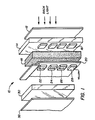
- Device 10 is subjected to a back light and comprises a polarizer 12, and a glass substrate 14 including a plurality of thin film transistors 16.
- a well-known liquid crystal material 18 is between substrate 14 and a common electrode 20 including B-G-R-Y color filters 22, 24, 26, 28, respectively.
- Another glass substrate 30 and polarizer 32 complete the elements of device 10.
- Figures 2a, 2b, 2c, and 2d illustrate four color pixel arrangements which are known to be either under investigation or implemented for color matrix displays.
- Figure 2a shows an R-G-B arrangement with a diagonal orientation of color primaries.
- Figure 2b shows an R-G-B arrangement in which the primary color pixels are packed in triads. This has an offset structure, reminiscent of color triad arrangements commonly used on delta gun shadow-mask color cathode ray tubes.
- Figure 2c depicts an R-G-B pattern with a vertical stripe orientation of color primaries. This pattern is reminiscent of in-line gun shadow mask color cathode ray tubes.
- Figure 2d shows a four-element R-G-B-G pattern.
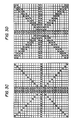
- Figures 3a, 3b, 3c, and 3d show synthesized white lines composed of R-G-B elements in vertical, horizontal, and two 45 degree orientations for each of the four color pixel arrangements described above and in Figures 2a, 2b, 2c, and 2d.
- the letter designation in each of the two sets of figures are correlated in that each letter is associated with one of the four pixel arrangements. It should be noted that in the four-element pattern of Figures 2d and 3d, the two, redundant G elements would each be driven so as to produce half the total required green luminance at each of the two G pixels.
- Figures 3a, 3b, 3c, and 3d are the illustration of varying degree of line width non-uniformity and "stair stepping” or “aliasing" of straight lines as a function of the angular orientation of the lines and the arrangement of primary color pixels.
- the four-element pattern of Figure 2d is seen to produce the most uniform line widths and least amount of stair-stepping or aliasing. This is the result of the more angularly symmetrical packing of four-element color pixels in a regular rectangular matrix than any of the three-element patterns.
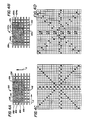
- Array 100, Figure 4A comprises a plurality of adjacent rows 102, 104. Each row 102, 104 includes a plurality of picture elements (pixels) 106. Rows 102, 104 extend in a first direction indicated by the directional arrow designated F.
- Array 100 also comprises a plurality of adjacent columns 108, 110. Each column 108, 110 also includes a plurality of pixels 106. Columns 108, 110 extend in a second direction, normal to the first direction, and indicated by the directional arrow designated S.
- Each array of either Figure 4A or 4b includes a plurality of four-color pixel patterns 112 formed by the intersection of any two adjacent rows with any two adjacent columns.
- Each pixel pattern includes an R, Y, B and G pixel.
- one of the rows 102 includes an alternating pattern of two of the four pixels, e. g. R and Y.
- Adjacent row 104 includes an alternating pattern of another two of the four pixels, e. g. B and G.
- One of the columns 108 includes an alternating pattern of two of the four pixels, e. g. R and B.
- Adjacent column 110 includes an alternating pattern of another two of the pixels, e. g. Y and G.
- a single four-color pixel pattern 112 is repeated throughout the matrix.
- each adjacent row includes a sequential pattern of each of the four pixels, e. g. row 102a includes R, Y, B and G p pixels and row 104a includes B, G, R and Y pixels.
- Each adjacent column includes a sequential pattern of each of the four pixels, e. g. column 108a includes R, B, Y and G pixels.
- Adjacent column 110a includes Y, G, R and B pixels.
- Figures 4a and 4b reveal the pattern or invention, while Figures 4c and 4d depict synthesized white lines in vertical, horizontal, and two 45 degree orientations produced by the R-G-B-Y pixel arrangements.
- Figure 4a shows a R-G-B-Y pattern in which the same 4-pixel R-G-B-Y element is repeated regularly throughout the matrix.
- Figure 4b shows a variant of the pattern in which rows of the R-G-B-Y pattern alternate simply in horizontal dimension of the matrix and columns of the pattern alternate simply in the vertical dimension of the matrix.
- the invention allows color images in R, G, B and Y to be produced by single primary color elements, while the mixture colors magenta (R+B), cyan (G+B), and white (Y+B) are generated by a maximum of two primary colors, one of which is always B.
- the foregoing has described devices for the display of color which utilize a number of discretely addressable pixels each of which will produce a single primary color when activated and when appropriately activated in combination with other color pixels, will form a spatially synthesized full color image. More specifically the present invention relates to flat-panel type color matrix display devices, such as those in which a discretely addressable matrix of R-G-B picture elements are used to generate full-color alphanumeric, graphic and/or television-type video images.
- the present invention includes an additional primary color, Y, to produce a four primary color system R-G-B-Y.
- the present invention employs a 4-primary color pattern.
- the r-color pattern has two major advantages for the design of limited resolution, color matrix displays: 1) the inclusion of a Y primary eliminates the need for problematic R+G color mixes in that Y can be produced by a single element rather than a R+G mix and white can be produced by a Y+B mix rather than the typical R+G+B combination; and 2) angular asymmetries for either single or double element lines are minimized for all primary and mixture colors.
- Previous basic vision experiments have indicated that blue chromaticity integrates over a large spatial area. Blue, therefore effectively enables color change but contributes very little to luminance or visible resolution.
- this feature of human vision is used to advantage by enabling all secondary or mixture colors to be produced by either a R, G or Y primary color
- this feature of human vision is used to advantage by enabling all secondary or mixture colors to be produced by either a R, G or Y primary in combination with B.
- the R, G or Y primaries need not be activated in combination to produce mixture colors.
- B When B is used in combination with other primaries, it enables the color to be changed without producing observable fringe patterns or growth in line width.
- the reduction or elimination of angular asymmetry is an additional benefit resulting from the fact that a 4-color primary pixel pattern can be packed more symmetrically in a regular matrix than a 3-color primary pattern. This minimizes jagged edges on lines of various angular orientations and also serve to minimize color fringing or aliasing.
- the significant advantage of the 4-color (R-G-B-Y) pixel arrangement are: 1) minimization of perceived color fringe or color aliasing problems; and 2) better symmetry of various colored lines or images across angular orientations.
- the first advantage is derived by appealing to the human visual system's large area spatial chromatic integration function for short-wavelengths and poor short-wavelength luminance resolution, while the advantage of greater symmetry is due to the ability to achieve a more angularly symmetric geometry when packing a 4-color primary pixel arrangement into a regular matrix.
Landscapes
- Physics & Mathematics (AREA)
- Engineering & Computer Science (AREA)
- General Physics & Mathematics (AREA)
- Nonlinear Science (AREA)
- Crystallography & Structural Chemistry (AREA)
- Chemical & Material Sciences (AREA)
- Mathematical Physics (AREA)
- Signal Processing (AREA)
- Multimedia (AREA)
- Optics & Photonics (AREA)
- Computer Hardware Design (AREA)
- Theoretical Computer Science (AREA)
- Devices For Indicating Variable Information By Combining Individual Elements (AREA)
Abstract
A four color repetitive sequence matrix array for flat panel displays is formed by establishing a repetitive sequence with pixels of four different colors arranged in the rows of the matrix. The sequence commences with a different color in each row, thereby establishing a second repetitive sequence in the matrix columns. These row and column sequences establish a pattern of 16 pixels with sets of four rows and four columns that is repetitive throughout the array.
Description
- This invention relates generally to pictorial communication and more particularly to flat-panel type color matrix display devices, such as those in which a discretely addressable matrix of red, green, and blue (R-G-B) picture elements are used to generate full-color alphanumeric, graphic and/or television video images.
- The current generation of full-color matrix display devices do not possess sufficient pixel density to produce high-quality color images in all angular image orientations. Attempts to pack three primary color pixel (typically R-G-B) within a regular matrix, which greatly facilitates the construction and implementation of discrete pixel addressing schemes, produces asymmetrical angular resolution for images of different colors. Insufficient pixel density and asymmetrical angular resolution manifest themselves as image coarseness and color "fringing or aliasing". Coarseness and/or asymmetry of R and G primaries are particularly problematic, especially for the mixture colors yellow (R+G) and white (R+G+B). The problem arises due to the human visual system's high degree of resolution acuity for R and G. This makes the fusion of R and G primary elements difficult at practical levels of discrete element pixel density.
- Two approaches have been investigated to solve this problem. The first, and most obvious, is to increase the pixel density to the point where discrete element quantization effects become insignificant. Extremely high pixel density appears to be impractical due to limitations relating to manufacturability, cost, and driver complexity. The second approach has been to define optimized geometric arrangements of R-G-B elements which minimize color fringe/aliasing effects and enable a usable resolution to be achieved in all angular image orientations. This second approach has proven difficult, primarily because of limitations relating to relatively low pixel density (coarseness) and suboptimal geometry in attempting to pack 3-color R-G-B triads into a regular orthogonal matrix. Arrangements of pixels into quadrates rather then triads has helped the angular effects, however, color fringes when combining R and G elements have continued to be difficult to eliminate.
- The foregoing illustrates limitations known to exist in present devices. Thus, it is apparent that it would be advantageous to provide an alternative directed to overcoming one or more of the limitations set forth above. Accordingly, the invention provides a suitable alternative including features more fully disclosed hereinafter and characterized in the claims.
- In one aspect of the present invention, this is accomplished by providing a color matrix array including a plurality of four color pixel patterns in the matrix. Each pattern includes R-G-B pixels and a yellow (Y) pixel. The matrix comprises a plurality of adjacent rows and adjacent columns. Each pattern is formed by the intersection of any two adjacent rows with any two adjacent columns.
- The foregoing and other aspects will become apparent from the following detailed description of the invention when considered in conjunction with the accompanying drawing. It is to be expressly understood, however, that the drawing is not intended as a definition of the invention but is for the purpose of illustration only.
- In the drawing:
- Figure 1 is a perspective view illustrating an embodiment of major device components to color image forming color pixel matrix;
- Figures 2a, 2b, 2c and 2d, are diagrammatic views illustrating previously developed color pixel arrangements for matrix displays.
- Figures 3a, 3b, 3c and 3d are diagrammatic views illustrating white lines in vertical, horizontal and two 45 degree angular orientations for the pixel arrangements illustrated in Figures 2a, 2b, 2c and 2d; and
- Figures 4a, 4b, 4c, and 4d, are diagrammatic vies illustrating embodiments of a color matrix array and the resulting white lines in accordance with this invention.
- A color matrix display may employ any number of techniques to generate full color imagery. The display may be self-luminous. as in the case of multi-color light emitting diode (LED) matrix displays or matrix addressed electroluminescent (EL) panels. the display may also be non-self-luminous, such as in liquid crystal (LC) matrix displays in which electronic control of LC molecule alignment and orientation enable incident light to be either transmitted or absorbed. A passive non-self-luminous device such as an LC matrix display is often described as a "light valve" in that the pixels serve to form a quantized image by selectively passing or obstructing light from an external source. The common feature in creating full-color imagery with all current matrix display technologies is the mosaic of color primary elements, typically R-G-B. In the case of self-luminous devices, separate emitters which each produce light in one of the wavelengths bands of the primary colors are required, and these separate emitters are arranged to produce the color matrix pixel pattern. In the case of the passive, non-self luminous device, such as the LC matrix, a color filter array is imposed over the matrix of individual light valves and aligned such as to produce a mosaic of color pixels. Again, these are typically R-G-B filter elements. Figure 1 illustrates the relationship between the components of a typical passive color matrix device, generally designated 10, modified to add a fourth color, yellow (Y), and the color filter array which determines the color pixel arrangement. The concept and properties of the color pixel arrangement are the major subject matter of this invention.
-
Device 10 is subjected to a back light and comprises apolarizer 12, and a glass substrate 14 including a plurality ofthin film transistors 16. A well-knownliquid crystal material 18 is between substrate 14 and acommon electrode 20 including B-G-R-Y color filters glass substrate 30 andpolarizer 32 complete the elements ofdevice 10. - Figures 2a, 2b, 2c, and 2d illustrate four color pixel arrangements which are known to be either under investigation or implemented for color matrix displays. Figure 2a shows an R-G-B arrangement with a diagonal orientation of color primaries. Figure 2b shows an R-G-B arrangement in which the primary color pixels are packed in triads. This has an offset structure, reminiscent of color triad arrangements commonly used on delta gun shadow-mask color cathode ray tubes. Figure 2c depicts an R-G-B pattern with a vertical stripe orientation of color primaries. This pattern is reminiscent of in-line gun shadow mask color cathode ray tubes. Figure 2d shows a four-element R-G-B-G pattern.
- Figures 3a, 3b, 3c, and 3d show synthesized white lines composed of R-G-B elements in vertical, horizontal, and two 45 degree orientations for each of the four color pixel arrangements described above and in Figures 2a, 2b, 2c, and 2d. The letter designation in each of the two sets of figures are correlated in that each letter is associated with one of the four pixel arrangements. It should be noted that in the four-element pattern of Figures 2d and 3d, the two, redundant G elements would each be driven so as to produce half the total required green luminance at each of the two G pixels. The importance of Figures 3a, 3b, 3c, and 3d is the illustration of varying degree of line width non-uniformity and "stair stepping" or "aliasing" of straight lines as a function of the angular orientation of the lines and the arrangement of primary color pixels. The four-element pattern of Figure 2d is seen to produce the most uniform line widths and least amount of stair-stepping or aliasing. This is the result of the more angularly symmetrical packing of four-element color pixels in a regular rectangular matrix than any of the three-element patterns. What is not apparent from a monochromatic representation of Figures 3a, 3b, 3c, and 3d are the color fringe patterns or color aliasing typically observed in the different color pixel arrangements as a function of angular orientation of line images. These effects are dependent upon the size, chromaticity, luminance, and shape of individual color pixels and thus are not easily demonstrable in graphic form or in monochrome. The effects are easily observable in current color matrix displays, and are primarily attributable to the lack of sufficient visual integration of R and G elements, which is a function of the good resolving capability of the human system for medium G and long R wavelengths of the visible spectrum. For example, in a Y image composed or R and G elements the observer sees an image with a yellowish appearance but is also able to resolve individual R and G elements. Rather than a solid Y image, the image appears as being composed of a mosaic of individual elements. Furthermore, edge and asymmetry affects can cause specific primary colors to accumulate at the edge of images resulting in pronounced primary color fringes and poor image quality. The severity of image degradation varies with the color pixel arrangement and the angular orientation of lines used to construct the image. The same is true for white images composed of R-G-B elements. The R and G elements are individually resolvable, even at relatively small pixel sizes (e. g. .008-.010 inches) and at normal viewing distances estimated at approximately 20 - 28 inches. However, owing to the unique nature of the short wavelength (B sensitive) visual mechanism, 8 elements at the appropriate relative luminance level for white mixture are virtually unresolvable under the same conditions.
- Embodiments of
color matrix array Array 100, Figure 4A comprises a plurality ofadjacent rows row Rows F. Array 100 also comprises a plurality ofadjacent columns column pixels 106.Columns - Each array of either Figure 4A or 4b includes a plurality of four-
color pixel patterns 112 formed by the intersection of any two adjacent rows with any two adjacent columns. Each pixel pattern includes an R, Y, B and G pixel. - Specific to the array of Figure 4A, one of the
rows 102 includes an alternating pattern of two of the four pixels, e. g. R and Y.Adjacent row 104 includes an alternating pattern of another two of the four pixels, e. g. B and G. One of thecolumns 108 includes an alternating pattern of two of the four pixels, e. g. R and B.Adjacent column 110 includes an alternating pattern of another two of the pixels, e. g. Y and G. As a result, a single four-color pixel pattern 112 is repeated throughout the matrix. - Specific to the array of Figure 4B, each adjacent row, includes a sequential pattern of each of the four pixels,
e. g. row 102a includes R, Y, B and G p pixels androw 104a includes B, G, R and Y pixels. Each adjacent column includes a sequential pattern of each of the four pixels, e. g. column 108a includes R, B, Y and G pixels.Adjacent column 110a includes Y, G, R and B pixels. As a result four, four-color pixel patterns - Figures 4a and 4b reveal the pattern or invention, while Figures 4c and 4d depict synthesized white lines in vertical, horizontal, and two 45 degree orientations produced by the R-G-B-Y pixel arrangements. Figure 4a shows a R-G-B-Y pattern in which the same 4-pixel R-G-B-Y element is repeated regularly throughout the matrix. Figure 4b shows a variant of the pattern in which rows of the R-G-B-Y pattern alternate simply in horizontal dimension of the matrix and columns of the pattern alternate simply in the vertical dimension of the matrix.
- The pattern of Figure 4b, while slightly more complex, enables more symmetrical lines to be produced in angles just slightly off the major horizontal and vertical dimensions. The uniformity of line widths and relative freedom from stair-stepping or aliasing is apparent from Figures 4c and 4d. Again, color specific properties cannot be depicted in a monochromatic representation.
- What is evident from full-color images of correct size, chromaticity, and luminance, is the absence of color fringe patterns or color aliasing in images produced by the R-G-B-Y color pixel arrangement. The invention allows color images in R, G, B and Y to be produced by single primary color elements, while the mixture colors magenta (R+B), cyan (G+B), and white (Y+B) are generated by a maximum of two primary colors, one of which is always B. Since B has special characteristics in being extremely potent in determining chromaticity at luminance levels where it is barely resolvable (if at all), all mixture colors appear as a single, homogeneous image whose chromaticity is determined by the mixture of the two primaries but whose brightness and geometric appearance are determined virtually solely by the non-blue primary element. The improvements in color matrix display image resulting from the utilization of the present invention are highly significant and often dramatic.
- The foregoing has described devices for the display of color which utilize a number of discretely addressable pixels each of which will produce a single primary color when activated and when appropriately activated in combination with other color pixels, will form a spatially synthesized full color image. More specifically the present invention relates to flat-panel type color matrix display devices, such as those in which a discretely addressable matrix of R-G-B picture elements are used to generate full-color alphanumeric, graphic and/or television-type video images. The present invention includes an additional primary color, Y, to produce a four primary color system R-G-B-Y.
- The present invention employs a 4-primary color pattern. The r-color pattern has two major advantages for the design of limited resolution, color matrix displays: 1) the inclusion of a Y primary eliminates the need for problematic R+G color mixes in that Y can be produced by a single element rather than a R+G mix and white can be produced by a Y+B mix rather than the typical R+G+B combination; and 2) angular asymmetries for either single or double element lines are minimized for all primary and mixture colors. Previous basic vision experiments have indicated that blue chromaticity integrates over a large spatial area. Blue, therefore effectively enables color change but contributes very little to luminance or visible resolution. By adding the Y primary color, this feature of human vision is used to advantage by enabling all secondary or mixture colors to be produced by either a R, G or Y primary color, this feature of human vision is used to advantage by enabling all secondary or mixture colors to be produced by either a R, G or Y primary in combination with B. The R, G or Y primaries need not be activated in combination to produce mixture colors. When B is used in combination with other primaries, it enables the color to be changed without producing observable fringe patterns or growth in line width. The reduction or elimination of angular asymmetry is an additional benefit resulting from the fact that a 4-color primary pixel pattern can be packed more symmetrically in a regular matrix than a 3-color primary pattern. This minimizes jagged edges on lines of various angular orientations and also serve to minimize color fringing or aliasing.
- The significant advantage of the 4-color (R-G-B-Y) pixel arrangement are: 1) minimization of perceived color fringe or color aliasing problems; and 2) better symmetry of various colored lines or images across angular orientations. The first advantage is derived by appealing to the human visual system's large area spatial chromatic integration function for short-wavelengths and poor short-wavelength luminance resolution, while the advantage of greater symmetry is due to the ability to achieve a more angularly symmetric geometry when packing a 4-color primary pixel arrangement into a regular matrix. These two features enable much better color matrix display image quality to be achieved with the present invention without the cost and complexity of increasing pixel density.
- While the invention has been described in its preferred embodiments, it is to be understood that the words which have been used are words of description rather than of limitation and that changes within the purview of the appended claims may be made without departure from the true scope and spirit of the invention in its broader aspects.
Claims (2)
1. A flat panel display comprising a plurality of pixels each being one of four colors; blue, green, red or, yellow arranged to form a matrix of rows and columns wherein said columns are perpendicular to said rows characterized in that each row in said matrix has a repetitive sequence of said four colors, each row in a set of four rows commencing with a different one of said four colors such that a first group of two contiguous rows in said set of four rows has a first repetitive row sequence of said four colors and a second group of two contiguous rows in said set of four rows has a second repetitive row sequence of said four colors, thereby establishing repetitive sets of four rows, in that said first and second row sequences are arranged such that a repetitive set of four columns is established wherein a first group of two contiguous columns have a first repetitive column sequence of said four colors and a second group of two contiguous columns have a second repetitive column sequence of said four colors and in that said first and second row sequences with said first and second column sequences establish blocks of four pixels in said matrix formed by two rows and two columns wherein each block contains said four colors, one in each element.
2. A flat panel display in accordance with Claim 1 further characterized in that two contiguous blocks of said four pixels in a first row sequence and two contiguous blocks of said four pixels in a second row sequence form first and second column sequences of said blocks of said four pixels such that a repetitive sequence of a 16 pixels pattern is formed that is repetitive throughout said matrix.
Applications Claiming Priority (1)
| Application Number | Priority Date | Filing Date | Title |
|---|---|---|---|
| US06/922,659 US4800375A (en) | 1986-10-24 | 1986-10-24 | Four color repetitive sequence matrix array for flat panel displays |
Publications (1)
| Publication Number | Publication Date |
|---|---|
| EP0367848A1 true EP0367848A1 (en) | 1990-05-16 |
Family
ID=25447399
Family Applications (1)
| Application Number | Title | Priority Date | Filing Date |
|---|---|---|---|
| EP88118541A Withdrawn EP0367848A1 (en) | 1986-10-24 | 1988-11-08 | Four-color repetitive sequence matrix array for flat panel displays |
Country Status (2)
| Country | Link |
|---|---|
| US (1) | US4800375A (en) |
| EP (1) | EP0367848A1 (en) |
Cited By (24)
| Publication number | Priority date | Publication date | Assignee | Title |
|---|---|---|---|---|
| WO1995010160A1 (en) * | 1993-10-05 | 1995-04-13 | British Broadcasting Corporation | Method and apparatus for decoding colour video signals for display |
| EP0843487A1 (en) * | 1996-11-19 | 1998-05-20 | Sony Corporation | Projector apparatus |
| EP0878969A3 (en) * | 1997-05-15 | 2000-07-19 | Matsushita Electric Industrial Co., Ltd. | LED display device and method for controlling the same |
| WO2001001704A1 (en) * | 1999-06-25 | 2001-01-04 | Sarnoff Corporation | Color display |
| WO2004036535A1 (en) * | 2002-10-18 | 2004-04-29 | Koninklijke Philips Electronics N.V. | Full-color organic electro-luminescent display device |
| EP1473694A3 (en) * | 2001-06-11 | 2005-12-07 | Genoa Color Technologies Ltd. | Device, system and method for color display |
| EP1591987A3 (en) * | 2004-04-26 | 2006-01-11 | Seiko Epson Corporation | Display device, color filter, and electronic apparatus |
| WO2006077488A3 (en) * | 2005-01-21 | 2006-12-07 | Space Cannon Vh S P A | Led device comprising a plurality of led diodes |
| US7268757B2 (en) | 2001-06-11 | 2007-09-11 | Genoa Color Technologies Ltd | Device, system and method for color display |
| US7352488B2 (en) | 2000-12-18 | 2008-04-01 | Genoa Color Technologies Ltd | Spectrally matched print proofer |
| CN100401359C (en) * | 2000-07-28 | 2008-07-09 | 克雷沃耶提公司 | Arrangement of color pixels for full color imaging device with simplified addressing |
| US7417799B2 (en) | 2003-08-04 | 2008-08-26 | Genoa Color Technologies Ltd. | Multi-primary color display |
| US7471822B2 (en) | 2002-07-24 | 2008-12-30 | Genoa Color Technologies Ltd | Method and apparatus for high brightness wide color gamut display |
| US7483095B2 (en) | 2003-12-15 | 2009-01-27 | Genoa Color Technologies Ltd | Multi-primary liquid crystal display |
| US7495722B2 (en) | 2003-12-15 | 2009-02-24 | Genoa Color Technologies Ltd. | Multi-color liquid crystal display |
| US7697012B2 (en) * | 2002-08-10 | 2010-04-13 | Samsung Electronics Co., Ltd. | Method and apparatus for rendering image signal |
| US7714824B2 (en) | 2001-06-11 | 2010-05-11 | Genoa Color Technologies Ltd. | Multi-primary display with spectrally adapted back-illumination |
| US7791565B2 (en) | 2004-04-16 | 2010-09-07 | Tpo Hong Kong Holding Limited | Colour electroluminescent display device and its driving method |
| US7999823B2 (en) | 2002-01-07 | 2011-08-16 | Samsung Electronics Co., Ltd. | Device and method for projection device based soft proofing |
| US8228275B2 (en) | 2003-01-28 | 2012-07-24 | Genoa Color Technologies Ltd. | Optimal subpixel arrangement for displays with more than three primary colors |
| US8289266B2 (en) | 2001-06-11 | 2012-10-16 | Genoa Color Technologies Ltd. | Method, device and system for multi-color sequential LCD panel |
| US8587621B2 (en) | 2005-11-28 | 2013-11-19 | Genoa Color Technologies Ltd. | Sub-pixel rendering of a multiprimary image |
| US9953590B2 (en) | 2002-04-11 | 2018-04-24 | Samsung Display Co., Ltd. | Color display devices and methods with enhanced attributes |
| RU2711121C1 (en) * | 2018-08-14 | 2020-01-15 | Александр Георгиевич Носков | Complex of four-color digital television full colours |
Families Citing this family (148)
| Publication number | Priority date | Publication date | Assignee | Title |
|---|---|---|---|---|
| EP0189214B1 (en) * | 1985-01-25 | 1997-07-23 | Nec Corporation | Liquid-crystal multi-color display panel structure |
| US4892391A (en) * | 1988-02-16 | 1990-01-09 | General Electric Company | Method of arranging the cells within the pixels of a color alpha-numeric display device |
| US5266940A (en) * | 1988-03-05 | 1993-11-30 | Sharp Kabushiki Kaisha | Method of gray scale display for dot matrix type display device |
| US4967373A (en) * | 1988-03-16 | 1990-10-30 | Comfuture, Visual Information Management Systems | Multi-colored dot display device |
| JPH0817086B2 (en) * | 1989-05-17 | 1996-02-21 | 三菱電機株式会社 | Display device |
| US5046827C1 (en) * | 1989-07-20 | 2001-08-07 | Honeywell Inc | Optical reconstruction filter for color mosaic displays |
| IL91303A0 (en) * | 1989-08-14 | 1990-03-19 | Ibm Israel | System for displaying images on a cathode ray tube |
| FR2655459A1 (en) * | 1989-12-05 | 1991-06-07 | Thomson Tubes Electroniques | POLYCHROME VISUALIZATION SCREEN. |
| FR2661305B1 (en) * | 1990-04-24 | 1993-12-24 | Sextant Avionique | METHOD FOR VIEWING IMAGES ON A DOT MATRIX COLOR SCREEN. |
| GB9019975D0 (en) * | 1990-09-12 | 1990-10-24 | Smiths Industries Plc | Display assemblies |
| US5541749A (en) * | 1991-07-09 | 1996-07-30 | Semiconductor Energy Laboratory Co., Ltd. | Electro-optical device |
| JP3082114B2 (en) * | 1992-07-02 | 2000-08-28 | 富士通株式会社 | Liquid crystal display |
| JP3046701B2 (en) * | 1993-12-24 | 2000-05-29 | シャープ株式会社 | Color liquid crystal display |
| US5646702A (en) * | 1994-10-31 | 1997-07-08 | Honeywell Inc. | Field emitter liquid crystal display |
| US5642176A (en) * | 1994-11-28 | 1997-06-24 | Canon Kabushiki Kaisha | Color filter substrate and liquid crystal display device |
| TW417074B (en) * | 1996-09-06 | 2001-01-01 | Matsushita Electric Industrial Co Ltd | Display device |
| GB9818092D0 (en) * | 1998-08-19 | 1998-10-14 | Cambridge Display Tech Ltd | Display devices |
| KR100430100B1 (en) * | 1999-03-06 | 2004-05-03 | 엘지.필립스 엘시디 주식회사 | Driving Method of Liquid Crystal Display |
| JP3713193B2 (en) * | 2000-01-18 | 2005-11-02 | シャープ株式会社 | Liquid crystal display device and manufacturing method thereof |
| US6570584B1 (en) * | 2000-05-15 | 2003-05-27 | Eastman Kodak Company | Broad color gamut display |
| US6870523B1 (en) | 2000-06-07 | 2005-03-22 | Genoa Color Technologies | Device, system and method for electronic true color display |
| US7274383B1 (en) | 2000-07-28 | 2007-09-25 | Clairvoyante, Inc | Arrangement of color pixels for full color imaging devices with simplified addressing |
| US7283142B2 (en) * | 2000-07-28 | 2007-10-16 | Clairvoyante, Inc. | Color display having horizontal sub-pixel arrangements and layouts |
| US8022969B2 (en) * | 2001-05-09 | 2011-09-20 | Samsung Electronics Co., Ltd. | Rotatable display with sub-pixel rendering |
| US6950115B2 (en) * | 2001-05-09 | 2005-09-27 | Clairvoyante, Inc. | Color flat panel display sub-pixel arrangements and layouts |
| US7221381B2 (en) | 2001-05-09 | 2007-05-22 | Clairvoyante, Inc | Methods and systems for sub-pixel rendering with gamma adjustment |
| US7123277B2 (en) * | 2001-05-09 | 2006-10-17 | Clairvoyante, Inc. | Conversion of a sub-pixel format data to another sub-pixel data format |
| US7184066B2 (en) | 2001-05-09 | 2007-02-27 | Clairvoyante, Inc | Methods and systems for sub-pixel rendering with adaptive filtering |
| EP1407445B1 (en) | 2001-06-07 | 2010-07-21 | Genoa Color Technologies Ltd. | System and method of data conversion for wide gamut displays |
| US20030112863A1 (en) | 2001-07-12 | 2003-06-19 | Demos Gary A. | Method and system for improving compressed image chroma information |
| US6985163B2 (en) * | 2001-08-14 | 2006-01-10 | Sarnoff Corporation | Color display device |
| AU2002353139A1 (en) | 2001-12-14 | 2003-06-30 | Clairvoyante Laboratories, Inc. | Improvements to color flat panel display sub-pixel arrangements and layouts with reduced visibility of a blue luminance well |
| US20030117423A1 (en) * | 2001-12-14 | 2003-06-26 | Brown Elliott Candice Hellen | Color flat panel display sub-pixel arrangements and layouts with reduced blue luminance well visibility |
| US7755652B2 (en) | 2002-01-07 | 2010-07-13 | Samsung Electronics Co., Ltd. | Color flat panel display sub-pixel rendering and driver configuration for sub-pixel arrangements with split sub-pixels |
| US20040051724A1 (en) * | 2002-09-13 | 2004-03-18 | Elliott Candice Hellen Brown | Four color arrangements of emitters for subpixel rendering |
| US7492379B2 (en) * | 2002-01-07 | 2009-02-17 | Samsung Electronics Co., Ltd. | Color flat panel display sub-pixel arrangements and layouts for sub-pixel rendering with increased modulation transfer function response |
| US7417648B2 (en) | 2002-01-07 | 2008-08-26 | Samsung Electronics Co. Ltd., | Color flat panel display sub-pixel arrangements and layouts for sub-pixel rendering with split blue sub-pixels |
| US6860606B2 (en) * | 2003-01-21 | 2005-03-01 | Hewlett-Packard Development Company, L.P. | Projector having concentrated beam |
| US20040080479A1 (en) * | 2002-10-22 | 2004-04-29 | Credelle Thomas Lioyd | Sub-pixel arrangements for striped displays and methods and systems for sub-pixel rendering same |
| US7075242B2 (en) * | 2002-12-16 | 2006-07-11 | Eastman Kodak Company | Color OLED display system having improved performance |
| US7184067B2 (en) * | 2003-03-13 | 2007-02-27 | Eastman Kodak Company | Color OLED display system |
| US7230594B2 (en) * | 2002-12-16 | 2007-06-12 | Eastman Kodak Company | Color OLED display with improved power efficiency |
| US7397485B2 (en) * | 2002-12-16 | 2008-07-08 | Eastman Kodak Company | Color OLED display system having improved performance |
| KR100493165B1 (en) * | 2002-12-17 | 2005-06-02 | 삼성전자주식회사 | Method and apparatus for rendering image signal |
| US7046256B2 (en) * | 2003-01-22 | 2006-05-16 | Clairvoyante, Inc | System and methods of subpixel rendering implemented on display panels |
| JP4660466B2 (en) * | 2003-01-28 | 2011-03-30 | コーニンクレッカ フィリップス エレクトロニクス エヌ ヴィ | How to display an image on a color display |
| US20040164101A1 (en) * | 2003-02-20 | 2004-08-26 | Valois Sas | Fluid dispenser |
| US7167186B2 (en) * | 2003-03-04 | 2007-01-23 | Clairvoyante, Inc | Systems and methods for motion adaptive filtering |
| US6917368B2 (en) * | 2003-03-04 | 2005-07-12 | Clairvoyante, Inc. | Sub-pixel rendering system and method for improved display viewing angles |
| US20040196302A1 (en) * | 2003-03-04 | 2004-10-07 | Im Moon Hwan | Systems and methods for temporal subpixel rendering of image data |
| US7352374B2 (en) * | 2003-04-07 | 2008-04-01 | Clairvoyante, Inc | Image data set with embedded pre-subpixel rendered image |
| KR100951350B1 (en) | 2003-04-17 | 2010-04-08 | 삼성전자주식회사 | Liquid crystal display |
| US6919681B2 (en) * | 2003-04-30 | 2005-07-19 | Eastman Kodak Company | Color OLED display with improved power efficiency |
| US20040233308A1 (en) * | 2003-05-20 | 2004-11-25 | Elliott Candice Hellen Brown | Image capture device and camera |
| US7268748B2 (en) * | 2003-05-20 | 2007-09-11 | Clairvoyante, Inc | Subpixel rendering for cathode ray tube devices |
| US7230584B2 (en) * | 2003-05-20 | 2007-06-12 | Clairvoyante, Inc | Projector systems with reduced flicker |
| US20040246280A1 (en) * | 2003-06-06 | 2004-12-09 | Credelle Thomas Lloyd | Image degradation correction in novel liquid crystal displays |
| US7218301B2 (en) * | 2003-06-06 | 2007-05-15 | Clairvoyante, Inc | System and method of performing dot inversion with standard drivers and backplane on novel display panel layouts |
| US7791679B2 (en) | 2003-06-06 | 2010-09-07 | Samsung Electronics Co., Ltd. | Alternative thin film transistors for liquid crystal displays |
| US7397455B2 (en) * | 2003-06-06 | 2008-07-08 | Samsung Electronics Co., Ltd. | Liquid crystal display backplane layouts and addressing for non-standard subpixel arrangements |
| US7209105B2 (en) * | 2003-06-06 | 2007-04-24 | Clairvoyante, Inc | System and method for compensating for visual effects upon panels having fixed pattern noise with reduced quantization error |
| US8035599B2 (en) | 2003-06-06 | 2011-10-11 | Samsung Electronics Co., Ltd. | Display panel having crossover connections effecting dot inversion |
| US7187353B2 (en) * | 2003-06-06 | 2007-03-06 | Clairvoyante, Inc | Dot inversion on novel display panel layouts with extra drivers |
| US20040246265A1 (en) * | 2003-06-06 | 2004-12-09 | Starkweather Gary K. | Four-color display |
| US6897876B2 (en) * | 2003-06-26 | 2005-05-24 | Eastman Kodak Company | Method for transforming three color input signals to four or more output signals for a color display |
| US7084923B2 (en) * | 2003-10-28 | 2006-08-01 | Clairvoyante, Inc | Display system having improved multiple modes for displaying image data from multiple input source formats |
| US7525526B2 (en) * | 2003-10-28 | 2009-04-28 | Samsung Electronics Co., Ltd. | System and method for performing image reconstruction and subpixel rendering to effect scaling for multi-mode display |
| WO2005054937A1 (en) * | 2003-12-03 | 2005-06-16 | Samsung Electronics Co., Ltd. | Display device |
| JP4184334B2 (en) * | 2003-12-17 | 2008-11-19 | シャープ株式会社 | Display device driving method, display device, and program |
| EP1571485A3 (en) * | 2004-02-24 | 2005-10-05 | Barco N.V. | Display element array with optimized pixel and sub-pixel layout for use in reflective displays |
| JP4549881B2 (en) * | 2004-03-18 | 2010-09-22 | シャープ株式会社 | Color signal conversion apparatus, display unit, color signal conversion program, and computer-readable recording medium recording the color signal conversion program |
| US7333080B2 (en) * | 2004-03-29 | 2008-02-19 | Eastman Kodak Company | Color OLED display with improved power efficiency |
| US7248268B2 (en) * | 2004-04-09 | 2007-07-24 | Clairvoyante, Inc | Subpixel rendering filters for high brightness subpixel layouts |
| US20050250821A1 (en) * | 2004-04-16 | 2005-11-10 | Vincent Sewalt | Quaternary ammonium compounds in the treatment of water and as antimicrobial wash |
| JP4082379B2 (en) * | 2004-04-26 | 2008-04-30 | セイコーエプソン株式会社 | Liquid crystal display device and electronic device |
| US7091523B2 (en) * | 2004-05-13 | 2006-08-15 | Eastman Kodak Company | Color OLED device having improved performance |
| US7590299B2 (en) * | 2004-06-10 | 2009-09-15 | Samsung Electronics Co., Ltd. | Increasing gamma accuracy in quantized systems |
| TWI236550B (en) * | 2004-06-16 | 2005-07-21 | Chi Mei Optoelectronics Corp | Color filter apparatus, display method and application thereof |
| JP4675325B2 (en) * | 2004-08-19 | 2011-04-20 | シャープ株式会社 | Multi-primary color display device |
| WO2006019025A1 (en) * | 2004-08-19 | 2006-02-23 | Sharp Kabushiki Kaisha | Multiprimary color display device and liquid crystal display device |
| US7193716B2 (en) * | 2004-12-01 | 2007-03-20 | Avago Technologies Ecbu Ip (Singapore) Pte. Ltd. | Arrangement of color filters for characterizing the color of an aggregate light |
| WO2006064395A2 (en) * | 2004-12-14 | 2006-06-22 | Koninklijke Philips Electronics N.V. | Pixel layout for displays |
| JP2008076416A (en) * | 2004-12-27 | 2008-04-03 | Sharp Corp | Display panel drive device, display panel, display device including the same, and display panel drive method |
| JP2008064771A (en) * | 2004-12-27 | 2008-03-21 | Sharp Corp | Display panel driving device, display device including the same, display panel driving method, program, and recording medium |
| US7439670B2 (en) * | 2005-02-03 | 2008-10-21 | Eastman Kodak Company | Making multicolor OLED displays |
| US20060221218A1 (en) * | 2005-04-05 | 2006-10-05 | Doron Adler | Image sensor with improved color filter |
| US8384856B2 (en) * | 2005-04-05 | 2013-02-26 | Sharp Kabushiki Kaisha | Color filter substrate and display device |
| WO2006109567A1 (en) * | 2005-04-05 | 2006-10-19 | Sharp Kabushiki Kaisha | Display device compatible with reflection and transmission |
| US7436113B2 (en) * | 2005-04-25 | 2008-10-14 | Eastman Kodak Company | Multicolor OLED displays |
| US7471041B2 (en) * | 2005-04-25 | 2008-12-30 | Eastman Kodak Company | OLED multicolor displays |
| US7602119B2 (en) * | 2005-04-25 | 2009-10-13 | Eastman Kodak Company | OLED with magenta and green emissive layers |
| FR2889763B1 (en) * | 2005-08-12 | 2007-09-21 | Thales Sa | MATRIX DISPLAY WITH SEQUENTIAL COLOR DISPLAY AND ADDRESSING METHOD |
| JP4364281B2 (en) * | 2005-09-16 | 2009-11-11 | シャープ株式会社 | Display device |
| CN102122460B (en) * | 2005-09-21 | 2012-08-29 | 夏普株式会社 | Display device and color filter substrate |
| EP1770676B1 (en) | 2005-09-30 | 2017-05-03 | Semiconductor Energy Laboratory Co., Ltd. | Display device and electronic device |
| CN102663975B (en) * | 2005-10-03 | 2014-12-24 | 夏普株式会社 | display device |
| TW200719026A (en) * | 2005-11-10 | 2007-05-16 | Chi Lin Technology Co Ltd | LED array |
| EP1990678A4 (en) * | 2006-02-27 | 2010-08-25 | Sharp Kk | Liquid crystal display |
| US7880834B2 (en) * | 2006-03-17 | 2011-02-01 | Sharp Kabushiki Kaisha | Liquid crystal display device |
| JP4528859B2 (en) * | 2006-06-19 | 2010-08-25 | シャープ株式会社 | Display device |
| WO2008016015A1 (en) * | 2006-08-02 | 2008-02-07 | Sharp Kabushiki Kaisha | Display device, method for generating four or more primary color signals, and program causing computer to execute processing for generating four or more primary color signals |
| US7876341B2 (en) * | 2006-08-28 | 2011-01-25 | Samsung Electronics Co., Ltd. | Subpixel layouts for high brightness displays and systems |
| US8018476B2 (en) | 2006-08-28 | 2011-09-13 | Samsung Electronics Co., Ltd. | Subpixel layouts for high brightness displays and systems |
| JP4976404B2 (en) * | 2006-09-26 | 2012-07-18 | シャープ株式会社 | Liquid crystal display |
| US9928786B2 (en) * | 2006-10-13 | 2018-03-27 | Sharp Kabushiki Kaisha | Display device and signal converting device |
| WO2008065935A1 (en) * | 2006-11-28 | 2008-06-05 | Sharp Kabushiki Kaisha | Signal conversion circuit and multiple primary color liquid crystal display device with the circuit |
| JP4913161B2 (en) * | 2007-01-25 | 2012-04-11 | シャープ株式会社 | Multi-primary color display device |
| CN101636775B (en) * | 2007-03-16 | 2014-05-07 | 夏普株式会社 | Display device |
| US20080297530A1 (en) * | 2007-05-31 | 2008-12-04 | Monte Jerome Ramstad | Four primary color display apparatus and method |
| US9620038B2 (en) * | 2007-08-08 | 2017-04-11 | Landmark Screens, Llc | Method for displaying a single image for diagnostic purpose without interrupting an observer's perception of the display of a sequence of images |
| US9536463B2 (en) * | 2007-08-08 | 2017-01-03 | Landmark Screens, Llc | Method for fault-healing in a light emitting diode (LED) based display |
| US9659513B2 (en) | 2007-08-08 | 2017-05-23 | Landmark Screens, Llc | Method for compensating for a chromaticity shift due to ambient light in an electronic signboard |
| US9779644B2 (en) * | 2007-08-08 | 2017-10-03 | Landmark Screens, Llc | Method for computing drive currents for a plurality of LEDs in a pixel of a signboard to achieve a desired color at a desired luminous intensity |
| US9342266B2 (en) * | 2007-08-08 | 2016-05-17 | Landmark Screens, Llc | Apparatus for dynamically circumventing faults in the light emitting diodes (LEDs) of a pixel in a graphical display |
| US9262118B2 (en) * | 2007-08-08 | 2016-02-16 | Landmark Screens, Llc | Graphical display comprising a plurality of modules each controlling a group of pixels corresponding to a portion of the graphical display |
| US8654050B2 (en) * | 2007-09-13 | 2014-02-18 | Sharp Kabushiki Kaisha | Multiple-primary-color liquid crystal display device |
| US20090073099A1 (en) * | 2007-09-14 | 2009-03-19 | Tpo Displays Corp. | Display comprising a plurality of pixels and a device comprising such a display |
| WO2009144896A1 (en) * | 2008-05-27 | 2009-12-03 | シャープ株式会社 | Signal conversion circuit, and multiple primary color liquid crystal display device having the circuit |
| BRPI0916678A2 (en) * | 2008-07-28 | 2015-11-17 | Sharp Kk | primary multi color display device device |
| EP2330585A4 (en) * | 2008-09-22 | 2013-02-27 | Sharp Kk | Signal conversion circuit, and multiple-primary-color liquid crystal display device provided with same |
| EP2369576A3 (en) * | 2008-11-13 | 2013-01-02 | Sharp Kabushiki Kaisha | Display device |
| CN102227675B (en) * | 2008-11-28 | 2014-05-28 | 夏普株式会社 | Multiple primary color liquid crystal display device and signal conversion circuit |
| JP5300866B2 (en) | 2008-12-10 | 2013-09-25 | シャープ株式会社 | Liquid crystal display |
| JP5680969B2 (en) | 2008-12-26 | 2015-03-04 | シャープ株式会社 | Liquid crystal display |
| US8576262B2 (en) | 2008-12-26 | 2013-11-05 | Sharp Kabushiki Kaisha | Liquid crystal display apparatus |
| US20110013056A1 (en) * | 2009-07-17 | 2011-01-20 | Searete Llc, A Limited Liability Corporation Of The State Of Delaware | Color filters and demosaicing techniques for digital imaging |
| RU2012122061A (en) | 2009-10-29 | 2013-12-10 | Шарп Кабусики Кайся | LIQUID CRYSTAL DISPLAY DEVICE |
| BR112012012359A2 (en) | 2009-11-26 | 2016-03-22 | Sharp Kk | multiple primary color display device |
| KR101634744B1 (en) * | 2009-12-30 | 2016-07-11 | 삼성디스플레이 주식회사 | Display apparatus |
| US8947476B2 (en) | 2010-01-07 | 2015-02-03 | Sharp Kabushiki Kaisha | Liquid-crystal display and signal converting circuit |
| JP5368590B2 (en) | 2010-01-29 | 2013-12-18 | シャープ株式会社 | Liquid crystal display |
| WO2011093387A1 (en) | 2010-01-29 | 2011-08-04 | シャープ株式会社 | Liquid crystal display device |
| US9177512B2 (en) | 2010-02-19 | 2015-11-03 | Sharp Kabushiki Kaisha | Display device |
| WO2011115169A1 (en) * | 2010-03-18 | 2011-09-22 | シャープ株式会社 | Multi-primary color liquid crystal panel drive circuit, multi-primary color liquid crystal panel drive method, liquid crystal display device and overdrive setting method |
| JP5650918B2 (en) * | 2010-03-26 | 2015-01-07 | 株式会社ジャパンディスプレイ | Image display device |
| EP2579092A1 (en) | 2010-06-02 | 2013-04-10 | Sharp Kabushiki Kaisha | Liquid crystal display device and display defect correction method |
| US9245471B2 (en) | 2010-07-06 | 2016-01-26 | Sharp Kabushiki Kaisha | Multiple-primary color liquid crystal display apparatus |
| WO2012005022A1 (en) | 2010-07-09 | 2012-01-12 | シャープ株式会社 | Liquid crystal display device |
| US9093017B2 (en) | 2010-10-18 | 2015-07-28 | Vp Assets Limited | Image device with pixel dots with multi-primary colors |
| US8717255B2 (en) * | 2010-10-18 | 2014-05-06 | Vp Assets Limited | Image device with pixel dots with multi-primary colors |
| CN104992654B (en) * | 2011-07-29 | 2019-02-22 | 深圳云英谷科技有限公司 | Sub-pixel arrangement of display and presentation method thereof |
| US9520101B2 (en) * | 2011-08-31 | 2016-12-13 | Microsoft Technology Licensing, Llc | Image rendering filter creation |
| US9279547B2 (en) * | 2012-01-13 | 2016-03-08 | Koninklijke Philips N.V. | LED-based direct-view luminaire with uniform lit appearance |
| US9552757B2 (en) | 2014-08-21 | 2017-01-24 | Vp Assets Limited | Image device with improved chrominance quality |
| US9613588B2 (en) | 2014-08-21 | 2017-04-04 | Vp Assets Limited | Image device with improved chrominance quality |
| US20160055781A1 (en) | 2014-08-21 | 2016-02-25 | Vp Assets Limited | Image device with imrpoved chrominance quality |
| CN104375315B (en) * | 2014-11-18 | 2017-06-16 | 深圳市华星光电技术有限公司 | Color membrane substrates, colored filter, display panel and display device |
| CA3192134A1 (en) * | 2022-03-07 | 2023-09-07 | Lmpg Inc. | Led lighting fixture having multiple led clusters with relative angular displacement (rotation) |
Citations (4)
| Publication number | Priority date | Publication date | Assignee | Title |
|---|---|---|---|---|
| FR2451082A1 (en) * | 1979-03-05 | 1980-10-03 | Hitachi Ltd | PLEOCHROIC COLOR DISPLAY DEVICE |
| EP0096856A1 (en) * | 1982-06-15 | 1983-12-28 | International Standard Electric Corporation | Liquid crystal display |
| GB2139393A (en) * | 1983-05-06 | 1984-11-07 | Dainippon Screen Mfg | A multi-colour liquid crystal display device |
| GB2180979A (en) * | 1985-01-29 | 1987-04-08 | Matsushita Electric Industrial Co Ltd | Digitally driven color display device |
Family Cites Families (5)
| Publication number | Priority date | Publication date | Assignee | Title |
|---|---|---|---|---|
| US3961365A (en) * | 1974-10-24 | 1976-06-01 | Stewart-Warner Corporation | Color display device |
| US4513281A (en) * | 1982-04-05 | 1985-04-23 | At&T Bell Laboratories | AC plasma panel shift with intensity control |
| JPS5961818A (en) * | 1982-10-01 | 1984-04-09 | Seiko Epson Corp | liquid crystal display device |
| JPS59111196A (en) * | 1982-12-15 | 1984-06-27 | シチズン時計株式会社 | Color display unit |
| US4622881A (en) * | 1984-12-06 | 1986-11-18 | Michael Rand | Visual display system with triangular cells |
-
1986
- 1986-10-24 US US06/922,659 patent/US4800375A/en not_active Expired - Fee Related
-
1988
- 1988-11-08 EP EP88118541A patent/EP0367848A1/en not_active Withdrawn
Patent Citations (4)
| Publication number | Priority date | Publication date | Assignee | Title |
|---|---|---|---|---|
| FR2451082A1 (en) * | 1979-03-05 | 1980-10-03 | Hitachi Ltd | PLEOCHROIC COLOR DISPLAY DEVICE |
| EP0096856A1 (en) * | 1982-06-15 | 1983-12-28 | International Standard Electric Corporation | Liquid crystal display |
| GB2139393A (en) * | 1983-05-06 | 1984-11-07 | Dainippon Screen Mfg | A multi-colour liquid crystal display device |
| GB2180979A (en) * | 1985-01-29 | 1987-04-08 | Matsushita Electric Industrial Co Ltd | Digitally driven color display device |
Cited By (41)
| Publication number | Priority date | Publication date | Assignee | Title |
|---|---|---|---|---|
| GB2282928B (en) * | 1993-10-05 | 1998-01-07 | British Broadcasting Corp | Method and apparatus for decoding colour video signals for display |
| WO1995010160A1 (en) * | 1993-10-05 | 1995-04-13 | British Broadcasting Corporation | Method and apparatus for decoding colour video signals for display |
| EP0843487A1 (en) * | 1996-11-19 | 1998-05-20 | Sony Corporation | Projector apparatus |
| US6191826B1 (en) | 1996-11-19 | 2001-02-20 | Sony Corporation | Projector apparatus |
| EP0878969A3 (en) * | 1997-05-15 | 2000-07-19 | Matsushita Electric Industrial Co., Ltd. | LED display device and method for controlling the same |
| US6144352A (en) * | 1997-05-15 | 2000-11-07 | Matsushita Electric Industrial Co., Ltd. | LED display device and method for controlling the same |
| WO2001001704A1 (en) * | 1999-06-25 | 2001-01-04 | Sarnoff Corporation | Color display |
| CN100401359C (en) * | 2000-07-28 | 2008-07-09 | 克雷沃耶提公司 | Arrangement of color pixels for full color imaging device with simplified addressing |
| US7352488B2 (en) | 2000-12-18 | 2008-04-01 | Genoa Color Technologies Ltd | Spectrally matched print proofer |
| US8310498B2 (en) | 2000-12-18 | 2012-11-13 | Samsung Display Co., Ltd. | Spectrally matched print proofer |
| US7714824B2 (en) | 2001-06-11 | 2010-05-11 | Genoa Color Technologies Ltd. | Multi-primary display with spectrally adapted back-illumination |
| US7990403B2 (en) | 2001-06-11 | 2011-08-02 | Genoa Color Technologies Ltd. | Device, system and method for color display |
| US9851599B2 (en) | 2001-06-11 | 2017-12-26 | Samsung Display Co., Ltd. | Color display device comprising at least six different primary colors |
| US9430974B2 (en) | 2001-06-11 | 2016-08-30 | Samsung Display Co., Ltd. | Multi-primary display with spectrally adapted back-illumination |
| US9196203B2 (en) | 2001-06-11 | 2015-11-24 | Samsung Display Co., Ltd. | Device and system for a multi-color sequential LCD panel wherein the number of colors in a sequence of display colors is greater than the number of LED colors |
| US8885120B2 (en) | 2001-06-11 | 2014-11-11 | Genoa Color Technologies Ltd. | Liquid crystal display device using a color-sequential method wherein the number of different colored LEDs is less than the number of primary colors used in the display |
| US8558857B2 (en) | 2001-06-11 | 2013-10-15 | Genoa Color Technologies Ltd. | Device, system and method for color display |
| US8289266B2 (en) | 2001-06-11 | 2012-10-16 | Genoa Color Technologies Ltd. | Method, device and system for multi-color sequential LCD panel |
| US8248440B2 (en) | 2001-06-11 | 2012-08-21 | Genoa Color Technologies Ltd. | Device, system and method for color display |
| US7268757B2 (en) | 2001-06-11 | 2007-09-11 | Genoa Color Technologies Ltd | Device, system and method for color display |
| EP1473694A3 (en) * | 2001-06-11 | 2005-12-07 | Genoa Color Technologies Ltd. | Device, system and method for color display |
| US7995019B2 (en) | 2001-06-11 | 2011-08-09 | Genoa Color Technologies Ltd. | Device, system and method for color display |
| US7999823B2 (en) | 2002-01-07 | 2011-08-16 | Samsung Electronics Co., Ltd. | Device and method for projection device based soft proofing |
| US9953590B2 (en) | 2002-04-11 | 2018-04-24 | Samsung Display Co., Ltd. | Color display devices and methods with enhanced attributes |
| US7471822B2 (en) | 2002-07-24 | 2008-12-30 | Genoa Color Technologies Ltd | Method and apparatus for high brightness wide color gamut display |
| US7916939B2 (en) | 2002-07-24 | 2011-03-29 | Samsung Electronics Co., Ltd. | High brightness wide gamut display |
| US7697012B2 (en) * | 2002-08-10 | 2010-04-13 | Samsung Electronics Co., Ltd. | Method and apparatus for rendering image signal |
| WO2004036535A1 (en) * | 2002-10-18 | 2004-04-29 | Koninklijke Philips Electronics N.V. | Full-color organic electro-luminescent display device |
| US8228275B2 (en) | 2003-01-28 | 2012-07-24 | Genoa Color Technologies Ltd. | Optimal subpixel arrangement for displays with more than three primary colors |
| US7417799B2 (en) | 2003-08-04 | 2008-08-26 | Genoa Color Technologies Ltd. | Multi-primary color display |
| US8451405B2 (en) | 2003-12-15 | 2013-05-28 | Genoa Color Technologies Ltd. | Multi-color liquid crystal display |
| US7483095B2 (en) | 2003-12-15 | 2009-01-27 | Genoa Color Technologies Ltd | Multi-primary liquid crystal display |
| US7495722B2 (en) | 2003-12-15 | 2009-02-24 | Genoa Color Technologies Ltd. | Multi-color liquid crystal display |
| US8934072B2 (en) | 2003-12-15 | 2015-01-13 | Genoa Color Technologies Ltd. | Multi-color liquid crystal display |
| US8179502B2 (en) | 2003-12-15 | 2012-05-15 | Genoa Color Technologies Ltd. | Multi-color liquid crystal display |
| US7791565B2 (en) | 2004-04-16 | 2010-09-07 | Tpo Hong Kong Holding Limited | Colour electroluminescent display device and its driving method |
| US7443469B2 (en) | 2004-04-26 | 2008-10-28 | Seiko Epson Corporation | Display device, color filter, and electronic apparatus |
| EP1591987A3 (en) * | 2004-04-26 | 2006-01-11 | Seiko Epson Corporation | Display device, color filter, and electronic apparatus |
| WO2006077488A3 (en) * | 2005-01-21 | 2006-12-07 | Space Cannon Vh S P A | Led device comprising a plurality of led diodes |
| US8587621B2 (en) | 2005-11-28 | 2013-11-19 | Genoa Color Technologies Ltd. | Sub-pixel rendering of a multiprimary image |
| RU2711121C1 (en) * | 2018-08-14 | 2020-01-15 | Александр Георгиевич Носков | Complex of four-color digital television full colours |
Also Published As
| Publication number | Publication date |
|---|---|
| US4800375A (en) | 1989-01-24 |
Similar Documents
| Publication | Publication Date | Title |
|---|---|---|
| US4800375A (en) | Four color repetitive sequence matrix array for flat panel displays | |
| JP4806514B2 (en) | Color / pixel arrangement for full-color image device by simple addressing method | |
| US4642619A (en) | Non-light-emitting liquid crystal color display device | |
| US8134583B2 (en) | To color flat panel display sub-pixel arrangements and layouts for sub-pixel rendering with split blue sub-pixels | |
| JP4675325B2 (en) | Multi-primary color display device | |
| KR101097922B1 (en) | Improved subpixel rendering filters for high brightness subpixel layouts | |
| US7515122B2 (en) | Color display device with enhanced pixel pattern | |
| US6023315A (en) | Spatial light modulator and directional display | |
| US6980176B2 (en) | Three-dimensional image display apparatus and color reproducing method for three-dimensional image display | |
| CN112436031A (en) | Pixel arrangement structure, display panel and display device | |
| US20020008812A1 (en) | Dot-sequential color display system | |
| TW201023127A (en) | Improvements to color flat panel display sub-pixel arrangements and layouts with reduced blue luminance well visibility | |
| KR101093230B1 (en) | New subpixel layouts and arrays for high brightness display | |
| KR20010043751A (en) | Method and apparatus for displaying bitmap multi-color image data on dot matrix-type display screen on which three primary color lamps are dispersedly arrayed | |
| US6796658B2 (en) | Configurations for color displays by the use of lenticular optics | |
| US8038316B2 (en) | 3-D color synthesis displays and methods | |
| CN111164758A (en) | Display device for improving edge color cast and television | |
| US6469756B1 (en) | Compensating for aperture parallax distortion in tiled displays | |
| JPH02173783A (en) | Color matrix array for flat panel display device | |
| Tannas Jr | Color in electronic displays | |
| JP3123306B2 (en) | Display device | |
| CA2061329A1 (en) | Method and apparatus for improving output display device resolution | |
| Miller et al. | 27.3: When is Sub‐Sampling in RGB Displays Practical? | |
| JPS63282718A (en) | Active matrix type liquid crystal display device | |
| Silverstein | Display color synthesis in the space-time continuum |
Legal Events
| Date | Code | Title | Description |
|---|---|---|---|
| PUAI | Public reference made under article 153(3) epc to a published international application that has entered the european phase |
Free format text: ORIGINAL CODE: 0009012 |
|
| AK | Designated contracting states |
Kind code of ref document: A1 Designated state(s): DE FR GB IT |
|
| 17P | Request for examination filed |
Effective date: 19901026 |
|
| 17Q | First examination report despatched |
Effective date: 19920831 |
|
| STAA | Information on the status of an ep patent application or granted ep patent |
Free format text: STATUS: THE APPLICATION IS DEEMED TO BE WITHDRAWN |
|
| 18D | Application deemed to be withdrawn |
Effective date: 19940601 |