EP0367938A2 - Procédé de fabrication d'un fil, en particulier un fil à condre, et fil ainsi obtenu - Google Patents
Procédé de fabrication d'un fil, en particulier un fil à condre, et fil ainsi obtenu Download PDFInfo
- Publication number
- EP0367938A2 EP0367938A2 EP89116516A EP89116516A EP0367938A2 EP 0367938 A2 EP0367938 A2 EP 0367938A2 EP 89116516 A EP89116516 A EP 89116516A EP 89116516 A EP89116516 A EP 89116516A EP 0367938 A2 EP0367938 A2 EP 0367938A2
- Authority
- EP
- European Patent Office
- Prior art keywords
- yarn
- dtex
- component
- tex
- multifilament
- Prior art date
- Legal status (The legal status is an assumption and is not a legal conclusion. Google has not performed a legal analysis and makes no representation as to the accuracy of the status listed.)
- Granted
Links
Images
Classifications
-
- D—TEXTILES; PAPER
- D02—YARNS; MECHANICAL FINISHING OF YARNS OR ROPES; WARPING OR BEAMING
- D02G—CRIMPING OR CURLING FIBRES, FILAMENTS, THREADS, OR YARNS; YARNS OR THREADS
- D02G1/00—Producing crimped or curled fibres, filaments, yarns, or threads, giving them latent characteristics
- D02G1/16—Producing crimped or curled fibres, filaments, yarns, or threads, giving them latent characteristics using jets or streams of turbulent gases, e.g. air, steam
- D02G1/164—Producing crimped or curled fibres, filaments, yarns, or threads, giving them latent characteristics using jets or streams of turbulent gases, e.g. air, steam in the presence of a liquid, e.g. a crimp finish
-
- D—TEXTILES; PAPER
- D02—YARNS; MECHANICAL FINISHING OF YARNS OR ROPES; WARPING OR BEAMING
- D02G—CRIMPING OR CURLING FIBRES, FILAMENTS, THREADS, OR YARNS; YARNS OR THREADS
- D02G1/00—Producing crimped or curled fibres, filaments, yarns, or threads, giving them latent characteristics
- D02G1/02—Producing crimped or curled fibres, filaments, yarns, or threads, giving them latent characteristics by twisting, fixing the twist and backtwisting, i.e. by imparting false twist
- D02G1/0286—Producing crimped or curled fibres, filaments, yarns, or threads, giving them latent characteristics by twisting, fixing the twist and backtwisting, i.e. by imparting false twist characterised by the use of certain filaments, fibres or yarns
-
- D—TEXTILES; PAPER
- D02—YARNS; MECHANICAL FINISHING OF YARNS OR ROPES; WARPING OR BEAMING
- D02G—CRIMPING OR CURLING FIBRES, FILAMENTS, THREADS, OR YARNS; YARNS OR THREADS
- D02G1/00—Producing crimped or curled fibres, filaments, yarns, or threads, giving them latent characteristics
- D02G1/16—Producing crimped or curled fibres, filaments, yarns, or threads, giving them latent characteristics using jets or streams of turbulent gases, e.g. air, steam
- D02G1/165—Producing crimped or curled fibres, filaments, yarns, or threads, giving them latent characteristics using jets or streams of turbulent gases, e.g. air, steam characterised by the use of certain filaments or yarns
-
- D—TEXTILES; PAPER
- D02—YARNS; MECHANICAL FINISHING OF YARNS OR ROPES; WARPING OR BEAMING
- D02G—CRIMPING OR CURLING FIBRES, FILAMENTS, THREADS, OR YARNS; YARNS OR THREADS
- D02G3/00—Yarns or threads, e.g. fancy yarns; Processes or apparatus for the production thereof, not otherwise provided for
- D02G3/44—Yarns or threads characterised by the purpose for which they are designed
- D02G3/46—Sewing-cottons or the like
Definitions
- the present invention relates to a method for producing a yarn, in particular a sewing thread, with the features of the preamble of claim 1 and a yarn with the features of the preamble of claim 28.
- a number of methods are known for producing yarns, in particular sewing yarns, by intermingling two yarn components.
- US Pat. No. 4,615,167 describes a method for producing a sewing thread, wherein a first thread component serving as a soul is swirled in a nozzle with the aid of a fluid stream with a second thread component used as an effect material.
- a pre-oriented yarn POY yarn
- US Pat. No. 4,615,167 proposes to also pre-stretch the second yarn component used as the effect material via a corresponding heated pin.
- EP-B 00 57 583 and the corresponding US Pat. No. 4,497,099 likewise describe a process for producing a swirled yarn.
- EP-B 00 57 583 proposes at least one pre-drawing of the first yarn component at a drawing ratio that is greater than the drawing ratio recommended for the material used in each case. The aim of this is to ensure that the loops which form during the swirling and cross themselves over themselves are pulled together during a subsequent thermal aftertreatment to form a non-crimped, compact yarn.
- a method with the features of the preamble of claim 1 is proposed by the previously filed European patent application with the official application number 88 109 358.7, which was not yet published on the filing date of the present patent application and which goes back to the same applicant as the present patent application.
- This European patent application describes a method for producing a high-strength sewing thread, this sewing thread having a first yarn component as core material and a second yarn component interlaced with it as an effect material.
- the aforementioned European patent application suggests the use of a pre-oriented yarn (POY yarn) as the material for the first yarn component, the specific strength of the core material being increased by using a special pre-stretching process.
- POY yarn pre-oriented yarn
- This European patent application also lists for the first time specific strength data for core materials which are pre-stretched by the known methods, for example by the method according to the aforementioned US Pat. No. 4,615,167 or EP-B 00 57 583.
- specific strengths of these conventionally pre-stretched core materials between about 30 cN / tex and about 40 cN / tex.
- the present invention is based on the object of providing a method of the type specified, by means of which yarns, in particular sewing yarns, having a high strength are particularly easy to produce.
- the method according to the invention is based on the basic idea of using at least one multifilament yarn as the first yarn component for the production of the yarn, in particular the sewing yarn, which has inherently high strength as the starting material. It is therefore proposed in the method according to the invention to use at least one multifilament yarn as the starting material for the first yarn component, the specific strength of which is between about 60 cN / tex and about 75 cN / tex and not to pre-stretch this multifilament yarn before intermingling with the second yarn component.
- the method according to the invention has a number of advantages. It is thus possible, for example, to make a yarn, in particular sewing, with very little mechanical effort yarn, which has excellent properties.
- the sewing thread thus produced has absolute strengths between approximately 1300 cN and approximately 5500 cN, the corresponding specific strengths varying between approximately 40 cN / tex and approximately 60 cN / tex.
- the specific strength is defined as the force per titer (cN / tex).
- These strengths mentioned above mean that the yarn shows no yarn or capillary breaks during further processing, in particular a sewing thread produced by the method according to the invention when sewing, even under extreme loads.
- the yarn produced by the process according to the invention also has excellent residual shrinkage values, for example the free thermal shrinkage at 160 ° of a dyed yarn between about 0.3% and about 1.5% and the cooking shrinkage of the same yarn below about 1.0%.
- the first yarn component is usually fed with an advance of the intermingling. This ensures that the yarn produced has a certain volume or a certain crimp, whereby further advantages are achieved. It was found that a certain volume of yarn in the interstices between the individual filaments includes a certain amount of air, which is pressed out when the yarn is deflected, for example on deflection elements or in the case of a sewing thread in the area of the sewing needle, thereby cooling the deflection elements or the sewing needle is brought about. This in turn improves the processing properties. Usually the first yarn component with an advance of between about 1% to about 9% is preferred between about 2% and about 5% fed to the swirling step.
- the easiest way to achieve this is to feed the first yarn component to the intermingling step via appropriate delivery mechanisms, the delivery mechanism speed relative to the speed of the take-off mechanism that transports the intermingled yarn being between about 1% and about 9%, preferably between about 2% and is about 5% higher.
- a further embodiment of the method according to the invention provides that the first yarn component is wetted with a liquid before the intermingling. If particles are also added to this liquid, as described in German patent application P 38 16 318 by the same applicant, the swirling can be intensified. This leads to the yarn composite thus formed being particularly stable.
- the second yarn component with lead is usually also fed to the intermingling step.
- the volume and the number of loops or loops formed in the intermingled yarn produced can hereby be varied, which in particular has a decisive influence on the previously described air storage capacity of the interlaced yarns and thus also on the processing properties.
- the second yarn component is usually fed to the intermingling step with an advance of between approximately 14% and approximately 35%, preferably between approximately 20% and approximately 30%.
- Sewing showed particularly good results in industrial sewing tests yarn in which the first yarn component with an advance between 3% and 4% and the second yarn component with an advance between 24% and 26% was fed to the intermingling step.
- This sewing thread showed no thread or capillary breakage even in long-term use, even under extreme stress, ie a stitch density of 7000 stitches per minute.
- any starting material can be used as the second yarn component in the method according to the invention.
- one or more, in particular one to four, multifilament yarns or multifilament yarns are preferably used for this purpose, which are conventional textile standard yarns.
- Good results with regard to the properties of the yarns produced by the process according to the invention are obtained if pre-oriented yarns (POY yarns) are used as the second yarn component and these pre-oriented yarns are pre-drawn before the intermingling step.
- This pre-stretching can be carried out, for example, in the known manner using a heated pin. Pen temperatures that vary between approximately 110 ° C. and approximately 150 ° C., preferably between approximately 120 ° C. and 140 ° C., have proven to be particularly good.
- Yarns that are particularly stable against mechanical stresses are obtained by selecting a POY yarn as the second yarn component and stretching it over an unheated pin and then subjecting it to thermal treatment, as is disclosed in the European patent application with the official file number 88 109, which goes back to the same applicant 358.7.
- the second yarn component is preferably drawn in a ratio which is about 2% to about 40%, preferably about 10% to about 25%, less than the value for the respective yarn yarn breakage or capillary breaks occur.
- a particularly suitable variant of the method which takes into account the above-described problem of different coloring of the first yarn component relative to the second yarn component to a particular extent and still enables the production of high-strength yarns, provides that the individual titers of the filaments of the first yarn component and the individual titers of the filaments the second yarn component matches each other.
- the first and second yarn components dye evenly with respect to the hue and depth of color if filaments with a single titer between about 2 dtex and about 5 dtex, preferably between 2.5 dtex, are used for the first yarn component and about 4 dtex, and for the second yarn component selects filaments with a single titer between about 0.8 dtex and about 5 dtex, preferably between about 1 dtex and about 4 dtex. It is particularly surprising here that the intermingled yarns dye themselves uniformly regardless of the material incorporated here as the first and second yarn component, these materials of course always being the same fiber substrate, i.e. polyester fiber, polypropylene or polyamide fiber, for example.
- interwoven yarns the first component of which is multifila
- pre-drawn POY yarns and / or high-strength yarns before the intermingling step have the aforementioned strengths, always evenly if one has taken into account the above-mentioned coordination of the individual titers of the filaments in both yarn components.
- a non-matted multifilament thread or several non-matted multifilament threads is used in particular as the second thread component.
- the sewing properties are further improved compared to a thread which has a matted multifilament thread or matted multifilament thread as the second thread component.
- B. expresses in a reduced warming of the sewing needle.
- Such a yarn, which has non-matted filaments as the second yarn component can also be produced at a higher speed by the method according to the invention.
- the mass ratio of the first yarn component relative to the second yarn component is determined in the method according to the invention.
- This mass ratio of the first yarn component to the second yarn component can usually be varied between 90%: 10% to about 50%: 50%, preferably between about 85%: 15% to about 70%: 30%.
- yarns, in particular sewing threads can be produced particularly well.
- At least one multifilament yarn is selected for the first yarn component, the strength of which varies between 60 cN / tex and about 75 cN / tex.
- These are usually also referred to as high-strength multifilament yarns or technical multifilament yarns, which generally have a viscosimetrically determined molecular weight, which is about 5% to about 50%, preferably, compared to the viscosimetrically determined molecular weight of an otherwise chemically identical textile standard fiber is about 10% to about 25% larger.
- the viscosimetrically determined molecular weight is measured for polyester fibers according to SNV 19 55 91 or for polyamide fibers according to SNV 95 590 or DIN 53 728.
- other high-strength multifilament yarns can also be used in the method according to the invention, provided that they have the specific strengths mentioned above.
- the selection of the first yarn component depends on the desired final titer of the intermingled yarn and the desired properties.
- a multifilament material is usually used for this, the total titre of which varies between approximately 100 dtex and approximately 1000 dtex, preferably between approximately 100 dtex and approximately 600 dtex.
- the selection of the number of filaments depends on the desired properties in the method according to the invention. So it could be found in the area of sewing threads that by the inventive According to the method, excellent yarns can be produced if a yarn material is used for this as the first yarn component, the number of filaments of which is between about 16 and about 300, preferably between about 24 and about 96.
- the intermingled yarn is wound up under low tension and is then available as finished yarn for further processing. It is also possible to dye the intermingled yarn after the intermingling step, in which case the intermingled yarn is expediently wound directly onto corresponding dye tubes directly after the intermingling step.
- the subsequent dyeing process in particular with HT dyeing at about 130 ° C., the yarn shrinks by about 2 to 3%, which leads to a reduction in the diameter of the self-intersecting loops or loops, without these being pulled together in knots .
- Another embodiment of the method according to the invention provides that after the intermingling step and before winding, the yarn thus produced is subjected to a tension treatment.
- the diameters of the self-intersecting loops and loops formed during swirling are preferably reduced to such an extent that they are reduced by about 20% to about 95% based on their original diameter. It is expressly to be emphasized that, however, this should prevent the loops and loops from contracting into knots, since otherwise the later processing properties of a such yarns, especially a sewing thread, deteriorate. It was thus found that the loops or loops, which are smaller in diameter, bring about very good yarn cohesion, which is desirable in particular because of the high demands placed on a sewing thread during processing.
- such a sewing thread still has a certain volume, so that air is enclosed within the thread, which is pressed out during sewing thread, in particular when the thread is deflected on thread guide elements or the needle. This in turn causes cooling of the deflecting members or the needle, so that no yarn breaks occur with such a yarn, which is not the case with a comparison yarn in which the loops are knotted together.
- the yarn is fed to the tension treatment at a speed which is between 0.1% and 5%, in particular between 0.1% and 2.5%, less than the speed at which the Yarn is withdrawn from the tension treatment.
- the speed differences mentioned above depend on the one hand on the desired reduction in the diameter of the self-crossing loops and loops and on the other hand on the respectively selected advance of the first and second yarn components.
- Another embodiment of the method according to the invention provides that in addition to the stress treatment or instead of the stress treatment, a thermal Treatment is carried out before winding the entangled yarn, the temperature of the thermal treatment varies between about 100 ° C and about 250 ° C, in particular between about 180 ° C and about 230 ° C.
- a thermal Treatment similar to the previously described tension treatment taking place at room temperature, results in a reduction in the diameter of the crossing loops and loops, which includes the advantages already set out, in particular in the case of a sewing thread.
- the thermal shrinkage values of the intermingled yarn are reduced by a thermal treatment, which is furthermore positively expressed when the yarn is subsequently used in the processed state.
- This thermal treatment is usually carried out with residence times between about 0.01 s to about 10 s, preferably between about 0.05 s and 1 s.
- tension in the thermal treatment it should be noted that this is carried out without tension or, preferably, with a certain amount of advance, so that the swirled yarn treated in this way can shrink.
- the yarn is carried out at speeds of thermal treatment which are 0.1% to 10%, in particular 2% to 4%, higher than the take-off speeds. This prevents undesirable tensions from being frozen in the yarn, which are disadvantageously noticeable in later use, for example in the case of a sewing thread due to a bolting of the seams.
- a further embodiment of the method according to the invention provides that the intermingled yarn is twisted.
- the yarn can be rotated between about 10 turns per m and about 800 turns per m, preferably between about 100 turns per m and about 600 turns per m.
- Such twisting of the yarn can be carried out as an integrated step in one of the methods described above before winding the yarn. In many cases, however, it is better to twist the yarn in a separate step after winding, since otherwise the production speed would have to depend on the relatively slow twisting.
- a single multifilament thread is used for the first thread component, which has the abovementioned single titer range, the number of filaments and a specific strength between 60 cN / tex and 75 cN / tex has.
- This multifilament yarn is interwoven with the above-mentioned leads with a second multifilament yarn as the second yarn component, the second yarn component having the single-titer range already mentioned above and being fed to the interlacing step with the aforementioned lead.
- the intermingled yarn thus produced is then drawn at room temperature under the abovementioned conditions and then transferred to a thermal treatment, the abovementioned temperatures, tensions and residence times being used. Then you wind up the sewing thread thus produced and twist, dye and / or finish it afterwards.
- the present invention is also based on the object of providing a yarn of the type specified, in which, with excellent mechanical strength, the two yarn components can be dyed particularly uniformly, both in terms of color and depth of color.
- the thread according to the invention which is preferably a sewing thread, has a first thread component which is interlaced with a second thread component to form loops and loops which intersect each other. Both yarn components each consist of only one multifilament yarn.
- the multifilament yarn of the first yarn component has a specific strength between about 60 cN / tex and about 75 cN / tex and a single filament titer between about 2 dtex and about 5 dtex, preferably between about 2.5 dtex and about 4 dtex.
- the multifilament yarn of the second yarn component has an individual titer between approximately 0.8 dtex and approximately 5 dtex, preferably between approximately 1 dtex and approximately 4 dtex.
- the first yarn component and the second yarn component are provided in a mass ratio between 90:10 to approximately 50:50, preferably in a mass ratio between approximately 85:15 to approximately 70:30.
- Such a yarn designed according to the invention has excellent strength. It was thus found that when such a thread was used as sewing thread, no thread or capillary breaks occurred even in large-scale sewing tests, which was due to the excellent strength on the one hand and the voluminous on the other Structure of the yarn is returned. In addition, both yarn components dye evenly when dyeing with critical dye combinations, both in terms of shade and depth of color.
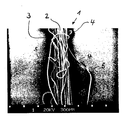
- a yarn designated as 1 in the electron scanning microscope photo, which is a sewing thread, has a core material 2, which is a multifilament yarn, as the first yarn component.
- the core material 2 is interwoven with a second yarn component 3, which is also usually referred to as fancy yarn component or fancy yarn.
- the fancy yarn component 3 consists of a multifilament yarn.
- the fancy yarn component 3 is predominantly arranged in the outer region of the yarn 1 and forms loops 4 or loops 5 that intersect with one another in relation to the core material 2, which predominantly extends in a straight line in the axial direction.
- the self-crossing loops have 4 different loop diameters, but are not knot-like.
- a multi-filament yarn is used as core material 2, which has a specific strength of 70 cN / tex, an elementary thread number of 64 and a single titer of about 3.6 dtex.
- the effect material 3 consists of a pre-oriented yarn 1 ten multifilament yarn (POY yarn), which was drawn over a pin heated to 130 ° C with a diameter of 70 mm at a pre-drawing ratio of 1: 1.7 and has a single filament number of 24, the single filament titer being about 3.4 dtex .
- the total titer of yarn 1 after swirling is about 300 dtex.
- the absolute strength of yarn 1 is 1300 cN.
- the loops 4 and loops 5 protruding from the yarn were measured from the yarn shown.
- the yarn was transported perpendicular to a bundled light beam, which was generated by an appropriate light source.
- the light source was arranged in a plane opposite a photo cell, so that the interruption of the light beam caused by a loop 4 or loop 5 was detected by the photo cell and added accordingly.
- This measurement was carried out at a distance of the light beam from the yarn of 0.5 mm and 1 mm. With a distance of the light beam of 0.5 mm above the yarn, 160 breaks per m and at a distance of 1 mm 18 breaks per m could be measured.
- the yarns were rinsed twice cold and hot and then dried conventionally.
- the dye liquors were adjusted to pH 4.5 by adding acetic acid and sodium acetate. Furthermore, all liquors had 0.5 g / l of a dispersing / leveling agent (Lewegal HTN, Bayer). The following dye combinations were used:
- Yarn 7 showed clear color and depth differences, so that despite the same single filament titer, this yarn is not suitable because of the upcoming color differences.
Landscapes
- Engineering & Computer Science (AREA)
- Mechanical Engineering (AREA)
- Textile Engineering (AREA)
- Physics & Mathematics (AREA)
- Fluid Mechanics (AREA)
- Yarns And Mechanical Finishing Of Yarns Or Ropes (AREA)
Priority Applications (3)
| Application Number | Priority Date | Filing Date | Title |
|---|---|---|---|
| EP91112663A EP0463635B1 (fr) | 1988-09-17 | 1989-09-07 | Fil, en particulier un fil à coudre |
| AT89116516T ATE74974T1 (de) | 1988-09-17 | 1989-09-07 | Verfahren zur herstellung eines garnes, insbesondere eines naehgarnes und danach hergestelltes garn. |
| HK106892A HK106892A (en) | 1989-09-07 | 1992-12-31 | Method for making a yarn, particularly a sewing yarn, and yarn so obtained |
Applications Claiming Priority (2)
| Application Number | Priority Date | Filing Date | Title |
|---|---|---|---|
| DE3831700A DE3831700A1 (de) | 1988-09-17 | 1988-09-17 | Verfahren zur herstellung eines garnes, insbesondere eines naehgarnes, sowie ein garn |
| DE3831700 | 1988-09-17 |
Related Child Applications (2)
| Application Number | Title | Priority Date | Filing Date |
|---|---|---|---|
| EP91112663.9 Division-Into | 1989-09-07 | ||
| EP91112663A Division EP0463635B1 (fr) | 1988-09-17 | 1989-09-07 | Fil, en particulier un fil à coudre |
Publications (3)
| Publication Number | Publication Date |
|---|---|
| EP0367938A2 true EP0367938A2 (fr) | 1990-05-16 |
| EP0367938A3 EP0367938A3 (en) | 1990-12-27 |
| EP0367938B1 EP0367938B1 (fr) | 1992-04-15 |
Family
ID=6363188
Family Applications (2)
| Application Number | Title | Priority Date | Filing Date |
|---|---|---|---|
| EP91112663A Expired - Lifetime EP0463635B1 (fr) | 1988-09-17 | 1989-09-07 | Fil, en particulier un fil à coudre |
| EP89116516A Expired - Lifetime EP0367938B1 (fr) | 1988-09-17 | 1989-09-07 | Procédé de fabrication d'un fil, en particulier un fil à condre, et fil ainsi obtenu |
Family Applications Before (1)
| Application Number | Title | Priority Date | Filing Date |
|---|---|---|---|
| EP91112663A Expired - Lifetime EP0463635B1 (fr) | 1988-09-17 | 1989-09-07 | Fil, en particulier un fil à coudre |
Country Status (6)
| Country | Link |
|---|---|
| EP (2) | EP0463635B1 (fr) |
| AT (2) | ATE74974T1 (fr) |
| DE (3) | DE3831700A1 (fr) |
| ES (2) | ES2032089T3 (fr) |
| HK (1) | HK184396A (fr) |
| SG (1) | SG88892G (fr) |
Cited By (10)
| Publication number | Priority date | Publication date | Assignee | Title |
|---|---|---|---|---|
| EP0295601A3 (fr) * | 1987-06-15 | 1991-04-17 | Amann & Söhne GmbH & Co. | Procédé de fabrication d'un fil, et fil comprenant une structure d'âme |
| US5146738A (en) * | 1987-05-15 | 1992-09-15 | Amann Und Sohne Gmbh & Co. | Thread having looped effect yarn intermingled with multi-filament core yarn |
| EP0363798B1 (fr) * | 1988-10-07 | 1993-08-11 | Hoechst Aktiengesellschaft | Fil à coudre constitué de deux composants entremêlés et son procédé de fabrication |
| EP0569890A1 (fr) * | 1992-05-12 | 1993-11-18 | AMANN & SÖHNE GmbH & Co. | Fil à coudre à haute tenacité et procédé pour la production d'un tel fil à coudre |
| EP0569891A1 (fr) * | 1992-05-12 | 1993-11-18 | AMANN & SÖHNE GmbH & Co. | Fil et procédé pour la production d'un fil |
| EP0579082A1 (fr) * | 1992-07-10 | 1994-01-19 | Hoechst Aktiengesellschaft | Méthode pour le traitement thermique de fils en mouvement et dispositif pour effectuer ce traitement |
| US5344710A (en) * | 1992-08-26 | 1994-09-06 | Hoechst Aktiengesschaft | Low-denier two-component loop yarns of high strength, production thereof and use thereof as sewing and embroidery yarns |
| EP0718425A1 (fr) | 1994-12-07 | 1996-06-26 | Hoechst Trevira GmbH & Co. KG | Fils à coudre constitués de deux composants entremêlés à base de filaments d'aramide, procédé pour leur production et leur utilisation |
| US5593777A (en) * | 1994-01-20 | 1997-01-14 | Hoechst Aktiengesellschaft | Two-component loop yarns, production thereof and use thereof as sewing and embroidery yarns |
| WO2004065670A3 (fr) * | 2003-01-17 | 2005-02-24 | Inst Textil & Faserforschung | Procede et dispositif pour la production de fils multifilaments |
Families Citing this family (7)
| Publication number | Priority date | Publication date | Assignee | Title |
|---|---|---|---|---|
| DE4215015A1 (de) * | 1992-05-12 | 1993-11-18 | Amann & Soehne | Verfahren zum Verstrecken |
| GB9223102D0 (en) * | 1992-11-04 | 1992-12-16 | Coats Ltd J & P | Making textile strands |
| EP0602489B1 (fr) * | 1992-12-18 | 1997-05-07 | Amann & Söhne GmbH & Co. | Fil à coudre en fibres synthétiques et/ou naturelles |
| DE4401512A1 (de) * | 1994-01-20 | 1995-07-27 | Hoechst Ag | Zweikomponenten-Schlingengarne, Verfahren zu deren Herstellung und deren Verwendung als Nähgarne und Stickgarne |
| DE19627010C1 (de) * | 1996-07-04 | 1997-12-11 | Madeira Garnfabrik Rudolf Schm | Verfahren zum Herstellen eines schrumpfarmen Garns |
| DE19643685C2 (de) * | 1996-10-23 | 2001-05-17 | Trevira Gmbh & Co Kg | Verfahren zur Herstellung einer Schar von Mischgarnen sowie deren Verwendung |
| DE19817418A1 (de) * | 1998-04-18 | 1999-10-21 | Schoeller Textil Gmbh & Co Kg | Verfahren und Vorrichtung zur Avivierung von Fasern sowie entsprechend ausgestattete Spinnlinie bzw. Einzelmaschine |
Family Cites Families (5)
| Publication number | Priority date | Publication date | Assignee | Title |
|---|---|---|---|---|
| US4080777A (en) * | 1976-09-13 | 1978-03-28 | Akzona Incorporated | Novelty yarns |
| ZA82486B (en) * | 1981-02-04 | 1982-12-29 | Coats Ltd J & P | Synthetic yarn and yarn-like structures and a method and apparatus for their production |
| DE3431834A1 (de) * | 1984-08-30 | 1986-03-06 | Hoechst Ag, 6230 Frankfurt | Hochfeste zulieferfaeden fuer naehgarne und verfahren zu ihrer herstellung |
| US4615167A (en) * | 1985-01-04 | 1986-10-07 | Greenberg Neville G | Highly entangled thread development |
| DE3720237A1 (de) * | 1987-06-15 | 1989-01-05 | Amann & Soehne | Verfahren zum herstellen von luftblastexturiertem naehgarn |
-
1988
- 1988-09-17 DE DE3831700A patent/DE3831700A1/de active Granted
-
1989
- 1989-09-07 ES ES198989116516T patent/ES2032089T3/es not_active Expired - Lifetime
- 1989-09-07 EP EP91112663A patent/EP0463635B1/fr not_active Expired - Lifetime
- 1989-09-07 AT AT89116516T patent/ATE74974T1/de not_active IP Right Cessation
- 1989-09-07 ES ES91112663T patent/ES2082891T3/es not_active Expired - Lifetime
- 1989-09-07 AT AT91112663T patent/ATE131881T1/de not_active IP Right Cessation
- 1989-09-07 EP EP89116516A patent/EP0367938B1/fr not_active Expired - Lifetime
- 1989-09-07 DE DE58909540T patent/DE58909540D1/de not_active Expired - Lifetime
- 1989-09-07 DE DE8989116516T patent/DE58901175D1/de not_active Expired - Lifetime
-
1992
- 1992-09-02 SG SG888/92A patent/SG88892G/en unknown
-
1996
- 1996-10-03 HK HK184396A patent/HK184396A/xx not_active IP Right Cessation
Cited By (10)
| Publication number | Priority date | Publication date | Assignee | Title |
|---|---|---|---|---|
| US5146738A (en) * | 1987-05-15 | 1992-09-15 | Amann Und Sohne Gmbh & Co. | Thread having looped effect yarn intermingled with multi-filament core yarn |
| EP0295601A3 (fr) * | 1987-06-15 | 1991-04-17 | Amann & Söhne GmbH & Co. | Procédé de fabrication d'un fil, et fil comprenant une structure d'âme |
| EP0363798B1 (fr) * | 1988-10-07 | 1993-08-11 | Hoechst Aktiengesellschaft | Fil à coudre constitué de deux composants entremêlés et son procédé de fabrication |
| EP0569890A1 (fr) * | 1992-05-12 | 1993-11-18 | AMANN & SÖHNE GmbH & Co. | Fil à coudre à haute tenacité et procédé pour la production d'un tel fil à coudre |
| EP0569891A1 (fr) * | 1992-05-12 | 1993-11-18 | AMANN & SÖHNE GmbH & Co. | Fil et procédé pour la production d'un fil |
| EP0579082A1 (fr) * | 1992-07-10 | 1994-01-19 | Hoechst Aktiengesellschaft | Méthode pour le traitement thermique de fils en mouvement et dispositif pour effectuer ce traitement |
| US5344710A (en) * | 1992-08-26 | 1994-09-06 | Hoechst Aktiengesschaft | Low-denier two-component loop yarns of high strength, production thereof and use thereof as sewing and embroidery yarns |
| US5593777A (en) * | 1994-01-20 | 1997-01-14 | Hoechst Aktiengesellschaft | Two-component loop yarns, production thereof and use thereof as sewing and embroidery yarns |
| EP0718425A1 (fr) | 1994-12-07 | 1996-06-26 | Hoechst Trevira GmbH & Co. KG | Fils à coudre constitués de deux composants entremêlés à base de filaments d'aramide, procédé pour leur production et leur utilisation |
| WO2004065670A3 (fr) * | 2003-01-17 | 2005-02-24 | Inst Textil & Faserforschung | Procede et dispositif pour la production de fils multifilaments |
Also Published As
| Publication number | Publication date |
|---|---|
| ES2032089T3 (es) | 1993-01-01 |
| EP0367938B1 (fr) | 1992-04-15 |
| SG88892G (en) | 1993-04-16 |
| EP0463635B1 (fr) | 1995-12-20 |
| DE58909540D1 (de) | 1996-02-01 |
| ATE74974T1 (de) | 1992-05-15 |
| DE3831700C2 (fr) | 1990-09-13 |
| HK184396A (en) | 1996-10-11 |
| EP0367938A3 (en) | 1990-12-27 |
| DE58901175D1 (de) | 1992-05-21 |
| ES2082891T3 (es) | 1996-04-01 |
| ATE131881T1 (de) | 1996-01-15 |
| EP0463635A1 (fr) | 1992-01-02 |
| DE3831700A1 (de) | 1990-03-22 |
Similar Documents
| Publication | Publication Date | Title |
|---|---|---|
| EP0295601B1 (fr) | Procédé de fabrication d'un fil, et fil comprenant une structure d'âme | |
| EP0367938B1 (fr) | Procédé de fabrication d'un fil, en particulier un fil à condre, et fil ainsi obtenu | |
| DE4121638C2 (de) | Garn, insbesondere naehgarn, sowie verfahren zur herstellung eines derartigen garnes | |
| DE3030972A1 (de) | Chirurgischer naehfaden | |
| DE3844615A1 (de) | Garn, insbesondere naehgarn | |
| DE3205188A1 (de) | Falschdrahttextuiertes garn und verfahren zu seiner herstellung | |
| EP0569891B1 (fr) | Fil et procédé pour la production d'un fil | |
| DE2539272A1 (de) | Texturierter hochbausch-hybridfaden und verfahren zu seiner herstellung | |
| DE3424633A1 (de) | Perforierte huelse zum aufwickeln eines textilfadens | |
| EP0569889B1 (fr) | Procédé de l'étirage | |
| EP0569890B1 (fr) | Fil à coudre à haute tenacité et procédé pour la production d'un tel fil à coudre | |
| EP1101848A1 (fr) | Procédé de texturation par fausse torsion pour la production d'un fil frisé | |
| EP1036866A2 (fr) | Fil à coudre et procédé pour la production d'un tel fil à coudre | |
| DE3438743C2 (de) | Verfahren zum Herstellen eines volumenarmen Effektgarns | |
| EP1258547A1 (fr) | Fils texturés par jet d'air et méthode de fabrication | |
| DE4035908C2 (de) | Garn, insbesondere Nähgarn, sowie Verfahren zur Herstellung eines derartigen Garnes | |
| DE19709677A1 (de) | Garn, insbesondere Nähgarn | |
| EP0329014A2 (fr) | Procédé de fabrication d'un fil volumineux, et dispositif pour l'exécution du procédé | |
| DE3813898A1 (de) | Verfahren zum herstellen von luftblastexturiertem naehgarn | |
| EP0602489B1 (fr) | Fil à coudre en fibres synthétiques et/ou naturelles | |
| DE1660482B2 (de) | Verfahren zur Herstellung eines hochelastischen, gekräuselten Garns aus einem thermoplastischen Fadenbündel | |
| DD158711A3 (de) | Verfahren zur herstellung eines bauschfaehigen fadens | |
| DE2720309A1 (de) | Verfahren zur herstellung einer mischexturseide | |
| EP0099046A2 (fr) | Procédé de fabrication d'un fil mixte texturé | |
| DE1947106B2 (de) | Bauschiges Spinnfasergarn und Verfahren zu seiner Herstellung |
Legal Events
| Date | Code | Title | Description |
|---|---|---|---|
| PUAI | Public reference made under article 153(3) epc to a published international application that has entered the european phase |
Free format text: ORIGINAL CODE: 0009012 |
|
| AK | Designated contracting states |
Kind code of ref document: A2 Designated state(s): AT BE CH DE ES FR GB GR IT LI LU NL SE |
|
| PUAL | Search report despatched |
Free format text: ORIGINAL CODE: 0009013 |
|
| AK | Designated contracting states |
Kind code of ref document: A3 Designated state(s): AT BE CH DE ES FR GB GR IT LI LU NL SE |
|
| 17P | Request for examination filed |
Effective date: 19901211 |
|
| 17Q | First examination report despatched |
Effective date: 19910904 |
|
| GRAA | (expected) grant |
Free format text: ORIGINAL CODE: 0009210 |
|
| AK | Designated contracting states |
Kind code of ref document: B1 Designated state(s): AT BE CH DE ES FR GB GR IT LI LU NL SE |
|
| PG25 | Lapsed in a contracting state [announced via postgrant information from national office to epo] |
Ref country code: SE Effective date: 19920415 Ref country code: GR Free format text: LAPSE BECAUSE OF FAILURE TO SUBMIT A TRANSLATION OF THE DESCRIPTION OR TO PAY THE FEE WITHIN THE PRESCRIBED TIME-LIMIT Effective date: 19920415 |
|
| REF | Corresponds to: |
Ref document number: 74974 Country of ref document: AT Date of ref document: 19920515 Kind code of ref document: T |
|
| XX | Miscellaneous (additional remarks) |
Free format text: TEILANMELDUNG 91112663.9 EINGEREICHT AM 07/09/89. |
|
| REF | Corresponds to: |
Ref document number: 58901175 Country of ref document: DE Date of ref document: 19920521 |
|
| GBT | Gb: translation of ep patent filed (gb section 77(6)(a)/1977) | ||
| ITF | It: translation for a ep patent filed | ||
| ET | Fr: translation filed | ||
| K2C2 | Correction of patent specification (partial reprint) published |
Effective date: 19920415 |
|
| K2C2 | Correction of patent specification (partial reprint) published |
Effective date: 19920415 |
|
| NLXE | Nl: other communications concerning ep-patents (part 3 heading xe) |
Free format text: ON 921029 A NEW PAGE 14 OF THE TRANSLATION OF THE PATENT SPECIFICATION HAVE BEEN RECEIVED IN CONNECTION WITH A CORRECTION ISSUED BY THE EUROPEAN PATENT OFFICE |
|
| REG | Reference to a national code |
Ref country code: ES Ref legal event code: FG2A Ref document number: 2032089 Country of ref document: ES Kind code of ref document: T3 |
|
| PLBE | No opposition filed within time limit |
Free format text: ORIGINAL CODE: 0009261 |
|
| STAA | Information on the status of an ep patent application or granted ep patent |
Free format text: STATUS: NO OPPOSITION FILED WITHIN TIME LIMIT |
|
| 26N | No opposition filed | ||
| EPTA | Lu: last paid annual fee | ||
| REG | Reference to a national code |
Ref country code: GB Ref legal event code: IF02 |
|
| PGFP | Annual fee paid to national office [announced via postgrant information from national office to epo] |
Ref country code: LU Payment date: 20080916 Year of fee payment: 20 |
|
| PGFP | Annual fee paid to national office [announced via postgrant information from national office to epo] |
Ref country code: AT Payment date: 20080912 Year of fee payment: 20 Ref country code: FR Payment date: 20080915 Year of fee payment: 20 Ref country code: IT Payment date: 20080926 Year of fee payment: 20 Ref country code: NL Payment date: 20080903 Year of fee payment: 20 |
|
| PGFP | Annual fee paid to national office [announced via postgrant information from national office to epo] |
Ref country code: GB Payment date: 20080910 Year of fee payment: 20 |
|
| PGFP | Annual fee paid to national office [announced via postgrant information from national office to epo] |
Ref country code: CH Payment date: 20081002 Year of fee payment: 20 Ref country code: DE Payment date: 20080930 Year of fee payment: 20 |
|
| PGFP | Annual fee paid to national office [announced via postgrant information from national office to epo] |
Ref country code: BE Payment date: 20080922 Year of fee payment: 20 Ref country code: ES Payment date: 20081021 Year of fee payment: 20 |
|
| REG | Reference to a national code |
Ref country code: CH Ref legal event code: PL |
|
| BE20 | Be: patent expired |
Owner name: *AMANN & SOHNE G.M.B.H. & CO. Effective date: 20090907 |
|
| REG | Reference to a national code |
Ref country code: GB Ref legal event code: PE20 Expiry date: 20090906 |
|
| NLV7 | Nl: ceased due to reaching the maximum lifetime of a patent |
Effective date: 20090907 |
|
| REG | Reference to a national code |
Ref country code: ES Ref legal event code: FD2A Effective date: 20090908 |
|
| PG25 | Lapsed in a contracting state [announced via postgrant information from national office to epo] |
Ref country code: GB Free format text: LAPSE BECAUSE OF EXPIRATION OF PROTECTION Effective date: 20090906 Ref country code: NL Free format text: LAPSE BECAUSE OF EXPIRATION OF PROTECTION Effective date: 20090907 |
|
| PG25 | Lapsed in a contracting state [announced via postgrant information from national office to epo] |
Ref country code: ES Free format text: LAPSE BECAUSE OF EXPIRATION OF PROTECTION Effective date: 20090908 |