EP0368003A2 - Membranes microporeuses en polyéther éthercétone et leur procédé de fabrication - Google Patents
Membranes microporeuses en polyéther éthercétone et leur procédé de fabrication Download PDFInfo
- Publication number
- EP0368003A2 EP0368003A2 EP89118771A EP89118771A EP0368003A2 EP 0368003 A2 EP0368003 A2 EP 0368003A2 EP 89118771 A EP89118771 A EP 89118771A EP 89118771 A EP89118771 A EP 89118771A EP 0368003 A2 EP0368003 A2 EP 0368003A2
- Authority
- EP
- European Patent Office
- Prior art keywords
- peek
- membrane
- polymer
- solution
- fiber
- Prior art date
- Legal status (The legal status is an assumption and is not a legal conclusion. Google has not performed a legal analysis and makes no representation as to the accuracy of the status listed.)
- Granted
Links
Images

Classifications
-
- C—CHEMISTRY; METALLURGY
- C08—ORGANIC MACROMOLECULAR COMPOUNDS; THEIR PREPARATION OR CHEMICAL WORKING-UP; COMPOSITIONS BASED THEREON
- C08J—WORKING-UP; GENERAL PROCESSES OF COMPOUNDING; AFTER-TREATMENT NOT COVERED BY SUBCLASSES C08B, C08C, C08F, C08G or C08H
- C08J9/00—Working-up of macromolecular substances to porous or cellular articles or materials; After-treatment thereof
- C08J9/28—Working-up of macromolecular substances to porous or cellular articles or materials; After-treatment thereof by elimination of a liquid phase from a macromolecular composition or article, e.g. drying of coagulum
-
- B—PERFORMING OPERATIONS; TRANSPORTING
- B01—PHYSICAL OR CHEMICAL PROCESSES OR APPARATUS IN GENERAL
- B01D—SEPARATION
- B01D71/00—Semi-permeable membranes for separation processes or apparatus characterised by the material; Manufacturing processes specially adapted therefor
- B01D71/06—Organic material
- B01D71/52—Polyethers
- B01D71/522—Aromatic polyethers
- B01D71/5222—Polyetherketone, polyetheretherketone, or polyaryletherketone
-
- D—TEXTILES; PAPER
- D01—NATURAL OR MAN-MADE THREADS OR FIBRES; SPINNING
- D01D—MECHANICAL METHODS OR APPARATUS IN THE MANUFACTURE OF ARTIFICIAL FILAMENTS, THREADS, FIBRES, BRISTLES OR RIBBONS
- D01D5/00—Formation of filaments, threads, or the like
- D01D5/24—Formation of filaments, threads, or the like with a hollow structure; Spinnerette packs therefor
-
- C—CHEMISTRY; METALLURGY
- C08—ORGANIC MACROMOLECULAR COMPOUNDS; THEIR PREPARATION OR CHEMICAL WORKING-UP; COMPOSITIONS BASED THEREON
- C08J—WORKING-UP; GENERAL PROCESSES OF COMPOUNDING; AFTER-TREATMENT NOT COVERED BY SUBCLASSES C08B, C08C, C08F, C08G or C08H
- C08J2371/00—Characterised by the use of polyethers obtained by reactions forming an ether link in the main chain; Derivatives of such polymers
-
- Y—GENERAL TAGGING OF NEW TECHNOLOGICAL DEVELOPMENTS; GENERAL TAGGING OF CROSS-SECTIONAL TECHNOLOGIES SPANNING OVER SEVERAL SECTIONS OF THE IPC; TECHNICAL SUBJECTS COVERED BY FORMER USPC CROSS-REFERENCE ART COLLECTIONS [XRACs] AND DIGESTS
- Y10—TECHNICAL SUBJECTS COVERED BY FORMER USPC
- Y10T—TECHNICAL SUBJECTS COVERED BY FORMER US CLASSIFICATION
- Y10T428/00—Stock material or miscellaneous articles
- Y10T428/24—Structurally defined web or sheet [e.g., overall dimension, etc.]
- Y10T428/24479—Structurally defined web or sheet [e.g., overall dimension, etc.] including variation in thickness
- Y10T428/24496—Foamed or cellular component
- Y10T428/24504—Component comprises a polymer [e.g., rubber, etc.]
Definitions
- Microporous polymer membranes are staple products in the art of separating fluid fractions.
- Poly(oxy-1,4-phenyleneoxy-1,4-phenylene-carbonyl-1,4-phenylene), more commonly known as poly-(etheretherketone), or PEEK displays advantageous chemical and physical properties for many such uses.
- the high melting point (about 367°C), high glass transition temperature (about 145°C), low solubility and high chemical resistance make PEEK a material of choice for separations applications for harsh environments.
- PEEK is not known to be affected by common organic solvents at room temperature. PEEK is also resistant to acids and bases with the exception of strong acids in high concentrations. The general insolubility of PEEK, while a useful and advantageous property of a membrane in place, complicates the formation of useful articles including microporous membranes from PEEK.
- Polymer film useful as ultrafiltration membranes and reverse osmosis membrane supports are traditionally formed by dissolving the polymer in a solvent, casting the polymer solution on a support as a thin film, followed by coagulation of the polymer by immersion of the support and polymer film into a bath of liquid in which the polymer solvent is miscible, but which is not a solvent for the polymer.
- PEEK membranes from solutions thereof that are not sulfonated and, thus, do not swell in water.
- An objective of the invention is the preparation of useful articles from PEEK, including porous solid fibers, membrane film, and hollow membrane fibers.
- the membranes of the invention have improved durability for ultrafiltration, microfiltration, and reverse osmosis.
- Articles of PEEK are prepared from PEEK dissolved in a non-sulfonating acid or a non-sulfonating mixture of acids.
- a semi-permeable membrane suitable as an asymmetrical ultrafiltration (UF) membrane and as a support for a reverse osmosis (RO) membrane can now be prepared from a PEEK-type polymer by dissolving the PEEK polymer with a non-solfonating acid solvent and forming the solution into an article by, for example, casting or extruding.
- UF ultrafiltration
- RO reverse osmosis
- Microporous membranes in sheet form and in the form of hollow fibers may be prepared according to the method of the invention.
- Hollow fiber membranes may be formed according to the invention by spinning fibers from a PEEK-type polymer dissolved in a non-sulfonating acid.
- Enhanced flux PEEK membranes may be prepared from a PEEK-type polymer dissolved in non-sulfonating acids by adding small amounts of halogenated hydrocarbons.
- Articles and microporous membranes of the present invention are conveniently formed from a solid particulate form of a PEEK-type polymer, such as e.g., a powder, crumbs, pellets, or other convenient or available PEEK subdivided form.
- PEEK, or a PEEK-type polymer includes polymers prepared, for example, by a condensation polymerization reaction involving as the starting material 4,4′difluorobenzophenone, and hydroquinone to which is added anhydrous potassium carbonate in a nitrogen atmosphere at temperatures up to 320°C. Detailed instructions appear in U.S. Patent 4,320,224.
- Microporous membranes are prepared from solid PEEK dissolved in a strong but non-sulfonating acid.
- Non-sulfonating acid refers to acids and mixtures of acids which dissolve PEEK in an amount of not less than about five percent by weight but which do not react with the PEEK and change the chemical structure of the PEEK.
- Non-sulfonating acids include methane sulfonic acid (MSA), trichloromethane sulfonic acid, hydrofluoric acid, phosphoric acid, and trifluoromethane sulfonic acid (TFMSA).
- Sulfuric acid may be effectively used as a diluent for a non-sulfonating acid, provided the proportion of sulfuric acid is limited so as not to increase the viscosity of the solution of PEEK which would impair the flow of the solution of PEEK in the membrane casting step, or result in sulfonating the PEEK. More than 60 percent H2SO4 in MSA at room temperature when used as a solvent for PEEK causes sulfonation of the PEEK. It has been noted that H2SO4 alone is not a suitable solvent to form PEEK membranes.
- the PEEK In order to form uniform membranes according to this invention, the PEEK must be substantially uniformly dissolved in the acid or a mixture of acids. PEEK, suitable for forming microporous membranes of this invention, will be present in the casting solution in a range of 5 to 40 percent by weight preferably in a range of 8 to 20 percent by weight.
- the step of dissolving PEEK to form the membrane casting solution may be carried out readily at a temperature of room temperature to 40°C. Temperatures in excess of 40°C may be useful to reduce the time necessary to prepare a substantially uniform PEEK solution. However, temperatures should not be elevated so as to cause degradation or sulfonation of PEEK by the acid solvent. Temperatures lower than room temperature may be found advantageous to obtain particular membrane properties. Temperatures of 15° to 30°C are generally preferred for casting PEEK membranes in the method of this invention.
- the size and shape of subdivided solid PEEK polymer, crumbs, particles, or bead size may be varied, but is practically limited by the surface area available to the acid solvent for ease of dissolving and mixing.
- the casting of PEEK articles or membrane films is achieved in the traditional method of membrane manufacture.
- the article is form by pouring a solution of PEEK into a mold of the article or, in the case of thin films, by spreading a solution of PEEK on an impervious surface.
- Uniform thickness of the resulting membrane is achieved by customary methods such as drawing a casting bar, glass rod or knife across a cast solution of PEEK deposited on a support medium.
- the casting solution of PEEK is permitted to remain on the support for a period of time which may range from the minimum time necessary to complete the casting step to minutes before the cast PEEK solution is coagulated in a fluid bath.
- the PEEK solution may be cast on a fibrous reinforcing medium that provides rigidity and strength such as a non-woven glass fiber mat or a non-woven polyester mat laid upon an impervious surface such as a glass plate.
- the PEEK membrane film may be cast without reinforcement on an impervious support surface such as a glass plate. After coagulation of PEEK in the coagulation bath, the PEEK membrane may be removed from the glass plate for further preparation or use.
- the coagulation bath is a solution in which the acid or mixture of acids is miscible, but which is not a solvent for PEEK.
- Water is a suitable coagulation fluid for both MSA and TFMSA.
- a coagulation bath causes coagulation of the dissolved PEEK by diluting the non-sulfonating acid solvent for PEEK.
- Shaped articles cast from PEEK dissolved in non-sulfonating acids generally maintain their integrity and form when immersed in a coagulation bath.
- Membranes cast from PEEK dissolved in non-sulfonating acids maintain their integrity as membranes when gently immersed in a coagulation bath.
- Membranes of PEEK demonstrate sufficient structural integrity after coagulation for use or further processing when carefully handled. After casting and coagulating, a PEEK membrane, is generally washed in water to remove residual acid solvent for approximately 30 to 60 minutes. Prior to use, membranes may optionally be further washed with dilute basic solutions to promote removal of the non-sulfonating acids.
- Solutions of PEEK described herein may also be formed into solid fibers and into hollow fibers by, for example, an air gap wet spinning process described in Encyclopedia of Polymer Science and Technology, 2d , "Fibers, Manufacture” Mark, H. F. et al., ed Wiley-Interscience, New York, 1986 and Encyclopedia of Chemical Technology, 3d , "Hollow Fiber Membranes", Mark, H. F., et al., ed Wiley-Interscience, New York, 1980.
- Preparation of PEEK solid or hollow fibers from solutions of PEEK is complicated by the fact that the room temperature solubility of PEEK in MSA is limited to about 8 percent on a weight-to-weight basis.
- a feature of the present invention is that the solubility limit of PEEK in MSA may be increased by the addition of other non-sulfonating acids to form a solvent mixture for PEEK.
- the substitution of up to 100 percent TFMSA for MSA increases the solubility of PEEK to as high as about 40 percent by weight at room temperature.
- a mixture of 90 percent MSA/10 percent TFMSA is a convenient solvent for PEEK.
- PEEK fibers may be conveniently extruded from a PEEK solution in a non-sulfonating acid solvent in a PEEK concentration from 8 percent to 40 percent, preferably in a range from 16 percent to 10 percent.
- a further feature of she present invention is that the viscosity of the PEEK solution may be increased by the incorporation of H2SO4 into the non-sulfonating acid solvent for PEEK up to about 60 percent by weight sof solvent without the occurrence of adverse sulfonation of the PEEK.
- the amount of H2SO4 which may be incorporated as a diluent in the non-sulfonating acid solvent for PEEK is limited by the concentration at which the PEEK begins to be sulfonated by the H2SO4.
- the concentration of H2SO4 at which sulfonation begins will be lower as the temperature increases.
- the solution of dissolved PEEK may be extruded into fibers in the usual manner which is well known in the art.
- Hollow fiber membranes may be prepared by extrusion of the PEEK solution through an annular shaped orifice while a core fluid simultaneously flows through the center of the PEEK solution flow as it emerges from the annular orifice.
- the core fluid flow rate is empirically adjusted to a level compatible with the fiber flow rate.
- the fiber flow rate is also empirically adjusted to produce a uniformly shaped stream prior to immersion in a liquid coagulation bath.
- a further feature of the invention is controlling membrane surface properties of the membranes formed from PEEK dissolved in a non-sulfonating acid by variation of coagulation fluid.
- the use of various coagulation fluids for the preparation of PEEK membranes permits formation of a skin on one or both membrane surfaces, and the formation of an elongated honeycomb porous structure between the surfaces of the membrane.
- the porous structure between membrane surfaces advantageously provides structural support to the membrane surface, making microporous hollow fiber of PEEK-type polymer particularly suited for application as a support for high pressure uses such as a support for a composite membrane for reverse osmosis applications.
- a further advantage of the porous structure of the PEEK membranes is the formation of numerous flow channels between the membrane surfaces which permits unencumbered flow of the permeating fluid after the permeate passes through a skin layer or a composite membrane formed on a membrane surface.
- Membrane structure and properties may be varied by variation of the coagulation fluid, polymer molecular weight, or non-sulfonating acid solvent.
- a coagulation bath which has a high relative race of diffusion of the coagulation liquid into the PEEK polymer phase a microporous skin forms on the exterior surface of the hollow fiber.
- the rate of diffusion of the coagulation fluid into the PEEK polymer phase containing the non-sulfonating acid PEEK solvent may be slowed by the addition of an acid to the coagulation fluid, such as a coagulation bath of a non-sulfonating level of H2SO4, for instance 52 percent H2SO4 in water.
- Other methods of influencing the rate of diffusion of the coagulation fluid from the diffusion rate of water include the substitution of a polyglycol for water in the coagulation bath at a concentration up to 100 percent polyglycol.
- the viscosity of water is lower than the viscosity of thickened water or polyethylene glycol, consequently, the relative rate of diffusion of the non-sulfonating acid solvent in water is higher than the relative rate of diffusion in thickened water, or polyethylene glycol.
- membrane flux is related to membrane skin thickness, porosity, polymer molecular weight, and pore size, as well as the porosity of the internal membrane structure
- optimization of the membrane preparation parameters of non-sulfonation acid solvent, polymer molecular weight, and the relative rate of diffusion of the coagulation fluid will benefit each system in which a membrane separation of fluid fractions is attempted.
- a PEEK membrane prepared according to the present invention is characterized by a porous asymmetric structure.
- the PEEK membrane fibers resulting from the hollow fiber extrusion process include an interior porous finger-like or ribbed structure between the opposing surfaces of the microporous membrane fibers with fingers or ribs extending generally radially between the outer surface or skin and the lumen of the fiber.
- the fingers or ribs surround vacuoles formed within the PEEK membrane.
- This radial structure is advantageous for hollow fiber membrane applications because it provides porous channels for flow between the discriminating microporous membrane skin and the lumen.
- the fingers or ribs in the asymmetric hollow membrane fiber provide additional structural support for the discriminating skin layer under elevated pressures employed in the use of the hollow fiber PEEK membrane as a reverse osmosis membrane support.
- the physical characteristics of the hollow fiber PEEK membrane may be reversed by reversing characteristics of the bore fluid and the characteristics of the immersion bath.
- skin may be formed on the lumen surface by injecting in the bore of the hollow PEEK fiber at the extruder a fluid having a high affinity for the non-sulfonating acid PEEK solvent. If the immersion bath has a fluid which does not have a strong affinity for the non-sulfonating acid or acid mixture which dissolves PEEK, the finger or rib-like structure will result generally radially outward from the skin formed at the bore, or lumen, of the hollow fiber.
- a skin will result in both the bore and the outer surface of the PEEK hollow fiber membrane.
- the surface and internal properties of a fiber of PEEK extruded without a lumen may be similarly modified from the outer surface.
- the viscosity of the solution of PEEK in acid solvent at which PEEK hollow fiber membranes advantageously may be prepared will be empirically established by the practitioner having ordinary skill in the art and a working knowledge of the hollow fiber membrane spinning extruder and related machinery employed. Working viscosities are generally in the range from 2 centipoise to 12 centipoise.
- An additional feature of the invention is use of a halogenated hydrocarbon solvent of 3 or less carbon atoms in the non-sulfonating acid solvent for PEEK.
- the incorporation of a sufficient amount of the halogenated hydrocarbon solvent results in an enhanced level of fluid flux over membranes prepared without said solvent.
- a further advantage is that the enhanced flux rate does not occur at the expense of membrane selectivity.
- a suitable halogenated hydrocarbon for addition to the non-sulfonating acid PEEK solvent must be miscible with the membrane casting solution of dissolved PEEK in a non-sulfonating acid and not cause precipitation of PEEK from the solution.
- the halogenated hydrocarbon chosen should be immiscible with the coagulation fluid.
- the halogenated hydrocarbon chosen should be relatively volatile at room temperature or such other temperature at which the membrane preparation process is undertaken.
- Suitable halogenated hydrocarbons include, but are not limited to, chloroform, methylene chloride, carbon tetrachloride, 1,1,2-trichloroethane, 1,1,2-trichlorotrifluoroethane, or tetrachloroethane.
- PEEK membranes prepared according to this invention are also useful as support in composite reverse osmosis membranes made up of thin-layer polymers, or coacervates, or ionic complexes.
- Typical of such composite membranes are those which may be prepared from interfacial condensation of polyfunctional secondary amines with polyfunctional acid halides as more fully disclosed in U.S. Patent 4,259,183, and composite membranes prepared from crosslinked, interfacially polymerized aromatic polyamides as more fully described in U.S. Patent 4,277,344.
- Composite reverse osmosis membranes may also be prepared according to most any other procedures known and practiced in the art of separation of fluid fractions by reverse osmosis membranes utilizing the PEEK membranes formed according to the present invention as a support for composite membranes.
- PEEK-type polymer used for the examples of the instant invention was secured from ICI Americas, Inc.
- the molecular weight provided by the manufacturer for grade 150G was 7,000, for grade 380G was 13,000, and for grade 450P was 18,000.
- a weight-average molecular weight for a sample of grade 150G PEEK is 20,700; for grade 380G is 32,200 and for grade 450P is 39,200. Reference herein to molecular weight relates to the average molecular weights provided by the manufacturer.
- a sheet of non-woven polyester fabric to be used as a membrane support is taped to a glass plate.
- a puddle of dissolved PEEK solution is poured onto the backing and spread across the non-woven fabric with a doctor blade shimmed to provide a gap of 0.152 mm above the glass plate.
- the glass plate is then immediately immersed in a water bath at room temperature for 30 minutes. A pink colored coagulated membrane results.
- Residual acid is removed from the membrane by soaking in 10 percent by weight sodium carbonate for 3 to 10 minutes followed by soaking in methanol for 3 to 10 minutes followed by a final rinsing with water.
- the membrane appears white in color and opaque to light transmission.
- a series of membranes are prepared in the manner described in Example 1, except that various non-sulfonating acids are used as indicated.
- the membranes are tested to determine the flux and rejection of a solution of 0.1 percent dextran in water at a pressure of 345 kPa, said dextran having a molecular weight of 35,000 to 50,000.
- the flux rates for various PEEK loadings and acid solvent systems appear in Table I.
- PEEK membranes are prepared according to the method of Example 1 are cast from a solution of 12 percent by weight PEEK in a solvent of a blend of 60 percent MSA/40 percent TFMSA. After the water rinse, the membranes are maintained in a wet condition until used as supports for thin film composite membranes.
- sheet PEEK membrane samples are immersed in an aqueous solution of 2 percent m-phenylenediamine for about one minute. After removal of the PEEK membrane supports from the amine bath, they are placed on a glass plate with the side up of the PEEK membrane that was exposed to air at the time of casting and coagulation. Excess amine solution is gently squeezed from the PEEK-type membrane supports by gently rolling with a rubber roller. The PEEK-type supports are then placed flat in a solution of 0.1 weight/volume percent trimesoyl chloride in 1,1,2-trichlorotrifluoroethane for one minute, excess trimesoyl chloride solution is then drained from the resulting membrane.
- PEEK membranes are cast in the method of Example 3 from a solution of PEEK-type polymer 12 percent by weight, dissolved in a solvent of 60 percent MSA/40 TFMSA.
- the solution of m-phenylenediamine is replaced with an aqueous solution of 2 percent by weight piperazine, 2 percent by weight triethylamine and 0.2 percent by weight sodium lauryl sulfate.
- the membranes are tested for magnesium sulfate rejection using an aqueous solution of 0.2 weight percent solution of magnesium sulfate at an operating pressure of 1,380 kPa. Table III shows magnesium sulfate rejection.
- the coagulated membrane sample is white and opaque.
- the coagulated PEEK sample lifts cleanly from the glass plate.
- the membrane is subsequently washed in water for 16 hours and air dried.
- the surface of the PEEK membrane exposed to the air at the time of casting appears to be shiny, while the surface of the membrane in contact with the glass support is dull in appearance.
- Scanning electron microscope examination discloses submicron pores dispersed uniformly in the textured surface of the matrix having a pore size of about 0.2 ⁇ m or less.
- the glass-contacting surface exhibits larger pore diameters on the order of 3 ⁇ m or larger.
- the membrane is remarkably asymmetric.
- a water transmission rate of 10,824 l/m2/day at one atmosphere pressure is observed.
- the membrane retains a polystyrene latex having a particle size of 0.091 ⁇ m.
- the flux rate and size retention characteristics of the membrane are tested with a water solution of 17 weight percent polyvinylpyrrolidone (PVP) having an average molecular weight of 40,000.
- PVP polyvinylpyrrolidone
- the membrane exhibits an ultrafiltration flow rate of 146 liters/m2.day at a pressure of 345 kPa.
- the membrane retains 90 percent of the PVP.
- the extruder consists of a 15 mm diameter stainless steel barrel with a single hole spinnerette having a 0.343 mm center hole for a core fluid surrounded by a concentric annularly shaped material flow channel having an inner diameter ot about 1.6 mm and having an outer diameter of about 2.1 mm. These dimensions give an extrusion factor (nominal extrudate velocity at the die face, divided by the velocity of the plunger in the barrel) of 120.
- the prepared polymer solutions are fed into the barrel at room temperature.
- the plunger of the extruder moves in the barrel at a constant speed of 51 mm/minute.
- the PEEK solution emerges through the annular shaped flow channel.
- a fiber velocity at the die face of about 1.5 m/min results.
- the core fluid contains a mixture of 20 percent water and 80 percent polyglycol having an average molecular weight of 1,000.
- the core fluid stream is empirically adjusted with a needle valve to cause a uniform stream of shaped PEEK solution to develop before the shaped solution enters a water coagulation bath.
- the extruded hollow fiber exits the spinnerette flowing downward at right angles to the horizontal into a water coagulation bath.
- a 7.6 cm air gap exists between the spinnerette and the underlying water coagulation bath.
- the fiber After coagulation, the fiber is wound using a motor driven winder. The winding speed is adjusted to produce a PEEK fiber having a size of 1 mm outside diameter and 500 ⁇ m inside diameter. The collected fiber is leached and rinsed in water for from 15 to 60 minutes.
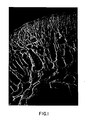
- the resulting fibers exhibit an asymmetric microporous structure.
- a scanning electron microscope photograph of an end-view of a section of a fiber appears as Figure 1 hereof. Filtration tests disclose a flux of 81 to 244 l/m2.day at 83.4 kPa. Molecular weight cut-off was 360,000 with 80 percent retention.
- a polymer solution is prepared substantially as in Example 8.
- PEEK hollow fiber membranes are spun using the equipment and method of Example 8, except that the core liquid is water, and the coagulation bath is tetraethylene glycol.
- the spun fibers remain immersed in the coagulation bath until the fibers turn totally white and opaque, an indication of complete coagulation. Thereafter, the fibers are transferred to a water bath for rinsing.
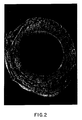
- the fibers prepared in accordance with this example exhibit an asymmetric microporous structure with a skin formation at the lumen surface.
- a finger-like microporous structure with fingers extending radially from the skin of the lumen toward the outside surface and a layer of sponge-like porous structure with vacuoles therein is exhibited next to the outside surface.
- a scanning electron microscope photograph of an end-view of a section of the resulting membrane fiber wall appears as Figure 2. Scanning electron microscope examination reveals the outside surface to be porous having pore sizes in a range from 0.2 ⁇ m to 0.5 ⁇ m.
- Example 8 A polymer solution and membrane spinning methods are employed as in Example 8 to prepare PEEK hollow fiber membranes with the exception that both the core fluid and the coagulation medium are water. Membranes prepared exhibit both an inside and outside skin formation with a finger-like structure extending from the skin across the fiber thickness toward the opposing surface. A scanning electron microscope photograph of the fiber membranes prepared in the practice of this example appears as Figure 3.
- Flow rate and molecular size retention are tested using an Amicon Model 8050 filtration cell having a size of 50 ml.
- the filtration cell is available from the manufacturer at 182 Conant St., Danvers, Massachusetts, U.S.A.
- a 0.5 percent polyvinylpyrrolidone solution in water having a molecular weight of 40,000 is used to measure size retention.
- the permeate concentrations are determined by ultraviolet spectroscopy.
- Table IV shows membrane flux and PVP retention for chloroform loading. TABLE IV Sample Additional Percent CHCl3 Flux 1/m2.day at 345 kPa Retention PVP 40,000 (percent) 11.1 0 50 >95 11.2 5 794 >90 11.3 10 186 >90
- Membranes cast from solutions having 5 percent chloroform show a dramatic water flux improvement with no significant change in molecular weight cut-off.
- Membrane solutions are prepared in accordance with Example 11 except a mixture of acids are used as solvent. MSA and TFMSA in a ratio of 90 percent MSA/10 percent TFMSA are used as solvents at room temperature. After PEEK is dissolved in the manner of Example 11, 5 percent chloroform is added to an aliquot and the solution stirred for an additional hour. The PEEK concentrations in the membrane casting solutions utilized and the results of testing the membranes are disclosed in Table V, the membranes cast being evaluated for flux and molecular size retention.
Landscapes
- Chemical & Material Sciences (AREA)
- Engineering & Computer Science (AREA)
- Chemical Kinetics & Catalysis (AREA)
- Health & Medical Sciences (AREA)
- Textile Engineering (AREA)
- Materials Engineering (AREA)
- Mechanical Engineering (AREA)
- Medicinal Chemistry (AREA)
- Polymers & Plastics (AREA)
- Organic Chemistry (AREA)
- Separation Using Semi-Permeable Membranes (AREA)
- Manufacture Of Macromolecular Shaped Articles (AREA)
- Moulding By Coating Moulds (AREA)
- Artificial Filaments (AREA)
Applications Claiming Priority (2)
| Application Number | Priority Date | Filing Date | Title |
|---|---|---|---|
| US255220 | 1988-10-11 | ||
| US07/255,220 US4992485A (en) | 1988-10-11 | 1988-10-11 | Microporous peek membranes and the preparation thereof |
Publications (3)
| Publication Number | Publication Date |
|---|---|
| EP0368003A2 true EP0368003A2 (fr) | 1990-05-16 |
| EP0368003A3 EP0368003A3 (en) | 1990-08-22 |
| EP0368003B1 EP0368003B1 (fr) | 1994-01-05 |
Family
ID=22967364
Family Applications (1)
| Application Number | Title | Priority Date | Filing Date |
|---|---|---|---|
| EP89118771A Expired - Lifetime EP0368003B1 (fr) | 1988-10-11 | 1989-10-10 | Membranes microporeuses en polyéther éthercétone et leur procédé de fabrication |
Country Status (7)
| Country | Link |
|---|---|
| US (1) | US4992485A (fr) |
| EP (1) | EP0368003B1 (fr) |
| JP (1) | JPH02136229A (fr) |
| AU (1) | AU638418B2 (fr) |
| CA (1) | CA2000458A1 (fr) |
| DE (1) | DE68912078T2 (fr) |
| DK (1) | DK502789A (fr) |
Cited By (8)
| Publication number | Priority date | Publication date | Assignee | Title |
|---|---|---|---|---|
| EP0382356A3 (en) * | 1989-01-26 | 1990-08-29 | Imperial Chemical Industries Plc | Membranes |
| AU625381B2 (en) * | 1989-02-08 | 1992-07-09 | Imperial Chemical Industries Plc | Anion exchange membranes |
| EP0472476B1 (fr) * | 1990-07-24 | 1994-12-07 | Le Carbone Lorraine | Procédé de fabrication d'une membrane minérale ultra-mince et asymétrique |
| WO1995015808A1 (fr) * | 1993-12-10 | 1995-06-15 | North West Water Group Plc | Production de membranes |
| EP0737506A1 (fr) * | 1995-03-28 | 1996-10-16 | REHAU AG + Co | Procédé de fabrication de membranes polymériques à base de polyéther éther cétone |
| EP0824959A4 (fr) * | 1995-05-09 | 2000-01-19 | Asahi Chemical Ind | Film poreux |
| CN106659987A (zh) * | 2014-08-13 | 2017-05-10 | 旭化成株式会社 | 正渗透膜及正渗透处理系统 |
| CN114534513A (zh) * | 2022-03-23 | 2022-05-27 | 烟台大学 | 一种聚醚醚酮中空纤维多孔膜及其制备方法 |
Families Citing this family (35)
| Publication number | Priority date | Publication date | Assignee | Title |
|---|---|---|---|---|
| US5338605A (en) * | 1990-01-31 | 1994-08-16 | Ketema, Inc. | Hollow carbon fibers |
| GB9103259D0 (en) * | 1991-02-15 | 1991-04-03 | Ici Plc | Membranes |
| US5480554A (en) * | 1992-05-13 | 1996-01-02 | Pall Corporation | Integrity-testable wet-dry-reversible ultrafiltration membranes and method for testing same |
| US5788862A (en) * | 1992-05-13 | 1998-08-04 | Pall Corporation | Filtration medium |
| EP0796649B1 (fr) * | 1994-12-05 | 2006-03-29 | Asahi Kasei Kabushiki Kaisha | Procede de preparation d'une membrane en polyether ether cetone |
| US5598874A (en) * | 1995-08-11 | 1997-02-04 | Mg Generon, Inc. | Loom processing of hollow fiber membranes |
| JP2004500971A (ja) * | 2000-05-02 | 2004-01-15 | ベルント・シンドラー | スルホン化アリールスルホネートマトリックスおよびその製造方法 |
| US7407609B2 (en) * | 2001-06-26 | 2008-08-05 | Victrex Manufacturing Limited | Membranes and their manufacture |
| WO2004099299A2 (fr) * | 2003-05-05 | 2004-11-18 | Porogen Corporation | Membranes de poly(aryl ether cetone) poreuses, leurs methodes de preparation et d'utilisation |
| US7176273B2 (en) * | 2004-11-03 | 2007-02-13 | Porogen Llc | Functionalized porous poly(aryl ether ketone) materials and their use |
| US7439291B2 (en) * | 2005-09-14 | 2008-10-21 | General Electric Company | Solvent-resistant membranes from solvent-inert polyimides and polyketones |
| US20070056901A1 (en) * | 2005-09-14 | 2007-03-15 | General Electric Company | Solvent-resistant membranes from solvent-inert polyimides and polyketones |
| WO2007084759A2 (fr) * | 2006-01-18 | 2007-07-26 | Board Of Regents, The University Of Texas System | Membranes de dessalement resistantes au chlore à base de copolymères de poly(arylène éther sulfone) directement sulfonés |
| US20070256969A1 (en) * | 2006-05-04 | 2007-11-08 | Porogen Corporation | Composite Perfluorohydrocarbon Membranes, Their Preparation and Use |
| CN101225555B (zh) * | 2008-02-01 | 2010-05-12 | 吉林大学 | 聚醚醚酮纤维的熔融纺丝热拉伸定型制备方法 |
| US8216473B2 (en) | 2008-06-13 | 2012-07-10 | Solution Dynamics, Llc | Apparatus and methods for solution processing using reverse osmosis |
| US9683311B2 (en) | 2009-02-02 | 2017-06-20 | Arkema Inc. | High performance fibers |
| EP3536733A1 (fr) | 2009-02-05 | 2019-09-11 | Arkema Inc. | Assemblages contenant des couches d'adhérence constituées de polyéthercétonecétone |
| ES2578752T3 (es) | 2009-02-05 | 2016-08-01 | Arkema Inc. | Fibras aprestadas con poliétercetonacetonas |
| JP5763045B2 (ja) | 2009-03-20 | 2015-08-12 | アーケマ・インコーポレイテッド | ポリエーテルケトンケトン不織布マット |
| KR101606297B1 (ko) * | 2011-09-09 | 2016-03-24 | 아사히 가세이 셍이 가부시키가이샤 | 폴리케톤 다공막 |
| ES2606356T3 (es) | 2011-12-20 | 2017-03-23 | Ingeteam Power Technology, S.A. | Diafragma de speek para electrolisis alcalina y su uso |
| WO2014020545A1 (fr) | 2012-07-30 | 2014-02-06 | Sabic Innovative Plastics Ip B.V. | Séparateur résistant à une fusion à haute température |
| CN108367244B (zh) | 2015-07-29 | 2022-05-03 | 格雷迪安特公司 | 渗透脱盐方法和相关系统 |
| US11629072B2 (en) | 2018-08-22 | 2023-04-18 | Gradiant Corporation | Liquid solution concentration system comprising isolated subsystem and related methods |
| WO2022108891A1 (fr) | 2020-11-17 | 2022-05-27 | Gradiant Corporaton | Systèmes et procédés osmotiques impliquant une récupération d'énergie |
| WO2022125741A1 (fr) * | 2020-12-09 | 2022-06-16 | Red Bank Technologies Llc | Membranes de type oxyde de graphène pour osmose inverse |
| EP4308649A4 (fr) * | 2021-03-19 | 2025-03-26 | Prolynx LLC | Membrane de microémulsification haut débit |
| CN115245748B (zh) * | 2021-04-28 | 2024-03-26 | 天津膜天膜科技股份有限公司 | 复合膜制备方法 |
| US11505671B1 (en) | 2021-06-16 | 2022-11-22 | Avanpore LLC | Preparation of mesoporous poly (aryl ether ketone) articles and use thereof |
| US11491464B1 (en) | 2021-06-24 | 2022-11-08 | Avanpore LLC | Mesoporous poly (aryl ether ketone) hollow fiber membranes and use thereof in mass transfer processes |
| US11673099B2 (en) | 2021-07-14 | 2023-06-13 | Avanpore LLC | Composite poly (aryl ether ketone) membranes, their preparation and use thereof |
| US11511238B1 (en) | 2021-07-20 | 2022-11-29 | Avanpore LLC | Composite covalent organic framework membranes |
| US12617894B2 (en) * | 2022-02-04 | 2026-05-05 | Genesse Valley Innovations, LLC | Polymer fiber screen surface modifications for cation exchange membranes |
| CN121177985A (zh) * | 2025-11-11 | 2025-12-23 | 湖南坎普尔环保技术有限公司 | 一种中空纤维超滤膜及其制备方法 |
Family Cites Families (18)
| Publication number | Priority date | Publication date | Assignee | Title |
|---|---|---|---|---|
| US3928295A (en) * | 1973-05-25 | 1975-12-23 | Ici Ltd | Aromatic polymers containing ketone linking groups and process for their preparation |
| EP0001879B2 (fr) * | 1977-09-07 | 1989-11-23 | Imperial Chemical Industries Plc | Polyéthercétones aromatiques thermoplastiques, procédé pour leur préparation et leur application comme isolants électriques |
| EP0041780A1 (fr) * | 1980-06-10 | 1981-12-16 | Imperial Chemical Industries Plc | Polyaryléthercétones sulfonées |
| JPS57191322A (en) * | 1981-05-11 | 1982-11-25 | Toray Ind Inc | Aromatic polyether ketone fiber and its preparation |
| JPS5863417A (ja) * | 1981-10-13 | 1983-04-15 | Sumitomo Bakelite Co Ltd | 等方性配向ポリエ−テルエ−テルケトンフイルムの製造方法 |
| DE3321860A1 (de) * | 1983-06-16 | 1984-12-20 | Forschungsinstitut Berghof Gmbh, 7412 Eningen | Integralasymmetrische, loesungsmittelbstaendige ulrafiltrationsmembran aus partiell sulfoniertem, aromatischem polyetheretherketon |
| DE3402471A1 (de) * | 1984-01-25 | 1985-08-01 | Forschungsinstitut Berghof Gmbh, 7412 Eningen | Kationanaustauschermembran und herstellungsverfahren |
| US4721732A (en) * | 1984-05-18 | 1988-01-26 | Raychem Corporation | Polymeric articles and methods of manufacture thereof |
| GB8428525D0 (en) * | 1984-11-12 | 1984-12-19 | Ici Plc | Membranes |
| DE3686782T2 (de) * | 1985-05-10 | 1993-02-25 | Celanese Corp | Faser aus aromatischem polyaetherketon und verfahren zu deren herstellung. |
| GB8523460D0 (en) * | 1985-09-23 | 1985-10-30 | Ici Plc | Filamentary yarn & film |
| JP2513460B2 (ja) * | 1985-10-18 | 1996-07-03 | 日東電工株式会社 | 複合半透膜及びその製造方法 |
| GB8530023D0 (en) * | 1985-12-05 | 1986-01-15 | Ici Plc | Polymer composition |
| JPS6320339A (ja) * | 1986-07-14 | 1988-01-28 | Mitsubishi Rayon Co Ltd | 多孔質膜の製造方法 |
| DE3761308D1 (de) * | 1986-07-23 | 1990-02-08 | Akzo Nv | 18-phenylestrane-derivate. |
| NL8602402A (nl) * | 1986-09-23 | 1988-04-18 | X Flow Bv | Werkwijze voor de vervaardiging van hydrofiele membranen en dergelijke membranen. |
| JP2694341B2 (ja) * | 1987-02-04 | 1997-12-24 | ハイドロノーティクス | 改良された耐酸化性膜およびその製造方法 |
| GB8715530D0 (en) * | 1987-07-02 | 1987-08-12 | Ici Plc | Microporous products |
-
1988
- 1988-10-11 US US07/255,220 patent/US4992485A/en not_active Expired - Fee Related
-
1989
- 1989-10-10 DE DE68912078T patent/DE68912078T2/de not_active Expired - Fee Related
- 1989-10-10 EP EP89118771A patent/EP0368003B1/fr not_active Expired - Lifetime
- 1989-10-10 DK DK502789A patent/DK502789A/da not_active Application Discontinuation
- 1989-10-11 AU AU42808/89A patent/AU638418B2/en not_active Ceased
- 1989-10-11 CA CA002000458A patent/CA2000458A1/fr not_active Abandoned
- 1989-10-11 JP JP1263170A patent/JPH02136229A/ja active Pending
Cited By (11)
| Publication number | Priority date | Publication date | Assignee | Title |
|---|---|---|---|---|
| EP0382356A3 (en) * | 1989-01-26 | 1990-08-29 | Imperial Chemical Industries Plc | Membranes |
| AU625381B2 (en) * | 1989-02-08 | 1992-07-09 | Imperial Chemical Industries Plc | Anion exchange membranes |
| EP0472476B1 (fr) * | 1990-07-24 | 1994-12-07 | Le Carbone Lorraine | Procédé de fabrication d'une membrane minérale ultra-mince et asymétrique |
| WO1995015808A1 (fr) * | 1993-12-10 | 1995-06-15 | North West Water Group Plc | Production de membranes |
| EP0737506A1 (fr) * | 1995-03-28 | 1996-10-16 | REHAU AG + Co | Procédé de fabrication de membranes polymériques à base de polyéther éther cétone |
| EP0824959A4 (fr) * | 1995-05-09 | 2000-01-19 | Asahi Chemical Ind | Film poreux |
| CN106659987A (zh) * | 2014-08-13 | 2017-05-10 | 旭化成株式会社 | 正渗透膜及正渗透处理系统 |
| EP3181215A4 (fr) * | 2014-08-13 | 2017-06-21 | Asahi Kasei Kabushiki Kaisha | Membrane d'osmose directe et système de traitement à osmose directe |
| CN106659987B (zh) * | 2014-08-13 | 2020-02-28 | 旭化成株式会社 | 正渗透膜及正渗透处理系统 |
| US10589232B2 (en) | 2014-08-13 | 2020-03-17 | Asahi Kasei Kabushiki Kaisha | Forward osmosis membrane and forward osmosis treatment system |
| CN114534513A (zh) * | 2022-03-23 | 2022-05-27 | 烟台大学 | 一种聚醚醚酮中空纤维多孔膜及其制备方法 |
Also Published As
| Publication number | Publication date |
|---|---|
| US4992485A (en) | 1991-02-12 |
| EP0368003B1 (fr) | 1994-01-05 |
| DE68912078D1 (de) | 1994-02-17 |
| AU4280889A (en) | 1990-04-26 |
| EP0368003A3 (en) | 1990-08-22 |
| DE68912078T2 (de) | 1994-06-30 |
| DK502789A (da) | 1990-04-12 |
| AU638418B2 (en) | 1993-07-01 |
| DK502789D0 (da) | 1989-10-10 |
| CA2000458A1 (fr) | 1990-04-11 |
| JPH02136229A (ja) | 1990-05-24 |
Similar Documents
| Publication | Publication Date | Title |
|---|---|---|
| EP0368003B1 (fr) | Membranes microporeuses en polyéther éthercétone et leur procédé de fabrication | |
| EP0779381B1 (fr) | Fibre creuse et poreuse de polysulphone | |
| EP1842581B1 (fr) | Procédé de préparation de membranes d'ultrafiltration hautement asymetriques | |
| US4957817A (en) | Film, fiber, and microporous membranes of poly(etheretherketone)dissolved in high boiling point polar organic solvents | |
| CA2359050C (fr) | Membrane polyolefinique integralement asymetrique | |
| US7632439B2 (en) | Poly(ethylene chlorotrifluoroethylene) membranes | |
| EP0407684A1 (fr) | Procédé pour la préparation de membranes microporeuses sous forme de films ou de fibres creuses à partir de solutions de polyétheréthercétones dans des solvants organiques polaires à point d'ébullition élevé | |
| JP2566973B2 (ja) | 中空繊維不整ガス分離膜の形成方法 | |
| JPH09136985A (ja) | 非対称単一膜用高分子溶液、それを用いる非対称単一膜およびその製造方法 | |
| WO2002102500A1 (fr) | Compositions polymeres pour membranes | |
| JPH02151636A (ja) | 等方性の微孔性ポリスルホン膜の製造法 | |
| JPWO2017217446A1 (ja) | 多孔質膜、及び多孔質膜の製造方法 | |
| JPWO2015141653A1 (ja) | 複合分離膜 | |
| JP7305621B2 (ja) | 微多孔膜およびその作製方法 | |
| JPH11253771A (ja) | ポリスルホン系中空糸膜の製造方法及びポリスルホン系中空糸膜 | |
| US5082565A (en) | Semipermeable membrane made from polyether ketones | |
| US7160927B2 (en) | Sulfonated aryl sulfonate matrices and method of production | |
| CN117018878A (zh) | 一种高贯通性含扭曲结构合金中空纤维超滤膜的制备方法 | |
| JPS62117812A (ja) | 中空繊維およびその製造方法 | |
| JP3456739B2 (ja) | 非晶質芳香族ポリエ−テルケトン中空糸分離膜及びその製造方法 | |
| JPS60172312A (ja) | ポリスルホン中空糸膜の製造法 | |
| JP2675197B2 (ja) | 高強度・多孔質ポリスルホン中空糸膜の製法 | |
| JP4325913B2 (ja) | 血液処理用中空糸膜 | |
| JPS6329562B2 (fr) | ||
| KR20010003232A (ko) | 혈액투석용 폴리설폰계 중공사막 및 그의 제조방법 |
Legal Events
| Date | Code | Title | Description |
|---|---|---|---|
| PUAI | Public reference made under article 153(3) epc to a published international application that has entered the european phase |
Free format text: ORIGINAL CODE: 0009012 |
|
| AK | Designated contracting states |
Kind code of ref document: A2 Designated state(s): BE CH DE ES FR GB IT LI NL |
|
| PUAL | Search report despatched |
Free format text: ORIGINAL CODE: 0009013 |
|
| AK | Designated contracting states |
Kind code of ref document: A3 Designated state(s): BE CH DE ES FR GB IT LI NL |
|
| 17P | Request for examination filed |
Effective date: 19901210 |
|
| 17Q | First examination report despatched |
Effective date: 19910702 |
|
| GRAA | (expected) grant |
Free format text: ORIGINAL CODE: 0009210 |
|
| AK | Designated contracting states |
Kind code of ref document: B1 Designated state(s): BE CH DE ES FR GB IT LI NL |
|
| PG25 | Lapsed in a contracting state [announced via postgrant information from national office to epo] |
Ref country code: IT Free format text: LAPSE BECAUSE OF FAILURE TO SUBMIT A TRANSLATION OF THE DESCRIPTION OR TO PAY THE FEE WITHIN THE PRE;WARNING: LAPSES OF ITALIAN PATENTS WITH EFFECTIVE DATE BEFORE 2007 MAY HAVE OCCURRED AT ANY TIME BEFORE 2007. THE CORRECT EFFECTIVE DATE MAY BE DIFFERENT FROM THE ONE RECORDED.SCRIBED TIME-LIMIT Effective date: 19940105 Ref country code: CH Effective date: 19940105 Ref country code: NL Effective date: 19940105 Ref country code: BE Effective date: 19940105 Ref country code: FR Effective date: 19940105 Ref country code: ES Free format text: THE PATENT HAS BEEN ANNULLED BY A DECISION OF A NATIONAL AUTHORITY Effective date: 19940105 Ref country code: LI Effective date: 19940105 |
|
| REF | Corresponds to: |
Ref document number: 68912078 Country of ref document: DE Date of ref document: 19940217 |
|
| REG | Reference to a national code |
Ref country code: CH Ref legal event code: PL |
|
| EN | Fr: translation not filed | ||
| NLV1 | Nl: lapsed or annulled due to failure to fulfill the requirements of art. 29p and 29m of the patents act | ||
| PLBE | No opposition filed within time limit |
Free format text: ORIGINAL CODE: 0009261 |
|
| STAA | Information on the status of an ep patent application or granted ep patent |
Free format text: STATUS: NO OPPOSITION FILED WITHIN TIME LIMIT |
|
| 26N | No opposition filed | ||
| PGFP | Annual fee paid to national office [announced via postgrant information from national office to epo] |
Ref country code: DE Payment date: 19950828 Year of fee payment: 7 |
|
| PGFP | Annual fee paid to national office [announced via postgrant information from national office to epo] |
Ref country code: GB Payment date: 19950929 Year of fee payment: 7 |
|
| PG25 | Lapsed in a contracting state [announced via postgrant information from national office to epo] |
Ref country code: GB Effective date: 19961010 |
|
| GBPC | Gb: european patent ceased through non-payment of renewal fee |
Effective date: 19961010 |
|
| PG25 | Lapsed in a contracting state [announced via postgrant information from national office to epo] |
Ref country code: DE Effective date: 19970701 |