EP0368213A2 - Lithiumsalze sowie spezielle Aminsalze von 1-(4-Phenylazophenylazo)-2-hydroxynaphtalin-6,8-disulfonsäure - Google Patents
Lithiumsalze sowie spezielle Aminsalze von 1-(4-Phenylazophenylazo)-2-hydroxynaphtalin-6,8-disulfonsäure Download PDFInfo
- Publication number
- EP0368213A2 EP0368213A2 EP89120521A EP89120521A EP0368213A2 EP 0368213 A2 EP0368213 A2 EP 0368213A2 EP 89120521 A EP89120521 A EP 89120521A EP 89120521 A EP89120521 A EP 89120521A EP 0368213 A2 EP0368213 A2 EP 0368213A2
- Authority
- EP
- European Patent Office
- Prior art keywords
- phenyl azo
- dye
- hydroxynaphthalene
- formula
- disulfonic acid
- Prior art date
- Legal status (The legal status is an assumption and is not a legal conclusion. Google has not performed a legal analysis and makes no representation as to the accuracy of the status listed.)
- Withdrawn
Links
- -1 amine salts Chemical class 0.000 title description 8
- 239000002253 acid Substances 0.000 title description 2
- 229910003002 lithium salt Inorganic materials 0.000 title description 2
- 159000000002 lithium salts Chemical class 0.000 title description 2
- 229950011260 betanaphthol Drugs 0.000 title 1
- 125000000664 diazo group Chemical group [N-]=[N+]=[*] 0.000 claims abstract description 10
- XLYOFNOQVPJJNP-UHFFFAOYSA-N water Substances O XLYOFNOQVPJJNP-UHFFFAOYSA-N 0.000 claims abstract description 10
- 125000001495 ethyl group Chemical group [H]C([H])([H])C([H])([H])* 0.000 claims abstract description 8
- 238000002360 preparation method Methods 0.000 claims abstract description 7
- 239000007788 liquid Substances 0.000 claims abstract description 5
- 125000002496 methyl group Chemical group [H]C([H])([H])* 0.000 claims abstract description 4
- QGZKDVFQNNGYKY-UHFFFAOYSA-O Ammonium Chemical compound [NH4+] QGZKDVFQNNGYKY-UHFFFAOYSA-O 0.000 claims abstract description 3
- HBBGRARXTFLTSG-UHFFFAOYSA-N Lithium ion Chemical compound [Li+] HBBGRARXTFLTSG-UHFFFAOYSA-N 0.000 claims abstract description 3
- 229910001416 lithium ion Inorganic materials 0.000 claims abstract description 3
- 125000002887 hydroxy group Chemical group [H]O* 0.000 claims 1
- 239000000975 dye Substances 0.000 description 15
- 239000000203 mixture Substances 0.000 description 7
- 150000001412 amines Chemical class 0.000 description 6
- 239000012071 phase Substances 0.000 description 6
- LYCAIKOWRPUZTN-UHFFFAOYSA-N Ethylene glycol Chemical compound OCCO LYCAIKOWRPUZTN-UHFFFAOYSA-N 0.000 description 5
- MTHSVFCYNBDYFN-UHFFFAOYSA-N diethylene glycol Chemical compound OCCOCCO MTHSVFCYNBDYFN-UHFFFAOYSA-N 0.000 description 5
- DURPTKYDGMDSBL-UHFFFAOYSA-N 1-butoxybutane Chemical compound CCCCOCCCC DURPTKYDGMDSBL-UHFFFAOYSA-N 0.000 description 4
- VEXZGXHMUGYJMC-UHFFFAOYSA-N Hydrochloric acid Chemical compound Cl VEXZGXHMUGYJMC-UHFFFAOYSA-N 0.000 description 4
- 125000001436 propyl group Chemical group [H]C([*])([H])C([H])([H])C([H])([H])[H] 0.000 description 4
- 238000003756 stirring Methods 0.000 description 4
- WMFOQBRAJBCJND-UHFFFAOYSA-M Lithium hydroxide Chemical compound [Li+].[OH-] WMFOQBRAJBCJND-UHFFFAOYSA-M 0.000 description 3
- DNIAPMSPPWPWGF-UHFFFAOYSA-N Propylene glycol Chemical compound CC(O)CO DNIAPMSPPWPWGF-UHFFFAOYSA-N 0.000 description 3
- 239000008346 aqueous phase Substances 0.000 description 3
- 239000002904 solvent Substances 0.000 description 3
- URNUWVIPNDXJGL-UHFFFAOYSA-N 2-chloro-1-(6-methoxy-2,2,4-trimethyl-3,4-dihydroquinolin-1-yl)ethanone Chemical compound ClCC(=O)N1C(C)(C)CC(C)C2=CC(OC)=CC=C21 URNUWVIPNDXJGL-UHFFFAOYSA-N 0.000 description 2
- QPQKUYVSJWQSDY-CCEZHUSRSA-N 4-(phenylazo)aniline Chemical compound C1=CC(N)=CC=C1\N=N\C1=CC=CC=C1 QPQKUYVSJWQSDY-CCEZHUSRSA-N 0.000 description 2
- 239000012954 diazonium Substances 0.000 description 2
- 150000001989 diazonium salts Chemical class 0.000 description 2
- SZXQTJUDPRGNJN-UHFFFAOYSA-N dipropylene glycol Chemical compound OCCCOCCCO SZXQTJUDPRGNJN-UHFFFAOYSA-N 0.000 description 2
- 150000002334 glycols Chemical class 0.000 description 2
- ZXEKIIBDNHEJCQ-UHFFFAOYSA-N isobutanol Chemical compound CC(C)CO ZXEKIIBDNHEJCQ-UHFFFAOYSA-N 0.000 description 2
- XGZVUEUWXADBQD-UHFFFAOYSA-L lithium carbonate Chemical compound [Li+].[Li+].[O-]C([O-])=O XGZVUEUWXADBQD-UHFFFAOYSA-L 0.000 description 2
- 229910052808 lithium carbonate Inorganic materials 0.000 description 2
- 150000002642 lithium compounds Chemical class 0.000 description 2
- 238000000034 method Methods 0.000 description 2
- 239000012074 organic phase Substances 0.000 description 2
- 150000003839 salts Chemical class 0.000 description 2
- LPXPTNMVRIOKMN-UHFFFAOYSA-M sodium nitrite Chemical compound [Na+].[O-]N=O LPXPTNMVRIOKMN-UHFFFAOYSA-M 0.000 description 2
- 125000000954 2-hydroxyethyl group Chemical group [H]C([*])([H])C([H])([H])O[H] 0.000 description 1
- QOXOZONBQWIKDA-UHFFFAOYSA-N 3-hydroxypropyl Chemical group [CH2]CCO QOXOZONBQWIKDA-UHFFFAOYSA-N 0.000 description 1
- PIEQFSVTZMAUJA-UHFFFAOYSA-N 7-hydroxy-8-{[4-(phenyldiazenyl)phenyl]diazenyl}naphthalene-1,3-disulfonic acid Chemical class OC1=CC=C2C=C(S(O)(=O)=O)C=C(S(O)(=O)=O)C2=C1N=NC(C=C1)=CC=C1N=NC1=CC=CC=C1 PIEQFSVTZMAUJA-UHFFFAOYSA-N 0.000 description 1
- DOBIZWYVJFIYOV-UHFFFAOYSA-N 7-hydroxynaphthalene-1,3-disulfonic acid Chemical compound C1=C(S(O)(=O)=O)C=C(S(O)(=O)=O)C2=CC(O)=CC=C21 DOBIZWYVJFIYOV-UHFFFAOYSA-N 0.000 description 1
- SAIKULLUBZKPDA-UHFFFAOYSA-N Bis(2-ethylhexyl) amine Chemical compound CCCCC(CC)CNCC(CC)CCCC SAIKULLUBZKPDA-UHFFFAOYSA-N 0.000 description 1
- CDBYLPFSWZWCQE-UHFFFAOYSA-L Sodium Carbonate Chemical compound [Na+].[Na+].[O-]C([O-])=O CDBYLPFSWZWCQE-UHFFFAOYSA-L 0.000 description 1
- 239000000987 azo dye Substances 0.000 description 1
- BMRWNKZVCUKKSR-UHFFFAOYSA-N butane-1,2-diol Chemical compound CCC(O)CO BMRWNKZVCUKKSR-UHFFFAOYSA-N 0.000 description 1
- 125000004432 carbon atom Chemical group C* 0.000 description 1
- 230000007812 deficiency Effects 0.000 description 1
- YSVBPNGJESBVRM-UHFFFAOYSA-L disodium;4-[(1-oxido-4-sulfonaphthalen-2-yl)diazenyl]naphthalene-1-sulfonate Chemical class [Na+].[Na+].C1=CC=C2C(N=NC3=C(C4=CC=CC=C4C(=C3)S([O-])(=O)=O)O)=CC=C(S([O-])(=O)=O)C2=C1 YSVBPNGJESBVRM-UHFFFAOYSA-L 0.000 description 1
- 238000004043 dyeing Methods 0.000 description 1
- 230000001804 emulsifying effect Effects 0.000 description 1
- 229920001223 polyethylene glycol Polymers 0.000 description 1
- 239000011541 reaction mixture Substances 0.000 description 1
- 235000010288 sodium nitrite Nutrition 0.000 description 1
- 159000000000 sodium salts Chemical class 0.000 description 1
- 125000000020 sulfo group Chemical group O=S(=O)([*])O[H] 0.000 description 1
- 239000000725 suspension Substances 0.000 description 1
- ZIBGPFATKBEMQZ-UHFFFAOYSA-N triethylene glycol Chemical compound OCCOCCOCCO ZIBGPFATKBEMQZ-UHFFFAOYSA-N 0.000 description 1
- 238000005406 washing Methods 0.000 description 1
- PEAGNRWWSMMRPZ-UHFFFAOYSA-L woodstain scarlet Chemical compound [Na+].[Na+].OC1=CC=C2C=C(S([O-])(=O)=O)C=C(S([O-])(=O)=O)C2=C1N=NC(C=C1)=CC=C1N=NC1=CC=CC=C1 PEAGNRWWSMMRPZ-UHFFFAOYSA-L 0.000 description 1
Classifications
-
- C—CHEMISTRY; METALLURGY
- C09—DYES; PAINTS; POLISHES; NATURAL RESINS; ADHESIVES; COMPOSITIONS NOT OTHERWISE PROVIDED FOR; APPLICATIONS OF MATERIALS NOT OTHERWISE PROVIDED FOR
- C09B—ORGANIC DYES OR CLOSELY-RELATED COMPOUNDS FOR PRODUCING DYES, e.g. PIGMENTS; MORDANTS; LAKES
- C09B67/00—Influencing the physical, e.g. the dyeing or printing properties of dyestuffs without chemical reactions, e.g. by treating with solvents grinding or grinding assistants, coating of pigments or dyes; Process features in the making of dyestuff preparations; Dyestuff preparations of a special physical nature, e.g. tablets, films
- C09B67/0096—Purification; Precipitation; Filtration
-
- C—CHEMISTRY; METALLURGY
- C09—DYES; PAINTS; POLISHES; NATURAL RESINS; ADHESIVES; COMPOSITIONS NOT OTHERWISE PROVIDED FOR; APPLICATIONS OF MATERIALS NOT OTHERWISE PROVIDED FOR
- C09B—ORGANIC DYES OR CLOSELY-RELATED COMPOUNDS FOR PRODUCING DYES, e.g. PIGMENTS; MORDANTS; LAKES
- C09B69/00—Dyes not provided for by a single group of this subclass
- C09B69/02—Dyestuff salts, e.g. salts of acid dyes with basic dyes
-
- C—CHEMISTRY; METALLURGY
- C09—DYES; PAINTS; POLISHES; NATURAL RESINS; ADHESIVES; COMPOSITIONS NOT OTHERWISE PROVIDED FOR; APPLICATIONS OF MATERIALS NOT OTHERWISE PROVIDED FOR
- C09B—ORGANIC DYES OR CLOSELY-RELATED COMPOUNDS FOR PRODUCING DYES, e.g. PIGMENTS; MORDANTS; LAKES
- C09B69/00—Dyes not provided for by a single group of this subclass
- C09B69/02—Dyestuff salts, e.g. salts of acid dyes with basic dyes
- C09B69/04—Dyestuff salts, e.g. salts of acid dyes with basic dyes of anionic dyes with nitrogen containing compounds
- C09B69/045—Dyestuff salts, e.g. salts of acid dyes with basic dyes of anionic dyes with nitrogen containing compounds of anionic azo dyes
Definitions
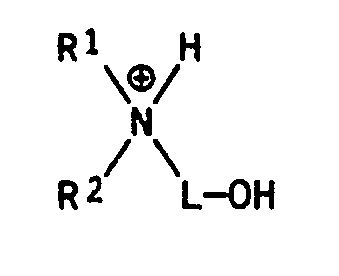
- the present invention relates to the disazo dye of the formula I. in the Kat ⁇ a lithium ion or an ammonium ion of the formula means, wherein R1 and R2 are the same or different and each independently represent methyl, ethyl or hydroxy-substituted C2-C3-alkyl and L are C2-C3-alkylene, and liquid dye preparations containing water and the new disazo dye.
- the above dye is in the form of its sodium salt as C.I. Acid Red 73 known and described in the Color Index under No. 27 290.
- the object of the present invention was therefore to provide new salts of CI Acid Red 73 which no longer have the deficiencies mentioned above.
- R1 and R2 in formula I are e.g. Methyl, ethyl, 2-hydroxyethyl, 2-hydroxypropyl or 3-hydroxypropyl.
- L in formula I is e.g. Ethylene, 1,2-propylene or 1,3-propylene.
- the disazo dye of the formula I is prepared by methods known per se. For example, 4-aminoazobenzene of the formula II diazotize and couple the resulting diazonium salt with 2-hydroxynaphthalene-6,8-disulfonic acid (G-acid).
- the aqueous reaction mixture resulting from the above-described reaction can then be treated with a non-emulsifying, water-insoluble amine which has 12 to 40 carbon atoms, approximately one per mol equivalent of hydroxysulfonyl groups in the dye Molar equivalent of amine used.
- a pH value below 5 is set and the lipophilic amine salt of the dye, which separates from the aqueous phase, is separated off.
- the organic phase is then, optionally after washing with water, with a basic lithium compound, for example lithium hydroxide or lithium carbonate, or with an amine of the formula III in which R1, R2 and L each have the meaning given above, and water is added, whereupon two phases form.
- a basic lithium compound for example lithium hydroxide or lithium carbonate
- an amine of the formula III in which R1, R2 and L each have the meaning given above water is added, whereupon two phases form.
- the organic phase consists essentially of the water-insoluble amine used at the beginning, while the aqueous phase contains the disazo dye of the formula I in dissolved form.
- the new azo dye of the formula I which has excellent water solubility, is advantageously suitable for dyeing paper.
- the aqueous phase can be used directly as a liquid preparation.
- water-miscible solvents e.g. Isobutanol, glycols or etherified glycols, such as ethylene glycol, 1,2-propylene glycol, 1,2-butylene glycol, 1,2-isobutylene glycol, diethylene glycol, triethylene glycol, polyethylene glycols, dipropylene glycol, ethylene glycol monomethyl, ethyl, propyl or butyl ether, 1,2-propylene glycol monomethyl, ethyl, propyl or butyl ether, diethylene glycol monomethyl, ethyl, propyl or butyl ether, dipropylene glycol monomethyl, ethyl, propyl or butyl ether or mixtures thereof.
- Isobutanol e.g. Isobutanol, glycols or etherified glycols, such as ethylene glycol, 1,2-propylene glycol
- Such an aqueous dye preparation generally contains 15 to 40% by weight of disazo dye of the formula I and 5 to 15% by weight of a water-miscible solvent, in each case based on the total weight.
- the water-miscible solvents can be added either at the end or together with the amine of the formula III or the basic lithium compounds.
- the resulting dye suspension was then heated to a temperature of 40 to 50 ° C and treated with 262 g of di (2-ethylhexyl) amine. The mixture was then heated to a temperature of 95 ° C. with stirring, two phases being formed.
- the lower phase which contained the dye in the form of its amine salt, was separated off and washed several times with water. Thereafter, it was mixed with 600 ml of water, 45 g of lithium carbonate and 75 g of dipropylene glycol and heated to a temperature of 95 ° C., again forming two phases.
- the lower phase which contained the dye in the form of its lithium salt, was separated off and clarified. This phase represents the aqueous dye preparation.
Landscapes
- Chemical & Material Sciences (AREA)
- Organic Chemistry (AREA)
- Chemical Kinetics & Catalysis (AREA)
- Coloring (AREA)
Abstract

Description
- Die vorliegende Erfindung betrifft den Disazofarbstoff der Formel I

- Der oben genannte Farbstoff ist in Form seines Natriumsalzes als C.I. Acid Red 73 bekannt und im Colour Index unter der Nr. 27 290 beschrieben.
- Aus der DE-A 2 142 939 sowie der FR-A 2 008 161 sind außerdem einige Aminsalze von 1-(4-Phenylazophenylazo)-2-hydroxynaphthalin-6,8-disulfonsäure bekannt.
- Es hat sich jedoch gezeigt, daß die bisher bekannten Salze unbefriedigende anwendungstechnische Eigenschaften aufweisen. Insbesondere ist ihre Löslichkeit zu gering, was der Anwendung in Flüssigpräparationen im Wege steht.
- Aufgabe der vorliegenden Erfindung war es deshalb, neue Salze von C.I. Acid Red 73 bereitzustellen, die die oben genannten Mängel nicht mehr aufweisen.
- Demgemäß wurde der eingangs beschriebe Disazofarbstoff der Formel I gefunden.
- R¹ und R² in Formel I sind z.B. Methyl, Ethyl, 2-Hydroxyethyl, 2-Hydroxypropyl oder 3-Hydroxypropyl.
- L in Formel I ist z.B. Ethylen, 1,2-Propylen oder 1,3-Propylen.
- Die Herstellung des Disazofarbstoffs der Formel I erfolgt nach an sich bekannten Methoden. Beispielsweise kann man 4-Aminoazobenzol der Formel II

- Mittels des aus der EP-B 53 220 bekannten Verfahrens kann dann das aus der oben beschriebenen Umsetzung resultierende wäßrige Reaktionsgemisch mit einem nicht emulgierend wirkenden, wasserunlöslichen Amin, das 12 bis 40 Kohlenstoffatome aufweist, behandelt werden, wobei man je Moläquivalent Hydroxysulfonylgruppen im Farbstoff ungefähr ein Moläquivalent Amin verwendet. Durch Zugabe von Säure wird dabei ein pH-Wert, der unterhalb von 5 liegt, eingestellt und das lipophile Aminsalz des Farbstoffs, das sich von der wäßrigen Phase abscheidet, abgetrennt.
- Die organische Phase wird dann, gegebenenfalls nach Waschen mit Wasser, mit einer basischen Lithiumverbindung, z.B. Lithiumhydroxid oder Lithiumcarbonat, oder mit einem Amin der Formel III

- Der neue Azofarbstoff der Formel I, der eine hervorragende Wasserlöslichkeit aufweist, eignet sich in vorteilhafter Weise zum Färben von Papier.
- Die wäßrige Phase kann direkt als Flüssigpräparation verwendet werden. Zur Erhöhung der Lagerstabiität ist es von Vorteil, noch wassermischbare Lösungsmittel, z.B. Isobutanol, Glykole oder veretherte Glykole, wie Ethylenglykol, 1,2-Propylenglykol, 1,2-Butylenglykol, 1,2-Isobutylenglykol, Diethylenglykol, Triethylenglykol, Polyethylenglykole, Dipropylenglykol, Ethylenglykolmonomethyl-, -ethyl-, -propyl- oder -butylether, 1,2-Propylenglykolmonomethyl-, -ethyl-, -propyl- oder -butylether, Diethylenglykolmonomethyl-, -ethyl, -propyl- oder butylether, Dipropylenglykolmonomethyl-, -ethyl-, -propyl- oder -butylether oder deren Mischungen, zuzusetzen.
- Eine solche wäßrige Farbstoffpräparation enthält in der Regel 15 bis 40 Gew.% Disazofarbstoff der Formel I und 5 bis 15 Gew.% eines wassermischbaren Lösungsmittels, jeweils bezogen auf das Gesamtgewicht. Die wassermischbaren Lösungsmittel können dabei entweder am Ende oder auch bereits zusammen mit dem Amin der Formel III oder den basischen Lithiumverbindungen zugesetzt werden.
- Die folgenden Beispiele sollen die Erfindung näher erläutern.
- 99 g p-Aminoazobenzol wurden in 700 ml Wasser gegeben und mit 140 g 30 gew.%iger Salzsäure versetzt. Durch Zugabe von 675 g Eis wurde das Gemisch auf eine Temperatur von ± 0°C abgekühlt und unter Rühren mit 175 g einer 3,3-N wäßrigen Natriumnitritlösung versetzt.
- Unabhängig davon wurden in einem anderen Gefäß 152 g 2-Hydroxynaphthalin-6,8-disulfonsäure in 800 ml Wasser gelöst und mit 161 g Soda versetzt. Danach wurde das Gemisch durch Zugabe von 650 g Eis auf eine Temperatur von 2 bis 6°C abgekühlt. Zu diesem Gemisch ließ man unter kräftigem Rühren das Diazoniumsalzgemisch einlaufen. Nach kurzem Rühren wurde mittels 30 gew.%iger Salzsäure auf einen pH-Wert von 0,1 bis 0,3 angesäuert.
- Die resultierende Farbstoffsuspension wurde dann auf eine Temperatur von 40 bis 50°C erwärmt und mit 262 g Di(2-ethylhexyl)amin versetzt. Anschließend wurde unter Rühren auf eine Temperatur von 95°C erwärmt, wobei sich zwei Phasen ausbildeten. Die untere Phase, die den Farbstoff in Form seines Aminsalzes enthielt wurde abgetrennt und mehrmals mit Wasser gewaschen. Danach wurde sie mit 600 ml Wasser, 45 g Lithiumcarbonat und 75 g Dipropylenglykol versetzt und auf eine Temperatur von 95°C erwärmt, wobei sich wiederum zwei Phasen ausbildeten. Die untere Phase, die den Farbstoff in Form seines Lithiumsalzes enthielt, wurde abgetrennt und klärfiltriert. Diese Phase stellt die wäßrige Farbstoffpräparation dar.
- In analoger Weise erhält man Aminsalze mit den folgenden Aminen.

Claims (2)


Applications Claiming Priority (2)
| Application Number | Priority Date | Filing Date | Title |
|---|---|---|---|
| DE19883838092 DE3838092A1 (de) | 1988-11-10 | 1988-11-10 | Lithiumsalze sowie spezielle aminsalze von 1-(4-phenylazophenylazo)-2-hydroxynaphthalin-6,8-disulfonsaeure |
| DE3838092 | 1988-11-10 |
Publications (2)
| Publication Number | Publication Date |
|---|---|
| EP0368213A2 true EP0368213A2 (de) | 1990-05-16 |
| EP0368213A3 EP0368213A3 (de) | 1990-12-27 |
Family
ID=6366857
Family Applications (1)
| Application Number | Title | Priority Date | Filing Date |
|---|---|---|---|
| EP19890120521 Withdrawn EP0368213A3 (de) | 1988-11-10 | 1989-11-06 | Lithiumsalze sowie spezielle Aminsalze von 1-(4-Phenylazophenylazo)-2-hydroxynaphtalin-6,8-disulfonsäure |
Country Status (2)
| Country | Link |
|---|---|
| EP (1) | EP0368213A3 (de) |
| DE (1) | DE3838092A1 (de) |
Cited By (1)
| Publication number | Priority date | Publication date | Assignee | Title |
|---|---|---|---|---|
| EP0553705A1 (de) * | 1992-01-28 | 1993-08-04 | Nippon Kayaku Kabushiki Kaisha | Zusammensetzung enthaltend einen anionischen Farbstoff |
Family Cites Families (5)
| Publication number | Priority date | Publication date | Assignee | Title |
|---|---|---|---|---|
| DE1769328A1 (de) * | 1968-05-09 | 1971-10-21 | Bayer Ag | Disazofarbstoffe |
| BE754665A (fr) * | 1969-08-13 | 1971-01-18 | Bayer Ag | Procede de teinture et d'impression en continu de matieres fibreuses enpolyamides synthetiques |
| BE787646A (fr) * | 1971-08-27 | 1973-02-19 | Basf Ag | Sels colorants disazoiques solubles |
| DE2341293C3 (de) * | 1973-08-16 | 1981-10-08 | Bayer Ag, 5090 Leverkusen | Anionische Farbstoffe und konzentrierte Lösungen dieser Farbstoffe |
| DE2949517A1 (de) * | 1979-12-08 | 1981-06-25 | Bayer Ag, 5090 Leverkusen | Konzentrierte waessrige loesungen von monoazofarbstoffen und deren verwendung zum faerben von papier |
-
1988
- 1988-11-10 DE DE19883838092 patent/DE3838092A1/de not_active Withdrawn
-
1989
- 1989-11-06 EP EP19890120521 patent/EP0368213A3/de not_active Withdrawn
Cited By (1)
| Publication number | Priority date | Publication date | Assignee | Title |
|---|---|---|---|---|
| EP0553705A1 (de) * | 1992-01-28 | 1993-08-04 | Nippon Kayaku Kabushiki Kaisha | Zusammensetzung enthaltend einen anionischen Farbstoff |
Also Published As
| Publication number | Publication date |
|---|---|
| DE3838092A1 (de) | 1990-05-17 |
| EP0368213A3 (de) | 1990-12-27 |
Similar Documents
| Publication | Publication Date | Title |
|---|---|---|
| EP0089004B1 (de) | Verfahren zum Färben von Fasermaterial aus natürlichen Polyamiden | |
| DE3821196A1 (de) | Basische rhodamin-farbstoffe | |
| EP0135198B1 (de) | Verfahren zum Färben von Fasermaterial aus synthetischen Polyamiden | |
| DE3342432A1 (de) | Fluessige reaktivfarbstoffzubereitungen und ihre verwendung | |
| DE2755030A1 (de) | Loesliche farbstoffe | |
| EP0479056B1 (de) | Konzentrierte wässrige Lösungen von 2-Phenylbenzthiazolazofarbstoffen | |
| DE69220707T2 (de) | Konzentrierte flüssige Zusammensetzung Salzbildender Farbstoffe und Tinten | |
| EP0524520B1 (de) | Flüssige Farbstoffzubereitungen | |
| EP1219682A1 (de) | Monoazorfarbstoffe, deren Herstellung und Verwendung | |
| EP1031614B1 (de) | Monoazofarbstoffe, deren Herstellung und Verwendung | |
| EP0035152B1 (de) | Polyazofarbstoffe und deren konzentrierte wässrige Lösungen sowie ihre Verwendung zum Färben cellulosehaltiger Materialien und Leder | |
| DE2529658C3 (de) | Wäßrige oder wasserhaltige Reaktivfarbstoffzubereitungen | |
| DE2458580A1 (de) | Stabile konzentrierte loesungen sulfonsaeuregruppenhaltiger farbstoffe, verfahren zu ihrer herstellung und ihre verwendung | |
| DE2719719C2 (de) | Farbstofflösungen, Verfahren zu deren Herstellung und ihre Verwendung | |
| DE2630988C2 (de) | Azofarbstoffe | |
| DE3034576C2 (de) | Asymmetrische 1:2-Chromazokomplexe, Verfahren zur Herstellung und Verwendung | |
| EP0182743B1 (de) | Konzentrierte lagerstabile wässrige Lösungen gelber Stilbenazo(xy)-farbstoffe | |
| DE3838092A1 (de) | Lithiumsalze sowie spezielle aminsalze von 1-(4-phenylazophenylazo)-2-hydroxynaphthalin-6,8-disulfonsaeure | |
| EP0311949B1 (de) | Wasserlösliche gelbe Monoazofarbstoffe | |
| DE2142947A1 (de) | Monoazofarbstoffe und deren Verwendung | |
| EP1317512B1 (de) | Bisazofarbstoffe auf der basis von hydroxynaphthalincarbonsäure | |
| DE2163389A1 (de) | Neue wasserloesliche reaktivfarbstoffe und verfahren zu ihrer herstellung | |
| DE3046450A1 (de) | "gemischte salze anionischer stilbenazo(xy)verbindungen" | |
| DE2415453A1 (de) | Verfahren zur entwicklung latenter fingerabdruecke | |
| CH624978A5 (en) | Process for the preparation of chromium or cobalt complex dyes |
Legal Events
| Date | Code | Title | Description |
|---|---|---|---|
| PUAI | Public reference made under article 153(3) epc to a published international application that has entered the european phase |
Free format text: ORIGINAL CODE: 0009012 |
|
| AK | Designated contracting states |
Kind code of ref document: A2 Designated state(s): CH DE FR GB IT LI |
|
| PUAL | Search report despatched |
Free format text: ORIGINAL CODE: 0009013 |
|
| AK | Designated contracting states |
Kind code of ref document: A3 Designated state(s): CH DE FR GB IT LI |
|
| 17P | Request for examination filed |
Effective date: 19901123 |
|
| STAA | Information on the status of an ep patent application or granted ep patent |
Free format text: STATUS: THE APPLICATION HAS BEEN WITHDRAWN |
|
| 17Q | First examination report despatched |
Effective date: 19930323 |
|
| 18W | Application withdrawn |
Withdrawal date: 19930423 |