EP0368218B1 - Neue Copolymerisate und ihre Verwendung als Hilfsmittel und/oder Zusatzstoff in Formulierungen zur Herstellung von Polyisocyanat-Polyadditionsprodukten - Google Patents
Neue Copolymerisate und ihre Verwendung als Hilfsmittel und/oder Zusatzstoff in Formulierungen zur Herstellung von Polyisocyanat-Polyadditionsprodukten Download PDFInfo
- Publication number
- EP0368218B1 EP0368218B1 EP89120526A EP89120526A EP0368218B1 EP 0368218 B1 EP0368218 B1 EP 0368218B1 EP 89120526 A EP89120526 A EP 89120526A EP 89120526 A EP89120526 A EP 89120526A EP 0368218 B1 EP0368218 B1 EP 0368218B1
- Authority
- EP
- European Patent Office
- Prior art keywords
- weight
- und
- parts
- oder
- acid
- Prior art date
- Legal status (The legal status is an assumption and is not a legal conclusion. Google has not performed a legal analysis and makes no representation as to the accuracy of the status listed.)
- Expired - Lifetime
Links
- 239000000203 mixture Substances 0.000 title claims abstract description 122
- 229920001577 copolymer Polymers 0.000 title claims abstract description 79
- 238000009472 formulation Methods 0.000 title claims abstract description 16
- 239000002671 adjuvant Substances 0.000 title 1
- 239000012752 auxiliary agent Substances 0.000 title 1
- 229920001228 polyisocyanate Polymers 0.000 claims abstract description 67
- 239000005056 polyisocyanate Substances 0.000 claims abstract description 66
- 239000000178 monomer Substances 0.000 claims abstract description 55
- PPBRXRYQALVLMV-UHFFFAOYSA-N Styrene Chemical compound C=CC1=CC=CC=C1 PPBRXRYQALVLMV-UHFFFAOYSA-N 0.000 claims abstract description 27
- 239000006185 dispersion Substances 0.000 claims abstract description 26
- LFQSCWFLJHTTHZ-UHFFFAOYSA-N Ethanol Chemical compound CCO LFQSCWFLJHTTHZ-UHFFFAOYSA-N 0.000 claims abstract description 24
- 239000000654 additive Substances 0.000 claims abstract description 21
- VOZRXNHHFUQHIL-UHFFFAOYSA-N glycidyl methacrylate Chemical compound CC(=C)C(=O)OCC1CO1 VOZRXNHHFUQHIL-UHFFFAOYSA-N 0.000 claims abstract description 17
- 238000002360 preparation method Methods 0.000 claims abstract description 17
- 229920000728 polyester Polymers 0.000 claims abstract description 16
- 239000002253 acid Substances 0.000 claims abstract description 15
- 229920002554 vinyl polymer Polymers 0.000 claims abstract description 13
- RPQRDASANLAFCM-UHFFFAOYSA-N oxiran-2-ylmethyl prop-2-enoate Chemical compound C=CC(=O)OCC1CO1 RPQRDASANLAFCM-UHFFFAOYSA-N 0.000 claims abstract description 11
- 150000003857 carboxamides Chemical class 0.000 claims abstract description 9
- ZQXSMRAEXCEDJD-UHFFFAOYSA-N n-ethenylformamide Chemical compound C=CNC=O ZQXSMRAEXCEDJD-UHFFFAOYSA-N 0.000 claims abstract description 9
- 125000000391 vinyl group Chemical group [H]C([*])=C([H])[H] 0.000 claims abstract description 9
- 150000007942 carboxylates Chemical class 0.000 claims abstract 4
- 238000004945 emulsification Methods 0.000 claims abstract 2
- -1 alkyl radical Chemical class 0.000 claims description 132
- KFZMGEQAYNKOFK-UHFFFAOYSA-N Isopropanol Chemical compound CC(C)O KFZMGEQAYNKOFK-UHFFFAOYSA-N 0.000 claims description 64
- 229910052757 nitrogen Inorganic materials 0.000 claims description 49
- 229920005862 polyol Polymers 0.000 claims description 48
- 125000004432 carbon atom Chemical group C* 0.000 claims description 40
- 239000006260 foam Substances 0.000 claims description 32
- 238000004519 manufacturing process Methods 0.000 claims description 29
- 238000000034 method Methods 0.000 claims description 23
- JOYRKODLDBILNP-UHFFFAOYSA-N urethane group Chemical group NC(=O)OCC JOYRKODLDBILNP-UHFFFAOYSA-N 0.000 claims description 18
- WHNWPMSKXPGLAX-UHFFFAOYSA-N N-Vinyl-2-pyrrolidone Chemical compound C=CN1CCCC1=O WHNWPMSKXPGLAX-UHFFFAOYSA-N 0.000 claims description 17
- 229920001971 elastomer Polymers 0.000 claims description 17
- 239000007788 liquid Substances 0.000 claims description 17
- VZCYOOQTPOCHFL-OWOJBTEDSA-N Fumaric acid Chemical compound OC(=O)\C=C\C(O)=O VZCYOOQTPOCHFL-OWOJBTEDSA-N 0.000 claims description 16
- 239000000806 elastomer Substances 0.000 claims description 16
- 125000004435 hydrogen atom Chemical class [H]* 0.000 claims description 16
- 239000004970 Chain extender Substances 0.000 claims description 15
- 239000003054 catalyst Substances 0.000 claims description 15
- 239000003431 cross linking reagent Substances 0.000 claims description 14
- JDSHMPZPIAZGSV-UHFFFAOYSA-N melamine Chemical compound NC1=NC(N)=NC(N)=N1 JDSHMPZPIAZGSV-UHFFFAOYSA-N 0.000 claims description 14
- VZCYOOQTPOCHFL-UHFFFAOYSA-N trans-butenedioic acid Natural products OC(=O)C=CC(O)=O VZCYOOQTPOCHFL-UHFFFAOYSA-N 0.000 claims description 13
- NIXOWILDQLNWCW-UHFFFAOYSA-N 2-Propenoic acid Natural products OC(=O)C=C NIXOWILDQLNWCW-UHFFFAOYSA-N 0.000 claims description 12
- 229920000877 Melamine resin Polymers 0.000 claims description 12
- 229920005906 polyester polyol Polymers 0.000 claims description 12
- CERQOIWHTDAKMF-UHFFFAOYSA-N Methacrylic acid Chemical compound CC(=C)C(O)=O CERQOIWHTDAKMF-UHFFFAOYSA-N 0.000 claims description 11
- 125000003118 aryl group Chemical group 0.000 claims description 10
- XSQUKJJJFZCRTK-UHFFFAOYSA-N urea group Chemical group NC(=O)N XSQUKJJJFZCRTK-UHFFFAOYSA-N 0.000 claims description 10
- HRPVXLWXLXDGHG-UHFFFAOYSA-N Acrylamide Chemical compound NC(=O)C=C HRPVXLWXLXDGHG-UHFFFAOYSA-N 0.000 claims description 9
- 239000004604 Blowing Agent Substances 0.000 claims description 9
- OFOBLEOULBTSOW-UHFFFAOYSA-N Propanedioic acid Natural products OC(=O)CC(O)=O OFOBLEOULBTSOW-UHFFFAOYSA-N 0.000 claims description 9
- SMZOUWXMTYCWNB-UHFFFAOYSA-N 2-(2-methoxy-5-methylphenyl)ethanamine Chemical compound COC1=CC=C(C)C=C1CCN SMZOUWXMTYCWNB-UHFFFAOYSA-N 0.000 claims description 7
- 239000001530 fumaric acid Substances 0.000 claims description 7
- 239000003505 polymerization initiator Substances 0.000 claims description 7
- 239000007787 solid Substances 0.000 claims description 7
- 230000000996 additive effect Effects 0.000 claims description 6
- VZCYOOQTPOCHFL-UPHRSURJSA-N maleic acid Chemical compound OC(=O)\C=C/C(O)=O VZCYOOQTPOCHFL-UPHRSURJSA-N 0.000 claims description 6
- 239000011976 maleic acid Substances 0.000 claims description 6
- ZTWTYVWXUKTLCP-UHFFFAOYSA-N vinylphosphonic acid Chemical compound OP(O)(=O)C=C ZTWTYVWXUKTLCP-UHFFFAOYSA-N 0.000 claims description 6
- NLVXSWCKKBEXTG-UHFFFAOYSA-N vinylsulfonic acid Chemical compound OS(=O)(=O)C=C NLVXSWCKKBEXTG-UHFFFAOYSA-N 0.000 claims description 6
- JAHNSTQSQJOJLO-UHFFFAOYSA-N 2-(3-fluorophenyl)-1h-imidazole Chemical compound FC1=CC=CC(C=2NC=CN=2)=C1 JAHNSTQSQJOJLO-UHFFFAOYSA-N 0.000 claims description 5
- UFHFLCQGNIYNRP-UHFFFAOYSA-N Hydrogen Chemical compound [H][H] UFHFLCQGNIYNRP-UHFFFAOYSA-N 0.000 claims description 5
- 125000000217 alkyl group Chemical group 0.000 claims description 5
- 239000001257 hydrogen Substances 0.000 claims description 5
- 229910052739 hydrogen Inorganic materials 0.000 claims description 5
- LVHBHZANLOWSRM-UHFFFAOYSA-N methylenebutanedioic acid Natural products OC(=O)CC(=C)C(O)=O LVHBHZANLOWSRM-UHFFFAOYSA-N 0.000 claims description 5
- 125000005250 alkyl acrylate group Chemical group 0.000 claims description 3
- FQPSGWSUVKBHSU-UHFFFAOYSA-N methacrylamide Chemical compound CC(=C)C(N)=O FQPSGWSUVKBHSU-UHFFFAOYSA-N 0.000 claims description 3
- 238000010526 radical polymerization reaction Methods 0.000 claims description 3
- 238000000465 moulding Methods 0.000 claims description 2
- OSSNTDFYBPYIEC-UHFFFAOYSA-N 1-ethenylimidazole Chemical compound C=CN1C=CN=C1 OSSNTDFYBPYIEC-UHFFFAOYSA-N 0.000 claims 2
- PBGPBHYPCGDFEZ-UHFFFAOYSA-N 1-ethenylpiperidin-2-one Chemical compound C=CN1CCCCC1=O PBGPBHYPCGDFEZ-UHFFFAOYSA-N 0.000 claims 2
- GAVHQOUUSHBDAA-UHFFFAOYSA-N 3-butyl-1-ethenylaziridin-2-one Chemical compound CCCCC1N(C=C)C1=O GAVHQOUUSHBDAA-UHFFFAOYSA-N 0.000 claims 2
- 125000002768 hydroxyalkyl group Chemical group 0.000 claims 1
- 150000002605 large molecules Chemical class 0.000 claims 1
- RAXXELZNTBOGNW-UHFFFAOYSA-N imidazole Substances C1=CNC=N1 RAXXELZNTBOGNW-UHFFFAOYSA-N 0.000 abstract description 6
- OFHCOWSQAMBJIW-AVJTYSNKSA-N alfacalcidol Chemical compound C1(/[C@@H]2CC[C@@H]([C@]2(CCC1)C)[C@H](C)CCCC(C)C)=C\C=C1\C[C@@H](O)C[C@H](O)C1=C OFHCOWSQAMBJIW-AVJTYSNKSA-N 0.000 abstract 1
- 150000003077 polyols Chemical class 0.000 description 44
- LYCAIKOWRPUZTN-UHFFFAOYSA-N Ethylene glycol Chemical compound OCCO LYCAIKOWRPUZTN-UHFFFAOYSA-N 0.000 description 39
- 229960004592 isopropanol Drugs 0.000 description 31
- PEDCQBHIVMGVHV-UHFFFAOYSA-N Glycerine Chemical compound OCC(O)CO PEDCQBHIVMGVHV-UHFFFAOYSA-N 0.000 description 29
- 239000004721 Polyphenylene oxide Substances 0.000 description 27
- 229920000570 polyether Polymers 0.000 description 27
- 125000002887 hydroxy group Chemical group [H]O* 0.000 description 26
- 239000004814 polyurethane Substances 0.000 description 25
- 150000001875 compounds Chemical class 0.000 description 24
- MTHSVFCYNBDYFN-UHFFFAOYSA-N diethylene glycol Chemical compound OCCOCCO MTHSVFCYNBDYFN-UHFFFAOYSA-N 0.000 description 24
- 239000000243 solution Substances 0.000 description 24
- 229920002635 polyurethane Polymers 0.000 description 22
- 230000001413 cellular effect Effects 0.000 description 20
- 239000000047 product Substances 0.000 description 19
- 239000011541 reaction mixture Substances 0.000 description 18
- UPMLOUAZCHDJJD-UHFFFAOYSA-N 4,4'-Diphenylmethane Diisocyanate Chemical compound C1=CC(N=C=O)=CC=C1CC1=CC=C(N=C=O)C=C1 UPMLOUAZCHDJJD-UHFFFAOYSA-N 0.000 description 15
- WERYXYBDKMZEQL-UHFFFAOYSA-N butane-1,4-diol Chemical compound OCCCCO WERYXYBDKMZEQL-UHFFFAOYSA-N 0.000 description 15
- 229920001451 polypropylene glycol Polymers 0.000 description 15
- 229920003171 Poly (ethylene oxide) Polymers 0.000 description 13
- 150000002148 esters Chemical class 0.000 description 13
- GOOHAUXETOMSMM-UHFFFAOYSA-N Propylene oxide Chemical compound CC1CO1 GOOHAUXETOMSMM-UHFFFAOYSA-N 0.000 description 12
- WNLRTRBMVRJNCN-UHFFFAOYSA-N adipic acid Chemical compound OC(=O)CCCCC(O)=O WNLRTRBMVRJNCN-UHFFFAOYSA-N 0.000 description 12
- 150000001298 alcohols Chemical class 0.000 description 12
- 150000001991 dicarboxylic acids Chemical class 0.000 description 12
- ZJCCRDAZUWHFQH-UHFFFAOYSA-N Trimethylolpropane Chemical compound CCC(CO)(CO)CO ZJCCRDAZUWHFQH-UHFFFAOYSA-N 0.000 description 11
- 150000002009 diols Chemical class 0.000 description 11
- 235000011187 glycerol Nutrition 0.000 description 11
- 125000002496 methyl group Chemical group [H]C([H])([H])* 0.000 description 11
- 238000006116 polymerization reaction Methods 0.000 description 11
- XLYOFNOQVPJJNP-UHFFFAOYSA-N water Chemical compound O XLYOFNOQVPJJNP-UHFFFAOYSA-N 0.000 description 11
- IAYPIBMASNFSPL-UHFFFAOYSA-N Ethylene oxide Chemical group C1CO1 IAYPIBMASNFSPL-UHFFFAOYSA-N 0.000 description 10
- 229920005830 Polyurethane Foam Polymers 0.000 description 10
- WYURNTSHIVDZCO-UHFFFAOYSA-N Tetrahydrofuran Chemical compound C1CCOC1 WYURNTSHIVDZCO-UHFFFAOYSA-N 0.000 description 10
- 238000007334 copolymerization reaction Methods 0.000 description 10
- 239000007858 starting material Substances 0.000 description 10
- 125000000999 tert-butyl group Chemical group [H]C([H])([H])C(*)(C([H])([H])[H])C([H])([H])[H] 0.000 description 10
- 125000001449 isopropyl group Chemical group [H]C([H])([H])C([H])(*)C([H])([H])[H] 0.000 description 9
- 229920000768 polyamine Polymers 0.000 description 9
- 239000003381 stabilizer Substances 0.000 description 9
- 238000003756 stirring Methods 0.000 description 9
- UHOVQNZJYSORNB-UHFFFAOYSA-N Benzene Chemical compound C1=CC=CC=C1 UHOVQNZJYSORNB-UHFFFAOYSA-N 0.000 description 8
- YXFVVABEGXRONW-UHFFFAOYSA-N Toluene Chemical compound CC1=CC=CC=C1 YXFVVABEGXRONW-UHFFFAOYSA-N 0.000 description 8
- 238000006243 chemical reaction Methods 0.000 description 8
- 239000003995 emulsifying agent Substances 0.000 description 8
- XXMIOPMDWAUFGU-UHFFFAOYSA-N hexane-1,6-diol Chemical compound OCCCCCCO XXMIOPMDWAUFGU-UHFFFAOYSA-N 0.000 description 8
- NLYAJNPCOHFWQQ-UHFFFAOYSA-N kaolin Chemical compound O.O.O=[Al]O[Si](=O)O[Si](=O)O[Al]=O NLYAJNPCOHFWQQ-UHFFFAOYSA-N 0.000 description 8
- 229920000642 polymer Polymers 0.000 description 8
- 239000002904 solvent Substances 0.000 description 8
- 229940113165 trimethylolpropane Drugs 0.000 description 8
- 210000004027 cell Anatomy 0.000 description 7
- 150000004985 diamines Chemical class 0.000 description 7
- 150000002334 glycols Chemical class 0.000 description 7
- 150000003254 radicals Chemical class 0.000 description 7
- 238000010992 reflux Methods 0.000 description 7
- 239000000126 substance Substances 0.000 description 7
- 239000005995 Aluminium silicate Substances 0.000 description 6
- QGZKDVFQNNGYKY-UHFFFAOYSA-N Ammonia Chemical compound N QGZKDVFQNNGYKY-UHFFFAOYSA-N 0.000 description 6
- ALQSHHUCVQOPAS-UHFFFAOYSA-N Pentane-1,5-diol Chemical compound OCCCCCO ALQSHHUCVQOPAS-UHFFFAOYSA-N 0.000 description 6
- HEMHJVSKTPXQMS-UHFFFAOYSA-M Sodium hydroxide Chemical compound [OH-].[Na+] HEMHJVSKTPXQMS-UHFFFAOYSA-M 0.000 description 6
- WQDUMFSSJAZKTM-UHFFFAOYSA-N Sodium methoxide Chemical compound [Na+].[O-]C WQDUMFSSJAZKTM-UHFFFAOYSA-N 0.000 description 6
- 125000001931 aliphatic group Chemical group 0.000 description 6
- 235000012211 aluminium silicate Nutrition 0.000 description 6
- ZZTCPWRAHWXWCH-UHFFFAOYSA-N diphenylmethanediamine Chemical compound C=1C=CC=CC=1C(N)(N)C1=CC=CC=C1 ZZTCPWRAHWXWCH-UHFFFAOYSA-N 0.000 description 6
- 239000002270 dispersing agent Substances 0.000 description 6
- 230000001804 emulsifying effect Effects 0.000 description 6
- 125000001495 ethyl group Chemical group [H]C([H])([H])C([H])([H])* 0.000 description 6
- 239000004872 foam stabilizing agent Substances 0.000 description 6
- 229920000582 polyisocyanurate Polymers 0.000 description 6
- 239000011495 polyisocyanurate Substances 0.000 description 6
- 238000003860 storage Methods 0.000 description 6
- YLQBMQCUIZJEEH-UHFFFAOYSA-N tetrahydrofuran Natural products C=1C=COC=1 YLQBMQCUIZJEEH-UHFFFAOYSA-N 0.000 description 6
- RUELTTOHQODFPA-UHFFFAOYSA-N toluene 2,6-diisocyanate Chemical compound CC1=C(N=C=O)C=CC=C1N=C=O RUELTTOHQODFPA-UHFFFAOYSA-N 0.000 description 6
- NLHHRLWOUZZQLW-UHFFFAOYSA-N Acrylonitrile Chemical compound C=CC#N NLHHRLWOUZZQLW-UHFFFAOYSA-N 0.000 description 5
- PNEYBMLMFCGWSK-UHFFFAOYSA-N Alumina Chemical compound [O-2].[O-2].[O-2].[Al+3].[Al+3] PNEYBMLMFCGWSK-UHFFFAOYSA-N 0.000 description 5
- YMWUJEATGCHHMB-UHFFFAOYSA-N Dichloromethane Chemical compound ClCCl YMWUJEATGCHHMB-UHFFFAOYSA-N 0.000 description 5
- WSFSSNUMVMOOMR-UHFFFAOYSA-N Formaldehyde Chemical compound O=C WSFSSNUMVMOOMR-UHFFFAOYSA-N 0.000 description 5
- GSEJCLTVZPLZKY-UHFFFAOYSA-N Triethanolamine Chemical compound OCCN(CCO)CCO GSEJCLTVZPLZKY-UHFFFAOYSA-N 0.000 description 5
- 150000008064 anhydrides Chemical class 0.000 description 5
- 150000004984 aromatic diamines Chemical group 0.000 description 5
- 230000015572 biosynthetic process Effects 0.000 description 5
- 238000009835 boiling Methods 0.000 description 5
- 125000000484 butyl group Chemical group [H]C([*])([H])C([H])([H])C([H])([H])C([H])([H])[H] 0.000 description 5
- 239000003795 chemical substances by application Substances 0.000 description 5
- 239000000470 constituent Substances 0.000 description 5
- ZBCBWPMODOFKDW-UHFFFAOYSA-N diethanolamine Chemical compound OCCNCCO ZBCBWPMODOFKDW-UHFFFAOYSA-N 0.000 description 5
- 238000004508 fractional distillation Methods 0.000 description 5
- ZFSLODLOARCGLH-UHFFFAOYSA-N isocyanuric acid Chemical group OC1=NC(O)=NC(O)=N1 ZFSLODLOARCGLH-UHFFFAOYSA-N 0.000 description 5
- 238000005191 phase separation Methods 0.000 description 5
- 239000004417 polycarbonate Substances 0.000 description 5
- 229920000515 polycarbonate Polymers 0.000 description 5
- YPFDHNVEDLHUCE-UHFFFAOYSA-N propane-1,3-diol Chemical compound OCCCO YPFDHNVEDLHUCE-UHFFFAOYSA-N 0.000 description 5
- 150000003839 salts Chemical class 0.000 description 5
- 150000005846 sugar alcohols Polymers 0.000 description 5
- 150000004072 triols Chemical class 0.000 description 5
- RLOISEUPMPOJMI-UHFFFAOYSA-N 2-methylbut-1-en-1-ol Chemical compound CCC(C)=CO RLOISEUPMPOJMI-UHFFFAOYSA-N 0.000 description 4
- NIXOWILDQLNWCW-UHFFFAOYSA-M Acrylate Chemical compound [O-]C(=O)C=C NIXOWILDQLNWCW-UHFFFAOYSA-M 0.000 description 4
- XKRFYHLGVUSROY-UHFFFAOYSA-N Argon Chemical compound [Ar] XKRFYHLGVUSROY-UHFFFAOYSA-N 0.000 description 4
- IJGRMHOSHXDMSA-UHFFFAOYSA-N Atomic nitrogen Chemical compound N#N IJGRMHOSHXDMSA-UHFFFAOYSA-N 0.000 description 4
- AKNUHUCEWALCOI-UHFFFAOYSA-N N-ethyldiethanolamine Chemical compound OCCN(CC)CCO AKNUHUCEWALCOI-UHFFFAOYSA-N 0.000 description 4
- KWYUFKZDYYNOTN-UHFFFAOYSA-M Potassium hydroxide Chemical compound [OH-].[K+] KWYUFKZDYYNOTN-UHFFFAOYSA-M 0.000 description 4
- KKEYFWRCBNTPAC-UHFFFAOYSA-N Terephthalic acid Chemical compound OC(=O)C1=CC=C(C(O)=O)C=C1 KKEYFWRCBNTPAC-UHFFFAOYSA-N 0.000 description 4
- ZMANZCXQSJIPKH-UHFFFAOYSA-N Triethylamine Chemical compound CCN(CC)CC ZMANZCXQSJIPKH-UHFFFAOYSA-N 0.000 description 4
- XTXRWKRVRITETP-UHFFFAOYSA-N Vinyl acetate Chemical compound CC(=O)OC=C XTXRWKRVRITETP-UHFFFAOYSA-N 0.000 description 4
- 150000001252 acrylic acid derivatives Chemical class 0.000 description 4
- 239000001361 adipic acid Substances 0.000 description 4
- 235000011037 adipic acid Nutrition 0.000 description 4
- 239000003513 alkali Substances 0.000 description 4
- 125000002947 alkylene group Chemical group 0.000 description 4
- 150000001412 amines Chemical class 0.000 description 4
- 150000001735 carboxylic acids Chemical class 0.000 description 4
- RWGFKTVRMDUZSP-UHFFFAOYSA-N cumene Chemical compound CC(C)C1=CC=CC=C1 RWGFKTVRMDUZSP-UHFFFAOYSA-N 0.000 description 4
- SZXQTJUDPRGNJN-UHFFFAOYSA-N dipropylene glycol Chemical compound OCCCOCCCO SZXQTJUDPRGNJN-UHFFFAOYSA-N 0.000 description 4
- 230000032050 esterification Effects 0.000 description 4
- 238000005886 esterification reaction Methods 0.000 description 4
- 125000003055 glycidyl group Chemical group C(C1CO1)* 0.000 description 4
- 239000011256 inorganic filler Substances 0.000 description 4
- 239000012948 isocyanate Substances 0.000 description 4
- 150000002513 isocyanates Chemical class 0.000 description 4
- 229910052751 metal Inorganic materials 0.000 description 4
- 239000002184 metal Substances 0.000 description 4
- 150000002736 metal compounds Chemical class 0.000 description 4
- 238000002156 mixing Methods 0.000 description 4
- 239000012766 organic filler Substances 0.000 description 4
- XNGIFLGASWRNHJ-UHFFFAOYSA-N phthalic acid Chemical compound OC(=O)C1=CC=CC=C1C(O)=O XNGIFLGASWRNHJ-UHFFFAOYSA-N 0.000 description 4
- 229920000435 poly(dimethylsiloxane) Polymers 0.000 description 4
- 229920006149 polyester-amide block copolymer Polymers 0.000 description 4
- 229920006324 polyoxymethylene Polymers 0.000 description 4
- 229920001296 polysiloxane Polymers 0.000 description 4
- 239000011496 polyurethane foam Substances 0.000 description 4
- ZIBGPFATKBEMQZ-UHFFFAOYSA-N triethylene glycol Chemical compound OCCOCCOCCO ZIBGPFATKBEMQZ-UHFFFAOYSA-N 0.000 description 4
- DNIAPMSPPWPWGF-VKHMYHEASA-N (+)-propylene glycol Chemical compound C[C@H](O)CO DNIAPMSPPWPWGF-VKHMYHEASA-N 0.000 description 3
- BPRJQFIHEGORJE-UHFFFAOYSA-N 2-(1-hydroxypropan-2-yloxy)propan-1-ol 1-(2-hydroxypropoxy)propan-2-ol Chemical compound CC(O)COCC(C)O.CC(CO)OC(C)CO BPRJQFIHEGORJE-UHFFFAOYSA-N 0.000 description 3
- HZAXFHJVJLSVMW-UHFFFAOYSA-N 2-Aminoethan-1-ol Chemical compound NCCO HZAXFHJVJLSVMW-UHFFFAOYSA-N 0.000 description 3
- XEKOWRVHYACXOJ-UHFFFAOYSA-N Ethyl acetate Chemical compound CCOC(C)=O XEKOWRVHYACXOJ-UHFFFAOYSA-N 0.000 description 3
- PIICEJLVQHRZGT-UHFFFAOYSA-N Ethylenediamine Chemical compound NCCN PIICEJLVQHRZGT-UHFFFAOYSA-N 0.000 description 3
- CERQOIWHTDAKMF-UHFFFAOYSA-M Methacrylate Chemical compound CC(=C)C([O-])=O CERQOIWHTDAKMF-UHFFFAOYSA-M 0.000 description 3
- OKKJLVBELUTLKV-UHFFFAOYSA-N Methanol Chemical compound OC OKKJLVBELUTLKV-UHFFFAOYSA-N 0.000 description 3
- 229920002396 Polyurea Polymers 0.000 description 3
- KDYFGRWQOYBRFD-UHFFFAOYSA-N Succinic acid Natural products OC(=O)CCC(O)=O KDYFGRWQOYBRFD-UHFFFAOYSA-N 0.000 description 3
- 150000007513 acids Chemical class 0.000 description 3
- 239000013543 active substance Substances 0.000 description 3
- 229910052783 alkali metal Inorganic materials 0.000 description 3
- 150000008044 alkali metal hydroxides Chemical class 0.000 description 3
- 239000007795 chemical reaction product Substances 0.000 description 3
- FOTKYAAJKYLFFN-UHFFFAOYSA-N decane-1,10-diol Chemical compound OCCCCCCCCCCO FOTKYAAJKYLFFN-UHFFFAOYSA-N 0.000 description 3
- 150000001990 dicarboxylic acid derivatives Chemical class 0.000 description 3
- 125000005442 diisocyanate group Chemical group 0.000 description 3
- 235000013870 dimethyl polysiloxane Nutrition 0.000 description 3
- RTZKZFJDLAIYFH-UHFFFAOYSA-N ether Substances CCOCC RTZKZFJDLAIYFH-UHFFFAOYSA-N 0.000 description 3
- 150000002170 ethers Chemical class 0.000 description 3
- 239000003063 flame retardant Substances 0.000 description 3
- 229910003475 inorganic filler Inorganic materials 0.000 description 3
- NIMLQBUJDJZYEJ-UHFFFAOYSA-N isophorone diisocyanate Chemical compound CC1(C)CC(N=C=O)CC(C)(CN=C=O)C1 NIMLQBUJDJZYEJ-UHFFFAOYSA-N 0.000 description 3
- QQVIHTHCMHWDBS-UHFFFAOYSA-N isophthalic acid Chemical compound OC(=O)C1=CC=CC(C(O)=O)=C1 QQVIHTHCMHWDBS-UHFFFAOYSA-N 0.000 description 3
- 229940056960 melamin Drugs 0.000 description 3
- 239000006082 mold release agent Substances 0.000 description 3
- 150000002763 monocarboxylic acids Chemical class 0.000 description 3
- 239000012071 phase Substances 0.000 description 3
- 229920005903 polyol mixture Polymers 0.000 description 3
- 229920000166 polytrimethylene carbonate Polymers 0.000 description 3
- WBHHMMIMDMUBKC-XLNAKTSKSA-N ricinelaidic acid Chemical compound CCCCCC[C@@H](O)C\C=C\CCCCCCCC(O)=O WBHHMMIMDMUBKC-XLNAKTSKSA-N 0.000 description 3
- CXMXRPHRNRROMY-UHFFFAOYSA-N sebacic acid Chemical compound OC(=O)CCCCCCCCC(O)=O CXMXRPHRNRROMY-UHFFFAOYSA-N 0.000 description 3
- 239000004094 surface-active agent Substances 0.000 description 3
- BWSZXUOMATYHHI-UHFFFAOYSA-N tert-butyl octaneperoxoate Chemical compound CCCCCCCC(=O)OOC(C)(C)C BWSZXUOMATYHHI-UHFFFAOYSA-N 0.000 description 3
- WGTYBPLFGIVFAS-UHFFFAOYSA-M tetramethylammonium hydroxide Chemical compound [OH-].C[N+](C)(C)C WGTYBPLFGIVFAS-UHFFFAOYSA-M 0.000 description 3
- IMNIMPAHZVJRPE-UHFFFAOYSA-N triethylenediamine Chemical compound C1CN2CCN1CC2 IMNIMPAHZVJRPE-UHFFFAOYSA-N 0.000 description 3
- XFNJVJPLKCPIBV-UHFFFAOYSA-N trimethylenediamine Chemical compound NCCCN XFNJVJPLKCPIBV-UHFFFAOYSA-N 0.000 description 3
- XOOUIPVCVHRTMJ-UHFFFAOYSA-L zinc stearate Chemical class [Zn+2].CCCCCCCCCCCCCCCCCC([O-])=O.CCCCCCCCCCCCCCCCCC([O-])=O XOOUIPVCVHRTMJ-UHFFFAOYSA-L 0.000 description 3
- PAPBSGBWRJIAAV-UHFFFAOYSA-N ε-Caprolactone Chemical compound O=C1CCCCCO1 PAPBSGBWRJIAAV-UHFFFAOYSA-N 0.000 description 3
- AJDIZQLSFPQPEY-UHFFFAOYSA-N 1,1,2-Trichlorotrifluoroethane Chemical compound FC(F)(Cl)C(F)(Cl)Cl AJDIZQLSFPQPEY-UHFFFAOYSA-N 0.000 description 2
- ZFDWWDZLRKHULH-UHFFFAOYSA-N 1,2-dimethyl-5,6-dihydro-4h-pyrimidine Chemical compound CN1CCCN=C1C ZFDWWDZLRKHULH-UHFFFAOYSA-N 0.000 description 2
- GIWQSPITLQVMSG-UHFFFAOYSA-N 1,2-dimethylimidazole Chemical compound CC1=NC=CN1C GIWQSPITLQVMSG-UHFFFAOYSA-N 0.000 description 2
- FCQPNTOQFPJCMF-UHFFFAOYSA-N 1,3-bis[3-(dimethylamino)propyl]urea Chemical compound CN(C)CCCNC(=O)NCCCN(C)C FCQPNTOQFPJCMF-UHFFFAOYSA-N 0.000 description 2
- RTBFRGCFXZNCOE-UHFFFAOYSA-N 1-methylsulfonylpiperidin-4-one Chemical compound CS(=O)(=O)N1CCC(=O)CC1 RTBFRGCFXZNCOE-UHFFFAOYSA-N 0.000 description 2
- GEEGPFGTMRWCID-UHFFFAOYSA-N 1-n,1-n,1-n',1-n'-tetramethylbutane-1,1-diamine Chemical compound CCCC(N(C)C)N(C)C GEEGPFGTMRWCID-UHFFFAOYSA-N 0.000 description 2
- VILCJCGEZXAXTO-UHFFFAOYSA-N 2,2,2-tetramine Chemical compound NCCNCCNCCN VILCJCGEZXAXTO-UHFFFAOYSA-N 0.000 description 2
- PQXKWPLDPFFDJP-UHFFFAOYSA-N 2,3-dimethyloxirane Chemical compound CC1OC1C PQXKWPLDPFFDJP-UHFFFAOYSA-N 0.000 description 2
- OZAIFHULBGXAKX-UHFFFAOYSA-N 2-(2-cyanopropan-2-yldiazenyl)-2-methylpropanenitrile Chemical compound N#CC(C)(C)N=NC(C)(C)C#N OZAIFHULBGXAKX-UHFFFAOYSA-N 0.000 description 2
- HIXDQWDOVZUNNA-UHFFFAOYSA-N 2-(3,4-dimethoxyphenyl)-5-hydroxy-7-methoxychromen-4-one Chemical compound C=1C(OC)=CC(O)=C(C(C=2)=O)C=1OC=2C1=CC=C(OC)C(OC)=C1 HIXDQWDOVZUNNA-UHFFFAOYSA-N 0.000 description 2
- MIJDSYMOBYNHOT-UHFFFAOYSA-N 2-(ethylamino)ethanol Chemical compound CCNCCO MIJDSYMOBYNHOT-UHFFFAOYSA-N 0.000 description 2
- SYBYTAAJFKOIEJ-UHFFFAOYSA-N 3-Methylbutan-2-one Chemical compound CC(C)C(C)=O SYBYTAAJFKOIEJ-UHFFFAOYSA-N 0.000 description 2
- YBRVSVVVWCFQMG-UHFFFAOYSA-N 4,4'-diaminodiphenylmethane Chemical compound C1=CC(N)=CC=C1CC1=CC=C(N)C=C1 YBRVSVVVWCFQMG-UHFFFAOYSA-N 0.000 description 2
- BRKHZWFIIVVNTA-UHFFFAOYSA-N 4-cyclohexylmorpholine Chemical compound C1CCCCC1N1CCOCC1 BRKHZWFIIVVNTA-UHFFFAOYSA-N 0.000 description 2
- NDWUBGAGUCISDV-UHFFFAOYSA-N 4-hydroxybutyl prop-2-enoate Chemical compound OCCCCOC(=O)C=C NDWUBGAGUCISDV-UHFFFAOYSA-N 0.000 description 2
- RSWGJHLUYNHPMX-UHFFFAOYSA-N Abietic-Saeure Natural products C12CCC(C(C)C)=CC2=CCC2C1(C)CCCC2(C)C(O)=O RSWGJHLUYNHPMX-UHFFFAOYSA-N 0.000 description 2
- CURLTUGMZLYLDI-UHFFFAOYSA-N Carbon dioxide Chemical group O=C=O CURLTUGMZLYLDI-UHFFFAOYSA-N 0.000 description 2
- UGFAIRIUMAVXCW-UHFFFAOYSA-N Carbon monoxide Chemical compound [O+]#[C-] UGFAIRIUMAVXCW-UHFFFAOYSA-N 0.000 description 2
- RPNUMPOLZDHAAY-UHFFFAOYSA-N Diethylenetriamine Chemical compound NCCNCCN RPNUMPOLZDHAAY-UHFFFAOYSA-N 0.000 description 2
- YNQLUTRBYVCPMQ-UHFFFAOYSA-N Ethylbenzene Chemical compound CCC1=CC=CC=C1 YNQLUTRBYVCPMQ-UHFFFAOYSA-N 0.000 description 2
- DGAQECJNVWCQMB-PUAWFVPOSA-M Ilexoside XXIX Chemical compound C[C@@H]1CC[C@@]2(CC[C@@]3(C(=CC[C@H]4[C@]3(CC[C@@H]5[C@@]4(CC[C@@H](C5(C)C)OS(=O)(=O)[O-])C)C)[C@@H]2[C@]1(C)O)C)C(=O)O[C@H]6[C@@H]([C@H]([C@@H]([C@H](O6)CO)O)O)O.[Na+] DGAQECJNVWCQMB-PUAWFVPOSA-M 0.000 description 2
- XEEYBQQBJWHFJM-UHFFFAOYSA-N Iron Chemical compound [Fe] XEEYBQQBJWHFJM-UHFFFAOYSA-N 0.000 description 2
- FYYHWMGAXLPEAU-UHFFFAOYSA-N Magnesium Chemical compound [Mg] FYYHWMGAXLPEAU-UHFFFAOYSA-N 0.000 description 2
- KWYHDKDOAIKMQN-UHFFFAOYSA-N N,N,N',N'-tetramethylethylenediamine Chemical compound CN(C)CCN(C)C KWYHDKDOAIKMQN-UHFFFAOYSA-N 0.000 description 2
- UEEJHVSXFDXPFK-UHFFFAOYSA-N N-dimethylaminoethanol Chemical compound CN(C)CCO UEEJHVSXFDXPFK-UHFFFAOYSA-N 0.000 description 2
- CTQNGGLPUBDAKN-UHFFFAOYSA-N O-Xylene Chemical compound CC1=CC=CC=C1C CTQNGGLPUBDAKN-UHFFFAOYSA-N 0.000 description 2
- URLKBWYHVLBVBO-UHFFFAOYSA-N Para-Xylene Chemical group CC1=CC=C(C)C=C1 URLKBWYHVLBVBO-UHFFFAOYSA-N 0.000 description 2
- YGYAWVDWMABLBF-UHFFFAOYSA-N Phosgene Chemical compound ClC(Cl)=O YGYAWVDWMABLBF-UHFFFAOYSA-N 0.000 description 2
- OAICVXFJPJFONN-UHFFFAOYSA-N Phosphorus Chemical compound [P] OAICVXFJPJFONN-UHFFFAOYSA-N 0.000 description 2
- KHPCPRHQVVSZAH-HUOMCSJISA-N Rosin Natural products O(C/C=C/c1ccccc1)[C@H]1[C@H](O)[C@@H](O)[C@@H](O)[C@@H](CO)O1 KHPCPRHQVVSZAH-HUOMCSJISA-N 0.000 description 2
- AWMVMTVKBNGEAK-UHFFFAOYSA-N Styrene oxide Chemical compound C1OC1C1=CC=CC=C1 AWMVMTVKBNGEAK-UHFFFAOYSA-N 0.000 description 2
- CZMRCDWAGMRECN-UGDNZRGBSA-N Sucrose Chemical compound O[C@H]1[C@H](O)[C@@H](CO)O[C@@]1(CO)O[C@@H]1[C@H](O)[C@@H](O)[C@H](O)[C@@H](CO)O1 CZMRCDWAGMRECN-UGDNZRGBSA-N 0.000 description 2
- 229930006000 Sucrose Natural products 0.000 description 2
- SLINHMUFWFWBMU-UHFFFAOYSA-N Triisopropanolamine Chemical compound CC(O)CN(CC(C)O)CC(C)O SLINHMUFWFWBMU-UHFFFAOYSA-N 0.000 description 2
- 239000007983 Tris buffer Substances 0.000 description 2
- PQYJRMFWJJONBO-UHFFFAOYSA-N Tris(2,3-dibromopropyl) phosphate Chemical compound BrCC(Br)COP(=O)(OCC(Br)CBr)OCC(Br)CBr PQYJRMFWJJONBO-UHFFFAOYSA-N 0.000 description 2
- YKTSYUJCYHOUJP-UHFFFAOYSA-N [O--].[Al+3].[Al+3].[O-][Si]([O-])([O-])[O-] Chemical compound [O--].[Al+3].[Al+3].[O-][Si]([O-])([O-])[O-] YKTSYUJCYHOUJP-UHFFFAOYSA-N 0.000 description 2
- CQQXCSFSYHAZOO-UHFFFAOYSA-L [acetyloxy(dioctyl)stannyl] acetate Chemical compound CCCCCCCC[Sn](OC(C)=O)(OC(C)=O)CCCCCCCC CQQXCSFSYHAZOO-UHFFFAOYSA-L 0.000 description 2
- UKLDJPRMSDWDSL-UHFFFAOYSA-L [dibutyl(dodecanoyloxy)stannyl] dodecanoate Chemical compound CCCCCCCCCCCC(=O)O[Sn](CCCC)(CCCC)OC(=O)CCCCCCCCCCC UKLDJPRMSDWDSL-UHFFFAOYSA-L 0.000 description 2
- 229910001854 alkali hydroxide Inorganic materials 0.000 description 2
- 150000001340 alkali metals Chemical class 0.000 description 2
- WYTGDNHDOZPMIW-RCBQFDQVSA-N alstonine Natural products C1=CC2=C3C=CC=CC3=NC2=C2N1C[C@H]1[C@H](C)OC=C(C(=O)OC)[C@H]1C2 WYTGDNHDOZPMIW-RCBQFDQVSA-N 0.000 description 2
- 150000001408 amides Chemical class 0.000 description 2
- 150000001409 amidines Chemical class 0.000 description 2
- 150000001414 amino alcohols Chemical class 0.000 description 2
- 229910021529 ammonia Inorganic materials 0.000 description 2
- 229910052612 amphibole Inorganic materials 0.000 description 2
- JFCQEDHGNNZCLN-UHFFFAOYSA-N anhydrous glutaric acid Natural products OC(=O)CCCC(O)=O JFCQEDHGNNZCLN-UHFFFAOYSA-N 0.000 description 2
- ADCOVFLJGNWWNZ-UHFFFAOYSA-N antimony trioxide Chemical compound O=[Sb]O[Sb]=O ADCOVFLJGNWWNZ-UHFFFAOYSA-N 0.000 description 2
- VMPVEPPRYRXYNP-UHFFFAOYSA-I antimony(5+);pentachloride Chemical compound Cl[Sb](Cl)(Cl)(Cl)Cl VMPVEPPRYRXYNP-UHFFFAOYSA-I 0.000 description 2
- 229910052786 argon Inorganic materials 0.000 description 2
- TZCXTZWJZNENPQ-UHFFFAOYSA-L barium sulfate Chemical compound [Ba+2].[O-]S([O-])(=O)=O TZCXTZWJZNENPQ-UHFFFAOYSA-L 0.000 description 2
- KDYFGRWQOYBRFD-NUQCWPJISA-N butanedioic acid Chemical compound O[14C](=O)CC[14C](O)=O KDYFGRWQOYBRFD-NUQCWPJISA-N 0.000 description 2
- 239000006227 byproduct Substances 0.000 description 2
- BDOSMKKIYDKNTQ-UHFFFAOYSA-N cadmium atom Chemical compound [Cd] BDOSMKKIYDKNTQ-UHFFFAOYSA-N 0.000 description 2
- 239000004202 carbamide Substances 0.000 description 2
- 239000006229 carbon black Substances 0.000 description 2
- 150000001733 carboxylic acid esters Chemical class 0.000 description 2
- 239000004359 castor oil Substances 0.000 description 2
- 235000019438 castor oil Nutrition 0.000 description 2
- 238000001311 chemical methods and process Methods 0.000 description 2
- 239000011248 coating agent Substances 0.000 description 2
- 150000007973 cyanuric acids Chemical class 0.000 description 2
- FSDSKERRNURGGO-UHFFFAOYSA-N cyclohexane-1,3,5-triol Chemical compound OC1CC(O)CC(O)C1 FSDSKERRNURGGO-UHFFFAOYSA-N 0.000 description 2
- VKONPUDBRVKQLM-UHFFFAOYSA-N cyclohexane-1,4-diol Chemical compound OC1CCC(O)CC1 VKONPUDBRVKQLM-UHFFFAOYSA-N 0.000 description 2
- JHIVVAPYMSGYDF-UHFFFAOYSA-N cyclohexanone Chemical compound O=C1CCCCC1 JHIVVAPYMSGYDF-UHFFFAOYSA-N 0.000 description 2
- KBLWLMPSVYBVDK-UHFFFAOYSA-N cyclohexyl prop-2-enoate Chemical compound C=CC(=O)OC1CCCCC1 KBLWLMPSVYBVDK-UHFFFAOYSA-N 0.000 description 2
- JBSLOWBPDRZSMB-FPLPWBNLSA-N dibutyl (z)-but-2-enedioate Chemical compound CCCCOC(=O)\C=C/C(=O)OCCCC JBSLOWBPDRZSMB-FPLPWBNLSA-N 0.000 description 2
- 239000012975 dibutyltin dilaurate Substances 0.000 description 2
- PXBRQCKWGAHEHS-UHFFFAOYSA-N dichlorodifluoromethane Chemical compound FC(F)(Cl)Cl PXBRQCKWGAHEHS-UHFFFAOYSA-N 0.000 description 2
- UMNKXPULIDJLSU-UHFFFAOYSA-N dichlorofluoromethane Chemical compound FC(Cl)Cl UMNKXPULIDJLSU-UHFFFAOYSA-N 0.000 description 2
- 235000014113 dietary fatty acids Nutrition 0.000 description 2
- 239000004205 dimethyl polysiloxane Substances 0.000 description 2
- XXBDWLFCJWSEKW-UHFFFAOYSA-N dimethylbenzylamine Chemical compound CN(C)CC1=CC=CC=C1 XXBDWLFCJWSEKW-UHFFFAOYSA-N 0.000 description 2
- ROORDVPLFPIABK-UHFFFAOYSA-N diphenyl carbonate Chemical compound C=1C=CC=CC=1OC(=O)OC1=CC=CC=C1 ROORDVPLFPIABK-UHFFFAOYSA-N 0.000 description 2
- 230000000694 effects Effects 0.000 description 2
- 239000000194 fatty acid Substances 0.000 description 2
- 229930195729 fatty acid Natural products 0.000 description 2
- 150000004665 fatty acids Chemical class 0.000 description 2
- 150000002191 fatty alcohols Chemical class 0.000 description 2
- 239000000945 filler Substances 0.000 description 2
- 238000005187 foaming Methods 0.000 description 2
- ZEMPKEQAKRGZGQ-XOQCFJPHSA-N glycerol triricinoleate Natural products CCCCCC[C@@H](O)CC=CCCCCCCCC(=O)OC[C@@H](COC(=O)CCCCCCCC=CC[C@@H](O)CCCCCC)OC(=O)CCCCCCCC=CC[C@H](O)CCCCCC ZEMPKEQAKRGZGQ-XOQCFJPHSA-N 0.000 description 2
- 125000003827 glycol group Chemical group 0.000 description 2
- 238000010559 graft polymerization reaction Methods 0.000 description 2
- 150000008282 halocarbons Chemical class 0.000 description 2
- 239000001307 helium Substances 0.000 description 2
- 229910052734 helium Inorganic materials 0.000 description 2
- SWQJXJOGLNCZEY-UHFFFAOYSA-N helium atom Chemical compound [He] SWQJXJOGLNCZEY-UHFFFAOYSA-N 0.000 description 2
- ACCCMOQWYVYDOT-UHFFFAOYSA-N hexane-1,1-diol Chemical compound CCCCCC(O)O ACCCMOQWYVYDOT-UHFFFAOYSA-N 0.000 description 2
- NAQMVNRVTILPCV-UHFFFAOYSA-N hexane-1,6-diamine Chemical compound NCCCCCCN NAQMVNRVTILPCV-UHFFFAOYSA-N 0.000 description 2
- 125000004051 hexyl group Chemical group [H]C([H])([H])C([H])([H])C([H])([H])C([H])([H])C([H])([H])C([H])([H])* 0.000 description 2
- 239000008240 homogeneous mixture Substances 0.000 description 2
- 229930195733 hydrocarbon Natural products 0.000 description 2
- 150000002430 hydrocarbons Chemical class 0.000 description 2
- 238000011065 in-situ storage Methods 0.000 description 2
- 239000011261 inert gas Substances 0.000 description 2
- 239000003999 initiator Substances 0.000 description 2
- IQPQWNKOIGAROB-UHFFFAOYSA-N isocyanate group Chemical group [N-]=C=O IQPQWNKOIGAROB-UHFFFAOYSA-N 0.000 description 2
- 125000001972 isopentyl group Chemical group [H]C([H])([H])C([H])(C([H])([H])[H])C([H])([H])C([H])([H])* 0.000 description 2
- 239000000463 material Substances 0.000 description 2
- 229910044991 metal oxide Inorganic materials 0.000 description 2
- 150000004706 metal oxides Chemical class 0.000 description 2
- 150000002739 metals Chemical class 0.000 description 2
- CRVGTESFCCXCTH-UHFFFAOYSA-N methyl diethanolamine Chemical group OCCN(C)CCO CRVGTESFCCXCTH-UHFFFAOYSA-N 0.000 description 2
- 238000012986 modification Methods 0.000 description 2
- VLKZOEOYAKHREP-UHFFFAOYSA-N n-Hexane Chemical compound CCCCCC VLKZOEOYAKHREP-UHFFFAOYSA-N 0.000 description 2
- 125000004108 n-butyl group Chemical group [H]C([H])([H])C([H])([H])C([H])([H])C([H])([H])* 0.000 description 2
- 125000004123 n-propyl group Chemical group [H]C([H])([H])C([H])([H])C([H])([H])* 0.000 description 2
- BDJRBEYXGGNYIS-UHFFFAOYSA-N nonanedioic acid Chemical compound OC(=O)CCCCCCCC(O)=O BDJRBEYXGGNYIS-UHFFFAOYSA-N 0.000 description 2
- UTOPWMOLSKOLTQ-UHFFFAOYSA-N octacosanoic acid Chemical compound CCCCCCCCCCCCCCCCCCCCCCCCCCCC(O)=O UTOPWMOLSKOLTQ-UHFFFAOYSA-N 0.000 description 2
- NKBWPOSQERPBFI-UHFFFAOYSA-N octadecyl octadecanoate Chemical compound CCCCCCCCCCCCCCCCCCOC(=O)CCCCCCCCCCCCCCCCC NKBWPOSQERPBFI-UHFFFAOYSA-N 0.000 description 2
- 239000003921 oil Substances 0.000 description 2
- 235000019198 oils Nutrition 0.000 description 2
- AHHWIHXENZJRFG-UHFFFAOYSA-N oxetane Chemical compound C1COC1 AHHWIHXENZJRFG-UHFFFAOYSA-N 0.000 description 2
- 239000003973 paint Substances 0.000 description 2
- 239000002245 particle Substances 0.000 description 2
- UKODFQOELJFMII-UHFFFAOYSA-N pentamethyldiethylenetriamine Chemical compound CN(C)CCN(C)CCN(C)C UKODFQOELJFMII-UHFFFAOYSA-N 0.000 description 2
- 150000002989 phenols Chemical class 0.000 description 2
- 125000001997 phenyl group Chemical group [H]C1=C([H])C([H])=C(*)C([H])=C1[H] 0.000 description 2
- 229920002239 polyacrylonitrile Polymers 0.000 description 2
- 230000000379 polymerizing effect Effects 0.000 description 2
- 229920000098 polyolefin Polymers 0.000 description 2
- 229920000915 polyvinyl chloride Polymers 0.000 description 2
- SCVFZCLFOSHCOH-UHFFFAOYSA-M potassium acetate Chemical compound [K+].CC([O-])=O SCVFZCLFOSHCOH-UHFFFAOYSA-M 0.000 description 2
- 125000001436 propyl group Chemical group [H]C([*])([H])C([H])([H])C([H])([H])[H] 0.000 description 2
- KIDHWZJUCRJVML-UHFFFAOYSA-N putrescine Chemical compound NCCCCN KIDHWZJUCRJVML-UHFFFAOYSA-N 0.000 description 2
- ADRDEXBBJTUCND-UHFFFAOYSA-N pyrrolizidine Chemical compound C1CCN2CCCC21 ADRDEXBBJTUCND-UHFFFAOYSA-N 0.000 description 2
- 229960003656 ricinoleic acid Drugs 0.000 description 2
- FEUQNCSVHBHROZ-UHFFFAOYSA-N ricinoleic acid Natural products CCCCCCC(O[Si](C)(C)C)CC=CCCCCCCCC(=O)OC FEUQNCSVHBHROZ-UHFFFAOYSA-N 0.000 description 2
- 229920006395 saturated elastomer Polymers 0.000 description 2
- 125000002914 sec-butyl group Chemical group [H]C([H])([H])C([H])([H])C([H])(*)C([H])([H])[H] 0.000 description 2
- TYFQFVWCELRYAO-UHFFFAOYSA-N suberic acid Chemical compound OC(=O)CCCCCCC(O)=O TYFQFVWCELRYAO-UHFFFAOYSA-N 0.000 description 2
- 229960004793 sucrose Drugs 0.000 description 2
- 150000003460 sulfonic acids Chemical class 0.000 description 2
- 150000005622 tetraalkylammonium hydroxides Chemical class 0.000 description 2
- 150000003606 tin compounds Chemical class 0.000 description 2
- IUTCEZPPWBHGIX-UHFFFAOYSA-N tin(2+) Chemical class [Sn+2] IUTCEZPPWBHGIX-UHFFFAOYSA-N 0.000 description 2
- KHPCPRHQVVSZAH-UHFFFAOYSA-N trans-cinnamyl beta-D-glucopyranoside Natural products OC1C(O)C(O)C(CO)OC1OCC=CC1=CC=CC=C1 KHPCPRHQVVSZAH-UHFFFAOYSA-N 0.000 description 2
- IMFACGCPASFAPR-UHFFFAOYSA-N tributylamine Chemical compound CCCCN(CCCC)CCCC IMFACGCPASFAPR-UHFFFAOYSA-N 0.000 description 2
- HQUQLFOMPYWACS-UHFFFAOYSA-N tris(2-chloroethyl) phosphate Chemical compound ClCCOP(=O)(OCCCl)OCCCl HQUQLFOMPYWACS-UHFFFAOYSA-N 0.000 description 2
- GTRSAMFYSUBAGN-UHFFFAOYSA-N tris(2-chloropropyl) phosphate Chemical compound CC(Cl)COP(=O)(OCC(C)Cl)OCC(C)Cl GTRSAMFYSUBAGN-UHFFFAOYSA-N 0.000 description 2
- JWZZKOKVBUJMES-UHFFFAOYSA-N (+-)-Isoprenaline Chemical compound CC(C)NCC(O)C1=CC=C(O)C(O)=C1 JWZZKOKVBUJMES-UHFFFAOYSA-N 0.000 description 1
- HFVMEOPYDLEHBR-UHFFFAOYSA-N (2-fluorophenyl)-phenylmethanol Chemical compound C=1C=CC=C(F)C=1C(O)C1=CC=CC=C1 HFVMEOPYDLEHBR-UHFFFAOYSA-N 0.000 description 1
- 125000006686 (C1-C24) alkyl group Chemical group 0.000 description 1
- WRIDQFICGBMAFQ-UHFFFAOYSA-N (E)-8-Octadecenoic acid Natural products CCCCCCCCCC=CCCCCCCC(O)=O WRIDQFICGBMAFQ-UHFFFAOYSA-N 0.000 description 1
- ZBBLRPRYYSJUCZ-GRHBHMESSA-L (z)-but-2-enedioate;dibutyltin(2+) Chemical compound [O-]C(=O)\C=C/C([O-])=O.CCCC[Sn+2]CCCC ZBBLRPRYYSJUCZ-GRHBHMESSA-L 0.000 description 1
- DHKHKXVYLBGOIT-UHFFFAOYSA-N 1,1-Diethoxyethane Chemical compound CCOC(C)OCC DHKHKXVYLBGOIT-UHFFFAOYSA-N 0.000 description 1
- BAMUEXIPKSRTBS-UHFFFAOYSA-N 1,1-dichloro-1,2,2,2-tetrafluoroethane Chemical compound FC(F)(F)C(F)(Cl)Cl BAMUEXIPKSRTBS-UHFFFAOYSA-N 0.000 description 1
- OKIRBHVFJGXOIS-UHFFFAOYSA-N 1,2-di(propan-2-yl)benzene Chemical compound CC(C)C1=CC=CC=C1C(C)C OKIRBHVFJGXOIS-UHFFFAOYSA-N 0.000 description 1
- DDMOUSALMHHKOS-UHFFFAOYSA-N 1,2-dichloro-1,1,2,2-tetrafluoroethane Chemical compound FC(F)(Cl)C(F)(F)Cl DDMOUSALMHHKOS-UHFFFAOYSA-N 0.000 description 1
- ARHYWWAJZDAYDJ-UHFFFAOYSA-N 1,2-dimethylpiperazine Chemical compound CC1CNCCN1C ARHYWWAJZDAYDJ-UHFFFAOYSA-N 0.000 description 1
- GEYOCULIXLDCMW-UHFFFAOYSA-N 1,2-phenylenediamine Chemical compound NC1=CC=CC=C1N GEYOCULIXLDCMW-UHFFFAOYSA-N 0.000 description 1
- WZCQRUWWHSTZEM-UHFFFAOYSA-N 1,3-phenylenediamine Chemical compound NC1=CC=CC(N)=C1 WZCQRUWWHSTZEM-UHFFFAOYSA-N 0.000 description 1
- RYHBNJHYFVUHQT-UHFFFAOYSA-N 1,4-Dioxane Chemical compound C1COCCO1 RYHBNJHYFVUHQT-UHFFFAOYSA-N 0.000 description 1
- RXYPXQSKLGGKOL-UHFFFAOYSA-N 1,4-dimethylpiperazine Chemical compound CN1CCN(C)CC1 RXYPXQSKLGGKOL-UHFFFAOYSA-N 0.000 description 1
- 229940008841 1,6-hexamethylene diisocyanate Drugs 0.000 description 1
- UICXTANXZJJIBC-UHFFFAOYSA-N 1-(1-hydroperoxycyclohexyl)peroxycyclohexan-1-ol Chemical compound C1CCCCC1(O)OOC1(OO)CCCCC1 UICXTANXZJJIBC-UHFFFAOYSA-N 0.000 description 1
- ZMESHQOXZMOOQQ-UHFFFAOYSA-N 1-(naphthalen-1-ylmethyl)naphthalene Chemical class C1=CC=C2C(CC=3C4=CC=CC=C4C=CC=3)=CC=CC2=C1 ZMESHQOXZMOOQQ-UHFFFAOYSA-N 0.000 description 1
- SMNOVRZDAZZQTI-UHFFFAOYSA-N 1-[dibutyl(dodecanoyl)stannyl]dodecan-1-one Chemical compound CCCCCCCCCCCC(=O)[Sn](CCCC)(CCCC)C(=O)CCCCCCCCCCC SMNOVRZDAZZQTI-UHFFFAOYSA-N 0.000 description 1
- PBFKVYVGYHNCGT-UHFFFAOYSA-N 1-sulfanylpropane-1,2,3-triol Chemical compound OCC(O)C(O)S PBFKVYVGYHNCGT-UHFFFAOYSA-N 0.000 description 1
- CVFRFSNPBJUQMG-UHFFFAOYSA-N 2,3-bis(2-hydroxyethyl)benzene-1,4-diol Chemical compound OCCC1=C(O)C=CC(O)=C1CCO CVFRFSNPBJUQMG-UHFFFAOYSA-N 0.000 description 1
- RLYCRLGLCUXUPO-UHFFFAOYSA-N 2,6-diaminotoluene Chemical compound CC1=C(N)C=CC=C1N RLYCRLGLCUXUPO-UHFFFAOYSA-N 0.000 description 1
- RZEWIYUUNKCGKA-UHFFFAOYSA-N 2-(2-hydroxyethylamino)ethanol;octadecanoic acid Chemical compound OCCNCCO.CCCCCCCCCCCCCCCCCC(O)=O RZEWIYUUNKCGKA-UHFFFAOYSA-N 0.000 description 1
- CBKJLMZJKHOGEQ-UHFFFAOYSA-N 2-(oxiran-2-yl)ethyl prop-2-enoate Chemical compound C=CC(=O)OCCC1CO1 CBKJLMZJKHOGEQ-UHFFFAOYSA-N 0.000 description 1
- OHKOAJUTRVTYSW-UHFFFAOYSA-N 2-[(2-aminophenyl)methyl]aniline Chemical compound NC1=CC=CC=C1CC1=CC=CC=C1N OHKOAJUTRVTYSW-UHFFFAOYSA-N 0.000 description 1
- CJWBPEYRTPGWPF-UHFFFAOYSA-N 2-[bis(2-chloroethoxy)phosphoryloxy]ethyl bis(2-chloroethyl) phosphate Chemical compound ClCCOP(=O)(OCCCl)OCCOP(=O)(OCCCl)OCCCl CJWBPEYRTPGWPF-UHFFFAOYSA-N 0.000 description 1
- FZZMTSNZRBFGGU-UHFFFAOYSA-N 2-chloro-7-fluoroquinazolin-4-amine Chemical compound FC1=CC=C2C(N)=NC(Cl)=NC2=C1 FZZMTSNZRBFGGU-UHFFFAOYSA-N 0.000 description 1
- WFUGQJXVXHBTEM-UHFFFAOYSA-N 2-hydroperoxy-2-(2-hydroperoxybutan-2-ylperoxy)butane Chemical compound CCC(C)(OO)OOC(C)(CC)OO WFUGQJXVXHBTEM-UHFFFAOYSA-N 0.000 description 1
- IIVWHGMLFGNMOW-UHFFFAOYSA-N 2-methylpropane Chemical compound C[C](C)C IIVWHGMLFGNMOW-UHFFFAOYSA-N 0.000 description 1
- DTALCVXXATYTQJ-UHFFFAOYSA-N 2-propan-2-ylbenzaldehyde Chemical compound CC(C)C1=CC=CC=C1C=O DTALCVXXATYTQJ-UHFFFAOYSA-N 0.000 description 1
- LQJBNNIYVWPHFW-UHFFFAOYSA-N 20:1omega9c fatty acid Natural products CCCCCCCCCCC=CCCCCCCCC(O)=O LQJBNNIYVWPHFW-UHFFFAOYSA-N 0.000 description 1
- MEUVFKGGRZPHMN-UHFFFAOYSA-N 3,5-dimethyl-1-pentan-2-ylcyclohexa-3,5-diene-1,2-diamine Chemical compound CC(CCC)C1(C(C(=CC(=C1)C)C)N)N MEUVFKGGRZPHMN-UHFFFAOYSA-N 0.000 description 1
- FRIBMENBGGCKPD-UHFFFAOYSA-N 3-(2,3-dimethoxyphenyl)prop-2-enal Chemical compound COC1=CC=CC(C=CC=O)=C1OC FRIBMENBGGCKPD-UHFFFAOYSA-N 0.000 description 1
- WUPHOULIZUERAE-UHFFFAOYSA-N 3-(oxolan-2-yl)propanoic acid Chemical compound OC(=O)CCC1CCCO1 WUPHOULIZUERAE-UHFFFAOYSA-N 0.000 description 1
- IKYAJDOSWUATPI-UHFFFAOYSA-N 3-[dimethoxy(methyl)silyl]propane-1-thiol Chemical compound CO[Si](C)(OC)CCCS IKYAJDOSWUATPI-UHFFFAOYSA-N 0.000 description 1
- DKIDEFUBRARXTE-UHFFFAOYSA-N 3-mercaptopropanoic acid Chemical compound OC(=O)CCS DKIDEFUBRARXTE-UHFFFAOYSA-N 0.000 description 1
- OFNISBHGPNMTMS-UHFFFAOYSA-N 3-methylideneoxolane-2,5-dione Chemical compound C=C1CC(=O)OC1=O OFNISBHGPNMTMS-UHFFFAOYSA-N 0.000 description 1
- UUEWCQRISZBELL-UHFFFAOYSA-N 3-trimethoxysilylpropane-1-thiol Chemical compound CO[Si](OC)(OC)CCCS UUEWCQRISZBELL-UHFFFAOYSA-N 0.000 description 1
- VFXXTYGQYWRHJP-UHFFFAOYSA-N 4,4'-azobis(4-cyanopentanoic acid) Chemical compound OC(=O)CCC(C)(C#N)N=NC(C)(CCC(O)=O)C#N VFXXTYGQYWRHJP-UHFFFAOYSA-N 0.000 description 1
- KZTROCYBPMKGAW-UHFFFAOYSA-N 4-[[4-amino-3,5-di(propan-2-yl)phenyl]methyl]-2,6-di(propan-2-yl)aniline Chemical compound CC(C)C1=C(N)C(C(C)C)=CC(CC=2C=C(C(N)=C(C(C)C)C=2)C(C)C)=C1 KZTROCYBPMKGAW-UHFFFAOYSA-N 0.000 description 1
- CNPURSDMOWDNOQ-UHFFFAOYSA-N 4-methoxy-7h-pyrrolo[2,3-d]pyrimidin-2-amine Chemical compound COC1=NC(N)=NC2=C1C=CN2 CNPURSDMOWDNOQ-UHFFFAOYSA-N 0.000 description 1
- QSBYPNXLFMSGKH-UHFFFAOYSA-N 9-Heptadecensaeure Natural products CCCCCCCC=CCCCCCCCC(O)=O QSBYPNXLFMSGKH-UHFFFAOYSA-N 0.000 description 1
- 239000004254 Ammonium phosphate Substances 0.000 description 1
- OMPJBNCRMGITSC-UHFFFAOYSA-N Benzoylperoxide Chemical compound C=1C=CC=CC=1C(=O)OOC(=O)C1=CC=CC=C1 OMPJBNCRMGITSC-UHFFFAOYSA-N 0.000 description 1
- KZMGYPLQYOPHEL-UHFFFAOYSA-N Boron trifluoride etherate Chemical compound FB(F)F.CCOCC KZMGYPLQYOPHEL-UHFFFAOYSA-N 0.000 description 1
- 241000134942 Botrychium lineare Species 0.000 description 1
- MXZLTDPEZHOOAC-UHFFFAOYSA-N C=CC=C.C=CC1=CC=CC=C1.C=CC#N.Cl Chemical compound C=CC=C.C=CC1=CC=CC=C1.C=CC#N.Cl MXZLTDPEZHOOAC-UHFFFAOYSA-N 0.000 description 1
- HNUALPPJLMYHDK-UHFFFAOYSA-N C[CH]C Chemical compound C[CH]C HNUALPPJLMYHDK-UHFFFAOYSA-N 0.000 description 1
- GAWIXWVDTYZWAW-UHFFFAOYSA-N C[CH]O Chemical group C[CH]O GAWIXWVDTYZWAW-UHFFFAOYSA-N 0.000 description 1
- 229940126062 Compound A Drugs 0.000 description 1
- XDTMQSROBMDMFD-UHFFFAOYSA-N Cyclohexane Chemical compound C1CCCCC1 XDTMQSROBMDMFD-UHFFFAOYSA-N 0.000 description 1
- FBPFZTCFMRRESA-FSIIMWSLSA-N D-Glucitol Natural products OC[C@H](O)[C@H](O)[C@@H](O)[C@H](O)CO FBPFZTCFMRRESA-FSIIMWSLSA-N 0.000 description 1
- FBPFZTCFMRRESA-JGWLITMVSA-N D-glucitol Chemical compound OC[C@H](O)[C@@H](O)[C@H](O)[C@H](O)CO FBPFZTCFMRRESA-JGWLITMVSA-N 0.000 description 1
- 239000004338 Dichlorodifluoromethane Substances 0.000 description 1
- RWSOTUBLDIXVET-UHFFFAOYSA-N Dihydrogen sulfide Chemical class S RWSOTUBLDIXVET-UHFFFAOYSA-N 0.000 description 1
- VGGSQFUCUMXWEO-UHFFFAOYSA-N Ethene Chemical compound C=C VGGSQFUCUMXWEO-UHFFFAOYSA-N 0.000 description 1
- 239000005977 Ethylene Substances 0.000 description 1
- NLDMNSXOCDLTTB-UHFFFAOYSA-N Heterophylliin A Natural products O1C2COC(=O)C3=CC(O)=C(O)C(O)=C3C3=C(O)C(O)=C(O)C=C3C(=O)OC2C(OC(=O)C=2C=C(O)C(O)=C(O)C=2)C(O)C1OC(=O)C1=CC(O)=C(O)C(O)=C1 NLDMNSXOCDLTTB-UHFFFAOYSA-N 0.000 description 1
- 239000005058 Isophorone diisocyanate Substances 0.000 description 1
- DJOWTWWHMWQATC-KYHIUUMWSA-N Karpoxanthin Natural products CC(=C/C=C/C=C(C)/C=C/C=C(C)/C=C/C1(O)C(C)(C)CC(O)CC1(C)O)C=CC=C(/C)C=CC2=C(C)CC(O)CC2(C)C DJOWTWWHMWQATC-KYHIUUMWSA-N 0.000 description 1
- YIVJZNGAASQVEM-UHFFFAOYSA-N Lauroyl peroxide Chemical compound CCCCCCCCCCCC(=O)OOC(=O)CCCCCCCCCCC YIVJZNGAASQVEM-UHFFFAOYSA-N 0.000 description 1
- 239000002841 Lewis acid Substances 0.000 description 1
- NTIZESTWPVYFNL-UHFFFAOYSA-N Methyl isobutyl ketone Chemical compound CC(C)CC(C)=O NTIZESTWPVYFNL-UHFFFAOYSA-N 0.000 description 1
- UIHCLUNTQKBZGK-UHFFFAOYSA-N Methyl isobutyl ketone Natural products CCC(C)C(C)=O UIHCLUNTQKBZGK-UHFFFAOYSA-N 0.000 description 1
- OPKOKAMJFNKNAS-UHFFFAOYSA-N N-methylethanolamine Chemical group CNCCO OPKOKAMJFNKNAS-UHFFFAOYSA-N 0.000 description 1
- GWFGDXZQZYMSMJ-UHFFFAOYSA-N Octadecansaeure-heptadecylester Natural products CCCCCCCCCCCCCCCCCOC(=O)CCCCCCCCCCCCCCCCC GWFGDXZQZYMSMJ-UHFFFAOYSA-N 0.000 description 1
- MHQJUHSHQGQVTM-HNENSFHCSA-N Octadecyl fumarate Chemical compound CCCCCCCCCCCCCCCCCCOC(=O)\C=C/C(O)=O MHQJUHSHQGQVTM-HNENSFHCSA-N 0.000 description 1
- 239000005642 Oleic acid Substances 0.000 description 1
- ZQPPMHVWECSIRJ-UHFFFAOYSA-N Oleic acid Natural products CCCCCCCCC=CCCCCCCCC(O)=O ZQPPMHVWECSIRJ-UHFFFAOYSA-N 0.000 description 1
- 239000004435 Oxo alcohol Substances 0.000 description 1
- 229910019142 PO4 Inorganic materials 0.000 description 1
- 235000019483 Peanut oil Nutrition 0.000 description 1
- ISWSIDIOOBJBQZ-UHFFFAOYSA-N Phenol Chemical compound OC1=CC=CC=C1 ISWSIDIOOBJBQZ-UHFFFAOYSA-N 0.000 description 1
- XBDQKXXYIPTUBI-UHFFFAOYSA-M Propionate Chemical compound CCC([O-])=O XBDQKXXYIPTUBI-UHFFFAOYSA-M 0.000 description 1
- YSMRWXYRXBRSND-UHFFFAOYSA-N TOTP Chemical compound CC1=CC=CC=C1OP(=O)(OC=1C(=CC=CC=1)C)OC1=CC=CC=C1C YSMRWXYRXBRSND-UHFFFAOYSA-N 0.000 description 1
- GWEVSGVZZGPLCZ-UHFFFAOYSA-N Titan oxide Chemical compound O=[Ti]=O GWEVSGVZZGPLCZ-UHFFFAOYSA-N 0.000 description 1
- RTAQQCXQSZGOHL-UHFFFAOYSA-N Titanium Chemical compound [Ti] RTAQQCXQSZGOHL-UHFFFAOYSA-N 0.000 description 1
- XSTXAVWGXDQKEL-UHFFFAOYSA-N Trichloroethylene Chemical compound ClC=C(Cl)Cl XSTXAVWGXDQKEL-UHFFFAOYSA-N 0.000 description 1
- 229920001807 Urea-formaldehyde Polymers 0.000 description 1
- HCHKCACWOHOZIP-UHFFFAOYSA-N Zinc Chemical compound [Zn] HCHKCACWOHOZIP-UHFFFAOYSA-N 0.000 description 1
- 239000005083 Zinc sulfide Substances 0.000 description 1
- ISKQADXMHQSTHK-UHFFFAOYSA-N [4-(aminomethyl)phenyl]methanamine Chemical compound NCC1=CC=C(CN)C=C1 ISKQADXMHQSTHK-UHFFFAOYSA-N 0.000 description 1
- GHVZOJONCUEWAV-UHFFFAOYSA-N [K].CCO Chemical compound [K].CCO GHVZOJONCUEWAV-UHFFFAOYSA-N 0.000 description 1
- IKWTVSLWAPBBKU-UHFFFAOYSA-N a1010_sial Chemical compound O=[As]O[As]=O IKWTVSLWAPBBKU-UHFFFAOYSA-N 0.000 description 1
- 238000005299 abrasion Methods 0.000 description 1
- 150000003926 acrylamides Chemical class 0.000 description 1
- 125000002252 acyl group Chemical group 0.000 description 1
- 150000007933 aliphatic carboxylic acids Chemical class 0.000 description 1
- 150000001447 alkali salts Chemical class 0.000 description 1
- 229910052784 alkaline earth metal Inorganic materials 0.000 description 1
- 150000001342 alkaline earth metals Chemical class 0.000 description 1
- 150000001350 alkyl halides Chemical class 0.000 description 1
- 125000000746 allylic group Chemical group 0.000 description 1
- 229910052782 aluminium Inorganic materials 0.000 description 1
- XAGFODPZIPBFFR-UHFFFAOYSA-N aluminium Chemical compound [Al] XAGFODPZIPBFFR-UHFFFAOYSA-N 0.000 description 1
- 229960005363 aluminium oxide Drugs 0.000 description 1
- 230000009435 amidation Effects 0.000 description 1
- 238000007112 amidation reaction Methods 0.000 description 1
- 238000005576 amination reaction Methods 0.000 description 1
- 125000003277 amino group Chemical group 0.000 description 1
- 229910000148 ammonium phosphate Inorganic materials 0.000 description 1
- 235000019289 ammonium phosphates Nutrition 0.000 description 1
- 150000003863 ammonium salts Chemical class 0.000 description 1
- BFNBIHQBYMNNAN-UHFFFAOYSA-N ammonium sulfate Chemical compound N.N.OS(O)(=O)=O BFNBIHQBYMNNAN-UHFFFAOYSA-N 0.000 description 1
- 229910052921 ammonium sulfate Inorganic materials 0.000 description 1
- 235000011130 ammonium sulphate Nutrition 0.000 description 1
- 238000010539 anionic addition polymerization reaction Methods 0.000 description 1
- 229910052898 antigorite Inorganic materials 0.000 description 1
- 229910052787 antimony Inorganic materials 0.000 description 1
- WATWJIUSRGPENY-UHFFFAOYSA-N antimony atom Chemical compound [Sb] WATWJIUSRGPENY-UHFFFAOYSA-N 0.000 description 1
- 239000003963 antioxidant agent Substances 0.000 description 1
- 229910000413 arsenic oxide Inorganic materials 0.000 description 1
- 229960002594 arsenic trioxide Drugs 0.000 description 1
- 125000003710 aryl alkyl group Chemical group 0.000 description 1
- 239000012298 atmosphere Substances 0.000 description 1
- 238000010533 azeotropic distillation Methods 0.000 description 1
- 239000000022 bacteriostatic agent Substances 0.000 description 1
- 150000001555 benzenes Chemical class 0.000 description 1
- VJRITMATACIYAF-UHFFFAOYSA-N benzenesulfonohydrazide Chemical compound NNS(=O)(=O)C1=CC=CC=C1 VJRITMATACIYAF-UHFFFAOYSA-N 0.000 description 1
- 235000019400 benzoyl peroxide Nutrition 0.000 description 1
- HIFVAOIJYDXIJG-UHFFFAOYSA-N benzylbenzene;isocyanic acid Chemical class N=C=O.N=C=O.C=1C=CC=CC=1CC1=CC=CC=C1 HIFVAOIJYDXIJG-UHFFFAOYSA-N 0.000 description 1
- OHJMTUPIZMNBFR-UHFFFAOYSA-N biuret Chemical compound NC(=O)NC(N)=O OHJMTUPIZMNBFR-UHFFFAOYSA-N 0.000 description 1
- 238000004061 bleaching Methods 0.000 description 1
- 229920001400 block copolymer Polymers 0.000 description 1
- 238000012662 bulk polymerization Methods 0.000 description 1
- CDQSJQSWAWPGKG-UHFFFAOYSA-N butane-1,1-diol Chemical compound CCCC(O)O CDQSJQSWAWPGKG-UHFFFAOYSA-N 0.000 description 1
- 229910052793 cadmium Inorganic materials 0.000 description 1
- CJOBVZJTOIVNNF-UHFFFAOYSA-N cadmium sulfide Chemical compound [Cd]=S CJOBVZJTOIVNNF-UHFFFAOYSA-N 0.000 description 1
- 229910052980 cadmium sulfide Inorganic materials 0.000 description 1
- STIAPHVBRDNOAJ-UHFFFAOYSA-N carbamimidoylazanium;carbonate Chemical compound NC(N)=N.NC(N)=N.OC(O)=O STIAPHVBRDNOAJ-UHFFFAOYSA-N 0.000 description 1
- VPKDCDLSJZCGKE-UHFFFAOYSA-N carbodiimide group Chemical group N=C=N VPKDCDLSJZCGKE-UHFFFAOYSA-N 0.000 description 1
- 150000001718 carbodiimides Chemical class 0.000 description 1
- 150000001721 carbon Chemical group 0.000 description 1
- 229910052799 carbon Inorganic materials 0.000 description 1
- 239000001569 carbon dioxide Substances 0.000 description 1
- 229910002092 carbon dioxide Inorganic materials 0.000 description 1
- 229910002091 carbon monoxide Inorganic materials 0.000 description 1
- BVKZGUZCCUSVTD-UHFFFAOYSA-N carbonic acid Chemical class OC(O)=O BVKZGUZCCUSVTD-UHFFFAOYSA-N 0.000 description 1
- 150000001244 carboxylic acid anhydrides Chemical class 0.000 description 1
- 238000010538 cationic polymerization reaction Methods 0.000 description 1
- 230000009194 climbing Effects 0.000 description 1
- 239000003245 coal Substances 0.000 description 1
- 238000004581 coalescence Methods 0.000 description 1
- 238000000576 coating method Methods 0.000 description 1
- 229910017052 cobalt Inorganic materials 0.000 description 1
- 239000010941 cobalt Substances 0.000 description 1
- GUTLYIVDDKVIGB-UHFFFAOYSA-N cobalt atom Chemical compound [Co] GUTLYIVDDKVIGB-UHFFFAOYSA-N 0.000 description 1
- 239000013065 commercial product Substances 0.000 description 1
- 238000009833 condensation Methods 0.000 description 1
- 230000005494 condensation Effects 0.000 description 1
- 238000001816 cooling Methods 0.000 description 1
- LDHQCZJRKDOVOX-NSCUHMNNSA-N crotonic acid Chemical compound C\C=C\C(O)=O LDHQCZJRKDOVOX-NSCUHMNNSA-N 0.000 description 1
- 125000000058 cyclopentadienyl group Chemical group C1(=CC=CC1)* 0.000 description 1
- 229960002887 deanol Drugs 0.000 description 1
- 125000002704 decyl group Chemical group [H]C([H])([H])C([H])([H])C([H])([H])C([H])([H])C([H])([H])C([H])([H])C([H])([H])C([H])([H])C([H])([H])C([H])([H])* 0.000 description 1
- 238000007872 degassing Methods 0.000 description 1
- JQZRVMZHTADUSY-UHFFFAOYSA-L di(octanoyloxy)tin Chemical compound [Sn+2].CCCCCCCC([O-])=O.CCCCCCCC([O-])=O JQZRVMZHTADUSY-UHFFFAOYSA-L 0.000 description 1
- SWXVUIWOUIDPGS-UHFFFAOYSA-N diacetone alcohol Chemical compound CC(=O)CC(C)(C)O SWXVUIWOUIDPGS-UHFFFAOYSA-N 0.000 description 1
- PNOXNTGLSKTMQO-UHFFFAOYSA-L diacetyloxytin Chemical compound CC(=O)O[Sn]OC(C)=O PNOXNTGLSKTMQO-UHFFFAOYSA-L 0.000 description 1
- 125000004985 dialkyl amino alkyl group Chemical group 0.000 description 1
- WMWXXXSCZVGQAR-UHFFFAOYSA-N dialuminum;oxygen(2-);hydrate Chemical compound O.[O-2].[O-2].[O-2].[Al+3].[Al+3] WMWXXXSCZVGQAR-UHFFFAOYSA-N 0.000 description 1
- MNNHAPBLZZVQHP-UHFFFAOYSA-N diammonium hydrogen phosphate Chemical compound [NH4+].[NH4+].OP([O-])([O-])=O MNNHAPBLZZVQHP-UHFFFAOYSA-N 0.000 description 1
- 235000019404 dichlorodifluoromethane Nutrition 0.000 description 1
- 229940042935 dichlorodifluoromethane Drugs 0.000 description 1
- 229940099364 dichlorofluoromethane Drugs 0.000 description 1
- 229940087091 dichlorotetrafluoroethane Drugs 0.000 description 1
- QGBSISYHAICWAH-UHFFFAOYSA-N dicyandiamide Chemical compound NC(N)=NC#N QGBSISYHAICWAH-UHFFFAOYSA-N 0.000 description 1
- 150000005690 diesters Chemical class 0.000 description 1
- 235000013681 dietary sucrose Nutrition 0.000 description 1
- HPNMFZURTQLUMO-UHFFFAOYSA-N diethylamine Chemical compound CCNCC HPNMFZURTQLUMO-UHFFFAOYSA-N 0.000 description 1
- 239000003085 diluting agent Substances 0.000 description 1
- 239000012972 dimethylethanolamine Substances 0.000 description 1
- 239000012971 dimethylpiperazine Substances 0.000 description 1
- CZZYITDELCSZES-UHFFFAOYSA-N diphenylmethane Chemical compound C=1C=CC=CC=1CC1=CC=CC=C1 CZZYITDELCSZES-UHFFFAOYSA-N 0.000 description 1
- POULHZVOKOAJMA-UHFFFAOYSA-M dodecanoate Chemical compound CCCCCCCCCCCC([O-])=O POULHZVOKOAJMA-UHFFFAOYSA-M 0.000 description 1
- PYBNTRWJKQJDRE-UHFFFAOYSA-L dodecanoate;tin(2+) Chemical compound [Sn+2].CCCCCCCCCCCC([O-])=O.CCCCCCCCCCCC([O-])=O PYBNTRWJKQJDRE-UHFFFAOYSA-L 0.000 description 1
- 125000003438 dodecyl group Chemical group [H]C([H])([H])C([H])([H])C([H])([H])C([H])([H])C([H])([H])C([H])([H])C([H])([H])C([H])([H])C([H])([H])C([H])([H])C([H])([H])C([H])([H])* 0.000 description 1
- KWKXNDCHNDYVRT-UHFFFAOYSA-N dodecylbenzene Chemical class CCCCCCCCCCCCC1=CC=CC=C1 KWKXNDCHNDYVRT-UHFFFAOYSA-N 0.000 description 1
- 239000000975 dye Substances 0.000 description 1
- 239000000839 emulsion Substances 0.000 description 1
- 238000007720 emulsion polymerization reaction Methods 0.000 description 1
- ZSWFCLXCOIISFI-UHFFFAOYSA-N endo-cyclopentadiene Natural products C1C=CC=C1 ZSWFCLXCOIISFI-UHFFFAOYSA-N 0.000 description 1
- 125000004185 ester group Chemical group 0.000 description 1
- SHZIWNPUGXLXDT-UHFFFAOYSA-N ethyl hexanoate Chemical compound CCCCCC(=O)OCC SHZIWNPUGXLXDT-UHFFFAOYSA-N 0.000 description 1
- DNJIEGIFACGWOD-UHFFFAOYSA-N ethyl mercaptane Natural products CCS DNJIEGIFACGWOD-UHFFFAOYSA-N 0.000 description 1
- 238000002474 experimental method Methods 0.000 description 1
- 239000002360 explosive Substances 0.000 description 1
- 238000011049 filling Methods 0.000 description 1
- 230000009969 flowable effect Effects 0.000 description 1
- 125000001153 fluoro group Chemical group F* 0.000 description 1
- IVJISJACKSSFGE-UHFFFAOYSA-N formaldehyde;1,3,5-triazine-2,4,6-triamine Chemical compound O=C.NC1=NC(N)=NC(N)=N1 IVJISJACKSSFGE-UHFFFAOYSA-N 0.000 description 1
- 238000010528 free radical solution polymerization reaction Methods 0.000 description 1
- 230000001408 fungistatic effect Effects 0.000 description 1
- 239000007789 gas Substances 0.000 description 1
- 210000004602 germ cell Anatomy 0.000 description 1
- 239000011521 glass Substances 0.000 description 1
- 239000003365 glass fiber Substances 0.000 description 1
- 150000002357 guanidines Chemical class 0.000 description 1
- 238000010438 heat treatment Methods 0.000 description 1
- 125000000623 heterocyclic group Chemical group 0.000 description 1
- RRAMGCGOFNQTLD-UHFFFAOYSA-N hexamethylene diisocyanate Chemical compound O=C=NCCCCCCN=C=O RRAMGCGOFNQTLD-UHFFFAOYSA-N 0.000 description 1
- 238000000265 homogenisation Methods 0.000 description 1
- 229910052892 hornblende Inorganic materials 0.000 description 1
- 150000002431 hydrogen Chemical group 0.000 description 1
- 238000005984 hydrogenation reaction Methods 0.000 description 1
- 230000007062 hydrolysis Effects 0.000 description 1
- 238000006460 hydrolysis reaction Methods 0.000 description 1
- 150000002432 hydroperoxides Chemical class 0.000 description 1
- 230000001771 impaired effect Effects 0.000 description 1
- 239000012796 inorganic flame retardant Substances 0.000 description 1
- 229910052500 inorganic mineral Inorganic materials 0.000 description 1
- 239000001023 inorganic pigment Substances 0.000 description 1
- 238000009413 insulation Methods 0.000 description 1
- 229910052742 iron Inorganic materials 0.000 description 1
- UQSXHKLRYXJYBZ-UHFFFAOYSA-N iron oxide Inorganic materials [Fe]=O UQSXHKLRYXJYBZ-UHFFFAOYSA-N 0.000 description 1
- 235000013980 iron oxide Nutrition 0.000 description 1
- VBMVTYDPPZVILR-UHFFFAOYSA-N iron(2+);oxygen(2-) Chemical class [O-2].[Fe+2] VBMVTYDPPZVILR-UHFFFAOYSA-N 0.000 description 1
- HLJDOURGTRAFHE-UHFFFAOYSA-N isocyanic acid;3,5,5-trimethylcyclohex-2-en-1-one Chemical compound N=C=O.N=C=O.CC1=CC(=O)CC(C)(C)C1 HLJDOURGTRAFHE-UHFFFAOYSA-N 0.000 description 1
- QXJSBBXBKPUZAA-UHFFFAOYSA-N isooleic acid Natural products CCCCCCCC=CCCCCCCCCC(O)=O QXJSBBXBKPUZAA-UHFFFAOYSA-N 0.000 description 1
- 150000004658 ketimines Chemical class 0.000 description 1
- 150000002576 ketones Chemical class 0.000 description 1
- 150000002596 lactones Chemical class 0.000 description 1
- 229940070765 laurate Drugs 0.000 description 1
- 239000011133 lead Substances 0.000 description 1
- 150000007517 lewis acids Chemical class 0.000 description 1
- 239000007791 liquid phase Substances 0.000 description 1
- 238000011068 loading method Methods 0.000 description 1
- 150000002646 long chain fatty acid esters Chemical class 0.000 description 1
- 150000004668 long chain fatty acids Chemical class 0.000 description 1
- 229940018564 m-phenylenediamine Drugs 0.000 description 1
- 150000004988 m-phenylenediamines Chemical class 0.000 description 1
- 229910052749 magnesium Inorganic materials 0.000 description 1
- 239000011777 magnesium Substances 0.000 description 1
- 239000000155 melt Substances 0.000 description 1
- 150000002734 metacrylic acid derivatives Chemical class 0.000 description 1
- ZQMHJBXHRFJKOT-UHFFFAOYSA-N methyl 2-[(1-methoxy-2-methyl-1-oxopropan-2-yl)diazenyl]-2-methylpropanoate Chemical compound COC(=O)C(C)(C)N=NC(C)(C)C(=O)OC ZQMHJBXHRFJKOT-UHFFFAOYSA-N 0.000 description 1
- 229940073584 methylene chloride Drugs 0.000 description 1
- 239000011707 mineral Substances 0.000 description 1
- 230000004048 modification Effects 0.000 description 1
- 150000002762 monocarboxylic acid derivatives Chemical class 0.000 description 1
- HVOCIKWRESPGDV-UHFFFAOYSA-N n-butan-2-yl-4-[4-(butan-2-ylamino)phenyl]aniline Chemical compound C1=CC(NC(C)CC)=CC=C1C1=CC=C(NC(C)CC)C=C1 HVOCIKWRESPGDV-UHFFFAOYSA-N 0.000 description 1
- HOKMYEORIPLLGI-KVVVOXFISA-N n-ethylethanamine;(z)-octadec-9-enoic acid Chemical compound CCNCC.CCCCCCCC\C=C/CCCCCCCC(O)=O HOKMYEORIPLLGI-KVVVOXFISA-N 0.000 description 1
- 125000000740 n-pentyl group Chemical group [H]C([H])([H])C([H])([H])C([H])([H])C([H])([H])C([H])([H])* 0.000 description 1
- 150000002825 nitriles Chemical class 0.000 description 1
- QIQXTHQIDYTFRH-UHFFFAOYSA-N octadecanoic acid Chemical compound CCCCCCCCCCCCCCCCCC(O)=O QIQXTHQIDYTFRH-UHFFFAOYSA-N 0.000 description 1
- FSAJWMJJORKPKS-UHFFFAOYSA-N octadecyl prop-2-enoate Chemical compound CCCCCCCCCCCCCCCCCCOC(=O)C=C FSAJWMJJORKPKS-UHFFFAOYSA-N 0.000 description 1
- ZQPPMHVWECSIRJ-KTKRTIGZSA-N oleic acid Chemical compound CCCCCCCC\C=C/CCCCCCCC(O)=O ZQPPMHVWECSIRJ-KTKRTIGZSA-N 0.000 description 1
- TWNQGVIAIRXVLR-UHFFFAOYSA-N oxo(oxoalumanyloxy)alumane Chemical compound O=[Al]O[Al]=O TWNQGVIAIRXVLR-UHFFFAOYSA-N 0.000 description 1
- GPSSQIRGCXEBSH-UHFFFAOYSA-N oxoarsenic Chemical compound [As]=O GPSSQIRGCXEBSH-UHFFFAOYSA-N 0.000 description 1
- 125000006353 oxyethylene group Chemical group 0.000 description 1
- SOQBVABWOPYFQZ-UHFFFAOYSA-N oxygen(2-);titanium(4+) Chemical class [O-2].[O-2].[Ti+4] SOQBVABWOPYFQZ-UHFFFAOYSA-N 0.000 description 1
- 238000010422 painting Methods 0.000 description 1
- NFHFRUOZVGFOOS-UHFFFAOYSA-N palladium;triphenylphosphane Chemical compound [Pd].C1=CC=CC=C1P(C=1C=CC=CC=1)C1=CC=CC=C1.C1=CC=CC=C1P(C=1C=CC=CC=1)C1=CC=CC=C1.C1=CC=CC=C1P(C=1C=CC=CC=1)C1=CC=CC=C1.C1=CC=CC=C1P(C=1C=CC=CC=1)C1=CC=CC=C1 NFHFRUOZVGFOOS-UHFFFAOYSA-N 0.000 description 1
- 239000012188 paraffin wax Substances 0.000 description 1
- 239000000312 peanut oil Substances 0.000 description 1
- WXZMFSXDPGVJKK-UHFFFAOYSA-N pentaerythritol Chemical compound OCC(CO)(CO)CO WXZMFSXDPGVJKK-UHFFFAOYSA-N 0.000 description 1
- 150000002976 peresters Chemical class 0.000 description 1
- 150000002978 peroxides Chemical class 0.000 description 1
- 150000004986 phenylenediamines Chemical class 0.000 description 1
- 235000021317 phosphate Nutrition 0.000 description 1
- 235000011007 phosphoric acid Nutrition 0.000 description 1
- 150000003013 phosphoric acid derivatives Chemical class 0.000 description 1
- 150000003016 phosphoric acids Chemical class 0.000 description 1
- 239000000049 pigment Substances 0.000 description 1
- 229920000233 poly(alkylene oxides) Polymers 0.000 description 1
- 238000006068 polycondensation reaction Methods 0.000 description 1
- 229920001223 polyethylene glycol Polymers 0.000 description 1
- 229920000151 polyglycol Polymers 0.000 description 1
- 239000010695 polyglycol Substances 0.000 description 1
- ODGAOXROABLFNM-UHFFFAOYSA-N polynoxylin Chemical compound O=C.NC(N)=O ODGAOXROABLFNM-UHFFFAOYSA-N 0.000 description 1
- 229920006389 polyphenyl polymer Polymers 0.000 description 1
- 229920003225 polyurethane elastomer Polymers 0.000 description 1
- 239000004800 polyvinyl chloride Substances 0.000 description 1
- 229910052700 potassium Inorganic materials 0.000 description 1
- 239000011591 potassium Substances 0.000 description 1
- 235000011056 potassium acetate Nutrition 0.000 description 1
- WQKGAJDYBZOFSR-UHFFFAOYSA-N potassium;propan-2-olate Chemical compound [K+].CC(C)[O-] WQKGAJDYBZOFSR-UHFFFAOYSA-N 0.000 description 1
- 230000002265 prevention Effects 0.000 description 1
- ARJOQCYCJMAIFR-UHFFFAOYSA-N prop-2-enoyl prop-2-enoate Chemical compound C=CC(=O)OC(=O)C=C ARJOQCYCJMAIFR-UHFFFAOYSA-N 0.000 description 1
- 239000011814 protection agent Substances 0.000 description 1
- 238000010107 reaction injection moulding Methods 0.000 description 1
- 239000012744 reinforcing agent Substances 0.000 description 1
- 239000012763 reinforcing filler Substances 0.000 description 1
- QEVHRUUCFGRFIF-MDEJGZGSSA-N reserpine Chemical compound O([C@H]1[C@@H]([C@H]([C@H]2C[C@@H]3C4=C(C5=CC=C(OC)C=C5N4)CCN3C[C@H]2C1)C(=O)OC)OC)C(=O)C1=CC(OC)=C(OC)C(OC)=C1 QEVHRUUCFGRFIF-MDEJGZGSSA-N 0.000 description 1
- 239000013557 residual solvent Substances 0.000 description 1
- 229920005989 resin Polymers 0.000 description 1
- 239000011347 resin Substances 0.000 description 1
- 238000004062 sedimentation Methods 0.000 description 1
- 238000000926 separation method Methods 0.000 description 1
- 229910052604 silicate mineral Inorganic materials 0.000 description 1
- 150000004760 silicates Chemical class 0.000 description 1
- 229920002545 silicone oil Polymers 0.000 description 1
- 229910052708 sodium Inorganic materials 0.000 description 1
- 239000011734 sodium Substances 0.000 description 1
- 159000000000 sodium salts Chemical class 0.000 description 1
- 239000011877 solvent mixture Substances 0.000 description 1
- 210000002023 somite Anatomy 0.000 description 1
- 239000000600 sorbitol Substances 0.000 description 1
- 230000006641 stabilisation Effects 0.000 description 1
- 238000011105 stabilization Methods 0.000 description 1
- 230000000087 stabilizing effect Effects 0.000 description 1
- 239000005720 sucrose Substances 0.000 description 1
- 150000003467 sulfuric acid derivatives Chemical class 0.000 description 1
- 239000000454 talc Substances 0.000 description 1
- 229910052623 talc Inorganic materials 0.000 description 1
- OPQYOFWUFGEMRZ-UHFFFAOYSA-N tert-butyl 2,2-dimethylpropaneperoxoate Chemical compound CC(C)(C)OOC(=O)C(C)(C)C OPQYOFWUFGEMRZ-UHFFFAOYSA-N 0.000 description 1
- GJBRNHKUVLOCEB-UHFFFAOYSA-N tert-butyl benzenecarboperoxoate Chemical compound CC(C)(C)OOC(=O)C1=CC=CC=C1 GJBRNHKUVLOCEB-UHFFFAOYSA-N 0.000 description 1
- 150000003512 tertiary amines Chemical class 0.000 description 1
- 125000001302 tertiary amino group Chemical group 0.000 description 1
- UWHCKJMYHZGTIT-UHFFFAOYSA-N tetraethylene glycol Chemical compound OCCOCCOCCOCCO UWHCKJMYHZGTIT-UHFFFAOYSA-N 0.000 description 1
- 125000000383 tetramethylene group Chemical group [H]C([H])([*:1])C([H])([H])C([H])([H])C([H])([H])[*:2] 0.000 description 1
- 229920001187 thermosetting polymer Polymers 0.000 description 1
- NJRXVEJTAYWCQJ-UHFFFAOYSA-N thiomalic acid Chemical compound OC(=O)CC(S)C(O)=O NJRXVEJTAYWCQJ-UHFFFAOYSA-N 0.000 description 1
- 239000012974 tin catalyst Substances 0.000 description 1
- 229910052719 titanium Inorganic materials 0.000 description 1
- 239000010936 titanium Substances 0.000 description 1
- OGIDPMRJRNCKJF-UHFFFAOYSA-N titanium oxide Inorganic materials [Ti]=O OGIDPMRJRNCKJF-UHFFFAOYSA-N 0.000 description 1
- LDHQCZJRKDOVOX-UHFFFAOYSA-N trans-crotonic acid Natural products CC=CC(O)=O LDHQCZJRKDOVOX-UHFFFAOYSA-N 0.000 description 1
- CYRMSUTZVYGINF-UHFFFAOYSA-N trichlorofluoromethane Chemical compound FC(Cl)(Cl)Cl CYRMSUTZVYGINF-UHFFFAOYSA-N 0.000 description 1
- 229940029284 trichlorofluoromethane Drugs 0.000 description 1
- 229920006305 unsaturated polyester Polymers 0.000 description 1
- AVWRKZWQTYIKIY-UHFFFAOYSA-N urea-1-carboxylic acid Chemical compound NC(=O)NC(O)=O AVWRKZWQTYIKIY-UHFFFAOYSA-N 0.000 description 1
- 229920001567 vinyl ester resin Polymers 0.000 description 1
- 239000010456 wollastonite Substances 0.000 description 1
- 229910052882 wollastonite Inorganic materials 0.000 description 1
- 239000008096 xylene Substances 0.000 description 1
- 229910052725 zinc Inorganic materials 0.000 description 1
- 239000011701 zinc Substances 0.000 description 1
- 229910052984 zinc sulfide Inorganic materials 0.000 description 1
- DRDVZXDWVBGGMH-UHFFFAOYSA-N zinc;sulfide Chemical compound [S-2].[Zn+2] DRDVZXDWVBGGMH-UHFFFAOYSA-N 0.000 description 1
- DGVVWUTYPXICAM-UHFFFAOYSA-N β‐Mercaptoethanol Chemical compound OCCS DGVVWUTYPXICAM-UHFFFAOYSA-N 0.000 description 1
Classifications
-
- C—CHEMISTRY; METALLURGY
- C08—ORGANIC MACROMOLECULAR COMPOUNDS; THEIR PREPARATION OR CHEMICAL WORKING-UP; COMPOSITIONS BASED THEREON
- C08F—MACROMOLECULAR COMPOUNDS OBTAINED BY REACTIONS ONLY INVOLVING CARBON-TO-CARBON UNSATURATED BONDS
- C08F290/00—Macromolecular compounds obtained by polymerising monomers on to polymers modified by introduction of aliphatic unsaturated end or side groups
- C08F290/02—Macromolecular compounds obtained by polymerising monomers on to polymers modified by introduction of aliphatic unsaturated end or side groups on to polymers modified by introduction of unsaturated end groups
- C08F290/06—Polymers provided for in subclass C08G
- C08F290/062—Polyethers
-
- C—CHEMISTRY; METALLURGY
- C08—ORGANIC MACROMOLECULAR COMPOUNDS; THEIR PREPARATION OR CHEMICAL WORKING-UP; COMPOSITIONS BASED THEREON
- C08F—MACROMOLECULAR COMPOUNDS OBTAINED BY REACTIONS ONLY INVOLVING CARBON-TO-CARBON UNSATURATED BONDS
- C08F216/00—Copolymers of compounds having one or more unsaturated aliphatic radicals, each having only one carbon-to-carbon double bond, and at least one being terminated by an alcohol, ether, aldehydo, ketonic, acetal or ketal radical
- C08F216/12—Copolymers of compounds having one or more unsaturated aliphatic radicals, each having only one carbon-to-carbon double bond, and at least one being terminated by an alcohol, ether, aldehydo, ketonic, acetal or ketal radical by an ether radical
- C08F216/14—Monomers containing only one unsaturated aliphatic radical
- C08F216/1416—Monomers containing oxygen in addition to the ether oxygen, e.g. allyl glycidyl ether
- C08F216/1425—Monomers containing side chains of polyether groups
- C08F216/145—Monomers containing side chains of polyethylene-co-propylene oxide groups
-
- C—CHEMISTRY; METALLURGY
- C08—ORGANIC MACROMOLECULAR COMPOUNDS; THEIR PREPARATION OR CHEMICAL WORKING-UP; COMPOSITIONS BASED THEREON
- C08F—MACROMOLECULAR COMPOUNDS OBTAINED BY REACTIONS ONLY INVOLVING CARBON-TO-CARBON UNSATURATED BONDS
- C08F220/00—Copolymers of compounds having one or more unsaturated aliphatic radicals, each having only one carbon-to-carbon double bond, and only one being terminated by only one carboxyl radical or a salt, anhydride ester, amide, imide or nitrile thereof
- C08F220/02—Monocarboxylic acids having less than ten carbon atoms; Derivatives thereof
- C08F220/10—Esters
- C08F220/26—Esters containing oxygen in addition to the carboxy oxygen
- C08F220/28—Esters containing oxygen in addition to the carboxy oxygen containing no aromatic rings in the alcohol moiety
- C08F220/283—Esters containing oxygen in addition to the carboxy oxygen containing no aromatic rings in the alcohol moiety and containing one or more carboxylic moiety in the chain, e.g. acetoacetoxyethyl(meth)acrylate
-
- C—CHEMISTRY; METALLURGY
- C08—ORGANIC MACROMOLECULAR COMPOUNDS; THEIR PREPARATION OR CHEMICAL WORKING-UP; COMPOSITIONS BASED THEREON
- C08F—MACROMOLECULAR COMPOUNDS OBTAINED BY REACTIONS ONLY INVOLVING CARBON-TO-CARBON UNSATURATED BONDS
- C08F226/00—Copolymers of compounds having one or more unsaturated aliphatic radicals, each having only one carbon-to-carbon double bond, and at least one being terminated by a single or double bond to nitrogen or by a heterocyclic ring containing nitrogen
-
- C—CHEMISTRY; METALLURGY
- C08—ORGANIC MACROMOLECULAR COMPOUNDS; THEIR PREPARATION OR CHEMICAL WORKING-UP; COMPOSITIONS BASED THEREON
- C08F—MACROMOLECULAR COMPOUNDS OBTAINED BY REACTIONS ONLY INVOLVING CARBON-TO-CARBON UNSATURATED BONDS
- C08F226/00—Copolymers of compounds having one or more unsaturated aliphatic radicals, each having only one carbon-to-carbon double bond, and at least one being terminated by a single or double bond to nitrogen or by a heterocyclic ring containing nitrogen
- C08F226/06—Copolymers of compounds having one or more unsaturated aliphatic radicals, each having only one carbon-to-carbon double bond, and at least one being terminated by a single or double bond to nitrogen or by a heterocyclic ring containing nitrogen by a heterocyclic ring containing nitrogen
-
- C—CHEMISTRY; METALLURGY
- C08—ORGANIC MACROMOLECULAR COMPOUNDS; THEIR PREPARATION OR CHEMICAL WORKING-UP; COMPOSITIONS BASED THEREON
- C08L—COMPOSITIONS OF MACROMOLECULAR COMPOUNDS
- C08L75/00—Compositions of polyureas or polyurethanes; Compositions of derivatives of such polymers
- C08L75/04—Polyurethanes
-
- Y—GENERAL TAGGING OF NEW TECHNOLOGICAL DEVELOPMENTS; GENERAL TAGGING OF CROSS-SECTIONAL TECHNOLOGIES SPANNING OVER SEVERAL SECTIONS OF THE IPC; TECHNICAL SUBJECTS COVERED BY FORMER USPC CROSS-REFERENCE ART COLLECTIONS [XRACs] AND DIGESTS
- Y10—TECHNICAL SUBJECTS COVERED BY FORMER USPC
- Y10S—TECHNICAL SUBJECTS COVERED BY FORMER USPC CROSS-REFERENCE ART COLLECTIONS [XRACs] AND DIGESTS
- Y10S507/00—Earth boring, well treating, and oil field chemistry
- Y10S507/935—Enhanced oil recovery
- Y10S507/936—Flooding the formation
Definitions
- compact or cellular polyisocyanate polyaddition products such as compact or cellular polyurethane (PU) elastomers and flexible, semi-hard or hard polyurethane (PU) foams
- organic polyisocyanates and / or modified organic polyisocyanates with higher molecular weight compounds
- At least two reactive hydrogen atoms for example polyoxyalkylene polyamines and / or preferably organic polyhydroxyl compounds with molecular weights of, for example, 500 to 12,000 and optionally chain extenders and / or crosslinking agents with molecular weights of up to about 500 in the presence of catalysts, blowing agents, auxiliaries and / or additives are known from numerous patent and literature publications.
- polyisocyanate higher molecular weight compounds with reactive hydrogen atoms and optionally chain extenders and / or crosslinking agents
- elastic or rigid, compact or cell-containing polyisocyanate polyadducts as well as all modifications in between can be produced by this method.
- surface-active auxiliaries such as e.g. Surfactants, dispersing and / or emulsifying aids, foam stabilizers and / or cell regulators are used.
- surfactants are e.g. in the prevention of the coalescence of the foam bubbles when foaming, the participation in the formation of the gas bubbles acting as germ cells and the air loading of reaction mixtures which can be processed by the RIM process by stabilizing the air bubbles which have been hammered in.
- a disadvantage of these silicones is, for example, that they have to be used in relatively large amounts, for example in amounts of 1 to 2% by weight, based on the polyhydroxyl compounds; on the other hand, they interfere with a possible later painting of the cellular polyisocyanate polyaddition products, since they prevent good paint adhesion to the molded part surface.
- Polyurethane formulations the mutually incompatible polyols and, if appropriate, catalysts and blowing agents are also not uncommon in polyurethane chemistry. Contain auxiliaries and / or additives and therefore tend to phase separation. Examples include systems made of higher molecular weight polyhydroxyl compounds and with these incompatible glycol chain extenders for the production of cellular or non-cellular polyurethane elastomers, e.g. for shoe soles or soft integral foams, or with at least trifunctional, hydroxyl group-containing crosslinking agents incompatible with these polyhydroxy compounds for the production of highly crosslinked. compact or cellular polyurethane materials, e.g. cellular or compact thermosets as well as systems made of polyols or polyol mixtures and with these incompatible additives or auxiliaries, e.g. solid or liquid stabilizers, antioxidants etc.
- EP-A-95 116 discloses storage-stable, emulsifier-free polyol mixtures with a high mixed OH number and a high ethylene glycol content from higher molecular weight polyoxyalkylene polyols with an OH number of 20 to 210 with at least 5% by weight predominantly or exclusively containing oxyethylene blocks in 5 mixtures with reaction products made from ethylene glycol and 0.1 to 0.5 mol of propylene oxide
- glycol chain extenders are completely miscible with mixtures of certain polyoxypropylene-polyoxyethylene polyols with at least 23% by weight of ethylene oxide residues.
- the foam stabilizers used for PU and PIR foams are polymers which are prepared from unsaturated polyoxyalkylene adducts and unsaturated dicarboxylic acid diesters by graft polymerization in the presence of initiators which form free radicals, fumaric acid diesters in such a mixture as unsaturated dicarboxylic acid diesters Amount used that at least 75% by weight of the unsaturated dicarboxylic diesters are grafted on.
- the unsaturated polyoxyalkylene adducts are capped with suitable compounds before or after the graft polymerization to reduce the hydroxyl number to less than 50.
- DE-A-16 94 432 (US Pat. No. 3,484,392) describes copolymers which are obtained by copolymerizing an unsaturated compound A and at least one derivative B of a mono- or diprotonic unsaturated acid which is copolymerizable with the compound (A), one or both of the compounds (A) and (B) having one or more aliphatic substituents having at least 4 carbon atoms bonded and at least one of the compounds (A) and (B ) one or more polyoxyalkylene radicals which have an alkyl, aryl, aralkyl or acyl group as the end group.
- polyoxyalkylene end groups are largely inert to isocyanate groups, these stabilizers are suitable for the preparation of storable mixtures with polyisocyanates.
- silicon-free stabilizers enable the production of PU and PIR foams with surfaces that can be better painted, wetted and glued. The flame retardancy of the foams is also improved.
- a disadvantage of the silicon-free stabilizers compared to the organosilicon stabilizers is based on the reduced solubility of halogenated hydrocarbons as blowing agents in the foam formulation, which in turn can cause the insulating effect of the foam formed to deteriorate.
- copolymers of a) vinyl monomers based on vinyl carboxylates, esters of acrylic and methacrylic acid or vinylpyrrolidone and b) allylic or. are used as foam stabilizers according to DE-B-37 24 717 Methallylpolyoxyalkylene ethers with an average molecular weight of 400 to 5000 in the molar ratio a: b of the monomers from 1: 1 to 10: 1 are used.
- a disadvantage of these copolymer stabilizers is the difficult accessibility of the (meth) allylpolyoxyalkylene ethers, which can form explosive ether peroxides if handled improperly.
- Another disadvantage is the relatively simple formation of crosslinked by-products during production.
- the object of the present invention was therefore to develop polymers or copolymers which are suitable as dispersants and / or emulsifiers for formulations for the preparation of polyisoryanate polyadducts.
- the invention further relates to the use of the novel copolymers according to the invention as dispersing and / or emulsifying auxiliaries in formulations for the preparation of polyisocyanate polyaddition products or as an additive for improving the mechanical properties of the polyisocyanate polyaddition products according to claims 6 to 8 and a process for the preparation of Polyisocyanate polyaddition products in the presence of these new copolymers.
- the essential components of the copolymers according to the invention contain polymerized units of the olefinically unsaturated polyoxyalkylene alcohol or polyester alcohol adducts (A), vinyl monomers (B) and glycidyl (meth) acrylates (C).
- A olefinically unsaturated polyoxyalkylene alcohol or polyester alcohol adducts
- B vinyl monomers
- C glycidyl (meth) acrylates
- the copolymers can be modified and in this way adapted to the special requirements of their use.
- copolymers which have polymerized units of the monomers (A) to (C) and optionally (E) bound as essential constituents are particularly suitable as dispersing agents for the preparation of stable solid polyol dispersions for flexible PU and rigid PU foams.
- Copolymers which have polymerized units of the monomers (A) to (D) and, if appropriate, (E) bound as an essential constituent, on the other hand, are used in particular as dispersants for the preparation of stable dispersions of powdery solids, e.g. of melamine. in polyols that are liquid at room temperature for rigid and flexible PU foams.
- the new copolymers have the advantage that they are generally applicable and in principle do not impose any restrictions on the selection of the starting materials for the formation of formulations or the polyaddition products which can be prepared therefrom, as is the case with most of the homogenization processes according to the prior art.
- the mechanical properties of the end products produced are positively influenced when properly used as dispersing and / or emulsifying agents.
- the improved flame resistance of flexible PU foams is also worth mentioning.
- the density of flexible PU foams can be reduced within certain limits without the mechanical properties level of the foams being impaired. Also noteworthy is the improved flow behavior of the dispersions from at least one powdery solid, in particular melamine, and the polyester and / or polyether polyols which are liquid at room temperature. Their use in combination with aromatic, preferably difunctional polyisocyanates results in flexible PU foams with improved cell structure, improved mechanical properties, increased flame resistance and lower density.
- copolymers according to the invention can be prepared by means of bulk, solution or emulsion polymerization using suitable polymerization initiators. Such polymerization processes are known and are described, for example, in EP-A-0 039 797, EP-A-003 516 (US-A-4 250 070) and DE-A-25 26 747 (GB-A-1 546 144) so that the copolymers can be obtained analogously to the production processes described there.
- the copolymerization in solution is preferably used for this.
- the customary solvents such as hydrocarbons, such as benzene, toluene, o-, m-, p-xylene, ethylbenzene, benzine, n-hexane, cyclohexane, esters such as ethyl acetate, alcohols such as ethanol, methanol, iso- Propanol, ethers such as dioxane, tetrahydrofuran, and mixtures of the solvents mentioned can be used.
- hydrocarbons such as benzene, toluene, o-, m-, p-xylene, ethylbenzene, benzine, n-hexane, cyclohexane
- esters such as ethyl acetate
- alcohols such as ethanol, methanol
- iso- Propanol ethers such as dioxane, tetrahydrofuran, and mixtures of the solvent
- the amount of the polymerization initiator is generally from 0.01 to 7% by weight, based on the sum of the weights of the monomers (A) and (B).
- Suitable polymerization initiators are e.g. 2,2'-azobisisobutyronitrile (Porofor® N), dimethyl 2,2'-azobisisobutyrate (V 601, from Wako), 4,4'-azobis (4-cyanovaleric acid), peresters such as tert-butyl perpivalate , tert-butyl peroctoate, tert-butyl perbenzoate, peroxides such as dibenzoyl peroxide and dilauroyl peroxide, hydroperoxides such as cumene hydroperoxide and peroxidicarbonates such as dicyclohexyl peroxidicarbonate, ketone peroxides such as methyl ethyl ketone peroxide, cyclohexanone peroxide.
- the initiators mentioned can be used alone or together.
- compounds which lower the degree of polymerization can also be added to the reaction mixture.
- Mercaptans e.g. Mercaptoethanol, mercapto-succinic acid, mercaptopropionic acid, mercaptoglycerin, 3-mercaptopropyltrimethoxysilane, 3-mercaptopropyl-methyl-dimethoxysilane, benzene derivatives such as e.g. Isopropylbenzene, diisopropylbenzene, isopropylbenzaldehyde or ketones, e.g. Methyl isopropyl ketone used.
- These polymerization regulators are added in amounts of 0 to 10% by weight, based on the sum of the weights of the monomers (A) and (B).
- copolymers according to the invention are preferably prepared without the use of the above-mentioned polymerization regulators.
- part or all of the solvent is usually heated with part of the monomer mixture and part or all of the amount of the polymerization initiator.
- the start of the copolymerization is awaited and the rest of the monomer mixture and, if appropriate, the rest of the polymerization initiator and, if appropriate, solvent are added.
- the copolymerization is advantageously carried out in a highly concentrated solution, preferably at monomer concentrations of more than 40% by weight, particularly preferably of more than 65% by weight and in particular of more than 80% by weight, based on the total weight of the reaction mixture.
- the copolymerization is advantageously carried out at temperatures from 50 to 230 ° C., preferably from 70 to 120 ° C. under normal pressure or elevated pressure, for example at 1 to 100 bar, preferably 1 to 15 bar.
- the solvent or solvent mixture is distilled off at elevated temperature after the copolymerization has ended. Residual solvents and optionally other volatile components are removed under reduced pressure, e.g. from 500 to 20 mbar at temperatures from 80 to 150 ° C.
- the solvents and volatile constituents can be separated off directly from the polymerization vessel.
- the copolymer solution can also, if appropriate after concentration, be fed to a degassing device and degassed there.
- novel copolymers according to the invention are used as dispersing agents and / or emulsifying agents in formulations or their partial mixtures, e.g. in components (A) and / or (B), for the production of polyisocyanate polyaddition products and / or as an additive for improving the mechanical properties of polyisocyanate polyaddition products produced from these formulations.
- the copolymers are also suitable as an additive in formulations for the production of practically shrink-free molded parts based on urethane groups or elastomers or foams containing urethane and urea groups.
- the structural components (a), (b) and optionally (c) are used in amounts such that the ratio of NCO groups to reactive hydrogen atoms is from 3 to 60: 1, preferably 3 to 10 : 1 is.
- the urethane groups or foams containing urethane and isocyanurate groups and compact or cellular elastomers containing urethane and / or urea groups can be prepared in a manner known per se by the prepolymer, semi-prepolymer or one-shot process.
- the structural components (a) (b), (d) and (e) and optionally (c) and / or (f) are mixed intensively in the proportions mentioned at temperatures from 0 to 60 ° C., preferably 15 to 40 ° C. and then lets the reaction mixture foam up in the open or closed mold after filling.
- the structural components can be supplied as individual substances and mixed intensively in the mixing chamber.
- the foams produced by the process described have densities of 0.015 to 0.5 g / m3, preferably 0.025 to 0.3 g / m3.
- the foams are used, for example, as seat cushions for furniture or means of transport, mattresses, spring mats for lining or coating molded parts and for insulation purposes.
- the optionally compressed cellular elastomers have densities of 0.15 to 1.1 g / m3, preferably 0.3 to 0.8 g / m3 and find e.g. Use as headrests, armrests, steering wheels in transport as well as as a computer case and window frame.
- the compact elastomers have densities of 0.9 to 1.4 g / m3, preferably from 1.0 to 1.2 g / m3 and are suitable e.g. as bumper guards, fenders, hubcaps and spoilers for automobiles.
- copolymers described in the examples were prepared in a conventional polymerization apparatus suitable for reactions under pressure or reduced pressure, equipped with a stirrer, reflux condenser, inert gas connection, feed vessels, control thermometer and a device for heating or cooling.
- the K value was determined in accordance with DIN 53726 in 0.5% by weight solution in isopropanol at 25 ° C.
- a copolymer C1 with a K value of 17 was obtained.
- Example 1 The procedure of Example 1 was repeated, except that 150 g of A2 were used instead of A3 and a mixture consisting of 300 g of N-vinylpyrrolidone, 50 g of glycidyl methacrylate and 250 g of isopropanol was used instead of mixture I.
- a copolymer C2 with a K value of 23 was obtained.
- a copolymer C4 with a K value of 12 was obtained.
- a mixture of a polyoxypropylene (80% by weight) - polyoxyethylene (20% by weight) - triol with a hydroxyl number of 26 was prepared by polyaddition of 1,2-propylene oxide onto trimethylolpropane and subsequent polyaddition of ethylene oxide to the trimethylolpropane-polyoxypropylene adduct obtained - hereinafter abbreviated as Lu 2042 - and ethylene glycol different amounts of the above-described copolymer C4 / ethylene glycol dispersion - abbreviated to C4-Et-D. called - incorporated.
- the homogeneity was determined after 6 weeks of storage.
- the mixture was still homogeneous after 6 weeks and showed no signs of phase separation.
- the mixture obtained showed no phase separation after a storage period of 6 months.
- a mix of 180 g A3 and 20 g of a solution I consisting of 100 g of N-vinyl-pyrrolidone, 40 g glycidyl methacrylate and 160 g isopropanol was heated to 110 ° C with stirring.
- the mix was 6 g of a solution II consisting of 6 g of tert-butyl peroctoate and 64 g isopropanol incorporated and polymerized the reaction mixture for 15 minutes.
- the copolymer solution was allowed to cool to room temperature in about 12 hours.
- a copolymer C5 with a K value of 17.5 was obtained.
- a copolymer C6 with a K value of 15.0 was obtained.
- Lu 2040 [g] Copolymer C5 dispersion 298 Copolymer C6 dispersion 358
- reaction mixture was polymerized under gentle reflux of the isopropanol for 15 minutes, after which the remaining 745 g of mixture I and 325 g of mixture II were added over the course of 2 hours with stirring at 95 to 100 ° C., and the reaction mixture was refluxed for 2 hours polymerized.
- a copolymer C7 with a K value of 23 was obtained.
- the copolymer C7 solution prepared according to Example 15 was mixed with 1380 g Lu 2040 and then the isopropanol was distilled off by fractional distillation under reduced pressure.
- the dispersion obtained had a copolymer content of 50.3% by weight.
- Example 16 The procedure of Example 16 was repeated, but the polyether polyol Lu 2042 was used instead of Lu 2040.
- the dispersion obtained had a copolymer content of 50% by weight.
- Example 15 The procedure of Example 15 was repeated, but instead of the mixture I described there, one consisting of 200 g of N-vinyl-pyrrolidone, 160 g glycidyl methacrylate, 200 g styrene and 250 g isopropanol.
- the copolymer C8 obtained had a K value of 22.
- the copolymer C8 solution prepared according to Example 19 was mixed with 1300 g of Lu 2042 and then the isopropanol was distilled off by fractional distillation under reduced pressure.
- the colorless dispersion obtained had a copolymer content of 50.4% by weight.
- Example 15 The procedure of Example 15 was repeated, but instead of the mixture I described there, one consisting of 300 g of N-vinyl-pyrrolidone, 160 g glycidyl methacrylate, 100 g styrene and 250 g isopropanol and instead of the mixture II described there, one consisting of 24 g of tert-butyl per-2-ethylhexanoate and 350 g isopropanol.
- a copolymer C9 with a K value of 18 was obtained.
- reaction mixture was polymerized under gentle reflux of the isopropanol for 15 minutes, after which the remaining 745 g of mixture I and 325 g of mixture II were added over the course of 2 hours with stirring at 95 to 100 ° C., and the reaction mixture was refluxed for 2 hours polymerized.
- a mixture III consisting of 24 g tert. Butyl per-2-ethylhexanoate and 160 g isopropanol were polymerized for a further 1.5 hours under the reaction conditions mentioned, then the remaining 92 g of mixture III were incorporated into the reaction mixture within 5 minutes and polymerized again for 2 hours.
- a copolymer C11 with a K value of 24 was obtained.
- Component A is a compound having Component A:
- Component B is a compound having Component B:
- Components (A) and (B) were heated to 50 ° C., in the ratio (A) :( B) equal to 100: 57 parts by weight according to the reaction injection molding process on a high-pressure metering system of the ®Puromat 30 type from Elastogran-millnbau mixed and processed into a molded part in an aluminum mold at 65 ° C with the spatial shape of an automobile door side panel and an internal dimension of approximately 2 x 1000 x 10 mm.
- the molded part obtained had about 0.4% less shrinkage compared to a molded part produced from the same structural components, but without the emulsifier dispersion according to Example 17.
Landscapes
- Chemical & Material Sciences (AREA)
- Health & Medical Sciences (AREA)
- Chemical Kinetics & Catalysis (AREA)
- Medicinal Chemistry (AREA)
- Polymers & Plastics (AREA)
- Organic Chemistry (AREA)
- Polyurethanes Or Polyureas (AREA)
Description
- Die Erfindung bezieht sich auf neue Copolymerisate, die hergestellt werden durch radikalische Copolymerisation von
- A) mindestens einem olefinisch ungesättigten Polyoxyalkylenalkohol- oder Polyesteralkoholaddukt,
- B) mindestens einem Vinylmonomeren aus der Gruppe N-Vinylformamid, -2-pyrrolidon, -2-piperidon, -2-caprolactam, -imidazol, -2-ethylenharnstoff und -2-propylenharnstoff und
- C) Glycidylacrylat und/oder Glycidylmethacrylat sowie gegebenenfalls
- D) mindestens einer α,β-monoolefinisch ungesättigten Säure und
- E) mindestens einem olefinisch ungesättigten Carbonsäureamid und/oder -ester und/oder Styrol
- Die Herstellung von kompakten oder zellhaltigen Polyisocyanat-Polyadditionsprodukten, wie z.B. von kompakten oder zelligen Polyurethan (PU)-Elastomeren und flexiblen, halbharten oder harten Polyurethan(PU)-Schaumstoffen, durch Umsetzung von organischen Polyisocyanaten und/oder modifizierten organischen Polyisocyanaten mit höhermolekularen Verbindungen mit mindestens zwei reaktiven Wasserstoffatomen, beispielsweise Polyoxyalkylen-polyaminen und/oder vorzugsweise organischen Polyhydroxylverbindungen mit Molekulargewichten von z.B. 500 bis 12 000 und gegebenenfalls Kettenverlängerungs- und/oder Vernetzungsmitteln mit Molekulargewichten bis ungefähr 500 in Gegenwart von Katalysatoren, Treibmitteln, Hilfsmitteln und/oder Zusatzstoffen ist bekannt aus zahlreichen Patent- und Literaturveröffentlichungen. Durch geeignete Wahl der Aufbaukomponenten Polyisocyanat, höhermolekularen Verbindungen mit reaktiven Wasserstoffatomen und gegebenenfalls Kettenverlängerungs- und/oder Vernetzungsmitteln können nach dieser Methode elastische oder starre, kompakte oder zellhaltige Polyisocyanat-Polyadditionsprodukte sowie alle dazwischen liegende Modifikationen hergestellt werden.
- Eine Übersicht über die Herstellung von kompakten und zelligen PU-Elastomeren, PU-Schaumstoffen und Polyisocyanurat(PIR)-Schaumstoffen, ihre mechanische Eigenschaften und ihre Verwendung wird beispielsweise in den Monographien High Polymers, Band XVI, "Polyurethanes", Teil I und II von J.H. Saunders und K.C. Frisch (Verlag Interscience Publishers, New York 1962 bzw. 1964), Kunststoff-Handbuch, Band VII, "Polyurethane", 1. Auflage 1966, herausgegeben von R. Vieweg und A. Höchtlen und 2. Auflage, 1983, herausgegeben von G. Oertel (Carl Hanser Verlag, München) und "Integralschaumstoffe ", herausgegeben von H. Piechota und H. Röhr (Carl Hanser Verlag, München, Wien 1975) gegeben.
- Zur Herstellung von kompakten und insbesondere zellhaltigen Polyisocyanat-Polyadditionsprodukten, bei denen neben chemischen auch in erheblichem Maße kolloidchemische Vorgänge eine Rolle spielen, werden zweckmäßigerweise oberflächenaktive Hilfsmittel, wie z.B. Tenside, Dispergier- und/oder Emulgierhilfsmittel, Schaumstabilisatoren und/oder Zellregler eingesetzt.
- Tenside bewirken durch ihre Emulgierwirkung eine gute Vermischung der Aufbaukomponenten und sorgen üblicherweise außerdem für die Stabilisierung des entstehenden Schaums und dessen gleichmäßige Beschaffenheit. Trotz zahlreicher Untersuchungen ist die Wirkungsweise der Schaumstabilisatoren bei der Schaumbildung noch nicht abschließend geklärt. Ihre Aufgabe besteht darin, den thermodynamisch instabilen Zustand eines Schaumes während des Steigvorgangs bis zu seiner Aushärtung durch Oberflächenkräfte aufrecht zu erhalten. Schaumstabilisatoren erniedrigen die Oberflächenspannung der Aufbaukomponentenmischung und wirken dadurch auch als Emulgator für das Gesamtsystem. Zellregler beeinflussen ebenfalls die Oberflächenspannungsverhältnisse der Schaummischung bei der Schaumstoffherstellung.
- Andere Anwendungen dieser oberflächenaktiven Hilfsmittel liegen z.B. in der Verhinderung der Koaleszenz der Schaumblasen beim Aufschäumen, der Mitwirkung bei der Bildung der als Keimzellen wirkenden Gasbläschen und der Luftbeladung von nach dem RIM-Verfahren verarbeitbaren Reaktionsmischungen durch Stabilisierung der eingeschlagenen Luftbläschen.
- Als oberflächenaktive Hilfsmittel wurden bereits Verbindungen mit den unterschiedlichsten chemischen Strukturen verwendet. Beispielhaft genant seien Polyoxypropylen-polyoxyethylen-Copolymere, langkettige Fettsäureester von Polyglykolen, oxethylierte Phenole, C₉-C₁₁-Oxoalkohole, Alkalistearate, Alkaliparaffinsulfonate, Polydimethylsiloxane u.a.. Am besten bewährt haben sich und daher vorzugsweise Anwendung finden Polyoxyalkylen-polydimethylsiloxan-Blockcopolymere, im folgenden kurz Silikone genannt.
- Nachteilig an diesen Silikonen ist z.B., daß man sie in relativ großen Mengen, beispielweise in Mengen von 1 bis 2 Gew.-%, bezogen auf die Polyhydroxylverbindungen einsetzen muß; zum anderen stören sie bei einer eventuellen späteren Lackierung der zelligen Polyisocyanat-Polyadditionsprodukte, da sie eine gute Lackhaftung an der Formteiloberfläche verhindern.
- In der Polyurethanchemie keine Seltenheit sind ferner Polyurethan-Formulierungen, die miteinander unverträgliche Polyole sowie gegebenenfalls Katalysatoren, Treibmittel. Hilfsmittel und/oder Zusatzstoffe enthalten und daher zur Phasentrennung neigen. Beispielhaft genannt seien Systeme aus höhermolekularen Polyhydroxylverbindungen und mit diesen unverträglichen Glykol-Kettenverlängerungsmitteln zur Herstellung von zelligen oder nirhtzelligen Polyurethan-Elastomeren, z.B. für Schuhsohlen oder Weichintegralschaumstoffe, oder mit diesen Polyhydroxylverbindungen unverträglichen mindestens trifunktionellen, hydroxylgruppenhaltigen Vernetzern zur Herstellung von hochvernetzten. kompakten oder zelligen Polyurethan-Werkstoffen, wie z.B. zelligen oder kompakten Duromeren sowie Systeme aus Polyolen oder Polyolmischungen und mit diesen unverträglichen Zusatz- oder Hilfmitteln, wie z.B. festen oder flüssigen Stabilisatoren, Antioxidantien u.a..
- Die Verwendung von Gemischen aus miteinander unverträglichen Polyolen ist teilweise nicht zu umgehen, wenn Polyurethan-Werkstoffe mit bestimmten mechanischen Eigenschaften angestrebt werden. Nach Angaben der DE-B-17 70 703 (US 3 558 529) sind auf diese Weise Polyurethan-Schaumstoffe zugänglich, die fast konstante lasttragende Eigenschaften über einen weiten Temperaturbereich zeigen. Nachteilig an derartigen Systemen ist jedoch, daß bereits kurzzeitige Lagerungen zur Auftrennung des Gemisches in 2 Phasen führt, so daß das System ständig gemischt werden muß, um ein konstantes Mischungsverhältnis der Komponenten bei der Verarbeitung zu gewährleisten.
- Es sind daher bereits verschiedene Methoden beschrieben worden, Systeme aus miteinander unverträglichen Aufbaukomponenten zu homogenisieren. Beispielhaft genannt seien die EP-A-95 116 (US 4 518 521 und US 4 554 340) und EP-A-96 231 sowie der in diesen Patentpublikationen genannte Stand der Technik.
- Aus der EP-A-95 116 sind lagerstabile, emulgatorfreie Polyolgemische mit hoher Misch-OH-Zahl und hohem Ethylenglykolgehalt bekannt aus höhermolekularen Polyoxyalkylen-polyolen der OH-Zahl 20 bis 210 mit mindestens 5 Gew.% überwiegend oder ausschließlich entständigen Oxyethylenblöcken in 5 Abmischung mit Reaktionsprodukten, hergestellt aus Ethylenglykol und 0,1 bis 0,5 Mol Propylenoxid Nach Angaben der EP-A-96 231 sind Glykol-Kettenverlängerungsmittel mit Gemischen aus bestimmten Polyoxypropylen-polyoxyethylen-polyolen mit mindestens 23 Gew.% Ethylenoxidresten vollständig mischbar.
- Keine der vorgenannten Methoden hat jedoch zu einem technisch zufriedenstellenden Ergebnis geführt, da die Mischungen nur eine beschränkte, unzureichende Lagerbeständigkeit aufwiesen und/oder die Polyolkomponente mit der zwingend vorgeschriebenen Molekularstruktur die Variations, möglichkeit zur Einstellung bestimmter Systemeigenschaften zu stark einschränken.
- Zur Verminderung dieses Nachteils wird nach Angaben der deutschen Patentanmeldung P 38 24 055.6 zur Herstellung homogener Mischungen aus miteinander unverträglichen Polyolen in die Polyolmischung ein Gemisch aus nichtionischen und ionischen Lösungsvermittlern eingebracht.
- Die DE-A-37 18 935 (US 4 673 696) beschreibt lagerbeständige Gemische aus einem langkettigen Polyol und einem kurzkettigen Diol, denen zur Verhinderung der normalerweise bei der Lagerung eintretenden Phasentrennung ein ethylenisch ungesättigter Esteralkohol einverleibt wurde.
- Aus der DE-C-22 44 350 (US-A-3 746 663) bekannt ist ein Verfahren zur Herstellung eines Polyurethanschaums aus üblichen Ausgangsstoffen, bei welchem man als Zellstabilisator ein Gemisch verwendet, das erhalten wurde durch Polymerisation von N-Vinylpyrrolidon, einer Mischung aus N-Vinylpyrrolidon und Dibutylmaleat oder einer Mischung aus N-Vinylpyrrolidon, Dibutylmaleat und Vinylacetat in bestimmten Mengenverhältniissen in einem flüssigen Polyether-polyol mit 2 bis 8 Hydroxylgruppen und einem Molekulargewicht von 150 bis 6500.
- Ähnliche Stabilisatoren werden in der US-A-3 914 188 beschrieben. Das als Stabilisator wirksame Polymerisat wird in einem Polyoxyalkylen mit verkappten, gegenüber Isocyanatgruppen inerten Endgruppen durch Polymerisation von N-Vinyllactamen der Formel

in der n = 3 bis 5 ist, oder durch Copolymerisation der genannten N-Vinyllactamen mit dem Ester einer ungesättigten Dicarbonsäure mit 4 oder 5 Kohlenstoffatomen hergestellt. - Nach Angaben der US-A-4 529 745 werden als Schaumstabilisatoren für PU-und PIR-Schaumstoffe Polymerisate verwendet, die hergestellt werden aus ungesättigten Polyoxyalkylenaddukten und ungesättigten Dicarbonsäurediestern durch Pfropfpolymerisation in Gegenwart von freie Radikale bildenden Initiatoren, wobei als ungesättigte Dicarbonsäurediester Fumarsäurediester in einer solchen Menge eingesetzt werden, daß mindestens 75 Gew.% der ungesättigten Dicarbonsäurediester aufgepfropft werden. Die ungesättigten Polyoxyalkylenaddukte werden vor oder nach der Pfropfpolymerisation zur Reduzierung der Hydroxylzahl von kleiner als 50 mit geeigneten Verbindungen verkappt.
- Als die Porengröße kontrollierender Zusatz zur Herstellung von PU-Schaumstoffen werden in der DE-A-16 94 432 (US-A-3 484 392) Mischpolymerisate beschrieben, die erhalten werden durch Copolymerisation einer ungesättigten Verbindung A und zumindest einem Derivat B einer mono- oder diprotonisch ungesättigten Säure, welche mit der Verbindung (A) mischpolymerisierbar ist, wobei eine oder beide der Verbindungen (A) und (B) einen oder mehrere aliphatische Substituenten mit mindestens 4 Kohlenstoffatomen gebunden haben und wenigstens eine der Verbindungen (A) und (B) einen oder mehrere Polyoxyalkylenreste, die eine Alkyl-, Aryl-, Aralkyl- oder Acylgruppe als Endgruppe besitzen, aufweisen.
- Da die Polyoxyalkylenendgruppen gegenüber Isocyanatgruppen weitgehend inert sind, eignen sich diese Stabilisatoren zur Herstellung von lagerfähigen Gemischen mit Polyisocyanaten.
- Diese bekannten siliciumfreien Stabilisatoren ermöglichen die Herstellung von PU- und PIR-Schaumstoffen mit besser überlackier-, benetz- und verklebbaren Oberflächen. Verbessert wird ferner die Flammwidrigkeit der Schaumstoffe. Ein Nachteil der siliciumfreien Stabilisatoren gegenüber den siliciumorganischen Stabilisatoren beruht auf der verminderten Löslichkeit von Halogenkohlenwasserstoffen als Treibmittel in der Schaumstoff-Formulierung, die ihrerseits eine Verschlechterung der Isolierwirkung des gebildeten Schaumstoffs bewirken kann.
- Zur Verbesserung der Flammwidrigkeit und der Isolierwirkung bei PU- und PIR-Schaumstoffen werden gemäß DE-B-37 24 717 als Schaumstabilisatoren Copolymerisate aus a) Vinylmonomeren auf Basis von Vinylcarboxylaten, Estern der Acryl- und Methacrylsäure oder Vinylpyrrolidon und b) Allyl- oder Methallylpolyoxyalkylenethern mit einem durchschnittlichen Molekulargewicht von 400 bis 5000 im Molverhältnis a:b der Monomeren von 1:1 bis 10:1 verwendet.
- Nachteilig an diesen Copolymerisatstabilisatoren ist die anspruchsvolle Zugänglichkeit der (Meth)allylpolyoxyalkylenether, die bei unsachgemäßer Handhabung explosive Etherperoxide bilden können. Nachteilig ist ferner die relativ einfache Bildung vernetzter Nebenprodukte bei der Herstellung.
- Es bestand daher weiterhin ein dringendes technisches Interesse an homogenen, lagerstabilen Formulierungen für Polyisocyanat-Polyadditionsprodukte aus an sich miteinander unverträglichen höhermolekularen Polyolen und niedermolekularen Kettenverlängerungs- und/oder Vernetzungsmitteln oder lagerstabilen Dispersionen aus Feststoffen und Polyolen sowie gegebenenfalls Katalysatoren. Treibmitteln, Hilfsmitteln und/oder Zusatzstoffen, die nicht zur Phasentrennung und/oder Sedimentation, auch bei längeren Lagerzeiten, neigen und die obengenannten Nachteile ganz überwinden oder zumindest teilweise beseitigen.
- Die Aufgabe der vorliegenden Erfindung bestand somit darin, Polymerisate oder Copolymerisate zu entwickeln, die sich als Dispergier- und/oder Emulgiermittel für Formulierungen zur Herstellung von Polyisoryanat-Polyadditionsprodukten eignen.
- Diese Aufgabe konnte überraschenderweise gelöst werden mit Hilfe der erfindungsgemäßen, neuen Copolymerisate.
- Gegenstand der Erfindung sind Copolymerisate mit einem K-Wert von 5 bis 80, vorzugsweise von 8 bis 60, besonders bevorzugt 10 bis 40 und insbesondere 12 bis 30, gemessen als 0.5 gew.%ige Lösung in Isopropanol bei 25°C (nach Fikentscher, Cellulosechemie 13 [ 1932], Seite 58), die hergestellt werden in Gegenwart von Polymerisationsinitiatoren durch radikalische Polymerisation von
- A) 20 bis 80 Gew.%, vorzugsweise 25 bis 70 Gew.% und insbesondere 30 bis 55 Gew.%, bezogen auf das Gesamtgewicht der Monomeren (A) und (B), mindestens eines olefinisch ungesättigten Polyoxyalkylenalkohol-oder Polyesteralkoholaddukts,
- B) 80 bis 20 Gew.%, vorzugsweise 75 bis 30 Gew.% und insbesondere 70 bis 45 Gew.%, bezogen auf das Gesamtgewicht der Monomeren (A) und (B). mindestens eines Vinylmonomeren ausgewählt aus der Gruppe N-Vinyl-formamid, -2-pyrrolidon, -2-piperidon, -2-caprolactam, -imidazol, -2-ethylenharnstoff und -2-propylenharnstoff,
- C) 0,05 bis 40 Gew.-Teilen, vorzugsweise 0,1 bis 40 Gew.-Teilen und insbesondere 2,5 bis 30 Gew.-Teilen, bezogen auf 100 Gew.-Teile der Monomeren (A) und (B), Glycidylacrylat. Glycidylmethacrylat oder Mischungen davon,
- D) 0 bis 10 Gew.-Teilen, vorzugsweise 0,1 bis 10 Gew.-Teilen und insbesondere 1 bis 7,5 Gew.-Teilen, bezogen auf 100 Gew.-Teile der Monomeren (A) und (B), mindestens einer α,β-monoolefinisch ungesättigten Säure und
- E) 0 bis 30 Gew.-Teilen, vorzugsweise 0,1 bis 25 Gew.-Teilen und insbesondere 5 bis 20 Gew.-Teilen, bezogen auf 100 Gew.-Teile der Monomeren (A) und (B), mindestens eines olefinisch ungesättigten Carbonsäureamids und/oder -esters und/oder Styrol.
- Nach einer bevorzugten Ausführungsform bestehen die erfindungsgemäßen Copolymerisate aus
- A) 20 bis 80 Gew.%, vorzugsweise 30 bis 55 Gew.%, bezogen auf das Gesamtgewicht von (A) und (B), des Monomeren (A),
- B) 80 bis 20 Gew.%, vorzugsweise 70 bis 45 Gew.%, bezogen auf das Gesamtgewicht von (A) und (B), des Monomeren (B),
- C) 0,05 bis 40 Gew.-Teilen, vorzugsweise 0,1 bis 40 Gew.-Teilen, bezogen auf 100 Gew.-Teile der Monomeren (A) und (B), des Monomeren (C),
- D) 0,1 bis 10 Gew.-Teilen, insbesondere 1 bis 7,5 Gew.-Teilen, bezogen auf 100 Gew.-Teile der Monomeren (A) und (B), einer olefinisch ungesättigten Säure (D), ausgewählt aus der Gruppe Acrylsäure, Methacrylsäure, Maleinsäure, Fumarsäure, Itaconsäure, Vinylsulfonsäure und Vinylphosphonsäure und
- E) 0 bis 30 Gew.-Teilen, vorzugsweise 0,1 bis 25 Gew.-Teilen, bezogen auf 100 Gew.-Teile der Monomeren (A) und (B), des Monomeren (E).
- Gegenstände der Erfindung sind ferner die Verwendung der neuen erfindungsgemäßen Copolymerisate als Dispergier- und/oder Emulgierhilfsmittel in Formulierungen zur Herstellung von Polyisocyanat-Polyadditionsprodukten oder als Additiv zur Verbesserung der mechanischen Eigenschaften der Polyisocyanat-Polyadditionsprodukte gemäß den Ansprüchen 6 bis 8 und ein Verfahren zur Herstellung von Polyisocyanat-Polyadditionsprodukten in Gegenwart dieser neuen Copolymerisate.
- Die erfindungsgemäßen Copolymerisate enthalten als wesentliche Bestandteile polymerisierte Einheiten der olefinisch ungesättigten Polyoxyalkylenalkohol- oder Polyesteralkoholaddukte (A), Vinylmonomeren (B) und Glycidyl(meth)acrylate (C). Durch Zusatz der Monomeren (D) sowie gegebenenfalls (E) können die Copolymerisate modifiziert und auf diese Weise den speziellen Erfordernissen ihrer Verwendung angepaßt werden. Beispielsweise eignen sich Copolymerisate, die als wesentlichen Bestandteile polymerisierte Einheiten der Monomeren (A) bis (C) sowie gegebenenfalls (E) gebunden haben, insbesondere als Dispergierhilfsmittel zur Herstellung stabiler Feststoff-Polyoldispersionen für PU-Weich- und PU-Hartschaumstoffe. als Emulgierhilfsmittel zur Bildung stabiler Emulsionen von inneren Formtrennmitteln in Polyolen für kompakte und zellige Polyurethan(PU)-Elastomere und als Additiv zur Minimierung des Schrumpfs bei PU-Elastomeren oder Schaumstoffen. Copolymerisate, die als wesentlichen Bestandteil polymerisierte Einheiten der Monomeren (A) bis (D) sowie gegebenenfalls (E) gebunden haben, finden hingegen insbesondere Verwendung als Dispergierhilfsmittel zur Herstellung stabiler Dispersionen von pulverigen Feststoffen, z.B. von Melamin. in bei Raumtemperatur flüssigen Polyolen für PU-Hart- und -Weichschaumstoffe.
- Die neuen Copolymerisate weisen den Vorteil auf, daß sie allgemein anwendbar sind und prinzipiell keine Einschränkungen in der Auswahl der Ausgangsstoffe für die Bildung von Formulierungen bzw. der daraus herstellbaren Polyadditionsprodukte auferlegen, wie dies bei den meisten Homogenisierungsverfahren entsprechend dem Stand der Technik der Fall ist. Die mechanischen Eigenschaften der hergestellten Endprodukte werden bei sachgerechter Anwendung als Dispergier- und/oder Emulgierhilfsmittel positiv beeinflußt. Überraschenderweise konnte bei Zusatz größerer Mengen, d.h. von mehr als 3 Gew.%, bezogen auf das Gewicht der höhermolekularen Polyole, insbesondere die Schrumpfung der Polyisocyanat-Polyadditionsprodukte bei der Formteilherstellung minimiert werden. Erwähnenswert ist ferner die verbesserte Flammwidrigkeit bei PU-Weichschaumstoffen. Außerdem kann die Dichte von PU-Weichschaumstoffen in gewissen Grenzen vermindert werden, ohne daß das mechanische Eigenschaftsniveau der Schaumstoffe verschlechtert wird. Bemerkenswert ist auch das verbesserte Fließverhalten der Dispersionen aus mindestens einem pulverigen Feststoff, insbesondere Melamin, und den bei Raumtemperatur flüssigen Polyester- und/oder Polyether-polyolen. Ihre Verwendung ergibt in Verbindung mit aromatischen, bevorzugt difunktionellen Polyisocyanaten PU-Weichschaumstoffe mit verbesserter Zellstruktur, verbesserten mechanischen Eigenschaften, erhöhter Flammbeständigkeit sowie geringerer Dichte.
- Zu den olefinisch ungesättigten Monomeren (A) bis (E) zur Herstellung der neuen Copolymerisate und zu den Aufbaukomponenten (a) bis (f) zur Herstellung der Polyisocyanat-Polyadditionsprodukte ist folgendes auszuführen:
Wie bereits dargelegt wurde, enthalten die neuen Copolymerisate als erfindungswesentliche Bestandteile polymerisierte Einheiten von olefinisch ungesättigten Polyoxyalkylenalkohol- oder Polyesteralkoholaddukten (A), den ausgewählten Vinylmonomeren (B) und Glycidyl(meth)acrylaten (C) sowie in Abhängigkeit von der Art ihrer Verwendung polymerisierte Einheiten eines oder mehrerer der Monomeren (D) und/oder (E). - A. Als olefinisch ungesättigte Polyoxyalkylenalkohol- oder Polyesteralkoholaddukte (A) eignen sich Monomere der Formeln (I) bis (VIII)

- R¹ und R²
- jeweils ein Wasserstoffatom oder eine lineare oder verzweigte Alkylgruppe mit 1 bis 4 Kohlenstoffatomen, beispielsweise eine Methyl-, Ethyl-, n- oder iso-Propyl- und n- oder sek-Butylgruppe, wobei die Reste R¹ und R² gleich oder Verschieden sein können und R¹ vorzugsweise Wasserstoff oder eine Methylgruppe und R² vorzugsweise Wasserstoff, eine Methyl- oder Ethylgruppe sind,
- R
- gleiche oder verschiedene Brückenglieder der Formeln
-CH₂CH₂- , -CH₂-CH(CH₃)- ,
oder -CO-(CH₂)m-O-, wobei m eine ganze Zahl von 1 bis 10, vorzugsweise 2 bis 6 ist, - Z
- ein Wasserstoffatom, einen linearen oder verzweigten Alkylrest mit 1 bis 24 Kohlenstoffatomen, vorzugsweise 4 bis 18 Kohlenstoffatomen, einen linearen oder verzweigten fluorsubstituierten Alkylrest mit 1 bis 24 Kohlenstoffatomen, vorzugsweise 4 bis 18 Kohlenstoffatomen, bei dem die Wasserstoffatome vollständig oder vorzugsweise teilweise durch Fluoratome substituiert sind, einen Arylrest, vorzugsweise eine Phenylgruppe oder einen alkylsubstituierten Arylrest, vorzugsweise eine mit C₁-C₂₄-Alkylresten, insbesondere C₄-C₁₈-Alkylresten substituierte Phenylgruppe, wie z.B. die p-Nonyl-, p-Decyl- oder Dodecylphenylgruppe
- n
- eine ganze Zahl von 2 bis 200, vorzugsweise von 10 bis 100 und
- p
- eine ganze Zahl von 1 bis 18, vorzugsweise von 1 bis 10.
(̵RO)̵n- sind somit Einheiten aus polymerisiertem Styroloxid, Tetrahydrofuran, 1,2-Propylenoxid oder Ethylenoxid oder gemischte Einheiten aus diesen Alkylenoxiden, wobei die Einheiten statistisch oder blockweise gebunden sein können und unterschiedliche Alkoxilierungsgrade aufweisen können. Vorzugsweise Anwendung finden Polyoxyethylen-, Polyoxypropylen- und Polyoxypropylen-polyoxyethylen-Einheiten. Als Reste (̵RO)̵n- eignen sich ferner polymerisierte Caprolactone.
Zur Bildung der olefinisch ungesättigten Polyoxyalkylenalkohol- oder Polyesteralkoholaddukte (A) können monofunktionelle aliphatische, cycloaliphatische, heterocyclische und/oder aromatische Hydroxylverbindungen wie z.B. lineare oder verzweigtkettige, gegebenenfalls fluorierte Alkohole, Phenole und/oder Alkylphenole oxalkyliert und danach ebenso wie die entsprechenden Polyoxyalkylen-glykole oder Polyester-diole mit olefinisch ungesättigten Mono- oder Dicarbonsäuren oder deren Derivate, wie z.B. Anhydride. Mono- und/oder Dialkylester, in den entsprechenden Molverhältnissen verestert oder umgeestert werden. Nach einer anderen Methode können die olefinisch ungesättigten Monocarbonsäuren, Monoester von olefinisch ungesättigten Dicarbonsäuren, die entsprechenden Carbonsäureamide oder olefinisch ungesättigten, gegebenenfalls fluorierte Alkohole, wie z.B. 2-Methylbutenol, alkoxiliert, vorzugsweise ethoxiliert und/oder propoxiliert und danach die endständigen Hydroxylgruppen, z.B. mit Alkylhalogeniden, gegebenenfalls verethert werden. Als olefinisch ungesättigte Carbonsäuren oder Alkohol finden insbesondere Acrylsäure, Methacrylsäure, Maleinsäure, Fumaräsure, Itaconsäure sowie die Monoalkylester der genannten Dicarbonsäuren und 2-Methylbutenol Verwendung. Insbesondere bevorzugt weisen die olefinisch ungesättigten Addukte (A) mit NCO-Gruppen reaktive Reste, insbesondere eine Hydroxylgruppe, auf. Sie können einzeln oder in Form von Mischungen verwendet werden. - B. Als geeignete Vinylmonomeren (B) kommen in Betracht: N-Vinyl-formamid, -2-pyrrolidon, -2-piperidon, -2-caprolactam, -imidazol, -2-ethylenharnstoff und -2-propylenharnstoff. Besonders bewährt hat sich und daher vorzugsweise Anwendung findet N-Vinyl-pyrrolidon. Die N-Vinylmonomeren (B) können ebenso wie die Monomeren (A) einzeln oder als Gemische eingesetzt werden.
- C. Als Monomer (C) finden Glycidylacrylat, Glycidylmethacrylat oder Mischungen aus Glycidylacrylat und -methacrylat Verwendung.
- D. Zusätzlich zu den vorgenannten Glycidyl(meth)acrylaten (C) kann in Abhängigkeit von der Verwendung der erfindungsgemäßen Copolymerisate als weiteres Monomer (D) mindestens eine α,β-monoolefinisch ungesättigte Säure, vorzugsweise eine Mono- und/oder Dicarbonsäure mit 3 bis 6 Kohlenstoffatomen und/oder die Monoalkvlester von 4 bis 6 Kohlenstoffatomen enthaltenden Dicarbonsäuren mit 1 bis 24 Kohlenstoffatomen, vorzugsweise 4 bis 8 Kohlenstoffatomen enthaltenden linearen oder verzweigtkettigen Alkanolen, verwendet werden. Anstelle der Dicarbonsäuren oder im Gemisch mit diesen können auch die entsprechenden Anhydride eingesetzt werden. Als geeignete Säuren seien beispielhaft genannt: olefinisch ungesättigte Sulfonsäuren oder Phosphorsäuren, vorzugsweise Vinylsulfonsäure oder Vinyl-phosphonsäure, Mono- oder Dicarbonsäuren, z.B. Crotonsäure, vorzugsweise Acrylsäure, Methacrylsäure, Maleinsäure, Fumarsäure und Itaconsäure, Carbonsäureanhydride, z.B. Maleinsäure-, Itaconsäureanhydrid und (Meth)acrylsäureanhydrid und Monoalkylester von Dicarbonsäuren wie z.B Monomethyl-, -butyl-, -2-ethylhexyl-, -iso-amyl-, -iso-octyl- oder -stearylmaleinat.
Sofern die Monomeren (D) Anwendung finden, können sie, wie bereits ausgeführt wurde, einzeln oder in Form von Mischungen verwendet werden. - E. Zur Herstellung der erfindungsgemäßen neuen Copolymerisate können gegebenenfalls als zusätzliches Monomer Styrol und/oder olefinisch ungesättigte Carbonsäureamide und/oder Carbonsäureester verwendet werden, wobei vorzugsweise Carbonsäurevinylester und/oder die Amide und Ester der Acryl- und Methacrylsäure Anwendung finden. In Betracht kommen beispielsweise N,N-Dialkylacrylamide, N,N-Dialkylmethacrylamide, N-Alkylacrylamide und N-Alkylmethacrylamide mit 1 bis 12 Kohlenstoffatomen, vorzugsweise 1 bis 4 Kohlenstoffatomen im Alkylrest, wie z.B. N,N-Dimethyl-, N,N-Diethyl-, N,N-Diisopropyl-, N,N-Dibutyl(meth)acrylamid, N-Methyl-, N-n-Propyl-, N-iso-Propyl-, N-tert.Butyl-, N-tert.Hexyl-, N-Cyclohexyl-, N-tert.Octyl- und N-1-Methylundecyl(meth)acrylamid, N-Benzyl(meth)acrylamid, N-Iso-bornyl(meth)acrylamid und Diaceton(meth)acrylamid, Acrylamid und Methacrylamid, Carbonsäurevinylester mit 1 bis 20 Kohlenstoffatomen, vorzugsweise 2 bis 8 Kohlenstoffatomen im Alkanoylrest, wie z.B. Vinylacetat, -propionat, -2-ethylhexanat, -laurat und -stearat, Alkylacrylate und/oder Alkylmethacrylate mit 1 bis 24 Kohlenstoffatomen, vorzugsweise 1 bis 18 Kohlenstoffatomen im Alkylrest, wie z.B. Methyl-, Ethyl-, n-Propyl-, iso-Propyl-, n-, iso- und tert.-Butyl-, 2-Ethylhexyl-, Amyl-, iso-Amyl-, iso-Octyl-, Decyl-, Lauryl-, Stearylacrylat und/oder -methacrylat sowie Cyclohexylacrylat und/oder -methacrylat, Hydroxyalkylacrylate und -methacrylate mit 2 bis 10 Kohlenstoffatomen, vorzugsweise 2 bis 6 Kohlenstoffatomen, im Hydroxyalkvlrest, wie z.B. Hydroxyethyl-, 2-Hydroxypropyl- und 4-Hydroxybutylacrylat und/oder -methacrylat, N,N-Dialkylaminoalkyl(meth)acrylate. wie z.B. N,N-Diethlylaminoethyl(meth)acrylat und N,N-Dimethylaminoethyl(meth)acrylat sowie N-Methylolether(meth)acrylamide mit 1 bis 12 Kohlenstoffatomen im linearen oder verzweigten Methyloletherrest.
- Die Herstellung der erfindungsgemäßen Copolymerisate kann mittels Substanz-, Lösungs- oder Emulsionspolymerisation unter Verwendung geeigneter Polymerisationsinitiatoren durchgeführt werden. Derartige Polymerisationsverfahren sind bekannt und werden beispielsweise beschrieben in der EP-A-0 039 797, EP-A-003 516 (US-A-4 250 070) und DE-A-25 26 747 (GB-A-1 546 144), so daß die Copolymerisate analog den dort beschriebenen Herstellungsverfahren erhältlich sind. Die Copolymerisation in Lösung wird hierzu bevorzugt angewandt.
- Für die Copolymerisation in Lösung können die üblichen Lösungsmittel wie z.B. Kohlenwasserstoffe, wie Benzol, Toluol, o-, m-, p-Xylol, Ethylbenzol, Benzine, n-Hexan, Cyclohexan, Ester wie Ethylacetat, Alkohole wie Ethanol, Methanol, iso-Propanol, Ether wie Dioxan, Tetrahydrofuran, sowie Gemische aus den genannten Lösemitteln verwendet werden.
- Die Menge des Polymerisationsinitiators beträgt im allgemeinen 0,01 bis 7 Gew.%, bezogen auf die Summe der Gewichte der Monomeren (A) und (B). Geeignete Polymerisationsinitiatoren sind z.B. 2,2'-Azobisisobutyronitril (Porofor® N), Dimethyl-2,2'-azobisisobutyrat (V 601, Fa. Wako), 4,4'-Azo- bis-(4-cyanvaleriensäure), Perester wie tert.-Butylperpivalat, tert.-Butylperoctoat, tert.-Butylperbenzoat, Peroxide wie Dibenzoylperoxid und Dilauroylperoxid, Hydroperoxide wie Cumolhydroperoxid sowie Peroxidicarbonate wie Dicyclohexylperoxidicarbonat, Ketonperoxide wie Methylethylketonperoxid, Cyclohexanonperoxid.
- Die genannten Initiatoren können für sich allein oder gemeinsam verwendet werden.
- Für die Durchführung der Copolymerisation können auch den Polymerisationsgrad senkende Verbindungen dem Reaktionsgemisch zugesetzt werden. Hierfür werden u.a. Mercaptane, wie z.B. Mercaptoethanol, Mercaptobernsteinsäure, Mercaptopropionsäure, Mercaptoglycerin, 3-Mercaptopropyltrimethoxysilan, 3-Mercaptopropyl-methyl-dimethoxysilan, Benzolderivate wie z.B. Isopropylbenzol, Diisopropylbenzol, Isopropylbenzaldehyd oder Ketone, wie z.B. Methylisopropylketon eingesetzt. Diese Polymerisationsregler werden dabei in Mengen von 0 bis 10 Gew.%, bezogen auf die Summe der Gewichte der Monomeren (A) und (B) zugesetzt.
- Die erfindungsgemäßen Copolymerisate werden vorzugsweise ohne die Mitverwendung der oben angeführten Polymerisationsregler hergestellt.
- Fur die Durchführung der Copolymerisation in Lösung wird meist ein Teil oder das gesamte Lösemittel mit einem Teil des Monomerengemisches und einem Teil oder der gesamten Menge des Polymerisationsinitiators erwärmt. Es wird der Beginn der Copolymerisation abgewartet und der Rest des Monomerengemisches und gegebenenfalls der Rest des Polymerisationsinitiators und gegebenenfalls noch Lösemittel zugefügt. Die Copolymerisation erfolgt zweckmäßigerweise in hochkonzentrierter Lösung, vorzugsweise bei Monomerkonzentrationen von über 40 Gew.%, besonders bevorzugt von über 65 Gew.% und insbesondere von über 80 Gew.%, bezogen auf das Gesamtgewicht der Reaktionsmischung.
- Die Copolymerisation wird zweckmäßigerweise bei Temperaturen von 50 bis 230°C, vorzugsweise von 70 bis 120°C unter Normaldruck oder erhöhtem Druck, z.B. bei 1 bis 100 bar, vorzugsweise 1 bis 15 bar durchgeführt.
- Zur Isolierung der erfindungsgemäßen Copolymerisate wird das Lösemittel oder Lösemittelgemisch nach beendeter Copolymerisation bei erhöhter Temperatur abdestilliert. Lösemittelreste und gegebenenfalls andere flüchtige Bestandteile werden unter vermindertem Druck, z.B. von 500 bis 20 mbar bei Temperaturen von 80 bis 150°C abgetrennt. Die Abtrennung der Lösemittel und flüchtigen Bestandteile kann direkt aus dem Polymerisationsgefäß heraus erfolgen, Die Copolymerisatlösung kann jedoch auch, gegebenenfalls nach einer Aufkonzentrierung, einem Entgasungsgerät zugeführt und dort entgast werden.
- Nach einer anderen Methode können nach beendeter Copolymerisation der Reaktionsmischung ausgewählte Aufbaukomponenten zur Herstellung der Polyisocyanat-Polyadditionsprodukte einverleibt werden und danach das Lösemittel sowie gegebenenfalls die flüchtigen Bestandteile, beispielsweise durch fraktionierte Destillation, abgetrennt werden.
- Die erfindungsgemäßen neuen Copolymerisate finden Verwendung als Dispergierhilfsmittel und/oder Emulgierhilfsmittel in Formulierungen oder deren Teilmischungen, z.B. in den Komponenten (A) und/oder (B) , zur Herstellung von Polyisocyanat-Polyadditionsprodukten und/oder als Additiv zur Verbesserung der mechanischen Eigenschaften von aus diesen Formulierungen hergestellten Polyisocyanat-Polyadditionsprodukten. Die Copolymerisate eignen sich ferner als Additiv in Formulierungen zur Herstellung von praktisch schrumpffreien Formteilen auf der Grundlage von Urethangruppen oder Urethan- und Harnstoffgruppen enthaltenden Elastomeren oder Schaumstoffen.
- Anwendung finden sie außerdem als Dispergierhilfsmittel zur Herstellung lagerstabiler Dispersionen aus mindestens einem pulverigen Feststoff, vorzugsweise Melamin, und mindestens einem bei 25°C flüssigen Polyester- und/oder Polyether-polyol.
- Zur Herstellung der Polyisocyanat-Polyadditionsprodukte werden in an sich bekannter Weise
- a) organische Polyisocyanate und/oder modifizierte organische Polyisocyanate mit
- b) höhermolekularen Verbindungen mit mindestens zwei reaktiven Wasserstoffatomen und gegebenenfalls
- c) Kettenverlängerungs- und/oder Vernetzungsmitteln in Gegenwart von
- d) Katalysatoren,
- e) Hilfsmitteln und/oder Zusatzstoffen sowie in Gegenwart oder Abwesenheit von
- f) Treibmitteln
- Zu den Aufbaukomponenten (a) bis (f) zur Herstellung der kompakten oder zelligen Polyisocyanat-Polyadditionsprodukte, vorzugsweise der Urethan- oder Urethan- und Isocyanuratgruppen enthaltenden Schaumstoffe oder zelligen oder kompakten Urethan-, Harnstoff- oder Urethan- und Harnstoffgruppen enthaltenden Elastomeren ist folgendes auszuführen:
- a) Als organische Polyisocyanate kommen die an sich bekannten aliphatischen, cycloaliphatischen, araliphatischen und vorzugsweise aromatischen mehrwertigen Isocyanate in Frage.
Im einzelnen seien beispielhaft genannt: Alkylendiisocyanate mit 4 bis 12 Kohlenstoffatomen im Alkylenrest, wie 1,12-Dodecan-diisocyanat, 2-Ethyl-tetramethylen-diisocyanat-1,4, 2-Methyl-pentamethylen-diisocyanat-1,5, Tetramethylen-diisocyanat-1,4 und vorzugsweise Hexamethylen-diisocyanat-1,6; cycloaliphatische Diisocyanate, wie Cyclohexan-1,3- und -1,4-diisocyanat sowie beliebige Gemische dieser Isomeren, 1-Isocyanato-3,3,5-trimethyl-5-isocyanatomethyl-cyclohexan (Isophoron-diisocyanat), 2,4- und 2,6-Hexahydrotoluylen-diisocyanat sowie die entsprechenden Isomerengemische, 4,4'-, 2,2' - und 2,4' -Dicyclohexylmethan-diisocyanat sowie die entsprechenden Isomerengemische und vorzugsweise aromatischen Di- und Polyisocyanate, wie z.B. 2,4- und 2,6-Toluylen-diisocyanat und die entsprechenden Isomerengemische, 4,4'-, 2,4'- und 2,2'-Diphenylmethan-diisocyanat und die entsprechenden Isomerengemische, Mischungen aus 4,4' - und 2,4' -Diphenylmethan-diisocyanaten, Polyphenyl-polymethylen-polyisocyanate` Mischungen aus 4,4'-, 2,4'- und 2,2'-Diphenylmethan-diisocyanaten und Polyphenyl-polymethylen-polyisocyanaten (Roh-MDI) und Mischungen aus Roh-MDI und Toluylen-diisocyanaten. Die organischen Di- und Polyisocyanate können einzeln oder in Form von Mischungen eingesetzt werden.
Häufig werden auch sogenannte modifizierte mehrwertige Isocyanate, d.h. Produkte, die durch chemische Umsetzung organischer Di- und/oder Polyisocyanate erhalten werden, verwendet. Beispielhaft genannt seien Ester-, Harnstoff-, Biuret-, Allophanat-, Carbodiimid-, Isocyanurat- und/oder Urethangruppen enthaltende Di- und/oder Polyisocyanate. Im einzelnen kommen beispielsweise in Betracht: Urethangruppen enthaltende organische, vorzugsweise aromatische Polyisocyanate mit NCO-Gehalten von 33,6 bis 15 Gew.%, vorzugsweise von 31 bis 21 Gew.%, bezogen auf das Gesamtgewicht, beispielsweise mit niedermolekularen Diolen, Triolen, Dialkylenglykolen, Trialkylenglykolen oder Polyoxyalkylenglykolen mit Molekulargewichten bis 800 modifiziertes 4,4'-Diphenylmethan-diisocyanat oder 2,4- bzw. 2,6-Toluylen-diisocyanat, wobei als Di- bzw. Polyoxyalkylen-glykole, die einzeln oder als Gemische eingesetzt werden können, beispielsweise genannt seien: Diethylen-, Dipropylen-, Polyoxyethylen-, Polyoxypropylen- und Polyoxypropylen-polyoxyethylen-glykole. Geeignet sind auch NCO-Gruppen enthaltende Prepolymere mit NCO-Gehalten von 25 bis 9 Gew.%, vorzugsweise von 21 bis 14 Gew.%, bezogen auf das Gesamtgewicht, hergestellt aus den nachfolgend beschriebenen Polyester- und/oder vorzugsweise Polyether-polyolen und 4,4' -Diphenylmethan-diisocyanat, Mischungen aus 2,4'- und 4,4'-Diphenylmethan-diisocyanat, 2,4- und/oder 2,6-Toluylendiisocyanaten oder Roh-MDI. Bewährt haben sich ferner flüssige Carbodiimidgruppen und/oder Isocyanuratringe enthaltende Polyisocyanate mit NCO-Gehalten von 33,6 bis 15, vorzugsweise 31 bis 21 Gew.%, bezogen auf das Gesamtgewicht, z.B. auf Basis von 4,4'-, 2,4'- und/oder 2,2'-Diphenylmethan-diisocyanat und/oder 2,4- und/oder 2,6-Toluylendiisocyanat.
Die modifizierten Polyisocyanate können miteinander oder mit unmodifizierten organischen Polyisocyanaten wie z.B. 2,4'-, 4,4'-Diphenylmethan-diisocyanat, Roh-MDI, 2,4- und/oder 2,6-Toluylen-diisocyanat gegebenenfalls gemischt werden.
Besonders bewährt haben sich als organische Polyisocyanate und kommen daher vorzugsweise zur Anwendung zur Herstellung von zelligen Elastomeren: NCO-Gruppen enthaltende Prepolymere mit einem NCO-Gehalt von 25 bis 9 Gew.%, insbesondere auf Basis von Polyether- oder Polyester-polyolen und einem oder mehreren Diphenylmethan-diisocvanat-Isomeren, vorteilhafterweise 4,4' -Diphenylmethan-diisocyanat und/oder modifizierte Urethangruppen enthaltende organische Polyisocyanate mit einem NCO-Gehalt von 33,6 bis 15 Gew.%, insbesondere auf Basis von 4,4'-Diphenylmethan-diisocyanat oder Diphenylmethan-diisocyanat-Isomerengemischen, zur Herstellung von flexiblen Polyurethanschaumstoffen: Mischungen aus 2,4- und 2,6-Toluylen-diisocyanaten, Mischungen aus Toluylen-diisocyanaten und Roh-MDI oder insbesondere Mischungen aus den vorgenannten Prepolymeren auf Basis von Diphenylmethan-diisocyanat-Isomeren und Roh-MDI und zur Herstellung von Polyurethan- oder Polyurethan-Polyisocyanurat-Hartschaumstoffen: Roh-MDI. - b) Als höhermolekulare Verbindungen b) mit mindestens zwei reaktiven Wasserstoffatomen werden zweckmäßigerweise solche mit einer Funktionalität von 2 bis 8, vorzugsweise 2 bis 4 und einem Molekulargewicht von 800 bis 8000, vorzugsweise von 1200 bis 6000 verwendet. Bewährt haben sich z.B. Polyether-polyamine und/oder vorzugsweise Polyole ausgewählt aus der Gruppe der Polyether-polyole, Polyester-polyole, Polythioether-polyole, Polyesteramide, hydroxylgruppenhaltigen Polyacetale und hydroxylgruppenhaltigen aliphatischen Polycarbonate oder Mischungen aus mindestens zwei der genannten Polyole. Vorzugsweise Anwendung finden Polyester-polyole und/oder Polyether-polyole.
Geeignete Polyester-polyole können beispielsweise aus organischen Dicarbonsäuren mit 2 bis 12 Kohlenstoffatomen, vorzugsweise aliphatischen Dicarbonsäuren mit 4 bis 6 Kohlenstoffatomen und mehrwertigen Alkoholen, vorzugsweise Diolen, mit 2 bis 12 Kohlenstoffatomen, vorzugsweise 2 bis 6 Kohlenstoffatomen hergestellt werden. Als Dicarbonsäuren kommen beispielsweise in Betracht: Bernsteinsäure, Glutarsäure, Adipinsäure, Korksäure, Azelainsäure, Sebacinsäure, Decandicarbonsäure, Maleinsäure, Fumarsäure, Phthalsäure, Isophthalsäure und Terephthalsäure. Die Dicarbonsäuren können dabei sowohl einzeln als auch im Gemisch untereinander verwendet werden. Anstelle der freien Dicarbonsäuren können auch die entsprechenden Dicarbonsäurederivate, wie z.B. Dicarbonsäureester von Alkoholen mit 1 bis 4 Kohlenstoffatomen oder Dicarbonsäureanhydride eingesetzt werden. Vorzugsweise verwendet werden Dicarbonsäuregemische aus Bernstein-, Glutar- und Adipinsäure in Mengenverhältnissen von beispielsweise 20 bis 35 : 35 bis 50 : 20 bis 32 Gew.-Teilen, und insbesondere Adipinsäure. Beispiele für zwei- und mehrwertige Alkohole, insbesondere Diole sind: Ethandiol, Diethylenglykol, 1,2- bzw. 1,3-Propandiol, Dipropylenglykol, 1,4-Butandiol, 1,5-Pentandiol, 1,6-Hexandiol, 1,10-Decandiol, Glycerin und Trimethylolpropan. Vorzugsweise verwendet werden Ethandiol, Diethylenglykol, 1,4-Butandiol, 1,5-Pentandiol, 1,6-Hexandiol oder Mischungen aus mindestens zwei der genannten Diole, insbesondere Mischungen aus 1,4-Butandiol, 1,5-Pentandiol und 1,6-Hexandiol. Eingesetzt werden können ferner Polyester-polyole aus Lactonen, z.B. ε-Caprolacton oder Hydroxycarbonsäuren, z.B. ω-Hydroxycapronsäure.
Zur Herstellung der Polyester-polyole können die organischen, z.B. aromatischen und vorzugsweise aliphatischen Polycarbonsäuren und/oder -derivate und mehrwertigen Alkohole katalysatorfrei oder vorzugsweise in Gegenwart von Veresterungskatalysatoren, zweckmäßigerweise in einer Atmosphäre aus Inertgasen, wie z.B. Stickstoff, Kohlenmonoxid, Helium, Argon u.a. in der Schmelze bei Temperaturen von 150 bis 250°C, vorzugsweise 180 bis 220°C gegebenenfalls unter vermindertem Druck bis zu der gewünschten Säurezahl, die vorteilhafterweise kleiner als 10, vorzugsweise kleiner als 2 ist, polykondensiert werden. Nach einer bevorzugten Ausführungsform wird das Veresterungsgemisch bei den obengenannten Temperaturen bis zu einer Säurezahl von 80 bis 30, vorzugsweise 40 bis 30, unter Normaldruck und anschließend unter einem Druck von kleiner als 500 mbar, vorzugsweise 50 bis 150 mbar, polykondensiert. Als Veresterungskatalysatoren kommen beispielsweise Eisen-, Cadmium-, Kobalt-, Blei-, Zink-, Antimon-, Magnesium-, Titan- und Zinnkatalysatoren in Form von Metallen, Metalloxiden oder Metallsalzen in Betracht. Die Polykondensation kann jedoch auch in flüssiger Phase in Gegenwart von Verdünnungs- und/oder Schleppmitteln, wie z.B. Benzol, Toluol, Xylol oder Ghlorbenzol, zur azeotropen Abdestillation des Kondensationswassers durchgeführt werden.
Zur Herstellung der Polyester-polyole werden die organischen Polycarbonsäuren und/oder -derivate und mehrwertigen Alkohole vorteilhafterweise im Molverhältnis von 1:1 bis 1,8, vorzugsweise 1:1,05 bis 1,2 polykondensiert.
Die erhaltenen Polyester-polyole besitzen vorzugsweise eine Funktionalität von 2 bis 4, insbesondere 2 bis 3 und ein Molekulargewicht von 800 bis 3000, vorzugsweise 1200 bis 3000 und insbesondere 1800 bis 2500.
Insbesondere als Polyole verwendet werden jedoch Polyether-polyole, die nach bekannten Verfahren, beispielsweise durch anionische Polymerisation mit Alkalihydroxiden, wie Natrium- oder Kaliumhydroxid oder Alkalialkoholaten, wie Natriummethylat, Natrium- oder Kaliumethylat oder Kaliumisopropylat als Katalysatoren und mindestens einem Startermolekül, das 2 bis 8, vorzugsweise 2 bis 4 reaktive Wasserstoffatome gebunden enthält, oder durch kationische Polymerisation mit Lewis-Säuren, wie Antimonpentachlorid, Borfluorid-Etherat u.a. oder Bleicherde als Katalysatoren aus einem oder mehreren Alkylenoxiden mit 2 bis 4 Kohlenstoffatomen im Alkylenrest hergestellt werden.
Geeignete Alkylenoxide sind beispielsweise Tetrahydrofuran, 1,3-Propylenoxid, 1,2- bzw. 2,3-Butylenoxid, Styroloxid und vorzugsweise Ethylenoxid und 1,2-Propylenoxid. Die Alkylenoxide können einzeln, alternierend nacheinander oder als Mischungen verwendet werden. Als Startermoleküle kommen beispielsweise in Betracht: Wasser, organische Dicarbonsäuren, wie Bernsteinsäure, Adipinsäure, Phthalsäure und Terephthalsäure, aliphatische und aromatische, gegebenenfalls N-mono-, N,N- und N,N'-dialkylsubstituierte Diamine mit 1 bis 4 Kohlenstoffatomen im Alkylrest, wie gegebenenfalls mono- und dialkylsubstituiertes Ethylendiamin, Diethylentriamin, Triethylentetramin, 1,3-Propylendiamin, 1,3- bzw. 1,4-Butylendiamin, 1,2-, 1,3-, 1,4-, 1,5- und 1,6-Hexamethylendiamin, Phenylendiamine, 2,3-, 2,4- und 2,6-Toluylendiamin und 4,4'-, 2,4' - und 2,2'-Diamino-diphenylmethan.
Als Startermoleküle kommen ferner in Betracht Alkanolamine, wie Ethanolamin, Diethanolamin, N-Methyl- und N-Ethyl-ethanolamin, N-Methyl- und N-Ethyl-diethanolamin und Triethanolamin und Ammoniak. Vorzugsweise verwendet werden mehrwertige, insbesondere zwei- und/oder dreiwertige Alkohole, wie Ethandiol, Propandiol-1,2 und -1,3, Diethylenglykol, Dipropylenglykol, Butandiol-1,4, Hexandiol-1,6, Glycerin, Trimethylol-propan, Pentaerythrit, Sorbit und Saccharose.
Die Polyether-polyole besitzen eine Funktionalität von vorzugsweise 2 bis 4 und insbesondere 2 und 3 und Molekulargewichte von 800 bis 8000, vorzugsweise 1200 bis 6000 und insbesondere 1800 bis 4000.
Als Polyether-polyole eignen sich ferner Pfropf-polyether-polyole, insbesondere solche auf Styrol- und/oder Acrylnitrilbasis, die durch in situ Polymerisation von Acrylnitril, Styrol oder vorzugsweise Mischungen aus Styrol und Acrylnitril, z.B. im Gewichtsverhältnis 90:10 bis 10:90, vorzugsweise 70:30 bis 30:70, in zweckmäßigerweise den vorgenannten Polyether-polyolen analog den Angaben der deutschen Patentschriften 11 11 394, 12 22 669 (US 3 304 273, 3 383 351, 3 523 093), 11 52 536 (GB 10 40 452) und 11 52 537 (GB 987 618) hergestellt werden. Anstelle der genannten Polyether-polyole und/oder Pfropf-polyether-polyole können auch andere polymermodifizierte Polyether-polyole oder Mischungen aus Polyether-polyolen und polymermodifizierten Polyether-polyolen Anwendung finden. Geeignete polymermodifizierte Polyether-polyole enthalten zweckmäßigerweise 2 bis 50 Gew.%, vorzugsweise 3 bis 25 Gew.%, bezogen auf das Gesamtgewicht, anorganische Füllstoffe, wie z.B. Kaolin oder Aluminiumoxid, organische Füllstoffe, wie z.B. Ruß, Kollophonium, Melamin, Cyanursäurederivaie oder Polymerpartikel, wobei die Polymerpartikel vorzugsweise ausgewählt sind aus der Gruppe der Polyharnstoffe, Polyhydrazide, tert.-Aminogruppen enthaltende Polyurethane, Polyolefine, Polyacrylnitrile und Polyvinylchloride. Derartige polymermodifizierte Polyether-polyole und Verfahren zu ihrer Herstellung sind z.B. bekannt aus der EP-B-0 011 752 (US 4 304 708), US-A-4 374 209 und DE-A-32 31 497. Die Polyether-polyole können ebenso wie die Polyester-polyole einzeln oder in Form von Mischungen verwendet werden. Ferner können sie mit den Pfropf-polyether-polyolen oder Polyester-polyolen sowie den hydroxylgruppenhaltigen Polyesteramiden, Polyacetalen, Polycarbonaten und/oder Polyether-polyaminen gemischt werden.
Als hydroxylgruppenhaltige Polyacetale kommen z.B. die aus Glykolen, wie Diethylenglykol, Triethylenglykol, 4,4'-Dihydroxyethoxy-diphenyldimethylmethan, Hexandiol und Formaldehyd herstellbaren Verbindungen in Frage. Auch durch Polymerisation cyclischer Acetale lassen sich geeignete Polyacetale herstellen.
Als Hydroxylgruppen aufweisende Polycarbonate kommen solche der an sich bekannten Art in Betracht, die beispielsweise durch Umsetzung von Diolen, wie Propandiol-(1,3), Butandiol-(1,4) und/oder Hexandiol-(1,6), Diethylenglykol, Triethylenglykol oder Tetraethylenglykol mit Diarylcarbonaten, z.B. Diphenylcarbonat, oder Phosgen hergestellt werden können.
Zu den Polyesteramiden zählen z.B. die aus mehrwertigen gesättigten und/oder ungesättigten Carbonsäuren bzw. deren Anhydriden und mehrwertigen gesättigten und/oder ungesättigten Aminoalkoholen oder Mischungen aus mehrwertigen Alkoholen und Aminoalkoholen und/oder Polyaminen gewonnen, vorwiegend linearen Kondensate.
Geeignete Polyether-polyamine können aus den obengenannten Polyether-polyolen nach bekannten Verfahren hergestellt werden. Beispielhaft genannt seien die Cyanoalkylierung von Polyoxyalkylen-polyolen und anschließende Hydrierung des gebildeten Nitrils (US 3 267 050) oder die Aminierung von Polyoxyalkylen-polyolen mit Aminen oder Ammoniak in Gegenwart von Wasserstoff und Katalysatoren (DE 12 15 373). - c) Die Polyisocyanat-Polyadditionsprodukte und vorzugsweise die genannten Schaumstoffe und kompakten oder zelligen Elastomeren können ohne oder unter Mitverwendung von Kettenverlängerungs- und/oder Vernetzungsmitteln hergestellt werden. Zur Modifizierung der mechanischen Eigenschaften, z.B. der Härte, kann sich jedoch der Zusatz von Kettenverlängerungsmitteln, Vernetzungsmitteln oder gegebenenfalls auch Gemische davon als vorteilhaft erweisen. Als Kettenverlängerungs- und/oder Vernetzungsmittel verwendet werden Diole und/oder Triole mit Molekulargewichten kleiner als 400, vorzugsweise von 60 bis 300. In Betracht kommen beispielsweise aliphatische, cycloaliphatische und/oder araliphatische Diole mit 2 bis 14, vorzugsweise 4 bis 10 Kohlenstoffatomen, wie z.B. Ethylenglykol, Propandiol-1,3, Decandiol-1,10, o-, m-, p-Dihydroxycyclohexan, Diethylenglykol, Dipropylenglykol und vorzugsweise Butandiol-1,4, Hexandiol-1,6 und Bis-(2-hydroxyethyl)-hydrochinon, Triole, wie 1,2,4-, 1,3,5-Trihydroxy-cyclohexan, Glycerin und Trimethylolpropan und niedermolekulare hydroxylgruppenhaltige Polyalkylenoxide auf Basis Ethylen- und/oder 1,2-Propylenoxid und den vorgenannten Diolen und/oder Triolen als Startermoleküle.
Zur Herstellung zelliger Polyurethan-Polyharnstoff-Elastomerer können neben den obengenannten Diolen und/oder Triolen oder im Gemisch mit diesen als Kettenverlängerungs- oder Vernetzungsmittel auch sekundäre aromatische Diamine, primäre aromatische Diamine, 3,3'-di- und/oder 3,3', 5,5'-tetraalkylsubstituierte Diamino-diphenylmethane Anwendung finden.
Als sek. aromatische Diamine seine beispielhaft genannt: N,N' -dialkylsubstituierte aromatische Diamine, die gegebenenfalls am aromatischen Kern durch Alkylreste substituiert sein können, mit 1 bis 20, vorzugsweise 1 bis 4 Kohlenstoffatomen im N-Alkylrest, wie N,N'-Diethyl-, N,N'-Di-sek-pentyl-, N,N'-Di-sek-hexyl-, N,N'-Di-sek-decyl-, N,N'-Di-cyclohexvl-p- bzw. -m-Phenylendiamin, N,N'-Dimethyl-, N,N'-Diethyl-, N,N'-Diisopropyl-, N,N'-Di-sek-butyl-, N,N'-Dicyclohexyl-4,4'-diaminodiphenylmethan und N,N'-Di-sek-butyl-benzidin,
Als aromatische Diamine werden zweckmäßigerweise solche verwendet, die in ortho-Stellung zu den Aminogruppen mindestens einen Alkylsubstituenten besitzen, bei Raumtemperatur flüssig und mit der Komponente (b), insbesondere den Polyether-polyolen, mischbar sind. Bewährt haben sich ferner alkylsubstituierte meta-Phenylendiamine der Formeln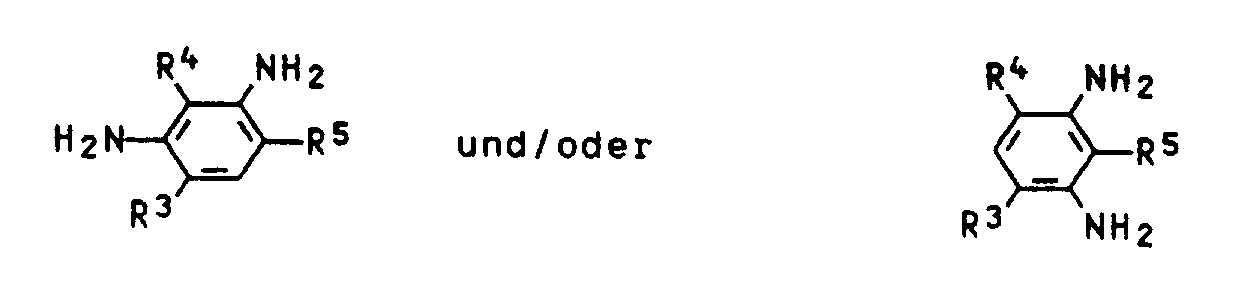
Als alkylsubstituierte m-Phenylendiamine kommen beispielsweise in Betracht: 2,4-Dimethyl-6-cyclohexyl-, 2-Cyclohexyl-4,6-diethyl-, 2-Cyclohexyl-2,6-isopropyl-, 2,4-Dimethyl-6-(1-ethyl-n-propyl)-, 2,4-Dimethyl-6-(1,1-dimethyl-n-propyl)-, 2-(1-Methyl-n-butyl)-4,6-dimethylphenylendiamin-1,3. Vorzugsweise verwendet werden 1-Methyl-3,5-diethyl-2,4- bzw. -2,6-phenylendiamine, 2,4-Dimethyl-6-tert.butyl-, 2,4-Dimethyl-6-isooctyl-und 2,4-Dimethyl-6-cyclohexyl-m-phenylendiamin-1,3.
Geeignete 3,3'-di- und 3,3',5,5'-tetra-n-alkylsubstituierte 4,4'-Diamino-diphenylmethane sind beispielsweise 3,3'-Di-,3,3',5,5'-Tetramethyl-, 3,3'-Di-, 3,3',5,5'-Tetraethyl-, 3,3'-Di- und 3,3',5,5'-Tetra-n-propyl-4,4'-diaminodiphenylmethan.
Vorzugsweise verwendet werden Diamino-diphenylmethane der Formel

Vorzugsweise verwendet werden 3,5-Dimethyl-3',5'-diisopropyl- und 3,3',5,5'-Tetraisopropyl-4,4'-diamino-diphenylmethan. Die Diamino-diphenylmethane können einzeln oder in Form von Mischungen eingesetzt werden.
Die genannten Kettenverlängerungsmittel und/oder Vernetzungsmittel (c) können einzeln oder als Mischungen von gleichen oder verschiedenen Arten verwendet werden.
Sofern Kettenverlängerungsmittel, Vernetzungsmittel oder Mischungen davon Anwendung finden, kommen diese zweckmäßigerweise in Mengen von 2 bis 60 Gew.%, vorzugsweise 8 bis 50 Gew.% und insbesondere 10 bis 40 Gew.%, bezogen auf das Gewicht der Komponenten (b) und (c) zum Einsatz. - d) Als Katalysatoren (d) werden insbesondere Verbindungen verwendet, die die Reaktion der Hydroxylgruppen enthaltenden Verbindungen der Komponenten (b) und (c) mit den Polyisocyanaten stark beschleunigen. In Betracht kommen organische Metallverbindungen, vorzugsweise organische Zinnverbindungen, wie Zinn-(II)-salze von organischen Carbonsäuren, z.B. Zinn-(II)-acetat, Zinn-(II)-octoat, Zinn-(II)-ethylhexoat und Zinn-(II)-laurat und die Dialkylzinn-(IV)-salze von organischen Carbonsäuren, z.B. Dibutyl-zinndiacetat, Dibutylzinndilaurat, Dibutylzinn-maleat und Dioctylzinn-diacetat. Die organischen Metallverbindungen werden allein oder vorzugsweise in Kombination mit stark basischen Aminen eingesetzt. Genannt seien beispielsweise Amidine, wie 2,3-Dimethyl-3,4,5,6-tetrahydropyrimidin, tertiäre Amine, wie Triethylamin, Tributylamin, Dimethylbenzylamin, N-Methyl-, N-Ethyl-, N-Cyclohexylmorpholin, N,N,N',N'-Tetramethyl-ethylendiamin, N,N,N',N'-Tetramethyl-butandiamin, Pentamethyl-diethylentriamin, Tetramethyl-diaminoethylether, Bis-(dimethylaminopropyl)-harnstoff, Dimethylpiperazin, 1,2-Dimethylimidazol, 1-Aza-bicyclo-(3,3,0)-octan und vorzugsweise 1,4-Diaza-bicyclo-(2,2,2)-octan und Alkanolaminverbindungen, wie Triethanolamin, Triisopropanolamin, N-Methyl- und N-Ethyl-diethanolamin und Dimethylethanolamin.
Als Katalysatoren kommen ferner in Betracht: Tris-(dialkylaminoalkyl)-s-hexahydrotriazine, insbesondere Tris-(N,N-dimethylaminopropyl)-s-hexahydrotriazin, Tetraalkylammoniumhydroxide, wie Tetramethylammoniumhydroxid, Alkalihydroxide, wie Natriumhydroxid und Alkalialkoholate, wie Natriummethylat und Kaliumisopropylat sowie Alkalisalze von langkettigen Fettsäuren mit 10 bis 20 C-Atomen und gegebenenfalls seitenständigen OH-Gruppen. Vorzugsweise verwendet werden 0,001 bis 5 Gew.%, insbesondere 0,05 bis 2 Gew.% Katalysator bzw. Katalysatorkombination bezogen auf das Gewicht der Komponente (b). - e) Erfindungsgemäß werden zur Herstellung der Polyisocyanat-Polyadditionsprodukte als Hilfsmittel und/oder Zusatzstoffe die neuen Copolymerisate nach einem der Ansprüche 1 bis 5 verwendet. Hierbei werden je nach Art des Verwendungszwecks und nach der Struktur des Copolymerisats, beispielsweise werden Copolymerisate mit einpolymerisierten Polyesteralkoholaddukten bevorzugt in Verbindung mit Polyester-polyolen und Copolymerisate mit einpolymerisierten Polyoxyalkylenalkoholaddukten bevorzugt in Verbindung mit Polyether-polyolen angewandt, in unterschiedlichen Mengen eingesetzt. Werden die Copolymerisate als Dispergier- und/oder Emulgierhilfsmittel verwendet, so sind üblicherweise 0,01 bis 5 Gew.%, vorzugsweise 0,1 bis 2 Gew.%, bezogen auf das Gewicht der höhermolekularen Verbindungen mit mindestens 2 reaktiven Wasserstoffatomen (b) ausreichend. Werden die erfindungsgemäßen Copolymerisate in Kombination mit anderen oberflächenaktiven Verbindungen verwendet, die ebenfalls einen Dispergier- und/oder Emulgiereffekt zeigen, so werden die genauen Mengen zweckmäßigerweise durch einfache Versuche ermittelt. Zur Verbesserung der mechanischen Eigenschaften der hergestellten Polyisocyanat-Polyadditionsprodukte werden üblicherweise 3 bis 15 Gew.% und insbesondere 4 bis 10 Gew.% Copolymerisat, bezogen auf das Gewicht der höhermolekularen Verbindung (b) eingesetzt. Zur Verhinderung oder Minimierung des Schrumpfs bei der Herstellung von Formteilen finden zweckmäßigerweise 2 bis 15 Gew.%, vorzugsweise 3 bis 11 Gew.%, bezogen auf das Gewicht der höhermolekularen Verbindung (b) Anwendung.
Zusätzlich zu den erfindungsgemäß zur Verbesserung der Dispergier- und/oder Emulgierwirkung, Minimierung der Schrumpfung der Formteile und Erhöhung des mechanischen Eigenschaftsniveaus der hergestellten Polyisocyanat-Polyadditionsprodukte eingesetzten Copolymerisaten können der Reaktionsmischung gegebenenfalls auch noch andere Hilfsmittel und/oder Zusatzstoffe (e) einverleibt werden. Genannt seien beispielsweise oberflächenaktive Substanzen, Füllstoffe, Flammschutzmittel, Farbstoffe, Pigmente, Trennmittel, Hydrolyseschutzmittel, fungistatisch und bakteriostatisch wirkende Substanzen.
Als oberflächenaktive Substanzen seien beispielsweise genannt: Natriumsalze von Ricinusölsulfaten oder von Fettsäuren sowie Salze von Fettsäuren mit Aminen, z.B. ölsaures Diethylamin, stearinsaures Diethanolamin, ricinolsaures Diethanolamin, Salze von Sulfonsäuren, z.B. Alkali- oder Ammoniumsalze von Dodecylbenzol- oder Dinaphthylmethandisulfonsäure und Ricinolsäure; Schaumstabilisatoren, wie Siloxan-Oxalkylen-Mischpolymerisate und andere Organopolysiloxane, oxethylierte Alkylphenole, oxethylierte Fettalkohole, Paraffinöle, Ricinusöl- bzw. Ricinolsäureester, Türkischrotöl und Erdnußöl und Zellregler, wie Paraffine, Fettalkohole und Dimethylpolysiloxane. Die oberflächenaktiven Substanzen werden üblicherweise in Mengen von 0,01 bis 5 Gew.-Teilen, bezogen auf 100 Gew.-Teile der Komponente (b), angewandt.
Als Füllstoffe, insbesondere verstärkend wirkende Füllstoffe, sind die an sich bekannten üblichen organischen und anorganischen Füllstoffe, Verstärkungsmittel, Beschwerungsmittel, Mittel zur Verbesserung des Abriebverhaltens in Anstrichfarben, Beschichtungsmittel usw. zu verstehen. Im einzelnen seien beispielhaft genannt: anorganische Füllstoffe wie silikatische Mineralien, beispielsweise Schichtsilikate, wie Antigorit, Serpentin, Hornblenden, Amphibole, Chrisotil, Talkum; Metalloxide, wie Kaolin, Aluminiumoxide, Titanoxide und Eisenoxide, Metallsalze wie Kreide, Schwerspat und anorganische Pigmente, wie Cadmiumsulfid und Zinksulfid sowie Glaskugel und Kurzglasfasern. Vorzugsweise verwendet werden Kaolin (China Clay), Aluminiumsilikat und Copräzipitate aus Bariumsulfat und Aluminiumsilikat sowie natürliche und synthetische faserförmige Mineralien wie Wollastonit. Als organische Füllstoffe kommen beispielsweise in Betracht: Kohle, z.B. Ruß, Melamin, Kollophonium, Cyclopentadienylharze, Melamin-Formaldehyd und Harnstoff-Formaladehyd-Kondensate.
Die anorganischen und organischen Füllstoffe, die einzeln oder als Gemische verwendet werden können, werden der Reaktionsmischung vorteilhafterweise in Mengen von 0,5 bis 50 Gew.%, vorzugsweise 1 bis 40 Gew.%, bezogen auf das Gewicht der Komponenten a) bis c), einverleibt.
Geeignete Flammschutzmittel sind beispielsweise Trikresylphosphat, Tris-(2-chlorethyl)phosphat, Tris-(2-chlorpropyl)phosphat und Tris-(2,3-dibrompropyl)phosphat und Tetrakis(2-chlorethyl)ethylendiphosphat.
Außer den bereits genannten halogensubstituierten Phosphaten können auch anorganische Flammschutzmittel, wie Antimontrioxid, Arsenoxid, Ammoniumphoshat, Ammoniumsulfat, Aluminiumoxidhydrat und roter Phosphor sowie Isocyanursäurederivate, wie Melamin, Dicyan-diamid und Guanidinsalze, z.B. Guanidincarbonat, zum Flammfestmachen der Polyisocyanat-Polyadditionsprodukte verwendet werden. Im allgemeinen hat es sich als vorteilhaft erwiesen, 5 bis 50 Gew.-Teile, vorzugsweise 5 bis 25 Gew.-Teile der genannten Flammschutzmittel für jeweils 100 Gew.-Teile der Mischung aus den Aufbau-Komponenten (a) bis (c) zu verwenden.
Als geeignete Trennmittel, vorzugsweise innere Trennmittel, die in Mengen von 0,05 bis 2 Gew.%, bezogen auf die Komponente (b) eingesetzt werden, seien beispielsweise genannt: Stearylstearat, Carbonsäureester und/oder Carbonsäureamide, hergestellt durch Veresterung oder Amidierung einer Mischung aus Montansäure und mindestens einer aliphatischen Carbonsäure mit mindestens 10 Kohlenstoffatomen mit mindestens difunktionellen Alkanolaminen, Polyolen und/oder Polyaminen mit Molekulargewichten von 60 bis 400, gemäß EP-A-153 639 oder Stearaten von Alkali-, Erdalkali- oder anderen Metallen, wie sie beispielsweise in US-A-4 519 965, EP-A-218 175, EP-A-240 715 oder DE-A-36 31 842 beschrieben werden.
Nähere Angaben über die obengenannten anderen üblichen Hilfs- und Zusatzstoffe sind der Fachliteratur, beispielsweise der Monographie von J.H. Saunders und K.C. Frisch "High Polymers" Band XVI, Polyurethanes, Teil 1 und 2, Verlag Interscience Publishers 1962 bzw. 1964, oder dem Kunststoff-Handbuch, Band VII, Polyurethane 1. und 2. Auflage, Carl-Hanser-Verlag, München 1966 und 1983, zu entnehmen. - f) Als Treibmittel zur Herstellung der zelligen Polyisocyanat-Polyadditionsprodukte, vorzugsweise der Schaumstoffe und zelligen Elastomeren, werden niedrig-siedende, in der Komponente (b) lösliche oder emulgierbare Flüssigkeiten verwendet, die unter dem Einfluß der exothermen Polyadditionsreaktion verdampfen. Geeignet sind Flüssigkeiten, welche gegenüber dem organischen Polyisocyanat inert sind und Siedepunkte unter 100°C aufweisen. Beispiele derartiger, vorzugsweise verwendeter Flüssigkeiten sind halogenierte Kohlenwasserstoffe, wie Methylenchlorid, Trichlorfluormethan, Dichlordifluormethan, Dichlormonofluormethan, Dichlortetrafluorethan und 1,1,2-Trichlor-1,2,2-trifluorethan. Auch Gemische dieser niedrig-siedenden Flüssigkeiten untereinander und/oder mit anderen substituierten oder unsubstituierten Kohlenwasserstoffen können verwendet werden.
Als Treibmittel eignet sich auch Wasser, das mit den Polyisocyanaten unter Bildung von Kohlendioxid und Polyharnstoffgruppen reagiert und dadurch die Druckfestigkeit der Endprodukte beeinflußt. Da die in den Polyester- und Polyether-polyolen als Nebenprodukt enthaltene Wassermenge meist ausreicht, bedarf es vielfach keiner separaten Wasserzugabe. Sofern jedoch der Polyurethan-Formulierung zusätzlich Wasser einverleibt werden muß, wird dieses üblicherweise in Mengen von 0,05 bis 4 Gew.%, vorzugsweise von 0,5 bis 3,0 Gew.%, bezogen auf das Gewicht der Aufbaukomponente b) verwendet.
Die zweckmäßigste Menge an niedrigsiedender Flüssigkeit zur Herstellung der zelligen Polyisocyanat-Polyadditionsprodukte hängt ab von der Dichte, die man erreichen will und der gegebenenfalls eingesetzten Wassermenge. Im allgemeinen liefern Mengen von 1 bis 15 Gew.-Teilen; vorzugsweise von 2 bis 6 Gew.-Teilen, bezogen auf 100 Gew.-Teile der Komponente (b) zufriedenstellende Ergebnisse. - Zur Herstellung der urethangruppenhaltigen Schaumstoffe und der urethan- und/oder harnstoffgruppenhaltigen, kompakten oder zelligen Elastomeren werden die organischen und/oder modifizierten organischen Polyisocyanate (a) mit den höhermolekularen Verbindungen mit mindestens 2 reaktiven Wasserstoffatomen (b) und vorzugsweise Kettenverlängerungs- und/oder Vernetzungsmittel (c) in solchen Mengen zur Umsetzung gebracht, daß das Verhältnis von reaktiven Wasserstoffatomen zu NCO-Gruppen 1:0,8 bis 2,5, vorzugsweise 1:0,9 bis 1,2 und insbesondere ungefähr 1:1 beträgt.
- Zur Herstellung von Urethan- und Isocyanuratgruppen enthaltenden Schaumstoffe werden die Aufbaukomponenten (a), (b) und gegebenenfalls (c) in solchen Mengen eingesetzt, daß das Verhältnis von NCO-Gruppen zu reaktiven Wasserstoffatomen von 3 bis 60:1, vorzugsweise 3 bis 10:1 beträgt.
- Die Urethangruppen oder Urethan- und Isocyanuratgruppen enthaltende Schaumstoffe und urethan- und/oder harnstoffgruppenhaltigen kompakten oder zelligen Elastomeren können in an sich bekannter Weise nach dem Prepolymer-, Semiprepolymer- oder one shot-Verfahren hergestellt werden. Hierzu mischt man die Aufbaukomponenten (a) (b), (d) und (e) und gegebenenfalls (c) und/oder (f) intensiv in den genannten Mengenverhältnissen bei Temperaturen von 0 bis 60°C, vorzugsweise 15 bis 40°C und läßt danach die Reaktionsmischung im offenen oder nach dem Befüllen geschlossenen Formwerkzeugen aufschäumen. Bei Verwendung einer Mischvorrichtung mit mehreren Zulaufdüsen können die Aufbaukomponenten als Einzelstoffe zugeführt und in der Mischkammer intensiv vermischt werden. Als besonders zweckmäßig hat es sich jedoch erwiesen, nach dem sogenannten Zwei-komponenten-Verfahren zu arbeiten und die höhermolekularen Verbindungen mit mindestens 2 reaktiven Wasserstoffatomen (b), Katalysatoren (d), Hilfsmittel und/oder Zusatzstoffe (e) und gegebenenfalls Kettenverlängerungs- und/oder Vernetzungsmittel (c) und/oder Treibmittel (f) zu der Komponente A zu vereinigen und als Komponente B die organischen und/oder modifizierten organischen Polyisocyanate zu verwenden. Vorteilhaft ist hierbei, daß nur zwei Komponenten gelagert und vor der Verarbeitung gemischt werden müssen.
- Die nach dem beschriebenen Verfahren hergestellten Schaumstoffe besitzen bei freier Aufschäumung Dichten von 0,015 bis 0,5 g/m³, vorzugsweise von 0,025 bis 0,3 g/m³. Die Schaumstoffe finden beispielsweise Verwendung als Sitzkissen für Möbel oder Verkehrsmittel, Matratzen, Sprungmatten zur Auskleidung oder Beschichtung von Formteilen sowie für Isolierzwecke.
- Die gegebenenfalls verdichteten zelligen Elastomeren besitzen Dichten von 0,15 bis 1,1 g/m³, vorzugsweise von 0,3 bis 0,8 g/m³ und finden z.B. Verwendung als Kopfstützen, Armlehnen, Lenkräder in Verkehrsmitteln sowie als Computergehäuse und Fensterrahmen.
- Die kompakten Elastomeren weisen Dichten von 0,9 bis 1,4 g/m³, vorzugsweise von 1,0 bis 1,2 g/m³ auf und eignen sich z.B. als Rammschutzleisten, Kotflügel, Radkappen und Spoiler für Automobile.
- Die in den Beispielen beschriebenen Copolymerisate wurden in einer üblichen, für Reaktionen unter Druck oder vermindertem Druck geeigneten Polymerisationsapparatur, ausgestattet mit Rührer, Rückflußkühler, Inertgasanschluß, Zulaufgefäßen, Kontrollthermometer und einer Vorrichtung zur Beheizung oder Kühlung, hergestellt.
- Die Bestimmung des K-Werts erfolgte nach DIN 53726 in 0,5 gew.%iger Lösung in Isopropanol bei 25°C.
- In den Beispielen wurden als olefinisch ungesättigte Polyesteralkohol- und Polyoxyalkylenalkoholaddukte die folgenden Monomeren verwendet:
- A1:
-

Handelsprodukt Tone® TM-100 Acrylat der Firma Union Carbide Corp. - A2:
-

- A3:
-

- A4:
-
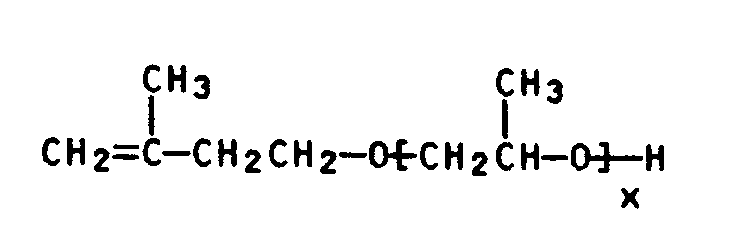
- A5:
-

- A6:
-

- Zu einer unter schwachem Rückfluß siedenden Mischung aus
150 g A3,
30 g Isopropanol,
55 g eines Gemisches I, bestehend aus
200 g N-Vinyl-pyrrolidon,
100 g Vinylacetat,
50 g Glycidylmethacrylat und
250 g Isopropanol und
5 g eines Gemisches 11, bestehend aus
5 g tert.-Butyl-per-2-ethyl-hexanoat und
32 g Isopropanol
fügte man im Verlauf von 3 Stunden gleichzeitig unter Rühren die restlichen 545 g des Gemisches I und 32 g des Gemisches II. Anschließend wurde 3 Stunden unter Rückflußtemperatur weitergerührt und danach der Reaktionsmischung innerhalb eines Zeitraums von einer Stunde
20 g einer Lösung aus
5 g tert.-Butyl-per-2-ethylhexanoat und
15 g Isopropanol einverleibt. - Man erhielt ein Copolymerisat C1 mit einem K-Wert von 17.
- Man verfuhr analog den Angaben des Beispiels 1, verwendete jedoch anstelle von A3 150 g A2 und anstelle des Gemisches I ein Gemisch, bestehend aus 300 g N-Vinyl-pyrrolidon, 50 g Glycidylmethacrylat und 250 g Isopropanol.
- Man erhielt ein Copolymerisat C2 mit einem K-Wert von 23.
- Man verfuhr analog den Angaben des Beispiels 1, verwendete jedoch anstelle von A3 100 g A1.
- Man erhielt ein Copolymerisat C3 mit einem K-Wert von 20.
- Eine Mischung aus
180 g A3,
20 g eines Gemisches I, bestehend aus
100 g N-Vinyl-pyrrolidon
40 g Glycidylmethacrylat und
200 g Isopropanol, und
6 g eines Gemisches 11, bestehend aus
6 g tert.-Butyl-per-2-ethyl-hexanoat und
80 g Isopropanol
wurden unter Rühren auf eine Temperatur erwärmt, bei welcher schwacher Rückfluß eintrat. - Im Verlauf von 2,5 Stunden wurden der Mischung gleichzeitig unter Rühren die restlichen 320 g des Gemisches I und 80 g des Gemisches II hinzugefügt und noch 1 Stunde unter schwacher Rückflußtemperatur weiterpolymerisiert.
- Anschließend wurden innerhalb von 30 Minuten
36 g einer Mischung aus
6 g tert.-Butyl-per-2-ethylhexanoat und
30 g Isopropanol
der Reaktionsmischung einverleibt und die Polymerisation in einer Stunde zu Ende geführt. - Man erhielt ein Copolymerisat C4 mit einem K-Wert von 12.
- Zu der gemäß Beispiel 4 hergestellten Lösung des Copolymerisats C4 in Isopropanol fügte man 332 g Ethylenglykol und trennte das Isopropanol durch fraktionierte Destillation unter vermindertem Druck ab. Die erhaltene Dispersion wurde mit Ethylenglykol auf einen Copolymerisat C4-Gehalt von 50 Gew.% eingestellt.
- Zur Herstellung homogener Mischungen und zur Bestimmung ihrei Stabilität wurden einer Mischung aus einem Polyoxipropylen(80 Gew.%)-polyoxiethylen-(20 Gew.%)-triol mit einer Hydroxylzahl von 26, hergestellt durch Polyaddition von 1,2-Propylenoxid an Trimethylolpropan und anschließender Polyaddition von Ethylenoxid an das erhaltene Trimethylolpropan-polyoxipropylenaddukt - im folgenden abgekürzt Lu 2042 genannt - und Ethylenglykol unterschiedliche Mengen der oben beschriebenen Copolymerisat C4/Ethylenglykol-Dispersion - abgekürzt C4-Et-D. genannt - einverleibt. Ermittelt wurde die Homogenität nach 6 Wochen Lagerzeit.
Beispiel Lu 2042 Gew.-Teile Ethylenglykol Gew.-Teile Mischung Gew.- Teile C4-Et-D Gew.-Teile Homogenität 5 70 30 100 0 inhomogen Ausbildung zweier Phasen 6 70 30 95 5 homogene, stabile Lösung 7 70 30 99 1 homogene, stabile Lösung - 99,5 Gew.-Teilen eines Gemisches, bestehend aus
27,9 Gew.-Teilen eines Polyoxipropylen(86 Gew.%)-polyoxiethylen(14 Gew.%)-triols mit einer Hydroxylzahl von 28, hergestellt durch Polyaddition von 1,2-Propylenoxid an Glycerin und anschließender Polyaddition von Ethylenoxid an das erhaltene Glycerin-polyoxipropylenaddukt,
27,9 Gew.-Teilen eines Polyoxipropylen(87 Gew.%)-polyoxiethylen(13 Gew.%)-triols mit einer Hydroxylzahl von 35, hergestellt durch Polyaddition von 1,2-Propylenoxid an Trimethylolpropan und anschließender Polyaddition von Ethylenoxid an das erhaltene Trimethylolpropan-polyoxipropylenaddukt und
6,3 Gew.-Teilen Ethylenglykol,
wurden
0,5 Gew.-Teile der C4-Et-D einverleibt. - Die Mischung war nach 6 Wochen noch homogen und zeigte keinerlei Anzeichen einer Phasentrennung.
- 99,5 Gew.-Teilen eines Gemisches, bestehend aus
87 Gew.-Teilen eines Polyoxipropylen(81,5 Gew.%)-polyoxiethylen(18,5 Gew.%)-triols mit der Hydroxyzahl von 29, hergestellt durch Polyaddition von 1,2-Propylenoxid an Glycerin und anschließende Polyaddition von Ethylenoxid an das erhaltene Glycerin-polyoxypropylenaddukt,
12,2 Gew.-Teilen eines Polyoxipropylen(80 Gew.%)-polyoxiethylen(20 Gew.%)triols mit der Hydroxyzahl von 26, hergestellt unter Verwendung von Trimethylolpropan als Startermolekül,
5,3 Gew.-Teilen eines Polyoxipropylen(86,5 Gew.%)-polyoxiethylen(13,5 Gew.%)-triols mit der Hydroxylzahl von 35, hergestellt unter Verwendung von Glycerin als Startermolekül und
8,1 Gew.-Teilen Butandiol-1,4
wurden
0,5 Gew.-Teile der C4-Et-D einverleibt. - Die erhaltene Mischung zeigte nach einer Lagerzeit von 6 Monaten keinerlei Phasentrennung.
- Eine Mischung aus
180 g A3 und
20 g einer Lösung I, bestehend aus
100 g N-Vinyl-pyrrolidon,
40 g Glycidylmethyacrylat und
160 g Isopropanol
wurde auf 110°C unter Rühren erwärmt. Der Mischung wurden
6 g einer Lösung II, bestehend aus
6 g tert.-Butylperoctoat und
64 g Isopropanol
einverleibt und die Reaktionsmischung 15 Minuten anpolymerisiert. - Nach dieser Zeit wurden im Verlauf von 2 Stunden der Mischung unter Rühren bei 110°C gleichzeitig die restlichen 380 g der Lösung I und 64 g der Lösung II einverleibt und weitere 2 Stunden polymerisiert.
- Nach Zugabe von
23 g einer Lösung III, bestehend aus
6 g tert.-Butylperoctoat und
40 g Isopropanol,
wurden unter den genannten Reaktionsbedingungen weitere 1,5 Stunden polymerisiert und nach dieser Zeit die restlichen 23 g der Lösung III der Reaktionsmischung einverleibt. - Nach einer Nachpolymerisationszeit von 2 Stunden ließ man die Copolymerisatlösung in ca. 12 Stunden auf Raumtemperatur abkühlen.
- Man erhielt ein Copolymerisat C5 mit einem K-Wert von 17,5.
- Man verfuhr analog den Angaben des Beispiels 10, verwendete jedoch anstelle der Lösung I eine Mischung aus
40 g N-Vinyl-pyrrolidon,
12 g N-Diacetonacrylamid,
10 g Glycidylmethacrylat und
160 g Isopropanol. - Man erhielt ein Copolymerisat C6 mit einem K-Wert von 15,0.
- Herstellung von Dispersionen der Copolymerisate C5 und C6 in einem mit Glycerin gestarteten Polyoxipropylen(86 Gew.%)-polyoxiethylen(14 Gew.%)-triols der Hydroxylzahl 28, abgekürzt Lu 2040 genannt.
- Zu den gemäß den Beispielen 10 und 11 hergestellten Copolymerisat-C5- und -C6-lösungen wurden die im folgenden genannten Mengen Lu 2040 hinzugefügt und anschließend das Isopropanol durch fraktionierte Destillation unter vermindertem Druck abdestilliert. Die erhaltenen Dispersionen wurden mit Lu 2040 auf einen Copolymerisatgehalt von 50 Gew.% eingestellt.
Lu 2040 [g] Copolymerisat C5-dispersion 298 Copolymerisat C6-dispersion 358 - Zu einer Mischung aus Lu 2040 und Melamin fügte man die obengenannten Copolymerisat C5- oder C6-Lu 2040-dispersion. Die verwendeten Mengen und die ermittelte Stabilität der erhaltenen Melamin/Lu 2040-Dispersionen nach einer 5-wöchigen Lagerung sind in der folgenden Tabelle zusammengefaßt.
Beispiel Lu 2040 Melamin* Copolymerisat/Lu 2040-dispersion Stabilität Gew.-Teile Gew.-Teile Art Gew.-Teile 12 (Vergleich) 52 48 - - entmischt 13 51 48 C5 1 stabil 14 51 48 C6 1 stabil * Melamin U 24 der BASF Aktiengesellschaft - Zu 720 g auf 100°C temperiertes A4 fügte man unter Rühren innerhalb eines Zeitraums von 5 Minuten gleichzeitig
65 g einer Mischung I, bestehend aus
400 g N-Vinyl-pyrrolidon,
160 g Glycidylmethylacrylat und
250 g Isopropanol
und
19 g einer Mischung 11, bestehend aus
24 g tert.-Butyl-per-2-ethylhexanoat und
320 g Isopropanol. - Die Reaktionsmischung wurde unter schwachem Rückfluß des Isopropanols 15 Minuten polymerisiert, danach wurden im Verlauf von 2 Stunden unter Rühren bei 95 bis 100°C gleichzeitig die restlichen 745 g der Mischung I und 325 g der Mischung II hinzugefügt und die Reaktionsmischung unter Rückflußkühlung 2 Stunden lang polymerisiert.
- Nach der Zugabe von 92 g einer Mischung III, bestehend aus
24 g tert.-Butyl-per-2-ethylhexanoat und
160 g Isopropanol
wurden unter den genannten Reaktionsbedingungen weitere 1,5 Stunden polymerisiert, anschließend die restlichen 92 g der Mischung III innerhalb von 5 Minuten der Reaktionsmischung einverleibt und nochmals 2 Stunden polymerisiert. - Man erhielt ein Copolymerisat C7 mit einem K-Wert von 23.
- Die gemäß Beispiel 15 hergestellte Copolymerisat-C7-Lösung wurde mit 1380 g Lu 2040 gemischt und anschließend das Isopropanol durch fraktionierte Destillation unter vermindertem Druck abdestilliert. Die erhaltene Dispersion besaß einen Copolymerisatgehalt von 50,3 Gew.%.
- Man verfuhr analog den Angaben des Beispiels 16, verwendete jedoch anstelle von Lu 2040 das Polyether-polyol Lu 2042. Die erhaltene Dispersion besaß einen Copolymerisatgehalt von 50 Gew.%.
- Mischung aus
79,0 Gew.-Teilen Lu 2040,
5,0 Gew.-Teilen eines Polyoxipropylen-tetrols mit einer Hvdroxylzahl von 768, hergestellt unter Verwendung von Ethylendiamin als Startermolekül,
2,0 Gew.-Teilen eines Polyoxipropylen(26 Gew.%)-polyoxiethylen(24 Gew.%)-triols mit einer Hydroxylzahl von 42, hergestellt unter Verwendung von Glycerin als Startermolekül,
10,0 Gew.-Teilen Emulgatordispersion hergestellt gemäß Beispiel 16,
0,5 Gew.-Teilen Triethanolamin,
2,5 Gew.-Teilen Wasser,
0,4 Gew.-Teilen eines Silikonöls (Tegostab® B 4690 der Firma Goldschmidt AG, Essen) und
0,6 Gew.-Teilen Kaliumacetat (40 gew.%ige Lösung in Ethylenglykol). - Mischung aus Diphenylmethan-diisocyanaten und Polyphenyl-polymethylenpolyisocyanaten mit einem NCO-Gehalt von 31 Gew.%
Zur Herstellung des Schaumstoffs wurden 100 Gew.-Teile der A-Komponente und 54,7 Gew.-Teile der B-Komponente bei 23°C intensiv gemischt und mit der fließfähigen Reaktionsmischung eine Polyvinylchlorid-Acrylnitril-Butadien-Styrol-Kautschukfolie in an sich bekannter Weise hinterschäumt. Der gebildete halbharte Polyurethanschaumstoff härtete schrumpffrei aus. - Man verfuhr analog den Angaben des Beispiels 15, verwendete jedoch anstelle der dort beschriebenen Mischung I eine solche, bestehend aus
200 g N-Vinyl-pyrrolidon,
160 g Glycidylmethacrylat,
200 g Styrol und
250 g Isopropanol. - Das erhaltene Copolymerisat C8 besaß einen K-Wert von 22.
- Die gemäß Beispiel 19 hergestellte Copolymerisat C8-Lösung wurde mit 1300 g Lu 2042 gemischt und anschließend das Isopropanol durch fraktionierte Destillation unter vermindertem Druck abdestilliert. Die erhaltene farblose Dispersion besaß einen Copolymerisatgehalt von 50,4 Gew.%.
- Man verfuhr analog den Angaben des Beispiels 15, verwendete jedoch anstelle der dort beschriebenen Mischung I eine solche, bestehend aus
300 g N-Vinyl-pyrrolidon,
160 g Glycidylmethacrylat,
100 g Styrol und
250 g Isopropanol
und anstelle der dort beschriebenen Mischung II eine solche, bestehend aus
24 g tert.-Butyl-per-2-ethylhexanoat und
350 g Isopropanol. - Man erhielt ein Copolymerisat C9 mit einem K-Wert von 18.
- Zu 720 g auf 100°C temperiertes A5 fügte man unter Rühren innerhalb eines Zeitraums von 5 Minuten gleichzeitig
65 g einer Mischung I, bestehend aus
400 g N-Vinyl-pyrrolidon
160 g Glycidylmethacrylat und
250 g Isopropanol
und
19 g einer Mischung II, bestehend aus
24 g tert. Butyl-per-2-ethylhexanoat und
320 g Isopropanol. - Die Reaktionsmischung wurde unter schwachem Rückfluß des Isopropanols 15 Minuten polymerisiert, danach wurden im Verlauf von 2 Stunden unter Rühren bei 95 bis 100°C gleichzeitig die restlichen 745 g der Mischung I und 325 g der Mischung II hinzugefügt und die Reaktionsmischung unter Rückflußkühlung 2 Stunden lang polymerisiert. Nach der Zugabe von
92 g einer Mischung III, bestehend aus
24 g tert. Butyl-per-2-ethylhexanoat und
160 g Isopropanol
wurden unter den genannten Reaktionsbedingungen weitere 1,5 Stunden polymerisiert, anschließend die restlichen 92 g der Mischung III innerhalb von 5 Minuten der Reaktionsmischung einverleibt und nochmals 2 Stunden polymerisiert. - Man erhielt im Copolymerisat C10 mit einem K-Wert von 30.
- Man verfuhr analog den Angaben des Beispiels 22, verwendete jedoch anstelle von A5 das ungesättigte Monomere A6.
- Man erhielt ein Copolymerisat C11 mit einem K-Wert von 24.
- Mischung aus:
71,50 Gew.-Teilen eines Polyoxipropylen(80 Gew.%)-polyoxiethylen(20 Gew.%)-triols mit einer Hydroxylzahl von 26, hergestellt durch Addition von 1,2-Propylenoxid an Trimethylolpropan und anschließender Polyaddition von Ethylenoxid an das erhaltene Trimethylolpropan-polyoxipropylenaddukt,
20,00 Gew.-Teilen 3,5-Diethyl-toluylen-diamin-2,4,
1,25 Gew.-Teilen 1,4-Diazabicyclo-(2,2,2)octan, gelöst 33 gew.%ig in Dipropylenglykol,
0,25 Gew.-Teilen Dibutylzinndilaurat
5 Gew.-Teilen eines inneren Formtrennmittels, hergestellt analog den Angaben der DE-A-26 31 842 und bestehend aus 31 Gew.-Teilen eines Ketimins auf der Grundlage eines Polyoxialkylenpolyamins (®Jeffamine D230), Cyclohexanon und Methylisobutylketon,
8,0 Gew.-Teilen Ölsäure und
61,0 Gew.-Teilen Zinkstearat und
3 Gew.-Teilen Emulgatordispersion gemäß Beispiel 17 - Mischung aus mit Polyoxipropylen-glykol modifiziertem 4,4'-Diphenylmethan-diisocyanat mit einem NCO-Gehalt von 23 Gew.%.
- Die Komponenten (A) und (B) wurden auf 50°C erwärmt, im Verhältnis (A):(B) gleich 100:57 Gew.-Teilen nach den Reaktionsspritzguß-Verfahren auf einer Hochdruckdosieranlage vom Typ ®Puromat 30 der Elastogran-Maschinenbau gemischt und in einem auf 65°C temperierten Aluminiumformwerkzeug mit der Raumform einer Automobiltürseitenverkleidung und einer Innendimension von ungefähr 2 x 1000 x 10 mm zu einem Formteil verarbeitet.
- Das erhaltene Formteil besaß eine um ca. 0,4 % geringere Schwindung im Vergleich zu einem Formteil, hergestellt aus denselben Aufbaukomponenten, jedoch ohne Mitverwendung der Emulgatordispersion gemäß Beispiel 17.
Claims (9)
- Copolymerisate mit einem K-Wert von 5 bis 80, gemessen als 0,5 gew.%ige Lösung in Isopropanol bei 25°C, hergestellt in Gegenwart von Polymerisationsinitiatoren durch radikalische Polymerisation vonA) 20 bis 80 Gew.%, bezogen auf das Gesamtgewicht der Monomeren (A) und (B), mindestens eines olefinisch ungesättigten Polyoxyalkylenalkohol- oder Polyesteralkoholaddukts,B) 80 bis 20 Gew.%, bezogen auf das Gesamtgewicht der Monomeren (A) und (B), mindestens eines Vinylmonomeren ausgewählt aus der Gruppe N-Vinyl-formamid, N-Vinyl-2-pyrrolidon, N-Vinyl-2-piperidon,, N-Vinyl-2-caprolactam, N-Vinyl-imidazol, N-Vinyl-2-ethylenharnstoff und N-Vinyl-2-propylenharnstoff,C) 0,05 bis 40 Gew.-Teilen, bezogen auf 100 Gew.-Teile der Monomeren (A) und (B), Glycidylacrylat, Glycidylmethacrylat oder Mischungen davon,D) 0 bis 10 Gew.-Teilen, bezogen auf 100 Gew.-Teile der Monomeren (A) und (B), mindestens einer α,β-monoolefinisch ungesättigten Säure undE) 0 bis 30 Gew.-Teilen, bezogen auf 100 Gew.-Teile der Monomeren (A) und (B), mindestens eines olefinisch ungesättigten Carbonsäureamids und/oder -esters und/oder Styrol.
- Copolymerisate nach Anspruch 1, dadurch gekennzeichnet, daß die olefinisch ungesättigten Polyoxyalkylenalkohol- oder Polyesteralkoholaddukte (A) eine der Formeln (I) bis (VIII) aufweisen:

 R¹ und R² jeweils ein Wasserstoffatom oder eine lineare oder verzweigte Alkylgruppe mit 1 bis 4 Kohlenstoffatomen, wobei die Reste R¹ und R² gleich oder verschieden sind,R gleiche oder verschiedene Brückenglieder der Formeln
-CH₂CH₂- , -CH₂-CH(CH₃)- ,
oder -CO-(CH₂)m-O-, wobei m eine ganze Zahl von 1 bis 10 ist,Z ein Wasserstoffatom, einen linearen oder verzweigten Alkylrest mit 1 bis 24 Kohlenstoffatomen, einen linearen oder verzweigten fluorsubstituierten Alkylrest mit 1 bis 24 Kohlenstoffatomen einen Arylrest oder einen alkylsubstituierten Arylrest,n eine ganze Zahl von 2 bis 200 undp eine ganze Zahl von 1 bis 18. - Copolymerisate nach Anspruch 1, dadurch gekennzeichnet, daß die α,β-monoolefinisch ungesättigte Säure (D) ausgewählt ist aus der Gruppe Acrylsäure, Methacrylsäure, Maleinsäure, Fumarsäure, Itaconsäure, Vinylsulfonsäure und Vinylphosphonsäure.
- Copolymerisate nach Anspruch 1, dadurch gekennzeichnet, daß die olefinisch ungesättigten Carbonsäureamide oder -ester (E) ausgewählt sind aus der Gruppe der N,N-Dialkylacrylamide, N,N-Dialkylmethacrylamide, N-Alkylacrylamide, N-Alkylmethacrylamide mit 1 bis 12 Kohlenstoffatomen im Alkylrest, Acrylamid, Methacrylamid, Vinylcarbonsäureester mit 1 bis 20 Kohlenstoffatomen im Alkanoylrest, Alkylacrylate, Alkylmethacrylate, Hydroxyalkylacrylate und Hydroxyalkylmethacrylate mit 1 bis 24 Kohlenstoffatomen im Alkylrest oder 2 bis 10 Kohlenstoffatomen in der Hydroxyalkylgruppe.
- Copolymerisate nach einem der Ansprüche 1 bis 4, hergestellt durch radikalische Polymerisation vonA) 20 bis 80 Gew.%, bezogen auf das Gesamtgewicht der Monomeren (A) und (B), mindestens eines olefinisch ungesättigten Polyoxyalkylenalkohol- oder Polyesteralkoholaddukts,B) 80 bis 20 Gew.%, bezogen auf das Gesamtgewicht der Monomeren (A) und (B), mindestens eines Vinylmonomeren ausgewählt aus der Gruppe N-Vinyl-formamid, N-Vinyl-2-pyrrolidon, N-Vinyl-2-piperidon,, N-Vinyl-2-caprolactam, N-Vinyl-imidazol, N-Vinyl-2-ethylenharnstoff und N-Vinyl-2-propylenharnstoff,C) 0,05 bis 40 Gew.-Teilen, bezogen auf 100 Gew.-Teile der Monomeren (A) und (B), Glycidylacrylat und/oder Glycidylmethacrylat,D) 0,1 bis 10 Gew.-Teilen, bezogen auf 100 Gew.-Teile der Monomeren (A) und (B), einer olefinisch ungesättigten Säure, ausgewählt aus der Gruppe Acrylsäure, Methacrylsäure, Maleinsäure, Fumarsäure, Itaconsäure, Vinylsulfonsäure und Vinylphosphonsäure undE) 0 bis 30 Gew.-Teilen, bezogen auf 100 Gew.-Teile der Monomeren (A) und (B), mindestens eines olefinisch ungesättigten Carbonsäureamids und/oder -esters und/oder Styrol.
- Verwendung der Copolymerisate nach einem der Ansprüche 1 bis 5 als Dispergierhilfsmittel und/oder Emulgierhilfsmittel in Formulierungen oder deren Teilmischungen zur Herstellung von Polyisocyanat-Polyadditionsprodukten und/oder als Additiv zur Verbesserung der mechanischen Eigenschaften von aus diesen Formulierungen hergestellten Polyisocyanat-Polyadditionsprodukten.
- Verwendung der Copolymerisate nach einem der Ansprüche 1 bis 5 als Additiv in Formulierungen zur Herstellung von praktisch schrumpffreien Formteilen auf der Grundlage von Urethangruppen oder Urethan- und Harnstoffgruppen enthaltenden Elastomeren oder Schaumstoffen.
- Verwendung der Copolymerisate nach einem der Ansprüche 1 bis 5 als Dispergierhilfsmittel zur Herstellung lagerstabiler Dispersionen aus mindestens einem pulverigen Feststoff, vorzugsweise Melamin, und mindestens einem bei 25°C flüssigen Polyester- und/oder Polyether-polyol.
- Verfahren zur Herstellung von Polyisocyanat-Polyadditionsprodukten durch Umsetzung vona) organischen Polyisocyanaten und/oder modifizierten organischen Polyisocyanaten mitb) höhermolekularen Verbindungen mit mindestens 2 reaktiven Wasserstoffatomen und gegebenenfallsc) Kettenverlängerungsmitteln und/oder Vernetzungsmittelnin Gegenwart vond) Katalysatoren,e) Hilfsmitteln und/oder Zusatzstoffen sowie in Gegenwart oder Abwesenheit vonf) Treibmitteln,dadurch gekennzeichnet, daß man als Hilfsmittel und/oder Zusatzstoffe Copolymerisate nach einem der Ansprüche 1 bis 5 verwendet.
Priority Applications (1)
| Application Number | Priority Date | Filing Date | Title |
|---|---|---|---|
| AT89120526T ATE101627T1 (de) | 1988-11-09 | 1989-11-06 | Neue copolymerisate und ihre verwendung als hilfsmittel und/oder zusatzstoff in formulierungen zur herstellung von polyisocyanat- polyadditionsprodukten. |
Applications Claiming Priority (2)
| Application Number | Priority Date | Filing Date | Title |
|---|---|---|---|
| DE3838030A DE3838030A1 (de) | 1988-11-09 | 1988-11-09 | Neue copolymerisate und ihre verwendung als hilfsmittel und/oder zusatzstoff in formulierungen zur herstellung von polyisocyanat-polyadditionsprodukten |
| DE3838030 | 1988-11-09 |
Publications (3)
| Publication Number | Publication Date |
|---|---|
| EP0368218A2 EP0368218A2 (de) | 1990-05-16 |
| EP0368218A3 EP0368218A3 (en) | 1990-08-01 |
| EP0368218B1 true EP0368218B1 (de) | 1994-02-16 |
Family
ID=6366825
Family Applications (1)
| Application Number | Title | Priority Date | Filing Date |
|---|---|---|---|
| EP89120526A Expired - Lifetime EP0368218B1 (de) | 1988-11-09 | 1989-11-06 | Neue Copolymerisate und ihre Verwendung als Hilfsmittel und/oder Zusatzstoff in Formulierungen zur Herstellung von Polyisocyanat-Polyadditionsprodukten |
Country Status (6)
| Country | Link |
|---|---|
| US (1) | US5059632A (de) |
| EP (1) | EP0368218B1 (de) |
| AT (1) | ATE101627T1 (de) |
| CA (1) | CA2002400C (de) |
| DE (2) | DE3838030A1 (de) |
| ES (1) | ES2061887T3 (de) |
Families Citing this family (14)
| Publication number | Priority date | Publication date | Assignee | Title |
|---|---|---|---|---|
| DE3942330A1 (de) * | 1989-12-21 | 1991-06-27 | Basf Ag | Verfahren zur herstellung von flexiblen polyurethan-weichschaumstoffen mit viskoelastischen, koerperschalldaempfenden eigenschaften und hierzu verwendbare polyoxyalkylen-polyol-mischungen |
| GB9011992D0 (en) * | 1990-05-30 | 1990-07-18 | Ici Plc | Polyisocyanate composition |
| US5418016A (en) * | 1991-03-03 | 1995-05-23 | Air Products And Chemicals, Inc. | Coating process using radiation curable compositions |
| US5281682A (en) * | 1992-03-03 | 1994-01-25 | Air Products And Chemicals, Inc. | Radiation curable compositions and method of use |
| DE4227974C2 (de) * | 1992-08-26 | 1996-04-18 | Stockhausen Chem Fab Gmbh | Alkoxygruppenhaltige Copolymerisate, Verfahren zu ihrer Herstellung und ihre Verwendung zum Nachgerben von Leder |
| EP0611077A3 (de) * | 1993-02-08 | 1994-12-28 | Rohm & Haas | Polyurethanelastomergemische. |
| US6172164B1 (en) | 1999-04-01 | 2001-01-09 | Basf Corporation | Process for making graft polyols using t-amyl peroxy free radical initiator |
| DE19941031A1 (de) * | 1999-08-28 | 2001-03-01 | Byk Chemie Gmbh | Verzweigte, Imidazolgruppen enthaltende Polymere, sowie deren Herstellung und Verwendung |
| FR2807045B1 (fr) * | 2000-03-31 | 2004-02-27 | Atofina | Copolymeres acryliques hydrosolubles et leur utilisation comme fluidifiants ou dispersants |
| US8242224B2 (en) | 2007-08-15 | 2012-08-14 | Isp Investments Inc. | Polyvinylamide polymers containing polymerizable functionalities |
| AU2008286759B2 (en) * | 2007-08-15 | 2014-05-08 | Isp Investments Inc. | Polyvinylamide polymers containing polymerizable functionalities |
| US8980799B2 (en) * | 2010-09-16 | 2015-03-17 | Baker Hughes Incorporated | Polymer foam cell morphology control and use in borehole filtration devices |
| CN106471022B (zh) | 2014-07-09 | 2021-07-09 | 巴斯夫欧洲公司 | 作为生产聚合物的共聚单体的反应性单体 |
| CN111072917B (zh) | 2020-01-02 | 2021-06-29 | 万华化学集团股份有限公司 | 一种存储稳定的多异氰酸酯组合物及制备方法 |
Family Cites Families (3)
| Publication number | Priority date | Publication date | Assignee | Title |
|---|---|---|---|---|
| US4280979A (en) * | 1979-09-18 | 1981-07-28 | Union Carbide Corporation | Copolymers, compositions, and articles, and methods for making same |
| CS250939B1 (en) * | 1985-01-28 | 1987-05-14 | Slavko Hudecek | Terpolymeres with hydrogel character |
| US4990582A (en) * | 1986-07-18 | 1991-02-05 | Salamone Joseph C | Fluorine containing soft contact lens hydrogels |
-
1988
- 1988-11-09 DE DE3838030A patent/DE3838030A1/de not_active Withdrawn
-
1989
- 1989-11-01 US US07/430,607 patent/US5059632A/en not_active Expired - Fee Related
- 1989-11-06 EP EP89120526A patent/EP0368218B1/de not_active Expired - Lifetime
- 1989-11-06 DE DE89120526T patent/DE58906989D1/de not_active Expired - Lifetime
- 1989-11-06 ES ES89120526T patent/ES2061887T3/es not_active Expired - Lifetime
- 1989-11-06 AT AT89120526T patent/ATE101627T1/de not_active IP Right Cessation
- 1989-11-07 CA CA002002400A patent/CA2002400C/en not_active Expired - Fee Related
Also Published As
| Publication number | Publication date |
|---|---|
| CA2002400C (en) | 1999-04-27 |
| CA2002400A1 (en) | 1990-05-09 |
| ATE101627T1 (de) | 1994-03-15 |
| US5059632A (en) | 1991-10-22 |
| DE3838030A1 (de) | 1990-05-10 |
| EP0368218A3 (en) | 1990-08-01 |
| ES2061887T3 (es) | 1994-12-16 |
| EP0368218A2 (de) | 1990-05-16 |
| DE58906989D1 (de) | 1994-03-24 |
Similar Documents
| Publication | Publication Date | Title |
|---|---|---|
| EP0368217B1 (de) | Neue Copolymerisate und ihre Verwendung als Hilfsmittel und/oder Zusatzstoff in Formulierungen zur Herstellung von Polyisocyanat-Polyadditionsprodukten | |
| EP0368218B1 (de) | Neue Copolymerisate und ihre Verwendung als Hilfsmittel und/oder Zusatzstoff in Formulierungen zur Herstellung von Polyisocyanat-Polyadditionsprodukten | |
| EP0153639B1 (de) | Verfahren zur Herstellung von zelligen oder kompakten Polyurethan-Polyharnstoff-Formkörpern mit verbesserten Entformungseigenschaften sowie innere Formtrennmittel für das Polyisocyanat-Polyadditions-verfahren | |
| EP0351614B1 (de) | Verfahren zur Herstellung von zellhaltigen Kunststoffen nach dem Polyisocyanat-Polyadditionsverfahren mittels lagerstabiler, treibmittelhaltiger Emulsion und diese Emulsionen | |
| EP0008444B1 (de) | Verfahren zur Herstellung von modifizierten Polyätherpolyolen und deren Verwendung zur Herstellung von Polyurethankunststoffen | |
| EP0093335A1 (de) | Verfahren zur Herstellung von Formkörpern auf Basis von Polyurethan- oder Polyurethan-Polyharnstoff-Elastomeren mit verbesserter Licht- und Witterungsbeständigkeit | |
| EP0364854A2 (de) | Verfahren zur Herstellung von Formkörpern mit einer verdichteten Randzone und einem zelligen Kern, vorzugsweise Schuhsohlen | |
| DE3724716C1 (de) | Verfahren zur Herstellung von Polyurethan- und/oder Polyisocyanurat-Hartschaeumen | |
| EP0157119B1 (de) | Verfahren zur Herstellung von gegebenenfalls zelligen Polyurethan-Polyharnstoff-Formkörpern | |
| EP0944661B1 (de) | Innere formtrennmittel zur herstellung von selbsttrennenden formkörpern aus polyisocyanat-polyadditionsprodukten | |
| EP0496204A2 (de) | Verfahren zur Herstellung von zelligen Polyurethan-Elastomeren unter Verwendung von Polyethercarbonatdiolen als Ausgangskomponente | |
| DE2915610A1 (de) | Verfahren zur herstellung von modifizierten polyetherpolyolen und deren verwendung in verfahren zur herstellung von polyurethankunststoffen | |
| EP0069287A1 (de) | Verfahren zur Herstellung von gegebenenfalls zellhaltigen Polyurethan-Elastomeren | |
| EP3155030B1 (de) | Polyurethane mit reduzierter aldehydemission | |
| US3912672A (en) | Acrylate rubber vulcanizable compositions | |
| EP0093334B1 (de) | Verfahren zur Herstellung von gegebenenfalls zellhaltigen Formkörpern aus Polyharnstoff-Elastomeren | |
| EP0711799A2 (de) | Verfahren zur Herstellung von fluorchlorkohlenwasserstofffreien, Urethangruppen enthaltenden Formkörpern mit einem zelligen Kern und einer verdichteten Randzone | |
| EP0093336B1 (de) | Verfahren zur Herstellung von kompakten oder zellhaltigen Formkörpern aus Polyharnstoff-Polyurethan-Elastomeren | |
| EP0866817B1 (de) | Verfahren zur herstellung von selbsttrennenden, kompakten oder zelligen, gegebenenfalls verstärkungsmittel enthaltenden formkörpern aus polyisocyanat-polyadditionsprodukten und innere formtrennmittel hierfür | |
| EP0731118B1 (de) | Niedrigviskose Polymerpolyole, ein Verfahren zu ihrer Herstellung sowie ihre Verwendung zur Herstellung von Polyurethanschaumstoffen | |
| DE3347573A1 (de) | Verfahren zur herstellung von gegebenenfalls zellfoermigen formkoerpern | |
| EP0463479B1 (de) | Herstellung von zellhaltigen Kunststoffen nach dem Polyisocyanat-Polyadditionsverfahren unter Mitverwendung von tertiären Alkoholen | |
| DE3535711A1 (de) | Verfahren zur herstellung von zelligen oder kompakten polyurethan-polyharnstoff-formkoerpern mit verbesserten entformungseigenschaften sowie innere formtrennmittel und deren verwendung fuer das polyisocyanat-polyadditionsverfahren | |
| DE3436098A1 (de) | Verfahren zur herstellung von gegebenenfalls zelligen polyurethan-polyharnstoff-formkoerpern unter verwendung von urethan- und isocyanuratgruppen enthaltenden 2,4- und/oder 2,6-toluylen-diisocyanaten | |
| DE3824355A1 (de) | In gegenwart von fluoraliphatischen seitengruppen enthaltenden oligomeren hergestellte polyurethan-schaumstoffe, verfahren zu ihrer herstellung und die verwendung der fluoraliphatischen seitengruppen enthaltenden oligomeren als oberflaechenaktives hilfsmittel |
Legal Events
| Date | Code | Title | Description |
|---|---|---|---|
| PUAI | Public reference made under article 153(3) epc to a published international application that has entered the european phase |
Free format text: ORIGINAL CODE: 0009012 |
|
| AK | Designated contracting states |
Kind code of ref document: A2 Designated state(s): AT BE CH DE ES FR GB GR IT LI NL SE |
|
| PUAL | Search report despatched |
Free format text: ORIGINAL CODE: 0009013 |
|
| AK | Designated contracting states |
Kind code of ref document: A3 Designated state(s): AT BE CH DE ES FR GB GR IT LI NL SE |
|
| 17P | Request for examination filed |
Effective date: 19901213 |
|
| 17Q | First examination report despatched |
Effective date: 19920406 |
|
| GRAA | (expected) grant |
Free format text: ORIGINAL CODE: 0009210 |
|
| AK | Designated contracting states |
Kind code of ref document: B1 Designated state(s): AT BE CH DE ES FR GB GR IT LI NL SE |
|
| REF | Corresponds to: |
Ref document number: 101627 Country of ref document: AT Date of ref document: 19940315 Kind code of ref document: T |
|
| ITF | It: translation for a ep patent filed | ||
| REF | Corresponds to: |
Ref document number: 58906989 Country of ref document: DE Date of ref document: 19940324 |
|
| GBT | Gb: translation of ep patent filed (gb section 77(6)(a)/1977) |
Effective date: 19940328 |
|
| REG | Reference to a national code |
Ref country code: GR Ref legal event code: FG4A Free format text: 3011603 |
|
| ET | Fr: translation filed | ||
| REG | Reference to a national code |
Ref country code: ES Ref legal event code: FG2A Ref document number: 2061887 Country of ref document: ES Kind code of ref document: T3 |
|
| PLBE | No opposition filed within time limit |
Free format text: ORIGINAL CODE: 0009261 |
|
| STAA | Information on the status of an ep patent application or granted ep patent |
Free format text: STATUS: NO OPPOSITION FILED WITHIN TIME LIMIT |
|
| EAL | Se: european patent in force in sweden |
Ref document number: 89120526.2 |
|
| 26N | No opposition filed | ||
| PGFP | Annual fee paid to national office [announced via postgrant information from national office to epo] |
Ref country code: FR Payment date: 19981023 Year of fee payment: 10 |
|
| PGFP | Annual fee paid to national office [announced via postgrant information from national office to epo] |
Ref country code: SE Payment date: 19981026 Year of fee payment: 10 |
|
| PGFP | Annual fee paid to national office [announced via postgrant information from national office to epo] |
Ref country code: NL Payment date: 19981030 Year of fee payment: 10 |
|
| PGFP | Annual fee paid to national office [announced via postgrant information from national office to epo] |
Ref country code: GB Payment date: 19981102 Year of fee payment: 10 |
|
| PGFP | Annual fee paid to national office [announced via postgrant information from national office to epo] |
Ref country code: AT Payment date: 19981103 Year of fee payment: 10 |
|
| PGFP | Annual fee paid to national office [announced via postgrant information from national office to epo] |
Ref country code: CH Payment date: 19981104 Year of fee payment: 10 |
|
| PGFP | Annual fee paid to national office [announced via postgrant information from national office to epo] |
Ref country code: ES Payment date: 19981118 Year of fee payment: 10 Ref country code: BE Payment date: 19981118 Year of fee payment: 10 |
|
| PGFP | Annual fee paid to national office [announced via postgrant information from national office to epo] |
Ref country code: GR Payment date: 19981127 Year of fee payment: 10 |
|
| PGFP | Annual fee paid to national office [announced via postgrant information from national office to epo] |
Ref country code: DE Payment date: 19981204 Year of fee payment: 10 |
|
| PG25 | Lapsed in a contracting state [announced via postgrant information from national office to epo] |
Ref country code: GB Free format text: LAPSE BECAUSE OF NON-PAYMENT OF DUE FEES Effective date: 19991106 Ref country code: AT Free format text: LAPSE BECAUSE OF NON-PAYMENT OF DUE FEES Effective date: 19991106 |
|
| PG25 | Lapsed in a contracting state [announced via postgrant information from national office to epo] |
Ref country code: SE Free format text: LAPSE BECAUSE OF NON-PAYMENT OF DUE FEES Effective date: 19991107 Ref country code: ES Free format text: LAPSE BECAUSE OF NON-PAYMENT OF DUE FEES Effective date: 19991107 |
|
| PG25 | Lapsed in a contracting state [announced via postgrant information from national office to epo] |
Ref country code: DE Free format text: LAPSE BECAUSE OF THE APPLICANT RENOUNCES Effective date: 19991123 |
|
| PG25 | Lapsed in a contracting state [announced via postgrant information from national office to epo] |
Ref country code: LI Free format text: LAPSE BECAUSE OF NON-PAYMENT OF DUE FEES Effective date: 19991130 Ref country code: GR Free format text: LAPSE BECAUSE OF NON-PAYMENT OF DUE FEES Effective date: 19991130 Ref country code: CH Free format text: LAPSE BECAUSE OF NON-PAYMENT OF DUE FEES Effective date: 19991130 Ref country code: BE Free format text: LAPSE BECAUSE OF NON-PAYMENT OF DUE FEES Effective date: 19991130 |
|
| BERE | Be: lapsed |
Owner name: BASF A.G. Effective date: 19991130 |
|
| PG25 | Lapsed in a contracting state [announced via postgrant information from national office to epo] |
Ref country code: NL Free format text: LAPSE BECAUSE OF NON-PAYMENT OF DUE FEES Effective date: 20000601 |
|
| GBPC | Gb: european patent ceased through non-payment of renewal fee |
Effective date: 19991106 |
|
| REG | Reference to a national code |
Ref country code: CH Ref legal event code: PL |
|
| EUG | Se: european patent has lapsed |
Ref document number: 89120526.2 |
|
| PG25 | Lapsed in a contracting state [announced via postgrant information from national office to epo] |
Ref country code: FR Free format text: LAPSE BECAUSE OF NON-PAYMENT OF DUE FEES Effective date: 20000731 |
|
| NLV4 | Nl: lapsed or anulled due to non-payment of the annual fee |
Effective date: 20000601 |
|
| REG | Reference to a national code |
Ref country code: FR Ref legal event code: ST |
|
| REG | Reference to a national code |
Ref country code: ES Ref legal event code: FD2A Effective date: 20001214 |
|
| PG25 | Lapsed in a contracting state [announced via postgrant information from national office to epo] |
Ref country code: IT Free format text: LAPSE BECAUSE OF NON-PAYMENT OF DUE FEES Effective date: 20051106 |