EP0368425B1 - Méthode et appareil pour enregistrer, accéder à et traiter des données à base de voxel - Google Patents
Méthode et appareil pour enregistrer, accéder à et traiter des données à base de voxel Download PDFInfo
- Publication number
- EP0368425B1 EP0368425B1 EP89202852A EP89202852A EP0368425B1 EP 0368425 B1 EP0368425 B1 EP 0368425B1 EP 89202852 A EP89202852 A EP 89202852A EP 89202852 A EP89202852 A EP 89202852A EP 0368425 B1 EP0368425 B1 EP 0368425B1
- Authority
- EP
- European Patent Office
- Prior art keywords
- voxel
- storage
- voxels
- depth
- along
- Prior art date
- Legal status (The legal status is an assumption and is not a legal conclusion. Google has not performed a legal analysis and makes no representation as to the accuracy of the status listed.)
- Expired - Lifetime
Links
Images









Classifications
-
- G—PHYSICS
- G06—COMPUTING OR CALCULATING; COUNTING
- G06T—IMAGE DATA PROCESSING OR GENERATION, IN GENERAL
- G06T1/00—General purpose image data processing
- G06T1/60—Memory management
Definitions
- the present invention relates generally to methods of and apparatus for storing in and accessing from a memory device, three-dimensional data. More particularly, the present invention relates to methods of and apparatus for storing and accessing voxel-based data of voxel-based imagery from a three-dimensional frame buffer memory.
- 3-D geometric models are typically constructed from continuous 3-D geometric representations, including for example, 3-D straight line segments, planar polygons, polyhedra, cubic polynomial curves, surfaces, and volumes, circles, and quadratic objects such as spheres, cones, and cylinders.
- 3-D geometrical representations are used to model various parts of an object, and are expressed in the form of mathematical functions evaluated over particular values of coordinates in continuous R 3 space.
- the 3-D geometrical representations of the 3-D geometric model are stored in the format of a graphical display list.
- the object can be graphically displayed along a particular view direction by repeatedly scan-converting the graphical display list.
- 3-D geometrical-based graphic systems are not without shortcomings and drawbacks.
- the hidden surfaces must be detected using surface detection algorithms, and removed by a computationally intensive process referred to as "hidden surface removal".
- the graphical display list must be manipulated and repeatedly scan-converted, which is both time consuming and computationally intensive, further limiting the technique.
- the data is already in a voxel-based form and no geometric information is available.
- 3-D voxel-image space systems As an alternative to 3-D geometrical-based systems, several 3-D voxel-image space systems have been developed. In general, these voxel-image space, or voxel-based, systems are based on the concept that a 3-D inherently continuous object or scene is discretized, sampled, and stored in a large 3-D Cubic Frame Buffer (CFB) memory comprising unit cubic cells called volume elements, or "voxels". Three-dimensional objects are digitized and a regularly spaced 3-D matrix array of values is obtained and stored in the Cubic Frame Buffer. The 3-D array of voxels in the Cubic Frame Buffer is loaded with experimental data obtained by a 3-D scanner such as a CAT or MRI medical scanner, or from a voxel data base.
- CFB Cubic Frame Buffer
- the digitization is performed by scan-converting a 3-D geometrical model.
- Both experimental and synthetic samplings yield a cellular tessellation of the original volumes, and the resulting cellular cubic memory provides a real yet discrete model of the 3-D scene or object.
- the voxel representation which is fundamental to all 3-D voxel-based systems, is very effective for the traditional applications employing empirical 3-D voxel imagery, such as medicine (e.g. computed tomography and ultrasounding), geology, biology, and 3-D image processing (e.g. time varying 2-D images).
- the proposed 3-D computer graphic workstation is based upon the 3-D voxel-based representation of objects within a large 3-D memory referred to hereinafter as a 3-D Cubic Frame Buffer, which comprises specially organized memory modules containing a cellular array of unit cubic cells called voxels.
- the workstation 1 is a multi-processor system with three processors accessing the Cubic Frame Buffer 2 to input sampled or synthetic data, to manipulate, to project, and to render the 3-D voxel images.
- the processors include a 3-D Frame Buffer Processor 3, a 3-D Geometry Processor 4, and a 3-D Viewing Processor 5.
- the 3-D Frame Buffer Processor 3 acts as a channel for 3-D voxel-based images which have been "scanned” using a 3-D scanner 6 such as CAT and MRI medical scanners.
- the 3-D scanned voxel-based images are the primary source of Cubic Frame Buffer data. Once the voxel images are stored in the Cubic Frame Buffer 2, they can be manipulated and transformed by their 3-D Frame Buffer Processor 3, which also acts as a monitor for 3-D interaction.
- the 3-D Geometry Processor 4 samples and thereafter converts or maps 3-D continuous geometrical representations of a 3-D object, into their 3-D discrete voxel representation within a Cubic Frame Buffer 2.
- the 3-D continuous geometrical representations comprise a set of mathematical functions which, as a whole, serve as a 3-D model of the 3-D object.
- the sampling and conversion (i.e. mapping) process is typically referred to as a "scan-conversion" process.
- a general overview of the 2-D and 3-D scan-conversion processes is given in terms of (i) mapping from continuous 3-D geometric models to 2-D discrete pixel image space, and (ii) mapping from continuous 3-D geometric models to 3-D discrete voxel-image space, respectively.
- the 2-D scan-conversion process illustrated in Fig. 3 is not carried out as such prior art processes are strictly limited to 2-D image data based generation and 2-D pixel image modelling, whereas in contrast, the 3-D scan-conversion process provides robust 3-D image data base generation and 3-D voxel image modelling.
- the 3-D Viewing Processor 5 examines the voxels in the Cubic Frame Buffer 2 in the specified view direction which can be one of a variety of directions. By taking into consideration depth, translucency and color values, the 3-D Viewing Processor 5 generates a 2-D projection (i.e. video pixel image) of the cubic frame voxel-based image, inputs the same into a conventional 2-D Frame Buffer 7, which in turn is scanned by a conventional video processor 8, thereby updating a video screen 9 with the 2-D pixel image.
- the Viewing Processor 5 also performs the viewing transformations, hidden surface removal, and allows for different viewing angles, or directions.
- a 2-D projection of the Cubic Frame Buffer image could be generated onto a 2-D graphic display.
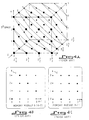
- the skewed memory storage organization involved sectioning the 3-D voxel space of the Cubic Frame Buffer into diagonal parallel sub-spaces having a 45° angle with respect to the main principal axes planes.
- the physical memory of the Cubic Frame Buffer is divided into n memory modules, as illustrated in Figs. 4B through 4E.
- each memory module has its own independent address, k.
- the true voxel-based image in discrete voxel space Z 3 is "scrambled" and stored away in n different memory modules each having nxn memory cells, with address indices (i, j) that differ from the physical x, y and z coordinates of the voxels.
- the mapping operation of voxel beams into computer-storage space N 3 the user/viewer is wholly incapable of specifying (in terms of physically interpretable measures) that a particular beam of voxels along a particular storage/retrieval direction, is to be retrieved from the skewed Cubic Frame Buffer.
- the voxel-based system proposed in applicants' prior art publications is not without further limitations and shortcomings.
- the proposed system is limited to parallel projection of 3-D voxel images, along one or more of the six principal view directions: +x, -x, +y, -y, +z, -z orthographic views parallel to the principal axes.
- viewing of the 3-D voxel image in the Cubic Frame Buffer from more than the six principal viewing directions requires that the 3-D voxel image in the Cubic Frame Buffer is first transformed (i.e. rotated) using the 3-D Frame Buffer Processor (an operation which distorts the 3-D voxel image), and thereafter viewing it along one of the principal orthographic directions. It is only through such a process that arbitrary parallel projections are achievable.
- Voxel Multiple Write Bus as employing a sequence of processing units which simultaneously process a full beam of voxels and select the first opaque one in a time which is proportional to the log of the length of the beam, the details for carrying out such a concept have not been disclosed or known.
- 3-D voxel-based graphic systems which are fast, computationally efficient, and organized to simplify hardware and software implementation
- 3-D voxel-based graphic systems and methods capable of generating parallel projections of 3-D voxel images from a various number of viewing directions, without distorting or otherwise degrading the quality of information of such 3-D voxel images, by requiring transformation (i.e. rotation) of the 3-D voxel image stored in the Cubic Frame Buffer, prior to projection.
- the present invention provides a method of storing and retrieving one or more voxels of a beam disposed along one or more of a plurality of storage/retrieval directions of a 3-D matrix array in 3-D discrete voxel space, said 3-D discrete voxel space being specified in terms of x, y and z coordinate directions, the storage of said voxels into memory storage space being accomplished by addressing said voxels along one of said plurality of storage/retrieval directions into a plurality of n independently accessible memory modules in said memory storage space, the retrieval of said voxels from the memory storage space being accomplished along one of said plurality of storage/retrieval directions in said 3-D voxel space, characterized by:
- the voxel depth measures for voxels along beams parallel to any one of the twenty six storage/retrieval directions require particular demapping functions which are derivable using modular arithmetic, the linear skewing function utilized, and various techniques used in number theory. These demapping functions which provide the depth measure along the various storage/retrieval directions, have been derived for the 6 and 26 storage/retrieval directions. However, utilizing the principles of the present invention, other methods can be derived, for storing and retrieving voxels along more than 26 conflict-free storage/retrieval directions.
- a transparent parameter which is either transparent or non-transparent voxel value is used in order to determine which voxels will qualify for the Local competition amongst the voxel depth measures.
- voxel depth measures determined to be within a predetermined depth measure range (determined by the observer/user) are allowed to compete in the voxel depth competition process.
- a predetermined depth measure range determined by the observer/user
- the present invention also provides an apparatus for storing and retrieving a beam of voxels disposed parallel to a storage/retrieval direction of an n 3 matrix array in 3-D discrete voxel space, said 3-D discrete voxel space being specified in terms of x, y and z coordinate directions, said apparatus including storing means (2) for storing said voxels into memory storage space, by storing said voxels along one of said plurality of storage/retrieval directions into a plurality of n independently accessible memory modules (16) in said memory storage space and retrieving means (14) for retrieving said voxels along one of said plurality of storage/retrieval directions in said 3-D voxel space, characterized by:
- each k-th module comprises a voxel or multiple write processing unit, a k-th voxel value storage register, a k-th voxel depth measure register, a k-th voxel depth competition unit and a writing means.
- the k-th value stored register is for storing the k-th voxel value of the k-th voxel along the beam parallel to the storage/retrieval direction.
- the k-th voxel depth measure register is for storing the voxel depth measure of the k-th voxel along the beam parallel to the storage/retrieval direction.
- the writing means is for writing into a two dimensional frame buffer, the voxel value stored in a k-th voxel value storage register which corresponds to a voxel pass control signal.
- the apparatus also includes means for providing transparency control parameters to the voxel multiple write processing units. These transparency control parameters are received by a k-th voxel transparency control unit, so as to control the local comparison of voxel depth measures within the k-th voxel depth competition unit.
- the voxel depth competition control is carried out on the basis of the voxel value in the k-th voxel value register in the k-th transparency control parameter.
- the storage/retrieval apparatus is included within the 3-D voxel based graphic system including: a 3-D geometry processor, a 3-D frame buffer processor, and a 3-D viewing processor.
- the voxel based graphic system comprises a memory and addressing system for storing and retrieving an 3-D voxel based image along a plurality of storage/retrieval directions and 3-D discrete voxel space.
- the memory and addressing system includes a plurality of modules, wherein each module has a memory module and a local address unit for independently addressing the memory module.
- a central addressing unit is also provided for simultaneously transmitting to each module, broadcasted addresses and control parameters.
- a transfer means is provided for transferring broadcast addresses and control parameters to each module, and in addition a means is also provided for transferring the voxel based images into or from the n memory modules.
- the voxel-based workstation of the present invention is capable of providing a full range of inherent 3-D interactive operations in a simple, general work-bench set-up, since the workstation operates in both discrete 3-D voxel space and 3-D geometry space, and provides ways in which to interact two spaces. Accordingly, the workstation can be used with inherent 3-D user interactive devices, techniques and electronic tools, which support direct and natural interaction, generation and editing of 3-D continuous geometrical models, 3-D discrete voxel images, and their transformations. Such a 3-D voxel-based workstation is appropriate for many 3-D applications such as medical imaging, 3-D computer-aided design, 3-D animation and simulation (e.g. flight simulation), 3-D image processing and pattern recognition, and general 3-D graphics interaction.
- 3-D voxel-based workstation is appropriate for many 3-D applications such as medical imaging, 3-D computer-aided design, 3-D animation and simulation (e.g. flight simulation), 3-D image processing and pattern recognition, and general 3-D graphics interaction.
- a principal advantage of the present invention is that a 3-D matrix array of voxels in Z 3 space, can be mapped into a plurality of independently accessible memory modules with conflict-free access to beams of voxels along a plurality of storage/retrieval directions in Z 3 space.
- Another advantage of the present invention is that beams of voxels along a plurality of conflict-free storing/retrieving (and viewing) directions in 3-D discrete voxel space Z 3 , can be stored in and retrieved from 3-D computer storage space, requiring specification of the voxel beam in Z 3 space solely in terms of spatial parameters having a physical interpretation to the user/observer.
- Another advantage of the present invention is that a voxel beam can be mapped from a particular conflict-free storage/retrieval direction in Z 3 space, into a plurality of independently accessible memory modules in skewed computer storage space according to a linear skewing function which provides conflict-free access to beams of voxels along a plurality of storage/retrieval directions.
- a further advantage of the present invention is that conflict-free access to a voxel beam in the Cubic Frame Buffer is provided along storage/retrieval directions parallel to the x, y and z principal axes thereof, wherein specification of the voxel beam, is solely in terms of spatial parameters, such as the physical coordinates of the voxels and their physical depth into the 3-D matrix array model of the Cubic Frame Buffer.
- a further advantage of the present invention is that conflict-free access to the Cubic Frame Buffer is provided along twenty-six symmetrically disposed storage/retrieval (e.g. viewing) directions.
- Another advantage of the present invention is that the non-transparent voxel in a beam along a specified storage/retrieval direction which is closest to an observer along that direction, can be determined.
- computed voxel depth measures for voxels along the beam compete in a process to determine the closest voxel.
- the method can be used to determine which voxel is the closest to the observer and which satisfies observer-selected transparency control parameters, such as for example, color, translucency ratios, texture, transparency and opaqueness.
- a further advantage of the present invention is that depth and interval control parameters are used to restrict the voxel depth competition process amongst those voxels falling with ranges specified by such depth and/or interval control parameter.
- the method of the present invention can be utilized in order to provide a method of projecting (from 3-D voxel-based images), 2-D voxel images along a specified viewing direction.
- An even further advantage is that methods and apparatus utilizing the present invention can be used for storing, accessing, and/or processing general-purpose 3-D data in a computer system.
- Figs. 6A, 6B, and 5A and 5B the method of storing and retrieving beams of voxels along a plurality of storage/retrieval directions in 3-D discrete voxel space, according to the present invention will now be described below.
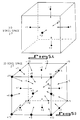
- FIG. 5A a 3-D matrix array model of the Cubic Frame Buffer in 3-D voxel space Z 3 is illustrated, wherein the six orthographic storage/retrieval directions in Z 3 space are shown by directional arrows labelled ⁇ 1, ⁇ 2 and ⁇ 3 for the ⁇ x, ⁇ y and ⁇ z principal axes, respectively.
- each voxel has physical coordinate values x, y and z along x, y and z coordinate directions, respectively, which taken together form a 3-D matrix array. Passing through the 3-D matrix array, are strings of voxels referred to hereinafter as "beams", can also be called “rays” as well depending on the type of implementation involved.
- the Cubic Frame Buffer is a memory cube of n 3 voxels
- the address indices of each voxel V(x, y, z) in a beam of n voxels B n are represented as k, i, j in 3-D computer storage space N 3 , which will be further specified below.
- the voxel beam storage and retrieval method of the present invention relies on a memory storage scheme that maps the voxels of a 3-D matrix array (Cubic Frame Buffer) in Z 3 space, into a certain number of memory modules (i.e. banks) and provides for the conflict-free access to various beams of voxels parallel to a plurality of storage/retrieval directions.
- a memory storage is dependent upon the particular storage scheme utilized.
- the practicality of skewing schemes in general, depends upon whether they can be described by a small amount of tabular information, or by a simple formula.
- Each k-th memory module contains n 2 memory cells, with each memory cell being specified by internal memory module indices i and j.
- linear skewing function S(x, y, z) is given by where x, y and z are the coordinate values of each voxel in 3-D discrete voxel space Z 3 , 0 ⁇ k, x, y, z ⁇ n-1, where a, b and c are integer coefficients, and where n is a prime relative to the integer coefficients a, b and c and to linear combinations thereof, e.g. a - b, b + c, a + b + c, etc.
- the linear skewing function S maps physical coordinate values x, y and z represented in 3-D voxel space Z 3 , into memory module storage indices k, i, j represented in 3-D skewed memory storage space N 3 .
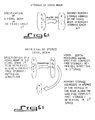
- This mapping process is illustrated in Fig. 6A, in particular.
- conflict-free access to specified storage/retrieval viewing directions can be provided for a proper choice of a, b, c and n, which can be achieved by ensuring that no two voxels along a beam parallel to a storage/retrieval direction, are mapped into the same independently accessible memory storage module K.
- Fig. 5A the six storage and retrieval directions of the method of the present invention are specified as follows.
- “Rows” are referred to hereinafter as those storage/retrieval and viewing directions that are parallel to the x principal axis.
- “Columns” are referred to hereinafter as storage/retrieval directions that are parallel to the y principal axis, whereas, “axles” are referred to as storage viewing directions that are parallel to the z principal axis.
- Every integer which divides all the integers a, b, ..., l is said to be a "common divisor" of them.
- gcd (a, b, ... l) 1, then a, b, ... l are said to be "relatively prime", which signifies that there is no divisor, except for 1, which is common to a, b, ..., l.
- the linear skewing scheme S(x, y, z) is "proper" in that all memory modules are used in the mapping operation.
- the "proper" condition of the linear skewing scheme S(x, y, z) is satisfied if and only if integer coefficients a, b and c are "relatively prime” with respect to n.
- This "relatively prime” condition for proper linear skewing schemes can be expressed alternatively as follows:
- the voxels of a beam along a row of the 3-D matrix array are placed or "ordered" in successive memory modules which are "a" apart mod n, and are termed a-ordered voxels.
- the voxels of a beam along a column of the 3-D matrix array e.g. parallel to the +y principal axis, with x and z fixed constant are placed in successive memory modules which are b apart mod n, termed b-ordered voxels.
- those voxels of a beam along an axle of the 3-D matrix array are placed in successive memory modules c apart mod n, and are termed c-ordered.
- any power of 2 as this simplifies memory construction, addressing, and/or the modulo computation in the linear skewing function S(x, y,z).
- a user/observer After having mapped (i.e. stored) beams of voxels (characterized by x, y and z coordinates) from Z 3 voxel space into 3-D computer storage space N 3 (characterized by memory storage cell address indices k, i, j), using the above-derived proper linear skewing function, a user/observer typically has a natural need to retrieve the stored beam of voxels from 3-D computer storage space N 3 , by demapping the beam of voxels in 3-D voxel space Z 3 , for processing and/or viewing.
- Fig. 6B in particular, wherein a "demapping" process is illustrated for retrieving a voxel beam mapped into skewed memory storage space N 3 , according to the principles of the present invention.
- a whole beam of voxels mapped into computer storage space N 3 according to a particular linear skewing function can be retrieved from skewed storage space N 3 by a process demapping the voxel beam back into 3-D voxel space Z 3 .
- a demapping process only requires specifying the beam of voxels in discrete voxel space Z 3 , solely in terms of spatial parameters having a physical interpretation to the user/observer.
- the spatial parameters that have been selected for voxel-beam retrieval specification are (i) the physical coordinate direction of the voxel beam, and (ii) the physical depth of the beam into the 3-D matrix array model of the Cubic Frame Buffer.
- These spatial parameters are natural in that they have a physical interpretation, namely they specify the direction of the voxel beam, and also the depth of the voxels in the beam extending into the 3-D matrix array along the specified storage/retrieval (e.g. viewing) direction.
- the demapping process involves specifying along which of the six storage/retrieval directions, the voxel beam (to be retrieved) extends into the 3-D matrix array in Z 3 space.
- module arithmetic For a discussion of the involved principles and operations of modular arithmetic, reference is made to Elements of Number Theory by I.M. Vinogradov, translated from the Fifth Revised Edition (1949) by Saul Kravetz, published by Dover Publications in 1954.
- the memory storage addresses for the beam to be retrieved along the specified storage/retrieval direction are determinable in a manner described above.
- Fig. 6A, 6B, and Fig. 5B in particular, the case of twenty-six conflict-free storage/retrieval directions of a 3-D matrix array in 3-D voxel space Z 3 , will be considered.
- a 3-D matrix array model of the Cubic Frame Buffer in 3-D voxel space Z 3 is illustrated, wherein the twenty-six storage/retrieval directions in Z 3 space are shown by directional arrows labelled ⁇ 1 for the rows parallel to the ⁇ x principal axes, ⁇ 2 for the columns parallel to the ⁇ principal axes, and ⁇ 3 for the axles parallel to the ⁇ z principal axes.
- the other additional twenty storage/retrieval directions are specified along the minor-diagonals represented by directional arrows ⁇ 4, ⁇ 5, ⁇ 6, the minor-anti-diagonals represented by directional arrows ⁇ 7, ⁇ 8, ⁇ 9, major-diagonals represented by directional arrows ⁇ 10, ⁇ 12, and major anti-diagonals represented by directional arrows ⁇ 11, ⁇ 13.
- the voxel beam storage and retrieval method of the present invention relies on a memory storage scheme that maps the voxels of a 3-D matrix array (Cubic Frame Buffer) in 3-D voxel space Z 3 , into n independently accessible memory storage modules, which provides for conflict-free access to beams of voxels parallel to any one of twenty-six storage/retrieval directions.
- the condition gcd (a, b, c, n) 1 must be maintained.
- the above-skewing function will map the voxels of a 3-D matrix into n independently accessible memory modules, so as to provide conflict-free access to all rows, columns, axles, major and minor diagonals and anti-diagonals.
- the voxels of a row are placed (i.e. mapped into, or "ordered") in successive memory modules which are "a apart modulo n", termed a-ordered.
- the voxels of a column are placed in successive memory modules "b apart modulo n", termed b-ordered.
- the voxels of an axle are placed in successive memory modules "c apart modulo n”, termed c-ordered.
- the voxels of major diagonals are placed in successive memory modules "(a + b + c) apart modulo n", termed (a + b + c)-ordered, and "a + b - c apart modulo n", termed (a + b - c)-ordered.
- the voxels of a major anti-diagonal are placed in successive memory modules "(a + b - c) apart modulo n", termed (a + b - c)-ordered, and "a - b+ c apart modulo n", termed (a - b + c)-ordered.
- the voxels along minor diagonals and anti-diagonals are placed in successive memory modules "(a + b) apart modulo n", termed (a + b)-ordered, "(a - b) apart modulo n" termed (a - b)-ordered in the x-y faces, are (a + c)-ordered, and (a - c)-ordered in the y-x faces, and the voxels are termed (b + c)-ordered and (b - c)-ordered in the y-x faces.
- the voxels along the positive and negative directions of the same beam have the same "order".
- the voxels in the 3-D matrix array in voxel space Z 3 can be mapped into memory storage space N 3 as discussed hereinbefore.
- the voxels or beam thereof along one of the twenty-six conflict-free storage/retrieval directions in Z 3 space can be retrieved by a demapping process involving demapping of the voxels from N 3 storage space into Z 3 voxel space using spatial parameters and integer n.
- This demapping operation in the voxel beam retrieval process will now be described below in detail for the case of twenty-six conflict-free storage/retrieval directions.
- retrieval of one or more voxels of a beam in 3-D voxel space Z 3 requires, according to the principles of the present invention, determination of the memory storage addresses (in N 3 storage space) of the voxels of the beam to be retrieved parallel to one of the twenty-six conflict-free storage/retrieval directions.
- the ratio of n/a e.g. 517/5, can be developed into a continued fraction n/a.
- d -x n - d +x - 1.
- each memory module address k specifies a different coordinate y, which is proportional to the distance d y from the observer along the minor diagonal.
- each memory module address k also specifies a different coordinate x, which is proportional to the distance d x from the observer along the minor diagonal.
- x-y constant
- y-z constant
- x-z constant
- each memory module k also specifies a different coordinate y which is proportional to the distance measure d +y from the observer along the major diagonal.
- each memory module k specifies a different coordinate z which is proportional to the distance measure d +z from the observer along the major diagonal.
- FIGs. 7 through 13 the apparatus of the present invention, will now be described. Notably, however, such apparatus while capable of carrying out the methods of the present invention, can nevertheless be used to perform other more general voxel-based and general computer data storage, accessing and processing operations.
- the voxel-based graphics system of the preferred embodiment is graphically represented as comprising three processors, namely a Geometry Processor 4, a Frame Buffer Processor 3 and a Viewing Processor 5, a memory and addressing system, and a 2-D Frame Buffer 7.
- the memory and addressing system 10 includes an addressing system 11, a Cubic Frame Buffer, and a voxel multiple write processing system 12.
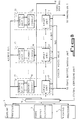
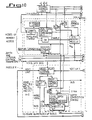
- the voxel-based graphics system of Fig. 7 is schematically illustrated, with the elements of the memory and addressing system 10 shown in greater detail.
- each k-th module 13 includes a k-th local address unit 15, a k-th memory module 16, and voxel multiple write processing unit 17.
- Each k-th memory module is independently accessible (i.e. addressable) by the central addressing unit 14, as well as in cooperation with the corresponding k-th local addressing unit 15.
- each k-th memory module contains a plurality of internal memory cells, each indexed (or addressed) by internal memory cell indices (or addresses) i and j, where 0 ⁇ i ⁇ n-1 and 0 ⁇ j ⁇ n-1.
- a two-dimensional type memory unit is not necessary to carry out the method hereof, but could be realized using a linear type memory array specified by a single index n ranging from 0 ⁇ n ⁇ (n-1) 2 for an n 3 -voxel Cubic Frame Buffer.
- a voxel data bus 18 is provided and can be realized in several ways known to those skilled in the art.
- an intermodule voxel-data movement (i.e. shifting or skipping) mechanism 19 is also provided, being more fully illustrated in Fig. 12.
- Fig. 9 there is graphically represented in detail, the internal elements of a single k-th module of the modular-structured memory and addressing unit illustrated in Fig. 8. Also shown in Fig. 9, is the central addressing unit 14 which, in the preferred embodiment hereof, provides in a global manner, broadcasted addresses k", i", and j" to each of the local addressing units of the n modules by way of a common bus for the purpose of transmitting (i.e. "broadcasting") those addresses k", i", j" to the local addressing units, in a manner to be described more fully hereinafter.
- broadcasted addresses k", i", and j to each of the local addressing units of the n modules by way of a common bus for the purpose of transmitting (i.e. "broadcasting") those addresses k", i", j" to the local addressing units, in a manner to be described more fully hereinafter.
- interval and depth control parameters e.g., d 1 and d 2 , which are broadcasted to each of the local addressing units of the n modules, preferably over a common bus.
- voxel beam write/read/view control parameters are similarly "broadcasted" over a common bus, to each of the k-th local addressing units.
- the local addressing unit 15 includes several elements; namely: a local voxel depth measure (i.e. metric) computation unit 20 for computing the voxel depth measure of the k-th voxel in a beam; a k-th module index (i.e.
- a k-th broadcasted address/module identity comparator unit 22 comparing the k" broadcast address with the k-th module index and generating a control enable; and comparator unit 23 for comparing the "broadcasted" interval and depth control parameters d 1 and d 2 , with the locally-computed voxel depth measure of the k-th voxel, and generating a control enable as well, to be provided to the k-th memory module.
- Each k-th local addressing unit 15, is provided with a logical "OR" device 24, the inputs of which are the outputs of the comparator units 22 and 23.
- a logical "OR" device provides control enable signals to its corresponding memory module. For example, when only a single k-th voxel is to be read or written, then only the k-th memory module will be enabled, the k-th enabled memory module being the module where the broadcasted index k" equals the k-th module index (or identity).
- the enabled memory module is enabled to read or write voxel(s) on the voxel data bus.
- Each local addressing unit 15 also includes a switching means for passing either
- the memory module and local address units of each module may participate in carrying out the specified operation, and that, in general, although subject to some exceptions, the voxel multiple write processing system is inactive.
- One exception is during intermodule voxel-data movement, carried out by the intermodule voxel-data movement mechanism.
- the voxel-multiple write processing system is enabled to assist in performing the necessary operations of such an intermodule voxel-data permutation scheme, which will be described in greater detail hereinafter.
- the voxel multiple write processing system 12 is an active participant in such a projection-based process.
- each k-th voxel multiple write processing unit 17 includes in the preferred embodiment, a voxel value storage register 27, a voxel depth measure storage register 28, a local voxel depth competition unit 29, a transparency control unit 30, a switching unit 31, and a logical "AND" device.
- Each k-th voxel value storage register 27, is interconnected with each of its adjacent neighboring voxel value storage registers by way of a voxel-data transfer path.
- the intermodule connections amongst the voxel storage registers can "skip" one or more voxel storage registers along the voxel data transfer path.
- Such "skips” could be realized for example, by hardwired connections.
- each k-th voxel value storage register 27 is provided to two input ports of two elements, namely, the transparency control unit 30 and the switching unit 31.
- each k-th transparency control unit 30 is provided with transparency control parameters transmitted (i.e., "broadcasted") to all transparency control units, over a common bus 32.
- transparency control parameters can be of a wide variety, as can be the voxel value themselves.
- the voxel value can represent different colors.
- any set of such colors can be defined as “transparent”, or opaque (i.e., non-transparent).
- voxel values can represent physical or other properties of objects and scenes, other than color. For example, texture, material density and translucency ratios, of a small unit cube in the real scenes are important.
- the method of the present invention involves the following procedure. For each voxel in a beam, the voxel depth measured along a specified storage/retrieval direction, is placed in its respective voxel depth measure storage register 28. Then each k-th transparency control unit determines whether the voxel value in its corresponding voxel value storage register is, by definition of the broadcasted transparency parameter, opaque.
- a depth control enable is provided to the input of the logical "AND" device. If the voxel value in the k-th voxel value storage register is both "opaque" and within the depth interval specified by d, and d 2 control parameters, then the and device generates a depth competition enable signal to the k-th corresponding voxel depth competition unit, thereby allowing it to conduct a local "depth value competition process" to be described below.
- the "AND" device can be substituted with an “OR” device or eliminated altogether thus allowing local depth competition processes in each of the n modules, regardless of transparency and depth interval parameters. This might be useful on reading/writing operations.
- this "winning" voxel value represent the "opaque" voxel value which closet to the observer viewing along the voxel beam parallel to the user-specified storage/retrieval direction.
- this process provides great flexibility in defining which voxel values are opaque, and thus are allowed to compete locally prior to passage into the 2-D frame buffer, where the voxel value can be processed "on the fly" within a suitable shading unit.
- each voxel multiple write processing unit 17 of the preferred embodiment is illustrated in greater detail.
- the depth measure storage register 28 comprises a plurality of storage cells, each cell containing a b i bit which is provided to a different stage of the k-th voxel depth competition unit 29.
- Each i-th stage in the voxel depth competition unit comprises conventional logic circuitry (e.g., logic elements A, B, and C) which in effect compares the b i bit with the corresponding b i bits of all other voxel depth measures provided to the k-th depth competition unit by way of the common depth bus, as described hereinbefore.
- logic circuitry e.g., logic elements A, B, and C
- the predetermined extreme value e.g., largest value
- determining and group formation steps are repeated for successive stages of the voxel depth competition unit 29, on the basis of consecutive significant binary digits, until only one surviving voxel depth measure remains in the group.
- the voxel depth competition unit 29 corresponding to the surviving voxel generates a voxel pass control provided to the switch unit 31 to allow that voxel in the corresponding voxel value storage register, to be passed into 2-D frame buffer, (FB) 7 as described hereinbefore.
- the surviving voxel depth measure corresponds to the voxel which is closest to the viewing along the specified storage/retrieval direction.
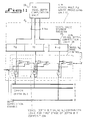
- FIG. 13 an addition schematic representation is shown, illustrating only those portions of central addressing unit, local address units, and memory modules which function in the memory storage mapping and demapping operations of the present invention.
- pairs of coordinate value sums and differences are required to compute the local addresses using the demapping functions as discussed hereinbefore.
- coordinate value sum and differences are required by each local voxel depth computation unit, they are in the preferred embodiment, computed by the central addressing unit 14 and "broadcasted" to all local addressing units over a common bus 32.
- the demapping functions i.e., voxel depth measure formulas
- the demapping functions can be realized using multipliers, adders, subtractors and switches.
- a depth measure function is realized in Fig. 13, partly by the central addressing unit 14 and partly by the k-the local addressing unit 15.
- modifications of such realizations are expected to occur.
- the binary skewing function S (x, y, z) for the case of six conflict-free storage/retrieval directions could typically be realized in the central processing unit 14 using again, devices to carry out multiplication, addition, subtraction and other arithmetic functions, and thereafter be "broadcasted" to all in local addresses, over a common addressing bus 32.
Landscapes
- Physics & Mathematics (AREA)
- General Physics & Mathematics (AREA)
- Engineering & Computer Science (AREA)
- Theoretical Computer Science (AREA)
- Image Generation (AREA)
- Ultra Sonic Daignosis Equipment (AREA)
Claims (15)
- Méthode pour mémoriser et récupérer un ou plusieurs voxels d'un faisceau disposé le long d'une ou plusieurs d'une pluralité de directions de mémorisation/récupération d'un agencement de matrice tridimensionnel dans un espace de voxels discrets tridimensionnel, ledit espace de voxels discrets tridimensionel étant spécifié en termes de directions de coordonnées x, y et z, la mémorisation desdits voxels dans un espace de mémorisation de mémoire étant accomplie en adressant lesdits voxels le long d'une de ladite pluralité de directions de mémorisation/récupération dans une pluralité de n modules de mémoire, accessibles de manière indépendante, dans ledit espace de mémorisation de mémoire, la récupération desdits voxels à partir de l'espace de mémorisation de mémoire étant accomplie le long d'une de ladite pluralité de directions de mémorisation/récupération dans ledit espace de voxels tridimensionnel, caractérisée par :(a) la carthographie desdits voxels le long dudit faisceau parallèle à ladite direction de mémorisation/récupération, dans une pluralité de n modules de mémoire, accessibles de manière indépendante, qui sont indexés par des indices de module de mémoire k=0, 1, ... n-1, chaque kième module de mémoire contenant n2 cellules de mémoire, chaque cellule de mémoire étant spécifiée par des indices de modules internes, i et j, ladite cartographie étant exécutée conformément à une fonction d'inclinaison linéaire de la forme générale(b) pour chacun desdits voxels le long dudit faisceau parallèle à ladite direction de mémorisation/récupération, la détermination d'une mesure de profondeur de voxel représentant la profondeur de chacun desdits voxels dans ledit agencement de matrice n3 dans ledit espace de voxels discrets tridimensionnel, ladite détermination de ladite mesure de profondeur de voxel étant déterminée pour chacun desdits voxels sur la base d'une ou plusieurs desdites valeurs de coordonnées x, y et z dudit voxel, desdits coefficients entiers a, b et c et dudit index de module k dudit module de mémoire dans lequel ledit voxel a été cartographié à l'étape (a) ;(c) pour chacun desdits voxels le long dudit faisceau parallèle à ladite direction de mémorisation/récupération, la détermination desdits indices de cellule de mémoire i et j sur la base de ladite mesure de profondeur de voxel et desdites valeurs de coordonnées x, y et z correspondant à chacun desdits voxels, et(d) la récupération desdits voxels le long d'une direction de mémorisation/récupération spécifiée, en utilisant lesdits indices de cellule de mémoire i et j et ledit index de module k.
- Méthode selon la revendication 1, dans laquelle chacun desdits coefficients entiers a, b et c est égal à 1, de manière à fournir six directions de mémorisation/récupération correspondant aux axes principaux ±x, ±y, ±z dudit agencement de matrice n3.
- Méthode selon la revendication 2, dans laquelle l'étape (b) est, de plus, caractérisée par la détermination de chacun desdits voxels, lesdites mesures de profondeur de voxel d+x et d-x pour lesdits voxels le long desdits faisceaux parallèles à l'axe principal x, ladite mesure de profondeur de voxel d+y et d-y pour lesdits voxeis le long desdits faisceaux parallèles à l'axe principal y et ladite mesure de profondeur de voxel d+z et d-z pour lesdits voxels le long desdits faisceaux parallèles audit axe principal z étant déterminées, respectivement, selon les fonctions
- Méthode selon la revendication 1, dans laquelle ledit coefficient entier a est égal à 5, ledit coefficient entier b est égal à 2 et ledit coefficient entier c est égal à 1, de manière à fournir vingt-six directions de mémorisation/récupération dudit agencement de matrice n3 dans ledit espace de voxels discrets tridimensionnel.
- Méthode selon la revendication 1, dans laquelle l'étape (c) est, de plus, caractérisée par :
(A) la comparaison desdites mesures de profondeur de voxel déterminées à l'étape (b) de manière à déterminer quelle mesure de profondeur de voxel présente une valeur extrême prédéterminée et, de ce fait, est représentative du voxel correspondant le plus proche dudit observateur regardant le long dudit faisceau parallèle à ladite direction de mémorisation/récupération. - Méthode selon la revendication 5, dans laquelle ledit voxel est, de plus, spécifié par un paramètre de transparence qui est une valeur de voxel soit transparente, soit non-transparente, et dans laquelle avant l'étape (c) (A), ladite méthode est, de plus, caractérisée par ;la détermination desdits voxels présentant une valeur de voxel non-transparente et dans laquelle l'étape (c) (A) est, de plus, caractérisée par :la comparaison uniquement desdites mesures de profondeur de voxel déterminées à l'étape (b) qui correspondent auxdits voxels déterminés ci-dessus comme présentant une valeur non-transparente, de manière à déterminer quel voxel présentant une valeur de voxel non-transparente a une valeur de mesure se profondeur de voxel extrême prédéterminée et, de ce fait, représentative dudit voxel le plus proche audit observateur regardant le long dudit faisceau parallèle à ladite direction de mémorisation/récupération.
- Méthode selon la revendication 5, dans laquelle avant l'étape (C) (A) ladite méthode est, de plus, caractérisée par :la détermination desdits voxels non-transparents le long dudit faisceau, qui ont des mesures de profondeur de voxel correspondantes dans au moins une plage de mesure de profondeur prédéterminée, et dans laquelle l'étape (C) (A) est, de plus, caractérisée par :la comparaison uniquement desdites mesures de profondeur de voxel déterminées à l'étape (b) qui correspondent auxdits voxels non-transparents déterminés ci-dessus comme ayant des mesures de profondeur de voxel correspondantes dans ladite plage de mesure de profondeur prédéterminée, de manière à déterminer quel voxel dans ladite plage de mesure de profondeur prédéterminée, a une mesure de profondeur de voxel extrême prédéterminée et, de ce fait, représentative dudit voxel le plus proche audit observateur regardant le long dudit faisceau parallèle à ladite direction de mémorisation/récupération.
- Méthode selon la revendication 5, dans laquelle chacune desdites mesures de profondeur de voxel est représentent par une pluralité de chiffres binaires et dans laquelle ladite comparaisons des mesures de profondeur de voxel est caractérisée par :(i) la comparaison du chiffre binaire le plus significatif de chacune desdites mesures de profondeur de voxel,(ii) la détermination de quels voxels ont la mesure de profondeur de voxel extrême prédéterminée, sur la base de la comparaison desdits chiffres binaires les plus significatifs,(iii) la formation d'un groupe de voxels à partir de la détermination effectuée à l'étape (ii),(iv) la comparaison des chiffres binaires les plus significatifs consécutifs suivants des mesures de profondeur de voxel desdits voxels dans ledit groupe de voxels formé à l'étape (iii),(v) la détermination de quels voxels dans ledit groupe de voxels ont la mesure de profondeur de voxel extrême prédéterminée, sur la base de la comparaison desdits chiffres binaires les plus significatifs consécutifs suivants, et(vi) la réalisation, à plusieurs reprises, desdites étapes de comparaison, de détermination et de formation de groupe, sur la base des chiffres binaires les plus significatifs consécutifs, jusqu'à ce qu'une seule mesure de profondeur de voxel subsistante reste dans ledit groupe, ladite mesure de profondeur de voxel subsistante correspondant audit voxel le plus proche dudit observateur regardant le long de ladite direction de mémorisation/récupération.
- Méthode selon la revendication 8, qui est, de plus, caractérisée par, pour une pluralité de faisceaux parallèles à ladite direction de mémorisation/récupération, chacun desdits faisceaux ayant une pluralité de voxels le long de celle-ci,(1) la cartographie de ladite pluralité de voxels le long de chacun desdits faisceaux, dans ladite pluralité de n modules de mémoire, accessibles de manière indépendante, selon ladite fonction d'inclinaison linéaire,(2) la détermination d'une mesure de profondeur de voxel pour chacun desdits voxels non-transparents le long de chacun desdits faisceaux,(3) pour chacun desdits voxels le long de chacun desdits faisceaux, la comparaison desdites mesures de profondeur de voxel correspondant auxdits voxels non-transparents de manière à déterminer quelle mesure de profondeur de voxel est une valeur extrême prédéterminée et, de ce fait, représentative du voxel non-transparent correspondant le plus proche dudit observateur regardant le long dudit faisceau parallèle à ladite direction de mémorisation/récupération, et(4) la formation d'une image bidimensionnelle à partir de ladite pluralité des valeurs de voxels non-transparents déterminée à l'étape (3) ci-dessus.
- Appareil pour mémoriser et récupérer un faisceau de voxels disposé parallèle à une direction de mémorisation/récupération d'un agencement de matrice n3 dans l'espace de voxels discrets tridimensionnel, ledit espace de voxels discrets tridimensionnel étant spécifié en termes de directions de coordonnées x, y et z, ledit appareil comprenant des moyens de mémorisation (2) destinés à mémoriser lesdits voxels dans un espace de mémorisation de mémoire, en mémorisant lesdits voxels le long d'une de ladite pluralité de directions de mémorisation/récupération dans une pluralité de n modules de mémoire (16), accessibles de manière Indépendante, dans ledit espace de mémorisation de mémoire et des moyens de récupération (14) destinés à récupérer lesdits voxels le long d'une de ladite pluralité de directions de mémorisation/récupération dans ledit espace de voxels tridimensionnel, caractérisé par :(a) lesdits moyens de mémorisation indexant ledit module de mémoire (16) par un index de module de mémoire k=0, 1, ... n-1 et comportant n2 adresses de cellules de mémoire internes, ledit n étant un entier, ledit adressage desdits voxels comprenant une opération de carthographie exécutée conformément à une fonction d'inclinaison linéaire de la forme générale k = (ax + by + cz) mod n, où des coefficients entiers a, b, c et leurs combinaisons linéaires sont relativement des nombres premiers par rapport à n ;(b) une pluralité de n modules (13) étant également indexés avec des indices de modules k=0, 1 ... n-1, chacun desdits kièmes modules comprenant un desdits kièmes modules de mémoire (16), une kième unité d'adresse locale (15) pour accéder, de manière indépendante, audit kième module de mémoire spécifié par les indices de modules internes i=x et j=y, chaque kième unité d'adresse locale comprenant une unité de calcul de profondeur de voxel locale (20) pour calculer une mesure de profondeur de voxel de chaque voxel résidant dans ledit kième module de mémoire, ladite mesure de profondeur de voxel de chaque voxel étant représentative de la profondeur dudit voxel dans ledit agencement de matrice n3 et étant déterminée sur la base d'une ou plusieurs des valeurs de coordonnées x, y et z dudit voxel, lesdits coefficients entiers a, b et c et ledit index de module k dudit module de mémoire dans chacun desdits voxels étant cartographiés, ladite unité d'adressage locale comprenant, de plus, des moyens (20, 21, 22) destinés à déterminer, pour chacun desdits voxels, lesdits indices de cellules de mémoire i et j sur la base de ladite mesure de profondeur de voxel desdites valeurs de coordonnées x, y et z correspondant à chacun desdits voxels et des moyens de sélection d'index de cellule de mémoire (25, 26) destinés à sélectionner des indices de cellules de mémoire i et j à partir des indices de cellules de mémoire globaux i" et j" et desdites mesures de profondeur de voxel le long desdites directions de mémorisation/récupération,(c) des moyens de récupération (24, 25, 26) destinés à récupérer lesdits voxels le long d'une direction de mémorisation/récupération spécifiée, en utilisant lesdits indices de cellules de mémoire i et j et ledit index de module k.
- Appareil selon la revendication 10, dans lequel chacun desdits kièmes modules est, de plus, caractérisé par :une unité de traitements d'écriture multiples de voxels (17) destinée à traiter les voxels accédés à partir dudit kième module de mémoire,un kième registre de mémorisation de valeur de voxel (27) destiné à mémoriser la kième valeur de voxel du kième voxel le long dudit faisceau parallèle à ladite direction de mémorisation/récupération,un kième registre de mesure de profondeur de voxel (28) destiné à mémoriser ladite mesure de profondeur de voxel dudit kième voxel le long dudit faisceau parallèle à ladite direction de mémorisation/récupération,une kième unité de compétition de profondeur de voxel (29) destinée à comparer la valeur de ladite mesure de profondeur de voxel dudit kième voxel à tous les autres voxels dudit faisceau parallèle à ladite direction de mémorisation/récupération et à déterminer laquelle desdites mesures de profondeur de voxel présente une valeur extrême prédéterminée et à générer un signal de contrôle de passage de voxel correspondant à ladite mesure de profondeur de voxel ayant ladite valeur extrême prédéterminée, etdes moyens d'écriture destinés à écrire dans une mémoire tampon de trame bidimensionnelle ladite valeur de voxel mémorisée dans ledit kième registre de mémorisation de valeur de voxel correspondant audit signal de contrôle de passage de voxel.
- Appareil selon la revendication 11, caractérisé par des moyens destinés à fournir des paramètres de contrôle de transparence auxdites unités de traitements d'écriture multiples de voxels, chacune desdites kièmes unités de traitements d'écriture multiples de voxels est, de plus, caractérisée par :
une kième unité de contrôle de transparence de voxel (30) destinée à recevoir lesdits paramètres de contrôle de transparence et à contrôler la comparaison locale desdites mesures de profondeur de voxel à l'intérieur de ladite kième unité de compétition de profondeur de voxel (29), ledit contrôle de compétition de profondeur de voxel étant exécuté sur la base de ladite valeur de voxel dans ledit kième registre de valeur de voxel et desdits paramètres de contrôle de transparence. - Appareil selon la revendication 10, dans lequel chacune desdites kièmes unités d'adresses locales (15) est, de plus, caractérisée par des moyens de comparaison locale destinés à comparer la mesure de profondeur de voxel de chaque voxel à au moins une plage de mesure de profondeur de voxel présélectionnée et à contrôler la comparaison locale desdites mesures de profondeur de voxel à l'intérieur de ladite kième unité de compétition de profondeur de voxel (29), ledit contrôle de compétition de profondeur de voxel étant exécuté sur la base dudit voxel se trouvant dans ladite plage de mesure de profondeur de voxel présélectionnée.
- Appareil selon la revendication 11, dans lequel chacune desdites mesures de profondeur de voxel est reprérentée par une pluralité de bits binaires et dans lequel ladite unité de compétition de profondeur de voxel (29) est caractérisée par des moyens destinés à(i) comparer les bits binaires les plus significatifs de chacune desdites mesures de profondeur de voxel,(ii) déterminer quels voxels ont une mesure de profondeur de voxel extrême prédéterminée, sur la base de la comparaison desdits bits binaires les plus significatifs,(iii) former un groupe de voxels à partir de la détermination effectuée à l'étape (ii),(iv) comparer les bits binaires les plus significatifs consécutifs suivants des mesures de profondeur de voxel desdits voxels dans ledit groupe de voxels formé à l'étape (iii),(v) déterminer quels voxels dans ledit groupe de voxels ont la mesure de profondeur de voxel extrême prédéterminée, sur la base de la comparaison desdits bits binaires les plus significatifs consécutifs suivants.
- Appareil Selon la revendication 11, caractérisé, de plus, par des moyens de déplacement de valeur de voxel intermodule (18) destinés à déplacer la valeur de voxel mémorisée dans lesdits kièmes registres de mémorisation de valeur de voxel, vers d'autres registres de mémorisation de valeur de voxel.
Applications Claiming Priority (2)
| Application Number | Priority Date | Filing Date | Title |
|---|---|---|---|
| US07/269,567 US4985856A (en) | 1988-11-10 | 1988-11-10 | Method and apparatus for storing, accessing, and processing voxel-based data |
| US269567 | 1988-11-10 |
Publications (3)
| Publication Number | Publication Date |
|---|---|
| EP0368425A2 EP0368425A2 (fr) | 1990-05-16 |
| EP0368425A3 EP0368425A3 (fr) | 1992-02-12 |
| EP0368425B1 true EP0368425B1 (fr) | 1998-03-04 |
Family
ID=23027802
Family Applications (1)
| Application Number | Title | Priority Date | Filing Date |
|---|---|---|---|
| EP89202852A Expired - Lifetime EP0368425B1 (fr) | 1988-11-10 | 1989-11-09 | Méthode et appareil pour enregistrer, accéder à et traiter des données à base de voxel |
Country Status (6)
| Country | Link |
|---|---|
| US (1) | US4985856A (fr) |
| EP (1) | EP0368425B1 (fr) |
| JP (1) | JPH02244387A (fr) |
| AT (1) | ATE163784T1 (fr) |
| CA (1) | CA2002663C (fr) |
| DE (1) | DE68928594T2 (fr) |
Families Citing this family (71)
| Publication number | Priority date | Publication date | Assignee | Title |
|---|---|---|---|---|
| US5446479A (en) * | 1989-02-27 | 1995-08-29 | Texas Instruments Incorporated | Multi-dimensional array video processor system |
| US5199437A (en) * | 1991-09-09 | 1993-04-06 | Sensor Electronics, Inc. | Ultrasonic imager |
| JPH05189549A (ja) * | 1991-09-10 | 1993-07-30 | Kubota Corp | マルチプロセッサによる画像データ処理装置 |
| JP3327948B2 (ja) * | 1992-06-09 | 2002-09-24 | オリンパス光学工業株式会社 | 光学像再構成装置 |
| JPH087799B2 (ja) * | 1992-06-19 | 1996-01-29 | インターナショナル・ビジネス・マシーンズ・コーポレイション | データ視覚化装置および方法 |
| IL102289A (en) * | 1992-06-24 | 1997-08-14 | R Technologies Ltd B V | Method and system for processing moving images |
| US5361385A (en) * | 1992-08-26 | 1994-11-01 | Reuven Bakalash | Parallel computing system for volumetric modeling, data processing and visualization |
| US5347459A (en) * | 1993-03-17 | 1994-09-13 | National Research Council Of Canada | Real time collision detection |
| US5544283A (en) * | 1993-07-26 | 1996-08-06 | The Research Foundation Of State University Of New York | Method and apparatus for real-time volume rendering from an arbitrary viewing direction |
| US6559843B1 (en) * | 1993-10-01 | 2003-05-06 | Compaq Computer Corporation | Segmented ray casting data parallel volume rendering |
| USRE38410E1 (en) * | 1994-01-31 | 2004-01-27 | Axs Technologies, Inc. | Method and apparatus for a parallel data storage and processing server |
| US5737549A (en) * | 1994-01-31 | 1998-04-07 | Ecole Polytechnique Federale De Lausanne | Method and apparatus for a parallel data storage and processing server |
| AUPM719494A0 (en) * | 1994-08-01 | 1994-08-25 | Canon Information Systems Research Australia Pty Ltd | Dither method and apparatus |
| US5594842A (en) * | 1994-09-06 | 1997-01-14 | The Research Foundation Of State University Of New York | Apparatus and method for real-time volume visualization |
| AU699764B2 (en) * | 1994-09-06 | 1998-12-17 | Research Foundation Of The State University Of New York, The | Apparatus and method for real-time volume visualization |
| US6694163B1 (en) | 1994-10-27 | 2004-02-17 | Wake Forest University Health Sciences | Method and system for producing interactive, three-dimensional renderings of selected body organs having hollow lumens to enable simulated movement through the lumen |
| US5920319A (en) | 1994-10-27 | 1999-07-06 | Wake Forest University | Automatic analysis in virtual endoscopy |
| US5782762A (en) * | 1994-10-27 | 1998-07-21 | Wake Forest University | Method and system for producing interactive, three-dimensional renderings of selected body organs having hollow lumens to enable simulated movement through the lumen |
| US6049619A (en) * | 1996-02-12 | 2000-04-11 | Sarnoff Corporation | Method and apparatus for detecting moving objects in two- and three-dimensional scenes |
| US6192145B1 (en) * | 1996-02-12 | 2001-02-20 | Sarnoff Corporation | Method and apparatus for three-dimensional scene processing using parallax geometry of pairs of points |
| US5781194A (en) * | 1996-08-29 | 1998-07-14 | Animatek International, Inc. | Real-time projection of voxel-based object |
| US6343936B1 (en) | 1996-09-16 | 2002-02-05 | The Research Foundation Of State University Of New York | System and method for performing a three-dimensional virtual examination, navigation and visualization |
| US7194117B2 (en) * | 1999-06-29 | 2007-03-20 | The Research Foundation Of State University Of New York | System and method for performing a three-dimensional virtual examination of objects, such as internal organs |
| US5971767A (en) * | 1996-09-16 | 1999-10-26 | The Research Foundation Of State University Of New York | System and method for performing a three-dimensional virtual examination |
| US6331116B1 (en) | 1996-09-16 | 2001-12-18 | The Research Foundation Of State University Of New York | System and method for performing a three-dimensional virtual segmentation and examination |
| US5986662A (en) * | 1996-10-16 | 1999-11-16 | Vital Images, Inc. | Advanced diagnostic viewer employing automated protocol selection for volume-rendered imaging |
| US8682045B2 (en) * | 1997-02-25 | 2014-03-25 | Wake Forest University Health Sciences | Virtual endoscopy with improved image segmentation and lesion detection |
| US6144383A (en) * | 1997-05-30 | 2000-11-07 | Hewlett-Packard Company | Volumetric data organization method that allows for cache efficient rendering speedups and efficient graphics hardware design |
| US6054992A (en) * | 1997-09-19 | 2000-04-25 | Mitsubishi Electric Information Technology Center America, Inc. | cutting, jointing and tearing volumetric objects |
| DE19835215C2 (de) * | 1998-08-05 | 2000-07-27 | Mannesmann Vdo Ag | Kombinationsinstrument |
| EP1054384A3 (fr) * | 1999-05-20 | 2003-09-24 | TeraRecon, Inc., A Delaware Corporation | Méthode et dispositif de traduction et de coopération avec des adresses de mémoire de voxels |
| US7477768B2 (en) * | 1999-06-29 | 2009-01-13 | The Research Foundation Of State University Of New York | System and method for performing a three-dimensional virtual examination of objects, such as internal organs |
| US6385604B1 (en) * | 1999-08-04 | 2002-05-07 | Hyperroll, Israel Limited | Relational database management system having integrated non-relational multi-dimensional data store of aggregated data elements |
| US6408292B1 (en) | 1999-08-04 | 2002-06-18 | Hyperroll, Israel, Ltd. | Method of and system for managing multi-dimensional databases using modular-arithmetic based address data mapping processes on integer-encoded business dimensions |
| US6544178B1 (en) | 1999-11-05 | 2003-04-08 | Volumetrics Medical Imaging | Methods and systems for volume rendering using ultrasound data |
| US6621918B1 (en) | 1999-11-05 | 2003-09-16 | H Innovation, Inc. | Teleradiology systems for rendering and visualizing remotely-located volume data sets |
| US7133041B2 (en) * | 2000-02-25 | 2006-11-07 | The Research Foundation Of State University Of New York | Apparatus and method for volume processing and rendering |
| US20020029207A1 (en) * | 2000-02-28 | 2002-03-07 | Hyperroll, Inc. | Data aggregation server for managing a multi-dimensional database and database management system having data aggregation server integrated therein |
| US7356367B2 (en) * | 2000-06-06 | 2008-04-08 | The Research Foundation Of State University Of New York | Computer aided treatment planning and visualization with image registration and fusion |
| CA2315302A1 (fr) * | 2000-07-13 | 2002-01-13 | Paul A. Halmshaw | Systeme d'imagerie tridimensionnelle |
| WO2002029717A2 (fr) | 2000-10-02 | 2002-04-11 | The Research Foundation Of State University Of New York | Calcul de la ligne d'axe et des ramifications du squelette pour des objets virtuels |
| US6573912B1 (en) | 2000-11-07 | 2003-06-03 | Zaxel Systems, Inc. | Internet system for virtual telepresence |
| US20020180727A1 (en) * | 2000-11-22 | 2002-12-05 | Guckenberger Ronald James | Shadow buffer control module method and software construct for adjusting per pixel raster images attributes to screen space and projector features for digital warp, intensity transforms, color matching, soft-edge blending, and filtering for multiple projectors and laser projectors |
| US7630750B2 (en) * | 2001-02-05 | 2009-12-08 | The Research Foundation For The State University Of New York | Computer aided treatment planning |
| JP2002288687A (ja) * | 2001-03-22 | 2002-10-04 | Olympus Optical Co Ltd | 特徴量算出装置および方法 |
| US20050114831A1 (en) * | 2001-04-18 | 2005-05-26 | Andres Callegari | Volume body renderer |
| AU2002256265C1 (en) | 2001-04-18 | 2011-12-08 | Landmark Graphics Corporation, A Halliburton Company | Volume body renderer |
| EP1390917B1 (fr) | 2001-05-23 | 2008-12-10 | Vital Images, Inc. | Suppression d'occlusion destinee a un rendu volumique d'ordre d'objet |
| US7039723B2 (en) * | 2001-08-31 | 2006-05-02 | Hinnovation, Inc. | On-line image processing and communication system |
| US7324104B1 (en) | 2001-09-14 | 2008-01-29 | The Research Foundation Of State University Of New York | Method of centerline generation in virtual objects |
| US7596256B1 (en) | 2001-09-14 | 2009-09-29 | The Research Foundation For The State University Of New York | Computer assisted detection of lesions in volumetric medical images |
| US20030086595A1 (en) * | 2001-11-07 | 2003-05-08 | Hui Hu | Display parameter-dependent pre-transmission processing of image data |
| US7181064B1 (en) * | 2001-11-16 | 2007-02-20 | Hewlett-Packard Development Company, L.P. | Histogram-based color consistency measure for scene reconstruction |
| US20040047519A1 (en) * | 2002-09-05 | 2004-03-11 | Axs Technologies | Dynamic image repurposing apparatus and method |
| US20030228071A1 (en) * | 2002-06-05 | 2003-12-11 | Axs Technologies | Parallel resampling of image data |
| US7260250B2 (en) * | 2002-09-30 | 2007-08-21 | The United States Of America As Represented By The Secretary Of The Department Of Health And Human Services | Computer-aided classification of anomalies in anatomical structures |
| US20050074150A1 (en) * | 2003-10-03 | 2005-04-07 | Andrew Bruss | Systems and methods for emulating an angiogram using three-dimensional image data |
| US20050110791A1 (en) * | 2003-11-26 | 2005-05-26 | Prabhu Krishnamoorthy | Systems and methods for segmenting and displaying tubular vessels in volumetric imaging data |
| US20050143654A1 (en) * | 2003-11-29 | 2005-06-30 | Karel Zuiderveld | Systems and methods for segmented volume rendering using a programmable graphics pipeline |
| US7286128B2 (en) * | 2004-07-08 | 2007-10-23 | Actuality Systems, Inc. | System and method for rendering data associated with a 3-D scene description |
| WO2006017771A1 (fr) * | 2004-08-06 | 2006-02-16 | University Of Washington | Afficheurs a balayage lumineux a fixation de distance de visionnage variable |
| US7711162B2 (en) * | 2005-01-27 | 2010-05-04 | Siemens Medical Solutions Usa, Inc. | Accelerated texture-based fusion renderer |
| US7460119B2 (en) * | 2005-01-27 | 2008-12-02 | Siemens Medical Solutions Usa, Inc. | Invisible space skipping with adaptive granularity for texture-based volume rendering |
| JP2006338630A (ja) * | 2005-05-31 | 2006-12-14 | Terarikon Inc | 圧縮された画像データを順次部分解凍しながら三次元画像を作成する三次元画像表示装置 |
| US20070109299A1 (en) * | 2005-11-15 | 2007-05-17 | Vital Images, Inc. | Surface-based characteristic path generation |
| US20100260390A1 (en) * | 2005-11-30 | 2010-10-14 | The Research Foundation Of State University Of New York | System and method for reduction of false positives during computer aided polyp detection |
| US8452061B2 (en) * | 2005-11-30 | 2013-05-28 | The Research Foundation Of State University Of New York | Electronic colon cleansing method for virtual colonoscopy |
| JP2008112934A (ja) * | 2006-10-31 | 2008-05-15 | Oki Electric Ind Co Ltd | 半導体記憶装置及びその製造方法 |
| US9704289B2 (en) * | 2014-05-06 | 2017-07-11 | Whitecap Scientific Corporation | Indexing method and system |
| US10719902B2 (en) * | 2017-04-17 | 2020-07-21 | Intel Corporation | Thread serialization, distributed parallel programming, and runtime extensions of parallel computing platform |
| US12232744B2 (en) | 2019-07-15 | 2025-02-25 | Stryker Corporation | Robotic hand-held surgical instrument systems and methods |
Family Cites Families (2)
| Publication number | Priority date | Publication date | Assignee | Title |
|---|---|---|---|---|
| US4719585A (en) * | 1985-08-28 | 1988-01-12 | General Electric Company | Dividing cubes system and method for the display of surface structures contained within the interior region of a solid body |
| CA1258923A (fr) * | 1986-04-14 | 1989-08-29 | Robert A. Drebin | Methode et appareil de representation de volumes |
-
1988
- 1988-11-10 US US07/269,567 patent/US4985856A/en not_active Expired - Lifetime
-
1989
- 1989-11-09 EP EP89202852A patent/EP0368425B1/fr not_active Expired - Lifetime
- 1989-11-09 CA CA002002663A patent/CA2002663C/fr not_active Expired - Fee Related
- 1989-11-09 DE DE68928594T patent/DE68928594T2/de not_active Expired - Fee Related
- 1989-11-09 AT AT89202852T patent/ATE163784T1/de not_active IP Right Cessation
- 1989-11-10 JP JP1293755A patent/JPH02244387A/ja active Pending
Also Published As
| Publication number | Publication date |
|---|---|
| JPH02244387A (ja) | 1990-09-28 |
| CA2002663A1 (fr) | 1990-05-10 |
| US4985856A (en) | 1991-01-15 |
| ATE163784T1 (de) | 1998-03-15 |
| EP0368425A2 (fr) | 1990-05-16 |
| CA2002663C (fr) | 1998-02-03 |
| EP0368425A3 (fr) | 1992-02-12 |
| DE68928594T2 (de) | 1998-10-01 |
| DE68928594D1 (de) | 1998-04-09 |
Similar Documents
| Publication | Publication Date | Title |
|---|---|---|
| CA2002663C (fr) | Methode et appareil de stockage, d'extraction et de traitement de voxels | |
| US5101475A (en) | Method and apparatus for generating arbitrary projections of three-dimensional voxel-based data | |
| US5544283A (en) | Method and apparatus for real-time volume rendering from an arbitrary viewing direction | |
| Meagher | Geometric modeling using octree encoding | |
| US4694404A (en) | High-speed image generation of complex solid objects using octree encoding | |
| US5038302A (en) | Method of converting continuous three-dimensional geometrical representations into discrete three-dimensional voxel-based representations within a three-dimensional voxel-based system | |
| Pfister et al. | Cube-4-a scalable architecture for real-time volume rendering | |
| US5173947A (en) | Conformal image processing apparatus and method | |
| US4987554A (en) | Method of converting continuous three-dimensional geometrical representations of polygonal objects into discrete three-dimensional voxel-based representations thereof within a three-dimensional voxel-based system | |
| US6219061B1 (en) | Method for rendering mini blocks of a volume data set | |
| Levoy | Efficient ray tracing of volume data | |
| US5751928A (en) | Parallel computing system for volumetric modeling, data processing and visualization volumetric | |
| US6144383A (en) | Volumetric data organization method that allows for cache efficient rendering speedups and efficient graphics hardware design | |
| GB2298111A (en) | Improvements relating to computer 3d rendering systems | |
| US6429864B1 (en) | Method for traversing a binary space partition or octree and image processor for implementing the method | |
| Shareef et al. | Rapid previewing via volume-based solid modeling | |
| EP0324307B1 (fr) | Méthode de contrôle d'interférence à trois dimensions | |
| Weiler et al. | Hardware-software-balanced resampling for the interactive visualization of unstructured grids | |
| Juskiw et al. | Interactive rendering of volumetric data sets | |
| Kanus et al. | Implementations of Cube-4 on the teramac custom computing machine | |
| KR20100033979A (ko) | 병렬 프로세서용 어드레싱 디바이스 | |
| Zheng et al. | An Efficient Parallel Implementation of the Marching-cubes Algorithm | |
| Schmidt | Design of a parallel accelerator for volume rendering | |
| Beutel | From Point Cloud to 2D and 3D Grids: A natural neighbor interpolation algorithm using the GPU | |
| Wang | Modelling and image generation |
Legal Events
| Date | Code | Title | Description |
|---|---|---|---|
| PUAI | Public reference made under article 153(3) epc to a published international application that has entered the european phase |
Free format text: ORIGINAL CODE: 0009012 |
|
| AK | Designated contracting states |
Kind code of ref document: A2 Designated state(s): AT BE CH DE ES FR GB GR IT LI LU NL SE |
|
| PUAL | Search report despatched |
Free format text: ORIGINAL CODE: 0009013 |
|
| AK | Designated contracting states |
Kind code of ref document: A3 Designated state(s): AT BE CH DE ES FR GB GR IT LI LU NL SE |
|
| 17P | Request for examination filed |
Effective date: 19920811 |
|
| 17Q | First examination report despatched |
Effective date: 19941114 |
|
| GRAG | Despatch of communication of intention to grant |
Free format text: ORIGINAL CODE: EPIDOS AGRA |
|
| GRAG | Despatch of communication of intention to grant |
Free format text: ORIGINAL CODE: EPIDOS AGRA |
|
| GRAH | Despatch of communication of intention to grant a patent |
Free format text: ORIGINAL CODE: EPIDOS IGRA |
|
| GRAH | Despatch of communication of intention to grant a patent |
Free format text: ORIGINAL CODE: EPIDOS IGRA |
|
| GRAA | (expected) grant |
Free format text: ORIGINAL CODE: 0009210 |
|
| AK | Designated contracting states |
Kind code of ref document: B1 Designated state(s): AT BE CH DE ES FR GB GR IT LI LU NL SE |
|
| PG25 | Lapsed in a contracting state [announced via postgrant information from national office to epo] |
Ref country code: IT Free format text: LAPSE BECAUSE OF FAILURE TO SUBMIT A TRANSLATION OF THE DESCRIPTION OR TO PAY THE FEE WITHIN THE PRE;WARNING: LAPSES OF ITALIAN PATENTS WITH EFFECTIVE DATE BEFORE 2007 MAY HAVE OCCURRED AT ANY TIME BEFORE 2007. THE CORRECT EFFECTIVE DATE MAY BE DIFFERENT FROM THE ONE RECORDED.SCRIBED TIME-LIMIT Effective date: 19980304 Ref country code: GR Free format text: LAPSE BECAUSE OF NON-PAYMENT OF DUE FEES Effective date: 19980304 Ref country code: NL Free format text: LAPSE BECAUSE OF FAILURE TO SUBMIT A TRANSLATION OF THE DESCRIPTION OR TO PAY THE FEE WITHIN THE PRESCRIBED TIME-LIMIT Effective date: 19980304 Ref country code: ES Free format text: THE PATENT HAS BEEN ANNULLED BY A DECISION OF A NATIONAL AUTHORITY Effective date: 19980304 |
|
| REF | Corresponds to: |
Ref document number: 163784 Country of ref document: AT Date of ref document: 19980315 Kind code of ref document: T |
|
| REG | Reference to a national code |
Ref country code: CH Ref legal event code: EP |
|
| REF | Corresponds to: |
Ref document number: 68928594 Country of ref document: DE Date of ref document: 19980409 |
|
| ET | Fr: translation filed | ||
| PG25 | Lapsed in a contracting state [announced via postgrant information from national office to epo] |
Ref country code: SE Free format text: LAPSE BECAUSE OF FAILURE TO SUBMIT A TRANSLATION OF THE DESCRIPTION OR TO PAY THE FEE WITHIN THE PRESCRIBED TIME-LIMIT Effective date: 19980604 |
|
| REG | Reference to a national code |
Ref country code: CH Ref legal event code: NV Representative=s name: ISLER & PEDRAZZINI AG |
|
| NLV1 | Nl: lapsed or annulled due to failure to fulfill the requirements of art. 29p and 29m of the patents act | ||
| PLBE | No opposition filed within time limit |
Free format text: ORIGINAL CODE: 0009261 |
|
| STAA | Information on the status of an ep patent application or granted ep patent |
Free format text: STATUS: NO OPPOSITION FILED WITHIN TIME LIMIT |
|
| 26N | No opposition filed | ||
| PGFP | Annual fee paid to national office [announced via postgrant information from national office to epo] |
Ref country code: FR Payment date: 20000915 Year of fee payment: 12 |
|
| PGFP | Annual fee paid to national office [announced via postgrant information from national office to epo] |
Ref country code: AT Payment date: 20000922 Year of fee payment: 12 |
|
| PGFP | Annual fee paid to national office [announced via postgrant information from national office to epo] |
Ref country code: LU Payment date: 20001114 Year of fee payment: 12 |
|
| PGFP | Annual fee paid to national office [announced via postgrant information from national office to epo] |
Ref country code: BE Payment date: 20001122 Year of fee payment: 12 |
|
| PGFP | Annual fee paid to national office [announced via postgrant information from national office to epo] |
Ref country code: CH Payment date: 20001206 Year of fee payment: 12 |
|
| PG25 | Lapsed in a contracting state [announced via postgrant information from national office to epo] |
Ref country code: AT Free format text: LAPSE BECAUSE OF NON-PAYMENT OF DUE FEES Effective date: 20011109 Ref country code: LU Free format text: LAPSE BECAUSE OF NON-PAYMENT OF DUE FEES Effective date: 20011109 |
|
| PG25 | Lapsed in a contracting state [announced via postgrant information from national office to epo] |
Ref country code: LI Free format text: LAPSE BECAUSE OF NON-PAYMENT OF DUE FEES Effective date: 20011130 Ref country code: BE Free format text: LAPSE BECAUSE OF NON-PAYMENT OF DUE FEES Effective date: 20011130 Ref country code: CH Free format text: LAPSE BECAUSE OF NON-PAYMENT OF DUE FEES Effective date: 20011130 |
|
| REG | Reference to a national code |
Ref country code: GB Ref legal event code: IF02 |
|
| BERE | Be: lapsed |
Owner name: THE RESEARCH FOUNDATION OF STATE UNIVERSITY OF NE Effective date: 20011130 |
|
| REG | Reference to a national code |
Ref country code: CH Ref legal event code: PL |
|
| PG25 | Lapsed in a contracting state [announced via postgrant information from national office to epo] |
Ref country code: FR Free format text: LAPSE BECAUSE OF NON-PAYMENT OF DUE FEES Effective date: 20020730 |
|
| REG | Reference to a national code |
Ref country code: FR Ref legal event code: ST |
|
| PGFP | Annual fee paid to national office [announced via postgrant information from national office to epo] |
Ref country code: DE Payment date: 20020906 Year of fee payment: 14 |
|
| REG | Reference to a national code |
Ref country code: FR Ref legal event code: ST |
|
| PGFP | Annual fee paid to national office [announced via postgrant information from national office to epo] |
Ref country code: GB Payment date: 20021106 Year of fee payment: 14 |
|
| PG25 | Lapsed in a contracting state [announced via postgrant information from national office to epo] |
Ref country code: GB Free format text: LAPSE BECAUSE OF NON-PAYMENT OF DUE FEES Effective date: 20031109 |
|
| PG25 | Lapsed in a contracting state [announced via postgrant information from national office to epo] |
Ref country code: DE Free format text: LAPSE BECAUSE OF NON-PAYMENT OF DUE FEES Effective date: 20040602 |
|
| GBPC | Gb: european patent ceased through non-payment of renewal fee |
Effective date: 20031109 |