EP0368436A2 - Elément fantôme ayant des propriétés optiques similaires aux tissus vivants - Google Patents
Elément fantôme ayant des propriétés optiques similaires aux tissus vivants Download PDFInfo
- Publication number
- EP0368436A2 EP0368436A2 EP89304479A EP89304479A EP0368436A2 EP 0368436 A2 EP0368436 A2 EP 0368436A2 EP 89304479 A EP89304479 A EP 89304479A EP 89304479 A EP89304479 A EP 89304479A EP 0368436 A2 EP0368436 A2 EP 0368436A2
- Authority
- EP
- European Patent Office
- Prior art keywords
- scattering
- phantom
- particles
- light
- radius
- Prior art date
- Legal status (The legal status is an assumption and is not a legal conclusion. Google has not performed a legal analysis and makes no representation as to the accuracy of the status listed.)
- Withdrawn
Links
- 230000003287 optical effect Effects 0.000 title claims description 16
- 239000002245 particle Substances 0.000 claims abstract description 46
- 238000000149 argon plasma sintering Methods 0.000 claims abstract description 15
- 239000011159 matrix material Substances 0.000 claims abstract description 7
- 239000000203 mixture Substances 0.000 claims abstract description 4
- 230000005484 gravity Effects 0.000 claims description 4
- 239000004793 Polystyrene Substances 0.000 description 21
- 229920002223 polystyrene Polymers 0.000 description 21
- 210000001519 tissue Anatomy 0.000 description 18
- QVGXLLKOCUKJST-UHFFFAOYSA-N atomic oxygen Chemical compound [O] QVGXLLKOCUKJST-UHFFFAOYSA-N 0.000 description 12
- 229910052760 oxygen Inorganic materials 0.000 description 12
- 239000001301 oxygen Substances 0.000 description 12
- 210000004556 brain Anatomy 0.000 description 9
- XLYOFNOQVPJJNP-UHFFFAOYSA-N water Substances O XLYOFNOQVPJJNP-UHFFFAOYSA-N 0.000 description 7
- 238000000034 method Methods 0.000 description 5
- 102000001554 Hemoglobins Human genes 0.000 description 4
- 108010054147 Hemoglobins Proteins 0.000 description 4
- 210000004958 brain cell Anatomy 0.000 description 4
- 238000011156 evaluation Methods 0.000 description 4
- 206010003497 Asphyxia Diseases 0.000 description 3
- 239000006096 absorbing agent Substances 0.000 description 3
- 238000010521 absorption reaction Methods 0.000 description 3
- 230000034994 death Effects 0.000 description 3
- 231100000517 death Toxicity 0.000 description 3
- 238000003384 imaging method Methods 0.000 description 3
- 230000031700 light absorption Effects 0.000 description 3
- 206010021143 Hypoxia Diseases 0.000 description 2
- 210000005013 brain tissue Anatomy 0.000 description 2
- 238000011161 development Methods 0.000 description 2
- 238000003745 diagnosis Methods 0.000 description 2
- 238000002474 experimental method Methods 0.000 description 2
- 230000007954 hypoxia Effects 0.000 description 2
- 238000005259 measurement Methods 0.000 description 2
- 238000002156 mixing Methods 0.000 description 2
- 238000012986 modification Methods 0.000 description 2
- 230000004048 modification Effects 0.000 description 2
- 238000002428 photodynamic therapy Methods 0.000 description 2
- 239000013598 vector Substances 0.000 description 2
- 206010008111 Cerebral haemorrhage Diseases 0.000 description 1
- 102000018832 Cytochromes Human genes 0.000 description 1
- 108010052832 Cytochromes Proteins 0.000 description 1
- 208000032843 Hemorrhage Diseases 0.000 description 1
- 238000000862 absorption spectrum Methods 0.000 description 1
- 238000004458 analytical method Methods 0.000 description 1
- 230000000740 bleeding effect Effects 0.000 description 1
- 210000000988 bone and bone Anatomy 0.000 description 1
- 208000031513 cyst Diseases 0.000 description 1
- 238000000354 decomposition reaction Methods 0.000 description 1
- 230000007812 deficiency Effects 0.000 description 1
- 238000010586 diagram Methods 0.000 description 1
- 239000000839 emulsion Substances 0.000 description 1
- 239000000835 fiber Substances 0.000 description 1
- 230000001678 irradiating effect Effects 0.000 description 1
- 239000000463 material Substances 0.000 description 1
- 239000007764 o/w emulsion Substances 0.000 description 1
- 210000000056 organ Anatomy 0.000 description 1
- 239000002504 physiological saline solution Substances 0.000 description 1
- 230000005855 radiation Effects 0.000 description 1
- -1 say Substances 0.000 description 1
- 238000001228 spectrum Methods 0.000 description 1
Images

Classifications
-
- G—PHYSICS
- G01—MEASURING; TESTING
- G01N—INVESTIGATING OR ANALYSING MATERIALS BY DETERMINING THEIR CHEMICAL OR PHYSICAL PROPERTIES
- G01N21/00—Investigating or analysing materials by the use of optical means, i.e. using sub-millimetre waves, infrared, visible or ultraviolet light
- G01N21/17—Systems in which incident light is modified in accordance with the properties of the material investigated
- G01N21/47—Scattering, i.e. diffuse reflection
- G01N21/4785—Standardising light scatter apparatus; Standards therefor
Definitions
- the present invention relates to a phantom having optical characteristics, in particular light-scattering characteristics, that are similar to those of living tissues.
- Cerebral hemorrhage and inadequate supply of oxygen to brain cells have been either the primary cause of the death of newborn babies in an ICU (Intensive Care Unit) or one of the causes that make them handicapped throughout their life. Bleeding in the brain can be readily discovered by ultrasonic diagnosis or by other imaging techniques.
- hypoxia of brain cells as with cysts in porencephalic patients and other deficiencies of brain tissues, cannot be detected until after about 3 weeks have passed since the occurrence of the damage.
- Hypoxia in the brain cells of newborn babies has even become a social concern for medical institutions in developed countries. In Great Britain, intranatal deaths resulting from asphyxia account for one third of the causes of natal death. In other words, three out of 1,000 newborn babies die of suffocation and at least an equal number of babies who survive will be handicapped on account of asphyxia.
- a phantom or a volume of material that has optical characteristics (absorption and scattering) equivalent to those of brain tissues, and this phantom is required to be stable and to ensure reproducible results.
- An oil-in-water emulsion has been conventionally used as a phantom but this is not highly stable and suffers the disadvantage of experiencing a change in particle size with time.
- a further problem is that the particles in the emulsion often become too small to realize optical characteristics similar to those of living tissues of interest.
- a phantom has similar optical characteristics to living tissues with respect to light-scattering characteristics such as the scattering distribution and has a structure that in a selected medium is suspended a mixture of particles of different-valued radius r k (k is a positive integer of 1 to m) at respective values of concentration C k which are determined on the basis of the following matrix equation: where P meas ( ⁇ i ) is a scattering intensity with the living tissues at a scattering angle of ⁇ i (i is a positive integer of 1 to n) and P ( ⁇ i ,r k )) is a scattering intensity with a particle having the radius r k ).
- a phantom having similar optical characteristics to living tissues of interest can be produced by merely incorporating different-sized particles in a medium.
- Particularly high stability and reproducibility can be realised by selecting particles whose specific gravity is generally the same as that of the medium (this may be achieved by mixing polystyrene particles with water for example).
- a phantom of the present invention is prepared by suspending different-sized particles in a medium.
- the particles to be suspended desirably have a specific gravity that is generally the same as that of the medium. This condition may be satisfied by suspending polystyrene particles in water.
- the wavelength range in which optical characteristics of interest are to be measured is desirably that of near infrared radiation (e.g. 700 - 900 nm) and the absorption of light by polystyrene particles is negligible in this wavelength range.
- the phantom of the present invention is formed by suspending a mixture of particles, say, polystyrene particles, of different-valued radius r k (k is a positive integer of 1 to m) at respective values of concentration C k in a selected medium, say, water.
- the respective values of C k are determined as follows.
- the concentration, C k of polystyrene particles having a specific value of radius r k can be determined on the basis of the following matrix equation:
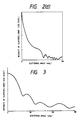
- the scattering distribution, P meas ( ⁇ i ), given on the left side of equation (1) can be obtained by measuring the scattering characteristics of the tissues of a living organ such as the brain illuminated with incident light. If a profile as shown in Fig. 1 is obtained, which represents the dependence of the intensity of scattered light on the scattering angle, the intensities of scattered light at scattering angles ⁇ 1, ⁇ i , and ⁇ n correspond to P meas ( ⁇ 1), P meas ( ⁇ i ) and P meas ( ⁇ n ), respectively.
- the scattering distribution, P( ⁇ i r k ), given in the first term of the right side of equation (1) is that of polystyrene particles having a radius of r k .
- P( ⁇ ,r k ) is calculated by known Mie theory of light scattering but it may also be determined by actual measurements. In this latter case, the scattering characteristics of polystyrene particles are measured for each value of the radius r k and P( ⁇ ,r k ) is determined from the obtained data.
- operations are performed on the matrix equation (1) to determine the concentration of polystyrene particles, C k , for each value of the radius r k .
- Operations with the matrix equation (1) may be performed by the SVD (single value decomposition) method.
- the scattering distribution P( ⁇ i ,r k ) is calculated by Mie theory of light scattering.
- concentration of polystyrene particles, C k is calculated for each value of the radius r k by equation (1).
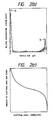
- the scattering angle ⁇ i this calculation is performed over the range of 0-180° with 1° increments, and as for the radius r k , calculation is carried out over the range of 0 - 0.6 ⁇ m with 0.04 ⁇ m increments. The results are as shown graphically in Fig.
- the scattering distribution, P( ⁇ i ,r k ), as determined by Mie theory of light scattering is shown graphically in Fig. 2(c) with the scattering angle plotted on the horizontal axis.
- the horizontal axis of the graph shown in Fig. 2(c) corresponds to the scattering angle and has been normalized in accordance with the SVD method.
- the phantom of the present invention is composed of polystyrene particles having many different values of radius.
- polystyrene particles having many different values of radius In practice, however, it is difficult and economically infeasible to obtain polystyrene particles having many different values of radius and this necessitates a certain kind of approximation.
- the coefficient of scattering ⁇ s is a parameter expressed by the reciprocal of the mean optical pathlength which light travels between successive scatterings, and is given by: where r k is the radius of a particle, C k is the concentration of particles having the radius r k , and S k is the scattering cross section (as determined by Mie theory of light scattering) of the particles of the radius r k . Therefore, if the relative concentration of particles is determined as shown in Fig. 2(b) by performing operations on the matrix equation (1), the absolute concentration of the particles that yield a predetermined coefficient of scattering ⁇ s can be determined.
- the phantom of the present invention has many other applications and three of them are briefly described below.
- physiological saline may be used instead of water as a medium in which polystyrene particles are to be suspended.
- a light-absorbing dye is added in a suitable amount, the absorption characteristics of the phantom can be adjusted independently of its scattering characteristics.
- a phantom having similar optical characteristics to living tissues of interest can be produced in the present invention by merely incorporating different-sized particles in a medium.
- Particularly high stability and reproducibility can be realized by selecting particles whose specific gravity is generally the same as that of the medium (for instance, by suspending polystyrene particles in water).
Landscapes
- General Health & Medical Sciences (AREA)
- Health & Medical Sciences (AREA)
- Life Sciences & Earth Sciences (AREA)
- Chemical & Material Sciences (AREA)
- Analytical Chemistry (AREA)
- Biochemistry (AREA)
- Physics & Mathematics (AREA)
- General Physics & Mathematics (AREA)
- Immunology (AREA)
- Pathology (AREA)
- Investigating Or Analysing Materials By Optical Means (AREA)
- Measurement Of The Respiration, Hearing Ability, Form, And Blood Characteristics Of Living Organisms (AREA)
- Measuring And Recording Apparatus For Diagnosis (AREA)
Applications Claiming Priority (2)
| Application Number | Priority Date | Filing Date | Title |
|---|---|---|---|
| GB8826104A GB2224829A (en) | 1988-11-08 | 1988-11-08 | Phantom having similar optical characteristics to living tissues |
| GB8826104 | 1988-11-08 |
Publications (2)
| Publication Number | Publication Date |
|---|---|
| EP0368436A2 true EP0368436A2 (fr) | 1990-05-16 |
| EP0368436A3 EP0368436A3 (fr) | 1991-05-02 |
Family
ID=10646475
Family Applications (1)
| Application Number | Title | Priority Date | Filing Date |
|---|---|---|---|
| EP19890304479 Withdrawn EP0368436A3 (fr) | 1988-11-08 | 1989-05-04 | Elément fantôme ayant des propriétés optiques similaires aux tissus vivants |
Country Status (3)
| Country | Link |
|---|---|
| EP (1) | EP0368436A3 (fr) |
| JP (1) | JPH02128750A (fr) |
| GB (1) | GB2224829A (fr) |
Cited By (10)
| Publication number | Priority date | Publication date | Assignee | Title |
|---|---|---|---|---|
| NL1006902C2 (nl) * | 1997-09-01 | 1999-03-02 | Stichting Tech Wetenschapp | Optisch fantoom geschikt voor het simuleren van de optische eigenschappen van biologisch materiaal en werkwijze voor het vervaardigen ervan. |
| EP0959353A3 (fr) * | 1998-05-18 | 2001-11-28 | Sumitomo Metal Mining Company Limited | Calibrateur pour appareil de mesure non-destructive de la transmission optique |
| US6807876B2 (en) | 1998-12-04 | 2004-10-26 | Karl Storz Gmbh & Co. Kg | Testing or setting device for a PDD or PDT system, or for training on such a system and tissue phantom |
| WO2005001442A1 (fr) * | 2003-06-27 | 2005-01-06 | Foss Analytical Ab | Etalon de reference pour matiere biologique et procede d'etalonnage |
| US7202091B2 (en) * | 2001-04-11 | 2007-04-10 | Inlight Solutions, Inc. | Optically similar reference samples |
| WO2009056560A3 (fr) * | 2007-11-02 | 2009-09-11 | Ge Healthcare Uk Limited | Fantômes d'imagerie microscopique |
| EP1786326A4 (fr) * | 2004-02-19 | 2010-01-13 | Nu Skin International Inc | Norme d'etalonnage synthetique de reponse photonique de tissus |
| US8117044B2 (en) | 2003-02-20 | 2012-02-14 | Nse Products, Inc. | Bio-photonic feedback control software and database |
| US8116842B2 (en) | 2004-06-10 | 2012-02-14 | Nse Products, Inc. | Bio-photonic feedback control software and database |
| EP2846150A1 (fr) * | 2013-09-06 | 2015-03-11 | DiTest Fahrzeugdiagnose GmbH | Élément de calibrage et procédé de fabrication d'un tel élément de calibrage |
-
1988
- 1988-11-08 GB GB8826104A patent/GB2224829A/en not_active Withdrawn
-
1989
- 1989-05-04 EP EP19890304479 patent/EP0368436A3/fr not_active Withdrawn
- 1989-05-15 JP JP12073189A patent/JPH02128750A/ja active Pending
Non-Patent Citations (3)
| Title |
|---|
| BRITISH JOURNAL OF APPLIED PHYSICS, vol. 3, no. 2, February 1970, pages 221-227; J.P. KRATOHVIL et al.: "Calibration of light-scattering photometers. VII. Calibration by means of colloidal dispersions of Mie scatterers" * |
| MEDICAL PHYSICS, vol. 14, no. 5, September 1987, pages 835-841, New York, US; S.T. FLOCK et al.: "Total attenuation coefficients and scattering phase functions of tissues and phantom materials at 633 nm" * |
| PROCEEDINGS OF S.P.I.E., vol. 808: "Inverse Problems in Optics", 1987, pages 100-104, SPIE, Bellingham, WA, US; O. GLATTER et al.: "Size of shape analysis of elastic light scattering data from large particles (Mie scattering)" * |
Cited By (15)
| Publication number | Priority date | Publication date | Assignee | Title |
|---|---|---|---|---|
| EP0906936A1 (fr) * | 1997-09-01 | 1999-04-07 | Stichting Voor De Technische Wetenschappen | FantÔme optique pour la simulation des propriétés optiques de matériau biologique et procédé pour sa production |
| US6224969B1 (en) | 1997-09-01 | 2001-05-01 | Stichting Voor De Technische Wetenschappen | Optical phantom suitable for stimulating the optical properties of biological material and a method of producing said phantom |
| NL1006902C2 (nl) * | 1997-09-01 | 1999-03-02 | Stichting Tech Wetenschapp | Optisch fantoom geschikt voor het simuleren van de optische eigenschappen van biologisch materiaal en werkwijze voor het vervaardigen ervan. |
| EP0959353A3 (fr) * | 1998-05-18 | 2001-11-28 | Sumitomo Metal Mining Company Limited | Calibrateur pour appareil de mesure non-destructive de la transmission optique |
| US6807876B2 (en) | 1998-12-04 | 2004-10-26 | Karl Storz Gmbh & Co. Kg | Testing or setting device for a PDD or PDT system, or for training on such a system and tissue phantom |
| US7202091B2 (en) * | 2001-04-11 | 2007-04-10 | Inlight Solutions, Inc. | Optically similar reference samples |
| US8117044B2 (en) | 2003-02-20 | 2012-02-14 | Nse Products, Inc. | Bio-photonic feedback control software and database |
| US7057164B2 (en) | 2003-06-27 | 2006-06-06 | Foss Analytical Ab | Reference standard and method for calibration |
| AU2004252392B2 (en) * | 2003-06-27 | 2009-03-26 | Foss Analytical Ab | Reference standard for biological matter and method for calibration |
| WO2005001442A1 (fr) * | 2003-06-27 | 2005-01-06 | Foss Analytical Ab | Etalon de reference pour matiere biologique et procede d'etalonnage |
| EP1786326A4 (fr) * | 2004-02-19 | 2010-01-13 | Nu Skin International Inc | Norme d'etalonnage synthetique de reponse photonique de tissus |
| US8116842B2 (en) | 2004-06-10 | 2012-02-14 | Nse Products, Inc. | Bio-photonic feedback control software and database |
| WO2009056560A3 (fr) * | 2007-11-02 | 2009-09-11 | Ge Healthcare Uk Limited | Fantômes d'imagerie microscopique |
| EP2270476A1 (fr) * | 2007-11-02 | 2011-01-05 | GE Healthcare UK Limited | Fantômes d'imagerie microscopique |
| EP2846150A1 (fr) * | 2013-09-06 | 2015-03-11 | DiTest Fahrzeugdiagnose GmbH | Élément de calibrage et procédé de fabrication d'un tel élément de calibrage |
Also Published As
| Publication number | Publication date |
|---|---|
| GB2224829A (en) | 1990-05-16 |
| GB8826104D0 (en) | 1988-12-14 |
| EP0368436A3 (fr) | 1991-05-02 |
| JPH02128750A (ja) | 1990-05-17 |
Similar Documents
| Publication | Publication Date | Title |
|---|---|---|
| EP0627619B1 (fr) | Procédé et appareil pour mesurer dans un milieu diffusant | |
| EP0627620B1 (fr) | Procédé et dispositif pour déterminer une information interne dans un milieu diffusant | |
| Angmar-Månsson et al. | Optical methods for the detection and quantification of caries | |
| US5413098A (en) | Path constrained spectrophotometer and method for determination of spatial distribution of light or other radiation scattering and absorbing substances in a radiation scattering medium | |
| US6564076B1 (en) | Time-resolved spectroscopic apparatus and method using streak camera | |
| US5139025A (en) | Method and apparatus for in vivo optical spectroscopic examination | |
| JP4490587B2 (ja) | 酸素代謝を組織中で非侵襲的に検出するための装置 | |
| EP1241979B1 (fr) | Procede et dispositif permettant de determiner la repartition locale d'une grandeur de mesure | |
| Berardesca et al. | Bioengineering and the patch test | |
| US7706862B2 (en) | Detecting human cancer through spectral optical imaging using key water absorption wavelengths | |
| Liebert et al. | Multichannel laser-Doppler probe for blood perfusion measurements with depth discrimination | |
| Durkin et al. | Comparison of methods to determine chromophore concentrations from fluorescence spectra of turbid samples | |
| GB2224829A (en) | Phantom having similar optical characteristics to living tissues | |
| JP3154997B2 (ja) | ランダムな媒体を画像化するためのシステム | |
| Tzroya et al. | Extracting Superficial Scattering by Q‐Sensing Technique | |
| Maarek et al. | A simulation method for the study of laser transillumination of biological tissues | |
| JP3195951B2 (ja) | 無侵襲医療用センサ | |
| Kopola et al. | Two-channel fiber optic skin erythema meter | |
| JP3304559B2 (ja) | 光計測方法および装置 | |
| USRE36044E (en) | Path constrained spectrophotometer and method for determination of spatial distribution of light or other radiation scattering and absorbing substances in a radiation scattering medium | |
| JPH0698890A (ja) | 光ct装置 | |
| JP3047188B2 (ja) | 吸光度原点標準器 | |
| Borsboom et al. | Fiber optic scattering monitor for application on bulk biological tissue, paper, and plastic | |
| Yamamoto et al. | Development and application of noninvasive optical topography | |
| Khairullina et al. | Data bank of optical properties of biological tissue and blood in the visible and near infrared spectral region |
Legal Events
| Date | Code | Title | Description |
|---|---|---|---|
| PUAI | Public reference made under article 153(3) epc to a published international application that has entered the european phase |
Free format text: ORIGINAL CODE: 0009012 |
|
| AK | Designated contracting states |
Kind code of ref document: A2 Designated state(s): DE GB |
|
| PUAL | Search report despatched |
Free format text: ORIGINAL CODE: 0009013 |
|
| AK | Designated contracting states |
Kind code of ref document: A3 Designated state(s): DE GB |
|
| STAA | Information on the status of an ep patent application or granted ep patent |
Free format text: STATUS: THE APPLICATION HAS BEEN WITHDRAWN |
|
| 18W | Application withdrawn |
Withdrawal date: 19910514 |
|
| R18W | Application withdrawn (corrected) |
Effective date: 19910514 |
|
| R18W | Application withdrawn (corrected) |
Effective date: 19910514 |