EP0368569B1 - Paketvermittlungsnetzwerk - Google Patents
Paketvermittlungsnetzwerk Download PDFInfo
- Publication number
- EP0368569B1 EP0368569B1 EP89311374A EP89311374A EP0368569B1 EP 0368569 B1 EP0368569 B1 EP 0368569B1 EP 89311374 A EP89311374 A EP 89311374A EP 89311374 A EP89311374 A EP 89311374A EP 0368569 B1 EP0368569 B1 EP 0368569B1
- Authority
- EP
- European Patent Office
- Prior art keywords
- packets
- network
- destination
- output
- priority
- Prior art date
- Legal status (The legal status is an assumption and is not a legal conclusion. Google has not performed a legal analysis and makes no representation as to the accuracy of the status listed.)
- Expired - Lifetime
Links
- 238000004891 communication Methods 0.000 claims description 5
- 230000003111 delayed effect Effects 0.000 claims description 3
- 230000004931 aggregating effect Effects 0.000 claims 3
- 239000000872 buffer Substances 0.000 description 24
- 230000005540 biological transmission Effects 0.000 description 8
- 238000013459 approach Methods 0.000 description 7
- 230000006870 function Effects 0.000 description 6
- 238000013461 design Methods 0.000 description 5
- 230000000694 effects Effects 0.000 description 5
- 238000007781 pre-processing Methods 0.000 description 4
- 230000003134 recirculating effect Effects 0.000 description 4
- 238000001514 detection method Methods 0.000 description 3
- 230000001174 ascending effect Effects 0.000 description 2
- 238000010586 diagram Methods 0.000 description 2
- 239000004744 fabric Substances 0.000 description 2
- 238000000034 method Methods 0.000 description 2
- 230000007935 neutral effect Effects 0.000 description 2
- 230000001143 conditioned effect Effects 0.000 description 1
- 230000007423 decrease Effects 0.000 description 1
- 230000001934 delay Effects 0.000 description 1
- 230000001419 dependent effect Effects 0.000 description 1
- 238000005516 engineering process Methods 0.000 description 1
- 238000003780 insertion Methods 0.000 description 1
- 230000037431 insertion Effects 0.000 description 1
- 230000008520 organization Effects 0.000 description 1
- 230000008569 process Effects 0.000 description 1
- 230000004044 response Effects 0.000 description 1
- 230000011664 signaling Effects 0.000 description 1
Images



Classifications
-
- H—ELECTRICITY
- H04—ELECTRIC COMMUNICATION TECHNIQUE
- H04L—TRANSMISSION OF DIGITAL INFORMATION, e.g. TELEGRAPHIC COMMUNICATION
- H04L12/00—Data switching networks
- H04L12/54—Store-and-forward switching systems
- H04L12/56—Packet switching systems
- H04L12/5601—Transfer mode dependent, e.g. ATM
-
- H—ELECTRICITY
- H04—ELECTRIC COMMUNICATION TECHNIQUE
- H04L—TRANSMISSION OF DIGITAL INFORMATION, e.g. TELEGRAPHIC COMMUNICATION
- H04L47/00—Traffic control in data switching networks
- H04L47/10—Flow control; Congestion control
-
- H—ELECTRICITY
- H04—ELECTRIC COMMUNICATION TECHNIQUE
- H04L—TRANSMISSION OF DIGITAL INFORMATION, e.g. TELEGRAPHIC COMMUNICATION
- H04L49/00—Packet switching elements
- H04L49/10—Packet switching elements characterised by the switching fabric construction
- H04L49/104—Asynchronous transfer mode [ATM] switching fabrics
- H04L49/105—ATM switching elements
- H04L49/106—ATM switching elements using space switching, e.g. crossbar or matrix
-
- H—ELECTRICITY
- H04—ELECTRIC COMMUNICATION TECHNIQUE
- H04L—TRANSMISSION OF DIGITAL INFORMATION, e.g. TELEGRAPHIC COMMUNICATION
- H04L49/00—Packet switching elements
- H04L49/15—Interconnection of switching modules
- H04L49/1553—Interconnection of ATM switching modules, e.g. ATM switching fabrics
-
- H—ELECTRICITY
- H04—ELECTRIC COMMUNICATION TECHNIQUE
- H04L—TRANSMISSION OF DIGITAL INFORMATION, e.g. TELEGRAPHIC COMMUNICATION
- H04L49/00—Packet switching elements
- H04L49/15—Interconnection of switching modules
- H04L49/1553—Interconnection of ATM switching modules, e.g. ATM switching fabrics
- H04L49/1561—Distribute and route fabrics, e.g. Batcher-Banyan
-
- H—ELECTRICITY
- H04—ELECTRIC COMMUNICATION TECHNIQUE
- H04L—TRANSMISSION OF DIGITAL INFORMATION, e.g. TELEGRAPHIC COMMUNICATION
- H04L12/00—Data switching networks
- H04L12/54—Store-and-forward switching systems
- H04L12/56—Packet switching systems
- H04L12/5601—Transfer mode dependent, e.g. ATM
- H04L2012/5638—Services, e.g. multimedia, GOS, QOS
- H04L2012/5646—Cell characteristics, e.g. loss, delay, jitter, sequence integrity
- H04L2012/5649—Cell delay or jitter
-
- H—ELECTRICITY
- H04—ELECTRIC COMMUNICATION TECHNIQUE
- H04L—TRANSMISSION OF DIGITAL INFORMATION, e.g. TELEGRAPHIC COMMUNICATION
- H04L12/00—Data switching networks
- H04L12/54—Store-and-forward switching systems
- H04L12/56—Packet switching systems
- H04L12/5601—Transfer mode dependent, e.g. ATM
- H04L2012/5638—Services, e.g. multimedia, GOS, QOS
- H04L2012/5646—Cell characteristics, e.g. loss, delay, jitter, sequence integrity
- H04L2012/5651—Priority, marking, classes
-
- H—ELECTRICITY
- H04—ELECTRIC COMMUNICATION TECHNIQUE
- H04L—TRANSMISSION OF DIGITAL INFORMATION, e.g. TELEGRAPHIC COMMUNICATION
- H04L12/00—Data switching networks
- H04L12/54—Store-and-forward switching systems
- H04L12/56—Packet switching systems
- H04L12/5601—Transfer mode dependent, e.g. ATM
- H04L2012/5678—Traffic aspects, e.g. arbitration, load balancing, smoothing, buffer management
- H04L2012/5681—Buffer or queue management
Definitions
- This invention relates to wideband switching systems and, more particularly, to packet switching systems.
- a signal packet is a collection of bits that contains information about the packet (such as the destination of the packet) as well as the information that is to be communicated.
- digital signal packets normally have a header section that contains the "administrative" information and a body section that contains the data.
- signal packets contain a trailer section, or both a header and a trailer section.
- the header section normally contains the destination address and other information bits, such as whether the packet contains information, whether the packet is blank, whether the packet contains signaling data, etc.
- a wideband packet switching network performs packet switching through network elements that permit the packets to route themselves to their desired destinations. These elements are a concentrator, a sorting network, a trap network, and an expander.
- packets of a predetermined length are applied synchronously to the concentrator.
- the destination addresses and the activity status within the packets are compared to each other, and based on those comparisons the packets are routed so that the signals at the output ports of the concentrator form two contiguous sets--the set with active signal packets, and the set of blank or inactive signal packets.
- the sorting network that follows sorts the active packet signals at the output of the concentrator in the order of destination addresses.
- the trap network insures that no two packets are destined to the same address. It insures this condition by deactivating (and thereby abandoning) all but one such packet.
- the expander takes the ordered and consecutively placed packets at the output of the trap network and routes the packets, according to their destination address, to the proper output port (destination). This is a very efficient and cost effective design for those applications where only one source can communicate at any one time with a chosen destination. A conventional telephone connection is one such application.
- a distributed prioritized concentrator is disclosed.
- the system described there is directed to efficient communication of packets through a communication channel.
- a communication channel Such a channel, it is assumed, is intentionally designed to have the capacity less than that required to carry all packets at all times. If the channel had been designed to handle the maximum offered load, then at less loaded times the channel would be under utilized and less cost effective.
- a merge network is provided at the channel input that forwards the packets that the channel can handle, and sends the overflow packets to a delay memory. The memory places those packets at the input of the merge network to allow them another chance to be transmitted.
- Means are also disclosed for improving the chances recirculated packets have to be transmitted via a time stamp priority schema.
- This system is very useful in telephone trunk applications, where it is desired to pass through as many packets as the trunk would allow, and the exact line on which the packets flow is not important.
- IEEE GLOBAL TELECOMMUNICATIONS CONFERENCE PROCEEDINGS vol. 1, November 1984, pages 121-125, IEEE, New York, US, A. Huang et al . describe an arrangement for switching different signal sources to different destinations in a very effective manner, regardless of the bandwidths of the different signals. The different bandwidths are accommodated by dividing each signal into a plurality of packet streams where each packet stream is capable of communicating a given bandwidth. This is achieved with demultiplexers.
- a switch fabric is employed akin to the one disclosed in U.S. Patent 4,516,238.
- the outputs of the switch fabric can then be communicated to remote destinations over provisioned channels, and if those channels are provisioned for less than the maximum signal load that may be applied to the channel, a prioritized concentrator is described, akin to the one disclosed in U.S. Patent 4,472,801.
- WO-A-8 602 512 describes an arrangement which accepts packets at any of N input ports, stores the packets in a multi-port memory, and outputs those packets to any one of M output ports of the memory. The outputs selected are determined by destination tag signals in the packets. Control logic exercises dominion over the memory. It effects sorting of the stored data according to destination and arbitrates between packets that seek a common destination so that a packet would not have to wait indefinitely.
- the prior art shows that one can abandon concurrent packets that seek to be transmitted to a destination that is temporarily "spoken for,” and the prior art also shows that one can postpone the sending of a packet when a channel is "occupied", with the postponing being effected by means of a delay memory that recirculates the packets.
- neither method offers an ideal solution when one wishes to permit many packets that are destined to the same user to peacefully coexist within the switching system.
- One suggested approach that does accommodate contemporaneously arriving packets with identical destination addresses is to increase the size of the expander network and to allow a multiple number of "appearances" of the same address to appear at the output of the expander. In this manner a first packet addressed to a certain address would be routed to the first appearance of that address of the expander, the second packet would be routed to the second appearance of that address, and so on. Of course, there would always be the possibility of more packets destined to a particular address than there are appearances of the address, and in that case some packets would have to be abandoned.
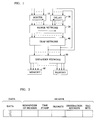
- FIG. 1 depicts a block diagram of a switching network embodying the principles of our invention.
- Sorting network 10 accepts incoming signal packets and sorts those packets according to destination, priority, and time stamp.
- the time stamp can be initialized (e.g., to all 1's) in the incoming packets.
- a horizontal arrow is shown within sorter 10. This arrow depicts the sort direction of the output. That is, at the base of the arrow (on the left) the sorter outputs the packets that are destined to the lowest destination, and those packets are ordered by priority, starting with the highest priority, and followed by time stamp priority, starting with the oldest packets.
- the destination address of the following packets is higher, ending, perhaps, with blank packets that have no destination address.
- the output of sorter 10 is connected to merge network 20.
- Merge network 20 has another source for signal packets, and that source is recirculating delay buffer 30.
- Buffer 30 also has an arrow shown near its output lines, but its direction is opposite to that of the sorter 10 arrow.
- the output of delay buffer 30 is sorted in accordance with the shown arrow and, thus, the input packets of merge network 20 form an ascending and a descending sorted list.
- Network 20 merges the two lists and outputs the merged result in order (by destination, priority and time stamp), as shown by the arrow near the output lines of the merge network.
- the output of merge network 20 is applied trap network 40.
- trap network 40 The function of trap network 40 is to advance the objective of our invention by allowing a certain maximum number of highest order packets addressed to a particular destination to be allowed to continue on to that destination. Specifically, if that maximum number of packets is N, then the N packets having the highest priority and destined to any particular address are grouped and marked for passage, while the remaining packets that are destined to such addresses are marked for recirculation.
- This function is accomplished in network 40 by handling the sorted incoming set of packets (sorted by address beginning with the lowest address, then by priority, and then by time stamp) in subsets defined by the destination address. For each subset, network 40 routes the packets to its left-most available outputs (in FIG.
- trap network 40 contains (1) packets, starting at the left end, that are destined to be "pass-through” packets; (2) packets, starting at the right end, that are destined to be recirculated; and (3) a variable number of "blank" packets in the middle that form a variable-width "neutral” zone. Both the size and the location of the neutral zone between the two sets of packets are completely dependent of the particular set of incoming packets and on the history of the incoming packets.
- buffer 30 is a one packet delay which may simply be a set of registers, with each holding a single packet.
- the size of the portion of trap network 40 outputs that is connected to memory 30 is strictly a design choice, but it is realized that this choice controls the cost and performance of the network. For example, if one expects to handle M incoming packets at a time, then sorter 10 must have M inputs and M outputs. If one believes that no more than half of the packets present within the FIG. 1 network at any one time violate the condition of no more than N packets destined to the same address, then connecting M network 40 outputs to buffer 30, would be a reasonable choice. That, of course, forces network 40 to be 2M wide to permit connection of the M packets from sorter 10 and the M packets from buffer 30.
- buffer 30 is primarily a delay memory.
- memory 30 must include a preprocessing stage that is keyed to the tag bits. Specifically, packets that appear at the input of buffer 30 that are not destined for recirculation should not be accepted while packets that are destined for recirculation should be appropriately conditioned. This preprocessing is necessary because the M right-most outputs of trap network 40 are connected to delay 30, but the number of packets that need to be connected to delay 30 is variable. Hence it is the function of the tag bits in the packets' headers to "inform" delay 30 of which packets are to be delayed and which packets are to be discarded.
- the full set of trap network 40 outputs is connected in FIG. 1 to expander network 50. It is, of course, realized that this is a design choice.
- the outputs of expander 50 are the fixed destination points of the network, and they are divided into sets of N outputs each. That is, the first set (left-most set in FIG. 1) of N outputs of network 50 corresponds to destination address 0, the second set corresponds to destination address 1, etc.
- the function of expander 50 therefore, is to route the incoming packets that are not designated for recirculation to the appropriate output destination ports. That means that expander 50 must preprocess the incoming packets (to ignore the packets that are to be recirculated) and then it must route the packets in the particular fashion that recognizes the fact that N output ports have the same address.
- each set of N outputs of expander 50 is connected to a memory 60, which we call a FIPO memory (first in, priority out).
- Memory 60 is special only in that it is able to be accessed by the priority of the packet signals contained therein. In a sense, memory 60 is a content addressable memory, in fact memory 60 need not be a FIPO memory. Any memory can be employed as long as it serves as a buffer to allow the insertion at some times of as many as N packets while only one packet at a time is accessed and deleted from the buffer.
- the signal packets are as illustrated in FIG. 2, where the packet comprises a header portion and a data portion.
- the header portion contains a two-bit tag field followed by a multi-bit destination field.
- the destination field specifies the output port to which the packet seeks to be routed.
- the FIG. 2 packet contains a priority field followed by a time stamp field.
- a header may have additional fields for purposes other than switching, and those other portions are represented in FIG. 2 by the "remainder of header" field.
- the data field comes last.
- Packets that contain data can, for example, contain "0" in both bits of the tag field, whereas packets that do not contain data (and hence have no destination or priority) advantageously contain a "0" in the first bit and a "1" in the second bit. We call such packets "blank packets”.
- Sort network 10 can be constructed in the manner described, for example, by Batcher in U. S. Patent No. 3,428,946 issued February 18, 1969, or as described by Huang et al. in U. S. Patent No. 4,516,238 issued May 7, 1985.
- the "destination address" would most advantageously include the tag bits that precede the actual destination address, or at least include the second tag bit portion thereof. It may also be remembered that the condition of two or more packets seeking connection to a particular destination is permitted. To accommodate this condition, the sorting of packets should also follow the priority field and, therefore, the sort key in the FIG. 3 embodiment should most advantageously be a concatenation of the tag bit, the destination, and the priority fields. The latter requires, however, that high priority packets have a lower binary value (in the priority field) than low priority packets.
- the time stamp field of incoming packets is initialized to all "1's" so its value is of no importance; and in any event, sort network 10 can exclude the time stamp field from its sort key.
- Merge network 20 is also a sort network, and it can be constructed in the same general manner as is sort network 10.
- One difference, however, is that the input to the merge network is bitonic (ascending and descending), as described above, and that permits the merge network to be realized with fewer sort levels.
- the other difference lies in the sort key.
- the son key of network 20 includes the time stamp field to provide a reasoned treatment of recirculating packets (which was not included in sorter 10). This is described in more detail hereinafter.
- merge network 20 can be observed by perusing through the top two plots of FIG. 3, where plot 110 is the input to network 20 and the plot 120 is the output of network 20. It may be observed that the signal portion of plot 110 which is received from sort network 10 increases to the right (where the signal value represents the destination address) and ends with the value "01" (blank packets), while the signal portion received from memory 30 starts with "01" (blank packets) and thereafter decreases.
- the output of network 20, as depicted by plot 120, is sorted, and increasing to the right.
- trap network 40 accepts packets seeking connection to a particular destination, up to a selected number. It designates those packets for transmission to the expander, and it designates packets over and above the selected number, should they exist, for recirculation. This may be accomplished, as shown in FIG. 4, by a layer of comparators 135. Each output port of merge network 20 (other than the last) is connected to a first input of a comparator 135 with which it is associated and to a second input of a comparator 135 associated with the adjacent output of merge network 20 in the direction of increasing sort key value (to the right). The last output of merge network 20 is connected only to its associated comparator 135. The comparator associated with the first and left-most output of merge network 20 also has only one input.
- the other input is fixed at all “1's” to insure a "0" output (of course, a "0" output can be hard wired without the use of a comparator).
- the second output of merge network 20, line 136 is connected to comparator 135 marked B and to a comparator 135 marked C.
- the third output port of merge network 20, line 137 is also connected to comparator 135 marked C.
- each comparator 135 is either a "1" or a "0". It is a "1" when the destination addresses of the packets applied to the comparator are the same, and it is "0" otherwise.
- Comparator 135 can be constructed from Exclusive OR gates and a flip-flop. Thus, in response to a set of destination addresses 0, 0, 2, 5, 6, 7, 7, 7, 7, 9, 9, 11, 11, 11, 17 the comparators yield the output signal set 0, 1, 0, 0, 0, 0, 1, 1, 1, 1, 1, 0, 1, 0, 1, 1, 0.
- the second layer in the trap network of FIG. 4 is a set of AND gates 140 and buffers 145. Again, there is a buffer 145 associated with each output of merge network 20 as well as an associated AND gate 140. Buffer 145 delays the output of merge network 20 and also provides the two tag bits to AND gate 140.
- Each gate 140 is also connected to its associated comparator and to a fixed number of previous adjacent comparators. This fixed number is equal to the number of packets that is permitted to be applied simultaneously to FIPO memory 60. In FIG. 4, that number is 4, and accordingly, each AND gate 140 is connected to its associated comparator and to 3 previous comparators (when they exist). For example, AND gate 140 marked D is connected to comparators A, B, C, and D.
- the size of buffer 145 is arranged to coincide with the completion of the comparison performed in comparators 135. At that time, the output of AND gate 140 is a "1" only if the tag bits are 00 (non-blank packet) and the two addresses applied to the relevant comparators are equal. That signal, together with the packet signal at the output of buffer 145, is applied to logic circuit 150.
- the outputs of AND gates 140 form the signal set 0, 0, 0, 0, 0, 0, 0, 0, 0, 1, 0, 0, 0, 0, 0, 0, 0.
- the only "1" in the above set is associated with the fifth packet that seeks to be connected to destination "7". This fifth packet must be designated for recirculation and pushed towards the M right-most outputs of merge network 20 for connection to delay block 30 (if M is the number of inputs of block 30).
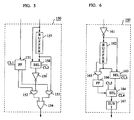
- the FIG. 4 arrangement includes logic circuits 150 for inverting the bits in the sort key field of packets that need to be pushed (in the process changing the tag bits from the value 0 to the value 3). This is accomplished, as shown in FIG. 5, with inverter 159, flip-flop 151 that is clocked to capture the appropriate output of AND gate 140, and AND/OR logic gates 152, 153, and 154 that are interconnected to effect the appropriate signal selections.
- the results at the outputs of logic circuits 150 are shown by way of example in FIG. 3 by plot 115. Therein it may be observed that a number of packets with address 000011 (the 011 being the sought destination and 00 being the tag bits) have been converted to 11100, and a number of packets with address 000101 have been converted to 111010.
- the output signals of logic circuits 150 are applied in FIG. 4 to sorter network 155.
- Network 155 sorts the packets by the sort key field, and that "pushes" the packets that are designated for recirculation to the right-most outputs of trap network 40. This output is depicted by plot 116 in FIG. 3.
- buffer 30 should accept such packets but should reject (e.g., set to blank packet condition) all other incoming packets.
- buffer 30 should accept such packets but should reject (e.g., set to blank packet condition) all other incoming packets.
- This is accomplished in buffer 30 through a preprocessor detection layer of logic circuits 160 illustrated in FIG. 6.
- Each logic circuit 160 inverts the incoming signal with inverter 161 and inputs the incoming packets into buffer 162, for reinsertion of the destination field immediately behind the tag bits.
- the reinsertion of the destination field is accomplished with selector 163 and an appropriate clock signal (CL3), and the output of selector 163 is applied to one input of selector 164.
- the other input of selector 164 receives a clock signal that generates, in effect, a blank packet.
- each logic circuit 160 includes a time stamp decrementer 167.
- the purpose of the decrementer is to enhance probability of packets which have been recirculated a number of times, to be selected for transmission to expander 50 rather than being recirculated again. More specifically, it is intended to balance the probability of such packets over the transmission probability of packets that have been recirculated a fewer number of times.
- the time stamp field contains all "1's" which, in a 6 bit field, for example, corresponds to 63.
- decrementer 167 the value is reduced to 62 and, accordingly, the packet with the time stamp 62 will be found to the left of the packet with time stamp 63 at the output of merge network 20 (all other fields in the sort key being equal).
- the outputs of logic circuit 160 are applied to a sorter (such as sorter 155) which resorts the packets applied to the delay elements in destination addresses order.
- the output of the sorter is applied within block 30 to a one packet delay, which, as indicated earlier, may simply be a set of shift registers, with each register storing one packet.
- the input/output connection of signals of buffer block 30 is such that the right-most output of merge network 40 is connected to the right-most input of buffer 30.
- delay block 30 can be performed within trap network 40, if it is advantageous to do so.
- FIG. 7 illustrates one simple realization for logic circuit 170. It includes a flip-flop 171, an AND gate 172 and a flip-flop 173 that combine to detect and capture the "00" tag bit condition. The output of flip-flop 173 controls a selector 174 that permits transmission only of the active packets destined to expander 50.
- Expander 50 can be constructed in a manner that is similar to that of the expander described in the aforementioned U.S. Patent 4,516,238, where the destination control in the expander is solely the destination field.
- the only potential difficulty with the referenced expander design is the manner by which N outputs that seek connection to a particular destination are routed to this destination. That problem can be addressed, however, with some preprocessing circuitry.
- one approach for solving the "multiple appearances" problem is to multiply the destination address by the allowable number of address occurrences and add a low significance subfield to the destination address (the sort key) which assigns a consecutive number to each occurrence of a destination address.
- the destination addresses can be multiplied by 4 (a two-bit shift in the address) and to each packet there is added a subfield with a value between 0 and 3.
- the destination address of the first packet is converted to address 68 (4 times 17 plus 0) and the destination address of the second packet is converted to 69.
- FIG. 8 is a collection of logic blocks 180.
- the input to the FIG. 8 circuit is the collection of output signals of logic circuits 170. Each input is applied to a comparator layer that is essentially identical to the comparator layer of FIG. 4. The only difference is that the output of comparators 181 of FIG. 8 is reversed from the output of the comparators of FIG. 4. The result is a sequence of "1"s and "0"s, where a "0” marks the first appearance of a particular destination address, and a "1" indicates a subsequent appearance of a particular address.
- the output of a comparator 181 in a FIG. 8 logic segment 180 is connected to AND gates 182 and 183, to one input of a binary adder 184, and to an AND gate 182 in the following logic section 180.
- the output of AND gate 182 is connected to the second input of adder 184 and to AND gate 183 in the following logic section 180, and the output of adder 184 is connected to binary adder 185.
- the output of gate 183 is connected to the second input of adder 185.
- the first four logic sections 180 are shown, with an input set 0, 1, 1, 1 at the output of the comparators. This corresponds to four appearances of the lowest value destination address.
- the "0" output of the first comparator propagates to the two adders of the first and second sections 180, to adder 184 of the third section 180, and to adder 185 of the fourth section 180.
- the output of adders 184 form the set 0, 1, 2, 2, and the outputs of adders 185 form the set 0, 1, 2, 3.
- This output set is combined with the existing sort key appearing on lines 175 next to the adder 185 output lines, and applied to an expander network 186 constructed in a conventional manner, as indicated above.
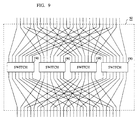
- FIG. 9 An alternative embodiment is shown in FIG. 9. It comprises N adjacent (in this case, four) expanders 190 that are interconnected so that the input signals are cyclically assigned to the four expanders. That is, the 1 st , 5 st , 9 st ,etc., inputs are applied to the first expander, the 2 nd , 6 st , 10 st , etc., inputs are applied to the second expander, and so on.
- the outputs of the expanders are grouped and, as with the inputs, the outputs in each group are cyclically derived from the four expanders.
- the 1 st output of the four expanders supply the 1 st group
- the 2 nd output of the four expanders supply the 2 nd group
- the outputs in each group are sorted on the priority and time fields in a circular manner.
- a four-wide merge network can set the priority to a fixed pattern.
- the output of expander network 50 is applied in the FIG. 1 embodiment to FIPO memory 60.
- memory 60 is a "first in - priority out" memory. It can be constructed in a number of ways. One approach may be to employ a prioritized concentrator circuit like the one disclosed by A. Huang in U. S. Patent 4,472,801 issued September 18, 1984. Specifically, one can employ a sort network with an N + M number of inputs, where N is the number of input ports in memory 60 and M is the number of packets that memory 60 is intended to store. The sort key field in this network is the priority field of the packets and thus the sort network outputs the applied packets with the highest priority packet at one end and the lowest priority packets at the other end.
- the output with the highest priority is also the output of FIPO memory 60, while the next M outputs are each applied to a one packet delay element (e.g., a shift register).
- the outputs of the M delay elements are connected to the M inputs of the sort network, leaving N-1 outputs of the sort network unconnected. These are the overflow outputs of the FIPO memory.
- a slightly more complex realization that requires less hardware can be implemented by sorting (by priority) the packets that enter FIPO memory 60. This would permit using a merge network instead of a sort network.
Landscapes
- Engineering & Computer Science (AREA)
- Computer Networks & Wireless Communication (AREA)
- Signal Processing (AREA)
- Physics & Mathematics (AREA)
- Mathematical Physics (AREA)
- Data Exchanges In Wide-Area Networks (AREA)
Claims (8)
- Ein Netz zur Wegelenkung von Paketen, die eine Zielbezeichnung und eine Prioritätsbezeichnung enthalten, wobei Signalpakete an eine Sortiereinheit (10) angelegt werden, ein Verzögerungsnetzwerk (30) verzögerte Pakete bereitstellt, und ein Mischnetzwerk (20), das auf eine von der Sortiereinheit gelieferte sortierte Paketmenge und eine vom Verzögerungsnetzwerk gelieferte verzögerte Paketmenge reagiert, gekennzeichnet durch:
ein Trennungsnetzwerk (40), das auf Ausgangssignale vom besagten Mischnetzwerk reagiert, um (a) Paketmengen mit einer gemeinsamen Zielbezeichnung zu kennzeichnen und (b) jede der besagten Paketmengen in eine erste Teilmenge und eine zweite Teilmenge zu trennen, so daß die Anzahl von Paketen in der besagten zweiten Teilmenge Null ist, solange die Anzahl von Paketen in der ersten Teilmenge weniger als eine vorgewählte Anzahl N ist, wobei N größer als 1 ist, und die Prioritätsbezeichnung von Paketen in der besagten ersten Teilmenge höher als die Prioritätsbezeichnung von Paketen in der besagten zweiten Teilmenge ist;
das auf Ausgaben des besagten Trennungsnetzwerks reagierende Verzögerungsnetzwerk (30);
ein Erweiterungsnetzwerk (50), bei dem als Reaktion auf Ausgangssignale des besagten Trennungsnetzwerks jede Zieladresse N-mal auftritt, zur Wegelenkung von Paketen der besagten ersten Teilmengen entsprechend den Zieladressen von vermittelten Paketen; und
eine Mehrzahl von Speichermitteln (60), die jeweils einen Ausgang und N mit den besagten Erscheinungsfällen eines gewählten Ziels am Ausgang des besagten Erweiterungsnetzes verbundene Eingänge zum Zuführen von Paketen zum besagten Ausgang aufweisen. - Das Netz nach Anspruch 1, wobei das besagte Trennungsnetzwerk auch Pakete von den besagten zweiten Teilmengen am Ausgang des besagten Trennungsnetzwerks gruppiert.
- Das Netz nach Anspruch 1, wobei das besagte Trennungsnetzwerk Mittel (150) zum Anfügen einer Markierungsbezeichnung an für das besagte Verzögerungsnetzwerk bestimmte Pakete zum Bilden von markierten Paketen umfaßt.
- Das Netz nach Anspruch 3, wobei das besagte Trennungsnetzwerk weiterhin Mittel (155) zum Sortieren von markierten Paketen nach Priorität enthält.
- Das Netz nach Anspruch 4, wobei das besagte Trennungsnetzwerk weiterhin Mittel zum Kennzeichnen einer ausgewählten Anzahl von Paketen mit höchster Priorität unter den sortierten markierten Paketen, sowie Mittel (155) zum Sortieren der besagten ausgewählten Anzahl von Paketen mit höchster Priorität nach Ziel enthält.
- Das Netz nach Anspruch 1, wobei
das besagte Verzögerungsnetzwerk Mittel zum Kennzeichnen eines ausgewählten Anteils der besagten das besagte Verzögerungsnetzwerk (167) durchlaufenden Pakete als Zeitmarkenfeld und zum Ändern des Inhalts des besagten Zeitmarkenfelds zur Anzeige des Durchlaufs der das besagte Verzögerungsmittel durchlaufenden Pakete enthält; und
das besagte Trennungsnetzwerk (40) bei der Bestimmung des besagten Trennens jeder der besagten Paketmengen in eine erste Teilmenge und eine zweite Teilmenge Prioritäts- und Zeitmarkenfelder kombiniert. - Das Netz nach Anspruch 1, wobei jedes der besagten Speichermittel seinem Ausgang Pakete in der Prioritätsreihenfolge von dem besagten Speichermittel zugeführten Paketen zuliefert.
- Eine Kommunikationsvermittlungseinrichtung zum Vermitteln von Eingangsdatenmeldungen mit veränderlichem Vorrang an entsprechende einer Mehrzahl von Zielen, und mit Mitteln (20) zum Zusammenführen von gegenwärtig empfangenen Meldungen mit vorher empfangenen Meldungen, die nicht an ihre entsprechenden Ziele weitergegeben worden sind, um eine Menge von zusammengeführten Meldungen zu bilden (Ausgang von 20), Meldungsauawählmitteln (40), Meldungsspeichermitteln (30) und Mitteln (50,60) zum Übertragen der ausgewählten Meldungen an entsprechende Ziele entsprechend ihrem Vorrang, dadurch gekennzeichnet, daß
das Meldungsauswählmittel ein Mittel zum Auswählen - für jedes Ziel - der N Meldungen mit dem höchsten Vorrang unter den zusammengeführten Meldungen mit dem besagten jeweiligen Ziel ist, wobei N eine vorgewählte Nummer größer als 1 ist, und
das Meldungsspeichermittel ein Mittel zum Speichern der T Meldungen mit dem größten Vorrang unter den derartig vom besagten Meldungsauswählmittel ausgewählten zusammengeführten Meldungen ist, wobei T eine weitere vorgewählte Nummer darstellt, wodurch die gespeicherten Meldungen für spätere Zusammenführungen durch die besagten Mittel zum Zusammenführen zur Verfügung gestellt werden.
Applications Claiming Priority (2)
| Application Number | Priority Date | Filing Date | Title |
|---|---|---|---|
| US07/267,606 US4891803A (en) | 1988-11-07 | 1988-11-07 | Packet switching network |
| US267606 | 1988-11-07 |
Publications (3)
| Publication Number | Publication Date |
|---|---|
| EP0368569A2 EP0368569A2 (de) | 1990-05-16 |
| EP0368569A3 EP0368569A3 (de) | 1991-07-24 |
| EP0368569B1 true EP0368569B1 (de) | 1995-07-12 |
Family
ID=23019482
Family Applications (1)
| Application Number | Title | Priority Date | Filing Date |
|---|---|---|---|
| EP89311374A Expired - Lifetime EP0368569B1 (de) | 1988-11-07 | 1989-11-02 | Paketvermittlungsnetzwerk |
Country Status (5)
| Country | Link |
|---|---|
| US (1) | US4891803A (de) |
| EP (1) | EP0368569B1 (de) |
| JP (1) | JP2846369B2 (de) |
| CA (1) | CA1320258C (de) |
| DE (1) | DE68923426T2 (de) |
Families Citing this family (33)
| Publication number | Priority date | Publication date | Assignee | Title |
|---|---|---|---|---|
| US5365519A (en) | 1991-03-05 | 1994-11-15 | Hitachi, Ltd. | ATM switch1ng system connectable to I/O links having different transmission rates |
| US6330240B1 (en) * | 1987-04-24 | 2001-12-11 | Hitachi, Ltd. | ATM cell switching system |
| JPH0758963B2 (ja) * | 1989-01-27 | 1995-06-21 | 日本電気株式会社 | セル交換装置 |
| CA2012425C (en) * | 1989-03-17 | 1996-12-24 | Atsuo Itoh | Packet switching system having arbitrative function for competing packets |
| US5148428A (en) * | 1989-05-02 | 1992-09-15 | Bell Communictions Research, Inc. | Modular architecture for very large packet switch |
| JP2531275B2 (ja) * | 1989-09-29 | 1996-09-04 | 日本電気株式会社 | Atmセル転送方式 |
| DE59106783D1 (de) * | 1990-12-24 | 1995-11-30 | Siemens Ag | Verfahren zur vermittlung von nachrichten. |
| US5253251A (en) * | 1991-01-08 | 1993-10-12 | Nec Corporation | Switching system with time-stamped packet distribution input stage and packet sequencing output stage |
| EP0562184B1 (de) * | 1992-03-27 | 1998-10-28 | Alcatel | Einrichtung für die Erzeugung von Mehradresspaketen in einem Paketvermittlungssystem |
| US5305311A (en) * | 1992-05-20 | 1994-04-19 | Xerox Corporation | Copy network providing multicast capabilities in a broadband ISDN fast packet switch suitable for use in a local area network |
| JPH0637797A (ja) * | 1992-05-20 | 1994-02-10 | Xerox Corp | パケット交換網の予約リング機構 |
| US5291482A (en) * | 1992-07-24 | 1994-03-01 | At&T Bell Laboratories | High bandwidth packet switch |
| US5416769A (en) * | 1993-07-13 | 1995-05-16 | At&T Corp. | Controlled-feedback packet switching system |
| US5598581A (en) * | 1993-08-06 | 1997-01-28 | Cisco Sytems, Inc. | Variable latency cut through bridge for forwarding packets in response to user's manual adjustment of variable latency threshold point while the bridge is operating |
| US5473607A (en) * | 1993-08-09 | 1995-12-05 | Grand Junction Networks, Inc. | Packet filtering for data networks |
| FR2729040B1 (fr) * | 1994-12-29 | 1997-01-31 | Alcatel Nv | Matrice de commutation photonique |
| GB9500696D0 (en) * | 1995-01-13 | 1995-03-08 | Plessey Telecomm | In access to obscure and remote services |
| US5689508A (en) * | 1995-12-21 | 1997-11-18 | Xerox Corporation | Reservation ring mechanism for providing fair queued access in a fast packet switch networks |
| US5841775A (en) * | 1996-07-16 | 1998-11-24 | Huang; Alan | Scalable switching network |
| US6026092A (en) * | 1996-12-31 | 2000-02-15 | Northern Telecom Limited | High performance fault tolerant switching system for multimedia satellite and terrestrial communications networks |
| KR100246627B1 (ko) * | 1997-08-27 | 2000-03-15 | 정선종 | 트래픽 흐름제어 및 감시기능을 갖는 멀티채널 패킷 스위칭 장치 |
| US20040042400A1 (en) * | 1998-12-18 | 2004-03-04 | Telefonaktiebolaget Lm Ericsson | Connection admission control based on bandwidth and buffer usage |
| US20040190506A1 (en) * | 2003-03-24 | 2004-09-30 | International Business Machines Corp. | Method and apparatus for performing complex pattern matching in a data stream within a computer network |
| US20070260728A1 (en) * | 2006-05-08 | 2007-11-08 | Finisar Corporation | Systems and methods for generating network diagnostic statistics |
| US8107822B2 (en) * | 2005-05-20 | 2012-01-31 | Finisar Corporation | Protocols for out-of-band communication |
| US7899057B2 (en) * | 2006-04-28 | 2011-03-01 | Jds Uniphase Corporation | Systems for ordering network packets |
| US7823185B1 (en) * | 2005-06-08 | 2010-10-26 | Federal Home Loan Mortgage Corporation | System and method for edge management of grid environments |
| US7881258B2 (en) * | 2006-03-22 | 2011-02-01 | Sibeam, Inc. | Mechanism for streaming media data over wideband wireless networks |
| US8213333B2 (en) * | 2006-07-12 | 2012-07-03 | Chip Greel | Identifying and resolving problems in wireless device configurations |
| US8526821B2 (en) | 2006-12-29 | 2013-09-03 | Finisar Corporation | Transceivers for testing networks and adapting to device changes |
| US20100241638A1 (en) * | 2009-03-18 | 2010-09-23 | O'sullivan Patrick Joseph | Sorting contacts |
| US10523596B1 (en) * | 2015-02-06 | 2019-12-31 | Xilinx, Inc. | Circuits for and methods of merging streams of data to generate sorted output data |
| US11748281B2 (en) | 2020-10-30 | 2023-09-05 | Hewlett Packard Enterprise Development Lp | Remote memory access using memory address templates |
Family Cites Families (5)
| Publication number | Priority date | Publication date | Assignee | Title |
|---|---|---|---|---|
| US3428946A (en) * | 1965-08-26 | 1969-02-18 | Goodyear Aerospace Corp | Means for merging data |
| US4516238A (en) * | 1983-03-28 | 1985-05-07 | At&T Bell Laboratories | Self-routing switching network |
| US4472801A (en) * | 1983-03-28 | 1984-09-18 | At&T Bell Laboratories | Distributed prioritized concentrator |
| US4630258A (en) * | 1984-10-18 | 1986-12-16 | Hughes Aircraft Company | Packet switched multiport memory NXM switch node and processing method |
| US4761780A (en) * | 1986-12-22 | 1988-08-02 | Bell Communications Research, Inc. | Enhanced efficiency Batcher-Banyan packet switch |
-
1988
- 1988-11-07 US US07/267,606 patent/US4891803A/en not_active Expired - Lifetime
-
1989
- 1989-09-26 CA CA000613179A patent/CA1320258C/en not_active Expired - Fee Related
- 1989-11-02 EP EP89311374A patent/EP0368569B1/de not_active Expired - Lifetime
- 1989-11-02 DE DE68923426T patent/DE68923426T2/de not_active Expired - Fee Related
- 1989-11-07 JP JP28807389A patent/JP2846369B2/ja not_active Expired - Fee Related
Also Published As
| Publication number | Publication date |
|---|---|
| EP0368569A3 (de) | 1991-07-24 |
| DE68923426T2 (de) | 1995-12-07 |
| US4891803A (en) | 1990-01-02 |
| JP2846369B2 (ja) | 1999-01-13 |
| DE68923426D1 (de) | 1995-08-17 |
| JPH02174341A (ja) | 1990-07-05 |
| EP0368569A2 (de) | 1990-05-16 |
| CA1320258C (en) | 1993-07-13 |
Similar Documents
| Publication | Publication Date | Title |
|---|---|---|
| EP0368569B1 (de) | Paketvermittlungsnetzwerk | |
| US5274642A (en) | Output buffered packet switch with a flexible buffer management scheme | |
| US5636210A (en) | Asynchronous transfer mode packet switch | |
| Garcia-Haro et al. | ATM shared-memory switching architectures | |
| JP2996353B2 (ja) | 非同期時分割多重セルのスイッチングのための多重路自己経路選択交換網 | |
| US4893304A (en) | Broadband packet switch with combined queuing | |
| US4899334A (en) | Self-routing multistage switching network for fast packet switching system | |
| CA2160888C (en) | Multicast virtual circuit switch using cell recycling | |
| CA1319410C (en) | Self routing packet switching network architecture | |
| WO1992017990A1 (en) | Non-blocking multi-cast switching system | |
| US6757284B1 (en) | Method and apparatus for pipeline sorting of ordered streams of data items | |
| US5504741A (en) | Data queuing apparatus and ATM cell switch based on shifting and searching | |
| US6952402B1 (en) | Apparatus and method for manipulating packet ordering over parallel links of a crossbar based switch fabric | |
| EP0809380A2 (de) | Vermittlungssystem zur Vermittlung einer Zelle mit fester Länge | |
| US6970466B2 (en) | Packet switching apparatus | |
| WO1993006675A1 (en) | Nonblocking multicast fast packet/circuit switching networks | |
| Sharma | Review of recent shared memory based ATM switches | |
| CA2012425C (en) | Packet switching system having arbitrative function for competing packets | |
| CN1719805A (zh) | 3D Torus交换网络中报文保序的多路径路由方法 | |
| US6496513B1 (en) | Traffic priority control system for a concentration-type ATM switch | |
| KR100378588B1 (ko) | 대용량화가 가능한 다중 경로 비동기 전송 모드 스위치 및 셀구조 | |
| CA2227655A1 (en) | The single-queue switch | |
| White | A quantitative comparison of architectures for ATM switching systems | |
| Awdeh et al. | A fair and simple mechanism for contention resolution in Batcher-Banyan networks | |
| Tong et al. | A Multi-Stage Interconnection Network with Packet Diverting and Limited Combining Capabilities |
Legal Events
| Date | Code | Title | Description |
|---|---|---|---|
| PUAI | Public reference made under article 153(3) epc to a published international application that has entered the european phase |
Free format text: ORIGINAL CODE: 0009012 |
|
| AK | Designated contracting states |
Kind code of ref document: A2 Designated state(s): DE FR GB |
|
| PUAL | Search report despatched |
Free format text: ORIGINAL CODE: 0009013 |
|
| AK | Designated contracting states |
Kind code of ref document: A3 Designated state(s): DE FR GB |
|
| 17P | Request for examination filed |
Effective date: 19920115 |
|
| 17Q | First examination report despatched |
Effective date: 19931110 |
|
| RAP3 | Party data changed (applicant data changed or rights of an application transferred) |
Owner name: AT&T CORP. |
|
| GRAA | (expected) grant |
Free format text: ORIGINAL CODE: 0009210 |
|
| AK | Designated contracting states |
Kind code of ref document: B1 Designated state(s): DE FR GB |
|
| ET | Fr: translation filed | ||
| REF | Corresponds to: |
Ref document number: 68923426 Country of ref document: DE Date of ref document: 19950817 |
|
| PLBE | No opposition filed within time limit |
Free format text: ORIGINAL CODE: 0009261 |
|
| STAA | Information on the status of an ep patent application or granted ep patent |
Free format text: STATUS: NO OPPOSITION FILED WITHIN TIME LIMIT |
|
| 26N | No opposition filed | ||
| REG | Reference to a national code |
Ref country code: GB Ref legal event code: IF02 |
|
| PGFP | Annual fee paid to national office [announced via postgrant information from national office to epo] |
Ref country code: FR Payment date: 20021023 Year of fee payment: 14 |
|
| PGFP | Annual fee paid to national office [announced via postgrant information from national office to epo] |
Ref country code: GB Payment date: 20021029 Year of fee payment: 14 |
|
| PGFP | Annual fee paid to national office [announced via postgrant information from national office to epo] |
Ref country code: DE Payment date: 20021205 Year of fee payment: 14 |
|
| PG25 | Lapsed in a contracting state [announced via postgrant information from national office to epo] |
Ref country code: GB Free format text: LAPSE BECAUSE OF NON-PAYMENT OF DUE FEES Effective date: 20031102 |
|
| PG25 | Lapsed in a contracting state [announced via postgrant information from national office to epo] |
Ref country code: DE Free format text: LAPSE BECAUSE OF NON-PAYMENT OF DUE FEES Effective date: 20040602 |
|
| GBPC | Gb: european patent ceased through non-payment of renewal fee |
Effective date: 20031102 |
|
| PG25 | Lapsed in a contracting state [announced via postgrant information from national office to epo] |
Ref country code: FR Free format text: LAPSE BECAUSE OF NON-PAYMENT OF DUE FEES Effective date: 20040730 |
|
| REG | Reference to a national code |
Ref country code: FR Ref legal event code: ST |