EP0368600A1 - Armiertes Pflaster und seine Bewehrung - Google Patents
Armiertes Pflaster und seine Bewehrung Download PDFInfo
- Publication number
- EP0368600A1 EP0368600A1 EP89311490A EP89311490A EP0368600A1 EP 0368600 A1 EP0368600 A1 EP 0368600A1 EP 89311490 A EP89311490 A EP 89311490A EP 89311490 A EP89311490 A EP 89311490A EP 0368600 A1 EP0368600 A1 EP 0368600A1
- Authority
- EP
- European Patent Office
- Prior art keywords
- fabric
- mesh structure
- strands
- laminate
- ground
- Prior art date
- Legal status (The legal status is an assumption and is not a legal conclusion. Google has not performed a legal analysis and makes no representation as to the accuracy of the status listed.)
- Granted
Links
- 230000003014 reinforcing effect Effects 0.000 title claims description 6
- 230000002787 reinforcement Effects 0.000 title description 3
- 239000004744 fabric Substances 0.000 claims abstract description 63
- 239000000463 material Substances 0.000 claims abstract description 18
- 239000004033 plastic Substances 0.000 claims abstract description 16
- 229920003023 plastic Polymers 0.000 claims abstract description 16
- 239000000853 adhesive Substances 0.000 claims abstract description 14
- 230000001070 adhesive effect Effects 0.000 claims abstract description 14
- 239000007788 liquid Substances 0.000 claims abstract description 7
- 238000000034 method Methods 0.000 claims description 19
- 238000003825 pressing Methods 0.000 claims description 3
- 239000010426 asphalt Substances 0.000 abstract description 33
- 239000004746 geotextile Substances 0.000 abstract description 2
- 230000007480 spreading Effects 0.000 abstract description 2
- 238000003892 spreading Methods 0.000 abstract description 2
- 238000005507 spraying Methods 0.000 abstract 1
- 239000010410 layer Substances 0.000 description 11
- 239000011230 binding agent Substances 0.000 description 5
- 229920000728 polyester Polymers 0.000 description 4
- 239000004567 concrete Substances 0.000 description 3
- 238000010276 construction Methods 0.000 description 3
- 239000000839 emulsion Substances 0.000 description 3
- 238000002844 melting Methods 0.000 description 3
- 230000008018 melting Effects 0.000 description 3
- 239000000203 mixture Substances 0.000 description 3
- 239000002904 solvent Substances 0.000 description 3
- 239000004831 Hot glue Substances 0.000 description 2
- 239000004743 Polypropylene Substances 0.000 description 2
- 244000007853 Sarothamnus scoparius Species 0.000 description 2
- 238000001816 cooling Methods 0.000 description 2
- 238000005336 cracking Methods 0.000 description 2
- 238000010030 laminating Methods 0.000 description 2
- -1 polypropylene Polymers 0.000 description 2
- 229920001155 polypropylene Polymers 0.000 description 2
- 238000007711 solidification Methods 0.000 description 2
- 230000008023 solidification Effects 0.000 description 2
- 230000009471 action Effects 0.000 description 1
- 230000015572 biosynthetic process Effects 0.000 description 1
- 230000001680 brushing effect Effects 0.000 description 1
- 230000008859 change Effects 0.000 description 1
- 239000011248 coating agent Substances 0.000 description 1
- 238000000576 coating method Methods 0.000 description 1
- 230000001427 coherent effect Effects 0.000 description 1
- 239000002131 composite material Substances 0.000 description 1
- 230000000694 effects Effects 0.000 description 1
- 238000002474 experimental method Methods 0.000 description 1
- 239000003365 glass fiber Substances 0.000 description 1
- 239000002184 metal Substances 0.000 description 1
- 238000012986 modification Methods 0.000 description 1
- 230000004048 modification Effects 0.000 description 1
- 229920000642 polymer Polymers 0.000 description 1
- 230000008569 process Effects 0.000 description 1
- 239000002994 raw material Substances 0.000 description 1
- 230000000717 retained effect Effects 0.000 description 1
- 229920002379 silicone rubber Polymers 0.000 description 1
- 239000004945 silicone rubber Substances 0.000 description 1
- 239000007921 spray Substances 0.000 description 1
- 239000004575 stone Substances 0.000 description 1
- 239000000126 substance Substances 0.000 description 1
- 239000002344 surface layer Substances 0.000 description 1
Images
Classifications
-
- B—PERFORMING OPERATIONS; TRANSPORTING
- B32—LAYERED PRODUCTS
- B32B—LAYERED PRODUCTS, i.e. PRODUCTS BUILT-UP OF STRATA OF FLAT OR NON-FLAT, e.g. CELLULAR OR HONEYCOMB, FORM
- B32B5/00—Layered products characterised by the non- homogeneity or physical structure, i.e. comprising a fibrous, filamentary, particulate or foam layer; Layered products characterised by having a layer differing constitutionally or physically in different parts
- B32B5/22—Layered products characterised by the non- homogeneity or physical structure, i.e. comprising a fibrous, filamentary, particulate or foam layer; Layered products characterised by having a layer differing constitutionally or physically in different parts characterised by the presence of two or more layers which are next to each other and are fibrous, filamentary, formed of particles or foamed
- B32B5/24—Layered products characterised by the non- homogeneity or physical structure, i.e. comprising a fibrous, filamentary, particulate or foam layer; Layered products characterised by having a layer differing constitutionally or physically in different parts characterised by the presence of two or more layers which are next to each other and are fibrous, filamentary, formed of particles or foamed one layer being a fibrous or filamentary layer
- B32B5/26—Layered products characterised by the non- homogeneity or physical structure, i.e. comprising a fibrous, filamentary, particulate or foam layer; Layered products characterised by having a layer differing constitutionally or physically in different parts characterised by the presence of two or more layers which are next to each other and are fibrous, filamentary, formed of particles or foamed one layer being a fibrous or filamentary layer another layer next to it also being fibrous or filamentary
-
- B—PERFORMING OPERATIONS; TRANSPORTING
- B29—WORKING OF PLASTICS; WORKING OF SUBSTANCES IN A PLASTIC STATE IN GENERAL
- B29C—SHAPING OR JOINING OF PLASTICS; SHAPING OF MATERIAL IN A PLASTIC STATE, NOT OTHERWISE PROVIDED FOR; AFTER-TREATMENT OF THE SHAPED PRODUCTS, e.g. REPAIRING
- B29C70/00—Shaping composites, i.e. plastics material comprising reinforcements, fillers or preformed parts, e.g. inserts
- B29C70/68—Shaping composites, i.e. plastics material comprising reinforcements, fillers or preformed parts, e.g. inserts by incorporating or moulding on preformed parts, e.g. inserts or layers, e.g. foam blocks
- B29C70/82—Forcing wires, nets or the like partially or completely into the surface of an article, e.g. by cutting and pressing
-
- B—PERFORMING OPERATIONS; TRANSPORTING
- B32—LAYERED PRODUCTS
- B32B—LAYERED PRODUCTS, i.e. PRODUCTS BUILT-UP OF STRATA OF FLAT OR NON-FLAT, e.g. CELLULAR OR HONEYCOMB, FORM
- B32B5/00—Layered products characterised by the non- homogeneity or physical structure, i.e. comprising a fibrous, filamentary, particulate or foam layer; Layered products characterised by having a layer differing constitutionally or physically in different parts
- B32B5/02—Layered products characterised by the non- homogeneity or physical structure, i.e. comprising a fibrous, filamentary, particulate or foam layer; Layered products characterised by having a layer differing constitutionally or physically in different parts characterised by structural features of a fibrous or filamentary layer
- B32B5/028—Net structure, e.g. spaced apart filaments bonded at the crossing points
-
- E—FIXED CONSTRUCTIONS
- E01—CONSTRUCTION OF ROADS, RAILWAYS, OR BRIDGES
- E01C—CONSTRUCTION OF, OR SURFACES FOR, ROADS, SPORTS GROUNDS, OR THE LIKE; MACHINES OR AUXILIARY TOOLS FOR CONSTRUCTION OR REPAIR
- E01C11/00—Details of pavings
- E01C11/005—Methods or materials for repairing pavings
-
- E—FIXED CONSTRUCTIONS
- E01—CONSTRUCTION OF ROADS, RAILWAYS, OR BRIDGES
- E01C—CONSTRUCTION OF, OR SURFACES FOR, ROADS, SPORTS GROUNDS, OR THE LIKE; MACHINES OR AUXILIARY TOOLS FOR CONSTRUCTION OR REPAIR
- E01C11/00—Details of pavings
- E01C11/16—Reinforcements
- E01C11/165—Reinforcements particularly for bituminous or rubber- or plastic-bound pavings
-
- B—PERFORMING OPERATIONS; TRANSPORTING
- B32—LAYERED PRODUCTS
- B32B—LAYERED PRODUCTS, i.e. PRODUCTS BUILT-UP OF STRATA OF FLAT OR NON-FLAT, e.g. CELLULAR OR HONEYCOMB, FORM
- B32B2305/00—Condition, form or state of the layers or laminate
- B32B2305/38—Meshes, lattices or nets
-
- B—PERFORMING OPERATIONS; TRANSPORTING
- B32—LAYERED PRODUCTS
- B32B—LAYERED PRODUCTS, i.e. PRODUCTS BUILT-UP OF STRATA OF FLAT OR NON-FLAT, e.g. CELLULAR OR HONEYCOMB, FORM
- B32B2307/00—Properties of the layers or laminate
- B32B2307/50—Properties of the layers or laminate having particular mechanical properties
- B32B2307/514—Oriented
- B32B2307/518—Oriented bi-axially
-
- Y—GENERAL TAGGING OF NEW TECHNOLOGICAL DEVELOPMENTS; GENERAL TAGGING OF CROSS-SECTIONAL TECHNOLOGIES SPANNING OVER SEVERAL SECTIONS OF THE IPC; TECHNICAL SUBJECTS COVERED BY FORMER USPC CROSS-REFERENCE ART COLLECTIONS [XRACs] AND DIGESTS
- Y10—TECHNICAL SUBJECTS COVERED BY FORMER USPC
- Y10T—TECHNICAL SUBJECTS COVERED BY FORMER US CLASSIFICATION
- Y10T428/00—Stock material or miscellaneous articles
- Y10T428/24—Structurally defined web or sheet [e.g., overall dimension, etc.]
- Y10T428/24802—Discontinuous or differential coating, impregnation or bond [e.g., artwork, printing, retouched photograph, etc.]
- Y10T428/24826—Spot bonds connect components
-
- Y—GENERAL TAGGING OF NEW TECHNOLOGICAL DEVELOPMENTS; GENERAL TAGGING OF CROSS-SECTIONAL TECHNOLOGIES SPANNING OVER SEVERAL SECTIONS OF THE IPC; TECHNICAL SUBJECTS COVERED BY FORMER USPC CROSS-REFERENCE ART COLLECTIONS [XRACs] AND DIGESTS
- Y10—TECHNICAL SUBJECTS COVERED BY FORMER USPC
- Y10T—TECHNICAL SUBJECTS COVERED BY FORMER US CLASSIFICATION
- Y10T442/00—Fabric [woven, knitted, or nonwoven textile or cloth, etc.]
- Y10T442/10—Scrim [e.g., open net or mesh, gauze, loose or open weave or knit, etc.]
- Y10T442/102—Woven scrim
- Y10T442/159—Including a nonwoven fabric which is not a scrim
-
- Y—GENERAL TAGGING OF NEW TECHNOLOGICAL DEVELOPMENTS; GENERAL TAGGING OF CROSS-SECTIONAL TECHNOLOGIES SPANNING OVER SEVERAL SECTIONS OF THE IPC; TECHNICAL SUBJECTS COVERED BY FORMER USPC CROSS-REFERENCE ART COLLECTIONS [XRACs] AND DIGESTS
- Y10—TECHNICAL SUBJECTS COVERED BY FORMER USPC
- Y10T—TECHNICAL SUBJECTS COVERED BY FORMER US CLASSIFICATION
- Y10T442/00—Fabric [woven, knitted, or nonwoven textile or cloth, etc.]
- Y10T442/10—Scrim [e.g., open net or mesh, gauze, loose or open weave or knit, etc.]
- Y10T442/102—Woven scrim
- Y10T442/172—Coated or impregnated
- Y10T442/174—Including particulate material other than fiber in coating or impregnation
Definitions
- the invention relates to a method of reinforcing a paved surface, and also to a reinforcement for use in the method.
- Asphalt is used herein in the general sense to refer to an aggregate having a hydrocarbon-type binder, which may be for instance natural asphalt or bitumen; the asphalt is normally laid hot and sets on cooling, though cold-mix asphalts can be used.
- the asphalt can be used on for instance a road or runway, normal practice being to lay an asphalt base course and to place an asphalt wearing course over the base or binder course.
- the ground is the surface to be covered with a paving layers and can be any suitable surface, and can eventually be within a multi-layer construction, eg within the thickness of a full depth asphalt pavement or road.
- the ground can be eg the surface of a lower layer of asphalt or concrete to be covered with an upper layer of asphalt, or the base or binder course, or the lower part of an old wearing course when refurbishing, or a concrete or lean-mix concrete base or sub-base.
- the invention can be applied when making a new construction or when refurbishing, for instance, after part or whole removal of the old wearing course, or even directly onto an old wearing course.
- mesh structures which are also termed grids
- the mesh structure can control rutting and reflective cracking (cracking which is initiated in or below the base course).
- the mesh structure itself is laid onto the ground and is tensioned, the tension being maintained throughout the laying process.
- Modern practice is to spray the mesh structure and the ground with a bituminous emulsion or solvent-based bitumen known as "cut-back", and a layer of small stone chippings is then spread over the surface, becoming adhered to the bitumen.
- a conventional paving operation can then be carried out to apply a layer of hot asphalt onto the layer of chippings without the tracks or wheels of the asphalt laying machine (called a paviour) coming into contact with the grid.
- the layer of hot asphalt becomes integrated with the layer of chippings and bitumen, the whole composite being bonded to the road surface through the bitumen.
- Vertical loads on the new road surface are resolved into horizontal forces, which are then restrained by the grid structure into which the chippings and aggregate from the asphalt layer interlock.
- the mesh structure itself is preferably formed of plastics material, high-strength molecularly oriented polymer structures being used, for instance, a biaxially-oriented mesh in accordance with US 4 374 798.
- plastics material high-strength molecularly oriented polymer structures being used, for instance, a biaxially-oriented mesh in accordance with US 4 374 798.
- other materials such as glass fibre grids, woven or knitted polyester meshes or metal grids may be used.
- a commercially-acceptable method is desirable for positioning the mesh structure in the asphalt.
- the mesh structure was laid on top of the base or binder course and the wearing course placed on top of the mesh structure using a conventional machine; the mesh structure was a biaxially-orientated mesh structure in accordance with US 4 374 798. It was found that if the mesh structure was merely laid on the surface of the base or binder course, the tractive forces and weight of the asphalt laying machine caused the mesh structure to stretch and buckle as the wearing course was laid, resulting in the mesh structure being imprecisely positioned and causing subsequent rucking of the mesh structure and splitting of the asphalt. The mesh structure moves forward in front of the wheels or track of the machine, forming a type of bow wave. This makes it impossible to determine the position of the mesh structure within the wearing course.
- a mesh structure/fabric laminate is adhered to the ground with the fabric lowermost, and aggregate is placed on the laminate to form a reinforced paved surface.
- a mesh structure/fabric laminate is produced by providing a plastics material mesh structure comprising oriented strands connected to each other at junctions containing parts which are substantially thicker than the strands, stand proud of the strands, and contain plastics material which is unorientated or of low orientation, melting the surfaces of said thicker parts, and pressing a fabric onto the mesh structure so that the plastics material of said thicker parts envelopes some of the fibres of filaments of the fabric and thereby bonds said thicker parts to the fabric without bonding the strands of the mesh structure to the fabric.
- the reinforcing method of the invention makes it unnecessary to tension the mesh structure as it is being laid. Nonetheless, as the laminate is properly retained by adhesion to the ground, the mesh structure does not stretch and does not form bow waves as the asphalt laying machine advances.
- the fabric provides a good medium for adhering or bonding to the ground, but does not prevent interlock between pieces of aggregate and the mesh structures which is important for effective reinforcement by the mesh structure. No significant plane of weakness is formed. If, as is preferred, the mesh structure comprises strands and parts which are thicker than the strands, which parts are secured to the fabric to form the laminate, the strands can stand slightly proud of the fabric, which improves interlock.
- the normal paving operation can be carried out without the necessity for the application of the chippings to the mesh structure, though some time may be required to allow the adhesive to cure.
- the laminate may be adhered to the ground by using a liquid which is sprayed or spread on the ground before laying laminate, and a second application of liquid may be made to the top of the laminate after laying the laminate on the ground.
- the fabric not only absorbs the liquid, but allows the liquid to pass through the fabric so forming a bond as the liquid cures or sets, and adhering the fabric to the ground.
- the fabric can be secured firmly to the adhesive by brushing it onto the ground with push brooms or automatic equipment having the same action. Some time must be allowed for curing or setting before proper adhesion is achieved.
- the fabric can be of any suitable type, but will have a fibrous or filamentary structure suitable for mechanical interlock with the cured or set adhesive. It should be sufficiently coherent to provide a good bond between the mesh structure and the ground, though the presence of the adhesive in the intesticies of the fabric can achieve this.
- the preferred fabrics are needled continuous filaments or staple fibres or spun bonded fabrics, but woven or knitted fabrics could be used.
- the fabric will normally be formed of a plastics material such as polyester. Suitable geotextile fabrics are known.
- any suitable adhesive can be used, and adhesion may be due for instance to a chemical change, solidification on cooling or solidification as a solvent evaporates.
- the adhesive could be an aqueous based bituminous emulsion or a solvent based bitumen known as "cut-back" or "pure bitumen”.
- the rate of appliation of the adhesive will depend on the weight of fabric being used and also the standard of finish on the ground on which the fabric is laid, but sufficient needs to be applied to ensure an adequate bond to the ground.
- the unit weight of the fabric could be from 80 gms/m2 to 250 gms/m2, but preferably about 130 gms/m2.
- the mesh structure can be made from any suitable material by any suitable method, but is preferably made from polypropylene or polyester, and is preferably made by the method described in US 4 374 798.
- the mesh pitch could be from 30 mm to 100 mm, but preferably is from 40 mm to 75 mm.
- the weight of the grid structure could be from 150 gms/m2 to 400 gms/m2 but is preferably about 240 gms/m2.
- the size of aggregate included in the surface layer will depend on the purpose to which the surface is to be put, but will range from 3 mm to 40 mm as single sizes or in a specified grading range.
- the particular laminate of the invention is especially useful in the reinforcing method of the invention - as explained above, the strands can stand slightly proud of the fabric.
- the plastics material of the thicker parts envelopes some of the fibres or filaments of the fabric, and thus forms a mechanical bond between the mesh structure and the fabric. Provided this is carried out properly and provided the correct mesh structures are used, melting the surfaces of the thicker parts does not weaken the mesh structure significantly.
- the mesh structures are preferably such as to have pronounced nodules of unorientated or low-orientation plastics material in the junctions, and suitable mesh structures can be made in accordance with US 4 374 798.
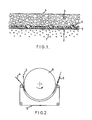
- Figure 1 shows a road base 1 which forms the ground to which has been adhered the fabric 2 of a mesh structure/fabric laminate 3 which includes the mesh structure 4.
- the fabric 2 is lowermost, and has been adhered to the road base 1 in any suitable manner, as discussed above.
- Aggregate 5 has been placed on the laminate 3, and the pieces of the aggregate 5 pass into the meshes of the mesh structure 4 and interlock with the strands of the mesh structure 4.
- the aggregate 5 has been subjected to pressure in order to consolidate it, forming a flat road surface 6. Though the strands of the mesh structure 4 may be somewhat pressed down, it is found that some of them stand slightly proud of the fabric 2 and interlock with the pieces of the aggregate 5.
- Figure 2 shows a known laminating machine having a heated roll 11 whose lower half is wrapped by a silicone rubber belt 12.
- a fabric 2 and a plastics material mesh structure 4 are fed between the roll 11 and belt 12 so that the roll 11 heats the high points or nodules (ie the thicker parts) of the mesh structure 4 through the fabric 2 and laminates them together to form the laminate 3.
- the molten plastics material penetrates the fabric 2 and produces a mechanical bond. Due to the arrangement, the heated roll 11 has little effect on the oriented strands of the mesh structure 4.
- the machine of Figure 2 is used to make a laminate.
- the mesh structure is in accordance with Figure 21 of US 4 374 798.
- the mesh structure is a biaxially-oriented mesh structure having rectangular meshes, and formed by oriented strands connected together at junctions. Each junction has a thick unoriented or low-oriented nodule in its centre, surrounded by thinner, more oriented zones. The nodules are much thicker than the strands.
- the mesh structure is made of polypropylene, which during mandfacture is heat set and thus made resistant to reversion (shrinkage) at asphalt laying temperatures.
- the laminate was used as described in relation to Figure 1 to form a road surface using a conventional asphalt paviours to lay the asphalt.
- the adhesive was spread on the ground before placing the laminate in position after which further adhesive was applied on top of the fabric.
- the adhesive was a bituminous aqueous-based emulsion, sprayed on at a rate of 1 1/2 to 2 litres/m2 of ground; a lower rate, eg 0.8 to 1 litres/m2 can be sprayed on if push brooms are used to brush the fabric down onto the adhesive surface or automated lay-down equipment used.
- the asphalt was a rolled asphalt wearing course (Design Mix), laid as follows: Thickness of layer 50 mm Aggregate size 20 mm maximum (graded) Laying temperature 140° - 150° C
Landscapes
- Engineering & Computer Science (AREA)
- Architecture (AREA)
- Civil Engineering (AREA)
- Structural Engineering (AREA)
- Chemical & Material Sciences (AREA)
- Composite Materials (AREA)
- Mechanical Engineering (AREA)
- Road Paving Structures (AREA)
- Application Of Or Painting With Fluid Materials (AREA)
Applications Claiming Priority (2)
| Application Number | Priority Date | Filing Date | Title |
|---|---|---|---|
| GB8825990 | 1988-11-07 | ||
| GB888825990A GB8825990D0 (en) | 1988-11-07 | 1988-11-07 | Reinforcing paved surface & reinforcement therefor |
Publications (2)
| Publication Number | Publication Date |
|---|---|
| EP0368600A1 true EP0368600A1 (de) | 1990-05-16 |
| EP0368600B1 EP0368600B1 (de) | 1997-05-07 |
Family
ID=10646417
Family Applications (1)
| Application Number | Title | Priority Date | Filing Date |
|---|---|---|---|
| EP89311490A Expired - Lifetime EP0368600B1 (de) | 1988-11-07 | 1989-11-07 | Armiertes Pflaster und seine Bewehrung |
Country Status (6)
| Country | Link |
|---|---|
| US (1) | US5152633A (de) |
| EP (1) | EP0368600B1 (de) |
| CA (1) | CA2002277C (de) |
| DE (1) | DE68928028T2 (de) |
| GB (2) | GB8825990D0 (de) |
| NO (1) | NO178669C (de) |
Cited By (4)
| Publication number | Priority date | Publication date | Assignee | Title |
|---|---|---|---|---|
| FR2767543A1 (fr) | 1997-08-25 | 1999-02-26 | 6D Solutions | Armature du type grille pour le renforcement de structures routieres, notamment en bitume |
| WO1999014038A3 (de) * | 1997-09-15 | 1999-06-10 | Josef Scherer | Armierungsmaterial mit biegeverformbarem sowie für füllstoff aufnahmefähigem fasermaterial |
| WO2000001891A1 (fr) | 1998-07-06 | 2000-01-13 | Daniel Doligez | Complexe anti-humidite de grille de fibres et de film plastique |
| AU2002217305B2 (en) * | 2001-04-06 | 2006-10-19 | Hanson Building Products Ltd | A reinforced permeable paving structure |
Families Citing this family (11)
| Publication number | Priority date | Publication date | Assignee | Title |
|---|---|---|---|---|
| US5277520A (en) * | 1991-12-06 | 1994-01-11 | The Tensar Corporation | Grid composite for backfill barriers and waste applications |
| SE9304279L (sv) * | 1993-12-23 | 1995-06-24 | Fundia Bygg Ab | Sätt vid armering av beläggningar av plastiska massor samt armeringsnät för användning därvid |
| US5513925A (en) * | 1994-09-19 | 1996-05-07 | The Board Of Trustees Of The University Of Illinois | Stress absorbing composite for road repair and method |
| US5651853A (en) * | 1994-12-02 | 1997-07-29 | P.L.G. Research Limited | Mesh structure/fabric laminate |
| IT1280462B1 (it) * | 1994-12-02 | 1998-01-20 | Plg Res | Procedimento per la fabbricazione di un laminato, laminato ottenuto con tale procedimento e macchina per l'esecuzione del procedimento. |
| US6192650B1 (en) | 1996-06-24 | 2001-02-27 | Bay Mills Ltd. | Water-resistant mastic membrane |
| DE19652584A1 (de) | 1996-12-17 | 1998-06-18 | Huesker Synthetic Gmbh & Co | Textiles Gitter zum Bewehren bitumengebundener Schichten |
| US6315499B1 (en) | 1999-04-01 | 2001-11-13 | Saint Cobain Technical Fabrics Canada, Ltd. | Geotextile fabric |
| US6991548B2 (en) * | 1999-08-26 | 2006-01-31 | John Arie | Elevated wood and concrete racetrack for go-karts and associated methods |
| US7504129B2 (en) * | 2005-03-16 | 2009-03-17 | Ra Golv Ab | Method of producing a flooring and a flooring produced according to the method |
| GB202101168D0 (en) * | 2021-01-28 | 2021-03-17 | Tensar Tech Limited | Underpinning asphalt with multiaxial geogrids |
Citations (5)
| Publication number | Priority date | Publication date | Assignee | Title |
|---|---|---|---|---|
| DE1459734A1 (de) * | 1964-08-10 | 1969-02-06 | Licentia Gmbh | Fahrbahnbelag,insbesondere fuer transportable Unterlagen,wie Bruecken |
| NL6807089A (de) * | 1968-05-17 | 1969-11-19 | ||
| NL7007249A (en) * | 1970-05-20 | 1971-07-26 | Fibre reinforced asphalt for road making | |
| DE2400769A1 (de) * | 1974-01-08 | 1975-07-17 | Buesing & Fasch Kg | Verfahren zum herstellen einer fahrbahndecke auf brueckenbauwerken, insbesondere betonbruecken |
| DE3317628A1 (de) * | 1983-05-14 | 1984-11-15 | Kalkspatgruben und Labranit-Edelputzwerk Heinrich Lahme, 5790 Brilon | Waermedaemmplatte mit putztraeger |
Family Cites Families (10)
| Publication number | Priority date | Publication date | Assignee | Title |
|---|---|---|---|---|
| DE1635711A1 (de) * | 1967-01-23 | 1971-07-15 | Hercules Inc | Luftdurchlaessige,netzverstaerkte,nichtgewebte Textilien und Verfahren zu ihrer Herstellung |
| US3260177A (en) * | 1964-02-24 | 1966-07-12 | Rex Chainbelt Inc | Laying reinforced concrete pavement |
| US3361043A (en) * | 1966-02-24 | 1968-01-02 | Jaeger Machine Co | Pavement reinforcement mesh placer |
| US3566758A (en) * | 1969-04-29 | 1971-03-02 | Glen E Perkins | Continuously reinforced concrete paving apparatus |
| US3678816A (en) * | 1970-04-13 | 1972-07-25 | Rex Chainbelt Inc | Apparatus for installing reinforcing in plastic concrete |
| US3797953A (en) * | 1970-10-22 | 1974-03-19 | Syst Res Inc | Apparatus for the laying and rolling out of coating or paving materials |
| US3913854A (en) * | 1974-05-02 | 1975-10-21 | Phillips Petroleum Co | Tensioned unrolling device for fabric rolls |
| ES465947A3 (es) * | 1977-08-16 | 1978-09-16 | Ici Ltd | Perfeccionamientos en la fabricacion de bolsas de plastico. |
| NO152611C (no) * | 1978-10-16 | 1985-10-23 | Plg Res | Plastnettkonstruksjon, fremgangsmaate til dens fremstilling og anvendelse av konstruksjonen |
| ATE23056T1 (de) * | 1981-04-03 | 1986-11-15 | Plg Res | Netzstruktur aus kunststoff. |
-
1988
- 1988-11-07 GB GB888825990A patent/GB8825990D0/en active Pending
-
1989
- 1989-11-06 CA CA002002277A patent/CA2002277C/en not_active Expired - Lifetime
- 1989-11-07 DE DE68928028T patent/DE68928028T2/de not_active Expired - Lifetime
- 1989-11-07 NO NO894418A patent/NO178669C/no not_active IP Right Cessation
- 1989-11-07 EP EP89311490A patent/EP0368600B1/de not_active Expired - Lifetime
- 1989-11-07 GB GB8925105A patent/GB2225048B/en not_active Expired - Lifetime
-
1991
- 1991-08-22 US US07/748,523 patent/US5152633A/en not_active Expired - Lifetime
Patent Citations (5)
| Publication number | Priority date | Publication date | Assignee | Title |
|---|---|---|---|---|
| DE1459734A1 (de) * | 1964-08-10 | 1969-02-06 | Licentia Gmbh | Fahrbahnbelag,insbesondere fuer transportable Unterlagen,wie Bruecken |
| NL6807089A (de) * | 1968-05-17 | 1969-11-19 | ||
| NL7007249A (en) * | 1970-05-20 | 1971-07-26 | Fibre reinforced asphalt for road making | |
| DE2400769A1 (de) * | 1974-01-08 | 1975-07-17 | Buesing & Fasch Kg | Verfahren zum herstellen einer fahrbahndecke auf brueckenbauwerken, insbesondere betonbruecken |
| DE3317628A1 (de) * | 1983-05-14 | 1984-11-15 | Kalkspatgruben und Labranit-Edelputzwerk Heinrich Lahme, 5790 Brilon | Waermedaemmplatte mit putztraeger |
Cited By (6)
| Publication number | Priority date | Publication date | Assignee | Title |
|---|---|---|---|---|
| FR2767543A1 (fr) | 1997-08-25 | 1999-02-26 | 6D Solutions | Armature du type grille pour le renforcement de structures routieres, notamment en bitume |
| WO1999010601A1 (fr) | 1997-08-25 | 1999-03-04 | 6D Solutions | Armature de renforcement de structures routieres, notamment en bitume |
| WO1999010600A1 (fr) * | 1997-08-25 | 1999-03-04 | 6D Solutions | Armature de renforcement de structures routieres, notamment en bitume |
| WO1999014038A3 (de) * | 1997-09-15 | 1999-06-10 | Josef Scherer | Armierungsmaterial mit biegeverformbarem sowie für füllstoff aufnahmefähigem fasermaterial |
| WO2000001891A1 (fr) | 1998-07-06 | 2000-01-13 | Daniel Doligez | Complexe anti-humidite de grille de fibres et de film plastique |
| AU2002217305B2 (en) * | 2001-04-06 | 2006-10-19 | Hanson Building Products Ltd | A reinforced permeable paving structure |
Also Published As
| Publication number | Publication date |
|---|---|
| DE68928028T2 (de) | 1997-10-02 |
| GB8925105D0 (en) | 1989-12-28 |
| GB2225048A (en) | 1990-05-23 |
| CA2002277A1 (en) | 1990-05-07 |
| NO894418L (no) | 1990-05-08 |
| CA2002277C (en) | 1999-10-05 |
| EP0368600B1 (de) | 1997-05-07 |
| GB8825990D0 (en) | 1988-12-14 |
| US5152633A (en) | 1992-10-06 |
| NO894418D0 (no) | 1989-11-07 |
| GB2225048B (en) | 1993-06-30 |
| DE68928028D1 (de) | 1997-06-12 |
| NO178669C (no) | 1996-05-08 |
| NO178669B (no) | 1996-01-29 |
Similar Documents
| Publication | Publication Date | Title |
|---|---|---|
| CA2002277C (en) | Reinforcing a paved surface, and reinforcement therefor | |
| US5273804A (en) | Reinforcement for reinforcing a paved surface | |
| RU2446053C2 (ru) | Клейкая пленка для дорожного покрытия, способ дорожного покрытия с ее использованием и способ получения клейкой пленки | |
| JP5944432B2 (ja) | アスファルト舗装用の製造物、およびアスファルト舗装用の補強製造物の形成方法 | |
| US3909144A (en) | Plastic sheet materials and structures containing the same | |
| EP0318707B1 (de) | Vorgefertigte Bewehrung für Asphaltbeläge und Verfahren zum Herstellen bewehrter Strassendecken | |
| KR100831907B1 (ko) | 포장 표면의 강화 및 방수처리 방법 | |
| HK1001477B (en) | Prefabricated reinforcement for asphaltic paving and process for reinforcing asphaltic pavings | |
| EP2183429B1 (de) | Verbundstoff mit klebefilm für asphaltierung und verfahren zur herstellung eines verbundstoffes mit klebefilm zur asphaltierung | |
| CN100366822C (zh) | 对铺砌表面进行加固和防水处理的方法 | |
| WO1999058325A2 (en) | Water-resistant mastic membrane | |
| CN105951555A (zh) | 增强型路基用玻璃纤维土工格栅及其制作方法、施工方法 | |
| GB2259048A (en) | A mesh structure/fabric laminate | |
| US20060245830A1 (en) | Reinforcement membrane and methods of manufacture and use | |
| WO2000018574A1 (en) | Composite roadway fabric | |
| HU209333B (en) | Water-insulating device particularly for bridge floors and method for producing same | |
| HK1007892A1 (en) | Preformed, unitary composite for reinforcing while suppressing curl in bituminous roofing membranes and process for making such composites |
Legal Events
| Date | Code | Title | Description |
|---|---|---|---|
| PUAI | Public reference made under article 153(3) epc to a published international application that has entered the european phase |
Free format text: ORIGINAL CODE: 0009012 |
|
| AK | Designated contracting states |
Kind code of ref document: A1 Designated state(s): DE FR IT SE |
|
| 17P | Request for examination filed |
Effective date: 19901114 |
|
| 17Q | First examination report despatched |
Effective date: 19911106 |
|
| GRAG | Despatch of communication of intention to grant |
Free format text: ORIGINAL CODE: EPIDOS AGRA |
|
| GRAH | Despatch of communication of intention to grant a patent |
Free format text: ORIGINAL CODE: EPIDOS IGRA |
|
| GRAH | Despatch of communication of intention to grant a patent |
Free format text: ORIGINAL CODE: EPIDOS IGRA |
|
| GRAA | (expected) grant |
Free format text: ORIGINAL CODE: 0009210 |
|
| ITF | It: translation for a ep patent filed | ||
| AK | Designated contracting states |
Kind code of ref document: B1 Designated state(s): DE FR IT SE |
|
| REF | Corresponds to: |
Ref document number: 68928028 Country of ref document: DE Date of ref document: 19970612 |
|
| ET | Fr: translation filed | ||
| PLBE | No opposition filed within time limit |
Free format text: ORIGINAL CODE: 0009261 |
|
| STAA | Information on the status of an ep patent application or granted ep patent |
Free format text: STATUS: NO OPPOSITION FILED WITHIN TIME LIMIT |
|
| 26N | No opposition filed | ||
| PGFP | Annual fee paid to national office [announced via postgrant information from national office to epo] |
Ref country code: DE Payment date: 20081103 Year of fee payment: 20 |
|
| PGFP | Annual fee paid to national office [announced via postgrant information from national office to epo] |
Ref country code: IT Payment date: 20081126 Year of fee payment: 20 Ref country code: SE Payment date: 20081107 Year of fee payment: 20 |
|
| PGFP | Annual fee paid to national office [announced via postgrant information from national office to epo] |
Ref country code: FR Payment date: 20081112 Year of fee payment: 20 |