EP0368924B1 - Bipolare hochleistungsmembranen - Google Patents
Bipolare hochleistungsmembranen Download PDFInfo
- Publication number
- EP0368924B1 EP0368924B1 EP88907166A EP88907166A EP0368924B1 EP 0368924 B1 EP0368924 B1 EP 0368924B1 EP 88907166 A EP88907166 A EP 88907166A EP 88907166 A EP88907166 A EP 88907166A EP 0368924 B1 EP0368924 B1 EP 0368924B1
- Authority
- EP
- European Patent Office
- Prior art keywords
- membranes
- solution
- bipolar membrane
- membrane
- aqueous alkaline
- Prior art date
- Legal status (The legal status is an assumption and is not a legal conclusion. Google has not performed a legal analysis and makes no representation as to the accuracy of the status listed.)
- Expired - Lifetime
Links
Images

Classifications
-
- C—CHEMISTRY; METALLURGY
- C08—ORGANIC MACROMOLECULAR COMPOUNDS; THEIR PREPARATION OR CHEMICAL WORKING-UP; COMPOSITIONS BASED THEREON
- C08J—WORKING-UP; GENERAL PROCESSES OF COMPOUNDING; AFTER-TREATMENT NOT COVERED BY SUBCLASSES C08B, C08C, C08F, C08G or C08H
- C08J5/00—Manufacture of articles or shaped materials containing macromolecular substances
- C08J5/20—Manufacture of shaped structures of ion-exchange resins
- C08J5/22—Films, membranes or diaphragms
- C08J5/2206—Films, membranes or diaphragms based on organic and/or inorganic macromolecular compounds
- C08J5/2275—Heterogeneous membranes
-
- C—CHEMISTRY; METALLURGY
- C08—ORGANIC MACROMOLECULAR COMPOUNDS; THEIR PREPARATION OR CHEMICAL WORKING-UP; COMPOSITIONS BASED THEREON
- C08J—WORKING-UP; GENERAL PROCESSES OF COMPOUNDING; AFTER-TREATMENT NOT COVERED BY SUBCLASSES C08B, C08C, C08F, C08G or C08H
- C08J2381/00—Characterised by the use of macromolecular compounds obtained by reactions forming in the main chain of the macromolecule a linkage containing sulfur with or without nitrogen, oxygen, or carbon only; Polysulfones; Derivatives of such polymers
- C08J2381/08—Polysulfonates
Definitions
- This invention relates to low electrical resistance bipolar membranes comprising separate anion and cation exchange films, a process for their production and to the use of such membranes for producing acid and alkali.
- Acids and bases are important intermediates for a wide variety of products made by the chemical industry. After processing and use these find their way back to nature as salts. A logical route for completing the cycle would be to regenerate the acids and bases directly from these salts. Electrolysis of brine to generate chlorine and caustic soda, in a certain sense, is such a process. Another process is electrodialysis, using bipolar membranes to directly generate acids and bases from their salts. The process is electrically driven and the splitting of the salt to generate the acid and base occurs in an aqueous medium. The process is conceptually a simple one and can be represented by the equation: To effect and maintain separation of the various species, ion exchange membranes are used.
- bipolar membrane so called because it is composed of two distinct parts which are selective to ions of opposite charges. Under the influence of an applied direct current, such a sandwich membrane is capable of forcibly dissociating water to form equivalent amounts of hydrogen and hydroxyl ions.
- the assembly Used in conjunction with other cation- and anion- selective (i.e., monopolar), membranes, the assembly constitutes a potentially economical water splitting apparatus that generates acid and base.
- Bipolar membranes can be prepared by many different methods.
- U.S. Patents 4,024,043 and 4,057,481 both Dege et al
- single film bipolar membranes are prepared from pre-swollen films containing a relatively high amount of an insoluble cross-linked aromatic polymer on which highly dissociable cationic exchange groups are chemically bonded to the aromatic nuclei to a desired depth of the film from one side only; subsequently, highly dissociable anionic exchange groups are chemically bonded to the unreacted aromatic nuclei on the other side of the film.
- bipolar membranes are prepared by partially covering a membrane with a cover film, sulfonating the surface of the membrane not in contact with the cover film to introduce cation exchange groups, exfoliating the cover film, and introducing anion exchange groups on the exfoliated surfaces.
- Bipolar membranes have also been prepared by bonding together separate anion and cation exchange films or membranes.
- the two monopolar membranes of opposite selectivity can be fused together with the application of heat and pressure. See, for example, U.S. Patent 3,372,101 by Kollsman wherein separate cation and anion membranes are bonded together in a hydraulic press at 150°C at a pressure of 400 lb/sq. inch to form a two ply membrane structure.
- bipolar membranes formed in this way suffer the disadvantage of high electrical resistance produced by the fusion. Furthermore these membranes are prone to bubble or blister and they are operable for only short time periods at relatively low current densities. These disadvantages make the bipolar membranes formed in this way unattractive for commercial electrodialysis operations.
- the present invention in a first aspect consists in a bipolar membrane comprising conjoined anion and cation exchange membranes, wherein said membranes have been treated with:
- the present invention consists in a method for the preparation of a bipolar membrane from modified anion and cation exchange membranes by either
- the present invention consists in a method for the production of acid and alkali, comprising electrodialysing an aqueous salt solution using a bipolar membrane of the first aspect of the invention.
- this treatment may either alter or modify the surface properties or structure of the membrane and/or by the introduction of certain species into occlusions in the membrane.
- the membranes are treated, prior to conjoining, by immersion in an aqueous solution of at least one divalent or higher oxidation state cation.
- the membranes are treated with the aqueous alkaline solution prior to conjoining.
- this solution may be combined with the aqueous solution of the at least one divalent or higher oxidation state cation.
- each membrane is boiled in the cation containing solution of high pH.
- Moderate alkali concentrations of about 1 molar, have been found to be effective, but lower or higher concentrations may also be utilised, typically in the size of from 0.2 to 2.0 molar.
- Suitable metal cations include, but are by no means limited to, for example, Cr6+, Ru3+, Ce3+, Ni2+, Zr4+, In3+ and Sn2+.
- Suitable cation containing salts include chromic nitrate, ruthenium trichloride, indium sulphate, cerous sulphate, thorium nitrate and zirconium chloride.
- the anion and cation exchange membranes treated as described herein, are pressed together either at room temperature or else under heat with treated surfaces located at the interface. This heating may be carried out at a temperature in the range from ambient up to a temperature just below the onset of deformation or degradation of the anionic or cationic exchange membranes employed.
- the inventive membranes of this embodiment have been found to possess a number of advantages over prior art membranes, the preferred method of forming the membranes has two aspects which present some difficulty.
- a typical alkaline solution containing the selected cation species may splutter on heating and is strongly corrosive.
- the spluttering is exacerbated by the presence of the membrane and therefore limits the amount of membrane which can be treated in a given volume of solution.
- the present inventor has found that alternatively, in a second embodiment, the membranes are treated with an aqueous solution of the selected cation, conjoined and then treated with an aqueous alkaline solution.
- the membranes of this embodiment may be stored in a sealed container following treatment with the inventive aqueous cation solution. The membranes may then be removed from the container and conjoined to form a bipolar membrane prior to treatment with the aqueous alkaline solution.
- the treatment of the cation and anion exchange membranes with the aqueous cation solution is preferably carried out by immersion of the membranes in the solution for an appropriate time.
- the solution need only be at room temperature, whilst the treatment time may vary from less than thirty minutes to overnight.
- Suitable metal cations include, without limitation, Cr3+, Ru3+, Ce3+, Ni2+, Zr4+, In3+, Sn2+ and Fe2+. These may be present in the form of salts such as chromic nitrate, chromic chloride, ruthenium trichloride, ferrous chloride, indium sulphate, cerous sulphate, thorium nitrate and zirconium chloride.
- a salt concentration of the order of about 5% to 15% has been found to be effective.
- the membranes are preferably washed with water prior to being conjoined by pressing together either at room temperature or else they may be conjoined under heat at a temperature below the onset of deformation or degradation of the membrane.
- the treated membranes may be stored wet in a sealed container for a period prior to them being joined.
- the membrane is treated with an aqueous alkaline solution, preferably by fitting the membrane into a multi-chamber electrodialysis cell and placing into at least one of the chambers in contact with the membrane, an amount of alkaline solution sufficient to treat the one of the faces of the membrane. This may take place at the point of preparation of the membrane or at the site of use.
- the alkaline solution will be in concentration of about 0.2 - 2.0 molar at a temperature of about 75°C for a treatment time of about 15 - 30 minutes.
- concentration, temperature of the solution and the treatment time may be varied appropriately.
- the bipolar membrane is ready for use. If the alkaline treatment has taken place in a cell as described, the alkaline solution may be conveniently replaced by the solution or solutions to be subjected to electrodialysis.
- the resulting bipolar membrane consists of three principle regions:
- the electrical resistance of the resulting bipolar membrane is generally much smaller than that of a membrane when the component membranes or at least the interface is untreated.
- a potential difference across the membrane which is 1.0V or less can be sufficient for a current density of 100mA cm ⁇ 2 when it separates 1N KC1 solutions.
- the corresponding voltage for a membrane if the component films are untreated is likely to exceed 3V.
- the current efficiency for acid base production of treated membranes can be higher than 90%.
- anion and cation exchange membranes containing strong acid and strong base groups may be used in the invention but preferably the membranes contain sulphonic acid and quaternary ammonium groups.
- the treatment of the membranes according to the invention not only provides a high degree of bonding and adhesion between the anion and cation exchange membranes but, more importantly, provides a much lower electrical resistance for the resulting bipolar membrane than if the membrane or the interface of the component membranes is not treated or was bonded simply by the prior art application of heat and pressure.
- a bipolar membrane according to the invention consists of three regions, a cation-selective region 1, an anion-selective region 3, and the interface between these two regions 2. These membranes behave anisotropically under the influence of an electric field as is illustrated by the transport processes shown in Figs. 1 and 2.
- Fig. 1 shows that when a direct current is passed across the bipolar membrane with its cation side toward the anode and salt solution on either side, cations and anions are transported to the interface through the permselective membranes, but the passage of ions out of the interface region is limited since they would have to pass through membranes of the wrong selectivity.
- the salt consequently builds up at the interface and results in a low resistance in this region.
- Fig. 2 illustrates the water splitting capacity of the bipolar membrane. If the interface is made very thin, then even though only H+ and OH ⁇ ions may be present the resistance of the layer can be small and the membrane may be used to generate acid and base.
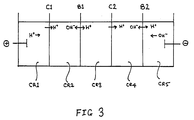
- Fig. 3 shows the cell used for determining the current efficiency of a bipolar membrane.
- B1 and B2 are bipolar films
- C1 and C2 are Nafion® cation exchange films.
- Chamber CR1 contained 1M H2SO4, chambers CR2 and CR4 an NaOH solution and chambers CR3 and CR5 an HCl solution.
- the acid and alkali solutions were of equal molarity, usually 2 molar.
- protons flow into chamber CR5 from the water splitting bipolar membrane B2 while hydroxyl ions are generated in the chamber at the cathode. If the water splitting current efficiency of the bipolar membrane were 100%, then the pH of the chamber would be essentially constant.
- hydroxyl ions flow into the compartment from the bipolar membrane and protons, which originate in the acid chamber CR3, from the cation exchange membrane.
- the only other ion which can carry current across C2 are hydroxyl ions from chamber CR4, sodium ions in chamber CR4 and chloride ions in chamber CR3 being precluded from doing so by the direction of the electric field.
- the transport number of protons across C2 is less than unity, the difference is due to a flow of hydroxyl ions in the opposite direction. It follows that if the water splitting current efficiency of the bipolar membrane is 100% then the pH of chamber CR4 should be essentially constant during current flow.
- Negev Institute quaternary ammonium anion and sulfonic acid cation exchange membranes were immersed for five minutes in a 7% (W/V) solution of chromium chloride in 2N sodium hydroxide at 70°C. The membranes were then washed and pressed together under heat to form a bipolar membrane. The potential difference across the bipolar membrane was 1.0 volts when it separated 1M KC1 solutions and the current was 100mA cm2. The current efficiency for acid base production by the film exceeded 80%. By comparison the potential difference across a bipolar membrane formed from untreated Negev Institute anion and cation exchange membranes at the same current and electrolyte concentrations was 3.0 volts.
- Negev Institute quaternary ammonium anion and sulfonic acid cation exchange membranes were immersed for five minutes in a 5% (W/V) solution of ceric sulphate in 1N sodium hydroxide at 70°C. The membranes were then washed and pressed together to form a bipolar membrane. The potential difference across the bipolar membrane was 1.0 volts when it separated 1M KC1 solutions and the current was 100mA cm ⁇ 2. The current efficiency for acid base production by the film exceeded 80%. By comparison the potential difference across a bipolar membrane formed from untreated Negev Institute anion and cation exchange membranes at the same current and electrolyte concentrations was 3.0 volts.
- Negev Institute quaternary ammonium anion and sulfonic acid cation exchange membranes were immersed for five minutes in a 7% (W/V) solution of stannous chloride in 2N sodium hydroxide at 70°C. The membranes were then washed and pressed together to form a bipolar membrane. The potential difference across the bipolar membrane was 1.1 volts when it separated 1M KC1 solutions and the current was 100 mA cm ⁇ 2. The current efficiency for acid base production by the film exceeded 80%. By comparison the potential difference across a bipolar membrane formed from untreated Negev Institute anion and cation exchange membranes at the same current and electrolyte concentrations was 3.0 volts.
- Raipore 1035 and 1010 anion and cation exchange membranes were immersed for 20 minutes in a 5% (W/V) solution of ruthenium chloride in 1N NaOH at 70°C. The membranes were then washed and pressed together to form a bipolar membrane. The potential difference across the bipolar membrane was 0.9 volts for several weeks, which was the duration of the experiment, when it separated 2N HC1 and 2N NaOH solutions and the current was 100 mA cm ⁇ 2. The current efficiency for acid base production by the film exceeded 85%. By comparison the potential difference across a bipolar membrane formed from untreated Raipore anion and cation exchange membranes at the same current and electrolyte concentrations was 2.5 volts.
- Negev Institute quaternary ammonium anion and sulfonic acid cation exchange membranes were immersed for five minutes in a 5% solution of zirconium chloride in 2N sodium hydroxide at 70°C. The membranes were then washed and pressed together to form a bipolar membrane. The potential difference across the bipolar membrane was 1.0 volts when it separated 1M KC1 solutions and the current was 100 mA cm ⁇ 2. The current efficiency for acid base production by the film exceeded 80%. By comparison the potential difference across a bipolar membrane formed from untreated Negev Institute anion and cation exchange membranes at the same current and electrolyte concentrations was 3.0 volts
- Negev Institute quaternary ammonium anion and sulfonic acid cation exchange membranes were immersed for fifteen minutes in a 7% solution of nickel chloride in 2N sodium hydroxide at 60°. The membranes were then washed and pressed together to form a bipolar membrane. The potential difference across the bipolar membrane was 1.1 volts when it separated 1M KC1 solutions and the current was 100mA cm ⁇ 2. The current efficiency for acid base production by the film exceeded 85%. By comparison the potential difference across a bipolar membrane formed from untreated Negev Institute anion and cation exchange membranes at the same current and electrolyte concentrations was 3.0 volts.
- a Negev Institute quaternary ammonium anion exchange membrane was immersed for ten minutes in a 5% (W/V) solution of chromium chloride in 2N NaOH at 70°C. The membrane was then washed and pressed against an Asahi Chemicals K101 cation exchange membrane to form a bipolar membrane. The potential difference across the bipolar membrane was 1.4 volts when it separated 1M KC1 solutions and the current was 100 mA cm ⁇ 2. The current efficiency for acid base production by the film exceeded 80%. By comparison the potential difference across the bipolar membrane formed from untreated Negev Institute anion and Asachi Chemicals cation exchange membranes at the same current and electrolyte concentrations was 6 volts.
- Raipore R-1010 and R-1035 cation and anion exchange membranes were immersed for 20 minutes in a 7% (W/V) solution of chromic chloride in 2N NaOH at 100°C. The membranes were then washed clean and pressed together to form a bipolar film. The potential difference across the bipolar film was 0.9V when it separated 2N HC1 and 2N NaOH solutions and the current was 100 mA cm ⁇ 2. The current efficiency for acid base product ion in the bipolar film exceeded 85%. The properties of the film appeared constant for the duration of the experiment which was four months. By comparison the potential difference across the bipolar film formed from untreated R-1010 and R01035 membranes exceeded 2.5V.
- Negev Institute quaternary ammonium group anion and sulfonic acid group cation exchange membranes were immersed for five minutes in a 7% (W/V) solution of chromic chloride in 2N NaOH at 100°C. The membranes were then washed clean and pressed together to form a bipolar film.
- the potential difference across the bipolar film was 1.1V when it separated 2N HC1 and 2N NaOH solutions and the current was 100 mA cm-2.
- the current efficiency for acid base production in the bipolar film was 68%.
- the properties of the film appeared constant for the duration of the experiment which was three weeks.
- the potential difference across the bipolar film formed from untreated monopolar membranes for the same current and electrolyte concentrations was 4.5V.
- Raipore R-1010 and R-4030 cation and anion exchange 1 m1 and 2ml thick membranes were immersed in a 1 molar chromium chloride solution, at room temperature, for one hour. The membranes were then washed with distilled water and entered wet into a polyethylene bag. The bag was then sealed.
- Raipore R-1010 and R-1030 cation and anion exchange 1ml thick membranes were immersed in a 10% (W/V) solution of ruthenium (III) chloride at room temperature overnight. The membranes were then washed clean, pressed together to form a bipolar film and then introduced into a multichamber electrodialysis cell. A solution of 0.5N NaOH at 75°C was then introduced into the chambers adjacent to the membrane for thirty minutes. The 0.5N NaOH solution was then discarded and replaced by a 2N NaOH solution on the anolyte side of the film and a 2N HC1 solution on the catholyte side of the film at room temperature. The potential difference across the bipolar film was 1.0V when the current was 100 MA cm ⁇ 2.
- Negev Institute quaternary ammonium anion and sulfonic acid cation exchange membrances were immersed for thirty minutes in a 1 molar solution of chromium chloride. The membranes were then washed, pressed together to form a bipolar membrane, and then introduced into a multichamber electrodialysis cell. A solution of 2N NaOH at 75°C was then introduced into the chambers adjacent to the membrane for thirty minutes. The NaOH was then discarded and replaced by 1M KC1 solutions, at room temperature. The potential difference across the bipolar membrane was 1.4 volts when it separated 1M KC1 solutions and the current was 50mA cm ⁇ 2. The current efficiency for acid base production by the film exceeded 80%. By comparison the potential difference across a bipolar membrane formed from untreated Negev Institute anion and cation exchange membranes at the same current and electrolyte concentrations was 2.2 volts.
- Raipore R-1010 and R-1030 cation and anion exchange 1 ml thick membranes were immersed in a 10% (w/V) solution of ferrous chloride at room temperature for one hour. The membranes were then washed with distilled water, pressed together to form a bipolar membrane, and introduced into a multichamber electrodialysis cell. A solution of 2N NaOH at 70°C was introduced into the chambers adjacent to the membrane for thirty minutes. The 2N NaOH solution was then discarded and replaced by a 2N NaOH solution on the anolyte side of the film and a 2N HC1 solution on the catholyte side of the film, at room temperature. The potential difference across the bipolar film was 1.1V when the current was 100 mA cm ⁇ 2.
- Raipore R-1010 and R-1030 cation and anion exchange 1 ml thick membranes were immersed in a 10% (w/V) solution of stannous chloride for 1 hour. The membranes were then washed with distilled water, pressed together to form a bipolar membrane and introduced into a multichamber electrodialysis cell. A solution of 2N NaOH at 75°C was then introduced into the chambers adjacent to the membrane for fifteen minutes. The 2N NaOH solution was then discarded and replaced by 1M KC1 solution, at room temperature. The potential difference across the bipolar film was 1.1V when the current was 100mA cm ⁇ 2. The current efficiency for water splitting in the film exceeded 85%. By comparison the potential difference across the bipolar film formed from untreated R-1010 and R-1030 membranes under the same operating conditions exceeded at 2.5V.
Landscapes
- Chemical & Material Sciences (AREA)
- Manufacturing & Machinery (AREA)
- Engineering & Computer Science (AREA)
- Chemical Kinetics & Catalysis (AREA)
- Materials Engineering (AREA)
- Health & Medical Sciences (AREA)
- Inorganic Chemistry (AREA)
- Medicinal Chemistry (AREA)
- Polymers & Plastics (AREA)
- Organic Chemistry (AREA)
- Separation Using Semi-Permeable Membranes (AREA)
- Electrolytic Production Of Non-Metals, Compounds, Apparatuses Therefor (AREA)
- Manufacture Of Macromolecular Shaped Articles (AREA)
- Electrodes For Compound Or Non-Metal Manufacture (AREA)
Claims (31)
- Zweipolige Membrane aus zusammenfuegten abgeanderten Anionen- und Kationen-Austausch-Membranen, wobei die vorgenannten abgeaenderten Membranen Anionen- und Kationen-Austausch-Membranen enthalten, die folgendermassen abgeaendert werdena) Behandlung mit einer waessrigen Salzloesung in einer Konzentration von mindestens 5 Gew.%, wobei diese Salzloesung ein zweiwertiges oder hoeher-wertiges oxidiertes Kation liefert, bevor sie zusammengefuegt werden;b) Behandlung mindestens einer Flaeche der Anionen- oder Kationen-Austausch-Membranen mit einer waessrigen Laugeloesung von mindestens 0,2 N,dadurch gekennzeichnet, dass die vorgenannte waessrige Laugeloesung oder die Kombination der vorgenannten waessrigen Salzloesung mit der vorgenannten waessrigen Laugeloesung eine Temperatur von mindestens 60°C aufweist.
- Zweipolige Membrane nach Anspruch 1, worin die Membranen, bevor sie zusammengefuegt werden, in eine zumindest ein zweiwertiges oder hoeher-wertiges oxidiertes Kation liefernende waessrige Salzloesung eingetaucht werden.
- Zweipolige Membrane nach Anspruch 2, worin die Membranen vor deren Behandlung mit der waessrigen Salzloesung zusammengefuegt werden.
- Zweipolige Membrane nach Anspruch 2, worin die Membranen, bevor sie zusammengefuegt werden, mit der waessrigen Laugeloesung behandelt werden.
- Zweipolige Membrane nach Anspruch 4, worin die waessrige Laugeloesung mindestens ein zweiwertiges oder hoeher-wertiges oxidiertes Kation enthaelt.
- Zweipolige Membrane nach Anspruch 5, worin die beiden Membranen durch Eintauchen in die waessrige Laugeloesung behandelt werden.
- Zweipolige Membrane nach Anspruch 6, dadurch gekennzeichnet, dass die waessrige Laugeloesung eine Temperatur zwischen etwa 70°C und etwa 100°C aufweist.
- Zweipolige Membrane nach Anspruch 4, dadurch gekennzeichnet, dass die beiden Membranen, bevor sie zusammengefuegt werden, in eine mindestens ein zweiwertiges oder hoeher-wertiges oxidiertes Kation liefernende waessrige Salzloesung eingetaucht werden, und dann in die waessrige Laugeloesung behandelt werden.
- Zweipolige Membrane nach Anspruch 3, worin die Behandlung mit der waessrigen Laugeloesung darin besteht, dass eine Membraneflaeche mit der vorgenannten Loesung in Beruehrung gebracht wird.
- Zweipolige Membrane nach Anspruch 9, worin die beiden Membraneflaechen mit der waessrigen Laugeloesung in Beruehrung gebracht werden.
- Zweipolige Membrane nach Anspruch 10, worin die waessrige Laugeloesung eine Temperatur von etwa 75°C hat.
- Zweipolige Membrane nach Anspruch 2, worin die vorgenannte, mindestens ein Kation liefernende Salzloesung eine Konzentration von 5 bis 15 Gew.% aufweist.
- Zweipolige Membrane nach Anspruch 12, worin das mindestens ein Kation von der aus Cr³⁺, Ru³⁺, Ce³⁺, Ni²⁺, Zr⁴⁺, In³⁺, Sn²⁺ und Fe²⁺ bestehenden Gruppe ausgewaehlt wird.
- Zweipolie Membrane nach Anspruch 13, worin das Salz von der aus Chromnitrat, Chromchlorid, Rutheniumtrichlorid, Eisenchlorid, Indiumsulfat, Zeriumsulfat, Thoriumnitrat und Zirkoniumchlorid bestehenden Gruppe ausgewaehlt wird.
- Zweipolige Membrane nach Anspruch 2, worin die Lauge eine Konzentration von 0,2 N bis 2,0 N hat.
- Zweipolige Membrane nach Anspruch 2, worin die Anionen- und Kationen-Austausch-Membranen quaternaere Ammonium- und Sulfonsaeure-Gruppen enthalten.
- Verfahren zur Vorbereitung einer zweipoligen Membrane aus abgeaenderten Anionen- und Kationen-Austausch-Membranen, wobei die Anionen- und Kationen-Austausch-Membranen durch folgende Verfahrensschritte abgeaendert werden:a) Behandlung einer Anionen-Austausch-Membrane und einer Kationen-Austausch-Membrane mit einer waessrigen Loesung eines Salzes in einer Konzentration von mindestens 5 Gew.%, wobei dieses Salz in der Loesung mindestens ein zweiwertiges oder hoeher-wertiges oxidiertes Kation liefert;b) Zusammenfuegen der so behandelten Anionen- und Kationen-Austausch-Membranen, undc) Behandlung mindestens einer Flaeche der zusammengefuegten Membranen mit einer waessrigen Laugeloesung in einer Konzentration von mindestens 0,2 N zur Erhaltung der vorgenannten n Membrane, oderd) Behandlung einer Anionen-Austausch-Membrane und einer Kationen-Austausch-Membrane mit einer waessrigen Laugeloesung eines Salzes, wobei diese waessrige Laugeloesung eine Konzentration von mindestens 0,2 N und dieses Salz eine Konzentration von mindestens 5 Gew. % hat und wobei das vorgenannte Salz in der Loesung mindestens ein zweiwertiges oder hoeher-wertiges oxidiertes Kation liefert, wonach die abgeaenderten Membranen zur vorgenannten zweipoligen Membrane zusammengefuegt werden,dadurch gekennzeichnet, dass die vorgenannte waessrige Laugeloesung oder die vorgenannte waessrige Laugeloesung eines Salzes eine Temperatur von mindestens 60°C aufweist.
- Verfahren nach Anspruch 17, worin die Behandlung das Eintauchen der Anionen-Austausch-Membrane in die waessrige Salzloesung ethaelt.
- Verfahren nach Anspruch 17, worin die Behandlung (c) mit der waessrige Laugeloesung dadurch durchgefuehrt wird, dass eine Flaeche der zweipoligen Membrane mit der vorgenannte Loesung in Beruehrung gebracht wird.
- Verfahren nach Anspruch 19, worin die beiden Flaechen der zweipoligen Membrane mit der waessrigen Laugeloesung in Beruehrung gebracht werden.
- Verfahren nach Anspruch 17, worin die Lauge in einer Konzentration von 0,2 N bis 2,0 N vorliegt.
- Verfahren nach Anspruch 21, worin in der Behandlung (c) die Membrane 15 bis 30 Minuten mit der Laugeloesung in Beruehrung bleibt.
- Verfahren nach Anspruch 22, worin die Laugeloesung eine Temperatur von etwa 75°C hat.
- Verfahren nach Anspruch 17, worin die Anionen- und Kationen-Austausch-Membranen sind in der Behandlung (a) in der waessrigen Salzloesung eingetaucht.
- Verfahren nach Anspruch 17, worin in das Salz eine Konzentration von 5 bis 15 Gew. % hat.
- Verfahren nach Anspruch 25, worin in das Salz von der aus Chromnitrat, Chromchlorid, Rutheniumtrichlorid, Eisenchlorid, Indiumsulfat, Zeriumsulfat, Thoriumnitrat und Zirkoniumchlorid bestehenden Gruppe ausgewaehlt wird.
- Verfahren nach Anspruch 17, worin in die Membranen bei einer Temperatur unterhalb der Verformungs- oder Abbautemperatur durch Zusammenpressen vereingt werden.
- Verfahren nach Anspruch 17, worin in die Membranen bei der Behandlung (d) in die waessrige Laugeloesung von Salz eingetaucht werden.
- Verfahren nach Anspruch 28, worin in die waessrige Laugeloesung von Salz eine Temperatur zwischen etwa 70°C und etwa 100°C hat.
- Verfahren nach Anspruch 17, worin die Membranen vor der Zusammenfuegung gewaschen werden.
- Anwendung einer zweipoligen Membrane nach je einem Anspruch 1 bis 16 zur Herstellung von Saeuren oder Laugen durch eine Elektrodialyse einer waessrigen Salzloesung.
Applications Claiming Priority (5)
| Application Number | Priority Date | Filing Date | Title |
|---|---|---|---|
| AU3430/87 | 1987-07-30 | ||
| AUPI343087 | 1987-07-30 | ||
| AU8266/88 | 1988-05-17 | ||
| AUPI826688 | 1988-05-17 | ||
| PCT/AU1988/000279 WO1989001059A1 (en) | 1987-07-30 | 1988-07-29 | High performance bipolar membranes |
Publications (3)
| Publication Number | Publication Date |
|---|---|
| EP0368924A1 EP0368924A1 (de) | 1990-05-23 |
| EP0368924A4 EP0368924A4 (en) | 1990-10-10 |
| EP0368924B1 true EP0368924B1 (de) | 1994-09-07 |
Family
ID=25643329
Family Applications (1)
| Application Number | Title | Priority Date | Filing Date |
|---|---|---|---|
| EP88907166A Expired - Lifetime EP0368924B1 (de) | 1987-07-30 | 1988-07-29 | Bipolare hochleistungsmembranen |
Country Status (8)
| Country | Link |
|---|---|
| EP (1) | EP0368924B1 (de) |
| JP (1) | JP2724735B2 (de) |
| AT (1) | ATE111165T1 (de) |
| AU (1) | AU611197B2 (de) |
| CA (1) | CA1336898C (de) |
| DE (1) | DE3851435T2 (de) |
| FI (1) | FI93699C (de) |
| WO (1) | WO1989001059A1 (de) |
Families Citing this family (12)
| Publication number | Priority date | Publication date | Assignee | Title |
|---|---|---|---|---|
| WO1990014877A1 (en) * | 1989-06-02 | 1990-12-13 | Unisearch Limited | Minimizing electrical resistance of bipolar membrane by limiting carbon dioxide uptake by solution |
| CA2043583C (en) * | 1990-05-31 | 1999-01-05 | Fumio Hanada | Bipolar membrane and method for its production |
| US5707652A (en) * | 1990-12-04 | 1998-01-13 | State Of Oregon | Methods of treating circadian rhythm phase disorders |
| DE4041571A1 (de) * | 1990-12-22 | 1992-06-25 | Basf Ag | Verfahren zur freisetzung von organischen sulfonsaeuren |
| BE1005716A3 (fr) * | 1992-03-09 | 1993-12-28 | Solvay | Procede de fabricatiion d'hydroxyde de sodium. |
| BE1006774A3 (fr) * | 1993-02-24 | 1994-12-06 | Univ Bruxelles | MEMBRANE BIPOLAIRE, PROCEDE POUR SON OBTENTION ET UTILISATION DE CELLE-CI POUR LA PRODUCTION DE BASES ET D'ACIDES OU POUR LA REGULATION DU pH D'UNE SOLUTION AQUEUSE. |
| BE1006940A6 (fr) * | 1993-04-08 | 1995-01-31 | Solvay | Procede de fabrication d'une membrane bipolaire et procede de fabrication d'une solution aqueuse d'hydroxyde de metal alcalin. |
| IT1280011B1 (it) | 1993-12-24 | 1997-12-23 | Solvay | Procedimento di fabbricazione di un idrossido di un metallo alcalino |
| BE1008471A3 (fr) * | 1994-07-05 | 1996-05-07 | Solvay | Membrane bipolaire et procede de fabrication d'une membrane bipolaire. |
| IT1269982B (it) * | 1994-09-20 | 1997-04-16 | Solvay | Procedimento di fabbricazione di una membrana bipolare e procedimento di preparazione di una soluzione acquosa di un idrossido di un metalloalcalino mediante elettrodialisi |
| FR2807950B1 (fr) * | 2000-04-19 | 2002-07-19 | Solvay | Procede de fabrication d'une membrane bipolaire et utilisation de la membrane bipolaire ainsi obtenue |
| CZ201316A3 (cs) * | 2013-01-08 | 2014-05-28 | Vysoká škola chemicko-technologická v Praze | Způsob přípravy heterogenních iontovýměnných membrán |
Family Cites Families (3)
| Publication number | Priority date | Publication date | Assignee | Title |
|---|---|---|---|---|
| US4024043A (en) * | 1975-12-31 | 1977-05-17 | Allied Chemical Corporation | Single film, high performance bipolar membrane |
| US4584246A (en) * | 1983-11-23 | 1986-04-22 | Chinese Petroleum Corp. | Bipolar membranes |
| DE3508206A1 (de) * | 1985-03-08 | 1986-09-11 | Basf Ag, 6700 Ludwigshafen | Verfahren zur herstellung bipolarer membranen |
-
1988
- 1988-07-29 AT AT88907166T patent/ATE111165T1/de not_active IP Right Cessation
- 1988-07-29 WO PCT/AU1988/000279 patent/WO1989001059A1/en not_active Ceased
- 1988-07-29 EP EP88907166A patent/EP0368924B1/de not_active Expired - Lifetime
- 1988-07-29 AU AU22557/88A patent/AU611197B2/en not_active Ceased
- 1988-07-29 DE DE3851435T patent/DE3851435T2/de not_active Expired - Fee Related
- 1988-07-29 JP JP63506665A patent/JP2724735B2/ja not_active Expired - Fee Related
- 1988-08-02 CA CA000573592A patent/CA1336898C/en not_active Expired - Fee Related
-
1990
- 1990-01-30 FI FI900460A patent/FI93699C/fi not_active IP Right Cessation
Also Published As
| Publication number | Publication date |
|---|---|
| DE3851435T2 (de) | 1995-04-27 |
| AU611197B2 (en) | 1991-06-06 |
| WO1989001059A1 (en) | 1989-02-09 |
| EP0368924A4 (en) | 1990-10-10 |
| CA1336898C (en) | 1995-09-05 |
| FI900460A0 (fi) | 1990-01-30 |
| DE3851435D1 (de) | 1994-10-13 |
| AU2255788A (en) | 1989-03-01 |
| JPH03505894A (ja) | 1991-12-19 |
| JP2724735B2 (ja) | 1998-03-09 |
| EP0368924A1 (de) | 1990-05-23 |
| FI93699B (fi) | 1995-02-15 |
| FI93699C (fi) | 1995-05-26 |
| ATE111165T1 (de) | 1994-09-15 |
Similar Documents
| Publication | Publication Date | Title |
|---|---|---|
| US3510418A (en) | Ion selective membrane | |
| US5227040A (en) | High performance bipolar membranes | |
| CN116829514B (zh) | 使用了双极膜的电渗析方法 | |
| Strathmann | Electrodialysis and related processes | |
| CA1336898C (en) | High performance bipolar membranes | |
| US4636295A (en) | Method for the recovery of lithium from solutions by electrodialysis | |
| US5840192A (en) | Single-film membrane, process for obtaining it and use thereof | |
| GB2122543A (en) | Bipolar membranes with separate anion and cation exchange films | |
| US4165248A (en) | Method of joining fluorocarbon membrane sheets with quaternary ammonium compounds | |
| JPH06145379A (ja) | バイポーラ膜 | |
| US5849167A (en) | Method for making a bipolar membrane | |
| CZ288286B6 (en) | Bipolar membrane, process of its manufacture and use | |
| JP3339961B2 (ja) | 両性膜及びアルカリ金属水酸化物水溶液の製造方法 | |
| Strathmann et al. | Electromembrane processes, efficient and versatile tools in a sustainable industrial development | |
| US4051002A (en) | Electrodialysis for aqueous solution of base | |
| Oztekin et al. | Recovery of acids from salt forms of sodium using cation-exchange membranes | |
| CA1331361C (en) | Method for purifying a dipeptide ester | |
| JPH07148420A (ja) | 酸及びアルカリの回収方法 | |
| US4061550A (en) | Process for electrolysis | |
| WO1990014877A1 (en) | Minimizing electrical resistance of bipolar membrane by limiting carbon dioxide uptake by solution | |
| JP3387517B2 (ja) | 酸の製造方法 | |
| JP3151042B2 (ja) | 酸及びアルカリの製造方法 | |
| JPH07258878A (ja) | バイポーラ膜使用の電気透析方法 | |
| JP2002309391A (ja) | システイン及びシステイン鉱酸塩の製造方法 | |
| JPH06338A (ja) | 酸及びアルカリの製造方法 |
Legal Events
| Date | Code | Title | Description |
|---|---|---|---|
| PUAI | Public reference made under article 153(3) epc to a published international application that has entered the european phase |
Free format text: ORIGINAL CODE: 0009012 |
|
| 17P | Request for examination filed |
Effective date: 19900129 |
|
| AK | Designated contracting states |
Kind code of ref document: A1 Designated state(s): AT BE CH DE FR GB IT LI LU NL SE |
|
| A4 | Supplementary search report drawn up and despatched |
Effective date: 19900822 |
|
| AK | Designated contracting states |
Kind code of ref document: A4 Designated state(s): AT BE CH DE FR GB IT LI LU NL SE |
|
| 17Q | First examination report despatched |
Effective date: 19910802 |
|
| GRAA | (expected) grant |
Free format text: ORIGINAL CODE: 0009210 |
|
| AK | Designated contracting states |
Kind code of ref document: B1 Designated state(s): AT BE CH DE FR GB IT LI LU NL SE |
|
| REF | Corresponds to: |
Ref document number: 111165 Country of ref document: AT Date of ref document: 19940915 Kind code of ref document: T |
|
| REF | Corresponds to: |
Ref document number: 3851435 Country of ref document: DE Date of ref document: 19941013 |
|
| ITF | It: translation for a ep patent filed | ||
| ET | Fr: translation filed | ||
| EAL | Se: european patent in force in sweden |
Ref document number: 88907166.8 |
|
| PLBE | No opposition filed within time limit |
Free format text: ORIGINAL CODE: 0009261 |
|
| STAA | Information on the status of an ep patent application or granted ep patent |
Free format text: STATUS: NO OPPOSITION FILED WITHIN TIME LIMIT |
|
| PG25 | Lapsed in a contracting state [announced via postgrant information from national office to epo] |
Ref country code: LU Free format text: LAPSE BECAUSE OF NON-PAYMENT OF DUE FEES Effective date: 19950731 |
|
| 26N | No opposition filed | ||
| REG | Reference to a national code |
Ref country code: GB Ref legal event code: IF02 |
|
| PGFP | Annual fee paid to national office [announced via postgrant information from national office to epo] |
Ref country code: NL Payment date: 20040704 Year of fee payment: 17 |
|
| PGFP | Annual fee paid to national office [announced via postgrant information from national office to epo] |
Ref country code: SE Payment date: 20040706 Year of fee payment: 17 |
|
| PGFP | Annual fee paid to national office [announced via postgrant information from national office to epo] |
Ref country code: FR Payment date: 20040708 Year of fee payment: 17 |
|
| PGFP | Annual fee paid to national office [announced via postgrant information from national office to epo] |
Ref country code: AT Payment date: 20040713 Year of fee payment: 17 |
|
| PGFP | Annual fee paid to national office [announced via postgrant information from national office to epo] |
Ref country code: GB Payment date: 20040728 Year of fee payment: 17 |
|
| PGFP | Annual fee paid to national office [announced via postgrant information from national office to epo] |
Ref country code: CH Payment date: 20040729 Year of fee payment: 17 |
|
| PGFP | Annual fee paid to national office [announced via postgrant information from national office to epo] |
Ref country code: DE Payment date: 20040806 Year of fee payment: 17 |
|
| PGFP | Annual fee paid to national office [announced via postgrant information from national office to epo] |
Ref country code: BE Payment date: 20040909 Year of fee payment: 17 |
|
| PG25 | Lapsed in a contracting state [announced via postgrant information from national office to epo] |
Ref country code: IT Free format text: LAPSE BECAUSE OF NON-PAYMENT OF DUE FEES;WARNING: LAPSES OF ITALIAN PATENTS WITH EFFECTIVE DATE BEFORE 2007 MAY HAVE OCCURRED AT ANY TIME BEFORE 2007. THE CORRECT EFFECTIVE DATE MAY BE DIFFERENT FROM THE ONE RECORDED. Effective date: 20050729 Ref country code: GB Free format text: LAPSE BECAUSE OF NON-PAYMENT OF DUE FEES Effective date: 20050729 Ref country code: AT Free format text: LAPSE BECAUSE OF NON-PAYMENT OF DUE FEES Effective date: 20050729 |
|
| PG25 | Lapsed in a contracting state [announced via postgrant information from national office to epo] |
Ref country code: SE Free format text: LAPSE BECAUSE OF NON-PAYMENT OF DUE FEES Effective date: 20050730 |
|
| PG25 | Lapsed in a contracting state [announced via postgrant information from national office to epo] |
Ref country code: LI Free format text: LAPSE BECAUSE OF NON-PAYMENT OF DUE FEES Effective date: 20050731 Ref country code: CH Free format text: LAPSE BECAUSE OF NON-PAYMENT OF DUE FEES Effective date: 20050731 Ref country code: BE Free format text: LAPSE BECAUSE OF NON-PAYMENT OF DUE FEES Effective date: 20050731 |
|
| PG25 | Lapsed in a contracting state [announced via postgrant information from national office to epo] |
Ref country code: NL Free format text: LAPSE BECAUSE OF NON-PAYMENT OF DUE FEES Effective date: 20060201 Ref country code: DE Free format text: LAPSE BECAUSE OF NON-PAYMENT OF DUE FEES Effective date: 20060201 |
|
| REG | Reference to a national code |
Ref country code: CH Ref legal event code: PL |
|
| EUG | Se: european patent has lapsed | ||
| GBPC | Gb: european patent ceased through non-payment of renewal fee |
Effective date: 20050729 |
|
| PG25 | Lapsed in a contracting state [announced via postgrant information from national office to epo] |
Ref country code: FR Free format text: LAPSE BECAUSE OF NON-PAYMENT OF DUE FEES Effective date: 20060331 |
|
| NLV4 | Nl: lapsed or anulled due to non-payment of the annual fee |
Effective date: 20060201 |
|
| REG | Reference to a national code |
Ref country code: FR Ref legal event code: ST Effective date: 20060331 |
|
| BERE | Be: lapsed |
Owner name: *UNISEARCH LTD Effective date: 20050731 |