EP0369435A2 - Isolierung für Drehankerspule - Google Patents
Isolierung für Drehankerspule Download PDFInfo
- Publication number
- EP0369435A2 EP0369435A2 EP89121156A EP89121156A EP0369435A2 EP 0369435 A2 EP0369435 A2 EP 0369435A2 EP 89121156 A EP89121156 A EP 89121156A EP 89121156 A EP89121156 A EP 89121156A EP 0369435 A2 EP0369435 A2 EP 0369435A2
- Authority
- EP
- European Patent Office
- Prior art keywords
- polyimide
- insulation
- resin
- polyimide film
- resin compound
- Prior art date
- Legal status (The legal status is an assumption and is not a legal conclusion. Google has not performed a legal analysis and makes no representation as to the accuracy of the status listed.)
- Ceased
Links
Images

Classifications
-
- H—ELECTRICITY
- H01—ELECTRIC ELEMENTS
- H01B—CABLES; CONDUCTORS; INSULATORS; SELECTION OF MATERIALS FOR THEIR CONDUCTIVE, INSULATING OR DIELECTRIC PROPERTIES
- H01B3/00—Insulators or insulating bodies characterised by the insulating materials; Selection of materials for their insulating or dielectric properties
- H01B3/18—Insulators or insulating bodies characterised by the insulating materials; Selection of materials for their insulating or dielectric properties mainly consisting of organic substances
- H01B3/30—Insulators or insulating bodies characterised by the insulating materials; Selection of materials for their insulating or dielectric properties mainly consisting of organic substances plastics; resins; waxes
- H01B3/38—Insulators or insulating bodies characterised by the insulating materials; Selection of materials for their insulating or dielectric properties mainly consisting of organic substances plastics; resins; waxes condensation products of aldehydes with amines or amides
-
- H—ELECTRICITY
- H01—ELECTRIC ELEMENTS
- H01B—CABLES; CONDUCTORS; INSULATORS; SELECTION OF MATERIALS FOR THEIR CONDUCTIVE, INSULATING OR DIELECTRIC PROPERTIES
- H01B3/00—Insulators or insulating bodies characterised by the insulating materials; Selection of materials for their insulating or dielectric properties
- H01B3/18—Insulators or insulating bodies characterised by the insulating materials; Selection of materials for their insulating or dielectric properties mainly consisting of organic substances
- H01B3/30—Insulators or insulating bodies characterised by the insulating materials; Selection of materials for their insulating or dielectric properties mainly consisting of organic substances plastics; resins; waxes
- H01B3/40—Insulators or insulating bodies characterised by the insulating materials; Selection of materials for their insulating or dielectric properties mainly consisting of organic substances plastics; resins; waxes epoxy resins
-
- H—ELECTRICITY
- H01—ELECTRIC ELEMENTS
- H01B—CABLES; CONDUCTORS; INSULATORS; SELECTION OF MATERIALS FOR THEIR CONDUCTIVE, INSULATING OR DIELECTRIC PROPERTIES
- H01B3/00—Insulators or insulating bodies characterised by the insulating materials; Selection of materials for their insulating or dielectric properties
- H01B3/18—Insulators or insulating bodies characterised by the insulating materials; Selection of materials for their insulating or dielectric properties mainly consisting of organic substances
- H01B3/30—Insulators or insulating bodies characterised by the insulating materials; Selection of materials for their insulating or dielectric properties mainly consisting of organic substances plastics; resins; waxes
- H01B3/303—Macromolecular compounds obtained by reactions forming a linkage containing nitrogen with or without oxygen or carbon in the main chain of the macromolecule, not provided for in groups H01B3/38 or H01B3/302
- H01B3/306—Polyimides or polyesterimides
Definitions
- the present invention relates generally to an insulation for a revolving-armature coil with high thermal resistance.
- inorganic material and organic material can be used.
- Inorganic material generally has higher heat-resisting ability.
- organic material may provide better workability and function ability.
- polyimide resin is often used for electrical equipments which require high heat-resisting ability.
- coil conductor is wrapped with insulative film tape or insulative film sheet for element wire insulation and insulation to the earth.
- synthetic resin is impregnated in gaps in the insulative film tape or sheet.
- polyimide type film and polyimide type resin are used as insulating film and impregnating resin.
- polyimide resin As the impregnating resin, it is preferred to have long pot life and low viscosity for obtaining better impregnation ability. Furthermore, for the insulating system, it is required to have good compatibility between the impregnating resin and element wire or between the impregnating resin and the film for insulation to the earth, and have sufficiently high heat-resisting ability. However, such insulating system has not been realized yet.
- an insulation structure for revolving-armature coil principally uses a polyimide file tape or sheet as at least a part of element wire insulation and insulation to the earth.
- the tape or sheet is formed of a polyimide composition generally expressed by the following formula: Synthetic resin compound polyimide resin and epoxy resin as principal material and an acid anhydride type hardening agent is impregnated and hardened.
- an insulation structure for an electric conductor comprises an insulation layer composed of a polyimide film layer formed by wrapping a polyimide film having chemical structure as expressed by the following formula on a conductive wire: and an impregnating resin compound composed of polyimide resin and epoxy resin as primary component and acid anhydride type hardening agent and being impregnated to the polyimide layer and hardened.
- the insulation structure may be applied for a revolving-armature coil.
- a process for forming insulation for an electric conductor comprises the steps of: forming an insulation layer composed of a polyimide film layer formed by wrapping a polyimide film having chemical structure as expressed by the following formula on a conductive wire: and impregnating a resin compound composed of polyimide resin and epoxy resin as primary component and acid anhydride type hardening agent to the polyimide layer and hardening the impregnated resin compound.
- an insulation structure for a revolving-armature coil principally uses a polyimide file tape or sheet as at least a part of element wire insulation and insulation to the earth.
- the tape or sheet is formed of a polyimide composition generally expressed by the following formula: Synthetic resin compound containing polyimide resin and epoxy resin as principal material and an acid anhydride type hardening agent is impregnated and hardened.
- the polyimide compound expressed by the formula (1) has good compatibility with the resin compound composing polyimide resin and epoxy resin as principal material and further composing acid anhydride type hardening agent.
- the resin compound has good impregnation ability in relation to the polyimide film. Utilizing the aforementioned materials, it has been found that, with the proposed combination, thermal degradation of the polyimide film is successfully prevented for remarkably enhancing heat-resisting ability of the insulation structure.
- a model coil as shown in Figs. 1 and 2 was prepared.
- Flat type copper wire 1 (1.8 x 5.0 mm) with polyimide type enamel coating layer as an element wire insulating layer 2, was selected as an element wire 3.
- Three element wires 3 are arranged in parallel in side-by-side relationship to form a set.
- Two sets of three wires were piled as shown in Fig. 2 in order to form a coil conductor.
- the coil conductor was shaped into hexagonal shaped configuration as shown in Fig. 1.
- the length l of the straight section is 200 mm.
- the coil conductor thus prepared was wrapped by a polyimide film in a manner of half lapping for three plies.
- the polyimide film was selected to have the chemical structure as expressed in the formula (1).
- polyimide film sold as UPILEX R (tradename) from Ube Kosan K.K. Over the polyimide film wrapped on the coil conductor, glass tape of 0.13 mm thick was wrapped for one ply in order to form earth insulation layer 4.
- model slot 4 For the straight portion of thus formed coil conductor, 180 mm length of iron model slot 4 was attached.
- the model slot 4 is so installed for the coil conductor for establishing tight contact with the mating surfaces of the coil conductor in order to form a coil assembly.
- the coil assembly was then subject degasing process in a vacuum chamber at 100 o C for four hours. Thereafter, vacuum impregnation of resin compound.
- the resin compound was composed of a polyimide resin and an epoxy resin as principal material. Acid anhydride type hardening agent was added to the mixture of the polyimide resin and epoxy resin for formulating the impregnating resin compound.
- Resin impregnated assembly was then subject hardening treatment. The hardening treatment was initially performed in a drying furnace at 150 o C for sixteen hours for pre-cure and subsequently at 200 o C for twelve hours for after-cure.
- a comparative example of model coil was also prepared.
- a polyimide film made of a material having chemical structure expressed below was selected.
- a KAPTON (tradename) available from DuPoint was used as the polyimide film.
- the polyimide film used in the comparative example had equivalent heat-resisting ability to that used in the invention.
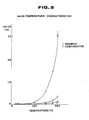
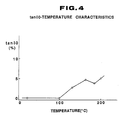
- Variation characterisrics of tan ⁇ 0 of the example and the comparative example versus temperature is shown in Fig. 3.
- Fig. 3 there is additionally shown the variation characteristics of tan ⁇ 0 of the example, for which earth insulation was provided without impregnation of resin compound, versus temperature.
- solid lines show the variation characteristics of tan ⁇ 0 of example and comparative example, for which impregnation of polyimide resin compound was performed
- broken lines shows the variation characteristics of tan ⁇ 0 of example and comparative example, for which impregnation of polyimide resin compound was not performed
- both of the example and comparative example have low value of tan ⁇ 0. Therefore, no substantial difference of tan ⁇ 0 in the example and the comparative example could be observed.
- the comparative example for which polyimide resin compound impregnation and hardening was performed shows substantial increase of tan ⁇ 0.
- the example with polyimide resin compound impregnated insulating structure shows much smaller increase of tan ⁇ 0.
- the polyimide film formed of the material expressed by the foregoing formula (1) has good compatibility to the polyimide resin compound containing polyimide resin and epoxy resin as principal component and acid anhydride type hardening agent for impregnating the latter.
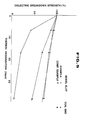
- thermal degradation test was performed for checking heat-resisting ability of the example and the comparative example. Test was performed by placing the model coils within a constant temperature bath, in which temperature was maintained constant at 270 o C.
- Fig. 5 shows lowering rate of dielectric strength after thermal degradation versus the initial dielectric strength. The dielectric strength was measured at the model slot section s and the coil end section e indicated in Fig. 1. As can be seen from Fig. 5, the dielectric strength of the comparative example was lowered in a short period. Form this, it can be confirmed that thermal degradation in the comparative example was substantial. Particularly,as can be seen from Fig. 5, the degradation at the stop section s in the comparative example, as represented by drop of the dielectric strength, was substantially great. In contrast to this, thermal degradation caused in the example is moderate. In the example, there cannot be observed any difference of dielectric strength at the slop section and the coil end section.
- the polyimide film was UPILEX R from Ube Kosan K.K. and is expressed by the foregoing formula (1).
- EXAMPLE 2 the polyimide film is used for insulation to the earth.
- EXAMPLE 3 the polyimide film is used both for element wire insulation and insulation to the earth.
- a sample as comparative example was also prepared utilizing polyimide film having composition expressed by the foregoing equation (2), e.g. KAPTON from DuPonte, for element wire insulation and insulation to the earth.
- Insulation treatment was performed in the following manner.
- For bear flat type copper wire of 1.8 mm x 5.0 mm, 0.05 mm thick and 12 mm width of polyimide film was wrapped for one ply with half lapping to form the element wire insulation.
- Two element wire insulated wires were arranged in side-by-side relationship to form a set.
- Four sets of wires are piled one another for forming the coil conductor.
- the coil conductor was shaped into hexagonal configuration with 200 mm length of straight portion.
- 0.05 mm thick and 19 mm width of polyimide film was wrapped for three plies in half lapped manner.
- glass fiber fabric tape of 0.13 mm thick was wrapped for one ply in half lapping manner.
- the EXAMPLEs 1 through 3 had much higher resistance against thermal degradation. Namely, the average dielectric strength of respective EXAMPLEs 1 through 3 are higher than 60% of the initial value. This value is much higher than that of the COMPARATIVE EXAMPLE. From this, the insulation structure according to the present invention can provide good and high heat-resisting ability.
- the present invention can fulfills all of the objects and advantages sought therefor.
Landscapes
- Physics & Mathematics (AREA)
- Spectroscopy & Molecular Physics (AREA)
- Chemical & Material Sciences (AREA)
- Chemical Kinetics & Catalysis (AREA)
- Insulation, Fastening Of Motor, Generator Windings (AREA)
- Compositions Of Macromolecular Compounds (AREA)
- Epoxy Resins (AREA)
- Organic Insulating Materials (AREA)
- Insulating Bodies (AREA)
- Manufacture Of Motors, Generators (AREA)
Applications Claiming Priority (2)
| Application Number | Priority Date | Filing Date | Title |
|---|---|---|---|
| JP63286661A JP2699475B2 (ja) | 1988-11-15 | 1988-11-15 | 回転電機コイルの絶縁構造 |
| JP286661/88 | 1988-11-15 |
Publications (2)
| Publication Number | Publication Date |
|---|---|
| EP0369435A2 true EP0369435A2 (de) | 1990-05-23 |
| EP0369435A3 EP0369435A3 (de) | 1990-12-19 |
Family
ID=17707316
Family Applications (1)
| Application Number | Title | Priority Date | Filing Date |
|---|---|---|---|
| EP19890121156 Ceased EP0369435A3 (de) | 1988-11-15 | 1989-11-15 | Isolierung für Drehankerspule |
Country Status (3)
| Country | Link |
|---|---|
| EP (1) | EP0369435A3 (de) |
| JP (1) | JP2699475B2 (de) |
| KR (1) | KR900008539A (de) |
Cited By (3)
| Publication number | Priority date | Publication date | Assignee | Title |
|---|---|---|---|---|
| CN101859615A (zh) * | 2010-05-26 | 2010-10-13 | 江苏五洲电磁线有限公司 | 一种变压器线圈薄膜导线的薄膜叠包烧结方法 |
| WO2014088900A1 (en) * | 2012-12-05 | 2014-06-12 | Ge Oil & Gas Esp | High temperature downhole motors with advanced polyimide insulation materials |
| US12123264B2 (en) | 2020-11-11 | 2024-10-22 | Baker Hughes Oilfield Operations Llc | Advanced insulation and jacketing for downhole power and motor lead cables |
Families Citing this family (1)
| Publication number | Priority date | Publication date | Assignee | Title |
|---|---|---|---|---|
| JP5787148B2 (ja) * | 2011-08-19 | 2015-09-30 | 日立工機株式会社 | 電動工具 |
Family Cites Families (4)
| Publication number | Priority date | Publication date | Assignee | Title |
|---|---|---|---|---|
| JPS5291196A (en) * | 1976-01-28 | 1977-08-01 | Hitachi Ltd | Magnetic material having superior heat resistance |
| JPS5528822A (en) * | 1978-08-23 | 1980-02-29 | Ube Ind Ltd | Method for manufacturing polyimide film |
| US4510272A (en) * | 1983-03-16 | 1985-04-09 | Avco Corporation | Bis-maleimide-epoxy compositions and prepregs |
| JPS63105444U (de) * | 1986-12-24 | 1988-07-08 |
-
1988
- 1988-11-15 JP JP63286661A patent/JP2699475B2/ja not_active Expired - Fee Related
-
1989
- 1989-11-15 EP EP19890121156 patent/EP0369435A3/de not_active Ceased
- 1989-11-15 KR KR1019890016645A patent/KR900008539A/ko not_active Ceased
Cited By (3)
| Publication number | Priority date | Publication date | Assignee | Title |
|---|---|---|---|---|
| CN101859615A (zh) * | 2010-05-26 | 2010-10-13 | 江苏五洲电磁线有限公司 | 一种变压器线圈薄膜导线的薄膜叠包烧结方法 |
| WO2014088900A1 (en) * | 2012-12-05 | 2014-06-12 | Ge Oil & Gas Esp | High temperature downhole motors with advanced polyimide insulation materials |
| US12123264B2 (en) | 2020-11-11 | 2024-10-22 | Baker Hughes Oilfield Operations Llc | Advanced insulation and jacketing for downhole power and motor lead cables |
Also Published As
| Publication number | Publication date |
|---|---|
| JP2699475B2 (ja) | 1998-01-19 |
| JPH02136046A (ja) | 1990-05-24 |
| KR900008539A (ko) | 1990-06-04 |
| EP0369435A3 (de) | 1990-12-19 |
Similar Documents
| Publication | Publication Date | Title |
|---|---|---|
| EP0571155B1 (de) | Beschichtungsstoff für die Ankerspule eines Motors für eine elektrische Ausrüstung | |
| US4427740A (en) | High maximum service temperature low cure temperature non-linear electrical grading coatings resistant to V.P.I. resins containing highly reactive components | |
| US2848794A (en) | Method of making electrical coils for high temperature use | |
| US4806806A (en) | Coil for arrangement in slots in a stator or rotor of an electrical machine | |
| US2459653A (en) | Insulated conductor | |
| JPS6212603B2 (de) | ||
| JPH04502546A (ja) | 大形回転電機のための導体巻線装置 | |
| CA1201337A (en) | Solid insulator and electric equipment coil using the same | |
| US1840139A (en) | Electrical coil | |
| US3213302A (en) | Insulated metallic articles | |
| US3014980A (en) | Insulation systems | |
| Emery | The application of conductive and stress grading tapes to vacuum pressure impregnated, high voltage stator coils | |
| US20030017950A1 (en) | Manufacturing process for an electrically insulating and mechanically structuring sheath on an electric conductor | |
| US6680119B2 (en) | Insulated electrical coil having enhanced oxidation resistant polymeric insulation composition | |
| US3801392A (en) | Method for insulating electrical conductor components of an electrical apparatus utilizing mica tape impregnated with a hardenable synthetic resin | |
| EP0331823A1 (de) | Isolierter Litzendraht und Methode zu dessen Herstellung | |
| US6555023B2 (en) | Enhanced oxidation resistant polymeric insulation composition for air-cooled generators | |
| JPH02136046A (ja) | 回転電機コイルの絶縁構造 | |
| GB2211368A (en) | Power cable jointing method | |
| US1872358A (en) | Insulating material | |
| EP0066633A1 (de) | Verfahren zur Bildung einer keramik-ähnlichen Isolierung | |
| JP3178924B2 (ja) | 電気機器の絶縁診断方法 | |
| GB2125207A (en) | Fire resistant electric cable | |
| JP2817270B2 (ja) | 電気機器用の耐熱巻線の製作方法 | |
| Balke et al. | Application and performance of insulations for 500 c hypersonic aircraft generators |
Legal Events
| Date | Code | Title | Description |
|---|---|---|---|
| PUAI | Public reference made under article 153(3) epc to a published international application that has entered the european phase |
Free format text: ORIGINAL CODE: 0009012 |
|
| AK | Designated contracting states |
Kind code of ref document: A2 Designated state(s): DE FR GB SE |
|
| PUAL | Search report despatched |
Free format text: ORIGINAL CODE: 0009013 |
|
| AK | Designated contracting states |
Kind code of ref document: A3 Designated state(s): DE FR GB SE |
|
| 17P | Request for examination filed |
Effective date: 19910404 |
|
| 17Q | First examination report despatched |
Effective date: 19930614 |
|
| STAA | Information on the status of an ep patent application or granted ep patent |
Free format text: STATUS: THE APPLICATION HAS BEEN REFUSED |
|
| 18R | Application refused |
Effective date: 19951029 |