EP0370333A2 - Bildgebung von Metaboliten mittels magnetischer Kernresonanz mit einer Vielfach-Quantum-Anregungssequenz - Google Patents
Bildgebung von Metaboliten mittels magnetischer Kernresonanz mit einer Vielfach-Quantum-Anregungssequenz Download PDFInfo
- Publication number
- EP0370333A2 EP0370333A2 EP89120852A EP89120852A EP0370333A2 EP 0370333 A2 EP0370333 A2 EP 0370333A2 EP 89120852 A EP89120852 A EP 89120852A EP 89120852 A EP89120852 A EP 89120852A EP 0370333 A2 EP0370333 A2 EP 0370333A2
- Authority
- EP
- European Patent Office
- Prior art keywords
- excitation
- metabolite
- nuclei
- pulse
- pulses
- Prior art date
- Legal status (The legal status is an assumption and is not a legal conclusion. Google has not performed a legal analysis and makes no representation as to the accuracy of the status listed.)
- Ceased
Links
Images


Classifications
-
- G—PHYSICS
- G01—MEASURING; TESTING
- G01R—MEASURING ELECTRIC VARIABLES; MEASURING MAGNETIC VARIABLES
- G01R33/00—Arrangements or instruments for measuring magnetic variables
- G01R33/20—Arrangements or instruments for measuring magnetic variables involving magnetic resonance
- G01R33/44—Arrangements or instruments for measuring magnetic variables involving magnetic resonance using nuclear magnetic resonance [NMR]
- G01R33/48—NMR imaging systems
- G01R33/4828—Resolving the MR signals of different chemical species, e.g. water-fat imaging
-
- G—PHYSICS
- G01—MEASURING; TESTING
- G01R—MEASURING ELECTRIC VARIABLES; MEASURING MAGNETIC VARIABLES
- G01R33/00—Arrangements or instruments for measuring magnetic variables
- G01R33/20—Arrangements or instruments for measuring magnetic variables involving magnetic resonance
- G01R33/44—Arrangements or instruments for measuring magnetic variables involving magnetic resonance using nuclear magnetic resonance [NMR]
- G01R33/48—NMR imaging systems
- G01R33/54—Signal processing systems, e.g. using pulse sequences ; Generation or control of pulse sequences; Operator console
- G01R33/56—Image enhancement or correction, e.g. subtraction or averaging techniques, e.g. improvement of signal-to-noise ratio and resolution
Definitions
- the field of the invention is nuclear magnetic resonance (NMR) imaging and, more particularly, methods and apparatus for removing unwanted spin resonance response signals from an NMR signal.
- NMR nuclear magnetic resonance
- NMR nuclear magnetic resonance
- 1H NMR signals suffer from unwanted signal components such as those from uncoupled spin resonances, such as water and coupled-spin resonances, such as those from lipids.
- uncoupled spin resonances such as water
- coupled-spin resonances such as those from lipids.
- These undesired spin resonances are typically three to four orders of magnitude larger than the spectral peaks of interest.
- these undesired spin resonances are positioned approximately at the same spectral position as the desired metabolite peaks, rendering the detection of the desired metabolite peaks virtually impossible by conventional NMR techniques. Accordingly, it is highly advantageous to provide a method for acquiring spin resonance responses from coupled hydrogen spins in metabolites in the presence of other in vivo human tissue components such as water and lipids.
- NMR methods which utilize a narrow bandwidth RF excitation pulse which is centered at the frequency of the offending spectral peak, and which suppresses the unwanted resonance peak in the total acquired NMR response spectrum.
- the most straightforward approach is the application of a long presaturating RF excitation pulse utilized to suppress the offending signal peak response (usually that of a water resonance) prior to receiving and processing the desired spectrum.
- Another technique utilizes a series of 90°, RF excitation pulses with interleaved delays, to maneuver the undesired spin magnetization into a longitudinal direction, while the spin magnetization of the desired resonances are maneuvered into the transverse plane where they produce a detectable NMR signal.
- These techniques are limited because they also suppress desired spin resonant components which are at or near the frequency of the suppressed component, and they do not suppress other undesired spin resonant components at other frequencies.
- This disadvantage may be overcome with yet another method known as Homonuclear Double-Resonance Difference Spectroscopy, which allows retention of certain coupled peaks, such as the lactate resonance, while excluding certain other resonances, such as the lipid alkyl resonances.
- This method applies a selective 180° RF excitation pulse which is centered on one of the lactate peak frequencies to only invert the phase of the lactate resonance peak, to which the first resonance peak is coupled. This occurs only if the frequency of the selective pulse is correctly set to within about 1 Hz, and an incorrect frequency will cause the original lactate peak to be distorted in phase or amplitude, and may result in the desired signal components cancelling one another in the final NMR signal.
- the present invention relates to an NMR pulse sequence which employs a double quantum coherence transfer technique to produce an image of the distribution and levels of metabolites in vivo .
- the pulse sequence includes a set of three RF excitation pulses which are applied to the region of interest in the presence of a polarizing magnetic field and in the presence of a composite magnetic field gradient to produce a multiple quantum excitation of 1H in the region of interest, applying a 180° RF excitation pulse following the multiple quantum excitation, and applying magnetic field gradients to the region of interest after the multiple quantum excitation to position encode the NMR signals which result.
- composite i.e. simultaneous x, y and z
- the 180° excitation pulse substantially improves the signal-to-noise ratio of the signal components due to the methyl portion of the lactate molecule.
- Yet another aspect of the invention is to further suppress the signal components due to lipids by replacing the third excitation pulse in the multiple quantum excitation with a frequency selective excitation pulse which is optimized to reduce the lipid signal components in the resulting NMR signals.
- a general object of the invention is to adapt the multiple quantum excitation sequence to an imaging sequence which may be employed to produce images of the distribution and levels of metabolites in vivo .
- the time period t1 between the second and third excitation pulse is incremented through a series of discrete values to provide discrimination between metabolite signals and lipid signals. Residual water signals are suppressed by the applied composite magnetic field gradients, the residual lipid signals are suppressed by the frequency selective third excitation pulse, and the desired lactate signals are enhanced by the application of the 180° excitation pulse and the application of the selective third excitation pulse.
- a variety of known imaging methods can then be employed by applying magnetic field gradients to the excited spin to encode the resulting NMR signals. The encoded NMR signals are employed to reconstruct an image using well known reconstruction algorithms.
- Molecule is a type AB3 molecule, such as a lactate molecule, in which scalar coupling exists between a single hydrogen atom 10a, having a single bond with a middle carbon atom in the Ha(A) moiety, and the three hydrogen atoms 10b, each having a bond with an end carbon atom in the Hb(B3) moiety.
- a polarizing magnetic field B0 and a transverse RF excitation field B1 is applied, an NMR signal is produced by this molecule which has a number of resonant peaks.
- the Ha(A) hydrogen atom 10a can have the spin of its nucleus pointing either up or down, the nuclear spins of the Hb(B3) atoms 10b encounter one of two different local environments, so that the peak of their resonance is split into a doublet of spectral lines, each of a substantially similar amplitude.
- the three b hydrogen atoms 10b can assume spin configurations with any one of: all three spins pointing in the upward direction, one spin in the downward direction and the other two spins in the upward direction, two spins in the downward direction and one spin in the upward direction, or all three spins in the downward direction. Therefore, the a hydrogen atom 10a sees four different environments and its resonance is split into a quartet of spectral lines, having relative intensities 1:3:3:1.
- FIG. 1b An example of the transformed NMR signal produced by the in vivo lactate molecule is shown in Fig. 1b.
- the NMR signal has been converted to the frequency domain such that its signal components are shown as peaks, or "spectral components", at different frequencies along the horizontal frequency axis.
- One spectral component produced by the hydrogen nuclei in the water is shown at the frequency ⁇ H , although it can be appreciated by those skilled in the art that there are typically many other unwanted spectral components present which are produced by uncoupled resonant spin. These other spectral components are often many orders of magnitude greater than the lactate spectral components.
- the NMR signal components due to the a hydrogen spin resonance Ha(A) of the illustrative lactate molecule 10 provides the quartet of spectral components R, S, T and U at respective frequencies ⁇ R , ⁇ S , ⁇ T and ⁇ U . Each of these peaks are separated by the spin-spin coupling constant J which is approximately 7.3 Hz at 2.0 Tesla.
- the b hydrogen resonances Hb(B3) provide the doublet spectral components V and W, at respective frequencies ⁇ V and ⁇ W . The separation therebetween is determined by the same spin-spin coupling constant J.
- the sum of the frequency offsets from the RF transmitter for the two coupled protons (H a and H b ) defines the double quantum modulation frequency (DQMF).
- the DQMF becomes the frequency offset between the two coupled protons which is 250 Hz at a field strength of 2.0 Tesla.
- the spacing between the center of the quartet and the center of the doublet is referred to as the chemical shift difference.
- the zero quantum modulation frequency (ZQMF) is equal to this difference in absolute frequency units (HZ). In the example, the ZQMF is equal to 250 Hz at 2.0 Tesla.
- the multiple quantum excitation pulse sequence is illustrated in Fig. 2. It includes the application of three 90° RF excitation pulses 20, 21 and 22, and the acquisition of the resulting NMR echo signal 23.
- the RF excitation transmitter frequency is positioned on the water resonance at 4.8 parts per millions.
- a gradient pulse 24 is applied during the time period t1 to dephase the spin, and a second magnetic field gradient pulse 25 is applied after the third RF excitation pulse 22.
- the strength of the pulse 25 is double that of the pulse 24 to selectively rephase the spin as discussed by A. Bax, P.G. deJong, A.F. Mehlkopf and J. Smidt in Chem. Phys. Lett. 69, 576 (1980).
- the NMR echo signal 23 is produced during an acquisition period.
- the multiple quantum excitation pulse sequence is a sequence in which the first pair of selective 90° RF pulses separated by the delay (TE/2) create multiple quantum coherence of the spin populations in the localized NMR spin system. This coherence of the spin populations evolves during the subsequent time period (t1) and with coupled spins this results in the phase modulation of the detected NMR signal.
- Spin resonances which are not coupled to other spin resonances do not exhibit multiple quantum behavior and do not, therefore, experience modulation during the time period (t1).
- spin resonances which are coupled exhibit unique multiple quantum modulation frequencies and this difference can be exploited to distinguish between coupled spin resonances.
- the present invention enables this phenomena to be used in the production of NMR images.
- Fig. 3 is a simplified block diagram of the major components of an NMR system suitable for acquiring the data according to the present invention.
- the system generally designated 400, is made up of a general purpose minicomputer 401 which is functionally coupled to disk storage unit 403 and an interface unit 405.
- An RF transmitter 402, signal averager 404, and gradient power supplies 406, 408 and 410 for energizing, respectively, G x , G y and G z gradient coils 416, 418, and 420, are coupled to computer 401 through interface unit 405.
- RF transmitter 402 contains an RF oscillator oscillating at the desired Larmor frequency.
- the transmitter is gated with pulse envelopes from computer 401 to generate RF pulses having the required modulation to excite resonance in the object under study.
- the RF pulses are amplified in RF power amplifier 412 to levels varying from 100 watts to several kilowatts and applied to transmitter coil 424.
- the NMR signal is sensed by receiver coil 426, amplified in a low noise preamplifier 422, and applied for further amplification, detection, and filtering to receiver 414.
- the signal is then digitized for averaging by signal averager 404 and for processing by computer 401.
- Preamplifier 422 and receiver 414 are protected from the RF pulses during transmission by active gating or by passive filtering.
- Computer 401 provides gating and envelope modulation for NMR pulses, blanking for the preamplifier and RF power amplifier, and voltage waveforms for the gradient power supplies. It also advances the gradients and the frequency of RF pulses during scanning.
- the computer also performs data processing such as Fourier transforms, data filtering, and storage functions.
- the transmitter and receiver RF coils may comprise a single coil. Alternatively, two separate coils that are electrically orthogonal may be used. The latter configuration has the advantage of reduced RF pulse breakthrough into the receiver during pulse transmission. In both cases, the fields of coils are orthogonal to the direction of the static magnetic field B0 produced by magnet 428 (Fig. 3). The coils are isolated from the remainder of the system by enclosure in an RF shielded case.
- Magnetic field gradient coils 416, 418, and 420 are necessary to provide gradients G x , G y and G z , respectively.
- the gradients should be monotonic and linear over the region of interest.
- Non-monotonic gradient fields cause a degradation in the NMR signal data, known as aliasing, which leads to severe artifacts.
- Nonlinear gradients cause geometric distortions of the image.
- the present invention is an improvement to the pulse sequence of Fig. 2 which enables the NMR system of Fig. 3 to produce images of the distribution and level of metabolites in vivo .
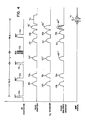
- the preferred embodiment of the improved pulse sequence is shown in Fig. 4.
- it includes a first pair of 90° RF excitation pulses 50 and 51 which define the time period TE/2.
- the third 90° pulse 52 which defines the time period t1 is a selective RF excitation pulse which is known in the art as a 1 3 3 1 pulse.
- this selective excitation pulse 52 further suppresses the signal component from lipids and it enhances the signal-to-noise ratio of the methyl (CH3) component by a factor of three.
- a pair of 180° RF refocusing pulses 53 and 54 are inserted in the middle of the respective TE/2 periods to improve the transfer efficiency by reducing chemical shift precession and to thereby improve the signal-to-noise ratio of the methyl (CH3) signal component.
- a pair of composite gradient magnetic field pulses straddle each refocusing pulse 53 and 54. More specifically, these include composite pulse pair 55 and 56, which are produced along each of the three axes of the applied magnetic field gradient, and which straddle the first refocusing pulse 53. They also include composite pulse pair 57 and 58 which straddles the second refocusing pulse 54 and which produces magnetic field gradient components along each axis of the NMR system. While these composite gradient magnetic field pulses are not absolutely necessary for proper operation, they do improve signal quality by preventing interference from unwanted echoes which might be formed as a result of imperfect refocusing pulses.
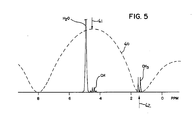
- the 1 3 3 1 pulse 52 has an excitation spectrum which is indicated by the dashed line 60.
- the selective pulse 52 is tuned for maximum excitation of the CH component of lactate molecule at 4.2 parts per million (PPM), as indicated by arrow 61. It has a null at the chemical shift frequency of the methyl (CH3) component of the lactate molecule, as indicated by arrow 62.
- still another aspect of the present invention is the use of composite magnetic field gradient pulses 65 during the t1 time period of the multiple quantum excitation pulse sequence in combination with composite magnetic field gradient pulses 66 during the final TE/2 time period.
- the composite gradient pulses 65 cause the double quantum coherent spin (CH3) to accumulate some phase dispersal (2 ⁇ /cm) along the direction determined by the vector sum of the gradient field components 65′, 65 ⁇ and 65′′′.
- the single quantum coherent spin of the unwanted water protons accumulates a similar phase dispersal, but only one-half as much ( ⁇ /cm).
- the composite gradient pulse 66 must have double the strength and be oppositely directed (-2 ⁇ /cm). While the composite gradient pulse 66 rephases the desired methyl signal (CH3), the undesired water signal is over compensated and is dephased in the opposite direction (- ⁇ /cm). As a result, the desired signal is restored to its maximum amplitude, while the unwanted signal from water is suppressed by dephasing the signals produced by its protons.
- the term "strength” refers to the integral of the magnetic field gradient amplitude over the time period during which it is applied.
- the general objective of the present invention is to improve the multiple quantum excitation pulse sequence so that it can be used to produce images of metabolites in vivo .
- FIG. 4 there are numerous imaging techniques which can be used with the pulse sequence and which involve the application of magnetic field gradient pulses during the final TE/2 time period.
- a read gradient pulse 70 is applied during the acquisition of the NMR signal 71 at the termination of the TE/2 time period to frequency encode the NMR signal for position along the x axis.
- the amplitude of the gradient field pulse 66′′′ is also stepped through a series of values and the corresponding series of acquired NMR signals are phase encoded for position along the y axis.
- the resulting two-dimensional array of acquired NMR data is then used to reconstruct an image in the well known manner.
- the present invention is not limited to any particular imaging technique, and other strategies can be employed by applying the proper gradient pulses during the final TE/2 time period.
- the gradient pulse 66 ⁇ may be replaced by a gradient pulse which is aligned with the final 180° RF pulse 54. If the pulse 54 is made frequency selective, a slice through the region of interest perpendicular to the z axis is selected for imaging.
- Yet another aspect of the invention is to modulate the acquired NMR data as a function of time period t1.
- This can be done in a number of ways including the difference method disclosed in the above-cited U.S. patent application serial no. 181,956, which requires two pulse sequences with different time periods t1.
- the pulse sequence can be repeated many times with incrementally different t1 values for each setting of the magnetic field gradients to produce a three-dimensional array of acquired NMR data. Images can then be reconstructed by Fourier transformation along each of these dimensions, including the t1 dimension.
- the multiple quantum excitation pulse sequence of the present invention substantially improves image quality.
- the composite gradient pulses 65 and 66 do not significantly improve the signal-to-noise ratio of the desired methyl signal, but they do significantly suppress the unwanted water signal.
- the use of the pair of symmetrical 180° RF pulses 53 and 54 results in an improvement of approximately 40% in the signal-to-noise ratio, and the use of the selective RF pulse 53 (1 3 3 1 ) results in a further improvement in methyl signal-to-noise ratio of approximately 160%.
Landscapes
- Physics & Mathematics (AREA)
- High Energy & Nuclear Physics (AREA)
- Condensed Matter Physics & Semiconductors (AREA)
- General Physics & Mathematics (AREA)
- Magnetic Resonance Imaging Apparatus (AREA)
- Image Processing (AREA)
- Image Analysis (AREA)
Priority Applications (1)
| Application Number | Priority Date | Filing Date | Title |
|---|---|---|---|
| EP95118829A EP0702244A1 (de) | 1988-11-25 | 1989-11-10 | Bildgebung von Metaboliten mittels magnetischer Kernresonanz mit einer Vielfach-Quantum-Anregungssequenz |
Applications Claiming Priority (2)
| Application Number | Priority Date | Filing Date | Title |
|---|---|---|---|
| US276173 | 1988-11-25 | ||
| US07/276,173 US5111819A (en) | 1988-11-25 | 1988-11-25 | Nmr imaging of metabolites using a multiple quantum excitation sequence |
Related Child Applications (2)
| Application Number | Title | Priority Date | Filing Date |
|---|---|---|---|
| EP95118829A Division EP0702244A1 (de) | 1988-11-25 | 1989-11-10 | Bildgebung von Metaboliten mittels magnetischer Kernresonanz mit einer Vielfach-Quantum-Anregungssequenz |
| EP95118829.1 Division-Into | 1989-11-10 |
Publications (2)
| Publication Number | Publication Date |
|---|---|
| EP0370333A2 true EP0370333A2 (de) | 1990-05-30 |
| EP0370333A3 EP0370333A3 (de) | 1991-02-06 |
Family
ID=23055499
Family Applications (2)
| Application Number | Title | Priority Date | Filing Date |
|---|---|---|---|
| EP95118829A Withdrawn EP0702244A1 (de) | 1988-11-25 | 1989-11-10 | Bildgebung von Metaboliten mittels magnetischer Kernresonanz mit einer Vielfach-Quantum-Anregungssequenz |
| EP19890120852 Ceased EP0370333A3 (de) | 1988-11-25 | 1989-11-10 | Bildgebung von Metaboliten mittels magnetischer Kernresonanz mit einer Vielfach-Quantum-Anregungssequenz |
Family Applications Before (1)
| Application Number | Title | Priority Date | Filing Date |
|---|---|---|---|
| EP95118829A Withdrawn EP0702244A1 (de) | 1988-11-25 | 1989-11-10 | Bildgebung von Metaboliten mittels magnetischer Kernresonanz mit einer Vielfach-Quantum-Anregungssequenz |
Country Status (3)
| Country | Link |
|---|---|
| US (1) | US5111819A (de) |
| EP (2) | EP0702244A1 (de) |
| JP (1) | JP2553719B2 (de) |
Cited By (6)
| Publication number | Priority date | Publication date | Assignee | Title |
|---|---|---|---|---|
| EP0412602A3 (en) * | 1989-08-05 | 1991-08-07 | Philips Patentverwaltung Gmbh | Nmr spectroscopic method and apparatus for using it |
| EP0404248A3 (de) * | 1989-06-22 | 1991-08-14 | Philips Patentverwaltung GmbH | Kernresonanzabbildungsverfahren |
| DE4023128A1 (de) * | 1990-07-20 | 1992-01-23 | Philips Patentverwaltung | Kernresonanz-spektroskopieverfahren |
| EP0496447A1 (de) * | 1991-01-24 | 1992-07-29 | Philips Patentverwaltung GmbH | Kernresonanzspektroskopieverfahren und Anordnung zur Durchführung des Verfahrens |
| EP0460929A3 (en) * | 1990-06-07 | 1992-08-05 | General Electric Company | Nmr spectroscopy |
| EP0597785A1 (de) * | 1992-11-13 | 1994-05-18 | Sadis Bruker Spectrospin, Societe Anonyme De Diffusion De L'instrumentation Scientifique Bruker Spectrospin | Verfahren zur Anregung und Ermittlung von magnetischen Kernresonanzsignalen, insbesondere in Leichtwasser |
Families Citing this family (17)
| Publication number | Priority date | Publication date | Assignee | Title |
|---|---|---|---|---|
| GB8819753D0 (en) * | 1988-08-19 | 1988-09-21 | Nycomed As | Apparatus |
| US5377679A (en) * | 1988-10-27 | 1995-01-03 | Kabushiki Kaisha Toshiba | Magnetic resonance imaging system |
| DE3914301A1 (de) * | 1989-04-29 | 1990-10-31 | Bruker Medizintech | Verfahren zur aufnahme von spinresoneanzspektren und zur spinresonanz-bildgebung |
| US5617861A (en) * | 1994-02-16 | 1997-04-08 | Huntington Medical Research Institutes | Magnetic resonance spectral analysis of the brain for diagnosis of clinical conditions |
| US6385479B1 (en) | 1999-03-31 | 2002-05-07 | Science & Technology Corporation @ Unm | Method for determining activity in the central nervous system |
| DE10015265C2 (de) * | 2000-03-28 | 2002-04-11 | Siemens Ag | Spektroskopisches Bildgebungsverfahren für ein Magnetresonanzgerät |
| JP3516631B2 (ja) * | 2000-03-30 | 2004-04-05 | ジーイー・メディカル・システムズ・グローバル・テクノロジー・カンパニー・エルエルシー | Rfコイルおよび磁気共鳴撮影装置 |
| JP4509336B2 (ja) * | 2000-08-31 | 2010-07-21 | 株式会社東芝 | 磁気共鳴装置 |
| US6864242B2 (en) * | 2001-03-05 | 2005-03-08 | Stephen P. Ernest | Enteral formulation |
| US7200430B2 (en) * | 2001-03-29 | 2007-04-03 | The Regents Of The University Of California | Localized two-dimensional shift correlated MR spectroscopy of human brain |
| US20040128081A1 (en) * | 2002-12-18 | 2004-07-01 | Herschel Rabitz | Quantum dynamic discriminator for molecular agents |
| US7289840B2 (en) * | 2004-09-22 | 2007-10-30 | Receptomon, Llc | Method for monitoring early treatment response |
| US7355405B2 (en) * | 2004-10-13 | 2008-04-08 | Hitachi Medical Corporation | Magnetic resonance imaging system and magnetic resonance imaging method |
| US7622102B2 (en) * | 2005-02-08 | 2009-11-24 | Receptomon, Llc | Method for monitoring early treatment response |
| WO2006107950A2 (en) * | 2005-04-05 | 2006-10-12 | Receptomon, Llc. | Method for monitoring early treatment response |
| US20070025918A1 (en) * | 2005-07-28 | 2007-02-01 | General Electric Company | Magnetic resonance imaging (MRI) agents: water soluble carbon-13 enriched fullerene and carbon nanotubes for use with dynamic nuclear polarization |
| DE102005040540B4 (de) * | 2005-08-26 | 2007-05-24 | Siemens Ag | Verfahren und Gerät zur Nachweisverbesserung einer schwachsensitiven Atomkernart in der NMR-Spektroskopie |
Family Cites Families (14)
| Publication number | Priority date | Publication date | Assignee | Title |
|---|---|---|---|---|
| JPS60146140A (ja) * | 1984-01-10 | 1985-08-01 | Yokogawa Hokushin Electric Corp | 核磁気共鳴による検査方法及びその装置 |
| US4678995A (en) * | 1984-12-12 | 1987-07-07 | Yale University | Apparatus and method for determining the presence of substances in a sample by NMR and producing an NMR image thereof |
| GB8520587D0 (en) * | 1985-08-16 | 1985-09-25 | Picker Int Ltd | Spectroscopy method |
| DE3543123A1 (de) * | 1985-12-06 | 1987-06-11 | Spectrospin Ag | Verfahren zur aufnahme von kernresonanzspektren |
| DE3543854A1 (de) * | 1985-12-12 | 1987-06-19 | Philips Patentverwaltung | Kernspintomographieverfahren und anordnung zur durchfuehrung des verfahrens |
| US4684893A (en) * | 1985-12-23 | 1987-08-04 | Kabushiki Kaisha Toshiba | Field gradient correction apparatus for compensating static field inhomogeneities in NMR imaging system |
| JPS62207447A (ja) * | 1986-03-07 | 1987-09-11 | 横河メディカルシステム株式会社 | Nmrイメ−ジングにおける選択励起方法 |
| US4703270A (en) * | 1986-04-18 | 1987-10-27 | The University Of British Columbia | Zero quantum NMR imaging and spectroscopy in a low homogeneity magnetic field |
| US4701708A (en) * | 1986-08-01 | 1987-10-20 | General Electric Company | Polarization transfer by selective homonuclear technique for suppression of uncoupled spins in NMR spectroscopy |
| US4774466A (en) * | 1986-08-15 | 1988-09-27 | Picker International, Inc. | Quick imaging scheme utilizing differently phase encoded primary and stimulated echoes |
| JPS63212337A (ja) * | 1987-02-28 | 1988-09-05 | 株式会社島津製作所 | 水・脂肪分離撮像法 |
| DE3739856A1 (de) * | 1987-11-25 | 1989-06-08 | Philips Patentverwaltung | Kernresonanz-spektroskopieverfahren |
| US4843321A (en) * | 1988-04-15 | 1989-06-27 | General Electric Company | Method for volume localized spectral editing of NMR signals produced by metabolites containing coupled spins |
| DE3823961A1 (de) * | 1988-07-15 | 1990-01-18 | Philips Patentverwaltung | Kernspintomographieverfahren und kernspintomograph zur durchfuehrung des verfahrens |
-
1988
- 1988-11-25 US US07/276,173 patent/US5111819A/en not_active Expired - Lifetime
-
1989
- 1989-11-10 EP EP95118829A patent/EP0702244A1/de not_active Withdrawn
- 1989-11-10 EP EP19890120852 patent/EP0370333A3/de not_active Ceased
- 1989-11-20 JP JP1299916A patent/JP2553719B2/ja not_active Expired - Fee Related
Cited By (9)
| Publication number | Priority date | Publication date | Assignee | Title |
|---|---|---|---|---|
| EP0404248A3 (de) * | 1989-06-22 | 1991-08-14 | Philips Patentverwaltung GmbH | Kernresonanzabbildungsverfahren |
| EP0412602A3 (en) * | 1989-08-05 | 1991-08-07 | Philips Patentverwaltung Gmbh | Nmr spectroscopic method and apparatus for using it |
| EP0460929A3 (en) * | 1990-06-07 | 1992-08-05 | General Electric Company | Nmr spectroscopy |
| DE4023128A1 (de) * | 1990-07-20 | 1992-01-23 | Philips Patentverwaltung | Kernresonanz-spektroskopieverfahren |
| EP0496447A1 (de) * | 1991-01-24 | 1992-07-29 | Philips Patentverwaltung GmbH | Kernresonanzspektroskopieverfahren und Anordnung zur Durchführung des Verfahrens |
| EP0597785A1 (de) * | 1992-11-13 | 1994-05-18 | Sadis Bruker Spectrospin, Societe Anonyme De Diffusion De L'instrumentation Scientifique Bruker Spectrospin | Verfahren zur Anregung und Ermittlung von magnetischen Kernresonanzsignalen, insbesondere in Leichtwasser |
| FR2698177A1 (fr) * | 1992-11-13 | 1994-05-20 | Sadis Bruker Spectrospin | Procédé d'excitation et d'acquisition de signaux de résonance magnétique nucléaire, notamment dans l'eau légère. |
| US5475308A (en) * | 1992-11-13 | 1995-12-12 | Sadis Bruker Spectrospin Societe Anonyme De Diffusion De L'instrumentation Scientifique Bruker Spectrospin | Process for the excitation and acquistion of nuclear magnetic resonance signals, particularly in light water |
| EP0913700A3 (de) * | 1992-11-13 | 1999-07-21 | Bruker Sa | Verfahren zur Anregung und ermittlung von magnetischen Kernresonanzsigalen, insbesondere in Leichtwasser |
Also Published As
| Publication number | Publication date |
|---|---|
| JPH02224642A (ja) | 1990-09-06 |
| JP2553719B2 (ja) | 1996-11-13 |
| EP0370333A3 (de) | 1991-02-06 |
| US5111819A (en) | 1992-05-12 |
| EP0702244A1 (de) | 1996-03-20 |
Similar Documents
| Publication | Publication Date | Title |
|---|---|---|
| US5111819A (en) | Nmr imaging of metabolites using a multiple quantum excitation sequence | |
| Alley et al. | Gradient characterization using a Fourier‐transform technique | |
| US4443760A (en) | Use of phase alternated RF pulses to eliminate effects of spurious free induction decay caused by imperfect 180 degree RF pulses in NMR imaging | |
| EP0135847B1 (de) | Bilderzeugung mittels magnetischer Kernresonanz mit Impulsfolgen durch Kombination von selektiver Anregung und gesteuerter freier Präzession | |
| EP2233940B1 (de) | Gleichzeitige Erregung und Erfassung bei der Magnetresonanz | |
| EP0254983B1 (de) | Polarisationstransfer durch selektive Homonukleartechnik zur Unterdrückung von entkoppelten Spins in der KMR-Spektroskopie | |
| US5652516A (en) | Spectroscopic magnetic resonance imaging using spiral trajectories | |
| EP2924457B1 (de) | "Half Fourier"-MRT mit iterativer Rekonstruktion | |
| US4740748A (en) | Method of high-speed magnetic resonance imaging | |
| US4962357A (en) | Two-dimensional method for spectral editing of NMR signals produced by metabolites containing coupled spins | |
| US4699148A (en) | Nuclear magnetic resonance imaging | |
| Hafner et al. | Magic echoes and NMR imaging of solids | |
| US6066949A (en) | Gradient characterization using fourier-transform | |
| US4843321A (en) | Method for volume localized spectral editing of NMR signals produced by metabolites containing coupled spins | |
| US4616183A (en) | Method for reducing baseline error components in NMR signals | |
| WO1998028630A2 (en) | Method and device for spectroscopic magnetic resonance imaging | |
| US20080211499A1 (en) | Low Power Decoupling for Multi-Nuclear Spectroscopy | |
| US4684893A (en) | Field gradient correction apparatus for compensating static field inhomogeneities in NMR imaging system | |
| US5077524A (en) | Gradient enhanced NMR correlation spectroscopy | |
| Uijen et al. | Fast fourier imaging | |
| US6104191A (en) | Quantitative in vivo spectroscopy using oversampling, waterline referencing, and prior knowledge fitting | |
| US6166545A (en) | MRI reconstruction using partial echo and partial NEX data acquisitions | |
| EP0479926B1 (de) | Verfahren zur bilderzeugung mittels magnetischer kernresonanz | |
| US5262723A (en) | Method and apparatus for obtaining pure-absorption two-dimensional lineshape data for multidimensional NMR spectroscopy using switched acquisition time gradients | |
| WO1987006699A1 (en) | A method for performing volume-selected nmr spectroscopy |
Legal Events
| Date | Code | Title | Description |
|---|---|---|---|
| PUAI | Public reference made under article 153(3) epc to a published international application that has entered the european phase |
Free format text: ORIGINAL CODE: 0009012 |
|
| AK | Designated contracting states |
Kind code of ref document: A2 Designated state(s): CH DE FR GB LI NL |
|
| PUAL | Search report despatched |
Free format text: ORIGINAL CODE: 0009013 |
|
| AK | Designated contracting states |
Kind code of ref document: A3 Designated state(s): CH DE FR GB LI NL |
|
| 17P | Request for examination filed |
Effective date: 19910806 |
|
| 17Q | First examination report despatched |
Effective date: 19931214 |
|
| GRAG | Despatch of communication of intention to grant |
Free format text: ORIGINAL CODE: EPIDOS AGRA |
|
| STAA | Information on the status of an ep patent application or granted ep patent |
Free format text: STATUS: THE APPLICATION HAS BEEN REFUSED |
|
| 18R | Application refused |
Effective date: 19961109 |