EP0370400A2 - Carafe et procédé de fabrication d'une carafe - Google Patents
Carafe et procédé de fabrication d'une carafe Download PDFInfo
- Publication number
- EP0370400A2 EP0370400A2 EP89121282A EP89121282A EP0370400A2 EP 0370400 A2 EP0370400 A2 EP 0370400A2 EP 89121282 A EP89121282 A EP 89121282A EP 89121282 A EP89121282 A EP 89121282A EP 0370400 A2 EP0370400 A2 EP 0370400A2
- Authority
- EP
- European Patent Office
- Prior art keywords
- handle
- glass container
- edge
- receptacle
- container
- Prior art date
- Legal status (The legal status is an assumption and is not a legal conclusion. Google has not performed a legal analysis and makes no representation as to the accuracy of the status listed.)
- Withdrawn
Links
Images


Classifications
-
- A—HUMAN NECESSITIES
- A47—FURNITURE; DOMESTIC ARTICLES OR APPLIANCES; COFFEE MILLS; SPICE MILLS; SUCTION CLEANERS IN GENERAL
- A47J—KITCHEN EQUIPMENT; COFFEE MILLS; SPICE MILLS; APPARATUS FOR MAKING BEVERAGES
- A47J45/00—Devices for fastening or gripping kitchen utensils or crockery
- A47J45/06—Handles for hollow-ware articles
- A47J45/07—Handles for hollow-ware articles of detachable type
- A47J45/078—Handles for coffee pots or the like
-
- A—HUMAN NECESSITIES
- A47—FURNITURE; DOMESTIC ARTICLES OR APPLIANCES; COFFEE MILLS; SPICE MILLS; SUCTION CLEANERS IN GENERAL
- A47G—HOUSEHOLD OR TABLE EQUIPMENT
- A47G19/00—Table service
- A47G19/12—Vessels or pots for table use
-
- B—PERFORMING OPERATIONS; TRANSPORTING
- B29—WORKING OF PLASTICS; WORKING OF SUBSTANCES IN A PLASTIC STATE IN GENERAL
- B29C—SHAPING OR JOINING OF PLASTICS; SHAPING OF MATERIAL IN A PLASTIC STATE, NOT OTHERWISE PROVIDED FOR; AFTER-TREATMENT OF THE SHAPED PRODUCTS, e.g. REPAIRING
- B29C66/00—General aspects of processes or apparatus for joining preformed parts
- B29C66/50—General aspects of joining tubular articles; General aspects of joining long products, i.e. bars or profiled elements; General aspects of joining single elements to tubular articles, hollow articles or bars; General aspects of joining several hollow-preforms to form hollow or tubular articles
- B29C66/51—Joining tubular articles, profiled elements or bars; Joining single elements to tubular articles, hollow articles or bars; Joining several hollow-preforms to form hollow or tubular articles
- B29C66/53—Joining single elements to tubular articles, hollow articles or bars
- B29C66/534—Joining single elements to open ends of tubular or hollow articles or to the ends of bars
- B29C66/5344—Joining single elements to open ends of tubular or hollow articles or to the ends of bars said single elements being substantially annular, i.e. of finite length, e.g. joining flanges to tube ends
-
- B—PERFORMING OPERATIONS; TRANSPORTING
- B29—WORKING OF PLASTICS; WORKING OF SUBSTANCES IN A PLASTIC STATE IN GENERAL
- B29C—SHAPING OR JOINING OF PLASTICS; SHAPING OF MATERIAL IN A PLASTIC STATE, NOT OTHERWISE PROVIDED FOR; AFTER-TREATMENT OF THE SHAPED PRODUCTS, e.g. REPAIRING
- B29C66/00—General aspects of processes or apparatus for joining preformed parts
- B29C66/50—General aspects of joining tubular articles; General aspects of joining long products, i.e. bars or profiled elements; General aspects of joining single elements to tubular articles, hollow articles or bars; General aspects of joining several hollow-preforms to form hollow or tubular articles
- B29C66/61—Joining from or joining on the inside
- B29C66/612—Making circumferential joints
-
- B—PERFORMING OPERATIONS; TRANSPORTING
- B29—WORKING OF PLASTICS; WORKING OF SUBSTANCES IN A PLASTIC STATE IN GENERAL
- B29C—SHAPING OR JOINING OF PLASTICS; SHAPING OF MATERIAL IN A PLASTIC STATE, NOT OTHERWISE PROVIDED FOR; AFTER-TREATMENT OF THE SHAPED PRODUCTS, e.g. REPAIRING
- B29C65/00—Joining or sealing of preformed parts, e.g. welding of plastics materials; Apparatus therefor
- B29C65/48—Joining or sealing of preformed parts, e.g. welding of plastics materials; Apparatus therefor using adhesives, i.e. using supplementary joining material; solvent bonding
-
- B—PERFORMING OPERATIONS; TRANSPORTING
- B29—WORKING OF PLASTICS; WORKING OF SUBSTANCES IN A PLASTIC STATE IN GENERAL
- B29C—SHAPING OR JOINING OF PLASTICS; SHAPING OF MATERIAL IN A PLASTIC STATE, NOT OTHERWISE PROVIDED FOR; AFTER-TREATMENT OF THE SHAPED PRODUCTS, e.g. REPAIRING
- B29C65/00—Joining or sealing of preformed parts, e.g. welding of plastics materials; Apparatus therefor
- B29C65/48—Joining or sealing of preformed parts, e.g. welding of plastics materials; Apparatus therefor using adhesives, i.e. using supplementary joining material; solvent bonding
- B29C65/52—Joining or sealing of preformed parts, e.g. welding of plastics materials; Apparatus therefor using adhesives, i.e. using supplementary joining material; solvent bonding characterised by the way of applying the adhesive
- B29C65/54—Joining or sealing of preformed parts, e.g. welding of plastics materials; Apparatus therefor using adhesives, i.e. using supplementary joining material; solvent bonding characterised by the way of applying the adhesive between pre-assembled parts
-
- B—PERFORMING OPERATIONS; TRANSPORTING
- B29—WORKING OF PLASTICS; WORKING OF SUBSTANCES IN A PLASTIC STATE IN GENERAL
- B29C—SHAPING OR JOINING OF PLASTICS; SHAPING OF MATERIAL IN A PLASTIC STATE, NOT OTHERWISE PROVIDED FOR; AFTER-TREATMENT OF THE SHAPED PRODUCTS, e.g. REPAIRING
- B29C66/00—General aspects of processes or apparatus for joining preformed parts
- B29C66/01—General aspects dealing with the joint area or with the area to be joined
- B29C66/05—Particular design of joint configurations
- B29C66/10—Particular design of joint configurations particular design of the joint cross-sections
- B29C66/12—Joint cross-sections combining only two joint-segments; Tongue and groove joints; Tenon and mortise joints; Stepped joint cross-sections
- B29C66/124—Tongue and groove joints
- B29C66/1244—Tongue and groove joints characterised by the male part, i.e. the part comprising the tongue
- B29C66/12441—Tongue and groove joints characterised by the male part, i.e. the part comprising the tongue being a single wall
-
- B—PERFORMING OPERATIONS; TRANSPORTING
- B29—WORKING OF PLASTICS; WORKING OF SUBSTANCES IN A PLASTIC STATE IN GENERAL
- B29C—SHAPING OR JOINING OF PLASTICS; SHAPING OF MATERIAL IN A PLASTIC STATE, NOT OTHERWISE PROVIDED FOR; AFTER-TREATMENT OF THE SHAPED PRODUCTS, e.g. REPAIRING
- B29C66/00—General aspects of processes or apparatus for joining preformed parts
- B29C66/01—General aspects dealing with the joint area or with the area to be joined
- B29C66/05—Particular design of joint configurations
- B29C66/10—Particular design of joint configurations particular design of the joint cross-sections
- B29C66/12—Joint cross-sections combining only two joint-segments; Tongue and groove joints; Tenon and mortise joints; Stepped joint cross-sections
- B29C66/124—Tongue and groove joints
- B29C66/1246—Tongue and groove joints characterised by the female part, i.e. the part comprising the groove
- B29C66/12469—Tongue and groove joints characterised by the female part, i.e. the part comprising the groove being asymmetric
-
- B—PERFORMING OPERATIONS; TRANSPORTING
- B29—WORKING OF PLASTICS; WORKING OF SUBSTANCES IN A PLASTIC STATE IN GENERAL
- B29K—INDEXING SCHEME ASSOCIATED WITH SUBCLASSES B29B, B29C OR B29D, RELATING TO MOULDING MATERIALS OR TO MATERIALS FOR MOULDS, REINFORCEMENTS, FILLERS OR PREFORMED PARTS, e.g. INSERTS
- B29K2709/00—Use of inorganic materials not provided for in groups B29K2703/00 - B29K2707/00, for preformed parts, e.g. for inserts
- B29K2709/08—Glass
-
- B—PERFORMING OPERATIONS; TRANSPORTING
- B29—WORKING OF PLASTICS; WORKING OF SUBSTANCES IN A PLASTIC STATE IN GENERAL
- B29L—INDEXING SCHEME ASSOCIATED WITH SUBCLASS B29C, RELATING TO PARTICULAR ARTICLES
- B29L2031/00—Other particular articles
- B29L2031/712—Containers; Packaging elements or accessories, Packages
- B29L2031/7136—Vases, pots, e.g. for flowers
Definitions
- the invention relates to a carafe with a handle connected to it, in particular a carafe with a glass container to which a handle for pouring is fastened, namely via a plurality of fasteners which are fastened in a receiving space of the handle and also on an upwardly pointing edge the neck part of the glass container.
- Known carafes consist of a glass container or glass vessel, to which a handle is connected using a metal band, via which the handle is connected to the neck part of the glass container.
- This design must take into account the thermal changes in length of the belt and the glass container when the carafe and its contents are heated.
- This known construction is difficult to assemble.
- a carafe is described in which the neck portion of the glass container is held within an annular cavity of a handle by a flexible adhesive which completely surrounds the neck portion of the carafe. Compare US-A-4,090,648.
- the invention is therefore based on the main object of proposing a new and improved carafe with a handle serving for pouring, the handle being firmly attached is connected to a glass container and the glass container can expand and contract when the temperature changes. Furthermore, the invention is based on the object of proposing such a carafe in which the handle is firmly connected to the glass container and length changes due to temperature changes are possible. It should be avoided that the handle loosens when it is loaded in a strongly heated state. Furthermore, the invention is based on the object of proposing a carafe of this type which manages with a minimum number of components, the handle being simple to connect to the glass container, the connection being intended to be resilient and nevertheless withstanding the temperature fluctuations which occur.
- the invention has for its object to design such a carafe so that the handle is firmly connected to the edge of the glass container, via several fasteners which are arranged all around the edge of the glass container and which a shift of the handle with respect to temperature changes Prevent glass container.
- Another object of the invention is to propose a carafe of this type which has locking means in order to hold and seal the handle on the glass container firmly and securely, temperature changes also being absorbed.
- the invention is based on the object of proposing a compact and sturdy carafe which can be easily assembled, is simple and reliable in use and which can also be produced inexpensively.
- the invention is characterized in that the handle has an annular receptacle into which the edge of the glass container fits with play, with several fastening means being provided in the receptacle which lie against the edge of the glass container and the handle attach the glass container around its opening, and wherein a flexible material is provided in the receptacle that seals the handle on the glass container.
- the fastening means consist of several spring clips, each spring clip consisting of a metal strip or metal strip which is essentially V-shaped.
- the legs or feet of the spring clip are connected to each other via a rounded middle part.
- the spring clips are placed over the edge of the glass container and fastened there, with their feet provided on both sides of the edge.
- the spring clips are spaced from each other around the opening of the glass container.
- the receiving space of the handle has opposing surfaces and each foot of the spring clip rests on one of these surfaces in order to attach the handle to the glass container. At least one of these surfaces of the handle receptacle can be provided with a rib, while the ends of the feet of the spring clips have an edge with which they rest on the rib and thereby firmly fix the spring clip to the handle.
- the upward-facing edge of the glass container has a bulge, while the middle part of each spring clip is bent accordingly, so that the bulge lies in it.
- the opposite surfaces of the receiving space of the handle can each be equipped with a plurality of adjacent ribs, which form grooves between them for receiving the end edges of the legs of the spring elements, whereby the spring elements are fastened within the handle and thereby the handle is locked on the neck part of the glass vessel so that the glass vessel is securely fastened in the receptacle of the handle.
- the neck part of the glass vessel can also be equipped with positioning means for gripping and holding the spring elements at spaced locations around the opening of the glass container.
- the positioning means may have protrusions from the edge of the neck portion to grip and hold each spring element and to prevent displacement of the spring elements along the edge and to prevent the container from opening.
- a resilient or resilient material is provided within the annular receptacle of the handle that surrounds the neck portion of the container and the fasteners.
- a method for producing a carafe using a glass container with a neck part with an upward-pointing edge and a handle for pouring is also proposed, the handle having an annular receptacle in which the neck part of the glass container is loosely inserted and in which several Spring elements added are, and that over the upward-facing edge of the neck portion of the glass container and spaced apart.
- a flexible, liquid sealing material is introduced into the ring-shaped receptacle of the handle for the glass container, the spring elements are inserted, being located around the neck part of the glass container, namely in the ring-shaped receptacle of the handle and in contact with the opposite one another Surfaces of the annular receptacle, so that the neck part of the glass container is located in the receptacle and is positioned there and it is locked on the handle by the spring elements.
- the resilient sealing material surrounds the edge of the glass container. The sealing material solidifies and forms a flexible, liquid-tight seal between the handle and the glass container.
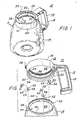
- the carafe 10 has a pouring handle 12, which is preferably made of a plastic material that is heat-resistant.
- the carafe also has a glass container 14.
- the handle 12 has a cylindrical part 16 for attachment to the glass container 14 and a handle 18 which extends outwards and downwards from one side of the cylindrical part 16.
- the cylindrical part 16 has a cylindrical side wall 20, an upper side 22 and an inner cylinder wall 24, which forms an opening 26.
- a lip 28 extends from the cylinder surface 20 and the top 22 to a location opposite the handle 18.
- the top 22 has a raised peripheral edge 23 for receiving and holding a cover, not shown in the drawing, which closes the opening 26.
- the underside 30 of the cylinder part 16 of the handle 12 has an annular receptacle 32, which is shown in FIGS. 2 and 3.
- the annular receptacle 32 is defined by mutually opposite outer or inner surfaces 34, 36 and by an upper side 38 and an opening 39.
- the receptacle 32 is defined such that the upstanding edge 40 (see FIGS. 2 and 3) of the neck part 42 the glass container 14 can be accommodated with play in it.
- the container 14 is preferably made of glass, which can hold heated substances, for example coffee, wherein the substances can be poured out by means of the handle 12.
- the neck part 42 with the edge 40 pointing upward forms an opening 44 in the interior 46 of the container 14.
- the upstanding edge 40 ends at the top in a bead 48.
- a plurality of fastening means 50 which have metallic spring clips 52, are placed over the upstanding edge 40, spaced apart from one another around the opening 44 of the container 14.
- Each spring element 52 consists of a resilient metal strip which is profiled essentially in a V-shape, whereby opposing first and second feet 54, 56 are formed, which are connected to one another via a curved middle part 57.
- the foot 54 of the spring clip 52 extends outwards, as seen from the neck part 42 of the container 14, while the foot 56, which is shorter than the foot 54, extends from the neck part 42 extends inwards. See Fig. 3.
- the curved central portion 57 of the spring clips 52 corresponds to the bead 48 and is placed over the bead, namely on the top of the container 14, whereby the spring clips 52 are attached to the neck portion 42 of the container 34.
- Fig. 2 shows that the spring elements 52 are placed evenly spaced from each other on the edge of the container 14 and protrude together with the edge 40 into the annular receptacle 32 of the handle 12 (see. Fig. 3).
- the opening of the annular receptacle 32 is dimensioned such that the edge 40 of the neck part 42 of the container 34 can be freely received in the receptacle, as a result of which loads on the neck part 42 of the container 14 are reduced or completely eliminated when the temperature changes.
- the distance between the outer wall 34 and the inner wall 36 is sufficient to avoid contact with the edge 40 of the container 14.
- the amount by which the edge 40 is received in the annular receptacle 32 is limited by the contact made by the bottom 30 of the handle 32 with the inner and outer surfaces of the container at the locations 60, 62. This limits the insertion of the neck part 40 into the receptacle 32 and prevents the upper side 38 of the receptacle 32 from contacting the neck part 40.
- the outer surface 34 of the receptacle 32 has one or more grooves 64 and ribs 66, while the opposite inner surface 36 has an inclined surface 68 at the bottom that is at an angle of, for example, 20 ° with the upper vertical wall 70, thereby providing an enlarged access 39 to the annular Recording 32 is formed, which tapers gradually upwards.
- the handle 12 is held firmly on the neck part 42 of the container 14 via the spring clips 52 of the fastening means, as shown in Fig. 3.
- the feet 54, 56 of each spring element 52 lie against the inner wall 34 or the outer wall 36 of the annular receptacle 32.
- the edge 72 at the end of the feet 54 of the spring elements 52 is received in a groove 64 and lies against a rib 66 in the outer surface 34, while its edge 74 at the end of the other foot 56 lies against the surface 68 of the inner surface 36.
- the contact of the spring elements 52 at their edges 72, 74 prevents displacement in the annular receptacle 32 and holds the curved middle part 57 of each spring element 52 around the bead 48 of the container 14, so that the handle 12 is securely attached to the container 14.
- the spring clips 52 allow the edge 40 to move relative to the handle 12 within the annular receiving space 32, the relative movements being caused by temperature changes. These movements are absorbed by the spring action of the spring clips 52, without a component being impermissibly loaded.
- a resilient or resilient sealing material 80 is provided in the annular receptacle 32, which sealing material embeds the neck part 42 and its upward-facing edge 40 of the container and also the spring clips 52, which are located in the annular receptacle. Because the fasteners 50 serve to lock the handle on the container 14 and prevent displacement, the curing or destruction of the resilient sealing material 80 caused by heat does not affect the secure attachment of the handle 12 to the container 14.
- Fig. 4 shows a sectional view similar to Fig. 3, but in a modified embodiment of a handle 12 'a carafe 10'.
- the handle 12 ' corresponds essentially to the handle 12, except that the annular receptacle 32' has a series of grooves 64 ', at the lower part of its surface 36', similar to the grooves and edges 64, 66 on the opposite outer surface 34 of the Recording 32 '.
- An angled surface 68 ' is also provided on the lower part of the inner surface 36' to form a widened access 39 'to the receptacle 32' and to touch the container 14 at the point 62 ', as is also the case with the handle 12 .
- the spring clips 52 ' are also placed over the upstanding edge 40 of the container 14, the curved central parts 57' of which are firmly placed around the bead 48 and the edge 72 'of the struts 54' are received in a groove 64 and by a rib 66 are held in the outer surface 34.
- the other feet 56 ' which are shorter than the feet 54', have edges 74 'which rest on a rib 66' of the inner surface 36 'of the receptacle 32'.
- the system of the feet 54 'and 56' of the spring elements or spring clips 52 ' holds them firmly in the receptacle 32', while the central part 57 'are firmly placed around the bead 58 of the container 14, so that the container by means of the spring clips 52' on Handle 12 'is attached.
- the spring clips 52 ' secure the handle 12' on the container 14 and connect both parts. They enable the components to expand and contract.
- the resilient sealing material 80 is also provided in the receptacle 32 'and forms a liquid-tight seal between the container 14 and the handle 12'.
- FIG. 5 and 6 show a modified embodiment of a container 14 '.
- the container 14 ' corresponds essentially to the container 14, except that the upstanding edge 40' of the neck part 42 'is provided with positioning means 90 for each spring clip 52 of the fastening means 50.
- the positioning means 90 have a large number of sets in the form shown Projection pairs 92, 94, which extend from the outer surface 96 of the edge 40 'of the container 14 to the outside.
- a set of projections 92, 94 is provided for each spring clip 52 which is placed around the upward edge 40 'of the container 14'.
- the projections 92, 94 of each pair are spaced from each other so that they receive and abut against opposite edges 98, 100 of a foot 54 of a spring clip 52.
- the edges 98, 100 extend near the surface 96 of the edge 40 ', as shown in FIGS. 5 and 6.
- the positioning means 90 serve to receive and hold each spring clip 52 on the neck portion 42 'spaced apart.
- the handle 12 or 12 ' is securely attached to the container 14, namely via the spring clips 52, the positioning means 90 providing resistance to rotation of the handle 12, 12' with respect to the neck portion 42 'of the container 14'.
- the fasteners 50 used by the Spring clips 52 are formed, also prevent lateral movement of the handle 12, 12 'with respect to the container 14 or 14', based on the weight of the liquid in the container when the carafe 10 or 10 'is held on the handle 18 for pouring its contents.
- the inventive method for producing such a carafe uses a glass container with a neck part with an upstanding edge and a pouring handle with an annular receptacle in which the neck part of the container is loosely received.
- a plurality of spring elements 52 of a fastening means 50 are placed at a distance from one another over the edge 40, as shown in FIGS. 2 and 5.
- a resilient sealing material is entered in the liquid state in the annular receptacle 32 of the handle 12 or in the annular receptacle 32 'of the handle 12'.
- the annular receptacle of the handle 12 is flush with the edge 40 of the container 14, while the spring clips 52 and the neck 42 of the container 14 are inserted into the annular receptacle 52 of the handle 12.
- the spring elements are now located over the edge 40 of the container 14 and are moved into the receptacle 32 through their access 39, the feet 54, 56 resting against the outer wall 34 and inner wall 36 of the receptacle 32.
- the foot 54 of each spring element 52 bears against the row of grooves 64 and edges 66, while the end 56 bears against the inclined part 68 of the inner wall 36.
- the spring clips 52 are seated so that their ends 54 each abut a rib 66 while their legs 56 are stretched by sliding along the inclined surface 68.
- the spring clips 52 are locked in the annular receptacle 32 and the legs 54, 56 are pressed together, so that the central parts 57 of the spring clips 52 firmly grip around the bead 48 of the container 14 and are held thereon.
- the liquid sealing material 80 now solidifies and results in a flexible liquid seal between the handle 12 and the container 14.
- the assembly of the handle 12 or the handle 12 'on the container 14 or 14' is carried out as described above.
- the handle 12 ' has grooves and ribs along the opposite inner and outer surfaces 34', 36 'of the receptacle 32' to which the feet 54 ', 56' of the spring clips 52 'create, while the container 14' has positioning means in which the spring clips 52 from each other spaced around the edge 40 'of the container 14 are held.
- the carafe 10 ' is mounted with a handle 12' and a container 14 or 14 ', the components being firmly attached to one another via the spring clips 52'.
- a carafe with a handle and a spout and with a container which are connected to one another via spring clips, by means of which the neck of the container and the handle are firmly connected to one another.
- the spring clips are flexible and thus absorb the thermal changes in length of the components.
- the thermal changes in length are based on the heating and dispensing of hot liquids, for example coffee. The occurrence of excessive forces that could damage the carafe is thus avoided.
- the components for the production of the carafe can also be assembled quickly and carefully.
Landscapes
- Engineering & Computer Science (AREA)
- Mechanical Engineering (AREA)
- Food Science & Technology (AREA)
- Table Devices Or Equipment (AREA)
- Centrifugal Separators (AREA)
- Details Of Rigid Or Semi-Rigid Containers (AREA)
- Closures For Containers (AREA)
Applications Claiming Priority (2)
| Application Number | Priority Date | Filing Date | Title |
|---|---|---|---|
| US07/274,818 US4930687A (en) | 1988-11-22 | 1988-11-22 | Decanter with attached spout-handle and method of making same |
| US274818 | 2008-11-20 |
Publications (1)
| Publication Number | Publication Date |
|---|---|
| EP0370400A2 true EP0370400A2 (fr) | 1990-05-30 |
Family
ID=23049727
Family Applications (1)
| Application Number | Title | Priority Date | Filing Date |
|---|---|---|---|
| EP89121282A Withdrawn EP0370400A2 (fr) | 1988-11-22 | 1989-11-17 | Carafe et procédé de fabrication d'une carafe |
Country Status (10)
| Country | Link |
|---|---|
| US (1) | US4930687A (fr) |
| EP (1) | EP0370400A2 (fr) |
| JP (1) | JPH03136611A (fr) |
| AR (1) | AR244619A1 (fr) |
| AU (1) | AU609003B2 (fr) |
| BR (1) | BR8905870A (fr) |
| CA (1) | CA2003357C (fr) |
| DK (1) | DK584889A (fr) |
| FI (1) | FI895541A7 (fr) |
| NO (1) | NO894633L (fr) |
Cited By (2)
| Publication number | Priority date | Publication date | Assignee | Title |
|---|---|---|---|---|
| DE4242987A1 (de) * | 1992-12-18 | 1994-06-23 | Braun Ag | Glaskanne zum Aufbewahren eines Brühgetränkes |
| US5752618A (en) * | 1994-07-23 | 1998-05-19 | Braun Aktiengesellschaft | Carafe for carrying a beverage with holding ring structure |
Families Citing this family (10)
| Publication number | Priority date | Publication date | Assignee | Title |
|---|---|---|---|---|
| US5224634A (en) * | 1991-05-20 | 1993-07-06 | Wilbur Curtis Company, Inc. | Decanter vessel and pouring spout |
| AU131658S (en) * | 1997-04-09 | 1997-10-01 | Oil Safe Systems Pty Ltd | A lid |
| US5988457A (en) * | 1998-04-10 | 1999-11-23 | Hp Intellectual Corp. | Beverage vessel |
| USD455044S1 (en) | 1999-05-14 | 2002-04-02 | Service Ideas, Inc. | Beverage server |
| USD448995S1 (en) | 2000-12-29 | 2001-10-09 | Mcdonald Robert | Combined lid and handle for a can |
| USD465121S1 (en) | 2002-01-09 | 2002-11-05 | Conair Cip, Inc. | Container |
| US6968984B2 (en) * | 2002-01-10 | 2005-11-29 | Conair Corporation | Thermal container |
| US6736295B2 (en) * | 2002-05-13 | 2004-05-18 | Shin-Shuoh Lin | High flow carafe |
| EP3845101B1 (fr) * | 2019-12-30 | 2023-07-19 | BSH Hausgeräte GmbH | Récipient ayant une poignée pour un appareil de cuisine |
| USD922137S1 (en) * | 2020-11-12 | 2021-06-15 | Xiamen bikuer technology Co., Ltd | Bottle lid |
Family Cites Families (16)
| Publication number | Priority date | Publication date | Assignee | Title |
|---|---|---|---|---|
| US332754A (en) * | 1885-12-22 | George e | ||
| US1463692A (en) * | 1923-07-31 | Invisible pipe joint | ||
| US2314328A (en) * | 1940-10-28 | 1943-03-23 | Frank C Enderle | Flue or vent pipe |
| FR1078580A (fr) * | 1953-03-31 | 1954-11-19 | Cie De Pont A Mousson | Nouveau produit pour la liaison étanche d'éléments de canalisation et joint en comportant application |
| CH392170A (de) * | 1960-05-23 | 1965-05-15 | Peck Rolf | Verbindung zweier gleichartiger Elemente |
| US3308982A (en) * | 1964-09-28 | 1967-03-14 | Kitabayashi Seiichi | Mounting cap means for dispenser |
| US3473833A (en) * | 1967-12-28 | 1969-10-21 | Nat Distillers Chem Corp | Plastic pipe coupling |
| US3491924A (en) * | 1968-01-08 | 1970-01-27 | Bloomfield Ind Inc | Pouring spouts for decanters |
| US3800988A (en) * | 1968-06-17 | 1974-04-02 | Cory Corp | One-piece spout and handle structure |
| US3784235A (en) * | 1971-10-08 | 1974-01-08 | Us Navy | Tubular adhesive joint with snap lock |
| US3744824A (en) * | 1972-06-26 | 1973-07-10 | Graenges Essem Ab | Pipe couplings |
| GB1486671A (en) * | 1975-01-25 | 1977-09-21 | Hepworth Plastics Ltd | Pipe couplings |
| US4090648A (en) * | 1976-04-09 | 1978-05-23 | Bloomfield Industries, A Division Of Beatrice Foods Co. | Decanter and molded interlocking handle |
| GB1529141A (en) * | 1977-04-27 | 1978-10-18 | Kin Hip Metal Plastic | Jugs |
| US4819972A (en) * | 1986-01-07 | 1989-04-11 | Gary Champa | Grip joints for plastic ducts |
| US4838463A (en) * | 1987-04-15 | 1989-06-13 | Bloomfield Industries, Inc. | Decanter with molded interlocking handle |
-
1988
- 1988-11-22 US US07/274,818 patent/US4930687A/en not_active Expired - Fee Related
-
1989
- 1989-11-17 EP EP89121282A patent/EP0370400A2/fr not_active Withdrawn
- 1989-11-20 CA CA002003357A patent/CA2003357C/fr not_active Expired - Fee Related
- 1989-11-21 AU AU45386/89A patent/AU609003B2/en not_active Ceased
- 1989-11-21 DK DK584889A patent/DK584889A/da not_active Application Discontinuation
- 1989-11-21 NO NO89894633A patent/NO894633L/no unknown
- 1989-11-21 FI FI895541A patent/FI895541A7/fi not_active Application Discontinuation
- 1989-11-22 JP JP1302278A patent/JPH03136611A/ja active Granted
- 1989-11-22 BR BR898905870A patent/BR8905870A/pt unknown
- 1989-11-22 AR AR89315506A patent/AR244619A1/es active
Cited By (3)
| Publication number | Priority date | Publication date | Assignee | Title |
|---|---|---|---|---|
| DE4242987A1 (de) * | 1992-12-18 | 1994-06-23 | Braun Ag | Glaskanne zum Aufbewahren eines Brühgetränkes |
| US5379925A (en) * | 1992-12-18 | 1995-01-10 | Braun Aktiengesellschaft | Glass carafe for storing a brewed beverage |
| US5752618A (en) * | 1994-07-23 | 1998-05-19 | Braun Aktiengesellschaft | Carafe for carrying a beverage with holding ring structure |
Also Published As
| Publication number | Publication date |
|---|---|
| JPH0467968B2 (fr) | 1992-10-30 |
| NO894633D0 (no) | 1989-11-21 |
| DK584889D0 (da) | 1989-11-21 |
| CA2003357A1 (fr) | 1990-05-22 |
| AU4538689A (en) | 1990-07-19 |
| FI895541A0 (fi) | 1989-11-21 |
| AU609003B2 (en) | 1991-04-18 |
| CA2003357C (fr) | 1994-05-24 |
| BR8905870A (pt) | 1990-06-19 |
| NO894633L (no) | 1990-05-23 |
| JPH03136611A (ja) | 1991-06-11 |
| DK584889A (da) | 1990-05-23 |
| US4930687A (en) | 1990-06-05 |
| FI895541A7 (fi) | 1990-05-23 |
| AR244619A1 (es) | 1993-11-30 |
Similar Documents
| Publication | Publication Date | Title |
|---|---|---|
| DE69822525T2 (de) | Verbesserungen an elektrisch geheizten Kochgefässen | |
| EP0149797B1 (fr) | Eprouvette synthétique pour de faibles quantités de liquide | |
| DE69526296T2 (de) | Ring, Vorrichtung und Verfahren zum Befestigen einer Kappe an einem Behälter | |
| DE3712052C2 (fr) | ||
| DE69902052T2 (de) | Entnahmeverschluss | |
| DE69700974T2 (de) | Elektrischer Kessel mit heizender metallischer Platte | |
| EP0370400A2 (fr) | Carafe et procédé de fabrication d'une carafe | |
| DE2703528A1 (de) | Wasserkuehler, insbesondere fuer eine brennkraftmaschine | |
| WO1994022732A1 (fr) | Bouchage en plastique | |
| DE69124729T2 (de) | Wasser-Verschluss | |
| EP0458254B1 (fr) | Dispositif de fixation d'une poignée à un récipient de cuisson | |
| DE2501435A1 (de) | Vorrichtung zum verriegeln eines deckels eines strassenschachtes | |
| DE2042951A1 (de) | Kindersichere Sicherheitspackung | |
| EP0018480A1 (fr) | Support de produit désodorisant pour cuvette de W.-C. | |
| DE2618522A1 (de) | Flaschenkasten | |
| EP0693267B1 (fr) | Cruche pour boissons avec anse | |
| DE3413964A1 (de) | Sicherheitsverschlussanordnung fuer einen behaelter | |
| DE8336248U1 (de) | Behälter, insbesondere für Servicemittel wie Elektrokabel | |
| DE3418530A1 (de) | Vorrichtung zum verstopfen von behaeltern mit einem hals | |
| DE3423923C1 (de) | Lagerkörper für die Latten eines Lattenrostes | |
| DE69121716T2 (de) | Schachtabdeckung | |
| EP1052925B1 (fr) | Appareil de nettoyage des planchers | |
| DE19740843C1 (de) | Mattenförmige Unterlage für ärztliche Instrumente | |
| DE3343760C1 (de) | Brat- und Kochgefäß | |
| DE2501718A1 (de) | Verfahren zur herstellung von fussbodenablaeufen mit wasserverschluss, sowie nach dem verfahren hergestellter fussbodenablauf |
Legal Events
| Date | Code | Title | Description |
|---|---|---|---|
| PUAI | Public reference made under article 153(3) epc to a published international application that has entered the european phase |
Free format text: ORIGINAL CODE: 0009012 |
|
| 17P | Request for examination filed |
Effective date: 19900313 |
|
| AK | Designated contracting states |
Kind code of ref document: A2 Designated state(s): AT BE CH DE ES FR GB GR IT LI LU NL SE |
|
| RAP1 | Party data changed (applicant data changed or rights of an application transferred) |
Owner name: MELITTA HAUSHALTSPRODUKTE GMBH & CO. KOMMANDITGESE |
|
| STAA | Information on the status of an ep patent application or granted ep patent |
Free format text: STATUS: THE APPLICATION IS DEEMED TO BE WITHDRAWN |
|
| 18D | Application deemed to be withdrawn |
Effective date: 19911202 |