EP0370879A1 - Türschliesser für eine Schwingtür mit automatischer Öffnung und Schliessung und eine Tür, die damit ausgerüstet ist - Google Patents
Türschliesser für eine Schwingtür mit automatischer Öffnung und Schliessung und eine Tür, die damit ausgerüstet ist Download PDFInfo
- Publication number
- EP0370879A1 EP0370879A1 EP89403178A EP89403178A EP0370879A1 EP 0370879 A1 EP0370879 A1 EP 0370879A1 EP 89403178 A EP89403178 A EP 89403178A EP 89403178 A EP89403178 A EP 89403178A EP 0370879 A1 EP0370879 A1 EP 0370879A1
- Authority
- EP
- European Patent Office
- Prior art keywords
- pinion
- leaf
- operator
- output shaft
- door
- Prior art date
- Legal status (The legal status is an assumption and is not a legal conclusion. Google has not performed a legal analysis and makes no representation as to the accuracy of the status listed.)
- Granted
Links
- 238000006073 displacement reaction Methods 0.000 claims description 8
- 230000000903 blocking effect Effects 0.000 claims description 6
- 230000015556 catabolic process Effects 0.000 description 1
- 238000009434 installation Methods 0.000 description 1
- 230000001050 lubricating effect Effects 0.000 description 1
- 238000000034 method Methods 0.000 description 1
- 230000002028 premature Effects 0.000 description 1
- 229920002994 synthetic fiber Polymers 0.000 description 1
Images


Classifications
-
- B—PERFORMING OPERATIONS; TRANSPORTING
- B66—HOISTING; LIFTING; HAULING
- B66B—ELEVATORS; ESCALATORS OR MOVING WALKWAYS
- B66B13/00—Doors, gates, or other apparatus controlling access to, or exit from, cages or lift well landings
- B66B13/02—Door or gate operation
- B66B13/04—Door or gate operation of swinging doors
-
- E—FIXED CONSTRUCTIONS
- E05—LOCKS; KEYS; WINDOW OR DOOR FITTINGS; SAFES
- E05F—DEVICES FOR MOVING WINGS INTO OPEN OR CLOSED POSITION; CHECKS FOR WINGS; WING FITTINGS NOT OTHERWISE PROVIDED FOR, CONCERNED WITH THE FUNCTIONING OF THE WING
- E05F15/00—Power-operated mechanisms for wings
- E05F15/60—Power-operated mechanisms for wings using electrical actuators
- E05F15/603—Power-operated mechanisms for wings using electrical actuators using rotary electromotors
- E05F15/605—Power-operated mechanisms for wings using electrical actuators using rotary electromotors for folding wings
-
- E—FIXED CONSTRUCTIONS
- E05—LOCKS; KEYS; WINDOW OR DOOR FITTINGS; SAFES
- E05F—DEVICES FOR MOVING WINGS INTO OPEN OR CLOSED POSITION; CHECKS FOR WINGS; WING FITTINGS NOT OTHERWISE PROVIDED FOR, CONCERNED WITH THE FUNCTIONING OF THE WING
- E05F15/00—Power-operated mechanisms for wings
- E05F15/60—Power-operated mechanisms for wings using electrical actuators
- E05F15/603—Power-operated mechanisms for wings using electrical actuators using rotary electromotors
- E05F15/611—Power-operated mechanisms for wings using electrical actuators using rotary electromotors for swinging wings
- E05F15/614—Power-operated mechanisms for wings using electrical actuators using rotary electromotors for swinging wings operated by meshing gear wheels, one of which being mounted at the wing pivot axis; operated by a motor acting directly on the wing pivot axis
-
- E—FIXED CONSTRUCTIONS
- E05—LOCKS; KEYS; WINDOW OR DOOR FITTINGS; SAFES
- E05F—DEVICES FOR MOVING WINGS INTO OPEN OR CLOSED POSITION; CHECKS FOR WINGS; WING FITTINGS NOT OTHERWISE PROVIDED FOR, CONCERNED WITH THE FUNCTIONING OF THE WING
- E05F15/00—Power-operated mechanisms for wings
- E05F15/60—Power-operated mechanisms for wings using electrical actuators
- E05F15/603—Power-operated mechanisms for wings using electrical actuators using rotary electromotors
- E05F15/611—Power-operated mechanisms for wings using electrical actuators using rotary electromotors for swinging wings
- E05F15/627—Power-operated mechanisms for wings using electrical actuators using rotary electromotors for swinging wings operated by flexible elongated pulling elements, e.g. belts, chains or cables
-
- E—FIXED CONSTRUCTIONS
- E05—LOCKS; KEYS; WINDOW OR DOOR FITTINGS; SAFES
- E05Y—INDEXING SCHEME ASSOCIATED WITH SUBCLASSES E05D AND E05F, RELATING TO CONSTRUCTION ELEMENTS, ELECTRIC CONTROL, POWER SUPPLY, POWER SIGNAL OR TRANSMISSION, USER INTERFACES, MOUNTING OR COUPLING, DETAILS, ACCESSORIES, AUXILIARY OPERATIONS NOT OTHERWISE PROVIDED FOR, APPLICATION THEREOF
- E05Y2201/00—Constructional elements; Accessories therefor
- E05Y2201/40—Motors; Magnets; Springs; Weights; Accessories therefor
- E05Y2201/47—Springs
- E05Y2201/474—Compression springs
-
- E—FIXED CONSTRUCTIONS
- E05—LOCKS; KEYS; WINDOW OR DOOR FITTINGS; SAFES
- E05Y—INDEXING SCHEME ASSOCIATED WITH SUBCLASSES E05D AND E05F, RELATING TO CONSTRUCTION ELEMENTS, ELECTRIC CONTROL, POWER SUPPLY, POWER SIGNAL OR TRANSMISSION, USER INTERFACES, MOUNTING OR COUPLING, DETAILS, ACCESSORIES, AUXILIARY OPERATIONS NOT OTHERWISE PROVIDED FOR, APPLICATION THEREOF
- E05Y2900/00—Application of doors, windows, wings or fittings thereof
- E05Y2900/10—Application of doors, windows, wings or fittings thereof for buildings or parts thereof
- E05Y2900/104—Application of doors, windows, wings or fittings thereof for buildings or parts thereof for elevators
Definitions
- the present invention relates to an operator for a door with at least one leaf with automatic closing and opening, in particular of an elevator car, in particular of the accordion type comprising at least one folding leaf element.
- the invention also relates to a swing door with automatic closing and opening, in particular of an elevator car, actuated by an operator of the aforementioned type.
- switches of the tear-off type, comprise in a known embodiment, at least one movable contact mounted on a leaf element pivoted on the door which cooperates, at the end of pivoting of this leaf element, with a fixed contact integral with the fixed amount of the clapper.
- the lifetime of such switches is limited and moreover, these switches are unreliable because it may happen that the end leaf element is no longer guided in its guide rail but that the closing contact is nevertheless established. so that the elevator car may leave when its door is not or is not closed properly.
- An object of the invention is to provide an operator for a door with at least one leaf with automatic closing and opening, in particular of an elevator car, in part culier of the accordion type comprising at least one folding wing element, which is of robust and reliable design, that is to say in particular of which it is certain that the elevator car equipped with such a door will only leave when the door is actually closed and which can also ensure the number of opening-closing sequences in relation to the rate of use of the elevator car.
- Another object of the invention is to improve the aforementioned operator by providing it with torque limiting means which are capable of effectively controlling in sequence the interruption of the closing of the leaf and a reopening of this leaf in the event of blockage to the closing of it.
- the invention also aims to propose an operator who adapts to elevator car doors of variable width and which can also be installed above or below the door.
- the operator is characterized in that it comprises means for actuating the leaf comprising a torque motor, the output shaft of which is made integral in rotation with a first coaxial drive pinion with this output shaft, a second drive pinion geared by the first pinion for actuating the leaf, rotary means for driving the leaf controlled by the second pinion, torque limiting means mounted on the output shaft of the torque motor for sequentially controlling the interruption of the closing and a reopening of the leaf in the event of a blockage when the latter is closed, and in that it also comprises first end-of-travel sensor means of the end free of the wing fixed to this free end to cooperate with second end-of-travel sensor means of said free end secured to the operator's chassis to deliver a door closing signal.
- the operator further comprises means for guiding in linear displacement of the free end of the leaf, this leaf comprising for example a first leaf element pivoted by said rotary drive means and at least one leaf element articulated on the first.
- the above combination of means makes it possible to produce an operator whose operation is extremely reliable even after the command of a very high number of door opening and closing sequences.
- the means for guiding in linear displacement of the free end of the leaf associated with the first end of stroke sensor means of the free end of the leaf secured to this free end and cooperating with these second end of stroke sensor means of said free end integral with the operator's chassis make it possible to reliably deliver a signal which authorizes or not the departure of the cabin.
- the torque limiting means comprise a slide coaxial with the first pinion and made integral in rotation with the latter and this slide is held in abutment against the first pinion by means of biasing means elastic arranged between the internal face of the slider and an end opening of the output shaft of the motor, the means for securing the slider to the first pinion being designed so that a blocking of this first pinion causes a translation of the slider towards the end of the output shaft opposite the motor and that these cam-forming means projecting radially from the external face of the slide cooperate with a fixed contact secured to the operator's chassis to control in sequence the interruption of the closure and reopening the leaf.
- the means for securing the slider to the first pinion comprise at least two conical projections regularly distributed at the periphery of the surface of the first pinion adjacent to the slider and housed in corresponding recesses in the base of the slider and for securing the first pinion with the output shaft of the torque motor is obtained by keying with play in the circumferential direction while the internal face of the slide has at its end opposite the first pinion grooves regularly distributed and forming with the outer surface of the end opening of the output shaft of the housings for balls facilitating the relative movement of the slide and the output shaft.
- the output shaft of the torque motor continues to rotate until its key comes abut against the corresponding edge of the keyway formed in the first pinion.
- the output shaft continues to drive the slide in rotation, the edges of the recesses of which mount on the corresponding conical projections of the first pinion until the cam means actuate the contact integral with the operator's chassis. which controls in sequence the interruption of the closing and the reopening of the leaf.
- cam means are arranged in such a manner relative to the external surface of the slide that in the closed position of the leaf, said means escape the fixed contact secured to the chassis.
- the guide means in linear displacement of the free end of the leaf comprise a carriage mounted, at each end of the free end of the leaf, sliding relative to a guide rail which stretches over the width of the door, while at least one of the carriages carries a device for actuating an end-of-travel contact of the leaf integral with the operator's chassis.
- the second pinion is made integral in rotation with a first drive pulley of a toothed belt made of relatively inextensible material , itself integral in rotation with a second pulley for driving in rotation a rotary drive axis of one of the leaves, this second pinion also meshing a toothed sector for driving in rotation of the other leaf .
- This planetary arrangement of the sprocket drive pinions as well as the use of a toothed sector for the rotational drive of one of the leaves makes it possible to limit the size of the operator according to the invention.
- the means for actuating the leaves are mounted on support plates fixed in adjustable position on an operator base in order to adjust the spacing of the pivoted ends of the leaves to allow them to adapt to a door of variable width.
- a door with at least one leaf with automatic closing and opening, in particular of an elevator car characterized in that it is actuated by an operator having at least one of the aforementioned features.
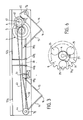
- an operator 1 for an elevator car door with two leaves 2 a , 2 b with automatic closing and opening, of the accordion type each comprising two hinged elements 14, 15 hinged hinged one against the other in the open position of the door essentially comprises means for actuating each leaf 2 a , 2 b comprising: - A torque motor 3 whose output shaft 4, directed towards the upper region of the operator 1 and extending in a plane parallel to that of the opening of said door, is made integral in rotation with a first drive pinion 5 coaxial with this output shaft 4, a second drive pinion 6 meshed by the first pinion 5 for actuating the leaves 2 a , 2 b , - rotary drive means 7 a , 7 b of the leaves 2 a respectively 2 b , controlled by the second pinion 6, said means 7a, 7b comprising axes whose rotation is allowed by ball bearings (not shown), - torque limiting means 8 mounted on the output shaft 4 of the torque motor 3 for sequentially controlling the interruption of the
- the operator 1 further comprises guide means 13 a, 13 b in linear displacement of the free end 10 a, 10 b of each wing 2a, respectively 2b, each wing 2 a, 2 b comprising (see Figure 1 ) a first leaf element 14 pivoted by said rotary drive means 7 a , 7 b and a leaf element 15 articulated on the first 14 by hinge means 16 known in themselves and not specific to the invention.
- each leaf 2 a , 2 b could for example comprise three or four leaf elements depending on the width of the door.
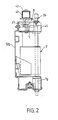
- the torque limiting means 8 essentially comprise a slide 20 coaxial with the first pinion 5 and the output shaft 4 and made integral in rotation with this first pinion 5, this slider 20 being held in abutment against the first gear 5 by means of a helical spring 21 coaxial with the output shaft 4 and disposed between the inner face 20 a of the slider 20 and an end 22 fulfillment of output shaft 4.
- the fastening means, which will be described later, of the slide 20 to the first pinion 5 are designed so that a blocking of this first pinion 5, due to an unexpected blocking of the closing of the leaves 2 a , 2 b , cause a translation of the slide 20 towards the end of the output shaft 4 opposite the motor 3 and that cam means 23 projecting radially from the external face 20b of the slide 20 cooperate with a fixed contact 24 secured to the frame 12 of the operator 1 which delivers, so known an electrical signal to the motor 3 for controlling in sequence the interruption of the closing of the leaves 2 a , 2 b and a reopening of these leaves 2 a , 2 b .
- Contact 24 is for example a switch contact or the like.
- the means for securing the slide 20 to the first pinion 5 comprise (see FIG. 6) three conical projections 25 regularly distributed around the periphery of the surface 5 a of the first pinion 5 adjacent to the slide 20 and, during normal operation of the leaves 2 a , 2 b , housed in corresponding recesses 26 of the base 20 c of the slide 20 which is in the general form of a cylindrical sleeve whose end adjacent to the first pinion 5 is partially closed by said base 20 c which comprises, on the side of the first pinion 5, an axial bore for the passage of the output shaft 4 and said recesses 26.
- the end opening 22 of the output shaft 4 is in the form of a blind sleeve of generally frustoconical shape, the end opposite to the first pinion 5 is screwed axially on the output shaft 4 and which has an axial bore into which the end of the output shaft 4 is introduced, of which a longitudinal key 27 is housed in a longitudinal groove of said bore of the frustoconical sleeve 22.
- This end sleeve 22 of the output shaft 4 also has an external annular radial projection 28 which forms a stop for the end of the helical spring 21 opposite the first pinion 5, the other end of this spring 21 being in abutment on the face of the base 20 c of the slide 20 opposite the first pinion 5.
- the internal face 20 a of the slide 20 has at its end opposite the first pinion 5 of the grooves 29 regularly distributed over this internal surface 20 a , for example three grooves, and forming with the external surface 22 a of the end sleeve 22 of the output shaft 4 housings with an axis parallel to the output shaft 4 for balls 30 facilitating the relative displacements of the slide 20 and of the sleeve 22.
- the balls 30 which are two in number per groove 29, could of course be replaced by any other suitable "lubricating" device such as rings of the METAFRAM brand ( trademark).
- the securing of the first pinion 5 with the output shaft 4 of the torque motor 3 is obtained by keying with play in the circumferential direction (see Figure 6).
- the surface of the axial bore of the first pinion 5 comprises a longitudinal keyway 31 in which is housed, with play, the key 27 secured to the output shaft 4.
- the output shaft rotates, via the end sleeve 22 and the balls 30, the slider 20 whose walls 26 has recesses 26 slide upwards , that is to say on the side opposite to the first pinion 5, on the flanks 25 has conical projections 25 of the first pinion 5, so that the slider 20 slides upward relative to the sleeve 22, and that the cam 23 comes into contact with the switch 24 which then delivers the signal to interrupt the closing of the leaves 2 a , 2 b and the reopening of the said leaves.
- cam means 23 are arranged in such a manner with respect to the external surface 20 b of the slide 20, that in the closed position of the leaves 2 a , 2 b , said means 23 escape the fixed contact of the switch 24 secured to the chassis 12 so as not to order an unexpected reopening of these leaves.
- the guide means in linear displacement of the free end 10 a , 10 b of each leaf 2 a respectively 2 b comprise a carriage 13 a respectively 13 b mounted, at each end of the upright 35 a respectively 35 b forming the free end 10 a respectively 10 b of each leaf 2 a respectively 2 b , sliding with respect to a pair of upper 37 and lower guide rails 38 of each leaf 2 a , 2 b which s 'extend over the entire width of the door.
- At least one of the carriages 13 a , 13 b of each leaf 2 a , 2 b carries an actuating device 39 a respectively 39 b of a limit switch 40 a respectively 40 b of the corresponding leaf 2 a , 2 b which is secured to the chassis 12 of the operator to deliver a closing signal for the leaves 2 a , 2 b making it possible to control, in a manner known per se, the departure from the elevator car.
- the mobile devices 39 a , 39 b are electrically conductive fingers which, in the closed position of the leaves 2 a , 2 b , are inserted between two fixed contacts 40 a or 40 b forming a plug to close a circuit which then delivers the signal in question.
- the second drive pinion 6 meshed by the first pinion 5 is made integral in rotation by means of an axis 31 of a first toothed pulley or roller 42 d ' drive a belt 43 itself rotationally secured to a second toothed pulley or roller 44 for driving in rotation the rotary drive axis 7 a of the pivoted end of the leaf 2 a , this second pinion 6 also meshing with a toothed sector 45 for rotating the rotary drive axis 7b of the pivoted end of the other leaf 2b .
- the aforementioned belt 43 is for example a notched strip of synthetic material such as rubber or the like but in any case relatively inextensible, the two ends of which are connected by means of a device forming a graph 50, known in itself, and stretched by means of a tensioner device 51, also known in itself and not specific to the invention.
- the second pinion 6 is further made integral in rotation with an arm 52 (see FIG. 1) which cooperates with a stop 53 limiting the angular travel of the second pinion 6 and consequently that of the belt 43 and of the toothed sector 45, limiting thereby the angular displacements of the rotary drive shafts 7 a, 7 b of the wings 2a respectively 2b.
- the planetary configuration of the leaf actuation means 2 a , 2 b that is to say the rotational drive of the pulley 42 which carries the belt 43 and of the toothed sector 45 which controls the rotation of the axis 7 b by the second pinion 6, gives the operator 1 according to the invention a minimum size.
- the use of a toothed sector 45 for controlling the rotation of the axis 7b also contributes to the reduction of this bulk.
- the means for actuating the leaves 2 a , 2 b that is to say in particular the torque motor 3 and the associated gear means 5, 6 and 45, as well as the pulleys 42 and 44 and that the axes 7 a and 7 b d drive in rotation of the pivoted ends of the leaves 2 a , 2 b , are mounted on support plates 52 a , 52 b fixed in adjustable position, for example by means of rails 53 and suitable screws (see Figure 1) on a fixed base of the chassis 12 of the operator 1 in order to adjust the distance between the pivoted ends of the leaves 2 a , 2 b to allow them to adapt to a door of variable width.
- This characteristic is particularly advantageous when it comes to equipping already old elevator cars with doors with automatic closing and opening actuated by an operator according to the invention.
- the operator according to the invention therefore makes it possible to produce an accordion type swing door with automatic closing and opening for an elevator car, the operation of which is extremely reliable even after a very large number of opening and closing operations.
- the size of the operator being reduced, it is very easy to install such an operator on existing installations, that is to say for example old elevator cars which are not yet equipped. interior door with automatic closing and opening.
- the invention is not limited to the examples described and shown.
- the operator who has been shown in the high position of the cabin, that is to say above the leaves 2 a , 2 b could very well be disposed in the low position, that is to say under the leaves 2 a , 2 b .
Landscapes
- Power-Operated Mechanisms For Wings (AREA)
- Lock And Its Accessories (AREA)
Applications Claiming Priority (2)
| Application Number | Priority Date | Filing Date | Title |
|---|---|---|---|
| FR8815168 | 1988-11-22 | ||
| FR8815168A FR2639338B1 (fr) | 1988-11-22 | 1988-11-22 | Operateur pour porte a battant a fermeture et ouverture automatiques et porte le comportant |
Publications (2)
| Publication Number | Publication Date |
|---|---|
| EP0370879A1 true EP0370879A1 (de) | 1990-05-30 |
| EP0370879B1 EP0370879B1 (de) | 1993-06-23 |
Family
ID=9372083
Family Applications (1)
| Application Number | Title | Priority Date | Filing Date |
|---|---|---|---|
| EP19890403178 Expired - Lifetime EP0370879B1 (de) | 1988-11-22 | 1989-11-17 | Türschliesser für eine Schwingtür mit automatischer Öffnung und Schliessung und eine Tür, die damit ausgerüstet ist |
Country Status (3)
| Country | Link |
|---|---|
| EP (1) | EP0370879B1 (de) |
| DE (1) | DE68907321D1 (de) |
| FR (1) | FR2639338B1 (de) |
Cited By (3)
| Publication number | Priority date | Publication date | Assignee | Title |
|---|---|---|---|---|
| WO2011090423A1 (en) * | 2010-01-19 | 2011-07-28 | Rosen Goran | Motor-driven driving arrangement at a door system |
| EP1902995A3 (de) * | 2006-08-28 | 2012-05-30 | Siemens Aktiengesellschaft | Türantrieb für eine automatische Tür |
| CN106744200A (zh) * | 2016-12-08 | 2017-05-31 | 宁波永良电梯技术发展有限公司 | 电梯门驱动装置 |
Families Citing this family (1)
| Publication number | Priority date | Publication date | Assignee | Title |
|---|---|---|---|---|
| CN111704009A (zh) * | 2020-07-24 | 2020-09-25 | 沈阳华彩机械制造有限公司 | 一种平开电梯门 |
Citations (5)
| Publication number | Priority date | Publication date | Assignee | Title |
|---|---|---|---|---|
| FR1186950A (fr) * | 1956-04-11 | 1959-09-03 | Falconi & C G | Mécanisme pour la commande de portes automatiques à ouverture dites à livre, spécialement pour ascenseurs et monte-charge |
| FR2066382A5 (de) * | 1969-10-23 | 1971-08-06 | Kiekert Soehne Arn | |
| FR2101372A5 (de) * | 1970-08-03 | 1972-03-31 | Kiekert Soehne Arn | |
| EP0118081A2 (de) * | 1983-03-02 | 1984-09-12 | Kiekert Gmbh & Co Kg | Antriebsvorrichtung für eine Fahrzeugtür |
| EP0290355A1 (de) * | 1987-05-05 | 1988-11-09 | Societe Lyonnaise De Construction De Materiel D'ascenseurs S.L.Y.C.M.A. | Falttürenantriebsvorrichtung für Fahrkörbe von Aufzügen |
-
1988
- 1988-11-22 FR FR8815168A patent/FR2639338B1/fr not_active Expired - Fee Related
-
1989
- 1989-11-17 EP EP19890403178 patent/EP0370879B1/de not_active Expired - Lifetime
- 1989-11-17 DE DE8989403178T patent/DE68907321D1/de not_active Expired - Lifetime
Patent Citations (5)
| Publication number | Priority date | Publication date | Assignee | Title |
|---|---|---|---|---|
| FR1186950A (fr) * | 1956-04-11 | 1959-09-03 | Falconi & C G | Mécanisme pour la commande de portes automatiques à ouverture dites à livre, spécialement pour ascenseurs et monte-charge |
| FR2066382A5 (de) * | 1969-10-23 | 1971-08-06 | Kiekert Soehne Arn | |
| FR2101372A5 (de) * | 1970-08-03 | 1972-03-31 | Kiekert Soehne Arn | |
| EP0118081A2 (de) * | 1983-03-02 | 1984-09-12 | Kiekert Gmbh & Co Kg | Antriebsvorrichtung für eine Fahrzeugtür |
| EP0290355A1 (de) * | 1987-05-05 | 1988-11-09 | Societe Lyonnaise De Construction De Materiel D'ascenseurs S.L.Y.C.M.A. | Falttürenantriebsvorrichtung für Fahrkörbe von Aufzügen |
Cited By (3)
| Publication number | Priority date | Publication date | Assignee | Title |
|---|---|---|---|---|
| EP1902995A3 (de) * | 2006-08-28 | 2012-05-30 | Siemens Aktiengesellschaft | Türantrieb für eine automatische Tür |
| WO2011090423A1 (en) * | 2010-01-19 | 2011-07-28 | Rosen Goran | Motor-driven driving arrangement at a door system |
| CN106744200A (zh) * | 2016-12-08 | 2017-05-31 | 宁波永良电梯技术发展有限公司 | 电梯门驱动装置 |
Also Published As
| Publication number | Publication date |
|---|---|
| FR2639338A1 (fr) | 1990-05-25 |
| FR2639338B1 (fr) | 1991-02-15 |
| EP0370879B1 (de) | 1993-06-23 |
| DE68907321D1 (de) | 1993-07-29 |
Similar Documents
| Publication | Publication Date | Title |
|---|---|---|
| EP0589790B1 (de) | Schiebehebedach | |
| FR2525784A1 (fr) | Dispositif de verrouillage d'un organe d'actionnement a verrouillage rotatif | |
| EP0559624B1 (de) | Schwenkbetätigungsvorrichtung einer Trittstufenanordnung für Fahrzeuge | |
| FR2550267A1 (fr) | Dispositif de manoeuvre d'un organe, tel qu'une glace de portiere ou un toit ouvrant, notamment pour vehicule automobile | |
| FR2949394A1 (fr) | Trappe a carburant motorisee pour vehicules automobiles | |
| EP0159238A1 (de) | Elektromechanishe Schlossbedienung und Kraftfahrzeugtürschloss damit versehen | |
| EP0370879B1 (de) | Türschliesser für eine Schwingtür mit automatischer Öffnung und Schliessung und eine Tür, die damit ausgerüstet ist | |
| EP0248303B1 (de) | Elektro-mechanische Antriebsvorrichtung für Schiebetüren | |
| EP2694306B2 (de) | Glasdach mit verschiebbarer und schwenkbarer mobiler platte | |
| FR2930201A1 (fr) | Trappe a carburant verrouillable pour vehicule automobile. | |
| EP0308292A1 (de) | Elektromechanischer zyklischer Programmierer, bestimmt für die Betätigung von Vorrichtungen, wie zum Beispiel aufklappbare Verdecke von Fahrzeugen | |
| FR2646202A1 (fr) | Dispositif de manoeuvre pour l'ouverture et la fermeture d'au moins un volet | |
| EP0102263B1 (de) | Elektrisches Schloss für Kraftfahrzeugtür | |
| EP0000320B1 (de) | Faltschiebedach | |
| EP0142398A1 (de) | Elektromechanische Betätigungsvorrichtung für Türen oder Tore | |
| EP0524900A1 (de) | Elektromechanische Antriebsvorrichtung für Kipptor, insbesondere für Garagenkipptor | |
| EP1255017B1 (de) | Antriebseinrichtung mit schwimmendem Motor für zwei Mechanismen, insbesondere für Klappladen | |
| FR2929317A1 (fr) | Porte de garage et ensemble comportant une telle porte | |
| FR2493906A1 (fr) | Volet roulant ou dispositif similaire avec entrainement electrique et commande automatique | |
| FR2891569A1 (fr) | Dispositif pour manoeuvrer une porte coulissante, et vehicule automobile comportant une porte equipee d'un tel dispositif. | |
| FR2625991A1 (fr) | Dispositif d'entrainement d'une porte de cabine d'ascenseur | |
| FR2514067A1 (fr) | Dispositif d'entrainement pour stores ou equivalents | |
| EP0584002B1 (de) | Verriegelungsvorrichtung für das Verschlussmittel einer Öffnung, z.B. eine Tür | |
| EP0114537A2 (de) | Betätigungsvorrichtung für Schiebeflügel von Kraftfahrzeugen | |
| FR2622241A1 (fr) | Serrure assistee a pene rotatif |
Legal Events
| Date | Code | Title | Description |
|---|---|---|---|
| PUAI | Public reference made under article 153(3) epc to a published international application that has entered the european phase |
Free format text: ORIGINAL CODE: 0009012 |
|
| AK | Designated contracting states |
Kind code of ref document: A1 Designated state(s): BE CH DE ES GB IT LI LU NL |
|
| 17P | Request for examination filed |
Effective date: 19900702 |
|
| 17Q | First examination report despatched |
Effective date: 19910805 |
|
| GRAA | (expected) grant |
Free format text: ORIGINAL CODE: 0009210 |
|
| AK | Designated contracting states |
Kind code of ref document: B1 Designated state(s): BE CH DE ES GB IT LI LU NL |
|
| PG25 | Lapsed in a contracting state [announced via postgrant information from national office to epo] |
Ref country code: IT Free format text: LAPSE BECAUSE OF FAILURE TO SUBMIT A TRANSLATION OF THE DESCRIPTION OR TO PAY THE FEE WITHIN THE PRE;WARNING: LAPSES OF ITALIAN PATENTS WITH EFFECTIVE DATE BEFORE 2007 MAY HAVE OCCURRED AT ANY TIME BEFORE 2007. THE CORRECT EFFECTIVE DATE MAY BE DIFFERENT FROM THE ONE RECORDED.SCRIBED TIME-LIMIT Effective date: 19930623 Ref country code: ES Free format text: THE PATENT HAS BEEN ANNULLED BY A DECISION OF A NATIONAL AUTHORITY Effective date: 19930623 Ref country code: GB Effective date: 19930623 Ref country code: NL Effective date: 19930623 Ref country code: DE Effective date: 19930623 |
|
| REF | Corresponds to: |
Ref document number: 68907321 Country of ref document: DE Date of ref document: 19930729 |
|
| PGFP | Annual fee paid to national office [announced via postgrant information from national office to epo] |
Ref country code: LU Payment date: 19931101 Year of fee payment: 5 |
|
| PG25 | Lapsed in a contracting state [announced via postgrant information from national office to epo] |
Ref country code: CH Effective date: 19931130 Ref country code: LI Effective date: 19931130 |
|
| NLV1 | Nl: lapsed or annulled due to failure to fulfill the requirements of art. 29p and 29m of the patents act | ||
| EPTA | Lu: last paid annual fee | ||
| GBV | Gb: ep patent (uk) treated as always having been void in accordance with gb section 77(7)/1977 [no translation filed] |
Effective date: 19930623 |
|
| PGFP | Annual fee paid to national office [announced via postgrant information from national office to epo] |
Ref country code: BE Payment date: 19940114 Year of fee payment: 5 |
|
| PLBE | No opposition filed within time limit |
Free format text: ORIGINAL CODE: 0009261 |
|
| STAA | Information on the status of an ep patent application or granted ep patent |
Free format text: STATUS: NO OPPOSITION FILED WITHIN TIME LIMIT |
|
| 26N | No opposition filed | ||
| REG | Reference to a national code |
Ref country code: CH Ref legal event code: PL |
|
| PG25 | Lapsed in a contracting state [announced via postgrant information from national office to epo] |
Ref country code: LU Free format text: LAPSE BECAUSE OF NON-PAYMENT OF DUE FEES Effective date: 19941117 |
|
| PG25 | Lapsed in a contracting state [announced via postgrant information from national office to epo] |
Ref country code: BE Effective date: 19941130 |
|
| BERE | Be: lapsed |
Owner name: ASCENSEURS FRANCE LOGIQUE Effective date: 19941130 |