EP0370917A2 - Schienenelement für die End to End-Nervennaht - Google Patents
Schienenelement für die End to End-Nervennaht Download PDFInfo
- Publication number
- EP0370917A2 EP0370917A2 EP89403249A EP89403249A EP0370917A2 EP 0370917 A2 EP0370917 A2 EP 0370917A2 EP 89403249 A EP89403249 A EP 89403249A EP 89403249 A EP89403249 A EP 89403249A EP 0370917 A2 EP0370917 A2 EP 0370917A2
- Authority
- EP
- European Patent Office
- Prior art keywords
- nerve
- epineurium
- sutures
- suture
- splint
- Prior art date
- Legal status (The legal status is an assumption and is not a legal conclusion. Google has not performed a legal analysis and makes no representation as to the accuracy of the status listed.)
- Withdrawn
Links
Images

Classifications
-
- A—HUMAN NECESSITIES
- A61—MEDICAL OR VETERINARY SCIENCE; HYGIENE
- A61B—DIAGNOSIS; SURGERY; IDENTIFICATION
- A61B17/00—Surgical instruments, devices or methods
- A61B17/04—Surgical instruments, devices or methods for suturing wounds; Holders or packages for needles or suture materials
-
- A—HUMAN NECESSITIES
- A61—MEDICAL OR VETERINARY SCIENCE; HYGIENE
- A61B—DIAGNOSIS; SURGERY; IDENTIFICATION
- A61B17/00—Surgical instruments, devices or methods
- A61B17/11—Surgical instruments, devices or methods for performing anastomosis; Buttons for anastomosis
- A61B17/1128—Surgical instruments, devices or methods for performing anastomosis; Buttons for anastomosis of nerves
Definitions
- the present invention relates to a splint-like element for use in end-to-end nerve suture to eliminate tension at the anastomosis site and thus allow optimal coaptation between the nerve ends to be sutured.
- interfascicular nerve graft Since it is, in practice, almost impossible to achieve proper anastomosis under nerve tension, interfascicular nerve graft must usually be carried out to make it sure that there is no tension at the time of suturing the nerve ends.
- the results with nerve grafting are allways less than with nerve anastomosis is under no tension, because the graft nerve has to survive and the axons have to pass two anastomsis sites.
- the amount of nerves to be used for such grafting is, in practice, limited.
- K. TSUGE et al Another technique to eliminate tension has been suggested by K. TSUGE et al under the name of "anchoring funicular sutures" (see K. TSUGE et al, Plast. Reconst. Surg., 56:496, 1975).
- This technique makes use of a needle fitted with a looped suture wire deviced for tendon suture. Basically, this technique consists attaching the wire to the epineurium of one nerve end, then passing it through the epineurium of both nerve ends and subsequently tightening it and attaching it to the epineurium of the other nerve end in such a manner as to make the anastomosis site tension free.
- the object of the present invention is to provide a new surgical tool, namely a splint-like element, for use in end-to-end nerve suture to eliminate tension between the nerve ends at the anastomosis site and thus allow optimal coaptation between these ends and avoid nerve grafting under some circumstances.
- this object is achieved with a splint-like element for use in end-to-end nerve suture to eliminate tension at the anastomosis site and thus allow optimal coaptation between the nerve ends to be sutured,
- element comprises an elongated body made of a material this is rigid or slightly resilient and is biologically acceptable, such as silicone.
- the body is long enough to have one end attachable to the epineurium of one of the nerve ends by at least one but preferably two longitudinally spaced-apart sutures, and another end attachable to the epineurium of the other nerve end also by at least one but preferably two other longitudinally spaced-apart sutures.
- the element also comprises pieces of reinforcing material preferably consisting of beads of plastic material embedded into the body material wherever this body is intended to be attached to the epineurium to prevent the body material from being torn or otherwise cut by the sutures.
- two such splint-like elements may be attached symmetrically to the epineurium of the nerve ends while the same are held into contact in order to make the suture site tension free. Then, the nerve ends may be sutured as is known in the medical art to achieve the requested anastomosis.
- the splint-like element 1 as shown in Figs. 1 to 3 of the accompanying drawings is intended to be used in end-to-end nerve suture to eliminate tension between the nerve ends at the anastomosis site and thus allow optimal coaptation between these ends.
- the element 1 comprises an elongated body 3 made of a material which is either rigid or slightly resilient and, of course, is biologically acceptable.
- a material is preferably a silicon resin like the one sold under the trademark SILASTIC, which is well known and commonly used in the medical art.
- the elongated body 3 is preferably made of a material that is slightly resilient enough to give some slack at the suture site between the nerve ends.
- This material must however not be too much resilient as it must actually act as a mechanical joint strong enough to transfer tension from the epineurium of one nerve end to the epineurium of the other nerve end while leaving the anastomosis site in-between tension free as will be explained in greater details hereinafter.
- the slight resiliency of the material makes it possible for the tension to be distributed substantially equally between all of the sutures. The slight resiliency also makes it possible to generate "artificially" some compression at the anastomosis site whenever this is necessary.
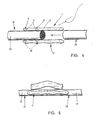
- the elongated body 3 may be of any shape provided however that it is elongated. It may also be of any length and/or diameter provided however that it is long enough to have one end attachable to the epineurium 13 of one of the nerve end 11 to be sutured, by at least one but preferably two longitudinally spaced apart sutures 7, as shown in Figs. 4 and 5.
- the elongated body 3 must also be long enough to have its other end attachable to the epinerium 17 of the other nerve end 15 to be sutured, also by at least one but preferably two other longitudinally spaced apart sutures 9 as shown in Fig. 5.
- the splint-like element 1 also comprises pieces of reinforcing material placed along the body 3 wherever this body is intended to be attached by the sutures 7 and 9 to the epineurium of the nerve ends 11 and 15, respectively.
- the purpose of these pieces is essentially to provide mechanical "anchors" through which the suture wires may be passed and/or to which they may be attached, to prevent the elongated body 3 made of silicon resin or similar substance from being torn or otherwise cut by the sutures 7 and/or 9.
- Pieces of reinforcing material may consist of patches of fabric embedded into the slightly resilient material of the elongated body 3. They may also consist in sheets of plastic material or metal fixed on top of the elongated body to be visible to the surgeon in charge of the nerve suture. Preferably however, these pieces consist of beds 5 of plastic material such as DACRON® embedded into the slightly resilient material, as shown in the drawings.
- the particular shape of the elongated body 1 is not an essential feature of the invention. It must however be understood that this shape must be as smooth as possible to avoid cutting or scratching of the surrounding tissues.
- the size, viz. the length and/or diameter of the elongated body 3 may substantially vary depending on the size of the nerve to be repaired and the amount of tension to eliminate at the anastomosis site.
- the splint-like element 1 may be as long as 6 cm and have a diameter in-between the embedded beads 5 of up to 2 mm.
- the element may be 1 cm long and 1 mm wide.
- the splint-like element 1 disclosed hereinabove can be used as follows.
- a first splint-like element 1 as disclosed hereinabove may be attached by means of at least one but preferably two sutures 5 to one side of the epineurium 13 of one of the nerve ends.
- the sutures can be made with 5-0 or 6-0 NYLON suture wires to make the attachment strong enough to afford the tension that the nerve may undergo.
- only one end of the splint-like element 1 is attached to the epineurium 13 of the first nerve end 11 at the given distance from the anastomosis site.
- the attachment is carried out in such a manner that the other end of the element 1 projects from the one nerve end, away from the anastomosis site.
- a second splint-like element 1′ is similarly attached by at least one but preferably two sutures 7′ to the epineurium 13 of the first nerve end 11 at substantially the same given distance from the anastomosis site as the first element 1.
- This attachment is carried out in such a manner that the second element 1′ extends parallel to the first element 1 on the opposite side of the nerve end 11, as clearly shown in Fig. 4.
- the other nerve end 15 may be pulled in-between the free ends of the first and second splint-like elements 1 and 1′ as shown with the arrow in Fig. 4. Such a pull must be carried out to such an extent that the free end of the other nerve end 15 be at least in contact with the free end of the one nerve end 11. However, it may advantageous under certain circumstance to pull the nerve end 15 to such an extent that it extend slightly over the one nerve 11, as will be explained hereinafter.
- first and second splint-like elements 1 and 1′ may be attached to the epineurium 17 of the other nerve end 15 by means of at least one but preferably two further sutures 9, as shown in Fig. 5, thereby making the nerve suture site tension free.
- bot nerve ends 11 and 15 may be sutured according to any known technique to achieve the requested anastomosis.
- anastomosis can be made by wire suture, laser microanastomosis, adhesive microanastomosis, etc...
- the advantages of pulling the other nerve end 15 to such an extent that it extends slightly over the one nerve end 13 are that, on the one hand, it makes it possible to create some "artificial" compression of the anastomosis site and that, on the other hand, it makes it possible to resect at least one but preferably two of the nerve ends 11 and 15 to adjust their length and shape to fit each other prior to suturing the fasciculi.
- the splint-like elements 1 and 1′ may be removed from around the nerve.
- such a removal is not compulsory.
Landscapes
- Health & Medical Sciences (AREA)
- Surgery (AREA)
- Life Sciences & Earth Sciences (AREA)
- Biomedical Technology (AREA)
- Nuclear Medicine, Radiotherapy & Molecular Imaging (AREA)
- Engineering & Computer Science (AREA)
- Heart & Thoracic Surgery (AREA)
- Medical Informatics (AREA)
- Molecular Biology (AREA)
- Animal Behavior & Ethology (AREA)
- General Health & Medical Sciences (AREA)
- Public Health (AREA)
- Veterinary Medicine (AREA)
- Neurology (AREA)
- Materials For Medical Uses (AREA)
Applications Claiming Priority (2)
| Application Number | Priority Date | Filing Date | Title |
|---|---|---|---|
| CA000583927A CA1303932C (en) | 1988-11-23 | 1988-11-23 | Splint-like element for use in end-to-end nerve suture |
| CA583927 | 1988-11-23 |
Publications (2)
| Publication Number | Publication Date |
|---|---|
| EP0370917A2 true EP0370917A2 (de) | 1990-05-30 |
| EP0370917A3 EP0370917A3 (de) | 1991-07-17 |
Family
ID=4139161
Family Applications (1)
| Application Number | Title | Priority Date | Filing Date |
|---|---|---|---|
| EP19890403249 Withdrawn EP0370917A3 (de) | 1988-11-23 | 1989-11-23 | Schienenelement für die End to End-Nervennaht |
Country Status (2)
| Country | Link |
|---|---|
| EP (1) | EP0370917A3 (de) |
| CA (1) | CA1303932C (de) |
Cited By (1)
| Publication number | Priority date | Publication date | Assignee | Title |
|---|---|---|---|---|
| WO2008029373A3 (en) * | 2006-09-08 | 2008-05-22 | Univ Cattolica Sacro Cuore | Neural guide |
Family Cites Families (2)
| Publication number | Priority date | Publication date | Assignee | Title |
|---|---|---|---|---|
| US3833002A (en) * | 1973-09-10 | 1974-09-03 | J Palma | Apparatus for aiding severed nerves to join |
| BR8806038A (pt) * | 1987-03-13 | 1989-10-03 | Univ Brown Res Found | Canais piezeletricos para orientacao de nervos |
-
1988
- 1988-11-23 CA CA000583927A patent/CA1303932C/en not_active Expired - Lifetime
-
1989
- 1989-11-23 EP EP19890403249 patent/EP0370917A3/de not_active Withdrawn
Cited By (1)
| Publication number | Priority date | Publication date | Assignee | Title |
|---|---|---|---|---|
| WO2008029373A3 (en) * | 2006-09-08 | 2008-05-22 | Univ Cattolica Sacro Cuore | Neural guide |
Also Published As
| Publication number | Publication date |
|---|---|
| CA1303932C (en) | 1992-06-23 |
| EP0370917A3 (de) | 1991-07-17 |
Similar Documents
| Publication | Publication Date | Title |
|---|---|---|
| US4920962A (en) | Splint-like element for use in end-to-end nerve suture | |
| EP0341288B1 (de) | Einstellbare chirurgische klammer und verwendungsverfahren | |
| US5556428A (en) | Apparatus and method for promoting growth and repair of soft tissue | |
| US6102947A (en) | Splint with flexible body for repair of tendons or ligaments and method | |
| US4269180A (en) | Bone fastener for the greater trochanter | |
| US5723008A (en) | Splint for repair of tendons or ligaments and method | |
| US5129902A (en) | Endosteal ligament retainer and process | |
| US6749616B1 (en) | Surgical system for repairing and grafting severed nerves and methods of repairing and grafting severed nerves | |
| US7303577B1 (en) | Apparatus and method for use in repairs of injured soft tissue | |
| AU739161B2 (en) | Prosthetic with collagen for tissue repair | |
| US6740100B2 (en) | Tendon repair using adhesive | |
| US5769893A (en) | Apparatus and method for promoting growth and repair of soft tissue | |
| US5002562A (en) | Surgical clip | |
| AU775491B2 (en) | Apparatus and methods for tendon or ligament repair | |
| US5354305A (en) | Nerve repair device | |
| US20020077631A1 (en) | Apparatus and methods for tendon or ligament repair | |
| JPH11500928A (ja) | 腱及び靭帯修復システム | |
| JP2002503516A (ja) | ループ捕捉無結紮の2部品式縫合糸アンカーアセンブリ | |
| JPH01146535A (ja) | 腱及び靭帯の結合組織を修復する装置 | |
| JP2021514288A (ja) | 軟質組織を修復し、軟質組織を骨に取り付けるための装置、システム、および方法 | |
| US20250107794A1 (en) | Method of tissue repair | |
| WO1996003084A1 (en) | Device and method for restoration of connective tissue | |
| US20170367692A1 (en) | System, method and apparatus for tenorrhaphy | |
| EP0370917A2 (de) | Schienenelement für die End to End-Nervennaht | |
| WO1989010101A1 (en) | Mechanical fixation of prosthetic ligament |
Legal Events
| Date | Code | Title | Description |
|---|---|---|---|
| PUAI | Public reference made under article 153(3) epc to a published international application that has entered the european phase |
Free format text: ORIGINAL CODE: 0009012 |
|
| AK | Designated contracting states |
Kind code of ref document: A2 Designated state(s): CH DE ES FR GB IT LI |
|
| PUAL | Search report despatched |
Free format text: ORIGINAL CODE: 0009013 |
|
| AK | Designated contracting states |
Kind code of ref document: A3 Designated state(s): CH DE ES FR GB IT LI |
|
| 17P | Request for examination filed |
Effective date: 19911125 |
|
| STAA | Information on the status of an ep patent application or granted ep patent |
Free format text: STATUS: THE APPLICATION HAS BEEN WITHDRAWN |
|
| 18W | Application withdrawn |
Withdrawal date: 19930614 |
|
| R18W | Application withdrawn (corrected) |
Effective date: 19930614 |