EP0371772A2 - Vermittlungsnetzwerk für Speicherzugriff - Google Patents
Vermittlungsnetzwerk für Speicherzugriff Download PDFInfo
- Publication number
- EP0371772A2 EP0371772A2 EP89312386A EP89312386A EP0371772A2 EP 0371772 A2 EP0371772 A2 EP 0371772A2 EP 89312386 A EP89312386 A EP 89312386A EP 89312386 A EP89312386 A EP 89312386A EP 0371772 A2 EP0371772 A2 EP 0371772A2
- Authority
- EP
- European Patent Office
- Prior art keywords
- memory
- elements
- routing
- address
- concentrator
- Prior art date
- Legal status (The legal status is an assumption and is not a legal conclusion. Google has not performed a legal analysis and makes no representation as to the accuracy of the status listed.)
- Granted
Links
Images




Classifications
-
- G—PHYSICS
- G06—COMPUTING OR CALCULATING; COUNTING
- G06F—ELECTRIC DIGITAL DATA PROCESSING
- G06F15/00—Digital computers in general; Data processing equipment in general
- G06F15/16—Combinations of two or more digital computers each having at least an arithmetic unit, a program unit and a register, e.g. for a simultaneous processing of several programs
- G06F15/163—Interprocessor communication
- G06F15/173—Interprocessor communication using an interconnection network, e.g. matrix, shuffle, pyramid, star, snowflake
- G06F15/17356—Indirect interconnection networks
- G06F15/17368—Indirect interconnection networks non hierarchical topologies
- G06F15/17393—Indirect interconnection networks non hierarchical topologies having multistage networks, e.g. broadcasting scattering, gathering, hot spot contention, combining/decombining
Definitions
- the present invention relates to computers and more particularly to computers providing parallel processing capability through the use of multiple processors which share a single large memory.
- certain mathematical problems exhibit a high degree of parallelism, particularly those which involve the manipulation of large arrays or matrices. Such problems can be broken down into computational segments each of which can be performed by a separate processor.
- the present invention relates in large part to an improved parallel processing architecture in which a multiplicity of processors are synchronized to issue memory requests only at the same predetermined time within a computational cycle or frame interval, the requests being issued as bit serial messages.
- the initial data in the bit serial messages define memory addresses and a novel switch network architecture is provided for efficiently communicating requests from any processor to any memory location even though the number of processors and the number of memory locations may be very large.
- parallel processing computational apparatus employs a multiplicity of wide word processors.
- the processors are synchronized to a common clock.
- the clock provides not only a basic high speed clock period but also defines a start time which enables the various elements of the system to time intervals and operating sequences in synchronism.
- the various elements employ a frame interval encompassing a predetermined large number of clock periods.
- the processors are synchronized so as to issue memory requests only at the same predetermined time within a frame interval.
- the requests are issued as bit serial messages in which the initial data is the address of the memory location to which the request is directed.
- the network which selectively connects each processor to each memory location includes a plurality of similar routing switch elements arranged in at least three stages, each routing element having a plurality of output leads connectable to respective different address groups of said memory locations and a plurality of input leads, any one of which may receive a message seeking direction to any one of the address groups.
- the routing elements in each stage address selected routing elements in the next stage in response to corresponding address bits in the request messages. Interposed between at least two stages of the routing elements are a stage of concentrator elements.
- Each concentrator element has a plurality of input leads connected to address-equivalent output leads of the preceding level of routing elements and a plurality of output leads connected to the address-equivalent leads of the following stage of routing elements, the number of concentrator element output leads being substantially smaller than the number of concentrator element input leads.
- the concentrator elements include means for transferring a message arriving at any input lead to an output lead based on a random selection of simultaneously incoming messages, up to the number of output leads.
- an advantage of the architecture of the present invention is that it enables the effective utilization of a very large number of processors sharing a very large memory, each processor being given equal access to all parts of the memory.
- the particular architecture specifically illustrated herein allows for over 30,000 processors addressing 16 gigabytes of memory.
- Another advantage of the present architecture is that it is highly regular and is implemented using large numbers of each of a relatively small number of different modules or logical elements.
- essentially the same routing switch element is used repeatedly throughout the switching network as is a concentrator switch element which is interposed betwen various stages of switching elements. Further, the routing switch elements and the concentrator elements share many digital logic subgroups which are repeated in a regular fashion in each of these elements.
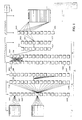
- Fig. 1 The regular nature of the architecture is illustrated in Fig. 1. In view of the very large number of identical components in the overall system, only representative groupings of each type are shown. Similarly, only illustrative sets of connections between the various elements are shown so as not to obscure the drawings.
- the processors generally are designated by reference character 11, the memory modules by reference character 13, and the interconnection network by reference character 15. Certain of the processors may be dedicated to IO (input/output) operation and may be provided with connections to terminals, workstations and disk memory.
- IO input/output
- Each processor communicates with the switching network 15 by means of a single lead through which the processor transmits and receives bit serial messages.
- the memory itself is organized into a succession of modules, each module holding 65536 words of data. As is explained in greater detail hereinafter, however, the data words in a given memory module are not logically consecutive but, rather, the memory is highly interleaved, i.e. on a word basis.
- Each memory module is multiply ported and comprises eight bidirectional leads for receiving bit serial request messages and for issuing bit serial responses thereto.
- the communications network which couples processors to memory employs a plurality of similar routing switch elements arranged in successive stages or levels.
- the routing switch elements in the first stage i.e. the stage closest to the processors, are designated by reference character SA0-SA15.
- those in the second stage are designated by reference characters SB0-SB15; those in the third stage by reference characters SC0-SC7; and those in the fourth stage by reference characters SD0-SD9.
- a set of concentrator elements, designated by reference characters CA0-CA15 are interposed between the first and second stages of routing switch elements and a second set of concentrator elements, designated by reference characters CB0-CB15 are interposed between the second and third stages of routing switch elements.
- the first, second and fourth stages of routing switch elements implement the full 16-way routing while in the third stage only 8-way routing is implemented.
- part of the communications network designated by reference character 17, may be thought of as being associated with or physically proximate to the processors while another portion, designated by reference character 19, may be thought of as physically proximate to the memory.
- Output signals from the concentrators CB0-CB15 are communicated to the input leads of the next stage routing switch elements SC0-SC7 through leads provided with transceivers TB0-TB15 and TC0-TC7 at the ends of the leads.
- These leads may, for example, be implemented as coax or twinax cable and, with the transceivers, are appropriate for spanning larger physical distances, i.e.
- the start indication is preferably encoded into the basic clock signal, e.g. by periodically providing relatively long high and low states or by periodically reversing the phase of a pair of adjacent bits, so that the start information can be extrated from the same signal as the basic clock. In this way phasing errors can be avoided. While the various elements of the system utilize the start of timing information to define synchronized frames as described in greater detail hereinafter, the start of timing information does not need to be generated every frame interval and preferably is not.
- the processors communicate with the memory by means of bit serial messages in which the first part of the message data comprises the memory address.
- An initial start bit is provided so that the start of a message may be readily detected in conventional manner.
- the memory address is presented with the least significant bits first and that the lower order address bits are arranged in four groups with each group comprising three or four address bits and a parity bit. In the particular addressing scheme employed, the least significant bit is designated A3.
- Each address group controls the routing decision at one stage in the passage of the message through the switching network 15.
- each routing switch element decodes and acts upon the information contained in the respective address group, that address group is stripped or omitted from the message which is passed on through to the next stage of the network.
- the message format includes a gap, i.e. a series of nulls or blank pad bits between each of the address groups. These gaps provide time for the successive routing switch elements to make the respective routing decisions before the rest of the message is passed through the routing switch element to the next stage.
- the messages which are passed through the network are, in general, of two types.
- a long request message e.g. 132 bits
- the memory sends back a short reply, e.g. four bits.
- the processor is seeking data from the memory, e.g. as in a READ operation, it sends a short request, e.g. 58 bits, and the memory responds with a long reply, e.g. 76 bits.
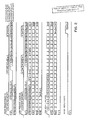
- Fig. 3 illustrates the relative timing of the two types of message transactions as well as the messages passed through the switching network.
- each routing switch element strips off those address bits which were utilized in making its routing decisions before passing the message on to the next stage, e.g. by merely not activating the selected output channel until the unwanted bits are past.
- the concentrator elements strip off leading padding bits that are incorporated in the message format to allow time for the allocation functions performed by the concentrator elements.
- the routing switch elements do not store and forward the messages but, rather, introduce only a slight delay and start passing the ongoing portion of the message on to the next stage before the incoming message is complete.
- the routing switch elements effect 16-way routing in each of the stages except for the third which effects 8-way routing and for each route out of a given routing switch element, at least two paths are provided. If each succeeding stage of routing switch elements had to provide enough input leads to match up with all of the output leads of the preceding stage, the number of switching elements and leads would grow geometrically making a realizable implementation of the network impossible as a practical matter.
- a stage of concentrator elements is interposed between successive routing switch stages.
- a stage of concentrator elements is provided between the first and second stages of routing switching and also between the second and third stages of routing switching.
- the concentrator elements perform no address decoding or routing decisions but merely allocate a limited number of address equivalent output leads to a larger number of address equivalent input leads, the allocation being essentially on a random basis.
- a given concentrator element will take in as inputs the outputs which are directed to the same region of memory from a plurality of routing switch elements in the preceding stage.
- the particular concentrator elements employed in the embodiment illustrated allocate 12 output leads to messages appearing on any one of 32 input leads.
- the number of leads is kept within manageable bounds, even for a system comprising a very large number of processors addressing a very large common or shared memory.
- the routing switch elements and concentrator elements perform functions which are, in one sense, complementary or opposite in terms of ratio of input leads to output leads, many of the logical components within these elements are in fact quite similar since both types of element perform a matrix switching function of connecting any input lead to any available output lead, i.e. an allocation function.
- An advantage of this switch network architecture and addressing scheme of the present invention is that the memory is highly interleaved, i.e. on a word basis.
- the address is presented and decoded least signficant bits first by the switching network, i.e. the first stage of routing switch elements codes and strips off the least significant bits of the address.
- the next stage of routing switch elements operates upon and strips off the next most significant group of address bits and so on.
- the more significant address bits, i.e. A18-A36 are decoded by the memory module to which the message is finally delivered. In other words, in a given memory module, the lower 15 bits of address are all the same.
- Fig. 4 illustrates the functional arrangement of a typical one of the routing switch elements.
- the general function of each routing switch element is to respond to a bit serial message appearing on any one of a plurality of input leads and to couple that message to a selected output lead in accordance with address information incorporated in the message. While, as noted previously, data can flow in both directions through the routing switch element, the term input is used to designate the side or direction from which the originating message arrives. This may also be considered to be the processor side. Thus the output side may similarly be considered to be the memory side.
- each routing switch element comprises 12 input leads and 32 output leads, 2 output leads going to each of the 16 regions of memory addressed by the routing switch.
- the input leads are designated by reference characters 31-42 though only five of these are actually shown in the drawing for the purposes of clarity.
- the output leads are designated by reference characters 51-82 though, again, only six of these (three pairs) are actually shown.
- the routing switch elements and the concentrator elements are each implemented as very large scale integrated circuits. In such an implementation, the bit serial communications architecture of the present invention is advantageous in that it minimizes input and output leads.
- the data rate on the input and output leads is set just as high as is feasible with the particular type of integrated circuit fabrication technique being employed.
- TR (transmit/receive) switching logic is provided as indicated by reference character 83 at each of the input and output leads for switching the bidirection external lead between two oppositely oriented, unidirectional internal data paths.
- the transmit, receive logic circuits are operated in response to the clock signals described previously to switch between receive and transmit consistent with the message formats described in relation to Figs. 2 and 3.
- sequencing circuitry controlled by the clock 20 is incorporated for providing appropriate timing signals to the various subcomponents of the routing switch element.
- the received data coming out of the T/R circuitry 83 is sent first to a serial-to-parallel converter 85 which converts the incoming data from a bit serial format to a two-bit wide data path. After conversion, the data is applied to a FIFO (first in, first out) buffer 87.
- FIFO first in, first out
- the FIFO registers 87 provide for re-synchronization of all incoming messages for application to the switching matrix which comprises the interior of each routing switch element.
- the switching matrix comprises sixteen similar sub-units, designated by reference characters 101-116.
- that route is left set up to allow the memory to send response data back toward the processors through the same path.
- This response data comes out of the crossbar switch matrix on the input or processor side in two-bit wide format and is converted back to serial data by a parallel-to-serial converter 89 before proceeding on to the T/R switching logic 83.
- the crossbar switch matrix comprises sixteen sub-units 101-116, one for each address region, and all of the data signals from the processor side circuitry are provided to all of the sub-units.
- a pair of cross point circuits are provided for selectively coupling each set of processor side data channels to either one of the address equivalent output or memory side data channels.
- each sub-unit encompasses respective decoding circuitry for decoding the respective address bits of incoming processor-originated messages for each of the input channels.
- Each sub-unit also comprises allocation logic circuitry which is responsive to all of the decoded address bits as well as to control signals provided by a random number generator 120.
- any processor request message appearing at any one of the processor side input leads 31-42 may be seeking to be directed to any one of the memory regions over which the routing switch element has routing control. Since two output channels are provided for each memory region in the particular embodiment illustrated in Fig. 4, up to two processors can address the same region of memory through a given routing switch element at the same time. However, if more than two processor-originated messages are seeking to go to the same memory region, some will have to be blocked in that only two can be directly successful. It should be understood that other embodiments might provide three or more address equivalent output channels for an even greater reduction in blocking likelihood.
- the general function of the allocation logic is to allocate the available memory side leads to possibly contending request messages on the processor side leads on an essentially random basis so that no processor is given preference to any path through the overall switch matrix 15.
- the data on the outgoing memory side data path is coupled to the data path or return data.
- This coupling is provided, with one clock period delay, by flip-flop circuitry designated by reference character 122 on each memory side or output channel.
- This cross coupling is implemented only during the request portion of the overall frame interval so that there is no interference with the later communication of data being returned by the memory itself.
- a correspondingly delayed version of the blocked incoming message is applied to a separate set of data leads for each input channel by respective flip-flop circuits 124.
- the random number generator asserts one and only one of the signals T0-T12.
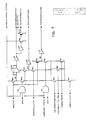
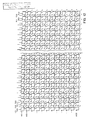
- Fig. 5 comprises a twelve-by-two allocator constructed using twenty four one-by-one sub allocators which comprise simple combinatorial logic building blocks.
- the setup signals are EnbRowAllocate with its compliment, Bidij with its compliment, and ThisColumnAllocated_.
- the signal EnbRowAllocate is a setup signal corresponding to the A signal in the leftmost column and the signal Bidij is a setup signal corresponding with the R signal in the topmost row. If EnbRowAllocate is clear, the allocation element will not allocate the memory side channel to any processor side channel.
- the Bidij signal indicates that processor side channel i is bidding for memory side channel j.
- ThisColumnAllocated indicates that one allocation element in the column has already decided to assign the processor side channel to one of the memory side channel.
- ResetXp a sequencer generated timing signal, is asserted just prior to the allocation process to precharge nodes N2_ , N3_ , N4_ , and MsTxReqj
- Signals TokFromUpperRow, TokFromLeftColumn, and ConnectImljml are activation signals sourced from allocation elements above, to the left of, and diagonally to the upper left of the allocation element respectively. These signals correspond to the signals U and V and T of Fig. 6. In the top row, the ConnectImjml signals are forced clear and in the left column the TokFromLeftColumn signals are forced clear.
- a pair of address comparing circuits are provided as indicated by reference characters 171 and 172. Each of these is operative to compare the delayed incoming address data provided over leads 153 with mirrored address data appearing on a respective one of the memory side returning data leads 161 or 162.
- the comparing circuits assert a respect output signal, provided over leads designated by reference characters 173 and 174, if there is a mismatch occurs in the compared address data streams. As described previously, these signals are used to cause data returned by memory to be applied in response to a blocked processor request message as well as in response to a successful request message, providing both requests were directed to the same memory location.
- Fig. 9 illustrates a particular way in which the cross-point connection functions illustrated in Fig. 8 may be implemented in dynamic CMOS.
- a crosspoint can be in one of three states: 1) disconnected, i.e. no path between processor and memory channels are established, 2) both directions connected, i.e. a path is established in both the processor to memory direction and the memory to processor direction, and 3) read combining connected, i.e. a path is established in the memory to processor direction only. Note that the last possible combination of a path being established in the processor to memory direction but not in the memory to processor direction is not implemented, i.e. is prohibited.
- nodes N8_, N9_, N10_, and N11_ are precharged low and nodes MsTxDj_[1-0] and PsTxDi_[1-0] are precharged high.
- the serialized request, sourced from the processor side channel on signal lines PsRxDi_[1-0] and the serialized reply, sourced from the memory side channel on signal lines MsRxDj_[1-0] change state.
- nodes N8_ , N9_ , N10 , and N11_ are conditionally pulled high thereby conditionally discharging nodes MsTxDj_0, MsTxDj_1, PsTxDi_0, and PsTxDi_1 respectively.
- CMOS implementation of such logic is illustrated in Fig. 10. If the address comparison is successful, a reply coming back from the memory will be propagated to all processor side channels attempting to read from the same location.
- the request is propagated through a crosspoint to the memory side channel on signal lines MsTxDj [1-0]. These signals are resynchronized on the zero to one transition of the clock and then rebroadcast back to all crosspoints in the row on signal lines dMsTxDj [1-0]. Simultaneously, a delayed replica of the request sourced from the processor side channel is broadcast to all crosspoints in a column on signal lines dPsRxDi_[1-0]. These two pairs of signals, dPsRxDi_[1-0] and dMsTxDj_[1-0] are compared throughout the entire address portion of the request message.
- ResetXp precharges node CopyBackij high thereby indicating that the request header sourced by the processor side channel is identical to the request header transmitted on the memory side channel.
- the assertion of ResetXp also precharges PsTxRplyi_ high indicating that no reply is to be transmitted out from the processor side channel.
- EnbCopyBackCompare is asserted.
- CopyBackij When EnbCopyBackCompare ANDed with the compliment of clock is asserted, CopyBackij is pulled low is either dMsTxDj [1-0] does not equal ddPsRxDi_[1-0] (i.e. the address is not identical) or Bidij is not asserted (i.e. the processor side channel is not bidding for the memory side channel) or InhCopyBacki is asserted (i.e. the copyback function is inhibited). CopyBackij drives back-to-back inverters X18 which latch the CopyBackij_ signal for the remaining portion of the frame.
- CopyBackij is ORed with PsToMsConnectij_ and ANDed with RplyDetectj to form MsToPsConnectij which indicates that a memory side to processor side data path is to be established.
- RplyDetectj is asserted when a reply is detected into the memory side channel and is not asserted while EnbCopyBackCompare is asserted.
- PsTxRplyi_ is pulled low to indicate that the reply is to be transmitted from the processor side channel.
- each concentrator element has the general function of assigning a limited number of address equivalent output leads to request messages which may appear on any one of a larger number of input leads. While the concentrator elements do not perform any address decoding or routing in the sense of selecting between different regions of memory, many of the logic sub-components of the concentrator elements are essentially the same as corresponding sub-components in the routing switch element, as will be apparent from the following description.
- Fig. 11 illustrates the functional arrangement of a typical one of the concentrator elements in a manner comparable to that in which Fig. 4 illustrates a typical routing switch element.
- each concentrator element comprises thirty-two bidirectional input leads, designated by reference characters 201-232, and twelve bidirectional output leads, designated by reference characters 241-242.
- T/R transmit/receive
- each of the bidirectional input leads T/R (transmit/receive) circuitry 83 for coupling to unidirectional internal data paths, serial-to-parallel (85) and parallel-to-serial (89) converters for broadening the internal data paths and FIFO registers 87 for allowing incoming messages to be synchronized.
- flip-flop circuitry 124 is included for providing a delayed version of data being received.
- Corresponding circuitry is provided for each of the output leads 240, 252, this circuitry again being essentially identical with that employed for each output lead in the routing switch elements of Fig. 4.
- the concentrator element comprises a quite general cross-bar switching matrix.
- cross-point switching circuitry As indicated in the drawing. This circuitry is essentially the same as that employed at each cross-point in the routing switch element and may be implemented essentially as illustrated in Figs. 8 and 9.
- Each cross-point similarly includes the address comparison circuitry as illustrated in Figs. 8 and 10 since, to effectively provide read combining, memory response messages must be able to be returned through the concentrator elements to blocked requests as well as to allocated requests if the addresses are the same.
- the switch matrix is also provided with allocation logic as indicated by reference character 260 in Fig. 10.
- allocation logic 260 is to operate the various cross-point switching circuits so as to allocate available output leads to requesting input messages on an essentially random basis so that no processor is preferred in accessing memory.
- the architecture of the present invention provides a highly effective and efficient means for allowing multiple processors to communicate with a shared memory, keeping the number of leads and connections between components within manageable bounds even if the number of processors is very large.
- contention between processors in seeking access to memory is reduced to an acceptable level.
- a highly efficient mechanism for combining memory read operations is provided so that the effects of contention are further reduced when a number of processors are trying to read the same memory location.
- RESETXP Reset crosspoint BIDIJ The ith input is seeking the jth output ENBROWALLOCATE The output channel is available so the row may be allocated TOKFROMUPPERROW The token signal if arriving from the row above TOKFROMLEFTCOLUMN The token signal if arriving from the column to the left CONNECTIMlJMl The token signal if arriving from the diagonal upper left adjacent element ENBALLOCATE A sequence timing signal which enables allocation THISCOLUMNALLOCATED Signals that one allocation element has assigned the input channel, a wired OR signal linking the elements in a column PSTOMSCONNECTIJ Processor side to memory side connect- i.e.
Landscapes
- Engineering & Computer Science (AREA)
- Physics & Mathematics (AREA)
- Computer Hardware Design (AREA)
- Theoretical Computer Science (AREA)
- Multimedia (AREA)
- Mathematical Physics (AREA)
- Software Systems (AREA)
- General Engineering & Computer Science (AREA)
- General Physics & Mathematics (AREA)
- Multi Processors (AREA)
- Memory System (AREA)
Applications Claiming Priority (2)
| Application Number | Priority Date | Filing Date | Title |
|---|---|---|---|
| US277993 | 1988-11-30 | ||
| US07/277,993 US5041971A (en) | 1988-11-30 | 1988-11-30 | Memory accessing switch network |
Publications (3)
| Publication Number | Publication Date |
|---|---|
| EP0371772A2 true EP0371772A2 (de) | 1990-06-06 |
| EP0371772A3 EP0371772A3 (de) | 1991-07-03 |
| EP0371772B1 EP0371772B1 (de) | 1996-01-31 |
Family
ID=23063236
Family Applications (1)
| Application Number | Title | Priority Date | Filing Date |
|---|---|---|---|
| EP89312386A Expired - Lifetime EP0371772B1 (de) | 1988-11-30 | 1989-11-29 | Vermittlungsnetzwerk für Speicherzugriff |
Country Status (4)
| Country | Link |
|---|---|
| US (1) | US5041971A (de) |
| EP (1) | EP0371772B1 (de) |
| JP (1) | JP2781623B2 (de) |
| DE (1) | DE68925571T2 (de) |
Cited By (1)
| Publication number | Priority date | Publication date | Assignee | Title |
|---|---|---|---|---|
| EP1407362A4 (de) * | 2001-07-17 | 2007-01-24 | Alcatel Internetworking Inc | Koppelfeld mit doppelportspeicheremulationsschema |
Families Citing this family (35)
| Publication number | Priority date | Publication date | Assignee | Title |
|---|---|---|---|---|
| US5276828A (en) * | 1989-03-01 | 1994-01-04 | Digital Equipment Corporation | Methods of maintaining cache coherence and processor synchronization in a multiprocessor system using send and receive instructions |
| US5142686A (en) * | 1989-10-20 | 1992-08-25 | United Technologies Corporation | Multiprocessor system having processors and switches with each pair of processors connected through a single switch using Latin square matrix |
| US6070003A (en) * | 1989-11-17 | 2000-05-30 | Texas Instruments Incorporated | System and method of memory access in apparatus having plural processors and plural memories |
| EP0429733B1 (de) * | 1989-11-17 | 1999-04-28 | Texas Instruments Incorporated | Multiprozessor mit Koordinatenschalter zwischen Prozessoren und Speichern |
| US5226125A (en) * | 1989-11-17 | 1993-07-06 | Keith Balmer | Switch matrix having integrated crosspoint logic and method of operation |
| FR2666472B1 (fr) * | 1990-08-31 | 1992-10-16 | Alcatel Nv | Systeme de memorisation temporaire d'information comprenant une memoire tampon enregistrant des donnees en blocs de donnees de longueur fixe ou variable. |
| US5963745A (en) * | 1990-11-13 | 1999-10-05 | International Business Machines Corporation | APAP I/O programmable router |
| US5590345A (en) * | 1990-11-13 | 1996-12-31 | International Business Machines Corporation | Advanced parallel array processor(APAP) |
| US5815723A (en) * | 1990-11-13 | 1998-09-29 | International Business Machines Corporation | Picket autonomy on a SIMD machine |
| US5630162A (en) * | 1990-11-13 | 1997-05-13 | International Business Machines Corporation | Array processor dotted communication network based on H-DOTs |
| US5765012A (en) * | 1990-11-13 | 1998-06-09 | International Business Machines Corporation | Controller for a SIMD/MIMD array having an instruction sequencer utilizing a canned routine library |
| US5794059A (en) * | 1990-11-13 | 1998-08-11 | International Business Machines Corporation | N-dimensional modified hypercube |
| US5966528A (en) * | 1990-11-13 | 1999-10-12 | International Business Machines Corporation | SIMD/MIMD array processor with vector processing |
| US5625836A (en) * | 1990-11-13 | 1997-04-29 | International Business Machines Corporation | SIMD/MIMD processing memory element (PME) |
| US5828894A (en) * | 1990-11-13 | 1998-10-27 | International Business Machines Corporation | Array processor having grouping of SIMD pickets |
| US5963746A (en) * | 1990-11-13 | 1999-10-05 | International Business Machines Corporation | Fully distributed processing memory element |
| US5734921A (en) * | 1990-11-13 | 1998-03-31 | International Business Machines Corporation | Advanced parallel array processor computer package |
| EP0485690B1 (de) * | 1990-11-13 | 1999-05-26 | International Business Machines Corporation | Paralleles Assoziativprozessor-System |
| US5765011A (en) * | 1990-11-13 | 1998-06-09 | International Business Machines Corporation | Parallel processing system having a synchronous SIMD processing with processing elements emulating SIMD operation using individual instruction streams |
| US5809292A (en) * | 1990-11-13 | 1998-09-15 | International Business Machines Corporation | Floating point for simid array machine |
| US5713037A (en) * | 1990-11-13 | 1998-01-27 | International Business Machines Corporation | Slide bus communication functions for SIMD/MIMD array processor |
| US5617577A (en) * | 1990-11-13 | 1997-04-01 | International Business Machines Corporation | Advanced parallel array processor I/O connection |
| US5588152A (en) * | 1990-11-13 | 1996-12-24 | International Business Machines Corporation | Advanced parallel processor including advanced support hardware |
| US5765015A (en) * | 1990-11-13 | 1998-06-09 | International Business Machines Corporation | Slide network for an array processor |
| US5594918A (en) * | 1991-05-13 | 1997-01-14 | International Business Machines Corporation | Parallel computer system providing multi-ported intelligent memory |
| JP2777301B2 (ja) * | 1992-01-07 | 1998-07-16 | 三菱電機株式会社 | 記録装置 |
| JP2642039B2 (ja) * | 1992-05-22 | 1997-08-20 | インターナショナル・ビジネス・マシーンズ・コーポレイション | アレイ・プロセッサ |
| JP3237736B2 (ja) * | 1993-09-07 | 2001-12-10 | ヒュンダイ エレクトロニクス アメリカ | データ記憶装置のマトリックス構造 |
| US5450578A (en) * | 1993-12-23 | 1995-09-12 | Unisys Corporation | Method and apparatus for automatically routing around faults within an interconnect system |
| US5495589A (en) * | 1993-12-23 | 1996-02-27 | Unisys Corporation | Architecture for smart control of bi-directional transfer of data |
| US5592142A (en) * | 1995-09-15 | 1997-01-07 | International Business Machines Corporation | High speed greater than or equal to compare circuit |
| US6473827B2 (en) * | 1998-12-22 | 2002-10-29 | Ncr Corporation | Distributed multi-fabric interconnect |
| US20080282050A1 (en) * | 2007-05-07 | 2008-11-13 | On Demand Microelectronics | Methods and arrangements for controlling memory operations |
| US8306042B1 (en) * | 2009-06-19 | 2012-11-06 | Google Inc. | Class-based deterministic packet routing |
| US12474866B2 (en) * | 2023-08-31 | 2025-11-18 | Xilinx, Inc. | Interconnect circuitry for multi-channel and multi-requester memory systems |
Family Cites Families (6)
| Publication number | Priority date | Publication date | Assignee | Title |
|---|---|---|---|---|
| US4598400A (en) * | 1983-05-31 | 1986-07-01 | Thinking Machines Corporation | Method and apparatus for routing message packets |
| US4805091A (en) * | 1985-06-04 | 1989-02-14 | Thinking Machines Corporation | Method and apparatus for interconnecting processors in a hyper-dimensional array |
| US4670871A (en) * | 1985-06-27 | 1987-06-02 | American Telephone And Telegraph Company, At&T Bell Laboratories | Reliable synchronous inter-node communication in a self-routing network |
| US4831519A (en) * | 1985-12-12 | 1989-05-16 | Itt Corporation | Cellular array processor with variable nesting depth vector control by selective enabling of left and right neighboring processor cells |
| US4814980A (en) * | 1986-04-01 | 1989-03-21 | California Institute Of Technology | Concurrent hypercube system with improved message passing |
| US4789927A (en) * | 1986-04-07 | 1988-12-06 | Silicon Graphics, Inc. | Interleaved pipeline parallel processing architecture |
-
1988
- 1988-11-30 US US07/277,993 patent/US5041971A/en not_active Expired - Lifetime
-
1989
- 1989-11-29 DE DE68925571T patent/DE68925571T2/de not_active Expired - Fee Related
- 1989-11-29 EP EP89312386A patent/EP0371772B1/de not_active Expired - Lifetime
- 1989-11-30 JP JP1312212A patent/JP2781623B2/ja not_active Expired - Fee Related
Cited By (1)
| Publication number | Priority date | Publication date | Assignee | Title |
|---|---|---|---|---|
| EP1407362A4 (de) * | 2001-07-17 | 2007-01-24 | Alcatel Internetworking Inc | Koppelfeld mit doppelportspeicheremulationsschema |
Also Published As
| Publication number | Publication date |
|---|---|
| JPH02263260A (ja) | 1990-10-26 |
| US5041971A (en) | 1991-08-20 |
| EP0371772A3 (de) | 1991-07-03 |
| EP0371772B1 (de) | 1996-01-31 |
| DE68925571D1 (de) | 1996-03-14 |
| JP2781623B2 (ja) | 1998-07-30 |
| DE68925571T2 (de) | 1996-08-01 |
Similar Documents
| Publication | Publication Date | Title |
|---|---|---|
| US5041971A (en) | Memory accessing switch network | |
| US4630258A (en) | Packet switched multiport memory NXM switch node and processing method | |
| US4623996A (en) | Packet switched multiple queue NXM switch node and processing method | |
| US4929939A (en) | High-speed switching system with flexible protocol capability | |
| US5347450A (en) | Message routing in a multiprocessor computer system | |
| US4814762A (en) | Delta network control of a cross-point switch | |
| US4201889A (en) | Distributed control digital switching system | |
| US4201890A (en) | Multiport digital switching element | |
| US4752777A (en) | Delta network of a cross-point switch | |
| EP0721164A2 (de) | Kreuzschienenschaltergerät und -protokoll | |
| US5398317A (en) | Synchronous message routing using a retransmitted clock signal in a multiprocessor computer system | |
| GB2029671A (en) | Expandable digital switching network | |
| EP0405208B1 (de) | Mehrstufiges Netz mit verteilter Steuerung | |
| US5410300A (en) | Distributed crossbar switch architecture | |
| US4672604A (en) | Time slot polling arrangement for multiple stage time division switch | |
| US6041379A (en) | Processor interface for a distributed memory addressing system | |
| US5142686A (en) | Multiprocessor system having processors and switches with each pair of processors connected through a single switch using Latin square matrix | |
| US5039986A (en) | High speed dynamic allocator for various length time slots | |
| EP0505781A2 (de) | Mehrmedien serieler Linienwähler für Parallelnetzwerke und ein heterogenes homologes Rechnersystem | |
| JP2609714B2 (ja) | 非同期情報集線多重化装置 | |
| EP0369116B1 (de) | TDM-Schaltmatrixsteuerung | |
| JP3112208B2 (ja) | マトリクス網回路 | |
| SU1501081A1 (ru) | Устройство св зи многопроцессорной вычислительной системы | |
| Dheere | Universal computer interfaces | |
| RU1793436C (ru) | Модуль матричного коммутатора |
Legal Events
| Date | Code | Title | Description |
|---|---|---|---|
| PUAI | Public reference made under article 153(3) epc to a published international application that has entered the european phase |
Free format text: ORIGINAL CODE: 0009012 |
|
| AK | Designated contracting states |
Kind code of ref document: A2 Designated state(s): DE FR GB IT |
|
| PUAL | Search report despatched |
Free format text: ORIGINAL CODE: 0009013 |
|
| AK | Designated contracting states |
Kind code of ref document: A3 Designated state(s): DE FR GB IT |
|
| 17P | Request for examination filed |
Effective date: 19911217 |
|
| 17Q | First examination report despatched |
Effective date: 19930604 |
|
| GRAA | (expected) grant |
Free format text: ORIGINAL CODE: 0009210 |
|
| AK | Designated contracting states |
Kind code of ref document: B1 Designated state(s): DE FR GB IT |
|
| PG25 | Lapsed in a contracting state [announced via postgrant information from national office to epo] |
Ref country code: IT Free format text: LAPSE BECAUSE OF FAILURE TO SUBMIT A TRANSLATION OF THE DESCRIPTION OR TO PAY THE FEE WITHIN THE PRESCRIBED TIME-LIMIT;WARNING: LAPSES OF ITALIAN PATENTS WITH EFFECTIVE DATE BEFORE 2007 MAY HAVE OCCURRED AT ANY TIME BEFORE 2007. THE CORRECT EFFECTIVE DATE MAY BE DIFFERENT FROM THE ONE RECORDED. Effective date: 19960131 |
|
| REF | Corresponds to: |
Ref document number: 68925571 Country of ref document: DE Date of ref document: 19960314 |
|
| ET | Fr: translation filed | ||
| PLBE | No opposition filed within time limit |
Free format text: ORIGINAL CODE: 0009261 |
|
| STAA | Information on the status of an ep patent application or granted ep patent |
Free format text: STATUS: NO OPPOSITION FILED WITHIN TIME LIMIT |
|
| 26N | No opposition filed | ||
| REG | Reference to a national code |
Ref country code: FR Ref legal event code: CD |
|
| REG | Reference to a national code |
Ref country code: GB Ref legal event code: IF02 |
|
| PGFP | Annual fee paid to national office [announced via postgrant information from national office to epo] |
Ref country code: GB Payment date: 20031121 Year of fee payment: 15 |
|
| PGFP | Annual fee paid to national office [announced via postgrant information from national office to epo] |
Ref country code: DE Payment date: 20031127 Year of fee payment: 15 |
|
| PGFP | Annual fee paid to national office [announced via postgrant information from national office to epo] |
Ref country code: FR Payment date: 20031128 Year of fee payment: 15 |
|
| PG25 | Lapsed in a contracting state [announced via postgrant information from national office to epo] |
Ref country code: GB Free format text: LAPSE BECAUSE OF NON-PAYMENT OF DUE FEES Effective date: 20041129 |
|
| PG25 | Lapsed in a contracting state [announced via postgrant information from national office to epo] |
Ref country code: DE Free format text: LAPSE BECAUSE OF NON-PAYMENT OF DUE FEES Effective date: 20050601 |
|
| GBPC | Gb: european patent ceased through non-payment of renewal fee |
Effective date: 20041129 |
|
| PG25 | Lapsed in a contracting state [announced via postgrant information from national office to epo] |
Ref country code: FR Free format text: LAPSE BECAUSE OF NON-PAYMENT OF DUE FEES Effective date: 20050729 |
|
| REG | Reference to a national code |
Ref country code: FR Ref legal event code: ST |