EP0372911A2 - Capteur enzymatique réutilisable avec système de remplacement de la membrane - Google Patents
Capteur enzymatique réutilisable avec système de remplacement de la membrane Download PDFInfo
- Publication number
- EP0372911A2 EP0372911A2 EP89312678A EP89312678A EP0372911A2 EP 0372911 A2 EP0372911 A2 EP 0372911A2 EP 89312678 A EP89312678 A EP 89312678A EP 89312678 A EP89312678 A EP 89312678A EP 0372911 A2 EP0372911 A2 EP 0372911A2
- Authority
- EP
- European Patent Office
- Prior art keywords
- electrode
- membrane
- sensor according
- enzyme sensor
- recoverable
- Prior art date
- Legal status (The legal status is an assumption and is not a legal conclusion. Google has not performed a legal analysis and makes no representation as to the accuracy of the status listed.)
- Withdrawn
Links
- 239000012528 membrane Substances 0.000 title claims abstract description 157
- 108090000790 Enzymes Proteins 0.000 title claims abstract description 61
- 102000004190 Enzymes Human genes 0.000 title claims abstract description 61
- 239000003792 electrolyte Substances 0.000 claims abstract description 47
- 239000000919 ceramic Substances 0.000 claims abstract description 32
- 229910052751 metal Inorganic materials 0.000 claims abstract description 14
- 239000002184 metal Substances 0.000 claims abstract description 14
- 229940088598 enzyme Drugs 0.000 claims description 58
- BASFCYQUMIYNBI-UHFFFAOYSA-N platinum Chemical compound [Pt] BASFCYQUMIYNBI-UHFFFAOYSA-N 0.000 claims description 48
- BQCADISMDOOEFD-UHFFFAOYSA-N Silver Chemical compound [Ag] BQCADISMDOOEFD-UHFFFAOYSA-N 0.000 claims description 31
- 229910052709 silver Inorganic materials 0.000 claims description 26
- 239000004332 silver Substances 0.000 claims description 26
- 229910052697 platinum Inorganic materials 0.000 claims description 23
- 239000000126 substance Substances 0.000 claims description 22
- PCHJSUWPFVWCPO-UHFFFAOYSA-N gold Chemical compound [Au] PCHJSUWPFVWCPO-UHFFFAOYSA-N 0.000 claims description 10
- 229910052737 gold Inorganic materials 0.000 claims description 10
- 239000010931 gold Substances 0.000 claims description 10
- 238000005660 chlorination reaction Methods 0.000 claims description 9
- KDLHZDBZIXYQEI-UHFFFAOYSA-N Palladium Chemical compound [Pd] KDLHZDBZIXYQEI-UHFFFAOYSA-N 0.000 claims description 8
- -1 irridium Chemical compound 0.000 claims description 8
- 239000004033 plastic Substances 0.000 claims description 8
- 229920003023 plastic Polymers 0.000 claims description 8
- UFHFLCQGNIYNRP-UHFFFAOYSA-N Hydrogen Chemical compound [H][H] UFHFLCQGNIYNRP-UHFFFAOYSA-N 0.000 claims description 7
- 239000001257 hydrogen Substances 0.000 claims description 7
- 229910052739 hydrogen Inorganic materials 0.000 claims description 7
- ZAMOUSCENKQFHK-UHFFFAOYSA-N Chlorine atom Chemical compound [Cl] ZAMOUSCENKQFHK-UHFFFAOYSA-N 0.000 claims description 6
- 239000000460 chlorine Substances 0.000 claims description 6
- 229910052801 chlorine Inorganic materials 0.000 claims description 6
- 150000002739 metals Chemical class 0.000 claims description 6
- 238000005245 sintering Methods 0.000 claims description 6
- OKTJSMMVPCPJKN-UHFFFAOYSA-N Carbon Chemical compound [C] OKTJSMMVPCPJKN-UHFFFAOYSA-N 0.000 claims description 5
- 229910052799 carbon Inorganic materials 0.000 claims description 5
- 239000011148 porous material Substances 0.000 claims description 5
- 229910052763 palladium Inorganic materials 0.000 claims description 4
- 108010015776 Glucose oxidase Proteins 0.000 claims description 3
- 239000004366 Glucose oxidase Substances 0.000 claims description 3
- 229940116332 glucose oxidase Drugs 0.000 claims description 3
- 235000019420 glucose oxidase Nutrition 0.000 claims description 3
- 229910001020 Au alloy Inorganic materials 0.000 claims description 2
- ZOKXTWBITQBERF-UHFFFAOYSA-N Molybdenum Chemical compound [Mo] ZOKXTWBITQBERF-UHFFFAOYSA-N 0.000 claims description 2
- 229910045601 alloy Inorganic materials 0.000 claims description 2
- 239000000956 alloy Substances 0.000 claims description 2
- 229920001971 elastomer Polymers 0.000 claims description 2
- 239000000806 elastomer Substances 0.000 claims description 2
- 229910052750 molybdenum Inorganic materials 0.000 claims description 2
- 239000011733 molybdenum Substances 0.000 claims description 2
- 229910052755 nonmetal Inorganic materials 0.000 claims description 2
- 229910052762 osmium Inorganic materials 0.000 claims description 2
- SYQBFIAQOQZEGI-UHFFFAOYSA-N osmium atom Chemical compound [Os] SYQBFIAQOQZEGI-UHFFFAOYSA-N 0.000 claims description 2
- 229910052715 tantalum Inorganic materials 0.000 claims description 2
- GUVRBAGPIYLISA-UHFFFAOYSA-N tantalum atom Chemical compound [Ta] GUVRBAGPIYLISA-UHFFFAOYSA-N 0.000 claims description 2
- WFKWXMTUELFFGS-UHFFFAOYSA-N tungsten Chemical compound [W] WFKWXMTUELFFGS-UHFFFAOYSA-N 0.000 claims description 2
- 229910052721 tungsten Inorganic materials 0.000 claims description 2
- 239000010937 tungsten Substances 0.000 claims description 2
- 229910001260 Pt alloy Inorganic materials 0.000 claims 1
- 230000003746 surface roughness Effects 0.000 claims 1
- WCUXLLCKKVVCTQ-UHFFFAOYSA-M Potassium chloride Chemical compound [Cl-].[K+] WCUXLLCKKVVCTQ-UHFFFAOYSA-M 0.000 abstract description 8
- 239000001103 potassium chloride Substances 0.000 abstract description 4
- 235000011164 potassium chloride Nutrition 0.000 abstract description 4
- 239000000523 sample Substances 0.000 description 25
- QVGXLLKOCUKJST-UHFFFAOYSA-N atomic oxygen Chemical compound [O] QVGXLLKOCUKJST-UHFFFAOYSA-N 0.000 description 21
- 230000000694 effects Effects 0.000 description 21
- 239000001301 oxygen Substances 0.000 description 21
- 229910052760 oxygen Inorganic materials 0.000 description 21
- 238000000034 method Methods 0.000 description 18
- 230000008859 change Effects 0.000 description 17
- 230000007774 longterm Effects 0.000 description 17
- 230000004044 response Effects 0.000 description 16
- 239000000463 material Substances 0.000 description 15
- 229910052593 corundum Inorganic materials 0.000 description 14
- 239000010431 corundum Substances 0.000 description 14
- 238000009792 diffusion process Methods 0.000 description 14
- 238000013461 design Methods 0.000 description 11
- 238000005259 measurement Methods 0.000 description 10
- 238000006243 chemical reaction Methods 0.000 description 9
- 238000010276 construction Methods 0.000 description 9
- 238000004519 manufacturing process Methods 0.000 description 9
- 230000008569 process Effects 0.000 description 8
- 229910021607 Silver chloride Inorganic materials 0.000 description 7
- 230000035945 sensitivity Effects 0.000 description 7
- HKZLPVFGJNLROG-UHFFFAOYSA-M silver monochloride Chemical compound [Cl-].[Ag+] HKZLPVFGJNLROG-UHFFFAOYSA-M 0.000 description 7
- 230000010287 polarization Effects 0.000 description 6
- 230000002255 enzymatic effect Effects 0.000 description 5
- 239000012535 impurity Substances 0.000 description 5
- 230000003993 interaction Effects 0.000 description 5
- WQZGKKKJIJFFOK-GASJEMHNSA-N Glucose Natural products OC[C@H]1OC(O)[C@H](O)[C@@H](O)[C@@H]1O WQZGKKKJIJFFOK-GASJEMHNSA-N 0.000 description 4
- 239000012491 analyte Substances 0.000 description 4
- 230000007423 decrease Effects 0.000 description 4
- 230000001419 dependent effect Effects 0.000 description 4
- 230000008021 deposition Effects 0.000 description 4
- 230000008030 elimination Effects 0.000 description 4
- 238000003379 elimination reaction Methods 0.000 description 4
- 239000011521 glass Substances 0.000 description 4
- 239000008103 glucose Substances 0.000 description 4
- 238000009413 insulation Methods 0.000 description 4
- 238000005498 polishing Methods 0.000 description 4
- KWYUFKZDYYNOTN-UHFFFAOYSA-M Potassium hydroxide Chemical compound [OH-].[K+] KWYUFKZDYYNOTN-UHFFFAOYSA-M 0.000 description 3
- 230000015556 catabolic process Effects 0.000 description 3
- 238000006731 degradation reaction Methods 0.000 description 3
- 150000002500 ions Chemical class 0.000 description 3
- 238000004377 microelectronic Methods 0.000 description 3
- 239000000203 mixture Substances 0.000 description 3
- 230000001681 protective effect Effects 0.000 description 3
- 238000007086 side reaction Methods 0.000 description 3
- 239000000243 solution Substances 0.000 description 3
- 238000001179 sorption measurement Methods 0.000 description 3
- 238000003860 storage Methods 0.000 description 3
- XLYOFNOQVPJJNP-UHFFFAOYSA-N water Substances O XLYOFNOQVPJJNP-UHFFFAOYSA-N 0.000 description 3
- CURLTUGMZLYLDI-UHFFFAOYSA-N Carbon dioxide Chemical compound O=C=O CURLTUGMZLYLDI-UHFFFAOYSA-N 0.000 description 2
- VEXZGXHMUGYJMC-UHFFFAOYSA-M Chloride anion Chemical compound [Cl-] VEXZGXHMUGYJMC-UHFFFAOYSA-M 0.000 description 2
- MHAJPDPJQMAIIY-UHFFFAOYSA-N Hydrogen peroxide Chemical compound OO MHAJPDPJQMAIIY-UHFFFAOYSA-N 0.000 description 2
- 108010093096 Immobilized Enzymes Proteins 0.000 description 2
- UIIMBOGNXHQVGW-UHFFFAOYSA-M Sodium bicarbonate Chemical compound [Na+].OC([O-])=O UIIMBOGNXHQVGW-UHFFFAOYSA-M 0.000 description 2
- 230000004913 activation Effects 0.000 description 2
- 230000008901 benefit Effects 0.000 description 2
- 239000000872 buffer Substances 0.000 description 2
- 238000001514 detection method Methods 0.000 description 2
- 238000003411 electrode reaction Methods 0.000 description 2
- 238000005516 engineering process Methods 0.000 description 2
- 238000006911 enzymatic reaction Methods 0.000 description 2
- 239000012530 fluid Substances 0.000 description 2
- 230000004907 flux Effects 0.000 description 2
- 238000000227 grinding Methods 0.000 description 2
- 230000035699 permeability Effects 0.000 description 2
- 239000002574 poison Substances 0.000 description 2
- 231100000614 poison Toxicity 0.000 description 2
- 239000011736 potassium bicarbonate Substances 0.000 description 2
- 235000015497 potassium bicarbonate Nutrition 0.000 description 2
- 229910000028 potassium bicarbonate Inorganic materials 0.000 description 2
- BWHMMNNQKKPAPP-UHFFFAOYSA-L potassium carbonate Chemical group [K+].[K+].[O-]C([O-])=O BWHMMNNQKKPAPP-UHFFFAOYSA-L 0.000 description 2
- TYJJADVDDVDEDZ-UHFFFAOYSA-M potassium hydrogencarbonate Chemical compound [K+].OC([O-])=O TYJJADVDDVDEDZ-UHFFFAOYSA-M 0.000 description 2
- 229940086066 potassium hydrogencarbonate Drugs 0.000 description 2
- 230000000063 preceeding effect Effects 0.000 description 2
- 238000002360 preparation method Methods 0.000 description 2
- 230000009467 reduction Effects 0.000 description 2
- 239000012266 salt solution Substances 0.000 description 2
- 229920006395 saturated elastomer Polymers 0.000 description 2
- 238000007789 sealing Methods 0.000 description 2
- VWDWKYIASSYTQR-UHFFFAOYSA-N sodium nitrate Chemical compound [Na+].[O-][N+]([O-])=O VWDWKYIASSYTQR-UHFFFAOYSA-N 0.000 description 2
- 238000003756 stirring Methods 0.000 description 2
- 239000000758 substrate Substances 0.000 description 2
- 230000002277 temperature effect Effects 0.000 description 2
- 229910000497 Amalgam Inorganic materials 0.000 description 1
- 102100032843 Beta-2-syntrophin Human genes 0.000 description 1
- 108050004003 Beta-2-syntrophin Proteins 0.000 description 1
- WKBOTKDWSSQWDR-UHFFFAOYSA-N Bromine atom Chemical compound [Br] WKBOTKDWSSQWDR-UHFFFAOYSA-N 0.000 description 1
- 241000282472 Canis lupus familiaris Species 0.000 description 1
- RWSOTUBLDIXVET-UHFFFAOYSA-N Dihydrogen sulfide Chemical compound S RWSOTUBLDIXVET-UHFFFAOYSA-N 0.000 description 1
- 239000002000 Electrolyte additive Substances 0.000 description 1
- AYFVYJQAPQTCCC-GBXIJSLDSA-N L-threonine Chemical compound C[C@@H](O)[C@H](N)C(O)=O AYFVYJQAPQTCCC-GBXIJSLDSA-N 0.000 description 1
- JVTAAEKCZFNVCJ-UHFFFAOYSA-M Lactate Chemical compound CC(O)C([O-])=O JVTAAEKCZFNVCJ-UHFFFAOYSA-M 0.000 description 1
- GQPLMRYTRLFLPF-UHFFFAOYSA-N Nitrous Oxide Chemical compound [O-][N+]#N GQPLMRYTRLFLPF-UHFFFAOYSA-N 0.000 description 1
- 239000004743 Polypropylene Substances 0.000 description 1
- 239000004809 Teflon Substances 0.000 description 1
- 229920006362 Teflon® Polymers 0.000 description 1
- 238000010521 absorption reaction Methods 0.000 description 1
- 239000008351 acetate buffer Substances 0.000 description 1
- 239000002253 acid Substances 0.000 description 1
- 238000012801 analytical assay Methods 0.000 description 1
- 238000013459 approach Methods 0.000 description 1
- 238000003556 assay Methods 0.000 description 1
- WQZGKKKJIJFFOK-VFUOTHLCSA-N beta-D-glucose Chemical compound OC[C@H]1O[C@@H](O)[C@H](O)[C@@H](O)[C@@H]1O WQZGKKKJIJFFOK-VFUOTHLCSA-N 0.000 description 1
- 238000005842 biochemical reaction Methods 0.000 description 1
- 238000010170 biological method Methods 0.000 description 1
- 230000015572 biosynthetic process Effects 0.000 description 1
- 230000036983 biotransformation Effects 0.000 description 1
- 238000009529 body temperature measurement Methods 0.000 description 1
- GDTBXPJZTBHREO-UHFFFAOYSA-N bromine Substances BrBr GDTBXPJZTBHREO-UHFFFAOYSA-N 0.000 description 1
- 229910052794 bromium Inorganic materials 0.000 description 1
- 239000001569 carbon dioxide Substances 0.000 description 1
- 229910002092 carbon dioxide Inorganic materials 0.000 description 1
- 239000001913 cellulose Substances 0.000 description 1
- 229920002678 cellulose Polymers 0.000 description 1
- 239000004568 cement Substances 0.000 description 1
- 238000001311 chemical methods and process Methods 0.000 description 1
- 238000004140 cleaning Methods 0.000 description 1
- 238000011109 contamination Methods 0.000 description 1
- 230000008878 coupling Effects 0.000 description 1
- 238000010168 coupling process Methods 0.000 description 1
- 238000005859 coupling reaction Methods 0.000 description 1
- 238000000354 decomposition reaction Methods 0.000 description 1
- 230000006735 deficit Effects 0.000 description 1
- 230000003297 denaturating effect Effects 0.000 description 1
- 238000009826 distribution Methods 0.000 description 1
- 239000003814 drug Substances 0.000 description 1
- 238000007812 electrochemical assay Methods 0.000 description 1
- 238000003487 electrochemical reaction Methods 0.000 description 1
- 230000005518 electrochemistry Effects 0.000 description 1
- 239000008151 electrolyte solution Substances 0.000 description 1
- 238000000855 fermentation Methods 0.000 description 1
- 230000004151 fermentation Effects 0.000 description 1
- 230000002641 glycemic effect Effects 0.000 description 1
- 239000001307 helium Substances 0.000 description 1
- 229910052734 helium Inorganic materials 0.000 description 1
- SWQJXJOGLNCZEY-UHFFFAOYSA-N helium atom Chemical compound [He] SWQJXJOGLNCZEY-UHFFFAOYSA-N 0.000 description 1
- 230000036571 hydration Effects 0.000 description 1
- 238000006703 hydration reaction Methods 0.000 description 1
- 229910000037 hydrogen sulfide Inorganic materials 0.000 description 1
- 230000001976 improved effect Effects 0.000 description 1
- 230000002452 interceptive effect Effects 0.000 description 1
- 239000003014 ion exchange membrane Substances 0.000 description 1
- 230000001788 irregular Effects 0.000 description 1
- 210000004153 islets of langerhan Anatomy 0.000 description 1
- 239000007769 metal material Substances 0.000 description 1
- 229960001730 nitrous oxide Drugs 0.000 description 1
- 238000011017 operating method Methods 0.000 description 1
- 230000001151 other effect Effects 0.000 description 1
- 239000002245 particle Substances 0.000 description 1
- 238000007747 plating Methods 0.000 description 1
- 239000004417 polycarbonate Substances 0.000 description 1
- 229920000515 polycarbonate Polymers 0.000 description 1
- 229920000139 polyethylene terephthalate Polymers 0.000 description 1
- 239000005020 polyethylene terephthalate Substances 0.000 description 1
- 229920001155 polypropylene Polymers 0.000 description 1
- 229920001296 polysiloxane Polymers 0.000 description 1
- 229920001343 polytetrafluoroethylene Polymers 0.000 description 1
- 239000004810 polytetrafluoroethylene Substances 0.000 description 1
- 229910000027 potassium carbonate Inorganic materials 0.000 description 1
- 235000011181 potassium carbonates Nutrition 0.000 description 1
- 238000012545 processing Methods 0.000 description 1
- 230000002035 prolonged effect Effects 0.000 description 1
- 230000002787 reinforcement Effects 0.000 description 1
- 210000002966 serum Anatomy 0.000 description 1
- 229910000030 sodium bicarbonate Inorganic materials 0.000 description 1
- 235000017557 sodium bicarbonate Nutrition 0.000 description 1
- 239000004317 sodium nitrate Substances 0.000 description 1
- 235000010344 sodium nitrate Nutrition 0.000 description 1
- 239000007787 solid Substances 0.000 description 1
- 230000001052 transient effect Effects 0.000 description 1
- 230000007704 transition Effects 0.000 description 1
- 229960005486 vaccine Drugs 0.000 description 1
- 238000005406 washing Methods 0.000 description 1
Images


Classifications
-
- C—CHEMISTRY; METALLURGY
- C12—BIOCHEMISTRY; BEER; SPIRITS; WINE; VINEGAR; MICROBIOLOGY; ENZYMOLOGY; MUTATION OR GENETIC ENGINEERING
- C12Q—MEASURING OR TESTING PROCESSES INVOLVING ENZYMES, NUCLEIC ACIDS OR MICROORGANISMS; COMPOSITIONS OR TEST PAPERS THEREFOR; PROCESSES OF PREPARING SUCH COMPOSITIONS; CONDITION-RESPONSIVE CONTROL IN MICROBIOLOGICAL OR ENZYMOLOGICAL PROCESSES
- C12Q1/00—Measuring or testing processes involving enzymes, nucleic acids or microorganisms; Compositions therefor; Processes of preparing such compositions
- C12Q1/001—Enzyme electrodes
Definitions
- the invention relates to a recoverable enzyme sensor with a replaceable membrane system.
- the goal of the present invention is to find a constructional design of the enzyme sensor enabling the replacement of the enzyme in the reacting membrane so that glucose, lactate or other substances may be either used for a long time span, or easy recovered or replaced.
- the enzyme sensor consists of two basic parts:
- the electrode system - a set of two electrodes, at least, being assembled as a single operating unit being provided with interconnection wires, input cable and output connector to connect a processing unit.
- the electrode - this is part of electrode system containing an electrically conductive and (solution and/or melt and/or solid state) electrolyte.
- the membrane system - this generally comprises at least one or a set of two electrodes, which lie one on the other differing from each other by their response characteristics and chemical composition and which control the entry of the analyte to be measured to the electrode system in which the selective biochemical reactions are carried out to determine the analyte of interest.
- Electrode arrangements which have been used for electrochemical and analytical assays have been reviewed (e.g. Linek V., Vacek V., Sinkule J. in Dissolved Oxygen Probes).
- the electrode system can be prepared using microelectronic procedures. The properties of electrodes and electrode systems have been discussed theoretically in detail (e.g. Lonek V., Vacek V., Sinkule J.: Dissolved Oxygen Probes in W.C. Robinson (editor) Comprehensive Biotechnology, Vol. 3, Chapter 22, Pergamon Press, Oxford 1984; Koryta J., Stuklik K. Ions selectivity electrodes, Academia, Moscow, 1984; Vasely J., Weiss D., Stuklik K. Assays using ion-selective electrodes, SNTL Prague, 1979; Dvorak J., Koryta J.: Electrochemistry Prentice Hall, Inc. Engelwood Cliffs 1987).
- Membrane systems have been described theoretically in detail. However, some membrane systems are lacking in stability when assaying the analytes of interest or they show low selectivity. In some electrode systems, the immobilization of the enzyme is troublesome.
- a suitable example could be the membrane system of the glucose analyser manufactured by Yellow Springs Instrument which consists of a polycarbonate membrane, immobilized enzyme and cellulose membrances with pore diameters of 0.6 nm and 30 nm, respectively, the enzyme being immobilized in between both membranes.
- the construction of the electrode system can be explained on the electrode system construction being used for the O2 detection (Clark cell).
- Material of cathode the most suitable material for the cathode is silver. However, its main disadvantage is in that it cannot be sealed in the glass which proved to be necessary for an insulation resistance of an adequately high value. Further materials being used for cathode manufacture are gold, platinum or carbon.
- Electrodes of carbon which are specially treated have the advantage there are no problems observed with biocompatibility.
- the purity of the material, the treatment and tooling all considerably influence the shape of the polarographic curve and, thus, the operation capability of the sensor.
- the polarographic curve shape could be influenced by the treatment of the cathode surface. It has been proven that the optimum roughness of the cathode surface is 1 ⁇ m. Further, the shape of the polarographic curve may be influenced by the both size and electrode construction.
- the purity of the material used influences the way of tooling and interconnecting the wires to the material of cathode, because during these operations the surface of cathode might be contaminated. Further, some specific requirements should be considered for other metals.
- Gold and silver are not the stable ones. Silver may be easy poisoned with trace amount of hydrogen sulfide and darken. Platinum has properties which are strongly dependent on the surface conditions and the fabrication history (polishing, grinding). In acid surroundings, the electrode reaction velocity is lowered on platinum. The surface of a carbon electrode should be activated using the proper procedure. The dimensions of all cathodes should not be lower than 0.1 mm.
- Anode - its dimensions should not be less than 103 times greater than those of the cathode. It is required that the anode shall not be the polarizable one. Conventionally, argentchloride electrodes have been used. Palladium usage in conjunction with enzyme membrances has been known, too. This arrangement improves the probe stability. The minimum palladium purity is 99%
- potassium chloride is mostly used. However, it should be saturated (it causes unwanted silver deposition on the cathode causing the properties of the probe to change and the residual current to increase). A concentration of 0.75 M has been recommended. In some cases a solution of potassium hydroxide can be used instead, but it has worse properties than those of potassium chloride.
- potassium hydrogen carbonate, sodium hydrogen carbonate, a composition of potassium carbonate and potassium hydrogen carbonate, and acetate buffer can be used. To prevent changes of concentration of electrolyte from occurring because of water diffusion, sodium nitrate is added. For a prolonged utility time span some modified electrolyte systems have been introduced, for example ion-exchange membranes, electrolyte soaked in the membrane substrate, or electrolyte contained in a gel of suitable composition, and mediators.
- Body, electrode attachments, geometrical arrangement all materials used should have high resistivity and they should be inert to salt solutions.
- the design arrangement should be such that between electrodes the resistance is in excess of 109 ohm, at least. Experimentally, it has been found the cathode should free touch the ideal membrane.
- the geometrical probe arrangement as a whole should be such so that the inlet analytes, e.g. oxygen, may diffuse perpendicularly to the plane of cathode i.e. that the concentration gradient may be in the direction of the normal to the surface of the measuring electrode (cathode) so that the so-called side diffusion causing slow sensitivity decrease, hysteresis of probe and change of dynamic response may be prevented. If it is the case the before-mentioned requirements have been met, there is an output signal from the electrode system covered with the ideal membrane system permeable to oxygen proportionally to the partial pressure of the oxygen.
- Non-linearities can be caused by:
- the stability of the electrode system can be divided in short term stability and long term stability.
- the nonstabilities can be divided into:
- the residual current in the ideal case in which none of the beforementioned problems is observed, there is no electrical current flowing between the electrodes. Because of manufacturing imperfections, impurities, leakages and further events, there is in fact an electric current flowing between electrodes even if there is no oxygen present, this current being called the residual current. In a well constructed electrode system, the magnitude of the residual current can be neglected (1-3%). In cases in which the residual current is high, and at the same time stable, it can be electrically compensated. Should it be the case the residual current is non-stable and, at the same time, high the probe cannot be used at all.
- the sources of residual current are as follows:
- the dynamic response characteristics of the electrode system are uniquely determined by the transition characteristic of the electrode system. As stated hereinbefore, the optimum performance of the electrode system of the oxygen probe requires a very thin layer of electrolyte. Because of this, the electrolyte effect on the dyanmic performance can be neglected.
- condition (I) counteracts the requirement for quick removal of hydroxide ions which could cause significant changes in the pH value in the electrolyte layer and, thus, in its final result, could change the performance characteristic under dynamic conditions without any dependence on the partial oxygen pressure.
- cathodes having diameters ranging from 1 to 10 micrometers have been evaluated. With such small dimensions, the analyte concentrations in the vicinity of the cathode can be quickly equalized by diffusion; thus these electrodes require no stirring.
- the causes of changes in the probe dynamic response characteristic can be as follows:
- Temperature effects The temperature considerably affects the behaviour of the oxygen probe. Especially, the temperature influences the sensitivity and the response time of the probe.
- the response of the probe is given both by electrochemical reaction on the cathode and by oxygen transportation. The velocity of these events depends exponentially on the temperature.
- the machanism of both events can be classified by means of activation energies. It has been known that the average change in probe parameters is 1-6% per 1 degree.
- the membrane system secures the proper analytical reaction. In a plurality of cases, it consists of a covering membrane separating enzyme membranes in which the analytical reaction take place at the electrode system. The enzyme membranes are separated by controlling membranes ensuring that an adequate flux of analytes to the different components of the enzyme membranes is available. Overall characteristics of the membrane system:
- the parameters of the membrane system may be constant (thickness of different membranes, their diffusivity, mechanical properties etc).
- the membrane system can effect the linearity of the sensor.
- the main causes of the nonlinearity can be as follows:
- Nonlinearities of the beforementioned kinds can be avoided by suitable application and fixation of the membrane system.
- Short term nonstability can be caused by one or both of the following causes:
- Long term nonstability can be caused by one or more of the following causes:
- Sensitivity In the ideal case it can be determined by the "diffusive" resistance of the membrane system.
- the points c) and d) can cause serious failures during measurement using the electrochemical sensor.
- the description of the both events can be carried out conventionally by means of the activation energy.
- the (upper) limit of the temperature dependence can be determined. For any membrane and any chemical reaction approximately 2% change per degree can be observed while the result being given changes with the temperature.
- the effect of pressure results in dimension changes in the membrane system and occurence of stresses in the membrane system.
- the overall change of the membrane system position results in a change in the electrolyte layer thickness. This effect has been discusssed in the case of the electrolyte system.
- the stresses in the membrane system can cause a change of its diffuse response characteristics and in this way they can effect its sensitivity. If relaxation of the membrane system materials is the case, this can result in long term non-stability.
- the needle electrode reviewed in the abovementioned articles has been manufactured by sealing a small platinum wire into a glass cylinder inserted into a silver covering serving, at the same time, as the reference electrode.
- the front part of the sealed sylinder is polished and on the polished surface an enzyme is immobilized being covered with a cellulose membrane containing heparin.
- the complete point of the needle electrode is covered with a polyurethane membrane.
- the needle electrode reviewed in this article consists of two self-contained oxygen electrodes arranged in series, of which one is coated with an enzyme.
- needle electrodes consists in that the electrolyte has not been defined and also, generally, that the surface area is not well defined, and the conditions for satisfactory performance of the electrochemical sensor are not met satisfactorily.
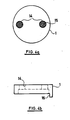
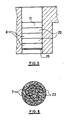
- the recoverable enzyme sensor of the present invention i.e. a recoverable enzyme sensor with an interchangeable membrane system characterised in that it comprises a ceramic body 3 having disposed therein a current electrode 5 in the form of a porous metal insert occupying a reservoir 10 for electrolyte, a reference electrode 4 and at least one measuring electrode 6, said electrodes being arranged so that they each have a contact surface at a common surface 13 of the ceramic body such that the contact surface of the current electrode 5 surrounds that of the reference electrode 4 and the contact surface of each measuring electrode 6 is outside the surrounding electrode 5, said common surface 13 being provided with a permeable membrane cover 9, the body 3 being provided with a removable cover 2 to hold an exchangeable enzyme membrane 8 in contact with said common surface 13 covered by the membrane cover 9.
- a recoverable enzyme sensor with an interchangeable membrane system characterised in that it comprises a ceramic body 3 having disposed therein a current electrode 5 in the form of a porous metal insert occupying a reservoir 10 for electrolyte, a reference electrode 4 and at least one
- the ceramic body is preferably in the shape of cylinder, the body being terminated with a truncated taper in which there is a reservoir created having the shape of an annular cylinder inside which thre are disposed both the porous metal current electrode and the electrolyte, e.g.
- the ceramic body comprises an inner ceramic layer shaped as a circular ring in which there is arranged one measuring electrode, at least, and an outer ceramic layer has a shape (in section) of a co-axial ring in which there is the reference electrode arranged and, further, the body is both covered with a covering membrane and connected with the housing of the probe to which the replaceable membrane system is attached by a holder equipped with an aperture, in which there are arranged at least one enzyme membrane, at least one protective membrane and at least one control membrane.
- the recoverable enzyme sensor is further characterised by: the body being made of silicone corundum ceramics having a resistivity of at least value of 1012 ohm.m; the first ceramics layer of the reservoir being provided with at least one projection arranged on the inner part of the circular ring, a measuring electrode being arranged in the projection; the cover of the sensor being made of elastomer or tough plastics, the mechanical properties of which, e.g.
- the holder being made of plastics and arranged for disassemblable connection with the cover of the sensor; the holder being provided with an arresting projection; orifices in which the membrane system is arranged, located over the different measureing electrodes; the holder having a circular shape and being provided with orifices in which there are arranged enzymatic membranes equipped with the appropriated enzyme e.g.
- the glucose oxidase and further, with a control membrane which has a pore size corresponding with the sizes of the molecules to be measured and with a protective membrane having a negligible diffuse resistivity;
- the orifices being provided with meshes;
- the measuring electrode being of a metal selected from platinum, silver, gold, tantalum, molybdenum, irridium, osmium and tungsten;
- the front surface of the body taper being provided with electrode structures created by covering with other metals e.g.
- the front surface of the body taper being polished and having a roughness ranging from 0.1 to 50 ⁇ m; the front surface of the body taper projecting over the measuring electrode by 1 to 10 ⁇ m; the measuring electrode being made of an alloy of gold with platinum in the ratio range 0.0 to 99.9% by weight and platinum with gold ratio ranging 0.1 to 99.9% by weight; the measuring electrode being made of non-metal material, e.g. carbon; the reference electrode being made of metal, e.g.
- the current electrode being made of silver having purity of at least 97%; the electrolyte being contained in the porous current electrode; the body, cover and holder all being mutually connected in a disassemblable way; the current electrode being made by sintering silver powder in a hydrogen atmosphere at a temperature ranging from 800 to 900°C; the current electrode being treated by chlorination in gaseous chlorine.
- the new and improved effect can be seen not only in the fact that the sensor complies with the main requirements of the present state-of-art (see the introduction), but in addition, that its constructions design enables, further: Making the cathode of silver, either by silver paste (amalgam) deposition with subsequent burning, or by deposition of silver using microelectronics procedures at the outlets of platinum electrode sites. This procedure assumes a corundum ceramics is used, to which the silver has a very good adhesivity. A similar advantage can be obtained with gold, as well.
- the platinum cathode can be used directly in the corundum ceramics.
- the electrodes are closely arranged one to another, all will be influenced in the same manner during treatment (e.g. polishing) and the resulting sensor will possess symetrical electrodes. Because the measurement is carried out differentially, the effect of the manufacturing history is eliminated in platinum electrodes.
- the anode of the sensor in accordance with the present invention is made by sintering the silver powder in the hydrogen atmosphere with subsequent chlorination in gaseous chlorine.
- This process ensures that the surface area of the anode is by some orders higher than that of the cathode, with a very small volume.
- the sintering in hydrogen surroundings ensures complete cleaning of silver and the subsequent chlorination operation makes a homogenous compact layer of silver chloride.
- the anode is porous. By this fact, a storage reservoir for electrolyte in minute volume is created at the same time. By this arrangement an electrolyte storage reservoir of minute volume can be made in a relatively small sensor.
- the body of the sensor is made of corundum ceramics having a high resistivity and being inert to salt solutions so that a resistance between electrodes in excess of 1010 ohms can be maintained while the electrolyte present, for a long time span.
- corundum ceramics When corundum ceramics is used a very homogenous connection of the cathode metal (e.g. platinum) with the ceramics (helium seal) can be attained. By this means it is ensured that the electrode reaction takes place only on the front surface of the sensor and no side reactions occur at a longer distance from the membrane system. In this way hysteresis is prevented, there are no dynamic performance characteristic changes and no sensitivity impairment.
- the sensor according to the present invention limits some other effects of long term non-stability. It limits some non-stabilities caused by side reactions by means of the way the body is formed of inert sintered ceramics which can be compactly connected with the electrodes.
- the long term non-stabilities caused by changes of anode parameters by the fact that the anode used has a large surface area.
- the long term non-stabilities caused by wrong chlorination processes by the means of the fact that the anode is completely cleaned out while sintering in the hydrogen atmosphere and the next chlorination in gaseous chlorine makes a homogenous layer of the silver chloride, are supressed, as well.
- the long term non-stabilities caused by conductive bridge can be limited by the way that the body of the sensor is made of inert sintered corundum ceramics which is of steady behaviour in the surrounding of electrolyte.
- the sensor complying with the present invention significantly limits the sources of the residual current.
- the residual current caused by diffusion of oxygen from electrolyte can be further eliminated by suitable geometrical arrangement in which the electrolyte is situated inside the body of the probe and covered by massive walls of corundum cermaics.
- the desing of the sensor complying with the present invention improves even the dynamic performace characteristics in comparison with the prior-of-the-art enzyme electrodes.
- corundum ceramics having a very high hardness a very high quality of the front surface of the sensor can be achieved, and by this way the close application of the membrane system can be ensured.
- using corundum ceramics enables a defined layer of electrolyte to be made through polishing the sensor surface with a grinding means having a lower hardness than that of the corundum ceramics and having a higher hardness than that of the material of cathode.
- the sinking of electrodes in the material of the sensor is carried out. On this sinking, other metals can be polished once more.
- the thin layers of the electrode system can be definitively prepared having a thickness ranging from 1 to 10 micrometers.
- the sensor complying with the objects of the present invention can eliminate significantly the effects of temperature, because the measuring electrodes used for the differential measurement are very near one another, they are isolated by the silver anode (with a very high temperature conductivity) and they are symmetrically arranged. Because of this, the electrodes will operate on the same temperature level as each other and, in the temperature dependence of the sensor, events being influenced by the temperature which are symmetric with reference to the measuring electrodes take no part. As well as the temperature dependence of the electrode process is compensated, the temperature dependence of covering membrane diffusivity and the diffusivity parameters of all membranes being symmetrically arranged in the membrane system for various measuring electrodes, are also compensated.
- the temperature dependence of the probe is mainly determined by the temperature dependence of the speed of the enzyme reaction which has been used to determine the substance or substances.
- the sensor complying with the objects of the present invention decreases the influence of the pressure on the sensor operation considerably by means of the sintered silver anode acting as the support for the membrane system, at the same time, eliminating greater movements of the membrane system in response to exposure to pressure.
- the sensor complying with the objects of the present invention solves some of the problems dealing with the immobilization and long term stability of enzymes, and their degradation, since the enzyme membrane, together with the controlling membrane, can be easily replaced and is designed for use for a given number of analyte determinations, thus removing the long term non-stability caused by the degradation of enzyme membranes.
- the membrane system is made symmetrically, i.e. for any measuring electrode, the membrane system contains membranes having the same parametes as the membrane system of reference and it differs only in the enzyme used.
- the sensors complying with the objects of the present invention, further, solve the question of the holder arresting the membrane system, by means of an arresting projection provided preventing a rotation or the application of an undefined membrane system holder to the membranes.
- the holder made in this way lowers the effects of non-linearity caused by non-homogenous membrane application and, together with the mechanical design it protects the electrode system from stresses occuring in the membrane system, and a free application is realized.
- the membrane system of the probe complying with the object of the present invention, one part of which having a covering membrane made of polypropylene or teflon or polyethyleneterephthalate being attached to the sensor body with a tapered coupling, lowers the long term non-stability because the beforementioned membranes possess very low values of diffusivity for molecules of water or substances able poison the cathode.
- the membrane system of the sensor complying with the object of the present invention lowers by its design even some negative effects of the dynamic behaviour characteristics.
- By the design of the membrane system and of the electrode system mechanical stresses are eliminated even in the membrane system.
- By means of the symmetrical design of both the electrode system and the membrane system mechanical stresses in the membrane system are eliminated, as well.
- By means of the symmetrical design of the membrane system the effect of both the fluid layer and of deposited substances on the suface of the membrane system can to some extent be eliminated, as well.
- the sensor comprises a body 3 terminated by a taper 12, being made of sintered corundum ceramics, the resistivity of which is 1012 ohms.
- a taper 12 being made of sintered corundum ceramics, the resistivity of which is 1012 ohms.
- the reservoir 10 of electrolyte arranged having a shape of circular ring (in section) in which the porous silver current electrode 5 is arranged. This is made by sintering silver powder at temperatures ranging from 800 to 900°C in a hydrogen atmosphere followed by chlorination in gaseous chlorine.
- reference platinum electrode 4 its front surface 21 being, e.g., silver plated and chlorinated and, at least one platinum measuring electrode 6.
- the taper 12 of the body 3 has its front surface polished, having a roughness in the range of from 1 to 10 ⁇ m and is covered with the covering membrane 9 which is attached to it with the cover 2 of the sensor. To it the holder 1 is attached, in which ther are arranged both an enzyme membrane 8 and a protective membrane 11.
- a body 3 which is made of corundum ceramics, the resistivity of which is in excess of 1012 ohm.m.
- the body 3 is made as a cylinder terminated with a truncated taper in which ere is created a reservoir 10 having its base in form of circular ring (in section).
- a first ceramic layer 17 has the shape of a circular ring on inner circumference of which ther are arranged four projections in which there are measuring electrodes 6.
- the projections 19 project into the space of the reservoir 10 in which there is arranged a porous silver current electrode 5, the pores of which are saturated with an electrolyte, e.g. silver chloride.
- This electrode surrounds a second layer of ceramics 18 in the shape ofa cylinder in which the platinum reference electrode 4 is present in the front surface 21, which is for example both silver plated and chlorinated.
- the taper 12 of the body 3 has a front surface 13 which is polished and has a roughness ranging from 0.1 to 25 ⁇ m and is covered with a covering membrane 9 being attached to it with a cover 2 made of plastics, the mechanical properties of which ensure an airtight connection of the membrane 9 with the taper 12 of the body 3 of the electrode system.
- a cover 2 is attached to the cover 2 there is attached a holder 1 being made of plastics, arranged for disassembleable connection.
- the holder 2 is equipped with an arresting projection with its inner cross-section of circular shape, and in it there are provided openings 14 are secured in which meshes 15 serving as a mechanical reinforcement of the membrane system.
- the membrane system comprises at least on enzyme membrane 8, soaked with an enzyme, for example, glucose oxidase, over which there is arranged at least one controlling membrane 20, and over it there is at least one protecting membrane 11.
- the operation of the recoverable enzyme sensor is as follows:
- the reference electrode 4 is connected to the input of an operation amplifier and picks up the potential in the vicinity of the covering membrane.
- the current electrode 5 is arranged to carry such electric current that the potential being picked up by the reference electrode 4 may have a predetermined value.
- the concentration of the substance to be determined is proportional to the amount of this substance which is created in the appropriate membrane system.
- the membrane system consists of plurality of membranes which can be, generally, divided in three groups.
- the first group comprises enzymatic membranes 8 which catalyse reactions between different chemical substances resulting in the formation of the substance which is then detected by the electrode system, as well.
- the second group comprises the controlling membrane 20, which limits the flow of the different substances to the enzymatic membranes 8 by diffusion, and thus set the concentration range in which the sensor can operate.
- the last group comprises the protecting membranes 11 which either cover the membrane system as a whole, or even individiually cover the enzyme membranes 8, and in this way any substances whih could deactivate the enzyme are prevented from entering.
- the proper measurement is carried out in such a manner that the substance to be determined is led to the membrane system where it penetrates through the protecting membrane 11 to the controlling membrane 20 in which its flux is controlled towards the enzyme membrane 8 in such a way so that the amount of the product being created by means of the enzyme immobilized in the enzyme membrane 8 may be optimal for the concentration of the substance to be assayed.
- the product then goes to the next controlling membrane 20 and this process is repeated so long till resulting product is created which is detected by the electrode system.
- the utilization of the recoverable enzyme sensor complying with the objects of the present invention has, because of its design, a very broad field of application, especially in biological method. Direct utilization can be found in the following branches: serum manufacture, vaccine preparation, food industry, biochemical procedures, medicine, chemical processes, microbiology, biotransformation control, fermentation process control etc. In the above mentioned branches the application of enzymatic sensors can be expected.
Landscapes
- Chemical & Material Sciences (AREA)
- Organic Chemistry (AREA)
- Life Sciences & Earth Sciences (AREA)
- Zoology (AREA)
- Wood Science & Technology (AREA)
- Proteomics, Peptides & Aminoacids (AREA)
- Health & Medical Sciences (AREA)
- Engineering & Computer Science (AREA)
- Microbiology (AREA)
- Biochemistry (AREA)
- Physics & Mathematics (AREA)
- Molecular Biology (AREA)
- Biotechnology (AREA)
- Biophysics (AREA)
- Analytical Chemistry (AREA)
- Immunology (AREA)
- Bioinformatics & Cheminformatics (AREA)
- General Engineering & Computer Science (AREA)
- General Health & Medical Sciences (AREA)
- Genetics & Genomics (AREA)
- Apparatus Associated With Microorganisms And Enzymes (AREA)
- Measuring Or Testing Involving Enzymes Or Micro-Organisms (AREA)
- Measurement Of The Respiration, Hearing Ability, Form, And Blood Characteristics Of Living Organisms (AREA)
Applications Claiming Priority (2)
| Application Number | Priority Date | Filing Date | Title |
|---|---|---|---|
| CS7992/88 | 1988-12-05 | ||
| CS799288A CS274231B1 (en) | 1988-12-05 | 1988-12-05 | Regenerable enzyme sensor with exchangeable membrane system |
Publications (2)
| Publication Number | Publication Date |
|---|---|
| EP0372911A2 true EP0372911A2 (fr) | 1990-06-13 |
| EP0372911A3 EP0372911A3 (fr) | 1991-01-02 |
Family
ID=5429947
Family Applications (1)
| Application Number | Title | Priority Date | Filing Date |
|---|---|---|---|
| EP19890312678 Withdrawn EP0372911A3 (fr) | 1988-12-05 | 1989-12-05 | Capteur enzymatique réutilisable avec système de remplacement de la membrane |
Country Status (4)
| Country | Link |
|---|---|
| EP (1) | EP0372911A3 (fr) |
| JP (1) | JPH02264855A (fr) |
| CA (1) | CA2002170A1 (fr) |
| CS (1) | CS274231B1 (fr) |
Cited By (4)
| Publication number | Priority date | Publication date | Assignee | Title |
|---|---|---|---|---|
| EP0972085A4 (fr) * | 1997-10-07 | 2000-04-26 | Motorola Inc | Capteurs permettant de detecter electriquement les phenomenes de liaison relatifs aux recepteurs moleculaires sur support |
| WO2001042508A3 (fr) * | 1999-12-09 | 2002-03-14 | Motorola Inc | Procedes et compositions se rapportant a la detection electrique des reactions d'acides nucleiques |
| US6518024B2 (en) | 1999-12-13 | 2003-02-11 | Motorola, Inc. | Electrochemical detection of single base extension |
| US6824669B1 (en) | 2000-02-17 | 2004-11-30 | Motorola, Inc. | Protein and peptide sensors using electrical detection methods |
Family Cites Families (2)
| Publication number | Priority date | Publication date | Assignee | Title |
|---|---|---|---|---|
| FR2391467A1 (fr) * | 1977-05-20 | 1978-12-15 | Anvar | Cellule de mesure pour microdosages, comprenant des electrodes a membranes enzymatiques |
| FR2615862B1 (fr) * | 1987-05-29 | 1990-07-06 | Armines | Procede de fabrication de supports enzymatiques utilisables dans des capteurs a enzymes et capteurs a enzymes equipes de tels supports |
-
1988
- 1988-12-05 CS CS799288A patent/CS274231B1/cs unknown
-
1989
- 1989-11-03 CA CA 2002170 patent/CA2002170A1/fr not_active Abandoned
- 1989-12-04 JP JP1313565A patent/JPH02264855A/ja active Pending
- 1989-12-05 EP EP19890312678 patent/EP0372911A3/fr not_active Withdrawn
Cited By (4)
| Publication number | Priority date | Publication date | Assignee | Title |
|---|---|---|---|---|
| EP0972085A4 (fr) * | 1997-10-07 | 2000-04-26 | Motorola Inc | Capteurs permettant de detecter electriquement les phenomenes de liaison relatifs aux recepteurs moleculaires sur support |
| WO2001042508A3 (fr) * | 1999-12-09 | 2002-03-14 | Motorola Inc | Procedes et compositions se rapportant a la detection electrique des reactions d'acides nucleiques |
| US6518024B2 (en) | 1999-12-13 | 2003-02-11 | Motorola, Inc. | Electrochemical detection of single base extension |
| US6824669B1 (en) | 2000-02-17 | 2004-11-30 | Motorola, Inc. | Protein and peptide sensors using electrical detection methods |
Also Published As
| Publication number | Publication date |
|---|---|
| CA2002170A1 (fr) | 1990-06-05 |
| CS274231B1 (en) | 1991-04-11 |
| JPH02264855A (ja) | 1990-10-29 |
| CS799288A1 (en) | 1990-09-12 |
| EP0372911A3 (fr) | 1991-01-02 |
Similar Documents
| Publication | Publication Date | Title |
|---|---|---|
| EP0266432B1 (fr) | Micro-electrode pour analyses electrochimiques | |
| US4062750A (en) | Thin film electrochemical electrode and cell | |
| US4517291A (en) | Biological detection process using polymer-coated electrodes | |
| Gernet et al. | Fabrication and characterization of a planar electrochemical cell and its application as a glucose sensor | |
| Harrison et al. | Characterization of perfluorosulfonic acid polymer coated enzyme electrodes and a miniaturized integrated potentiostat for glucose analysis in whole blood | |
| US3542662A (en) | Enzyme electrode | |
| JPH09127042A (ja) | バイオセンサー | |
| CN1175268C (zh) | 电化学分析元件 | |
| AU605111B2 (en) | Enzyme-electrode sensor | |
| US4605626A (en) | Electrochemical system with rotating electrode/sparger assembly | |
| US5312590A (en) | Amperometric sensor for single and multicomponent analysis | |
| US4632746A (en) | Electrochemical cell with thin wire electrode | |
| Mascini et al. | Glucose electrochemical probe with extended linearity for whole blood | |
| US5269903A (en) | Microbioelectrode and method of fabricating the same | |
| EP0304494B1 (fr) | Immobilisation de matiere biofonctionnelle, element prepare a partir de cette matiere et mesure l'utilisant | |
| US3668101A (en) | Membrane electrodes and cells | |
| GB2367136A (en) | Electrochemical gas sensor with membrane of specified copolymer | |
| De Vitre et al. | Preparation and properties of a mercury-plated iridium-based microelectrode | |
| EP0372911A2 (fr) | Capteur enzymatique réutilisable avec système de remplacement de la membrane | |
| WO1996033404A1 (fr) | Detecteur de gaz electrochimique utilise dans la detection du dioxyde d'azote | |
| US4604182A (en) | Perfluorosulfonic acid polymer-coated indicator electrodes | |
| JP2003513274A (ja) | 電流滴定センサおよび電位差センサの微視的組み合わせ | |
| Kaisheva et al. | Enzyme/gas-diffusion electrodes for determination of phenol | |
| JPH0257960A (ja) | 酸素電極 | |
| Russell et al. | The commercialisation of sensor technology in clinical chemistry: an outline of the potential difficulties |
Legal Events
| Date | Code | Title | Description |
|---|---|---|---|
| PUAI | Public reference made under article 153(3) epc to a published international application that has entered the european phase |
Free format text: ORIGINAL CODE: 0009012 |
|
| AK | Designated contracting states |
Kind code of ref document: A2 Designated state(s): AT BE CH DE FR GB IT LI LU NL SE |
|
| PUAL | Search report despatched |
Free format text: ORIGINAL CODE: 0009013 |
|
| AK | Designated contracting states |
Kind code of ref document: A3 Designated state(s): AT BE CH DE FR GB IT LI LU NL SE |
|
| 17P | Request for examination filed |
Effective date: 19910626 |
|
| STAA | Information on the status of an ep patent application or granted ep patent |
Free format text: STATUS: THE APPLICATION HAS BEEN WITHDRAWN |
|
| 18W | Application withdrawn |
Withdrawal date: 19920723 |