EP0372938A1 - Composition zéolitique utilisable en séparations d'oléfines - Google Patents
Composition zéolitique utilisable en séparations d'oléfines Download PDFInfo
- Publication number
- EP0372938A1 EP0372938A1 EP89312734A EP89312734A EP0372938A1 EP 0372938 A1 EP0372938 A1 EP 0372938A1 EP 89312734 A EP89312734 A EP 89312734A EP 89312734 A EP89312734 A EP 89312734A EP 0372938 A1 EP0372938 A1 EP 0372938A1
- Authority
- EP
- European Patent Office
- Prior art keywords
- olefins
- olefin
- silicalite
- zeolite
- paraffins
- Prior art date
- Legal status (The legal status is an assumption and is not a legal conclusion. Google has not performed a legal analysis and makes no representation as to the accuracy of the status listed.)
- Granted
Links
Images


Classifications
-
- C—CHEMISTRY; METALLURGY
- C10—PETROLEUM, GAS OR COKE INDUSTRIES; TECHNICAL GASES CONTAINING CARBON MONOXIDE; FUELS; LUBRICANTS; PEAT
- C10G—CRACKING HYDROCARBON OILS; PRODUCTION OF LIQUID HYDROCARBON MIXTURES, e.g. BY DESTRUCTIVE HYDROGENATION, OLIGOMERISATION, POLYMERISATION; RECOVERY OF HYDROCARBON OILS FROM OIL-SHALE, OIL-SAND, OR GASES; REFINING MIXTURES MAINLY CONSISTING OF HYDROCARBONS; REFORMING OF NAPHTHA; MINERAL WAXES
- C10G25/00—Refining of hydrocarbon oils in the absence of hydrogen, with solid sorbents
- C10G25/02—Refining of hydrocarbon oils in the absence of hydrogen, with solid sorbents with ion-exchange material
- C10G25/03—Refining of hydrocarbon oils in the absence of hydrogen, with solid sorbents with ion-exchange material with crystalline alumino-silicates, e.g. molecular sieves
-
- B—PERFORMING OPERATIONS; TRANSPORTING
- B01—PHYSICAL OR CHEMICAL PROCESSES OR APPARATUS IN GENERAL
- B01J—CHEMICAL OR PHYSICAL PROCESSES, e.g. CATALYSIS OR COLLOID CHEMISTRY; THEIR RELEVANT APPARATUS
- B01J29/00—Catalysts comprising molecular sieves
- B01J29/04—Catalysts comprising molecular sieves having base-exchange properties, e.g. crystalline zeolites
- B01J29/06—Crystalline aluminosilicate zeolites; Isomorphous compounds thereof
- B01J29/40—Crystalline aluminosilicate zeolites; Isomorphous compounds thereof of the pentasil type, e.g. types ZSM-5, ZSM-8 or ZSM-11, as exemplified by patent documents US3702886, GB1334243 and US3709979, respectively
-
- B—PERFORMING OPERATIONS; TRANSPORTING
- B01—PHYSICAL OR CHEMICAL PROCESSES OR APPARATUS IN GENERAL
- B01J—CHEMICAL OR PHYSICAL PROCESSES, e.g. CATALYSIS OR COLLOID CHEMISTRY; THEIR RELEVANT APPARATUS
- B01J2229/00—Aspects of molecular sieve catalysts not covered by B01J29/00
- B01J2229/10—After treatment, characterised by the effect to be obtained
- B01J2229/26—After treatment, characterised by the effect to be obtained to stabilize the total catalyst structure
-
- B—PERFORMING OPERATIONS; TRANSPORTING
- B01—PHYSICAL OR CHEMICAL PROCESSES OR APPARATUS IN GENERAL
- B01J—CHEMICAL OR PHYSICAL PROCESSES, e.g. CATALYSIS OR COLLOID CHEMISTRY; THEIR RELEVANT APPARATUS
- B01J2229/00—Aspects of molecular sieve catalysts not covered by B01J29/00
- B01J2229/30—After treatment, characterised by the means used
- B01J2229/42—Addition of matrix or binder particles
Definitions
- This invention relates to a zeolite composition for use in olefinic separation, and to a process for separating n-olefins, and optionally n-paraffins, from hydrocarbon mixtures.
- linear and lightly-branched olefins are valuable as feeds to the hydroformylation (Oxo) process for making linear alcohols.
- Linear ⁇ -olefins are valuable molecules for the synthesis of high-value added polymers and other products. It is particularly desirable to develop a process for separating linear olefins from low-valued refinery streams such as FLEXICOKER naphthas and distillates.
- Acidic activity in zeolites has been identified as due to both Bronsted and Lewis acid sites. Clearly the existence of protons in the structure can lead to acidity but in addition, many other sites are suspected. The structures of acidic sites are difficult to identify and the whole area is subject to great debate. Additional acidity can come from non-framework aluminum species.
- the as-received silicalite contains acidic activity even at room temperature. This activity was likely to cause in situ polymerization reactions which would effectively block adsorption sites, rendering the adsorbent inactive with time.
- This invention describes various zeolite treatments, described below, which are effective in reducing acid catalytic activity.
- the present invention provides a process for the separation of C5 to C19 n-olefins from a mixture comprising C5 to C19 n-olefins and branched chained olefins, the process comprising contacting said mixture of C5 to C19 n-olefins and branched chain olefins with a neutral molecular sieve adsorbent under conditions sufficient to effect selective adsorption of said n-olefins, and contacting the resulting sieve containing the adsorbed n-olefins extract with a more volatile desorbent under conditions sufficient to effect displacement from the sieve of said extract, characterised in that the molecular sieve adsorbent is a silicalite or ZSM-5 which has been first acid treated and then base treated.
- the present invention provides a process for the separation of C5 to C19 n-olefins and n-paraffins from a mixture comprising C5 to C19 n-olefins, n-paraffins and other hydrocarbons, the process comprising contacting said mixture with a neutral molecular sieve adsorbent under conditions sufficient to effect selective adsorption of said n-olefins and n-paraffins, and contacting the resulting sieve containing the adsorbed n-olefins and n-paraffins extract with a more volatile desorbent under conditions sufficient to effect displacement from the sieve of said extract, characterised in that the molecular sieve adsorbent is a silicalite or ZSM-5 which has been first acid treated and then base treated.
- the present invention also provides a zeolite composition
- a zeolite composition comprising a high silica zeolite molecular sieve having a pore diameter of at least about 5.0 ⁇ which has been first treated with an acid and subsequently treated with a base.
- This invention teaches a new improved zeolite composition for a new separation approach for obtaining normal olefin, particularly ⁇ -olefin reactants, suitivelyable as chemical intermediates.
- Known chemical methods for the preparation of such olefins are ethylene oligomerization, paraffin cracking and dehydrogenation and alkyl chloride dehydrogenation and alkyl chloride dehydrochlorination.
- the present invention provides a process which separates either a mixture of olefins or a mixture of n-olefins and n-paraffins by the use of a neutral molecular sieve of preferably high silica alumina ratio. The olefin components of this mixture are then selectively converted to desired higher molecular weight products in a separate step. Finally, the unreacted paraffins can be removed from the reaction mixture by distillation.
- An attractive feature of the present separation process is that it utilizes low cost olefinic hydrocarbon feeds which can be pure olefinic feeds or can contain not only aliphatic hydrocarbons but aromatic hydrocarbon and sulfur compounds as well.
- Such olefinic hydrocarbon feeds are produced by the high temperature thermal cracking of petroleum residua, particularly vacuum resids. These feeds contain high concentrations of linear terminal (i.e. ⁇ -) olefins of Type I and linear internal olefins of Type II.
- the mixture of olefins can be derived from the steam cracking of gases, oils, naphthas, light paraffins and linear waxy paraffins, fluid catalytic cracking, coking (fluid and delayed), and catalytic dehydrogenation of paraffins.
- a neutral molecular sieve which minimizes the olefin side reactions and allows the separation of 1-n-olefin - n-paraffin mixtures without any major terminal, e.g. olefin to internal olefin isomerization.
- alumina zeolites such as silicalite having less than 5000 ppm alumina are used for selective adsorption.
- the preferred feeds of the present separation process are olefinic distillates produced from petroleum residua by high temperature thermal cracking. Such cracked distillates are preferably produced from vacuum residua by Fluid-coking or Flexicoking. These distillates contain 1-n-olefins as the major type of olefin components and organic sulfur.
- the invention teaches the separation of linear and lightly-branched olefins from hydrocarbon streams using high-silica zeolite molecular sieves in which the limiting pore aperture providing access to the internal pore volume of the crystals is formed from 10 membered oxygen rings (approx. 5.5-60 ⁇ diameter).
- zeolite molecular sieves include silicalite, ZSM-5, ZSM-12, etc. Rings of this size will admit linear/ lightly-branched olefins and linear/lightly branched paraffins, but will exclude other hydrocarbon types, including aromatics.
- the high-silica zeolite molecular sieve is rendered inert towards olefin isomerization, oligomerization and polymerization by modifying it by first treating the zeolites with acid and then treating the zeolite with base.
- This treatment has been shown to remove acidic sites from the internal and external surfaces of the crystals, thus preventing olefin side reactions, and allowing the linear and lightly-branched olefins to be recovered in high purity by desorption.
- the acid-base treatment is also effective in removing acidity from the silica binder used in forming adsorbent pellets.
- the present invention relates to an improved zeolite composition used in a process for the separation of C5 to C19 preferably C9 to C19 olefins or mixtures of n-olefins and n-paraffins, preferably 1-n-olefins and n-paraffins, from a mixture of aliphatic and aromatic hydrocarbons and, optionally, sulfur containing compounds comprising contacting a mixture of C5 to C19 olefins or aliphatic and aromatic hydrocarbons, preferably a mixture also containing organic sulfur compounds, specifically in concentrations equivalent to from about 0.05% to about 3% sulfur with a neutral molecular sieve (improved zeolite composition), preferably a neutralized zeolite such as the sodium form of ZSM-5 having a minimum silica to alumina ratio of 20, more preferably silicalite, most preferably silicalite substantially free from alumina, which has been preferably pretreated by an acid and then a base, under conditions sufficient to
- the invention provides a process for the separation of C9 to C19 n-olefins or mixtures of n-olefins and n-paraffins from aliphatic and aromatic hydrocarbons and, optionally, sulfur containing compounds, preferably 1-n-olefins and n-paraffins, comprising contacting a mixture of C9 to C19, preferably C9 to C13, olefins or aliphatic and aromatic hydrocarbons, which preferably also contains sulfur compounds, with a neutral molecular sieve, preferably a zeolite having a minimum silica alumina ratio of 20, the sodium form of ZSM-5 or more preferably silicalite, in the liquid phase and in the temperature range of about 80°C and about 200°C preferably about 100°C to about 150°C for a sufficient time to effect adsorption, and desorbing the resulting n-olefin n-paraffin and n-olefin enriched extract from the sieve with a neutral
- the present invention provides a process for the separation of C5 to C19, preferably C9 to C15, more preferably C9 to C13 mixture of olefins or of 1-n-olefins and n-paraffins from aliphatic and aromatic hydrocarbons and, optionally, sulfur containing compounds comprising contacting a corresponding olefinic cracked distillate feed produced from petroleum residua by high temperature thermal cracking, preferably Fluid-coking or Flexicoking, and contacting 1-n-olefins as the major type of olefin components, the percentage of Type I olefins preferably exceeding 30 wt% of the total olefins, and organic sulfur compounds, preferivelyably in concentration exceeding about 0.05%, more preferably in the concentration range of about 0.3% to about 3% with a neutral molecular sieve, preferably an above described high Si/Al ratio zeolite, more preferably the sodium form of ZSM-5 or silicalite
- the present invention represents a process for the separation of C9 to C19, preferably C9 to C15 olefins, mixtures of 1-n-olefins and n-paraffins comprising contacting a C9 to C19 olefin mixture or an olefinic cracked distillate feed produced from vacuum residua by high temperature thermal cracking in a Fluid-coker or Flexicoker unit which contains more than 20% olefins, more than 30% of said olefins being of Type I, and additionally contains organic sulfur compounds in concentrations exceeding 0.3% sulfur, with a neutral molecular sieve, preferably an earlier defined high Si/Al ratio zeolite, more preferably silicalite in the liquid phase in the temperature range of 80°C and 200°C for a sufficient time to to effect adsorption, and desorbing the resulting 1-n-olefin or 1-n-olefin - n-paraffin enriched extract from the sieve with a more volatile n
- the present invention also encompasses a separation - conversion process comprising contacting C5 to C19, preferably C9 to C19 olefins or a mixture of aliphatic and aromatic hydrocarbon feed, the more preferred feeds being those defined above, with a neutral molecular sieve, preferably a zeolite with a high Si/Al ratio, preferably as defined above, more preferably a silicalite, in the liquid and or gas phase preferably in the liquid phase in the temperature range of about 100° to about 250°C for a time sufficient to effect a selective adsorption of the 1-n-olefin and n-paraffin components, desorbing the resulting the 1-n-olefin or 1-n-olefin and n-paraffin enriched extract with a more volatile n-olefin and/or paraffin, preferably n-olefin, and converting the olefin components of the extract to less volatile products via reactions preferably selected from the group consisting of oli
- this invention covers a selective separation- conversion process comprising contacting a C9 to C13 olefinic cracked petroleum distillate feed, produced from vacuum residua by high temperature thermal cracking in a Fluid-coker or Flexicoker unit, which contains more than 20%, preferably more than 30%, olefins and more than 30% said olefins being of Type I and additionally contains organic sulfur compounds in concentrations exceeding 0.3% sulfur, with a neutral molecular sieve, preferably a silicalite or sodium ZSM-5 in the liquid or gas phase, preferably in the liquid phase, in the temperature range of about 100°C to about 250°C, preferably about 100 to 150°C for a sufficient time to effect selective adsorption of the 1-n-olefin and n-paraffin components, desorbing the resulting 1-n-olefin - n-paraffin rich extract from the sieve with a more volatile n-olefin or/and n-paraffin,
- the combined separation- conversion process of the present invention will be detailed regarding the conversion encompassed within the inventive concept.
- the conversion of the n-olefin or the olefin components of the n-olefin - n-paraffin extract to synthetic lubricants will be particularly described.
- the preferred hydrocarbon feeds of the present invention contain major amounts of olefins, paraffins and aromatic compounds or alternatively, are a mixture of n-olefins and branched chained olefins which, more preferably the feeds also contain significant amounts of sulfur compounds.
- olefins paraffins and aromatic compounds
- branched chained olefins which, more preferably the feeds also contain significant amounts of sulfur compounds.
- the olefin compounds of the feed are preferably in concentrations exceeding about 10 wt.%, more preferably about 20 wt%, most preferably about 30%.
- the prevalent specific olefins are 1-n-olefins.
- Some preferred olefin feed components are 1-pentene 3-hexene, 3-methyl-2-pentene, 1-octene, trans-2-decene, tetradecene, 1-octadecene.
- paraffin components are preferably in concentrations similar or lower concentrations than those of the olefins or lower, the normal paraffins being the major paraffin component.
- exemplary paraffins are n-pentane, cyclohexane, n-octane, n-decane, 2-methylnonane, decalin, hexadecane.
- the aromatic hydrocarbon components preferably represent from about 1 to about 60 wt.% of the feed more preferably about 10 to 60 wt.%.
- the preferred aromatic hydrocarbons are either unsubstituted or substituted by short C1 to C3 alkyl groups such as benzene, p-xylene, 1-methyl-4-ethylbenzene, 1,2,3-trimethylbenzene, naphthalene, 2-methylnaphthalene, phenanthrene.
- the sulfur compounds are usually present as impurities in the hydrocarbon feed.
- the present process is preferred for feeds of relatively high sulfur content, 0.05 wt.% or above and can handle feeds having sulfur concentrations ranging from about 0.3 to 3% sulfur.
- the sulfur compounds are usually present as thiol and/or aromatic sulfur compounds.
- Aromatic sulfur compounds such as thiophenes, benzothiophenes and dibenzothiophenes are preferred. These aromatic sulfur compounds can be substituted by one or more short chain alkyl groups, preferably C1 to C3 alkyl, more preferably methyl.
- the preferred olefinic distillate feeds of the present invention are produced from petroleum residua by high temperature thermal cracking.
- the percentage of the most desired 1-n-olefin components of such feeds generally increases with the temperature of cracking. Therefore, the distillate products of high temperature thermal cracking processes such as Fluid-coking and Flexicoking are preferred feeds for the present process. Delayed coking which is normally operated at lower temperatures can also produce suitable feeds for the present process although these feeds contain higher concentrations of n-paraffins than 1-n-olefins.
- Other less preferred, but suitable, generally milder cracking processes to produc feeds for the present invention are the thermal cracking of gas oils and the vis-breaking of vacuum residues.
- the preferred feeds of Fluid-coking and Flexicoking are highly olefinic with olefin concentrations exceeding 20 wt.%, preferably 30%.
- the aliphatic hydrocarbons are semilinear in character.
- the main components are linear, i.e. normal olefins and normal paraffins.
- the largest specific type of compounds are 1-n-olefins followed by n-paraffins.
- the R groups in the formulas of the various types of olefins can be straight chain or branched alkyl groups.
- the alkyl groups of the preferred coker olefins of Type I and Type II are predominantly either straight chain or monomethyl branched.
- the Type III and Type IV olefin components of these preferred feeds predominantly possess a methyl group as one of the alkyl groups on the completely substituted vinylic carbon.
- NMR also indicated the presence of minor amounts of conjugated dienes ranging from about 2 to about 10% concentration.
- the concentration of the various olefins generally decreases with their molecular weight, i.e. carbon number. Therefore, coker distillates having more than 19 carbons per molecule are less preferred.
- the paraffin components of the preferred coker distillate feeds are present in concentrations similar to but smaller than the olefin components.
- the n-paraffins are the major single types of paraffins present.
- the branched paraffins are largely methyl branched. Monomethyl branched paraffins are prevalent.
- the aromatic hydrocarbons of the present feeds have a concentration range from about 6% to about 50%.
- the percentage of the aromatic components increases with the carbon number of he distillate fractions. Of course the percentages of olefins and paraffins decrease accordingly.
- the concentration of aromatics is between 10 and 50%.
- the aromatic hydrocarbon components of these feeds are predominantly unsubstituted parent compound such as benzene or substituted with methyl groups such as toluene.
- concentration of ethyl substituted compounds is much smaller.
- Propyl substituted aromatics are present in insignificant amounts.
- Up to 12 carbon atoms, the aromatics are benzenoid hydrocarbons. From C12 to C15 most aromatics are of the naphthalene type. Among the higher carbon number hydrocarbons most aromatics are three member fused ring compounds such as anthracenes and phenanthrenes.
- the concentration and type of sulfur compounds in the preferred coker distillates depend on their carbon number.
- the sulfur concentrations range from 0.1% to 3%. In general, sulfur concentrations increase with the carbon number to about 3%.
- the C5 to C7 carbon range there are major amounts of thiols present.
- the C8 and higher fractions contain mostly aromatic sulfur compounds, mostly of the thiophene type.
- the structure of aromatic thiol components is similar to those of the aromatic hydrocarbons. Methyl and ethyl substituted thiophenes are present in decreasing amounts.
- Alkylthiophenes are the major sulfur compounds in the C8 to C11 range. Benzothiophenes are mostly present in the C12 to C15 range. In the higher boiling fractions, dibenzothiophenes are major sulfur compound components.
- the zeolite adsorbents of the present process are molecular sieves which include not only crystalline alumino-silicates but aluminophosphates, silicalite and similar microporous crystalline materials. Zeolites either possess an internal pore system comprised of interconnected cagelike voids or a system of one, two or three dimensional channels. The zeolite minerals mordenite and chabazite are examples of these two types. Zeolites are mainly used as catalysts for chemical conversions and adsorbents for separations. They are described as "Molecular Sieves" in Kirk-Othmer's Encyclopedia of Chemical Technology', published by J. Wiley & Sons of New York.
- Separations based on the molecular sieve effect generally employ dehydrated zeolites. Zeolites can selectively adsorb molecules based upon differences in molecular size, shape and other properties such as polarity.
- the preferred zeolite adsorbents of the present invention possess pore diameters ranging from about 3.5 to about 7°A. Zeolites of this pore diameter range from chabazite to ZSM-5 and silicalite. Such zeolites can adsorb n-paraffins and 1-n-olefins while rejecting bulky hydrocarbon molecules such as branched olefins, branched paraffins and C9 and higher aromatic hydrocarbons.
- the other important characteristics of the preferred zeolites is their reduced polarity which increases their affinity toward aliphatic rather than aromatic hydrocarbons. To produce a reduced polarity, i.e.
- the silica to alumina ratio of the present zeolites is preferably above 12, more preferably above 30 such as ZSM-5 and silicalite.
- U.S. Patent 3,702,886 describes ZSM-5 and is incorporated herein by reference. Similar zeolites are ZSM-12 described in U.S. Patent 3,709,979 and ZSM-11 described in U.S. Patent 3,832,449.
- the silica to alumina ratio of zeolites is increased by acid treatment which removes some of the alumina. This reduces the acidity and the polarity of the thus treated zeolite. Acid treatment can also affect pore size. These combined effect increase the adsorptive capacity and selectivity of zeolites while reducing the extent of undesired side reactions.
- the calcium exchanged form of the synthetic zeolite A has a pore diameter of 4.2 °A. This sieve is referred to as 5A.
- the natural zeolite, chabazite is another aluminosilicate with a similar pore diameter.
- the preferred ZSM-5 is a high Si/Al ratio sodium aluminosilicate having a pore diameter above 5°A.
- the sodium form of ZSM-5 can be prepared from either the corresponding quaternary ammonium derivative via thermal decomposition and neutralization or by direct synthesis.
- the preferred zeolite adsorbents are silicalite which topologically resembles ZSM-5 and contains the same type of building unit.
- the two sets of intersecting channels of silicalite have pore sizes ranging from 5.2 to 5.7°A.
- Silicalite contains no exchangeable cations and as such it is highly non polar with high affinity for nonpolar hydrocarbon molecules.
- silicalite from Union Carbide Corporation contains significant amounts, about 0.5%, of aluminum as Al2O3. Significant amounts of this impurity can be removed by acid treatment. The resulting low alumina (about 0.3% Al) silicalite is then treated with a base to neutralize and remove acid impurities contained within the molecular structure of the zeolites.
- the crystalline zeolite adsorbents are usually formed into spheres or cylindrical pellets which have high mechanical attrition resistance. This is achieved using binders which do not seriously hinder diffusion in the micropores. Silica, alumina and crosslinked organic polymers can be employed as binders.
- Adsorption by zeolite molecular sieves is performed using gaseous and liquid feeds.
- zeolites are regenerated and used for many adsorption-desorption cycles.
- the present invention comprises the selective adsorption of n-olefins from a mixture of n-olefins and branched chain olefins or of both n-olefins and n-paraffins from a mixture of aliphatic and aromatic hydrocarbon compounds.
- the preferred feed mixtures are in the C5 to C19 range.
- 1-n-olefins and n-paraffins are mainly adsorbed from a feed richer in terminal 1-n-olefins than internal n-olefins.
- Such preferred feeds are the distillates produced from petroleum residua by high temperature thermal cracking. These feeds additionally contain sulfur compounds.
- 1-n-Olefins are particularly subject to isomerization resulting in internal olefins. In general, internal olefins are less desired than terminal olefins.
- the 1-n-olefin components of the C9 to C15 feeds are preferably adsorbed over the corresponding n-paraffins.
- the trans-isomers of the internal linear olefins and 1-olefins are adsorbed at comparative rates. Little adsorption of the very minor cis-isomers occurs. In case of the minor conjugated linear diene components, such as transpiperylene, a selective adsorption is also observed.
- silicalite is a size selective adsorbent for certain monomethyl branched olefins. 3-Methyl-2-pentene was selectively adsorbed, while 2-methyl-2-pentene, 2-methyl-1-pentene and 4-methyl-2-pentene, were not. Some adsorption of C8 and higher carbon 2-methyl-1-alkenes and 2-methylalkanes was observed. However, their presence in minor amounts in the extracts of coker distillates does not interfere with the use of such extracts in synlube preparation.
- the adsorption occurs on contacting the hydrocarbon feed and the zeolite at a temperature wherein the molecules to be adsorbed have a sufficient energy to overcome the repulsive interaction with the zeolite and pass through the aperture of the zeolite channels and reversibly fill the micropores.
- increased temperatures are needed to overcome the activation energy requirements of molecules of increasing size and/or molecular weight.
- preferred adsorption temperatures are in the 10 to 250°C range.
- Adsorption of the low molecular weight, C5 to C8 distillate, feeds can be carried out at low temperatures, in the 10 to 100 °C regime.
- the adsorption of C9 to C19 fractions at optimum diffusion rates requires increasing temperatures, ranging from 100 to 200°C.
- the optimum temperatures of the present adsorption process are limited by the need to avoid 1-n-olefin isomerization and cracking.
- the choice of adsorption temperature also depends on the carbon range of the hydrocarbon feed. Broad distillate feed cuts are processed at temperatures higher than warranted for their low boiling components.
- Gas phase adsorption is carried out preferably at close to atmospheric pressures in a temperature range wherein the feed is in the gaseous state.
- liquid phase adsorption is performed at temperatures where the feed is liquid.
- a volatile feed such as C5
- above atmospheric pressure may be used.
- a liquid phase operation is preferred because it can be usually carried out at a lower temperature providing a higher extract yield.
- Desorption i.e. the removal of the n-olefin or the n-olefin and n-paraffin rich extract from the zeolite adsorbents
- a thermal swing cycle comprises desorption at a temperature higher than that for the adsorption.
- a pressure swing cycle employs reduced pressure to effect desorption.
- An isothermal purge cycle employs a non-adsorbed liquid to strip the adsorbate from the voids and eventually from the pores of the zeolite.
- the displacement purge cycle employs a desorbent which is equally or more strongly adsorbed than the adsorbate. This desorbent is then displaced by the adsorbate in the adsorption cycle.
- the preferred desorption is part of a displacement purge cycle.
- This cycle is preferably practiced as outlined by D.B. Broughton in U.S. Patent 2,985,589 and a paper entitled “Continuous Adsorptive Processing-A New Separation Technique", presented at the 34th Annual Meeting of the Society of Chemical Engineers at Tokyo, Japan on April 2, Broughton particularly described a simulated moving bed countercurrent process flow scheme preferred in the process of the present invention.
- a variety of compounds such as CO2, NH3, methane, butane, and butene can be used in the desorption step.
- NH3 being used in the desorption step, the zeolite is regenerated to its previous state of the acid-base treated zeolite which was used in the adsorption step.
- n-paraffins and/or n-olefins, particularly 1-n-olefins are the choice desorbents.
- These preferred desorbents are liquids which are lower boiling than the feed.
- the boiling point of the desorbent should be low enough for easy separation from the feed by distillation but high enough so as to assure that the specific gravity and viscosity of the feed are not drastically different from that of the feed. The latter facilitates smooth feed and extract displacement by liquid flow through the adsorbent bed.
- Exemplary desorbing agents include, n-pentane for a C6 feed, 1-hexene for a C7 to C9 feed, 1-n-octene for a C9 to C13 feed.
- 1-n-octene is a preferred desorbent in the present process. Even though 1-n-octene may not be completely separated from the 1-n-olefin n-paraffin rich extract, its presence is not objectionable in the subsequent conversions of the olefin components.
- a broad feed fraction such as C8 to C15
- the low boiling part of the extract e.g. a mixture of C8, C9 n-olefins and n-paraffins, is used as a desorbent.
- the low boiling components of the extract are distilled and used as desorbents.
- the broad temperature range of desorption is generally the same as that of the adsorption.
- the preferred temperature ranges for desorption and adsorption are similar by definition.
- the pressure ranges of adsorption and desorption are generally similar. Close to atmospheric cycles are preferred. In a preferred liquid phase cycle, the use of a low boiling desorbent such as n-butane may require superatmospheric pressure.
- Adsorption-desorption cycles of the present process are operated in a temperature regime where no signficant olefin side reactions take place. Nevertheless, the zeolite adsorbents have finite lifetimes due to minor side reactions resulting in pore plugging. Regeneration of the thus deactivated zeolite is generally possible by calcination which results in the burning off of organic impurities.
- n-olefin plus n-paraffin mixtures obtained in the present separation process are advantageously converted to higher boiling derivatives and then separated from the unreacted n-paraffins.
- These conversions generally comprise known chemical reactions and processes.
- the preferred conversions are oligomerization, alkylation of aromatics and carbonylation.
- a preferred aspect of the present invention is a unique combination of zeolite separation and selective conversion of n-olefin plus n-paraffin mixtures followed by the separation of the n-paraffin.
- the preferred n-olefin-n-paraffin mixtures of the present invention contain 1-n-olefins as the main olefinic components. These 1-n-olefins are the preferred reactants in numerous types of conversions which are more specifically polymerization, oligomerization, alkylation, carbonylation and various other olefin conversions. In the following, mainly the conversions of these olefins will be discussed. n-Olefins generally undergo similar conversions at a lower rate.
- the acid catalyzed and free radical oligomerization of 1-n-olefins is widely known.
- acid catalysed oligomerization in the liquid phase is preferred.
- the catalysts are generally strong acids such phosphoric acid, sulfonic acid, aluminum chloride, alkylaluminum dichloride and boron trifluoride complexes.
- Boron trifluoride complexes are preferably those of protic compounds such as water, alcohols, and protic acids. Using BF3 complexes, cracking side reactions are avoided.
- the oligomerizations are generally carried in the -100 to 100°C temperature range at atmospheric pressure. Superatmospheric pressure may be used to assure a liquid phase operation.
- the number of monomer units in the oligomer products is 2 to 30, preferably 2 to 6.
- the n-olefin components of a mixture of n-olefins and n-paraffins into are converted into oligomers by reacting them in the presence of an acid of a free radical catalyst preferably an acid catalyst.
- oligomers containing an average of 3 to 4 monomer units, trimers and tetramers are produced by reacting a mixture rich in C9 to C13 1-n-olefins and n-paraffins, in the presence of a boron trifluoride complex.
- the 1-n-olefin and internal normal olefin components of a C13 to C17 mixture of n-olefins and n-paraffins are cooligomerized to produce oligomers containing an average of 2 to 3 monomer units.
- Another preferred acid catalysed oligomerization of n-olefins produces polyolefins in the C16 to C50 carbon range. These are subsequently used to alkylate benzene to produce C16 to C50 alkylbenzene intermediates for the synthesis of oil soluble Ca and Mg alkylbenzene sulfonate detergents. For these oligomerization preferably C5 to C8 n-olefins are employed.
- the unconverted paraffin components of the n-olefin oligomer product mixture are removed preferably by distillation.
- the distillation is performed either right after the oligomerization or subsequent to the next conversion step comprising either hydrogenation to isoparaffins or benzene alkylation to alkylbenzenes.
- n-olefin components of the n-olefin plus n-paraffin mixtures involves the acid catalyzed alkylation of aromatic compounds.
- exemplary reactants are benzene, toluene, o-xylene, naphthalene and phenol.
- Benzene alkylation by n-olefins is important in the preparation of the linear alkylbenzene intermediates of biodegradable aqueous alkylbenzene sulfonate detergents and oil soluble linear alkylbenzene sulfonates.
- Benzene alkylation can be effected with AlCl3 as a catalyst by known methods at temperatures between 0 and 100°C.
- Phenol alkylation by n-olefins leads to linear alkylphenol intermediates of ethoxylated surfactants.
- Phenol is highly reactive and can be readily alkylated in the presence of a crosslinked sulfonated styrene-divinyl benzene resin, Amberlyst 15, at 80 to 150°C.
- a third preferred conversion is the carbonylation of the n-olefin components of the n-olefin plus n-paraffin extracts.
- Carbonylation is a reaction with carbon monoxide and an active hydrogen compound to provide a carbonyl derivative of said olefin reactant.
- the preferred carbonylation catalysts are Co and Rh carbonyl complexes.
- the preferred carbonylation leading to aldehydes is hydroformylation.
- the hydroformylation of the olefin components of whole Flexicoker distillate feeds is described in the earlier referenced Oswald et al. patent and patent application. Similar hydroformylation catalysts and conditions are applicable to the n-olefin plus n-paraffin extracts of the present invention.
- the preferred feed of the present carbonylations is also Flexicoker based. It contains mainly 1-n-olefins and n-paraffins separated from Flexicoker distillates.
- n-olefin - n-paraffin mixtures employed as carbonylation feeds are of a relatively narrow carbon range, containing components having 3 different adjacent carbon atoms or less. This allows the separation of the unconverted paraffin components and paraffin by-products from the carbonyl compounds products.
- the aldehyde product may be hydrogenated to the corresponding alcohols prior to paraffin removal by hydrogenation.
- single carbon 1-n-olefin - n-paraffin mixtures are preferred.
- a mixture of 1-n-hexene and n-hexane produced by the present process can be used to produce an ethylene-hexene copolymer.
- Similar single carbon 1-n-olefin - n-paraffins are preferivelyably used in other olefin conversions such as hydroboration and epoxidation.
- model compound mixtures employed as feeds in the adsorption tests were made up from pure laboratory chemicals representing the main types of compounds present in the feeds of the present separation process.
- FLEXICOKER distillates produced by cracking vacuum residua of mixed crudes of South American and Mideastern origin. Fluid-coker distillates similarly derived from Northwest American crude had similar molecular compositions. Both distillates are described in detail in the earlier referred Oswald et al. patent and patent application.
- the zeolite adsorbents were calcined before use by heating at about 400°C overnight. Thereafter, they were stored at 80°C under nitrogen until used.
- a low alumina (less than 200 ppm) microcrystalline silicalite was also employed.
- the high alumina (about 5000 ppm) silicalite powder from Union Carbide Corporation was treated at room temperature at first with an 18% aqueous hydrochloric acid solution overnight 3-4 times, until the supernatant liquid was no longer discolored. Thereafter, the silicalite was treated with a dilute aqueous sodium hydroxide solution of pH 9-10 overnight or with an ammonia gas. These treatments resulted in a significant reduction of its alumina content and the neutralization of acidic impurities.
- the silicalite resulting from this acid base treatment was calcined as usual.
- ZSM-5 sodium aluminosilicate derivative derived from the corresponding quaternary ammonium derivative was also used.
- the microcrystalline powder was also calcined and employed in some of the adsorption tests.
- Sodium ZSM-5, made via direct synthesis by Uetikon of Switzerland was also tested.
- model compound mixtures and FLEXICOKER distillate fractions employed as feeds in the adsorption tests and their respective raffinates, i.e. non-adsorbed products of these tests, were analyzed by capillary gas chromatography (GC).
- GC capillary gas chromatography
- High resolution GC analyses were carried out using a 50 m fused silica column coated with non-polar methylsilicones. Thus GC retention times were approximately proportional to the boiling points of the components.
- the adsorption tests were carried out with accurately weighed amounts of zeolite and hydrocarbon feed. After contacting the zeolite and the feed, the composition of the rejected hydrocarbon raffinate was analyzed and compared with that of the feed.
- Static adsorption tests were carried out in both the gas and the liquid phase, using model compound mixtures and FLEXICOKER fractions of varying carbon ranges.
- gas phase test about 1 g zeolite and 0.2 g hydrocarbon feed were placed into a small closed vial and kept there for four hours at 40°C. With the low, C5 and C6, fractions used in these tests, this was sufficient to reach adsorption and gas liquid equilibria. Thereafter, the gas phase of the test mixture representing the raffinate and the feed were both sampled for G.C. analyses.
- the hydrocarbon feed was diluted with a non adsorbing bulky compound, heptamethylnonane or decalin.
- 2 g of a 10/90 mixture of hydrocarbon and diluent was used per g zeolite. This proportion of the liquids to solids gave rise to a substantial supernatant liquid phase of the test mixture which could be easily sampled.
- the test mixture was heated for several hours with occasional shaking to reach equilibrium and then allowed to cool. The supermatant liquid was then analyzed by GC and its composition was compared with that of the feed.
- liquid phase tests were carried out with about 1g of a 30/70 mixture of the feed plus diluent per g zeolite. These mixtures exhibited no significant supernatant liquid phase after settling.
- the sealed mixtures were heated to reach equilibria as above. Due to the absence of a separate liquid phase, the equilibria were more rapidly established in these tests.
- the test mixtures were diluted with about 1g of isooctane, 2,2,4-trimethylpentane, or other suitable bulky compound and thoroughly mixed. After settling, the clear supernatant liquid phase was analyzed by GC as usual.
- zeolite microcrystals from the liquids injected to the gas chromatograph is critical for correct compositional analyses of the raffinates. These crystals, if present, are deposited in the high temperature (about 325°C) injection port of the chromatograph and act as cracking catalysts particularly for the 1-n-olefin components.
- the FLEXICOKER distillate feeds exhibited complex gas chromatograms with overlapping GC peaks of some components, especially in case of the higher fractions. As a consequence the nominal GC percentages of some small components were dependent on the GC sample size.
- the selectivities and capacities of zeolite adsorbents for the components of the test mixtures were estimated by the ratio of their respective concentrations in the raffinate. High ratios indicated selective adsorption while low ratios were signs of rejection by the zeolite.
- silicalite S115 from Union Carbide Corporation
- the liquid-solid suspension was allowed to settle overnight to separate into two phases.
- the supernatant liquid phase which had become discolored, was decanted and 1 liter of fresh 18% HCl was added to the solid with stirring and again allowed to settle overnight.
- This acid washing procedure was repeated a third time, after which the liquid phase remained colorless.
- the silicalite was collected and washed repeatedly with deionized water until the wash water gave a neutral reaction to litmus.
- the silicalite was then washed in 1 liter of a mildly basic solution which was prepared by adding 0.3g NaOH to 1 liter of a mildly basic solution which was prepared by adding 0.3g NaOH to 1 liter water, again allowed to settle, and finally rinsed once with deionized water.
- the silicalite was dried in air overnight at 90°-95°C and calcined at 400°C for a minimum of 4 hours at which time it was ready for use.
- An alternate method to neutralize the acid sites in the silicalite was to dry it at 90°-95°C and calcined at 400°C for a minimum of 4 hours at which time it was ready for use.
- An alternate method to neutralize the residual acid sites in the silicalite was to dry it at 90°-95°C overnight following the acid washing and water rinsing as described above.
- the silicalite was then placed in an evacuated vessel which had been filled with 1% - 2% anhydrous ammonia, the percentage being based on the weight of silicalite to be so treated.
- the silicalite was spread out in the evacuated vessel to maximize the surface area in contact with the gaseous ammonia, and contact time was 1 hour. The silicalite was collected and it was ready for use.
- the data of the table indicate that 1-n-octene and n-octane are selectively adsorbed from a mixture containing C7 and C8 aromatic hydrocarbons at both test temperatures. There is only minor isomerization of 1-octene to internal i.e. 2-, 3- and 4-octenes.
- the aromatic sulfur compounds present, 2-methylthiophene and 2,5-dimethylthiophene, are highly selectively adsorbed.
- the selectivity as indicated by the ratio of raffinate to feed is particularly high for the less bulky methylthiophene.
- a liquid phase adsorption test was carried out with about 2.2 ml of a 10/90 mixture of a C8 Flexicoker distillate and heptamethylnonane and 1 g acid/base washed silicalite of Example 1. The mixture was heated at 110°C for 2 hours. The supernatant raffinate was analyzed by GC and its composition compared with that of the feed. The results are shown in Table V.
- a comparison of the feed composition with those of the raffinates indicate that all the silicalites tested selectively adsorb 1-n-decene and n-decane.
- the untreated and acid/base washed silicalites were especially effective in adsorbing 1-n-decene. It is indicated by the low concentration of cis-2-decene in the raffinate, that no significant isomerization of 1-n-decene occurred.
- the concentration of indene in the raffinate of the mixture with the untreated silicalite is sharply reduced. This is probably due to acid catalysed dimerization, oligomerization.
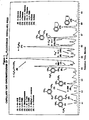
- Figure 2 indicates that the aromatic (and branched aliphatic) hydrocarbon components of the feed were eluted at first, due to their simple displacement by the desorbent from the voids of the silicalite column. This early fraction is the raffinate. Elution of the n-decane and 1-n-decene component rich extract occurred distinctly later. These components of the extract clearly coeluted, due their concurrent displacement from the channels of the silicalite by the desorbent. The 1-n-decene was slightly more difficult to displace than the n-decane. As it is shown by the Figure an in between-cut of the eluent was taken between the raffinate and the extract.
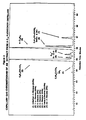
- Figure 3 shows that besides n-decane and 1-n-decene, signficant amounts of internal linear decenes (5-,4-and 2-decenes) were recovered in the extract. The latter compounds were in part already present in the feed. Additional amounts were formed via 1-n-decene isomerization during the adsorption desorption process.
- a mixture of C9 to C13 n-olefins and n-paraffins is separated from the corresponding broad Flexicoker distillate via a molecular adsorption of the type described in the previous examples.
- This mixture containing C9 to C13 1-n-olefins as the main reactive components, is then oligomerized using a boron trifluoride complex of an alcohol, i.e. neopentyl alcohol.
- the oligomerization is carried out in the liquid phase at temperatures and pressures sufficient to convert not only the terminal 1-n-olefin components but most of the internal n-olefins as well to polyolefin oligomers containing olefin trimers as the main components.
- the resulting polyolefin - n-paraffin mixture is then hydrogenated in the presence of a sulfur insensitive transition metal sulfide catalyst.
- This provides an isoparaffin plus n-paraffin mixture which is then separated by distillation.
- the n-paraffins and the isoparaffin dimers are distilled.
- the residual isoparaffin product comprising mainly trimers and tetramers is a desirable synthetic lubricant.
- the n-paraffin distillate is converted via known chlorination - dehydrochlorination reactions to linear olefin intermediates of biodegradable alkylbenzene sulfonate manufacture.
- the isoparaffin dimers are useful as solvents of low volatility.
- the polyolefin lubricant products are distinct over products of the prior art.
- the presence of comparable amounts of even and uneven carbon number olefin reactants in the feed also distinguishes the products over the prior art poly- ⁇ -olefin lubricants derived from ethylene via even numbered 1-n-olefins.
- silicaolite One liter of 18% hydrochloric acid was added to 20g silicaolite with stirring, at room ambient conditions, and the suspension was allowed to settle overnight. Next morning the supernatant liquid, which had become disclosed, was decanted and 1 liter of a fresh 18% HCl solution was again added to the silicalite with stirring and again allowed to settle overnight. This procedure was repeated a third time at which time the supernatant liquid remained colorless. The silicalite was separated from the liquid and washed in deionized water until the wash water gave a neutral reaction to litmus. The silicalite was then dried at 90°-95°C overnight and calcined at 100°C in air for 4 hours minimum. The silicalite was now ready for use.
- silicalite was washed with deionized water until the wash water gave a neutral reaction to litmus.
- the silicalite was then dried and calcined, as described in Example 13. The silicalite was now ready for use.
- This isomerization test is a very sensitive one because of the five linear hexene isomers 1-hexane is the least stable one thermodynamically.
- the 100°C environment is used to accelerate the isomerization reaction which may be slow under room ambient conditions.
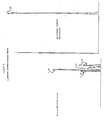
- FIG. 4 is a representation of the results of such a test.
- the left hand side of the figure shows that untreated silicalite isomerizes 1-hexene, as represented by the four peaks, one for each linear 2-hexene and 3-hexene isomers.
- the right hand side of the figure shows a single peak, that of 1-hexene, indicating that the acid-base treatment of the silicalite was effective in suppressing 1-hexene isomerization.
Landscapes
- Chemical & Material Sciences (AREA)
- Crystallography & Structural Chemistry (AREA)
- Engineering & Computer Science (AREA)
- Organic Chemistry (AREA)
- Chemical Kinetics & Catalysis (AREA)
- Oil, Petroleum & Natural Gas (AREA)
- Materials Engineering (AREA)
- General Chemical & Material Sciences (AREA)
- Organic Low-Molecular-Weight Compounds And Preparation Thereof (AREA)
- Production Of Liquid Hydrocarbon Mixture For Refining Petroleum (AREA)
- Solid-Sorbent Or Filter-Aiding Compositions (AREA)
Applications Claiming Priority (2)
| Application Number | Priority Date | Filing Date | Title |
|---|---|---|---|
| US28131188A | 1988-12-07 | 1988-12-07 | |
| US281311 | 1988-12-07 |
Publications (2)
| Publication Number | Publication Date |
|---|---|
| EP0372938A1 true EP0372938A1 (fr) | 1990-06-13 |
| EP0372938B1 EP0372938B1 (fr) | 1993-09-08 |
Family
ID=23076766
Family Applications (1)
| Application Number | Title | Priority Date | Filing Date |
|---|---|---|---|
| EP19890312734 Expired - Lifetime EP0372938B1 (fr) | 1988-12-07 | 1989-12-06 | Composition zéolitique utilisable en séparations d'oléfines |
Country Status (4)
| Country | Link |
|---|---|
| EP (1) | EP0372938B1 (fr) |
| JP (1) | JPH02194834A (fr) |
| CA (1) | CA2003740A1 (fr) |
| DE (1) | DE68909016T2 (fr) |
Cited By (7)
| Publication number | Priority date | Publication date | Assignee | Title |
|---|---|---|---|---|
| US5220102A (en) * | 1991-12-23 | 1993-06-15 | Uop | Process for separating normal olefins from non-normal olefins |
| EP0570842A1 (fr) * | 1992-05-21 | 1993-11-24 | BASF Aktiengesellschaft | Procédé pour fixer de grands cristaux d'une zéolithe ou d'un tamis moléculaire analogue sur un support |
| US5276246A (en) * | 1991-12-23 | 1994-01-04 | Uop | Process for separating normal olefins from non-normal olefins |
| US9662640B2 (en) | 2013-12-27 | 2017-05-30 | Rive Technology, Inc. | Introducing mesoporosity into zeolite materials with a modified acid pre-treatment step |
| CN117358198A (zh) * | 2023-11-23 | 2024-01-09 | 西北化工研究院有限公司 | Ag-ZSM-5分子筛费托合成油烷烯分离吸附剂、制备方法及其应用 |
| CN118480366A (zh) * | 2023-02-13 | 2024-08-13 | 中国科学院化学研究所 | 一种pao基础油及其制备方法 |
| CN121537991A (zh) * | 2025-12-25 | 2026-02-17 | 内蒙古伊泰煤基新材料研究院有限公司 | 分离烯烃与烷烃的方法及分子筛吸附剂 |
Families Citing this family (2)
| Publication number | Priority date | Publication date | Assignee | Title |
|---|---|---|---|---|
| US5262144A (en) * | 1991-12-26 | 1993-11-16 | Uop | Siliceous molecular sieves having low acid activity and process for preparing same |
| EP3083045A1 (fr) * | 2013-12-20 | 2016-10-26 | Basf Se | Catalyseur et procédé de conversion de composés oxygénés en oléfines |
Citations (3)
| Publication number | Priority date | Publication date | Assignee | Title |
|---|---|---|---|---|
| BE665809A (fr) * | 1964-06-25 | 1965-12-23 | ||
| EP0031676A1 (fr) * | 1979-12-19 | 1981-07-08 | Mobil Oil Corporation | Sorption sélective à l'aide de zéolites |
| US4444900A (en) * | 1982-05-05 | 1984-04-24 | Mobil Oil Corporation | Activation of zeolites |
-
1989
- 1989-11-23 CA CA 2003740 patent/CA2003740A1/fr not_active Abandoned
- 1989-12-06 EP EP19890312734 patent/EP0372938B1/fr not_active Expired - Lifetime
- 1989-12-06 DE DE1989609016 patent/DE68909016T2/de not_active Expired - Fee Related
- 1989-12-07 JP JP31662789A patent/JPH02194834A/ja active Pending
Patent Citations (3)
| Publication number | Priority date | Publication date | Assignee | Title |
|---|---|---|---|---|
| BE665809A (fr) * | 1964-06-25 | 1965-12-23 | ||
| EP0031676A1 (fr) * | 1979-12-19 | 1981-07-08 | Mobil Oil Corporation | Sorption sélective à l'aide de zéolites |
| US4444900A (en) * | 1982-05-05 | 1984-04-24 | Mobil Oil Corporation | Activation of zeolites |
Cited By (7)
| Publication number | Priority date | Publication date | Assignee | Title |
|---|---|---|---|---|
| US5220102A (en) * | 1991-12-23 | 1993-06-15 | Uop | Process for separating normal olefins from non-normal olefins |
| US5276246A (en) * | 1991-12-23 | 1994-01-04 | Uop | Process for separating normal olefins from non-normal olefins |
| EP0570842A1 (fr) * | 1992-05-21 | 1993-11-24 | BASF Aktiengesellschaft | Procédé pour fixer de grands cristaux d'une zéolithe ou d'un tamis moléculaire analogue sur un support |
| US9662640B2 (en) | 2013-12-27 | 2017-05-30 | Rive Technology, Inc. | Introducing mesoporosity into zeolite materials with a modified acid pre-treatment step |
| CN118480366A (zh) * | 2023-02-13 | 2024-08-13 | 中国科学院化学研究所 | 一种pao基础油及其制备方法 |
| CN117358198A (zh) * | 2023-11-23 | 2024-01-09 | 西北化工研究院有限公司 | Ag-ZSM-5分子筛费托合成油烷烯分离吸附剂、制备方法及其应用 |
| CN121537991A (zh) * | 2025-12-25 | 2026-02-17 | 内蒙古伊泰煤基新材料研究院有限公司 | 分离烯烃与烷烃的方法及分子筛吸附剂 |
Also Published As
| Publication number | Publication date |
|---|---|
| CA2003740A1 (fr) | 1990-06-07 |
| DE68909016D1 (de) | 1993-10-14 |
| JPH02194834A (ja) | 1990-08-01 |
| DE68909016T2 (de) | 1994-01-20 |
| EP0372938B1 (fr) | 1993-09-08 |
Similar Documents
| Publication | Publication Date | Title |
|---|---|---|
| US5292990A (en) | Zeolite composition for use in olefinic separations | |
| Guisnet et al. | Skeletal Isomerization ofn-Butenes: I. Mechanism ofn-Butene Transformation on a Nondeactivated H-Ferrierite Catalyst | |
| den Hollander et al. | Gasoline conversion: reactivity towards cracking with equilibrated FCC and ZSM-5 catalysts | |
| US2906795A (en) | Recovery and utilization of normally gaseous olefins | |
| RU2294916C2 (ru) | Способ конверсии углеводородной загрузки | |
| US4417088A (en) | Oligomerization of liquid olefins | |
| US4542251A (en) | Oligomerization of liquid olefin over a nickel-containing silicaceous crystalline molecular sieve | |
| Jolly et al. | Reaction mechanisms and kinetics in the n-hexane cracking over zeolites | |
| JP2010138405A (ja) | プロピレンの製造 | |
| JPH0324454B2 (fr) | ||
| EP0372939B1 (fr) | Procédé de séparation de n-oléfines et n-paraffines à partir de mélanges d'hydrocarbures | |
| Klingmann et al. | Hydrogenative regeneration of a Pt/La-Y zeolite catalyst deactivated in the isobutane/n-butene alkylation | |
| US5198597A (en) | Bimetallic catalysts for dehydroisomerization of N-butane to isobutene | |
| EP0372938A1 (fr) | Composition zéolitique utilisable en séparations d'oléfines | |
| US5498811A (en) | Process for producing gasolines and jet fuel from n-butane | |
| US4608450A (en) | Two-stage multiforming of olefins to tetramers | |
| Tabernilla et al. | Performance of HZSM-5 agglomerated in a mesoporous matrix in the fuel production from ethylene at atmospheric pressure | |
| US4650917A (en) | Method for upgrading olefinic lubes | |
| EP3352897B1 (fr) | Procédé de régénération d'un adsorbant de composés contenant de l'azote présents dans une charge d'hydrocarbure | |
| US4423268A (en) | Low pressure oligomerization of gaseous olefins | |
| US5017279A (en) | Multistep process for the manufacture of novel polyolefin lubricants from sulfur containing thermally cracked petroleum residua | |
| EP0376637B1 (fr) | Procédé de préparation au lubrifiants polyoléfiniques à partir de résidus de craquage thermique contenant du soufre | |
| US4395578A (en) | Oligomerization of olefins over boron trifluoride in the presence of a transition metal cation-containing promoter | |
| US20070246400A1 (en) | Zeolite Catalysts | |
| US5714661A (en) | Process for the preparation of synthetic lubricant base stocks |
Legal Events
| Date | Code | Title | Description |
|---|---|---|---|
| PUAI | Public reference made under article 153(3) epc to a published international application that has entered the european phase |
Free format text: ORIGINAL CODE: 0009012 |
|
| AK | Designated contracting states |
Kind code of ref document: A1 Designated state(s): BE DE FR GB IT NL |
|
| 17P | Request for examination filed |
Effective date: 19901130 |
|
| 17Q | First examination report despatched |
Effective date: 19910830 |
|
| GRAA | (expected) grant |
Free format text: ORIGINAL CODE: 0009210 |
|
| AK | Designated contracting states |
Kind code of ref document: B1 Designated state(s): BE DE FR GB IT NL |
|
| REF | Corresponds to: |
Ref document number: 68909016 Country of ref document: DE Date of ref document: 19931014 |
|
| ET | Fr: translation filed | ||
| ITF | It: translation for a ep patent filed | ||
| PLBE | No opposition filed within time limit |
Free format text: ORIGINAL CODE: 0009261 |
|
| STAA | Information on the status of an ep patent application or granted ep patent |
Free format text: STATUS: NO OPPOSITION FILED WITHIN TIME LIMIT |
|
| 26N | No opposition filed | ||
| PGFP | Annual fee paid to national office [announced via postgrant information from national office to epo] |
Ref country code: FR Payment date: 19940915 Year of fee payment: 6 |
|
| PGFP | Annual fee paid to national office [announced via postgrant information from national office to epo] |
Ref country code: DE Payment date: 19940919 Year of fee payment: 6 |
|
| PGFP | Annual fee paid to national office [announced via postgrant information from national office to epo] |
Ref country code: GB Payment date: 19940929 Year of fee payment: 6 |
|
| PGFP | Annual fee paid to national office [announced via postgrant information from national office to epo] |
Ref country code: BE Payment date: 19941020 Year of fee payment: 6 |
|
| PGFP | Annual fee paid to national office [announced via postgrant information from national office to epo] |
Ref country code: NL Payment date: 19941231 Year of fee payment: 6 |
|
| PG25 | Lapsed in a contracting state [announced via postgrant information from national office to epo] |
Ref country code: GB Effective date: 19951206 |
|
| PG25 | Lapsed in a contracting state [announced via postgrant information from national office to epo] |
Ref country code: BE Effective date: 19951231 |
|
| BERE | Be: lapsed |
Owner name: EXXON RESEARCH AND ENGINEERING CY Effective date: 19951231 |
|
| PG25 | Lapsed in a contracting state [announced via postgrant information from national office to epo] |
Ref country code: NL Effective date: 19960701 |
|
| GBPC | Gb: european patent ceased through non-payment of renewal fee |
Effective date: 19951206 |
|
| PG25 | Lapsed in a contracting state [announced via postgrant information from national office to epo] |
Ref country code: FR Effective date: 19960830 |
|
| NLV4 | Nl: lapsed or anulled due to non-payment of the annual fee |
Effective date: 19960701 |
|
| PG25 | Lapsed in a contracting state [announced via postgrant information from national office to epo] |
Ref country code: DE Effective date: 19960903 |
|
| REG | Reference to a national code |
Ref country code: FR Ref legal event code: ST |
|
| PG25 | Lapsed in a contracting state [announced via postgrant information from national office to epo] |
Ref country code: IT Free format text: LAPSE BECAUSE OF NON-PAYMENT OF DUE FEES;WARNING: LAPSES OF ITALIAN PATENTS WITH EFFECTIVE DATE BEFORE 2007 MAY HAVE OCCURRED AT ANY TIME BEFORE 2007. THE CORRECT EFFECTIVE DATE MAY BE DIFFERENT FROM THE ONE RECORDED. Effective date: 20051206 |