EP0373473A2 - Photopolymerizable elastomeric mixture and recording material, containing this mixture, for the production of ozone resistant flexographic printing plates - Google Patents
Photopolymerizable elastomeric mixture and recording material, containing this mixture, for the production of ozone resistant flexographic printing plates Download PDFInfo
- Publication number
- EP0373473A2 EP0373473A2 EP89122351A EP89122351A EP0373473A2 EP 0373473 A2 EP0373473 A2 EP 0373473A2 EP 89122351 A EP89122351 A EP 89122351A EP 89122351 A EP89122351 A EP 89122351A EP 0373473 A2 EP0373473 A2 EP 0373473A2
- Authority
- EP
- European Patent Office
- Prior art keywords
- mixture
- photopolymerizable
- alkylene
- oxa
- iso
- Prior art date
- Legal status (The legal status is an assumption and is not a legal conclusion. Google has not performed a legal analysis and makes no representation as to the accuracy of the status listed.)
- Granted
Links
Classifications
-
- G—PHYSICS
- G03—PHOTOGRAPHY; CINEMATOGRAPHY; ANALOGOUS TECHNIQUES USING WAVES OTHER THAN OPTICAL WAVES; ELECTROGRAPHY; HOLOGRAPHY
- G03F—PHOTOMECHANICAL PRODUCTION OF TEXTURED OR PATTERNED SURFACES, e.g. FOR PRINTING, FOR PROCESSING OF SEMICONDUCTOR DEVICES; MATERIALS THEREFOR; ORIGINALS THEREFOR; APPARATUS SPECIALLY ADAPTED THEREFOR
- G03F7/00—Photomechanical, e.g. photolithographic, production of textured or patterned surfaces, e.g. printing surfaces; Materials therefor, e.g. comprising photoresists; Apparatus specially adapted therefor
- G03F7/004—Photosensitive materials
- G03F7/027—Non-macromolecular photopolymerisable compounds having carbon-to-carbon double bonds, e.g. ethylenic compounds
- G03F7/032—Non-macromolecular photopolymerisable compounds having carbon-to-carbon double bonds, e.g. ethylenic compounds with binders
Definitions
- the invention relates to a photopolymerizable elastomeric mixture for producing ozone-resistant flexographic printing plates, essentially containing an elastomeric binder, a free-radically polymerizable olefinically unsaturated compound and a photoinitiator.
- flexographic printing plates containing these elastomers become brittle and have cracks even with the slightest presence of ozone.
- the ozone that is dangerous for these plates arises both when imagewise exposing the photopolymerizable elastomeric layer, in particular when using UV light, and when using the exposed and developed printing forms. This is where particularly high ozone concentrations occur, especially when flexible packaging materials such as paper or plastics are to be printed.
- these are corona-treated before printing. Since considerable amounts of ozone are generated during corona treatment and the treatment is most effective if it takes place immediately before the printing process, the printing form comes into considerable contact with the ozone resulting from this process.
- the susceptibility of the developed printing form to ozone is further increased by the fact that in most cases the printing forms are treated with halogen, in particular with bromine, which is necessary in order to reduce their stickiness.
- Additives are microcrystalline wax and paraffin wax, dibutylthiourea, 1,1,3,3-tetramethylthiourea, norbornene, N-phenyl-2-naphthylamine, unsaturated vegetable oils, ethylene / vinyl acetate copolymers, polyurethanes, chlorinated and / or chlorosulfonated polyethylenes, chlorinated ethylene / Methacrylic acid copolymers, polypentadienes, resins derived from furfural, ethylene / propylidene rubbers, diethylene glycol esters of resins and copolymers of alpha-methylstyrene with vinyltoluene are proposed.
- the disadvantage of this method is that the additives mentioned are often not sufficient to ensure the required resistance to ozone or, if the effective concentration of these additives is increased, the photopolymerizable mixture has cloudiness to such an extent that perfect imaging is no longer achieved can be.
- a major disadvantage of this method is the additional treatment step that is necessary.
- the treatment reagents described also leave something to be desired with regard to the achievable ozone resistance.
- a photopolymerizable elastomeric mixture of the type described at the outset which is characterized in that it contains at least one polyglycol ether according to the following general formula I. contains what R1 and R2 alkyl, in particular (C1-C3) alkyl, R3 is hydrogen or alkyl, in particular (C1-C3) alkyl, A, B, C and D may be the same or different and oxa-n- or -iso-alkylene, especially oxa-n- or -iso- (C1-C5) alkylene and l + m + n + o 3 to 40 mean.
- n and o > 0 and o ⁇ m, and R3 (C1-C3) alkyl.
- o and m are equal to l.
- D is preferably equal to A or C
- B in this case means an oxa-n-alkylene, in particular an oxa-n- (C3 or C5) alkylene radical.
- o 0 and the sum of l, m and n is 3-40.
- A is C but not B.
- a or C is an oxa-n- (C2-C4) alkylene and B is an oxa-n- or -iso- (C2 or C3) alkylene radical.
- an oxa-iso-alkylene radical is preferred for B.
- a and C in this case stand for oxa-n- or -iso- (C1-C5) alkylene, in particular for oxa-n- or -iso- (C2 or C3) alkylene, where A or C are at least different in the way that they do not together mean an oxa-n or an oxa-iso-alkylene radical.
- C or A is an oxa-n- or -iso- (C2-C5) alkylene, in particular an oxa-n- or -iso- (C2 or C3) alkylene.
- R1 and R2 in all cases mean (C1-C3) alkyl.
- R1 and R2 are the same and particularly preferably methyl.
- the average molecular weight of the polyglycol ether according to general formula I is 100 to 1,400, in particular 200 to 1,200, particularly preferably 200 to 600.
- the photopolymerizable elastomeric mixture according to the invention contains 0.1 to 40% by weight, preferably 0.5 to 20% by weight, at least one additive according to general formula I, in each case based on the elastomeric binder contained in the mixture.
- the addition of only one compound of the general formula I is particularly preferred.
- Polymers made from conjugated aliphatic dienes with 4 to 5 carbon atoms are suitable as elastomeric binders. Particular mention should be made of: natural rubbers, homo- or copolymers of butadiene and isoprene, copolymers of butadiene and / or isoprene with other monomers such as styrene, vinyl toluene, acrylonitrile or (meth) acrylic acid esters, e.g.
- Nitrile rubbers random styrene / butadiene, styrene / isoprene and styrene / isoprene / butadiene copolymers or block copolymers of styrene monomers and butadiene and / or isoprene with a styrene content of 10 to 50% by weight.
- Elastomeric binders of this type are described in DE-A-22 15 040.
- the photopolymerizable mixture according to the invention generally contains 20 to 98% by weight, preferably 30 to 95% by weight, of at least one of the elastomeric binder types mentioned. It also contains at least one free-radically polymerizable, olefinically unsaturated compound and at least one photoinitiator.
- Suitable monomers with one or more polymerizable olefinic double bonds are in particular esters and amides of acrylic and methacrylic acid.
- Examples are the compatible mono- and diacrylates and methacrylates of mono- or polyhydric alcohols such as ethylene glycol, di-, tri-, tetra- or polyethylene glycols, the latter preferably with 10 to 15 ethylene glycol units, 1,3-propanediol, 1,6-hexanediol , Dodecanediol, glycerin, 1,1,1-trimethylolpropane, 1,2,4-butanetriol or pentaerythritol, e.g. B.
- Alkenylphosphonic and phosphinic esters according to P 38 17 424.3 can also be used.
- the amount of monomers is generally about 1 to 70% by weight, preferably about 2 to 50% by weight, based on the non-volatile constituents of the mixture.
- Suitable photoinitiators for the mixture according to the invention are the known compounds which have sufficient thermal stability when processing the recording materials and also sufficient radical formation when exposed to initiate the polymerization of the monomers. They are supposed to be light Absorb in the wavelength range from approx. 250 to approx. 500 nm with the formation of radicals.
- suitable photoinitiators are acyloins and their derivatives such as benzoin, benzoin alkyl ethers, e.g. B. benzoin isopropyl ether, vicinal diketones and their derivatives, e.g. B.
- benzil, benzil acetals such as benzil dimethyl ketal, fluorenones, thioxanthones, multinuclear quinones, acridines and quinoxalines; also trichloromethyl-s-triazines, 2-halomethyl-4-vinyl-1,3,4-oxadiazole derivatives, halogen oxazoles substituted with trichloromethyl groups, carbonylmethylene heterocycles containing trihalomethyl groups according to DE-A 33 33 450, acylphosphine oxide compounds as described, for. B. are described in DE-A 31 33 419, and other phosphorus-containing photoinitiators, for. B.
- the photoinitiators can also be used in combination with one another or with coinitiators or activators, e.g. B. with Michler's ketone and its derivatives or 2-alkyl-anthraquinones.
- the amount of photoinitiator is generally about 0.01 to 10% by weight, preferably about 0.5 to 5% by weight, based on the photopolymerizable mixture.
- auxiliaries and additives such as hydroquinone and its derivatives, 2,6-di-tert-butyl-p- cresol, nitrophenols, nitrosamines such as N-nitrosodiphenylamine or salts of N-nitrosocyclohexylhydroxylamine, for example its alkali or aluminum salts.
- Other common additives are dyes, pigments, plasticizers, antihalation agents, antioxidants, crosslinking agents, regulators, fillers, fluxes and other auxiliaries which improve the function of the layer.
- the mixture according to the invention can be used for the production of relief and flexographic printing plates by casting from a solution with an organic solvent and by kneading at higher temperatures and subsequent pressing. Production can also be carried out by extrusion in a single- or twin-screw extruder and subsequent shaping by means of a smoothing unit or a calender to form layers with a thickness of 0.1 to 10, preferably 0.4 to 6 mm. Production using the rollerhead process is also possible.
- the layer produced in the manner described can be laminated to the surface of a suitable carrier or a solution of the mixture according to the invention can be applied to a layer carrier.
- the mixture according to the invention can e.g. also used for the production of planographic printing plates, gravure cylinders, screen printing stencils and photoresists.
- Suitable carriers are, depending on the purpose z. B. polyester films, steel or aluminum sheets, copper cylinders, screen printing stencil carriers, foam layers, rubber-elastic carriers or printed circuit boards. It may also be advantageous to have a cover or protective layer, e.g. B. a thin layer of polyvinyl alcohol, or a peelable cover sheet, e.g. B. from polyethylene terephthalate or polyamide. Pre-coating of the carrier can also be advantageous.
- the additional layer between the support and the photosensitive layer may e.g. B. be effective as an antihalation layer or as an adhesive layer.
- the recording material according to the invention can be exposed imagewise with actinic light from light sources such as mercury vapor lamps or fluorescent tubes, the emitted wavelength preferably being between 300 and 420 nm.
- the unexposed and uncrosslinked layer portions can be removed by spraying, washing or brushing with chlorinated hydrocarbons, esters, aromatic compounds or phenol ethers, as described in DE-A-22 15 090 and the as yet unpublished German patent applications P 38 36 402.6, P 38 36 403.4 and P 38 36 404.2 are described.
- Small amounts of defoamers or water-miscible organic solvents, for example lower aliphatic alcohols, can also be added to the solution.
- it can also be developed with water or aqueous solutions.
- the relief forms developed are expediently dried at temperatures of up to 120 ° C. and, if appropriate, post-exposed simultaneously or thereafter with actinic light.
- the flexographic printing plate After the flexographic printing plate has dried, it can be coated with a halogen-containing solution such as be treated with a bromine or chlorine solution. Post-treatment with actinic light, in particular with a wavelength of ⁇ 300 nm, is also possible. Before the imagewise exposure, the entire side can also be briefly exposed to actinic light from the opposite side.
- the recording material according to the invention is particularly suitable for the production of printing forms, especially high-pressure or relief printing forms, which are particularly suitable for flexographic printing.
- a photopolymerizable elastomeric mixture consisting of 90 pbw of a styrene / isoprene / styrene three-block copolymer containing 15% by weight of styrene, 8 pbw of hexanediol diacrylate, 2 pbw of benzil dimethyl ketal and 0.3 pbw of 2,6-di-tert-butyl-4-methylphenol in 100 pbw of toluene.
- the mixture was poured onto a 125 ⁇ m thick, biaxially stretched and heat-set polyester film in a metal frame to form a 6 mm thick layer.
- a 125 ⁇ m thick, biaxially hidden and heat-set polyester film with an adhesive layer was placed on the free surface of the now 3 mm thick solid photopolymer layer and the resulting three-layer element in a plate press at 110 ° C using 2.7 mm thick spacers pressed at a pressure of 400 N / cm2 for 5 min.
- an overcoat made of polyamide with a thickness of 3-4 ⁇ m was laminated in its place.
- the remaining polyester film exposed the photopolymer layer over the entire surface.
- the more Layer element exposed to the radiation of a commercially available UV-A imagesetter (spectral range 320-400 nm, intensity of the radiation on the photopolymer surface: 14 mW / cm2) for 10 s.
- the image-wise exposure was then carried out with the same radiation source for 30 min, but from the opposite side of the multilayer element.
- the flexographic printing plate was then exposed for a further 10 minutes in a commercially available imagesetter.
- the flexographic printing plate was then clamped onto a cylinder with a diameter of 7 cm and exposed to air containing ozone (0.5 ppm ozone) in a chamber.
- the plate was assessed on the one hand by the time at which the first cracks appeared (cracks visible to the naked eye) and by how many cracks had occurred after 20 hours of ozone treatment. The results are summarized in Table 1.
- a photopolymerizable elastomeric mixture was produced in accordance with Example 1, but with the addition of 5 pbw of dipropylene glycol monomethyl ether.
- the elastomeric mixture was, as indicated in Example 1, processed into a flexographic printing plate and also exposed to the test in the ozone chamber. The result is comparable to that from Example 1. The addition appears to have no effect in the plate. The result is shown in Table 1.
- a photopolymerizable elastomeric mixture was produced in accordance with Example 1, but with the addition of 10 pbw of tetraethylene glycol dimethyl ether.
- the elastomeric mixture was, as indicated in Example 1, processed into a flexographic printing plate and also subjected to the test in the ozone chamber. The results are shown in Table 1.
- a photopolymerizable elastomeric mixture was produced in accordance with Example 1, but with the addition of 5 pbw of polyethylene glycol dimethyl ether with an average molecular weight of 250. As stated in Example 1, the elastomeric mixture was processed into a flexographic printing plate and also subjected to the test in the ozone chamber . The results are summarized in Table 1.
- a photopolymerizable elastomeric mixture consisting of 90 pbw of a styrene / isoprene / styrene three-block copolymer containing 15% by weight of styrene, 8 pbw of hexanediol diacrylate, 2 pbw of benzil dimethyl ketal, 0.3 pbw of 2,6-di-tert-butyl-4-methylphenol and 5 pbw of polyethylene glycol dimethyl ether (average molecular weight 250).
- the mixture was kneaded in a kneader at 150 ° C for 15 minutes.
- the mixture was then applied to a 125 ⁇ m thick, biaxially stretched and heat-set polyester film provided with an adhesive layer, and the resulting layer was covered with the same polyester film, but without an adhesive layer.
- the multilayer element produced was pressed in a plate press at 110 ° C. using 2.7 mm thick spacers for 2 min. After the polyester film which had not been coated with an adhesive was peeled off, processing was continued in accordance with Example 1. The result of this experiment is also shown in Table 1.
- Table 1 shows that the photopolymerizable elastomeric mixture according to the invention with the polyglycol ether of the general formula I can be used to produce flexographic printing plates which, surprisingly, are significantly more resistant to air containing ozone than flexographic printing plates which were previously known to the person skilled in the art.
Landscapes
- Physics & Mathematics (AREA)
- Spectroscopy & Molecular Physics (AREA)
- General Physics & Mathematics (AREA)
- Photosensitive Polymer And Photoresist Processing (AREA)
- Compositions Of Macromolecular Compounds (AREA)
Abstract
Es wird ein photopolymerisierbares elastomeres Gemisch zur Herstellung von ozonresistenten Flexodruckformen beschrieben, im wesentlichen enthaltend ein elastomeres Bindemittel, eine radikalisch polymerisierbare olefinisch ungesättigte Verbindung, einen Photoinitiator und einen Polyglykolether gemäß der allgemeinen Formel I
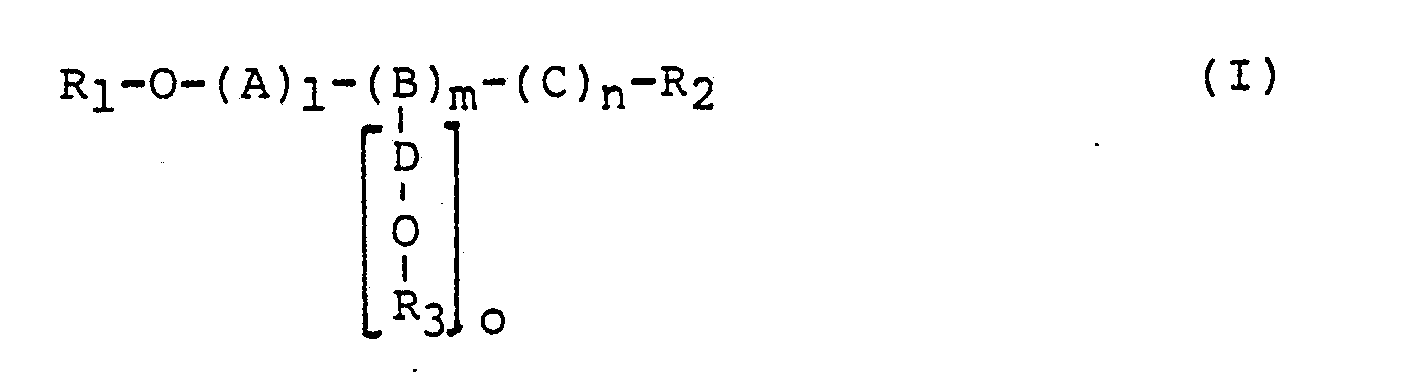
R₁ und R₂ Alkyl, insbesondere (C₁-C₃)Alkyl,
R₃ Wasserstoff oder Alkyl, insbesondere (C₁-C₃)Alkyl,
A, B, C und D gleich oder verschieden sein können und Oxa-n- oder -iso-alkylen, insbesondere Oxa-n-oder -iso-(C₁-C₅)alkylen und
l+m+n+o 3 bis 40
bedeuten. A photopolymerizable elastomeric mixture for producing ozone-resistant flexographic printing plates is described, essentially containing an elastomeric binder, a free-radically polymerizable olefinically unsaturated compound, a photoinitiator and a polyglycol ether according to the general formula I
R₁ and R₂ alkyl, in particular (C₁-C₃) alkyl,
R₃ is hydrogen or alkyl, in particular (C₁-C₃) alkyl,
A, B, C and D may be the same or different and oxa-n- or -iso-alkylene, especially oxa-n-or -iso- (C₁-C₅) alkylene and
l + m + n + o 3 to 40
mean.
Ebenso wird ein Aufzeichnungsmaterial, enthaltend das beschriebene photopolymerisierbare Gemisch beschrieben, sowie ein Verfahren zur Herstellung einer Flexodruckform.Likewise, a recording material containing the described photopolymerizable mixture and a method for producing a flexographic printing plate are described.
Die erhaltene Flexodruckform zeigt eine verbesserte Ozonresistenz im Vergleich zu Formen des Standes der Technik. The flexographic printing plate obtained shows an improved ozone resistance compared to the forms of the prior art.
Description
Die Erfindung betrifft ein photopolymerisierbares elastomeres Gemisch zur Herstellung von ozonresistenten Flexodruckformen, im wesentlichen enthaltend ein elastomeres Bindemittel, eine radikalisch polymerisierbare olefinisch ungesättigte Verbindung und einen Photoinitiator.The invention relates to a photopolymerizable elastomeric mixture for producing ozone-resistant flexographic printing plates, essentially containing an elastomeric binder, a free-radically polymerizable olefinically unsaturated compound and a photoinitiator.
Elastomere, insbesondere auf der Basis von Butadien oder Isopren für die Herstellung von Flexodruckformen sind seit langem bekannt und werden z.B. in den DE-B 22 15 090 (= US-A 4 423 135), DE-A 21 38 582 (= GB-A 1 358 062), 22 23 808 (= GB-A 1 395 822), DE-B 28 15 678 (= GB-A 1 577 706), DE-A 24 56 439 (= US-A 4 162 919) und 29 42 183 (= US-A 4 320 188) beschrieben. Es konnte allerdings festgestellt werden, daß Flexodruckformen, die diese Elastomere enthalten, schon bei geringster Anwesenheit von Ozon spröde werden und Risse aufweisen.Elastomers, in particular based on butadiene or isoprene, for the production of flexographic printing plates have long been known and are e.g. in DE-B 22 15 090 (= US-A 4 423 135), DE-A 21 38 582 (= GB-A 1 358 062), 22 23 808 (= GB-A 1 395 822), DE-B 28 15 678 (= GB-A 1 577 706), DE-A 24 56 439 (= US-A 4 162 919) and 29 42 183 (= US-A 4 320 188). However, it was found that flexographic printing plates containing these elastomers become brittle and have cracks even with the slightest presence of ozone.
Das Ozon, das diesen Platten gefährlich wird, entsteht sowohl bei der bildmäßigen Belichtung der photopolymerisierbaren elastomeren Schicht, insbesondere bei Verwendung von UV-Licht, aber auch bei der Anwendung der belichteten und entwickelten Druckformen. Gerade hierbei treten besonders hohe Ozonkonzentrationen auf, insbesondere dann, wenn flexible Verpackungsmaterialien wie Papier oder Kunststoffe bedruckt werden sollen. Der Grund ist darin zu suchen, daß infolge der Gewährleistung einer genügenden hohen Haftung der Druckfarbe, z.B. auf den Kunststoffolien, diese vor dem Bedrucken coronabehandelt werden. Da bei der Coronabehandlung erhebliche Mengen an Ozon entstehen und die Behandlung dann am wirkungsvollsten ist, wenn diese unmittelbar vor dem Druckvorgang stattfindet, gerät die Druckform in erheblichem Maße mit dem aus diesem Prozess entstehenden Ozon in Kontakt. Erhöht wird die Anfälligkeit der entwickelten Druckform gegenüber Ozon noch dadurch, daß in den meisten Fällen eine Nachbehandlung der Druckformen mit Halogen, insbesondere mit Brom, erfolgt, die notwendig ist, um deren Klebrigkeit zu reduzieren.The ozone that is dangerous for these plates arises both when imagewise exposing the photopolymerizable elastomeric layer, in particular when using UV light, and when using the exposed and developed printing forms. This is where particularly high ozone concentrations occur, especially when flexible packaging materials such as paper or plastics are to be printed. The The reason for this is that, as a result of guaranteeing sufficient high adhesion of the printing ink, for example on the plastic films, these are corona-treated before printing. Since considerable amounts of ozone are generated during corona treatment and the treatment is most effective if it takes place immediately before the printing process, the printing form comes into considerable contact with the ozone resulting from this process. The susceptibility of the developed printing form to ozone is further increased by the fact that in most cases the printing forms are treated with halogen, in particular with bromine, which is necessary in order to reduce their stickiness.
Um die Resistenz der Druckform gegenüber dem rissebildenden und die Sprödigkeit fördernden Ozon zu verbessern, wurden verschiedene Wege eingeschlagen:Various approaches have been taken to improve the resistance of the printing form to crack-forming and brittleness-promoting ozone:
Aus der DE-A-22 15 090 ist bekannt, die Ozonresistenz durch Zusätze zu dem photopolymerisierbaren Gemisch zu verbessern. Als Zusätze werden mikrokristallines Wachs und Paraffinwachs, Dibutylthioharnstoff, 1,1,3,3-Tetramethylthioharnstoff, Norbornen, N-Phenyl-2-naphthylamin, ungesättigte Pflanzenöle, Ethylen/Vinylacetat-Copolymerisate, Polyurethane, chlorierte und/oder chlorsulfonierte Polyethylene, chlorierte Ethylen/Methacrylsäure-Copolymerisate, Polypentadiene, von Furfurol abgeleitete Harze, Ethylen/Propyliden-Kautschuke, Diethylenglykolester von Harzen und Copolymerisate von alpha-Methylstyrol mit Vinyltoluol vorgeschlagen.From DE-A-22 15 090 it is known to improve the ozone resistance by adding to the photopolymerizable mixture. Additives are microcrystalline wax and paraffin wax, dibutylthiourea, 1,1,3,3-tetramethylthiourea, norbornene, N-phenyl-2-naphthylamine, unsaturated vegetable oils, ethylene / vinyl acetate copolymers, polyurethanes, chlorinated and / or chlorosulfonated polyethylenes, chlorinated ethylene / Methacrylic acid copolymers, polypentadienes, resins derived from furfural, ethylene / propylidene rubbers, diethylene glycol esters of resins and copolymers of alpha-methylstyrene with vinyltoluene are proposed.
Der Nachteil dieser Methode ist, daß die genannten Zusätze oftmals nicht ausreichen, um die geforderte Resistenz gegenüber Ozon zu gewährleisten, oder, wenn die wirksame Konzentration dieser Zusätze erhöht wird, das photopolymerisierbare Gemisch Trübungen in solchem Ausmaß aufweist, daß eine einwandfreie Bebilderung nicht mehr erzielt werden kann.The disadvantage of this method is that the additives mentioned are often not sufficient to ensure the required resistance to ozone or, if the effective concentration of these additives is increased, the photopolymerizable mixture has cloudiness to such an extent that perfect imaging is no longer achieved can be.
Ein anderes Verfahren zum Schutz einer Flexodruckform gegenüber Ozon wird in der DE-A 35 12 632 (= US-A 4 680 251) beschrieben. Dieses Verfahren fußt nicht auf irgendwelchen Zusätzen zu dem photopolymerisierbaren Gemisch, sondern beschreibt eine Nachbehandlung der entwickelten und mit Halogen behandelten Druckform mit bestimmten Polyglykolverbindungen. Die beschriebenen Polyglykolverbindungen sind entweder nicht oder nur monoverethert.Another method for protecting a flexographic printing plate against ozone is described in DE-A 35 12 632 (= US-A 4 680 251). This process is not based on any additives to the photopolymerizable mixture, but rather describes an aftertreatment of the developed and halogen-treated printing form with certain polyglycol compounds. The polyglycol compounds described are either not etherified or only monoetherified.
Ein wesentlicher Nachteil dieses Verfahrens ist der notwendige zusätzliche Behandlungsschritt. Ebenso lassen die beschriebenen Behandlungsreagenzien noch Wünsche hinsichtlich der erzielbaren Ozonresistenz offen.A major disadvantage of this method is the additional treatment step that is necessary. The treatment reagents described also leave something to be desired with regard to the achievable ozone resistance.
Es bestand deshalb die Aufgabe, ein photopolymerisierbares Gemisch, insbesondere geeignet für die Herstellung von Flexodruckformen, so zu modifizieren, daß deren Ozonresistenz gewährleistet ist und zugleich kein zusätzlicher Behandlungsschritt notwendig ist, um das geforderte Ziel zu erreichen. Die erreichte Ozonresistenz soll sich nicht negativ auf die Abbildungsqualität auswirken.It was therefore the task of modifying a photopolymerizable mixture, particularly suitable for the production of flexographic printing plates, in such a way that its ozone resistance is ensured and at the same time no additional treatment step is necessary in order to achieve the required goal. The ozone resistance achieved should not have a negative impact on the imaging quality.
Gelöst wird die Aufgabe durch ein photopolymerisierbares elastomeres Gemisch der eingangs beschriebenen Gattung, das dadurch gekennzeichnet ist, daß es mindestens einen Polyglykolether nach der folgenden allgemeinen Formel I

R₁ und R₂ Alkyl, insbesondere (C₁-C₃)Alkyl,
R₃ Wasserstoff oder Alkyl, insbesondere (C₁-C₃)Alkyl,
A, B, C und D gleich oder verschieden sein können und Oxa-n- oder -iso-alkylen, insbesondere Oxa-n- oder -iso-(C₁-C₅)alkylen und
l+m+n+o 3 bis 40
bedeuten.The object is achieved by a photopolymerizable elastomeric mixture of the type described at the outset, which is characterized in that it contains at least one polyglycol ether according to the following general formula I.
R₁ and R₂ alkyl, in particular (C₁-C₃) alkyl,
R₃ is hydrogen or alkyl, in particular (C₁-C₃) alkyl,
A, B, C and D may be the same or different and oxa-n- or -iso-alkylene, especially oxa-n- or -iso- (C₁-C₅) alkylene and
l + m + n + o 3 to 40
mean.
Bevorzugt ist, wenn m und o > 0 und o ≦ m gilt, sowie R₃ (C₁-C₃)Alkyl bedeutet. Insbesondere ist o und m gleich l.It is preferred if m and o> 0 and o ≦ m, and R₃ (C₁-C₃) alkyl. In particular, o and m are equal to l.
Ist o≠0, so ist D vorzugsweise gleich A oder C, und B bedeutet in diesem Fall einen Oxa-n-alkylen-, insbesondere einen Oxa-n-(C₃ oder C₅)alkylen-Rest.If o ≠ 0, D is preferably equal to A or C, and B in this case means an oxa-n-alkylene, in particular an oxa-n- (C₃ or C₅) alkylene radical.
Besonders bevorzugt ist aber, wenn o=0 ist, und die Summe aus l, m und n 3-40 ergibt.However, it is particularly preferred if o = 0 and the sum of l, m and n is 3-40.
Eine weitere bevorzugte Ausführungsform liegt vor, wenn A gleich C, aber ungleich B bedeutet. In diesem Fall wird bevorzugt, daß A bzw. C ein Oxa-n-(C₂-C₄)alkylen- und B ein Oxa-n- oder -iso-(C₂ oder C₃)alkylen-Rest bedeutet. Insbesondere wird hierbei für B ein Oxa-iso-alkylen-Rest bevorzugt.Another preferred embodiment is when A is C but not B. In this case it is preferred that A or C is an oxa-n- (C₂-C₄) alkylene and B is an oxa-n- or -iso- (C₂ or C₃) alkylene radical. In particular, an oxa-iso-alkylene radical is preferred for B.
Weiterhin bevorzugt ist, wenn m=0 bedeutet (d.h. auch o=0), und die Summe aus l und n 3-40 erreicht. A und C stehen in diesem Fall für Oxa-n- oder -iso-(C₁-C₅)alkylen, insbesondere für Oxa-n- oder -iso-(C₂ oder C₃)alkylen, wobei A oder C mindestens in der Weise unterschiedlich sind, daß sie nicht gemeinsam einen Oxa-n- oder einen Oxa-iso-alkylen-Rest bedeuten.It is further preferred if m = 0 (i.e. also o = 0) and the sum of l and n reaches 3-40. A and C in this case stand for oxa-n- or -iso- (C₁-C₅) alkylene, in particular for oxa-n- or -iso- (C₂ or C₃) alkylene, where A or C are at least different in the way that they do not together mean an oxa-n or an oxa-iso-alkylene radical.
Bevorzugt ist aber eher diejenige Variante, in der l und m bzw. m und n jeweils gleich 0 bedeuten (o ist in diesem Fall ebenso 0). In diesem Fall ist C bzw. A ein Oxa-n- oder -iso-(C₂-C₅)alkylen, insbesondere ein Oxa-n- oder -iso-(C₂ oder C₃)alkylen.However, the variant in which l and m or m and n each mean 0 is preferred (o in this case also being 0). In this case, C or A is an oxa-n- or -iso- (C₂-C₅) alkylene, in particular an oxa-n- or -iso- (C₂ or C₃) alkylene.
R₁ und R₂ bedeuten in allen Fällen (C₁-C₃)Alkyl. Insbesondere sind R₁ und R₂ gleich und besonders bevorzugt Methyl.R₁ and R₂ in all cases mean (C₁-C₃) alkyl. In particular, R₁ and R₂ are the same and particularly preferably methyl.
Das mittlere Molekulargewicht des Polyglykolethers gemäß der allgemeinen Formel I beträgt 100 bis 1.400, insbesondere 200 bis 1.200, besonders bevorzugt 200 bis 600.The average molecular weight of the polyglycol ether according to general formula I is 100 to 1,400, in particular 200 to 1,200, particularly preferably 200 to 600.
Das erfindungsgemäße photopolymerisierbare elastomere Gemisch enthält 0,1 bis 40 Gew.-%, vorzugsweise 0,5 bis 20 Gew.-%, mindestens einen Zusatz gemäß der allgemeinen Formel I, jeweils bezogen auf das in dem Gemisch enthaltende elastomere Bindemittel. Besonders bevorzugt wird der Zusatz lediglich einer Verbindung gemäß der allgemeinen Formel I.The photopolymerizable elastomeric mixture according to the invention contains 0.1 to 40% by weight, preferably 0.5 to 20% by weight, at least one additive according to general formula I, in each case based on the elastomeric binder contained in the mixture. The addition of only one compound of the general formula I is particularly preferred.
Als elastomere Bindemittel sind Polymerisate aus konjugierten aliphatischen Dienen mit 4 bis 5 C-Atomen geeignet. Insbesondere sind zu nennen: Naturkautschuke, Homo- oder Copolymerisate von Butadien und Isopren, Copolymerisate von Butadien und/oder Isopren mit anderen Monomeren wie Styrol, Vinyltoluol, Acrylnitril oder (Meth)Acrylsäureester, z.B. Nitrilkautschuke, statistische Styrol/Butadien-, Styrol/Isopren-, und Styrol/Isopren/Butadien-Copolymerisate oder auch Blockcopolymerisate aus Styrolmonomeren und Butadien und/oder Isopren mit einem Styrolgehalt von 10 bis 50 Gew.-%. Elastomere Bindemittel dieser Art sind in der DE-A-22 15 040 beschrieben.Polymers made from conjugated aliphatic dienes with 4 to 5 carbon atoms are suitable as elastomeric binders. Particular mention should be made of: natural rubbers, homo- or copolymers of butadiene and isoprene, copolymers of butadiene and / or isoprene with other monomers such as styrene, vinyl toluene, acrylonitrile or (meth) acrylic acid esters, e.g. Nitrile rubbers, random styrene / butadiene, styrene / isoprene and styrene / isoprene / butadiene copolymers or block copolymers of styrene monomers and butadiene and / or isoprene with a styrene content of 10 to 50% by weight. Elastomeric binders of this type are described in DE-A-22 15 040.
Das erfindungsgemäße photopolymerisierbare Gemisch enthält im allgemeinen 20 bis 98 Gew.-%, vorzugsweise 30 bis 95 Gew.-%, wenigstens einer der genannten elastomeren Bindemitteltypen. Es enthält weiterhin mindestens eine radikalisch polymerisierbare, olefinisch ungesättigte Verbindung sowie mindestens einen Photoinitiator.The photopolymerizable mixture according to the invention generally contains 20 to 98% by weight, preferably 30 to 95% by weight, of at least one of the elastomeric binder types mentioned. It also contains at least one free-radically polymerizable, olefinically unsaturated compound and at least one photoinitiator.
Geeignete Monomere mit einer oder mehreren polymerisierbaren olefinischen Doppelbindungen sind insbesondere Ester und Amide der Acryl- und Methacrylsäure. Beispiele sind die verträglichen Mono- und Diacrylate und -methacrylate von ein- oder mehrwertigen Alkoholen wie Ethylenglykol, Di-, Tri-, Tetra- oder Polyethylenglykolen, letztere bevorzugt mit 10 bis 15 Ethylenglykoleinheiten, 1,3-Propandiol, 1,6-Hexandiol, Dodecandiol, Glycerin, 1,1,1-Trimethylolpropan, 1,2,4-Butantriol oder Pentaerythrit, z. B. Ethylenglykolmonomethacrylat, 1,3-Propandiolmonomethacrylat, Glycerinmono- und -diacrylat, 1,2,4-Butantriolmonomethacrylat, Hexandioldiacrylat, Hexandioldimethacrylat, Dodecandioldiacrylat, 2-Ethylhexylacrylat, Laurylmethacrylat, Stearylmethacrylat, Pentaerythrittriacrylat, Polyethylenglykolmethyletheracrylat, Tetradecaethylenglykol-dimethacrylat oder der Triether aus Glycerin und 3 mol N-Methylolacrylamid oder -methacrylamid. Ebenso sind Alkenylphosphon- und -phosphinsäureester nach der P 38 17 424.3 anwendbar. Die Menge an Monomeren liegt im allgemeinen bei etwa 1 bis 70 Gew.-%, bevorzugt bei etwa 2 bis 50 Gew.-%, bezogen auf die nichtflüchtigen Betandteile des Gemischs.Suitable monomers with one or more polymerizable olefinic double bonds are in particular esters and amides of acrylic and methacrylic acid. Examples are the compatible mono- and diacrylates and methacrylates of mono- or polyhydric alcohols such as ethylene glycol, di-, tri-, tetra- or polyethylene glycols, the latter preferably with 10 to 15 ethylene glycol units, 1,3-propanediol, 1,6-hexanediol , Dodecanediol, glycerin, 1,1,1-trimethylolpropane, 1,2,4-butanetriol or pentaerythritol, e.g. B. ethylene glycol monomethacrylate, 1,3-propanediol monomethacrylate, glycerol mono- and diacrylate, 1,2,4-butanetriol monomethacrylate, hexanediol diacrylate, hexanediol dimethacrylate, dodecanediol diacrylate, 2-ethylhexylacrylate, lauryl methacrylate, stearia methacrylate, stearyl methacrylate, stearyl methacrylate, stearyl methacrylate, stearyl methacrylate, stearyl methacrylate, stearyl methacrylate, stearyl methacrylate, stearyl methacrylate, stearyl methacrylate, stearyl methacrylate, stearyl methacrylate, stearyl methacrylate, stearyl methacrylate, stearyl methacrylate, stearyl methacrylate, stearyl methacrylate, stearyl methacrylate, stearyl methacrylate, stearyl methacrylate, stearyl methacrylate, stearyl methacrylate, stearyl methacrylate, stearyl methacrylate, styrene methacrylate, and 3 moles of N-methylolacrylamide or methacrylamide. Alkenylphosphonic and phosphinic esters according to P 38 17 424.3 can also be used. The amount of monomers is generally about 1 to 70% by weight, preferably about 2 to 50% by weight, based on the non-volatile constituents of the mixture.
Als Photoinitiatoren für das erfindungsgemäße Gemisch kommen die bekannten Verbindungen in Frage, die eine hinreichende thermische Stabilität bei der Verarbeitung der Aufzeichnungsmaterialien sowie eine hinreichende Radikalbildung bei Belichtung unter Initiierung der Polymerisation der Monomeren aufweisen. Sie sollen Licht im Wellenlängenbereich von ca. 250 bis ca. 500 nm unter Bildung von Radikalen absorbieren. Beispiele geeigneter Photoinitiatoren sind Acyloine und deren Derivate wie Benzoin, Benzoinalkylether, z. B. Benzoinisopropylether, vicinale Diketone und deren Derivate, z. B. Benzil, Benzilacetale wie Benzildimethylketal, Fluorenone, Thioxanthone, Mehrkernchinone, Acridine und Chinoxaline; ferner Trichlormethyl-s-triazine, 2-Halogenmethyl-4-vinyl-1,3,4-oxadiazolderivate, mit Trichlormethylgruppen substituierte Halogenoxazole, Trihalogenmethylgruppen enthaltende Carbonylmethylenheterocyclen gemäß DE-A 33 33 450, Acylphosphinoxidverbindungen, wie sie z. B. in der DE-A 31 33 419 beschrieben sind, und andere phosphorhaltige Photoinitiatoren, z. B. die in der deutschen Patentanmeldung P 38 27 735.2 beschriebenen 6-Acyl-(6H)-dibenz[c,e] [1,2]oxaphosphorin-6-oxide, insbesondere das 6-(2,4,6-Trimethylbenzoyl)-(6H)-dibenz-[c,e] [1,2] oxaphosphorin-6-oxid. Die Photoinitiatoren lassen sich auch in Kombination miteinander oder mit Coinitiatoren bzw. Aktivatoren verwenden, z. B. mit Michlers Keton und seinen Derivaten oder 2-Alkyl-anthrachinonen. Die Menge an Photoinitiator beträgt im allgemeinen etwa 0,01 bis 10 Gew-%, bevorzugt etwa 0,5 bis 5 Gew.-%, bezogen auf das photopolymerisierbare Gemisch.Suitable photoinitiators for the mixture according to the invention are the known compounds which have sufficient thermal stability when processing the recording materials and also sufficient radical formation when exposed to initiate the polymerization of the monomers. They are supposed to be light Absorb in the wavelength range from approx. 250 to approx. 500 nm with the formation of radicals. Examples of suitable photoinitiators are acyloins and their derivatives such as benzoin, benzoin alkyl ethers, e.g. B. benzoin isopropyl ether, vicinal diketones and their derivatives, e.g. B. benzil, benzil acetals such as benzil dimethyl ketal, fluorenones, thioxanthones, multinuclear quinones, acridines and quinoxalines; also trichloromethyl-s-triazines, 2-halomethyl-4-vinyl-1,3,4-oxadiazole derivatives, halogen oxazoles substituted with trichloromethyl groups, carbonylmethylene heterocycles containing trihalomethyl groups according to DE-A 33 33 450, acylphosphine oxide compounds as described, for. B. are described in DE-A 31 33 419, and other phosphorus-containing photoinitiators, for. B. the 6-acyl- (6H) -dibenz [c, e] [1,2] oxaphosphorin-6-oxides described in German patent application P 38 27 735.2, in particular the 6- (2,4,6-trimethylbenzoyl) - (6H) -dibenz- [c, e] [1,2] oxaphosphorin-6-oxide. The photoinitiators can also be used in combination with one another or with coinitiators or activators, e.g. B. with Michler's ketone and its derivatives or 2-alkyl-anthraquinones. The amount of photoinitiator is generally about 0.01 to 10% by weight, preferably about 0.5 to 5% by weight, based on the photopolymerizable mixture.
0ft ist es von Vorteil, dem photopolymerisierbaren Gemisch noch weitere Hilfs- und Zusatzstoffe zuzugeben, z. B. Inhibitoren der thermischen Polymerisation wie Hydrochinon und seine Derivate, 2,6-Di-tert.-butyl-p- kresol, Nitrophenole, Nitrosamine wie N-Nitrosodiphenylamin oder Salze des N-Nitrosocyclohexylhydroxylamins, z.B. dessen Alkali- oder Aluminiumsalze. Weitere übliche Zusätze sind Farbstoffe, Pigmente, Weichmacher, Lichthofschutzmittel, Antioxidantien, Vernetzungsmittel, Regler, Füllmittel, Flußmittel und weitere die Schicht in ihrer Funktion verbessernde Hilfsmittel.It is often advantageous to add further auxiliaries and additives to the photopolymerizable mixture, e.g. B. Thermal polymerization inhibitors such as hydroquinone and its derivatives, 2,6-di-tert-butyl-p- cresol, nitrophenols, nitrosamines such as N-nitrosodiphenylamine or salts of N-nitrosocyclohexylhydroxylamine, for example its alkali or aluminum salts. Other common additives are dyes, pigments, plasticizers, antihalation agents, antioxidants, crosslinking agents, regulators, fillers, fluxes and other auxiliaries which improve the function of the layer.
Das erfindungsgemäße Gemisch läßt sich für die Herstellung von Relief- und Flexodruckplatten durch Gießen aus einer Lösung mit einem organischen Lösemittel und durch Verkneten bei höheren Temperaturen und anschließendem Verpressen verwenden. Die Herstellung kann auch durch Extrudieren in einem Ein- oder Zweischneckenextruder und anschließendem Ausformen durch ein Glättwerk oder einen Kalander zu Schichten einer Dicke von 0,1 bis 10, vorzugsweise von 0,4 bis 6 mm, erfolgen. Ebenso ist die Herstellung nach dem Rollerheadverfahren möglich. Die in der beschriebenen Weise hergestellte Schicht kann auf die Oberfläche eines geeigneten Trägers laminiert werden oder es kann eine Lösung des erfindungsgemäßen Gemisches auf einen Schichtträger aufgebracht werden.The mixture according to the invention can be used for the production of relief and flexographic printing plates by casting from a solution with an organic solvent and by kneading at higher temperatures and subsequent pressing. Production can also be carried out by extrusion in a single- or twin-screw extruder and subsequent shaping by means of a smoothing unit or a calender to form layers with a thickness of 0.1 to 10, preferably 0.4 to 6 mm. Production using the rollerhead process is also possible. The layer produced in the manner described can be laminated to the surface of a suitable carrier or a solution of the mixture according to the invention can be applied to a layer carrier.
Außer für die Herstellung von Reliefdruckplatten kann das erfindungsgemäße Gemisch z.B. auch zur Herstellung von Flachdruckplatten, Tiefdruckzylindern, Siebdruckschablonen und Photoresists verwendet werden.In addition to the production of relief printing plates, the mixture according to the invention can e.g. also used for the production of planographic printing plates, gravure cylinders, screen printing stencils and photoresists.
Geeignete Träger sind je nach Verwendungszweck z. B. Polyesterfolien, Stahl- oder Aluminiumbleche, Kupfer zylinder, Siebdruckschablonenträger, Schaumstofflagen, gummielastische Träger oder Leiterplatten. Es kann auch vorteilhaft sein, auf die lichtempfindliche Aufzeichnungsschicht eine Deck- bzw. Schutzschicht, z. B. eine dünne Schicht aus Polyvinylalkohol, oder eine abziehbare Deckfolie, z. B. aus Polyethylenterephthalat oder Polyamid aufzubringen. Weiterhin kann eine Vorbeschichtung des Trägers vorteilhaft sein. Die zusätzliche Schicht zwischen dem Träger und der lichtempfindlichen Schicht kann z. B. als Lichthofschutzschicht oder als Haftschicht wirksam sein.Suitable carriers are, depending on the purpose z. B. polyester films, steel or aluminum sheets, copper cylinders, screen printing stencil carriers, foam layers, rubber-elastic carriers or printed circuit boards. It may also be advantageous to have a cover or protective layer, e.g. B. a thin layer of polyvinyl alcohol, or a peelable cover sheet, e.g. B. from polyethylene terephthalate or polyamide. Pre-coating of the carrier can also be advantageous. The additional layer between the support and the photosensitive layer may e.g. B. be effective as an antihalation layer or as an adhesive layer.
Das erfindungsgemäße Aufzeichnungsmaterial kann bildmäßig mit aktinischem Licht aus Lichtquellen wie Quecksilberdampflampen oder Leuchtstoffröhren belichtet werden, wobei die emittierte Wellenlänge bevorzugt zwischen 300 und 420 nm liegt.The recording material according to the invention can be exposed imagewise with actinic light from light sources such as mercury vapor lamps or fluorescent tubes, the emitted wavelength preferably being between 300 and 420 nm.
Das Entfernen der unbelichteten und unvernetzten Schichtanteile kann durch Sprühen, Waschen oder Bürsten mit chlorierten Kohlenwasserstoffen, Estern, aromatischen Verbindungen oder Phenolethern, wie sie in der DE-A-22 15 090 und den noch nicht veröffentlichten deutschen Patentanmeldungen P 38 36 402.6, P 38 36 403.4 und P 38 36 404.2 beschrieben werden, erfolgen. Der Lösung können ferner kleine Mengen Entschäumer oder mit Wasser mischbare organische Lösemittel, z.B. niedere aliphatische Alkohole, zugesetzt werden. Je nach verwendetem Bindemittel kann auch mit Wasser oder wäßrigen Lösungen entwickelt werden.The unexposed and uncrosslinked layer portions can be removed by spraying, washing or brushing with chlorinated hydrocarbons, esters, aromatic compounds or phenol ethers, as described in DE-A-22 15 090 and the as yet unpublished German patent applications P 38 36 402.6, P 38 36 403.4 and P 38 36 404.2 are described. Small amounts of defoamers or water-miscible organic solvents, for example lower aliphatic alcohols, can also be added to the solution. Depending on the binder used, it can also be developed with water or aqueous solutions.
Zweckmäßig werden die entwickelten Reliefformen bei Temperaturen bis 120 °C getrocknet und gegebenenfalls gleichzeitig oder danach mit aktinischem Licht nachbelichtet. Nach dem Trocknen der Flexodruckform kann diese mit einer halogenhaltigen Lösung wie z.B. einer Brom- oder Chlorlösung nachbehandelt werden. Ebenso ist eine Nachbehandlung mit aktinischem Licht, insbesondere mit einer Wellenlänge von < 300 nm, möglich. Vor der bildmäßigen Belichtung kann von der gegenüberliegenden Seite kurzzeitig ebenfalls mit aktinischem Licht vollflächig belichtet werden.The relief forms developed are expediently dried at temperatures of up to 120 ° C. and, if appropriate, post-exposed simultaneously or thereafter with actinic light. After the flexographic printing plate has dried, it can be coated with a halogen-containing solution such as be treated with a bromine or chlorine solution. Post-treatment with actinic light, in particular with a wavelength of <300 nm, is also possible. Before the imagewise exposure, the entire side can also be briefly exposed to actinic light from the opposite side.
Das erfindungsgemäße Aufzeichnungsmaterial eignet sich besonders zur Herstellung von Druckformen, vor allem von Hoch- oder Reliefdruckformen, die besonders für den Flexodruck geeignet sind.The recording material according to the invention is particularly suitable for the production of printing forms, especially high-pressure or relief printing forms, which are particularly suitable for flexographic printing.
Die Erfindung wird durch die nachstehenden Beispiele erläutert. In den Beispielen steht Gt für Gewichtsteile; wenn nichts anderes angegeben, gilt für g:cm³ 1:1.The invention is illustrated by the examples below. In the examples, Gt stands for parts by weight; unless otherwise stated, g: cm³ is 1: 1.
Es wurde ein photopolymerisierbares elastomeres Gemisch hergestellt, bestehend aus
90 Gt eines Styrol/Isopren/Styrol-Dreiblockcopolymeren mit einem Gehalt von 15 Gew.-% an Styrol,
8 Gt Hexandioldiacrylat,
2 Gt Benzildimethylketal und
0,3 Gt 2,6-Di-tert.-butyl-4-methylphenol in
100 Gt Toluol.A photopolymerizable elastomeric mixture consisting of
90 pbw of a styrene / isoprene / styrene three-block copolymer containing 15% by weight of styrene,
8 pbw of hexanediol diacrylate,
2 pbw of benzil dimethyl ketal and
0.3 pbw of 2,6-di-tert-butyl-4-methylphenol in
100 pbw of toluene.
Das Gemisch wurde auf eine 125 µm dicke, biaxial verstreckte und thermofixierte Polyesterfolie in einem Metallrahnen zu einer 6 mm dicken Schicht ausgegossen. Nach dem Verdunsten des Toluols wurde auf die freie Oberfläche der nun 3 mm dicken festen Photopolymerschicht eine mit einer Haftschicht versehene, 125 µm dicke, biaxial versteckte und thermofixierte Polyesterfolie aufgelegt und das entstandene Dreischichtenelement in einer Plattenpresse bei 110° C unter Verwendung von 2,7 mm dicken Distanzstücken bei einem Druck von 400 N/cm² 5 min gepreßt.The mixture was poured onto a 125 μm thick, biaxially stretched and heat-set polyester film in a metal frame to form a 6 mm thick layer. After the toluene had evaporated, a 125 µm thick, biaxially hidden and heat-set polyester film with an adhesive layer was placed on the free surface of the now 3 mm thick solid photopolymer layer and the resulting three-layer element in a plate press at 110 ° C using 2.7 mm thick spacers pressed at a pressure of 400 N / cm² for 5 min.
Nach dem Abziehen derjenigen Polyesterfolie, die nicht mit einem Haftvermittler behandelt worden war, wurde an deren Stelle ein Overcoat aus Polyamid in einer Dicke von 3-4 µm auflaminiert. Zuerst erfolgte eine vollflächige Belichtung der photopolymeren Schicht durch die verbliebene Polyesterfolie. Hierzu wurde das Mehr schichtenelement der Strahlung eines handelsüblichen UV-A-Flachbelichters (Spektralbereich 320-400 nm, Intensität der Strahlung an der Photopolymeroberfläche: 14 mW/cm²) für 10 s ausgesetzt. Anschließend erfolgte die bildmäßige Belichtung mit derselben Strahlungsquelle für 30 min, jedoch von der gegenüberliegenden Seite des Mehrschichtenelements aus.After peeling off the polyester film that had not been treated with an adhesion promoter, an overcoat made of polyamide with a thickness of 3-4 μm was laminated in its place. First, the remaining polyester film exposed the photopolymer layer over the entire surface. For this, the more Layer element exposed to the radiation of a commercially available UV-A imagesetter (spectral range 320-400 nm, intensity of the radiation on the photopolymer surface: 14 mW / cm²) for 10 s. The image-wise exposure was then carried out with the same radiation source for 30 min, but from the opposite side of the multilayer element.
Entwickelt wurde mit Perchlorethylen. Nach dem Trocknen der entstandenen Flexodruckform wurde mit einer 0,4-Gew.-%igen wäßrigen Bromlösung 5 min nachbehandelt, worauf 10 min mit Wasser gespült wurde.It was developed with perchlorethylene. After the resulting flexographic printing plate had dried, it was aftertreated with a 0.4% by weight aqueous bromine solution for 5 minutes, after which it was rinsed with water for 10 minutes.
Die Flexodruckform wurde anschließend für 10 min im handelsüblichen Flachbelichter nachbelichtet.The flexographic printing plate was then exposed for a further 10 minutes in a commercially available imagesetter.
Anschließend wurde die Flexodruckform auf einen Zylinder von 7 cm Durchmesser gespannt und in einer Kammer ozonhaltiger Luft (0,5 ppm Ozon) ausgesetzt. Die Platte wurde zum einen danach beurteilt, zu welcher Zeit sich erste Risse zeigen (mit bloßem Auge sichtbare Risse), und danach, wieviel Risse nach einer 20stündigen Ozonbehandlung entstanden waren. Die Ergebnisse sind in Tabelle 1 zusammengefaßt.The flexographic printing plate was then clamped onto a cylinder with a diameter of 7 cm and exposed to air containing ozone (0.5 ppm ozone) in a chamber. The plate was assessed on the one hand by the time at which the first cracks appeared (cracks visible to the naked eye) and by how many cracks had occurred after 20 hours of ozone treatment. The results are summarized in Table 1.
Es wurde ein photopolymerisierbares elastomeres Gemisch entsprechend Beispiel 1 hergestellt, jedoch mit einem Zusatz von 5 Gt Dipropylenglykolmonomethylether. Das elastomere Gemisch wurde, wie in Beispiel 1 angegeben, zu einer Flexodruckplatte weiterverarbeitet und ebenso dem Test in der Ozonkammer ausgesetzt. Das Ergebnis ist vergleichbar mit dem aus Beispiel 1. Der Zusatz scheint keine Wirkung in der Platte zu entfalten. Das Ergebnis ist aus Tabelle 1 ersichtlich.A photopolymerizable elastomeric mixture was produced in accordance with Example 1, but with the addition of 5 pbw of dipropylene glycol monomethyl ether. The elastomeric mixture was, as indicated in Example 1, processed into a flexographic printing plate and also exposed to the test in the ozone chamber. The result is comparable to that from Example 1. The addition appears to have no effect in the plate. The result is shown in Table 1.
Es wurde ein photopolymerisierbares elastomeres Gemisch entsprechend Beispiel 1 hergestellt, jedoch mit einem Zusatz von 10 Gt an Tetraethylenglykoldimethylether. Das elastomere Gemisch wurde, wie in Beispiel 1 angegeben, zu einer Flexodruckplatte weiterverarbeitet und ebenso dem Test in der Ozonkammer ausgesetzt. Die Ergebnisse sind aus Tabelle 1 ersichtlich.A photopolymerizable elastomeric mixture was produced in accordance with Example 1, but with the addition of 10 pbw of tetraethylene glycol dimethyl ether. The elastomeric mixture was, as indicated in Example 1, processed into a flexographic printing plate and also subjected to the test in the ozone chamber. The results are shown in Table 1.
Es wurde ein photopolymerisierbares elastomeres Gemisch entsprechend Beispiel 1 hergestellt, jedoch mit einem Zusatz von 5 Gt an Polyethylenglykoldimethylether mit einem mittleren Molekulargewicht von 250. Das elastomere Gemisch wurde, wie in Beispiel 1 angegeben, zu einer Flexodruckplatte weiterverarbeitet und ebenso dem Test in der Ozonkammer ausgesetzt. Die Ergebnisse sind in Tabelle 1 zusammengefaßt.A photopolymerizable elastomeric mixture was produced in accordance with Example 1, but with the addition of 5 pbw of polyethylene glycol dimethyl ether with an average molecular weight of 250. As stated in Example 1, the elastomeric mixture was processed into a flexographic printing plate and also subjected to the test in the ozone chamber . The results are summarized in Table 1.
Anstelle von Polyethylenglykoldimethylether eines Molekulargewichts von 250 wurden in diesem Beispiel 5 Gt an Polyethylenglykoldimethylether eines mittleren Molekulargewichts von 500 eingesetzt. Die Vorgehensweise ent sprach ansonsten der des Beispiels 4. Die Ergebnisse zeigt Tabelle 1.Instead of polyethylene glycol dimethyl ether with a molecular weight of 250, 5 pbw of polyethylene glycol dimethyl ether with an average molecular weight of 500 were used in this example. The procedure ent otherwise spoke that of Example 4. The results are shown in Table 1.
Es wurde ein photopolymerisierbares elastomeres Gemisch hergestellt, bestehend aus
90 Gt eines Styrol/Isopren/Styrol-Dreiblockcopolymeren mit einem Gehalt von 15 Gew.-% an Styrol,
8 Gt Hexandioldiacrylat,
2 Gt Benzildimethylketal,
0,3 Gt 2,6-Di-tert.-butyl-4-methylphenol und
5 Gt Polyethylenglykoldimethylether (mittleres Molekulargewicht 250).A photopolymerizable elastomeric mixture consisting of
90 pbw of a styrene / isoprene / styrene three-block copolymer containing 15% by weight of styrene,
8 pbw of hexanediol diacrylate,
2 pbw of benzil dimethyl ketal,
0.3 pbw of 2,6-di-tert-butyl-4-methylphenol and
5 pbw of polyethylene glycol dimethyl ether (average molecular weight 250).
Das Gemisch wurde in einem Kneter 15 min bei 150° C geknetet. Anschließend wurde die Mischung auf eine mit einer Haftschicht versehenen, 125 µm dicken, biaxial verstreckten und thermofixierten Polyesterfolie aufgebracht, und die entstehende Schicht mit der gleichen Polyesterfolie, jedoch ohne Haftschicht, abgedeckt. Das erzeugte Mehrschichtenelement wurde in einer Plattenpresse bei 110° C unter Verwendung von 2,7 mm dicken Distanzstücken für 2 min gepreßt. Nach dem Abziehen der nicht mit einem Haftmittel beschichteten Polyesterfolie wurde entsprechend dem Beispiel 1 weiterverarbeitet. Das Ergebnis dieses Versuchs ist ebenso in Tabelle 1 verdeutlicht.
Tabelle 1 verdeutlicht, daß aus dem erfindungsgemäßen photopolymerisierbaren elastomeren Gemisch mit dem Polyglykolether nach der allgemeinen Formel I Flexodruckformen hergestellt werden können, die in überraschender Weise wesentlich resistenter gegenüber ozonhaltiger Luft sind als Flexodruckformen, die bisher dem Fachmann bekannt waren.Table 1 shows that the photopolymerizable elastomeric mixture according to the invention with the polyglycol ether of the general formula I can be used to produce flexographic printing plates which, surprisingly, are significantly more resistant to air containing ozone than flexographic printing plates which were previously known to the person skilled in the art.
Claims (14)

R₁ und R₂ Alkyl, insbesondere (C₁-C₃)Alkyl,
R₃ Wasserstoff oder Alkyl, insbesondere (C₁-C₃)Alkyl,
A, B, C und D gleich oder verschieden sein können und Oxa-n- oder -iso-alkylen, insbesondere Oxa-n- oder -iso-(C₁-C₅)alkylen und
l+m+n+o 3 bis 40
bedeuten.1. Photopolymerizable elastomeric mixture for the production of ozone-resistant flexographic printing plates, essentially containing an elastomeric binder, a free-radically polymerizable olefinically unsaturated compound and a photoinitiator, characterized in that the mixture comprises at least one polyglycol ether according to general formula I.
R₁ and R₂ alkyl, in particular (C₁-C₃) alkyl,
R₃ is hydrogen or alkyl, in particular (C₁-C₃) alkyl,
A, B, C and D may be the same or different and oxa-n- or -iso-alkylene, especially oxa-n- or -iso- (C₁-C₅) alkylene and
l + m + n + o 3 to 40
mean.
D A oder C,
B Oxa-n-alkylen, insbesondere Oxa-n-(C₃ oder C₅)alkylen und
R₁, R₂ und R₃(C₁-C₃)Alkyl
bedeuten.2. Photopolymerizable mixture according to claim 1, characterized in that for m and o> 0
DA or C,
B oxa-n-alkylene, especially oxa-n- (C₃ or C₅) alkylene and
R₁, R₂ and R₃ (C₁-C₃) alkyl
mean.
A und C Oxa-n- oder -iso-(C₁-C₅)alkylen, insbesondere Oxa-n- oder -iso-(C₂ oder C₃)alkylen, sowie
R₁ und R₂ (C₁-C₃)Alkyl
bedeuten.3. Photopolymerizable mixture according to claim 1, characterized in that for m = 0 and o = 0 the sum of l and n is 3 to 40 and
A and C oxa-n- or -iso- (C₁-C₅) alkylene, in particular oxa-n- or -iso- (C₂ or C₃) alkylene, and
R₁ and R₂ (C₁-C₃) alkyl
mean.
für l und m gleich 0
C Oxa-n- oder -iso-(C₂-C₅)alkylen, insbesondere Oxa-n- oder -iso-(C₂ oder C₃)alkylen
und für m und n gleich 0
A Oxa-n- oder -iso-(C₂-C₅)alkylen, insbesondere Oxa-n- oder -iso-(C₂ oder C₃)alkylen sowie jeweils
R₁ und R₂ (C₁-C₃)Alkyl, insbesondere Methyl bedeuten.4. Photopolymerizable mixture according to claims 1 or 3, characterized in that
for l and m equal to 0
C oxa-n- or -iso- (C₂-C₅) alkylene, especially oxa-n- or -iso- (C₂ or C₃) alkylene
and 0 for m and n
A oxa-n or iso (C₂-C₅) alkylene, especially oxa-n or iso (C₂ or C₃) alkylene and each
R₁ and R₂ (C₁-C₃) alkyl, especially methyl.
Applications Claiming Priority (2)
| Application Number | Priority Date | Filing Date | Title |
|---|---|---|---|
| DE3841853A DE3841853A1 (en) | 1988-12-13 | 1988-12-13 | PHOTOPOLYMERIZABLE ELASTOMERIC MIXTURE AND RECORDING MATERIAL THEREOF FOR THE PRODUCTION OF OZONE-RESISTANT FLEXO PRINTING FORMS |
| DE3841853 | 1988-12-13 |
Publications (3)
| Publication Number | Publication Date |
|---|---|
| EP0373473A2 true EP0373473A2 (en) | 1990-06-20 |
| EP0373473A3 EP0373473A3 (en) | 1991-08-07 |
| EP0373473B1 EP0373473B1 (en) | 1996-03-13 |
Family
ID=6369008
Family Applications (1)
| Application Number | Title | Priority Date | Filing Date |
|---|---|---|---|
| EP89122351A Expired - Lifetime EP0373473B1 (en) | 1988-12-13 | 1989-12-04 | Photopolymerizable elastomeric mixture and recording material, containing this mixture, for the production of ozone resistant flexographic printing plates |
Country Status (6)
| Country | Link |
|---|---|
| US (2) | US5512419A (en) |
| EP (1) | EP0373473B1 (en) |
| JP (1) | JP2772081B2 (en) |
| AU (1) | AU629272B2 (en) |
| CA (1) | CA2005209A1 (en) |
| DE (2) | DE3841853A1 (en) |
Families Citing this family (2)
| Publication number | Priority date | Publication date | Assignee | Title |
|---|---|---|---|---|
| JP4958571B2 (en) * | 2006-07-20 | 2012-06-20 | 富士フイルム株式会社 | Laser decomposable resin composition and pattern forming material using the same |
| CN107003608B (en) * | 2014-10-24 | 2020-09-25 | 飞利斯有限公司 | Photopatternable composition and method for manufacturing transistor device by using same |
Family Cites Families (30)
| Publication number | Priority date | Publication date | Assignee | Title |
|---|---|---|---|---|
| US3332904A (en) * | 1963-10-02 | 1967-07-25 | Union Carbide Corp | Water-soluble interpolymers of acrylamido-alkylsulfonates |
| US3322904A (en) * | 1963-12-23 | 1967-05-30 | Avo Corp | Telephone dialing device |
| CA977202A (en) * | 1970-08-03 | 1975-11-04 | Uniroyal | Photosensitive compositions |
| CA1099435A (en) * | 1971-04-01 | 1981-04-14 | Gwendyline Y. Y. T. Chen | Photosensitive block copolymer composition and elements |
| CA1101586A (en) * | 1971-05-17 | 1981-05-19 | Arnel D. Potter | Photosensitive compositions |
| US4065430A (en) * | 1973-02-13 | 1977-12-27 | Fuji Photo Film Co., Ltd. | Functional group containing polymer and method of preparing the same |
| US4162919A (en) * | 1974-11-29 | 1979-07-31 | Basf Aktiengesellschaft | Laminates for the manufacture of flexographic printing plates using block copolymers |
| DE2654427A1 (en) * | 1976-12-01 | 1978-06-08 | Hoechst Ag | MOLDED BODIES BASED ON CHEMICALLY MODIFIED CELLULOSE HYDRATE AND METHOD FOR MANUFACTURING THE MOLDED BODY |
| JPS53127004A (en) * | 1977-04-11 | 1978-11-06 | Asahi Chemical Ind | Photosensitive elastomer composition |
| US4177074A (en) * | 1978-01-25 | 1979-12-04 | E. I. Du Pont De Nemours And Company | Butadiene/acrylonitrile photosensitive, elastomeric polymer compositions for flexographic printing plates |
| US4179427A (en) * | 1978-03-21 | 1979-12-18 | Ashland Oil, Inc. | Phenolic resin-polyisocyanate binders |
| US4239849A (en) | 1978-06-19 | 1980-12-16 | Dynachem Corporation | Polymers for aqueous processed photoresists |
| US4272608A (en) * | 1979-04-05 | 1981-06-09 | E. I. Du Pont De Nemours And Company | Photosensitive compositions containing thermoplastic ionomeric elastomers useful in flexographic printing plates |
| DE2942183A1 (en) * | 1979-10-18 | 1981-05-07 | Basf Ag, 6700 Ludwigshafen | PHOTOPOLYMERIZABLE MIXTURES AND ELEMENTS THEREOF |
| JPS5679175A (en) * | 1979-11-30 | 1981-06-29 | Daikin Ind Ltd | Absorption refrigerant carrier composition |
| US4379190A (en) * | 1981-04-06 | 1983-04-05 | E. I. Du Pont De Nemours And Company | Filled thermoplastic compositions based on mixtures of ethylene interpolymers |
| JPS57124664A (en) * | 1981-01-28 | 1982-08-03 | Hitachi Ltd | Absorbing liquid for absorption type refrigerating machine |
| US4423135A (en) * | 1981-01-28 | 1983-12-27 | E. I. Du Pont De Nemours & Co. | Preparation of photosensitive block copolymer elements |
| US4400460A (en) * | 1981-05-07 | 1983-08-23 | E. I. Du Pont De Nemours And Compamy | Process for surface treatment of flexographic printing plates containing butadiene/acrylonitrile copolymers |
| US4430468A (en) * | 1982-07-21 | 1984-02-07 | E. I. Du Pont De Nemours And Company | Surfactant-containing filled and plasticized thermoplastic compositions based on ethylene interpolymers |
| US4452879A (en) * | 1983-09-13 | 1984-06-05 | E. I. Du Pont De Nemours And Company | Preparation of ozone resistant printing plates |
| US4680251A (en) * | 1984-04-21 | 1987-07-14 | E. I. Du Pont De Nemours And Company | Process for the ozone protection of photopolymer flexographic printing plates by treatment with liquid polyethers |
| PT85756A (en) * | 1986-09-22 | 1988-10-14 | Napp Systems Inc | PROCESS FOR THE PREPARATION OF PHOTOSENSIVE AND REVEALED SHEETS WITH WATER |
| US4948490A (en) * | 1988-02-19 | 1990-08-14 | Honeywell Inc. | Tetraalkylammonium ion solid electrolytes |
| US5075192A (en) * | 1988-08-30 | 1991-12-24 | E. I. Du Pont De Nemours And Company | Aqueous processible photosensitive compositions containing core shell microgels |
| US5254280A (en) * | 1988-12-27 | 1993-10-19 | Allied-Signal Inc. | Refrigeration compositions having polyoxyalkylene glycols with alkylene groups having at least 4 carbon atoms therein |
| ATE131851T1 (en) * | 1991-07-19 | 1996-01-15 | Uniroyal Chem Co Inc | COMPOSITIONS FOR USING FILM ON SEEDS |
| DE4228887A1 (en) * | 1992-08-29 | 1994-03-03 | Basf Ag | Process for the catalytic isomerization of â-alkenols |
| US5270399A (en) * | 1992-09-22 | 1993-12-14 | Basf Corporation | Urea-modified copolymers as dispersants for pigments in coating compositions |
| US5378762A (en) * | 1993-12-22 | 1995-01-03 | Basf Corporation | Polymeric pigment dispersants for use in coating compositions |
-
1988
- 1988-12-13 DE DE3841853A patent/DE3841853A1/en not_active Withdrawn
-
1989
- 1989-12-04 DE DE58909624T patent/DE58909624D1/en not_active Expired - Lifetime
- 1989-12-04 EP EP89122351A patent/EP0373473B1/en not_active Expired - Lifetime
- 1989-12-12 JP JP1322453A patent/JP2772081B2/en not_active Expired - Lifetime
- 1989-12-12 AU AU46141/89A patent/AU629272B2/en not_active Ceased
- 1989-12-12 CA CA002005209A patent/CA2005209A1/en not_active Abandoned
-
1994
- 1994-10-13 US US08/323,167 patent/US5512419A/en not_active Expired - Lifetime
-
1995
- 1995-06-02 US US08/460,685 patent/US5516624A/en not_active Expired - Fee Related
Also Published As
| Publication number | Publication date |
|---|---|
| EP0373473A3 (en) | 1991-08-07 |
| DE58909624D1 (en) | 1996-04-18 |
| AU4614189A (en) | 1990-06-21 |
| DE3841853A1 (en) | 1990-06-21 |
| CA2005209A1 (en) | 1990-06-13 |
| JPH02213846A (en) | 1990-08-24 |
| US5512419A (en) | 1996-04-30 |
| US5516624A (en) | 1996-05-14 |
| AU629272B2 (en) | 1992-10-01 |
| JP2772081B2 (en) | 1998-07-02 |
| EP0373473B1 (en) | 1996-03-13 |
Similar Documents
| Publication | Publication Date | Title |
|---|---|---|
| EP0075236B1 (en) | Photopolymerisable compositions and elements made therefrom | |
| EP0326977B1 (en) | Light-sensitive registration material in the form of a sheet | |
| EP0871069B1 (en) | Light-sensitive mixture and recording material prepared therefrom | |
| DE3828551C3 (en) | Process for the production of flexographic printing forms | |
| DE69127148T2 (en) | Photosensitive elastomeric element with improved solvent resistance | |
| DE2823300C2 (en) | Process for the production of tack-free surfaces of photopolymer relief printing forms | |
| EP0553662A1 (en) | Photosensitive mixture for production of relief and printing forms | |
| DE2615055C3 (en) | Photosensitive mixture | |
| EP0219795A2 (en) | Photopolymerisable compositions | |
| EP0373474B1 (en) | Process for production of an ozone resistant flexographic printing plate | |
| EP0365988B1 (en) | Developing solvent for layers which are crosslinkable by photopolymerization, and process for the production of relief printing forms | |
| EP0365989A2 (en) | Developing solvent for layers which are crosslinkable by photopolymerisation, and process for the production of relief printing forms | |
| EP0320742B1 (en) | Process for the after-treatment of developed flexographic printing platens | |
| EP0467135B1 (en) | Photopolymerizable printing plate for flexographic printing | |
| EP0373473B1 (en) | Photopolymerizable elastomeric mixture and recording material, containing this mixture, for the production of ozone resistant flexographic printing plates | |
| DE3831680A1 (en) | LIGHT-SENSITIVE RECORDING MATERIAL | |
| EP0365987A2 (en) | Developing solvent for layers which are crosslinkable by photopolymerization, and process for the production of relief printing forms | |
| EP0467136B1 (en) | Photopolymerizable printing plate for flexographic printing | |
| EP0469307B1 (en) | Photopolymerizable printing plate for flexographic printing | |
| DE3904780A1 (en) | METHOD FOR PRODUCING PHOTOPOLYMERIZED RELIEF PRINTING PLATES WITH NON-ADHESIVE SURFACE | |
| AT275570B (en) | Process for making a presensitized lithographic printing plate |
Legal Events
| Date | Code | Title | Description |
|---|---|---|---|
| PUAI | Public reference made under article 153(3) epc to a published international application that has entered the european phase |
Free format text: ORIGINAL CODE: 0009012 |
|
| AK | Designated contracting states |
Kind code of ref document: A2 Designated state(s): DE FR GB IT NL |
|
| 17P | Request for examination filed |
Effective date: 19901219 |
|
| PUAL | Search report despatched |
Free format text: ORIGINAL CODE: 0009013 |
|
| AK | Designated contracting states |
Kind code of ref document: A3 Designated state(s): DE FR GB IT NL |
|
| 18W | Application withdrawn |
Withdrawal date: 19921211 |
|
| D18W | Application withdrawn (deleted) | ||
| 17Q | First examination report despatched |
Effective date: 19940414 |
|
| RAP1 | Party data changed (applicant data changed or rights of an application transferred) |
Owner name: E.I. DU PONT DE NEMOURS & COMPANY INCORPORATED |
|
| RBV | Designated contracting states (corrected) |
Designated state(s): DE FR GB |
|
| GRAA | (expected) grant |
Free format text: ORIGINAL CODE: 0009210 |
|
| AK | Designated contracting states |
Kind code of ref document: B1 Designated state(s): DE FR GB |
|
| REF | Corresponds to: |
Ref document number: 58909624 Country of ref document: DE Date of ref document: 19960418 |
|
| ET | Fr: translation filed | ||
| GBT | Gb: translation of ep patent filed (gb section 77(6)(a)/1977) |
Effective date: 19960709 |
|
| PLBE | No opposition filed within time limit |
Free format text: ORIGINAL CODE: 0009261 |
|
| STAA | Information on the status of an ep patent application or granted ep patent |
Free format text: STATUS: NO OPPOSITION FILED WITHIN TIME LIMIT |
|
| 26N | No opposition filed | ||
| REG | Reference to a national code |
Ref country code: GB Ref legal event code: IF02 |
|
| PGFP | Annual fee paid to national office [announced via postgrant information from national office to epo] |
Ref country code: GB Payment date: 20061129 Year of fee payment: 18 |
|
| GBPC | Gb: european patent ceased through non-payment of renewal fee |
Effective date: 20071204 |
|
| PG25 | Lapsed in a contracting state [announced via postgrant information from national office to epo] |
Ref country code: GB Free format text: LAPSE BECAUSE OF NON-PAYMENT OF DUE FEES Effective date: 20071204 |
|
| PGFP | Annual fee paid to national office [announced via postgrant information from national office to epo] |
Ref country code: FR Payment date: 20081212 Year of fee payment: 20 |
|
| PGFP | Annual fee paid to national office [announced via postgrant information from national office to epo] |
Ref country code: DE Payment date: 20081127 Year of fee payment: 20 |