EP0375469A2 - Verfahren zur Elektroverfestigung eines vorgeformten Einzelwerkstücks - Google Patents
Verfahren zur Elektroverfestigung eines vorgeformten Einzelwerkstücks Download PDFInfo
- Publication number
- EP0375469A2 EP0375469A2 EP89313679A EP89313679A EP0375469A2 EP 0375469 A2 EP0375469 A2 EP 0375469A2 EP 89313679 A EP89313679 A EP 89313679A EP 89313679 A EP89313679 A EP 89313679A EP 0375469 A2 EP0375469 A2 EP 0375469A2
- Authority
- EP
- European Patent Office
- Prior art keywords
- improved method
- bed
- approximately
- particles
- electrically conductive
- Prior art date
- Legal status (The legal status is an assumption and is not a legal conclusion. Google has not performed a legal analysis and makes no representation as to the accuracy of the status listed.)
- Granted
Links
Images

Classifications
-
- C—CHEMISTRY; METALLURGY
- C04—CEMENTS; CONCRETE; ARTIFICIAL STONE; CERAMICS; REFRACTORIES
- C04B—LIME, MAGNESIA; SLAG; CEMENTS; COMPOSITIONS THEREOF, e.g. MORTARS, CONCRETE OR LIKE BUILDING MATERIALS; ARTIFICIAL STONE; CERAMICS; REFRACTORIES; TREATMENT OF NATURAL STONE
- C04B35/00—Shaped ceramic products characterised by their composition; Ceramics compositions; Processing powders of inorganic compounds preparatory to the manufacturing of ceramic products
- C04B35/515—Shaped ceramic products characterised by their composition; Ceramics compositions; Processing powders of inorganic compounds preparatory to the manufacturing of ceramic products based on non-oxide ceramics
- C04B35/56—Shaped ceramic products characterised by their composition; Ceramics compositions; Processing powders of inorganic compounds preparatory to the manufacturing of ceramic products based on non-oxide ceramics based on carbides or oxycarbides
- C04B35/563—Shaped ceramic products characterised by their composition; Ceramics compositions; Processing powders of inorganic compounds preparatory to the manufacturing of ceramic products based on non-oxide ceramics based on carbides or oxycarbides based on boron carbide
-
- C—CHEMISTRY; METALLURGY
- C04—CEMENTS; CONCRETE; ARTIFICIAL STONE; CERAMICS; REFRACTORIES
- C04B—LIME, MAGNESIA; SLAG; CEMENTS; COMPOSITIONS THEREOF, e.g. MORTARS, CONCRETE OR LIKE BUILDING MATERIALS; ARTIFICIAL STONE; CERAMICS; REFRACTORIES; TREATMENT OF NATURAL STONE
- C04B35/00—Shaped ceramic products characterised by their composition; Ceramics compositions; Processing powders of inorganic compounds preparatory to the manufacturing of ceramic products
- C04B35/515—Shaped ceramic products characterised by their composition; Ceramics compositions; Processing powders of inorganic compounds preparatory to the manufacturing of ceramic products based on non-oxide ceramics
- C04B35/52—Shaped ceramic products characterised by their composition; Ceramics compositions; Processing powders of inorganic compounds preparatory to the manufacturing of ceramic products based on non-oxide ceramics based on carbon, e.g. graphite
-
- C—CHEMISTRY; METALLURGY
- C04—CEMENTS; CONCRETE; ARTIFICIAL STONE; CERAMICS; REFRACTORIES
- C04B—LIME, MAGNESIA; SLAG; CEMENTS; COMPOSITIONS THEREOF, e.g. MORTARS, CONCRETE OR LIKE BUILDING MATERIALS; ARTIFICIAL STONE; CERAMICS; REFRACTORIES; TREATMENT OF NATURAL STONE
- C04B35/00—Shaped ceramic products characterised by their composition; Ceramics compositions; Processing powders of inorganic compounds preparatory to the manufacturing of ceramic products
- C04B35/515—Shaped ceramic products characterised by their composition; Ceramics compositions; Processing powders of inorganic compounds preparatory to the manufacturing of ceramic products based on non-oxide ceramics
- C04B35/56—Shaped ceramic products characterised by their composition; Ceramics compositions; Processing powders of inorganic compounds preparatory to the manufacturing of ceramic products based on non-oxide ceramics based on carbides or oxycarbides
- C04B35/565—Shaped ceramic products characterised by their composition; Ceramics compositions; Processing powders of inorganic compounds preparatory to the manufacturing of ceramic products based on non-oxide ceramics based on carbides or oxycarbides based on silicon carbide
- C04B35/575—Shaped ceramic products characterised by their composition; Ceramics compositions; Processing powders of inorganic compounds preparatory to the manufacturing of ceramic products based on non-oxide ceramics based on carbides or oxycarbides based on silicon carbide obtained by pressure sintering
-
- C—CHEMISTRY; METALLURGY
- C04—CEMENTS; CONCRETE; ARTIFICIAL STONE; CERAMICS; REFRACTORIES
- C04B—LIME, MAGNESIA; SLAG; CEMENTS; COMPOSITIONS THEREOF, e.g. MORTARS, CONCRETE OR LIKE BUILDING MATERIALS; ARTIFICIAL STONE; CERAMICS; REFRACTORIES; TREATMENT OF NATURAL STONE
- C04B35/00—Shaped ceramic products characterised by their composition; Ceramics compositions; Processing powders of inorganic compounds preparatory to the manufacturing of ceramic products
- C04B35/622—Forming processes; Processing powders of inorganic compounds preparatory to the manufacturing of ceramic products
- C04B35/64—Burning or sintering processes
- C04B35/645—Pressure sintering
Definitions
- the present invention is directed to a method of consolidating particulate metals, ceramic materials, or combinations of such materials into shaped products of very low porosity. More specifically, this invention provides a means to apply high compaction pressures at temperatures in the range of sintering temperature of the materials being consolidated to achieve essentially complete densification at extremely rapid processing rates as compared with prior art technologies. Moreover, because this invention employs a method of electrothermal heating generally referred to as "charge-resistor" heating, the temperatures that can be obtained by the process of this invention are well above the requirements for even the most refractory and heretofore difficult to densify materials, such as silicon carbide, boron carbide and other very high melting point materials.
- Hot pressing Processes for making dense metallic and/or ceramic articles from their powders are well established in industrial practice of the prior art. It is possible, for example, by the method known as "hot pressing," to place the powder between two cylindrical pistons contained within a cylindrical chamber having only a slightly greater diameter than the pistons, and by application of heat and pressure directly to the powder, the powder can be formed into a highly dense cylindrical billet. Because the method applies an external pressure directly to the material at or near its sintering temperature, hot pressing will yield consolidated product of higher density than if the powder material is densified by pressureless sintering. Hot pressing is a relatively simple prior art method to achieve essentially complete densification and is widely used to make many articles in present commercial use.
- the dies and plungers used for hot pressing must be made of a material capable of withstanding the required temperature.
- Graphite is the most practical material and is commonly used in commercial hot pressing of ceramics.
- the hot processing apparatus must be enclosed within a controlled atmosphere chamber, and shielded therein by inert gases. Often, a vacuum is also pulled on the chamber containing the hot pressing apparatus to allow for the removal of reactive gases that may evolve during heating of the material.
- a major disadvantage of this method of consolidation is that the cycle time or hot pressing increases with temperature, making the process slow at very high temperature. It is a further disadvantage that in order to utilize effectively the space available in a hot pressing furnace, it is necessary to assemble a series of parts into a "stack". This procedure can be intricate and not readily adapted to automated production.
- the processing that is generally used involves "pre-forming" the powder into a partially densified article having the desired shape of the finished part, then further consolidating the pre-form in a second step.
- Methods commonly used to make the pre-form include die pressing, slip casting, injection molding and extrusion.
- Pre-forms can then be further consolidated by one or a combination of operations that include cold isostatic pressing, hot pressing, hot isostatic pressing (HIPING), cold and hot forging, hot extrusion and pressureless sintering.
- Hot isostatic pressing or HIPING involves sealing a pre-form in an evacuated flexible container and inserting the cladded part into a pressure vessel, then applying pressure while heating to the sintering temperature.
- the container can be a thin metal sheath that can be welded, evacuated and sealed. If the metal cladding material is properly selected, it will deform to the shape of the preform and transmit pressure uniformly and isostatically to the part being consolidated. Pressure is applied by compression of the gas in the surrounding chamber.
- a metal sheath may be impractical and means to encapsulate the part in a glass composition has been developed.
- Hot isostatic pressing does provide a means to consolidate metal and ceramic preforms into dense articles of complex shape there is a growing use of HIPING in commercial production of powdered metal parts and ceramic components.
- HIP technology can be applied to ceramic materials including the high temperature non-oxide ceramics, such as silicon carbide; but the costs are very high. Temperatures in excess of 2000°C are needed at pressures of 30,000 psi or higher.
- HIPING entails long cycle times. Because the cost of high pressure equipment and systems are higher than for hot pressing, HIPING is more expensive. There has therefore been increasing interest in other methods that would allow production of ceramic components of complex shape at lower cost.
- pressureless sintering involves making preforms of the part from ultra-fine, sinter-active ceramic powder, for example by injection molding or cold isostatic pressing, then heating the preform to a temperature approaching the melting point of the material(s) to be sintered, causing a shrinkage and consolidation to the desired final size and shape.
- Pressureless sintering not only can consolidate complex and intricately shaped parts but it offers the obvious advantage of adaptation to continuous and easily automated production with inherently lower cost of mass production.
- Deviation from these specifications will lead to failure to obtain an essentially pore-free and homogeneous flaw-free structure absolutely necessary to obtain the high strength characteristics reguired in aircraft or automotive engine turbine rotors.
- the production of suitably qualified powders meeting the rigorous demands for pressureless sintering involves intricate and careful control that results in relatively high cost starting raw material powders.
- pressureless sintering at high temperature reguires a finite time during which the preformed powder compact must remain at the sintering temperature to allow for full shrinkage and densification.
- thermo shock a heating and/or cooling could also cause fracture due to differential expansion or contraction, referred to as "thermal shock".
- the limits of temperature rise rate and cooling rate during pressureless sintering are different for different materials and are dictated by the specific material being processed and the size and shape of the part.
- the pressureless sintering method for the manufacture of advanced materials by consolidation from powders, and particularly for making high performance ceramics represents the most attractive method from the standpoint of high volume-low cost production.
- the mechanical properties obtained in pressureless sintered materials are generally not as good as in materials made by application of pressure during sintering, as is the case for hot pressed and/or HIPED products. But these latter methods are either unsuited for making parts of complex shape and/or are very slow and unable to be easily or fully automated; thus, they are very expensive.
- U.S. Pat. No. 4,640,741 describes again the consolidation process of their invention and notes the use of a non-graphitic spherical carbon and mixtures of graphitic and non-graphitic spherical carbon and mixtures of spherical carbon and/or spherical graphitic carbon and ceramic particles as the pressure transmitting medium.
- U.S. Pat. No. 4,640,741 is again specific in noting that the preform and the bed of particles are to be at elevated temperature before pressurization.
- the present invention comprises an improved method of consolidating workpieces preformed from particulate, powdered, sintered, fibrous, spongiose, or other solid containing material capable of consolidation.
- the steps of such improved process include providing a bed of electrically conductive, flowable particles within a contained zone.
- the preformed workpiece is positioned in such bed of electrically conductive, flowable particles.
- sufficient compaction of the electrically conductive medium for good electrical conductivity is provided.
- electrical energy is applied to the electrically conductive, flowable particles within the bed in an amount sufficient to heat the bed to the consolidation temperature for the workpiece.
- pressure is applied to the bed of the electrically conductive flowable particles in an amount sufficient to effectuate substantial consolidation of the work piece.
- the present invention comprises an improved method of consolidating work pieces preformed from particulate, powdered, sintered, fibrous, spongiose, or other solid containing material capable of consolidation.
- the steps of such improved process include providing a bed of electrically conductive, flowable particles within a contained zone.
- the preformed workpiece is positioned in such bed of electrically conductive, flowable particles.
- a suitable pressurization is provided to the bed material to allow for adequate electrical contact of the bed particles.
- electrical energy is applied to the electrically conductive, flowable particles within the bed in an amount sufficient to heat the bed to the consolidation temperature for the workpiece.
- pressure is applied to the bed of the electrically conductive flowable particles in an amount sufficient to effectuate substantial consolidation of the work piece.
- Such pressure may be uniaxially applied applied in certain preferred embodiments.
- the electrically conductive flowable particles of the bed may preferably consist primarily of flowable and resiliently compressible carbonaceous particles in the form beads, which may have outwardly projecting nodules thereon, and at least some beads may have surface fissures thereinto.
- the particular workpiece may comprise silicon carbide, boron carbide, and/or combinations of other carbides and/or in conjunction with metals.
- the amount of electrical energy applied to the bed of conductive flowable particles should in preferred embodiments be sufficient to raise the temperature of such bed to a temperature in excess of approximately 2200°C, for certain uses, such as ferrous-based materials, although lower temperatures (such as approximately 1000°C) may be adequate for other materials (such as oxides, powdered metals, non-ferrous materials, etc.). Further preferred embodiments provide for such temperature rise in less than approximately 60 seconds.
- the electrically conductive bed is substantially electrically isolated from its surroundings in preferred embodiments. Also in such embodiments, a supply of inert gas is inputted and maintained within the bed prior to and during the application of electrical energy to the bed.
- Such particles of the bed may also comprise a silicon carbided spherical graphitic carbon.
- silicon. carbide spherical graphite carbon may comprise substantially spherical particles having a diameter of approximately 0.1 mm. to 0.8 mm.
- Such silicon carbide spherical graphite carbon may comprise approximately 50% silicon carbide, with substantially the balance thereof comprising free carbon.
- silicon carbided spherical graphite carbon may have some tendency to sinter, especially in consolidating silicon carbide workpieces. But, such silicon carbided materials may provide more beneficial propreties in certain applications, including more accurate control of resistivity, especially in lower temperature applications.
- the electrically conductive flowable particles may in preferred embodiments have an electrical resistivity of approximately 0.012 OHM-in. for some specific uses. Such particles may likewise have a resiliency of approximately at least 50%.
- the preformed workpiece may include as a binder a phenolic resin binder in an amount equal to provide approximately 2% free carbon after pyrolysis.
- a compaction pressure of approximately 1,000 psi may be utilized, but greater pressures (such as 2,000 psi) are also beneficially used in other embodiments.
- the inert gas utilized may comprise nitrogen, argon, or the noble gases.
- the electrical energy applied may comprise approximately 15 volts DC at 800 amps for approximately 30 seconds duration, in some systems, depending on the size of the equipment, the workpiece, configuration and material of the workpiece. These parameters and others may be adjusted by one of ordinary skill in the art without undue experimentation.
- Such consolidation may in preferred embodiments constitute approximately at least 80% densification.
- the preformed work piece may preferably comprise 60% densification prior to the application of electrical energy and pressure thereto.
- the density of such preformed work piece may be increased in preferred embodiments from approximately 2.01 g/cc to approximately 2.80 g/cc.
- Boron may be incorporated into the structure of the particles of the electrically conductive flowable bed, and may constitute 1.75% by weight of electrically conductive flowable particles, in preferred embodiments.
- the preformed workpiece may be formed by a variety of techniques in preferred embodiments, including cold compaction, and such cold compaction may be uniaxially applied.
- Such preformed workpiece may comprise approximately 1% by weight of a 5% solution of phenolic resin as dissolved in a solvent prior to pyrolysis.
- At least approximately 20 KW of electrical energy may be preferably applied to the electrically conductive flowable particles during consolidation of such workpiece.
- the particulate medium is selected not only to provide the desired compressibility or resiliency characteristics and temperature stability property described in Lichti and Hofstatter , supra , but also to be a suitably electrically conductive material to enable electrical current to be passed through the compaction assembly, and thereby to allow heating by direct electrothermal resistive heating of the medium during the compaction cycle.
- Such direct electrothermal heating takes place from within the apparatus and more specifically from within the zone between the compaction plungers where the pre-form is contained. Therefore, there is no need to preheat either the pre-form or the particulate medium or to transfer hot materials from separate auxiliary heaters to the compaction device.
- an apparatus generally as shown in Fig. 1 was assembled comprising a cylindrical vertical sleeve 10 of 2-inches in height having a 2-3/8 inch OD and 1-15/16 inch ID.
- This sleeve 10 was machined from solid graphite stock.
- a ceramic coating 14 was applied by painting inner surface 12 with a silicon carbide-containing paint obtained from ZYP Coatings, Inc.
- Sleeve 10 was placed on a machined graphite support 16 having a plenum chamber 18 into which inert gas (see Arrow A) was admitted through gas inlets 20 comprising an array of small holes drilled vertically from the top which allowed the inert gas to escape plenum 18 and to shield the outside 22 of vertical sleeve 10 from attack by ambient air, as shown at Arrows B, C, D.
- inert gas see Arrow A
- gas inlets 20 comprising an array of small holes drilled vertically from the top which allowed the inert gas to escape plenum 18 and to shield the outside 22 of vertical sleeve 10 from attack by ambient air, as shown at Arrows B, C, D.
- a vertical graphite piston 24 of 4-inch height overall was machined from 2-3/4 inch cylindrical stock to a diameter of 1-3/4 inch for entry from above into vertical sleeve 10, as shown in Fig. 1.
- a 1-inch D x 1/8-in pre-form of silicon carbide in the form of a workpiece 56 was then placed in the bed of particulate such that it was oriented horizontally.
- the pre- form was made with Superior Graphite Co.
- silicon carbide (Type HSC 059), contained approximately 2 per cent by weight B4C, and had been formed by cold compaction using a phenolic resin binder in an amount equivalent to provide about 2 percent free carbon after pyrolysis.
- the plunger was brought into the sleeve and a compaction pressure of 1000 psi was applied by a hydraulic cylinder (unshown) and which raised the lower platen 42 of the press (see large Arrow D in Fig. 1).
- Nitrogen flow was started (see Arrow A) and power at 15 volts DC and 800 amps was maintained for 30 seconds.
- Sleeve 10 was noted to begin to glow red, as did the lower section 52 of plunger 24 that extended above cylindrical sleeve 10.
- the silicon carbided spherical graphitic carbon had partially sintered around the silicon carbide pellet.
- the pellet was removed, weighed and measured, and was found to have consolidated from a 60 percent dense material to 80 percent.
- a further experiment was conducted using a 1-inch D silicon carbide pre-form made as set forth in Example II, supra , but preheated to 1500°C in a laboratory furnace to fully pyrolyze the phenolic resin binder.
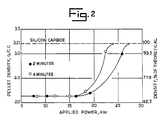
- the power was applied and maintained at 12 KW input for 1 minute while maintaining a 1000 psi compaction pressure.
- the pellet after the experiment was found to increase in density from 2.01 g/cc to 2.80 g/cc corresponding to an increase from 60 percent of the theoretical density of silicon carbide to 87.2 percent of theoretical density of silicon carbide.
- HSC Superior Graphite Co. of Chicago, Illinois under the trademark "HSC”.
- HSC silicon carbides have been developed for a wide range of uses including metallurgical additions, refractories, fine abrasive grit, and for high performance ceramics and special heat resistant composite materials.
- the HSC 059 grade of silicon carbide is prepared by processing run-of-furnace grade material to remove excess free carbon.
- This wet milled and chemically purified free flowing powder can be used directly in: metal or ceramic matrix composites, metallurgical and refractory applications, lapping and fine abrasive grit, high purity silicon carbide reaction bonded and pressureless or HIPed sintered ceramics.
- Table 1 sets forth the specifications of such desired materials.
- Superior Graphite Co. also produces 9400 Series Spherical Graphitic Carbon, which is suitable for other embodiments hereof.
- This free flowing, high purity spherical graphitic carbon product exhibits unusually high mechanical strength under compressive loading.
- the 9400 graphitic carbon is highly resistant to oxidation and chemical attack and has bood molding properties.
- the fields of use include refractory mixes, hydraulic fracturing proppant, core molds and as a special shot blast media.
- Oxidation inhibitor can be incorporated into the structure to achieve an extremely high degree of oxidation resistance.
- the 9400 RG product is a preferred material for consolidation of silicon carbide, because boron therein functions as a sintering aid, and its presence in the surrounding grain enhances the densification process.
- boron therein functions as a sintering aid, and its presence in the surrounding grain enhances the densification process.
- other carbided materials which are stable at the reactive temperatures (such as, for example, titanium tungsten, and the rare earth elements) may be used.
- the pre-forms hereof were made by cold uniaxial compaction of Superior Graphite Co. HSC 059 grade silicon carbide powder premixed with 110 percent by weight of 5 micron boron carbide and with 5 percent by weight of phenolic resin dissolved in acetone.
- the pellets were made in a 1-inch D steel die at 20,000 psi to give a green density of 2.14 g/cc corresponding to 66.6 percent theoretical density based on silicon carbide. These pellets were oven dried for 8 hours at 100°C and then baked at 250°C for 8 hours.
- the pellets were pyrolyzed at 1500°C for 30 minutes to reduce the formation of volatiles during the electroconsolidation process. A slight shrinkage occurred during the pyrolysis step, but because of a cor responding small weight loss, the density of the pellets remained essentially unchanged.
Landscapes
- Engineering & Computer Science (AREA)
- Chemical & Material Sciences (AREA)
- Ceramic Engineering (AREA)
- Manufacturing & Machinery (AREA)
- Materials Engineering (AREA)
- Structural Engineering (AREA)
- Organic Chemistry (AREA)
- Inorganic Chemistry (AREA)
- Ceramic Products (AREA)
- Adornments (AREA)
- Treatments Of Macromolecular Shaped Articles (AREA)
- Polishing Bodies And Polishing Tools (AREA)
Applications Claiming Priority (2)
| Application Number | Priority Date | Filing Date | Title |
|---|---|---|---|
| US28698088A | 1988-12-20 | 1988-12-20 | |
| US286980 | 1988-12-20 |
Publications (3)
| Publication Number | Publication Date |
|---|---|
| EP0375469A2 true EP0375469A2 (de) | 1990-06-27 |
| EP0375469A3 EP0375469A3 (de) | 1991-04-03 |
| EP0375469B1 EP0375469B1 (de) | 1996-04-24 |
Family
ID=23100958
Family Applications (1)
| Application Number | Title | Priority Date | Filing Date |
|---|---|---|---|
| EP89313679A Expired - Lifetime EP0375469B1 (de) | 1988-12-20 | 1989-12-15 | Verfahren zur Elektroverfestigung eines vorgeformten Einzelwerkstücks |
Country Status (4)
| Country | Link |
|---|---|
| EP (1) | EP0375469B1 (de) |
| AT (1) | ATE137211T1 (de) |
| CA (1) | CA2005002C (de) |
| DE (1) | DE68926338T2 (de) |
Cited By (5)
| Publication number | Priority date | Publication date | Assignee | Title |
|---|---|---|---|---|
| DE4407593C1 (de) * | 1994-03-08 | 1995-10-26 | Plansee Metallwerk | Verfahren zur Herstellung von Pulverpreßlingen hoher Dichte |
| EP0680290A4 (de) * | 1993-01-21 | 1996-11-27 | Biomet Inc | Verfahren zum formen von biokompatiblen komponenten. |
| EP1166926A3 (de) * | 1993-01-21 | 2002-05-22 | Biomet, Inc. | Verfahren zum Formen von biokompatiblen Komponenten |
| US7115221B1 (en) | 1999-11-26 | 2006-10-03 | Timcal Ag | Method for producing graphite powder with an increased bulk density |
| CN110160880A (zh) * | 2019-05-16 | 2019-08-23 | 浙江工业大学 | 一种三轴状态下土样的真空-堆载联合预压试验装置及方法 |
Family Cites Families (3)
| Publication number | Priority date | Publication date | Assignee | Title |
|---|---|---|---|---|
| BE551782A (de) * | 1956-12-31 | |||
| JPS57135707A (en) * | 1981-02-16 | 1982-08-21 | Inoue Japax Res Inc | Preparation of particular carbon |
| US4539175A (en) * | 1983-09-26 | 1985-09-03 | Metal Alloys Inc. | Method of object consolidation employing graphite particulate |
-
1989
- 1989-12-08 CA CA002005002A patent/CA2005002C/en not_active Expired - Fee Related
- 1989-12-15 DE DE68926338T patent/DE68926338T2/de not_active Expired - Fee Related
- 1989-12-15 AT AT89313679T patent/ATE137211T1/de not_active IP Right Cessation
- 1989-12-15 EP EP89313679A patent/EP0375469B1/de not_active Expired - Lifetime
Cited By (5)
| Publication number | Priority date | Publication date | Assignee | Title |
|---|---|---|---|---|
| EP0680290A4 (de) * | 1993-01-21 | 1996-11-27 | Biomet Inc | Verfahren zum formen von biokompatiblen komponenten. |
| EP1166926A3 (de) * | 1993-01-21 | 2002-05-22 | Biomet, Inc. | Verfahren zum Formen von biokompatiblen Komponenten |
| DE4407593C1 (de) * | 1994-03-08 | 1995-10-26 | Plansee Metallwerk | Verfahren zur Herstellung von Pulverpreßlingen hoher Dichte |
| US7115221B1 (en) | 1999-11-26 | 2006-10-03 | Timcal Ag | Method for producing graphite powder with an increased bulk density |
| CN110160880A (zh) * | 2019-05-16 | 2019-08-23 | 浙江工业大学 | 一种三轴状态下土样的真空-堆载联合预压试验装置及方法 |
Also Published As
| Publication number | Publication date |
|---|---|
| DE68926338T2 (de) | 1996-08-14 |
| EP0375469B1 (de) | 1996-04-24 |
| DE68926338D1 (de) | 1996-05-30 |
| ATE137211T1 (de) | 1996-05-15 |
| CA2005002A1 (en) | 1990-06-20 |
| EP0375469A3 (de) | 1991-04-03 |
| CA2005002C (en) | 2003-01-28 |
Similar Documents
| Publication | Publication Date | Title |
|---|---|---|
| US5348694A (en) | Method for electroconsolidation of a preformed particulate workpiece | |
| US4524138A (en) | Substantially pore-free sintered polycrystalline articles of α-silicon carbide, boron carbide and free carbon and process for their manufacture | |
| US5294382A (en) | Method for control of resistivity in electroconsolidation of a preformed particulate workpiece | |
| EP0277085B1 (de) | Herstellung von Metallkarbid-Körpern | |
| US4692418A (en) | Sintered silicon carbide/carbon composite ceramic body having fine microstructure | |
| EP0397513A1 (de) | Verfestigen von Aluminiumpulver und Aluminiumlegierungen | |
| US4789506A (en) | Method of producing tubular ceramic articles | |
| WO2008019182A2 (en) | Pressurelessly sintered zirconium diboride/silicon carbide composite bodies and a method for producing the same | |
| US3808012A (en) | Dense composite ceramic bodies | |
| EP0164830A2 (de) | Reaktionsgebundene Carbid-, Nitrid-, Borid-, Silicid- oder Sulfid-Formkörper | |
| EP0375469B1 (de) | Verfahren zur Elektroverfestigung eines vorgeformten Einzelwerkstücks | |
| JP2000128648A (ja) | 焼結体の製造方法 | |
| US5294264A (en) | Method of nitriding refractory metal articles | |
| JP3342882B2 (ja) | 予備成形された加工片の圧密方法 | |
| EP0178753A1 (de) | Verfahren zur Herstellung gesinterter Siliciumcarbid/Kohlenstoff-Verbundkeramikkörper mit ultrafeinem Kornmikrogefüge | |
| EP1761474B1 (de) | Verfahren zur herstellung von hochdichtem borcarbid | |
| JPH04130065A (ja) | 高密度金属硼化物−窒化アルミニウム複合体物品形成方法 | |
| KR100419778B1 (ko) | 액상 반응소결에 의한 탄화규소-탄화붕소 복합체 제조방법 | |
| Cornie | Advanced pressure infiltration casting technology produces near-absolute net-shape metal matrix composite components cost competitively | |
| CN107445625B (zh) | 一种高致密度ZrB2陶瓷的制备方法 | |
| US5082807A (en) | Production of metal carbide articles | |
| US5254509A (en) | Production of metal carbide articles | |
| JP2004169064A (ja) | 銅−タングステン合金およびその製造方法 | |
| JP3038489B2 (ja) | 金属複合カーボン材の製造方法 | |
| US5043119A (en) | High strength particulate ceramics |
Legal Events
| Date | Code | Title | Description |
|---|---|---|---|
| PUAI | Public reference made under article 153(3) epc to a published international application that has entered the european phase |
Free format text: ORIGINAL CODE: 0009012 |
|
| AK | Designated contracting states |
Kind code of ref document: A2 Designated state(s): AT BE CH DE ES FR GB GR IT LI LU NL SE |
|
| 17P | Request for examination filed |
Effective date: 19901214 |
|
| PUAL | Search report despatched |
Free format text: ORIGINAL CODE: 0009013 |
|
| AK | Designated contracting states |
Kind code of ref document: A3 Designated state(s): AT BE CH DE ES FR GB GR IT LI LU NL SE |
|
| 17Q | First examination report despatched |
Effective date: 19930730 |
|
| GRAH | Despatch of communication of intention to grant a patent |
Free format text: ORIGINAL CODE: EPIDOS IGRA |
|
| GRAA | (expected) grant |
Free format text: ORIGINAL CODE: 0009210 |
|
| AK | Designated contracting states |
Kind code of ref document: B1 Designated state(s): AT BE CH DE ES FR GB GR IT LI LU NL SE |
|
| PG25 | Lapsed in a contracting state [announced via postgrant information from national office to epo] |
Ref country code: LI Effective date: 19960424 Ref country code: NL Free format text: LAPSE BECAUSE OF FAILURE TO SUBMIT A TRANSLATION OF THE DESCRIPTION OR TO PAY THE FEE WITHIN THE PRESCRIBED TIME-LIMIT Effective date: 19960424 Ref country code: AT Effective date: 19960424 Ref country code: BE Effective date: 19960424 Ref country code: ES Free format text: THE PATENT HAS BEEN ANNULLED BY A DECISION OF A NATIONAL AUTHORITY Effective date: 19960424 Ref country code: GR Free format text: LAPSE BECAUSE OF FAILURE TO SUBMIT A TRANSLATION OF THE DESCRIPTION OR TO PAY THE FEE WITHIN THE PRESCRIBED TIME-LIMIT Effective date: 19960424 Ref country code: CH Effective date: 19960424 Ref country code: IT Free format text: LAPSE BECAUSE OF FAILURE TO SUBMIT A TRANSLATION OF THE DESCRIPTION OR TO PAY THE FEE WITHIN THE PRESCRIBED TIME-LIMIT;WARNING: LAPSES OF ITALIAN PATENTS WITH EFFECTIVE DATE BEFORE 2007 MAY HAVE OCCURRED AT ANY TIME BEFORE 2007. THE CORRECT EFFECTIVE DATE MAY BE DIFFERENT FROM THE ONE RECORDED. Effective date: 19960424 |
|
| REF | Corresponds to: |
Ref document number: 137211 Country of ref document: AT Date of ref document: 19960515 Kind code of ref document: T |
|
| REF | Corresponds to: |
Ref document number: 68926338 Country of ref document: DE Date of ref document: 19960530 |
|
| ET | Fr: translation filed | ||
| NLV1 | Nl: lapsed or annulled due to failure to fulfill the requirements of art. 29p and 29m of the patents act | ||
| PG25 | Lapsed in a contracting state [announced via postgrant information from national office to epo] |
Ref country code: LU Free format text: LAPSE BECAUSE OF NON-PAYMENT OF DUE FEES Effective date: 19961231 |
|
| PLBE | No opposition filed within time limit |
Free format text: ORIGINAL CODE: 0009261 |
|
| STAA | Information on the status of an ep patent application or granted ep patent |
Free format text: STATUS: NO OPPOSITION FILED WITHIN TIME LIMIT |
|
| 26N | No opposition filed | ||
| PGFP | Annual fee paid to national office [announced via postgrant information from national office to epo] |
Ref country code: GB Payment date: 20011120 Year of fee payment: 13 |
|
| PGFP | Annual fee paid to national office [announced via postgrant information from national office to epo] |
Ref country code: FR Payment date: 20011214 Year of fee payment: 13 |
|
| REG | Reference to a national code |
Ref country code: GB Ref legal event code: IF02 |
|
| PG25 | Lapsed in a contracting state [announced via postgrant information from national office to epo] |
Ref country code: GB Free format text: LAPSE BECAUSE OF NON-PAYMENT OF DUE FEES Effective date: 20021215 |
|
| GBPC | Gb: european patent ceased through non-payment of renewal fee |
Effective date: 20021215 |
|
| PG25 | Lapsed in a contracting state [announced via postgrant information from national office to epo] |
Ref country code: FR Free format text: LAPSE BECAUSE OF NON-PAYMENT OF DUE FEES Effective date: 20030901 |
|
| REG | Reference to a national code |
Ref country code: FR Ref legal event code: ST |
|
| PGFP | Annual fee paid to national office [announced via postgrant information from national office to epo] |
Ref country code: SE Payment date: 20031027 Year of fee payment: 15 |
|
| PGFP | Annual fee paid to national office [announced via postgrant information from national office to epo] |
Ref country code: DE Payment date: 20031128 Year of fee payment: 15 |
|
| PG25 | Lapsed in a contracting state [announced via postgrant information from national office to epo] |
Ref country code: SE Free format text: LAPSE BECAUSE OF NON-PAYMENT OF DUE FEES Effective date: 20041216 |
|
| PG25 | Lapsed in a contracting state [announced via postgrant information from national office to epo] |
Ref country code: DE Free format text: LAPSE BECAUSE OF NON-PAYMENT OF DUE FEES Effective date: 20050701 |
|
| EUG | Se: european patent has lapsed |