EP0375595A2 - Primaire composé abrasif/oxyde métallique hydraté amorphe comme traitement de surface pour joints de titane à base d'adhésifs organiques - Google Patents
Primaire composé abrasif/oxyde métallique hydraté amorphe comme traitement de surface pour joints de titane à base d'adhésifs organiques Download PDFInfo
- Publication number
- EP0375595A2 EP0375595A2 EP89630230A EP89630230A EP0375595A2 EP 0375595 A2 EP0375595 A2 EP 0375595A2 EP 89630230 A EP89630230 A EP 89630230A EP 89630230 A EP89630230 A EP 89630230A EP 0375595 A2 EP0375595 A2 EP 0375595A2
- Authority
- EP
- European Patent Office
- Prior art keywords
- titanium
- articles
- bonding
- metal
- primer
- Prior art date
- Legal status (The legal status is an assumption and is not a legal conclusion. Google has not performed a legal analysis and makes no representation as to the accuracy of the status listed.)
- Ceased
Links
Images

Classifications
-
- C—CHEMISTRY; METALLURGY
- C23—COATING METALLIC MATERIAL; COATING MATERIAL WITH METALLIC MATERIAL; CHEMICAL SURFACE TREATMENT; DIFFUSION TREATMENT OF METALLIC MATERIAL; COATING BY VACUUM EVAPORATION, BY SPUTTERING, BY ION IMPLANTATION OR BY CHEMICAL VAPOUR DEPOSITION, IN GENERAL; INHIBITING CORROSION OF METALLIC MATERIAL OR INCRUSTATION IN GENERAL
- C23C—COATING METALLIC MATERIAL; COATING MATERIAL WITH METALLIC MATERIAL; SURFACE TREATMENT OF METALLIC MATERIAL BY DIFFUSION INTO THE SURFACE, BY CHEMICAL CONVERSION OR SUBSTITUTION; COATING BY VACUUM EVAPORATION, BY SPUTTERING, BY ION IMPLANTATION OR BY CHEMICAL VAPOUR DEPOSITION, IN GENERAL
- C23C22/00—Chemical surface treatment of metallic material by reaction of the surface with a reactive liquid, leaving reaction products of surface material in the coating, e.g. conversion coatings, passivation of metals
-
- B—PERFORMING OPERATIONS; TRANSPORTING
- B32—LAYERED PRODUCTS
- B32B—LAYERED PRODUCTS, i.e. PRODUCTS BUILT-UP OF STRATA OF FLAT OR NON-FLAT, e.g. CELLULAR OR HONEYCOMB, FORM
- B32B7/00—Layered products characterised by the relation between layers; Layered products characterised by the relative orientation of features between layers, or by the relative values of a measurable parameter between layers, i.e. products comprising layers having different physical, chemical or physicochemical properties; Layered products characterised by the interconnection of layers
- B32B7/04—Interconnection of layers
- B32B7/12—Interconnection of layers using interposed adhesives or interposed materials with bonding properties
-
- C—CHEMISTRY; METALLURGY
- C08—ORGANIC MACROMOLECULAR COMPOUNDS; THEIR PREPARATION OR CHEMICAL WORKING-UP; COMPOSITIONS BASED THEREON
- C08J—WORKING-UP; GENERAL PROCESSES OF COMPOUNDING; AFTER-TREATMENT NOT COVERED BY SUBCLASSES C08B, C08C, C08F, C08G or C08H
- C08J5/00—Manufacture of articles or shaped materials containing macromolecular substances
- C08J5/12—Bonding of a preformed macromolecular material to the same or other solid material such as metal, glass, leather, e.g. using adhesives
- C08J5/124—Bonding of a preformed macromolecular material to the same or other solid material such as metal, glass, leather, e.g. using adhesives using adhesives based on a macromolecular component
-
- C—CHEMISTRY; METALLURGY
- C09—DYES; PAINTS; POLISHES; NATURAL RESINS; ADHESIVES; COMPOSITIONS NOT OTHERWISE PROVIDED FOR; APPLICATIONS OF MATERIALS NOT OTHERWISE PROVIDED FOR
- C09J—ADHESIVES; NON-MECHANICAL ASPECTS OF ADHESIVE PROCESSES IN GENERAL; ADHESIVE PROCESSES NOT PROVIDED FOR ELSEWHERE; USE OF MATERIALS AS ADHESIVES
- C09J5/00—Adhesive processes in general; Adhesive processes not provided for elsewhere, e.g. relating to primers
- C09J5/02—Adhesive processes in general; Adhesive processes not provided for elsewhere, e.g. relating to primers involving pretreatment of the surfaces to be joined
-
- B—PERFORMING OPERATIONS; TRANSPORTING
- B32—LAYERED PRODUCTS
- B32B—LAYERED PRODUCTS, i.e. PRODUCTS BUILT-UP OF STRATA OF FLAT OR NON-FLAT, e.g. CELLULAR OR HONEYCOMB, FORM
- B32B2311/00—Metals, their alloys or their compounds
- B32B2311/24—Aluminium
-
- C—CHEMISTRY; METALLURGY
- C09—DYES; PAINTS; POLISHES; NATURAL RESINS; ADHESIVES; COMPOSITIONS NOT OTHERWISE PROVIDED FOR; APPLICATIONS OF MATERIALS NOT OTHERWISE PROVIDED FOR
- C09J—ADHESIVES; NON-MECHANICAL ASPECTS OF ADHESIVE PROCESSES IN GENERAL; ADHESIVE PROCESSES NOT PROVIDED FOR ELSEWHERE; USE OF MATERIALS AS ADHESIVES
- C09J2400/00—Presence of inorganic and organic materials
- C09J2400/10—Presence of inorganic materials
- C09J2400/16—Metal
- C09J2400/166—Metal in the pretreated surface to be joined
Definitions
- the field of art to which this invention pertains is methods for adversely bonding joints.
- the invention is directed to a method of adhesively bonding articles, at least one of which is a titanium alloy, resulting in a joint resistant to crack propagation.
- a layer of metal alkoxide is applied to the titanium article and the metal alkoxide layer is exposed to heat and moisture.
- a polymeric adhesive is disposed between the articles and pressure and optionally heat are applied to the articles.
- the improvement comprises exposing the surface of the titanium article, prior to application of the metal alkoxide, to a substantially noncorrosive, nonanodic environment and abrasively treating the titanium article.
- This pretreatment for metal surfaces when used in combination with amorphous metal oxide primer for adhesively bonded titanium or titanium alloy joints reduces the need for the more technically complicated and environmentally hazardous pretreatments while providing bonds that are resistant to crack propagation. Such a system is particularly attractive for field repair in environmentally restricted areas.
- this invention makes a significant advancement by providing new technology relating to adhesive bonding.
- the titanium article surface (hereinafter titanium is meant to include titanium alloys) is pretreated by exposure to an abrasive treatment.
- abrasive treatments such as abrasive sheets (emory cloth) and SCOTCHBRITETM abrasive (3M Company) may be used.
- the preferred treatment is conventional grit blasting.
- the grit blasting is performed at ambient temperatures and typically comprises directing a stream of ceramic particles preferably alumina, silica or boron nitride at the article surface.
- conventional grit blasting is performed for a period of about 0.5 minutes to about 2 minutes under 20-80 psi pressure.
- the articles may be cleaned with conventional solvents prior to and post grit blasting as is conventionally done.
- this conventional grit blasting pretreatment results in equivalent or improved bonding in comparison to grit blasted articles that are additionally pretreated with standard corrosive or anodic pretreatments (such as CAA or Pasa JELL) applied prior to conventional organic type primers. It is believed this is because the inorganic primer provides an active clean oxide surface on which the organic adhesive can readily spread and interact to produce a stable interface.
- any method of bonding may be used for the practice of this invention that provides an amorphous, hydrated metal oxide coated metal article bonded to another article with an adhesive as described in commonly assigned U.S. Patent No. 4,623,591 and below. If a plurality of metal articles are to be bonded, it is preferred to prime each metal article. It is also preferred to apply a layer of metal alkoxide (described below) to the metal article(s) by a solvent casting, dipping or spraying procedure. The metal alkoxide coated metal articles are then maintained at a temperature of about 25°C to about 300°C in the presence of moisture.
- the reaction kinetics are typically too slow and above 300°C loss of desirable metal properties or crystallization of the oxide surface may occur with an accompanying loss of mechanical strength. It is especially preferred to heat the metal alkoxide coated articles to a temperature of about 25°C to about 125°C as the lower temperature minimize the risk of mechanical property degradation of, for example, aluminum substrates, such as with aluminum spars which have been shot peened to induce compressive surface stresses.
- the application of the inorganic primer for field repair situations is also possible with the use of the lower conversion temperature.
- Any metal alkoxide that hydrolyzes to give an amorphous hydrated metal oxide may be used in the practice of this invention.
- Metal alkoxides having the formula M x (OR) y where x is 1 and y is 3 or 4 are preferred in forming the metal oxide primer of this disclosure, y being determined by the particular valence of the metal. Typically, a valence of at least 3 is preferable to form a monohydroxy metal oxide.
- alkoxides where y is 2 are preferably combined with alkoxides having higher y values.
- M is any metal capable of forming a stable alkoxide, which can be purified by, for example, distillation or crystallization without decomposition; as y is defined above essentially all metals meet this requirement. It is preferred that the metal is selected from the group consisting of titanium, silicon, iron, nickel and aluminum. Aluminum is especially preferred.
- R can be any organic radical that can be distilled at temperatures below about 300°C. Since the alkoxide ((OR) moiety) is not incorporated into the primer, the important criteria associated with it is that the resultant alcohol can be volatilized at temperatures that are not high enough to damage the primer or substrate. It is preferred that R is an alkane radical from C1 to C10.
- R is methyl, ethyl, propyl or sec-butyl as these radicals are volatilized as alcohols at relatively low temperatures.
- the alkoxides can be modified by incorporation of varying amounts of additives such as phosphate, silicate or magnesium oxide without adversely affecting the primer properties. Mixtures of the above metal alkoxides may be used in the practice of this invention.
- partial hydrolyzates of the metal alkoxides can also be used as starting material, i.e., dimers, trimers, etc. of the monomeric alkoxides.
- the above metal alkoxides hydrolyze to amorphous hydrated metal oxides (primer) when exposed to moisture such as atmospheric moisture or moisture on the metal substrate surface and optionally heat as described below.
- An exemplary reaction believed to occur is that of aluminum alkoxide to hydrated alumina.
- the initial hydrolyzation reaction of aluminum alkoxides is empirically illustrated as Al(OR3) + H2O Al(OR)2(OH) + R(OH) (1)
- the thickness of this primer layer can vary effectively from about 15 nanometers (nm) to about 1200 nm. Preferably, the thickness is about 100 nm to about 1000 nm. Above about 1200 nm the layer can be so thick as to create stress risers and to form a weak boundary layer. Below about 100 nm, the layer does not provide the properties such as crack propagation resistance at the levels typically required. In addition, it is preferable to apply the primer to the metal surface with a plurality of layers of metal alkoxide as this facilitates removal of volatiles and solvent which can be more difficult to achieve from a single thick application.
- the articles of this invention comprise titanium or alloys thereof.
- alloy is meant the article having the major metal present in greater than a 50 percent by weight (%) amount.
- a primed metal article can be bonded to a conventional fiber reinforced polymeric matrix composite such as an epoxy, polyimide, polyester, acrylic, urethane, cellulosic, rubber or phenolic based composite.
- fibers include glass, alumina, silicon carbide, graphite, amides and KEVLARTM fiber (DuPont DeNemours, E.I., Co., Wilmington, Delaware).
- any of the above described metal alkoxides or mixtures thereof can be used to prime any of the above described metal articles, the composition of the mixture having little effect except that it is preferred to prime the titanium article with the aluminum alkoxide.
- Any conventional adhesive can be used for the practice of this invention that is useful for bonding articles, particularly metal articles.
- epoxide, polyimide, acrylic or urethane adhesives are used as these provide the properties most desired such as good strength. It is especially preferred to use epoxy, urethane or polyimide adhesives as they resist environmental stresses, are strong and are frequently chosen for aerospace applications.
- Methylethylketone (MEK) cleaned titanium 6Al-4V alloy specimens were grit blasted with #80 grit alumina under 40 psi pressure and flushed with MEK solvent.
- the inorganic primer was applied to the rough surface using a one percent toluene solution of E-8385 (Stauffer Chemical Co.) sec-butyl aluminum alkoxide. This was repeated up to seven (7) coatings with 20 minute air dry between each coat.
- a series of specimens were treated in a like manner to provide a sufficient number of wedge crack test specimens per ASTM D-3672 at each coating thickness. After coating, the specimens were oven-dried at 125°C for 30 minutes.
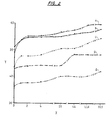
- Adhesively bonded joints were prepared using scrim supported FM-330 epoxy film adhesive from American Cyanamid. Wedge crack tests were carried out as specified by the above identified ASTM procedure to give the crack propagation results illustrated in Fig. 2.
- Fig. 1 illustrates crack propagation in mm Y as a function of time (hours) X at 71°C and 95% R.H.
- FM 35 polyimide adhesive was used to bond titanium alloy adherends.
- Curves A, B and C represent polyimide organic primed adherends that have been pretreated with a Picatinny Arsenal etch, Pasa JELL acid etch, and an anodization pretreatment, respectively.
- curves D and E represent amorphous hydrated alumina oxide primed adherends where no acidic or anodization pretreatment was used.
- Three coats of primer were used for curve D and seven coats of primer were used for curve E. It is clear that the amorphous hydrated aluminum oxide primed articles provide comparable if not better crack propagation resistance to the pretreated joints.
- Fig. 2 crack propagation in mm Y is illustrated as a function of time (hours) X at 71°C and 95% relative humidity (R.H.).
- the graphs illustrate the crack propagation of titanium adherends bonded with FM 330TM adhesive (American Cyanamid) for increasing number of coatings using amorphous hydrated aluminum oxide compositions.
- Curves A-E have 0, 1, 3, 5 and 7 coats, respectively.
- grit blast pretreatments coupled with inorganic primer may be used to advantage in bonding titanium to metal or titanium to composites. While this invention has been described in terms of a metal alkoxide a mixture of various metal alkoxides can be used.
- the pretreatment process enables preparation of the surface without corrosive environmentally hazardous chemicals, such as chromium or hydrogen fluoride.
- environmentally hazardous chemicals such as chromium or hydrogen fluoride.
- the primer coating provides improved crack propagation resistance in moist environments.
- the inorganic primers can be utilized as thinner coatings than the 0.2 to 0.4 mil layers typical of organic primers. Thicker layers tend to set up stress rises (i.e. weak boundary layer) as the components segregate.
- the inorganic primer can be used equally as well with high temperature adhesives such as polyimides or with low temperature adhesives such as epoxy systems unlike organic primers which are typically temperature specific.
- Another major advantage of the inorganic primer is that it can be used on metal surfaces which have been treated by a variety of surface treatments and provide the same high level of crack propagation resistance. In contrast, organic primers produce different results dependent upon the surface pretreatments employed.
Landscapes
- Chemical & Material Sciences (AREA)
- Organic Chemistry (AREA)
- Chemical Kinetics & Catalysis (AREA)
- Engineering & Computer Science (AREA)
- Materials Engineering (AREA)
- Manufacturing & Machinery (AREA)
- Health & Medical Sciences (AREA)
- Medicinal Chemistry (AREA)
- Polymers & Plastics (AREA)
- General Chemical & Material Sciences (AREA)
- Mechanical Engineering (AREA)
- Metallurgy (AREA)
- Adhesives Or Adhesive Processes (AREA)
- Pressure Welding/Diffusion-Bonding (AREA)
Applications Claiming Priority (2)
| Application Number | Priority Date | Filing Date | Title |
|---|---|---|---|
| US28592388A | 1988-12-19 | 1988-12-19 | |
| US285923 | 1988-12-19 |
Publications (2)
| Publication Number | Publication Date |
|---|---|
| EP0375595A2 true EP0375595A2 (fr) | 1990-06-27 |
| EP0375595A3 EP0375595A3 (fr) | 1992-03-25 |
Family
ID=23096275
Family Applications (1)
| Application Number | Title | Priority Date | Filing Date |
|---|---|---|---|
| EP19890630230 Ceased EP0375595A3 (fr) | 1988-12-19 | 1989-12-19 | Primaire composé abrasif/oxyde métallique hydraté amorphe comme traitement de surface pour joints de titane à base d'adhésifs organiques |
Country Status (7)
| Country | Link |
|---|---|
| EP (1) | EP0375595A3 (fr) |
| JP (1) | JPH02242869A (fr) |
| KR (1) | KR900010049A (fr) |
| AU (1) | AU625669B2 (fr) |
| BR (1) | BR8906563A (fr) |
| CA (1) | CA2005819A1 (fr) |
| IL (1) | IL92763A0 (fr) |
Families Citing this family (1)
| Publication number | Priority date | Publication date | Assignee | Title |
|---|---|---|---|---|
| US8764929B2 (en) * | 2011-03-22 | 2014-07-01 | The Boeing Company | Method of promoting adhesion and bonding of structures and structures produced thereby |
Family Cites Families (4)
| Publication number | Priority date | Publication date | Assignee | Title |
|---|---|---|---|---|
| US4196923A (en) * | 1977-11-25 | 1980-04-08 | Carrier Corporation | Adhesive bonding of aluminum coils |
| US4623591A (en) * | 1985-09-09 | 1986-11-18 | United Technologies Corporation | Amorphous hydrated metal oxide primer for organic adhesively bonded joints |
| DE267868T1 (de) * | 1986-11-12 | 1988-09-22 | United Technologies Corp., Hartford, Conn. | Vorbehandlungsverfahren eines amorphen hydratierten metalloxydgrundiermittels fuer organische klebverbindungsfugen. |
| US4888079A (en) * | 1987-10-21 | 1989-12-19 | United Technologies Corporation | Method for bonding joints with an organic adhesive using a water soluble amorphous hydrated metal oxide primer |
-
1989
- 1989-12-18 IL IL92763A patent/IL92763A0/xx not_active IP Right Cessation
- 1989-12-18 CA CA002005819A patent/CA2005819A1/fr not_active Abandoned
- 1989-12-19 KR KR1019890019118A patent/KR900010049A/ko not_active Withdrawn
- 1989-12-19 BR BR898906563A patent/BR8906563A/pt not_active Application Discontinuation
- 1989-12-19 EP EP19890630230 patent/EP0375595A3/fr not_active Ceased
- 1989-12-19 JP JP1329407A patent/JPH02242869A/ja active Pending
- 1989-12-19 AU AU46929/89A patent/AU625669B2/en not_active Ceased
Also Published As
| Publication number | Publication date |
|---|---|
| AU625669B2 (en) | 1992-07-16 |
| EP0375595A3 (fr) | 1992-03-25 |
| BR8906563A (pt) | 1990-09-04 |
| CA2005819A1 (fr) | 1990-06-19 |
| AU4692989A (en) | 1990-06-21 |
| KR900010049A (ko) | 1990-07-06 |
| IL92763A0 (en) | 1990-09-17 |
| JPH02242869A (ja) | 1990-09-27 |
Similar Documents
| Publication | Publication Date | Title |
|---|---|---|
| Critchlow et al. | Review of surface pretreatments for aluminium alloys | |
| US4853300A (en) | Amorphous hydrated metal oxide primer for organic adhesively bonded joints | |
| Walker | Organosilanes as adhesion promoters | |
| US4623591A (en) | Amorphous hydrated metal oxide primer for organic adhesively bonded joints | |
| EP0046362A1 (fr) | Substrats revêtus résistant à la corrosion | |
| US5936022A (en) | Compositions and methods for a high performance protective coating | |
| AU631472B2 (en) | Method for bonding joints with an organic adhesive using a water soluble silane modified amorphous hydrated metal oxide primer | |
| Park et al. | Investigation on the effectiveness of silane-based field level surface treatments of aluminum substrates for on-aircraft bonded repairs | |
| AU600320B2 (en) | Pretreatment process for amorphous hydrated metal oxide primer for organic adhesively bonded joints | |
| US6248403B1 (en) | Environmental wipe solvent processes | |
| AU625669B2 (en) | Combined abrasive/amorphous hydrated metal oxide primer as a surface treatment for organic adhesively bonded titanium joints | |
| Pike et al. | Plasma-sprayed coatings as adherend surface pretreatments | |
| Brewis | Factors affecting bonding of metals | |
| EP1522574B1 (fr) | Compositions de solvants d'essuyage et procédés sans danger pour l'environnement | |
| US4888079A (en) | Method for bonding joints with an organic adhesive using a water soluble amorphous hydrated metal oxide primer | |
| US4410393A (en) | Preparation of steel surfaces for adhesive bonding by etching with H3 PO4 -polyhydric alcohol mixture | |
| Stone | Effect of degree of abrasion of composite surfaces on strengths of adhesively bonded joints | |
| Tod et al. | Use of primers to enhance adhesive bonds | |
| Moyer et al. | The effect of surface pretreatment on carbon fibre–polyimide matrix composite bonding | |
| Cotter et al. | Metal joining with adhesives | |
| Chabot et al. | Evaluation of primers for adhesively-bonded aircraft repair | |
| Minford | Joint durability studies with abraded, etched, coated and anodized aluminum adherends | |
| Pike et al. | A Water Soluble Hydrated Metal Oxide primer for Adhesively Bonded Joints | |
| Menon et al. | Metal alkoxide primers in the adhesive bonding of mild steel | |
| Meyler et al. | Effectiveness of water-borne primers for structural adhesive bonding of aluminum and aluminum-lithium surfaces |
Legal Events
| Date | Code | Title | Description |
|---|---|---|---|
| PUAI | Public reference made under article 153(3) epc to a published international application that has entered the european phase |
Free format text: ORIGINAL CODE: 0009012 |
|
| AK | Designated contracting states |
Kind code of ref document: A2 Designated state(s): BE CH DE FR GB IT LI NL SE |
|
| PUAL | Search report despatched |
Free format text: ORIGINAL CODE: 0009013 |
|
| AK | Designated contracting states |
Kind code of ref document: A3 Designated state(s): BE CH DE FR GB IT LI NL SE |
|
| 17P | Request for examination filed |
Effective date: 19920818 |
|
| 17Q | First examination report despatched |
Effective date: 19930225 |
|
| STAA | Information on the status of an ep patent application or granted ep patent |
Free format text: STATUS: THE APPLICATION HAS BEEN REFUSED |
|
| 18R | Application refused |
Effective date: 19940922 |