EP0376154A2 - Bisindenyl-Derivat und Verfahren zu seiner Herstellung - Google Patents
Bisindenyl-Derivat und Verfahren zu seiner Herstellung Download PDFInfo
- Publication number
- EP0376154A2 EP0376154A2 EP89123611A EP89123611A EP0376154A2 EP 0376154 A2 EP0376154 A2 EP 0376154A2 EP 89123611 A EP89123611 A EP 89123611A EP 89123611 A EP89123611 A EP 89123611A EP 0376154 A2 EP0376154 A2 EP 0376154A2
- Authority
- EP
- European Patent Office
- Prior art keywords
- group
- compound
- solution
- zero
- atom
- Prior art date
- Legal status (The legal status is an assumption and is not a legal conclusion. Google has not performed a legal analysis and makes no representation as to the accuracy of the status listed.)
- Granted
Links
Classifications
-
- C—CHEMISTRY; METALLURGY
- C07—ORGANIC CHEMISTRY
- C07F—ACYCLIC, CARBOCYCLIC OR HETEROCYCLIC COMPOUNDS CONTAINING ELEMENTS OTHER THAN CARBON, HYDROGEN, HALOGEN, OXYGEN, NITROGEN, SULFUR, SELENIUM OR TELLURIUM
- C07F17/00—Metallocenes
-
- C—CHEMISTRY; METALLURGY
- C07—ORGANIC CHEMISTRY
- C07F—ACYCLIC, CARBOCYCLIC OR HETEROCYCLIC COMPOUNDS CONTAINING ELEMENTS OTHER THAN CARBON, HYDROGEN, HALOGEN, OXYGEN, NITROGEN, SULFUR, SELENIUM OR TELLURIUM
- C07F7/00—Compounds containing elements of Groups 4 or 14 of the Periodic Table
- C07F7/02—Silicon compounds
- C07F7/08—Compounds having one or more C—Si linkages
- C07F7/0803—Compounds with Si-C or Si-Si linkages
- C07F7/0805—Compounds with Si-C or Si-Si linkages comprising only Si, C or H atoms
-
- C—CHEMISTRY; METALLURGY
- C07—ORGANIC CHEMISTRY
- C07F—ACYCLIC, CARBOCYCLIC OR HETEROCYCLIC COMPOUNDS CONTAINING ELEMENTS OTHER THAN CARBON, HYDROGEN, HALOGEN, OXYGEN, NITROGEN, SULFUR, SELENIUM OR TELLURIUM
- C07F7/00—Compounds containing elements of Groups 4 or 14 of the Periodic Table
- C07F7/30—Germanium compounds
-
- C—CHEMISTRY; METALLURGY
- C08—ORGANIC MACROMOLECULAR COMPOUNDS; THEIR PREPARATION OR CHEMICAL WORKING-UP; COMPOSITIONS BASED THEREON
- C08F—MACROMOLECULAR COMPOUNDS OBTAINED BY REACTIONS ONLY INVOLVING CARBON-TO-CARBON UNSATURATED BONDS
- C08F10/00—Homopolymers and copolymers of unsaturated aliphatic hydrocarbons having only one carbon-to-carbon double bond
-
- C—CHEMISTRY; METALLURGY
- C08—ORGANIC MACROMOLECULAR COMPOUNDS; THEIR PREPARATION OR CHEMICAL WORKING-UP; COMPOSITIONS BASED THEREON
- C08F—MACROMOLECULAR COMPOUNDS OBTAINED BY REACTIONS ONLY INVOLVING CARBON-TO-CARBON UNSATURATED BONDS
- C08F2420/00—Metallocene catalysts
- C08F2420/08—Heteroatom bridge, i.e. Cp or analog where the bridging atom linking the two Cps or analogs is a heteroatom different from Si
-
- C—CHEMISTRY; METALLURGY
- C08—ORGANIC MACROMOLECULAR COMPOUNDS; THEIR PREPARATION OR CHEMICAL WORKING-UP; COMPOSITIONS BASED THEREON
- C08F—MACROMOLECULAR COMPOUNDS OBTAINED BY REACTIONS ONLY INVOLVING CARBON-TO-CARBON UNSATURATED BONDS
- C08F4/00—Polymerisation catalysts
- C08F4/42—Metals; Metal hydrides; Metallo-organic compounds; Use thereof as catalyst precursors
- C08F4/44—Metals; Metal hydrides; Metallo-organic compounds; Use thereof as catalyst precursors selected from light metals, zinc, cadmium, mercury, copper, silver, gold, boron, gallium, indium, thallium, rare earths or actinides
- C08F4/60—Metals; Metal hydrides; Metallo-organic compounds; Use thereof as catalyst precursors selected from light metals, zinc, cadmium, mercury, copper, silver, gold, boron, gallium, indium, thallium, rare earths or actinides together with refractory metals, iron group metals, platinum group metals, manganese, rhenium technetium or compounds thereof
- C08F4/62—Refractory metals or compounds thereof
- C08F4/64—Titanium, zirconium, hafnium or compounds thereof
- C08F4/659—Component covered by group C08F4/64 containing a transition metal-carbon bond
- C08F4/6592—Component covered by group C08F4/64 containing a transition metal-carbon bond containing at least one cyclopentadienyl ring, condensed or not, e.g. an indenyl or a fluorenyl ring
- C08F4/65922—Component covered by group C08F4/64 containing a transition metal-carbon bond containing at least one cyclopentadienyl ring, condensed or not, e.g. an indenyl or a fluorenyl ring containing at least two cyclopentadienyl rings, fused or not
- C08F4/65927—Component covered by group C08F4/64 containing a transition metal-carbon bond containing at least one cyclopentadienyl ring, condensed or not, e.g. an indenyl or a fluorenyl ring containing at least two cyclopentadienyl rings, fused or not two cyclopentadienyl rings being mutually bridged
-
- Y—GENERAL TAGGING OF NEW TECHNOLOGICAL DEVELOPMENTS; GENERAL TAGGING OF CROSS-SECTIONAL TECHNOLOGIES SPANNING OVER SEVERAL SECTIONS OF THE IPC; TECHNICAL SUBJECTS COVERED BY FORMER USPC CROSS-REFERENCE ART COLLECTIONS [XRACs] AND DIGESTS
- Y10—TECHNICAL SUBJECTS COVERED BY FORMER USPC
- Y10S—TECHNICAL SUBJECTS COVERED BY FORMER USPC CROSS-REFERENCE ART COLLECTIONS [XRACs] AND DIGESTS
- Y10S526/00—Synthetic resins or natural rubbers -- part of the class 520 series
- Y10S526/943—Polymerization with metallocene catalysts
Definitions
- the present invention relates to an improved process for the preparation of silyl or germyl bridged bisindenyl derivatives.
- silyl- and germyl-bridged compounds can be obtained in significantly higher yields and under milder conditions if the addition sequence is reversed, ie the indenyl component is slowly added as a solution to the dichlorosilyl or -germyl compound.
- R5 is a C1-C8 alkylene group, a C6-C10 arylene group, a C7-C40 arylalkylene group, a C7-C40 alkylarylene group, a group -O
- R1, R2, R3 and R4 are the same or different and represent a hydrogen atom, a C1-C30-, preferably C1-C2-alkyl group, a C2-C10-, preferably C2-alkenyl group, a C6-C10-, preferably C6-aryl group , a C7-C40-, preferably C7-arylalkyl group, a C7-C40-, preferably C7-C9-alkylaryl group, a C8-C40-, preferably C8-arylalkenyl group, a C1-C10-, preferably C1-C3-alkoxy group, one C6-C10-, preferably C6-aryloxy group, a halogenated C1-C20-, preferably C1-C3-alkyl group, especially perfluoroalkyl group, a halogenated C6-C10-, preferably C6-aryl group, especially perfluoroaryl group, or
- R6 and R7 are the same or different, preferably the same, and represent an unsubstituted or substituted indenyl group.
- substituted indenes are: 1- (trimethylsilyl) indene, 1-phenylindene, 1-, 2-, 4- or 5-methoxyindene, 1-, 2-, 4- or 5-methylindene and 4-, 5-, 6 - or 7-fluorindene. Indene or 1-methylindene is preferably used.
- the reaction temperature is -40 to 100 ° C, preferably 0 ° C to 50 ° C.
- the reaction is carried out with stirring and in an inert gas atmosphere.
- the process according to the invention has the advantage that the silyl- or germyl-bridged bisindenyl compounds are produced in significantly higher yields by reversing the addition sequence compared to the known synthesis process.
- Example 2 The procedure was analogous to Example 1. After the indene had been stripped off in an oil pump vacuum, the crude product was chromatographed on 350 g of silica gel 60. 23.6 g (82%) of compound 1 could be eluted with hexane / methylene chloride (5: 1 parts by volume).
Landscapes
- Chemical & Material Sciences (AREA)
- Organic Chemistry (AREA)
- Health & Medical Sciences (AREA)
- Chemical Kinetics & Catalysis (AREA)
- Medicinal Chemistry (AREA)
- Polymers & Plastics (AREA)
- Transition And Organic Metals Composition Catalysts For Addition Polymerization (AREA)
- Organic Low-Molecular-Weight Compounds And Preparation Thereof (AREA)
Abstract

R⁶ - M² (III) R⁷-M² (IV)
(M² = Alkalimetall)
in sehr guter Ausbeute erhalten, wenn bei der Umsetzung die Verbindung II vorgelegt und die Verbindung III oder IV langsam zugefügt wird.
Description
- Die vorliegende Erfindung bezieht sich auf ein verbessertes Verfahren zur Herstellung von silyl- oder germylverbrückten Bisindenyl-Derivaten.
- Verbindungen dieses Typs können als Ligandsysteme zum Aufbau von chiralen, stereorigiden Metallocen-Komplexen verwendet werden. Insbesondere die Zirkon- und Hafniumdichlorid-Komplexe können als hochaktive, stereospezifische Katalysatoren zur Herstellung von hochisotaktischem Polypropylen eingesetzt werden (vgl. EP 129 368).
- Es besteht Interesse daran, Verbindungen des Typs 1 ,1′-(R,R′(Si,Ge)bisindenyl (R, R′ = Alkyl, Aryl) zur Synthese von verbrückten Metallocenen, insbesondere Zirkon- und Hafniumdichlorid-Derivaten zu verwenden.
- In der Literatur ist bisher lediglich die Synthese von 1 ,1′-(Dimethylsilandiyl)bisindenyl in einer Ausbeute von 24 % durch Umsetzung von Indenyllithium mit Dimethyldichlorsilan in Xylol beschrieben (vgl. C.H. Sommer, N.S. Marans, JACS 73 (1951) 5135). Hierbei wurde die Silylkomponente zur Indenyllithium-Lösung zugetropft und der Ansatz anschließend für 24 Stunden bei 100°C gerührt.
- Nunmehr wurde gefunden, daß man silyl- und germylverbrückte Verbindungen in wesentlich höheren Ausbeuten und bei milderen Bedingungen erhält, wenn man die Zugabefolge umgekehrt, also die Indenylkomponente als Lösung langsam zur Dichlorsilyl- oder -germyl-Verbindung zugibt.
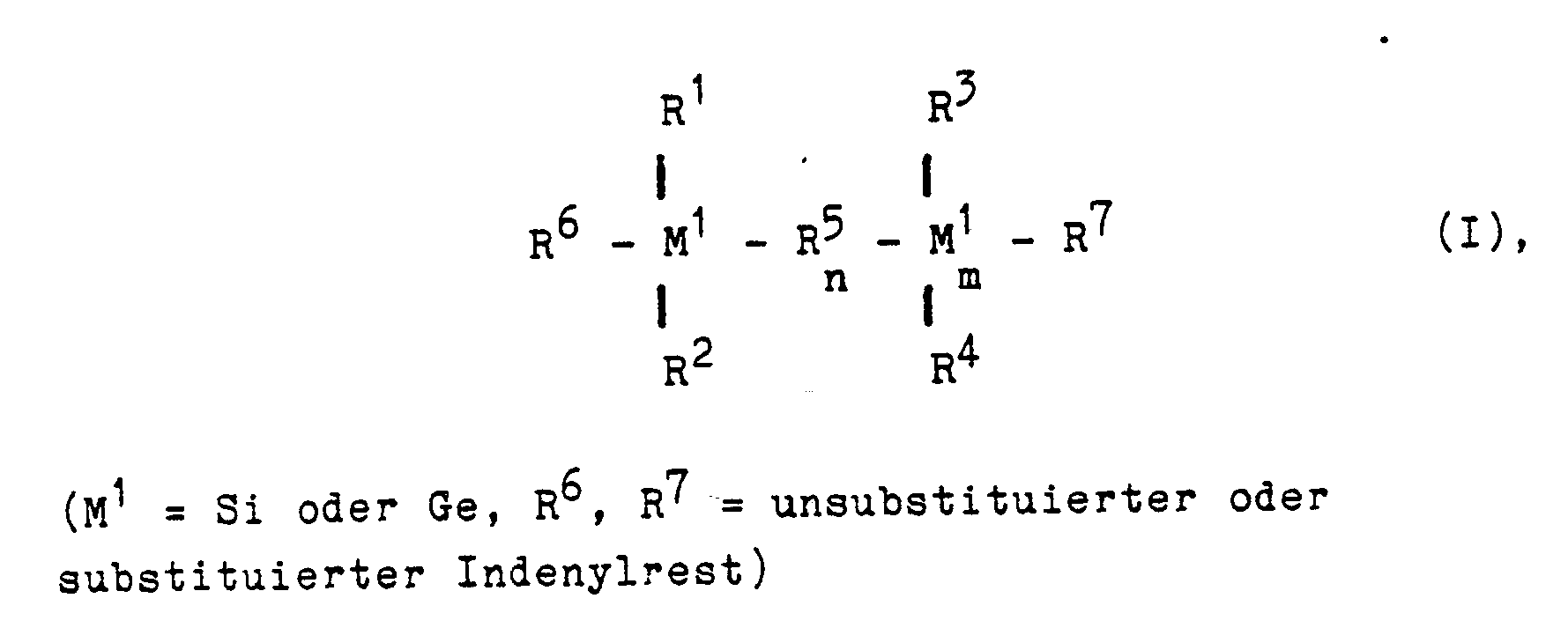
- Die Erfindung betrifft somit ein Bisindenyl-Derivat der Formel I

m null oder 1 bedeutet, bei m = null n = null und bei m = 1 n = null oder 1 ist,
R¹, R², R³ und R⁴ gleich oder verschieden sind und ein Wasserstoffatom, eine C₁-C₃₀-Alkylgruppe, eine C₂-C₁₀-Alkenylgruppe, eine C₆-C₁₀-Arylgruppe, eine C₇-C₄₀-Arylalkylgruppe, eine C₇-C₄₀-Alkylarylgruppe, eine C₈-C₄₀-Arylalkenylgruppe, eine C₁-C₁₀-Alkoxygruppe, eine C₆-C₁₀-Aryloxygruppe, eine halogenierte C₁-C₂₀-Alkylgruppe, eine halogenierte C₆-C₁₀-Arylgruppe oder ein Halogenatom bedeuten, oder
R¹ und R² oder R³ und R⁴ mit dem sie verbindenden Atom einen Ring bilden.
R⁵ eine C₁-C₈-Alkylengruppe, eine C₆-C₁₀-Arylengruppe, eine C₇-C₄₀-Arylalkylengruppe, eine C₇-C₄₀-Alkylarylengruppe, eine Gruppe -O|Si(CH₃)₂-O]p-, worin p eine ganze Zahl von 1 bis 5 ist, oder ein Chalkogenatom bedeutet, und
R⁶ und R⁷ gleich oder verschieden sind und einen unsubstituierten oder substituierten Indenylrest bedeuten, ausgenommen 1,1′-(Dimethylsilandiyl)bisindenyl. - Die Erfindung betrifft weiterhin ein Verfahren zur Herstellung dieser Verbindung.
- In Formel I ist M¹ Silizium oder Germanium. m ist null oder 1. Bei m = null ist n ebenfalls null und bei m = 1 ist n null oder 1.
- R¹, R², R³ und R⁴ sind gleich oder verschieden und bedeuten ein Wasserstoffatom, eine C₁-C₃₀-, vorzugsweise C₁-C₂-Alkylgruppe, eine C₂-C₁₀-, vorzugsweise C₂-Alkenylgruppe, eine C₆-C₁₀-, vorzugsweise C₆-Arylgruppe, eine C₇-C₄₀-, vorzugsweise C₇-Arylalkylgruppe, eine C₇-C₄₀-, vorzugsweise C₇-C₉-Alkylarylgruppe, eine C₈-C₄₀-, vorzugsweise C₈-Arylalkenylgruppe, eine C₁-C₁₀-, vorzugsweise C₁-C₃-Alkoxygruppe, eine C₆-C₁₀-, vorzugsweise C₆-Aryloxygruppe, eine halogenierte C₁-C₂₀-, vorzugsweise C₁-C₃-Alkylgruppe, insbesondere Perfluoralkylgruppe, eine halogenierte C₆-C₁₀-, vorzugsweise C₆-Arylgruppe, insbesondere Perfluorarylgruppe, oder ein Halogenatom, vorzugsweise Chlor.
R¹ und R² oder R³ und R⁴ können auch mit dem sie verbindenden Atom einen Ring bilden, vorzugsweise einen 4-6-atomigen Ring.
Insbesondere bedeuten R¹, R², R³ und R⁴ Methyl, Ethyl, Phenyl oder Vinyl. - R⁵ ist eine C₁-C₈-, vorzugsweise C₂-Alkylengruppe, eine C₆-C₁₀-, vorzugsweise C₆-Arylengruppe, eine C₇-C₄₀-, vorzugsweise C₇-C₉-Arylalkylengruppe, eine C₇-C₄₀-, vorzugsweise C₇-C₉-Alkylarylengruppe, eine Gruppe -O|Si(CH₃)₂-O]p-, wobei p eine ganze Zahl von 1 bis 5 ist, oder ein Chalkogenatom, vorzugsweise Sauerstoff.
- R⁶ und R⁷ sind gleich oder verschieden, vorzugsweise gleich, und bedeuten eine unsubstituierte oder substituierte Indenylgruppe. Beispiele für substituierte Indene sind: 1-(Trimethylsilyl)inden, 1-Phenylinden, 1-, 2-, 4- oder 5-Methoxyinden, 1-, 2-, 4- oder 5-Methylinden und 4-, 5-, 6- oder 7-Fluorinden. Bevorzugt wird Inden oder 1-Methylinden eingesetzt.
- Das erfindungsgemäße Bisindenylderivat der Formel I wird hergestellt durch Umsetzung einer Verbindung der Formel II

R⁶ - M² (III), R⁷-M² (IV),
worin R⁶ und R⁷ die vorgenannte Bedeutung haben und M² ein Alkalimetallatom, vorzugsweise Kalium und Lithium, insbesondere Lithium, ist. - Die Reaktion wird in einem inerten, absolutierten Lösemittel durchgeführt. Geeignete Lösemittel sind aromatische Kohlenwasserstoffe, wie beispielsweise Toluol oder Xylol, aliphatische Kohlenwasserstoffe, wie beispielsweise Hexan oder Pentan, oder Ether wie beispielsweise Diethylether, Tetrahydrofuran und Dioxan. Vorzugsweise wird Diethylether verwendet.
- Die Reaktionstemperatur beträgt -40 bis 100°C, vorzugsweise 0°C bis 50°C.
- Die Reaktionszeit beträgt 1 bis 100 Stunden, vorzugsweise 4 bis 20 Stunden, davon werden 1/4 bis 20 Stunden, vorzugsweise 1 bis 4 Stunden, für die Zugabe der Lösung der Verbindung III zur Lösung oder Suspension der Verbindung II aufgewendet. Verbindung II wird stets vorgelegt und Verbindung III oder IV zugegeben.
- Die Reaktion wird unter Rühren und in einer Inertgasatmosphäre durchgeführt. Das erfindungsgemäße Verfahren weist den Vorteil auf, daß die silyl- oder germylverbrückten Bisindenyl-Verbindungen gegenüber dem bekannten Syntheseverfahren durch eine Umkehrung der Zugabefolge in wesentlich höheren Ausbeuten entstehen.
- Alle nachfolgenden Arbeitsoperationen sind in Inertgasatmosphäre unter Verwendung absolutierter Lösemittel durchgeführt worden (Schlenk-Technik).
- Eine Lösung von 30 g (0,23 mol) über Aluminiumoxid filtriertes Inden (techn., ∼91 %) in 200 cm³ Diethylether wurde unter Eiskühlung mit 80 cm³ (0,20 mol) einer 2,5 molaren Lösung von n-Butyllithium in Hexan versetzt. Man rührte den Ansatz noch 15 min bei Raumtemperatur und gab die orangefarbene Lösung über eine Kanüle innerhalb 2 Stunden zu einer Lösung von 13,0 g (0,10 mol) Dimethyldichlorsilan (99 %) in 30 cm³ Diethylether. Die orangefarbene Suspension wurde über Nacht gerührt und dreimal mit 100 - 150 cm³ Wasser ausgeschüttelt. Die gelbe organische Phase wurde zweimal über Natriumsulfat getrocknet und im Rotationsverdampfer eingedampft. Das verbleibende orange Öl wurde 4 bis 5 Stunden im Ölpumpenvakuum bei 40°C gehalten und von überschüssigem Inden befreit, wobei ein weißer Niederschlag ausfiel. Durch Zugabe von 40 cm³ Methanol und Kristallisation bei -35°C ließen sich insgesamt 20,4 g (71 %) der Verbindung 1 als weißes bis beiges Pulver isolieren. Fp. 79 - 81°C.
¹H-NMR-Spektrum (CDCl₃): 2 Diastereomere (∼1 : 1), 7,14 - 7,50 (arom. H), 6,40 - 6,90 (olefin. H), 3,62 (allyl. H), -0,47, -0,28, -0,06 ppm (SiCH₃).
Korrekte Elementaranalysen. - Es wurde analog Beispiel 1 verfahren. Nach dem Abziehen des Indens im Ölpumpenvakuum wurde das Rohprodukt an 350 g Kieselgel 60 chromatographiert. Mit Hexan/Methylenchlorid (5:1 Vol.-Teile) ließen sich 23,6 g (82 %) der Verbindung 1 eluieren.
- In 100 cm³ Tetrahydrofuran wurden 7,8 g (0,20 mol) kleingeschnittenes Kalium vorgelegt. Innerhalb 1 Stunde wurden 30 cm³ (0,23 mol) über Aluminiumoxid filtriertes Inden (techn., ∼91 %) unter kräftigem Rühren so zugetropft, daß das Lösemittel leicht siedete. Anschließend wurde der Ansatz noch 2 Stunden unter Rückfluß erhitzt, bis das Kalium vollständig umgesetzt war. Die so bereitete Lösung von Indenylkalium wurde analog Beispiel 1 mit Dimethyldichlorsilan umgesetzt und aufgearbeitet. Man erhielt 16,1 g (56 %) der Verbindung 1 als weißes Pulver.
- Eine Lösung von 15,7 g (0,10 mol) Diethyldichlorsilan in 30 cm³ Diethylether wurde analog Beispiel 1 mit 0,20 mol Indenyllithium-Lösung umgesetzt und aufgearbeitet. Das nach dem Abziehen im Ölpumpenvakuum verbleibende Öl wurde an 400 g Kieselgel 60 chromatographiert. Mit Hexan/Methylenchlorid (10:1 Vol.-Teile) eluierte man das Produkt in einer blaßgelben Zone. Nach Abziehen des Lösemittels und Umkristallisation aus Hexan bei -35°C erhielt man 19,5 g (62 %) der Verbindung 2 als beiges Pulver.
¹H-NMR-Spektrum (CDCl₃): 2 Diastereomere (∼1:1), 7,1 - 7,6 (arom. H), 6,2 - 7,0 (olefin. H), 3,6 (allyl. H), 0,1 - 0,8 ppm (SiC₂H₅).
Korrekte Elementaranalysen. - Eine Lösung von 19,1 g (0,10 mol) Methylphenyldichlorsilan (98 %) in 30 cm³ Diethylether wurde analog Beispiel 1 mit 0,20 mol Lithiumindenyl-Lösung umgesetzt und aufgearbeitet. Aus Hexan kristallisierten bei -35°C insgesamt 30,1 g (86 %) der Verbindung 3 (weißes Kristallpulver) aus.
¹H-NMR-Spektrum (CDCl₃): 3 Diastereomere (11:2:1), 7,0 - 7,5 (arom. H), 6,5 - 6,9 (olefin. H), 3,91 - 3,97 (allyl. H), -0,31, -0,14, -0,03 ppm (SiCH₃).
Korrekte Elementaranalysen. - Eine Lösung von 25,3 g (0,10 mol) Diphenyldichlorsilan (99 %) in 40 cm³ Diethylether wurde analog Beispiel 1 mit 0,20 mol Lithiumindenyl-Lösung umgesetzt und aufgearbeitet. Das nach dem Abziehen im Ölpumpenvakuum verbleibende braune Öl wurde an 350 g Kieselgel 60 chromatographiert. Mit Hexan/Toluol (3:1 Vol.-Teile) ließen sich insgesamt 16,0 g (39 %) der Verbindung 4 eluieren, die nach dem Abziehen des Lösemittels als beiges Pulver anfiel.
¹H-NMR-Spektrum (CDCl₃): 2 Diastereomere (∼1:1), 7,0 - 7,5 (arom. H), 6,05 - 6,95 (olefin. H), 4,28, 4,33 ppm (allyl. H).
Korrekte Elementaranalysen.
Das Massenspektrum zeigte das zu erwartende Zerfallsmuster. - Eine Lösung von 20,3 g (0,10 mol) Phenylvinyldichlorsilan in 30 cm³ Diethylether wurde analog Beispiel 1 mit 0,20 mol Lithiumindenyl-Lösung umgesetzt und aufgearbeitet. Aus Hexan fielen bei -35°C 16,3 g (45 %) der Verbindung 5 als weißes Pulver aus.
¹H-NMR-Spektrum (CDCl₃): 2 Diastereomere (4:1), 7,0 - 7,6 (arom. H), 6,5 - 6,9 (olefin. H), 5,32 - 6,15 (vinyl. H), 4,02, 4,06 ppm (allyl. H).
Korrekte Elementaranalysen. - 14,1 g (0,10 mol) Methylvinyldichlorsilan in 30 cm³ Diethylether wurden mit 0,20 mol Lithiumindenyl-Lösung analog Beispiel 1 umgesetzt und aufgearbeitet. Aus Hexan kristallisierten bei -35°C insgesamt 14,4 g (48 %) der Verbindung 6.
¹H-NMR-Spektrum (CDCl₃): 7,1 - 7,5 (m, 8, arom. H), 6,92 - 6,96 (m, 2, β-olefin. H), 6,63 (dd, 1, α-olefin. H), 6,57 (dd, 1 α-olefin. H), 5,42 - 5,90 (m, 3, vinyl. H), 3,66 (s, 2, allyl. H), -0,25 ppm (s, 3, SiCH₃).
Korrekte Elementaranalysen. - 17,7 g (0,10 mol) Phenyldichlorsilan in 30 cm³ Diethylether wurden analog Beispiel 1 mit 0,20 mol Lithiumindenyl-Lösung umgesetzt und aufgearbeitet. Das nach dem Abziehen im Ölpumpenvakuum verbleibende Öl wurde mit Hexan/Toluol (2:1 Vol.-Teile) über eine Fritte mit 15 cm Kieselgel 60 filtriert. Das nach dem Abziehen der Lösemittel verbleibende Öl wurde mit Hexan versetzt. Bei -35°C kristallisierten 24,2 g (72 %) der Verbindung 7 aus.
¹H-NMR-Spektrum (CDCl₃): 3 Diastereomere, 7,0 - 7,5 (arom. H), 6,4 - 6,9 (olefin. H), 4,42, 4,27, 3,85 (3x t, Si-H), 4,00, 3,87, 3,85, 3,60 ppm (4 x m, allyl. H). Massen- und Infrarotspektrum entsprach den Erwartungen.
Korrekte Elementaranalysen. - Eine Lösung von 21,5 g (0,10 mol) 1,2-Bis-(chlordimethylsilyl)-ethan (80 %) in 50 cm³ Diethylether wurde mit 0,20 mol Lithiumindenyl-Lösung analog Beispiel 1 umgesetzt und aufgearbeitet. Aus Hexan kristallisierten bei -35°C 28,2 g (82 %) der Verbindung 8 in Form farbloser Kristalle aus. Fp. 71 - 74°C.
¹H-NMR-Spektrum (CDCl₃): 7,1 - 7,5 (arom. H), 6,90 (β-olefin. H), 6,57 (α-olefin. H), 3,53 (allyl. H), 0,25 - 0,46 (C₂H₄), -0,10, -0,11, -0,15, -0,16 (SiCH₃).
Korrekte Elementaranalysen. - Zu einer Lösung von 26,0 g (0,14 mol) Tetramethyldichlorsilan in 250 cm³ Diethylether wurde innerhalb 1 Stunde bei 0°C eine etherische Lösung von 0,30 mol Indenyllithium zugetropft. Nach einstündigem Rühren bei Raumtemperatur wurden 50 cm³ Wasser hinzugefügt, die organische Phase abgetrennt, über Magnesiumsulfat getrocknet und das Lösemittel entfernt. Der Rückstand wurde mit Methanol gewaschen und im Vakuum getrocknet.
Ausbeute: 26,5 g (55 %).
¹H-NMR-Spektrum (CDCl₃): 2 Diastereomere (∼1:1), 7,45 - 7,11 (m, 8, arom. H), 6,86, 6,84 (2 x ddd, 2 olefin. H), 6,59, 6,46 (2 x dd, 2 olefin. H), 3,43, 3,32 (2 x m, 2 allyl. H), 0,05, -0,04, -0,16m -0,31 (4 x s, 4 x 3H, Si-CH₃). - Eine Lösung von 24,7 g (0,19 mol) 1-Methylinden in 200 cm³ Diethylether wurde bei 0°C mit 45 cm³ (0,18 mol) einer 2,5-molaren Lösung von n-Butyllithium in n-Hexan versetzt. Nach 20 Minuten Rühren bei Raumtemperatur wurde die gelbe Lösung über eine Kanüle innerhalb von 2 Stunden zu einer Lösung von 12,3 g (0,09 mol) Dimethyldichlorsilan in 30 cm³ Diethylether gegeben und der Ansatz über Nacht gerührt. Aufarbeitung analog Beispiel 1. Aus Hexan kristallisierten bei -35°C 20,4 g (68 %) der Verbindung 10 in Form gelblicher Kristalle aus.
¹H-NMR-Spektrum (CDCl₃): 2 Diastereomere (∼1:1), 7,1 - 7,5 (arom. H), 6,26, 6,13 (α-olefin. H), 3,48 (allyl. H), 2,22 (Inden-CH₃), -0,15, -0,31, -0,48 (SiCH₃).
Korrekte Elementaranalysen. - Eine Lösung von 5,0 g (0,028 mol) Dimethyldichlorgerman in 10 cm³ Diethylether wurde analog Beispiel 1 mit 0,058 mol Indenyllithium-Lösung umgesetzt und aufgearbeitet. Die Kristallisation aus n-Hexan bei -35°C ergab 7,2 g (75 %) der Verbindung 11 als weißes Pulver.
¹H-NMR-Sepktrum (CDCl₃): 2 Diastereomere (∼1:1), 7,1 - 7,5 (arom. H), 6,9 - 7,1 (β-olefin. H), 6,42 - 6,65 (α-olefin. H), 3,77 (allyl. H) 0,09, -0,13, -0,30 ppm (GeCH₃).
Korrekte Elementaranalysen. - Eine Lösung von 25 g (0,125 mol) Diethyldichlorgerman in 30 cm³ Diethylether wurde bei Raumtemperatur mit 0,25 mol Indenyllithium-Lösung analog Beispiel 1 umgesetzt und aufgearbeitet. Das nach dem Abziehen im Ölpumpenvakuum verbleibende Öl wurde an 350 g Kieselgel 80 chromatographiert. Verbindung 12 wurde mit Hexan/Methylenchlorid (20:1 Vol.-Teile) eluiert und anschließend aus wenig Hexan bei-35°C umkristallisiert. Ausbeute: 27, 9 g (62 %) weißes Pulver.
¹H-NMR-Spektrum (CDCl₃): 2 Diastereomere (1:1), 7,0 - 7,6 (arom. H), 6,32 - 6,62 (olefin. H), 3,75 (allyl. H), 0,35 - 0,87 (GeC₂H₅).
Korrekte Elementaranalysen.
Claims (3)

m null oder 1 bedeutet, bei m = null n = null und bei m = 1 n = null oder 1 ist,
R¹, R², R³ und R⁴ gleich oder verschieden sind und ein Wasserstoffatom, eine C₁-C₃₀-Alkylgruppe, eine C₂-C₁₀-Alkenylgruppe, eine C₆-C₁₀-Arylgruppe, eine C₇-C₄-Arylalkylgruppe, eine C₇-C₄₀-Alkylarylgruppe, eine C₈-C₄₀-Arylalkenylgruppe, eine C₁-C₁₀-Alkoxygruppe, eine C₆-C₁₀-Aryloxygruppe, eine halogenierte C₁-C₂₀-Alkylgruppe, eine halogenierte C₆-C₁₀-Arylgruppe oder ein Halogenatom bedeuten, oder
R¹ und R² oder R³ und R⁴ mit dem sie verbindenden Atom einen Ring bilden,
R⁵ eine C₁-C₈-Alkylengruppe, eine C₆-C₁₀-Arylengruppe, eine C₇-C₄₀-Arylalkylengruppe, eine C₇-C₄₀-Alkylarylengruppe, eine Gruppe -O[Si(CH₃)₂-O]p-, worin p eine ganze Zahl von 1 bis 5 ist, oder ein Chalkogenatom bedeutet, und
R⁶ und R⁷ gleich oder verschieden sind und einen unsubstituierten oder substituierten Indenylrest bedeuten,
durch Umsetzung einer Indenyl-alkalimetallverbindung mit einer Dichlorsilylverbindung, dadurch gekennzeichnet, daß eine Verbindung der Formel II

R⁶ - M² (III), R⁷-M² (IV),
worin R⁶ und R⁷ die vorgenannte Bedeutung haben und M² ein Alkalimetallatom ist, bei einer Temperatur von -40 bis 100°C während 1 bis 100 Stunden zu der Lösung oder Suspension der Verbindung II zugegeben wird.
Priority Applications (1)
| Application Number | Priority Date | Filing Date | Title |
|---|---|---|---|
| EP95113494A EP0692486A3 (de) | 1988-12-30 | 1989-12-21 | Bisindenyl-Derivat und Verfahren zu seiner Herstellung |
Applications Claiming Priority (2)
| Application Number | Priority Date | Filing Date | Title |
|---|---|---|---|
| DE3844282 | 1988-12-30 | ||
| DE3844282A DE3844282A1 (de) | 1988-12-30 | 1988-12-30 | Bisindenyl-derivat und verfahren zu seiner herstellung |
Related Child Applications (2)
| Application Number | Title | Priority Date | Filing Date |
|---|---|---|---|
| EP95113494A Division EP0692486A3 (de) | 1988-12-30 | 1989-12-21 | Bisindenyl-Derivat und Verfahren zu seiner Herstellung |
| EP95113494.9 Division-Into | 1995-08-28 |
Publications (4)
| Publication Number | Publication Date |
|---|---|
| EP0376154A2 true EP0376154A2 (de) | 1990-07-04 |
| EP0376154A3 EP0376154A3 (de) | 1991-04-03 |
| EP0376154B1 EP0376154B1 (de) | 1996-03-27 |
| EP0376154B2 EP0376154B2 (de) | 2000-09-27 |
Family
ID=6370497
Family Applications (2)
| Application Number | Title | Priority Date | Filing Date |
|---|---|---|---|
| EP89123611A Expired - Lifetime EP0376154B2 (de) | 1988-12-30 | 1989-12-21 | Bisindenyl-Derivat und Verfahren zu seiner Herstellung |
| EP95113494A Withdrawn EP0692486A3 (de) | 1988-12-30 | 1989-12-21 | Bisindenyl-Derivat und Verfahren zu seiner Herstellung |
Family Applications After (1)
| Application Number | Title | Priority Date | Filing Date |
|---|---|---|---|
| EP95113494A Withdrawn EP0692486A3 (de) | 1988-12-30 | 1989-12-21 | Bisindenyl-Derivat und Verfahren zu seiner Herstellung |
Country Status (8)
| Country | Link |
|---|---|
| US (1) | US4985576A (de) |
| EP (2) | EP0376154B2 (de) |
| JP (1) | JP2825134B2 (de) |
| AU (1) | AU615602B2 (de) |
| CA (1) | CA2006905A1 (de) |
| DE (2) | DE3844282A1 (de) |
| ES (1) | ES2086314T5 (de) |
| ZA (1) | ZA899945B (de) |
Cited By (5)
| Publication number | Priority date | Publication date | Assignee | Title |
|---|---|---|---|---|
| EP0574597A1 (de) * | 1992-06-13 | 1993-12-22 | Hoechst Aktiengesellschaft | Verfahren zur Herstellung von verbrückten, chiralen Metallocenkatalysatoren des Types Bisindenyl |
| EP0617044A3 (de) * | 1993-03-22 | 1995-04-05 | Mitsui Petrochemical Ind | Verfahren zur Herstellung von Cyclopentadienyl Gruppen enthalten Silizium oder Germanium Verbindungen. |
| EP0665234A1 (de) * | 1994-01-26 | 1995-08-02 | Witco GmbH | Verfahren zur Herstellung von Bicyclopentadienyl-Verbindungen |
| WO1999019337A1 (de) * | 1997-10-09 | 1999-04-22 | Borealis Gmbh | Metallocene mit ferrocenyl-substituierten brücken für die olefinpolymerisation |
| US6960676B2 (en) | 2000-02-08 | 2005-11-01 | Exxonmobil Chemical Patents Inc. | Method of preparing group 14 bridged biscyclopentadienyl ligands |
Families Citing this family (14)
| Publication number | Priority date | Publication date | Assignee | Title |
|---|---|---|---|---|
| US5700896A (en) * | 1988-07-30 | 1997-12-23 | Hoechst Aktiengesellschaft | Polymer having long isotactic sequences and randomly-distributed ethylene content obtained by polymerizing propylene in presence of specific catalysts |
| DE59104869D1 (de) * | 1990-11-12 | 1995-04-13 | Hoechst Ag | 2-Substituierte Bisindenylmetallocene, Verfahren zu ihrer Herstellung und ihre Verwendung als Katalysatoren bei der Olefinpolymerisation. |
| US5157136A (en) * | 1991-04-09 | 1992-10-20 | Regents Of The University Of California | Single-source metalloorganic precursors to produce ii/vi materials |
| US5466766A (en) * | 1991-05-09 | 1995-11-14 | Phillips Petroleum Company | Metallocenes and processes therefor and therewith |
| US5486585A (en) * | 1993-08-26 | 1996-01-23 | Exxon Chemical Patents Inc. | Amidosilyldiyl bridged catalysts and method of polymerization using said catalysts. |
| US5473020A (en) * | 1994-06-30 | 1995-12-05 | Phillips Petroleum Company | Polymer bound ligands, polymer bound metallocenes, catalyst systems, preparation, and use |
| DE19527652A1 (de) * | 1995-07-28 | 1997-01-30 | Hoechst Ag | Metallocenverbindung |
| US5616765A (en) * | 1996-02-12 | 1997-04-01 | The United States Of America As Represented By The Secretary Of The Air Force | Method for the preparation of 4-hydroxy-and 4-trimethylsiloxybenzocyclobutene |
| US6015868A (en) * | 1996-10-03 | 2000-01-18 | The Dow Chemical Company | Substituted indenyl containing metal complexes and olefin polymerization process |
| US5900497A (en) * | 1996-12-20 | 1999-05-04 | Union Carbide Chemicals & Plsatics Technology Corporation | Process for preparing metallocene procatalysts |
| US6310256B1 (en) | 1999-03-03 | 2001-10-30 | The Dow Chemical Company | Synthesis of 4-ketocyclopentene compounds |
| US6417405B2 (en) | 1999-03-03 | 2002-07-09 | The Dow Chemical Company | Synthesis of cyclopentadiene or substituted cyclopentadiene compounds |
| RU2329272C2 (ru) * | 2002-10-25 | 2008-07-20 | Базелль Полиолефине Гмбх | Рацемоселективное получение поддающихся выделению анса-металлоценовых бифеноксидных комплексов, имеющих относительно короткое время изомеризации |
| US7285608B2 (en) * | 2004-04-21 | 2007-10-23 | Novolen Technology Holdings C.V. | Metallocene ligands, metallocene compounds and metallocene catalysts, their synthesis and their use for the polymerization of olefins |
Family Cites Families (10)
| Publication number | Priority date | Publication date | Assignee | Title |
|---|---|---|---|---|
| US3139448A (en) * | 1961-10-31 | 1964-06-30 | Ici Ltd | Chlorophenyl substituted di-and trisilaalkanes |
| NL8102268A (nl) * | 1980-05-30 | 1981-12-16 | Tno | Germaniumverbindingen, werkwijze voor het bereiden daarvan, werkwijze voor het bereiden van een geneesmiddel met toepassing van een derglijke germaniumverbinding voor de behandeling van kanker, alsmede aldus verkregen gevormd geneesmiddel. |
| ZA844157B (en) | 1983-06-06 | 1986-01-29 | Exxon Research Engineering Co | Process and catalyst for polyolefin density and molecular weight control |
| DE3443087A1 (de) * | 1984-11-27 | 1986-05-28 | Hoechst Ag, 6230 Frankfurt | Verfahren zur herstellung von polyolefinen |
| FR2599369B1 (fr) * | 1986-05-30 | 1989-03-31 | Europ Propulsion | Procede de preparation de disilylmethanes |
| DE3784199D1 (de) * | 1986-08-01 | 1993-03-25 | Ciba Geigy Ag | Titanocene und deren verwendung. |
| DE3751694T2 (de) * | 1987-04-03 | 1996-08-01 | Fina Technology | Metallocen-katalysatorsysteme für die Polymersation von Olefinen, mit einer Silizium-Hydrocarbyl-Brücke. |
| DE3742934A1 (de) * | 1987-12-18 | 1989-06-29 | Hoechst Ag | Verfahren zur herstellung einer chiralen, stereorigiden metallocen-verbindung |
| DE3743321A1 (de) * | 1987-12-21 | 1989-06-29 | Hoechst Ag | 1-olefinpolymerwachs und verfahren zu seiner herstellung |
| IL89525A0 (en) * | 1988-03-21 | 1989-09-10 | Exxon Chemical Patents Inc | Silicon-bridged transition metal compounds |
-
1988
- 1988-12-30 DE DE3844282A patent/DE3844282A1/de not_active Withdrawn
-
1989
- 1989-12-21 DE DE58909631T patent/DE58909631D1/de not_active Expired - Fee Related
- 1989-12-21 EP EP89123611A patent/EP0376154B2/de not_active Expired - Lifetime
- 1989-12-21 ES ES89123611T patent/ES2086314T5/es not_active Expired - Lifetime
- 1989-12-21 EP EP95113494A patent/EP0692486A3/de not_active Withdrawn
- 1989-12-27 JP JP1336754A patent/JP2825134B2/ja not_active Expired - Fee Related
- 1989-12-28 ZA ZA899945A patent/ZA899945B/xx unknown
- 1989-12-29 US US07/458,348 patent/US4985576A/en not_active Expired - Fee Related
- 1989-12-29 AU AU47333/89A patent/AU615602B2/en not_active Ceased
- 1989-12-29 CA CA002006905A patent/CA2006905A1/en not_active Abandoned
Cited By (7)
| Publication number | Priority date | Publication date | Assignee | Title |
|---|---|---|---|---|
| EP0574597A1 (de) * | 1992-06-13 | 1993-12-22 | Hoechst Aktiengesellschaft | Verfahren zur Herstellung von verbrückten, chiralen Metallocenkatalysatoren des Types Bisindenyl |
| EP0617044A3 (de) * | 1993-03-22 | 1995-04-05 | Mitsui Petrochemical Ind | Verfahren zur Herstellung von Cyclopentadienyl Gruppen enthalten Silizium oder Germanium Verbindungen. |
| EP0665234A1 (de) * | 1994-01-26 | 1995-08-02 | Witco GmbH | Verfahren zur Herstellung von Bicyclopentadienyl-Verbindungen |
| WO1999019337A1 (de) * | 1997-10-09 | 1999-04-22 | Borealis Gmbh | Metallocene mit ferrocenyl-substituierten brücken für die olefinpolymerisation |
| US6239299B1 (en) | 1997-10-09 | 2001-05-29 | Borealis Technology Oy | Metallocenes with ferrocenyl-substituted bridges used in olefin polymerization |
| US6960676B2 (en) | 2000-02-08 | 2005-11-01 | Exxonmobil Chemical Patents Inc. | Method of preparing group 14 bridged biscyclopentadienyl ligands |
| US7081543B2 (en) | 2000-02-08 | 2006-07-25 | Exxonmobil Chemical Patents Inc. | Bridged biscyclopentadienyl ligands and method of preparation |
Also Published As
| Publication number | Publication date |
|---|---|
| ZA899945B (en) | 1990-09-26 |
| US4985576A (en) | 1991-01-15 |
| EP0692486A2 (de) | 1996-01-17 |
| AU4733389A (en) | 1990-07-05 |
| DE3844282A1 (de) | 1990-07-05 |
| EP0692486A3 (de) | 2003-03-26 |
| JP2825134B2 (ja) | 1998-11-18 |
| EP0376154B1 (de) | 1996-03-27 |
| JPH02221285A (ja) | 1990-09-04 |
| EP0376154B2 (de) | 2000-09-27 |
| AU615602B2 (en) | 1991-10-03 |
| ES2086314T3 (es) | 1996-07-01 |
| DE58909631D1 (de) | 1996-05-02 |
| CA2006905A1 (en) | 1990-06-30 |
| EP0376154A3 (de) | 1991-04-03 |
| ES2086314T5 (es) | 2001-01-01 |
Similar Documents
| Publication | Publication Date | Title |
|---|---|---|
| EP0376154B2 (de) | Bisindenyl-Derivat und Verfahren zu seiner Herstellung | |
| EP0320762B1 (de) | Verfahren zur Herstellung einer chiralen, stereorigiden Metallocen-Verbindung | |
| US5391790A (en) | Process for the preparation of bridged, chiral metallocene catalysts of the bisindenyl type | |
| EP0682037B1 (de) | Verfahren zur Herstellung von verbrückten Halbsandwichkomplexen | |
| US5302733A (en) | Preparation of metallocenes | |
| EP0528287A1 (de) | Verbrückte, chirale Metallocene, Verfahren zu ihrer Herstellung und ihre Verwendung als Katalysatoren | |
| EP0990003A1 (de) | Neue katalysatorsysteme für (co-)polymerisationsreaktionen, metallocenamidhalogenide, ihre herstellung und verwendung | |
| US6043403A (en) | Process for the preparation of cyclopentadienyl compounds and compounds obtained therefrom | |
| EP0669340A1 (de) | Verfahren zur Herstellung von verbrückten stereorigiden Metallocenen | |
| DE4434640C1 (de) | Verfahren zur Herstellung verbrückter Metallocene | |
| CA2219087A1 (en) | Enhanced synthesis of racemic metallocenes | |
| EP0669337B1 (de) | Verbrückte Cyclopentadienylmagnesium-Verbindungen und Verfahren zu ihrer Herstellung und ihre Verwendung zur Herstellung von Metallocenen | |
| DE69904982T2 (de) | Funktionalisierte Metallocene, deren Herstellung und deren Verwendung | |
| EP0837865A1 (de) | Verfahren zur umwandlung der achiralen meso-form eines ansa-metallocenkomplexes in die chirale rac.-form | |
| US6180810B1 (en) | Silyl amines | |
| EP1046642B1 (de) | Verfahren zur Herstellung von silylverbrückten Fluorenyl-Cyclopentadienyl-Liganden und silylverbrückten Fluorenyl-Cyclopentadienyl-Metallocenen | |
| DE19933068A1 (de) | Verfahren zur Herstellung von silylverbrückten Fluorenyl-Cyclopentadienyl-Liganden und silylverbrückten Fluorenyl-Cyclopentadienyl-Metallocenen | |
| DE19918310A1 (de) | Verfahren zur Herstellung von silylverbrückten Fluorenyl-Cyclopentadienyl-Liganden und silylverbrückten Fluorenyl-Cyclopentadienyl-Metallocenen | |
| EP0816371A1 (de) | Verfahren zur stereoselektiven Herstellung von chiralen Metallocenen | |
| WO1999040095A1 (de) | Dicarbamoylfunktionalisierte metallkomplexe | |
| AU1786801A (en) | Silyl amines |
Legal Events
| Date | Code | Title | Description |
|---|---|---|---|
| PUAI | Public reference made under article 153(3) epc to a published international application that has entered the european phase |
Free format text: ORIGINAL CODE: 0009012 |
|
| AK | Designated contracting states |
Kind code of ref document: A2 Designated state(s): BE DE ES FR GB IT NL |
|
| PUAL | Search report despatched |
Free format text: ORIGINAL CODE: 0009013 |
|
| 17P | Request for examination filed |
Effective date: 19901221 |
|
| AK | Designated contracting states |
Kind code of ref document: A3 Designated state(s): BE DE ES FR GB IT NL |
|
| 17Q | First examination report despatched |
Effective date: 19931119 |
|
| GRAA | (expected) grant |
Free format text: ORIGINAL CODE: 0009210 |
|
| AK | Designated contracting states |
Kind code of ref document: B1 Designated state(s): BE DE ES FR GB IT NL |
|
| XX | Miscellaneous (additional remarks) |
Free format text: TEILANMELDUNG 95113494.9 EINGEREICHT AM 28/08/95. |
|
| REF | Corresponds to: |
Ref document number: 58909631 Country of ref document: DE Date of ref document: 19960502 |
|
| ITF | It: translation for a ep patent filed | ||
| REG | Reference to a national code |
Ref country code: ES Ref legal event code: FG2A Ref document number: 2086314 Country of ref document: ES Kind code of ref document: T3 |
|
| GBT | Gb: translation of ep patent filed (gb section 77(6)(a)/1977) |
Effective date: 19960614 |
|
| ET | Fr: translation filed | ||
| GRAH | Despatch of communication of intention to grant a patent |
Free format text: ORIGINAL CODE: EPIDOS IGRA |
|
| PLBI | Opposition filed |
Free format text: ORIGINAL CODE: 0009260 |
|
| 26 | Opposition filed |
Opponent name: BASF AKTIENGESELLSCHAFT, LUDWIGSHAFEN Effective date: 19961220 |
|
| PLBF | Reply of patent proprietor to notice(s) of opposition |
Free format text: ORIGINAL CODE: EPIDOS OBSO |
|
| NLR1 | Nl: opposition has been filed with the epo |
Opponent name: BASF AKTIENGESELLSCHAFT, LUDWIGSHAFEN |
|
| PLBF | Reply of patent proprietor to notice(s) of opposition |
Free format text: ORIGINAL CODE: EPIDOS OBSO |
|
| PLBF | Reply of patent proprietor to notice(s) of opposition |
Free format text: ORIGINAL CODE: EPIDOS OBSO |
|
| RAP2 | Party data changed (patent owner data changed or rights of a patent transferred) |
Owner name: TARGOR GMBH |
|
| NLT2 | Nl: modifications (of names), taken from the european patent patent bulletin |
Owner name: TARGOR GMBH |
|
| PLAW | Interlocutory decision in opposition |
Free format text: ORIGINAL CODE: EPIDOS IDOP |
|
| PLAW | Interlocutory decision in opposition |
Free format text: ORIGINAL CODE: EPIDOS IDOP |
|
| PUAH | Patent maintained in amended form |
Free format text: ORIGINAL CODE: 0009272 |
|
| STAA | Information on the status of an ep patent application or granted ep patent |
Free format text: STATUS: PATENT MAINTAINED AS AMENDED |
|
| 27A | Patent maintained in amended form |
Effective date: 20000927 |
|
| AK | Designated contracting states |
Kind code of ref document: B2 Designated state(s): BE DE ES FR GB IT NL |
|
| XX | Miscellaneous (additional remarks) |
Free format text: TEILANMELDUNG 95113494.9 EINGEREICHT AM 28/08/95. |
|
| ITF | It: translation for a ep patent filed | ||
| NLR2 | Nl: decision of opposition | ||
| PGFP | Annual fee paid to national office [announced via postgrant information from national office to epo] |
Ref country code: ES Payment date: 20001212 Year of fee payment: 12 |
|
| REG | Reference to a national code |
Ref country code: ES Ref legal event code: DC2A Kind code of ref document: T5 Effective date: 20001123 |
|
| ET3 | Fr: translation filed ** decision concerning opposition | ||
| NLR3 | Nl: receipt of modified translations in the netherlands language after an opposition procedure | ||
| GBPR | Gb: patent revoked under art. 102 of the ep convention designating the uk as contracting state |
Free format text: 960327 |
|
| GBTA | Gb: translation of amended ep patent filed (gb section 77(6)(b)/1977) | ||
| NLS | Nl: assignments of ep-patents |
Owner name: TARGOR GMBH |
|
| REG | Reference to a national code |
Ref country code: GB Ref legal event code: 732E |
|
| REG | Reference to a national code |
Ref country code: GB Ref legal event code: IF02 |
|
| PGFP | Annual fee paid to national office [announced via postgrant information from national office to epo] |
Ref country code: BE Payment date: 20020118 Year of fee payment: 13 |
|
| PG25 | Lapsed in a contracting state [announced via postgrant information from national office to epo] |
Ref country code: ES Free format text: LAPSE BECAUSE OF NON-PAYMENT OF DUE FEES Effective date: 20021223 |
|
| PG25 | Lapsed in a contracting state [announced via postgrant information from national office to epo] |
Ref country code: BE Free format text: LAPSE BECAUSE OF NON-PAYMENT OF DUE FEES Effective date: 20021231 |
|
| BERE | Be: lapsed |
Owner name: *TARGOR G.M.B.H. Effective date: 20021231 |
|
| REG | Reference to a national code |
Ref country code: ES Ref legal event code: FD2A Effective date: 20021223 |
|
| PGFP | Annual fee paid to national office [announced via postgrant information from national office to epo] |
Ref country code: NL Payment date: 20071223 Year of fee payment: 19 |
|
| PGFP | Annual fee paid to national office [announced via postgrant information from national office to epo] |
Ref country code: GB Payment date: 20071227 Year of fee payment: 19 |
|
| PGFP | Annual fee paid to national office [announced via postgrant information from national office to epo] |
Ref country code: DE Payment date: 20071221 Year of fee payment: 19 Ref country code: IT Payment date: 20071229 Year of fee payment: 19 |
|
| PGFP | Annual fee paid to national office [announced via postgrant information from national office to epo] |
Ref country code: FR Payment date: 20071217 Year of fee payment: 19 |
|
| GBPC | Gb: european patent ceased through non-payment of renewal fee |
Effective date: 20081221 |
|
| NLV4 | Nl: lapsed or anulled due to non-payment of the annual fee |
Effective date: 20090701 |
|
| REG | Reference to a national code |
Ref country code: FR Ref legal event code: ST Effective date: 20090831 |
|
| PG25 | Lapsed in a contracting state [announced via postgrant information from national office to epo] |
Ref country code: DE Free format text: LAPSE BECAUSE OF NON-PAYMENT OF DUE FEES Effective date: 20090701 |
|
| PG25 | Lapsed in a contracting state [announced via postgrant information from national office to epo] |
Ref country code: GB Free format text: LAPSE BECAUSE OF NON-PAYMENT OF DUE FEES Effective date: 20081221 Ref country code: NL Free format text: LAPSE BECAUSE OF NON-PAYMENT OF DUE FEES Effective date: 20090701 |
|
| PG25 | Lapsed in a contracting state [announced via postgrant information from national office to epo] |
Ref country code: FR Free format text: LAPSE BECAUSE OF NON-PAYMENT OF DUE FEES Effective date: 20081231 |
|
| PG25 | Lapsed in a contracting state [announced via postgrant information from national office to epo] |
Ref country code: IT Free format text: LAPSE BECAUSE OF NON-PAYMENT OF DUE FEES Effective date: 20081221 |