EP0376911A2 - Düsenpaket zum Spinnen von bikomponenten Faden - Google Patents
Düsenpaket zum Spinnen von bikomponenten Faden Download PDFInfo
- Publication number
- EP0376911A2 EP0376911A2 EP89870212A EP89870212A EP0376911A2 EP 0376911 A2 EP0376911 A2 EP 0376911A2 EP 89870212 A EP89870212 A EP 89870212A EP 89870212 A EP89870212 A EP 89870212A EP 0376911 A2 EP0376911 A2 EP 0376911A2
- Authority
- EP
- European Patent Office
- Prior art keywords
- plates
- pack
- slots
- spinning
- capillary
- Prior art date
- Legal status (The legal status is an assumption and is not a legal conclusion. Google has not performed a legal analysis and makes no representation as to the accuracy of the status listed.)
- Granted
Links
Images
Classifications
-
- D—TEXTILES; PAPER
- D01—NATURAL OR MAN-MADE THREADS OR FIBRES; SPINNING
- D01D—MECHANICAL METHODS OR APPARATUS IN THE MANUFACTURE OF ARTIFICIAL FILAMENTS, THREADS, FIBRES, BRISTLES OR RIBBONS
- D01D5/00—Formation of filaments, threads, or the like
- D01D5/28—Formation of filaments, threads, or the like while mixing different spinning solutions or melts during the spinning operation; Spinnerette packs therefor
- D01D5/30—Conjugate filaments; Spinnerette packs therefor
Definitions
- This invention relates to a spinning pack for wet spinning a large number of bicomponent filaments, particularly, bicomponent acrylic filaments and, more particularly, bicomponent acrylic filaments having the specific ability to develop a helical crimp on hot or hot/wet treatment because of a difference in shrinkage between the two components.
- Bicomponent filaments having this ability are commonly referred to as "conjugate filaments”.
- conjuggate filaments means filaments consisting of two components arranged either in a side-by-side or sheath/core configuration along the length of the filaments.
- wet spinning means a process in which a solution of fiber-forming polymer is extruded from a spinning pack through orifices directly into a liquid coagulation medium where the polymer is coagulated to form filaments that are further processed.
- the spinning pack is immersed in the liquid coagulation medium.
- the spinneret may be placed a short distance (e.g. 0.5 to 2 cm) above the surface of the liquid medium.
- Spinning packs useful for wet spinning bicomponent filaments are described in the prior art, for example, U.S. Patent 3,176,345 describes a spinning pack consisting of stacked plates that are bolted together. Some of the plates have slots defining orifices and the remaining plates have hollow regions defining manifolds. The plates are arranged so that a slotted plate is sandwiched between two manifold plates. In operation of the pack two solutions under pressure are fed to the pack, one polymer spinning solution flows to the manifold plates on one side of the slotted plates and the other polymer solution flows to the manifold plates on the other side of the slotted plates.
- the two solutions combine in each of the slots of the slotted plates and are extruded from each slot as a single stream which, when coagulated, provides a bicomponent filament.
- One problem encountered in using this pack is that the distribution of the two components in the filaments is not uniform because the lower viscosity solution tends to wrap around the higher viscosity solution.
- the present invention provides a spinning pack useful for wet spinning bicomponent filaments.
- the pack is characterized in being capable of providing a large number of conjugate filaments having a substantially uniform distribution of the components along the entire length of each filament and from filament to filament.
- the pack comprises a plurality of assembled metal plates which define openings through which two spinning dopes flow enroute to a spinneret.
- the pack of the present invention is particularly useful for wet spinning a tow consisting of in excess of 20,000 conjugate acrylic filaments. The tow can then be processed into yarn useful for applications where high bulk is desirable, for example, craft yarns and sweater yarns.
- Spinning packs of the invention comprise individual thin metal plates. Typically, there are four different types of thin plates plus two end plates and a spinneret plate.
- the packs are provided by first making the required number of each type of plate, preferably, from stainless steel. These plates can be made, for example, by machining stacks of solid plates by the technique of electron discharge machining (sometimes referred to as wire cutting) or by photoetching. The plates are then assembled in the proper order and converted by appropriate means to a structure that does not leak under conditions normally encountered in wet spinning processes. Preferably, the structure is converted to a monolithic structure by utilizing the process generally known as diffusion bonding (sometimes referred to as isostatic pressing).
- diffusion bonding the assembled plates are cleaned and held together in an inert atmosphere or under vacuum while being heated under conditions sufficient to cause the atoms of the adjacent metal plates to diffuse rapidly between the plates and convert the assembled plates to a monolithic structure.
- diffusion bonding of stainless steel plates is accomplished by holding the plates by pressures in the range of 446 to 13,892 kP while heating the plates at a temperature in the range of 927° to 1038°C for a period ranging from 1/2 hour to 24 hours.
- the plates instead of being made from stainless steel, may be made from other metals or from materials such as ceramics or carbon.
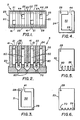
- spinning pack 5 consists of end walls or plates 20, spacer plates 21 and 24, capillary plates 22, divider plates 23 and spinneret plate 25 arranged as shown in Fig. 2.
- each of the spacer plates 21 and 24 has inlets 41 and 44, respectively, leading to central cavity 50.
- each of the capillary plates 22 has rectangular slots 60 extending inwardly and perpendicularly from the lower edge thereof a selected distance.
- each of the divider plates 23 has rectangular slots 70 extending inwardly and perpendicularly from the lower edge thereof.
- Slots 60 are of the same width as slots 70 but are longer. When plates 22 and 23 are arranged as shown in Fig. 2, slots 70 are aligned with slots 60.
- Spacer plates 21 differ from spacer plates 24 in that inlet 41 of plates 21 is reversed from inlet 44 of plates 24 as shown in Fig. 1.
- Spinneret plate 25 has orifices 80 and facilitates formation of uniform filaments. Spinneret plate 25 may be attached to the other plates by any suitable means. According to a preferred embodiment of the invention spinneret plate 25 is compression fitted (stretched) over the other plates.
- plates 20 - 24 are constructed and arranged so as to define a curved (convex) lower surface over which spinneret plate 25 is stretched.
- Stretching of spinneret plate 25 over plates 20 - 24 may be accomplished by suitable mechanical means, such as clamps, which pull spinneret plate 25 over the other plates.
- the convex surface defined by plates 20 - 24 conforms to and fits snugly against the upper surface of spinneret plate 25. (If the lower surface formed by plates 20 - 24 were flat instead of convex, spinneret plate 25 tends to bulge away and separate from the other during use of the pack.)
- Slots 70 of plates 23 align with orifices 80 of spinneret plate 25 and compensate for any misalignment of slots 60 and orifices 80. If desired, however, slots 70 may be omitted (i.e. plates 23 may be solid).
- spinneret plate 25 is omitted from pack 5, plates 23 have slots 70 and the lower surface of the pack defined by plates 20 - 24 is flat. (In this instance, if plates 23 were solid, each pair of opposite slots 60 abutting plates 23 would form two monocomponent fibers instead of one bicomponent fiber.)
- each orifice 80 to deliver an accurately controlled flow of dope to its outlet.
- the solutions are emitted from orifices 80 in the form of streams which, when coagulated, provide bicomponent fila ments in which the components are arranged in either a side-by-side or sheath/core configuration along the longitudinal axis of the filaments, depending on the viscosities of the two spinning solutions.
- the solutions are of the same viscosity
- the components will be arranged in a side-by-side configuration, whereas if solutions are each of a different viscosity, the components will be arranged in or approximate a sheath/core configuration since the lower viscosity solution tends to wrap around the higher viscosity solution.
- spinning pack 5 improved distribution of flow is achieved by sizing the thickness and width of slots 60 so that those through which one of the two spinning dopes flows enroute to orifices 80 are of a lesser cross-sectional area than those through which the other spinning dope flows.
- formation of sheath/core fibers is facilitated by placing tubes between each opening defined by slots 60 and 70 and each spinneret plate orifice 80.
- the tubes are, for example, 2.54 cm long and sealably connected to each said opening and its corresponding orifice 80.
- the dopes are considerably hotter (30° to 60°C.) than the aqueous coagulating liquid. It is important that dope in cavities 50 located at the outer portion of the pack is not cooled by the aqueous coagulating liquid to a greater extent than is dope in cavities 50 located at the center of the pack. Lowering the temperature of the dope, increases its viscosity, lowers its flow rate through the pack and, consequently, causes smaller diameter fibers to be formed. To prevent this, it is a conventional practice to heat packs, for example, by jacketing the pack and circulating a heating fluid (e.g. steam or oil) in the jacket or by providing channels in the plates for circulating a heated fluid.
- a heating fluid e.g. steam or oil
- the components are arranged in a side-by-side configuration where the distribution of the components is in a ratio of 1:1, that is, in cross-section one half of the filament consist entirely of one of the components and the other half consists entirely of the other component.
- the distribution of the components in the filaments can be selected by selecting the appropriate rates at which the solutions are fed to the orifices, for example, if one of the solutions is fed to the orifices at twice the rate of the other solution, the distribution of the two components in the filament will be in a ratio of 1:2, assuming Newtonium flow and other conditions remained the same.
- the distribution of the components in each filament and from filament to filament is maintained substantially the same by means of divider plates 23.
- the packs of the invention are particularly useful for providing a tow consisting of at least 20,000 conjugate acrylic filaments in which the distribution of the components is 1:1. Since the size of each of the filaments formed by the pack will be determined by the cross-sectional area of orifices 80, plates 22 and 23 must be thin and the slots narrow in order to provide packs capable of spinning 20,000 plus filaments. Suitable plates for preparing such a pack would be, for example, divider plates 23 each having a thickness of 3 mils, capillary plates 22 each having a thickness of 6 mils and spacer plates 21 and 24 each having a thickness of 31 mils.
- a typical spinneret plate 25 has a thickness of 0.152 cm and each orifice 80 a diameter of 0.009 cm.
- Slots 60 and 70 are preferably provided in plates 22 and 23 by means of electron discharge machining techniques. The plates are assembled in the order shown in Fig. 2. This order of assembly is continued until a pack with the desired number of orifices is achieved. The plates are held in alignment by means of dowel rods 28 during assembly and bonding of the plates. The assembled pack is then preferably subjected to appropriate diffusion bonding conditions to provide a monolithic structure.
- This example illustrates wet spinning conjugate acrylic filaments using the pack of the present invention.
- a first spinning solution is prepared by dissolving an appropriate amount of an acrylic polymer containing 92.5% of acrylonitrile (AN) and 7.5% vinyl acetate (VA) in dimethylacetamide (DMAc) to provide a solution containing 25% of the polymer.
- a second spinning solution of about the same viscosity is prepared in the same way, except in this instance the acrylic polymer contains 92.1% AN, 7.3% VA and 0.6% sodium p-sulfophenylmethallyl ether (SPME).
- SPME sodium p-sulfophenylmethallyl ether
- the first solution at 100°C. is fed into the pack through inlets 41 (Fig. 1) and the second spinning solution at 100°C. is fed into the pack through inlets 44 (Fig. 1).
- the resulting tow consisting of 30,000 bicomponent filaments in which the components are arranged in a side-by-side configuration is withdrawn from the coagulation bath at a linear speed of 20 fpm (6.1 mpm) with a theoretical jet stretch of 0.9 times by a first set of rolls, washed on these rolls, then stretched 6 times in boiling water between the first set of rolls and a second set of rolls, washed on the second set of rolls, dried on drying rolls and collected on a winder bobbin at a speed of 120 fpm (36.6m).
- the tow is then crimped and annealed with steam under conditions that do not develop the latent helical crimp present in the conjugate filaments of the tow.
- the tow is then converted to staple and made into skeins of yarn.
- the yarn is then wet-dyed and dried under conditions that develop the latent helical crimp.
- the resulting yarns have excellent bulk when observed under a microscope, the distribution of the tow components is substantially uniform along the length of each filament and from filament to filament and there is no visual evidence of splitting of the components.
- bicomponent filaments in which the components are arranged in a sheath/core configuration are made by utilizing the above dopes except in this instance the dopes are prepared so that the dope containing SPME is of a lesser viscosity (e.g. 1/6th) than the other dope. Similar results are obtained.
Landscapes
- Engineering & Computer Science (AREA)
- Mechanical Engineering (AREA)
- Textile Engineering (AREA)
- Spinning Methods And Devices For Manufacturing Artificial Fibers (AREA)
- Multicomponent Fibers (AREA)
Priority Applications (1)
| Application Number | Priority Date | Filing Date | Title |
|---|---|---|---|
| AT89870212T ATE97174T1 (de) | 1988-12-29 | 1989-12-21 | Duesenpaket zum spinnen von bikomponenten faden. |
Applications Claiming Priority (2)
| Application Number | Priority Date | Filing Date | Title |
|---|---|---|---|
| US29189188A | 1988-12-29 | 1988-12-29 | |
| US291891 | 1988-12-29 |
Publications (3)
| Publication Number | Publication Date |
|---|---|
| EP0376911A2 true EP0376911A2 (de) | 1990-07-04 |
| EP0376911A3 EP0376911A3 (de) | 1991-05-29 |
| EP0376911B1 EP0376911B1 (de) | 1993-11-10 |
Family
ID=23122311
Family Applications (1)
| Application Number | Title | Priority Date | Filing Date |
|---|---|---|---|
| EP89870212A Expired - Lifetime EP0376911B1 (de) | 1988-12-29 | 1989-12-21 | Düsenpaket zum Spinnen von bikomponenten Faden |
Country Status (5)
| Country | Link |
|---|---|
| EP (1) | EP0376911B1 (de) |
| JP (1) | JP2891425B2 (de) |
| AT (1) | ATE97174T1 (de) |
| DE (1) | DE68910664T2 (de) |
| ES (1) | ES2045560T3 (de) |
Cited By (1)
| Publication number | Priority date | Publication date | Assignee | Title |
|---|---|---|---|---|
| WO2004044280A3 (en) * | 2002-11-14 | 2004-11-18 | Spin Tec Engineering Gmbh | Apparatus and method for forming materials |
Family Cites Families (5)
| Publication number | Priority date | Publication date | Assignee | Title |
|---|---|---|---|---|
| US3176345A (en) * | 1962-06-25 | 1965-04-06 | Monsanto Co | Spinnerette |
| US3192563A (en) * | 1962-06-25 | 1965-07-06 | Monsanto Co | Laminated spinneret |
| NL125332C (de) * | 1962-06-25 | |||
| GB1149049A (en) * | 1965-11-04 | 1969-04-16 | Japan Exlan Co Ltd | Apparatus for spinning conjugate fibres |
| JPS5468417A (en) * | 1977-11-07 | 1979-06-01 | Mitsubishi Rayon Co Ltd | Acrylonitrile synthetic fibers and their production |
-
1989
- 1989-12-21 EP EP89870212A patent/EP0376911B1/de not_active Expired - Lifetime
- 1989-12-21 ES ES89870212T patent/ES2045560T3/es not_active Expired - Lifetime
- 1989-12-21 AT AT89870212T patent/ATE97174T1/de active
- 1989-12-21 DE DE89870212T patent/DE68910664T2/de not_active Expired - Fee Related
- 1989-12-28 JP JP1345046A patent/JP2891425B2/ja not_active Expired - Fee Related
Cited By (1)
| Publication number | Priority date | Publication date | Assignee | Title |
|---|---|---|---|---|
| WO2004044280A3 (en) * | 2002-11-14 | 2004-11-18 | Spin Tec Engineering Gmbh | Apparatus and method for forming materials |
Also Published As
| Publication number | Publication date |
|---|---|
| JP2891425B2 (ja) | 1999-05-17 |
| EP0376911B1 (de) | 1993-11-10 |
| ES2045560T3 (es) | 1994-01-16 |
| DE68910664T2 (de) | 1994-04-28 |
| JPH02221405A (ja) | 1990-09-04 |
| ATE97174T1 (de) | 1993-11-15 |
| EP0376911A3 (de) | 1991-05-29 |
| DE68910664D1 (de) | 1993-12-16 |
Similar Documents
| Publication | Publication Date | Title |
|---|---|---|
| US5017116A (en) | Spinning pack for wet spinning bicomponent filaments | |
| US4406850A (en) | Spin pack and method for producing conjugate fibers | |
| US5505889A (en) | Method of spinning bicomponent filaments | |
| US4370114A (en) | Spinneret assembly for use in production of multi-ingredient multi-core composite filaments | |
| US3501805A (en) | Apparatus for forming multicomponent fibers | |
| US5650112A (en) | Process of making cellulose fibers | |
| US4308004A (en) | Device for the production of bi-component yarns | |
| JPS62156306A (ja) | 複合紡糸用口金装置 | |
| WO2002072929A1 (de) | Verfahren und vorrichtung zur herstellung von cellulosefasern und cellulosefilamentgarnen | |
| US3182106A (en) | Spinning multi-component fibers | |
| US3192563A (en) | Laminated spinneret | |
| JPS6158566B2 (de) | ||
| EP0334653B1 (de) | Verfahren und Düse zum Schmelzblasspinnen | |
| CN109097848A (zh) | 一种超细旦多孔扁平fdy长丝的制备方法 | |
| CA1298503C (en) | Multifilament type plastic optical fiber | |
| EP0376911B1 (de) | Düsenpaket zum Spinnen von bikomponenten Faden | |
| US5397227A (en) | Apparatus for changing both number and size of filaments | |
| US3403422A (en) | Apparatus for spinning multicomponent fibers | |
| CN114875592B (zh) | 一种警用服饰编织产品用涤纶纤维牵伸装置 | |
| US3859031A (en) | Spinneret capillary metering plugs | |
| US3413683A (en) | Annular bi-component spinerette assembly | |
| CN117779218B (zh) | 用于纤维纺丝热牵伸处理的凹槽结构和应用及热牵伸方法和聚丙烯腈基碳纤维原丝 | |
| EP0265074A1 (de) | Kunststoffmultifilamentfaser als optische Faser | |
| JP2540384B2 (ja) | 芯鞘型複合繊維の製造方法および口金装置 | |
| SK7172000A3 (en) | Process and apparatus for collecting continuous blow spun fibers |
Legal Events
| Date | Code | Title | Description |
|---|---|---|---|
| PUAI | Public reference made under article 153(3) epc to a published international application that has entered the european phase |
Free format text: ORIGINAL CODE: 0009012 |
|
| AK | Designated contracting states |
Kind code of ref document: A2 Designated state(s): AT BE CH DE ES FR GB GR IT LI LU NL SE |
|
| PUAL | Search report despatched |
Free format text: ORIGINAL CODE: 0009013 |
|
| AK | Designated contracting states |
Kind code of ref document: A3 Designated state(s): AT BE CH DE ES FR GB GR IT LI LU NL SE |
|
| 17P | Request for examination filed |
Effective date: 19911021 |
|
| 17Q | First examination report despatched |
Effective date: 19920224 |
|
| GRAA | (expected) grant |
Free format text: ORIGINAL CODE: 0009210 |
|
| AK | Designated contracting states |
Kind code of ref document: B1 Designated state(s): AT BE CH DE ES FR GB GR IT LI LU NL SE |
|
| REF | Corresponds to: |
Ref document number: 97174 Country of ref document: AT Date of ref document: 19931115 Kind code of ref document: T |
|
| ET | Fr: translation filed | ||
| REF | Corresponds to: |
Ref document number: 68910664 Country of ref document: DE Date of ref document: 19931216 |
|
| REG | Reference to a national code |
Ref country code: ES Ref legal event code: FG2A Ref document number: 2045560 Country of ref document: ES Kind code of ref document: T3 |
|
| EPTA | Lu: last paid annual fee | ||
| ITF | It: translation for a ep patent filed | ||
| REG | Reference to a national code |
Ref country code: GR Ref legal event code: FG4A Free format text: 3010058 |
|
| PLBE | No opposition filed within time limit |
Free format text: ORIGINAL CODE: 0009261 |
|
| STAA | Information on the status of an ep patent application or granted ep patent |
Free format text: STATUS: NO OPPOSITION FILED WITHIN TIME LIMIT |
|
| PGFP | Annual fee paid to national office [announced via postgrant information from national office to epo] |
Ref country code: LU Payment date: 19941101 Year of fee payment: 6 |
|
| 26N | No opposition filed | ||
| PGFP | Annual fee paid to national office [announced via postgrant information from national office to epo] |
Ref country code: FR Payment date: 19941112 Year of fee payment: 6 |
|
| PGFP | Annual fee paid to national office [announced via postgrant information from national office to epo] |
Ref country code: CH Payment date: 19941114 Year of fee payment: 6 |
|
| PGFP | Annual fee paid to national office [announced via postgrant information from national office to epo] |
Ref country code: AT Payment date: 19941118 Year of fee payment: 6 |
|
| PGFP | Annual fee paid to national office [announced via postgrant information from national office to epo] |
Ref country code: SE Payment date: 19941121 Year of fee payment: 6 |
|
| PGFP | Annual fee paid to national office [announced via postgrant information from national office to epo] |
Ref country code: BE Payment date: 19941124 Year of fee payment: 6 |
|
| PGFP | Annual fee paid to national office [announced via postgrant information from national office to epo] |
Ref country code: GR Payment date: 19941129 Year of fee payment: 6 |
|
| PGFP | Annual fee paid to national office [announced via postgrant information from national office to epo] |
Ref country code: NL Payment date: 19941231 Year of fee payment: 6 |
|
| EAL | Se: european patent in force in sweden |
Ref document number: 89870212.1 |
|
| PG25 | Lapsed in a contracting state [announced via postgrant information from national office to epo] |
Ref country code: LU Free format text: LAPSE BECAUSE OF NON-PAYMENT OF DUE FEES Effective date: 19951221 Ref country code: AT Effective date: 19951221 |
|
| PG25 | Lapsed in a contracting state [announced via postgrant information from national office to epo] |
Ref country code: SE Effective date: 19951222 |
|
| PG25 | Lapsed in a contracting state [announced via postgrant information from national office to epo] |
Ref country code: LI Effective date: 19951231 Ref country code: CH Effective date: 19951231 Ref country code: BE Effective date: 19951231 |
|
| BERE | Be: lapsed |
Owner name: MONSANTO CY Effective date: 19951231 |
|
| PG25 | Lapsed in a contracting state [announced via postgrant information from national office to epo] |
Ref country code: GR Free format text: THE PATENT HAS BEEN ANNULLED BY A DECISION OF A NATIONAL AUTHORITY Effective date: 19960630 |
|
| PG25 | Lapsed in a contracting state [announced via postgrant information from national office to epo] |
Ref country code: NL Effective date: 19960701 |
|
| REG | Reference to a national code |
Ref country code: CH Ref legal event code: PL |
|
| PG25 | Lapsed in a contracting state [announced via postgrant information from national office to epo] |
Ref country code: FR Effective date: 19960830 |
|
| REG | Reference to a national code |
Ref country code: GR Ref legal event code: MM2A Free format text: 3010058 |
|
| NLV4 | Nl: lapsed or anulled due to non-payment of the annual fee |
Effective date: 19960701 |
|
| REG | Reference to a national code |
Ref country code: FR Ref legal event code: ST |
|
| REG | Reference to a national code |
Ref country code: GB Ref legal event code: 732E |
|
| REG | Reference to a national code |
Ref country code: GB Ref legal event code: IF02 |
|
| PGFP | Annual fee paid to national office [announced via postgrant information from national office to epo] |
Ref country code: GB Payment date: 20051214 Year of fee payment: 17 |
|
| PGFP | Annual fee paid to national office [announced via postgrant information from national office to epo] |
Ref country code: ES Payment date: 20051226 Year of fee payment: 17 |
|
| PGFP | Annual fee paid to national office [announced via postgrant information from national office to epo] |
Ref country code: DE Payment date: 20060131 Year of fee payment: 17 |
|
| PGFP | Annual fee paid to national office [announced via postgrant information from national office to epo] |
Ref country code: IT Payment date: 20061231 Year of fee payment: 18 |
|
| PG25 | Lapsed in a contracting state [announced via postgrant information from national office to epo] |
Ref country code: DE Free format text: LAPSE BECAUSE OF NON-PAYMENT OF DUE FEES Effective date: 20070703 |
|
| GBPC | Gb: european patent ceased through non-payment of renewal fee |
Effective date: 20061221 |
|
| PG25 | Lapsed in a contracting state [announced via postgrant information from national office to epo] |
Ref country code: GB Free format text: LAPSE BECAUSE OF NON-PAYMENT OF DUE FEES Effective date: 20061221 |
|
| REG | Reference to a national code |
Ref country code: ES Ref legal event code: FD2A Effective date: 20061222 |
|
| PG25 | Lapsed in a contracting state [announced via postgrant information from national office to epo] |
Ref country code: ES Free format text: LAPSE BECAUSE OF NON-PAYMENT OF DUE FEES Effective date: 20061222 |
|
| PG25 | Lapsed in a contracting state [announced via postgrant information from national office to epo] |
Ref country code: IT Free format text: LAPSE BECAUSE OF NON-PAYMENT OF DUE FEES Effective date: 20071221 |