EP0377395A2 - Equilibrage de charge d'un serveur - Google Patents
Equilibrage de charge d'un serveur Download PDFInfo
- Publication number
- EP0377395A2 EP0377395A2 EP89480184A EP89480184A EP0377395A2 EP 0377395 A2 EP0377395 A2 EP 0377395A2 EP 89480184 A EP89480184 A EP 89480184A EP 89480184 A EP89480184 A EP 89480184A EP 0377395 A2 EP0377395 A2 EP 0377395A2
- Authority
- EP
- European Patent Office
- Prior art keywords
- call
- transfer
- phone call
- phone
- display
- Prior art date
- Legal status (The legal status is an assumption and is not a legal conclusion. Google has not performed a legal analysis and makes no representation as to the accuracy of the status listed.)
- Ceased
Links
- 238000012546 transfer Methods 0.000 claims abstract description 91
- 238000000034 method Methods 0.000 claims abstract description 30
- 238000004891 communication Methods 0.000 claims description 67
- 230000006854 communication Effects 0.000 claims description 67
- 238000012545 processing Methods 0.000 claims description 29
- 230000004044 response Effects 0.000 claims description 4
- 238000013507 mapping Methods 0.000 claims 2
- 230000006870 function Effects 0.000 description 56
- 238000007726 management method Methods 0.000 description 23
- 230000000694 effects Effects 0.000 description 18
- 238000010586 diagram Methods 0.000 description 13
- 230000008569 process Effects 0.000 description 10
- 230000009471 action Effects 0.000 description 8
- 238000004458 analytical method Methods 0.000 description 7
- 238000004422 calculation algorithm Methods 0.000 description 7
- 238000009826 distribution Methods 0.000 description 7
- 238000013459 approach Methods 0.000 description 5
- 230000005540 biological transmission Effects 0.000 description 5
- 230000008859 change Effects 0.000 description 5
- 238000001514 detection method Methods 0.000 description 5
- 230000002093 peripheral effect Effects 0.000 description 5
- 230000008901 benefit Effects 0.000 description 4
- 238000003860 storage Methods 0.000 description 4
- 238000012360 testing method Methods 0.000 description 4
- 238000010200 validation analysis Methods 0.000 description 4
- 102100032920 Chromobox protein homolog 2 Human genes 0.000 description 3
- 101000797586 Homo sapiens Chromobox protein homolog 2 Proteins 0.000 description 3
- 238000004883 computer application Methods 0.000 description 3
- 238000012423 maintenance Methods 0.000 description 3
- 238000011084 recovery Methods 0.000 description 3
- 238000007792 addition Methods 0.000 description 2
- 238000013461 design Methods 0.000 description 2
- 238000005516 engineering process Methods 0.000 description 2
- 230000006872 improvement Effects 0.000 description 2
- 230000007257 malfunction Effects 0.000 description 2
- 238000012544 monitoring process Methods 0.000 description 2
- 238000005070 sampling Methods 0.000 description 2
- 238000013024 troubleshooting Methods 0.000 description 2
- 230000000712 assembly Effects 0.000 description 1
- 238000000429 assembly Methods 0.000 description 1
- 238000013475 authorization Methods 0.000 description 1
- 230000006399 behavior Effects 0.000 description 1
- 230000002457 bidirectional effect Effects 0.000 description 1
- 229940000425 combination drug Drugs 0.000 description 1
- 230000000295 complement effect Effects 0.000 description 1
- 238000001816 cooling Methods 0.000 description 1
- 238000012937 correction Methods 0.000 description 1
- 238000013479 data entry Methods 0.000 description 1
- 238000003066 decision tree Methods 0.000 description 1
- 230000001419 dependent effect Effects 0.000 description 1
- 230000005611 electricity Effects 0.000 description 1
- 230000008030 elimination Effects 0.000 description 1
- 238000003379 elimination reaction Methods 0.000 description 1
- 125000000524 functional group Chemical group 0.000 description 1
- 230000000977 initiatory effect Effects 0.000 description 1
- 238000009434 installation Methods 0.000 description 1
- PWPJGUXAGUPAHP-UHFFFAOYSA-N lufenuron Chemical compound C1=C(Cl)C(OC(F)(F)C(C(F)(F)F)F)=CC(Cl)=C1NC(=O)NC(=O)C1=C(F)C=CC=C1F PWPJGUXAGUPAHP-UHFFFAOYSA-N 0.000 description 1
- 238000012986 modification Methods 0.000 description 1
- 230000004048 modification Effects 0.000 description 1
- 230000006855 networking Effects 0.000 description 1
- 238000002360 preparation method Methods 0.000 description 1
- 238000003825 pressing Methods 0.000 description 1
- 230000003068 static effect Effects 0.000 description 1
- 230000009897 systematic effect Effects 0.000 description 1
- 230000007704 transition Effects 0.000 description 1
- 230000001960 triggered effect Effects 0.000 description 1
- 210000003954 umbilical cord Anatomy 0.000 description 1
- 230000000007 visual effect Effects 0.000 description 1
Images




Classifications
-
- H—ELECTRICITY
- H04—ELECTRIC COMMUNICATION TECHNIQUE
- H04Q—SELECTING
- H04Q11/00—Selecting arrangements for multiplex systems
- H04Q11/04—Selecting arrangements for multiplex systems for time-division multiplexing
-
- H—ELECTRICITY
- H04—ELECTRIC COMMUNICATION TECHNIQUE
- H04M—TELEPHONIC COMMUNICATION
- H04M3/00—Automatic or semi-automatic exchanges
- H04M3/42—Systems providing special services or facilities to subscribers
- H04M3/50—Centralised arrangements for answering calls; Centralised arrangements for recording messages for absent or busy subscribers ; Centralised arrangements for recording messages
- H04M3/51—Centralised call answering arrangements requiring operator intervention, e.g. call or contact centers for telemarketing
-
- H—ELECTRICITY
- H04—ELECTRIC COMMUNICATION TECHNIQUE
- H04M—TELEPHONIC COMMUNICATION
- H04M3/00—Automatic or semi-automatic exchanges
- H04M3/42—Systems providing special services or facilities to subscribers
- H04M3/50—Centralised arrangements for answering calls; Centralised arrangements for recording messages for absent or busy subscribers ; Centralised arrangements for recording messages
- H04M3/51—Centralised call answering arrangements requiring operator intervention, e.g. call or contact centers for telemarketing
- H04M3/523—Centralised call answering arrangements requiring operator intervention, e.g. call or contact centers for telemarketing with call distribution or queueing
-
- H—ELECTRICITY
- H04—ELECTRIC COMMUNICATION TECHNIQUE
- H04M—TELEPHONIC COMMUNICATION
- H04M3/00—Automatic or semi-automatic exchanges
- H04M3/42—Systems providing special services or facilities to subscribers
- H04M3/58—Arrangements for transferring received calls from one subscriber to another; Arrangements affording interim conversations between either the calling or the called party and a third party
-
- H—ELECTRICITY
- H04—ELECTRIC COMMUNICATION TECHNIQUE
- H04M—TELEPHONIC COMMUNICATION
- H04M3/00—Automatic or semi-automatic exchanges
- H04M3/42—Systems providing special services or facilities to subscribers
- H04M3/50—Centralised arrangements for answering calls; Centralised arrangements for recording messages for absent or busy subscribers ; Centralised arrangements for recording messages
- H04M3/51—Centralised call answering arrangements requiring operator intervention, e.g. call or contact centers for telemarketing
- H04M3/523—Centralised call answering arrangements requiring operator intervention, e.g. call or contact centers for telemarketing with call distribution or queueing
- H04M3/5237—Interconnection arrangements between ACD systems
Definitions
- This invention generally relates to improvements in data processing applications in a multiplex communication system and, more particularly, to load balancing of Automatic Call Distribution (ACD) agent positions in applications requiring the transfer of a phone call and the terminal display information associated with the phone call on a digital switch.
- ACD Automatic Call Distribution
- the display terminal also provided a useful repository of information for the employee.
- a client could call to obtain a current quotation on a stock portfolio.
- the client might also request prospectus information on other possible investments.
- the employee could access a host database to acquire the stock information; and, if the client wanted to place an order for additional stock, the employee could transfer the call to a broker. However, the broker would have to access the same information again that the other employee had before him on the display terminal before transferring the call.
- US Patent 4,788,682 discloses a method for providing a directory number to a sales person engaged in telemarketing to increase the efficiency of outbound telemarketing personnel.
- This patent provides no teaching of transferring information associated with a call to another interested party in conjunction with the transfer of the call. Also, there is no teaching of load balancing.
- these objects are accomplished by configuring a set of host data structures to link phone extensions to particular display terminals attached to the host and a particular CICS application.
- the data structures also contain information regarding the appropriate transfer of information from the host application to the phone extension across the network of digital switches.
- CBX and host have communication managers to facilitate the transfer of messages using a standard protocol. Also, a standard application manager is used to coordinate the activities of the system programs and other preexisting applications. The status of each call is carefully tracked by the system programs and recorded in logs for current and future analysis.
- the Computerized Branch Exchange (CBX) 1 is the digital switch that manages the telephone processing.
- the CBX 1 interfaces to the host 3 via an Logical Unit (LU) 6.2 interface 2.
- LU Logical Unit
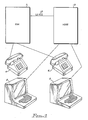
- the agent performs the normal tasks associated with transferring a call.
- the CBX 1 translates the request into a corresponding host display terminal transfer request transaction from terminal display 5 to display terminal 7.
- the transaction is built and sent from the CBX 1 through the LU 6.2 link 2 to the host 3.
- the host 3 performs a table lookup to determine the terminal display 7 associated with the new phone extension 6.
- the current display transaction that is displayed on the transferror terminal display 5 is displayed on the new terminal display 7.
- FIG. 2 An example of a prior art CBX, similar to the preferred embodiment, is provided in Figure 2, which illustrates the computer control equipment associated with the prior art ROLM CBX II 9000.
- the hardware consists of redundant memory 10, a shared, switched I/O bus (ISB) 20, various interface cards 30, disk 40, and redundant processors 50.
- ISB switched I/O bus
- INL Inter Node Link
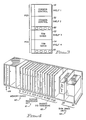
- FIG. 3 illustrates the hardware shelf layout of the CBX.
- Shelf one 51 is a common control shelf in a redundant system cabinet or another Time Division Multiplex (TDM) card shelf in a nonredundant system cabinet.
- Shelf two 52 is always a common control shelf.
- Shelves three 53 and four 54 are always TDM card shelves. Air cooling systems and redundant power systems are provided at 55 to dissipate heat and provide system power.
- TDM Time Division Multiplex
- FIG 4 illustrates the CPU shelf slots of the common control slot 52.
- memory cards 60 there are memory cards 60, processor set 61, shared input/ output (I/O) hardware 62, and disk drive units 63.
- the processor cards contain the microprocessors.
- the common control motherboard 64 is used to join the other common control motherboard from the redundant common control shelf 51 and the TDM shelves 53 and 54.
- FIG. 5 shows the TDM shelf slots.
- the TDM communication cards fit into the slots shown at 65.
- the other TDM cards occupy the slots at 68.
- Slot 70 is reserved for Line Shelf Monitor LSM which monitors the power supply and contains the fuses. If LSM detects a power supply failures or fuse failures, it is reported to error analysis by a scanner reporting a monitor error. Error analysis then parses specific decision trees to generate suggested actions.
- LSM Line Shelf Monitor
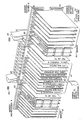
- Figure 6 is a hardware block diagram of the CBX system.
- the figure is a functional representation of the preferred embodiment of the CBX.
- Nodes are the modular building blocks of the CBX system. Each node can function as a stand-alone telecommunication system consisting of the time division multiplexing (TDM) switching network, processors, cabinet and power system, and interface cards.
- TDM time division multiplexing
- a single-node system can expand from one to five equipment cabinets to accommodate up to 2,000 lines.
- the CBX is a digital switching system using TDM and pulse code modulation (PCM) to support a wide range, of voice, data, and specialty applications.
- PCM pulse code modulation
- a 32-bit processor and Random Access Memory (RAM) provide control intelligence within each node.
- Multiplexing is a method of using a single communication channel to carry multiple speech and/or data transmissions simultaneously.
- the TDM channel use is alternated between users or between system functions, each receiving a small portion of channel time (a time slot) in rotation.
- the channel seems to be reserved for each individual transmission, but because of the highspeed channel, it carries many transmissions simultaneously.
- PCM is the process which analog sound waves of voice conversations are sampled, translated into digital signals, transported over the TDM network, and reconstructed into analog signals.
- the CBX samples voice signals at 8,000 times per second. The samples are converted into 8-bit binary words, which are transmitted over the data bus.
- Bus is the entire TDM switching network. It maintains the connections established by the processor and passes information between the common control electronics and the telephones, terminals, and trunks.
- the bus is the vehicle for intranode communication.
- the bus is a 16-bit, parallel, unidirectional bus that has a capacity of 295 megabits per second (Mbps). It provides 1,152 two-way or full-duplex communication channels, of which 1045 are available for voice/data traffic. The system uses the remaining channels for various control functions, such as setting up phone displays.
- TDM Network Control Group This group consists of the: * Intrashelf Bus 84 * Intershelf bus 86 & 87 * Expander 80 cards * TDM controller cards
- Intrashelf Bus 84 On the back of each TDM shelf is an Intrashelf Bus 84 implemented on the TDM backplane.
- the Intrashelf Bus 84 permits communication within a shelf.
- one Expander 80 card plugs into each Intrashelf Bus 84. Expander 80 cards provide the interface between the Intrashelf Bus 84 and the intershelf bus (ISB).
- ISB intershelf bus
- Each Intrashelf Bus 84 includes a 16-bit bidirectional data bus, a 10-bit address bus, and an "enable" line to each card.
- the enable line eliminates the need for configuring each card with a particular shelf address, so that interface cards can occupy any slot on the shelf. In addition, the enable line simplifies address decoding, which increases reliability
- ISB is an integral part of the proprietary Bus structure, handles communication among shelves through a flat, ribbon cable attached to the TDM controller (TC 81) card and the Expander 80 cards on each shelf.
- the ISB supports a data rate of 295 Mbps over two unidirectional buses: the source bus 87 and the Destination bus 86.
- Expander 80 cards are also redundant. When one common control side of the cabinet is active, one of the Expander 80 cards is in use, while the redundant (inactive) common control side and other Expander 80 card will wait to become active.
- Each Expander 80 card contains a connection table for all voice and data connections affecting its shelf. This frees intrashelf bandwidth for call data, instead of consuming bandwidth for the address information needed to make connections.
- the Expander 80 cards, TC 81 card, and Turnaround 82 card use the Bus ISB clock (located on the Turnaround 82 card) for timing the Bus traffic. This maintains the correct timing relationship between the data, which travels along the bus, and the clock pulses.
- the turnaround card also sends out a pulse at the beginning of each sampling interval. The pulse tells the Expander 80 card to start again with the first entry in the connection table.
- the Bus TC 81 card maintains supervision of the processor-ISB-interface communication.
- TC 81 cards reside on the common control shelves in cabinet 1 of a CBX node.
- the TC 81 card is responsible for the following three activities: loading and verifying the connection table on each Expander 80; configuring the turnaround card and InterNode Link (INL 83) hardware; and communicating with the various line card groups.
- the TC 81 card handles up to 12 Mbps of control information.
- Control packets contain addressing, control, and data information for loading the Expander 80 connection tables and reading the status of line cards.
- the TC 81 cards maintain a communication path between the two ends of a voice or data call.
- the processor through the TC 81 card, switches digitized signals by assigning them to unique time slots on the ISB.
- the Bus ISB uses TDM techniques, which enable the ISB to carry a large amount of simultaneous voice and data transmission.
- the Bus TC 81 card maintains supervision of the processor_ISB-interface communication.
- TC 81 cards reside on the common control shelves in cabinet 1 of a CBX node.
- the TC 81 card is responsible for the following three activities: loading and verifying the connection table on each Expander 80; configuring the Turnaround 82 card and InterNode Link(INL 83) hardware; and communicating with the various line card groups.
- the TC 81 card handles up to 12 Mbps of control information.
- Control packets contain addressing, control, and data information for loading the expander connection tables and reading the status of line cards.
- the TC 81 card maintain a communication path between the two ends of a voice or data call.
- the processor through the TC 81 card, switches digitized signals by assigning them to unique time slots on the ISB.
- the bus uses TDM techniques, which enable the ISB to carry a large amount of simultaneous voice and data transmission.
- the Turnaround 82 card turns the data around on the bus.
- the Expander 80 card on the transmitting card's shelf places a data word on the source bus 87.
- the data word travels to the right until it encounters the Turnaround 82 card, which receives the word and retransmits it ("turns it around") to the Destination bus 86. Then the Expander 80 on the destination shelf captures the word and sends it on to the proper card.
- the advantage of using the turnaround card is that information retransmitted in an individual time slot to the Destination bus 86 and the receiving card can be complete severelyly different from information received in that time slot from the source bus 87 and the transmitting card. This doubles the traffic capacity of the switch by allowing two internode conversations to take place in a single time slot on the bus.
- the Turnaround 82 card can fill this empty slot with a voice sample from the other end of the conversation. In this way, the signals from both ends of the conversation can occupy the same time slot simultaneously.
- the system clock In each node of a multinode CBX system, the system clock provides timing for the TDM network via the Turnaround 82 card. It also synchronizes INL 83 operation between nodes.
- the source of this clock can be its own internal system, or it can synchronize from an external T1 interface trunk.
- the system clock conforms to Stratum 4 of the Bell Network Synchronization Plan.
- the new Bus provides the CBX with 2,304 timeslots per node.
- Bandwidth is the measure of voice and data traffic capacity in the CBX.
- the clock speed of the Bus 16-bit parallels backplane is 18,432 MHz.
- the CBX offers the advantage of computer common control. With the stored programs of computer common control, it is easy to update features as business needs change. This provides greater flexibility and reduces the cost of feature additions and other changes that may be made in the future.
- the computer common control group directs all activities within the CBX system.
- a single-node CBX supports 1 or 2 common control shelves. Shelf 2 of cabinet 1 always houses a computer common control group. To increase reliability in critical applications or larger systems, shelf 1 can accommodate a second, or redundant, common control group.
- These groups consist of: * Processor * Memory * TDM control card * Floppy disk drives * A hard disk drive * Peripheral device controller * I/O cards * Diagnostic cards * Control Packet Network Interface (multinode only)
- the 9000 is a 32-bit processor employed by the CBX. It is a ROLM-proprietary design using powerful, high-speed, bit-slice technology, with a ROLM proprietary instruction set.
- a single node configuration supports form 7,500 to 11,000 Busy Hour Call Attempts (BHCA); that is, the total number of call setups attempted during the hour when the CBX carries the most traffic.
- the processor controlling the system is the active processor; the other one is the standby processor. Either processor can provide standby common control to prevent a failure in the active common control from halting system operation.
- the active processor continually transfers new information, such as moves and changes, Station Speed Calling information, as well as calls-in-progress information to the standby computer. Therefore, in the event of a switchover from the active computer, the standby computer always contains current information regarding the state of the system.
- CBX uses RAM to store all system software. Stored in memory are the system operating software, system-specific configuration parameters, and operating data. Each processor can access up to four memory cards. Each memory card accommodates 1 million words of memory, with each word composed of 16 bits plus 6 Error Correcting Code (ECC) bits. ECC improves the accuracy with which the system memory retains information. By automatically detecting and correcting all memory single-bit errors and detecting most multiple-bit errors, ECC minimizes the likelihood of a system failure due to a malfunctioning memory component. Systems with redundant processors are capable of detecting multiple-bit errors and automatically switching to the redundant computer. In addition, a hardware register on the memory card enters errors into a table to aid servicing.
- ECC Error Correcting Code
- ECC error code code
- the error detection and correction capability improves the reliability of the CBX system and eliminates needless hours of "trial and error” troubleshooting
- the Enhanced Communications Processor is a two-card processor that provides improved call setup, a foundation for future data products and applications. Supporting the ECP are the Data Front End (DFE) cards which reside on TDM shelves, and offloads the data call setup messages from the CBX processor. The DFE also allows call setup to occur at the baud rate of the calling device. This facilitates the use of popular PC-based communication packages that permit automatic data call setup.
- DFE Data Front End
- Peripherals housed on shelf 2 consist of two 3.5-inch, 1.44M floppy disks and one 5.25-inch, 40M hard disk, and a peripheral device controller (PDC) card.
- the right-hand end of the shelf contains the disk assemblies.
- IBM provides the CBX System Software, Release 9004.3, and diagnostic programs on floppy disks.
- the floppy disk system stores Initial Program Load (IPL) software, a back-up copy of the current site data base, and software updates (new software releases).
- IPL Initial Program Load
- IPL is a "cold start" that loads information from a floppy disk into the system's main memory and is then written onto the 40M hard disk assembly.
- IBM technicians perform IPL at a customer's site when they install a system.
- the hard disk system contains disk storage media that are sealed form the environment to provide a high degree of reliability.
- the hard disk contains the operating system program. It also has sufficient storage for certain voice and data applications to store information on a real-time basis. For example, the hard disk stores configuration tables, Moves, Adds, and Changes (MAC), and Forced Authorization Codes (FAC).
- MAC Moves, Adds, and Changes
- FAC Forced Authorization Codes
- APL Automatic Program Load
- SMC System Monitor Card
- SMC provides fuse/circuit alarm detection, software alarm detection, temperature alarm detection, power-failure detection, and dc voltage monitoring.
- This printed circuit card resides in one slot of the common control shelf (shelf 2) in both redundant and nonredundant configurations.
- Power-failure indicator LED's located on the SMC, light when voltage drops. LED's also provide a high-temperature warning. Fuse-alarm circuitry generates both visual and audible alarms should a fuse malfunction.
- RSM provides redundant common control shelf status for SMC.
- One RSM resides on the redundant processor shelf (shelf 1) in Models 50 and 70.
- LSM Local Shelf Monitor
- the SMP is a 4-channel maintenance interface that resides on common control shelf 2. Two of the four ports on the SMP are permanently assigned to the system terminal and the system modem.
- the two available ports can support: * Automatic Call Distribution terminals * System administration data link * Call Detail Recording list device
- the Quad Serial I/O card is an optional card used to increase the number of devices a system can support.
- Each Quad Serial I/O card supports up to four devices used for features such as Expanded Traffic Reports, Automatic Call Distribution (ACD) statistics, moves, and changes.
- the Quad Serial I/O card supports the following RS-232-C ASCII devices, which run at data rates of up to 9.6 Kbps: * Modems * Printers or output-only devices * Loaders or input-only devices * "Smart" and "nonintelligent" terminals * Automatic Call Distribution terminals * Interface to the PhoneMail Application Processor
- a node consists of one to five connected equipment cabinets.
- the maximum single-node configuration has 5 cabinets and a total of 20 shelves.
- cabinet 1 When viewed from the front, cabinet 1 is on the left with shelves 1 to 4.
- Cabinet 2 When viewed from the front, cabinet 1 is on the left with shelves 1 to 4.
- Cabinet 2 is next with shelves 5 to 8, while cabinet 5 is on the far right with shelves 17 to 20.
- Shelves contain three categories of equipment: computer common control; TDM interface cards for line, data, or trunk interface; and INL 83 for internode communication of voice and data information.
- the CBX is modified to accommodate the CMCS application as follows:
- the host link is a standard System Data Link Control (SDLC) communication link that conforms to the LU 6.2 standard.
- SDLC System Data Link Control
- a detailed description of an LU 6.2 communication link and how to implement a program interface to conform with this standard is provided in the following publications by International Business Machines Corporation: Systems Network Architecture; Sessions Between Logical Units, GC20-1868; SNA Transaction Programmer's Reference Manual For LU Type 6.2, GC30-3084.
- the host hardware is one of the IBM System/370 processors.
- a detailed analysis of the IBM System/370 processor is provided in S/370 Reference Summary, GX20-1850, published by International Business Machines Corporation. While a S/370 host processor is described in the preferred embodiment, those skilled in the art will recognize that the invention can be practiced on other mainframes, minicomputers and microprocessors.
- CMCS application resides in the CBX software application memory.
- the application is invoked by the initiation of any call to a phone that is flagged in the CBX for CMCS event processing.
- the CBX software is responsible for processing information from each flagged extension, managing an SDLC communication link to the host, formatting LU 6.2 transactions and sending the formatted transactions via the SDLC card to the host processor.
- Routing of a phone call is based on standard algorithms in the CBX for the originating call and the final destination of the call. Once the proper routing is determined, a host transaction is formatted and routed through the SDLC card to the host. The format of the various transactions are shown below in the message processing portion of the detailed invention. For more information on the detailed processing of calls, the reader is referred to the ROLM 9004.3 Business Communication System.
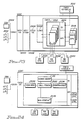
- FIG. 23 provides a software overview of the CMCS system.
- the operating system which manages the other host software and their use of system peripherals, is MVS/XA 2000.
- the host communication manager, ACF/VTAM 2002 interfaces with the operating system and manages the communication between the host and other peripherals such as the CBX 2004.
- CICS/VS 2006 manages the flow of information from application to display terminals.
- the CMCS applications 2010 process the transactions from the CBX 2004 and coordinate the transfer of application 2014 information to the terminals 2015.
- the CMCS 2010 and user 2014 applications are all CICS application programs.
- the interface to the user applications from CMCS 2010 is the Application Programming Interface (API) 2018.
- CMCS 2010 Systems Operations manages the CMCS 2010 system through the operations interface (OI) 2016 and an attached CMCS console 2012.
- the CMCS console 2012 allows support personnel to track system operation and run queries against the three system files.
- the system tables and logs are: configuration 2024, log 2022 and management information services (MIS) 2020 The system tables are discussed in detail below.
- the preferred operat ing system is Multiple Virtual Systems / Extended Architecture 2000 which is a multiple task, multiple user environment for execution on the newest of IBM's S/370 processors.
- the details of the operating system are described in MVS/XA OLTEP LOGIC, SY28-1188 and MVS/XA Logic VOLUMES 1-17, published by International Business Machines.
- ACF Advanced Communications Facility
- VTAM Virtual Terminal Application Monitor
- ACF/VTAM 2002 is the communication monitor that executes under the control of the operating system and controls the communication link to the CBX and each terminal that is attached to the host.
- VTAM controls the Systems Network Architecture (SNA) environment that supports the LU 6.2 protocol.
- SNA Systems Network Architecture
- a detailed description of VTAM is provided in the following references all published by International Business Machines Corporation: VTAM NCP SNA SNI NLDM SSP NCCF, SC27-0659; IMS LU 6.1 Adapter for LU 6.2 Applications, SH20-9254; Systems Network Architecture: Sessions Between Logical Units, GC20-1868; SNA Transaction Programmer's Reference Manual For LU Type 6.2, GC30-3084.
- CICS 2006 is a general purpose data communication monitor that reduces the effort necessary to implement terminal-oriented transaction applications.
- CICS is used around the world to enable applications, ranging from payroll to inventory control, to interactively handle a large number of displays.
- CICS/VS Customer Information Control System/Virtual Storage
- GC33-0155-1 published by International Business Machines Corporation.
- a more detailed description of the logic of CICS is provided in CICS/OS/VS Version 1 Release 7 Modification 0 (MVS/XA Feature) Listings, LYA4-3018; and CICS/VS, LIC Prog 5740-xx1, Logic, LY33-6034; published by International Business Machines Corporation.
- the CMCS applications 2010 and the User applications 2014 are all implemented as CICS application programs.
- the user applications 2014 interface to CMCS through the Application Programming Interface (API) 2018.
- An application program can acquire status information and access the CMCS logs 2020, 2022 & 2024 through the API. This information can be used to coordinate the display of information from application programs in addition to the information displayed by the CMCS system.
- Initial Screen is the first screen that the CMCS agent gets when a call is processed. Once the CMCS agent enters the customer identification, such as an account number or a name, the screen becomes a customer information display.
- Customer Information Screen is the screen that a CMCS agent gets if the call has already been screened by another employee.
- Normal Extension is an extension that has a physical appearance to a phone, as contrasted with ACD pilots or Phonemail pilots.
- Extension is considered the extension normally associated with a phone (normal extension) unless a qualifier appears before extension.
- CMCS caller is a trunk or extension that calls a CMCS called party.
- CMCS called party is an extension, an ACD agent, an ACD group, an ATC, or trunk which generates CMCS telephony activity events.
- CMCS agent refers to the operator, phone and host display terminal associated with a particular agent.
- Telephone activity is any call activity that occurs on a CMCS called party extension, for example: ring a CMCS called party or queue for an ACD group tagged as a CMCS called party.
- Flagged CMCS called party is a CMCS called party which has the ability to turn CMCS event generation on for all subsequent telephony activity.
- CMCS event is the first CMCS event with special initial call flag set in the event that is sent when a CMCS caller has telephony activity with any flagged CMCS called party for the first time.
- target extensions are tagged as CMCS.
- a target extension is equivalent to a CMCS called party. If a caller has telephony activity with a CMCS called party, then the caller is tagged as a CMCS caller. This is a dynamic tag and remains active until the CMCS caller becomes idle.
- CMCS callers can be trunks or normal extensions exclusively.
- CMCS called parties can be ACD group pilots, normal extensions, ATCs, and trunks.
- Only one display terminal is associated with the activity of an individual extension. For example, suppose that an extension has multiple appearances on two phones. Then, any telephony activity on these two phones with that extension affect the display of information on the display terminal.
- a CMCS called party that is being rung by a CMCS caller is presented with the initial customer screen or the customer information display terminal screen that the previous CMCS called party was viewing. Also, as a CMCS caller transfers forward to other CMCS called parties, the display terminal of each successive CMCS called party is updated with either the initial screen or the customer information screen.
- a blind transfer is a special type of transfer which transfers the display terminal screen that the CMCS called party (transferrer) was viewing to the transferred CMCS party while the call is ringing. This allows the agent some additional preparation time before answering the call.
- FIG. 23 is an overview block diagram of the CMCS application environment as they relate to the present invention.
- the call tracking application program includes the LU 6.2 communication manager.
- the primary function of call tracking is to maintain the call status on the event stream and resolve any ambiguities before reporting events to other applications. If call tracking determines that a transaction associated with an originating source identification (extension) needs updating, it refers the event to the Screen Update program. Queued events and events regarding source identification which contributed to a queue count are passed to ACD load balancing.
- Screen update application program performs screen transfer, initialization and recovery for each call. The processing is triggered by events on the CMCS host control link which the call tracking program passes to it.
- MIS Management Information Systems
- CMCS MIS program receives the CMCS table entries maintained for each call tracking every change of state, data entry field and queue count.
- the CMCS MIS program puts these records into a circular buffer 2020 of Figure 23 to store the information for other applications to process.
- This program processes the CMCS table entries to allow a CMCS operator to interrogate error conditions and monitor events on CBX source and target identifications (extensions). This program also configures the CMCS system and maintains the configuration file 2024 of Figure 23.
- CMCS customer applications are any CICS application programs. For purposes of our discussion, we will discuss a single CMCS customer application program that maintain a database of customer information for CMCS agents. In reality, there are many CICS applications currently used for such diverse applications as accounts payable, ac counts receivable, inventory control, stock queries and order entry. By providing an interface to existing applications, CMCS coordinates the display of information on a display terminal with the transfer of phone calls without changing existing CICS applications.
- CMCS complementary metal-oxide-semiconductor
- the processing begins at function block 500 where the CBX responds to the incoming call.
- This function block refers to normal CBX call processing as detailed in ROLM publication, ROLM CBX II 9004.3, published by International Business Machines Corporation.
- the CBX accepts the network dialing that accompanies the call and determines the correct extension to connect to. This is also normal call processing as described above. However, in function block 520, the CBX generates a call event transaction and sends it via the LU 6.2 link to the host as detailed in the Message Formats section of the Logic Description.
- the host Call Tracking Application receives the call event, parses the information and determines if this is the first event for the extension. If it is the first event, then a call event record is created in the Call Management Control Table (CMCT), shown in Figure 18. The call event record is updated to reflect each event that affects the extension. Then, the initial screen to be displayed is determined using the incoming trunk and/or the target phone extension as shown in function block 530.
- CMCT Call Management Control Table
- the Call Tracking Application uses the phone extensions sent from the CBX to access an extension to terminal (logical unit address (LUA)) table and determine the correct display terminal to send the screen display to.
- LOA logical unit address
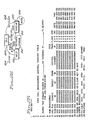
- the extension to terminal (LUA) table is shown in Figure 19.
- the network used in this example contains terminal displays and phone extensions from countries around the world.
- the only information necessary to make the connections to the various extensions and send the display information to the correct display terminal is contained in the extension to terminal (LUA) table.
- the extension to terminal (LUA) table is searched based on the sixteen byte extension of the called party to obtain the terminal LUA associated with the phone call. When a match is found between the sixteen byte extension and the first sixteen bytes of a record, the next twenty-four bytes of the record is the LUA of the associated display terminal. The host application then knows which display terminal to send the screen information to.
- the CMCS Customer Application sends the initial terminal display to the display terminal, as shown in function block 540.
- the display terminal LUA is determined by the Call Tracking Program by searching the extension to terminal (LUA) table and acquiring the correct LUA for the associated display terminal as discussed above in reference to function block 530.
- the agent who receives the call and the information on the display terminal has the option of entering additional information on the display terminal to further enhance the customer information as shown in function block 550. If the caller requests additional services that require the help of another agent, then the agent can transfer the caller using the standard call transfer features of the phone as shown in function block 560.
- a test is performed at decision block 570 to determine if another agent is available in the group that is being transferred to. If an agent is not available, then control is transferred to a queue for callers that is discussed in more detail later. If an agent is available, the CBX connects the caller to the other agent and sends a call event transaction through the LU 6.2 link to the host as shown in function block 580.
- the transaction contains the same source identification as the previous transaction, but now it also contains the phone extension of the agent that the call is transferred to.
- the host receives the call event from the CBX and identifies the caller by the same source identification and matches the new target extension to the terminal LUA as discussed above by a table lookup. Then, the host CMCS screen transfer program transfers the terminal transaction associated with the previous terminal to the new terminal LUA as shown in function block 600. As a result, the terminal associated with the caller shows the customer data as the phone is ringing as shown in function block 610. This would allow the agent to assimilate the information on the terminal display and prepare for the caller as shown in function block 620. Optionally, the terminal display could be updated as soon as the phone call is answered.
- the agent is now fully prepared to deal with the customer without having to ask the customer for information that has already been conveyed to the first agent.
- the new agent can acquire additional pertinent information and enter it into the CMCS Customer Application as shown at 630.
- the application program interface, 2018 of Figure 23 allows a customer's existing CICS application program to do optional intermediate processing during the display terminal transfer if a different display should be displayed other than the screen that was currently used at the prior display terminal.
- a test is performed next at decision block 640 to determine if the caller needs to talk to another agent. If the caller needs to talk to another agent, control is passed to function block 560 of Figure 7 to process the call. If the caller does not need additional assistance, then the caller hangs up the phone, as shown in function block 650, and the CBX notifies the host that the call is completed by sending a CALL_DISCONNECT transaction to the host as shown in Figure 13. Then, the host application CMCS Call Tracking Program cleans up the host record of the call and stores the user data collected.
- the existing CBX queuing capability is used by the CMCS system as shown in Figure 9.
- a call is transferred and the party is not available, then the call is queued as shown in function block 670, and the caller listens to music on hold until the agent is available.
- a call event transaction is sent to the host to let the host know that the previous extension is free and that the caller is now in a hold or waiting condition as indicated in function block 680 and updates the CMCT.
- This capability helps the host place the terminal display associated with the caller on hold and coordinate terminal display processing with the CBX.
- a test is performed in decision block 690 to determine if the agent is available. If the agent is available, then control is passed to function block 580 of Figure 7 to process the connection of the call and the display terminal update. If the agent is still not available, a test is performed at decision block 700 to determine if the caller has hung up. If the caller has not hung up, then control is passed to function block 670 to continue the hold pattern. If the caller has hung up then the CBX notifies the host of the event with a transaction as shown in function block 710 and the host cleans up the call environment, by updating the CMCT, as shown in function block 720.
- Figure 24 provides a detailed block diagram of the CMCS application programs and the communications between the applications.
- the call tracking application 2032 of Figure 24 is com severelyprised of subroutines for carrying out discrete functions.
- the first is the initialization subroutine which reads user defined configuration defaults such as the CBX ID/LU associations, the CBX access codes, error handling parameters, queue parameters and API interface parameters and determines the correct CICS transaction program application to execute to provide the screen for the display terminal associated with the phone extension.
- the second subroutine is the communication manager module 2030 of Figure 24 which is responsible for managing communication between the CBXs and the host using LU 6.2 protocol.
- the communication manager 2030 receives call event transactions from the CBX, sends request action messages to the CBXs, and sends/receives initialization messages with version numbers and diagnostic messages that notify the host of any changes in the CBX status.
- the communication manager 2030 processes the messages and writes information records to a CICS temporary storage queue to facilitate access by the other call tracking subroutines 2032.
- the communication manager 2030 After the communication manager 2030 receives the messages, they are read from the temporary storage queue and evaluated by the preliminary routing/error handling section of call tracking 2032 to separate error records from event transaction records.
- Event transaction records that have sub function codes of call assigned or call queued are evaluated by the validation/building section of call tracking.
- the originating source identification is validated for "first time” calls because the same source identification is used for the duration of the call.
- the target identification is validated for each transaction received in call tracking because it could change during the call.
- the originating source identification is required to be a CMCS trunk or an extension.
- the trunk and extension tables must be searched.
- the initial screen display is performed by searching the trunk to application table, the Dialed Number Indirect Service (DNIS) to application table and the extension to application table. Depending upon the match found, the appropriate CICS initial transaction identification will be used.
- DNIS Dialed Number Indirect Service
- a similar procedure is used for queued calls. If the queued call is a "first time" queued call, then the call is validated as discussed above. However, if it is not the first time the call generated an event, then there is no need to validate.
- a major function of the call tracking application is to track the status of CMCS calls.
- the call management control table is used to store status information on CMCS calls. Calls remain in the Call Management Control Table (CMCT) as they are assigned and queued. They are not removed from the CMCT until a disconnect transaction is received from the CBX.
- CMCT Call Management Control Table
- the call tracking application After the event record has been validated and the record containing host applications and terminal LUA has been built, the call tracking application performs CMCT validation before placing built event records in the CMCT or removing a call from the CMCT. Each time the CMCT is updated, a copy of the table entry is sent to the MIS interface.
- Call Records Records which do not have the "first time” call flag indicated should already exist in the CMCT.
- the CMCT is searched on originating source identification to obtain the information associated with the call. If no match is found an error situation is written to the error log and the new information written to the CMCT by the update code.
- the built record is evaluated to determine of the record is added, deleted, updated or unchanged in CMCT.
- An addition of a record to the CMCT is performed if the record is queued or assigned and not in the CMCT. If a record is flagged as "first time” and Assigned, then the ASSIGNED flag is set and the QUEUED flag is cleared. If a record is flagged as "first time” and queued, then the ASSIGNED flag is cleared and the QUEUED is set. If a record is not "first time” and ASSIGNED, then the ASSIGNED flag is set and the QUEUED flag is cleared. If a record is not "first time” and queued, then QUEUED is set and the ASSIGNED is cleared.
- Updates occur each time that a call status changes to reflect the new condition.
- the current terminal identification changes each time a phone call is transferred to reflect the current terminal associated with the phone extension.
- the assigned and queued flags are changed to reflect current status as described above.
- the CMCS call tracking application passes action required parameters to the screen presentation application. These parameters include the following: START: issued for "first time” calls that are assigned or when a call that was queued for the first time becomes assigned. SAVE: issued when a call which was assigned is now queued. For example, when a call is transferred and put in queue on hold. RESTORE: issued when a call that was queued (and not a "first time” call) becomes assigned. TRANSFER: issued when a call that is currently assigned to an extension becomes assigned to another extension. CLEAN-UP: issued when calls in CMCT are removed.
- the MIS application is notified whenever there are changes made to the CMCT.
- the information is written to a circular file for batch processing.
- the screen update application 2034 of Figure 24, provides the function described in function blocks 610, 620 and 630. Transfers of information from one display terminal to another are performed by updating the VTAM addressing so that the new display terminal is identical to the information on the display terminal that the agent that transferred the call was viewing. This is accomplished by substituting the LAU of the transferred to terminal display with the LAU of the transferring display and logically transferring the display terminals. An option provides for passing the update request to the user application for processing before transferring.
- the CMCT is used to track the status of calls in progress and provides control functions for a call.
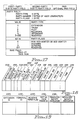
- Figure 18 shows the CMCT and each of the fields that make up the individual records. Information concerning a phone call is initially obtained from the other tables to fill out the fields of a call record. This record is then written to the CMCT and used to record the status of the call until it is terminated.
- the Sub-func code 1100 is a coded one-byte integer value.
- the codes and the functions associated with each code are shown in Figure 12.
- the Originating Source ID 1102 is the key that uniquely identifies the source of the call being tracked by CMCS.
- the ID can be a TRUNK ID or and EXTENSION ID.
- the Originating Source ID 1102 is kept for the duration of the phone call.
- the Originating Source ID 1102 is used by the host to "track" calls in the CMCT. All messages that are tracked by the host must have an Originating Source ID 1102.
- the Target ID 1104 is the termination point of the CMCS call. It can be an EXTENSION ID or a TRUNK ID.
- the Target ID 1104 can change during the phone call. Changes typically occur when a call is transferred. It is used to track the termination point of calls in the CMCT.
- the Term ID 1106 is the unique four bytes of character identification for the 3270 terminal that is currently associated with a call.
- the 3270 terminal could be a personal computer or other 3270 emulated terminal.
- the TERM Id 1106 that is currently associated with that call is written to the CMCT by the call tracking application. It is also used by the screen presentation application to determine where to obtain information from.
- the Ctl # 1108 is a fifteen byte key that is used by the CICS applications to identify any call being managed by CMCS. This key can be used to obtain status information from the various logs that CMCS manages.
- the Initial CICS Trans Id 1110 is a four byte code which is used by CICS to specify the transaction identifier to be used with the next input message from the terminal to which the task is attached. It is also used to identify the host application program that is invoked for an incoming call on a trunk.
- CMCS initial configuration of CMCS will match each trunk and particular extensions with CICS transaction ids. These will be stored in the Extension to Terminal Id table, DNIS table and the Trunk table.
- the Q flag field 1112 is a one byte flag that is set to zero or one depending on the status of the call. If the call is in queue, then the flag is set to one. If the call is not in queue, then the flag is set to zero.
- the Assign flag field 1114 is a one byte flag that is set to zero or one depending on the status of the call. A "first time" call will initially have a zero value for this field until it is assigned.
- the Reserve Terminal Flag 1116 is a one bit flag that is stored in the CMCT and the Extension to Terminal table. When this flag is set to one, CMCS will not initialize the screen when a call is transferred to the display terminal associated with the extension.
- the Err Ind 1118 is a one bit flag that is set to indicate an error and cleared to indicate the passing of the error condition.
- the Trans Ind 1120 is a four byte field that is used to indicate the CICS transaction to be used to update the display terminal of the current Term Id 1106.
- the Rec Ind 1122 is a system flag that is used to differ lengthyentiate various transactions.
- the Date 1124 and Time 1126 fields are six byte records that track the date and time of the last update of the CMCT.
- the Extension to Terminal table is shown in Figure 19.
- the table is depicted as a sequential file with forty byte records containing a sixteen byte phone Extension ID 1130 and a twenty-four byte Terminal ID (LUA) 1132.
- the LUA distinctly defines each terminal in a world-wide network.
- the Reserve Terminal Flag 1134 is a one byte flag that is stored in the CMCT and the Extension to Terminal table. When this flag is set to one, CMCS will not initialize the screen when a call is transferred to the display terminal associated with the extension.
- the Initial CICS Trans Id 1136 is a four byte code which is used by CICS to specify the transaction identifier to be used with the next input message from the terminal to which the task is attached. It is also used to identify the host application program that is invoked for an incoming call on a trunk.
- the Transfer Notify Indicator 1138 is a one byte flag that is set to indicate that the terminal is to be updated before the call is answered. If it is cleared, then the terminal will not be updated until the call is answered.
- the Recovery Notify Indicator 1140 is used to indicate that CMCS is in recovery mode following a failure.
- This table is used to associate an incoming trunk with the host initial CICS transaction that is to be invoked to send information to the display terminal associated with a particular trunk.
- the Trunk ID 1150 is ten byte identifier of the external telephone line that over which the CBX receives the incoming customer call. Trunks to be monitored by the CMCS system are flagged during initial configuration by the Administration application. The last three digits of the identifier are the unique CBX identifier of the particular CBX from which the trunk entered the CMCS system.
- the DNIS Trunk Flag 1152 is a one byte flag that is set to indicate that a dialed number indirect service was used to access the phone. If this indicator is set, the DNIS to Application table will have to be searched to determine the correct initial CICS application.
- the Initial CICS Trans Id 1154 is a four byte code which is used by CICS to specify the transaction identifier to be used with the next input message from the terminal to which the task is attached. It is also used to identify the host application program that is invoked for an incoming call on a trunk.
- This table is used to associate an incoming DNIS Trunk with the correct initial CICS transaction to invoke at the agent's terminal.
- the Target ID 1104 of the CMCT is used to match the Target DNIS ID 1156 of this table to determine the correct Initial CICS Trans ID 1158.
- the Initial CICS Trans Id 1158 is a four byte code which is used by CICS to specify the transaction identifier to be used with the next input message from the terminal to which the task is attached. It is also used to identify the host application program that is invoked for an incoming call on a trunk.
- the queue count table is used to monitor the number of calls in queue.
- the records are fixed length with entries for the call extension and other queue information.
- a two byte length field 1000 is first and contains the integer length in bytes of the transaction excluding the header information.
- the two byte field following this record 1010 is the application message type and is always set to Hex 12FF.
- the variable length message data 1020 is concatenated. The length of this information is dependent on the function 1021 and subfunction 1023.
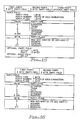
- the function 1021 is a one byte field that specifies one of the four functions listed in Figure 11.
- the subfunction field 1023 specifies the specific subfunction to perform under the control of the function 1021. Also, the subfunctions are listed in Figure 11. An additional table of proper groupings of the functions and subfunctions is provided in Figure 12.
- Figure 13 illustrates the proper format for the date and time fields which occupy the Date_Time field 1025 in Figure 10.
- the data 1027 resides in the next field and is variable length based on the function 1021 and subfunction 1023.
- the one byte Flag field 1029 trails the transaction. The types of flags and their meanings are shown in Figure 13.
- a session has to be initiated between the CBX and the host application before message data 1020 can be exchanged.
- a message is sent to the host and VTAM to initiate the session between the host application and the CBX. This initiates the single session that is used for all communications between the CBX and the host.
- APPLID application name (CMCS in our case).
- Figures 14 to figure 17 are provided to provide the details of the transactions that are used to process the most common transactions between the CBX and the host.
- the display terminal associated with each phone is in one of three states at any time as depicted in Figure 22.
- the three states are the idle state 1200, the display state 1210 and the held state 1220.
- the idle state 1200 occurs when a call has been disconnected from the phone associated with the display terminal.
- the transition from idle to display processing 1202 is the step that determines which display information to initially display on a terminal and initializes the status records on the host and the CBX. Also, if no terminal exists for the extension, then following processing the held state 1220 is entered.
- the clean-up process 1204 references the step of saving the information associated with the previous display and the completion status upon call disconnect.
- the Display state 1210 is the collection of information using the display terminal to interface to the agent.
- a move operation 1206 may be necessary to transfer from one terminal to another during the course of a phone call.
- a CALL_ASSIGN is sent from the CBX to the host and a CALL_CONNECT is subsequently sent when the connection to the new extension is completed.
- An activate 1214 operation is used to display information when a phone has become free after being in the Hold state 1220.
- the freeze operation 1212 stops display action and saves the current status before entering the Held state 1220 such as a caller being queued upon transfer from another agent.
- the Held state 1220 occurs when the caller is waiting for an agent to become available.
- the clean-up operation 1224 is used to save the information associated with the previous display and the completed status of the operation when the caller hangs up in the Held state 1220.
- the queue and initialize operation 1222 is used when a caller executes a transfer operation and the agent is on the phone. The operation queues up the calls waiting for the agent to become free and initializes the call when the agent becomes available.
- the Administration Application of the CMCS system is primarily responsible for the configuration and management of the system.
- the CICS displays that are used by the application to configure and manage the system are shown in Figures 25 to 30.
- Figure 25 is the View Call Management Control Tracking Table screen. It is used by the system operator to dynamically view changes to the Call Management Control Table (CMCT). Most of the fields of the CMCT can be viewed from this display.
- CMCT Call Management Control Table
- Figure 26 is the Extension to Terminal Correlation Table configurator. It is used to dynamically view and maintain the Extension to Terminal Table.
- the display allows a system operator to associate terminal ids with phone extensions and CICS application ids. This provides the linkage to enable a particular screen of information to be displayed in response to a transfer of a phone call.
- Figure 27 is the Trunk Id to Application correlation table configurator. This display is used to view and maintain the Trunk Id to Application Table. The fields of the table can be updated dynamically by a system operator with this display.
- Figure 28 is the DNIS Trunk Application Correlation Table configurator. This display is used to view and maintain the DNIS Id to Application table.
- Figure 29 is the Agent Extension to Terminal Correlation configurator. This display will be used by agents to configure their display terminal when a logon is performed and update the extension to terminal correlation table shown in Figure 26.
- These displays are standard CICS display screens which have displayable fields indicated by by XXXXX, user entry locations indicated by and user entry fields with a user supplied default indicated by#########. The field names on the display correspond to the fields discussed with the associated tables that are configured by the displays.
- the first sample scenario is a call from any source to a CMCS agent.
- the originating call comes from a party (P1) to an extension (P2).
- P1 a party
- P2 an extension
- the actions are separated into CBX actions, outgoing call event transaction and host actions.
- the second call scenario is a pair of successive calls to the same CMCS agent.
- Party1 ( P1 ) is the originator of the call.
- Party2 ( P2 ) is the agent's extension.
- Party3 ( P3 ) is another calling source.
- the third call scenario is a call in which the calling part hangs up before the call is answered.
- Party1 ( P1 ) is the originator of the call.
- Party2 ( P2 ) is the agent's extension.
- the fourth call scenario is an example of a call that is transferred.
- Party1 ( P1 ) is the originator of the call.
- Party2 ( P2 ) is the first party's extension (transferer).
- Party3 ( P3 ) is the second party's extension.
- the fifth call scenario is an example of a conference call.
- Party1 ( P1 in ) is the originator of the call.
- Party2 ( P2 ) is the first party's extension.
- Party3 ( P3 ) is the second party's extension.
- ACD Automatic Call Distribution
- ACD processing employs a pilot number that acts as the entry point to all the agents associated with a particular marketing area.
- the pilot number is linked to each of the available agents capable of servicing the particular type of call. For example, a company may have a single number that can be dialed to reach a company operator to obtain the direct extension of an employee of the company. This number could actually be a pilot number that is linked to ten company operators that handle calls as they are available. This approach works fine as long as one of the operators is always available to receive the next call. However, if all operators are on the line, then the next call will be required to enter a queue or experience a busy-signal. Often an additional agent group will be added to handle the overflow calls or agent groups are distributed in different locations to cover various time zone. Distributing staffing also provides local customer access to agents. Thus, it is important to balance calls between available agent groups.
- ACD load balancing maintains queue counts on ACD pilot groups which are to be balanced together.
- a load balancing algorithm determines where callers should be transferred.
- Two modes of load balancing are provided.
- the first mode uses host administered load balancing pilot numbers.
- a group of pilot numbers are configured in each CBX for each ACD group.
- the pilot numbers in a group each forward to the same ACD pilot number.
- Each pilot number is a CBX hunt group pilot put into busy forwarding to the ACD pilot number and configured with the CMCS class of service.
- These hunt groups have no extensions configured as members of the hunt group, so they always forward immediately.
- the CMCS/Host administers the numbers.
- the user's host application request a call to a particular ACD service (eg. loan officer) from the CMCS/Host, the CMCS/Host application selects which ACD group to send the caller to.
- a particular ACD service eg. loan officer
- the CMCS/Host reserves a primary load balance pilot number and passes it to the user's application program through an Application Program Interface (API) along with a backup number which can be used if the transfer to the primary number is unsuccessful.
- the backup number represents the pilot number of the desired service in the requesting agent's CBX.
- the user's application program displays the primary number to the agent's terminal.
- the agent uses a screen transfer to transfer the caller to the primary load balance pilot number.
- the host can identify the caller transferred across any private line network to the reserved load balance point number and automatically pick up tracking the call again as they forward to the target ACD group.
- the host When the host picks up the call, the host notifies the agent transferring the caller that tracking has recommenced and that the transfer is successful. The host conveys this information to the agent via a screen prompt.
- the transferring agent determines that the primary load balance number was not successful, then the caller is returned to the transferring agent and then is sent to the backup number and the information is transferred to the display associated with the backup number.
- the second mode is limited to ROLM networks with satellite operations connecting each of the CBXs.
- the first event out of the terminating CBX with CMCS also includes the extension number of the CMCS called-party that transferred the caller over the satellite tielines. This extension number plus the reserved pilot number insures no ambiguity exists in identifying the caller at the terminating switch.
- the load balancing algorithm detects that the groups are in the same CBX and load balances directly to the ACD groups without the use of reserved pilot groups.
- the Load Balancing module is accessed by a CICS link from the CMCS Call Tracking Manager whenever a call is queued or dequeued. Actual queuing information is kept in real time. Thus, when the call is processed it is based on an analysis of current ACD queue utilization.
- the Load Balancing module accesses the Originating_Source_ID and Queue_Count in the CICS data area and the fields in the Queue Count Table. Internally, it maintains a table of hunt distribution pilot numbers for each primary pilot number in the queue count table so that these numbers can be marked as reserved when appropriate and timed to space agent call assignments evenly.
- the table maintained and used by load balancing is the Queue Count Table. It contains user defined and maintained data including the Pilot Groups that are to be balanced. The CBX ID is appended to each of the Pilot Group IDs to enable the Communications Manager to route the new target number to the CBX for call redirection. Also, this table contains an Agent Function Description field that can be used by user-written applications to provide users with Pilot Group numbers that correspond to functional group descriptions. This field also serves to clarify how ACD groups are administered and contains fields that manage time zone overlaps.
- Queue Count Balance Points are the criteria which determine when load balancing is performed.
- Figure 30 illustrates the usage of Balance Points.
- Balance Point One 3410 and Balance Point Two 3420 represent the floor and ceiling, respectively, of the range of queued calls used to determine when calls are balanced.
- the balance point variables are entered by a CMCS administrator to establish how a particular ACD pilot number is to be balanced. Neither balance point is meaningful without the other and neither queue count is meaningful without the others.
- Load balancing is accomplished by monitoring the number of calls in each pilot group and comparing this to the current queue level parameters and the number of calls in other pilot group queues. Load balancing functions are illustrated in Figure 30. Scenario one 3430 shows all queues below balance point one, so no load balancing is required. Scenario two 3440 shows all queues are above balance point two, so no load balancing is required. Scenario three 3450 shows that all queues are between the balance points, so no load balancing is required.
- the Load Balancing module has three separate functions which will be requested by subroutine calls with fixed parameter lists:
- Pilot Group IDs entered must correspond to pilot Groups in CBXs which are Load Balanced. After the cursor is positioned at the desired pilot number, F2 will transfer to the next screen which allows entry of all reserved BFW/Pilot extensions for each target pilot number.
- a typical telephone network consists of one or more CBXs. Within the CBX there are several pilot numbers. Each pilot number can have several extensions to which a call can be assigned by the CBX depending on availability.
- pilot numbers can be configured on the CBX as dummy Busy Forward (BFW) and forward to a common ACD pilot number.
- BFW Busy Forward
- the significance of using this feature in CMCS is to force the CBX to send an event message to the host that will contain the BFW/pilot number and thus identify the call across CBXs (the incoming trunk id changes as the call is transferred from one CBX to another).
- the Queue Count Table allows a user to group certain pilot numbers in an ACD queue group. This provides a generic key for requesting an available telephone number from load balancing program.
- the extensions are not part of the Queue Count Table, they are configured on the CBX as extensions of the pilot number, so a call coming into a pilot number can ring on any one of the available extensions.
- Two balance points for each pilot group are to be determined by a customer.
- the initial value should be an estimate which can be monitored and fine tuned at a later point after the system has been in usage.
- Balance point 1 is an estimate of the number of calls in a queue group that a pilot group can handle comfortably at any given instance.
- Balance point 2 is an estimate of the maximum number of calls in a queue group that the pilot group can handle before it is overloaded.
- Level 0 If the number of calls in queue is less than balance point 1.
- Level 1 If the number of calls is between balance point 1 and balance point 2, inclusive of B1.
- Level 2 If the number is greater than or equal to Balance point 2.
- Call Tracking will issue an API to load balancing to increment the count on the queue count table.
- Call tracking will invoke a Load Balancing module to decrement the queue count. Every time the count is changed the queue level is recalculated and the table is updated.
- This number is sent along with the reserved BFW/Pilot (primary) to the user program. If the primary number cannot be dialed because of problems in the lines or the network is overloaded, the backup number is dialed. The backup number is within the same CBX as the target pilot number.
- the format of the number is DHHMM. Where D has a value indicative of the day of the week.
- the first record will have blanks for time and day fields. This record will be used as the default for all times not specified in other records and also to keep the queue counts in.
- This table is used to enter several extension numbers that are classified as "Do Not Disturb" and forward to the Target Pilot Number displayed above. These numbers are reserved for the load balancing program to be assigned to a user program which requests a transfer number.
- This table contains an entry for each BFW number for all target pilot numbers. The status of each BFW number is updated as it is reserved or assigned. It is the responsibility of the CMCS System Administrator to set up the entries on these tables and also to keep them parallel to the CBX configuration.
- the valid values for this field are: A (available) and R (reserved).
- A available
- R reserved
- the program picks out a target number and then goes down through this table to reserve the first available BFW number.
- CTM assigns the call to the load balanced number that was supplied to the user program
- CTM will request a release of the reserved BFW/Pilot number.
- the release actions include moving an 'A' to the status field and setting the available after time to the current time plus a Delay Factor (like 30 secs) which is an installation parameter determined by the customer.
- This field contains the first part of the complete telephone number. Typically, there will be three or four digits, although there is provision for all eight. The second part of the phone number will be saved in the Reserved BFW/Pilot number field. The length of this number is determined by the internal numbering system within the CBX. However, together the prefix and the number must not exceed eight characters. Note: Log records will be written at various stages to keep statistics like how many times a reserved number was unavailable, or the system experienced 'blockage'. These cases need to be defined as part of the MIS LOG module.
- This algorithm is used to determine the least busy pilot number to return to the User Program.
- the user program will provide the ACD queue group name and the CBX Id of the related telephone (or its terminal Id, so that the Load Balancing program can pick up the CBX Id using the Terminal to Extension table).
- the Load Balancing algo simplyrithm scans the Queue Count table and the Reserved BFW/Pilot table to determine the best number and send it back to the User Program along with a backup number.
- Search Queue Count Table for the requested ACD Queue Group within the same CBX. Use the queue count from the base entry for the pilot number (time and day fields are blank) to compute the queue level, use the balance points from the entry that corresponds to the current time and day. Save the Backup Number from this entry.
- Load Balancing module There are three functions performed by the Load Balancing module:
- the first two will be requested by the Call Tracking Manager and the third will be requested by a load Balancing API program which is not user modifiable and serves as the interface between the User Programs Call Tracking Manager and the Load Balancing module.
- Figure 31 shows the interfaces between IBM code and customer modifiable code.
- the four arrows crossing the vertical line 4010, 4050, 4130 & 4140 represent "calls" to various parts of the Load Balancing module with a fixed parameter list. If either side makes program changes, the parameter list must stay constant in order to conserve the interface.
- the Load Balancing API program 4110 MUST be used by user programs to request a load balanced number because the API conserves the defined interface for updating CMCT.
- CMCS 4000 represents the call transfer manager described more fully above.
- a call is transferred to an available agent group, two requests are made to update the queue control table 4010 and to release a reserved BFW number 4050.
- the two requests are handled by the CMCS Load Balancing program 4020, and more specifically by the update queue counts 4030 and the release reserved BFW numbers 4060.
- These modules update the Queue Control Table (QCT) 4040 and the Reserve BFW Table 4070 to reflect the selection of the load balanced number as shown in module 4080.
- QCT Queue Control Table
- a user program 4120 must interact through a defined interface to acquire information from the queue control table 4040, the Call Management Control Table (CMCT) 4090 and the Reserve BFW Table 4070.
- CMCT Call Management Control Table
- Reserve BFW Table 4070 To reserve a BFW number, calls are made to request a load balanced number via the request link 4140 to the CMCS Load Balancing API 4110. The request is relayed via the request load balance number link 4130 to select load balanced number module 4080. The number is obtained by the CMCS load balancing module 4020 from the Reserve BFW Table 4070.
- the number is passed back down the request link 4130 to the CMCS Load Balancing API 4110 to the CMCT 4000 through the host communication link 4160 which in turn updates the Call Management Control Table (CMCT) 4090 and the Reserve Pilot Number Table 4100 are updated to track the request. Then, the number is returned via the request link 4140 to the user program 4120.
- CMCT Call Management Control Table
- the link format from the Call Tracking Manager 4000 and Load Balancing API 4110 program is: EXEC CICS LINK PROGRAM(LOADBAL) COMMAREA(CMCS-LOAD-BALANCING-DATA) LENGTH(COMMAREA-LENGTH)
- CMCS-LOAD-BALANCING-DATA contains different combinations of variables depending on the function being requested, such as: 1. Update queue count Function requested (update-queue-count) Originating source ID queue count +1, or -1 Target pilot number for queue count update (primary) Target pilot number where the call is queued Return code 2. Release BFW/Pilot number: Function requested (release-number) Originating source ID Target pilot number Network dial prefix Reserved number Return code 3. Select reserved BFW/pilot numbers: Function requested (reserve-number) Originating source ID ACD queue group Return Target pilot number Return Network dial prefix Return Reserved number Return code
- Load Balancing API program This program will first get the load balanced number by linking to the Load Balancing module upon request from the user program. Then it will update the CMCT with the reserved number received from Load Balancing, and finally send the number to the user program.
Landscapes
- Engineering & Computer Science (AREA)
- Signal Processing (AREA)
- Business, Economics & Management (AREA)
- Marketing (AREA)
- Computer Networks & Wireless Communication (AREA)
- Data Exchanges In Wide-Area Networks (AREA)
- Telephonic Communication Services (AREA)
- Information Transfer Between Computers (AREA)
Applications Claiming Priority (2)
| Application Number | Priority Date | Filing Date | Title |
|---|---|---|---|
| US294316 | 1989-01-06 | ||
| US07/294,316 US4949373A (en) | 1989-01-06 | 1989-01-06 | Host load balancing |
Publications (2)
| Publication Number | Publication Date |
|---|---|
| EP0377395A2 true EP0377395A2 (fr) | 1990-07-11 |
| EP0377395A3 EP0377395A3 (fr) | 1992-09-09 |
Family
ID=23132876
Family Applications (1)
| Application Number | Title | Priority Date | Filing Date |
|---|---|---|---|
| EP19890480184 Ceased EP0377395A3 (fr) | 1989-01-06 | 1989-12-06 | Equilibrage de charge d'un serveur |
Country Status (3)
| Country | Link |
|---|---|
| US (1) | US4949373A (fr) |
| EP (1) | EP0377395A3 (fr) |
| JP (1) | JPH06101765B2 (fr) |
Cited By (6)
| Publication number | Priority date | Publication date | Assignee | Title |
|---|---|---|---|---|
| EP0670094A4 (fr) * | 1990-11-20 | 1994-11-11 | Teloquent Comm Corp | Systeme de prise en charge d'appels telephoniques. |
| WO1997039561A1 (fr) * | 1996-04-12 | 1997-10-23 | British Telecommunications Public Limited Company | Appareil de commutation multimedia |
| WO2002091722A1 (fr) * | 2001-05-04 | 2002-11-14 | Siemens Information And Communication Networks, Inc. | Procedes et appareil pour controler le renvoi d'appels par un serveur acd a partir d'un serveur ivr et pour permettre a un appelant d'un serveur acd d'effectuer une transaction tout en etant connecte avec le serveur ivr |
| EP1339207A3 (fr) * | 1994-02-07 | 2004-04-28 | Intel Corporation | Porte d'échange de groupe |
| EP1255396A3 (fr) * | 2001-05-04 | 2004-05-12 | Siemens Information and Communication Networks Inc. | Procédé et appareil pour contrôler le retirement d'un appel dans un réseau de communication |
| US6940963B2 (en) | 2001-05-04 | 2005-09-06 | Siemens Information And Communication Networks, Inc. | Methods and apparatus for automatically determining a call service request |
Families Citing this family (38)
| Publication number | Priority date | Publication date | Assignee | Title |
|---|---|---|---|---|
| US5012512A (en) * | 1990-03-30 | 1991-04-30 | At&T Bell Laboratories | Telephone operator and agent to database communication arrangement |
| US5315647A (en) * | 1991-07-31 | 1994-05-24 | Teleos Communications, Inc. | Private branch exchange adapted for telemarketing |
| US5311577A (en) * | 1992-03-06 | 1994-05-10 | International Business Machines Corporation | Data processing system, method and program for constructing host access tables for integration of telephony data with data processing systems |
| AU4653593A (en) * | 1992-06-25 | 1994-01-24 | Teledata Solutions, Inc. | Call distributor |
| US6226287B1 (en) | 1992-06-25 | 2001-05-01 | Apropros Technology | System and method for integrating voice on network with traditional telephony |
| US6173052B1 (en) | 1992-06-25 | 2001-01-09 | Apropros Technology | Blending communications in a call center |
| DE9303214U1 (de) * | 1993-03-05 | 1993-04-22 | CSB-System Software-Entwicklung & Unternehmensberatung GmbH, 5130 Geilenkirchen | Schaltungsanordnung zur Integration von EDV-Systemen bei der Benutzung von Telefonanlagen |
| US5544325A (en) * | 1994-03-21 | 1996-08-06 | International Business Machines Corporation | System and method for generating messages for use in transaction networks |
| US6704765B1 (en) | 1994-12-14 | 2004-03-09 | International Business Machines Corporation | System for allocating resources among agent processes |
| US5706516A (en) * | 1995-01-23 | 1998-01-06 | International Business Machines Corporation | System for communicating messages among agent processes |
| US6463149B1 (en) | 1995-04-10 | 2002-10-08 | Edify Corporation | Web page synchronization system and method |
| US5740240A (en) * | 1995-04-10 | 1998-04-14 | Edify Corporation | Computer telephony integration system and method |
| DE19536650A1 (de) * | 1995-09-30 | 1997-04-03 | Sel Alcatel Ag | Verfahren zum Steuern einer Vermittlungsstelle, Vermittlungsstelle und Kommunikationssystem |
| US5771468A (en) * | 1996-01-17 | 1998-06-23 | Telefonaktiebolaget L M Ericsson | Multi-purpose base station |
| US5848128A (en) * | 1996-02-29 | 1998-12-08 | Lucent Technologies Inc. | Telecommunications call preservation in the presence of control failure |
| US7555458B1 (en) | 1996-06-05 | 2009-06-30 | Fraud Control System.Com Corporation | Method of billing a purchase made over a computer network |
| US8229844B2 (en) | 1996-06-05 | 2012-07-24 | Fraud Control Systems.Com Corporation | Method of billing a purchase made over a computer network |
| US7013001B1 (en) | 1996-06-05 | 2006-03-14 | David Felger | Method of billing a communication session conducted over a computer network |
| US20030195848A1 (en) * | 1996-06-05 | 2003-10-16 | David Felger | Method of billing a purchase made over a computer network |
| US6553108B1 (en) | 1996-06-05 | 2003-04-22 | David Felger | Method of billing a communication session conducted over a computer network |
| US6282276B1 (en) | 1996-06-05 | 2001-08-28 | David Felger | Method of billing a value-added call |
| US5802156A (en) * | 1996-06-05 | 1998-09-01 | David Felger | Method for billing and controlling fraud in providing pay information services |
| US5933474A (en) * | 1996-12-24 | 1999-08-03 | Lucent Technologies Inc. | Telecommunications call preservation in the presence of control failure and high processing load |
| KR100233458B1 (ko) * | 1997-05-19 | 1999-12-01 | 윤종용 | 원격 다중 가입자의 호처리 이중화 방법 |
| AU7815898A (en) * | 1997-06-02 | 1998-12-30 | Harris Corporation | Web-based management of an enhanced services platform and method |
| US5974114A (en) * | 1997-09-25 | 1999-10-26 | At&T Corp | Method and apparatus for fault tolerant call processing |
| JP2001525621A (ja) * | 1997-12-03 | 2001-12-11 | テルコーディア テクノロジーズ インコーポレイテッド | パケット交換ベースネットワーク上の媒体接続性のための方法およびシステム |
| US6724747B1 (en) | 1997-12-03 | 2004-04-20 | Telcordia Technologies, Inc., A Corp. Of Delaware | Method and system for media connectivity over a packet-based network |
| AU4006400A (en) * | 1999-03-06 | 2000-09-28 | Dti Networks, Inc. | System and method for administrating call and call feature set-up in a telecommunications network |
| US6434625B1 (en) * | 1999-07-13 | 2002-08-13 | International Business Machines Corporation | Generalizing data streams to overcome differences in word length and byte order |
| US6546083B1 (en) | 2000-01-04 | 2003-04-08 | Cisco Technology, Inc. | System and method for placing a telephone call |
| US7068774B1 (en) * | 2000-02-25 | 2006-06-27 | Harris Corporation | Integrated acd and ivr scripting for call center tracking of calls |
| US7046778B2 (en) * | 2000-03-31 | 2006-05-16 | Coppercom, Inc. | Telecommunications portal capable of interpreting messages from an external device |
| JP2002064590A (ja) * | 2000-08-18 | 2002-02-28 | Nec Corp | 負荷分散型2重化通信システム及び2重化伝送装置 |
| US6845155B2 (en) | 2001-05-21 | 2005-01-18 | Metro One Telecommunications, Inc. | Technique for effectively processing and dynamically routing communication calls |
| DE60128155T2 (de) * | 2001-09-07 | 2008-01-03 | Telefonaktiebolaget Lm Ericsson (Publ) | Verfahren und anordnungen zur erzielung einer dynamischen betriebsmittelverteilungsrichtlinie in paketgestützten kommunikationsnetzen |
| US20030110154A1 (en) * | 2001-12-07 | 2003-06-12 | Ishihara Mark M. | Multi-processor, content-based traffic management system and a content-based traffic management system for handling both HTTP and non-HTTP data |
| CA2552706A1 (fr) | 2003-12-29 | 2005-07-28 | Grape Technology Group, Inc | Systeme et procede de traitement et de routage d'appels entrants pour systeme d'assistance a la communication |
Family Cites Families (4)
| Publication number | Priority date | Publication date | Assignee | Title |
|---|---|---|---|---|
| US4656623A (en) * | 1985-05-03 | 1987-04-07 | American Telephone And Telegraph Company | Agent communication arrangements for telecommunication systems |
| US4788682A (en) * | 1986-09-23 | 1988-11-29 | Northern Telecom Limited | Telephone system adapted to telemarketing |
| US4943995A (en) * | 1986-10-08 | 1990-07-24 | At&T Bell Laboratories | Semi-automated customer information system |
| US4805209A (en) * | 1987-12-09 | 1989-02-14 | International Business Machines | Coordinated transfer of voice and information through a digital switch |
-
1989
- 1989-01-06 US US07/294,316 patent/US4949373A/en not_active Expired - Lifetime
- 1989-11-20 JP JP1299882A patent/JPH06101765B2/ja not_active Expired - Fee Related
- 1989-12-06 EP EP19890480184 patent/EP0377395A3/fr not_active Ceased
Cited By (10)
| Publication number | Priority date | Publication date | Assignee | Title |
|---|---|---|---|---|
| EP0670094A4 (fr) * | 1990-11-20 | 1994-11-11 | Teloquent Comm Corp | Systeme de prise en charge d'appels telephoniques. |
| EP1339207A3 (fr) * | 1994-02-07 | 2004-04-28 | Intel Corporation | Porte d'échange de groupe |
| WO1997039561A1 (fr) * | 1996-04-12 | 1997-10-23 | British Telecommunications Public Limited Company | Appareil de commutation multimedia |
| US5822306A (en) * | 1996-04-12 | 1998-10-13 | British Telecommunications Public Limited Company | Multimedia switching apparatus |
| WO2002091722A1 (fr) * | 2001-05-04 | 2002-11-14 | Siemens Information And Communication Networks, Inc. | Procedes et appareil pour controler le renvoi d'appels par un serveur acd a partir d'un serveur ivr et pour permettre a un appelant d'un serveur acd d'effectuer une transaction tout en etant connecte avec le serveur ivr |
| EP1255396A3 (fr) * | 2001-05-04 | 2004-05-12 | Siemens Information and Communication Networks Inc. | Procédé et appareil pour contrôler le retirement d'un appel dans un réseau de communication |
| US6819755B2 (en) | 2001-05-04 | 2004-11-16 | Siemens Information And Communication Networks, Inc. | Methods and apparatus for controlling call handling in a communications network |
| US6819756B2 (en) | 2001-05-04 | 2004-11-16 | Siemens Information And Communication Networks, Inc. | Methods and apparatus for controlling call pullback by an automatic call distribution (acd) system from an interactive voice response (ivr) system and for allowing an acd caller to complete a critical transaction while connected to the ivr |
| EP1501269A1 (fr) * | 2001-05-04 | 2005-01-26 | Siemens Information and Communication Networks, Inc. | Procedes et appareil pour controler le renvoi d'appels par un serveur ACD a partir d'un serveur IVR et pour permettre a un appelant d'un serveur ACD d'effectuer une transaction tout en etant connecte avec le serveur IVR |
| US6940963B2 (en) | 2001-05-04 | 2005-09-06 | Siemens Information And Communication Networks, Inc. | Methods and apparatus for automatically determining a call service request |
Also Published As
| Publication number | Publication date |
|---|---|
| JPH06101765B2 (ja) | 1994-12-12 |
| JPH02203657A (ja) | 1990-08-13 |
| EP0377395A3 (fr) | 1992-09-09 |
| US4949373A (en) | 1990-08-14 |
Similar Documents
| Publication | Publication Date | Title |
|---|---|---|
| US4949373A (en) | Host load balancing | |
| US4942602A (en) | Coordinated transfer of voice and information through a network of digital switches | |
| EP0320426B1 (fr) | Transfert coordonné de signaux de parole et de signaux d'information à travers un commutateur numérique | |
| US4943996A (en) | Shared access to voice and information | |
| US6463148B1 (en) | Blending communications in a call center | |
| US5495522A (en) | Method and apparatus for audio teleconferencing a plurality of phone channels | |
| EP0724804B1 (fr) | AUTOCOMMUTATEUR à PROTOCOLES RESEAU ET SERVICES DE COMMUNICATIONS PROGRAMMABLES | |
| EP0647381B1 (fr) | Distributeur d'appels | |
| JP3313075B2 (ja) | コールセンタシステム、着信端末設定方法及び記録媒体 | |
| US7181401B2 (en) | Methods for generating voice prompts using grammatical rules in a system proving TDM voice communications and VOIP communications | |
| JP3398956B2 (ja) | 自動電話スケジュールシステムの方法と装置 | |
| US5787153A (en) | System for incremental redistribution of telephony applications computing workload | |
| US6594685B1 (en) | Universal application programming interface having generic message format | |
| US5345589A (en) | Centralized monitoring of activity in a distributed processing system | |
| EP0470415B1 (fr) | Marquage des appels avec d'information d'usager dans un environnement téléphonique | |
| IE920788A1 (en) | Message switching server for a digital communications system | |
| Kasson | The ROLM computerized branch exchange: An advanced digital PBX | |
| Hagstrom et al. | Communications Processor System Study |
Legal Events
| Date | Code | Title | Description |
|---|---|---|---|
| PUAI | Public reference made under article 153(3) epc to a published international application that has entered the european phase |
Free format text: ORIGINAL CODE: 0009012 |
|
| AK | Designated contracting states |
Kind code of ref document: A2 Designated state(s): DE FR GB |
|
| PUAL | Search report despatched |
Free format text: ORIGINAL CODE: 0009013 |
|
| AK | Designated contracting states |
Kind code of ref document: A3 Designated state(s): DE FR GB |
|
| 17P | Request for examination filed |
Effective date: 19930519 |
|
| 17Q | First examination report despatched |
Effective date: 19930826 |
|
| GRAG | Despatch of communication of intention to grant |
Free format text: ORIGINAL CODE: EPIDOS AGRA |
|
| STAA | Information on the status of an ep patent application or granted ep patent |
Free format text: STATUS: THE APPLICATION HAS BEEN REFUSED |
|
| 18R | Application refused |
Effective date: 19970712 |