EP0377923A1 - Sol artificiel poreux pour la culture de plantes et procédé pour sa fabrication - Google Patents
Sol artificiel poreux pour la culture de plantes et procédé pour sa fabrication Download PDFInfo
- Publication number
- EP0377923A1 EP0377923A1 EP89300158A EP89300158A EP0377923A1 EP 0377923 A1 EP0377923 A1 EP 0377923A1 EP 89300158 A EP89300158 A EP 89300158A EP 89300158 A EP89300158 A EP 89300158A EP 0377923 A1 EP0377923 A1 EP 0377923A1
- Authority
- EP
- European Patent Office
- Prior art keywords
- water
- soil
- artificial soil
- grs
- weight
- Prior art date
- Legal status (The legal status is an assumption and is not a legal conclusion. Google has not performed a legal analysis and makes no representation as to the accuracy of the status listed.)
- Granted
Links
Images


Classifications
-
- A—HUMAN NECESSITIES
- A01—AGRICULTURE; FORESTRY; ANIMAL HUSBANDRY; HUNTING; TRAPPING; FISHING
- A01G—HORTICULTURE; CULTIVATION OF VEGETABLES, FLOWERS, RICE, FRUIT, VINES, HOPS OR SEAWEED; FORESTRY; WATERING
- A01G24/00—Growth substrates; Culture media; Apparatus or methods therefor
- A01G24/40—Growth substrates; Culture media; Apparatus or methods therefor characterised by their structure
- A01G24/48—Growth substrates; Culture media; Apparatus or methods therefor characterised by their structure containing foam or presenting a foam structure
-
- A—HUMAN NECESSITIES
- A01—AGRICULTURE; FORESTRY; ANIMAL HUSBANDRY; HUNTING; TRAPPING; FISHING
- A01G—HORTICULTURE; CULTIVATION OF VEGETABLES, FLOWERS, RICE, FRUIT, VINES, HOPS OR SEAWEED; FORESTRY; WATERING
- A01G24/00—Growth substrates; Culture media; Apparatus or methods therefor
- A01G24/10—Growth substrates; Culture media; Apparatus or methods therefor based on or containing inorganic material
-
- A—HUMAN NECESSITIES
- A01—AGRICULTURE; FORESTRY; ANIMAL HUSBANDRY; HUNTING; TRAPPING; FISHING
- A01G—HORTICULTURE; CULTIVATION OF VEGETABLES, FLOWERS, RICE, FRUIT, VINES, HOPS OR SEAWEED; FORESTRY; WATERING
- A01G24/00—Growth substrates; Culture media; Apparatus or methods therefor
- A01G24/20—Growth substrates; Culture media; Apparatus or methods therefor based on or containing natural organic material
-
- A—HUMAN NECESSITIES
- A01—AGRICULTURE; FORESTRY; ANIMAL HUSBANDRY; HUNTING; TRAPPING; FISHING
- A01G—HORTICULTURE; CULTIVATION OF VEGETABLES, FLOWERS, RICE, FRUIT, VINES, HOPS OR SEAWEED; FORESTRY; WATERING
- A01G24/00—Growth substrates; Culture media; Apparatus or methods therefor
- A01G24/30—Growth substrates; Culture media; Apparatus or methods therefor based on or containing synthetic organic compounds
Definitions
- the present invention relates to porous artificial soil for plant culture and its manufacturing method, and more particularly to porous artificial soil for plant culture suitable for agriculture, gardening and the like, and to an economical and safe method of manufacturing such soil.
- the soil conditions for plant culture are very important. More specifically, the soil for plant culture is required to be excellent in water retention, water permeability, air permeability and the like, as well as to have a small root spreading resistance. Such soil is further required to contain moderate nutritious substance and to have good plant supporting and holding properties. To meet such requirements, the soil is generally improved by combining
- the leaf mold is nutritious and excellent in water retention, water permeability and air permeability, but has poor plant supporting and holding properties.
- the sands are excellent in water permeability, but is less nutritious and has poor water retention and plant supporting and holding properties.
- the artificial soils are excellent in air permeability and the like, but are expensive and apt to easily dry.
- the plant holding body disclosed by the publication above-mentioned is made by kneading peat moss having a small water content, with the polyurethane binder.
- a block 40 of soil particles thus obtained is a mere mass in which a number of particles 41 are bonded to one another with the polyurethane binder 42. Accordingly, this plant holding body is still weighty, causing handling inconvenience in transportation and the like. Further, the particle block 40 is hard, causing the root spreading resistance to be increased. This prevents the root of a plant from entering into the block 40, failing to assure sufficient plant supporting and holding properties.
- the foamed body disclosed by the publication above-mentioned is obtained by mixing a liquid having a low boiling point such as monofluoro trichloromethane or the like, with water, inorganic powder and a urethane prepolymer and foaming the resultant mixture.
- the resultant foamed body contains about 33 to 67 % by weight of the inorganic powder and 33 to 67 % by weight of the water-soluble urethane prepolymer.
- a number of the inorganic powder 52 and air bubbles 53 are dispersed in a foamed body of a urethane prepolymer 50. It may be considered that the foamed body thus obtained is used as artificial soil for plant culture to reduce the weight thereof.
- the foamed body 50 is still insufficient to be used as the artificial soil for plant culture. That is, the foamed body 50 in its entirety has a foamed structure of a urethane prepolymer. Accordingly, when the foamed body 50 is used as the artificial soil for plant culture, the root spreading resistance becomes great. This prevents the root of a plant from easily entering into such artificial soil, assuring no sufficient plant supporting and holding properties.
- the porous artificial soil for plant culture in accordance with the invention of Claim 1 contains (i) at least a water-soluble urethane prepolymer, (ii) at least one structural component selected from the group consisting of an organic matter, an inorganic matter and soil, and (iii) gas, these three substances being mixed with an aqueous dispersive medium.
- the soil contains total 70 to 90 % by weight of the structural component.
- the porous artificial soil for plant culture in accordance with the invention of Claim 2 contains (i) at least a water-soluble urethane prepolymer, (ii) an organic matter, (iii) an inorganic matter and/or soil, and (iv) a liquid having a low boiling point, these four substances being mixed with an aqueous dispersive medi um.
- the soil contains total 70 to 99 % by weight of the organic matter, the inorganic matter and/or soil.
- the porous artificial soil for plant culture in accordance with the invention of Claim 3 contains (i) at least a water-soluble urethane prepolymer, and (ii) an organic matter and/or an inorganic matter, these two substances being mixed with an aqueous dispersive medium.
- the bulk density of the organic matter and/or the inorganic matter is 0.5 g/cm3 or less.
- the bulk ratio of the organic matter and/or inorganic matter to the water-soluble urethane prepolymer is in a range from 2:1 to 100:1.
- the soil contains 70 to 99 % by weight of the organic matter and/or the inorganic matter.
- the method of manufacturing the porous artificial soil for plant culture in accordance with the invention of Claim 12 is a method of manufacturing porous artificial soil for plant culture which contains a water-soluble urethane prepolymer, and at least one structural component selected from the group consisting of an organic matter, an inorganic matter and soil.
- This method comprises the steps of: essentially adding and mixing one of the water-soluble urethane prepolymer and the structural component, to and with an aqueous dispersive medium to produce a first mixture; essentially adding and mixing the other of the water-soluble urethane prepolymer and the structural component, to and with the first mixture to produce a second mixture; and mixing gas with the first or second mixture at a suitable time during mixing.
- Fig. 2 is a schematic section view illustrating the artificial soil in accordance with the invention of Claim 3.
- the artificial soil 20 is a porous body having a number of air gaps 24, in which (i) organic or inorganic particles 21 having a bulk density of 0.5 g/cm3 or less and (ii) soil, gypsum and the like 22 are bonded together with urethane polymer pieces 23.
- the particles 21 are partially bonded with a suitable amount of the urethane polymer pieces 23, to be discussed later. Consequently, adjacent air gaps 24 communicate with each other.
- a chemical compound expressed by one of the following general formulas (A) and (B), is preferably used since such a compound has good dispersibility in the aqueous dispersive medium.
- water-soluble prepolymers containing a free isocyanate group for example, obtained by reacting hydrophile polyether polyol and an excessive amount of an iso cyanate compound so as to produce a free isocyanate group.
- n is an integer from 50 to 150.
- ethylene glycol monomethyl ether adipate toluene diisocyanate or diphenyl methane diisocyanate, as a crosslinking assistant, and ethyl methyl ketone as an organic solvent.
- the aqueous dispersive medium refers to a liquid for uniformly dispersing the water- soluble urethane prepolymer and the components such as an organic matter, an inorganic matter and soil. Further, the aqueous dispersive medium contains water such that the dispersed water-soluble urethane prepolymer is crosslinked to form a three-dimensional crosslinking structure, whereby the components above-mentioned are bonded together.
- the aqueous dispersive medium also serves to adjust the viscosity of the dispersion liquid to a value suitable for foaming.
- hydrophile polyether polyol inherently excludes (i) polyethylene glycol alone, and (ii) reaction products of polyhydraulic alcohol such as propylene glycol, polypropylene glycol, butanediol, 1,6-hexanediol, trimethylol propane, trimethylol ethane, pentaerythritol, sorbitol, polyester polyol, bisphenol A, to an alkylene oxide such as ethylene oxide, propylene oxide or the like.
- polyhydraulic alcohol such as propylene glycol, polypropylene glycol, butanediol, 1,6-hexanediol, trimethylol propane, trimethylol ethane, pentaerythritol, sorbitol, polyester polyol, bisphenol A, to an alkylene oxide such as ethylene oxide, propylene oxide or the like.
- isocyanate compound examples include chemical compounds containing two or more isocyanate groups such as tolylene diisocyanate, xylylene diisocyanate, diphenylmethane diisocyanate, hexamethylene diisocyanate, isophorone diisocyanate and the like.
- the iso cyanate group may be masked and stabilized with a masking agent such as acidic sodium bisulfite or the like.
- the isocyanate groups in the prepolymer pieces react with water such that the urethane polymer pieces are crosslinked to produce a three-dimensional crosslinking structure. This causes the urethane polymer pieces to be water-insoluble. At this time, the organic matter and/or the inorganic matter dispersed in the dispersion liquid are bonded together.
- the porous artificial soil for plant culture in accordance with the invention of Claim 2 contains an organic matter and/or an inorganic matter of which bulk density is 0.5 g/cm3 or less, in order to reduce the weight of the resultant artificial soil.
- Examples of the organic matter having the bulk density of 0.5 g/cm3 or less include peat moss, Barkumin, rice hulls, sludge, finely-crushed plastic pieces, paper scraps, waste tire powder, sawdust.
- Examples of the inorganic matter having the bulk density of 0.5 g/cm3 or less include silica and light-weight structural material which may be used as artificial soil such as pearlite, vermiculite and the like.
- the concentration of the organic matter and/or the inorganic matter is limited to a range from 70 to 99 % by weight, and preferably in a range from 85 to 99 % by weight. If the concentration is less than 70 % by weight, the proportional ratio of polyuretane is increased. This not only increases the manufacturing cost, but also exerts a bad influence upon the growth of a plant including increase in root spreading resistance. On the other hand, if the concentration exceeds 99 % by weight, it becomes difficult to integrate the artificial soil and to assure sufficient plant supporting and holding properties.
- the bulk ratio (bulk volume ratio) of the organic matter and/or the inorganic matter to the water-soluble urethane prepolymer is in a range from 2:1 to 100:1. If the water-soluble urethane prepolymer is loaded in a ratio greater than 2:1, the water permeability is lowered to deteriorate drainage. This also excessively increses the viscosity of the artificial soil, thereby to increase the root spreading resistance. This prevents the growth of a plant.
- % by weight refers to the concentration of a substance concerned in the artificial soil after the artificial soil has been dried to remove the water content therein. This also applies to the term of % by weight used in the following porous artificial soils for plant culture to be discussed later.
- natural soils including (i) soils such as red clay, black soil, Kanuma soil, Arakida soil, Keto soil, leaf mold, diatomaceous silica, Masa soil and the like, and (ii) sands such as Kiryu sand, Asaake sand, pumice, Fuji sand and the like.
- the natural soils mainly include an inorganic matter and further include an organic matter, microbes, air, water and the like.
- the natural soils have absolute specific gravity of about 2.2 to 2.7 and bulk specific gravity of about 1.3.
- a hydraulic substance such as gypsum or the like, and an organic or inorganic fibrous substance.
- Such substances not only give shape retention to the resultant artificial soil, but also further enhance the plant supporting and holding pro perties.
- Fertilizer may be added.
- the fertilizer include (i) natural fertilizer such as bone powder, oil cake and the like, (ii) chemical fertilizer and fertilizer such as ammonium sulfate, ammonium nitrate, urea, ammonium chloride, lime-nitrogen, superphosphate, fused phosphate fertilizer, calcined phosphate, potassium chloride, potassium sulfate or the like, and (iii) fertilizer containing, in addition to the fertilizers above-mentioned, calcium, magnesium, manganese, zinc, copper, molybdenum, iron, boron and the like.
- One or more fertilizers above-mentioned may be added, normally in a range from 1 to 30 % by weight.
- the fertilizers above-mentioned may be contained in the artificial soil by adding the fertilizers to the artificial soil during its production, or by impregnating or spraying the fertilizers in or to the artificial soil after its production.
- the artificial soil may contain (i) terra abla silicate for prevention of soil decay and for purification of the soil, (ii) an activating agent for accelerating the activity of a plant, (iii) a growth restraining agent to prevent a plant from excessively growing, (iv) a root-decay preventive agent, (v) a coloring agent, and (vi) a PH modifier such as slaked lime.
- a water-absorptive polymer may be contained in the artificial soil.
- the use of the water-absorptive polymer may lengthen the water sprinkling cycle required in plant culture. This may reduce the labor in plant culture.
- a water-soluble urethane prepolymer and (ii) an organic matter and/or an inorganic matter are mixed with an aqueous dispersive medium, thereby to produce a porous artificial soil 20 in which a plurality of organic and/or inorganic particles 21 are bonded together with urethane polymer pieces 23 and in which the aqueous dispersive medium is present in the bores in the soil 20.
- the artificial soil 20 may be dried to evaporate water content in the bores. This not only facilitates the transportation of the artificial soil 20, but also accelerates the inter-communication of the bores.
- the water-soluble urethane prepolymer and the organic matter and/or the inorganic matter may be mixed with the aqueous dispersive medium by a variety of methods including the following methods (a) and (b):
- the dispersion liquid may be heated, thereby to enhance the dispersibility of the organic matter and/or inorganic matter in the dispersion liquid.
- the uniformity of the resultant dispersion liquid may be enhanced. Accordingly, even though the concentration of the organic matter and/or inorganic matter is increased, it is possible to improve the porous body in uniformity, integrality, water retention, water permeability, air permeability, plant supporting and holding properties and the like.
- a nonionic, cationic or other surface active agent may be added to the aqueous dispersive medium.
- One or more surface active agents may be used generally in a range from 0.01 to 5 parts by weight and preferably in a range from 0.1 to 0.5 part by weight with respect to 100 parts by weight of the organic matter and/or the inorganic matter.
- the proportional ratio of the organic matter and/or the inorganic matter to the aqueous dispersive medium may be suitably set without prejudice to the working efficiency, dispersibility and the like of the organic matter and/or the inorganic matter.
- 50 to 6000 parts by weight of the aqueous dispersive medium may be used for 100 parts by weight of the organic matter and/or the inorganic matter.
- the proportional ratio of the water-soluble urethane prepolymer to the aqueous dispersive medium may be suitably set according to the working efficiency and the like. Generally, 200 to 6000 parts by weight and preferably 500 to 4000 parts by weight of the aqueous dispersive medium may be used for 100 parts by weight of the water-soluble urethane prepolymer. If less than 200 parts by weight of the aqueous dispersive medium is used, it is difficult to prepare a uniform mixture. On the contrary, if more than 6000 parts by weight of the aqueous dispersive medium is used, it is difficult to obtain a gelled product by reaction of the water-soluble urethane prepolymer to the aqueous dispersive medium. This causes the resultant porous artificial soil for plant culture to be fragil.
- a block-like water-containing porous artificial soil By curing the dispersion liquid consisting of the composition above-mentioned, a block-like water-containing porous artificial soil may be obtained.
- This water-containing artificial soil may be used as it is as an artificial soil block, or crushed into pieces having suitable sizes, or formed into suitable shapes with the use of a sugar coating machine, a pelletizer, a noodle making machine or the like.
- the soil When the soil is to be dried to remove water content therein, the soil may be dried at a suitable stage under drying conditions to be suitably set.
- the soil may be subjected to decompression drying or heating drying at a temperature of 100°C or more for about 1 to 10 hours.
- the artificial soil in accordance with the invention of Claim 2 is different from the artificial soil in accordance with Claim 3, in that the soil of Claim 2 has bores greater than those in the soil of Claim 3 and in that an organic matter or the like having a small bulk density need not to be used.
- the artificial soil in accordance with the invention of Claim 2 has structural components including an organic matter, an inorganic matter and/or soil.
- the total concentration of these structural components is in a range from 70 to 99 % by weight, and preferably in a range from 85 to 99 % by weight. With the concentration less than 70 % by weight, the concentration of polyurethane is accordingly increased. This not only increases the manufacturing cost, but also exerts a bad influence upon plant growth such as increase in plant root spreading resistance. On the other hand, if the concentration exceeds 99 % by weight, it is difficult not only to integrate the resultant artificial soil, but also to assure sufficient plant supporting and holding properties.
- Examples of the organic matter include not only a variety of the organic matters mentioned in connection with the artificial soil of Claim 3, but also (i) natural fibers such as cotton, jute and the like, (ii) synthetic fibers such as nylon, polyester and the like, (iii) bog moss, and (iv) rice hulls and the like. Most of these examples of the organic matter contain nitrogen, phosphoric acid, potassium, ash content and the like. When the organic matter is decomposed, these structural components are converted into a state where they can be fed. Thus, these structural components may be taken as nourishment by a plant.
- the organic matter is useful not only to decrease the bulk density of the porous artificial soil, but also to enhance the air permeability.
- Natural and synthetic fibers are useful to enhance the shape retention of the porous artificial soil.
- inorganic matter examples include: inorganic fibers such as rock wool, asbestos, glass fibers and the like; fly ash; silica; gypsum; cement; dolomite plaster and the like.
- the gypsum is preferable, because it serves as an agent for increasing the viscosity of the dispersion liquid, thereby to aid the formation of bubbles by gas or a liquid having a low boiling point.
- Examples of the gypsum include natural gypsum and chemical gypsum.
- Examples of the natural gypsum include: transparent gypsum of a colorless transparent plate-like crystal; alabaster of a pure-white fine crystal; fiber gypsum having silk-yarn luster; needle-like, leaf-like, particle-like and earth-like gypsum.
- Examples of the chemical gypsum include phosphogypsum, titanogypsum, fluorogypsum, gypsum obtained by desulfurization from fuel oil, gypsum obtained as a secondary product by flue gas desulfurization, and the like.
- hydraulic calcined gypsum obtained by heat-dehydration of the gypsum above-mentioned. That is, when the hydraulic calcined gypsum is used, the gypsum is hardened to prevent the foamed body from being reduced in volume after dried. This enables the resultant foamed body to maintain the original shape at the time of forming. This results in production of light-weight porous artificial soil having a small bulk density and excellent plant supporting and holding properties.
- Examples of the calcined gypsum include: ⁇ -gypsum dehydrated in a saline liquid such as aluminium sulfate in an autoclave; ⁇ -gypsum heatingly dehydrated in a vacuum; gypsum heatingly dehydrated with a kettle; hemihydrate gypsum and the like.
- the concentration of the gypsum is 15 % by weight or more and less than 70 % by weight. If the concentration of the gypsum is less than 15 % by weight, the viscosity of the aqueous dispersive medium is not sufficiently increased and, therefore, the aqueous dispersive medium is not foamed when the gypsum and the organic matter are added to and dispersed in the aqueous dispersive medium. This prevents the dispersion liquid from foaming.
- the concentration of the gypsum is 70 % by weight or more, the resultant artificial soil is too hard. This excessively increases the root spreading resistance, provoking the problem to prevent the root from normally growing dependent on the type of a plant.
- the total concentration of the gypsum and the organic matter is preferably in a range from 70 to 99 % by weight with respect to the total weight of the porous artificial soil.
- the reason of the foregoing is the same as the reason of why the proportional ratio of the structural components to the water-soluble urethane prepolymer is limited.
- the inorganic fibers are useful to enhance the shape reten tion of the resultant artificial soil.
- a variety of soils may be used. Not only natural soils above-mentioned, but also artificial soils such as vermiculite, pearlite and the like. One or more soils may be used as combined. Normally, there are used such soils having particle size of 5 mm or less.
- the artificial soil may contain fertilizer, terra abla silicate, an activating agent, a growth restraining agent, a root-decay preventive agent, a coloring agent, a water-absorptive polymer, a PH modifier and the like.
- Fig. 1 is a schematic section view of the artificial soil in accordance with the invention of Claim 10.
- Figs. 1 and 2 identical or substantially identical parts are designated by the same reference numerals.
- porous artificial soil 10 In production of the porous artificial soil for plant culture in accordance with Claim 2, at least a water-soluble urethane prepolymer, an organic matter, an inorganic matter and/or soil, and a liquid having a low boiling point are mixed with an aqueous dispersive medium, thereby to produce a porous artificial soil 10 in which a plurality of particles 11 of the organic matter, the inorganic matter or the soil are partially bonded with urethane polymer pieces 23, as shown in Fig. 1.
- the low-boiling-point liquid is evaporated by the reaction heat, the agitation heat and the like generated at the time of crosslinking of the water-soluble urethane prepolymer pieces. Accordingly, formed bores 24 are greater than those in Fig. 2.
- the artificial soil 10 may be dried to transpire the water content in the bores. This may not only serve the convenience of transportation of the artificial soil 10, but also promote the intercommunication of the bores with one another. The timing and conditions of such drying may be determined as mentioned earlier.
- the water-soluble urethane prepolymer, the organic matter, the inorganic matter and/or the soil, and the low-boiling-point liquid may be mixed with the aqueous dispersive medium by a variety of methods including the following methods (a) and (b):
- a mixture liquid containing the low-boiling-point liquid and the water-soluble urethane prepolymer there may be prepared a dispersion liquid of the structural components adapted to be heated to a temperature higher than the boiling point of the low-boiling-point liquid at the time when mixed with the mixture liquid above-mentioned.
- foaming may be carried out at a low temperature.
- a liquid having a boiling point lower than the room temperature is used as the low-boiling-point liquid.
- the dispersion liquid is set to a temperature, for example 25°C or more, higher than the boiling point of the low-boiling-point liquid in a dispersion liquid obtained by mixing the first-mentioned dispersion liquid with the mixture liquid.
- the temperature of the resultant dispersion liquid becomes higher than the boiling point of the low-boiling-point liquid. Accordingly, the dispersion liquid may be foamed at a temperature lower than the room temperature.
- the low-boiling-point liquid may be evaporated due to the reaction heat, the agitation heat and the like. In this case, it is not always required that the dispersion liquid be heated to a temperature higher than the boiling point of the low-boiling-point liquid.
- the mixture liquid containing the water-soluble urethane prepolymer is prepared independently from the dispersion liquid containing the aqueous dispersive medium which is reactive to the water-soluble urethane prepolymer.
- the mixture liquid and the dispersion liquid may be improved in stability and working efficiency as compared with the method by which the water-soluble urethane prepolymer and the aqueous dispersive medium are simultaneously mixed.
- the temperature of the dispersion liquid may be raised. This enables to enhance the dispersibility of the structural components in the dispersion liquid.
- the uniformity of the resultant dispersion liquid obtained by mixing the mixture liquid and the dispersion liquid may be enhanced.
- the resultant foamed body may have higher uniformity, integrality, water retention, air permeability and plant holding and supporting properties.
- a suitable low-boiling-point liquid may be selected.
- the low-boiling-point liquid for example, pentane, isopentane, cyclopentane, diethyl ether, ethyl chloride, isopropyl chloride, dichloromethane, monofluorotrichloromethane (flon 11), monofluorodichloromethane (flon 21), trichlorotrifluoroethane (flon 113), dichlorotetrafluoroethane (flon 114), and the like.
- One or more examples of the low-boiling-point liquid may be used as mixed.
- a suitable amount of the low-boiling-point liquid depends on the expansion rate to be used, and the like.
- To produce uniform bubbles it is a common practice to use 3 to 300 parts by weight and preferably 20 to 200 parts by weight of the low-boiling-point liquid for 100 parts by weight of the water-soluble urethane prepolymer.
- a bubbles modifier such as silicone may be added to the mixture liquid.
- the water-soluble urethane prepolymer is used in an amount corresponding to the amount of the polyurethane contained in the porous artificial soil. Generally, 1 to 40 parts by weight and preferably 2 to 30 parts by weight of the water-soluble urethane prepolymer is used for 100 parts by weight of the structural components.
- a nonionic, cationic or anionic surface active agent or to use structural components to which surface treatment has been made with a surface active agent.
- One or more examples of the surface active agent may be used as mixed. Normally, 0.001 to 5 parts by weight and preferably 0.005 to 0.5 parts by weight of the surface active agent is used for 100 parts by weight of the structural components.
- a thickening agent such as polybinyl alcohol, carboxymethyl cellulose and the like.
- the proportional ratio of the structural components to the aqueous dispersive medium may be suitably set without prejudice to the dispersibility of the structural components, the working efficiency and the like. Normally, 30 to 1500 parts by weight of the aqueous dispersive medium is used for 100 parts by weight of the structural components. By increasing or decreasing the amount of the aqueous dispersive medium, the viscosity of the water dispersion liquid may be so adjusted as to be suitable for foaming.
- the proportional ratio of the water-soluble urethane prepolymer to the aqueous dispersive medium may be suitably set according to the working efficiency and the like. 200 to 6000 parts by weight and preferably 500 to 4000 parts by weight of the aqueous dispersive medium may be used for 100 parts by weight of the water-soluble urethane prepolymer. If less than 200 parts by weight of the aqueous dispersive medium is used, it is difficult to obtain a uniform mixture. On the other hand, if more than 6000 parts by weight of the aqueous dispersive medium is used, this requires a great amount of heat for removing the aqueous dispersive medium from the water-containing foamed body. Further, because of the reaction of the water-soluble urethane prepolymer to the aqueous dispersive medium, it is difficult to obtain a gel-like product. This causes the resultant porous artificial soil to be fragil.
- the dispersion liquid having the composition above-mentioned may be prepared by simultaneously mixing the aqueous dispersive medium, the water-soluble urethane prepolymer, the structural components and the low-boiling-point liquid.
- foaming and viscosity increase due to the reaction of the aqueous dispersive medium to the water-soluble urethane prepolymer, as well as viscosity increase due to addition of the structural components do not only deteriorate the working efficiency, but also make it difficult to increase the concentration of the structural components to more than about 65 % by weight. It is, therefore, difficult to obtain a foamed body having a high concentration of the structural components.
- the bubbles are not uniform in the resultant foamed body. This makes it difficult to simultaneously satisfy the requirements of shape retention and the air permeability.
- the resultant foamed body lacks shape retention and integrality. This not only causes the handling thereof to be troublesome, but also fails to assure sufficient plant supporting and holding properties.
- the foamed body includes bores having sizes similar to those of the artificial soil in accordance with Claim 2 shown in Fig. 1, and is manufactured with the use of gas instead of the low-boiling-point liquid. Accordingly, the description made in connection with the artificial soil in accordance with Claim 2 may apply, as it is, to the description of the artificial soil in accordance with Claim 1, unless it is particularly contrary to the gist of the invention of Claim 1. In this connection, the following description will discuss an artificial soil manufacturing method in accordance with Claim 12 which is one of methods for manufacturing the artificial soil of Claim 1.
- the artificial soil manufacturing method in accordance with Claim 12 is proposed to overcome the problems above-mentioned.
- the foaming is not made with the use of a foaming agent, but made by mixing gas which is advantageous in view of cost and handling safety.
- Examples of this artificial soil manufacturing method with the use of the foaming method by gas-mixing include the following two methods in which the water-soluble urethane prepolymer and the structural components are loaded in different orders.
- the gas may be mixed at a suitable stage, e.g., at the time of mixing and dispersion of the structural components or after such mixing and dispersion.
- the temperature of the dispersion liquid may be increased. This enables to enhance the dispersibility of the structural components in the dispersion liquid. Accordingly, the method (ii) enables to enhance the uniformity of the dispersion liquid obtained by mixing the water-soluble urethane prepolymer with the aqueous dispersive medium. Thus, even though the concentration of the structural components is high, the resultant foamed body may have better uniformity, integrality, water retention, air permeability, plant supporting and holding properties and the like.
- Examples of the gas feed method include (i) a method by which air is swallowed by moving agitating blades vertically and horizontally, (ii) a method by which gas is forcibly fed into the dispersion liquid such that the gas and the dispersion liquid are mixed and agitated, and (iii) a method by which gas is injected into the dispersion liquid in a hermetically sealed system, after which the gas and the dispersion liquid are mixed and agitated.
- the gas feed amount may be determined according to the desired bulk density and the amount of the dispersion liquid to be used. That is, if the gas is fed in excess with respect to the amount of the dispersion liquid, this provokes bumping. Accordingly, a uniform foamed body may not be obtained.
- Examples of the gas to be fed include air, nitrogen, carbonic acid gas and the like.
- a foamed body is obtained by swallowing the gas without use of a foaming agent. This not only reduces the cost, but also eliminates the possibility that a low-boiling-point substance such as flon or the like destructs the ozone layer in the atmosphere. Further, this method is superior in safety in that a combustible such as pentane or the like is not used.
- a nonionic-type, cationic-type or anionic-type surface active agent When swallowing the air, it is required to jointly use a nonionic-type, cationic-type or anionic-type surface active agent together with the structural components, or to use structural components to which surface treatment has been made with any of these surface active agents, in order to obtain a sufficient expansion rate.
- One or more examples of the surface active agent may be used as mixed. Normally, 0.001 to 5 parts by weight and preferably 0.005 to 1.5 parts by weight of the surface active agent is used for 100 parts by weight of the structural components.
- the thickening agent mentioned earlier may be added to the dispersion liquid.
- the proportional ratio of the structural components to the aqueous dispersive medium may be suitably set without prejudice to the working efficiency and the dispersibility of the structural components. Normally, 30 to 1500 parts by weight of the aqueous dispersive medium is used for 100 parts by weight of the structural components.
- the proportional ratio of the water-soluble urethane prepolymer to the aqueous dispersive medium may be suitably set according to the working efficiency and the like. Normally, 200 to 6000 parts by weight and preferably 500 to 4000 parts by weight of the aqueous dispersive medium is used for 100 parts by weight of the water-soluble urethane prepolymer.
- the dispersion liquid mixingly containing the low- boiling-point liquid or the gas may be poured into a suitable vessel and then cured, thus producing water-containing porous artificial soil.
- the artificial soil has expansion rate of 2 to 100, and preferably in a range from 5 to 50.
- the artificial soil thus obtained may be used as it is, or crushed into pieces having suitable sizes, or formed into suitable shapes with the use of sugar coating machine, a pelletizer, a noodle making machine or the like.
- porous artificial soil for plant culture in a variety of shapes, e.g., block, particle, pellet, noodle, band and the like.
- the artificial soil thus obtained may be dried to transpire the water content in the bores therein. This not only serves the convenience of transportation of the artificial soil 20, but also promotes the communication of the bores with one another.
- the water removal may be carried out in the same manner mentioned earlier.
- Examples of the shape of the porous artificial soil for plant culture of the present invention include block, particle, pellet, noodle and the like.
- the block-shape artificial soil is easy to handle in transportation and the like. Further, when the block-shape artificial soil is used as soil for flowerpots, there is no possibility of the soil falling from the flowerpots to contaminate the environment, since the soil is in a unitary structure.
- the artificial soil in the form of particle, pellet, noodle and the like may be loaded in plant-culture vessels in various shapes, in the same manner as in natural soil. Further, such artificial soil is lighter in weight than the natural soil. This advantageously facilitates the handling or the like.
- the porous artificial soil in the form of particle, pellet, noodle or the like loaded in a plant-culture vessel there are formed gaps large enough to provoke no capillary action. This is advantageous for drainage. Further, it is possible to form a gas phase indispensable to prevent the root decay of a plant.
- Such soil is flexible and pre sents a small root spreading resistance.
- the root to enter not only the gaps in the porous artificial soil, but also each piece of the porous artificial soil in the form of particle, pellet, noodle or the like. This enables the root to spread in a good manner. This assures excellent plant supporting and holding properties.
- the root of a plant may get intertwined with the noodle-like porous artificial soil body to further improve the plant supporting and holding properties.
- the noodle-like porous artificial soil body may be used for a variety of applications including an application for culture of an orchid, instead of bog moss currently widely used for such a purpose.
- the bulk density is preferably in a range from 0.05 to 1.0 g/cm3, and more preferably in a range from 0.1 to 0.5 g/cm3.
- the bulk density less than 0.05 g/cm3 assures no sufficient plant supporting and holding properties.
- the bulk density exceeding 1.0 g/cm3 not only deteriorates the water retention and the air permeability, but also makes it difficult to reduce the weight of the artificial soil.
- the mixture dispersion liquid was poured into a mold frame of 250 mm x 250 mm x 35 mm, and allowed to cure at a temperature of 20°C for 10 minutes. Thus, an artificial soil block was produced.
- the artificial soil block After dried at a temperature of 60°C for three hours, the artificial soil block contained 21 % by weight of peat moss, 70 % by weight of calcined gypsum and 9 % by weight of the urethane polymer, and presented a bulk density of 0.17 g/cm3.
- Red fringed pinks were planted in this soil block, to which a sufficient amount of water was given.
- the soil block was then left for five days at a temperature of 20°C and a relative humidity of 65%. They germinated at a germination rate of 98%.
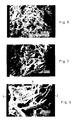
- Fig. 6, Fig. 7 and Fig. 8 are the electron microscope pictures of the section of the artificial soil prepared by Example 1.
- Fig. 6 is a picture magnified 35 times
- Fig 7 is a picture magnified 1000 times
- Fig. 8 is a picture magnified 3500 times. From the picture of Fig. 6, it is understood that the artificial soil of the present invention is porous.
- the gypsum (X) is presented by needle-like elements
- the peat moss (Y) is presented by elements having scale-like surfaces
- the urethane polymer (Z) is presented by elements having slippery and sticky surfaces.
- Barkumin manufactured by Sumitomo Ringyo Co., Ltd.
- calcined gypsum K
- 2 grs. of a surface active agent (“STARHOME DO” manufactured by Nippon Oil & Fats Co., Ltd) was dissolved in 330 grs. of water in a beaker.
- Dissolved in this liquid was 40 grs. of a water-soluble urethane prepolymer ("SANPLEIN WE-104" manufactured by Sanyo Chemical Industries Ltd.). The mixture above-mentioned was then added to the liquid, which was then agitated and mixed.
- the mixture liquid into which the air had been fed was poured into a pot of a size No. 5, and allowed to cure at a temperature of 20°C for 10 minutes, thereby to produce an artificial soil block.
- the artificial soil block contained 59 % by weight of Barkumin, 32 % by weight of calcined gypsum and 9 % by weight of the urethane polymer, and presented a bulk density of 0.22 g/cm3.
- the mixture liquid into which the carbonic acid gas had been fed was poured into a mold frame of 250 mm x 250 mm x 35 mm. This mixture liquid was left and allowed to cure at a temperature of 20°C for 20 minutes. Thus, an artificial soil block was produced.
- the artificial soil block After dried at a temperature of 60°C for three hours, the artificial soil block contained 96 % by weight of the calcined gypsum and 4 % by weight of the urethane polymer, and presented a bulk density of 0.37 g/cm3.
- An artificial soil block was made with the use of a mixer (type K-900 manufactured by Hansa Co., Ltd.).
- the water dispersion liquid and the air were agitated and mixed by a plurality of projections 3c disposed at a core portion 3a and an outer pipe portion 3b.
- poured into the liquid was 10 parts of a water-soluble urethane prepolymer ("OH-GROUT OH-1" manufactured by Toho Chemical Industry Co., Ltd.).
- the water dispersion liquid foamed was taken out from the outlet port of the mixing head unit 3 and poured into a mold frame 5. After left for 20 minutes, the foamed body was taken out from the mold frame 5 and dried at a temperature of 60°C for four hours by a drier.
- the resultant artificial soil block contained 36 % by weight of the calcined gypsum, 55 % by weight of the fly ash and 9 % by weight of the urethane polymer, and presented a bulk density of 0.32 g/cm3.
- This liquid under foaming was poured into a mold frame of 100 mm x 600 mm x 400 mm. The liquid was then left at a temperature of 20°C for 20 minutes, causing the same to be foamed. Thus, an artificial soil block was prepared.
- the artificial soil block After dried at a temperature of 90°C for 24 hours, the artificial soil block was excellent in water retention, air permeability, resiliency, shape retention and the like.
- This artificial soil block contained 22 % by weight of the peat moss, 67 % by weight of the calcined gypsum and 11% by weight of the urethane polymer, and presented a bulk density of 0.17 g/cm3.
- This liquid under foaming was poured into a mold frame of 100 mm x 100 mm x 320 mm. The liquid was then left at a temperature of 20°C for 20 minutes, causing the same to foam. Thus, an artificial soil block was produced.
- the resultant artificial soil block was excellent in water retention, air permeability, resiliency, shape retention and the like.
- This soil block contained 37 % by weight of the calcined gypsum, 46 % by weight of Barkumin, 9 % by weight of the fly ash and 8 % by weight of the urethane polymer, and presented a bulk density of 0.24 g/cm3.
- the artificial soils obtained by Example 1 to Example 6 had a foamed body structure. Accordingly, they were not only excellent in water retention and air permeability, but also light in weight. Further, they were excellent in plant supporting and holding properties.
- a suitable number of the artificial soil blocks of a predetermined shape may be used by laying, or the artificial soil block may be suitably cut and patched.
- a culture ground may be easily prepared as desired.
- this soil block may be easily cut out. It is therefore possible to set out plants or sow seeds in the cut-out portions of the block, without digging up the artificial soil. Seeds or the like may be held in the cut-out portions of the soil block, preventing the seeds from flowing out due to rain or the like.
- the artificial soil blocks having different concentrations of gypsum, different nourishments, different concentrations of fertilizers and the like, may be used, in a desired manner, as combined suitably for the growth of plants to be cultivated.
- the artificial soil block having a great concentration of fertilizer may be disposed around the root of a plant.
- the mixture dispersion liquid under foaming was poured into a unglazed flowerpot of the size No. 5 and left at a temperature of 20°C for 10 minutes, causing the same to foam and cure.
- the resultant soil block contained 77 % by weight of soil and presented a bulk density of 0.32 g/cm3. This soil block was excellent in water retention, air permeability, resilience, shape retention and the like.
- the mixture dispersion liquid under foaming was poured into a mold frame of 5000 mm x 5000 mm x 300 mm and left at 20°C for 20 minutes, causing the mixture dispersion liquid to further foam.
- the resultant foamed body was then removed from the mold frame, thus producing an artificial soil block for plant culture.
- This artificial soil block contained 75 % by weight of the compound soil, and presented a bulk density of 0.16 g/cm3 after dried at 90°C for two hours.
- This soil block was excellent in water retention, air permeability, resiliency, shape retention and the like.
- the resultant artificial soil block for plant culture contained 96 % by weight of the compound soil and presented a bulk density of 0.35 g/cm3. This soil block was excellent in water retention, air permeability, resiliency, shape retention and the like.
- This mixture dispersion liquid which started foaming was poured into a mold frame of 250 mm x 250 mm x 35 mm. This liquid was then left at 20°C for 10 minutes, causing the same to be cured. The cured body was then removed from the mold, thus producing an artificial soil block for plant culture. After dried at 60°C for three hours, the artificial soil block presented a bulk density of 0.35 g/cm3. This soil block was not only abundant in nutritious substance because of the rice hulls and leaf mold contained therein, but also particularly excellent in water retention because of the absorptive polymer contained therein.
- Added to this water dispersion liquid was 0.5 kg. of a water-soluble urethane prepolymer ("OH-GROUT OH-8B" manufactured by Toho Chemical Industry Co., Ltd., which is a composition obtained by mixing toluene diisocyanate and methyl ethyl ketone with a prepolymer of the organic isocyanate polyether triol type having m of 10 to 30 and n of 70 to 90 in the general formula (B)).
- the resultant mixture was agitated, after which normal pentane was added to the mixture.
- the resultant mixture was further agitated and mixed uniformly.
- This mixture liquid was poured into a mold frame of 75 mm x 600 mm x 600 mm and left at 20°C for 20 minutes, causing the mixture liquid to foam.
- the resultant foamed body was removed from the mold frame, thus producing an artificial soil block for plant culture.
- This soil block was excellent in water retention, air permeability, resiliency, shape retention and the like. After dried at 90°C for 24 hours, this soil block presented a bulk density of 0.24 g/cm3.
- a mixture liquid by uniformly agitating and mixing (i) 40 grs. of a water-soluble urethane prepolymer ("SANPLEIN WE-104" manufactured by Sanyo Chemical Industries Ltd.), and (ii) 8 grs. of normal pentane.
- the mixture liquid was agitatingly mixed with the water dispersion liquid, thereby to produce a mixture dispersion liquid.
- This mixture dispersion liquid was poured into a mold frame of 150 mm x 150 mm x 30 mm and left at a room temperature for 20 minutes, causing the liquid to foam. The foamed body was then removed from the mold frame, thus producing an artificial soil block for plant culture.
- the mixture dispersion liquid to which the carbonic acid gas had been dispersed was poured into a mold frame of 300 mm x 300 mm x 30 mm. This liquid was left at 20°C for 10 minutes, causing the same to be cured. The resultant foamed body was then removed from the mold frame, thus producing an artificial soil block for plant culture.
- This mixture dispersion liquid was poured into a mold frame of 250 mm x 250 mm x 35 mm. This liquid was left at 20°C for 10 minutes, causing the same to be cured. The resultant cured body was then removed from the mold frame, thus obtaining a soil block.
- this water dispersion liquid was 200 grs. of a water-soluble urethane prepolymer ("OH-GROUT OH-1" manufactured by Toho Chemical Industry Co., Ltd.). The resultant mixture was uniformly agitated and mixed to prepare a mixture dispersion liquid.
- OH-GROUT OH-1 a water-soluble urethane prepolymer manufactured by Toho Chemical Industry Co., Ltd.
- the artificial soil blocks for plant culture of Example 7 to Example 15 had a foamed body structure containing soils. Accordingly, they were not only excellent in water retention and air permeability, but also light in weight to facilitate the handling thereof. Further, they are excellent in plant supporting and holding properties.
- the flowerpot and the artificial soil were bonded togher, facilitating the transportation thereof.
- a suitable number of the artificial soil blocks of a predetermined shape may be used by laying, or the artificial soil block may be suitably cut and patched.
- a culture ground may be easily prepared as desired.
- this soil block may be easily cut out. It is therefore possible to set out plants or sow seeds in the cut-out portions of the block, without digging up the artificial soil. Seeds or the like may be held in the cut-out portions of the block, preventing the seeds from flowing out due to wind or the like.
- the artificial soil blocks having different concentrations of soils, different nourishments, different concentrations of fertilizers and the like may be used, in a desired manner, as combined suitably for the growth of plants to be cultivated.
- the artificial soil block having a great concentration of nourishment may be disposed around the root of a plant.
- the soil block for plant culture in accordance with the present invention is suitable as soil for agriculture and gardening soil.
- This mixture dispersion liquid was then poured into a mold frame in the form of a dog having a volume of 560 cm3.
- a dog-shape soil block for plant culture was obtained.
- this soil block for plant culture was excellent in water retention, air permeability, resiliency, shape retention and the like.
- This soil block presented a bulk density of 0.39 g/cm3.
- This mixture dispersion liquid was poured into a mold frame of 150 mm x 150 mm x 30 mm. Thus, an artificial soil block for plant culture was obtained.
- the soil block is integral with the dog-shape mold frame. Accordingly, the soil block may be disposed as desired, for example as hanging upside down. Thus, this soil block is suitable for a decorative flowerpot.
- Example 16 when the mixture dispersion liquid is to be poured into the dog-shape mold frame, mold release paper may be disposed between the mixture dispersion liquid and the mold frame or a mold release material may be applied to the mold frame.
- a dog-shape artificial soil block may be manufactured with the artificial soil only.
- the soil blocks for plant culture obtained by Example 16 and Example 17 presented a small bulk density and a suitable viscoelasticity. Accordingly, such blocks were not only light in weight and easy to handle, but also excellent in plant supporting and holding properties. When the artificial soil block was used for an indoor flowerpot, it did not fall from the flowerpot at the time of handling, thus preventing the floor or the like from being contaminated.
- a suitable number of the artificial soil blocks of a predetermined shape may be used as laying, or the artificial soil block may be suitably cut and patched.
- a culture ground may be easily prepared.
- this soil block may be easily cut out. It is therefore possible to set out plants or sow seeds in the cut-out portions of the block, without digging up the artificial soil. Seeds or the like may be held in the cut-out portions of the block, preventing the seeds from flowing out due to rain or the like.
- the artificial soil blocks having different concentrations of soils, different nourishments, different concentrations of fertilizers and the like may be used, in a desired manner, as combined suitably for the growth of plants to be cultivated.
- the artificial soil block having a great concentration of nourishment may be disposed around the root of a plant.
- the resultant cured body was crushed into pieces having suitable sizes. These crushed pieces were then loaded into a sugar coating machine, thus producing a porous artificial soil for plant culture in the form of a particle having a grain size of 2 to 17 mm. After dried at 70°C for four hours, the particles presented a bulk density of 0.51 g/cm3 when measured in the following manner. That is, the artificial soil was put in a vessel of a predetermined volume and the vessel was beaten three times with constant force. Measurement was then made with the vessel fully charged with the soil. In the following Example 19 to Example 29, the bulk density was measured in the same manner as above-mentioned.
- the resultant cured body was crushed into pieces having suitable sizes, thus producing a porous artificial soil for plant culture in the form of a particle having a size from 1 to 15 mm. After dried 80°C for five hours, these crushed pieces presented a bulk density of 0.12 g/cm3 and PH of 6.6.
- the PH was measured in a manner outlined below. One part by weight of the artificial soil was impregnated with 10 parts by weight of water. After the resultant artificial soil had been left for one hour, its PH value was measured with the use of a PH meter (Model PH-8AE manufactured by Yanagimoto Seisakusho Co., Ltd.). In the following Examples, the PH values were measured in the same manner as above-mentioned).
- aqueous dispersion liquid Added to this aqueous dispersion liquid was 0.5 kg. of a water-soluble urethane prepolymer ("OH-GROUT OH-8B" manufactured by Toho Chemical Industry Co., Ltd.). The resultant mixture was agitated, after which 35 grs. of normal pentane was added. The resultant mixture was uniformly agitated and mixed to prepare a dispersion liquid.
- OH-GROUT OH-8B a water-soluble urethane prepolymer manufactured by Toho Chemical Industry Co., Ltd.
- the resultant cured body was pelletized with the use of a pelleter (Model PU-5 manufactured by Fuji Paudal Co., Ltd.), thus producing a porous artificial soil for plant culture in the form of a pellet having a diameter of 2 mm and a length of 25 mm. After dried for 8 hours, these pellets presented a bulk density of 0.21 g/cm3 and PH of 6.3.
- a pelleter Model PU-5 manufactured by Fuji Paudal Co., Ltd.
- Carbonic acid gas was fed to the aqueous dispersion liquid while the dispersion liquid was agitated and mixed. Further, 100 grs. of a water-soluble urethane prepolymer ("OH-GROUT OH-8B" manufactured by Toho Chemical Industry Co., Ltd.) was added to this aqueous dispersion liquid. The resultant mixture was uniformly agitated and mixed to prepare a dispersion liquid.
- a water-soluble urethane prepolymer (“OH-GROUT OH-8B" manufactured by Toho Chemical Industry Co., Ltd.
- the dispersion liquid was allowed to be cured for a while until the liquid became suitably viscous.
- This viscous body was crushed into pieces having suitable sizes, which were then loaded into a sugar coating machine. There was thus produced a porous artificial soil for plant culture in the form of a particle having a grain size of 2 to 17 mm. After dried at 50°C for 9 hours, these particles presented a bulk density of 0.17 g/cm3.
- an aqueous dispersion liquid was prepared. Added to this dispersion liquid was 30 grs. of a water-soluble urethane prepolymer ("SANPLEIN WE-104" manufactured by Sanyo Chemical Industries Ltd.). The resultant mixture was further agitated and mixed with air swallowed therein, thus preparing a dispersion liquid.
- SANPLEIN WE-104 a water-soluble urethane prepolymer manufactured by Sanyo Chemical Industries Ltd.
- aqueous dispersion liquid Added to this aqueous dispersion liquid was 350 grs. of a water-soluble urethane prepolymer ("OH-GROUT OH-1" manufactured by Toho Chemical Industry Co., Ltd.). The resultant mixture was agitated. Added to this mixture was 105 grs. of monofluorotrichlorometane ("ASAHI FRON 11" manufactured by Asahi Glass Co., Ltd.). When the resultant mixture was uniformly agitated and mixed, the mixture started foaming.
- ASAHI FRON 11 monofluorotrichlorometane
- aqueous dispersion liquid Added to this aqueous dispersion liquid was 27 grs. of a water-soluble urethane prepolymer ("OH-GROUT OH-1" manufactured by Toho Chemical Industry Co., Ltd.). The resultant mixture was agitated, after which 20 grs. of normal pentan was added. When the resultant mixture was uniformly agitated and mixed, it started foaming.
- OH-GROUT OH-1 a water-soluble urethane prepolymer manufactured by Toho Chemical Industry Co., Ltd.
- aqueous dispersion liquid Added to this aqueous dispersion liquid was 150 grs. of a water-soluble urethane prepolymer ("OH-GROUT OH-8B" manufactured by Toho Chemical Industry Co., Ltd.). The resultant liquid was agitated, after which added was 28 grs. of monofluorotrichlorometane ("ASAHI FLON 11" manufactured by Asahi Glass Co., Ltd.). The resultant liquid was agitated. When the liquid was uniformly agitated and mixed, it started foaming.
- ASAHI FLON 11 monofluorotrichlorometane
- the dispersion liquid was poured into a palette and allowed to be cured for a while.
- a water-containing foamed body in the form of a thin layer was produced.
- This foamed body was formed with the use of a a noodle making machine (Model" LUSSO MOD 150" manufactured by AMPIA Co., Ltd.).
- a porous artificial soil for plant culture in the form of a band having a width of 7 mm, a thickness of 2 mm and a length of 2 to 300 mm.
- the artificial soils obtained by Example 18 to Example 29 were excellent in water retention, water permeability and air permeability. Further, they were not only light in weight and easy to handle, but also excellent in plant supporting and holding properties.
- the artificial soils of Examples 18, 19, 23, 24, 26, 27 and 29 are in the form of a particle, while the artificial soils of Examples 20, 21 and 25 are in the form of a pellet. Accordingly, these artificial soils could be used for a variety of plant culture vessels in the same manner as in natural soils.
- the artificial soils of Examples 22 and 28 are in the form of noodles. These soils could be used for a variety of plant culture vessels. Further, it was possible to intertwine a number of noodle bodies into the form of a mass. Such a mass could be used for plant culture as put in a basket or the like, without use of a culture vessel.
- this water dispersion liquid was 25 grs. of a water-soluble urethane prepolymer ("OH-GROUT OH-1" manufactured by Toho Chemical Industry Co., Ltd.).
- the resultant mixture liquid was uniformly agitated and mixed.
- 8 Grs. of n-pentane was further added to this mixture liquid.
- this liquid started foaming.
- This mixture liquid under foaming was poured into a rectangular parallelepied mold of 250 mm x 250 mm x 25 mm, causing the liquid to be cured.
- an artificial soil block was produced.
- This block was removed from the mold. After the block had been dried at 80°C for three hours in a drier, the block presented a bulk density of 0.16 g/cm3. The block also presented a maximum water holding capacity of 740 grs/l and a gas phase of 17% at the maximum water holding capacity.
- TENSILON UTM-1 manufactured by Orientec Co., Ltd.
- the artificial soil was pierced with a rod-like member having a diameter of 1 mm, at a speed of 10 mm/min.
- the piercing strength was measured as 28 grs./mm2.
- Rice plants, tomatoes, cucumbers, fringed pinks, pansies and the like were cultivated with culture grounds of this artificial soil, and checked for decay of their roots. These plants presented no root decay since the gas phase was in a range from 5 to 25% which is preferable for plants.
- this water dispersion liquid was 25 grs. of a water-soluble urethane prepolymer ("OH-GROUT OH-1" manufactured by Toho Chemical Industry Co., Ltd.).
- the resultant liquid was uniformly agitated and mixed. Further, 12 grs. of n-pentane was added. When the resultant mixture liquid was uniformly agitated and mixed, the n-pentane was evaporated, causing the liquid to start foaming.
- Example 30 the same procedures as in Example 30 were applied to prepare an artificial soil in the form of a block. After dried under the same conditions as in Example 30, the artificial soil presented a bulk density of 0.15 g/cm3, a maximum water holding capacity of 840 g/l and a gas phase at the maximum waer holding capacity of 9%.
- Rice plants, tomatoes, cucumbers, fringed pinks, pansies and the like were cultivated with culture grounds of this artificial soil, and then checked for decay of their roots. These plants presented no root decay since the gas phase was in a range from 5 to 25% which is preferable for plants.
- Example 30 the same procedures as in Example 30 were applied to this liquid, thereby to prepare an artificial soil in the form of a block.
- the artificial soil After dried under the same conditions as in Example 30, the artificial soil presented a bulk density of 0.15 g/cm3, a maximum water holding capacity of 920 g/l and a gas phase of 1% at the maximum water holding capacity.
- Rice plants, tomatoes, cucumbers, fringed pinks, pansies and the like were cultivated with culture grounds of this artificial soil, and then checked for decay of their roots. These plants presented root decay since the gas phase rate was too small.
- Example 30 From Example 30, Example 31 and Comparative Example 1, it is found that the gas phase rate in the artificial soil is increased as the proportional ratio of the organic matter to the inorganic matter is increased.
- this water dispersion liquid was 125 grs. of a water-soluble urethane prepolymer ("OH-GROUT OH-1" manufactured by Toho Chemical Industry Co., Ltd.).
- the resultant mixture liquid was uniformly agitated and mixed. Further, 5 grs. of n- pentane was added. When the resultant mixture liquid was uniformly agitated and mixed, the n-pentane was evaporated, causing the liquid to start foaming.
- Example 30 the same procedures as in Example 30 were applied to this liquid, thereby to prepare an artificial soil in the form of a block.
- the artificial soil presented a bulk density of 0.15 g/cm3.
- a measurement of piercing strength was carried out on this artificial soil block in the same manner as in Example 30.
- This soil block presented a piercing strength of 274 g/cm2.
Landscapes
- Life Sciences & Earth Sciences (AREA)
- Environmental Sciences (AREA)
- Chemical & Material Sciences (AREA)
- Inorganic Chemistry (AREA)
- Cultivation Of Plants (AREA)
Priority Applications (1)
| Application Number | Priority Date | Filing Date | Title |
|---|---|---|---|
| DE89300158T DE68911119D1 (de) | 1989-01-09 | 1989-01-09 | Poröse künstliche Erde für die Pflanzenkultur und Verfahren zu deren Herstellung. |
Applications Claiming Priority (3)
| Application Number | Priority Date | Filing Date | Title |
|---|---|---|---|
| JP2624788 | 1988-02-05 | ||
| JP63171648A JPH01309624A (ja) | 1987-07-10 | 1988-07-09 | 植物栽培用土壌ブロック及びその製造方法 |
| JP63171647A JPH01309623A (ja) | 1988-02-05 | 1988-07-09 | 植物栽培用人工土壌ブロック |
Publications (2)
| Publication Number | Publication Date |
|---|---|
| EP0377923A1 true EP0377923A1 (fr) | 1990-07-18 |
| EP0377923B1 EP0377923B1 (fr) | 1993-12-01 |
Family
ID=27285326
Family Applications (1)
| Application Number | Title | Priority Date | Filing Date |
|---|---|---|---|
| EP89300158A Expired - Lifetime EP0377923B1 (fr) | 1988-02-05 | 1989-01-09 | Sol artificiel poreux pour la culture de plantes et procédé pour sa fabrication |
Country Status (1)
| Country | Link |
|---|---|
| EP (1) | EP0377923B1 (fr) |
Cited By (7)
| Publication number | Priority date | Publication date | Assignee | Title |
|---|---|---|---|---|
| EP0456953A1 (fr) * | 1990-05-15 | 1991-11-21 | Ding-Ho Shiau | Milieu de croissance pour la culture de plantes |
| WO1997019585A1 (fr) * | 1995-11-27 | 1997-06-05 | Bayer Aktiengesellschaft | Corps moules en un substrat vegetal humique durci au polyurethanne/polyuree, leur procede de production et leur utilisation en culture vegetale |
| EP1935234A3 (fr) * | 2006-12-19 | 2010-04-14 | Gartneriet Bladgroent ApS | Milieu de croissance à forme permanente et procédé pour sa fabrication |
| WO2014143716A1 (fr) * | 2013-03-15 | 2014-09-18 | Gaia Institute | Sol artificiel |
| US20200128764A1 (en) * | 2014-05-29 | 2020-04-30 | Rockwool International A/S | Growth substrate product |
| DE102020119767A1 (de) | 2020-07-27 | 2022-01-27 | Dreesen Frische Kräuter GmbH & Co. KG | Pflanzenwachstumssubstrat |
| CN115784290A (zh) * | 2022-11-08 | 2023-03-14 | 宜都兴发化工有限公司 | 一种熔融盐浸取法净化磷石膏的工艺 |
Families Citing this family (2)
| Publication number | Priority date | Publication date | Assignee | Title |
|---|---|---|---|---|
| CN107987234A (zh) * | 2017-12-05 | 2018-05-04 | 苏州贝多环保技术有限公司 | 一种利用慈竹制备高效吸油材料的方法 |
| CN111527825A (zh) * | 2020-05-15 | 2020-08-14 | 中国农业科学院棉花研究所 | 一种棉花播种方法 |
Citations (6)
| Publication number | Priority date | Publication date | Assignee | Title |
|---|---|---|---|---|
| US3805531A (en) * | 1970-12-21 | 1974-04-23 | Minnesota Mining & Mfg | Consolidation of mineral aggregate |
| US4114316A (en) * | 1976-06-07 | 1978-09-19 | Merrill Cohen | Growing plants in an aquarium |
| US4175355A (en) * | 1974-05-29 | 1979-11-27 | Gravi-Mechanics Co. | Rooting media and methods of making the same |
| US4329436A (en) * | 1981-05-08 | 1982-05-11 | Dedolph Richard R | Method of forming a urethane prepolymer and its use in consolidating aggregate material |
| EP0089796A1 (fr) * | 1982-03-19 | 1983-09-28 | Imperial Chemical Industries Plc | Procédé de fabrication de mousses de polyuréthane |
| DE3627236A1 (de) * | 1986-08-12 | 1988-02-18 | Basf Ag | Hydrophile polyurethan-hartschaumstoffe, verfahren zu deren herstellung und deren verwendung |
-
1989
- 1989-01-09 EP EP89300158A patent/EP0377923B1/fr not_active Expired - Lifetime
Patent Citations (7)
| Publication number | Priority date | Publication date | Assignee | Title |
|---|---|---|---|---|
| US3805531A (en) * | 1970-12-21 | 1974-04-23 | Minnesota Mining & Mfg | Consolidation of mineral aggregate |
| US4175355A (en) * | 1974-05-29 | 1979-11-27 | Gravi-Mechanics Co. | Rooting media and methods of making the same |
| US4175355B1 (fr) * | 1974-05-29 | 1992-04-14 | Gravi Mechanics Co | |
| US4114316A (en) * | 1976-06-07 | 1978-09-19 | Merrill Cohen | Growing plants in an aquarium |
| US4329436A (en) * | 1981-05-08 | 1982-05-11 | Dedolph Richard R | Method of forming a urethane prepolymer and its use in consolidating aggregate material |
| EP0089796A1 (fr) * | 1982-03-19 | 1983-09-28 | Imperial Chemical Industries Plc | Procédé de fabrication de mousses de polyuréthane |
| DE3627236A1 (de) * | 1986-08-12 | 1988-02-18 | Basf Ag | Hydrophile polyurethan-hartschaumstoffe, verfahren zu deren herstellung und deren verwendung |
Cited By (8)
| Publication number | Priority date | Publication date | Assignee | Title |
|---|---|---|---|---|
| EP0456953A1 (fr) * | 1990-05-15 | 1991-11-21 | Ding-Ho Shiau | Milieu de croissance pour la culture de plantes |
| WO1997019585A1 (fr) * | 1995-11-27 | 1997-06-05 | Bayer Aktiengesellschaft | Corps moules en un substrat vegetal humique durci au polyurethanne/polyuree, leur procede de production et leur utilisation en culture vegetale |
| EP1935234A3 (fr) * | 2006-12-19 | 2010-04-14 | Gartneriet Bladgroent ApS | Milieu de croissance à forme permanente et procédé pour sa fabrication |
| WO2014143716A1 (fr) * | 2013-03-15 | 2014-09-18 | Gaia Institute | Sol artificiel |
| US20200128764A1 (en) * | 2014-05-29 | 2020-04-30 | Rockwool International A/S | Growth substrate product |
| DE102020119767A1 (de) | 2020-07-27 | 2022-01-27 | Dreesen Frische Kräuter GmbH & Co. KG | Pflanzenwachstumssubstrat |
| CN115784290A (zh) * | 2022-11-08 | 2023-03-14 | 宜都兴发化工有限公司 | 一种熔融盐浸取法净化磷石膏的工艺 |
| CN115784290B (zh) * | 2022-11-08 | 2024-03-12 | 宜都兴发化工有限公司 | 一种熔融盐浸取法净化磷石膏的工艺 |
Also Published As
| Publication number | Publication date |
|---|---|
| EP0377923B1 (fr) | 1993-12-01 |
Similar Documents
| Publication | Publication Date | Title |
|---|---|---|
| JP2002165520A (ja) | 植物育成応用のためのポリウレタンフォーム合成物及び関連する方法 | |
| US20040049980A1 (en) | Cohesive polymer plug for use in plant production | |
| US3472644A (en) | Foamed synthetic polymeric plant growth medium containing an inorganic filler and microorganisms | |
| US3961445A (en) | Plant holder and process for producing the same | |
| JP4573924B2 (ja) | 団粒構造ゼオライト、その製造方法および育苗培土 | |
| GB2085701A (en) | Growth substrate bed | |
| US2779670A (en) | Soil conditioning and fertilizing compounds and methods of manufacture | |
| CN100419025C (zh) | 一种保水保肥的多功能高分子复合材料及其制备方法 | |
| EP0377923A1 (fr) | Sol artificiel poreux pour la culture de plantes et procédé pour sa fabrication | |
| US3799755A (en) | Process for the manufacture of a plant substrate body | |
| US3979198A (en) | Polyurethane plant growth medium | |
| CN111543283A (zh) | 一种可塑形固体基质及其制备方法和应用以及一种草坪砖的制备方法 | |
| JP3969810B2 (ja) | 肥料培地 | |
| CN109503196A (zh) | 一种多孔陶瓷颗粒的制备方法 | |
| EP0487655B1 (fr) | Substrats de tourbe pour les plantes | |
| JPH05244820A (ja) | 植物栽培用多孔性人工土壌体およびその製造方法 | |
| JP4153587B2 (ja) | 粒状培地及びこれを用いた混合培地 | |
| FI57740B (fi) | Foerfarande foer framstaellning av pressad torvsubstrat | |
| JPH0220221A (ja) | 植物栽培用人工土壌ブロック | |
| JP2000212561A (ja) | 炭含有粒子、これを用いた培地及び栽培方法 | |
| JPH01309624A (ja) | 植物栽培用土壌ブロック及びその製造方法 | |
| JP2004283060A (ja) | マット植物用培地、マット植物用粒状培地、及びこれらを用いた緑化施工方法 | |
| JP2000139207A (ja) | 粒状培地及びこれを用いた混合培地 | |
| JPH02177819A (ja) | 植物栽培用多孔性人工土壌体およびその製造方法 | |
| JPH0473970B2 (fr) |
Legal Events
| Date | Code | Title | Description |
|---|---|---|---|
| PUAI | Public reference made under article 153(3) epc to a published international application that has entered the european phase |
Free format text: ORIGINAL CODE: 0009012 |
|
| 17P | Request for examination filed |
Effective date: 19900102 |
|
| AK | Designated contracting states |
Kind code of ref document: A1 Designated state(s): BE CH DE FR GB LI NL |
|
| 17Q | First examination report despatched |
Effective date: 19911122 |
|
| GRAA | (expected) grant |
Free format text: ORIGINAL CODE: 0009210 |
|
| AK | Designated contracting states |
Kind code of ref document: B1 Designated state(s): BE CH DE FR GB LI NL |
|
| PG25 | Lapsed in a contracting state [announced via postgrant information from national office to epo] |
Ref country code: NL Effective date: 19931201 Ref country code: LI Effective date: 19931201 Ref country code: FR Effective date: 19931201 Ref country code: DE Effective date: 19931201 Ref country code: CH Effective date: 19931201 Ref country code: BE Effective date: 19931201 |
|
| REF | Corresponds to: |
Ref document number: 68911119 Country of ref document: DE Date of ref document: 19940113 |
|
| PG25 | Lapsed in a contracting state [announced via postgrant information from national office to epo] |
Ref country code: GB Effective date: 19940301 |
|
| REG | Reference to a national code |
Ref country code: CH Ref legal event code: PL |
|
| EN | Fr: translation not filed | ||
| NLV1 | Nl: lapsed or annulled due to failure to fulfill the requirements of art. 29p and 29m of the patents act | ||
| PLBE | No opposition filed within time limit |
Free format text: ORIGINAL CODE: 0009261 |
|
| STAA | Information on the status of an ep patent application or granted ep patent |
Free format text: STATUS: NO OPPOSITION FILED WITHIN TIME LIMIT |
|
| GBPC | Gb: european patent ceased through non-payment of renewal fee |
Effective date: 19940301 |
|
| 26N | No opposition filed |