EP0377988A2 - Dispositif optique de conversion de longueur d'onde - Google Patents
Dispositif optique de conversion de longueur d'onde Download PDFInfo
- Publication number
- EP0377988A2 EP0377988A2 EP89313380A EP89313380A EP0377988A2 EP 0377988 A2 EP0377988 A2 EP 0377988A2 EP 89313380 A EP89313380 A EP 89313380A EP 89313380 A EP89313380 A EP 89313380A EP 0377988 A2 EP0377988 A2 EP 0377988A2
- Authority
- EP
- European Patent Office
- Prior art keywords
- wave
- optical
- face
- waveguide
- respect
- Prior art date
- Legal status (The legal status is an assumption and is not a legal conclusion. Google has not performed a legal analysis and makes no representation as to the accuracy of the status listed.)
- Granted
Links
- 230000003287 optical effect Effects 0.000 title claims abstract description 230
- 230000005466 cherenkov radiation Effects 0.000 claims abstract description 45
- 238000002310 reflectometry Methods 0.000 claims abstract description 39
- 238000005253 cladding Methods 0.000 claims abstract description 35
- 239000000463 material Substances 0.000 claims abstract description 22
- 239000000758 substrate Substances 0.000 claims description 72
- 239000011295 pitch Substances 0.000 description 33
- 238000006243 chemical reaction Methods 0.000 description 19
- 239000000835 fiber Substances 0.000 description 17
- 239000004065 semiconductor Substances 0.000 description 15
- 238000000034 method Methods 0.000 description 11
- 230000001902 propagating effect Effects 0.000 description 11
- 239000013598 vector Substances 0.000 description 7
- 238000003754 machining Methods 0.000 description 6
- 230000005855 radiation Effects 0.000 description 6
- 239000013078 crystal Substances 0.000 description 5
- 230000015572 biosynthetic process Effects 0.000 description 4
- 238000009792 diffusion process Methods 0.000 description 4
- 230000008569 process Effects 0.000 description 4
- 230000008878 coupling Effects 0.000 description 3
- 238000010168 coupling process Methods 0.000 description 3
- 238000005859 coupling reaction Methods 0.000 description 3
- 230000003247 decreasing effect Effects 0.000 description 3
- 239000000839 emulsion Substances 0.000 description 3
- 239000011521 glass Substances 0.000 description 3
- 230000010287 polarization Effects 0.000 description 3
- 230000000052 comparative effect Effects 0.000 description 2
- 238000012937 correction Methods 0.000 description 2
- 238000013461 design Methods 0.000 description 2
- 230000000694 effects Effects 0.000 description 2
- 238000000609 electron-beam lithography Methods 0.000 description 2
- 238000004519 manufacturing process Methods 0.000 description 2
- 238000005259 measurement Methods 0.000 description 2
- 238000012986 modification Methods 0.000 description 2
- 230000004048 modification Effects 0.000 description 2
- 230000010355 oscillation Effects 0.000 description 2
- NCGICGYLBXGBGN-UHFFFAOYSA-N 3-morpholin-4-yl-1-oxa-3-azonia-2-azanidacyclopent-3-en-5-imine;hydrochloride Chemical compound Cl.[N-]1OC(=N)C=[N+]1N1CCOCC1 NCGICGYLBXGBGN-UHFFFAOYSA-N 0.000 description 1
- 229910003327 LiNbO3 Inorganic materials 0.000 description 1
- 229910012463 LiTaO3 Inorganic materials 0.000 description 1
- 239000011248 coating agent Substances 0.000 description 1
- 238000000576 coating method Methods 0.000 description 1
- 230000001427 coherent effect Effects 0.000 description 1
- 230000000295 complement effect Effects 0.000 description 1
- 230000008094 contradictory effect Effects 0.000 description 1
- 238000010894 electron beam technology Methods 0.000 description 1
- 230000005284 excitation Effects 0.000 description 1
- 239000012535 impurity Substances 0.000 description 1
- 230000010365 information processing Effects 0.000 description 1
- 230000007774 longterm Effects 0.000 description 1
- 239000002184 metal Substances 0.000 description 1
- 230000002093 peripheral effect Effects 0.000 description 1
- 238000002834 transmittance Methods 0.000 description 1
Images






Classifications
-
- G—PHYSICS
- G02—OPTICS
- G02F—OPTICAL DEVICES OR ARRANGEMENTS FOR THE CONTROL OF LIGHT BY MODIFICATION OF THE OPTICAL PROPERTIES OF THE MEDIA OF THE ELEMENTS INVOLVED THEREIN; NON-LINEAR OPTICS; FREQUENCY-CHANGING OF LIGHT; OPTICAL LOGIC ELEMENTS; OPTICAL ANALOGUE/DIGITAL CONVERTERS
- G02F1/00—Devices or arrangements for the control of the intensity, colour, phase, polarisation or direction of light arriving from an independent light source, e.g. switching, gating or modulating; Non-linear optics
- G02F1/35—Non-linear optics
- G02F1/37—Non-linear optics for second-harmonic generation
- G02F1/377—Non-linear optics for second-harmonic generation in an optical waveguide structure
-
- G—PHYSICS
- G02—OPTICS
- G02B—OPTICAL ELEMENTS, SYSTEMS OR APPARATUS
- G02B27/00—Optical systems or apparatus not provided for by any of the groups G02B1/00 - G02B26/00, G02B30/00
- G02B27/42—Diffraction optics, i.e. systems including a diffractive element being designed for providing a diffractive effect
- G02B27/4233—Diffraction optics, i.e. systems including a diffractive element being designed for providing a diffractive effect having a diffractive element [DOE] contributing to a non-imaging application
-
- G—PHYSICS
- G02—OPTICS
- G02B—OPTICAL ELEMENTS, SYSTEMS OR APPARATUS
- G02B6/00—Light guides; Structural details of arrangements comprising light guides and other optical elements, e.g. couplings
- G02B6/10—Light guides; Structural details of arrangements comprising light guides and other optical elements, e.g. couplings of the optical waveguide type
- G02B6/12—Light guides; Structural details of arrangements comprising light guides and other optical elements, e.g. couplings of the optical waveguide type of the integrated circuit kind
- G02B6/122—Basic optical elements, e.g. light-guiding paths
- G02B6/124—Geodesic lenses or integrated gratings
-
- G—PHYSICS
- G02—OPTICS
- G02B—OPTICAL ELEMENTS, SYSTEMS OR APPARATUS
- G02B6/00—Light guides; Structural details of arrangements comprising light guides and other optical elements, e.g. couplings
- G02B6/24—Coupling light guides
- G02B6/26—Optical coupling means
- G02B6/32—Optical coupling means having lens focusing means positioned between opposed fibre ends
-
- G—PHYSICS
- G02—OPTICS
- G02B—OPTICAL ELEMENTS, SYSTEMS OR APPARATUS
- G02B6/00—Light guides; Structural details of arrangements comprising light guides and other optical elements, e.g. couplings
- G02B6/24—Coupling light guides
- G02B6/26—Optical coupling means
- G02B6/34—Optical coupling means utilising prism or grating
-
- G—PHYSICS
- G02—OPTICS
- G02B—OPTICAL ELEMENTS, SYSTEMS OR APPARATUS
- G02B27/00—Optical systems or apparatus not provided for by any of the groups G02B1/00 - G02B26/00, G02B30/00
- G02B27/09—Beam shaping, e.g. changing the cross-sectional area, not otherwise provided for
- G02B27/0938—Using specific optical elements
- G02B27/0944—Diffractive optical elements, e.g. gratings, holograms
-
- G—PHYSICS
- G02—OPTICS
- G02F—OPTICAL DEVICES OR ARRANGEMENTS FOR THE CONTROL OF LIGHT BY MODIFICATION OF THE OPTICAL PROPERTIES OF THE MEDIA OF THE ELEMENTS INVOLVED THEREIN; NON-LINEAR OPTICS; FREQUENCY-CHANGING OF LIGHT; OPTICAL LOGIC ELEMENTS; OPTICAL ANALOGUE/DIGITAL CONVERTERS
- G02F1/00—Devices or arrangements for the control of the intensity, colour, phase, polarisation or direction of light arriving from an independent light source, e.g. switching, gating or modulating; Non-linear optics
- G02F1/35—Non-linear optics
- G02F1/37—Non-linear optics for second-harmonic generation
- G02F1/372—Means for homogenizing the output beam
-
- G—PHYSICS
- G02—OPTICS
- G02F—OPTICAL DEVICES OR ARRANGEMENTS FOR THE CONTROL OF LIGHT BY MODIFICATION OF THE OPTICAL PROPERTIES OF THE MEDIA OF THE ELEMENTS INVOLVED THEREIN; NON-LINEAR OPTICS; FREQUENCY-CHANGING OF LIGHT; OPTICAL LOGIC ELEMENTS; OPTICAL ANALOGUE/DIGITAL CONVERTERS
- G02F1/00—Devices or arrangements for the control of the intensity, colour, phase, polarisation or direction of light arriving from an independent light source, e.g. switching, gating or modulating; Non-linear optics
- G02F1/35—Non-linear optics
- G02F1/37—Non-linear optics for second-harmonic generation
- G02F1/374—Cherenkov radiation
-
- G—PHYSICS
- G02—OPTICS
- G02F—OPTICAL DEVICES OR ARRANGEMENTS FOR THE CONTROL OF LIGHT BY MODIFICATION OF THE OPTICAL PROPERTIES OF THE MEDIA OF THE ELEMENTS INVOLVED THEREIN; NON-LINEAR OPTICS; FREQUENCY-CHANGING OF LIGHT; OPTICAL LOGIC ELEMENTS; OPTICAL ANALOGUE/DIGITAL CONVERTERS
- G02F1/00—Devices or arrangements for the control of the intensity, colour, phase, polarisation or direction of light arriving from an independent light source, e.g. switching, gating or modulating; Non-linear optics
- G02F1/35—Non-linear optics
- G02F1/37—Non-linear optics for second-harmonic generation
- G02F1/377—Non-linear optics for second-harmonic generation in an optical waveguide structure
- G02F1/383—Non-linear optics for second-harmonic generation in an optical waveguide structure of the optical fibre type
Definitions
- the present invention relates to a wavelength converting optical device for obtaining a light source for short wavelengths used for optical information processing or optical measurement equipments and, more particularly, to a wavelength converting optical device using a Cerenkov radiation system.
- Coherent light sources for short wavelengths have recently been developed for the purpose of application to high-density optical disk systems, measurement/display systems, and the like.
- a short wavelength light source is indispensable to a high-density optical disk system.
- a semiconductor laser as a short wavelength light source is compact and lightweight and has low power consumption. Because of these advantages, semiconductor lasers for shorter wavelengths using new materials have been developed.
- An InGaAtP semiconductor laser having an oscillation wavelength in the 0.6-am band (red) has already reached the level of practical application.
- semiconductor lasers for oscillating light beams having shorter wavelengths, such as green or blue light beams have been studied, no laser capable of continuous-wave oscillation at room temperature has been obtained yet, and hence practical application of such a laser is not warranted.
- SHG second harmonic generation
- a nonlinear optical crystal into a waveguide by using a semiconductor laser as a fundamental wave light source.
- a blue light beam (x 2 ) of 1 mW as a second harmonic wave was obtained with respect to a semiconductor laser beam with a fundamental wave ( ⁇ 1 ) of 80 mW, by using a proton-exchange LiNb0 3 waveguide having a waveguide portion formed on an LiNb0 3 substrate (T.
- a light output of at least several mW must be obtained.
- a light output of 100 mW or more is required as a fundamental wave.
- the laser tends to be degraded due to the influences of heat, COD (catastrophic optical damage), and the like. Therefore, a long-term reliability is difficult to ensure. This poses a serious limitation in practical use of a short wavelength light source using the SHG system.
- an external cavity system is considered as a means for increasing the conversion efficiency from a fundamental wave to an optical second harmonic wave. It is reported that an optical second harmonic wave of 29.7 mW is obtained with respect to, e.g., a light output of 52.6 mW as a fundamental wave by using this system (W.J. Kozlovsky et al., IEEE J. Quantum Electron., Vol-24, No. 6, pp. 913 - 919 (1988)). In this system, however, a YAG laser excited by a semiconductor laser is used as a fundamental wave, and the excitation semiconductor laser must have a light output of 500 mW. On the other hand, resonator type SHG in an optical waveguide has been reported.
- a Cerenkov radiation beam has a complex wave front due to radiation from axially distributed light sources. More specifically, a Cerenkov radiation beam is constituted by divergent light having different beam waist positions depending on output positions and hence does not have axial symmetry for the case of LiNb0 3 waveguide. For this reason, in order to collimate or focus the radiation beam, a special optical system is required. In addition, it is difficult to decrease the spot size of the beam to a diffraction limit.
- a waveguide for this SHG has a coaxial structure in which a nonlinear crystal core is covered with a glass cladding.
- This output beam has axial symmetry, but cannot be directly collimated or focused.
- the present invention has been made in consideration of the above situation, and has its object to provide a wavelength converting optical device having a high conversion efficiency without phase matching adjustment.
- a reflecting film is formed on an end face of an optical waveguide so as to increase conversion efficiency from a fundamental wave to an optical second harmonic wave.
- a wave front converting element for converting a conical wave into a plane wave or spherical wave is formed on a light output end face of an optical waveguide so as to collimate or focus an optical second harmonic beam emitted from the light output end face of the optical waveguide.
- a device which comprises an optical waveguide having a waveguide portion and a cladding portion at least one of which is formed of a nonlinear optical material, for converting a fundamental wave, incident on the waveguide portion from one end face of the optical waveguide, into an optical second harmonic wave by Cerenkov radiation, radiating the second harmonic wave onto the cladding portion, and outputting the optical second harmonic wave radiated on the cladding portion from the other end face of the optical waveguide; and a reflecting film formed on at least an optical second harmonic emerging end face of the optical waveguide, the reflecting film having a high reflectivity with respect to a fundamental wave of a guided mode and having a low reflectivity with respect to the optical second harmonic wave.
- a wavelength converting optical device for collimating or focusing an optical second harmonic wave which comprises a wavelength converting portion, having an optical waveguide including a waveguide portion and a cladding portion, at least one of which is formed of a nonlinear optical material, for converting a fundamental wave, incident on the waveguide portion from one end face of the optical waveguide, into an optical second harmonic wave by Cerenkov radiation, radiating the optical harmonic wave onto the clad portion, and outputting the optical second harmonic wave radiated on the cladding portion from the other end face of the optical waveguide; and a wave front converting portion, provided at the other end face of the waveguide, for converting the second harmonic wave emitted from the other end face into a plane wave, a spherical wave, or a conical wave having different divergence angles.
- optical waveguide type SHG using a Cerenkov radiation system by forming the above-described reflecting film on the end face of the optical waveguide, optical power in the optical waveguide can be increased, and hence the conversion efficiency from a fundamental wave to an optical second harmonic wave can be increased.
- the wave front converting portion is provided at the end face of the optical waveguide, an optical second harmonic wave as a plane wave (collimated light) or a spherical wave (converging or diverging light) can be obtained, thus allowing effective use of an optical second harmonic beam.
- the optical waveguide is constituted as a fiber optical waveguide, a wavelength converting optical device comprising a wave front converting portion, which can be easily manufactured and allows easy positioning, can be realized by using a concentrical diffraction grating as the wave front converting portion provided at the light emerging end face of the waveguide.
- a wavelength converting optical device comprising a wave front converting portion having a high diffraction efficiency can be realized by using a diffraction grating with a sawtooth section.
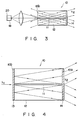
- Figs. 1 and 2 show a wavelength converting optical device according to a first embodiment of the present invention.
- the converting device comprises an optical waveguide 10 designed as a fiber type optical waveguide having axial symmetry.
- the waveguide 10 has a core (optical waveguide portion) 11 formed of a nonlinear material and having a circular section, and a cylindrical glass cladding 12 coated on the core 11.
- the waveguide 10 has output and input end faces 10a and 10b perpendicular to the axis of the waveguide.
- First and second reflecting films 14 and 13 are respectively bonded to these end faces.
- a fundamental wave 15 enters from the input end face 10b into the core 11 through the reflecting film 13, and a Cerenkov radiation beam (optical second harmonic wave) 16 propagating in the cladding 12 emerges from the output end face 10a on which the reflecting film 14 is formed.
- the refractive indices of the core 11 and the cladding 12 are set so as to cause an incident fundamental wave and a second harmonic wave to become a guided mode and a Cerenkov radiation beam, respectively.
- a material for the cladding 12 is selected to satisfy where n EFF is the effective refractive index of the fiber type optical waveguide 10 having the core 11 and the cladding 12 with respect to the fundamental wave.
- the fundamental wave 15 having the wavelength X When the fundamental wave 15 having the wavelength X, is incident on the optical waveguide 10, the wave is converted into an optical second harmonic wave having a wavelength ⁇ 1 /2 by the core 11 formed of a nonlinear optical material, and propagates in the cladding 12 as the Cerenkov radiation beam 16 having an angle 8c with respect to the core 11.
- the values ⁇ c , n EFF , and n 2 satisfy the following relation:
- the first and second reflecting films 14 and 13 serve to reflect a guided mode which is not converted into a second harmonic wave and to cause it to resonate, as will be described later. That is, the converting device is designed as a resonator type converting device.
- the first reflecting film 14 is designed to have a high reflectivity with respect to a fundamental wave as a guided mode and have a low reflectivity with respect to an optical second harmonic wave as a Cerenkov radiation beam.
- the reflectivity of the reflecting film 14 is ideally set to be 100% with respect to a fundamental wave, but is preferably set to be 95% or more, or still more preferably, 99% or more.
- the reflectivity with respect to a second harmonic wave is ideally set to be 0%, but is preferably set at 5% or less, or more preferably 2% of less.
- the second reflecting film 13 is designed to have an optimal reflectivity as a resonator with respect to a fundamental wave as a guided mode, as will be described below.
- the reflectivities of the reflecting films 13 and 14 with respect to a fundamental wave (guided mode) are respectively r, and r 2 ; the power of an incident fundamental wave, P 1 ; the coupling efficiency with respect to the optical waveguide 10, ⁇ ; the power of the guided mode immediately after it is incident on the optical waveguide, P c ; the conversion efficiency to a Cerenkov radiation beam, ⁇ sH ⁇ P c ; a ratio of power (with respect to a waveguide length L) lost by guided mode loss other than the conversion, a; and a power to be externally output as an optical second harmonic wave, P 2 .
- a conventional system for second harmonic generation by means of Cerenkov radiation i.e., a system without the reflecting films 13 and 14, if reflection by the end faces of a waveguide is ignored, the following relations are established between the above parameters:
- P. and P 2 are given by the following equations under resonance conditions (IEEE. J. Quantum Electron, QE-24,6, pp. 913 -919 (1988)): where t 2 is the transmittance of the first reflecting film 14 with respect to an optical second harmonic wave, and t is a function of P c , which is given by the following equation:
- the impedance matching condition of the resonator with respect to an incident wave is given as:
- the second reflecting film 13 has a reflectivity set in the above-described manner, a guided mode which is reflected by the first reflecting film 14 without being converted into a second harmonic wave is reflected by the second reflecting film 13 and propagates toward the output end face 10a through the core 11 again. In this case, part of the guided mode is converted into a second harmonic wave and emerges from the output end face 10a.
- an output of 1 mW is obtained as an optical second harmonic output with the parameters according to equation (4).
- t 2 1, the light output of an optical second harmonic wave is 11.4 mW. Therefore, the optical second harmonic wave power obtained in this arrangement is ten times that of the arrangement without reflecting films.
- the reflectivity of each reflecting film can be set in the above-described manner by using a dielectric multilayer.
- a conversion efficiency of about 10% is obtained; 90% of the incident wave power is not converted into a second harmonic wave propagating toward the end face 10a.
- 90% of the incident wave power is not converted into a second harmonic wave propagating toward the end face 10a.
- 50% is not coupled to the optical waveguide, 30% is lost by waveguide loss, and 10% is converted into an optical second harmonic wave propagating in the opposite direction.
- the coupling efficiency with respect to the optical waveguide is increased and the waveguide loss is decreased, a wavelength converting optical device having a higher conversion efficiency can be realized.
- the loss per unit length may be decreased, or the waveguide length may be shortened.
- a decrease in waveguide loss to 0.5 dB/cm is equivalent to a decrease in waveguide length to 2.5 mm in terms of an increase in conversion efficiency.
- the power of an incident wave can be set to be a smaller value.
- a light output of 30 mW is a general value for a GaAtAs laser used as a light source for a write-once type disk, and hence such an SHG system can be realized.
- the reflecting films 13 and 14 are provided on both the end faces of the fiber type optical waveguide to form a resonator, a guided mode power in the optical waveguide 10 can be increased. For this reason, the fundamental wave can be effectively converted into a Cerenkov radiation beam in the optical waveguide 10, and a conversion efficiency can be greatly increased to about ten times that of a conventional system. Since it is possible to decrease the incidence power, the device of this embodiment can be effectively used as a short wavelength light source having a light output of several mW even by using a currently available semiconductor laser. In addition, the device can be realized with a very simple arrangement obtained by merely providing the reflecting films 13 and 14 on both end faces of the optical waveguide 10.
- a resonator is formed by providing the reflecting films on both end faces of the optical waveguide.
- the conversion efficiency can be increased by providing a reflecting film on only the output end face.
- a semiconductor laser 18 is used as a light source for generating a fundamental wave, and a resonance effect may be obtained between the first reflecting film 14 of the converting device and a reflecting film 20 of the semiconductor laser.
- Fig. 4 shows a wavelength converting optical device according to the second embodiment of the present invention.
- the second embodiment is equivalent to the first embodiment in terms of its structure, but is different therefrom in the function of the second reflecting film 13. More specifically, in the first embodiment, half of an optical second harmonic wave generated by Cerenkov radiation propagates to the input end face 10b of the waveguide 10 and is wasted. In contrast to this, in the second embodiment, the optical second harmonic wave propagating to the incidence end face side is reflected by the reflecting film 13 so as to cause the wave to propagate toward the end face 10a of the waveguide 10.
- an output twice that of the first embodiment e.g., an optical second harmonic wave output of 6 mW or more can be obtained with respect to a fundamental wave of 30 mW.
- the reflectivity of the second reflecting film 13 with respect to a fundamental wave as a guided mode may be set to be the same value as that of the first embodiment, and the reflectivity with respect to an optical second harmonic wave as a Cerenkov radiation beam may be set to be 100%.
- the respective ideal values can be summarized as follows: where ( ⁇ ) and (2 ⁇ ) are respectively the reflectivities with respect to a fundamental wave and an optical second harmonic wave.
- the reflectivity of the second reflecting film 13 with respect to a fundamental wave is preferably set within the range of 50 to 95%.
- Table shows the design of each reflecting film (dielectric multilayer) for the above specification.
- a center wavelength X o is a value normalized by the wavelength of a fundamental wave
- H and L respectively represent high- and low-refractive-index layers having an optical thickness of ⁇ 0 /4.
- Actual thicknesses t H and t L of these layers are given by the following equations: where n H and n L are the refractive indices of the respective layers, and the following relationship is established between B H and 0 L and a Cerenkov radiation angle ⁇ c .
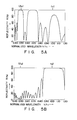
- the dielectric multilayers shown in Table respectively have a bandpass filter and a short-wavelength- pass filter as their fundamental structures.
- Figs. 5A and 5B respectively correspond to the dielectric multilayers denoted by (a) and (b) in Table.
- the actual reflectivities of the dielectric multilayers for the specification represented by equation (9) are: As is apparent from a comparison between equations (9) and (12), the multilayers can be designed to substantially satisfy the reflectivity characteristics of the specification. In this case, calculations are performed assuming that the value 8c is small and a second harmonic wave is perpendicularly incident on the first and second reflecting films. However, reflectivity design can be performed in consideration of incidence angles and the difference in reflectivity between a radiation mode (optical second harmonic wave) and a guided mode (fundamental wave).
- a structure having axial symmetry (fiber type optical waveguide) is exemplified.
- an optical waveguide a diffusion type optical waveguide or a three-dimensional optical waveguide such as a ridge stripe type optical waveguide may be used.
- an optical second harmonic wave to be output from the end face of the optical waveguide is a conical wave, and hence cannot be directly collimated or focused.
- the second harmonic wave can be converted into a plane or spherical wave.
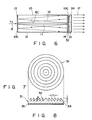
- Figs. 6 to 8 show a third embodiment of the present invention.
- the same reference numerals in the third embodiment denote the same parts as in the second embodiment, and a detailed description thereof will be omitted.
- a wavelength converting optical device comprises a fiber type optical waveguide (wavelength converting portion) 10 which has a core (waveguide portion) 11 formed of a nonlinear material and covered with a glass cladding 12.
- First and second reflecting films 14 and 13 are respectively attached to output and input end faces 10a and 10b of the waveguide 10.
- a lens plate (wave front converting portion) 31 having a diffraction grating of a concentrical pattern serving as a wave front converting element is arranged in contact with the first reflecting film 14.
- Refractive indices ni and n 2 of the cladding 12 and an effective refractive index n EFF of the optical waveguide 10 with respect to a fundamental wave are selected to satisfy equation (1) described above.
- a radiation angle 8c of a Cerenkov radiation beam 16 with respect to the core 11 is given by equation (2).
- the first and second reflecting films 14 and 13 are designed in the same manner as in the second embodiment.
- the optical second harmonic wave 16 emerging from the optical waveguide 10 is converted into a parallel light beam 17 by the lens plate 31.
- This parallel light beam 17 can be focused into a diffraction-limited spot by a conventional convex lens, unlike a light beam diverging in the form of a ring.
- the lens plate 31 includes a concentric diffraction grating 32 having grooves formed at equal intervals.
- a grating pitch A of the diffraction grating 32 is set to satisfy where m is a positive integer.
- an optical second harmonic wave 16 emerging from the end face of the fiber type optical waveguide 10 is converted into a collimated light beam 17 by m-th order diffraction of the diffraction grating 32 of the lens plate 31.
- Figs. 7 and 8 show a structure of the diffraction grating 32.
- the lens plate 31 includes a disk-like substrate 34.
- the diffraction grating 32 is formed on the incidence surface of the substrate.
- An anti-reflecting coating film 35 for preventing reflection of a harmonic wave in the substrate is bonded to the emerging surface of the diffraction grating 32.
- the lens plate 31 is arranged such that the center of diffraction grating 32 coincides with the central axis of the waveguide 10.
- the diffraction grating 32 has a sawtooth sectional shape, as shown in Fig. 8.
- An inclination angle 0 of each tooth at the sawtooth diffraction grating section is set to satisfy the following equation: where n s is the refractive index of the substrate 34, and ⁇ 0 is the propagation angle of a second harmonic wave emerging from the output end face 10a of the optical waveguide 10 in air.
- the following relationship is established between the propagation angle ⁇ 0 and the radiation angle ⁇ c by Cerenkov radiation:
- a depth t of each groove of the diffraction grating 32 can be given by the following equation according to equations (14) and (15):
- the grating 32 can be easily formed by using, e.g., a computer-controlled lathe (NC lathe).
- NC lathe computer-controlled lathe
- a metal die may be formed by means of NC lathe, and the grating 32 can be copied by using a plastic replica technique.
- the value ⁇ c can be decreased by properly selecting a cladding material.
- the conversion efficiency from a fundamental wave into a second harmonic wave can be increased in the same manner as in the second embodiment, and moreover the second harmonic wave can be collimated and output. Therefore, the converting device according to the third embodiment is very effective as a short wavelength light source using a semiconductor laser.
- Fig. 9 shows another method of manufacturing a concentric diffraction grating by using holographic interference exposure.
- reference numeral 40 denotes a truncated cone prism; 41, a diffraction grating substrate; and 42, a photosensitive emulsion layer.
- a central part of a plane wave incident on the bottom surface of the prism 40 propagates straight, whereas a peripheral part of the plane wave is refracted by a prism side surface to become a conical wave.
- Both the parts of light reach a surface of the emulsion layer 42, and a concentric diffraction grating is recorded on the surface by holographic interference.
- a bottom angle 8p of the prism 40 may be selected as follows:
- the lens plate 31 which is an optical element called an axicon
- a conical wave can be converted into a plane wave by using another typical axicon such as a conical prism.
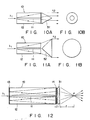
- a ring-like beam can be converted into a plane wave by a conical prism 51 as shown in Fig. 10A.
- the collimated light still has a ring-like shape, as shown in Fig. 10B.
- a method of arranging a conical prism 52 in the direction opposite to that in Fig. 10A as shown in Fig. 11 A may be considered.
- a collimated beam is not a beam having a hollow central portion.
- the prism 52 since only one point of the prism 52 is brought into contact with the output end face of the optical waveguide 10, positioning becomes difficult.
- the direction of light refracted by a side surface of the conical prism is determined by the bottom angle of the prism, considerably strict prism process precision is required.
- a wave front converting element constituted by a concentric diffraction grating can be attached in tight contact with the fiber type optical waveguide 10, output light does not become a ring-like beam having a hollow central portion as shown in Fig. 10B, and the difficulty in positioning shown in Fig. 11A can be eliminated.
- Figs. 12 to 14 show a schematic arrangement of a fourth embodiment of the present invention.
- a lens plate (wave front converting element) 31 is designed to focus an optical second harmonic wave emerging from the output end face of a fiber type optical waveguide 10 on one point.
- a phase n of a diffraction grating 32 of the element 31 is represented by the following equation as a function of a distance r from the center: where L(r) is the optical path length from a point on the diffraction grating surface to a focal point F.
- the optical path length L(r) is given by using a thickness t and a refractive index ns of a substrate 34 of the wave surface converting element 31 as follows (Appl.
- Equations (19) to (23) are substituted by -f, the resultant equations represent a wave front converting element for converting radiated light into light diverging from a point separated from the emerging surface of the substrate 34 by the distance f.
- Figs. 15 to 17 show an embodiment in which this wave front converting element is used.
- Figs. 13 and 14 and Figs. 16 and 17 respectively show patterns of diffraction gratings 32 of the wave front converting elements 31 according to the fourth and fifth embodiments.
- a diffraction grating can be formed by machining using an NC lathe in the same manner as in the third embodiment.
- the diffraction grating 32 is formed on the incidence surface side of the wave surface converting element 31.
- a diffraction grating may be formed on the emerging surface side of the substrate.
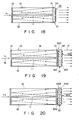
- Fig. 18 shows the sixth embodiment of the present invention, in which a diffraction grating 32 having a concentric pattern is formed on the light emerging side of a substrate 34 of a wave front converting element 31.
- the flat bottom surface of the substrate 34 can be bonded to the emerging end face of a fiber type optical waveguide 10.
- a wavelength converting optical device using a Cerenkov radiation system by using a wave front converting element on which a diffraction grating is formed, an optical second harmonic wave emitted from a fiber type optical waveguide can be collimated or focused.
- a wavelength converting optical device including a wave front converting element which can be easily formed and allows easy positioning, can be realized. If the grating pitch of this concentric diffraction grating is set to satisfy equation (13) or (22), an optical second harmonic wave can be converted into a plane wave (collimated light) or spherical wave (converging or diverging light).
- the sectional shape of the concentric diffraction grating is formed into a sawtooth blazed pattern, a wavelength converting optical element, including a wave front converting element having a high refractive index, can be realized.
- the grating pitch of the wave front converting element shown in Figs. 7 and 8 can be given by equation (13).
- the above grating constant can be realized.
- concentric diffraction gratings are formed by machining which enables mass production using a plastic replica, it is difficult to process a diffraction grating having a grating pitch of 1 um or less.
- a technique of performing wave front conversion not only once, but two or more times, may be employed so as to increase the grating pitch of each wave front converting surface, thus facilitating formation of a wave front converting element.
- Figs. 19 to 23 respectively show the seventh to eleventh embodiments based on this idea.
- a substrate 34 of a wave front converting element 31 has two wave front converting surfaces 31 a and 31 b.
- the surfaces 31 a and 31 are respectively constituted by concentric diffraction gratings 32a and 32b, each having grooves formed at equal intervals.
- a wave front converting element 31 includes two substrates 34a and 34b. Concentric diffraction gratings 32a and 32b, each having a grating pitch given by equation (25), are respectively formed on the substrates 34a and 34b. In this case, since the bottom surfaces of the substrates 34a and 34b, which have identical concentric diffraction gratings, need only be bonded to each other, formation of the wave front converting element is further facilitated.
- two diffraction gratings have the same grating pitch.
- a wave front converting element 31 may be constituted by a combination of a concentric diffraction grating 32 and a conical prism 36, as shown in a ninth embodiment of Fig. 21.
- the converting element 31 can be reduced in size as compared with the ones shown in Figs. 10A and 11 A, and moreover positioning is facilitated.
- Fig. 22 shows a tenth embodiment, in which a wave front converting element 31 is constituted by a combination of a concentric diffraction grating 32a having grooves formed at equal intervals and a Fresnel type concentric diffraction grating 32b.
- output light can be converted into a spherical wave converging on one point.
- the grating pitch can be increased as compared with the case wherein conversion is realized by only one wave front converting surface, thus formation of an element is facilitated.
- a concentric diffraction grating 32 having grooves formed at equal intervals and located at the incidence side of a wave converting element 31 may be combined with a spherical or aspherical lens 38 located at the emerging side.
- the wave front converting element is constituted by two or more wave front converting surfaces, a wavelength converting optical device, including a wave front converting element which can be easily processed by machining, can be realized.
- the optical waveguide having an axially symmetrical structure is exemplified as a fiber type optical waveguide.
- the present invention is not limited to this. That is, a three-dimensional optical waveguide such as a diffusion type optical waveguide, an embedded type optical waveguide, or a ridge stripe structure may be used.
- an optical waveguide 10 comprises a rectangular parallel-piped LiNb0 3 substrate 12 as a cladding portion, and a plate-like waveguide portion 11 bonded to a surface of the substrate 12.
- the optical waveguide 10 has input and output end faces 10b and 10a. These end faces extend perpendicular to the optical axis of incident light 15.
- a lens plate 31 as a wave front converting element is arranged to oppose the output end face 10a of the optical waveguide 10.
- the fundamental wave 15 is incident into the waveguide portion 11 through the input end face 10b, and a Cerenkov radiation beam (optical second harmonic wave) 16 propagating in the substrate 12 emerges from the end face 10a of the waveguide 10. Furthermore, the Cerenkov radiation beam 16 is converted into a collimated beam 17 by the wave front converting element 31.
- an optical second harmonic wave as a Cerenkov radiation beam is radiated from the waveguide portion 11 into only the substrate 12 side.
- n EFF the effective refractive index of the optical waveguide 10 with respect to the fundamental wave. Since LiNb0 3 has a large nonlinear optical constant d 33 , a substrate orientation and propagation and polarization directions of the fundamental wave are selected so as to use the constant d 33 .
- a guided mode of a fundamental wave is set to a TM mode propagating in y direction (or x direction). If an x-cut substrate (or y-cut substrate) is used, a guided mode of a fundamental wave is set to be a TE mode propagating in y direction (or x direction).
- the incident light is converted into an optical second harmonic wave having a wavelength of Xi/2 by a nonlinear optical effect of the LiNb0 3 , and propagates in the substrate 12 as the Cerenkov radiation beam 16 having an angle ⁇ c with respect to the waveguide portion 11.
- the following relationship is established between the angle ⁇ c and n 2 :
- This Cerenkov radiation beam is refracted by the output end face 10a and is radiated in the air at an angle eo.
- the following relationship is established between ⁇ 0 and ⁇ c :
- the second harmonic wave radiated in the air is converted into a collimated beam 17 by the wave front converting element 31.
- This collimated beam 17 can be focused into a diffraction-limited spot by a conventional lens.
- the second harmonic wave radiated from the waveguide 10 having the above-described arrangement does not become a perfectly conical wave. This is because the refractive index of a nonlinear crystal generally varies depending on propagation and polarization directions. That is, the emerging angle of the second harmonic wave radiated in the LiNb0 3 substrate 12 varies depending on directions, and the wave dose not have axial symmetry.
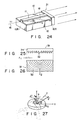
- the wave front converting element 31 comprises a rectangular substrate 34 having a diffraction grating 32 arranged to oppose the emerging end face of the waveguide 10.
- the diffraction grating 32 is constituted by part of an elliptic pattern such that equivalent radial grating pitches are changed in accordance with the divergence angle of the second harmonic wave.
- this elliptic pattern is formed such that its major axis coincides with the upper edge of the substrate 34.
- This diffraction grating 32 has grating pitches A 1 and A 2 in two orthogonal directions.
- a refractive index ellipsoid shown in Fig. 27 will be considered first to obtain the refractive index of the substrate 12 with respect to a second harmonic wave.
- the propagation direction of a fundamental wave of guided mode is x
- a vector n1 is given in the same direction as the polarization direction of the guided mode.
- a pointing vector s represents the propagation direction of the second harmonic wave.
- a vector, which has the same propagation direction as that of the second harmonic wave and whose absolute value represents the refractive index with respect to the second harmonic wave, is given as n2 .
- the vector s is represented by the following equation: If n1 and n2 are: then, the respective vectors must satisfy the following relations: where no and n e are respectively the refractive indices with respect to ordinary and extraordinary light waves at the wavelength of the second harmonic wave.
- the refractive index n 2 with respect to the second harmonic wave can be given by the following equation according to equations (30) to (35):
- the value ⁇ in the above equation corresponds to the Cerenkov radiation angle ⁇ c in the arrangement shown in Fig. 24. Since n 2 in equation (36) must satisfy equation (28), the value ⁇ c can be given by the following equation according to equations (28) and (36):
- the Cerenkov radiation angle ⁇ c generally varies depending on an angle ⁇ .
- the angle corresponds to the angle with respect to a waveguide surface when the x-cut substrate and TE mode are used, or corresponds to its complementary angle when the z-cut substrate and TM mode are used.
- the angle ⁇ 0 of the second harmonic wave radiated from the output end face 10a of the waveguide 10 varies depending on ⁇ .
- n e When LiNb0 3 is used, no and n e can be given by the following equations as functions of a wavelength ⁇ [ ⁇ m] and a temperature T [K], respectively (H. V. Hobden et al.: Phys. Lett., Vol. 23, No. 3, pp. 243 - 244 (1966)):
- Fig. 28 shows wavelength dependence of the refractive index of LiNb0 3 at room temperature (25 °C).
- Fig. 28 shows relationships between n 1 , n 2 , and n EFF in equations (27) to (29) when the wavelengths of a fundamental wave and the second harmonic wave are respectively set to be 0.84 ⁇ m and 0.42 ⁇ m.
- Fig. 29 shows relationships between AN and radiation angles of second harmonic waves in the substrate and in the air, which are calculated by using the above equations.
- AN represents the difference between the effective refractive index and the substrate refractive index with respect to the guided mode, and is given as:
- Fig. 29 shows two cases wherein in equation (37) is 0 and ⁇ /2.
- the grating pitch of a diffraction grating used as a wave front converting element for collimating the corresponding light can be given by the following equation:
- a large grating pitch A is preferable in terms of a diffraction grating process.
- AN in order to obtain large grating pitch A, AN must be increased.
- AN 0.135
- n EFF ( ⁇ ) n e ( ⁇ 2)
- A ⁇ .
- Such a diffraction grating can be formed by, e.g., electron beam lithography (G. Hatakoshi et al.: Appl. Opt., Vol. 24, No. 24, pp. 4307 - 4311 (1985)).
- the diffraction grating shown in Figs. 25 and 26 has a sawtooth section, i.e., a blazed pattern so as to increase the diffraction efficiency.
- a diffraction grating can be formed by dose control during electron beam drawing.
- the grating pitch of the diffraction grating varies in different radial directions.
- grating pitches can be set in accordance with the divergence angle of a second harmonic beam in different radial directions.
- an optical second harmonic wave having no axial symmetry can be collimated or focused.
- the wave front converting element serves to collimate output light.
- a wave front converting element for converting output light into a convergent or divergent spherical wave can be formed by changing the grating pattern.
- the grating pattern has an elliptic shape as in he twelfth embodiment.
- this grating has grooves formed at different intervals.
- first and second reflecting films 14 and 13 each having the same structure as that of the reflecting film in the second embodiment may be respectively bonded to emerging and incidence end faces 10a and 10b of an optical waveguide 10 having the same structure as that of the above-described twelfth embodiment. In this case, a conversion efficiency from a guided mode into a second harmonic wave can be increased.
- the diffraction grating of the twelfth embodiment can be formed by electron beam lithography.
- the grating has an elliptic pattern, it is difficult to form the grating by other methods such as machining.
- a diffraction grating having a concentric pattern can be relatively easily formed by using an NC lathe.
- such a diffraction grating having a concentric pattern is used as a wave front converting element in the converting device having the arrangement of the twelfth embodiment, it is difficult to collimate or focus a second harmonic output beam which does not have axial symmetry.
- Figs. 32 to 34 show a wavelength converting device according to a fourteenth embodiment of the present invention.
- This device employs a diffraction grating having a concentric pattern as a wave front converting element 31. More specifically, the device comprises an optical waveguide 10 having an LiNb0 3 substrate 12 and a waveguide 11, and the wave front converting element 31 arranged to oppose an output end face 10a of the waveguide 10.
- the converting element 31 has a rectangular substrate 34 and a diffraction grating 32 formed on its incidence surface.
- the diffraction grating 32 is constituted by part of a concentric pattern.
- the diffraction grating 32 is formed such that the center of the concentric pattern is located at an upper edge of the substrate 34.
- the output end face 10a of the waveguide 10 and the wave front converting element 31, i.e., the diffraction grating 32 are inclined at predetermined angles with respect to a plane perpendicular to the optical axis of incident light 15.
- the anisotropy of a Cerenkov radiation angle from the waveguide 10 can be corrected.
- the inclination angles of the concentric grating 32 and the end face 10a are respectively represented by ⁇ and ⁇ .
- the above equation is modified by using equations (28), (29), and the like as follows: where ⁇ 01 and 0 02 have the same meanings as those in equations (38) and (39).
- the pitch A, given by equation (45) is used as the grating pitch A, and ⁇ 01 and 0 02 are exchanged in the above equation.
- the fourteenth embodiment having the above-described arrangement since the output end face 10a of the optical waveguide 10 and the diffraction grating 32 of the wave front converting element 31 are inclined at the predetermined angles with respect to the plane perpendicular to the optical axis of the incidence light 15, the grating pitches of the diffraction grating can be set in accordance with the divergence angle of the second harmonic beam in different radial directions even by using the diffraction grating having a concentric pattern. Therefore, collimation or focusing of the second harmonic wave which does not have axial symmetry can be performed in the same manner as with the case wherein a diffraction grating having an elliptic pattern is used. In addition, since a diffraction grating having a concentric pattern can be used, a wave front converting element can be easily manufactured.
- both the wave front converting element and the output end face of the waveguide are inclined.
- the anisotropy of a Cerenkov radiation angle can be corrected in the same manner even by inclining only one of them.
- a fifteenth embodiment of the present invention shown in Fig. 35 an output end face 10a of an optical waveguide 10 is arranged to be perpendicular to the optical axis of incident light 15, and a wave front converting element 31 having a diffraction grating 32 with a concentric pattern is inclined with respect to the end face 10a, thereby correcting a Cerenkov radiation angle.
- B (1-cos ⁇ 02 ) 2 + sin 2 ⁇ 02 - sin 2 ⁇ 01 .
- the sign of ⁇ varies depending on whether the z-cut substrate or the x-cut substrate is used. More specifically, in equation (49), ⁇ ⁇ 0, wherein in equation (24), ⁇ > 0.
- Fig. 36 shows a relationship between AN and 0 defined by equation (42).
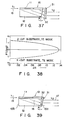
- a sixteenth embodiment shown in Fig. 37 only an output end face 10a of a waveguide 10 is inclined at a predetermined angle with respect to the plane perpendicular to the optical axis of incident light 15, and a wave front converting element 31 is arranged to be perpendicular to the optical axis.
- ⁇ 0 in equation (48)
- an inclination angle ⁇ of the end face 10a is obtained as follows (a z-cut substrate and a TM mode are used): Similarly, if an x-cut substrate and a TE mode are used,
- Fig. 38 shows a relationship between AN and W.
- an anisotropy correcting effect of a Cerenkov radiation angle is increased with & than with ⁇ . That is, a smaller inclination angle is required when the output end face of the optical waveguide is inclined than when the wave front converting element is inclined. As AN is increased, this tendency becomes more conspicuous.
- Fig. 39 shows a seventeenth embodiment of the present invention, in which both the output end face 10a of a waveguide 10 and a wave front converting element 31 are inclined in the same direction with respect to the plane perpendicular to the optical axis of incident light 15.
- a second harmonic wave emerging from each optical waveguide 10 can be collimated or focused by using a wave front converting element having a diffraction grating with a concentric pattern which can be relatively easily formed.
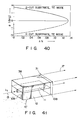
- Fig. 41 is a perspective view showing a schematic arrangement of an eighteenth embodiment of present invention.
- an embedded type three-dimensional waveguide is used as a fiber type optical waveguide, and a cover made of the same material as that of a substrate is fixed to the upper portion of the optical waveguide so as to further improve axial symmetry.
- the optical waveguide 10 comprises a rectangular parallel-piped LiNb0 3 substrate 12, a cylindrical waveguide portion 11 embedded in the substrate, and a rectangular parallel-piped LiNb0 3 cover 38 fixed to the upper surface of the substrate.
- a wave front converting element 31 is arranged on an output end face 10a of the waveguide 10.
- a diffraction grating having a concentric pattern or an elliptic pattern may be used as the element 31.
- the embedded type three-dimensional optical waveguide in this embodiment can be formed by, e.g., a combination of Ti diffusion and MgO additional diffusion (1986 Spring Applied Physics Meeting, 3p-L-11).
- an inorganic nonlinear material such as LiTaO 3 , KNb0 3 , Li10 3 , or KTP or an organic nonlinear material such as MNA or DAN may be used as a nonlinear material used for a cladding portion, a substrate, and the like of an optical waveguide in place of LiNbO 3 .
- the arrangement of an optical waveguide is not limited to those in the above-described embodiments.
- a waveguide portion may be formed by diffusing an impurity in a surface portion of a substrate formed of a nonlinear material.
- a waveguide portion and a clad portion (substrate) of an optical waveguide is formed of a nonlinear optical material. Therefore, a waveguide portion need not be always formed of a nonlinear optical material, and only cladding portion may be formed of a nonlinear optical material. Alternatively, both waveguide and cladding portions may be formed of a nonlinear optical material.
Landscapes
- Physics & Mathematics (AREA)
- General Physics & Mathematics (AREA)
- Optics & Photonics (AREA)
- Nonlinear Science (AREA)
- Engineering & Computer Science (AREA)
- Microelectronics & Electronic Packaging (AREA)
- Optical Modulation, Optical Deflection, Nonlinear Optics, Optical Demodulation, Optical Logic Elements (AREA)
- Optical Couplings Of Light Guides (AREA)
- Optical Integrated Circuits (AREA)
Applications Claiming Priority (4)
| Application Number | Priority Date | Filing Date | Title |
|---|---|---|---|
| JP6224/89 | 1989-01-13 | ||
| JP1006224A JP2878701B2 (ja) | 1989-01-13 | 1989-01-13 | 波長変換光学素子 |
| JP196831/89 | 1989-07-31 | ||
| JP1196831A JP2835087B2 (ja) | 1989-07-31 | 1989-07-31 | 波長変換光学素子 |
Publications (3)
| Publication Number | Publication Date |
|---|---|
| EP0377988A2 true EP0377988A2 (fr) | 1990-07-18 |
| EP0377988A3 EP0377988A3 (fr) | 1991-09-11 |
| EP0377988B1 EP0377988B1 (fr) | 1996-02-28 |
Family
ID=26340309
Family Applications (1)
| Application Number | Title | Priority Date | Filing Date |
|---|---|---|---|
| EP89313380A Expired - Lifetime EP0377988B1 (fr) | 1989-01-13 | 1989-12-20 | Dispositif optique de conversion de longueur d'onde |
Country Status (3)
| Country | Link |
|---|---|
| US (1) | US5377291A (fr) |
| EP (1) | EP0377988B1 (fr) |
| DE (1) | DE68925809T2 (fr) |
Cited By (6)
| Publication number | Priority date | Publication date | Assignee | Title |
|---|---|---|---|---|
| EP0490291A1 (fr) * | 1990-12-14 | 1992-06-17 | Sumitomo Electric Industries, Ltd. | Dispositif de source de lumière |
| EP0490369A1 (fr) * | 1990-12-14 | 1992-06-17 | Sumitomo Electric Industries, Ltd. | Convertisseur de longueur d'onde |
| US5912997A (en) * | 1994-09-09 | 1999-06-15 | Gemfire Corporation | Frequency converter optical source for switched waveguide |
| WO2003034118A1 (fr) * | 2001-10-17 | 2003-04-24 | Risø National Laboratory | Systeme de conversion d'un champ electromagnetique |
| EP1308767A3 (fr) * | 2001-11-06 | 2003-11-05 | Samsung Electronics Co., Ltd. | Système d'illumination et son utilisation dans un système de projection |
| CN113345619A (zh) * | 2021-06-16 | 2021-09-03 | 中国工程物理研究院激光聚变研究中心 | 一维x射线折射闪耀波带片 |
Families Citing this family (11)
| Publication number | Priority date | Publication date | Assignee | Title |
|---|---|---|---|---|
| JP3767927B2 (ja) * | 1995-01-31 | 2006-04-19 | 沖電気工業株式会社 | 波長変換方法及びそれを用いた波長変換装置 |
| JP3567540B2 (ja) * | 1995-08-11 | 2004-09-22 | ブラザー工業株式会社 | 走査光学装置 |
| US5668901A (en) * | 1996-02-14 | 1997-09-16 | Corning Incorporated | Low reflectivity fiber bragg grating with rectangular reflection function |
| US6810063B1 (en) * | 1999-06-09 | 2004-10-26 | The Furukawa Electric Co., Ltd. | Semiconductor laser device |
| DE10102592A1 (de) * | 2001-01-20 | 2002-07-25 | Deutsche Telekom Ag | Optik zur Einkopplung von Licht aus einer Lichtquelle in ein Medium |
| EP1684110A4 (fr) * | 2003-11-14 | 2009-04-29 | Optical Comb Inst Inc | Generateur de peigne de frequences optiques et modulateur optique |
| JP4781648B2 (ja) * | 2004-04-14 | 2011-09-28 | 株式会社 光コム | 光共振器 |
| US8014429B2 (en) * | 2008-01-21 | 2011-09-06 | Panasonic Corporation | Wavelength conversion laser, image display device and laser processing device |
| TWI420733B (zh) * | 2009-06-16 | 2013-12-21 | Chung Shan Inst Of Science | 微波模式轉換器及微波模式轉換方法 |
| JP6469893B2 (ja) * | 2016-01-26 | 2019-02-13 | シャープ株式会社 | 発光装置および照明装置 |
| TWI752882B (zh) * | 2021-05-25 | 2022-01-11 | 逢甲大學 | 製作徑向或方位偏極轉換元件之裝置及製法 |
Family Cites Families (16)
| Publication number | Priority date | Publication date | Assignee | Title |
|---|---|---|---|---|
| JPS6118933A (ja) * | 1984-07-05 | 1986-01-27 | Matsushita Electric Ind Co Ltd | 光波長変換器 |
| JPS6118934A (ja) * | 1984-07-05 | 1986-01-27 | Matsushita Electric Ind Co Ltd | 光波長変換装置 |
| JPS61189524A (ja) * | 1985-02-19 | 1986-08-23 | Matsushita Electric Ind Co Ltd | 光波長変換装置 |
| JPS6315235A (ja) * | 1986-07-08 | 1988-01-22 | Fuji Photo Film Co Ltd | 光波長変換素子 |
| JPH079502B2 (ja) * | 1986-12-19 | 1995-02-01 | 富士通株式会社 | グレ−テイングレンズ光学系 |
| JPS63121829A (ja) * | 1986-11-11 | 1988-05-25 | Matsushita Electric Ind Co Ltd | 高調波発生装置 |
| US4830447A (en) * | 1987-02-13 | 1989-05-16 | Fuji Photo Film Co., Ltd. | Optical wavelength conversion device |
| JPS63199328A (ja) * | 1987-02-16 | 1988-08-17 | Fuji Photo Film Co Ltd | 光波長変換素子 |
| JPS63254424A (ja) * | 1987-04-13 | 1988-10-21 | Fuji Photo Film Co Ltd | 光量モニタ−付光波長変換素子 |
| JPS63269130A (ja) * | 1987-04-28 | 1988-11-07 | Matsushita Electric Ind Co Ltd | 平行光作成装置 |
| JPS63269131A (ja) * | 1987-04-28 | 1988-11-07 | Matsushita Electric Ind Co Ltd | 平行光作成装置 |
| JPH01293326A (ja) * | 1988-05-20 | 1989-11-27 | Pioneer Electron Corp | ファイバー型光波長変換装置 |
| JP2686536B2 (ja) * | 1988-05-20 | 1997-12-08 | パイオニア株式会社 | ファイバー型光波長変換装置 |
| EP0352751B1 (fr) * | 1988-07-26 | 1996-03-27 | Fuji Photo Film Co., Ltd. | Dispositif de conversion de longueur d'onde optique et module convertisseur de longueur d'onde optique |
| JP2525879B2 (ja) * | 1988-10-14 | 1996-08-21 | パイオニア株式会社 | ファイバ―型光波長変換素子 |
| JPH02153328A (ja) * | 1988-12-05 | 1990-06-13 | Sumitomo Electric Ind Ltd | 光源装置 |
-
1989
- 1989-12-15 US US07/451,234 patent/US5377291A/en not_active Expired - Lifetime
- 1989-12-20 EP EP89313380A patent/EP0377988B1/fr not_active Expired - Lifetime
- 1989-12-20 DE DE68925809T patent/DE68925809T2/de not_active Expired - Fee Related
Cited By (11)
| Publication number | Priority date | Publication date | Assignee | Title |
|---|---|---|---|---|
| EP0490291A1 (fr) * | 1990-12-14 | 1992-06-17 | Sumitomo Electric Industries, Ltd. | Dispositif de source de lumière |
| EP0490369A1 (fr) * | 1990-12-14 | 1992-06-17 | Sumitomo Electric Industries, Ltd. | Convertisseur de longueur d'onde |
| US5195159A (en) * | 1990-12-14 | 1993-03-16 | Sumitomo Electric Industries, Ltd. | Optical wavelength converter device |
| US5293444A (en) * | 1990-12-14 | 1994-03-08 | Sumitomo Electric Industries, Ltd. | Wavelength converter |
| US5912997A (en) * | 1994-09-09 | 1999-06-15 | Gemfire Corporation | Frequency converter optical source for switched waveguide |
| US6078704A (en) * | 1994-09-09 | 2000-06-20 | Gemfire Corporation | Method for operating a display panel with electrically-controlled waveguide-routing |
| WO2003034118A1 (fr) * | 2001-10-17 | 2003-04-24 | Risø National Laboratory | Systeme de conversion d'un champ electromagnetique |
| US7292749B2 (en) | 2001-10-17 | 2007-11-06 | Danmarks Tekniske Universitet | System for electromagnetic field conversion |
| EP1308767A3 (fr) * | 2001-11-06 | 2003-11-05 | Samsung Electronics Co., Ltd. | Système d'illumination et son utilisation dans un système de projection |
| US7001022B2 (en) | 2001-11-06 | 2006-02-21 | Samsung Electronics Co., Ltd. | Illumination system and projection system adopting the same |
| CN113345619A (zh) * | 2021-06-16 | 2021-09-03 | 中国工程物理研究院激光聚变研究中心 | 一维x射线折射闪耀波带片 |
Also Published As
| Publication number | Publication date |
|---|---|
| EP0377988B1 (fr) | 1996-02-28 |
| US5377291A (en) | 1994-12-27 |
| DE68925809T2 (de) | 1996-11-14 |
| DE68925809D1 (de) | 1996-04-04 |
| EP0377988A3 (fr) | 1991-09-11 |
Similar Documents
| Publication | Publication Date | Title |
|---|---|---|
| US5377291A (en) | Wavelength converting optical device | |
| US5963359A (en) | Wavelength conversion device employing non-diffracting beam | |
| JP2892938B2 (ja) | 波長変換装置 | |
| US7027209B2 (en) | Optical resonant frequency converter | |
| EP0387354B1 (fr) | Deflecteur de lumiere | |
| US6785457B2 (en) | Optical waveguide device and coherent light source and optical apparatus using the same | |
| JPH02179626A (ja) | 光波長変換装置 | |
| US6501868B1 (en) | Optical waveguide device, coherent light source, integrated unit, and optical pickup | |
| US5416877A (en) | Optical wavelength converter device and optical wavelength converter module | |
| US5444571A (en) | Non-linear optical devices | |
| US5375138A (en) | Optical cavities for lasers | |
| US5502590A (en) | Harmonic wave generating element for coherent light having short wavelength | |
| JPH01257922A (ja) | 導波路型波長変換素子 | |
| JP2878701B2 (ja) | 波長変換光学素子 | |
| JPH09179155A (ja) | 光波長変換装置 | |
| EP0483952A2 (fr) | Convertisseur de longueur d'onde laser | |
| JP2835087B2 (ja) | 波長変換光学素子 | |
| JP3555888B2 (ja) | 自己導波光回路 | |
| JPH05323404A (ja) | 光波長変換素子 | |
| JP2658381B2 (ja) | 導波路型波長変換素子 | |
| JP4024260B2 (ja) | 波長変換装置 | |
| JP2688102B2 (ja) | 光波長変換装置 | |
| JPH0627509A (ja) | 波長変換素子 | |
| JPH03156431A (ja) | 光波長変換装置 | |
| JP2738155B2 (ja) | 導波路型波長変換素子 |
Legal Events
| Date | Code | Title | Description |
|---|---|---|---|
| PUAI | Public reference made under article 153(3) epc to a published international application that has entered the european phase |
Free format text: ORIGINAL CODE: 0009012 |
|
| 17P | Request for examination filed |
Effective date: 19900110 |
|
| AK | Designated contracting states |
Kind code of ref document: A2 Designated state(s): DE FR GB |
|
| PUAL | Search report despatched |
Free format text: ORIGINAL CODE: 0009013 |
|
| AK | Designated contracting states |
Kind code of ref document: A3 Designated state(s): DE FR GB |
|
| 17Q | First examination report despatched |
Effective date: 19931011 |
|
| GRAA | (expected) grant |
Free format text: ORIGINAL CODE: 0009210 |
|
| AK | Designated contracting states |
Kind code of ref document: B1 Designated state(s): DE FR GB |
|
| REF | Corresponds to: |
Ref document number: 68925809 Country of ref document: DE Date of ref document: 19960404 |
|
| ET | Fr: translation filed | ||
| PLBE | No opposition filed within time limit |
Free format text: ORIGINAL CODE: 0009261 |
|
| STAA | Information on the status of an ep patent application or granted ep patent |
Free format text: STATUS: NO OPPOSITION FILED WITHIN TIME LIMIT |
|
| 26N | No opposition filed | ||
| PGFP | Annual fee paid to national office [announced via postgrant information from national office to epo] |
Ref country code: FR Payment date: 19971209 Year of fee payment: 9 |
|
| PGFP | Annual fee paid to national office [announced via postgrant information from national office to epo] |
Ref country code: GB Payment date: 19971211 Year of fee payment: 9 |
|
| PG25 | Lapsed in a contracting state [announced via postgrant information from national office to epo] |
Ref country code: GB Free format text: LAPSE BECAUSE OF NON-PAYMENT OF DUE FEES Effective date: 19981220 |
|
| GBPC | Gb: european patent ceased through non-payment of renewal fee |
Effective date: 19981220 |
|
| PG25 | Lapsed in a contracting state [announced via postgrant information from national office to epo] |
Ref country code: FR Free format text: LAPSE BECAUSE OF NON-PAYMENT OF DUE FEES Effective date: 19990831 |
|
| REG | Reference to a national code |
Ref country code: FR Ref legal event code: ST |
|
| PGFP | Annual fee paid to national office [announced via postgrant information from national office to epo] |
Ref country code: DE Payment date: 20051215 Year of fee payment: 17 |
|
| PG25 | Lapsed in a contracting state [announced via postgrant information from national office to epo] |
Ref country code: DE Free format text: LAPSE BECAUSE OF NON-PAYMENT OF DUE FEES Effective date: 20070703 |