EP0378425A2 - Ausführungsvorrichtung für Verzweigungsbefehle - Google Patents
Ausführungsvorrichtung für Verzweigungsbefehle Download PDFInfo
- Publication number
- EP0378425A2 EP0378425A2 EP90300345A EP90300345A EP0378425A2 EP 0378425 A2 EP0378425 A2 EP 0378425A2 EP 90300345 A EP90300345 A EP 90300345A EP 90300345 A EP90300345 A EP 90300345A EP 0378425 A2 EP0378425 A2 EP 0378425A2
- Authority
- EP
- European Patent Office
- Prior art keywords
- branch
- instructions
- instruction
- sequence
- taken
- Prior art date
- Legal status (The legal status is an assumption and is not a legal conclusion. Google has not performed a legal analysis and makes no representation as to the accuracy of the status listed.)
- Withdrawn
Links
Images



Classifications
-
- G—PHYSICS
- G06—COMPUTING OR CALCULATING; COUNTING
- G06F—ELECTRIC DIGITAL DATA PROCESSING
- G06F9/00—Arrangements for program control, e.g. control units
- G06F9/06—Arrangements for program control, e.g. control units using stored programs, i.e. using an internal store of processing equipment to receive or retain programs
- G06F9/30—Arrangements for executing machine instructions, e.g. instruction decode
- G06F9/38—Concurrent instruction execution, e.g. pipeline or look ahead
- G06F9/3802—Instruction prefetching
- G06F9/3804—Instruction prefetching for branches, e.g. hedging, branch folding
-
- G—PHYSICS
- G06—COMPUTING OR CALCULATING; COUNTING
- G06F—ELECTRIC DIGITAL DATA PROCESSING
- G06F9/00—Arrangements for program control, e.g. control units
- G06F9/06—Arrangements for program control, e.g. control units using stored programs, i.e. using an internal store of processing equipment to receive or retain programs
- G06F9/30—Arrangements for executing machine instructions, e.g. instruction decode
- G06F9/38—Concurrent instruction execution, e.g. pipeline or look ahead
- G06F9/3836—Instruction issuing, e.g. dynamic instruction scheduling or out of order instruction execution
- G06F9/3842—Speculative instruction execution
- G06F9/3846—Speculative instruction execution using static prediction, e.g. branch taken strategy
Definitions
- This invention relates to apparatus and methods for executing branch instructions.
- An obstacle to the fast execution of instructions in a data processing system is the execution of a branch instruction.
- Traditional processors execute instructions in a serial fashion, i.e., one instruction at a time. Therefore, instructions are executed sequentially in a normal mode.
- the instruction sequence may be varied, i.e., the instruction following the branch instruction may not be the new instruction executed.
- the execution of instructions is delayed until a branch instruction execution can be completed. This is because the result of the branch instruction execution must be known in order to determine which instruction is to be executed next.
- conditional branch instructions a pre-existing condition must be determined before it will be known whether or not a branch may be taken as a result of a conditional branch instruction execution.
- conditional branch instruction is delayed until the specified condition for the branch has been determined.
- requirement for the resolution of conditions to perform branches has not been as much a problem as in more modern processing systems.
- execution of branch instructions will result in delays since the execution phase must be completed for a conditional branch before the data processing system knows which instructions to fetch for execution after the branch.
- the present invention provides a data processing system comprising means for storing a sequence of instructions; means for determining if said instruction sequence includes a branch instruction; means responsive to said determining means for storing a sequence of branch target instructions in said storing means; means for executing said branch instruction; means for dispatching instructions in said sequence to a processor for execution and dispatching instructions in said sequence after said branch instruction to said processor to be executed on condition that a branch is not taken before a determination of whether said branch will be taken while simultaneously determining if said branch is to be taken; and means for directing, if said branch is not taken, said processor to execute said instructions in sequence after said branch instruction or, if said branch is taken, for dispatching said branch target instruction sequence to said processor for execution.
- the present invention also provides a data processing system comprising means for storing a plurality of instructions in sequence; means for determining whether said plurality of instructions includes a branch instruction; means responsive to said determining means for storing a plurality of branch target instructions in sequence, when said firstmentioned plurality of instructions includes a branch instruction, means for dispatching one or more instructions to a processor for execution, means for dispatching one or more subsequent instructions after the branch instruction in the sequence, for execution on condition that the branch is not to be taken, means for executing said branch instruction, thereby determining whether the branch is to be taken, means responsive to said means for executing, for directing said processor to execute said subsequent instructions if said branch is not to be taken, and means responsive to said means for executing, of said branch target instructions for execution, if said branch is to be taken.
- a data processing system includes a circuit for storing a sequence of instructions, a circuit for determining if said instruction sequence includes a branch instruction, a circuit responsive to the determination of whether or not there is a branch instruction for storing a sequence of branch target instructions in the storing circuit, a circuit for dispatching instructions in sequence after the branch instruction to a processor to be executed on condition that a branch is not taken before a determination of whether the branch will be taken and simultaneously for determining if the branch is to be taken, and a circuit for directing, if the branch is not to be taken, the processor to execute the instructions in sequence after the branch instruction or, if the branch is to be taken, for dispatching the branch target instruction sequence to the processor for execution.
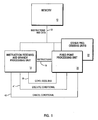
- the invention includes a data processing system having a memory, an instruction fetching and branch processing unit, and a fixed point processing unit.
- the instruction fetching and branch processing unit a mechanism is provided for fetching multiple instructions at a time and for storing these instructions in buffers.
- one buffer is provided for sequential instructions and a second buffer is provided for target instructions.
- Sequential instructions include the normal sequence of instructions that are being fetched and also instructions that are present after a branch instruction is encountered.
- Target instructions are instructions that are to be branched to if a branch is taken as a result of a branch instruction execution.
- the instruction fetching and branch processing unit executes branch instructions while coordinating the dispatching of instructions to the fixed point processing unit. According to the teachings of this invention, in certain circumstances, branch instructions can be generated in a pipeline fashion without causing any pipeline cycle delays of instruction execution.
- This invention relates to the field of data processing and a provides a capability to execute branch instructions in a small amount of time.
- the objective of the invention is to execute a branch in zero cycles of a fixed point processor.
- FIG. 1 is a block diagram illustrating a processor system according to the invention.
- memory 10 is connected by bus 12 to an instruction fetching and branch processing unit 14, a fixed point processing unit 20 and other processing units represented by block 22.
- the function of bus 12 is to provide a transfer of instructions and data from memory 10.
- the instruction fetching and branch processing unit 14 provides instructions over line 16 to the fixed point processing unit 20. Also conditional code information is provided to the instruction fetching and branch processing unit 14 over line 18 by the fixed point processing unit 20.
- branch execution logic in the instruction fetching unit 14 In response to the condition code information on bus 18 provided by the fixed point unit 20 to the instruction fetching unit 14, branch execution logic in the instruction fetching unit 14 generates an execute conditional signal via line 41 if the branch is not to be taken or generates the cancel conditional signal via line 43 if the branch is to be taken.
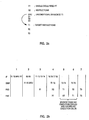
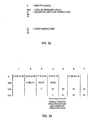
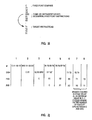
- Figures 2a to 2j represent example instruction sequences and resulting timing diagrams for the execution of those sequences.
- an instruction sequence is shown that includes an unconditional branch instruction. Specifically the unconditional branch instruction (BRU) branches to instruction T1 (the target instruction).
- the timing diagram illustrating the operation of the preferred embodiment with this instruction sequence is illustrated in Figure 2b.
- four phases of the pipeline operation are illustrated. The first phase is the instruction fetch operation (IF). The second phase is the instruction dispatch operation (Disp). During the second phase the instruction fetching and processing unit 14 detects branch instructions and initiates branch instruction execution.
- the third phase is the fixed point processor decoding operation (FXD).
- the fourth is the fixed point processor execution of the instruction (FXE). Seven instruction cycles are shown.
- cycle 1 four instructions are fetched (from the cache 34 Figure 3) which include X1, X2, BRU and S1.
- the prefix S designates the sequential instructions that occur after the unconditional branch instruction (BRU).
- the instruction fetch operation fetches additional sequential instructions (S2 and S3).
- the dispatch operation dispatches instructions X1 and X2 to the fixed point processing unit 20.
- the BRU instruction is dispatched and executed internally in the branch processing unit 14.
- the target address is generated in cycle 2.
- cycle 3 as a result of the execution of the unconditional branch in the branch processing unit 14, the four target instructions are fetched, T1, T2, T3, T4.
- instruction X1 is decoded in the fixed point processing unit 20.
- cycle 4 an additional four target instructions are fetched (T5, T6, T7 and T8). Also in cycle 4 instructions T1 and T2 are dispatched to the fixed point processing unit 20. Meanwhile in cycle 4 the fixed point processing unit 20 decodes the instruction X2 and executes instruction X1. In cycle 5, the target instructions T3 and T4 are dispatched to the fixed point processing unit 20 while the fixed point processing unit 20 decodes instruction T1 and executes instruction X2. In cycle 6, instructions T5 and T6 are dispatched while the fixed processing unit 20 decodes target instruction T2 and executes instruction T1. Finally in cycle 7, the instruction T3 is being decoded while instruction T2 is being executed in the fixed point processing unit 20. Note that the branch operation takes no execution cycles and causes no execution delay since the fetching of the target instructions was accomplished as a result of the early execution of the branch instruction during the dispatch cycle 2.
- FIG 2c an instruction sequence is shown that provides for a fixed point compare instruction (C) followed by a branch on condition instruction (BRC). If the branch is not taken, the sequential instructions following the branch will be executed (S1, S2, and S3). However, if the branch is taken the target instructions are executed (T1, T2, and T3). In the following example the conditional branch is not taken.
- the timing diagram in Figure 2d illustrates the operation of the processing unit. Initially in cycle 1 four instructions are fetched including the condition instruction (C), the conditional branch instruction (BRC), and the two sequential instructions S1 and S2. In cycle 2 the next four sequential instructions (S3 through S6) are fetched while the compare instruction C and the sequential instruction S1 are passed to the fixed point processing unit 20.
- the S1′ indicates that instruction S1 is passed as an instruction for conditional execution. In other words, the execution of S1 is conditional on the event that the branch is not taken.
- the conditional branch instruction (BRC) is passed to the branch processing unit 14 where it is executed. However, the completion of the execution of the conditional branch is delayed until the compare instruction is executed in the fixed point processing unit 20.
- BRC conditional branch instruction
- the target instructions are fetched (T1 through T4).
- Simultaneously instructions S2 and S3 are dispatched to the fixed point processing unit 20. Note that these instructions are dispatched as conditional instructions that will be executed upon the condition that the conditional branch will not be taken.
- the fixed point processor decodes the compare instruction.
- cycle 4 the next four target instructions are fetched (T5 through T8). Also the next two sequential instructions S4 and S5 are dispatched as conditional instructions to the fixed point processing unit 20.
- the fixed point processing unit 20 decodes the sequential instruction S1 while it executes the compare instruction. At the completion of the execution of the compare instruction the result of the compare instruction is provided to the branch processing unit 14 indicating to the branch processing unit 14 that the branch will not be taken (i.e., that the sequential instructions should be executed).
- the execute condition is asserted via line 41.
- the fixed point processing unit 20 decodes the sequential instruction S2 while it executes the sequential instruction S1. Also in cycle 5 the fetching of target instructions is suspended and the dispatching of target instructions is suspended.
- cycle 6 the fetching of sequential instructions is resumed with the fetching of sequential instructions S7 through S10. Also in cycle 6, the fixed point processing unit 20 decodes instruction S3 and executes sequential instruction S2. Finally in cycle 7, the fixed point processing unit is decoding instruction S4 and is executing instruction S3 illustrating that the sequential instruction sequence is being executed. Note that again the execution of the branch takes no execution cycles and causes no delay even though the branch was not taken.
- Figure 2e illustrates a conditional branch instruction where the branch is taken.
- the sequence illustrated in Figure 2e includes a fixed point compare instruction C, a conditional branch instruction BRC followed by a set of sequential instructions S1 through S3 then followed by a sequence of target instructions T1 through T4.
- the execution of this sequence is illustrated in Figure 2f.
- the sequential instruction S1 is being decoded in the fixed processing unit at the same time the compare instruction is being executed. As a result of the completion of the execution of the compare instruction in cycle 4, the branch processing unit 14 is informed that the branch should be taken. Therefore, in cycle 5 the sequential instruction S1 whose execution is conditioned on the branch not being taken will not be executed as a result the assertion of the cancel conditional line 43. Also even though the sequential instruction S2 is being decoded it will be purged. In cycle 6 the first two target instructions T1 and T2 are dispatched to the fixed point processing unit 20. In cycle 7 instruction T1 is being decoded and executed in cycle T8. Note that the execution of this conditional branch results in a three cycle delay. This is a worse case condition since the maximum delay in this configuration is 3-i cycles where i is the number of fixed point operations that are located between the compare and branch on compare instructions.
- FIG 2g another instruction sequence is illustrated that first includes a compare instruction followed by two fixed point instructions X1 and X2. Following X2 is a branch on condition of the compare instruction. Following the branch is the set of sequential instructions S1 and S3 followed later by the target instructions T1 through T4.
- the timing execution of these instruction sequences are illustrated in Figure 2h. Referring to Figure 2h, in cycle 1, the first four instructions are fetched (C, X1, X2 and BRC). In cycle 2 the next four instructions in the sequence are fetched (S1 through S4) while the compare instruction and the first fixed point instruction X1 are dispatched to the fixed point unit 20. Also during cycle 2, the instruction sequence that has been fetched has been scanned for branch instructions.
- the scanning logic determines if the target instructions of the branch can be computed.
- the target instruction addresses are computed and then in cycle 3 the first four target instructions T1 through T4 are fetched.
- instruction X2 is unconditionally dispatched and sequential instruction S1 is conditionally are dispatched to the fixed point processing unit 20.
- the conditional branch instruction BRC is dispatched to the processing unit 14.
- the fixed point processing unit 20 decodes the compare instruction C.
- the next four target instructions are fetched (T5 through T8) while sequential instructions S2 and S3 are dispatched to fixed point processing unit.
- the fixed point processing unit 20 decodes instruction X1 and executes the compare C. As a result of the compare instruction the branch is taken.
- instruction X2 is decoded by the fixed point processing unit 20 while the instruction X1 is executed. However, no additional instructions are fetched during these cycles and no instructions are dispatched. In cycle 6, the fetching of target instructions would continue however for the simplicity of this example only eight target instructions have been fetched. In cycle 6, the target instructions T1 and T2 are dispatched to the fixed point processing unit 20 during the execution of instruction X2. In cycle 7 instructions T3 and T4 are dispatched while instruction T1 is being decoded. Finally in cycle 8, instruction T1 is executed by the fixed point processing unit 20. Note that the branch in this case only causes a one cycle delay since there were two intermediate instructions between the compare and branch on condition instructions.
- FIG 2i another example instruction sequence is illustrated that includes three intermediate instructions between the fixed point compare instruction and the conditional branch instruction.
- the timing diagram for the execution of this instruction sequence is illustrated in Figure 2j.
- Figure 2j during cycle 1 the first four instructions of this instruction sequence in Figure 2i are fetched.
- cycle 2 the second four instructions are fetched while the first two instructions are dispatched. Note that since the first four instructions that were fetched did not contain the branch instruction, the scanning logic would not detect that there is a branch until cycle 3. Therefore in cycle 3 if additional sequential instructions were available they would be fetched.
- cycle 3 instructions X2 and X3 are dispatched to the fixed point processing unit 20 while the conditional branch is dispatched to the branch processing unit 14 while the fixed point processing unit decodes the compare instruction.
- the target instructions T1 through T4 are now prefetched as a result of the scanning of the conditional branch instruction in cycle 3.
- Sequential instructions S1 and S2 are conditionally dispatched to the fixed point processing unit 20 while instruction X1 is decoded and the compare instruction is executed.
- the branch processing unit is signalled that the branch will be taken.
- cycle 5 the next four target instructions are fetched (T5 through T8) while in the fixed point processing unit 20 instruction X2 is decoded and instruction X1 is executed.
- cycle 6 the first of the two target instructions T1 and T2 are dispatched to the fixed point processing unit 20 while instruction X3 is decoded and instruction X2 is executed.
- cycle 7 the next two target instructions T3 and T4 are dispatched while instruction T1 is decoded and instruction X3 is executed.
- instruction T2 is being decoded while the first of the target instructions T1 is being executed. Note that the execution of this conditional branch results in a zero cycle delay since the number of intermediate instructions between the compare instruction and the branch is equal to three.
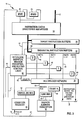
- Figure 3 is a block diagram illustrating the instruction fetching and branch processing unit 14.
- an instruction cache directory and array 34 is connected to bus 12 to receive instructions from memory.
- the instructions from the instruction cache 34 are provided to either a target instruction buffer 36 or sequential instruction buffer 38.
- Target instruction buffer 36 has a capacity of four in the preferred embodiment while the sequential instruction buffer 38 has a capacity of eight instructions.
- the target instructions in the target instruction buffer 36 pass to the sequential buffer 38 if the target instructions have been selected for dispatching.
- the interlock, dispatch, branch execution, and buffer control unit 40 is connected to the sequential instruction buffer 38 and scans the contents of the sequential instruction buffer 38 to detect branch instructions.
- the multiplex network 52 is controlled by the control logic 40 to dispatch two instructions over bus 16 to the fixed point processing unit 20.
- the control logic 40 Upon determining that a branch instructions exists in the sequential instruction buffer 38, the control logic 40 through the multiplexer network 52 provides the branch instruction to the unresolved branch register 54,if the branch is not resolved, and to the branch address generation unit 62.
- the branch address generation unit determines if the address of the target instruction of the branch can be computed. In certain instances the count register 58 or link register 60 are used in a computation of the address of the target instruction.
- the address of the target instruction is then provided over bus 61 to the instruction fetch address register 30.
- the condition register 56 is connected by bus 18 to the fixed point processing unit 20 and determines the result of a condition compare instruction execution that determines whether a conditional branch is taken.
- the control logic 40 monitors the condition register 56 and upon determining that a conditional branch is to be taken, the control logic 40 provides target instructions from the target instruction buffer 36 to the sequential instruction buffer 38 to be dispatched.
- the control of the target instruction buffer and the sequential instruction buffer is provided by lines 37 and 39 respectively. If the branch is not taken, the address of the sequential instruction is restored from register 32 to register 30 and sequential instructions in the sequential instruction buffer 38 continue to be dispatched.
- the control of the target instruction buffer 36 and the sequential instruction buffer 38 is provided by lines 37 and 39 respectively from the control logic 40.
- line 43 which provides the cancel conditional signal to the fixed point processing unit 20 indicating that the conditional instructions (the sequential instruction occurring after the branch instruction) are not to be executed.
- Line 41 provides the execute conditional signal to the fixed point processing unit 20 which indicates to the fixed point processing unit that these conditional instructions are to be executed.
- Figure 4 is a flow chart representing the operation of the interlock, dispatch, branch execution and buffer control logic 40.
- step 106 determines if an unresolved branch is pending. This is accomplished by determining if a unresolved branch pending bit has been set. If no unresolved branch is pending the flow proceeds to step 110 at which time the sequential instruction buffer 38 is scanned to determine if there are any branch instructions present. If not, the control flow proceeds to step 104 to fetch a new set of sequential instructions into the sequential instruction buffer 38 and to dispatch sequential instructions from sequential instruction buffer 38. Upon completing step 104 the control flow returns to step 100 to await the beginning of the next cycle.
- step 116 is executed in which a determination is made as to whether a target address can be generated. If not, the control flow proceeds to step 104. If so, the flow proceeds to step 126 to determine if all previous instructions have been dispatched. If all previous instructions before the branch have not been dispatched, the flow continues to step 132 to determine if prefetching of branch target instructions has begun. If not, in step 146 the target address is placed into the instruction fetch address register 30 and prefetching is begun. At this time the existing contents of the instruction fetch address register 30 is placed into the instruction fetch address register shadow 32.
- control flow Upon completing step 146 or if prefetching has already begun the control flow proceeds to step 150 to dispatch instruction from the sequential instruction buffer 38. Control flow then proceeds to step 102 where branch target instructions are fetched into the target instruction buffer 36. Afterwards the flow returns to step 100 to await the beginning of the next cycle.
- step 130 determines if it is known at this point if the branch will be taken. If the branch is known to be taken the control flow proceeds to step 136 to determine if prefetching has begun. If not the control flow proceeds to step 144 to place the target address into the instruction fetch address register 30 and the current sequential buffer is invalidated. As before the original contents of register 30 is placed into register 32. The flow then proceeds to step 104. Returning to step 136 if prefetching has already begun the flow proceeds to step 142 to load the instructions from the target instruction buffer 36 into the sequential instruction buffer 38 and to stop prefetching. Again the flow proceeds to step 104.
- step 134 determines if it is known whether or not the branch will not be taken. If the branch is not taken the flow continues to step 140 to determine if prefetching has begun. If not, the flow continues to step 104. However, if prefetching has begun, the flow proceeds to step 148 to stop the prefetching and restore the instruction fetch address register 30 with the contents of the instruction fetch address shadow 32. Upon completing step 148 the control flow proceeds to step 104.
- step 134 if it is not known if the branch will not be taken, the control flow proceeds to step 138 to load the unresolved branch register 54 and to set an internal bit indicating that there is an unresolved branch pending. Also, in sequential instructions are dispatched from the sequential buffer 38. These sequential instructions are for conditional execution, i.e., that they will be executed only if the branch is not taken. The control flow then proceeds to step 102.
- step 106 if there is an unresolved branch pending the flow proceeds to step 108 to determine if the branch is resolved.
- the control logic examines the contents of the condition register 56 to determine if the condition code has been set that is required for the resolution of the branch in the unresolved branch register 54. If the branch has not been resolved the flow proceeds to step 114 to determine if prefetching has begun. If not, the flow continues to step 122 to determine if the target address can be generated. If the target address cannot be generated the program flow proceeds to step 104.
- step 124 the program proceeds to step 124 to store the contents of the instruction fetch address register 30 into the instruction fetch address register shadow 32 and to place the generated target address into the instruction fetch address register 30 and to begin prefetching of branch target instructions. Proceeding to step 128 the dispatching of sequential instructions is begun. These sequential instructions are being dispatched for conditional execution, i.e., for execution upon the condition that the branch will not be taken. After step 128 the flow proceeds to step 102.
- step 112 determines if the branch has been taken. If the branch has not been taken then in step 120 an execution conditional signal on line 41 ( Figure 1) will be provided to the fixed point processing unit 20. The instruction fetch address register 30 will be restored with the contents of the instruction fetch address register shadow 32 and prefetching will be halted. The control flow then proceeds to step 104. If the branch is taken then in step 118 a cancel conditional sequential instruction execution signal is provided on line 43 to the fixed point processing unit 20 and the branch target instructions in the target instruction buffer 36 are loaded into the sequential instruction buffer 38. Also prefetching is halted. Control flow then proceeds to step 104.
Landscapes
- Engineering & Computer Science (AREA)
- Software Systems (AREA)
- Theoretical Computer Science (AREA)
- Physics & Mathematics (AREA)
- General Engineering & Computer Science (AREA)
- General Physics & Mathematics (AREA)
- Advance Control (AREA)
Applications Claiming Priority (2)
| Application Number | Priority Date | Filing Date | Title |
|---|---|---|---|
| US297784 | 1989-01-13 | ||
| US07/297,784 US5127091A (en) | 1989-01-13 | 1989-01-13 | System for reducing delay in instruction execution by executing branch instructions in separate processor while dispatching subsequent instructions to primary processor |
Publications (2)
| Publication Number | Publication Date |
|---|---|
| EP0378425A2 true EP0378425A2 (de) | 1990-07-18 |
| EP0378425A3 EP0378425A3 (de) | 1992-09-02 |
Family
ID=23147731
Family Applications (1)
| Application Number | Title | Priority Date | Filing Date |
|---|---|---|---|
| EP19900300345 Withdrawn EP0378425A3 (de) | 1989-01-13 | 1990-01-11 | Ausführungsvorrichtung für Verzweigungsbefehle |
Country Status (3)
| Country | Link |
|---|---|
| US (1) | US5127091A (de) |
| EP (1) | EP0378425A3 (de) |
| JP (1) | JP2761956B2 (de) |
Cited By (1)
| Publication number | Priority date | Publication date | Assignee | Title |
|---|---|---|---|---|
| EP1280052A3 (de) * | 2001-07-27 | 2003-04-09 | STMicroelectronics, Inc. | Verzweigungsabholarchitektur zur Reduzierung von Verzweigungszeitstrafen ohne Verzweigungsvorhersage |
Families Citing this family (46)
| Publication number | Priority date | Publication date | Assignee | Title |
|---|---|---|---|---|
| US5440749A (en) * | 1989-08-03 | 1995-08-08 | Nanotronics Corporation | High performance, low cost microprocessor architecture |
| US5230068A (en) * | 1990-02-26 | 1993-07-20 | Nexgen Microsystems | Cache memory system for dynamically altering single cache memory line as either branch target entry or pre-fetch instruction queue based upon instruction sequence |
| JPH0460720A (ja) * | 1990-06-29 | 1992-02-26 | Hitachi Ltd | 条件分岐命令制御方式 |
| US5371862A (en) * | 1991-02-27 | 1994-12-06 | Kabushiki Kaisha Toshiba | Program execution control system |
| US5539911A (en) * | 1991-07-08 | 1996-07-23 | Seiko Epson Corporation | High-performance, superscalar-based computer system with out-of-order instruction execution |
| US5493687A (en) | 1991-07-08 | 1996-02-20 | Seiko Epson Corporation | RISC microprocessor architecture implementing multiple typed register sets |
| US5511172A (en) * | 1991-11-15 | 1996-04-23 | Matsushita Electric Co. Ind, Ltd. | Speculative execution processor |
| JP2693678B2 (ja) * | 1992-01-28 | 1997-12-24 | 株式会社東芝 | データ処理装置 |
| US5438668A (en) * | 1992-03-31 | 1995-08-01 | Seiko Epson Corporation | System and method for extraction, alignment and decoding of CISC instructions into a nano-instruction bucket for execution by a RISC computer |
| DE69311330T2 (de) | 1992-03-31 | 1997-09-25 | Seiko Epson Corp., Tokio/Tokyo | Befehlsablauffolgeplanung von einem risc-superskalarprozessor |
| EP0638183B1 (de) | 1992-05-01 | 1997-03-05 | Seiko Epson Corporation | Vorrichtung und verfahren zum befehlsabschluss in einem superskalaren prozessor. |
| US5442756A (en) * | 1992-07-31 | 1995-08-15 | Intel Corporation | Branch prediction and resolution apparatus for a superscalar computer processor |
| US5692167A (en) * | 1992-07-31 | 1997-11-25 | Intel Corporation | Method for verifying the correct processing of pipelined instructions including branch instructions and self-modifying code in a microprocessor |
| US5423048A (en) * | 1992-08-27 | 1995-06-06 | Northern Telecom Limited | Branch target tagging |
| US6735685B1 (en) * | 1992-09-29 | 2004-05-11 | Seiko Epson Corporation | System and method for handling load and/or store operations in a superscalar microprocessor |
| JP3644959B2 (ja) * | 1992-09-29 | 2005-05-11 | セイコーエプソン株式会社 | マイクロプロセッサシステム |
| US5410657A (en) * | 1992-10-09 | 1995-04-25 | International Business Machines Corporation | Method and system for high speed floating point exception enabled operation in a multiscalar processor system |
| US5784604A (en) * | 1992-10-09 | 1998-07-21 | International Business Machines Corporation | Method and system for reduced run-time delay during conditional branch execution in pipelined processor systems utilizing selectively delayed sequential instruction purging |
| JP3211423B2 (ja) * | 1992-10-13 | 2001-09-25 | ソニー株式会社 | 分岐命令実行方法および分岐命令実行装置 |
| US5581719A (en) * | 1992-11-12 | 1996-12-03 | Digital Equipment Corporation | Multiple block line prediction |
| WO1994016384A1 (en) | 1992-12-31 | 1994-07-21 | Seiko Epson Corporation | System and method for register renaming |
| US6032244A (en) * | 1993-01-04 | 2000-02-29 | Cornell Research Foundation, Inc. | Multiple issue static speculative instruction scheduling with path tag and precise interrupt handling |
| CA2107046A1 (en) * | 1993-01-08 | 1994-07-09 | James Allan Kahle | Method and system for increased instruction dispatch efficiency in superscalar processor system |
| JP2596712B2 (ja) * | 1993-07-01 | 1997-04-02 | インターナショナル・ビジネス・マシーンズ・コーポレイション | 近接した分岐命令を含む命令の実行を管理するシステム及び方法 |
| CA2123442A1 (en) * | 1993-09-20 | 1995-03-21 | David S. Ray | Multiple execution unit dispatch with instruction dependency |
| US5539888A (en) * | 1993-12-23 | 1996-07-23 | Unisys Corporation | System and method for processing external conditional branch instructions |
| US5644779A (en) * | 1994-04-15 | 1997-07-01 | International Business Machines Corporation | Processing system and method of operation for concurrent processing of branch instructions with cancelling of processing of a branch instruction |
| JPH07281893A (ja) * | 1994-04-15 | 1995-10-27 | Internatl Business Mach Corp <Ibm> | 処理システム及び演算方法 |
| WO1995031779A1 (en) * | 1994-05-16 | 1995-11-23 | British Telecommunications Public Limited Company | Instruction creation device |
| US5805855A (en) * | 1994-10-05 | 1998-09-08 | International Business Machines Corporation | Data cache array having multiple content addressable fields per cache line |
| FR2726103B1 (fr) * | 1994-10-25 | 1996-12-13 | Suisse Electronique Microtech | Dispositif d'execution d'un programme d'instructions |
| US5781758A (en) * | 1995-03-23 | 1998-07-14 | Apple Computer, Inc. | Software emulation system with reduced memory requirements |
| US5802346A (en) * | 1995-06-02 | 1998-09-01 | International Business Machines Corporation | Method and system for minimizing the delay in executing branch-on-register instructions |
| US5634103A (en) * | 1995-11-09 | 1997-05-27 | International Business Machines Corporation | Method and system for minimizing branch misprediction penalties within a processor |
| US5799167A (en) * | 1996-05-15 | 1998-08-25 | Hewlett-Packard Company | Instruction nullification system and method for a processor that executes instructions out of order |
| US5918044A (en) * | 1996-10-31 | 1999-06-29 | International Business Machines Corporation | Apparatus and method for instruction fetching using a multi-port instruction cache directory |
| KR19990076967A (ko) * | 1996-11-04 | 1999-10-25 | 요트.게.아. 롤페즈 | 처리 장치 및 메모리내의 명령 판독 |
| US6957327B1 (en) * | 1998-12-31 | 2005-10-18 | Stmicroelectronics, Inc. | Block-based branch target buffer |
| US7493607B2 (en) | 2002-07-09 | 2009-02-17 | Bluerisc Inc. | Statically speculative compilation and execution |
| US20050114850A1 (en) | 2003-10-29 | 2005-05-26 | Saurabh Chheda | Energy-focused re-compilation of executables and hardware mechanisms based on compiler-architecture interaction and compiler-inserted control |
| US7996671B2 (en) | 2003-11-17 | 2011-08-09 | Bluerisc Inc. | Security of program executables and microprocessors based on compiler-architecture interaction |
| US8607209B2 (en) | 2004-02-04 | 2013-12-10 | Bluerisc Inc. | Energy-focused compiler-assisted branch prediction |
| US20070294181A1 (en) * | 2006-05-22 | 2007-12-20 | Saurabh Chheda | Flexible digital rights management with secure snippets |
| US20080126766A1 (en) | 2006-11-03 | 2008-05-29 | Saurabh Chheda | Securing microprocessors against information leakage and physical tampering |
| US20080154379A1 (en) * | 2006-12-22 | 2008-06-26 | Musculoskeletal Transplant Foundation | Interbody fusion hybrid graft |
| US9176737B2 (en) * | 2011-02-07 | 2015-11-03 | Arm Limited | Controlling the execution of adjacent instructions that are dependent upon a same data condition |
Family Cites Families (22)
| Publication number | Priority date | Publication date | Assignee | Title |
|---|---|---|---|---|
| JPS5021821B1 (de) * | 1968-10-31 | 1975-07-25 | ||
| US3699526A (en) * | 1971-03-26 | 1972-10-17 | Ibm | Program selection based upon intrinsic characteristics of an instruction stream |
| US4210960A (en) * | 1977-09-02 | 1980-07-01 | Sperry Corporation | Digital computer with overlapped operation utilizing conditional control to minimize time losses |
| AU529675B2 (en) * | 1977-12-07 | 1983-06-16 | Honeywell Information Systems Incorp. | Cache memory unit |
| JPS5485650A (en) * | 1977-12-21 | 1979-07-07 | Hitachi Ltd | Branch instruction control system |
| US4373180A (en) * | 1980-07-09 | 1983-02-08 | Sperry Corporation | Microprogrammed control system capable of pipelining even when executing a conditional branch instruction |
| US4390946A (en) * | 1980-10-20 | 1983-06-28 | Control Data Corporation | Lookahead addressing in a pipeline computer control store with separate memory segments for single and multiple microcode instruction sequences |
| US4551798A (en) * | 1982-11-03 | 1985-11-05 | Burroughs Corporation | Multiple control stores in a pipelined microcontroller for handling nester subroutines |
| JPS6015745A (ja) * | 1983-07-06 | 1985-01-26 | Nec Corp | 情報処理装置 |
| WO1985000453A1 (en) * | 1983-07-11 | 1985-01-31 | Prime Computer, Inc. | Data processing system |
| JPS60168238A (ja) * | 1984-02-10 | 1985-08-31 | Hitachi Ltd | パイプラインデータ処理装置 |
| US4742451A (en) * | 1984-05-21 | 1988-05-03 | Digital Equipment Corporation | Instruction prefetch system for conditional branch instruction for central processor unit |
| US4679141A (en) * | 1985-04-29 | 1987-07-07 | International Business Machines Corporation | Pageable branch history table |
| US4791557A (en) * | 1985-07-31 | 1988-12-13 | Wang Laboratories, Inc. | Apparatus and method for monitoring and controlling the prefetching of instructions by an information processing system |
| DE3752100T2 (de) * | 1986-01-07 | 1997-12-11 | Nippon Electric Co | Befehlsvorabrufgerät mit einer Schaltung zum Prüfen der Vorhersage eines Verzweigungsbefehls vor seiner Ausführung |
| JPS62208129A (ja) * | 1986-03-10 | 1987-09-12 | Fujitsu Ltd | デ−タ処理方式 |
| US4991080A (en) * | 1986-03-13 | 1991-02-05 | International Business Machines Corporation | Pipeline processing apparatus for executing instructions in three streams, including branch stream pre-execution processor for pre-executing conditional branch instructions |
| US4853889A (en) * | 1986-09-03 | 1989-08-01 | American Telephone And Telegraph Company, At&T Bell Laboratories | Arrangement and method for speeding the operation of branch instructions |
| JPS6393041A (ja) * | 1986-10-07 | 1988-04-23 | Mitsubishi Electric Corp | 計算機 |
| JPS63318634A (ja) * | 1987-06-23 | 1988-12-27 | Nec Corp | 命令先取り方式 |
| US4991078A (en) * | 1987-09-29 | 1991-02-05 | Digital Equipment Corporation | Apparatus and method for a pipelined central processing unit in a data processing system |
| JPH0769812B2 (ja) * | 1987-12-29 | 1995-07-31 | 富士通株式会社 | データ処理装置 |
-
1989
- 1989-01-13 US US07/297,784 patent/US5127091A/en not_active Expired - Lifetime
-
1990
- 1990-01-11 EP EP19900300345 patent/EP0378425A3/de not_active Withdrawn
- 1990-01-12 JP JP2003651A patent/JP2761956B2/ja not_active Expired - Fee Related
Cited By (2)
| Publication number | Priority date | Publication date | Assignee | Title |
|---|---|---|---|---|
| EP1280052A3 (de) * | 2001-07-27 | 2003-04-09 | STMicroelectronics, Inc. | Verzweigungsabholarchitektur zur Reduzierung von Verzweigungszeitstrafen ohne Verzweigungsvorhersage |
| US7010675B2 (en) | 2001-07-27 | 2006-03-07 | Stmicroelectronics, Inc. | Fetch branch architecture for reducing branch penalty without branch prediction |
Also Published As
| Publication number | Publication date |
|---|---|
| JPH02227731A (ja) | 1990-09-10 |
| US5127091A (en) | 1992-06-30 |
| JP2761956B2 (ja) | 1998-06-04 |
| EP0378425A3 (de) | 1992-09-02 |
Similar Documents
| Publication | Publication Date | Title |
|---|---|---|
| US5127091A (en) | System for reducing delay in instruction execution by executing branch instructions in separate processor while dispatching subsequent instructions to primary processor | |
| EP0238810B1 (de) | Verfahren und System zum Erleichtern der Befehlsausführung in einem digitalen Rechner | |
| EP0180725B1 (de) | Vorausschauende Speicherabrufoperation für Verzweigungsbefehle | |
| US5421020A (en) | Counter register implementation for speculative execution of branch on count instructions | |
| US4858104A (en) | Preceding instruction address based branch prediction in a pipelined processor | |
| US5136696A (en) | High-performance pipelined central processor for predicting the occurrence of executing single-cycle instructions and multicycle instructions | |
| EP0689131B1 (de) | Computersystem zur Ausführung von Verzweigungsbefehlen | |
| CA1325285C (en) | Method and apparatus for ordering and queueing multiple memory requests | |
| US5125083A (en) | Method and apparatus for resolving a variable number of potential memory access conflicts in a pipelined computer system | |
| US5404552A (en) | Pipeline risc processing unit with improved efficiency when handling data dependency | |
| US5606682A (en) | Data processor with branch target address cache and subroutine return address cache and method of operation | |
| EP0399757B1 (de) | Mechanismus zur präzisen Behandlung von Ausnahmebedingungen in einem Prozessor mit gepaarten Befehlen | |
| EP0721619B1 (de) | Ausführung von datenverarbeitungsbefehlen | |
| US5193159A (en) | Microprocessor system | |
| EP0094535B1 (de) | Nach dem Prinzip der Pipeline arbeitendes Datenverarbeitungssystem | |
| JP2742374B2 (ja) | スーパースカラ・プロセッサ・システムにおける命令ディスパッチ効率を向上させる方法およびシステム | |
| US5146570A (en) | System executing branch-with-execute instruction resulting in next successive instruction being execute while specified target instruction is prefetched for following execution | |
| EP1109095B1 (de) | Befehlsvorausladungs- und Verzweigungsvorhersageschaltung | |
| EP0297943A2 (de) | Steuerungssystem zum Lesen von Mikrocode | |
| JP3779012B2 (ja) | 分岐による中断のないパイプライン化されたマイクロプロセッサ及びその動作方法 | |
| US5850542A (en) | Microprocessor instruction hedge-fetching in a multiprediction branch environment | |
| US5410657A (en) | Method and system for high speed floating point exception enabled operation in a multiscalar processor system | |
| KR920006770B1 (ko) | 명령을 페치(fetch)하기 위한 제어 시스템 | |
| JPH01183737A (ja) | 情報処理装置 | |
| EP0261685B1 (de) | Mikroprozessorsystem |
Legal Events
| Date | Code | Title | Description |
|---|---|---|---|
| PUAI | Public reference made under article 153(3) epc to a published international application that has entered the european phase |
Free format text: ORIGINAL CODE: 0009012 |
|
| AK | Designated contracting states |
Kind code of ref document: A2 Designated state(s): DE FR GB |
|
| 17P | Request for examination filed |
Effective date: 19901113 |
|
| PUAL | Search report despatched |
Free format text: ORIGINAL CODE: 0009013 |
|
| AK | Designated contracting states |
Kind code of ref document: A3 Designated state(s): DE FR GB |
|
| 17Q | First examination report despatched |
Effective date: 19951013 |
|
| GRAG | Despatch of communication of intention to grant |
Free format text: ORIGINAL CODE: EPIDOS AGRA |
|
| GRAG | Despatch of communication of intention to grant |
Free format text: ORIGINAL CODE: EPIDOS AGRA |
|
| GRAH | Despatch of communication of intention to grant a patent |
Free format text: ORIGINAL CODE: EPIDOS IGRA |
|
| GRAH | Despatch of communication of intention to grant a patent |
Free format text: ORIGINAL CODE: EPIDOS IGRA |
|
| STAA | Information on the status of an ep patent application or granted ep patent |
Free format text: STATUS: THE APPLICATION HAS BEEN WITHDRAWN |
|
| 18W | Application withdrawn |
Withdrawal date: 19991229 |