EP0378664B1 - Selbsttragendes notatemgerät - Google Patents
Selbsttragendes notatemgerät Download PDFInfo
- Publication number
- EP0378664B1 EP0378664B1 EP89908218A EP89908218A EP0378664B1 EP 0378664 B1 EP0378664 B1 EP 0378664B1 EP 89908218 A EP89908218 A EP 89908218A EP 89908218 A EP89908218 A EP 89908218A EP 0378664 B1 EP0378664 B1 EP 0378664B1
- Authority
- EP
- European Patent Office
- Prior art keywords
- hood
- air
- duct
- nozzle
- pressure
- Prior art date
- Legal status (The legal status is an assumption and is not a legal conclusion. Google has not performed a legal analysis and makes no representation as to the accuracy of the status listed.)
- Expired - Lifetime
Links
- 230000000241 respiratory effect Effects 0.000 title abstract 2
- CURLTUGMZLYLDI-UHFFFAOYSA-N Carbon dioxide Chemical compound O=C=O CURLTUGMZLYLDI-UHFFFAOYSA-N 0.000 claims abstract description 32
- 229910002092 carbon dioxide Inorganic materials 0.000 claims abstract description 16
- 239000001569 carbon dioxide Substances 0.000 claims abstract description 15
- 238000002156 mixing Methods 0.000 claims abstract description 3
- 239000007789 gas Substances 0.000 claims description 34
- QVGXLLKOCUKJST-UHFFFAOYSA-N atomic oxygen Chemical compound [O] QVGXLLKOCUKJST-UHFFFAOYSA-N 0.000 claims description 11
- 239000001301 oxygen Substances 0.000 claims description 11
- 229910052760 oxygen Inorganic materials 0.000 claims description 11
- XLYOFNOQVPJJNP-UHFFFAOYSA-N water Substances O XLYOFNOQVPJJNP-UHFFFAOYSA-N 0.000 claims description 7
- 230000029058 respiratory gaseous exchange Effects 0.000 claims description 6
- 206010003497 Asphyxia Diseases 0.000 claims description 4
- 239000004642 Polyimide Substances 0.000 claims description 3
- 229920001721 polyimide Polymers 0.000 claims description 3
- VYPSYNLAJGMNEJ-UHFFFAOYSA-N Silicium dioxide Chemical compound O=[Si]=O VYPSYNLAJGMNEJ-UHFFFAOYSA-N 0.000 claims description 2
- 229910052751 metal Inorganic materials 0.000 claims description 2
- 239000002184 metal Substances 0.000 claims description 2
- 239000000741 silica gel Substances 0.000 claims description 2
- 229910002027 silica gel Inorganic materials 0.000 claims description 2
- 239000003779 heat-resistant material Substances 0.000 claims 1
- 238000002347 injection Methods 0.000 claims 1
- 239000007924 injection Substances 0.000 claims 1
- 239000003570 air Substances 0.000 description 31
- 239000000463 material Substances 0.000 description 16
- WMFOQBRAJBCJND-UHFFFAOYSA-M Lithium hydroxide Chemical compound [Li+].[OH-] WMFOQBRAJBCJND-UHFFFAOYSA-M 0.000 description 8
- 238000011144 upstream manufacturing Methods 0.000 description 8
- 230000002745 absorbent Effects 0.000 description 7
- 239000002250 absorbent Substances 0.000 description 7
- 238000010521 absorption reaction Methods 0.000 description 4
- 231100000331 toxic Toxicity 0.000 description 4
- 230000002588 toxic effect Effects 0.000 description 4
- 238000001914 filtration Methods 0.000 description 3
- 231100000566 intoxication Toxicity 0.000 description 3
- 230000035987 intoxication Effects 0.000 description 3
- 239000000203 mixture Substances 0.000 description 3
- 239000012080 ambient air Substances 0.000 description 2
- 230000034994 death Effects 0.000 description 2
- 231100000517 death Toxicity 0.000 description 2
- 230000008030 elimination Effects 0.000 description 2
- 238000003379 elimination reaction Methods 0.000 description 2
- 229920003023 plastic Polymers 0.000 description 2
- XXQBEVHPUKOQEO-UHFFFAOYSA-N potassium peroxide Inorganic materials [K+].[K+].[O-][O-] XXQBEVHPUKOQEO-UHFFFAOYSA-N 0.000 description 2
- MYMOFIZGZYHOMD-UHFFFAOYSA-N Dioxygen Chemical compound O=O MYMOFIZGZYHOMD-UHFFFAOYSA-N 0.000 description 1
- 229910000831 Steel Inorganic materials 0.000 description 1
- OLBVUFHMDRJKTK-UHFFFAOYSA-N [N].[O] Chemical compound [N].[O] OLBVUFHMDRJKTK-UHFFFAOYSA-N 0.000 description 1
- 229910052782 aluminium Inorganic materials 0.000 description 1
- XAGFODPZIPBFFR-UHFFFAOYSA-N aluminium Chemical compound [Al] XAGFODPZIPBFFR-UHFFFAOYSA-N 0.000 description 1
- 238000006243 chemical reaction Methods 0.000 description 1
- 239000011248 coating agent Substances 0.000 description 1
- 238000000576 coating method Methods 0.000 description 1
- 239000002131 composite material Substances 0.000 description 1
- 238000001816 cooling Methods 0.000 description 1
- 238000011049 filling Methods 0.000 description 1
- 230000009970 fire resistant effect Effects 0.000 description 1
- 238000010438 heat treatment Methods 0.000 description 1
- 231100000252 nontoxic Toxicity 0.000 description 1
- 230000003000 nontoxic effect Effects 0.000 description 1
- 239000004033 plastic Substances 0.000 description 1
- 229920003223 poly(pyromellitimide-1,4-diphenyl ether) Polymers 0.000 description 1
- CLSKHAYBTFRDOV-UHFFFAOYSA-N potassium;molecular oxygen Chemical compound [K+].O=O CLSKHAYBTFRDOV-UHFFFAOYSA-N 0.000 description 1
- 230000001681 protective effect Effects 0.000 description 1
- 230000008929 regeneration Effects 0.000 description 1
- 238000011069 regeneration method Methods 0.000 description 1
- 230000002040 relaxant effect Effects 0.000 description 1
- 239000000779 smoke Substances 0.000 description 1
- HUAUNKAZQWMVFY-UHFFFAOYSA-M sodium;oxocalcium;hydroxide Chemical compound [OH-].[Na+].[Ca]=O HUAUNKAZQWMVFY-UHFFFAOYSA-M 0.000 description 1
- 239000010959 steel Substances 0.000 description 1
- 230000008961 swelling Effects 0.000 description 1
Images

Classifications
-
- A—HUMAN NECESSITIES
- A62—LIFE-SAVING; FIRE-FIGHTING
- A62B—DEVICES, APPARATUS OR METHODS FOR LIFE-SAVING
- A62B17/00—Protective clothing affording protection against heat or harmful chemical agents or for use at high altitudes
- A62B17/04—Hoods
Definitions
- the invention relates to an autonomous emergency breathing apparatus, intended to be stored for an extended period of time and to be used for a short period of time, to allow the wearer of the apparatus to move away from an area with high risk of suffocation.
- the apparatuses which one currently finds on the trade include a mask or a hood intended to wrap the head of a person, and filters more or less sophisticated, intended to absorb the toxic components of the ambient air, before their inhalation by the person wearing the device.
- Devices of this type can be stored for a relatively long period of time and have a relatively high reliability, due to the absence of moving parts. They are simple to use, since it is enough to place them on the head and tighten them around the neck to prevent them from filling with smoke or toxic components.
- Self-contained breathing apparatus has also been proposed, including their own source of air or oxygen, some of which can operate in closed circulation, by means of air regeneration such as means for absorbing carbon dioxide. and water vapor.
- air regeneration such as means for absorbing carbon dioxide. and water vapor.
- These devices are generally sophisticated, expensive and intended for specific uses by professionals.
- Others are intended for use by the public for a short period of time, but they are generally poorly designed and cannot deliver the expected results.
- devices of this type which include a bottle containing under pressure a breathable oxygen-based gas. , means for expanding the gas leaving the bottle, and an air passage duct, which is supplied by the flow of breathable gas supplied by the bottle to suck in the air contained in the mask or in the hood, the pass through means of absorption of carbon dioxide and mix it with the breathable gas supplied by the bottle.
- the performance of these devices is generally limited and do not allow sufficient absorption of the carbon dioxide contained in the mask or hood, hence a risk of rapid intoxication or discomfort in the person using the device.
- the subject of the invention is an autonomous emergency breathing apparatus which has high reliability so that it can be stored for a period of several years and remain usable without reducing its performance, and which is also inexpensive and of convenient and simple use. by non-specialized people.
- a breathing apparatus of the aforementioned type comprising a hood intended to cover the wearer's head largely and in a substantially leaktight manner, a bottle containing under pressure a breathable gas comprising oxygen, means for relaxing the gas leaving the bottle.
- a nozzle for ejecting the expanded gas opening into an air passage duct for sucking air from the hood, passing it through means for absorbing carbon dioxide and mixing it with breathable gas supplied by the bottle, the flow of breathable gas supplied by the ejection nozzle being between 2 to 4 liters per minute, characterized in that the bottle has a volume of one hundred cm3 and is filled with breathable gas under a initial pressure of the order of 200 bars, and in that the expansion means supply with a pressure of several bars the ejection nozzle opening into the air passage duct, this ejection nozzle and this air passage duct forming an assembly having a drive ratio of the order of 10 to 20 approximately.
- the device according to the invention is of the autonomous type operating in closed circuit, which avoids all drawbacks of prior art devices of the outdoor air filtration type.
- this device has a high reliability (absence of moving part) and is independent of any external energy source, the speed of the gas leaving the ejection nozzle being sufficient to ensure, by entrainment, a suitable circulation of the air contained in the hood, the elimination of carbon dioxide (and possibly also water vapor) which it contains by passage over absorbent materials, and its mixture with the gas leaving the bottle.
- the weight and the low volume of the bottle also constitute an essential advantage of the invention: a bottle with a volume of the order of 100 cm3, filled with a breathable gas containing from 60 to 70% oxygen, is sufficient to ensure an autonomy of 5 to 10 min approximately, while maintaining the concentration of carbon dioxide in the hood at a value below a threshold of around 5%, beyond which there are risks of intoxication or discomfort.
- the above-mentioned ejection nozzle has an outlet diameter of approximately 0.35 mm.
- the middle part of the air passage duct is formed by a mixer with a substantially constant section, and has a diameter of approximately 3.5 mm and a length of approximately 25 mm.
- This conduit is formed by a diffuser so that the pressure of the gases leaving the conduit is slightly greater than ambient pressure, this diffuser comprising a frustoconical part having an apex angle of approximately 3 ° and ending by a flared end having a diameter of about 11 mm.
- the ejection nozzle is supplied with breathable gas at a pressure of between 4 and 10 bars approximately.
- All the aforementioned means namely the bottle, the expansion means, the means for absorbing carbon dioxide and possibly water vapor, the ejection nozzle and the air passage duct are contained inside. hood.
- the latter is advantageously made of a light and transparent plastic material, heat resistant, such as a polyimide.
- part of the outer surface of the hood can be metallized.
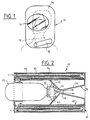
- the apparatus represented in FIG. 1 comprises a mask or a hood 10 of substantially cylindrical tubular shape, closed at its upper end and open at its lower end so that it can be put on the head of a person.
- the lower end of the hood 12 comprises tightening means around the neck of the person, to prevent the entry of air or external gas into this hood.
- the dimensions of the hood are such that, when inflated, its internal volume is much greater than that of a person's head.
- This hood is preferably made of a light, flexible, waterproof or waterproof plastic material, transparent, heat and fire resistant and, if possible, inexpensive.
- a polyimide sold under the brand KAPTON is used.
- a large part 14 of the outer surface of the hood can receive a protective metallic coating, while the remaining part 16, at eye level, remains transparent.
- an assembly 18 for supplying oxygen and for circulating and purifying the air contained in the hood.
- this assembly 18 includes a bottle 20 of small volume, made for example of metal such as steel or aluminum or of composite material, and containing a gas which is breathable under very high pressure. high of around 200 bars. Breathing gas can be pure oxygen or, for safety reasons, an oxygen-nitrogen mixture containing 60 to 70% oxygen. Expansion means 22, which may be of a conventional type, are mounted at the outlet of the bottle 20 to supply an ejection nozzle 24 with a relatively constant flow of gas at a pressure which is several times higher than normal pressure ambient, and which is for example between 4 and 10 bars approximately.
- the nozzle 24 is located immediately upstream of the neck 26 of an air passage duct 30, the upstream end 32 of which, with the nozzle 24, defines an air suction channel through a bed 34 of a material porous or powdery such as potassium dioxide KO2, lithium hydroxide LiOH, or preferably soda lime, which is easy to handle, non-toxic and less expensive than lithium hydroxide.
- a material porous or powdery such as potassium dioxide KO2, lithium hydroxide LiOH, or preferably soda lime, which is easy to handle, non-toxic and less expensive than lithium hydroxide.
- Silica gel can be added to this material for the absorption of water vapor.
- the absorbent material or materials are arranged in a tubular cylindrical envelope 40 which surrounds the bottle 20 and the conduit 30, so as to reduce the total bulk of the system.
- the envelope 40 is for example triple-walled and delimits two coaxial chambers in which are placed two tubular cylindrical containers 44, 46 filled with absorbent material (s). The perforated ends of these containers allow air to circulate through the absorbent material, along a baffled path inside the envelope 40.
- This is formed with or is mounted on a cylinder 48 also supporting the conduit 30 and having one end closed by the bottle 20, so that the upstream end 32 of the conduit 30 communicates with the outside via the passage containing the absorbent material (s).
- the nose of the bottle 20 is for example screwed into a threaded end of the regulator 22 which forms with the ejection nozzle 24 an assembly kept centered inside the cylinder 48.
- the front part of the regulator 22 is for example carried by radial lugs 42 integral with the cylinder 48 or the upstream end 32 of the conduit 30, for proper centering of the nozzle 24 relative to the conduit 30.
- the duct 30 comprises a mixer 26 of substantially constant cross section, and having a certain length, which is connected to a diffuser 36 such that the gas pressure at the outlet of the duct 30 is very slightly higher than the pressure inside the hood . A slight overpressure is thus produced inside the hood, which makes it possible to inflate it and prevent the entry of outside air, and a greater flow of air sucked into the duct 30 is also obtained.
- the absorption of carbon dioxide by the material 34 is an exothermic reaction, which results in heating of the purified air.
- the cooling which accompanies any expansion of a pressurized gas is advantageously used to reduce the temperature of the purified air, thanks to the arrangement of the bottle 20, the regulator 22 and the nozzle 24 at the inlet of the duct. 30 on the path of the aspirated air.
- the nozzle 24-conduit assembly 30, a preferred embodiment of which has been shown in FIG. 3, must have characteristics making it possible to ensure sufficient circulation of the air contained in the hood for the elimination of carbon dioxide.
- the nozzle 24 has an upstream diameter of the order of 2 mm, and a downstream diameter, at its outlet end, of 0.35 mm.
- the upstream end 32 of the conduit 30 is connected to the mixer 26 by a convex surface having a radius of curvature of approximately 4 mm.
- the mixer 26 has a diameter of about 3.5 mm and a length of about 25 mm, and it is connected to the diffuser 36 which comprises a frustoconical upstream part having an apex angle of approximately 3 ° and a flared downstream part, formed by a convex surface having a radius of curvature of the order of 6 mm.
- the downstream end of the diffuser 36 can have a diameter of approximately 11 mm.
- the nozzle 24-conduit assembly 30 has a length of the order of approximately 50 mm, the distance between the nozzle 24 and the upstream end 32 of the conduit 30 being approximately 5 mm.
- Such an assembly has a drive power of between 10 and 20 approximately, and for example equal to 12.
- the drive ratio is the ratio of the flow of air drawn inside the hood and the flow of engine gas. delivered by nozzle 24.
- this flow of engine gas is chosen to be equal to approximately 3 liters / minute, which ensures the suction of an air flow of the order of approximately 36 liters / minute into the hood: this flow d air keeps a CO2 level in the hood that does not exceed 3% when the person produces a moderate effort.
- the bottle 20 can have a volume of the order of 100 cm3, and is filled with gas containing from 60 to 70% of oxygen, under an initial pressure of 200 bars. It then ensures autonomy of at least five minutes for the wearer of the hood. During this time, the concentration of carbon dioxide inside the hood, which is of the order of 3% initially in the case of a moderate effort, remains less than 5%, which avoids the risks of intoxication and discomfort for the wearer of the device.
- the necessary quantity of absorbent material 34 is of the order of approximately 300 to 400 g.
- the device according to the invention is intended, in principle, to be stored for several years before possibly to be used in an emergency. For this, it is advantageous that it is stored away from air and moisture, in a sealed package, for example formed by the hood itself, and can also be easily checked and replaced if necessary. at regular intervals. It is also necessary that the bottle 20 is closed in a sealed manner to maintain its internal pressure for a long time, and that it is equipped with rapid opening means, for example by rotation over a quarter turn. Provision may be made for the entire apparatus to include automatic release means by unfolding the hood and pulling on a strap or the like, or by rotating the bottle, etc.
- the gas contained in the bottle 20 is expanded by the means 22 to a pressure of the order of approximately 4 to 10 bars, and reaches the ejection nozzle 24, with a substantially constant flow rate of the order of 3 liters / minute .
- the device according to the invention can be packaged in a waterproof bag provided with rapid opening means, for example of the type tearing or tearing of a pre-cut or pre-delimited strip by appropriate means.
Landscapes
- Health & Medical Sciences (AREA)
- Toxicology (AREA)
- General Health & Medical Sciences (AREA)
- Business, Economics & Management (AREA)
- Emergency Management (AREA)
- Respiratory Apparatuses And Protective Means (AREA)
Claims (10)
- Unabhängiges Notatemgerät, welches wahrend einer langen Zeitperiode aufbewahrt und kurzzeitig verwendet werden kann und dem Träger ermöglicht, sich aus einem Bereich mit Erstickungsgefahr zu entfernen und das aufweist: eine Maske (10) welche den Kopf des Trägers ausreichend und im wesentlichen dicht abdeckt, eine Flasche (20), welche ein unter Druck stehendes, sauerstoffhältiges Atemgas enthält, Drosselmittel (22) für das aus der Flasche (20) ausströmende Gas und eine Ausströmdüse (24) für das gedrosselte Gas, welches in eine Luftdurchströmleitung (30) zur Rückführung der in der Maske enthaltenen Luft mündet, welche dabei Mittel (34) zur Absorption von Kohlendioxid durchströmt und mit dem aus der Flasche gelieferten Atemgeas vermischt wird, wobei die Menge des aus der Ausströmdüse (24) gelieferten Atemgases in der Größenordnung von 2 bis 4 Liter pro Minute beträgt, dadurch gekennzeichnet, daß die Flasche (20) ein Volumen von einigen cm³ aufweist und mit einem Atemgas gefüllt ist, das unter einem Anfangsdruck von ungefähr 200 bar steht, und daß die Drosselmittel (22) die Ausströmdüse (24), welche in die Luftdurchströmleitung mündet, mit einem Druck von einigen bar beliefern, wobei die Ausströmdüse (24) und die Leitung (30) eine Anordnung mit einem Mischungsverhältnis zwischen 10 und 20 bilden.
- Gerät nach Anspruch 1, dadurch gekennzeichnet, daß die Düse (24) einen Ausgangsdurchmesser von ca. 0,35 mm besitzt.
- Gerät nach Anspruch 1 oder 2, dadurch gekennzeichnet, daß der Mittelabschnitt (26) der Leitung (30) einen Mischer mit im wesentlichen konstanten Querschnitt bildet, welcher einen Durchmesser von ca. 3,5 mm und eine Länge von ca. 25 mm aufweist.
- Gerät nach einem der vorigen Ansprüche, dadurch gekennzeichnet, daß der niederdruckseitige Abschnitt der Leitung (30) durch einen Strömungsverteiler (36) gebildet wird, sodaß der Gasdruck am Ausgang etwas höher als der Umgebungsdruck ist, wobei dieser Strömungsverteiler einen kegelstumpfartigen Abschnitt aufweist, dessen spitzer Winkel ca. 3° beträgt.
- Gerät nach einem der vorigen Ansprüche, dadurch gekennzeichnet, daß die Ausströmdüse (24) mit einem Druck zwischen 4 und 10 bar beliefert wird.
- Gerät nach einem der vorigen Ansprüche, dadurch gekennzeichnet, daß die Flasche (20), die Drosselmittel (22), die Kohlendioxid-Absorptionsmittel (34), die Ausströmdüse (24) und die Durchströmleitung (30) innerhalb der Maske enthalten sind.
- Gerät nach einem der vorigen Ansprüche, dadurch gekennzeichnet, daß es auch Mittel zur Absorption von Wasserdampf, wie ein Silikatgel, aufweist.
- Gerät nach einem der vorigen Ansprüche, dadurch gekennzeichnet, daß die Drosselmittel (22) in der Luftströmung zwischen der Leitung (30) für die Atemluft und dem Ausgang der Kohlendioxid-Absorptionsmittel (34) angeordnet sind.
- Gerät nach einem der vorigen Ansprüche, dadurch gekennzeichnet, daß die Maske aus eiem leichten und durchsichtigen wärmebeständigen Kunststoffmaterial, wie ein Polyimid, hergestellt ist.
- Gerät nach einem der vorigen Ansprüche, dadurch gekennzeichnet, daß ein Teil (14) der äußeren Oberfläche der Maske (10) metallbeschichtet ist.
Priority Applications (1)
| Application Number | Priority Date | Filing Date | Title |
|---|---|---|---|
| AT89908218T ATE102493T1 (de) | 1988-07-12 | 1989-07-10 | Selbsttragendes notatemgeraet. |
Applications Claiming Priority (2)
| Application Number | Priority Date | Filing Date | Title |
|---|---|---|---|
| FR8809453 | 1988-07-12 | ||
| FR8809453A FR2634130B1 (fr) | 1988-07-12 | 1988-07-12 | Appareil respiratoire autonome de secours |
Publications (2)
| Publication Number | Publication Date |
|---|---|
| EP0378664A1 EP0378664A1 (de) | 1990-07-25 |
| EP0378664B1 true EP0378664B1 (de) | 1994-03-09 |
Family
ID=9368355
Family Applications (1)
| Application Number | Title | Priority Date | Filing Date |
|---|---|---|---|
| EP89908218A Expired - Lifetime EP0378664B1 (de) | 1988-07-12 | 1989-07-10 | Selbsttragendes notatemgerät |
Country Status (6)
| Country | Link |
|---|---|
| US (1) | US5027810A (de) |
| EP (1) | EP0378664B1 (de) |
| JP (1) | JPH03502057A (de) |
| DE (1) | DE68913712D1 (de) |
| FR (1) | FR2634130B1 (de) |
| WO (1) | WO1990000421A1 (de) |
Families Citing this family (23)
| Publication number | Priority date | Publication date | Assignee | Title |
|---|---|---|---|---|
| US6347240B1 (en) | 1990-10-19 | 2002-02-12 | St. Louis University | System and method for use in displaying images of a body part |
| EP0553246B1 (de) | 1990-10-19 | 2000-09-13 | St. Louis University | Lokalisierungssystem für eine chirurgische sonde zur anwendung am kopf |
| NO178529C (no) * | 1991-08-27 | 1996-04-17 | Ottestad Nils T | Selvforsynt nödpusteinnretning |
| DE69432834T2 (de) | 1993-04-26 | 2004-05-13 | St. Louis University | Anzeige der Lage einer chirurgischen Sonde |
| US5490501A (en) * | 1994-05-16 | 1996-02-13 | Crowley; Thomas J. | Avalanche victim's air-from-snow breathing device |
| US5613490A (en) * | 1994-07-28 | 1997-03-25 | Mayes; Richard P. | Compact, lightweight breathable air pressure vessel |
| US5529058A (en) * | 1994-09-30 | 1996-06-25 | Crippen; Warren S. | Personal self-contained air safety system |
| US6978166B2 (en) | 1994-10-07 | 2005-12-20 | Saint Louis University | System for use in displaying images of a body part |
| US5495847A (en) * | 1995-05-17 | 1996-03-05 | Hu; Wei | Survival hood |
| US5724963A (en) * | 1995-10-27 | 1998-03-10 | Seeley; Larry E. | Portable air respirator |
| US6432172B1 (en) | 1996-03-07 | 2002-08-13 | Ptrl East, Inc. | Method of treating symptoms of panic attacks |
| DE19832000C1 (de) | 1998-07-16 | 1999-11-04 | Draeger Aerospace Gmbh | Fluchthaube |
| US6247471B1 (en) * | 1999-07-08 | 2001-06-19 | Essex Pb&R Corporation | Smoke hood with oxygen supply device and method of use |
| US6694972B2 (en) * | 2000-10-13 | 2004-02-24 | Government Specialty Products | Gas canister protection system |
| AU2003900203A0 (en) * | 2003-01-17 | 2003-01-30 | Unisearch Limited | A respiratory assist device and method of providing respiratory assistance |
| US20060011201A1 (en) * | 2004-07-14 | 2006-01-19 | Tsung-Yuan Ku | Modified eye and mouth mask structure for escape from dense smoke of fire accident |
| US20080223372A1 (en) * | 2004-07-14 | 2008-09-18 | Tsung-Yuan Ku | Modified eye and mouth mask structure for escape from dense smoke of fire accident |
| US7712151B2 (en) * | 2004-08-27 | 2010-05-11 | Campus Housing Company LLC | Inflatable protective enclosure |
| GB2466062B (en) * | 2008-12-12 | 2011-06-08 | Raymond Thornton Andrews | Portable emergency breathing apparatus |
| JP2013506505A (ja) * | 2009-09-30 | 2013-02-28 | エセックス ピー.ビー. アンド アール. コーポレーション | 緊急呼吸装置 |
| USD735846S1 (en) * | 2012-06-13 | 2015-08-04 | Kimberly-Clark Worldwide, Inc | Integrated mask and hood |
| FR3042421B1 (fr) * | 2015-10-15 | 2018-10-26 | L'air Liquide, Societe Anonyme Pour L'etude Et L'exploitation Des Procedes Georges Claude | Cagoule de protection respiratoire |
| US10933264B1 (en) | 2019-04-09 | 2021-03-02 | Christopher Strouse | Portable fire safety enclosure system |
Family Cites Families (10)
| Publication number | Priority date | Publication date | Assignee | Title |
|---|---|---|---|---|
| DE277995C (de) * | ||||
| DE132021C (de) * | 1901-04-03 | 1902-06-30 | ||
| FR730522A (fr) * | 1932-01-26 | 1932-08-17 | Appareils respiratoires simplifiés pour la protection des populations civiles contre les gaz de guerre | |
| US2366904A (en) * | 1942-05-16 | 1945-01-09 | Haugh S Products Ltd | Oxygen tent |
| GB577435A (en) * | 1944-02-23 | 1946-05-17 | Siebe Gorman & Co Ltd | Improvements relating to self-contained breathing apparatuses |
| DE1222801B (de) * | 1959-02-28 | 1966-08-11 | Medizintechnik Leipzig Veb | Sauerstoffatemschutzgeraet mit Regeneration der Ausatemluft |
| US3521629A (en) * | 1967-09-18 | 1970-07-28 | Schjeldahl Co G T | Heat and smoke protective hoods |
| US3976063A (en) * | 1974-09-16 | 1976-08-24 | The Bendix Corporation | Escape breathing apparatus |
| US4440163A (en) * | 1982-07-30 | 1984-04-03 | Gabriel Spergel | Emergency escape breathing apparatus |
| US4552140A (en) * | 1983-04-29 | 1985-11-12 | Erie Manufacturing Co. | Emergency escape device |
-
1988
- 1988-07-12 FR FR8809453A patent/FR2634130B1/fr not_active Expired - Lifetime
-
1989
- 1989-07-10 WO PCT/FR1989/000364 patent/WO1990000421A1/fr not_active Ceased
- 1989-07-10 JP JP1507829A patent/JPH03502057A/ja active Pending
- 1989-07-10 EP EP89908218A patent/EP0378664B1/de not_active Expired - Lifetime
- 1989-07-10 US US07/490,601 patent/US5027810A/en not_active Expired - Fee Related
- 1989-07-10 DE DE89908218T patent/DE68913712D1/de not_active Expired - Lifetime
Also Published As
| Publication number | Publication date |
|---|---|
| US5027810A (en) | 1991-07-02 |
| FR2634130A1 (fr) | 1990-01-19 |
| DE68913712D1 (de) | 1994-04-14 |
| FR2634130B1 (fr) | 1991-07-05 |
| JPH03502057A (ja) | 1991-05-16 |
| EP0378664A1 (de) | 1990-07-25 |
| WO1990000421A1 (fr) | 1990-01-25 |
Similar Documents
| Publication | Publication Date | Title |
|---|---|---|
| WO1990000421A1 (fr) | Appareil respiratoire autonome de secours | |
| EP0223808B1 (de) | Schutzhelm gegen rauch und hypoxie | |
| US4683880A (en) | Toxic fume protective hood and method of construction | |
| US5315987A (en) | Filtering canister with deployable hood and mouthpiece | |
| EP1948323B1 (de) | Rettungsboje, besonders für lawinen | |
| FR2611344A1 (fr) | Appareil respiratoire a circuit ferme | |
| US4498472A (en) | Smoke mask | |
| EP2979561B1 (de) | Atemschutzhaube | |
| AU2002358961A1 (en) | Respiratory hood | |
| FR2781163A1 (fr) | Cagoule de sauvetage | |
| FR2460686A1 (fr) | Dispositif d'alimentation en gaz pour appareil respiratoire | |
| EP4227575B1 (de) | Tragbare notsauerstoffabgabeanordnung mit sauerstoffspeicherpatrone | |
| FR2649897A1 (fr) | Appareil pour la protection respiratoire | |
| EP0185575B1 (de) | Verfahren und Vorrichtung um Gas zu erwärmen | |
| CN111202923B (zh) | 一种公共消防紧急逃生呼吸器 | |
| FR2680468A1 (fr) | Bulle de tete pour l'evacuation des blesses en atmosphere toxique. | |
| EP4227574B1 (de) | Tragbare notsauerstoffabgabeanordnung mit flusskontrollventilen | |
| BE1005567A3 (fr) | Douche autonome, portable, sterile, pour le lavage des parties du corps humain ou animal agressees notamment par des produits chimiques. | |
| KR20240044681A (ko) | 산소공급마스크 | |
| FR2737413A3 (fr) | Capuche de sauvetage anti-fumees d'incendie | |
| FR2657332A1 (fr) | Ensemble a capuchon de protection a mise en place rapide. | |
| FR2515521A1 (fr) | Appareil de protection respiratoire conforme en appareil respiratoire a filtre muni d'une alimentation en oxygene supplementaire | |
| FR3064492A1 (fr) | Dispositif de sauvetage lors d'une avalanche | |
| FR3117876A1 (fr) | Appareil de filtration de l’air individuellement portable et a ventilation assistee | |
| WO2021229155A1 (fr) | Procede et dispositif de protection contre l'inhalation d'éléments nuisibles |
Legal Events
| Date | Code | Title | Description |
|---|---|---|---|
| PUAI | Public reference made under article 153(3) epc to a published international application that has entered the european phase |
Free format text: ORIGINAL CODE: 0009012 |
|
| 17P | Request for examination filed |
Effective date: 19900314 |
|
| AK | Designated contracting states |
Kind code of ref document: A1 Designated state(s): AT BE CH DE FR GB IT LI LU NL SE |
|
| 17Q | First examination report despatched |
Effective date: 19910719 |
|
| GRAA | (expected) grant |
Free format text: ORIGINAL CODE: 0009210 |
|
| AK | Designated contracting states |
Kind code of ref document: B1 Designated state(s): AT BE CH DE FR GB IT LI LU NL SE |
|
| PG25 | Lapsed in a contracting state [announced via postgrant information from national office to epo] |
Ref country code: IT Free format text: LAPSE BECAUSE OF FAILURE TO SUBMIT A TRANSLATION OF THE DESCRIPTION OR TO PAY THE FEE WITHIN THE PRE;WARNING: LAPSES OF ITALIAN PATENTS WITH EFFECTIVE DATE BEFORE 2007 MAY HAVE OCCURRED AT ANY TIME BEFORE 2007. THE CORRECT EFFECTIVE DATE MAY BE DIFFERENT FROM THE ONE RECORDED.SCRIBED TIME-LIMIT Effective date: 19940309 Ref country code: DE Effective date: 19940309 Ref country code: SE Free format text: THE PATENT HAS BEEN ANNULLED BY A DECISION OF A NATIONAL AUTHORITY Effective date: 19940309 Ref country code: NL Effective date: 19940309 Ref country code: GB Effective date: 19940309 Ref country code: AT Effective date: 19940309 |
|
| REF | Corresponds to: |
Ref document number: 102493 Country of ref document: AT Date of ref document: 19940315 Kind code of ref document: T |
|
| REF | Corresponds to: |
Ref document number: 68913712 Country of ref document: DE Date of ref document: 19940414 |
|
| PG25 | Lapsed in a contracting state [announced via postgrant information from national office to epo] |
Ref country code: LU Free format text: LAPSE BECAUSE OF NON-PAYMENT OF DUE FEES Effective date: 19940731 Ref country code: LI Effective date: 19940731 Ref country code: BE Effective date: 19940731 Ref country code: CH Effective date: 19940731 |
|
| NLV1 | Nl: lapsed or annulled due to failure to fulfill the requirements of art. 29p and 29m of the patents act | ||
| GBV | Gb: ep patent (uk) treated as always having been void in accordance with gb section 77(7)/1977 [no translation filed] |
Effective date: 19940309 |
|
| PLBE | No opposition filed within time limit |
Free format text: ORIGINAL CODE: 0009261 |
|
| STAA | Information on the status of an ep patent application or granted ep patent |
Free format text: STATUS: NO OPPOSITION FILED WITHIN TIME LIMIT |
|
| BERE | Be: lapsed |
Owner name: BERTIN & CIE Effective date: 19940731 Owner name: TEIKOKU SEN-I CO. LTD Effective date: 19940731 |
|
| 26N | No opposition filed | ||
| REG | Reference to a national code |
Ref country code: CH Ref legal event code: PL |
|
| PGFP | Annual fee paid to national office [announced via postgrant information from national office to epo] |
Ref country code: FR Payment date: 20010530 Year of fee payment: 13 |
|
| PG25 | Lapsed in a contracting state [announced via postgrant information from national office to epo] |
Ref country code: FR Free format text: LAPSE BECAUSE OF NON-PAYMENT OF DUE FEES Effective date: 20030331 |
|
| REG | Reference to a national code |
Ref country code: FR Ref legal event code: ST |