EP0379939B1 - Ein anpassungsfähiges Verfahren zur Herstellung von Di- und Trialkylaminen - Google Patents
Ein anpassungsfähiges Verfahren zur Herstellung von Di- und Trialkylaminen Download PDFInfo
- Publication number
- EP0379939B1 EP0379939B1 EP19900100855 EP90100855A EP0379939B1 EP 0379939 B1 EP0379939 B1 EP 0379939B1 EP 19900100855 EP19900100855 EP 19900100855 EP 90100855 A EP90100855 A EP 90100855A EP 0379939 B1 EP0379939 B1 EP 0379939B1
- Authority
- EP
- European Patent Office
- Prior art keywords
- alkanol
- dialkylamine
- ethanol
- reaction
- catalyst
- Prior art date
- Legal status (The legal status is an assumption and is not a legal conclusion. Google has not performed a legal analysis and makes no representation as to the accuracy of the status listed.)
- Expired - Lifetime
Links
Images
Classifications
-
- C—CHEMISTRY; METALLURGY
- C07—ORGANIC CHEMISTRY
- C07C—ACYCLIC OR CARBOCYCLIC COMPOUNDS
- C07C209/00—Preparation of compounds containing amino groups bound to a carbon skeleton
- C07C209/04—Preparation of compounds containing amino groups bound to a carbon skeleton by substitution of functional groups by amino groups
- C07C209/14—Preparation of compounds containing amino groups bound to a carbon skeleton by substitution of functional groups by amino groups by substitution of hydroxy groups or of etherified or esterified hydroxy groups
- C07C209/16—Preparation of compounds containing amino groups bound to a carbon skeleton by substitution of functional groups by amino groups by substitution of hydroxy groups or of etherified or esterified hydroxy groups with formation of amino groups bound to acyclic carbon atoms or to carbon atoms of rings other than six-membered aromatic rings
Definitions
- This invention relates to an improved process for producing di and trialkylamines containing at least one C2 ⁇ 4 alkyl substituent in high selectivity.
- Alkylamines which usually comprise the reaction product of a C1 ⁇ 4 alkanol with ammonia to produce the resultant alkylamine are widely known and used as intermediates in the manufacture of many commercial products.
- the current commercial process schemes for producing the alkylamines involve the reaction of an alcohol or their corresponding ethers with ammonia and the subsequent separation and recycling of the mono di, and trialkylamine products to obtain a desired product distribution.
- Alkylation of ammonia or an amine by contact with an alcohol or its ether resulting in the production of a mixture of mono, di and trialkyl substituted amines is generally thought of as being equilibrium controlled.
- the product slate falls along an equilibrium line which changes with temperature or amine to alkanol (N/R) mole ratio.
- alkylamines including, C2 ⁇ 4 alkylamines, such as ethlyamines, propylamines, and butylamines:
- U.S. 4,398,041 discloses the nonequilibrium controlled production of C1 ⁇ 4 alkylamines by passing a mixture of a C1 ⁇ 4 alcohol and ammonia into a reaction zone containing a shape-selective crystalline alumino-silicate zeolite catalyst, e.g., an H-mordenite or H-erionite which is capable of catalyzing the synthesis of mono and dialkylamines but which has a pore size too small to permit the passage of a tri-substituted alkylamine therethrough.
- a shape-selective crystalline alumino-silicate zeolite catalyst e.g., an H-mordenite or H-erionite which is capable of catalyzing the synthesis of mono and dialkylamines but which has a pore size too small to permit the passage of a tri-substituted alkylamine therethrough.
- a fraction of the first product stream containing mono and dialkylamines is removed and the remainder is passed through a second conversion zone containing a catalyst having intracrystalline pores sufficiently large for permitting the production of an equilibrium controlled distribution of mono, di and trialkyl substituted amines.
- the streams are combined to form a nonequilibrium controlled product slate.
- An H-Y zeolite, REY zeolite or silica-alumina is used as the catalyst for the second reactor zone.
- German Application 3,539,266 discloses a process for preparing trialkyl amines by reacting a dialkylamine with a C2 ⁇ 4 alcohol in the presence of a hydrogenation/dehydrogenation catalyst containing essentially only copper as a catalytically hydrogenating/dehydrogenating metal.
- the reaction is carried out in liquid phase with a mole ratio of dialkylamine e.g., dimethylamine to C2 ⁇ 4 alkanol from 1-10:1 and further carrying out the reaction in the presence of water.
- the patentees point out that at the synthesis of tertiary amines by alkylation of secondary amines with alcohols had been difficult because of concomitant transalkylation and disproportionation reactions which occur along with the amination of the alcohol.
- Example 4 shows the production of triethylamine from diethylamine and ethanol (N/R of 0.2:1) under liquid phase conditions.
- European Patent Application 0 211 552 discloses a process for producing alkylamines by reacting an alcohol with an amine, e.g., ammonia using a nickel or cobalt containing catalyst and a difficulty reducible metal oxide, e.g., alumina plus a rare earth.
- an amine e.g., ammonia
- a nickel or cobalt containing catalyst e.g., nickel or cobalt containing catalyst
- a difficulty reducible metal oxide e.g., alumina plus a rare earth.
- conventional hydrogenation catalysts typically have given rise to appreciable quantities of by-products, particularly hydrocarbons and high boiling contaminants, e.g., nitriles and amides. To minimize the formation of such by-products, it had been customary to reduce the reaction temperature. To maximize selectivity to a desired product slate, extensive recycling of undesired alkylamines had been necessary.
- U.S. 4,014,933 discloses a process for producing alkylamines by the reaction of an alcohol with ammonia or an amine in the presence of hydrogen utilizing a cobalt, nickel, copper or copper-containing aluminum oxide or silicon dioxide supported catalyst optionally including a phosphorus containing cocatalyst and a promoter in the form of an alkali or alkaline earth metal.
- U.S. 4,314,084 discloses a gas phase process for producing C2 ⁇ 6 alkylamines by the amination of C2 ⁇ 6 alkanols.
- a hydrogen/dehydrogenation catalyst e.g., nickel or cobalt is carried on a neutral alumina support promoted with an alkaline material to enhance selectively and minimize olefin production.
- the product slate however was equilibrium controlled.
- This invention relates to an improved process for the production of a nonequilibrium controlled product slate of di and trialkylamines by the catalytic amination of a C1 ⁇ 4 alkanol and ammonia where the reaction is carried out in the presence of hydrogen and particularly to a process for producing trialkylamines, e.g., triethylamine.
- the improvement for producing trialklyamine resides in utilizing a feedstock comprising essentially a dialkylamine and contacting that feedstock with C2 ⁇ 4 alkanol in a fixed bed catalytic reactor containing a hydrogenation/dehydrogenation catalyst containing cobalt or nickel under gas phase conditions wherein the temperature is maintained from about 135 to 204°C (275 to 400°F), the gas hourly space velocity is maintained from 500 to 2000 hr. ⁇ 1, and the pressure is maintained at about 10.3 to 24.1 bar (150 to 350 psig).
- a nonequilibrium reaction product rich in trialkylamine is produced in high selectivity without producing substantial by-products in the form of olefins or lower amine by-products through reforming reactions. Conversion of alkanol is maintained at 50 to 70 mole percent.
- the mono and dialkylamine are separated from the reaction product and contacted with C2 ⁇ 4 alkanol under gas phase conditions in a fixed bed reactor.
- the catalyst utilized is a cobalt or nickel-containing catalyst and the mole ratio of alkanol to amine is from about 1 to 3:1. Conversion of alkanol is maintained at a level from 50 to 70 mole% by controlling the gas hourly space velocity from 500 to 2000 hr ⁇ 1, and the temperature from 135 to 204°C (275 to 400°F).
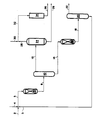
- the drawing is a process flow diagram of a reaction process for producing di and trialkylamines containing at least one C2 ⁇ 4 alkyl substituent in high selectivity using the process of this invention.
- a feedstock of a C1 ⁇ 4 alkanol such as ethanol, propanol, either isopropanol or n-propanol, and butanol, either isobutanol or n-butanol, is passed through line 2 and combined with recycle alkanol from line 3 and ammonia from line 4 and introduced through line 5 to reactor 6 to produce a reaction product containing a mixture of mono, di and trialkylamine.
- a high mole ratio of ammonia to alkanol is used in this initial reaction, e.g., from about 0.5 to 20.0 moles ammonia per mole alkanol and preferably between 1.5 to 16 moles ammonia per mole alkanol at pressures ranging from 0 to 48.2 bar (0 to 700 psig) and preferably from 8.9 to 29.6 bar (130 to 430 psig), and temperatures typically ranging from 149 to 422°C (300 to 800°F) and preferably from 176 to 395°C (350 to 750°F).
- the initial amination reaction may be carried in the presence of a hydrogenation/dehydrogenation catalyst typically, one containing cobalt or nickel carried on a support such as alumina (unneutralized and neutralized), silica, kaolin, zeolites, e.g., H- mordenite, H-Y, rare earth zeolites and silica-alumina.
- a hydrogenation/dehydrogenation catalyst typically, one containing cobalt or nickel carried on a support such as alumina (unneutralized and neutralized), silica, kaolin, zeolites, e.g., H- mordenite, H-Y, rare earth zeolites and silica-alumina.
- a weakly acidic or neutral support is used to carry the active metal.
- Silica-alumina may also be used as the catalyst to produce higher quantities of mono alkylamine in the initial amination.
- the reaction product obtained from the initial amination reaction is removed from reactor 6 via line 8 and separated in distillation column 10.
- Mono and dialkylamine in preselected amount are recovered as an overhead and removed as stream 12.
- a dialkylamine/alkanol bottoms is removed from column 10 through line 14.
- the level of dialkylamine in the bottoms is regulated via control of the level of dialkylamine removed with the monoalkylamine in the overhead.
- the dialkylamine is removed via line 14 and charged to reactor 16 which involves the reaction of a primary C2 ⁇ 4 alkanol with a secondary alkylamine to produce the trialkyl amine.
- the mole percent secondary alkylamine in the feedstock should be at least 90 percent and preferably about 100 percent of the amine in the feedstock.
- the alkyl substituent of the amine feedstock need not be the same as the alkanol used here, but such combination will result in a mixed or unsymmetrical product slate.
- at least one of the alkyl substituents in the di and trialkylamine is a C2 ⁇ 4 substituent, the other substituents may be a C1 methyl substituent.
- examples of di and trialkylamines include diethylmethylamine, triethylamine, dimethylethylamine, diethylpropylamine, tripropylamine and tributylamine.
- the temperature preferably is maintained from 163 to 190°C (325-375°F), and the pressure is maintained from 15.5 to 19 bar (225 to 275 psig).
- the key to producing a kinetically controlled slate, as opposed to equilibrium controlled slate, is in maintaining a gas hourly space velocity of about 1,000 - 2,000 hours ⁇ 1. This limits conversion of the alkanol to a range from 50 to 70 mole% and thereby enhances selectivity. Longer residence times tend to produce more by-products.
- the product from the reactor 16 is removed via line 18, and the reaction product separated in distillation column 20 where an overhead stream 22 rich in trialkylamine is generated and a bottoms rich in alkanol is recycled via line 3 to the initial reaction zone.
- the monoalkylamine/dialkylamine overhead mixture is removed via line 12 from distillation column 10 and charged to distillation column 24 wherein the monoalkylamine is separated from the dialkylamine.
- the product dialkylamine removed via line 26 may be recycled to reactor 16 or used as product depending upon the level of trialkylamine desired.
- the overhead consisting essentially of monoalkylamine is removed from column 24 via line 28 and contacted with additional C2 ⁇ 4 alkanol which is introduced through line 30.
- the reactant mixture is introduced via line 32 to fixed bed catalytic reactor 34. The reactants are converted to a product of essentially dialkylamine and removed via line 36.
- Conversion of monoalkylamine, particularly monoethylamine, to dialkylamine, e.g., diethylamine, is effected in high selectivity and at high conversion by utilizing a hydrogenation/dehydrogenation catalyst containing nickel or cobalt in the catalytic reactor.
- the metal content of nickel or cobalt in the catalyst used in the conversion of dialkylamine to trialkylamine is at conventional levels, e.g., from 30 to 40% by weight as metal.
- a mole ratio of alkanol to monoalkylamine of from about 0.1 to 3:1 is used. Conversion is limited to a range from 50 to 70% in order to enhance selectivity to avoid reforming, etc., that results in by-product formation.
- Diethylamine obtained from a commercial process for the production of ethylamines by the reaction of ethanol and ammonia was used as a feedstock for reaction with ethanol in an effort to synthesize triethylamine in high selectivity.
- the reaction was carried in a conventional, commercial fixed bed reactor system packed with a cobalt on calcium-alumina hydrogenation catalyst, the concentration of cobalt being approximately 35% as active metal.
- the mole ratio of ethanol, to diethylamine ranged from 0.5 to 2.3:1, the pressure from 12.4 to 15.8 bar (180 to 230 psig); the gas hourly space velocity ranged from 1,000-1,800 hr ⁇ 1 and the temperature ranged from 135 to 218°C (275-425°F). Hydrogen was used to maintain the catalyst in an active, reduced state.
- the mole ratio of hydrogen to ethanol ranged from 1.1 to 2.8.
- a typical product slate obtained from the equilibrium controlled reaction of ammonia and ethanol is MEA/DEA/TEA of 0.48 to 1 to 0.40 (molar) as formed in Runs 10 and 11. Attempts to increase triethylamine levels through higher temperatures and lower N/R mole ratios tends to increase the level of olefins, deamination products and nitriles produced in the process. Thus a nonequilibrium product slate can be achieved by the present process (compare Run 1 slate vs. the one obtained from the equilibrium controlled Run 10).
Landscapes
- Chemical & Material Sciences (AREA)
- Organic Chemistry (AREA)
- Organic Low-Molecular-Weight Compounds And Preparation Thereof (AREA)
- Low-Molecular Organic Synthesis Reactions Using Catalysts (AREA)
- Catalysts (AREA)
Claims (15)
- Verfahren zur Herstellung von Trialklyaminen in hoher Selektivität durch Aminierung eines C₂₋₄-Alkanols mit einem C₁₋₄-Dialkylamin in Gegenwart eines Hydrierungs-/Dehydrierungskatalysators und Wasserstoff in einer Menge, die ausreicht, um den Hydrierungs-/Dehydrierungskatalysator in aktivem Zustand zu halten, bei dem man
das Dialkylamin mit dem C₂₋₄-Alkanol in einem katalytischen Festbettreaktor unter Verwendung eines cobalt- oder nickelhaltigen Hydrierungs-/Dehydrierungskatalysators zur Umsetzung bringt;
während der Reaktion Gasphasebedingungen aufrechterhält;
eine Reaktionstemperatur von 135 bis 204°C (275 bis 400°F), einen Druck von 10,3 bis 24,1 bar (150 bis 350 psig), eine Raumgeschwindigkeit des Gases pro Stunde von 500 bis 2000 h⁻¹ und
ein Molverhältnis von C₂₋₄ Alkanol zum Dialkylamin von 1 bis 3 : 1 aufrechterhält. - Verfahren nach Anspruch 1, bei dem Ethanol das C₂₋₄-Alkanol ist und mit Diethylamin als C₁₋₄-Dialkylamin umgesetzt wird.
- Verfahren nach Anspruch 2, bei dem die Betriebstemperatur im Bereich von 163 bis 190°C (325 bis 375°F) liegt.
- Verfahren nach Anspruch 3, bei dem der Betriebsdruck im Bereich von 15,5 bis 19 bar (225 bis 275 psig) liegt.
- Verfahren nach Anspruch 4, bei dem die Betriebsraumgeschwindigkeit des Gases pro Stunde im Bereich von 1000 bis 2000 h⁻¹ liegt.
- Verfahren nach Anspruch 5, bei dem das Betriebsmolverhältnis für Ethanol/Diethylamin im Bereich von 1,5 bis 2,5 : 1 liegt.
- Verfahren nach Anspruch 6, bei dem die Ethanolumwandlung zu allen Produkten bei 50 bis 70 % gehalten wird.
- Verfahren nach Anspruch 1, bei dem Ethanol das C₂₋₄-Alkanol ist und mit Dimethylamin als C₁₋₄-Dialkylamin umgesetzt wird.
- Verfahren nach Anspruch 1, bei dem Ethanol das mit Dibutylamin umgesetzte C₂₋₄-Alkanol ist.
- Verfahren nach Anspruch 1 zur Herstellung eines Reaktionsproduktes aus Alkylamin, bei dem man:i) zuerst ein C₁₋₄-Alkanol mit Ammoniak in Gegenwart eines Katalysators zur Herstellung eines Reaktionsgemischs, das Mono-, Di- und Trialkylamine enthält, in Kontakt bringt;ii) das Dialkylamin aus dem Reaktionsgemisch abtrennt;iii) das Dialkylamin mit einem C₂₋₄-Alkanol in einem katalytischen Festbettreaktor unter Verwendung eines cobalt- oder nickelhaltigen Hydrierungs-/Dehydrierungskatalysators unter Gasphasebedingungen durch Aufrechterhaltung eines Molverhältnisses Alkanol zu Dialkylamin von 1 bis 3 : 1, einer Raumgeschwindigkeit des Gases pro Stunde von 1000 bis 2000 h⁻¹, einer Reaktionstemperatur von 163 bis 190°C (325 bis 375°F) und eines Drucks von 15,5 bis 19 bar (225 bis 275 psig) in Kontakt bringt, um ein Reaktionsgemisch zu erzeugen, das reich an Trialkylamin ist;iv) das Monoalkylamin aus dem Reaktionsgemisch abtrennt und dannv) mindestens einen Teil des Monoalkylamins mit einem C₂₋₄-Alkanol in einem katalytischen Festbettreaktor unter Verwendung eines cobalt- oder nickelhaltigen Hydrierungs-/Dehydrierungskatalysators unter Gasphasebedingungen durch Aufrechterhaltung einer Reaktionstemperatur von 135 bis 204°C (275 bis 400°F), einer stündlichen Geschwindigkeit des Gases von 500 bis 2000 h⁻¹, eines Molverhältnisses Alkanol zu Monoethylamin von 0,1 bis 3 : 1 und eines Drucks von 0,3 bis 24,1 bar (150 bis 350 psig) in Kontakt bringt und die dabei entstandenen, Dialkylamin enthaltenden Reaktionsgemische entnimmt.
- Verfahren nach Anspruch 10, bei dem der Hydrierungs-/Dehydrierungskatalysator ein cobalthaltiger Katalyator ist und der Gehalt an aktivem Metall in diesem Katalysator 30 bis 40 Gew.-% beträgt.
- Verfahren nach Anspruch 11, bei dem Propanol das C₂₋₄-Alkanol und Monopropylamin das C₁₋₄-Monoalkylamin ist.
- Verfahren nach Anspruch 11, bei dem das C₂₋₄-Alkanol Ethanol und das Dialkylamin Diethlyamin ist.
- Verfahren nach Anspruch 11, bei dem das C₂₋₄-Alkanol Ethanol und das Monoalkylarin Monobutylamin ist.
- Verfahren nach Anspruch 11, bei dem der zur Bildung eines Mono-, Di- und Trialklyamine umfassenden Reaktionsgemischs verwendete Katalyator Siliciumoxid-Aluminiumoxid ist.
Applications Claiming Priority (2)
| Application Number | Priority Date | Filing Date | Title |
|---|---|---|---|
| US30002089A | 1989-01-23 | 1989-01-23 | |
| US300020 | 1989-01-23 |
Publications (2)
| Publication Number | Publication Date |
|---|---|
| EP0379939A1 EP0379939A1 (de) | 1990-08-01 |
| EP0379939B1 true EP0379939B1 (de) | 1993-08-04 |
Family
ID=23157327
Family Applications (1)
| Application Number | Title | Priority Date | Filing Date |
|---|---|---|---|
| EP19900100855 Expired - Lifetime EP0379939B1 (de) | 1989-01-23 | 1990-01-16 | Ein anpassungsfähiges Verfahren zur Herstellung von Di- und Trialkylaminen |
Country Status (4)
| Country | Link |
|---|---|
| EP (1) | EP0379939B1 (de) |
| JP (1) | JPH072692B2 (de) |
| CA (1) | CA2007861C (de) |
| DE (1) | DE69002467T2 (de) |
Families Citing this family (3)
| Publication number | Priority date | Publication date | Assignee | Title |
|---|---|---|---|---|
| GB9914275D0 (en) * | 1999-06-18 | 1999-08-18 | Cerestar Holding Bv | Cationic cross-bonded starch with stable and tailor-made viscosity |
| US8466322B2 (en) | 2010-06-30 | 2013-06-18 | Basf Se | Process for preparing tri-n-propylamine (TPA) |
| CN102958904B (zh) * | 2010-06-30 | 2014-09-17 | 巴斯夫欧洲公司 | 生产三正丙基胺(tpa)的方法 |
Family Cites Families (4)
| Publication number | Priority date | Publication date | Assignee | Title |
|---|---|---|---|---|
| ZA797042B (en) * | 1978-12-29 | 1980-11-26 | Air Prod & Chem | Synthesis of lower alkyl amines |
| US4255357A (en) * | 1980-03-24 | 1981-03-10 | Pennwalt Corporation | Catalytic process for preparing ethyl amines |
| DE3539266A1 (de) * | 1985-11-06 | 1987-05-07 | Basf Ag | Verfahren zur herstellung von trialkylaminen |
| DE3627592A1 (de) * | 1986-08-14 | 1988-02-25 | Basf Ag | Verfahren zur herstellung von trialkylaminen |
-
1990
- 1990-01-16 EP EP19900100855 patent/EP0379939B1/de not_active Expired - Lifetime
- 1990-01-16 DE DE1990602467 patent/DE69002467T2/de not_active Expired - Fee Related
- 1990-01-16 CA CA002007861A patent/CA2007861C/en not_active Expired - Fee Related
- 1990-01-22 JP JP1077590A patent/JPH072692B2/ja not_active Expired - Fee Related
Also Published As
| Publication number | Publication date |
|---|---|
| CA2007861C (en) | 1997-01-28 |
| EP0379939A1 (de) | 1990-08-01 |
| DE69002467T2 (de) | 1993-12-02 |
| JPH072692B2 (ja) | 1995-01-18 |
| DE69002467D1 (de) | 1993-09-09 |
| CA2007861A1 (en) | 1990-07-23 |
| JPH02237966A (ja) | 1990-09-20 |
Similar Documents
| Publication | Publication Date | Title |
|---|---|---|
| US5189233A (en) | Process for the production of cyclohexane by liquid phase hydrogenation of benzene | |
| US4929758A (en) | Preparation of tert-butylamine from isobutene | |
| US4579984A (en) | Process for the production of alcohols | |
| US4260845A (en) | Alcohol dehydration employing a zinc aluminate catalyst | |
| US4851580A (en) | Preparation of trialkylamines | |
| US4647701A (en) | Processes for producing diethylenetriamine from monoethanolamine | |
| Vultier et al. | Copper catalyzed amination of 1, 6-hexanediol | |
| US4053515A (en) | Catalytic hydrogenation of unsaturated dinitriles employing high purity alumina | |
| US4313003A (en) | Preparation of dimethylamine | |
| US4255357A (en) | Catalytic process for preparing ethyl amines | |
| US4851578A (en) | Preparation of trialkylamines | |
| EP0227868B1 (de) | Verfahren zur Herstellung von Methylisobutylketon | |
| US4736030A (en) | Preparation of 1-alkyl- or 1-cycloalkylpiperazines | |
| CA2007861C (en) | Flexible process for the production of di and trialkylamines | |
| US5763668A (en) | Process for aminating a mixture obtained in cracking a mineral oil fraction with ammonia or a primary or secondary amine over specific heterogeneous catalysts | |
| EP0311900B1 (de) | Katalytisches Verfahren zur Herstellung von C-2- bis C-4-Alkylaminen | |
| US5900508A (en) | Preparation of amines from olefins over zeolites of the type PSH-3, MCM-22, SSZ-25 or mixtures thereof | |
| US6028239A (en) | Process for the production of tertiary olefin(s) by decomposition of the corresponding ether using a particular catalyst | |
| US4892974A (en) | Process for producing mono-ortho-tert-butyl-aniline using silica-alumina catalysts | |
| US5488165A (en) | Process for the production of methyl amines | |
| WO1996022263A1 (en) | Etherification process | |
| US3174992A (en) | Method for making aminonitriles | |
| ZA200510015B (en) | Process for producing alkylbenzene | |
| EP0023129B1 (de) | Produktion von Aminen durch Hydrogenierung in der Gasphase von niedrigen aliphatischen Mononitrilen | |
| EP0451979A2 (de) | Kontinuierliche Herstellung von sekundären Aminen aus Nitrilen mit der Verwendung von Kobalt und Zirkonium |
Legal Events
| Date | Code | Title | Description |
|---|---|---|---|
| PUAI | Public reference made under article 153(3) epc to a published international application that has entered the european phase |
Free format text: ORIGINAL CODE: 0009012 |
|
| AK | Designated contracting states |
Kind code of ref document: A1 Designated state(s): BE DE FR GB NL |
|
| 17P | Request for examination filed |
Effective date: 19900927 |
|
| 17Q | First examination report despatched |
Effective date: 19920325 |
|
| GRAA | (expected) grant |
Free format text: ORIGINAL CODE: 0009210 |
|
| AK | Designated contracting states |
Kind code of ref document: B1 Designated state(s): BE DE FR GB NL |
|
| REF | Corresponds to: |
Ref document number: 69002467 Country of ref document: DE Date of ref document: 19930909 |
|
| ET | Fr: translation filed | ||
| PLBE | No opposition filed within time limit |
Free format text: ORIGINAL CODE: 0009261 |
|
| STAA | Information on the status of an ep patent application or granted ep patent |
Free format text: STATUS: NO OPPOSITION FILED WITHIN TIME LIMIT |
|
| 26N | No opposition filed | ||
| PGFP | Annual fee paid to national office [announced via postgrant information from national office to epo] |
Ref country code: GB Payment date: 19961222 Year of fee payment: 8 |
|
| PGFP | Annual fee paid to national office [announced via postgrant information from national office to epo] |
Ref country code: NL Payment date: 19970120 Year of fee payment: 8 |
|
| PG25 | Lapsed in a contracting state [announced via postgrant information from national office to epo] |
Ref country code: GB Free format text: LAPSE BECAUSE OF NON-PAYMENT OF DUE FEES Effective date: 19980116 |
|
| PG25 | Lapsed in a contracting state [announced via postgrant information from national office to epo] |
Ref country code: NL Free format text: LAPSE BECAUSE OF NON-PAYMENT OF DUE FEES Effective date: 19980801 |
|
| GBPC | Gb: european patent ceased through non-payment of renewal fee |
Effective date: 19980116 |
|
| NLV4 | Nl: lapsed or anulled due to non-payment of the annual fee |
Effective date: 19980801 |
|
| PGFP | Annual fee paid to national office [announced via postgrant information from national office to epo] |
Ref country code: FR Payment date: 20040102 Year of fee payment: 15 |
|
| PGFP | Annual fee paid to national office [announced via postgrant information from national office to epo] |
Ref country code: DE Payment date: 20040130 Year of fee payment: 15 |
|
| PGFP | Annual fee paid to national office [announced via postgrant information from national office to epo] |
Ref country code: BE Payment date: 20040224 Year of fee payment: 15 |
|
| PG25 | Lapsed in a contracting state [announced via postgrant information from national office to epo] |
Ref country code: BE Free format text: LAPSE BECAUSE OF NON-PAYMENT OF DUE FEES Effective date: 20050131 |
|
| BERE | Be: lapsed |
Owner name: *AIR PRODUCTS AND CHEMICALS INC. Effective date: 20050131 |
|
| PG25 | Lapsed in a contracting state [announced via postgrant information from national office to epo] |
Ref country code: DE Free format text: LAPSE BECAUSE OF NON-PAYMENT OF DUE FEES Effective date: 20050802 |
|
| PG25 | Lapsed in a contracting state [announced via postgrant information from national office to epo] |
Ref country code: FR Free format text: LAPSE BECAUSE OF NON-PAYMENT OF DUE FEES Effective date: 20050930 |
|
| REG | Reference to a national code |
Ref country code: FR Ref legal event code: ST |
|
| BERE | Be: lapsed |
Owner name: *AIR PRODUCTS AND CHEMICALS INC. Effective date: 20050131 |