EP0379976A2 - Lentille ophtalmique asphérique - Google Patents
Lentille ophtalmique asphérique Download PDFInfo
- Publication number
- EP0379976A2 EP0379976A2 EP90101015A EP90101015A EP0379976A2 EP 0379976 A2 EP0379976 A2 EP 0379976A2 EP 90101015 A EP90101015 A EP 90101015A EP 90101015 A EP90101015 A EP 90101015A EP 0379976 A2 EP0379976 A2 EP 0379976A2
- Authority
- EP
- European Patent Office
- Prior art keywords
- lens
- curvature
- aspherical
- ophthalmic lens
- meridian
- Prior art date
- Legal status (The legal status is an assumption and is not a legal conclusion. Google has not performed a legal analysis and makes no representation as to the accuracy of the status listed.)
- Granted
Links
- 230000007423 decrease Effects 0.000 claims abstract description 7
- 239000000463 material Substances 0.000 claims description 8
- 201000009310 astigmatism Diseases 0.000 description 30
- 230000003287 optical effect Effects 0.000 description 12
- 230000004438 eyesight Effects 0.000 description 8
- 230000009467 reduction Effects 0.000 description 4
- 230000004075 alteration Effects 0.000 description 3
- 230000008859 change Effects 0.000 description 3
- 230000002093 peripheral effect Effects 0.000 description 3
- 230000009471 action Effects 0.000 description 2
- 230000000875 corresponding effect Effects 0.000 description 2
- 201000006318 hyperopia Diseases 0.000 description 2
- 230000004305 hyperopia Effects 0.000 description 2
- 238000000034 method Methods 0.000 description 2
- 201000010041 presbyopia Diseases 0.000 description 2
- 206010020675 Hypermetropia Diseases 0.000 description 1
- 238000013459 approach Methods 0.000 description 1
- 238000010276 construction Methods 0.000 description 1
- 230000003247 decreasing effect Effects 0.000 description 1
- 230000007547 defect Effects 0.000 description 1
- 230000001419 dependent effect Effects 0.000 description 1
- 230000006872 improvement Effects 0.000 description 1
- 238000003754 machining Methods 0.000 description 1
- 238000005259 measurement Methods 0.000 description 1
- 238000012986 modification Methods 0.000 description 1
- 230000004048 modification Effects 0.000 description 1
- 208000014733 refractive error Diseases 0.000 description 1
Images



Classifications
-
- G—PHYSICS
- G02—OPTICS
- G02C—SPECTACLES; SUNGLASSES OR GOGGLES INSOFAR AS THEY HAVE THE SAME FEATURES AS SPECTACLES; CONTACT LENSES
- G02C7/00—Optical parts
- G02C7/02—Lenses; Lens systems ; Methods of designing lenses
Definitions
- the present invention relates to the shape of the front convex surface of an aspherical ophthalmic lens and, more particularly, to the shape of an aspherical ophthalmic lens having a positive power.
- the front convex surfaces of ophthalmic lenses for correcting eyes, refractive error have been made spherical for easiness of machining.
- a lens is called a spherical lens.
- the refractive power of a lens is represented in diopters, abbreviated D.
- the refractive power of a surface of a lens is defined as (n - 1) x ⁇ where ⁇ is the curvature (m ⁇ 1) of the surface, and n is the refractive index of the material of the lens.
- the refractive power of the front refractive surface of a lens is especially known as the base curve.
- the curvature corresponding to the base curve is hereinafter referred to as the curvature of the base curve.
- the base curve can assume various values, depending on the combination of the refractive powers for a given value of lens power.
- the base curve is restricted to a certain range by the power of the lens because of the optical performance, especially in order to reduce the astigmatism produced on the eye when an object is viewed through the side portion of the lens which is at a distance from the optical axis of the lens.
- This graph shows the astigmatism produced when the ophthalmic lens is actually used and an object located 30° to the optical axis is viewed.
- the solid lines indicate the astigmatism produced when a distant object is viewed.
- the numerical values put beside the lines indicate the amounts of astigmatism. Lines indicating astigmatism of 0.3 D are shown on opposite sides of a line indicating the absence of astigmatism, i.e., 0 D.
- the broken lines indicate the astigmatism produced when an object located at a short distance of 30 cm is viewed.
- the optimum base curve giving zero astigmatism differs between when a remote object is viewed and when a close object is viewed. Accordingly, the base curve a in the hatched region is generally adopted so as to be able to view remote objects and close objects alike.
- Lenses which have positive powers and are principally used for far-sighted persons and presbyopic persons have some disadvantages.
- lenses having larger powers have a larger thickness at their center.
- a lens having a base curve having larger curvatures must be employed, and the convex surface protrudes more. This is unfavorable from an aesthetical point of view.
- Fig. 3 is a cross section of one example of such a lens.
- the illustrated lens has a power of +3 D and a diameter of 72 mm.
- the lens is a generally used plastic lens having a refractive index of 1.50.
- the base curve is 7.5 D, and the thickness at each edge is 1.0 mm. In this example, the thickness at the center of the lens is 5.3 mm.
- the amount 1 by which the convex surface of the lens protrudes from the edges of the lens is 10.6 mm. If ophthalmic lens are fabri cated from lenses of this construction, then the lenses are considerably thick and unsightly. One conceivable method of solving this problem is to reduce the base curve.
- Fig. 4 shows a lens which is similar to the lens shown in Fig.
- the base curve is 4.0 D.
- the thickness at the center of this lens is 4.9 mm, which is less than the thickness of the lens shown in Fig. 3 by 0.4 mm.
- the amount of protrusion is 5.3 mm, which is half of the amount of the lens shown in Fig. 3.
- the base curve is determined from the optical performance as mentioned above. As shown in Figs. 5 and 6, the base curve of 4.0 D severely deteriorates the optical performance.
- Figs. 5 and 6 show the astigmatisms produced in the field of view when a lens having a base curve of 7.5 D and a lens having a base curve of 4.0 D are respectively used.
- the vertical axis indicates the angle of the field of view in degrees
- the horizontal axis represents the astigmatism in diopters, measured based on the refractive power of the sagital direction.
- the astigmatisms occurring in fields of view when an infinitely remote object ( ⁇ ), an object at a distance of 1 m, and an object at a distance of 0.3 m are viewed are shown.
- JP-B-15,248/1985 and JP-A-24,112/1983 disclose lenses having large positive powers, the lenses being used for aphakial eyes.
- the lens disclosed in JP-B-15,248/1985 adopts an aspherical surface of revolution based on an aspherical surface of revolution of a tenth-order function of the radius r.
- the lens disclosed in JP-A-24,112/1983 adopts an aspherical plane of revolution based on a quadratic curve. A correcting term is added to it.
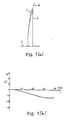
- Fig. 1(a) is a cross-sectional view of a half of an ophthalmic lens according to the invention.
- Fig. 1(b) shows the manner in which the curvature varies as a meridian goes from the center toward the edge.
- Fig. 1(c) shows the manner in which the amount of astigmatism varies.
- This lens is formed by applying the present invention to the lens which is shown in Fig. 4 and has a power of +3.0 D and a base curve of 4.0 D.
- the lens has a front refractive surface 1 and a rear refractive surface 2. The lens is symmetrical with respect to an axis 3 .
- the cross section of the prior art spherical lens is indicated by the dot-and dash line 4.
- This cross section is an arc having a curvature corresponding to the base curve.
- the front refractive surface 1 of the novel lens has the same curvature as the front surface of the prior art lens 4 near the axis of rotation, but the curvature of the front surface of the novel lens decreases as the meridian approaches the edge. As a result, the front surface is located ahead of the arc of the base curve at the edge.
- Fig. 1(b) shows the manner in which the curvature varies on the meridian. In the graph of Fig.
- the decreasing rate begins to drop in the region between the distance of 15 mm and the distance of 20 mm. After a distance of 35 mm has been reached, the rate is substantially constant, or the curvature begins to increase slightly. This is now discussed further mathematically.
- the curvature be a function C(r) of the distance r from the axis of symmetry.
- the first-order derivative dC/dr starts from 0 on the axis of symmetry and decreases gradually as the meridian goes away from the axis.
- the derivative assumes its minimum value at a distance of 15 to 20 mm and then it increases.
- the front refractive surface takes the form shown in Fig. 1(a). Consequently, the thickness at the center can be reduced as compared with the thickness of the prior art lens.
- the protrusion of the front refractive surface can be reduced.
- the thickness at the center is 4.3 mm, and the amount of protrusion is 4.7 mm. That is a reduction of 0.6 mm in the thickness at the center and a reduction of 5.9 mm in the amount of protrusion have been achieved as compared with the prior art spherical lens shown in Fig. 3.
- the novel lens is made much thinner and flatter than the prior art lens.
- a large amount of astigmatism remains, though the base curve is reduced to 4.0 D, as shown in Fig. 6.
- the amount of astigmatism is reduced greatly as shown in Fig. 1(c).
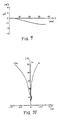
- Figs. 7 and 8 Another ophthalmic lens according to the invention is next described by referring to Figs. 7 and 8.
- This lens has a power of +3.0 D and a base curve of 4.0 D in the same way as the lens already described in connection with Figs. 1(a)-1(c).
- Fig. 7 shows the deviation ⁇ C of the curvature on a meridian. Values of the deviation are listed in Table 2.
- the curvature does not change at all in the region between the center and the distance of 5 mm. That is, the central portion having a radius of 5 mm is a spherical surface. In the region beginning with the end of this spherical portion and ending with the edge, the curvature changes in the same way as the lens described already in conjunction with Figs. 1(a)-1(c). Thus, as shown in Fig. 8, the astigmatism increases in the central spherical portion due to reductions in the base curve. Outside of this portion, the astigmatism is reduced by making the surface aspherical, in the same way as with the previous, first example.
- the base curve and the size of the central spherical portion are so adjusted that the amount of increase in the astigmatism in the central por tion is restricted to 0.1 to 0:15 D. This permits the lens to be used without hindrance to the vision.
- the thickness at the center is 4.4 mm, and the amount of protrusion is 4,8 mm.
- the second example has the following advantages over the first example.
- stable results are obtained.
- the power of the lens of the first example is measured on the optical axis (usually coincident with the axis of symmetry) with a lens meter, if the position at which the measurement is made deviates from the correct position, then the power will not be correctly measured or unwanted astigmatic aberrations will be introduced, because the lens is totally aspherical, i.e., has no spherical surface at the center.
- the provision of a spherical surface at the center solves these problems.
- One who compares Fig. 1(c) with Fig. 8 may wonder if the situation is opposite.
- a request for decentration can be fulfilled in the same way as an ordinary lens having a spherical front refractive surface.
- the central spherical portion produces a given power more stably than a lens having a totally aspherical surface. If the lens is decentered within this range, then the desired power can be derived stably, unlike a lens having a totally aspherical surface.
- the central spherical portion be at least 3 mm in radius, preferably more than 5 mm, because the opening in a normally used lens meter is 5 to 10 mm in diameter.
- FIG. 9 shows the deviation ⁇ C of the curvature on a meridian. Values of the deviation are listed in Table 3.
- the thickness at the center is 3.7 mm, and the amount of protrusion is 3.9 mm.
- the thickness is smaller by 1.6 mm (30%) and the amount of protrusion is smaller by 6.7 mm (63%) than those of the conventional spherical lens shown in Fig. 3. Since the material of the lens has a higher refractive index, the thickness at the center and the amount of protrusion are reduced by 0.7 mm and 0.9 mm, respectively, as compared with the second example.
- the astigmatism is shown in Fig. 10 and exhibits good characteristics similarly to the second example shown in Fig. 8.
- these three lenses are designed so that the astigmatism produced when an object located at a distance of 1 m is viewed is reduced substantially down to zero, i.e., the lenses are designed for intermediate vision.
- the lenses can be so designed that the astigmatism occurring when a remote object is viewed is fully eliminated, i.e., the lenses are designed for remote vision.
- the lenses can be designed in such a way that the astigmatism produced when an object located at a short distance of about 30 cm is viewed is removed, i.e., the lenses are designed for close vision. In any case, the same inventive theory is utilized.
- a lens designed for remote vision the curvature is changed to a greater extent than in the above-described examples.
- the curvature is changed to a lesser extent.
- the present inventor has confirmed that in a lens designed for remote vision, when the lens is actually used and a remote object is viewed, the lateral portions are somewhat insufficiently corrected as compared with the desired power, i.e., the power on the optical axis. Conversely, in a lens designed for close vision, when a remote object is viewed, the lateral portions are somewhat excessively corrected.
- lenses are preferably designed for intermediate vision to view an object at a distance of about 1 m.
- the novel ophthalmic lens having a positive power has a reduced thickness at the center and a less protruding front refractive surface.
- the optical performance is improved.
- the curvature of a meridian of the prior art aspherical lens changes monotonously and acceleratingly toward the edge.
- the discovered effective method consists in once reducing the first-order derivative of the curvature C(r) as the meridian goes away from the axis of symmetry of the lens and then increasing the derivative.
- the aspherical shape whose radius of curvature changes as described above is combined with a low base curve that is not adopted for an ordinary spherical lens because of the optical performance, to thereby realize an ophthalmic lens which is excellent in optical performance, has a small thickness at its center, is flat, and well-shaped.
- the base curve is the curvature near the axis of symmetry.
- the base curve is made low such that the following relation is satisfied: (n - 1) x ⁇ 0 ⁇ 0.5 x S + 5 where n is the refractive index of the material of the lens, ⁇ 0 is the curvature near the axis of rotation, i.e., the curvature of the base curve, and S is the equivalent spherical power (in diopters).
- a material having a high refractive index is combined with the above-described aspherical shape. As a result, greater merits are obtained.
- refractive indi ces exceeding 1.55 are called medium refractive indices or high refractive indices. Normal refractive index is 1.50.
- the spherical portion formed in the center stabilizes the power of the lens. Also, the novel lens is easy to machine. Further, the lens can be decentered.
- the curvature of the front refractive surface changes continuously. It is to be understood that changes and modifications can be made thereto.
- the curvature may change in a stepwise fashion as the meridian goes away from the axis of rotation. Also, the curvature may change subtly, as long as the radius of curvature is varied similarly to the above-described examples of the invention.
- the aspherical surface is symmetrical with respect to the axis of rotation, but the rotation symmetry is not essential to the invention. If the shape of the meridian extending from a certain point, e.g., the geometrical center, on the front refractive surface of the lens, toward the edge differs according to direction, the lens falls within the scope of the invention, provided that the curvature changes essentially in the manner described above.
Landscapes
- Health & Medical Sciences (AREA)
- Ophthalmology & Optometry (AREA)
- Physics & Mathematics (AREA)
- General Health & Medical Sciences (AREA)
- General Physics & Mathematics (AREA)
- Optics & Photonics (AREA)
- Eyeglasses (AREA)
- Lenses (AREA)
Applications Claiming Priority (9)
| Application Number | Priority Date | Filing Date | Title |
|---|---|---|---|
| JP1217589 | 1989-01-21 | ||
| JP12175/89 | 1989-01-21 | ||
| JP1217589 | 1989-01-21 | ||
| JP3755989 | 1989-02-17 | ||
| JP3755989 | 1989-02-17 | ||
| JP37559/89 | 1989-02-17 | ||
| JP327613/89 | 1989-12-18 | ||
| JP01327613A JP3038745B2 (ja) | 1989-01-21 | 1989-12-18 | 眼鏡レンズ |
| JP32761389 | 1989-12-18 |
Publications (4)
| Publication Number | Publication Date |
|---|---|
| EP0379976A2 true EP0379976A2 (fr) | 1990-08-01 |
| EP0379976A3 EP0379976A3 (fr) | 1991-05-29 |
| EP0379976B1 EP0379976B1 (fr) | 1994-12-07 |
| EP0379976B2 EP0379976B2 (fr) | 2000-02-16 |
Family
ID=27279732
Family Applications (1)
| Application Number | Title | Priority Date | Filing Date |
|---|---|---|---|
| EP90101015A Expired - Lifetime EP0379976B2 (fr) | 1989-01-21 | 1990-01-18 | Lentille ophtalmique asphérique |
Country Status (3)
| Country | Link |
|---|---|
| US (1) | US5050980A (fr) |
| EP (1) | EP0379976B2 (fr) |
| DE (1) | DE69014656T2 (fr) |
Cited By (4)
| Publication number | Priority date | Publication date | Assignee | Title |
|---|---|---|---|---|
| WO1997015857A3 (fr) * | 1995-10-28 | 1997-07-17 | Rodenstock Optik G | Verre de lunettes a unifocale avec deux faces aspheriques |
| EP0964285A1 (fr) * | 1998-06-10 | 1999-12-15 | Nikon Corporation | Lentille ophthalmique asphérique |
| EP0990938A4 (fr) * | 1996-01-16 | 2006-12-06 | Hoya Corp | Lentille de contact aspherique |
| EP0886166B1 (fr) * | 1997-06-19 | 2010-03-17 | Hoya Corporation | Lentille de lunettes asphérique |
Families Citing this family (10)
| Publication number | Priority date | Publication date | Assignee | Title |
|---|---|---|---|---|
| JPH085967A (ja) * | 1994-06-23 | 1996-01-12 | Nikon Corp | 非球面眼鏡レンズ |
| JPH1078566A (ja) * | 1996-09-05 | 1998-03-24 | Asahi Optical Co Ltd | 眼鏡レンズ |
| US20020008844A1 (en) * | 1999-10-26 | 2002-01-24 | Copeland Victor L. | Optically superior decentered over-the-counter sunglasses |
| US6036315A (en) | 1998-03-18 | 2000-03-14 | Copeland; Victor L. | Optically superior decentered over-the-counter sunglasses |
| JP3845251B2 (ja) | 2000-07-05 | 2006-11-15 | ペンタックス株式会社 | 眼鏡レンズの製造方法および供給方法 |
| JP3851495B2 (ja) | 2000-07-07 | 2006-11-29 | ペンタックス株式会社 | 眼鏡レンズの設計方法、製造方法および眼鏡レンズ |
| US6789895B2 (en) * | 2000-10-17 | 2004-09-14 | Pentax Corporation | Aspherical spectacle lens with prismatic power to correct phoria |
| US7255435B2 (en) * | 2001-12-11 | 2007-08-14 | Pratt Steven G | Blue blocking tens |
| US6955430B2 (en) * | 2001-12-11 | 2005-10-18 | Pratt Steven G | Blue blocking lens |
| CN113253482B (zh) * | 2021-06-01 | 2022-05-13 | 苏州科技大学 | 一种渐进多焦点眼镜片两段式子午线设计方法 |
Family Cites Families (6)
| Publication number | Priority date | Publication date | Assignee | Title |
|---|---|---|---|---|
| US3960442A (en) * | 1974-08-05 | 1976-06-01 | American Optical Corporation | Ophthalmic lens series |
| US4181409A (en) * | 1978-10-16 | 1980-01-01 | American Optical Corporation | Aspheric lens series |
| FR2440011A1 (fr) * | 1978-10-24 | 1980-05-23 | Essilor Int | Lentille ophtalmique, en particulier pour fort myope |
| DE3016936C2 (de) * | 1980-05-02 | 1983-12-01 | Fa. Carl Zeiss, 7920 Heidenheim | Brillenlinse mit astigmatischer Wirkung |
| AT387468B (de) * | 1981-07-08 | 1989-01-25 | Rodenstock Optik G | Brillenglas mit hohem positiven brechwert |
| DE3343891C2 (de) * | 1983-12-05 | 1986-06-05 | Optische Werke G. Rodenstock, 8000 München | Mehrstärkenglas mit hohem positiven Brechwert |
-
1990
- 1990-01-18 EP EP90101015A patent/EP0379976B2/fr not_active Expired - Lifetime
- 1990-01-18 DE DE69014656T patent/DE69014656T2/de not_active Expired - Fee Related
- 1990-01-18 US US07/466,818 patent/US5050980A/en not_active Expired - Lifetime
Cited By (4)
| Publication number | Priority date | Publication date | Assignee | Title |
|---|---|---|---|---|
| WO1997015857A3 (fr) * | 1995-10-28 | 1997-07-17 | Rodenstock Optik G | Verre de lunettes a unifocale avec deux faces aspheriques |
| EP0990938A4 (fr) * | 1996-01-16 | 2006-12-06 | Hoya Corp | Lentille de contact aspherique |
| EP0886166B1 (fr) * | 1997-06-19 | 2010-03-17 | Hoya Corporation | Lentille de lunettes asphérique |
| EP0964285A1 (fr) * | 1998-06-10 | 1999-12-15 | Nikon Corporation | Lentille ophthalmique asphérique |
Also Published As
| Publication number | Publication date |
|---|---|
| EP0379976B1 (fr) | 1994-12-07 |
| EP0379976B2 (fr) | 2000-02-16 |
| EP0379976A3 (fr) | 1991-05-29 |
| DE69014656T2 (de) | 1995-05-18 |
| DE69014656D1 (de) | 1995-01-19 |
| US5050980A (en) | 1991-09-24 |
Similar Documents
| Publication | Publication Date | Title |
|---|---|---|
| US5050979A (en) | Eyeglass lens | |
| US6019470A (en) | Progressive multifocal lens and manufacturing method of eyeglass lens and progressive multifocal lens | |
| US4856889A (en) | Uniform strength ophthalmic lens having a gradient refractive index changing rotation-symmetrically about the optical axis and method of making it | |
| US4561736A (en) | Eyeglass lenses for persons suffering from severe ametropia | |
| KR100940699B1 (ko) | 누진 굴절력 렌즈 | |
| JP3273783B2 (ja) | 正の遠隔視覚パワーを有する眼鏡用プログレッシブレンズ | |
| EP0379976B2 (fr) | Lentille ophtalmique asphérique | |
| WO1997021139A1 (fr) | Verre de lunette non correcteur decentre | |
| US20050122470A1 (en) | Shaped non-corrective eyewear lenses and methods for providing same | |
| WO1997021136A1 (fr) | Verre de lunettes non correcteur decentre | |
| JPS6015248B2 (ja) | 非球面レンズ系列 | |
| US4504128A (en) | Spectacle lens with high positive refractive power | |
| US5992998A (en) | Ophthalmic lens having a progressive effect | |
| US5550600A (en) | Ophthalmic lens having a negative refractive power | |
| US6056401A (en) | Spectacle lens | |
| US5235357A (en) | Spectacle lenses having an inside-out conicoidal front surface and method for forming same | |
| US4289387A (en) | Ophthalmic spectacle lenses having a hyperbolic surface | |
| KR100490345B1 (ko) | 비구면안경렌즈및그설계방법 | |
| US5353072A (en) | Aspherical spectacle lens | |
| US5455642A (en) | Progressive power lens | |
| JPH0812339B2 (ja) | 眼鏡レンズ | |
| US5083859A (en) | Aspheric lenses | |
| US5610670A (en) | Opthalmic lens having a positive refractive power | |
| JP2002372689A (ja) | 累進多焦点レンズ及び眼鏡レンズ | |
| JP4036921B2 (ja) | 眼鏡レンズ |
Legal Events
| Date | Code | Title | Description |
|---|---|---|---|
| PUAI | Public reference made under article 153(3) epc to a published international application that has entered the european phase |
Free format text: ORIGINAL CODE: 0009012 |
|
| AK | Designated contracting states |
Kind code of ref document: A2 Designated state(s): DE FR GB |
|
| PUAL | Search report despatched |
Free format text: ORIGINAL CODE: 0009013 |
|
| AK | Designated contracting states |
Kind code of ref document: A3 Designated state(s): DE FR GB |
|
| 17P | Request for examination filed |
Effective date: 19911108 |
|
| 17Q | First examination report despatched |
Effective date: 19930827 |
|
| GRAA | (expected) grant |
Free format text: ORIGINAL CODE: 0009210 |
|
| AK | Designated contracting states |
Kind code of ref document: B1 Designated state(s): DE FR GB |
|
| REF | Corresponds to: |
Ref document number: 69014656 Country of ref document: DE Date of ref document: 19950119 |
|
| ET | Fr: translation filed | ||
| PLBI | Opposition filed |
Free format text: ORIGINAL CODE: 0009260 |
|
| PLBI | Opposition filed |
Free format text: ORIGINAL CODE: 0009260 |
|
| 26 | Opposition filed |
Opponent name: ESSILOR INTERNATIONAL Effective date: 19950904 |
|
| 26 | Opposition filed |
Opponent name: ESSILOR INTERNATIONAL Effective date: 19950904 |
|
| PLBF | Reply of patent proprietor to notice(s) of opposition |
Free format text: ORIGINAL CODE: EPIDOS OBSO |
|
| PLBF | Reply of patent proprietor to notice(s) of opposition |
Free format text: ORIGINAL CODE: EPIDOS OBSO |
|
| PLAW | Interlocutory decision in opposition |
Free format text: ORIGINAL CODE: EPIDOS IDOP |
|
| PLAW | Interlocutory decision in opposition |
Free format text: ORIGINAL CODE: EPIDOS IDOP |
|
| PUAH | Patent maintained in amended form |
Free format text: ORIGINAL CODE: 0009272 |
|
| STAA | Information on the status of an ep patent application or granted ep patent |
Free format text: STATUS: PATENT MAINTAINED AS AMENDED |
|
| 27A | Patent maintained in amended form |
Effective date: 20000216 |
|
| AK | Designated contracting states |
Kind code of ref document: B2 Designated state(s): DE FR GB |
|
| ET3 | Fr: translation filed ** decision concerning opposition | ||
| REG | Reference to a national code |
Ref country code: GB Ref legal event code: IF02 |
|
| PGFP | Annual fee paid to national office [announced via postgrant information from national office to epo] |
Ref country code: GB Payment date: 20080116 Year of fee payment: 19 Ref country code: DE Payment date: 20080110 Year of fee payment: 19 |
|
| PLAB | Opposition data, opponent's data or that of the opponent's representative modified |
Free format text: ORIGINAL CODE: 0009299OPPO |
|
| PGFP | Annual fee paid to national office [announced via postgrant information from national office to epo] |
Ref country code: FR Payment date: 20080108 Year of fee payment: 19 |
|
| PLAB | Opposition data, opponent's data or that of the opponent's representative modified |
Free format text: ORIGINAL CODE: 0009299OPPO |
|
| GBPC | Gb: european patent ceased through non-payment of renewal fee |
Effective date: 20090118 |
|
| PG25 | Lapsed in a contracting state [announced via postgrant information from national office to epo] |
Ref country code: DE Free format text: LAPSE BECAUSE OF NON-PAYMENT OF DUE FEES Effective date: 20090801 |
|
| REG | Reference to a national code |
Ref country code: FR Ref legal event code: ST Effective date: 20091030 |
|
| PG25 | Lapsed in a contracting state [announced via postgrant information from national office to epo] |
Ref country code: GB Free format text: LAPSE BECAUSE OF NON-PAYMENT OF DUE FEES Effective date: 20090118 |
|
| PG25 | Lapsed in a contracting state [announced via postgrant information from national office to epo] |
Ref country code: FR Free format text: LAPSE BECAUSE OF NON-PAYMENT OF DUE FEES Effective date: 20090202 |