EP0380341A2 - Système de communication optique - Google Patents
Système de communication optique Download PDFInfo
- Publication number
- EP0380341A2 EP0380341A2 EP19900300797 EP90300797A EP0380341A2 EP 0380341 A2 EP0380341 A2 EP 0380341A2 EP 19900300797 EP19900300797 EP 19900300797 EP 90300797 A EP90300797 A EP 90300797A EP 0380341 A2 EP0380341 A2 EP 0380341A2
- Authority
- EP
- European Patent Office
- Prior art keywords
- terminal equipment
- terminal
- time
- signal
- terminal equipments
- Prior art date
- Legal status (The legal status is an assumption and is not a legal conclusion. Google has not performed a legal analysis and makes no representation as to the accuracy of the status listed.)
- Granted
Links
Images




Classifications
-
- H—ELECTRICITY
- H04—ELECTRIC COMMUNICATION TECHNIQUE
- H04B—TRANSMISSION
- H04B10/00—Transmission systems employing electromagnetic waves other than radio-waves, e.g. infrared, visible or ultraviolet light, or employing corpuscular radiation, e.g. quantum communication
- H04B10/27—Arrangements for networking
-
- H—ELECTRICITY
- H04—ELECTRIC COMMUNICATION TECHNIQUE
- H04B—TRANSMISSION
- H04B10/00—Transmission systems employing electromagnetic waves other than radio-waves, e.g. infrared, visible or ultraviolet light, or employing corpuscular radiation, e.g. quantum communication
- H04B10/27—Arrangements for networking
- H04B10/278—Bus-type networks
Definitions
- the present invention relates to an optical communication system for realizing a digital data bus for performing information communication between audio and video appliances.
- Fig. 1 shows an example of a system construction of a digital data bus realized by electric communication using metallic with as a transmission medium.
- portions surrounded by broken lines designate terminal equipments which are connected to each other through metallic wire.
- the reference numeral 3 designates a communication interface section for performing data communication according to a predetermined communication protocol.
- a driver circuit 1 and a receiver circuit 2 are connected to the communication interface section 3.
- the reference numerals 15 and 16 designates an input terminal and an output terminal respectively.
- the output terminal of each terminal equipment is connected to the input terminal of the succeeding terminal equipment through metallic wire successively to thereby constitute a bus-shaped transmission line.
- the reference numeral 17 designates terminal resistors which are provided on opposite ends of the bus for the purpose of impedance matching.
- each terminal equipment may be constituted by a coupler for coupling a transmission signal with an up-load signal and a branch device for branching a reception signal from a down-load signal by use of optical fiber as a transmission medium to thereby facilitate multiple transmission of audio and video signals as well as digital data and saving of wiring between terminal equipments.
- a large insertion loss occurs in the branch device as well as in the coupler, so that the levels of signals between terminal equipments vary widely in the case of bus connection.
- An object of the invention is to provide an optical communication system for realizing a digital data bus in which the aforementioned problems are solved.
- the light sending-out level in each terminal equipment is made variable and each terminal equipment measures a packet transmitted by the terminal equipment per se and informs the other terminal equipments of the result of the measurement so that each terminal equipment sets its sending-out level to the largest value of the sending-out levels of which the terminal equipment has been informed.
- each terminal equipment measures the delay time of an acknowledge bit transmitted from the other terminal equipments so that each terminal equipment shifts a sampling point by the mean value of the measured delay time.
- bus connection of terminal equipments through optical fiber can be made easy, and at the same time, channel access control based on the surviving type CSMA/CD can be made. Furthermore, multiple transmission of audio and video signals as well as digital data and saving of wiring between terminal equipments can be attained.
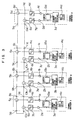
- Fig. 2 is a diagram showing a first embodiment of the optical communication system according to the present invention.
- the terminal equipments A, B, ..., D are connected to each other through optical fiber.
- the terminal equipments A, B, ..., D correspondingly respectively include: driver circuits 1a, 1b, ..., 1d; receiver circuits 2a, 2b, ..., 2d; communication interface sections 3a, 3b, ..., 3d; electro-optic converter sections 4a, 4b, ..., 4d; first branch couplers 5a, 5b, ..., 5d; second branch couplers 6a, 6b, ..., 6d; opto-electric converter sections 7a, 7b, ..., 7d; up-load optical signal input terminals 8a, 8b, ..., 8d; up-load optical signal output terminals 9a, 9b, ..., 9d; down-load optical signal input terminals 10a, 10b, ..., 10d;
- each terminal equipment A B, ..., D
- the communication interface section 3a (3b, ..., 3d) operates together with the driver circuit 1a (1b, ..., 1d) and the receiver circuit 2a (2b, ..., 2d) to perform transmission/reception of an electric signal in accordance with a predetermined communication protocol.
- a transmission signal is converted into an optical signal by the electro-optic converter section 4a (4b, ..., 4d) and a received optical signal is converted into an electric signal by the opto-electric converter section 7a (7a, ..., 7d), the electric signal being led to the receiver circuit 2a (2b, ..., 2d).
- each terminal equipment A (B, ..., D)
- the transmission signal is coupled with an up-load optical signal inputted from the up-load optical signal input terminal 8a (8b, ..., 8d) and then sent out from the up-load optical signal output terminal 9a (9b, ..., 9d).
- the up-load optical signal output terminal 9d of the terminal equipment D is connected to the up-load optical signal input terminal 8c of the terminal equipment C through optical fiber. The same applies to all the terminal equipments so that optical signals transmitted from all of the terminal equipments are sent out from the up-load optical signal output terminal 9a of the terminal equipment A located in the head position.
- the up-load optical signal output terminal 9a of the terminal equipment A is connected to the down-load optical signal input terminal 10a of the terminal equipment A through optical fiber, so that the signals transmitted from all of the terminal equipments are inputted to the down-load optical signal input terminal 10a as a down-load optical signal.
- each terminal equipment A (B, ..., D)
- a signal inputted through the down-load optical signal input terminal 10a (10b, ..., 10d) is branched into two by the second branch coupler 6a (6b, ..., 6d) so that one of the branched signals is sent out from the down-load optical signal output terminal 11a (11b, ..., 11d) and the other is led to the receiver circuit 2a (2b, ..., 2d) after converted into an electric signal by the opto-electric converter section 7a (7b, ..., 7d).
- the down-load optical signal output terminal 11a of the terminal equipment A is connected to the down-load optical signal input terminal 10b of the terminal equipment B through optical fiber.
- each terminal equipment A (B, ..., D) transmits a packet addressed to its own.
- the gain of the optical amplifier 12a (12b, ..., 12d) is started from its minimum.
- the packet addressed to its own is transmitted again after the amplification factor of the optical amplifier 12a (12b, ..., 12d) is increased by one rank. The aforementioned operation is repeated till reception is enabled.
- the signal sent out from the optical amplifier 12a (12b, ..., 12d) in each terminal equipment A (B, ..., D) is attenuated because of losses such as a branching loss, a coupling loss, an insertion loss, and a transmission loss of optical fiber, and then reaches to a reception point.
- the signal sent out of the optical amplifier 12a of the terminal equipment A is passed through the branch couplers 5a and 6a.
- the signal sent out of the optical amplifier 12d of the terminal equipment D is passed through the branch couplers 5d, 5c, 5b, 5a, 6a, 6b, 6c and 6d. Accordingly, in Fig.
- the amplification factor of the terminal equipment A may be set to be the smallest value and, on the other hand, the amplification factor of the terminal equipment D must be set to be the largest value.
- data communications between all of the terminal equipments can be made with no problem if the amplification factors of the all terminal equipments have the same value as the amplification factor of the terminal equipment D.
- each terminal equipment informs the other terminal equipments of its own amplification factor by means of a broadcast packet, and each terminal equipment sets the amplification factor of its own optical amplifier to be the largest value of the amplification factors received through the broadcast packet.
- Fig. 3 shows a second embodiment of the optical communication system according to the present invention.
- the reference numerals 13a, 13b, ..., 13d designate counting means for counting the time difference between the time when a signal is transmitted from the communication interface section 3a (3b, ..., 3d) to the driver circuit 1a (1b, ..., 1d) in the case of packet transmission and the time when an acknowledge bit reaches the communication interface section 3a (3b, ..., 3d) through the receiver circuit 2a (2b, ..., 2d), and for reporting he result of the counting to the communication interface section 3a, (3b, ..., 3d).
- the reference numerals 14a, 14b, ..., 14d designate indication means.
- Fig. 4 shows the data format in a digital data bus.
- the symbol P in the format represents a parity bit, A an acknowledge bit and EOD an end-of-data bit.
- the digital data bus is synchronized based on a start bit and then channel access control by CSMA/CD is performed based on mode and master address bits following the start bit. Consequently, one terminal equipment remaining undefeated acquires priority and transmits parity bits, slave address bits, control bits, data bits and an end-of-data bit as a master.
- An acknowledge bit is the bit for reporting the fact that a terminal equipment designated by the slave address bits has acknowledged information coming to the terminal equipment.
- the designated terminal equipment transmits with the passage of a predetermined time after the terminal equipment receives a bit synchronizing signal transmitted from the master in the early stage of the period of the respective acknowledge bit.
- Fig. 5 shows the bit format of the acknowledge bit.
- the diagram (a) shows a bit synchronizing signal for the acknowledge bit transmitted by the terminal equipment A as a master
- the diagram (b) shows the state where the bit synchronizing signal of the diagram (a) reaches the output of the receiver circuit 2d of the terminal equipment D as a slave.
- the signal of the diagram (b) is delayed, compared with the signal of the diagram (a), for the sum T DA-D of the delay time in the driver circuit 1a and the electro-optic converter section 4a of the terminal equipment A, the delay time in the light transmission line leading from the output point of the electro-optic converter section 4a to the input of the opto-electric converter section 7d of the terminal equipment D and the delay time in the opto-electric converter section 7d and the receiver circuit 2d.
- the acknowledge signal reaches the master in the form of an acknowledge signal shown in the diagram (d) after the signal is delayed for the sum T DD-A of the delay time in the driver circuit 1d and the electro-optic converter section 4d of the terminal equipment D, the delay time in the light transmission line leading from the output point of the electro-optic converter section 4d to the input of the opto-electric converter section 7a of the terminal equipment A and the delay time in the opto-electric converter section 7a and the receiver circuit 2a.
- the one-cycle transmission delay time between the terminal equipments can be found by counting the time difference T D between the point of time when the master transmits a high-level signal with the passage of time T M after transmitting a bit synchronizing signal and the point of time when the master receives an acknowledge signal from the slave.
- the terminal equipment to which a transmission request is given transmits a packet after confirming that a vacant channel exists.
- each terminal equipment transmits mode bits and mater address bits synchronously with the terminal equipment which has transmitted the start bit at the first time.
- Each terminal equipment receives bits and compares the received bits with the bits which the terminal equipment has transmitted. When the result of comparison is discord, the terminal equipment stops signal transmission.
- the system is configured so that, in the case where a high-level bit and a low-level bit collide with each other, the result is made to be low-level, that is priority is given to the low-level bit. Accordingly, a terminal equipment which has transmitted the mode and master address bits containing the greatest number of low-level bits acquires channel access priority to serve as a master.
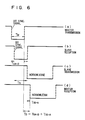
- FIG. 7 The bit format of the mode and master address bits is shown in Fig. 7.
- the diagram (a) shows the bit format for a terminal equipment to which a transmission request is given and the diagram (b) shows the bit format for a terminal equipment to which no transmission request is given.
- a terminal equipment to which a transmission request is given transmits a bit data of high- or low-level signal for a time period t3 with a passage of time t2 after receiving the bit synchronizing signal which is transmitted with a passage of time t1 after the start bit of the terminal equipment which has transmitted the start bit at the first time is terminated.
- Each terminal equipment A (B, ..., D) performs sampling of the output signal of the receiver circuit 2a (2b, ..., 2d) with a passage of time t S from the bit synchronizing signal.
- T D the one-cycle transmission delay time
- the bit data of the terminal equipment which has transmitted the bit synchronizing signal is not settled before the time t2 + T D is passed after the bit synchronizing signal is transmitted.
- the time t S to the sampling point must satisfies the relation t S > t2 + T D .
- T D 0, the bit data becomes unsettled again after the time t2 + t3.
- the sampling point must be established to satisfy the relation t2 + T D ⁇ t S ⁇ t2 + t3 in which the range of the one-cycle delay time T D must satisfies the relation 0 ⁇ T D ⁇ t3 to make it possible to sample settled data even in the case of t S ⁇ t2 + t3.
- t3 is small and high speed properties are required for the driver circuit 1a (1b, ..., 1d), the receiver circuit 2a (2b, ..., 2d), the electro-optic converter circuit 4a (4b, ..., 4d) and the opto-electric converter circuit 7a (7b, ..., 7d).
- each terminal equipment A (B, ..., D) contains one driver circuit 1a (1b, ..., 1d), one receiver circuit 2a (2b, ..., 2d), one electro-optic converter circuit 4a (4b, ..., 4d) and one opto-electric converter circuit 7a (7b, ..., 7d) as shown in Fig. 3, so that the delay time is considered to be the same even in the case where a communication is made between arbitrary terminal equipments.
- the delay time is represented by T DT
- the one-cycle transmission delay time T D can be represented by the sum of the delay time T DT and the delay time T Do in the optical transmission line.
- settled data can be sampled regardless of the delay time caused by the driver circuit 1a (1b, ..., 1d), the receiver circuit 2a (2b, ..., 2d), the electro-optic converter circuit 4a (4b, ..., 4d) and the opto-electric converter circuit 7a (7b, ..., 7d) constituting the terminal equipment A (B, ..., D) if the delay time caused by the light transmission line is less than the bit length with settled data.
- the system can be modified as follows, and reliability on the system can be improved by the modification.
- the system is designed to report the fact to terminal equipments having delay time T Do more than the bit length t3 so that signal transmission stops and abnormality is reported to the user by any indication means.
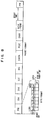
- the packet format of the home bus system is shown in Fig. 8.
- the symbol PR in the format represents a priority code, SA a source address, DA a destination address, CC a control code, BC a telegram-length code, DATA data, FCC a check code, DMY a dummy, and ACK/NAK an acknowledge code.
- the home bus system employs start-stop synchronization in which synchronization is made based on the start bit and the stop bit contained in each byte as a constituent member of a packet.
- a terminal equipment designated by the destination address DA returns an acknowledge code with the passage of dummy time (time corresponding to 11 bits) after the terminal equipment receives the packet till the check code FCC.
- the one-cycle transmission delay time T D can be found by subtracting the time corresponding to 11 bits from the value obtained by counting the time difference between the point of time when transmission of the stop bit of the check code is terminated in the terminal equipment to transmit a packet and the point of time when reception of the start bit of the acknowledge code from the other terminal equipment is started.
- channel access control is made based on the respective bits of the priority code and the source address.
- start-stop synchronization as in the home bus system regardless of bit synchronization, it is general that sampling is made in the center of the bit with settled data. In the case where pulse duty ratio is 50%, sampling is made in the point of 1/4 bit length of the respective bit.
- sampling is made in the point of 1/2 bit length of the respective bit.
- the limit of the one-cycle transmission delay time T D is 1/4 bit time in the case where pulse duty ratio is 50%.
- the limit of the one-cycle transmission delay time T D is 1/2 bit time in the case where pulse duty ratio is 100%. Accordingly, the scale of the system is limited more greatly as transmission rate increases.
- sampling timing can be shifted by the mean delay time in the distribution of the transmission delay time through founding the transmission delay time of each terminal equipment according to the method of the invention, so that the permissible range of the one-cycle transmission delay time can be enlarged greatly.
Landscapes
- Engineering & Computer Science (AREA)
- Computing Systems (AREA)
- Physics & Mathematics (AREA)
- Electromagnetism (AREA)
- Computer Networks & Wireless Communication (AREA)
- Signal Processing (AREA)
- Optical Communication System (AREA)
- Small-Scale Networks (AREA)
Applications Claiming Priority (2)
| Application Number | Priority Date | Filing Date | Title |
|---|---|---|---|
| JP1017992A JPH02199942A (ja) | 1989-01-27 | 1989-01-27 | 光通信装置 |
| JP17992/89 | 1989-01-27 |
Publications (3)
| Publication Number | Publication Date |
|---|---|
| EP0380341A2 true EP0380341A2 (fr) | 1990-08-01 |
| EP0380341A3 EP0380341A3 (fr) | 1991-10-02 |
| EP0380341B1 EP0380341B1 (fr) | 1995-09-13 |
Family
ID=11959222
Family Applications (1)
| Application Number | Title | Priority Date | Filing Date |
|---|---|---|---|
| EP90300797A Expired - Lifetime EP0380341B1 (fr) | 1989-01-27 | 1990-01-25 | Système de communication optique |
Country Status (4)
| Country | Link |
|---|---|
| US (1) | US5046137A (fr) |
| EP (1) | EP0380341B1 (fr) |
| JP (1) | JPH02199942A (fr) |
| DE (1) | DE69022256T2 (fr) |
Cited By (9)
| Publication number | Priority date | Publication date | Assignee | Title |
|---|---|---|---|---|
| US5130836A (en) * | 1990-06-01 | 1992-07-14 | Japan Aviation Electronics Industry Limited | Optical transceiver |
| WO2004030244A1 (fr) * | 2002-09-27 | 2004-04-08 | Lockheed Martin Corporation | Reseau de distribution optique destine a des signaux rf et a d'autres signaux analogiques |
| WO2004093351A3 (fr) * | 2003-03-31 | 2005-03-24 | Lockheed Corp | Systemes et dispositifs d'interface de reseau optique |
| US6912339B2 (en) | 2002-09-27 | 2005-06-28 | Lockheed Martin Corporation | Optical interface devices having balanced amplification |
| US7085497B2 (en) | 2002-04-03 | 2006-08-01 | Lockheed Martin Corporation | Vehicular communication system |
| US7349629B1 (en) | 2002-11-26 | 2008-03-25 | Lockheed Martin Corporation | Methods and systems for creating a digital interconnect fabric |
| US7424228B1 (en) | 2003-03-31 | 2008-09-09 | Lockheed Martin Corporation | High dynamic range radio frequency to optical link |
| US7440699B1 (en) | 2004-06-28 | 2008-10-21 | Lockheed Martin Corporation | Systems, devices and methods for transmitting and receiving signals on an optical network |
| USRE41247E1 (en) | 1997-04-01 | 2010-04-20 | Lockheed Martin Corporation | Optical transport system |
Families Citing this family (11)
| Publication number | Priority date | Publication date | Assignee | Title |
|---|---|---|---|---|
| US5109532A (en) * | 1990-01-30 | 1992-04-28 | General Instrument Corporation | Elimination of phase noise and drift incident to up and down conversion in a broadcast communication system |
| DE4139300A1 (de) * | 1991-11-29 | 1993-06-03 | Rheydt Kabelwerk Ag | Netzwerk-topologie zur datenuebertragung |
| US5809187A (en) * | 1997-04-24 | 1998-09-15 | Boeing North American, Inc. | Multi-port network using passive optical couplers |
| KR100607943B1 (ko) * | 1999-11-15 | 2006-08-03 | 삼성전자주식회사 | 광 모듈 정합을 위한 버스 인터페이스 장치 및 그 방법 |
| US20030053166A1 (en) * | 2001-09-14 | 2003-03-20 | Hamm Russell O. | Method and apparatus of transmitting several digital signals over a common optical fiber |
| US7283480B1 (en) | 2002-11-12 | 2007-10-16 | Lockheed Martin Corporation | Network system health monitoring using cantor set signals |
| WO2009022672A1 (fr) * | 2007-08-10 | 2009-02-19 | Nec Corporation | Bus de données optiques et système de transmission de données optiques utilisant celui-ci |
| JP2011049964A (ja) * | 2009-08-28 | 2011-03-10 | Denso Corp | 通信システムに用いられるノード |
| CN103378905B (zh) * | 2012-04-27 | 2017-02-08 | 鸿富锦精密工业(深圳)有限公司 | 光纤传输系统 |
| CN103457662A (zh) * | 2012-05-28 | 2013-12-18 | 鸿富锦精密工业(深圳)有限公司 | 光纤传输系统 |
| CN112861364B (zh) * | 2021-02-23 | 2022-08-26 | 哈尔滨工业大学(威海) | 一种基于状态时延转换图二次标注的工控系统设备行为建模实现异常检测的方法 |
Family Cites Families (5)
| Publication number | Priority date | Publication date | Assignee | Title |
|---|---|---|---|---|
| JPS5857835A (ja) * | 1981-09-30 | 1983-04-06 | Yokogawa Hokushin Electric Corp | 光通信方式 |
| JPS60501286A (ja) * | 1983-05-12 | 1985-08-08 | アメリカン テレフオン アンド テレグラフ カムパニ− | 通信ネットワ−ク |
| EP0216214B1 (fr) * | 1985-09-25 | 1991-05-08 | Siemens Aktiengesellschaft | Procédé de réglage automatique de niveau dans un réseau local, en particulier pour un multi-ordinateur avec un système de bus à fibres optiques dans un but de détection de collisions |
| JPH0638601B2 (ja) * | 1985-11-13 | 1994-05-18 | 富士通株式会社 | 光複合トランシーバー |
| US4742576A (en) * | 1985-12-23 | 1988-05-03 | Polaroid Corporation | Optical communication system employing coherent detection and method |
-
1989
- 1989-01-27 JP JP1017992A patent/JPH02199942A/ja active Pending
-
1990
- 1990-01-23 US US07/469,065 patent/US5046137A/en not_active Expired - Fee Related
- 1990-01-25 EP EP90300797A patent/EP0380341B1/fr not_active Expired - Lifetime
- 1990-01-25 DE DE69022256T patent/DE69022256T2/de not_active Expired - Fee Related
Cited By (11)
| Publication number | Priority date | Publication date | Assignee | Title |
|---|---|---|---|---|
| US5130836A (en) * | 1990-06-01 | 1992-07-14 | Japan Aviation Electronics Industry Limited | Optical transceiver |
| USRE41247E1 (en) | 1997-04-01 | 2010-04-20 | Lockheed Martin Corporation | Optical transport system |
| US7085497B2 (en) | 2002-04-03 | 2006-08-01 | Lockheed Martin Corporation | Vehicular communication system |
| WO2004030244A1 (fr) * | 2002-09-27 | 2004-04-08 | Lockheed Martin Corporation | Reseau de distribution optique destine a des signaux rf et a d'autres signaux analogiques |
| US6912339B2 (en) | 2002-09-27 | 2005-06-28 | Lockheed Martin Corporation | Optical interface devices having balanced amplification |
| USRE40425E1 (en) | 2002-09-27 | 2008-07-08 | Lockheed Martin Corporation | Optical interface devices having balanced amplification |
| US7349629B1 (en) | 2002-11-26 | 2008-03-25 | Lockheed Martin Corporation | Methods and systems for creating a digital interconnect fabric |
| WO2004093351A3 (fr) * | 2003-03-31 | 2005-03-24 | Lockheed Corp | Systemes et dispositifs d'interface de reseau optique |
| US7424228B1 (en) | 2003-03-31 | 2008-09-09 | Lockheed Martin Corporation | High dynamic range radio frequency to optical link |
| US7570887B2 (en) | 2003-03-31 | 2009-08-04 | Lockheed Martin Corporation | Optical network interface systems and devices |
| US7440699B1 (en) | 2004-06-28 | 2008-10-21 | Lockheed Martin Corporation | Systems, devices and methods for transmitting and receiving signals on an optical network |
Also Published As
| Publication number | Publication date |
|---|---|
| EP0380341B1 (fr) | 1995-09-13 |
| EP0380341A3 (fr) | 1991-10-02 |
| DE69022256T2 (de) | 1996-05-09 |
| JPH02199942A (ja) | 1990-08-08 |
| US5046137A (en) | 1991-09-03 |
| DE69022256D1 (de) | 1995-10-19 |
Similar Documents
| Publication | Publication Date | Title |
|---|---|---|
| US5046137A (en) | Optical communication system | |
| EP0346438B1 (fr) | Systeme de communication de donnees optiques sans fil | |
| EP0110691A2 (fr) | Système et méthode pour commander un système de communications de données à accès multiples | |
| GB2166328A (en) | In-house distribution facility for a broadband communication system | |
| US4850047A (en) | Optical bus communication system utilizing frame format signals | |
| JP2836592B2 (ja) | 光送受信器およびその光送受信器を用いたネットワーク | |
| JPS5899046A (ja) | 星形通信網 | |
| US4646361A (en) | Optical star repeater | |
| EP0118763A2 (fr) | Procédé pour la localisation des défauts dans une ligne de transmission numérique | |
| GB2128058A (en) | Multiple access data communication system | |
| EP0476444A1 (fr) | Emeteur-récepteur optique | |
| US4746918A (en) | Split bus system interface | |
| EP0568314A2 (fr) | Réseau en étoile pour le traitement décentralisé de données, concentrateur et terminaux utilisés | |
| US4683471A (en) | Data bus pilot tone | |
| US20250013596A1 (en) | Electronic device and transmission system | |
| JPH0214823B2 (fr) | ||
| KR920007747Y1 (ko) | Lan 접속용 송수신 장치 | |
| JP2684775B2 (ja) | バースト信号受信方法 | |
| JPS6198041A (ja) | 光トランシ−バ | |
| SU924903A1 (ru) | Устройство преобразовани сигналов низкого уровн | |
| KR100261028B1 (ko) | 티씨유와 단말기 사이의 프로토콜 구조 및 그 처리방법 | |
| KR200180537Y1 (ko) | 전자교환기 안내방송 장치의 데이터 송수신 장치 | |
| EP0364170A2 (fr) | Liaison de données en série à grand débit | |
| JPS645497B2 (fr) | ||
| JP2001292100A (ja) | 光情報伝送装置及び光情報受信装置 |
Legal Events
| Date | Code | Title | Description |
|---|---|---|---|
| PUAI | Public reference made under article 153(3) epc to a published international application that has entered the european phase |
Free format text: ORIGINAL CODE: 0009012 |
|
| AK | Designated contracting states |
Kind code of ref document: A2 Designated state(s): DE FR GB NL |
|
| RIN1 | Information on inventor provided before grant (corrected) |
Inventor name: MOCHIDA, YOSIHISA Inventor name: SUGINO, NOBUO Inventor name: IKEZAKI, MASAO Inventor name: NAKATSU, HIROMASA Inventor name: KUROBE, AKIO |
|
| 17P | Request for examination filed |
Effective date: 19901228 |
|
| PUAL | Search report despatched |
Free format text: ORIGINAL CODE: 0009013 |
|
| AK | Designated contracting states |
Kind code of ref document: A3 Designated state(s): DE FR GB NL |
|
| 17Q | First examination report despatched |
Effective date: 19940111 |
|
| GRAA | (expected) grant |
Free format text: ORIGINAL CODE: 0009210 |
|
| AK | Designated contracting states |
Kind code of ref document: B1 Designated state(s): DE FR GB NL |
|
| REF | Corresponds to: |
Ref document number: 69022256 Country of ref document: DE Date of ref document: 19951019 |
|
| ET | Fr: translation filed | ||
| PLBE | No opposition filed within time limit |
Free format text: ORIGINAL CODE: 0009261 |
|
| STAA | Information on the status of an ep patent application or granted ep patent |
Free format text: STATUS: NO OPPOSITION FILED WITHIN TIME LIMIT |
|
| 26N | No opposition filed | ||
| REG | Reference to a national code |
Ref country code: GB Ref legal event code: IF02 |
|
| PGFP | Annual fee paid to national office [announced via postgrant information from national office to epo] |
Ref country code: FR Payment date: 20030110 Year of fee payment: 14 |
|
| PGFP | Annual fee paid to national office [announced via postgrant information from national office to epo] |
Ref country code: GB Payment date: 20030122 Year of fee payment: 14 |
|
| PGFP | Annual fee paid to national office [announced via postgrant information from national office to epo] |
Ref country code: NL Payment date: 20030130 Year of fee payment: 14 |
|
| PGFP | Annual fee paid to national office [announced via postgrant information from national office to epo] |
Ref country code: DE Payment date: 20030206 Year of fee payment: 14 |
|
| PG25 | Lapsed in a contracting state [announced via postgrant information from national office to epo] |
Ref country code: GB Free format text: LAPSE BECAUSE OF NON-PAYMENT OF DUE FEES Effective date: 20040125 |
|
| PG25 | Lapsed in a contracting state [announced via postgrant information from national office to epo] |
Ref country code: NL Free format text: LAPSE BECAUSE OF NON-PAYMENT OF DUE FEES Effective date: 20040801 |
|
| PG25 | Lapsed in a contracting state [announced via postgrant information from national office to epo] |
Ref country code: DE Free format text: LAPSE BECAUSE OF NON-PAYMENT OF DUE FEES Effective date: 20040803 |
|
| GBPC | Gb: european patent ceased through non-payment of renewal fee |
Effective date: 20040125 |
|
| PG25 | Lapsed in a contracting state [announced via postgrant information from national office to epo] |
Ref country code: FR Free format text: LAPSE BECAUSE OF NON-PAYMENT OF DUE FEES Effective date: 20040930 |
|
| NLV4 | Nl: lapsed or anulled due to non-payment of the annual fee |
Effective date: 20040801 |
|
| REG | Reference to a national code |
Ref country code: FR Ref legal event code: ST |