EP0380378A1 - Verfahren und Vorrichtung für hierarchischen Zugriff zu einem Nachrichtenübertragungsnetz - Google Patents
Verfahren und Vorrichtung für hierarchischen Zugriff zu einem Nachrichtenübertragungsnetz Download PDFInfo
- Publication number
- EP0380378A1 EP0380378A1 EP90400044A EP90400044A EP0380378A1 EP 0380378 A1 EP0380378 A1 EP 0380378A1 EP 90400044 A EP90400044 A EP 90400044A EP 90400044 A EP90400044 A EP 90400044A EP 0380378 A1 EP0380378 A1 EP 0380378A1
- Authority
- EP
- European Patent Office
- Prior art keywords
- network
- station
- bit
- recessive
- bits
- Prior art date
- Legal status (The legal status is an assumption and is not a legal conclusion. Google has not performed a legal analysis and makes no representation as to the accuracy of the status listed.)
- Granted
Links
- 230000005540 biological transmission Effects 0.000 title claims abstract description 9
- 238000000034 method Methods 0.000 title claims description 30
- 238000004891 communication Methods 0.000 claims abstract description 9
- 230000007704 transition Effects 0.000 description 2
- 238000010200 validation analysis Methods 0.000 description 2
- 238000004458 analytical method Methods 0.000 description 1
- 238000013475 authorization Methods 0.000 description 1
- 238000012512 characterization method Methods 0.000 description 1
- 238000012217 deletion Methods 0.000 description 1
- 230000037430 deletion Effects 0.000 description 1
Images

Classifications
-
- H—ELECTRICITY
- H04—ELECTRIC COMMUNICATION TECHNIQUE
- H04L—TRANSMISSION OF DIGITAL INFORMATION, e.g. TELEGRAPHIC COMMUNICATION
- H04L12/00—Data switching networks
- H04L12/28—Data switching networks characterised by path configuration, e.g. LAN [Local Area Networks] or WAN [Wide Area Networks]
- H04L12/40—Bus networks
- H04L12/407—Bus networks with decentralised control
- H04L12/413—Bus networks with decentralised control with random access, e.g. carrier-sense multiple-access with collision detection [CSMA-CD]
- H04L12/4135—Bus networks with decentralised control with random access, e.g. carrier-sense multiple-access with collision detection [CSMA-CD] using bit-wise arbitration
Definitions
- the present invention relates to a hierarchical access method to a network for transmitting information by response in a communication frame, to stations connected to this network, and to a device for implementing this method, applicable in particular in automobile industry.
- the methods of transmitting information by response in a communication frame consist in that at least one of the stations connected to the network, transmits a start of message frame, also called header, and in that as a function of this header message, another station accesses the network to transmit the end of the message frame containing in particular event or data information from this station.
- the object of the invention is to propose a generalization of this method to a hierarchical access method such that each station can have a rank of access to the network.
- the subject of the invention is a method of hierarchical access to a network for transmitting information by response in a communication frame, from stations connected to this network, characterized in that each station connected is assigned to the network, a characteristic of rank of access to the network, this characteristic of rank of access being the number of bits already transmitted by another station connected to the network before the station considered can access this network to transmit its own information.
- the invention also relates to a device for the implementation of the process described above.
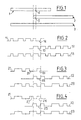
- a method of transmitting information in a communication network between several stations by response in the frame, consists in that at least one of the stations connected to this network, transmits a start of message also called header 1 and in depending on this message header, another station accesses the network to transmit the end of the message frame 2 containing event or data information from this station.
- a slave station recognizes the message header 1 sent on the network, by bit-by-bit comparison of this header with one or more values which are specific to it and sends the end of message 2 containing the information required by the master station that issued the header 1.
- the message frame 3 thus formed contains both the identification of the message and the corresponding information and therefore forms a normal communication frame which can be interpreted by all the other stations connected to this network.
- the master station sends a message header 1 ending with a recessive bit 4 which the slave station can dominate with a dominant bit 5 to initialize its response.
- the master station thus loses access to the network by conventional bit-by-bit property arbitration.
- This method has already been described in multi-master multi-slave systems and it is possible to generalize it to determine a hierarchical access method such that each station considered can have a determined characteristic of network access rank.
- This characteristic of network access rank is the number of bits already transmitted by another station before the station in question can have access to the network to transmit its own information.
- a master station is of rank O insofar as it can initiate a message frame itself.
- the slave stations are of maximum rank, that is to say of characteristic corresponding to the size of the information making it possible to completely identify the message.
- This method of accessing a network leads to embodiments which may differ depending on the chosen technique of encoding the bits.
- PWM Pulse Width Modulation
- PWM pulse width modulation coding for dominant bits and recessive bits, a recessive bit being formed by a dominant slot followed by two recessive slots, while a dominant bit is formed by two dominant slots followed of a recessive niche.
- the station having to carry out a response in the frame comprising a header 11 (Fig. 2) and an end of message 12 forming a communication frame 13, must simply dominate the recessive bit 14 transmitted by the master station at the following of the header 11, by a dominant bit 15 in synchronism with this recessive bit of the header.
- the analysis is different.
- a recessive bit is a recessive slot followed by a dominant slot while a dominant bit is a dominant slot followed by a slot recessive.
- the station having to carry out a response in the frame must transmit a dominant bit in synchronism with the recessive bit of the header transmitted by the master station.
- the header 21 (FIG. 3) is combined at the end of the message 22 to form the frame 23, by dominating the recessive bit 24 transmitted following the header 21, by a dominant bit 25 transmitted by the station having to transmit its information on the network.
- the station transmitting the response transmits in advance with respect to the header (Fig. 4)
- the new slot only prolongs the dominant state of the previous slot 27.
- the station transmitting its response transmits late, the resulting signal may drop back to the state recessive for a few moments before going back to the dominant state.
- This spurious signal 28 can be partially masked by the characteristics of the line transceivers, but also not detected by a part of the stations which can then either detect an error or synchronize with this spurious signal, this being to be avoided.
- This rule can be illustrated in the case where the header of a message ends with two mode bits allowing the writing of data and the reading of data in a slave station.
- the last message identification bit will be called MO thereafter while the penultimate bit will be called M1.
- the coding used is an NRZ coding in which each slot represents a bit
- the characterization of the mode bits is as follows: - M1 dominant, MO recessive: write request - M1 dominant, MO dominant: writing - M1 recessive, MO recessive: read request - Recessive Ml, dominant MO: response in the frame to a read request.
- the last bit of the header is therefore a dominant bit and in the case of NRZ coding, a recessive bit.
- bit stuffing mechanism consists of inserting, after a sequence of n bits of identical level, a bit of opposite logical value so as to create a transition allowing the receivers to keep the bit synchronization of the message.
- This technique is on the other hand sensitive to errors, a disturbance of the network being able to generate a desynchronization of one or more bits.
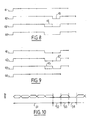
- Figs. 8 and 9. Examples are shown in which the original signal to be transmitted is indicated at 41, the signal encoded according to the stuffing bit technique with n 5 is illustrated at 42, the disturbed signal is illustrated at 43, the signal decoded by deletion at the stuffing bit is illustrated at 44, while the disturbed signal 43 includes an erroneous bit 45.
- the first example shows in Fig. 8 shows that stuffing bit 46 was received as a normal bit and therefore reception is one bit behind.
- the second example shown in Fig. 9 shows that a normal transmitted bit 47 has been received as a stuffing bit and therefore reception is one bit ahead.
- the station carrying out the response in the frame can therefore be one bit ahead or behind.
- the header bit sequence comprises message identification bits 51, a recessive bit delimiter identifier 52, a question-answer bit 53 and a recessive bit delimiter question-response bit 54.
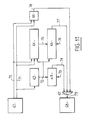
- FIG.11 an embodiment of a device for implementing the method described above, for transmitting information by response in the frame.
- This device comprises a reception block 61, a bit counter 62, a block 63 for comparing the counting of bits to a determined value r, a storage block 64 of the header bits received, a block 65 for comparing the header with one or more values characteristic of the station, a storage flip-flop 66 of the preceding bit, a gate with three inputs 67 and finally an emission block 68 comprising a validation input.
- the reception block 61 supplies the value of the received bit 70 as well as a clock 71.
- This clock increments the counter 62 which counts the bits.
- This counting value i is transmitted by a signal 72 to the various blocks connected to this counter, namely blocks 63, 64 and 65.
- this value is transmitted to the comparison block 63 at the end of being compared with the value r 73, the output signal 74 of this block indicating whether the value i of the count is greater than or equal to r.
- the signal 72 is also transmitted to the storage block 64 as well as to the comparison block 65.
- the header storage block 64 can be produced from a flip-flop addressable by the signal 72 and which further requires as data inputs the signal 70 as well as the clock signal 71 emanating from the reception block 61.
- the value of the header thus obtained is compared up to the bit of rank i dynamically, to the first i bits of one or more characteristic values 76 assigned to this station.
- the signal 77 which is deduced therefrom indicates equality up to the ith bit.
- the flip-flop 66 receiving the signal 70 and the clock 71 emanating from the reception block 61, makes it possible to store the last bit value and optionally according to the types of bit encoding, of uti read its direct or reverse output as a validation signal.
- An output signal 78 of this flip-flop as well as the output signals 74 and 77 of the blocks 63 and 65 respectively are connected to the inputs of the AND gate 67 which provides an input signal 79 for authorization to perform a response in the frame, this signal being applied to the input of the transmission block 68.
- the order of priority r of network access can be partially used.
- this process and this device can for example reside in: - the realization of slave stations with response in the frame, - the addressing of a block of stations, which one wishes to scan in parallel, for example a set of stations comprising inputs by a keypad.
- these stations can only transmit permanently if a master station requests them by transmitting the first r bits of the header common to these stations, and - the establishment of stations on a tree network comprising repeaters.
- a station placed on a terminal branch can only transmit after the repeaters are correctly positioned, directly or automatically, according to the first bits of the header of the message in progress.
Landscapes
- Engineering & Computer Science (AREA)
- Computer Networks & Wireless Communication (AREA)
- Signal Processing (AREA)
- Small-Scale Networks (AREA)
- Communication Control (AREA)
Applications Claiming Priority (2)
| Application Number | Priority Date | Filing Date | Title |
|---|---|---|---|
| FR8900823 | 1989-01-24 | ||
| FR8900823A FR2642244B1 (fr) | 1989-01-24 | 1989-01-24 | Procede et dispositif d'acces hierarchise a un reseau de transmission d'informations |
Publications (2)
| Publication Number | Publication Date |
|---|---|
| EP0380378A1 true EP0380378A1 (de) | 1990-08-01 |
| EP0380378B1 EP0380378B1 (de) | 1993-09-15 |
Family
ID=9378028
Family Applications (1)
| Application Number | Title | Priority Date | Filing Date |
|---|---|---|---|
| EP90400044A Expired - Lifetime EP0380378B1 (de) | 1989-01-24 | 1990-01-05 | Verfahren und Vorrichtung für hierarchischen Zugriff zu einem Nachrichtenübertragungsnetz |
Country Status (5)
| Country | Link |
|---|---|
| US (1) | US5165032A (de) |
| EP (1) | EP0380378B1 (de) |
| JP (1) | JP2772093B2 (de) |
| DE (1) | DE69003261T2 (de) |
| FR (1) | FR2642244B1 (de) |
Cited By (1)
| Publication number | Priority date | Publication date | Assignee | Title |
|---|---|---|---|---|
| RU2153775C1 (ru) * | 1999-06-08 | 2000-07-27 | Ростовский научно-исследовательский институт радиосвязи | Способ арбитража доступа группы абонентов к общим ресурсам |
Families Citing this family (7)
| Publication number | Priority date | Publication date | Assignee | Title |
|---|---|---|---|---|
| US5717932A (en) * | 1994-11-04 | 1998-02-10 | Texas Instruments Incorporated | Data transfer interrupt pacing |
| US6256737B1 (en) | 1999-03-09 | 2001-07-03 | Bionetrix Systems Corporation | System, method and computer program product for allowing access to enterprise resources using biometric devices |
| US7305562B1 (en) | 1999-03-09 | 2007-12-04 | Citibank, N.A. | System, method and computer program product for an authentication management infrastructure |
| US7441263B1 (en) | 2000-03-23 | 2008-10-21 | Citibank, N.A. | System, method and computer program product for providing unified authentication services for online applications |
| DE10027017A1 (de) * | 2000-05-31 | 2002-02-28 | Bayerische Motoren Werke Ag | Betriebsverfahren für einen Datenbus für mehrere Teilnehmer |
| US7035951B2 (en) * | 2003-12-04 | 2006-04-25 | Saia-Burgess Automotive Inc. | System and method for auto-addressing devices on a multiplexing bus based on binary coding |
| US8769360B2 (en) | 2010-10-14 | 2014-07-01 | International Business Machines Corporation | Dynamic detection and identification of the functional state of multi-processor cores |
Citations (3)
| Publication number | Priority date | Publication date | Assignee | Title |
|---|---|---|---|---|
| US4071908A (en) * | 1977-03-17 | 1978-01-31 | Bell Telephone Laboratories, Incorporated | Adaptive polling technique |
| WO1984002629A1 (en) * | 1982-12-28 | 1984-07-05 | Western Electric Co | Method and apparatus for bus contention resolution |
| EP0217571A2 (de) * | 1985-09-23 | 1987-04-08 | Ford Motor Company Limited | Kommunikationssystem für Datenübertragung |
Family Cites Families (4)
| Publication number | Priority date | Publication date | Assignee | Title |
|---|---|---|---|---|
| JPS61198844A (ja) * | 1985-02-27 | 1986-09-03 | Nippon Telegr & Teleph Corp <Ntt> | 双方向バス伝送方式 |
| JPH063920B2 (ja) * | 1986-11-13 | 1994-01-12 | 三菱電機株式会社 | 負荷制御システム |
| JPS63215242A (ja) * | 1987-03-04 | 1988-09-07 | Toshiba Corp | デ−タ収集方式 |
| FI81225C (fi) * | 1988-09-30 | 1990-09-10 | Kone Oy | Foerfarande och anordning foer att saenda meddelande i binaerform i en serietrafikbuss. |
-
1989
- 1989-01-24 FR FR8900823A patent/FR2642244B1/fr not_active Expired - Lifetime
-
1990
- 1990-01-05 EP EP90400044A patent/EP0380378B1/de not_active Expired - Lifetime
- 1990-01-05 DE DE90400044T patent/DE69003261T2/de not_active Expired - Fee Related
- 1990-01-10 US US07/462,753 patent/US5165032A/en not_active Expired - Lifetime
- 1990-01-23 JP JP2012000A patent/JP2772093B2/ja not_active Expired - Fee Related
Patent Citations (3)
| Publication number | Priority date | Publication date | Assignee | Title |
|---|---|---|---|---|
| US4071908A (en) * | 1977-03-17 | 1978-01-31 | Bell Telephone Laboratories, Incorporated | Adaptive polling technique |
| WO1984002629A1 (en) * | 1982-12-28 | 1984-07-05 | Western Electric Co | Method and apparatus for bus contention resolution |
| EP0217571A2 (de) * | 1985-09-23 | 1987-04-08 | Ford Motor Company Limited | Kommunikationssystem für Datenübertragung |
Non-Patent Citations (1)
| Title |
|---|
| IEEE TRANSACTIONS ON CONSUMER ELECTRONICS, vol. CE-27, no. 1, février 1981, pages 102-116, IEEE, New York, US; C.H. KAPLINSKY: "The D2B a one logical wire bus for consumer applications" * |
Cited By (1)
| Publication number | Priority date | Publication date | Assignee | Title |
|---|---|---|---|---|
| RU2153775C1 (ru) * | 1999-06-08 | 2000-07-27 | Ростовский научно-исследовательский институт радиосвязи | Способ арбитража доступа группы абонентов к общим ресурсам |
Also Published As
| Publication number | Publication date |
|---|---|
| DE69003261T2 (de) | 1994-01-13 |
| DE69003261D1 (de) | 1993-10-21 |
| FR2642244B1 (fr) | 1991-05-03 |
| JP2772093B2 (ja) | 1998-07-02 |
| US5165032A (en) | 1992-11-17 |
| FR2642244A1 (fr) | 1990-07-27 |
| JPH02237336A (ja) | 1990-09-19 |
| EP0380378B1 (de) | 1993-09-15 |
Similar Documents
| Publication | Publication Date | Title |
|---|---|---|
| EP0517609B1 (de) | Verfahren und Arbitrierungsbus zur Übertragung von seriellen Daten | |
| EP3206361B1 (de) | Nachrichtenfilterung für controller-area-network (can) | |
| US4409592A (en) | Multipoint packet data communication system using random access and collision detection techniques | |
| JP3160350B2 (ja) | 通信網制御方法 | |
| EP0333558B1 (de) | Prüfgerät für ein lokales Netz mit Zugriff durch Trägererfassung und Kollisionserkennung (CSMA/CD) | |
| EP0407279B1 (de) | Kommunikationsnetz zwischen Teilnehmereinrichtungen | |
| EP1074104B1 (de) | Verfahren und vorrichtungen zur synchronisierung in einem kommunikationsnetz | |
| JPH0225319B2 (de) | ||
| FR2682203A1 (fr) | Systeme de transmission de donnees. | |
| EP0380378B1 (de) | Verfahren und Vorrichtung für hierarchischen Zugriff zu einem Nachrichtenübertragungsnetz | |
| US12432087B2 (en) | Delay module for a controller area network (CAN), a CAN device, and a method for the delay module | |
| EP0505281A1 (de) | Endstationssynchronisierung in einem Baumnetzwerk mit mehreren Übertragungsraten und Halbduplexbetrieb | |
| EP1304836B1 (de) | Deterministisches Feldbus und Verwaltungsverfahren dafür | |
| EP1560372B1 (de) | Verfahren und Vorrichtung zur automatischen Erkennung der Bitrate von CAN-Bus-Netzwerk | |
| FR2988934A1 (fr) | Dispositif de communication et procede de programmation ou de correction d'erreur d'un ou plusieurs participants du dispositif de communication | |
| EP0384795B1 (de) | Verfahren und Vorrichtung zur Informationsübertragung zwischen Stationen eines Kommunikationsnetzwerkes, insbesondere für Kraftwagen | |
| EP1517474B1 (de) | Verfahren und korrespondierende Vorrichtung zur automatischen Erkennung der Bitrate eines Netzwerks, insbesondere vom Typ CAN (Controller Area Network), und zur Konfiguration des Netzwerks bei der erkannten Bitrate | |
| FR2737826A1 (fr) | Procede de communication sur un bus a cohabitation de debits differents | |
| FR2695495A1 (fr) | Procédé et appareil de transfert de données fonctionnant à deux fréquences. | |
| CH632350A5 (en) | Data processing assembly | |
| EP0930749B1 (de) | Verfahren und Vorrichtung zur Kommunikation mit Kohärenzsteuerung | |
| EP0974902B1 (de) | Verfahren um Fehler auf einer seriellen Verbindung einer integrierten Schaltung zu erkennen und Vorrichtung zur Durchführung des Verfahrens | |
| EP4576682B1 (de) | Verfahren zur überwachung eines halb-duplex-ethernet-netzwerks und zugehöriges halb-duplex-ethernet-netzwerk | |
| Hutchison et al. | Development of the FDDI physical layer | |
| FR2674395A1 (fr) | Procede de transmission de donnes numeriques emises sous forme de trames de signaux differentiels. |
Legal Events
| Date | Code | Title | Description |
|---|---|---|---|
| PUAI | Public reference made under article 153(3) epc to a published international application that has entered the european phase |
Free format text: ORIGINAL CODE: 0009012 |
|
| AK | Designated contracting states |
Kind code of ref document: A1 Designated state(s): DE GB IT SE |
|
| 17P | Request for examination filed |
Effective date: 19900608 |
|
| 17Q | First examination report despatched |
Effective date: 19920910 |
|
| GRAA | (expected) grant |
Free format text: ORIGINAL CODE: 0009210 |
|
| AK | Designated contracting states |
Kind code of ref document: B1 Designated state(s): DE GB IT SE |
|
| REF | Corresponds to: |
Ref document number: 69003261 Country of ref document: DE Date of ref document: 19931021 |
|
| GBT | Gb: translation of ep patent filed (gb section 77(6)(a)/1977) |
Effective date: 19930927 |
|
| ITF | It: translation for a ep patent filed | ||
| PLBE | No opposition filed within time limit |
Free format text: ORIGINAL CODE: 0009261 |
|
| STAA | Information on the status of an ep patent application or granted ep patent |
Free format text: STATUS: NO OPPOSITION FILED WITHIN TIME LIMIT |
|
| 26N | No opposition filed | ||
| EAL | Se: european patent in force in sweden |
Ref document number: 90400044.5 |
|
| REG | Reference to a national code |
Ref country code: GB Ref legal event code: IF02 |
|
| PGFP | Annual fee paid to national office [announced via postgrant information from national office to epo] |
Ref country code: SE Payment date: 20051228 Year of fee payment: 17 |
|
| PG25 | Lapsed in a contracting state [announced via postgrant information from national office to epo] |
Ref country code: SE Free format text: LAPSE BECAUSE OF NON-PAYMENT OF DUE FEES Effective date: 20070106 |
|
| REG | Reference to a national code |
Ref country code: GB Ref legal event code: 746 Effective date: 20070112 |
|
| EUG | Se: european patent has lapsed | ||
| PGFP | Annual fee paid to national office [announced via postgrant information from national office to epo] |
Ref country code: GB Payment date: 20071227 Year of fee payment: 19 |
|
| PGFP | Annual fee paid to national office [announced via postgrant information from national office to epo] |
Ref country code: IT Payment date: 20080123 Year of fee payment: 19 Ref country code: DE Payment date: 20080115 Year of fee payment: 19 |
|
| GBPC | Gb: european patent ceased through non-payment of renewal fee |
Effective date: 20090105 |
|
| PG25 | Lapsed in a contracting state [announced via postgrant information from national office to epo] |
Ref country code: DE Free format text: LAPSE BECAUSE OF NON-PAYMENT OF DUE FEES Effective date: 20090801 |
|
| PG25 | Lapsed in a contracting state [announced via postgrant information from national office to epo] |
Ref country code: GB Free format text: LAPSE BECAUSE OF NON-PAYMENT OF DUE FEES Effective date: 20090105 |
|
| PG25 | Lapsed in a contracting state [announced via postgrant information from national office to epo] |
Ref country code: IT Free format text: LAPSE BECAUSE OF NON-PAYMENT OF DUE FEES Effective date: 20090105 |