EP0380791A2 - Automatisch gesteuerte Vorrichtung für die abschnittsweise Behandlung einer Bahn aus Flachmaterial - Google Patents
Automatisch gesteuerte Vorrichtung für die abschnittsweise Behandlung einer Bahn aus Flachmaterial Download PDFInfo
- Publication number
- EP0380791A2 EP0380791A2 EP89122876A EP89122876A EP0380791A2 EP 0380791 A2 EP0380791 A2 EP 0380791A2 EP 89122876 A EP89122876 A EP 89122876A EP 89122876 A EP89122876 A EP 89122876A EP 0380791 A2 EP0380791 A2 EP 0380791A2
- Authority
- EP
- European Patent Office
- Prior art keywords
- work table
- web
- flat material
- movement
- feed position
- Prior art date
- Legal status (The legal status is an assumption and is not a legal conclusion. Google has not performed a legal analysis and makes no representation as to the accuracy of the status listed.)
- Granted
Links
Images
Classifications
-
- G—PHYSICS
- G06—COMPUTING OR CALCULATING; COUNTING
- G06K—GRAPHICAL DATA READING; PRESENTATION OF DATA; RECORD CARRIERS; HANDLING RECORD CARRIERS
- G06K15/00—Arrangements for producing a permanent visual presentation of the output data, e.g. computer output printers
- G06K15/22—Arrangements for producing a permanent visual presentation of the output data, e.g. computer output printers using plotters
Definitions
- the invention relates to an automatically controlled device for the section-wise treatment of a web made of flat material, which is spread out on the support surface of a work table, which is shorter than the web, with a control in the direction of the longitudinal extension of the web over the support surface of the work table. and movable carriage, on which a head, which can be moved back and forth transversely to the longitudinal extension of the web, for holding a tool, is arranged, and with a device for the partial displacement of the flat material from a storage area to the front in the direction of the longitudinal extension of the web.
- the device for the gradual displacement of the flat material consists of clamping elements which are attached to the slide are and which can be brought into clamping engagement with the edge region of the sheet of flat material in order in this way to shift the flat material by controlled movement of the slide a precisely defined distance, so that the flat material according to Freigae lies on the support surface of the work table in such a way that the records or incisions that are initially located at the rear end of the work table are now located at a precisely defined location on the front end of the support surface.
- the tool can then continue the treatment of the flat material in such a way that the new recordings or incisions closely follow the recordings or incisions previously made.
- the carriage carrying the head for receiving the tool is thus additionally equipped with the clamping elements, as a result of which its construction is relatively complicated and its weight is high. Therefore, the production is expensive and high demands are made on the drive and control devices for the slide.
- a device of the type mentioned at the outset is designed according to the invention in such a way that the work table in the direction of the longitudinal extent of the web between a working position for treating the flat material and a feed position offset in the direction of displacement can be moved back and forth, the length of the support surface of the work table being greater than the length of the path of movement of the work table between the work position and the feed position, so that the flat material has a relative movement at least during the movement of the work table from the work position to the feed position between them is connected to the work table and that a web holding device is provided in the area of the frame supporting the work table that is adjacent to the front edge of the work table in the feed position, which means that the flat material cannot be displaced with respect to the movement of the work table from the feed position to the work position Frame holds.
- the section-wise displacement of the sheet of flat material thus takes place in a controlled and defined manner in that after treatment of a section located on the support surface of the work table, the sheet is moved together with the work table into the feed position, in which the sheet is then moved by means of The web holding device is positioned so that it cannot be displaced, while the work table is moved back into the working position without the web being displaced.
- a precisely defined displacement movement of the flat material has taken place, so that the recordings or incisions previously made, located in the rear area of the support surface of the work table, are now at a known location in the front area of the support surface and the treatment by means of the tool with precise connection can continue to the previously made records or cuts.
- the web holding device can have a clamping bar which can be pressed against a bearing surface of the frame and which, in the pressed position, holds the web of flat material in such a way that it cannot be displaced with respect to the frame, while in the raised position the flat material can be displaced, i.e. the movement of the work table from the working position to the Feed position and thus the corresponding shifting of the web can take place.
- the work table can have forward-extending support projections at the front end that extend the support surface and, in the feed position, extend into recesses provided in the contact surface.
- the support of the flat material by the work table extends into the area of the support surface in the feed position, so that possible displacements of the flat material are avoided when the clamping bar is pressed onto the contact surface.
- the work table can be provided with a web suction device which is activated at least immediately before and during the movement of the work table from the work position to the feed position and which during the movement from the feed position to the work position is ineffective.
- the device shown has a frame 1, on which an idling guide roller 4 is arranged at one end, with respect to which guide plates 2 extending laterally and with their longitudinal extensions perpendicular to the central axis of the guide roller 4 are attached.
- a work table 10 is arranged on the frame 1, which has a support surface 11, in which suction openings 15 are formed, which are connected in a manner not shown to a pump generating a vacuum.
- this support projections 14 are notched, and the function of the support projections 14 will be described later.
- a carriage 20 is mounted, which extends across the work table 10 and can be moved back and forth in a controlled manner in the direction perpendicular to the longitudinal axis of the guide roller 4 over the support surface 11 of the work table 10, as is known per se and for example for so-called Flat plotter is common.
- a head 21 can be moved back and forth in a controlled manner parallel to the longitudinal axis of the guide roller 4 and carries a receptacle 22 for a tool, for example a cutting tool or a plotter cone.
- a bar 3 which in its upper surface has cutouts 5 in an indicated manner, the dimensions of which correspond to the dimensions of the support projections 14 of the work table 10.
- a clamping bar 30 which can be moved back and forth in the vertical direction and which can be lowered onto the upper surface of the bar 3 for the clamping support.
- a supply roll 51 with flat material wound on a carrier roller 41 is held in receptacles 40 adjacent to the guide roller 4 (FIG. 2), and the web 50 is guided over the guide roller 4 and laterally by the guide plates 2 with one section brought to the support surface 11 of the work table 10. If necessary, it is pulled firmly against the bearing surface 11 by applying a vacuum to the suction openings 15. In this state, the desired path course can be recorded on or into the section of the path 50 located on the support surface 11 of the work table 10 by controlled back and forth movements of the slide 20 and the head 21 Web to be cut.
- the clamping bar 30 When the feed position is reached, the clamping bar 30 is lowered and brought into engagement with the area of the web 50 located below it, so that it is pressed against the upper surface of the bar 3 and held in this position. Now the negative pressure applied to the suction openings 15 is switched off, and the work table 10 is moved back into the working position shown in the figures, while the web 50 is not displaced with respect to the frame 1. In the working position of the work table 10, negative pressure can then again be applied to the suction openings 15 and the section of the web 50 that is now to be machined and located on the support surface 11 of the work table 10 can be machined.
Landscapes
- Engineering & Computer Science (AREA)
- General Engineering & Computer Science (AREA)
- Physics & Mathematics (AREA)
- General Physics & Mathematics (AREA)
- Theoretical Computer Science (AREA)
- Replacement Of Web Rolls (AREA)
- Treatment Of Fiber Materials (AREA)
- Folding Of Thin Sheet-Like Materials, Special Discharging Devices, And Others (AREA)
- Processing And Handling Of Plastics And Other Materials For Molding In General (AREA)
- Machines For Laying And Maintaining Railways (AREA)
- Finish Polishing, Edge Sharpening, And Grinding By Specific Grinding Devices (AREA)
- Advancing Webs (AREA)
Abstract
Description
- Die Erfindung bezieht sich auf eine automatisch gesteuerte Vorrichtung für die abschnittsweise Behandlung einer Bahn aus Flachmaterial, das auf der Auflagefläche eines Arbeitstisches ausgebreitet wird, die kürzer ist als die Bahn, mit einem in Richtung der Längserstreckung der Bahn über die Auflagefläche des Arbeitstisches gesteuert hin- und herbewegbaren Schlitten, an dem ein quer zur Längserstreckung der Bahn gesteuert hin- und herbewegbarer Kopf zur Aufnahme eines Werkzeugs angeordnet ist, sowie mit einer Einrichtung zur abschnittsweisen Verlagerung des Flachmaterials von einem Vorratsbereich nach vorn in Richtung der Längserstreckung der Bahn.
- Bei einer bekannten Vorrichtung dieser Art (DE-PS 24 05 133), mit der mittels eines Zeichenwerkzeuges auf dem Flachmaterial gezeichnet oder mittels eines Schneidwerkzeuges Einschnitte im Flachmaterial hergestellt werden können, besteht die Einrichtung zur schrittweisen Verlagerung des Flachmaterials aus Klemmelementen, die am Schlitten befestigt sind und die mit dem Randbereich der Bahn aus Flachmaterial in klemmenden Eingriff gebracht werden können, um auf diese Weise das Flachmaterial durch gesteuerte Bewegung des Schlittens eine genau definierte Strecke zu verlagern, so daß das Flachmaterial nach Freigae derart auf der Auflagefläche des Arbeitstisches liegt, daß sich die zunächst am hinteren Ende des Arbeitstisches befindlichen Aufzeichnungen oder Einschnitte nunmehr an einer genau bestimmten Stelle am vorderen Ende der Auflagefläche befinden. Auf diese Weise kann das Werkzeug dann die Behandlung des Flachmaterials so fortsetzen, daß die neuen Aufzeichnungen oder Einschnitte genau an die zuvor hergestellten Aufzeichnungen oder Einschnitte anschließen.
- Bei der bekannten Vorrichtung ist somit der den Kopf zur Aufnahme des Werkzeugs tragende Schlitten zusätzlich mit den Klemmelementen ausgestattet, wodurch sein Aufbau verhältnismäßig kompliziert und sein Gewicht hoch wird. Daher ist die Herstellung teuer, und an die Antriebs- und Steuereinrichtungen für den Schlitten werden hohe Anforderungen gestellt.
- Es ist Aufgabe der Erfindung, eine Vorrichtung zur Behandlung einer Bahn aus Flachmaterial einfacher auszubilden.
- Zur Lösung dieser Aufgabe wird eine Vorrichtung der eingangs erwähnten Art erfindungsgemäß derart ausgestaltet, daß der Arbeitstisch in Richtung der Längserstreckung der Bahn zwischen einer Arbeitsstellung zur Behandlung des Flachmaterials und einer in Verlagerungsrichtung versetzten Vorschubstellung hin- und herbewegbar ist, wobei die Länge der Auflagefläche des Arbeitstisches größer ist als die Länge der Bewegungsbahn des Arbeitstisches zwischen Arbeitsstellung und Vorschubstellung, daß das Flachmaterial zumindest während der Bewegung des Arbeitstisches von der Arbeitsstellung in die Vorschubstellung eine Relativbewegung zwischen ihnen auschließend mit dem Arbeitstisch verbunden ist und daß im dem der vorderen Kante des in der Vorschubstellung befindlichen Arbeitstisch benachbarten Bereich des den Arbeitstisch tragenden Rahmens eine Bahnhalteeinrichtung vorgesehen ist, die das Flachmaterial während der Bewegung des Arbeitstisches von der Vorschubstellung in die Arbeitsstellung unverlagerbar bezüglich dem Rahmen hält.
- Bei der erfindungsgemäßen Vorrichtung erfolgt somit die abschnittsweise Verlagerung der Bahn aus Flachmaterial in gesteuerter und definierter Weise dadurch, daß die Bahn nach Behandlung eines auf der Auflagefläche des Arbeitstisches befindlichen Abschnittes zusammen mit dem Arbeitstisch in die Vorschubstellung bewegt wird, in der dann die Bahn mittels der Bahnhalteeinrichtung unverlagerbar positioniert wird, während der Arbeitstisch ohne Bahnverlagerung in die Arbeitsstellung zurückbewegt wird. Auf diese Weise hat eine genau definierte Verlagerungsbewegung des Flachmaterials stattgefunden, so daß sich die zuvor hergestellten, im hinteren Bereich der Auflagefläche des Arbeitstisches befindenden Aufzeichnungen oder Einschnitte nunmehr an einer bekannten Stelle im vorderen Bereich der Auflagefläche befinden und die Behandlung mittels des Werkzeuges unter genauem Anschluß an die zuvor hergestellten Aufzeichnungen oder Einschnitte fortgesetzt werden kann.
- Die Bahnhalteeinrichtung kann einen gegen eine Auflagefläche des Rahmens drückbaren Klemmbalken aufweisen, der in der angedrückten Stellung die Bahn aus Flachmaterial unverlagerbar bezüglich dem Rahmen hält, während in der angehobenen Stellung eine Verlagerung des Flachmaterials möglich ist, also die Bewegung des Arbeitstisches von der Arbeitsstellung in die Vorschubstellung und damit die entsprechende Verlagerung der Bahn erfolgen kann.
- Um eine genau definierte Positionierung des Flachmaterials im Bereich des Klemmbalkens zu erreichen, kann der Arbeitstisch am vorderen Ende sich nach vorn erstreckende, die Auflagefläche verlängernde Auflagevorsprünge aufweisen, die sich in der Vorschubstellung in in der Anlagefläche vorgesehene Aussparungen erstrecken. Dadurch reicht die Unterstützung des Flachmaterials durch den Arbeitstisch in der Vorschubstellung bis in den Bereich der Auflagefläche, so daß beim Andrücken des Klemmbalkens an die Anlagefläche sonst mögliche Verlagerungen des Flachmaterials vermieden werden.
- Um die gemeinsame Bewegung von Arbeitstisch und Flachmaterial zu erreichen, kann der Arbeitstisch mit einer Bahnansaugeinrichtung versehen sein, die zumindest unmittelbar vor Beginn und während der Bewegung des Arbeitstisches von der Arbeitsstellung in die Vorschubstellung aktiviert ist und die während der Bewegung von der Vorschubstellung in die Arbeitsstellung unwirksam ist.
- Mit einer derartigen Bahnansaugeinrichtung läßt sich auf einfache Weise eine flächige Halterung des Flachmaterials auf der Auflagefläche des Arbeitstisches erreichen, so daß bei der Bewegung des Arbeitstisches von der Arbeitsstellung in die Vorschubstellung keine Relativbewegung zwischen Arbeitstisch und Flachmaterial eintreten kann.
- Die Erfindung wird im folgenden anhand der schematisch und vereinfacht ein Ausführungsbeispiel zeigenden Figuren näher erläutert.
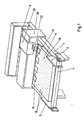
- Figur 1 zeigt in einer perspektivischen Teildarstellung eine Vorrichtung mit in der Arbeitsstellung befindlichem Arbeitstisch ohne aufgebrachtes Flachmaterial.
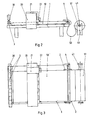
- Figur 2 zeigt in einer Seitenansicht die Vorrichtung aus Figur 1 mit in der Arbeitsstellung befindlichem Arbeitstisch, wobei die Vorschubstellung des Arbeitstisches gestrichelt angedeutet ist.
- Figur 3 zeigt eine Draufsicht auf die Vorrichtung aus Figur 2.
- Die dargestellte Vorrichtung hat einen Rahmen 1, auf dem an einem Ende eine leerlaufende Führrolle 4 angeordnet ist, bezüglich der seitlich und sich mit ihren Längserstreckungen senkrecht zur Mittelachse der Führrolle 4 verlaufende Führplatten 2 angebracht sind. Auf dem Rahmen 1 ist ein Arbeitstisch 10 angeordnet, der eine Auflagefläche 11 aufweist, in der Ansaugöffnungen 15 ausgebildet sind, die in nicht dargestellter Weise mit einer einen Unterdruck erzeugenden Pumpe verbunden sind. Am der Führrolle 4 abgewandten Ende des Arbeitstisches 10 ist dieser Auflagevorsprünge 14 bildend ausgeklinkt, und die Funktion der Auflagevorsprünge 14 wird später beschrieben werden.
- Am Rahmen 1 ist ein Schlitten 20 gehaltert, der sich quer über den Arbeitstisch 10 erstreckt und in Richtung senkrecht zur Längsachse der Führrolle 4 gesteuert über die Auflagefläche 11 des Arbeitstisches 10 hin- und herbewegt werden kann, wie dies an sich bekannt und beispielsweise für sogenannte Flach-Plotter üblich ist.
- Am Schlitten 20 ist ein Kopf 21 parallel zur Längsachse der Führrolle 4 gesteuert hin- und herbewegbar, der eine Aufnahme 22 für ein Werkzeug, etwa ein Schneidwerkzeug oder einen Plotter-Kegel trägt.
- Am der Führrolle 4 gegenüberliegenden Ende des Rahmens 1 befindet sich ein Balken 3, der in seiner oberen Fläche in angedeuteter Weise Aussparungen 5 aufweist, deren Abmessungen den Abmessungen der Auflagevorsprünge 14 des Arbeitstisches 10 entsprechen. Oberhalb des Balkens 3 befindet sich ein in der Senkrechten hin- und herbewegbarer Klemmbalken 30, der zur klemmenden Auflage auf die obere Fläche des Balkens 3 abgesenkt werden kann.
- Zur Bearbeitung einer Bahn 50 aus Flachmaterial wird eine auf einer Trägerrolle 41 aufgewickelte Vorratsrolle 51 mit Flachmaterial in Aufnahmen 40 benachbart zur Führrolle 4 gehaltert (Figur 2), und die Bahn 50 wird über die Führrolle 4 und seitlich geführt von den Führplatten 2 mit einem Abschnitt auf die Auflagefläche 11 des Arbeitstisches 10 gebracht. Gegebenenfalls wird sie durch Anlegen eines Unterdrucks an die Ansaugöffnungen 15 fest gegen die Auflagefläche 11 gezogen. In diesem Zustand kann durch gesteuerte Hin- und Herbewegungen des Schlittens 20 und des Kopfes 21 der gewünschte Bahnverlauf auf den auf der Auflagefläche 11 des Arbeitstisches 10 befindlichen Abschnitt der Bahn 50 aufgezeichnet bzw. in die Bahn eingeschnitten werden.
- Ist die Bearbeitung des auf der Auflagefläche 11 des Arbeitstisches 10 befindlichen Abschnittes der Bahn 50 beendet, so wird, falls nicht schon Unterdruck an den Ansaugöffnungen 15 anliegt, ein entsprechender Unterdruck erzeugt und dann der Tisch 10 aus der dargestellten Lage in den Figuren 2 und 3 nach links in Richtung auf den Balken 3 verfahren, bis er in die Figur 2 gestrichelt gezeigte Vorschubstellung gelangt, in der seine Auflagevorsprünge 14 sich in die Aussparungen 5 des Balkens 3 erstrecken. Bei dieser Verlagerungsbewegung des Arbeitstisches 10 wird der auf der Auflagefläche 11 befindliche Abschnitt der Bahn 50 in fester, unverlagerbarer Verbindung mit dem Arbeitstisch 10 gehalten.
- Ist die Vorschubstellung erreicht, wird der Klemmbalken 30 abgesenkt und in Eingriff mit dem unter ihm befindlichen Bereich der Bahn 50 gebracht, so daß dieser gegen die obere Fläche des Balkens 3 gepreßt und in dieser Lage festgehalten wird. Nunmehr wird der an den Ansaugöffnungen 15 anliegende Unterdruck weggeschaltet, und der Arbeitstisch 10 wird zurück in die in den Figuren gezeigte Arbeitsstellung verfahren, während die Bahn 50 keine Verlagerung bezüglich dem Rahmen 1 erfährt. In der Arbeitsstellung des Arbeitstisches 10 kann dann wieder Unterdruck an die Ansaugöffnungen 15 gelegt und der nunmehr zu bearbeitende, sich auf der Auflagefläche 11 des Arbeitstisches 10 befindliche Abschnitt der Bahn 50 bearbeitet werden.
- Da die Vorschubbewegung des Arbeitstisches 10 von der Arbeitsstellung in die Vorschubstellung kürzer ist als die Länge der Auflagefläche 11 des Arbeitstisches 10 in Richtung dieser Vorschubbewegung, liegt am in den Figuren 2 und 3 linken Ende der Auflagefläche nunmehr derjenige Bereich der Bahn 50 auf, der beim vorhergehenden Bearbeitungsschritt im in den Figuren 2 und 3 rechten Bereich der Arbeitsfläche 11 lag, und mit Hilfe des Werkzeugs ist es möglich, die Behandlung der Bahn so fortzusetzen, daß die weiteren Aufzeichnungen oder Einschnitte genau an die Aufzeichnungen oder Einschnitte anschließen, die aus dem vorhergehenden Bearbeitungsvorgang stammen und die sich nunmehr im Bereich des linken Endes der Auflagefläche 11 des Arbeitstisches 10 befinden.
Claims (4)
Priority Applications (1)
| Application Number | Priority Date | Filing Date | Title |
|---|---|---|---|
| AT89122876T ATE92623T1 (de) | 1988-12-24 | 1989-12-12 | Automatisch gesteuerte vorrichtung fuer die abschnittsweise behandlung einer bahn aus flachmaterial. |
Applications Claiming Priority (2)
| Application Number | Priority Date | Filing Date | Title |
|---|---|---|---|
| DE3843868 | 1988-12-24 | ||
| DE3843868A DE3843868C1 (de) | 1988-12-24 | 1988-12-24 |
Publications (3)
| Publication Number | Publication Date |
|---|---|
| EP0380791A2 true EP0380791A2 (de) | 1990-08-08 |
| EP0380791A3 EP0380791A3 (de) | 1991-12-04 |
| EP0380791B1 EP0380791B1 (de) | 1993-08-04 |
Family
ID=6370242
Family Applications (1)
| Application Number | Title | Priority Date | Filing Date |
|---|---|---|---|
| EP89122876A Expired - Lifetime EP0380791B1 (de) | 1988-12-24 | 1989-12-12 | Automatisch gesteuerte Vorrichtung für die abschnittsweise Behandlung einer Bahn aus Flachmaterial |
Country Status (4)
| Country | Link |
|---|---|
| EP (1) | EP0380791B1 (de) |
| AT (1) | ATE92623T1 (de) |
| DE (2) | DE3843868C1 (de) |
| ES (1) | ES2044035T3 (de) |
Cited By (1)
| Publication number | Priority date | Publication date | Assignee | Title |
|---|---|---|---|---|
| CN114852739A (zh) * | 2022-05-17 | 2022-08-05 | 宜昌佳艺包装有限责任公司 | 酒瓶口装饰丝带印刷的批量放卷装置及方法 |
Family Cites Families (5)
| Publication number | Priority date | Publication date | Assignee | Title |
|---|---|---|---|---|
| US3844461A (en) * | 1973-04-09 | 1974-10-29 | Gerber Scientific Instr Co | Precise indexing apparatus and method |
| US4483472A (en) * | 1983-03-01 | 1984-11-20 | Gerber Scientific Inc. | Apparatus and method for indexing sheet material |
| US4635365A (en) * | 1983-09-09 | 1987-01-13 | Dainippon Screen Seizo Kabushiki Kaisha | Coordinate plotter with automatic punching device |
| US4568075A (en) * | 1984-11-08 | 1986-02-04 | Eastman Kodak Company | Sheet registration and clamping apparatus |
| GB2177067B (en) * | 1985-05-31 | 1989-07-05 | Cybrid Ltd | Web feeding means |
-
1988
- 1988-12-24 DE DE3843868A patent/DE3843868C1/de not_active Expired - Fee Related
-
1989
- 1989-12-12 ES ES89122876T patent/ES2044035T3/es not_active Expired - Lifetime
- 1989-12-12 DE DE8989122876T patent/DE58905170D1/de not_active Expired - Fee Related
- 1989-12-12 AT AT89122876T patent/ATE92623T1/de not_active IP Right Cessation
- 1989-12-12 EP EP89122876A patent/EP0380791B1/de not_active Expired - Lifetime
Cited By (2)
| Publication number | Priority date | Publication date | Assignee | Title |
|---|---|---|---|---|
| CN114852739A (zh) * | 2022-05-17 | 2022-08-05 | 宜昌佳艺包装有限责任公司 | 酒瓶口装饰丝带印刷的批量放卷装置及方法 |
| CN114852739B (zh) * | 2022-05-17 | 2024-02-02 | 宜昌佳艺包装有限责任公司 | 酒瓶口装饰丝带印刷的批量放卷装置及方法 |
Also Published As
| Publication number | Publication date |
|---|---|
| EP0380791B1 (de) | 1993-08-04 |
| ES2044035T3 (es) | 1994-01-01 |
| ATE92623T1 (de) | 1993-08-15 |
| EP0380791A3 (de) | 1991-12-04 |
| DE58905170D1 (de) | 1993-09-09 |
| DE3843868C1 (de) | 1990-05-10 |
Similar Documents
| Publication | Publication Date | Title |
|---|---|---|
| DE1942410C3 (de) | Maschine zum Fertigen von Beuteln aus einer thermoplastischen Folienbahn | |
| DE4128194C2 (de) | Vorrichtung zum automatischen Herstellen von Blechteilen | |
| EP0046910A1 (de) | Bearbeitungsmaschine mit einer thermischen Schneidstrahleinrichtung, insbesondere Plasmaschneidstrahleinrichtung | |
| EP0505668A1 (de) | Arbeitstisch mit Vakuum-Ansaugung für Werkzeugmaschinen | |
| DE2656745A1 (de) | Montagevorrichtung | |
| DE2205107A1 (de) | Bearbeitungsvorrichtung von Werk stucken | |
| DE2425101B2 (de) | Verfahren und Vorrichtung zum Herstellen elektrischer Kontaktelemente | |
| DE3318314A1 (de) | Vorrichtung zum trennen der einzelnen zuschnitte eines stapels gestanzter blaetter | |
| DE10320295A1 (de) | Vorrichtung und Verfahren zum Bearbeiten von Werkstücken | |
| EP0380791B1 (de) | Automatisch gesteuerte Vorrichtung für die abschnittsweise Behandlung einer Bahn aus Flachmaterial | |
| EP0193750A2 (de) | Vorrichtung zum Ausriffeln von Fäden aus einem Gewebe | |
| DE3109226A1 (de) | Verfahren zum schneiden mit einem handgefuehrten schneidwerkzeug | |
| WO1984002451A1 (fr) | Procede d'usinage et/ou de manipulation de materiau plat | |
| DE8518255U1 (de) | Stütz- und Transportvorrichtung für flächige Werkstücke | |
| DE102004015994B4 (de) | Vorrichtung zur Vereinzelung und Positionierung von Modulbrücken | |
| DE102016120139B4 (de) | Verfahren, Werkzeugmaschine und Schlitzwerkzeug zum mehrhubig fortschreitenden Schlitzen von plattenförmigen Werkstücken | |
| EP1897665A1 (de) | Verfahren und Vorrichtung zum Herstellen von Zuschnitten | |
| DE2723432C3 (de) | Tischanschlag für eine Stanzmaschine | |
| DE4225836A1 (de) | Lochstanze | |
| DE3546859C2 (de) | Niederhaltevorrichtung für eine Maschinenschere | |
| DE2152518A1 (de) | Vorrichtung mit Taster zum Abschneiden von Rohrabschnitten von einem fortlaufend hergestellten Rohr | |
| DE3108337A1 (de) | Strangpressmaschine und verfahren zum betrieb einer strangpressmaschine | |
| DE3049480C2 (de) | Vorrichtung zum Holzspalten mit Hilfe einer Drallkeilspitze | |
| EP1422006A2 (de) | Blechbearbeitungsmaschine | |
| EP0811439B1 (de) | Vorrichtung zum Perforieren von Blechen |
Legal Events
| Date | Code | Title | Description |
|---|---|---|---|
| PUAI | Public reference made under article 153(3) epc to a published international application that has entered the european phase |
Free format text: ORIGINAL CODE: 0009012 |
|
| AK | Designated contracting states |
Kind code of ref document: A2 Designated state(s): AT BE CH DE ES FR GB GR IT LI LU NL SE |
|
| 17P | Request for examination filed |
Effective date: 19901231 |
|
| PUAL | Search report despatched |
Free format text: ORIGINAL CODE: 0009013 |
|
| AK | Designated contracting states |
Kind code of ref document: A3 Designated state(s): AT BE CH DE ES FR GB GR IT LI LU NL SE |
|
| 17Q | First examination report despatched |
Effective date: 19921218 |
|
| GRAA | (expected) grant |
Free format text: ORIGINAL CODE: 0009210 |
|
| AK | Designated contracting states |
Kind code of ref document: B1 Designated state(s): AT BE CH DE ES FR GB GR IT LI LU NL SE |
|
| PG25 | Lapsed in a contracting state [announced via postgrant information from national office to epo] |
Ref country code: SE Effective date: 19930804 Ref country code: NL Effective date: 19930804 Ref country code: GR Free format text: LAPSE BECAUSE OF FAILURE TO SUBMIT A TRANSLATION OF THE DESCRIPTION OR TO PAY THE FEE WITHIN THE PRESCRIBED TIME-LIMIT Effective date: 19930804 Ref country code: GB Effective date: 19930804 |
|
| REF | Corresponds to: |
Ref document number: 92623 Country of ref document: AT Date of ref document: 19930815 Kind code of ref document: T |
|
| REF | Corresponds to: |
Ref document number: 58905170 Country of ref document: DE Date of ref document: 19930909 |
|
| ET | Fr: translation filed | ||
| ITF | It: translation for a ep patent filed | ||
| PG25 | Lapsed in a contracting state [announced via postgrant information from national office to epo] |
Ref country code: AT Effective date: 19931212 |
|
| PG25 | Lapsed in a contracting state [announced via postgrant information from national office to epo] |
Ref country code: LU Free format text: LAPSE BECAUSE OF NON-PAYMENT OF DUE FEES Effective date: 19931231 Ref country code: LI Effective date: 19931231 Ref country code: CH Effective date: 19931231 Ref country code: BE Effective date: 19931231 |
|
| REG | Reference to a national code |
Ref country code: ES Ref legal event code: FG2A Ref document number: 2044035 Country of ref document: ES Kind code of ref document: T3 |
|
| NLV1 | Nl: lapsed or annulled due to failure to fulfill the requirements of art. 29p and 29m of the patents act | ||
| GBV | Gb: ep patent (uk) treated as always having been void in accordance with gb section 77(7)/1977 [no translation filed] |
Effective date: 19930804 |
|
| PLBE | No opposition filed within time limit |
Free format text: ORIGINAL CODE: 0009261 |
|
| STAA | Information on the status of an ep patent application or granted ep patent |
Free format text: STATUS: NO OPPOSITION FILED WITHIN TIME LIMIT |
|
| BERE | Be: lapsed |
Owner name: ARISTO GRAPHIC SYSTEME G.M.B.H. & CO. K.G. Effective date: 19931231 |
|
| 26N | No opposition filed | ||
| PG25 | Lapsed in a contracting state [announced via postgrant information from national office to epo] |
Ref country code: FR Effective date: 19940831 |
|
| REG | Reference to a national code |
Ref country code: CH Ref legal event code: PL |
|
| PG25 | Lapsed in a contracting state [announced via postgrant information from national office to epo] |
Ref country code: DE Effective date: 19940901 |
|
| REG | Reference to a national code |
Ref country code: FR Ref legal event code: ST |
|
| PG25 | Lapsed in a contracting state [announced via postgrant information from national office to epo] |
Ref country code: ES Free format text: LAPSE BECAUSE OF NON-PAYMENT OF DUE FEES Effective date: 19941213 |
|
| EUG | Se: european patent has lapsed |
Ref document number: 89122876.9 Effective date: 19931209 |
|
| REG | Reference to a national code |
Ref country code: ES Ref legal event code: FD2A Effective date: 19950112 |
|
| PG25 | Lapsed in a contracting state [announced via postgrant information from national office to epo] |
Ref country code: IT Free format text: LAPSE BECAUSE OF NON-PAYMENT OF DUE FEES;WARNING: LAPSES OF ITALIAN PATENTS WITH EFFECTIVE DATE BEFORE 2007 MAY HAVE OCCURRED AT ANY TIME BEFORE 2007. THE CORRECT EFFECTIVE DATE MAY BE DIFFERENT FROM THE ONE RECORDED. Effective date: 20051212 |