EP0381210A2 - Optisches Aufzeichnungsmedium und Verfahren zu seiner Herstellung - Google Patents
Optisches Aufzeichnungsmedium und Verfahren zu seiner Herstellung Download PDFInfo
- Publication number
- EP0381210A2 EP0381210A2 EP90102004A EP90102004A EP0381210A2 EP 0381210 A2 EP0381210 A2 EP 0381210A2 EP 90102004 A EP90102004 A EP 90102004A EP 90102004 A EP90102004 A EP 90102004A EP 0381210 A2 EP0381210 A2 EP 0381210A2
- Authority
- EP
- European Patent Office
- Prior art keywords
- organic dye
- optical recording
- organic
- thin film
- film layer
- Prior art date
- Legal status (The legal status is an assumption and is not a legal conclusion. Google has not performed a legal analysis and makes no representation as to the accuracy of the status listed.)
- Withdrawn
Links
Images

Classifications
-
- G—PHYSICS
- G11—INFORMATION STORAGE
- G11B—INFORMATION STORAGE BASED ON RELATIVE MOVEMENT BETWEEN RECORD CARRIER AND TRANSDUCER
- G11B7/00—Recording or reproducing by optical means, e.g. recording using a thermal beam of optical radiation by modifying optical properties or the physical structure, reproducing using an optical beam at lower power by sensing optical properties; Record carriers therefor
- G11B7/24—Record carriers characterised by shape, structure or physical properties, or by the selection of the material
- G11B7/241—Record carriers characterised by shape, structure or physical properties, or by the selection of the material characterised by the selection of the material
- G11B7/242—Record carriers characterised by shape, structure or physical properties, or by the selection of the material characterised by the selection of the material of recording layers
- G11B7/244—Record carriers characterised by shape, structure or physical properties, or by the selection of the material characterised by the selection of the material of recording layers comprising organic materials only
- G11B7/246—Record carriers characterised by shape, structure or physical properties, or by the selection of the material characterised by the selection of the material of recording layers comprising organic materials only containing dyes
- G11B7/248—Record carriers characterised by shape, structure or physical properties, or by the selection of the material characterised by the selection of the material of recording layers comprising organic materials only containing dyes porphines; azaporphines, e.g. phthalocyanines
-
- G—PHYSICS
- G11—INFORMATION STORAGE
- G11B—INFORMATION STORAGE BASED ON RELATIVE MOVEMENT BETWEEN RECORD CARRIER AND TRANSDUCER
- G11B7/00—Recording or reproducing by optical means, e.g. recording using a thermal beam of optical radiation by modifying optical properties or the physical structure, reproducing using an optical beam at lower power by sensing optical properties; Record carriers therefor
- G11B7/24—Record carriers characterised by shape, structure or physical properties, or by the selection of the material
- G11B7/26—Apparatus or processes specially adapted for the manufacture of record carriers
Definitions
- This invention relates to optical recording media capable of writing and reading out information by irradiation with laser beam, and to a process for preparing said optical recording media.
- optical recording media wherein the writing and readout of information are carried out by irradiation with laser beam.
- recording media there are known optical recording media wherein a recording layer provided on a substrate is irradiated with laser beam to cause changes such as fusion (melting), evaporation, decomposition, etc., in the irradiated area and thereby carrying out recording.
- optical recording media comprising a transparent substrate and an organic dye thin film layer as a recording layer provided on said substrate are disclosed in Japanese Patent Laid-Open Publication Nos. 82093/1982, 56892/1983, 89842/1985 and 150243/1985.
- the writing and readout of information are carried out by irradiation with laser beam of a relatively long wavelength such as 780 nm or longer.
- fine concavities (pits) can be easily formed on the organic thin film layer by fusing, evaporating or decomposing organic dyes by irradiation with semiconductor laser which allows optical systems for reproducing recording to be miniaturized.
- the above-mentioned optical recording media are prepared by dissolving an organic dye in an organic solvent and coating a transparent substrate with the resulting organic dye solution containing optionally a high-molecular binder to form an organic dye thin film layer on the transparent substrate.
- the organic dye thin film layers of the optical recording media as mentioned above have such problems that absorption coefficient for semiconductor laser beam is small, recording is not made with low power, and recording sensitivity is poor.
- the present inventors have eagerly studied and found that such problems can be solved by incorporating into the organic dye thin film layer as the recording layer formed on the transparent substrate liquid organic compound having a boiling point of no lower than 200 °C and capable of dissolving the organic dye.
- the present invention has been accomplished on the basis of this finding.
- the present invention is intended to solve such problems associated with the prior art as mentioned above and an object of the present invention is to provide organic recording media wherein recording can be made even by low power and hence are excellent in recording sensitivity.
- Another object of the present invention is to provide a process for preparing the above-mentioned optical recording media.
- the optical recording media of the present invention comprise a transparent substrate and an organic dye thin film layer formed on said substrate, said organic dye thin film layer comprising an organic dye and a liquid organic compound having a boiling point of not lower than 200 °C and capable of dissolving said organic dye.
- the process for preparing the optical recording media of the present invention comprises dissolving an organic dye in an organic solvent and coating a transparent substrate with the resulting organic dye solution to form an organic dye thin film layer on said transparent substrate, said organic dye solution comprising a liquid organic compound having a boiling point of not lower than 200 °C and capable of dissolving said organic dye.
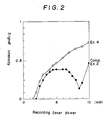
- Figures 1 and 2 are each a graph illustrating the relationship between signal intensity and recording laser power(mW) in the optical recording media of the present invention and that of Comparative Examples.
- optical recording media of the present invention and the process for preparing the same will be illustrated in more detail below.
- the transparent substrate of the present invention there can be used substrates which are conventionally used for the optical recording media and these substrates preferably have a light transmittance of at least 85 % for conducting the writing and readout of information and have low optical anisotropy.
- materials for the substrates include glass, thermoplastic resins such as acrylic resins, polycarbonate resins, polyester resins, polyamide resins, vinyl chloride resins, vinyl acetate resins, polystyrene resins, polyolefin resins, e.g., poly-4-methylpentene, amorphous polyolefins such as those disclosed in US Patent No.
- 4,614,778 including copolymers of ethylene with 1,4,5,8-dimethano-1,2,3,4,4a,5,8,8a-octahydronaphthalene (tetracyclododecene), copolymers of ethylene with 2-methyl1,4,5,8-dimethano-1,2,3,4,4a,5,8,8a-octahydronaphthalene (methyltetracyclododecene) and copolymers of ethylene with 2-ethyl-1,4,5,8-dimethano-1,2,3,4,4a,5,8,8a-octahydronaphthalene (ethyltetracyclododecene) and polyether sulfone resins, and thermosetting resins such as epoxy resins and allyl resins.
- substrates composed of amorphous polyolefin resins are preferred because many kind of solvents for dissolving dyes can be used if the amorphous polyo
- the transparent substrates may be in any form such as a sheet, a film, a disk or a card and the sizes thereof are particurarly limited.
- the transparent substrate is generally provided with guide grooves for position control in writing or reading out information, and also provided with recess and protrusion parts for preformatting various marks or address signal. These recess and protrusion parts can be formed, for example, with a stamper in molding the above-described thermoplastic resins by injection molding, compression molding or the like.
- the optical recording media of the present invention comprise the transparent substrate and the organic dye thin film layer formed on said substrate, said organic dye thin film layer comprising an organic dye and a liquid organic compound having a boiling point of not lower than 200 °C and capable of dissolving said organic dye.
- the phthalocyanine dyes, the naphthalocyanine dyes and mixtures thereof are preferred, because they are excellent in heat resistance, easily stacked in the organic dye thin film layer, easily carried out heat treatment and have good optical characteristics and stability.
- Liquid organic compounds which are used together with the organic dyes in the organic dye thin film layer of the present invention are those which can dissolve the organic dyes and have a boiling point of not lower than 200 °C, preferably not lower than 250 °C, more preferably not lower than 300 °C.
- the liquid organic compounds include dodecylbenzene, glycerin, dihexyl ether, diphenyl ether, dibutyl maleate, phthalate, for example, dialkylphthalate such as dimethyl phthalate, dibutyl phthalate and dioctyl phthalate and dibutyl sebacate.
- the preferred liquid organic compounds are phthalate, for example, dialkylphthalate such as dimethyl phthalate and dibutyl phthalate.
- the liquid organic compounds are used in an amount of 1 to 400 parts by weight, preferably 1 to 200 parts by weight, more preferably 5 to 100 parts by weight based on 100 parts by weight of the organic dyes.
- liquid organic solvents have a high boiling point. Therefore, they are scarcely evaporated during the manufacturing process of the optical recording media described hereinafter or during the use thereof and are retained in the organic dye thin film.
- the organic dye thin films as the recording layers of the optical recording media of the present invention contain the liquid organic compound having a boiling point of not lower than 200°C in addition to the organic dye, recording can be made even with low power and recording sensitivity is excellent as compared with those of optical recording media containing no liquid organic compound.
- the organic dye thin films of the optical recording media of the present invention may contain high-molecular binders.
- the high-molecular binders include vinyl chloride resins, acrylic resins, polyester resins, polyamide resins, polycarbonate resins, epoxy resins, methacrylate resins, vinyl acetate resins, nitrocellulose and phenolic resins.
- the content of the high-molecular binder in the organic dye thin film layer is preferably not higher than 10 % by weight, since the content of the high-molecular binder exceeds 10% by weight thermal motion of the organic dye and stacking may be obstructed.
- the thickness of the organic dye thin film layer formed on the transparent substrate is not more than 10 ⁇ m, preferably 500 ⁇ to 2 ⁇ m.
- organic dye is dissolved or dispersed in an organic solvent to prepare an organic dye solution.
- Organic solvents having a low boiling point of less than 200 °C, more preferably not higher than 150 °C are used.
- organic solvents examples include
- organic solvents may be used either alone or as a mixture of two or more in a certain ratio.
- the above-described liquid organic compound having a boiling point of not lower than 200 C is added to the organic dye solution.
- the above-described organic solvent is previously mixed with the liquid organic compound having a boiling point of not lower than 200 °C, and the organic dye may be dissolved in the resulting mixed solution.
- the high-molecular binder may be added to the organic dye solution.
- the transparent substrate is coated with the thus-prepared organic dye solution and dried to remove the organic solvent from the resulting organic dye film, whereby the optical recording medium of the present invention can be obtained.
- the transparent substrate can be coated with the organic dye solution, for example, by spin coating, dip coating, or spray coating, etc.
- the organic dye thin film layer as the recording layer formed on the transparent substrate can be heat-treated at a temperature of from 80 to 280 °C, preferably from 100 to 250 °C by heating it from an external heat source.
- the heating temperature is preferably lower than a boiling point of the liquid organic compound.
- the heating time greatly varies depending on the heating temperature, but is preferably from 30 seconds to 90 minutes, more preferably from 3 to 60 minutes.
- the heating can be performed by using a heating oven, or contacting the organic dye thin film layer with heated roller or hot plate, irradiating infrared rays to the organic dye thin film layer by using an infrared lamp, or hot pressing the organic dye thin film layer.
- the heat-treatment of the organic dye thin film layer is carried out in an inert atmosphere such as nitrogen gas or in an oxygen-containing atmosphere such as air.
- the organic dye thin film After the organic dye thin film is heat-treated at a temperature of 80 to 280 °C, the organic dye thin film may be exposed to vapor of an organic solvent such as chloroform, tetrahydrofuran or toluene, whereby an absorption wavelength of the organic dye thin film layer is shifted to a side of long wavelength and sensitivity to light in the region of the oscillating wavelength of semiconductor laser is remarkably improved in some cases.
- an organic solvent such as chloroform, tetrahydrofuran or toluene
- a protective layer can be provided on the organic dye thin film layer formed on the substrate by depositing an inorganic compound such as Al2O3, SiO2, SiO or SnO.
- an inorganic compound such as Al2O3, SiO2, SiO or SnO.
- high-molecular binder as described above may be applied on the organic dye thin film layer to form a protective layer.
- the organic dye thin film layer may be exposed to the vapor of the organic solvent before the heat treatment. Further, the protective layer may be formed on the organic dye thin film layer before the heat treatment.
- Recording information on the thus-obtained optical recording media can be made by irradiating to the organic dye thin film layer with laser beam, preferably semiconductor laser beam, which is focused on about 1 ⁇ m.
- the organic dye irradiated with laser beam absorbs laser energy to change physical state thereof such as decomposition, evaporation or fusion.
- the reproduction of information thus recorded on the organic dye thin film can be made by irradiating laser beam to the thermal changed area and the unchanged area and reading out a difference in reflectance therebetween.
- Laser beam for reproducing information has preferably lower energy than that of laser beam for writing information and does not cause thermal change in the state of the organic dye thin film when information is reproduced.
- laser beam sources such as He-Ne laser, Ar laser and semiconductor laser can be used for recording or reproducing information.
- semiconductor laser is particularly preferred from the viewpoints of cost and size.
- Laser having central wavelengths of 830 nm, 780 nm and shorter wavelength can be used as semiconductor laser.
- information can be recorded to the optical recording media of the present invention with a low power.
- a substrate made of a copolymer of ethylene and 1,4,5,8-dimethano-1,2,3,4,4a,5,8,8a-octahydronaphthalene was coated with the resulting solution for 30 seconds by means of a spin coater rotated at 800 rpm.
- the resulting coating film was dried at 100 °C for 30 minutes to form an organic dye thin film layer.
- the organic dye thin film layer of the optical recording medium had a thickness of about 850 ⁇ .
- Example 1 The procedure of Example 1 was repeated except that dimethyl phthalate was used in an amount of 2.04 parts by weight and cyclohexanone was used in an amount of 97.96 parts by weight to obtain an optical recording medium.
- Example 1 The procedure of Example 1 was repeated except that in place of dimethyl phthalate, dibutyl phthalate was used in an amount of 2.04 parts by weight cyclohexanone was used in an amount of 97.96 parts by weight to obtain an optical recording medium.
- Example 1 The procedure of Example 1 was repeated except that the following organic dye (b) was used in place of the organic dye (a) to obtain an optical recording medium.
- Organic dye (b) was used in place of the organic dye (a) to obtain an optical recording medium.
- Example 1 The procedure of Example 1 was repeated except that a solution of 2 parts by weight of the organic dye (a) dissolved in 100 parts by weight of cyclohexane was used to obtain an optical recording medium.
- Example 1 The procedure of Example 1 was repeated except that the organic dye (b) was used in place of the organic dye (a), and a solution of 2 parts by weight of the organic dye (b) dissolved in 100 parts by weight of cyclohexane were used to obtain an optical recording medium.
- Recording was made by rotating the optical recording media obtained above examples and comparative examples at a 1800 rpm under such conditions that recording frequency was 1.0 MHz and recording laser power was changed in the range of 1.0 to 10.0 mw. Signal intensity was evaluated with a readout power of 0.6 mW.
Landscapes
- Engineering & Computer Science (AREA)
- Manufacturing & Machinery (AREA)
- Thermal Transfer Or Thermal Recording In General (AREA)
- Optical Record Carriers And Manufacture Thereof (AREA)
- Manufacturing Optical Record Carriers (AREA)
Applications Claiming Priority (2)
| Application Number | Priority Date | Filing Date | Title |
|---|---|---|---|
| JP23064/89 | 1989-02-01 | ||
| JP1023064A JPH02202483A (ja) | 1989-02-01 | 1989-02-01 | 光記録媒体およびその製造方法 |
Publications (2)
| Publication Number | Publication Date |
|---|---|
| EP0381210A2 true EP0381210A2 (de) | 1990-08-08 |
| EP0381210A3 EP0381210A3 (de) | 1991-08-21 |
Family
ID=12099986
Family Applications (1)
| Application Number | Title | Priority Date | Filing Date |
|---|---|---|---|
| EP19900102004 Withdrawn EP0381210A3 (de) | 1989-02-01 | 1990-02-01 | Optisches Aufzeichnungsmedium und Verfahren zu seiner Herstellung |
Country Status (4)
| Country | Link |
|---|---|
| EP (1) | EP0381210A3 (de) |
| JP (1) | JPH02202483A (de) |
| KR (1) | KR900013479A (de) |
| CA (1) | CA2008998A1 (de) |
Cited By (3)
| Publication number | Priority date | Publication date | Assignee | Title |
|---|---|---|---|---|
| EP0511598A1 (de) * | 1991-04-26 | 1992-11-04 | MITSUI TOATSU CHEMICALS, Inc. | Optisches Aufzeichnungsmedium |
| EP0811506A4 (de) * | 1995-12-25 | 1998-04-01 | Toyo Ink Mfg Co | Optisches aufzeichnungsmaterial und optischer aufzeichnungsträger |
| WO2000049611A1 (en) * | 1999-02-16 | 2000-08-24 | Plasmon Limited | Forming optical recording layers |
Family Cites Families (2)
| Publication number | Priority date | Publication date | Assignee | Title |
|---|---|---|---|---|
| JPH0739211B2 (ja) * | 1985-08-06 | 1995-05-01 | 三井東圧化学株式会社 | 光記録媒体の製造方法 |
| JP2630381B2 (ja) * | 1985-10-07 | 1997-07-16 | 三菱レイヨン株式会社 | 光情報記録媒体 |
-
1989
- 1989-02-01 JP JP1023064A patent/JPH02202483A/ja active Pending
-
1990
- 1990-01-31 CA CA002008998A patent/CA2008998A1/en not_active Abandoned
- 1990-02-01 EP EP19900102004 patent/EP0381210A3/de not_active Withdrawn
- 1990-02-01 KR KR1019900001195A patent/KR900013479A/ko not_active Abandoned
Cited By (5)
| Publication number | Priority date | Publication date | Assignee | Title |
|---|---|---|---|---|
| EP0511598A1 (de) * | 1991-04-26 | 1992-11-04 | MITSUI TOATSU CHEMICALS, Inc. | Optisches Aufzeichnungsmedium |
| US5283094A (en) * | 1991-04-26 | 1994-02-01 | Mitsui Toatsu Chemicals, Inc. | Optical recording medium |
| EP0811506A4 (de) * | 1995-12-25 | 1998-04-01 | Toyo Ink Mfg Co | Optisches aufzeichnungsmaterial und optischer aufzeichnungsträger |
| US5820962A (en) * | 1995-12-25 | 1998-10-13 | Toyo Ink Manufacturing Co., Ltd. | Optical recording material and optical recording medium |
| WO2000049611A1 (en) * | 1999-02-16 | 2000-08-24 | Plasmon Limited | Forming optical recording layers |
Also Published As
| Publication number | Publication date |
|---|---|
| EP0381210A3 (de) | 1991-08-21 |
| KR900013479A (ko) | 1990-09-05 |
| JPH02202483A (ja) | 1990-08-10 |
| CA2008998A1 (en) | 1990-08-01 |
Similar Documents
| Publication | Publication Date | Title |
|---|---|---|
| JPH0415112B2 (de) | ||
| KR930000517B1 (ko) | 광 기록매체 | |
| US5579150A (en) | Optical recording medium using a charge transfer complex | |
| EP0381210A2 (de) | Optisches Aufzeichnungsmedium und Verfahren zu seiner Herstellung | |
| EP0307081B1 (de) | Aufzeichnungsträger für optischen Datenspeicher | |
| JPS6236878B2 (de) | ||
| JPS63164037A (ja) | 光情報記録媒体 | |
| JP2585459B2 (ja) | 光学的情報記録媒体 | |
| JPH06150385A (ja) | 光記録媒体 | |
| JPS62216794A (ja) | 光学記録媒体 | |
| JPH06251417A (ja) | 光学記録媒体 | |
| JPS6364794A (ja) | 光記録媒体 | |
| JPH0648045A (ja) | 光学記録媒体 | |
| US5196231A (en) | Optical recording media | |
| JPS63199759A (ja) | ジオキサジナフトペンタセン系誘導体及び該誘導体を使用した光学記録媒体 | |
| JPS6398493A (ja) | 光記録媒体 | |
| JPS62201289A (ja) | 光情報記録媒体 | |
| JPS62201288A (ja) | 光情報記録媒体 | |
| JPH02106390A (ja) | 光学記録媒体の製造方法 | |
| JPH0433887A (ja) | 光記録媒体 | |
| JPS61296542A (ja) | 光情報記録媒体 | |
| JPH0250874B2 (de) | ||
| JPH0732736A (ja) | 光記録媒体用記録膜材料およびそれを使用した光記録媒体 | |
| JPH05254253A (ja) | 光記録再生装置 | |
| JPS6137482A (ja) | 光記録素子 |
Legal Events
| Date | Code | Title | Description |
|---|---|---|---|
| PUAI | Public reference made under article 153(3) epc to a published international application that has entered the european phase |
Free format text: ORIGINAL CODE: 0009012 |
|
| AK | Designated contracting states |
Kind code of ref document: A2 Designated state(s): AT BE CH DE DK ES FR GB GR IT LI LU NL SE |
|
| PUAL | Search report despatched |
Free format text: ORIGINAL CODE: 0009013 |
|
| AK | Designated contracting states |
Kind code of ref document: A3 Designated state(s): AT BE CH DE DK ES FR GB GR IT LI LU NL SE |
|
| STAA | Information on the status of an ep patent application or granted ep patent |
Free format text: STATUS: THE APPLICATION HAS BEEN WITHDRAWN |
|
| 18W | Application withdrawn |
Withdrawal date: 19911017 |