EP0381621A2 - Neue Polymere - Google Patents
Neue Polymere Download PDFInfo
- Publication number
- EP0381621A2 EP0381621A2 EP90810052A EP90810052A EP0381621A2 EP 0381621 A2 EP0381621 A2 EP 0381621A2 EP 90810052 A EP90810052 A EP 90810052A EP 90810052 A EP90810052 A EP 90810052A EP 0381621 A2 EP0381621 A2 EP 0381621A2
- Authority
- EP
- European Patent Office
- Prior art keywords
- block copolymers
- formulas
- copolymers according
- xylylenediamine
- aminobenzylamine
- Prior art date
- Legal status (The legal status is an assumption and is not a legal conclusion. Google has not performed a legal analysis and makes no representation as to the accuracy of the status listed.)
- Ceased
Links
Classifications
-
- C—CHEMISTRY; METALLURGY
- C08—ORGANIC MACROMOLECULAR COMPOUNDS; THEIR PREPARATION OR CHEMICAL WORKING-UP; COMPOSITIONS BASED THEREON
- C08G—MACROMOLECULAR COMPOUNDS OBTAINED OTHERWISE THAN BY REACTIONS ONLY INVOLVING UNSATURATED CARBON-TO-CARBON BONDS
- C08G73/00—Macromolecular compounds obtained by reactions forming a linkage containing nitrogen with or without oxygen or carbon in the main chain of the macromolecule, not provided for in groups C08G12/00 - C08G71/00
- C08G73/06—Polycondensates having nitrogen-containing heterocyclic rings in the main chain of the macromolecule
- C08G73/10—Polyimides; Polyester-imides; Polyamide-imides; Polyamide acids or similar polyimide precursors
- C08G73/14—Polyamide-imides
Definitions
- the present invention relates to new polyamide-polyimide block copolymers (hereinafter called PAPI block copolymers).
- PAPI block copolymers are known per se and are described, for example, in DE-A-2,342,464. Because of their good electrical, thermal and / or mechanical properties, these are suitable, for example, as matrix resins for the production of composite materials, as coating resins in the electrical and electronics industry, as flexible laminating resins, as adhesive films or as molding compounds.
- Common PAPI block copolymers are insoluble or only slightly soluble in organic solvents, e.g. is known from US-A-4,503,285. Therefore, to take advantage of the good properties of the PAPI block copolymers, it is generally necessary to start from the readily soluble precursor, the polyamide-polyamic acid block copolymers. This approach is unsatisfactory in some ways.
- the soluble precursors are generally only stable in storage to a limited extent, since the amount of water produced by ring closure leads to a reduction in molecular weight and / or the ring closure leads to precipitation of the polymer.
- the resulting product may have defects such as holes and / or bubbles as a result of the escaping water.
- PAPI block copolymers have advantages in processing and can be stored almost indefinitely as solutions or as solids.
- PAPI block copolymers which are soluble in organic solvents have the disadvantage of being attacked by such solvents. So it's a soluble one PAPI block copolymer is desirable, which can be stabilized against solvent attack in a subsequent step after its application from solution.
- PAPI block copolymers according to the invention are distinguished by a surprisingly high solubility in dipolar, aprotic solvents and by a high reactivity in thermal crosslinking.
- PAPI block copolymers according to the invention can be dried at high temperatures up to about the glass transition point, which allows the polymers to be cleaned quickly without substantial crosslinking. Surprisingly, the difference between the maximum possible drying temperature and the curing temperature is small, so that there are also technical advantages.
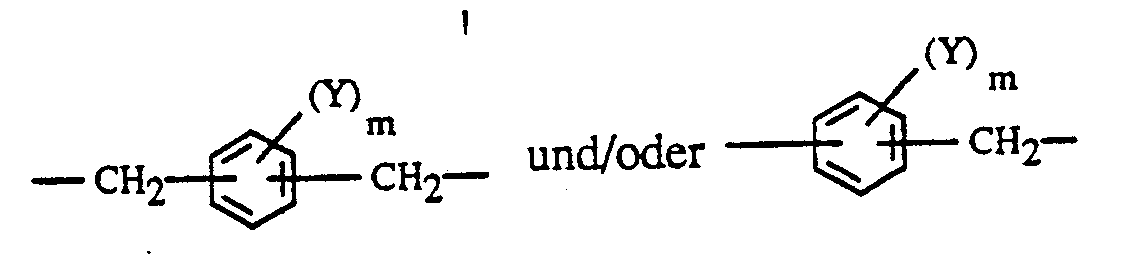
- the present invention relates to soluble polyamide-polyimide block copolymers with an average molecular weight M n of 1,000-50,000, in particular 5,000-40,000, containing combinations of blocks of the formulas Ia with IIb and / or IIc or of the formulas Ib with IIa and / or IIc or the formulas Ic with IIa and / or IIb wherein the indices a, b and c are independently integers from 1 to 100, R1 is a radical of the formulas -C n H 2n -, is n is an integer from 2 to 12, m is an integer from 0 to 4, Y is alkyl or halogen, Q is a direct bond or -CH2-, -CH2-CH2-, -CH (CH3) - , -C (CH3) 2-, -C (CF3) 2-, -O-, -S-, -SO2- or -CO-, R2 is a radical of the formulas -C n H 2n -,
- soluble PAPI block copolymer is generally understood to mean a copolymer which is soluble in dipolar, aprotic solvents and from which solutions containing at least 5% by weight, preferably at least 10% by weight, of PAPI block copolymer, based on the solution, can be prepared.
- the ratio of polyamide blocks to polyimide blocks or to polyamideimide blocks in the copolymers according to the invention is generally determined by the desired solubility of this copolymer in dipolar, aprotic solvents.
- the respective proportions of these blocks and the content of xylylenediamine units and / or aminobenzylamine units are selected so that the block copolymer is soluble in dipolar, aprotic solvents and is practically not attacked by these solvents in the crosslinked state.
- the preferred ratio of amide groups to imide groups in the copolymers according to the invention is 4: 1 to 1: 4.
- the average molecular weights M n of the polyamide blocks Ia or IIa or that of the polyimide blocks Ib or IIb or of the polyamideimide blocks Ic or IIc are generally 300 to 20,000, preferably 500 to 10,000.
- the fiction PAPI block copolymers also contain three-block combinations of the formulas Ia, Ib and IIc or Ia, Ic and IIb or Ib, Ic and IIa
- Block copolymers which consist essentially of the recurring structural units of the formulas Ia and IIb or Ib and IIa are particularly preferred.
- Very particularly preferred block copolymers of this type contain the xylylenediamine units or the aminobenzylamine units or a combination of xylylenediamine units and aminobenzylamine units only in the polyimide blocks Ib or IIb.
- Cross-linked products made from compounds of this type are characterized by particularly high thermal stability.
- the index n is preferably 6 to 12 and the index m is preferably 0 or 1, in particular 0.
- alkyl substituent Y in the formulas above can be branched or preferably straight-chain.
- Straight-chain C1-C6alkyl is preferred. Examples include methyl, ethyl, n-propyl, n-butyl, n-pentyl and n-hexyl. Methyl is particularly preferred.
- Y as halogen is preferably chlorine or bromine.
- R1 means, for example, 1,3-phenylene, 1,4-phenylene, 2,4-tolylene, 1,5-naphthylene, 1,8-naphthylene, 2,6-naphthylene, 4,4'-biphenylene,
- Preferred radical R1 is 1,3-phenylene.
- R1, R2, R4 or R6 represent a group -C n H 2n -, it is, for example, 1,2-ethylene, 1,2-propylene, 1,3-propylene, 2,2-propylidene, 1, 4-tetramethylene, 1,5-pentamethylene, 1,6-hexamethylene, 1,7-heptamethylene, 1,8-octamethylene, 1,9-nonamethylene, 1,10-decamethylene, 1,12-dodecamethylene, 2,9- Decamethylene or 2-methyl-1,5-pentamethylene.
- R1, R2, R4 or R6 a group it can be 1,2-, 1,3- or preferably 1,4-cyclohexylene.
- Examples of specific araliphatic groups R2 and / or R4 and / or R6 are 1,3-xylylene, 1,4-xylylene,
- R2, R4 or R6 are 1,2-phenylene, 1,3-phenylene, 1,4-phenylene, or one of the following groups
- Preferred radicals R2 and / or R4 and / or R6 are 1,3-phenylene, and particularly
- R5 is preferably a radical of the formula
- PAPI block copolymers according to the invention which have predominantly aromatic or araliphatic radicals, for example those such as those listed above for R1 to R6.
- R1, R2, R3, R4 or R6 a bridge member Q, it is preferably -CH2-, -C (CH3) 2-, -O-, -SO2- or -CO-.
- R2, R4 or R6 contains several bridge members Q, these can be the same or different.
- the tetravalent radical R3 is derived from a tetracarboxylic acid which is able to form a dianhydride.
- the proportion of the xylylenediamine residues or the aminobenzylamine residues or both types of these residues in the compounds according to the invention is preferably 25 to 75 mol%, based on the proportion of all diamine residues. These compounds are generally distinguished by a particularly good solubility in dipolar, aprotic solvents.
- the invention therefore preferably relates to PAPI block copolymers as defined above, characterized in that 25 to 75 mol%, in particular 50 to 75 mol% of the radicals R2, R4 and, if present, R6 of xylylenediamine or of aminobenzylamine or of a combination of xylylenediamine and aminobenzylamine derived, in particular from 1,3-xylylenediamine, and that at least 25 mol% of the radicals R2, R4 and, if present, R6 are derived from diaminodiphenylsulfone, the quantitative data relating to the total amount of these radicals.
- PAPI block copolymers of the present invention practically all of the radicals R2, R4 and, if present, R6 deviating from xylylenediamine and / or aminobenzylamine are derived from diaminodiphenylsulfone.
- the block copolymers according to the invention are produced in a manner known per se, and can be carried out, for example, according to one of the procedures described in DE-A-2,342,464 by reacting preformed polyamide, polyamidamic acid and polyamic acid blocks and then cyclizing the polyamide-polyamic acid.
- Another production method comprises the reaction of polyamic acids of the formula IIIa and / or IIIb with diamines of formula IV H2N-R2-NH2 (IV), and with dicarboxylic acid chlorides of the formula V Cl-OC-R1-CO-Cl (V) and the subsequent cyclization of the polyamide-polyamic acid block copolymers thus obtained.
- the symbols R1, R2, R3, R4, R5 and R6 have the meaning given above and x represents an integer ⁇ 0, preferably ⁇ 1.
- the preparation of the polyamic acids of the formulas IIIa or IIIb is likewise known per se and is carried out, for example, by the reaction of tetracarboxylic anhydrides of the formula VIa or of tricarboxylic anhydrides VIb or a corresponding tricarboxylic anhydride chloride wherein R3 and R5 have the meaning given above, with a deficit of a diamine of the formula IV.
- the desired average molecular weight can be selected by selecting the appropriate reaction conditions, such as, for example, by selecting the molar ratios of the reactants set the weights of the individual blocks. This selection is known per se to the person skilled in the art.
- the polycondensation of the di-, tri- or tetracarboxylic acid derivatives of the formulas IIIa, IIIb, V, VIa or VIb with the diamines of the formula IV can be carried out in a manner known per se, preferably in an anhydrous organic solvent and with exclusion of moisture, e.g. under nitrogen at temperatures between -20 ° C and + 50 ° C, especially about -15 ° C to + 10 ° C.
- Suitable organic solvents are, for example, N, N-dimethylacetamide, N, N-diethylacetamide, N, N-dimethylformamide, N-methyl-2-pyrrolidone (NMP), N-acetyl-2-pyrrolidone, N-methyl- ⁇ -caprolactam, N, N, N ', N'-tetramethyl urea, tetrahydrothiophene dioxide (sulfolane) and dimethyl sulfoxide.
- NMP N-acetyl-2-pyrrolidone
- N-methyl- ⁇ -caprolactam N, N, N ', N'-tetramethyl urea
- tetrahydrothiophene dioxide sulfolane
- reaction can also be carried out in mixtures of such solvents.
- organic aprotic solvents such as aromatic, cycloaliphatic or aliphatic, optionally chlorinated hydrocarbons, for example toluene, xylenes, cyclohexane, pentane, hexane, petroleum ether, dichloromethane, tetrahydrofuran, cyclohexanone and dioxane.
- the polyamide blocks can also be produced by interfacial polycondensation.
- the solvents can, if desired, be removed in a customary manner, for example by distillation, if appropriate under reduced pressure.
- the polyamide-polyamic acid block copolymers can be prepared by methods known per se by pouring the reaction solution into a precipitant such as water or aliphatic hydrocarbons, e.g. in petroleum ether, but especially in methanol, isopropanol, acetone, ethers of mono-, di- or triethylene glycol or acetonitrile on both sides, are precipitated and optionally dried.
- the cyclization of the polyamide-polyamic acid block copolymers to the corresponding PAPI block copolymers is carried out by heating the polyamide-polyamic acid block copolymers preferably without prior isolation, ie directly in the reaction solution described above to temperatures between 50 and 300 ° C. or with a de Hydrating agent treated alone or in a mixture with a tertiary amine.
- a de Hydrating agent treated alone or in a mixture with a tertiary amine.
- acetic anhydride or propionic anhydride or a mixture of acetic anhydride and triethylamine or pyridine are suitable. Methods of this type are described, for example, in US-A-3,894,114, US-A-4,124,651 or US-A-4,503,285.
- the compounds according to the invention can also be prepared by first building up a polyamide block or polyamideimide block in a manner known per se and then producing the polyamic acid-polyamide block copolymer by reaction with tetracarboxylic anhydride and diamine, which is then cyclized.
- the PAPI block copolymers according to the invention have a good solubility in aprotic, dipolar solvents for the problem mentioned at the outset. Very good solubilities can be achieved, for example, in N, N-dimethylacetamide, N, N-dimethylformamide, N, N-dimethylacetamide, N-methyl-2-pyrrolidone, sulfolane, dimethyl sulfoxide or ⁇ -butyrolactone, optionally with heating.
- the copolymers according to the invention can be crosslinked by heating.
- the temperatures for the crosslinking step are generally different, depending on the copolymer used.
- the copolymers are heated above their glass transition temperature (T g value) or, in the case of several T g values, above their lowest, in particular above their highest T g value.
- DSC differential scanning calorimetry
- glass transition temperature refers to the values of the polymer in the particular formulation.
- polymers containing solvents and / or plasticizers can have T g values which are below the values for the pure polymer.
- crosslinking takes place at temperatures between 250 and 350 ° C.
- the invention thus also relates to a process for the preparation of crosslinked PAPI block copolymers, characterized in that the compounds containing blocks of the formulas Ia and IIb and / or IIc defined above or of the formulas Ib and IIa and / or IIc or of the formulas Ic and IIa and / or IIb heated to temperatures above their glass transition point.
- the invention further relates to the crosslinked products obtainable by this process.
- the block copolymers according to the definition are characterized by good processability and can be used to manufacture industrial products such as fibers, fiber-reinforced composites, laminated bodies, castings, laminates, matrix resins, honeycomb core materials, lacquers, adhesives, foams, coating compositions, films (films), Press and sinter powders and compacts are used.
- block copolymers according to the invention can be used for the production of coatings, films and flexible laminates or as adhesives, matrix resins or molding compounds.
- additives such as pigments, fillers, electrical conductors such as carbon black or metal particles, agents for increasing the abrasion resistance, lubricants or reinforcing fibers such as carbon, boron or glass fibers can be added to the block copolymers before the crosslinking step.
- Laminates containing the block copolymers according to the invention can optionally be coated with coating layers which improve the surface properties, e.g. made of phenolic resins, aluminum, and are used, among other things, in aircraft construction.
- Block copolymers according to the invention preferably in the form of solutions, can also be used as coating compositions and adhesives, optionally with the addition of pigments, such as titanium dioxide, customary fillers and foams, for coating and coating substrates of all kinds in any form, such as films, fibers, nonwovens, Wires, lattice-shaped structures, fabrics, foams, can be used.
- pigments such as titanium dioxide, customary fillers and foams
- suitable substrates its mentioned: metals or alloys such as copper, brass, aluminum, iron or steel; Asbestos or fiberglass materials; Polymers such as cellulosic materials (cellulose esters or ethers, paper); Perfluorocarbon polymers, e.g. Polytetrafluoroethylene, polyolefins, polyesters, polyamides, polyimides or polyurethanes.
- the clear reaction mixture is cooled again (-7 ° C).
- 62.21 g (0.2500 mol) of 4,4'-diaminodiphenyl sulfone in 300 g of NMP are then added dropwise over the course of 150 minutes via the dropping funnel.
- 45.68 g (0.225 mol) of isophthalic acid dichloride are then added in portions, so that the internal temperature does not exceed 0.degree. It takes about 150 minutes, the solution becoming increasingly viscous.
- the polymer solution is stirred at room temperature for 50 minutes.
- a further 0.51 g (0.0025 mol) of isophthalic acid is used dichloride and stir for 3 hours to complete the polycondensation.
- the now available polyamide-polyamic acid block copolymer solution is now subjected to the chemical cyclization to give the polyamide-polyimide block copolymer.
- 79.69 g (0.7875 mol) of triethylamine are first added over a dropping funnel within 45 minutes and then 80.40 g (0.7875 mol) of acetic anhydride within 40 minutes at 20-25 ° C.
- the mixture is then stirred for a further 6 hours at room temperature.
- the inherent viscosity (0.5% solids, NMP, 25 ° C) of a polyamide-polyimide block copolymer produced in this way is 0.74 dl / g.
- Part of the solution described above is diluted with NMP, 10 times the amount of ethanol precipitated and dried in a drying cabinet under vacuum.
- the temperature is gradually increased to 200 ° C. within 72 hours and left at this temperature for 8 hours.
- the polymer is more than 25% soluble in NMP.
- the inherent viscosity (0.5%, NMP, 25 ° C) of the polymer is 0.60 dl / g.
- a solution of the above-described polyamide-polyimide block copolymer with 25% by weight in NMP is applied to a copper foil using a lacquer dumbbell (height 200 ⁇ m). The majority of the solvent is removed by IR radiation for 15 minutes. The polymer layer of a test strip produced in this way can be removed almost completely by immersing it in NMP for 30 minutes. Another test strip is additionally heated in a vacuum (15 mbar) within 30 minutes from room temperature to 300 ° C and at this temperature for a further 30 minutes. A bubble-free, flexible Cu foil is obtained. The film treated in this way is weighed, immersed in NMP for 30 minutes and weighed again. This shows an unchanged weight, i.e. the coating is no longer attacked by NMP. The surface of the coating is also unchanged before and after the NMP treatment.
- Examples 2-12 for soluble polyamide-polyimide block copolymers given in the following table are prepared as described under example 1. The following abbreviations are used in the table: ⁇ inh : inherent viscosity measured on a 0.5% by weight solution of the polymer at 25 ° C.
- This example shows the good mechanical properties of a flexible laminate produced with a PAPI block copolymer according to the invention.
- a copper foil is coated with a 25% strength solution of the block copolymer according to synthesis example 1 in N-methylpyrrolidone using a lacquer dumbbell (200 ⁇ m).
- the coating is dried with IR radiation (Heraeus model MBS 225/125) for 45 minutes.
- the average for 5 test strips is 354 cycles.
Landscapes
- Chemical & Material Sciences (AREA)
- Health & Medical Sciences (AREA)
- Chemical Kinetics & Catalysis (AREA)
- Medicinal Chemistry (AREA)
- Polymers & Plastics (AREA)
- Organic Chemistry (AREA)
- Macromolecular Compounds Obtained By Forming Nitrogen-Containing Linkages In General (AREA)
- Polymers With Sulfur, Phosphorus Or Metals In The Main Chain (AREA)
Abstract
Description
- Die vorliegende Erfindung betrifft neue Polyamid-Polyimid-Blockcopolymere (im folgenden PAPI Blockcopolymere genannt).
- PAPI Blockcopolymere sind an sich bekannt und beispielsweise in der DE-A-2,342,464 beschrieben. Diese eignen sich wegen ihrer guten elektrischen, thermischen und/oder mechanischen Eigenschaften beispielsweise als Matrixharze für die Herstellung von Verbundwerkstoffen, als Beschichtungsharze in der Elektro- und Elektronik-Industrie, als flexible Laminierharze, als Klebfilme oder als Pressmassen. Uebliche PAPI Blockcopolymere sind in organischen Lösungsmitteln unlöslich oder nur wenig löslich, wie z.B. aus der US-A-4,503,285 bekannt ist. Daher muss zur Ausnützung der guten Eigenschaften der PAPI Blockcopolymeren im allgemeinen von der gut löslichen Vorstufe, den Polyamid-Polyamidsäure Blockcopolymeren ausgegangen werden. Diese Vorgehensweise ist in mancher Hinsicht nicht befriedigend. Zum einen sind die löslichen Vorprodukte in der Regel nur bedingt lagerstabil, da die durch Ringschluss entstehende Wassermenge zu einem Molekulargewichtsabbau und/oder der Ringschluss zu einem Ausfällen des Polymeren führt. Wird ausserdem die Imidisierung erst bei der Verarbeitung durchgeführt, so kann das entstehende Produkt infolge des austretenden Wassers Fehlstellen, wie Löcher und/oder Blasen aufweisen.
- Es besteht daher der Wunsch nach löslichen PAPI Blockcopolymeren, die diese Nachteile nicht besitzen. Solche Polymeren sind bereits in der JP-A-62/30,121 und in der EP-A-260,709 beschrieben. Die vorbekannten Verbindungen sind durch die Verwendung vierkerniger aromatischer Diamineinheiten in den Polyamid- und den Polyimidblöcken oder durch die Anwesenheit von Polyamidimideinheiten in den Polyimidblöcken gekennzeichnet.
- Solche löslichen PAPI Blockcopolymere besitzen Vorteile bei der Verarbeitung und können als Lösungen oder als Feststoffe nahezu unbegrenzt gelagert werden. In organischen Lösungsmitteln lösliche PAPI Blockcopolymere weisen andererseits den Nachteil auf, von solchen Lösungsmitteln angegriffen zu werden. Es ist also ein lösliches PAPI Blockcopolymer wünschenswert, das nach seiner Applikation aus der Lösung in einem nachfolgenden Schritt gegen einen Lösungsmittelangriff stabilisiert werden kann.
- Es wurde jetzt gefunden, dass man dieses Ziel durch den Einbau von Xylylendiamineinheiten bzw. von Aminobenzylamineinheiten erreichen kann. Die erfindungsgemässen PAPI Blockcopolymeren zeichnen sich durch eine überraschend hohe Löslichkeit in dipolaren, aprotischen Lösungsmitteln und durch eine hohe Reaktivität bei der thermischen Vernetzung aus.
- Ferner wurde gefunden, dass die erfindungsgemässen PAPI Blockcopolymeren bei hohen Temperaturen etwa bis zum Glasübergangspunkt getrocknet werden können, was ein rasches Reinigen der Polymeren ohne wesentliche Vernetzung erlaubt. Ueberraschenderweise ist die Differenz zwischen maximal möglicher Trocknungstemperatur und der Härtungstemperatur gering, so dass sich auch anwendungstechnische Vorteile ergeben.
- Die vorliegende Erfindung betrifft lösliche Polyamid-Polyimid Blockcopolymere mit einem mittleren Molekulargewicht Mn von 1'000-50'000, insbesondere von 5'000-40'000, enthaltend Kombinationen von Blöcken der Formeln Ia mit IIb und/oder IIc oder der Formeln Ib mit IIa und/oder IIc oder der Formeln Ic mit IIa und/oder IIb


- Unter dem Begriff "lösliches PAPI Blockcopolymeres" wird im allgemeinen ein in dipolaren, aprotischen Lösungsmitteln lösliches Copolymeres verstanden, aus dem sich Lösungen enthaltend mindestens 5 Gew.%, vorzugsweise mindestens 10 Gew.% PAPI Blockcopolymer, bezogen auf die Lösung, herstellen lassen.
- Das Verhältnis von Polyamidblöcken zu Polyimidblöcken oder zu Polyamidimidblöcken in den erfindungsgemässen Copolymeren wird im allgemeinen durch die gewünschte Löslichkeit dieses Copolymeren in dipolaren, aprotischen Lösungsmitteln bestimmt. Die jeweiligen Anteile dieser Blöcke und der Gehalt an Xylylendiamineinheiten und/oder an Aminobenzylamineinheiten werden so gewählt, dass das Blockcopolymere in dipolaren, aprotischen Lösungsmitteln löslich ist und im vernetzten Zustand von diesen Lösungsmitteln praktisch nicht angegriffen wird.
- Das bevorzugte Verhältnis von Amidgruppen zu Imidgruppen in den erfindungsgemässen Copolymeren beträgt 4:1 bis 1:4.
- Die mittleren Molekulargewichte Mn der Polyamidblöcke Ia oder IIa oder der der Polyimidblöcke Ib oder IIb oder der Polyamidimidblöcke Ic oder IIc betragen im allgemeinen 300 bis 20'000, vorzugsweise 500 bis 10'000.
- Neben den oben erwähnten Kombinationen von zwei Blöcken können die erfindungs gemässen PAPI Blockcopolymeren auch Dreiblockkombinationen der Formeln Ia, Ib und IIc oder Ia, Ic und IIb oder Ib, Ic und IIa enthalten
- Besonders bevorzugt sind Blockcopolymere die im wesentlichen aus den wiederkehrenden Struktureinheiten der Formeln Ia und IIb oder Ib und IIa bestehen.
- Ganz besonders bevorzugte Blockcopolymere dieses Typs enthalten die Xylylendiamineinheiten oder die Aminobenzylamineinheiten oder eine Kombination von Xylylendiamineinheiten und Aminobenzylamineinheiten nur in den Polyimidblöcken Ib oder IIb. Vernetzte Produkte aus Verbindungen dieses Typs zeichnen sich durch eine besonders hohe thermische Stabilität aus.
- Der Index n ist vorzugsweise 6 bis 12 und der Index m ist bevorzugt 0 oder 1, insbesondere 0.
- Ein Alkylsubstituent Y in den obenstehenden Formeln kann verzweigt oder bevorzugt geradkettig sein. Bevorzugt wird geradkettiges C₁-C₆Alkyl. Beispiel dafür sind Methyl, Ethyl, n-Propyl, n-Butyl, n-Pentyl und n-Hexyl. Besonders bevorzugt wird Methyl.
- Y als Halogen ist vorzugsweise Chlor oder Brom.
- In den obenstehenden Formeln bedeutet R₁ beispielsweise 1,3-Phenylen, 1,4-Phenylen, 2,4-Tolylen, 1,5-Naphthylen, 1,8-Naphthylen, 2,6-Naphthylen, 4,4′-Biphenylen,

- Bevorzugter Rest R₁ ist 1,3-Phenylen.
- Bedeuten R₁, R₂, R₄ oder R₆ eine Gruppe -CnH2n-, so handelt es sich dabei beispielsweise um 1,2-Ethylen, 1,2-Propylen, 1,3-Propylen, 2,2-Propyliden, 1,4-Tetramethylen, 1,5-Pentamethylen, 1,6-Hexamethylen, 1,7-Heptamethylen, 1,8-Octamethylen, 1,9-Nonamethylen, 1,10-Decamethylen, 1,12-Dodecamethylen, 2,9-Decamethylen oder 2-Methyl-1,5-pentamethylen.
- Sind R₁, R₂, R₄ oder R₆ eine Gruppe

- Weitere Beispiele für spezifische cycloaliphatische Gruppen R₂ und/oder R₄ und/oder R₆ sind

- Beispiele für spezifische araliphatische Gruppen R₂ und/oder R₄ und/oder R₆ sind 1,3-Xylylen, 1,4-Xylylen,

- Beispiele für spezifische aromatische Gruppen R₂, R₄ oder R₆ sind 1,2-Phenylen, 1,3-Phenylen, 1,4-Phenylen, oder eine der folgenden Gruppen


- Bevorzugte Reste R₂ und/oder R₄ und/oder R₆ sind 1,3-Phenylen,


- R₅ ist vorzugsweise ein Rest der Formel

- Es hat sich gezeigt, dass die Thermostabilität der erfindungsgemässen PAPI Blockcopolymeren und der daraus erhältlichen vernetzten Produkte besonders gut ist, wenn sie einen hohen Anteil an aromatischen Resten aufweisen. Es sind daher PAPI Blockcopolymere bevorzugt, die überwiegend aromatische oder araliphatische Reste aufweisen, etwa solche, wie sie oben beispielhaft für R₁ bis R₆ aufgezählt sind.
- Enthalten die Reste R₁, R₂, R₃, R₄ oder R₆ ein Brückenglied Q, so handelt es sich bevorzugt um -CH₂-, -C(CH₃)₂-, -O-, -SO₂- oder -CO-.
- Enthält ein Rest R₂, R₄ oder R₆ mehrere Brückenglieder Q, so können diese gleich oder verschieden sein.
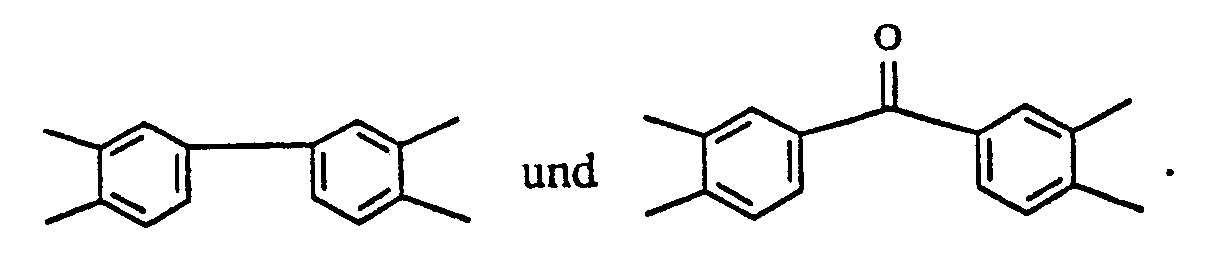
- Der vierwertige Rest R₃ leitet sich von einer Tetracarbonsäure ab, die in der Lage ist, ein Dianhydrid zu bilden.
- Dabei handelt es sich bevorzugt um Reste der Formel
- Der Anteil der Xylylendiaminreste oder der Aminobenzylaminreste oder beiden Typen dieser Reste in den erfindungsgemässen Verbindungen beträgt vorzugsweise 25 bis 75 Mol %, bezogen auf den Anteil aller Diaminreste. Diese Verbindungen zeichnen sich im allgemeinen durch eine besonders gute Löslichkeit in dipolaren, aprotischen Lösungsmitteln aus.
- Von diesen Verbindungen sind diejenigen besonders bevorzugt, worin neben den Xylylendiaminresten und/oder den Aminobenzylaminresten mindestens 25 Mol% der Reste R₂, R₄ und falls vorhanden R₆ sich von Diaminodiphenylsulfon ableiten. Diese Verbindungen zeichnen sich im allgemeinen durch eine nochmals verbesserte Löslichkeit in dipolaren, aprotischen Lösungsmitteln aus.
- Die Erfindung betrifft daher bevorzugt PAPI Blockcopolymere wie oben definiert, dadurch gekennzeichnet, das sich 25 bis 75 Mol %, inbesondere 50 bis 75 Mol % der Reste R₂, R₄ und falls vorhanden R₆ von Xylylendiamin oder von Aminobenzylamin oder von einer Kombination von Xylylendiamin und Aminobenzylamin ableiten, insbesondere von 1,3-Xylylendiamin, und dass sich mindestens 25 Mol % der Reste R₂, R₄ und falls vorhanden R₆ von Diaminodiphenylsulfon ableiten, wobei die Mengenangaben sich auf die Gesamtmenge dieser Reste beziehen.
- In besondere bevorzugten PAPI Blockcopolymeren der vorliegenden Erfindung leiten sich praktisch alle von Xylylendiamin und/oder von Aminobenzylamin abweichenden Reste R₂, R₄ und falls vorhanden R₆ von Diaminodiphenylsulfon ab.
- Die Herstellung der erfindungsgemässen Blockcopolymeren erfolgt auf an sich bekannte Weise, und kann beispielsweise nach einer der in der DE-A-2,342,464 beschriebenen Arbeitsweisen durch Umsetzung vorgeformter Polyamid-, Polyamidamidsäure- und Polyamidsäureblöcke und anschliessende Cyclisierung der Polyamid-Polyamidsäure erfolgen. Eine weitere Herstellungsmethode umfasst die Umsetzung von Polyamidsäuren der Formel IIIa und/oder IIIb

H₂N-R₂-NH₂ (IV),
und mit Dicarbonsäurechloriden der Formel V
Cl-OC-R₁-CO-Cl (V)
und die anschliessende Cyclisierung der so erhaltenen Polyamid-Polyamidsäure Blockcopolymeren. In den Formeln IIIa, IIIb, IV und V haben die Symbole R₁, R₂, R₃, R₄, R₅ und R₆ die oben angegebene Bedeutung und x steht für eine ganze Zahl ≧ 0, bevorzugt für ≧ 1. - Die Herstellung der Polyamidsäuren der Formeln IIIa, bzw. IIIb ist ebenfalls an sich bekannt und erfolgt beispielsweise durch die Umsetzung von Tetracarbonsäureanhydriden der Formel VIa bzw. von Tricarbonsäureanhydriden VIb oder einem entsprechenden Tricarbonsäureanhydridchlorid

- Die Ausgangsprodukte der Formeln IV, V, VIa und VIb sind an sich bekannt und teilweise im Handel erhältlich.
- Durch Wahl der geeigneten Reaktionsbedingungen, wie z.B. durch geeignete Wahl der Molverhältnisse der Reaktionspartner, lassen sich die gewünschten mittleren Molekular gewichte der einzelnen Blöcke einstellen. Diese Auswahl ist dem Fachmann an sich bekannt.
- Die Polykondensation der Di-, Tri- oder Tetracarbonsäurederivate der Formeln IIIa, IIIb, V, VIa oder VIb mit den Diaminen der Formel IV kann auf an sich bekannte Weise vorgenommen werden, vorzugsweise in einem wasserfreien organischen Lösungsmittel und unter Feuchtigkeitsausschluss, z.B. unter Stickstoff bei Temperaturen zwischen -20°C und +50°C, insbesondere etwa -15°C bis +10°C.
- Geeignete organische Lösungsmittel sind beispielsweise N,N-Dimethylacetamid, N,N-Diethylacetamid, N,N-Dimethylformamid, N-Methyl-2-pyrrolidon (NMP), N-Acetyl-2-pyrrolidon, N-Methyl-ε-caprolactam, N,N,N′,N′-Tetramethylharnstoff, Tetrahydrothiophendioxid (Sulfolan) und Dimethylsulfoxid.
- Die Reaktion kann auch in Gemischen solcher Lösungsmittel durchgeführt werden. Andererseits ist es auch möglich, diese bevorzugten Lösungsmittelsysteme mit anderen organischen aprotischen Lösungsmitteln, wie aromatischen, cycloaliphatischen oder aliphatischen, gegebenenfalls chlorierten Kohlenwasserstoffen, beispielsweise Toluol, Xylolen, Cyclohexan, Pentan, Hexan, Petrolether, Dichlormethan, Tetrahydrofuran, Cyclohexanon und Dioxan, zu verdünnen.
- Die Polyamidblöcke können auch mittels Grenzflächen-Polykondensation hergestellt werden.
- Nach Beendigung der Umsetzung lassen sich die Lösungsmittel gewünschtenfalls auf übliche Weise entfernen, beispielsweise durch Abdestillieren, gegebenenfalls unter vermindertem Druck. Die Polyamid-Polyamidsäure Blockcopolymeren können, falls gewünscht, nach an sich bekannten Methoden durch Eingiessen der Reaktionslösung in ein Fällungsmittel, wie Wasser oder aliphatische Kohlenwasserstoffe, z.B. in Petrolether, besonders jedoch in Methanol, Isopropanol, Aceton, beidseitige Ether des Mono-, Di- oder Triethylenglykols oder Acetonitril, ausgefällt und gegebenenfalls getrocknet werden.
- Die Cyclisierung der Polyamid-Polyamidsäure Blockcopolymeren zu den entsprechenden PAPI Blockcopolymeren erfolgt, indem man die Polyamid-Polyamidsäure Blockcopolymeren vorzugsweise ohne vorherige Isolation, d.h. direkt in der oben beschriebenen Reaktionslösung auf Temperaturen zwischen 50 und 300°C erhitzt oder mit einem De hydratisierungsmittel allein oder im Gemisch mit einem tertiären Amin behandelt. In Frage kommen z.B. Essigsäureanhydrid oder Propionsäureanhydrid oder ein Gemisch aus Essigsäureanhydrid und Triethylamin oder Pyridin. Verfahren diser Art sind beispielsweise in der US-A-3,894,114, der US-A-4,124,651 oder der US-A-4,503,285 beschrieben.
- Die erfindungsgemässen Verbindungen können auch hergestellt werden, indem in an sich bekannter Weise zuerst ein Polyamidblock oder Polyamidimidblock aufgebaut wird und anschliessend durch Umsetzung mit Tetracarbonsäureanhydrid und Diamin das Polyamidsäure-Polyamid Blockcopolymere hergestellt wird, das anschliessend cyclisiert wird.
- Die erfindungsgemässen PAPI Blockcopolymeren besitzen eine für die eingangs erwähnte Problemstellung gute Löslichkeit in aprotischen, dipolaren Lösungsmitteln. Sehr gute Löslichkeiten können beispielsweise in N,N-Dimethylacetamid, N,N-Dimethylformamid, N,N-Dimethylacetamid, N-Methyl-2-pyrrolidon, Sulfolan, Dimethylsulfoxid oder γ-Butyrolacton gegebenenfalls unter Erwärmen erzielt werden.
- Es ist zu erwähnen, das im allgemeinen eine hohe Konzentration der polymeren Verbindungen erwünscht ist. Die so hergestellten Lösungen sind im Gegensatz zur Polyamid-Polyamidsäurevorstufe lagerstabil. Das gleiche gilt natürlich auch für den Feststoff selbst.
- Auf diese Weise gelingt die Herstellung von Lösungen, welche im wesentlichen frei von Nebenprodukten und Monomerresten sind. Die Verarbeitung erfolgt äusserst einfach, da kein Cyclisierungsschritt zu durchlaufen ist und damit keine Wasserabspaltung erfolgt, welche zu unerwünschten Effekten und Schädigung des Endprodukts führt. Bei der Anwendung der erfindungsgemässen PAPI Blockcopolymeren muss lediglich das Lösungsmittel entfernt werden und es gelingt die Herstellung von Produkten hoher Qualität und hoher thermischer Stabilität mit der Möglichkeit zu hohen Gebrauchstemperaturen.
- In einem Folgeschritt oder gleichzeitig mit dem Entfernen des Lösungsmittels lassen sich die erfindungsgemässen Copolymeren durch Erhitzen vernetzen. Die Temperaturen für den Vernetzungsschritt sind im allgemeinen, je nach verwendetem Copolymeren, unterschiedlich. In der Regel erhitzt man die Copolymeren oberhalb ihrer Glasumwandlungstemperatur (Tg Wert) oder, im Falle von mehreren Tg Werten, oberhalb ihres niedrigsten, insbesondere oberhalb ihres höchsten Tg Wertes. Tg Werte lassen sich beispielsweise durch Differential Scanning Calorimetry (DSC) bestimmen, wobei hier der "onset Wert" [= Schnittpunkt der verlängerten Basislinie mit der Tangente an die Messkurve im Bereich des steilsten Anstiegs] Verwendung findet. Der Begriff "Glasumwandlungstemperatur" bezieht sich auf die Werte des Polymeren in der jeweiliegen Formulierung. Dabei kann es sich um Werte handeln, die auch unterhalb der Werte für das reine Polymere liegen. So können beispielsweise lösungsmittel- und/oder weichmacherhaltige Polymere Tg Werte aufweisen, die unterhalb der Werte für das reine Polymere liegen. In der Regel erfolgt die Vernetzung bei Temperaturen zwischen 250 und 350°C.
- Die Erfindung betrifft also auch ein Verfahren zur Herstellung von vernetzten PAPI Blockcopolymeren, dadurch gekennzeichnet, dass man die Verbindungen enthaltend Blöcke der oben definierten Formeln Ia und IIb und/oder IIc oder der Formeln Ib und IIa und/oder IIc oder der Formeln Ic und IIa und/oder IIb auf Temperaturen oberhalb ihres Glasumwandlungspunktes erhitzt.
- Ferner betrifft die Erfindung die durch dieses Verfahren erhältlichen vernetzten Produkte.
- Mit dem erfindungsgemässen Verfahren lassen sich auf vorteilhafte Weise Beschichtungen mit einer grossen Schichtdicke oder auch Formkörper herstellen, da die thermische Härtung innerhalb des gesamten vernetzbaren Materials im wesentlichen gleichmässig erfolgt.
- Die definitionsgemässen Blockcopolymeren zeichnen sich durch eine gute Verarbeitbarkeit aus und können zur Herstellung von industriellen Erzeugnissen, wie Fasern, faserverstärkten Verbundwerkstoffen, Schichtkörpern, Giesskörpern, Laminaten, Matrixharzen, Honeycomb-Core Materialien, Lacken, Klebstoffen, Schaumstoffen, Ueberzugsmassen, Filmen (Folien), Press- und Sinterpulvern und Presskörpern verwendet werden.
- Insbesondere lassen sich die erfindungsgemässen Blockcopolymeren zur Herstellung von Beschichtungen, Folien und flexiblen Laminaten oder als Klebstoffe, Matrixharze oder Pressmassen verwenden.
- Dazu können den Blockcopolymeren vor dem Vernetzungsschritt übliche Zusatzstoffe zugegeben werden, wie Pigmente, Füllstoffe, elektrische Leiter, wie beispielsweise Russ oder Metallpartikel, Mittel zur Erhöhung der Abriebfestigkeit, Schmiermittel oder verstärkende Fasern, wie Kohlenstoff-, Bor- oder Glasfasern.
- Schichtkörper, welche die erfindungsgemässen Blockcopolymeren enthalten, können gegebenenfalls mit die Oberflächeneigenschaften verbessernden Ueberzugsschichten, z.B. aus Phenolharzen, Aluminium, versehen werden und finden unter anderem im Flugzeugbau Verwendung.
- Erfindungsgemässe Blockcopolymer, vorzugsweise in Form von Lösungen, können auch als Ueberzugsmassen und Klebstoffe gegebenenfalls unter Zusatz von Pigmenten, wie Titandioxid, üblichen Füll- und Schaumstoffen, zum Beschichten und Ueberziehen von Substraten der verschiedensten Art in beliebiger Form, wie Folien, Fasern, Faservliesen, Drähten, gitterförmigen Strukturen, Geweben, Schaumstoffen, verwendet werden.
- Als geeignete Substrate seinen erwähnt: Metalle oder Legierungen, wie Kupfer, Messing, Aluminium, Eisen oder Stahl; Asbest- oder Glasfasermaterialien; Polymere, wie Cellulosematerialien (Celluloseester oder -ether, Papier); Perfluorkohlenstoffpolymere, z.B. Polytetrafluorethylen, Polyolefine, Polyester, Polyamide, Polyimide oder Polyurethane.
- Die folgenden Beispiele erläutern die Erfindung.
- In einem Doppelmantelreaktionsgefäss mit Schutzgasanschluss, Innenthermometer, Tropftrichter und Rührer werden under Stickstoff 44,13 g 3,3′,4,4′-Biphenyltetracarbonsäuredianhydrid (0,15 Mol) und 250 g N-Methylpyrrolidon (NMP) eingewogen. Das Reaktionsgefäss wird dreimal evakuiert und mit Stickstoff begast. Nach Abkühlen auf -7°C ergibt sich eine Suspension. Über den Tropftrichter wird bei einer Temperatur zwischen -7 und -4°C im Verlauf von 80 Minuten eine Lösung von 15,57 g (0,0635 Mol) 4,4′-Diaminodiphenylsulfon und von 8,52 g (0,0625 Mol) m-Xylylendiamin in 156 g NMP zugegeben. Danach lässt man die Reaktionsmischung auf Raumtemperatur kommen und rührt 2 Stunden nach.
- Die klare Reaktionsmischung wird erneut abgekühlt (-7°C). Über den Tropftrichter werden sodann 62,21 g (0,2500 Mol) 4,4′-Diaminodiphenylsulfon in 300 g NMP im Verlauf von 150 Minuten zugetropft. Im folgenden werden 45,68 g (0,225 Mol) Isophthalsäuredichlorid portionsweise zugegeben, so dass die Innentemperatur 0°C nicht übersteigt. Man benötigt etwa 150 Minuten, wobei die Lösung in zunehmendem Masse viskos wird. Schliesslich wird die Polymerlösung bei Raumtemperatur 50 Minuten gerührt. Man setzt weitere 0,51 g (0,0025 Mol) Isophthalsäure dichlorid zu und rührt 3 Stunden zur Vervollständigung der Polykondensation. Danach gibt man über einen Tropftrichter im Verlauf von 20 Minuten 34,00 g (0,4725 Mol) Butylenoxid zu (Innentemperatur 20-25°C). Man erhält auf diese Weise eine Lösung eines Polyamid-Polyamidsäure-Blockcopolymeren mit einer inhärenten Viskosität von 0,64 dl/g (0,5 Gew.-% an Feststoff in NMP/25°C).
- Die nun vorliegende Polyamid-Polyamidsäure Blockcopolymeren-Lösung wird nun der chemischen Cyclisierung zum Polyamid-Polyimid-Blockcopolymeren unterzogen. Dazu erfolgt über einen Tropftrichter zunächst die Zugabe von 79,69 g (0,7875 Mol) Triethylamin innerhalb von 45 Minuten und dann von 80,40 g (0,7875 Mol) Acetanhydrid innerhalb von 40 Minuten bei 20-25°C. Man lässt nun weitere 6 Stunden bei Raumtemperatur rühren. Die inhärente Viskosität (0,5% Feststoff, NMP, 25°C) eines so hergestellten Polyamid-Polyimid-Blockcopolymeren beträgt 0,74 dl/g.
Ein Teil der oben beschriebenen Lösung wird mit NMP verdünnt, in der 10fachen Menge Ethanol ausgefällt und im Trockenschrank unter Vakuum getrocknet. Die Temperatur wird dabei innerhalb von 72 Stunden stufenweise auf 200°C erhöht und bei dieser Temperatur 8 Stunden belassen. Das Polymere ist nach diesem Trockenprozess zu mehr als 25% in NMP löslich. Die inhärenten Viskosität (0,5%, NMP, 25°C) des Polymeren beträgt 0,60 dl/g. - Eine Lösung des oben beschriebenen Polyamid-Polyimid-Blockcopolymeren mit 25-Gew.-% in NMP wird mittels einer Lackhantel (Höhe 200 µm) auf eine Kupferfolie aufgetragen. Die Hauptmenge des Lösungsmittels wird durch eine 15minütige IR-Bestrahlung entfernt. Die Polymerschicht eines so hergestellten Probestreifens lässt sich durch 30minütiges Eintauchen in NMP nahezu vollständig ablösen. Ein weiterer Probestreifen wird zusätzlich im Vakuum (15 mbar) innerhalb von 30 Minuten von Raumtemperatur auf 300°C und bei dieser Temperatur weitere 30 Minuten erwärmt. Man erhält eine blasenfrei beschichtete, flexible Cu-Folie. Die so behandelte Folie wird gewogen, 30 Minuten in NMP getaucht und erneut gewogen. Dabei zeigt sich ein unverändertes Gewicht, d.h. die Beschichtung wird nicht mehr von NMP angegriffen. Ebenso ist die Oberfläche der Beschichtung vor und nach der NMP-Behandlung unverändert.
- Die in der folgenden Tabelle angegebenen Beispiel 2 - 12 für lösliche Polyamid-Polyimid-Blockcopolymere werden wie unter Beispiel 1 beschrieben hergestellt. In der Tabelle werden die folgenden Abkürzungen verwendet:
ηinh: Inhärente Viscosität gemessen an einer 0,5 gew.%igen Lösung des Polymeren bei 25°C in (NMP),
TGA: Thermogravimetrische Analyse (2 % Gewichtsverlust bei der angegebenen Temperatur unter N₂, Heizrate: 10°C/min),
BTDA: 3,3′,4,4′-Benzophenontetracarbonsäuredianhydrid,
BPDA: 3,3′,4,4′-Biphenyltetracarbonsäuredianhydrid,
IPC: Isophthalsäuredichlorid,
TMAC: Trimellitsäureanhydridchlorid,
mXDA: m-Xylylendiamin,
pXDA: p-Xylylendiamin,
ABA: Aminobenzylamin (Gemisch von m- und p-Isomeren),
mPDA: m-Phenylendiamin
mDDS: 3,3′-Diaminodiphenylsulfon,
pDDS: 4,4′-Diaminodiphenylsulfon.
- Mit diesem Beispiel werden die guten mechanischen Eigenschaften eines mit einem erfindungsgemässen PAPI-Blockcopolymeren hergestellten flexiblen Laminates gezeigt.
- Mittels einer Lackhantel (200 µm) beschichtet man eine Kupferfolie mit einer 25 %igen Lösung des Blockcopolymeren gemäss Synthesebeispiel 1 in N-Methylpyrrolidon. Die Beschichtung wird mit IR-Strahlung (Heraeus Modell MBS 225/125) 45 Minuten lang getrocknet. Die beschichtete Folie wird sodann in 1 cm lange Streifen zerschnitten und das "Flex-Life" des Laminates bestimmt [= Zahl der Faltungen bis zum Bruch des Laminates mittels Universal-Model 2 FDF Flex Ductility Tester (Hersteller: Universal Manufacturing Co.) mit Zuggewicht 224 g und 2 mm Dorn ermittelt]. Dabei ergibt sich für 5 Prüfstreifen ein Mittelwert von 354 Cyclen.
Claims (18)


Applications Claiming Priority (2)
| Application Number | Priority Date | Filing Date | Title |
|---|---|---|---|
| CH37889 | 1989-02-01 | ||
| CH378/89 | 1989-02-01 |
Publications (2)
| Publication Number | Publication Date |
|---|---|
| EP0381621A2 true EP0381621A2 (de) | 1990-08-08 |
| EP0381621A3 EP0381621A3 (de) | 1992-01-02 |
Family
ID=4185656
Family Applications (1)
| Application Number | Title | Priority Date | Filing Date |
|---|---|---|---|
| EP19900810052 Ceased EP0381621A3 (de) | 1989-02-01 | 1990-01-23 | Neue Polymere |
Country Status (4)
| Country | Link |
|---|---|
| EP (1) | EP0381621A3 (de) |
| JP (1) | JPH02233727A (de) |
| KR (1) | KR900012979A (de) |
| CA (1) | CA2008859A1 (de) |
Cited By (5)
| Publication number | Priority date | Publication date | Assignee | Title |
|---|---|---|---|---|
| EP0472421A3 (en) * | 1990-08-23 | 1993-05-26 | Mitsui Toatsu Chemicals, Incorporated | Polyamide-imide resins and process of producing them |
| US9200117B2 (en) | 2011-05-18 | 2015-12-01 | Samsung Electronics Co., Ltd. | Poly(amide-imide) block copolymer, article including same, and display device including the article |
| US9796816B2 (en) | 2011-05-18 | 2017-10-24 | Samsung Electronics Co., Ltd. | Poly(amide-imide) block copolymer, article including same, and display device including the article |
| EP3412732A4 (de) * | 2016-11-17 | 2019-04-17 | LG Chem, Ltd. | Polyimidbasierter blockcopolymerfilm |
| EP3486271A4 (de) * | 2016-12-15 | 2019-10-23 | LG Chem, Ltd. | Polyimidbasiertes blockcopolymer und polyimidbasierter film damit |
Families Citing this family (1)
| Publication number | Priority date | Publication date | Assignee | Title |
|---|---|---|---|---|
| KR101968258B1 (ko) * | 2012-02-07 | 2019-04-12 | 삼성전자주식회사 | 폴리(아미드-이미드) 블록 코폴리머, 이를 포함하는 성형품 및 상기 성형품을 포함하는 디스플레이 장치 |
Family Cites Families (5)
| Publication number | Priority date | Publication date | Assignee | Title |
|---|---|---|---|---|
| CH580125A5 (de) * | 1972-08-25 | 1976-09-30 | Ciba Geigy Ag | |
| US4331799A (en) * | 1980-01-10 | 1982-05-25 | General Electric Company | Copolymers of etherimides and amideimides |
| US4332929A (en) * | 1980-01-30 | 1982-06-01 | General Electric Company | Copolymers of etherimides and amides |
| EP0048219B1 (de) * | 1980-09-15 | 1986-10-01 | Ciba-Geigy Ag | Verwendung von flexiblem Basismaterial zur Herstellung von gedruckten Schaltungen |
| EP0324315A3 (de) * | 1987-12-15 | 1990-07-18 | Ciba-Geigy Ag | Polyamid-Polyimid-Blockcopolymere |
-
1990
- 1990-01-23 EP EP19900810052 patent/EP0381621A3/de not_active Ceased
- 1990-01-30 CA CA002008859A patent/CA2008859A1/en not_active Abandoned
- 1990-01-31 JP JP2021880A patent/JPH02233727A/ja active Pending
- 1990-01-31 KR KR1019900001176A patent/KR900012979A/ko not_active Withdrawn
Cited By (7)
| Publication number | Priority date | Publication date | Assignee | Title |
|---|---|---|---|---|
| EP0472421A3 (en) * | 1990-08-23 | 1993-05-26 | Mitsui Toatsu Chemicals, Incorporated | Polyamide-imide resins and process of producing them |
| US9200117B2 (en) | 2011-05-18 | 2015-12-01 | Samsung Electronics Co., Ltd. | Poly(amide-imide) block copolymer, article including same, and display device including the article |
| US9796816B2 (en) | 2011-05-18 | 2017-10-24 | Samsung Electronics Co., Ltd. | Poly(amide-imide) block copolymer, article including same, and display device including the article |
| EP3412732A4 (de) * | 2016-11-17 | 2019-04-17 | LG Chem, Ltd. | Polyimidbasierter blockcopolymerfilm |
| US10717819B2 (en) | 2016-11-17 | 2020-07-21 | Lg Chem, Ltd. | Polyimide-based block copolymer film |
| EP3486271A4 (de) * | 2016-12-15 | 2019-10-23 | LG Chem, Ltd. | Polyimidbasiertes blockcopolymer und polyimidbasierter film damit |
| US11377556B2 (en) | 2016-12-15 | 2022-07-05 | Lg Chem, Ltd. | Polyimide-based block copolymer and polyimide-based film comprising the same |
Also Published As
| Publication number | Publication date |
|---|---|
| JPH02233727A (ja) | 1990-09-17 |
| EP0381621A3 (de) | 1992-01-02 |
| KR900012979A (ko) | 1990-09-03 |
| CA2008859A1 (en) | 1990-08-01 |
Similar Documents
| Publication | Publication Date | Title |
|---|---|---|
| DE2446383C2 (de) | Von Phenylindandiaminen und -dianhydriden abgeleitete lösliche Polyimide | |
| DE2760336C2 (de) | ||
| DE2366273C3 (de) | Polyamid-Polyimid-Blockcopolymere | |
| DE19756554A1 (de) | Siloxan-Polyimid und ein Siloxan-Polyimid-haltiges, wärmebeständiges Haftmittel | |
| DE2601577C2 (de) | Von Phenylindan-Diaminen sich ableitende, lösliche Polyamid-Imide und Polyamid-Carbonsäuren sowie ein Verfahren zur Herstellung dieser Verbindungen | |
| DE1520616A1 (de) | Polymere Massen | |
| DE2263190A1 (de) | Loesliche polyimide aus aromatischen dianhydriden und 2,4-diaminodiphenylaminen und 2,4-diaminodiphenylsulfiden | |
| EP0245815B1 (de) | Neue lösliche und/oder schmelzbare Polyimide und Polyamidimide | |
| DE2342454C2 (de) | Polyamid-Polyamidsäure-Copolymere und deren Verwendung zur Herstellung von industriellen Erzeugnissen | |
| DE3734475C2 (de) | ||
| EP0324315A2 (de) | Polyamid-Polyimid-Blockcopolymere | |
| AT392974B (de) | Mischpolyimide sowie verfahren zu ihrer herstellung | |
| DE2321513A1 (de) | Loesliche polyimide aus aromatischen dianhydriden und 10,10-di-(p-aminophenyl)thioxanthen | |
| DE69033431T2 (de) | Polyamid-Säure mit dreidimensionaler Netzgittermolekularstruktur, daraus erhaltenes Polyimid und Verfahren zur Herstellung | |
| DE1765738C3 (de) | Isolierender Überzug auf einem elektrischen Leiter | |
| EP0381620A2 (de) | Verfahren zur Herstellung von vernetzten Produkten und neue Polymere | |
| DE68922730T2 (de) | Hexafluoroisopropyliden enthaltende polyimidoligomere und -polymere. | |
| EP0585829B1 (de) | Rekristallisierbare Polyimide | |
| DE2206359A1 (de) | Verfahren zur Herstellung verformbarer COO-silylgruppenhaltiger Polymerer | |
| EP0260709B1 (de) | Neue lösliche und/oder schmelzbare Polyamidimid-Polyimid-Blockcopolymere | |
| EP0381619A1 (de) | Neue Polymere | |
| DE2321527A1 (de) | S-triazin-imid-mischpolymerisate und verfahren zu deren herstellung | |
| EP0379467A2 (de) | Hydroxylgruppen-endständige stickstoffhaltige Polymere | |
| EP0317836A1 (de) | Lösliche und/oder schmelzbare Polyimide und Polyamidimide und Verfahren zu deren Herstellung | |
| DE1520968C3 (de) | Verfahren zur Herstellung von aromatischen Polyamidocarbonsäuren auf Basis der Trimellithsäure |
Legal Events
| Date | Code | Title | Description |
|---|---|---|---|
| PUAI | Public reference made under article 153(3) epc to a published international application that has entered the european phase |
Free format text: ORIGINAL CODE: 0009012 |
|
| 17P | Request for examination filed |
Effective date: 19900125 |
|
| AK | Designated contracting states |
Kind code of ref document: A2 Designated state(s): BE CH DE FR GB IT LI NL SE |
|
| PUAL | Search report despatched |
Free format text: ORIGINAL CODE: 0009013 |
|
| AK | Designated contracting states |
Kind code of ref document: A3 Designated state(s): BE CH DE FR GB IT LI NL SE |
|
| 17Q | First examination report despatched |
Effective date: 19930513 |
|
| STAA | Information on the status of an ep patent application or granted ep patent |
Free format text: STATUS: THE APPLICATION HAS BEEN REFUSED |
|
| 18R | Application refused |
Effective date: 19931101 |