EP0381804A2 - Target für die Herstellung von einer supraleitenden Oxydschicht, Verfahren zu seiner Herstellung sowie Verfahren zur Herstellung einer solchen Schicht - Google Patents
Target für die Herstellung von einer supraleitenden Oxydschicht, Verfahren zu seiner Herstellung sowie Verfahren zur Herstellung einer solchen Schicht Download PDFInfo
- Publication number
- EP0381804A2 EP0381804A2 EP89110308A EP89110308A EP0381804A2 EP 0381804 A2 EP0381804 A2 EP 0381804A2 EP 89110308 A EP89110308 A EP 89110308A EP 89110308 A EP89110308 A EP 89110308A EP 0381804 A2 EP0381804 A2 EP 0381804A2
- Authority
- EP
- European Patent Office
- Prior art keywords
- target
- targets
- metallic copper
- substrate
- oxide film
- Prior art date
- Legal status (The legal status is an assumption and is not a legal conclusion. Google has not performed a legal analysis and makes no representation as to the accuracy of the status listed.)
- Withdrawn
Links
Images

Classifications
-
- C—CHEMISTRY; METALLURGY
- C04—CEMENTS; CONCRETE; ARTIFICIAL STONE; CERAMICS; REFRACTORIES
- C04B—LIME, MAGNESIA; SLAG; CEMENTS; COMPOSITIONS THEREOF, e.g. MORTARS, CONCRETE OR LIKE BUILDING MATERIALS; ARTIFICIAL STONE; CERAMICS; REFRACTORIES; TREATMENT OF NATURAL STONE
- C04B35/00—Shaped ceramic products characterised by their composition; Ceramics compositions; Processing powders of inorganic compounds preparatory to the manufacturing of ceramic products
- C04B35/01—Shaped ceramic products characterised by their composition; Ceramics compositions; Processing powders of inorganic compounds preparatory to the manufacturing of ceramic products based on oxide ceramics
- C04B35/45—Shaped ceramic products characterised by their composition; Ceramics compositions; Processing powders of inorganic compounds preparatory to the manufacturing of ceramic products based on oxide ceramics based on copper oxide or solid solutions thereof with other oxides
-
- C—CHEMISTRY; METALLURGY
- C23—COATING METALLIC MATERIAL; COATING MATERIAL WITH METALLIC MATERIAL; CHEMICAL SURFACE TREATMENT; DIFFUSION TREATMENT OF METALLIC MATERIAL; COATING BY VACUUM EVAPORATION, BY SPUTTERING, BY ION IMPLANTATION OR BY CHEMICAL VAPOUR DEPOSITION, IN GENERAL; INHIBITING CORROSION OF METALLIC MATERIAL OR INCRUSTATION IN GENERAL
- C23C—COATING METALLIC MATERIAL; COATING MATERIAL WITH METALLIC MATERIAL; SURFACE TREATMENT OF METALLIC MATERIAL BY DIFFUSION INTO THE SURFACE, BY CHEMICAL CONVERSION OR SUBSTITUTION; COATING BY VACUUM EVAPORATION, BY SPUTTERING, BY ION IMPLANTATION OR BY CHEMICAL VAPOUR DEPOSITION, IN GENERAL
- C23C14/00—Coating by vacuum evaporation, by sputtering or by ion implantation of the coating forming material
- C23C14/06—Coating by vacuum evaporation, by sputtering or by ion implantation of the coating forming material characterised by the coating material
- C23C14/08—Oxides
- C23C14/087—Oxides of copper or solid solutions thereof
-
- C—CHEMISTRY; METALLURGY
- C23—COATING METALLIC MATERIAL; COATING MATERIAL WITH METALLIC MATERIAL; CHEMICAL SURFACE TREATMENT; DIFFUSION TREATMENT OF METALLIC MATERIAL; COATING BY VACUUM EVAPORATION, BY SPUTTERING, BY ION IMPLANTATION OR BY CHEMICAL VAPOUR DEPOSITION, IN GENERAL; INHIBITING CORROSION OF METALLIC MATERIAL OR INCRUSTATION IN GENERAL
- C23C—COATING METALLIC MATERIAL; COATING MATERIAL WITH METALLIC MATERIAL; SURFACE TREATMENT OF METALLIC MATERIAL BY DIFFUSION INTO THE SURFACE, BY CHEMICAL CONVERSION OR SUBSTITUTION; COATING BY VACUUM EVAPORATION, BY SPUTTERING, BY ION IMPLANTATION OR BY CHEMICAL VAPOUR DEPOSITION, IN GENERAL
- C23C14/00—Coating by vacuum evaporation, by sputtering or by ion implantation of the coating forming material
- C23C14/22—Coating by vacuum evaporation, by sputtering or by ion implantation of the coating forming material characterised by the process of coating
- C23C14/34—Sputtering
- C23C14/3407—Cathode assembly for sputtering apparatus, e.g. Target
- C23C14/3414—Metallurgical or chemical aspects of target preparation, e.g. casting, powder metallurgy
-
- H—ELECTRICITY
- H10—SEMICONDUCTOR DEVICES; ELECTRIC SOLID-STATE DEVICES NOT OTHERWISE PROVIDED FOR
- H10N—ELECTRIC SOLID-STATE DEVICES NOT OTHERWISE PROVIDED FOR
- H10N60/00—Superconducting devices
- H10N60/01—Manufacture or treatment
- H10N60/0268—Manufacture or treatment of devices comprising copper oxide
- H10N60/0296—Processes for depositing or forming copper oxide superconductor layers
- H10N60/0408—Processes for depositing or forming copper oxide superconductor layers by sputtering
-
- Y—GENERAL TAGGING OF NEW TECHNOLOGICAL DEVELOPMENTS; GENERAL TAGGING OF CROSS-SECTIONAL TECHNOLOGIES SPANNING OVER SEVERAL SECTIONS OF THE IPC; TECHNICAL SUBJECTS COVERED BY FORMER USPC CROSS-REFERENCE ART COLLECTIONS [XRACs] AND DIGESTS
- Y10—TECHNICAL SUBJECTS COVERED BY FORMER USPC
- Y10S—TECHNICAL SUBJECTS COVERED BY FORMER USPC CROSS-REFERENCE ART COLLECTIONS [XRACs] AND DIGESTS
- Y10S505/00—Superconductor technology: apparatus, material, process
- Y10S505/725—Process of making or treating high tc, above 30 k, superconducting shaped material, article, or device
- Y10S505/73—Vacuum treating or coating
- Y10S505/731—Sputter coating
-
- Y—GENERAL TAGGING OF NEW TECHNOLOGICAL DEVELOPMENTS; GENERAL TAGGING OF CROSS-SECTIONAL TECHNOLOGIES SPANNING OVER SEVERAL SECTIONS OF THE IPC; TECHNICAL SUBJECTS COVERED BY FORMER USPC CROSS-REFERENCE ART COLLECTIONS [XRACs] AND DIGESTS
- Y10—TECHNICAL SUBJECTS COVERED BY FORMER USPC
- Y10S—TECHNICAL SUBJECTS COVERED BY FORMER USPC CROSS-REFERENCE ART COLLECTIONS [XRACs] AND DIGESTS
- Y10S505/00—Superconductor technology: apparatus, material, process
- Y10S505/725—Process of making or treating high tc, above 30 k, superconducting shaped material, article, or device
- Y10S505/736—From free metal precursors
Definitions
- the present invention relates to a target used for forming a superconductive oxide film on a substrate by using a co-sputtering technique, a process for producing the same, and a process of forming a superconductive oxide film on a substrate by using the same.
- a superconductive oxide film in the Y-Ba-Cu-O system on a substrate by using the co-sputtering technique, three kinds of targets, namely a metallic copper target, a Y2O3 target and a BaCuO2 target, are used for depositing the superconductive oxide film on the substrate disposed in facing relationship with the targets, and the composition of the superconductive oxide is adjustable by independently controlling the powers applied between the shield plates and the targets, respectively.
- the co-sputtering system requires another set of the targets, i.e., a metallic copper target, a metallic bismuth target and a SrCaCu2O4 target. These targets are subjected to bombardments of, for example, argon ions and, accordingly, sputtered to deposit the superconductive oxide film on a substrate.
- a metallic copper target, a Tl2O3 target and a BaCaCu2O4 target are installed in the sputtering chamber for formation of a superconductive oxide film in the Tl-Ba-Ca-Cu-O system, and these targets are simultaneously sputtered with the bombardments of the argon ions.
- the above-mentioned BaCuO2, SrCaCu2O4 and BaCaCu2O4 targets are produced through the following process sequences.
- the process sequences start with preparation of powders of barium carbonate, strontium carbonates, the calcium carbonate and copper oxide which are not greater than 10 microns in average diameter.
- the powders of the barium carbonate and the copper oxide are regulated to a predetermined proportion and mixed with each other.
- the mixture is calcined at 850 to 950 degrees in centigrade for 10 hours, and the calcined product is pulverized.
- the calcination and the pulverization are repeated twice or three times to produce a powder of BaCuO2.
- the powder of BaCuO2 is formed into a target by using a hot-pressing technique under the following conditions: Atmosphere: a reduced pressure of not greater than 10 ⁇ 2 torr Heating temperature: 600 to 900 degrees in centigrade
- Compacting pressure 50 to 300 kgf/cm2 Heating time: 2 to 10 hours
- the powders of strontium carbonate, calcium carbonate and copper oxide are regulated to a predetermined proportion and mixed with one another. Then, the resulting mixture is calcined at 850 to 950 degrees in centigrade for a certain period of time, and the calcined product is pulverized. The calcination and the pulverization are repeated twice or three times to produce a powder of SrCaCu2O4. Subsequently, the powder of SrCaCu2O4 is formed into a target by using the hot-pressing technique under the similar conditions to the BaCuO2 target.
- the powders of barium carbonate, calcium carbonate and copper oxide are regulated into a predetermined proportion and mixed with one another. Then, the resulting mixture is calcined at 850 to 950 degrees in centigrade for a certain period of time, and the calcined product is pulverized. The calcination and the pulverization are repeated twice or three times to produce a powder of BaCaCu2O4. Subsequently, the powder of BaCaCu2O4 is formed into a target by using the hot-pressing technique under the similar conditions to the BaCuO2.
- the prior art targets are merely composed of an oxide such as BaCuO2, SrCaCu2O4 and BaCaCu2O4, respectively, and, for this reason, a problem is encountered in each of the prior art targets in low thermal conductivity.
- a large difference in temperature takes place between the sputtered surface of the target and the cooled surface thereof exposed to the associated cooling system, so that cracks are liable to be produced in the target due to the thermal stress during the sputtering.
- the prior art target is thus short in service life, so that the superconductive oxide film is large in the production cost.
- the prior art targets are low in mechanical strength and, accordingly, brittle, so that a meticulous care is necessary for handling the prior art target.
- the prior art target is much liable to be broken due to careless handling and suffers from short service life. This also increases the production cost of the superconductive oxide film.
- the present invention proposes to disperse metallic copper over a complex oxide used for formation of the target.
- a target used for forming a thin film of a superconductive oxide the target being formed of a composite material containing an oxygen compound and metallic copper ranging between about 5 % and about 40 % by volume, in which the superconductive oxide contains all of the elements of the complex oxide, and in which the metallic copper is dispersed in the complex oxide.
- the oxygen compound may of a ternary compound containing barium, copper and oxygen represented by the molecular formula of BaCuO2, a quaternary compound containing strontium, calcium, copper and oxygen represented by the molecular formula of SrCaCu2O4, or a quaternary compound containing barium, calcium, copper and oxygen represented by the molecular formula of BaCaCu2O4.
- a process of producing a target used for forming a superconductive oxide film comprising the steps of: a) preparing powders of ingredient compounds and metallic copper; b) mixing the powders into a predetermined proportion where the metallic copper is fallen within the range between about 5 % and about 40 % by volume; and c) forming the mixed powders into a target.
- the mixed powders may be formed into a target by using a hot pressing.
- a process of forming a superconductive oxide film comprising the steps of: a) preparing a DC sputtering system, a substrate, and targets one of which is made of an oxygen compound containing metallic copper ranging between about 5 % and about 40 % by volume; b) placing the targets on target retainers of the DC sputtering system, respectively, in such a manner as to be spaced apart from the substrate on a substrate holder of the DC sputtering system by a certain distance; c) simultaneously sputtering the targets to deposit a thin film of a complex oxide on the substrate; and d) annealing the thin film in a high temperature ambient.
- each of the targets is formed of a composite material containing metallic copper ranging from about 5 % to about 40 % by volume and an oxygen compound of about 60 % to about 95 % by volume.
- the oxygen compound is selected from the group consisting substances represented by the molecular formulae of BaCuO2, SrCaCu2O4 and BaCaCu2O4. If the metallic copper content is less than 5 % by volume, the desired thermal conductivity, resistivity and mechanical strength can not be achieved. On the other hand, if the metallic copper content is more than 40 % by volume, the superconductive oxide contains too much copper to have the composition appropriate for achievement of a high critical temperature.
- the compound oxide is uniformly dispersed in metallic copper as shown in Fig. 1, wherein reference numeral 1 designates the oxygen compound, and reference numeral 2 designates metallic copper.
- Each of the targets is advantageously produced by mixing about 5 to about 40 % by volume of metallic copper with about 60 to about 95 % by volume of each oxygen compound described above followed by the hot-pressing in a vacuum ambient at about 600 to about 900 degrees in centigrade under a compacting pressure of about 50 kgf/cm2 to about 300 kgf/cm2.
- Various targets are produced through the process sequence, and miscellaneous sub stances may be contained in the targets.
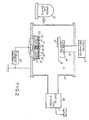
- each of the targets thus prepared is used for forming the superconductive oxide film on a substrate placed in a co-sputtering system exemplified in Fig. 2.
- reference numeral 11 designates a sputtering chamber defined by walls 12.
- a driving shaft 12 projects from the outside of the chamber 11 and is coupled at one end thereof to a driving mechanism 13 and at the other end thereof to a planetary gearing 14.
- the planetary gearing 14 is provided in association with a substrate holder 15 where a substrate 16 is disposed.
- the substrate 16 thus disposed on the holder 15 not only revolutes on the center axis thereof but also turns around the center axis of the driving shaft 12 through the orbital motion.
- the dual motions are conducive to a uniform composition of a thin film deposited on the substrate 16.
- each of the target retainers is constituted by a backing plate 20, a magnet unit 21 attached to the backing plate 20 and an earth shield member 22, and the backing plate 20 and the magnet unit 21 as a whole provide a conduit where a coolant passes.
- a D.C. current source 23 is coupled between the earth shield members 22 and the backing plates 20 in a parallel manner, and the earth shield members 22 is further grounded. By virtue of this coupling, the earth shield members 22 are fixed to the ground voltage level, and a negative voltage level is supplied to the backing plates 20 and, accordingly, to the targets 17 to 19.
- the target retainers thus arranged are located in such a manner as to face to an area defined by the orbit on which the substrate 16 turns. Therefore, the substrate successively passes through respective fluxes of sputtered particles from the targets 17 to 19.
- the sputtering chamber 11 is coupled to an evacuation system 24 so as to create a vacuum ambient, and an argon gas source 25 is conducted to the sputtering chamber 11 for supplying an argon gas.
- the argon gas may be replaced with a gaseous mixture of argon and oxygen.
- the target 17 of the present invention as well as two other kinds of targets 18 and 19 are fixed to the target retainers, respectively, and the substrate 16 is placed on a suitable position on the substrate holder 15 at a predetermined distance to the targets 17, 18 and 19.
- the sputtering chamber 11 is then evacuated by using the evacuation system 24, and charged with the argon gas or a gaseous mixture of argon and oxygen supplied from the gas source 25. Thereafter, a predetermined difference in voltage level is applied between the earth shield plates 22 and the targets 17, 18 and 19, then the argon gas is ionized by the agency of an electric field produced around the targets 17 to 19, and the argon ions are directed to the targets 17 to 19, respectively.
- the targets 17 to 19 are respectively subjected to bombardments of the argon ions, the targets 17 to 19 are simultaneously sputtered to produce the fluxes of the particles, and the fluxes are successively fallen onto the substrate 16 driven for rotation.
- the particles of the fluxes are deposited on the substrate 16, and the substrate 16 is finally covered with a complex oxide which is annealed in the later stage.
- the complex oxide thus produced shows the superconductivity at a relatively high critical temperature.
- the powder of BaCuO2 is produced through the process sequence used in the formation of the prior art target, and the powder is about 5 microns in average diameter.
- Another powder of metallic copper is further prepared for formation of a target according to the present invention.
- the powder of the metallic powder is about 99.999 % in purity and about 18.0 microns in average diameter.
- Both of the powders are regulated to respective proportions indicated in Table 1, and these regulated powders are mixed with each other by using a rotary ball mill for 30 minutes. Then, mixtures 1 to 7 are formed for the subsequent stage. Each of the resulting mixtures is confined in an internal space of a mold, and the internal space is initially about 5 centimeters in diameter and about 3.0 centimeters in thickness.
- the mixtures are subjected to hot pressing under the following conditions to produce targets each measuring about 5 centimeters in diameter and about 0.4 centimeter in thickness: Atmosphere: a reduced pressure of about 10 ⁇ 2 torr Heating temperature: about 850 degrees in centigrade Compacting pressure: about 200 kgf/cm2 Heating time period: about 4 hours
- targets 1 to 7 The targets produced from the mixtures 1 to 7 are hereinbelow referred to as "targets 1 to 7", respectively.
- the thermal conductivity, the electrical resistivity and the mechanical strength are measured for the respective targets thus produced, and the results are shown in Table 2.
- the thermal conductivity is used for evaluation of a cooling efficiency, and the mechanical strength is represented by the flexural strength.
- the surface of the target 4 is buffed and, then, observed with an optical microscope.
- the surface is sketched through the optical microscope as illustrated in Fig. 1.
- the oxygen compound BaCuO2 is uniformly dispersed in the metallic copper 2.
- the targets 1 to 7 are respectively co-sputtered together with a metallic copper target and an yttria target Y2O3 both adjusted to be equal in size to the targets 1 to 7, and the co-sputterings are carried out in the following circumstances to deposit thin films of respective complex oxides to a thickness of about 0.7 microns: Total pressure of atmosphere: about 20 milli-torr; Atmosphere: gaseous mixture of argon and oxygen mixed in the proportion of 3 : 1; Electric power: about 50 W; Substrate used: MgO single-crystalline substrate; Heating temperature of substrate: about 700 degrees in centigrade; Sputtering time: about 2 hours.
- the reason why the metallic copper target participates in the co-sputtering is that excess copper atoms are needed to adjust the composition of the complex oxide to a desirable proportion due to the reverse sputtering phenomenon.
- the powder of the oxygen compound represented by the molecular formula of SrCaCu2O4 is prepared through the process sequence described in connection with the prior art target, and the powder of metallic copper is also prepared for production of targets according to the present invention.
- the powder of the oxygen compound is about 5 microns in average diameter, and the metallic copper powder is about 18.0 microns in average diameter.
- These powders are regulated to respective proportions indicated in Table 3 and then mixed with each other by using a rotary ball mill for about 30 minutes to produce mixtures represented by numbers 8 to 14, respectively.
- the mixtures 8 to 14 are hot- pressed in the similar manner to the mixtures 1 to 7, and targets 8 to 14 are respectively produced from the mixtures 8 to 14.
- Each of the targets 8 to 14 is about 5 centimeters in diameter and about 0.4 centimeter thick.
- the thermal conductivity, the electrical resistivity and the mechanical strength are measured for the respective targets 8 to 14 thus produced, and the results are shown in Table 4.
- the thermal conductivity is used for evaluation of a cooling efficiency, and the mechanical strength is represented by the flexural strength.
- the surface of the target 11 is buffed and, then, observed with an optical microscope. The similar surface to that illustrated in Fig. 1 are observed. This means that the compound SrCaCu2O4 is uniformly dispersed in the metallic copper.
- the targets 8 to 14 are respectively co-sputtered together with a metallic copper target and a metallic bismuth target both adjusted to be equal in size to the targets 8 to 14, and the co-sputterings are carried out in the similar circumstances to the targets 1 to 7.
- the thin films are about 0.7 micron thick.
- the mixtures 8,9 and 14 and, accordingly, the targets 8, 9 and 14 are out of the scope of the present invention, because of the metallic copper contents.
- the thermal conductivity, the electric resistivity and the mechanical strength are improved without any sacrifice of the critical temperature in so far as the copper contents are fallen within the range between about 5 % and about 40 % by volume.
- Table 3 Mixture No. Composition of powders (% by volume) SrCaCu2O4 powder Metallic Cu powder 8 100 --- 9 98 2 10 95 5 11 90 10 12 80 20 13 60 40 14 50 50 (blank)
- the powder of the oxygen compound represented by the molecular formula of BaCaCu2O4 is prepared through the process sequence described in connection with the prior art target, and the powder of metallic copper is also prepared for production of targets according to the present invention.
- the powder of the oxygen compound is about 5 microns in average diameter, and the metallic copper powder is about 18.0 microns in average diameter.
- These powders are regulated to respective proportions indicated in Table 5 and then mixed with each other by using a rotary ball mill for about 30 minutes to produce mixtures represented by numbers 15 to 21, respectively.
- the mixtures 15 to 21 are hot- pressed in the similar manner to the mixtures 1 to 7, and targets 15 to 21 are respectively produced from the mixtures 15 to 21.
- Each of the targets 15 to 21 is about 5 centimeters in diameter and about 0.4 centimeter thick.
- the thermal conductivity, the electrical resistivity and the mechanical strength are measured for the respective targets 15 to 21 thus produced, and the results are shown in Table 6.
- the thermal conductivity is used for evaluation of a cooling efficiency, and the mechanical strength is represented by the flexural strength.
- the surface of the target 18 is observed with an optical microscope, and it is confirmed that the compound BaCaCu2O4 is uniformly dispersed in the metallic copper.
- the targets 15 to 21 are respectively co-sputtered together with a metallic copper target and a thallium oxide target both adjusted to be equal in size to the targets 15 to 21, and the co-sputterings are carried out in the similar circumstances to the targets 1 to 7.
- the thin films are about 0.7 micron thick.
- the mixtures 15, 16 and 21 and, accordingly, the targets 15, 16 and 21 are out of the scope of the present invention, because of the metallic copper contents.
- the thermal conductivity, the electric resistivity and the mechanical strength are improved without any sacrifice of the critical temperature in so far as the copper contents are fallen within the range between about 5 % and about 40 % by volume.
- Table 5 Mixture No. Composition of powders (% by volume) BaCaCu2O4 powder Metallic Cu powder 15 100 --- 16 98 2 17 95 5 18 90 10 19 80 20 20 60 40 21 50 50 (blank)
- the targets containing the metallic copper between about 5 % and about 40 % by volume are improved in the thermal conductivity, and, for this reason, cracks are less liable to take place in the targets.
- the electric resistivity is decreased by the agency of the metallic copper, so that each of the targets is usable in a DC co-sputtering system. Since the mechanical strength is increased, the target according to the present invention is less liable to be broken due to a careless handling of the operator.
Landscapes
- Chemical & Material Sciences (AREA)
- Engineering & Computer Science (AREA)
- Organic Chemistry (AREA)
- Materials Engineering (AREA)
- Mechanical Engineering (AREA)
- Metallurgy (AREA)
- Chemical Kinetics & Catalysis (AREA)
- Manufacturing & Machinery (AREA)
- Ceramic Engineering (AREA)
- Structural Engineering (AREA)
- Inorganic Compounds Of Heavy Metals (AREA)
- Physical Vapour Deposition (AREA)
- Compositions Of Oxide Ceramics (AREA)
- Superconductors And Manufacturing Methods Therefor (AREA)
Applications Claiming Priority (2)
| Application Number | Priority Date | Filing Date | Title |
|---|---|---|---|
| JP1031911A JPH02212351A (ja) | 1989-02-10 | 1989-02-10 | 超電導セラミックス膜形成用ターゲット材 |
| JP31911/89 | 1989-02-10 |
Publications (2)
| Publication Number | Publication Date |
|---|---|
| EP0381804A2 true EP0381804A2 (de) | 1990-08-16 |
| EP0381804A3 EP0381804A3 (de) | 1990-11-07 |
Family
ID=12344164
Family Applications (1)
| Application Number | Title | Priority Date | Filing Date |
|---|---|---|---|
| EP19890110308 Withdrawn EP0381804A3 (de) | 1989-02-10 | 1989-06-07 | Target für die Herstellung von einer supraleitenden Oxydschicht, Verfahren zu seiner Herstellung sowie Verfahren zur Herstellung einer solchen Schicht |
Country Status (4)
| Country | Link |
|---|---|
| US (1) | US4968665A (de) |
| EP (1) | EP0381804A3 (de) |
| JP (1) | JPH02212351A (de) |
| KR (1) | KR950011339B1 (de) |
Cited By (1)
| Publication number | Priority date | Publication date | Assignee | Title |
|---|---|---|---|---|
| CN118308692A (zh) * | 2024-04-08 | 2024-07-09 | 南京大学 | 一种在金属软基带上制备(Cu,C)Ba2Can-1CunO2n+3超导薄膜的方法 |
Families Citing this family (11)
| Publication number | Priority date | Publication date | Assignee | Title |
|---|---|---|---|---|
| EP0377073A3 (de) * | 1988-12-07 | 1990-11-07 | Mitsubishi Materials Corporation | Sputter-Target für die Herstellung von Supraleitendem Oxyd aus fünf Elementen |
| EP0462906B1 (de) * | 1990-06-21 | 1996-04-24 | Sumitomo Electric Industries, Ltd. | Prozess und Apparat zur Herstellung supraleitender Dünnschichten |
| US5196400A (en) * | 1990-08-17 | 1993-03-23 | At&T Bell Laboratories | High temperature superconductor deposition by sputtering |
| US5145713A (en) * | 1990-12-21 | 1992-09-08 | Bell Communications Research, Inc. | Stoichiometric growth of compounds with volatile components |
| US5087297A (en) * | 1991-01-17 | 1992-02-11 | Johnson Matthey Inc. | Aluminum target for magnetron sputtering and method of making same |
| CA2131791A1 (en) * | 1992-03-13 | 1993-09-16 | Dean W. Face | Process for producing thin films of inorganic oxides of controlled stoichiometry |
| US6749103B1 (en) | 1998-09-11 | 2004-06-15 | Tosoh Smd, Inc. | Low temperature sputter target bonding method and target assemblies produced thereby |
| KR100642034B1 (ko) * | 1998-09-11 | 2006-11-03 | 토소우 에스엠디, 인크 | 저온 스퍼터 타겟 접착방법 및 이 방법으로 제조된 타겟조립체 |
| JP4516199B2 (ja) | 2000-09-13 | 2010-08-04 | キヤノンアネルバ株式会社 | スパッタ装置及び電子デバイス製造方法 |
| US8158096B2 (en) * | 2008-09-19 | 2012-04-17 | The United States Of America, As Represented By The Secretary Of The Navy | Barium copper sulfur fluoride transparent conductive thin films and bulk material |
| CN115148889B (zh) * | 2022-07-13 | 2025-11-07 | 深圳大学 | 一种高质量柔性n型Cu掺杂锑化铋热电薄膜及其制备方法 |
Family Cites Families (5)
| Publication number | Priority date | Publication date | Assignee | Title |
|---|---|---|---|---|
| JPH0772349B2 (ja) * | 1987-05-12 | 1995-08-02 | 住友電気工業株式会社 | 大面積化合物薄膜の作製方法および装置 |
| JPS63307111A (ja) * | 1987-06-08 | 1988-12-14 | Matsushita Electric Ind Co Ltd | 導電体の製造方法 |
| JPH0717480B2 (ja) * | 1987-06-15 | 1995-03-01 | 古河電気工業株式会社 | 高温超伝導体膜の製造方法 |
| JPS644466A (en) * | 1987-06-26 | 1989-01-09 | Matsushita Electric Industrial Co Ltd | Manufacture of thin-film superconductor |
| JPH01252573A (ja) * | 1987-12-09 | 1989-10-09 | Mitsubishi Metal Corp | 超電導膜形成用ターゲット材 |
-
1989
- 1989-02-10 JP JP1031911A patent/JPH02212351A/ja active Pending
- 1989-02-10 KR KR1019890010108A patent/KR950011339B1/ko not_active Expired - Fee Related
- 1989-06-07 EP EP19890110308 patent/EP0381804A3/de not_active Withdrawn
- 1989-06-08 US US07/363,010 patent/US4968665A/en not_active Expired - Fee Related
Cited By (1)
| Publication number | Priority date | Publication date | Assignee | Title |
|---|---|---|---|---|
| CN118308692A (zh) * | 2024-04-08 | 2024-07-09 | 南京大学 | 一种在金属软基带上制备(Cu,C)Ba2Can-1CunO2n+3超导薄膜的方法 |
Also Published As
| Publication number | Publication date |
|---|---|
| JPH02212351A (ja) | 1990-08-23 |
| EP0381804A3 (de) | 1990-11-07 |
| KR950011339B1 (ko) | 1995-09-30 |
| US4968665A (en) | 1990-11-06 |
| KR900013532A (ko) | 1990-09-06 |
Similar Documents
| Publication | Publication Date | Title |
|---|---|---|
| US4950642A (en) | Method for fabricating superconducting oxide thin films by activated reactive evaporation | |
| US4968665A (en) | Target used for formation of superconductive oxide film, process of producing thereof, and process of forming superconductive oxide film on substrate using the same | |
| CA1338202C (en) | Chemical vapor deposition of oxide films containing alkaline earth metals from metal-organic sources | |
| KR0132061B1 (ko) | 초전도 박막의 제작 방법 | |
| EP0292958B1 (de) | Verfahren zur Herstellung einer dünnen Schicht aus supraleitendem Mischoxid | |
| EP0390499A2 (de) | Verfahren zur Herstellung von supraleitendem Material auf Bismuth-Basis | |
| EP0462902B1 (de) | Verfahren und Apparat zur Herstellung supraleitender Dünnschichten | |
| EP0277885B1 (de) | Verfahren zum Herstellen einer supraleitenden Dünnschicht | |
| US4900710A (en) | Process of depositing an alkali metal layer onto the surface of an oxide superconductor | |
| EP0358545B1 (de) | Prozess zur Herstellung thalliumartiger supraleitender Dünnfilme | |
| EP0526326A2 (de) | Verfahren zur Herstellung einer supraleitenden Dünnschicht aus Oxydverbindungen | |
| US5049452A (en) | Target member used for formation of superconducting film | |
| Moodera et al. | In situ deposition of superconducting Bi‐Pb‐Sr‐Ca‐Cu‐O thin films on MgO (100) substrates by rf magnetron sputtering and laser ablation | |
| US5077269A (en) | Sputtering target used for forming quinary superconductive oxide | |
| EP0338556B1 (de) | Target aus supraleitenden Oxyd mit geringem Widerstand | |
| EP0357509A1 (de) | Verfahren zum Herstellen eines Mischoxid-Supraleiters vom Thallium-Typ | |
| EP0412007A2 (de) | Verfahren zur Herstellung eines dünnen supraleitenden Films | |
| JP2567446B2 (ja) | 超電導薄膜の作製方法 | |
| JP2525852B2 (ja) | 超電導薄膜の作製方法 | |
| Shah et al. | Growth of YBa2Cu3O70 x thin films by sputtering | |
| JP2557446B2 (ja) | 複合酸化物系超電導薄膜の製造方法 | |
| JP2639510B2 (ja) | 超電導薄膜の作製方法 | |
| JP2501614B2 (ja) | 超電導薄膜の作製方法 | |
| Tachikawa et al. | High-Tc superconducting films of Y-Ba-Cu oxide prepared by a CO2 laser beam evaporation | |
| KR950007088B1 (ko) | Bi-Sr-Ca-Cu-O계 초전도막형성용 타아겟재 |
Legal Events
| Date | Code | Title | Description |
|---|---|---|---|
| PUAI | Public reference made under article 153(3) epc to a published international application that has entered the european phase |
Free format text: ORIGINAL CODE: 0009012 |
|
| AK | Designated contracting states |
Kind code of ref document: A2 Designated state(s): DE FR GB |
|
| PUAL | Search report despatched |
Free format text: ORIGINAL CODE: 0009013 |
|
| AK | Designated contracting states |
Kind code of ref document: A3 Designated state(s): DE FR GB |
|
| 17P | Request for examination filed |
Effective date: 19901116 |
|
| RAP1 | Party data changed (applicant data changed or rights of an application transferred) |
Owner name: MITSUBISHI MATERIALS CORPORATION |
|
| 17Q | First examination report despatched |
Effective date: 19930707 |
|
| STAA | Information on the status of an ep patent application or granted ep patent |
Free format text: STATUS: THE APPLICATION IS DEEMED TO BE WITHDRAWN |
|
| 18D | Application deemed to be withdrawn |
Effective date: 19940118 |