EP0381828B1 - Ermüdungsrissbeständige Nickelbasissuperlegierung - Google Patents
Ermüdungsrissbeständige Nickelbasissuperlegierung Download PDFInfo
- Publication number
- EP0381828B1 EP0381828B1 EP89121769A EP89121769A EP0381828B1 EP 0381828 B1 EP0381828 B1 EP 0381828B1 EP 89121769 A EP89121769 A EP 89121769A EP 89121769 A EP89121769 A EP 89121769A EP 0381828 B1 EP0381828 B1 EP 0381828B1
- Authority
- EP
- European Patent Office
- Prior art keywords
- alloy
- crack
- rate
- stress
- alloys
- Prior art date
- Legal status (The legal status is an assumption and is not a legal conclusion. Google has not performed a legal analysis and makes no representation as to the accuracy of the status listed.)
- Expired - Lifetime
Links
- 229910000601 superalloy Inorganic materials 0.000 title description 24
- PXHVJJICTQNCMI-UHFFFAOYSA-N Nickel Chemical compound [Ni] PXHVJJICTQNCMI-UHFFFAOYSA-N 0.000 title description 13
- 229910052759 nickel Inorganic materials 0.000 title description 6
- 239000000956 alloy Substances 0.000 claims description 92
- 229910045601 alloy Inorganic materials 0.000 claims description 91
- 239000004615 ingredient Substances 0.000 claims description 19
- 239000000203 mixture Substances 0.000 claims description 19
- 230000035882 stress Effects 0.000 description 37
- 238000001816 cooling Methods 0.000 description 12
- 125000004122 cyclic group Chemical group 0.000 description 12
- 238000000034 method Methods 0.000 description 11
- 238000012360 testing method Methods 0.000 description 11
- 239000011651 chromium Substances 0.000 description 10
- 239000000463 material Substances 0.000 description 8
- VYZAMTAEIAYCRO-UHFFFAOYSA-N Chromium Chemical compound [Cr] VYZAMTAEIAYCRO-UHFFFAOYSA-N 0.000 description 7
- 229910052804 chromium Inorganic materials 0.000 description 7
- 230000005764 inhibitory process Effects 0.000 description 6
- 239000002244 precipitate Substances 0.000 description 6
- 238000005336 cracking Methods 0.000 description 5
- 230000003068 static effect Effects 0.000 description 5
- 230000008859 change Effects 0.000 description 4
- 239000010955 niobium Substances 0.000 description 4
- 238000004663 powder metallurgy Methods 0.000 description 4
- 238000005275 alloying Methods 0.000 description 3
- 230000015572 biosynthetic process Effects 0.000 description 3
- 238000013461 design Methods 0.000 description 3
- 238000011161 development Methods 0.000 description 3
- 230000018109 developmental process Effects 0.000 description 3
- 230000006872 improvement Effects 0.000 description 3
- 238000002360 preparation method Methods 0.000 description 3
- 238000005728 strengthening Methods 0.000 description 3
- 101100117236 Drosophila melanogaster speck gene Proteins 0.000 description 2
- 229910001295 No alloy Inorganic materials 0.000 description 2
- 230000004075 alteration Effects 0.000 description 2
- 230000000052 comparative effect Effects 0.000 description 2
- 239000000470 constituent Substances 0.000 description 2
- 230000003247 decreasing effect Effects 0.000 description 2
- 238000010438 heat treatment Methods 0.000 description 2
- 238000004519 manufacturing process Methods 0.000 description 2
- 238000005259 measurement Methods 0.000 description 2
- 239000000843 powder Substances 0.000 description 2
- 238000012545 processing Methods 0.000 description 2
- 239000000047 product Substances 0.000 description 2
- 229910052702 rhenium Inorganic materials 0.000 description 2
- WUAPFZMCVAUBPE-UHFFFAOYSA-N rhenium atom Chemical compound [Re] WUAPFZMCVAUBPE-UHFFFAOYSA-N 0.000 description 2
- 230000036962 time dependent Effects 0.000 description 2
- 238000011282 treatment Methods 0.000 description 2
- 229910052727 yttrium Inorganic materials 0.000 description 2
- VWQVUPCCIRVNHF-UHFFFAOYSA-N yttrium atom Chemical compound [Y] VWQVUPCCIRVNHF-UHFFFAOYSA-N 0.000 description 2
- 229910000967 As alloy Inorganic materials 0.000 description 1
- 238000007792 addition Methods 0.000 description 1
- 230000032683 aging Effects 0.000 description 1
- 230000009286 beneficial effect Effects 0.000 description 1
- 239000000919 ceramic Substances 0.000 description 1
- 238000006243 chemical reaction Methods 0.000 description 1
- 238000010276 construction Methods 0.000 description 1
- 230000007423 decrease Effects 0.000 description 1
- 230000001419 dependent effect Effects 0.000 description 1
- 229910003460 diamond Inorganic materials 0.000 description 1
- 239000010432 diamond Substances 0.000 description 1
- 230000000694 effects Effects 0.000 description 1
- 238000001493 electron microscopy Methods 0.000 description 1
- 238000011156 evaluation Methods 0.000 description 1
- 238000002474 experimental method Methods 0.000 description 1
- 238000009661 fatigue test Methods 0.000 description 1
- 238000005242 forging Methods 0.000 description 1
- 229910052735 hafnium Inorganic materials 0.000 description 1
- VBJZVLUMGGDVMO-UHFFFAOYSA-N hafnium atom Chemical compound [Hf] VBJZVLUMGGDVMO-UHFFFAOYSA-N 0.000 description 1
- 231100001261 hazardous Toxicity 0.000 description 1
- 239000012535 impurity Substances 0.000 description 1
- 238000009776 industrial production Methods 0.000 description 1
- 230000002401 inhibitory effect Effects 0.000 description 1
- 230000007246 mechanism Effects 0.000 description 1
- 238000002844 melting Methods 0.000 description 1
- 230000008018 melting Effects 0.000 description 1
- 229910001092 metal group alloy Inorganic materials 0.000 description 1
- 238000012986 modification Methods 0.000 description 1
- 230000004048 modification Effects 0.000 description 1
- 229910052758 niobium Inorganic materials 0.000 description 1
- GUCVJGMIXFAOAE-UHFFFAOYSA-N niobium atom Chemical compound [Nb] GUCVJGMIXFAOAE-UHFFFAOYSA-N 0.000 description 1
- 230000000704 physical effect Effects 0.000 description 1
- 230000000644 propagated effect Effects 0.000 description 1
- 230000002829 reductive effect Effects 0.000 description 1
- 239000007787 solid Substances 0.000 description 1
- 229910052715 tantalum Inorganic materials 0.000 description 1
- GUVRBAGPIYLISA-UHFFFAOYSA-N tantalum atom Chemical compound [Ta] GUVRBAGPIYLISA-UHFFFAOYSA-N 0.000 description 1
- 238000007669 thermal treatment Methods 0.000 description 1
- WFKWXMTUELFFGS-UHFFFAOYSA-N tungsten Chemical compound [W] WFKWXMTUELFFGS-UHFFFAOYSA-N 0.000 description 1
- 229910052721 tungsten Inorganic materials 0.000 description 1
- 239000010937 tungsten Substances 0.000 description 1
Images





Classifications
-
- C—CHEMISTRY; METALLURGY
- C22—METALLURGY; FERROUS OR NON-FERROUS ALLOYS; TREATMENT OF ALLOYS OR NON-FERROUS METALS
- C22C—ALLOYS
- C22C19/00—Alloys based on nickel or cobalt
- C22C19/03—Alloys based on nickel or cobalt based on nickel
- C22C19/05—Alloys based on nickel or cobalt based on nickel with chromium
- C22C19/051—Alloys based on nickel or cobalt based on nickel with chromium and Mo or W
- C22C19/056—Alloys based on nickel or cobalt based on nickel with chromium and Mo or W with the maximum Cr content being at least 10% but less than 20%
Definitions
- Rene' 95 is a superalloy which is commercially available, which is strengthened by ⁇ ' precipitate and which is one of the strongest of such superalloys available on the market.
- phase Chemistries in Precipitation-Strengthening Superalloy by E.L. Hall, Y.M. Kouh, and K.M. Chang [Proceedings of 41st Annual Meeting of Electron Microscopy Society of America, August 1983 (p. 248)].
- a problem which has been recognized to a greater and greater degree with many such nickel based superalloys is that they are subject to formation of cracks or incipient cracks, either in fabrication or in use, and that the cracks can actually propagate or grow while under stress as during use of the alloys in such structures as gas turbines and jet engines.
- the propagation or enlargement of cracks can lead to part fracture or other failure.
- the consequence of the failure of the moving mechanical part due to crack formation and propagation is well understood. In jet engines it can be particularly hazardous.
- a principal finding of the NASA sponsored study was that the rate of propagation based on fatigue phenomena or in other words, the rate of fatigue crack propagation (FCP), was not uniform for all stresses applied nor to all manners of applications of stress. More importantly, the finding was that fatigue crack propagation actually varied with the frequency of the application of stress to the member where the stress was applied in a manner to enlarge the crack. More surprising still, was the magnitude of the finding from the NASA sponsored study that the application of stress of lower frequencies rather than at the higher frequencies previously employed in studies, actually increased the rate of crack propagation. In other words the NASA study verified that there was a time dependence in fatigue crack propagation. Further the time dependence of fatigue crack propagation was found to depend not on frequency alone but on the time during which the member was held under stress or a so-called hold-time.
- a superalloy which can be prepared by powder metallurgy techniques is provided. Also a method for processing this superalloy to produce materials with a superior set or combination of properties for use in advanced engine disk applications is provided.
- the properties which are conventionally needed for materials used in disk applications include high tensile strength and high stress rupture strength.
- the alloy of the subject invention exhibits a desirable property of resisting time dependent crack growth propagation. Such ability to resist crack growth is essential for the component LCF life.
- Crack growth i.e., the crack propagation rate, in high-strength alloy bodies is known to depend upon the applied stress ( ⁇ ) as well as the crack length (a). These two factors are combined by fracture mechanics to form one single crack growth driving force; namely, stress intensity factor K which is proportional to ⁇ a.
- stress intensity factor K which is proportional to ⁇ a.
- the stress intensity in a fatigue cycle may consist of two components, cyclic and static.
- the former represents the maximum variation of cyclic stress intensity ( ⁇ K), i.e., the difference between K max and K min .
- ⁇ K cyclic stress intensity
- ⁇ K the static fracture toughness
- Crack growth rate is expressed mathematically as da/dN ⁇ ( ⁇ K) n .
- N represents the number of cycles and n is material dependent.
- the cyclic frequency and the shape of the waveform are the important parameters determining the crack growth rate. For a given cyclic stress intensity, a slower cyclic frequency can result in a faster crack growth rate. This undesirable time-dependent behavior of fatigue crack propagation can occur in most existing high strength superalloys.
- ⁇ K 0
- the design objective is to make the value of da/dN as small and as free of time-dependency as possible. Components of stress intensity can interact with each other in some temperature range such that crack growth becomes a function of both cyclic and static stress intensities, i.e., both ⁇ K and K.
- Another object is to provide a method for reducing the tendency of known and established nickel-base superalloys to undergo cracking.
- Another object is to provide articles for use under cyclic high stress which are more resistant to fatigue crack propagation.
- Another object is to provide a composition and method which permits nickel-base superalloys to have imparted thereto resistance to cracking under stress which is applied cyclically over a range of frequencies.
- objects of the invention can be achieved by providing an alloy containing the following ingredients in the following proportions.
- the crack growth rate in ⁇ m (inches) per cycle is plotted against the ultimate tensile strength in MPa (ksi).
- the individual alloys are marked on the graph by plus signs which identify the respective crack growth rate in inches per cycle characteristic of the alloy at an ultimate tensile strength in MPa (ksi) which is correspondingly also characteristic for the labeled alloy.
- a line identified as a 900 second dwell time plot shows the characteristic relationship between the crack growth rate and the ultimate tensile strength for these conventional and well known alloys. Similar points corresponding to those of the labeled pluses are shown at the bottom of the graph for crack propagation rate tests conducted at 0.33 Hertz or in other words, at a higher frequency.
- a diamond data point appears in the region along the line labeled 0.33 Hertz for each labeled alloy shown in the upper part of the graph.
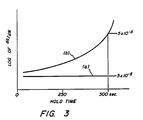
- FIG. 3 One way in which the relationship between the hold time for subjecting a test specimen to stress and the rate at which crack growth varies, is shown in Figure 3.
- the log of the crack growth rate is plotted as the ordinate and the dwell time or hold time in seconds is plotted as the abscissa.
- a crack growth rate of 5x10 ⁇ 5 might be regarded as an ideal rate for cyclic stress intensity factors of 67.86 MPa/cm (25 ksi/in). If an ideal alloy were formed the alloy would have this rate for any hold time during which the crack or the specimen is subjected to stress.
- Such a phenomenon would be represented by the line (a) of Figure 3 which indicates that the crack growth rate is essentially independent of the hold or dwell time during which the specimen is subjected to stress.
- An alloy identified as HK-101 was prepared.
- the composition of the alloy was essentially as follows: Ingredient Concentration in Weight % Ni balance Co 8 Cr 13 Mo 4 Al 3.5 Ti 2.5 Ta 5.6 Nb 1.9 Re 0.0 Hf 0.0 Zr 0.06 V 0 C 0.05 B 0.03 Y 0.0
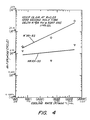
- alloys were subjected to various tests and the results of these tests are plotted in the Figures 4 through 8.
- alloys are identified by an appendage "-SS" if the data that were taken on the alloy were taken on material processed "super-solvus", i.e. the high temperature solid state heat treatment given to the material was at a temperature above which the strengthening precipitate ⁇ ' dissolves and below the incipient melting point. This usually results in grain size coarsening in the material.
- the strengthening phase ⁇ ' re-precipitates on subsequent cooling and aging.
- the invention provides an alloy having a unique combination of ingredients based both on the ingredient identification and on the relative concentrations thereof. It is also evident that the alloys which are proposed pursuant to the present invention have a novel and unique capability for crack propagation inhibition.
- the low crack propagation rate, da/dN, for the HK101-SS alloy which is evident from Figure 4 is a uniquely novel and remarkable result.
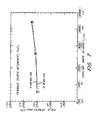
- the alloy of this invention is similar in certain respects to Rene' 95. Comparative testing of the subject alloy and samples of Rene' 95-SS were carried out to provide a basis for comparing the subject alloy to the Rene' 95 alloy which it closely resembles. Test results obtained at 399°C (750°F) are plotted in Figures 5 and 6 and test results obtained at 760°C (1400°F) are plotted in Figures 7 and 8.
- Figure 5 there is plotted a relationship between the yield stress in MPa (ksi) and the cooling rate in °C (°F) per minute for two alloy samples, HK101-SS and Rene'' 95-SS tests on which were performed at 399°C (750°F).
- HK101-SS alloy is essentially equivalent in yield strength at 399°C (750°F) to R'95-SS, an alloy well-known for its high strength.
- HK101-SS and Rene'' 95-SS were both prepared by powder metallurgy techniques and are accordingly quite comparable to each other.
- FIGs 7 and 8 there is plotted the relationship between the yield strength and ultimate tensile at 760°C (1400°F) versus the cooling rate in °C (°F) per minute for two alloys, one being Rene' 95-SS and the other being HK101-SS both of which samples were tested at 760°C (1400°F).
- the HK101-SS is essentially equivalent to the Rene' 95-SS.
- the subject alloys are far superior to Rene 95' particularly those alloys prepared at cooling rates of 56°C/min (100°F/min) to 336°C/min (600°F/min) which are the rates which are to be used for industrial production of the subject alloy.
Landscapes
- Chemical & Material Sciences (AREA)
- Engineering & Computer Science (AREA)
- Materials Engineering (AREA)
- Mechanical Engineering (AREA)
- Metallurgy (AREA)
- Organic Chemistry (AREA)
- Turbine Rotor Nozzle Sealing (AREA)
- Powder Metallurgy (AREA)
Claims (6)
- Eine Legierung, enthaltend die folgenden Bestandteile in den folgenden Anteilen:
Konzentration in Gew.-% Beanspruchte Zusammensetzung Bestandteil von bis Ni Rest Co 4 12 Cr 10 16 Mo 2 6 Al 2,5 4,5 Ti 1,5 3,2 Ta 5,0 6,0 Nb 1,0 3,0 Re 0,0 3,0 Hf 0,0 0,75 Zr 0,00 0,10 V 0,0 0,5 C 0,0 0,20 B 0,01 0,10 W 0,0 1,0 Y 0,0 0,1 - Die Legierung nach Anspruch 1, die mit einer Rate von etwa weniger als 336°C (600°F) pro Minute oder weniger gekühlt worden ist.
- Die Legierung nach Anspruch 1, die mit einer Rate zwischen 28°C (50) und 336°C (600°F) pro Minute gekühlt worden ist.
- Eine Legierung enthaltend die folgenden Bestandteile in den folgenden Anteilen:
Bestandteil Konzentration in Gew.-% Beanspruchte Zusammensetzung Ni Rest Co 8 Cr 13 Mo 4 Al 3,5 Ti 2,5 Ta 5,6 Nb 1,9 Zr 0,06 C 0,05 B 0,03 - Die Legierung nach Anspruch 4, die mit einer Rate von etwa weniger als 336°C (600°F) pro Minute oder weniger gekühlt worden ist.
- Die Legierung nach Anspruch 4, die mit einer Rate zwischen 28°C (50) und 336°C (600°F) pro Minute gekühlt worden ist.
Applications Claiming Priority (2)
| Application Number | Priority Date | Filing Date | Title |
|---|---|---|---|
| US07/290,400 US5055147A (en) | 1988-12-29 | 1988-12-29 | Fatigue crack resistant rene' 95 type superalloy |
| US290400 | 1988-12-29 |
Publications (2)
| Publication Number | Publication Date |
|---|---|
| EP0381828A1 EP0381828A1 (de) | 1990-08-16 |
| EP0381828B1 true EP0381828B1 (de) | 1993-10-20 |
Family
ID=23115831
Family Applications (1)
| Application Number | Title | Priority Date | Filing Date |
|---|---|---|---|
| EP89121769A Expired - Lifetime EP0381828B1 (de) | 1988-12-29 | 1989-11-24 | Ermüdungsrissbeständige Nickelbasissuperlegierung |
Country Status (4)
| Country | Link |
|---|---|
| US (1) | US5055147A (de) |
| EP (1) | EP0381828B1 (de) |
| JP (1) | JP3233361B2 (de) |
| DE (1) | DE68910105T2 (de) |
Families Citing this family (7)
| Publication number | Priority date | Publication date | Assignee | Title |
|---|---|---|---|---|
| US5431750A (en) * | 1991-06-27 | 1995-07-11 | Mitsubishi Materials Corporation | Nickel-base heat-resistant alloys |
| US6974508B1 (en) | 2002-10-29 | 2005-12-13 | The United States Of America As Represented By The United States National Aeronautics And Space Administration | Nickel base superalloy turbine disk |
| US20070044869A1 (en) * | 2005-09-01 | 2007-03-01 | General Electric Company | Nickel-base superalloy |
| US8992700B2 (en) * | 2009-05-29 | 2015-03-31 | General Electric Company | Nickel-base superalloys and components formed thereof |
| US8992699B2 (en) | 2009-05-29 | 2015-03-31 | General Electric Company | Nickel-base superalloys and components formed thereof |
| JP5696995B2 (ja) | 2009-11-19 | 2015-04-08 | 独立行政法人物質・材料研究機構 | 耐熱超合金 |
| GB2565063B (en) * | 2017-07-28 | 2020-05-27 | Oxmet Tech Limited | A nickel-based alloy |
Family Cites Families (5)
| Publication number | Priority date | Publication date | Assignee | Title |
|---|---|---|---|---|
| NL260545A (de) * | 1960-02-01 | |||
| FR1418583A (fr) * | 1964-12-22 | 1965-11-19 | Mond Nickel Co Ltd | Alliages de nickel-chrome |
| US3825420A (en) * | 1972-08-21 | 1974-07-23 | Avco Corp | Wrought superalloys |
| GB2151659B (en) * | 1983-12-24 | 1987-03-18 | Rolls Royce | An alloy suitable for making single crystal castings |
| US4888064A (en) * | 1986-09-15 | 1989-12-19 | General Electric Company | Method of forming strong fatigue crack resistant nickel base superalloy and product formed |
-
1988
- 1988-12-29 US US07/290,400 patent/US5055147A/en not_active Expired - Fee Related
-
1989
- 1989-11-24 EP EP89121769A patent/EP0381828B1/de not_active Expired - Lifetime
- 1989-11-24 DE DE89121769T patent/DE68910105T2/de not_active Expired - Fee Related
- 1989-12-27 JP JP33676289A patent/JP3233361B2/ja not_active Expired - Fee Related
Also Published As
| Publication number | Publication date |
|---|---|
| JPH02225640A (ja) | 1990-09-07 |
| US5055147A (en) | 1991-10-08 |
| JP3233361B2 (ja) | 2001-11-26 |
| DE68910105D1 (de) | 1993-11-25 |
| EP0381828A1 (de) | 1990-08-16 |
| DE68910105T2 (de) | 1994-05-05 |
Similar Documents
| Publication | Publication Date | Title |
|---|---|---|
| EP0403682B1 (de) | Ermüdungsrissbeständige Nickelbasissuperlegierungen und hergestelltes Erzeugnis | |
| US4814023A (en) | High strength superalloy for high temperature applications | |
| US4820353A (en) | Method of forming fatigue crack resistant nickel base superalloys and product formed | |
| US5130087A (en) | Fatigue crack resistant nickel base superalloys | |
| EP0260511A2 (de) | Verfahren zur Herstellung einer äusserst dauerbruchbeständigen Nickelbasissuperlegierung und nach dem Verfahren hergestelltes Erzeugnis | |
| US5156808A (en) | Fatigue crack-resistant nickel base superalloy composition | |
| JP3145091B2 (ja) | 耐疲れき裂ニッケル基超合金 | |
| EP0403681B1 (de) | Ermüdungsrissbeständige Nickelbasissuperlegierung und hergestelltes Erzeugnis | |
| US5124123A (en) | Fatigue crack resistant astroloy type nickel base superalloys and product formed | |
| EP0260512B1 (de) | Verfahren zur Herstellung einer dauerbruchbeständigen Nickelbasissuperlegierung und nach dem Verfahren hergestelltes Erzeugnis | |
| US5130089A (en) | Fatigue crack resistant nickel base superalloy | |
| EP0260510B1 (de) | Thermomechanisches Verfahren zur Herstellung einer dauerbruchbeständigen Nickelbasissuperlegierung und nach dem Verfahren hergestelltes Erzeugnis | |
| US5129970A (en) | Method of forming fatigue crack resistant nickel base superalloys and product formed | |
| US5129969A (en) | Method of forming in100 fatigue crack resistant nickel base superalloys and product formed | |
| EP0381828B1 (de) | Ermüdungsrissbeständige Nickelbasissuperlegierung | |
| US5171380A (en) | Method of forming fatigue crack resistant Rene' 95 type nickel base superalloys and product formed | |
| US5130086A (en) | Fatigue crack resistant nickel base superalloys | |
| US5130088A (en) | Fatigue crack resistant nickel base superalloys | |
| EP0371208B1 (de) | Ermüdungsrissbeständige Nickelbasissuperlegierungen und hergestelltes Erzeugnis | |
| US5037495A (en) | Method of forming IN-100 type fatigue crack resistant nickel base superalloys and product formed | |
| JP3232084B2 (ja) | 耐疲れ亀裂性ニッケル基超合金の製造方法およびその製品 | |
| JP3232083B2 (ja) | 耐疲れ亀裂性ニッケル基超合金の製造方法およびその製品 |
Legal Events
| Date | Code | Title | Description |
|---|---|---|---|
| PUAI | Public reference made under article 153(3) epc to a published international application that has entered the european phase |
Free format text: ORIGINAL CODE: 0009012 |
|
| AK | Designated contracting states |
Kind code of ref document: A1 Designated state(s): DE FR GB IT SE |
|
| 17P | Request for examination filed |
Effective date: 19901217 |
|
| 17Q | First examination report despatched |
Effective date: 19920827 |
|
| GRAA | (expected) grant |
Free format text: ORIGINAL CODE: 0009210 |
|
| AK | Designated contracting states |
Kind code of ref document: B1 Designated state(s): DE FR GB IT SE |
|
| PG25 | Lapsed in a contracting state [announced via postgrant information from national office to epo] |
Ref country code: IT Free format text: LAPSE BECAUSE OF FAILURE TO SUBMIT A TRANSLATION OF THE DESCRIPTION OR TO PAY THE FEE WITHIN THE PRE;WARNING: LAPSES OF ITALIAN PATENTS WITH EFFECTIVE DATE BEFORE 2007 MAY HAVE OCCURRED AT ANY TIME BEFORE 2007. THE CORRECT EFFECTIVE DATE MAY BE DIFFERENT FROM THE ONE RECORDED.SCRIBED TIME-LIMIT Effective date: 19931020 |
|
| REF | Corresponds to: |
Ref document number: 68910105 Country of ref document: DE Date of ref document: 19931125 |
|
| ET | Fr: translation filed | ||
| PLBE | No opposition filed within time limit |
Free format text: ORIGINAL CODE: 0009261 |
|
| STAA | Information on the status of an ep patent application or granted ep patent |
Free format text: STATUS: NO OPPOSITION FILED WITHIN TIME LIMIT |
|
| 26N | No opposition filed | ||
| EAL | Se: european patent in force in sweden |
Ref document number: 89121769.7 |
|
| REG | Reference to a national code |
Ref country code: GB Ref legal event code: IF02 |
|
| PGFP | Annual fee paid to national office [announced via postgrant information from national office to epo] |
Ref country code: FR Payment date: 20021030 Year of fee payment: 14 |
|
| PGFP | Annual fee paid to national office [announced via postgrant information from national office to epo] |
Ref country code: GB Payment date: 20021120 Year of fee payment: 14 |
|
| PGFP | Annual fee paid to national office [announced via postgrant information from national office to epo] |
Ref country code: DE Payment date: 20021202 Year of fee payment: 14 |
|
| PG25 | Lapsed in a contracting state [announced via postgrant information from national office to epo] |
Ref country code: GB Free format text: LAPSE BECAUSE OF NON-PAYMENT OF DUE FEES Effective date: 20031124 |
|
| PG25 | Lapsed in a contracting state [announced via postgrant information from national office to epo] |
Ref country code: DE Free format text: LAPSE BECAUSE OF NON-PAYMENT OF DUE FEES Effective date: 20040602 |
|
| GBPC | Gb: european patent ceased through non-payment of renewal fee |
Effective date: 20031124 |
|
| PG25 | Lapsed in a contracting state [announced via postgrant information from national office to epo] |
Ref country code: FR Free format text: LAPSE BECAUSE OF NON-PAYMENT OF DUE FEES Effective date: 20040730 |
|
| REG | Reference to a national code |
Ref country code: FR Ref legal event code: ST |
|
| PGFP | Annual fee paid to national office [announced via postgrant information from national office to epo] |
Ref country code: SE Payment date: 20071128 Year of fee payment: 19 |
|
| EUG | Se: european patent has lapsed | ||
| PG25 | Lapsed in a contracting state [announced via postgrant information from national office to epo] |
Ref country code: SE Free format text: LAPSE BECAUSE OF NON-PAYMENT OF DUE FEES Effective date: 20081125 |