EP0382129A2 - Therapeutisches System zur transdermalen oder transmucosalen Verabreichung von Wirkstoffen und seine Verwendung - Google Patents
Therapeutisches System zur transdermalen oder transmucosalen Verabreichung von Wirkstoffen und seine Verwendung Download PDFInfo
- Publication number
- EP0382129A2 EP0382129A2 EP90102174A EP90102174A EP0382129A2 EP 0382129 A2 EP0382129 A2 EP 0382129A2 EP 90102174 A EP90102174 A EP 90102174A EP 90102174 A EP90102174 A EP 90102174A EP 0382129 A2 EP0382129 A2 EP 0382129A2
- Authority
- EP
- European Patent Office
- Prior art keywords
- reservoir
- parts
- intermediate layer
- layer
- impermeable
- Prior art date
- Legal status (The legal status is an assumption and is not a legal conclusion. Google has not performed a legal analysis and makes no representation as to the accuracy of the status listed.)
- Granted
Links
Images

Classifications
-
- A—HUMAN NECESSITIES
- A61—MEDICAL OR VETERINARY SCIENCE; HYGIENE
- A61K—PREPARATIONS FOR MEDICAL, DENTAL OR TOILETRY PURPOSES
- A61K9/00—Medicinal preparations characterised by special physical form
- A61K9/70—Web, sheet or filament bases ; Films; Fibres of the matrix type containing drug
- A61K9/7023—Transdermal patches and similar drug-containing composite devices, e.g. cataplasms
- A61K9/703—Transdermal patches and similar drug-containing composite devices, e.g. cataplasms characterised by shape or structure; Details concerning release liner or backing; Refillable patches; User-activated patches
-
- A—HUMAN NECESSITIES
- A61—MEDICAL OR VETERINARY SCIENCE; HYGIENE
- A61K—PREPARATIONS FOR MEDICAL, DENTAL OR TOILETRY PURPOSES
- A61K9/00—Medicinal preparations characterised by special physical form
- A61K9/70—Web, sheet or filament bases ; Films; Fibres of the matrix type containing drug
- A61K9/7023—Transdermal patches and similar drug-containing composite devices, e.g. cataplasms
- A61K9/703—Transdermal patches and similar drug-containing composite devices, e.g. cataplasms characterised by shape or structure; Details concerning release liner or backing; Refillable patches; User-activated patches
- A61K9/7084—Transdermal patches having a drug layer or reservoir, and one or more separate drug-free skin-adhesive layers, e.g. between drug reservoir and skin, or surrounding the drug reservoir; Liquid-filled reservoir patches
-
- A—HUMAN NECESSITIES
- A61—MEDICAL OR VETERINARY SCIENCE; HYGIENE
- A61K—PREPARATIONS FOR MEDICAL, DENTAL OR TOILETRY PURPOSES
- A61K9/00—Medicinal preparations characterised by special physical form
- A61K9/70—Web, sheet or filament bases ; Films; Fibres of the matrix type containing drug
- A61K9/7023—Transdermal patches and similar drug-containing composite devices, e.g. cataplasms
- A61K9/703—Transdermal patches and similar drug-containing composite devices, e.g. cataplasms characterised by shape or structure; Details concerning release liner or backing; Refillable patches; User-activated patches
- A61K9/7092—Transdermal patches having multiple drug layers or reservoirs, e.g. for obtaining a specific release pattern, or for combining different drugs
Definitions
- the invention relates to a therapeutic system for the transdermal or transmucosal administration of active substances from an impermeable backing layer, an at least partly active substance-containing two-layer reservoir consisting of separate parts, and an impermeable and detachable protective layer.
- Therapeutic systems are to be understood as drug-containing devices or dosage forms which deliver one or more drugs at a predetermined rate to a specified place of use over a specified period of time (see Heilmann, "Therapeutic Systems", Enke Verlag, Stuttgart, 1984, page 24).
- a transdermal therapeutic system releases the active ingredient through the skin and is therefore applied topically to the skin.
- the first category includes systems in which the active ingredient only becomes bioavailable immediately before use is only converted into its bioavailable form immediately before use. This is necessary, for example, if the active ingredient is unstable in its bioavailable form.
- An example of this category are the multi-chamber systems described in EP-A 0252459 (Schering Corporation) and in the publication by CD Ebert.
- the chambers lie next to each other on the same level and the manipulation to be carried out before application consists in bringing the liquid chamber contents together, for example by breaking the chamber walls separating the chambers.
- the second category includes systems as described in EP-A 0249475 (Alza).
- an active substance-free layer is applied to an active substance-containing reservoir only immediately before use and then glued to the skin with the other side of this layer.
- the active ingredient only reaches the skin when it has passed through this active ingredient-free layer. This results in a targeted delay effect, which is advantageous, for example, if active substance levels are only desirable in the early morning after application in the evening.
- the manipulations to be carried out are particularly complicated in systems according to EP-A-0249475.
- two flat flexible structures must be brought into full contact with one another so that a laminate is formed. This is further complicated by the fact that at least one sheet-like structure must be self-adhesive.
- the proposed system structure in which the reservoir and the delay layer are connected to one another by a kind of hinge, also makes the manipulation to be carried out a relatively difficult, error-prone process. Since medicinal agents are administered by means of transdermal systems, drug safety is not guaranteed with this system structure.
- the object of the invention was to develop a system with improved drug safety even for such or similar cases, which enables even inexperienced persons to easily carry out the necessary manipulations and which can be produced without great effort.
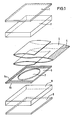
- FIG. 1 shows a system according to the invention. It consists of the carrier film (1), the upper reservoir part (2), which is impermeable to the contents of the upper reservoir part (2), a separating film (3) covering and pulling out the recess (7) of the shadow mask (5) with a grip piece (4) , the shadow mask (5) with a recess (7), the lower part of the reservoir (8) and a peel-off film (9) which is impermeable to the contents of the lower reservoir part (8) and is to be removed before use.
- the shadow mask (5) is connected to the upper reservoir via its hatched contact surface (6a) and to the lower reservoir (8) by the contact surface (6b).
- the contact surface (6b) thus corresponds to the total available surface, ie the rectangular surface of the shadow mask (5) minus the surface of the recess (7).
- the perforated mask (5) is of course impermeable for all contents of the two reservoir parts apart from the recess (7) as well as the separating film (3). In the case of the structure shown, it is assumed that the two reservoir parts which are separate before application are self-adhesive. The cohesion of the system is then ensured by the fact that the reservoir part (8) sticks over the entire surface of the contact surface (6b) and the reservoir part (2) onto the hatched surface (6a) of the shadow mask (5).
- the recess (7) of the shadow mask (5) can also have a geometry other than circular, and a shape reminiscent of the letter "U" is particularly suitable for increasing the contact area between the two reservoir parts to be combined.
- the system is activated by pulling out the specially folded and siliconized film (3).
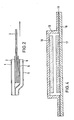
- the special folding also allows easy pulling out when both reservoir parts are self-adhesive, since they divert the forces so that the force vector is perpendicular to the level of the reservoir parts. This is illustrated in FIG. 2, which shows a view of the narrow side of the system cut through in the middle.
- a similarly folded film is used in EP-A 0241119 (American Home Products Corporation) in order to provide an active substance-containing reservoir that can only be stored in an aluminized packaging with a non-aluminized carrier film for transdermal application immediately before use.
- the intended use is very different here, and the possibility of using such a folded film for the easy in-situ production of laminates was not recognized.
- any siliconizable flexible material is suitable as the material for the release film.
- a polymer-metal composite film can also be used.
- a system is shown which is basically the same, but in which the shadow mask (5) (Fig. 1) is reduced to a strip (10), the upper surface (11a) of which is connected to the upper reservoir part (2), and lower surface (11b) communicates with the lower reservoir part.
- This system structure has the advantage that the contact area between the two reservoir parts (2) and (8) to be combined is particularly large, and that it is easier to manufacture. If a particularly flexible carrier film (1) is used, with this system, the reservoir parts (2) and (8) can be laminated on top of one another if the handling is very clumsy. To avoid this, the lamination aid (12) is used.
- the system lies between the surfaces (14) of the lamination aid (12), and the pull-out separating film (3) is connected to the lamination aid on the surface (13).
- the entire laminate is produced by pulling the system out of the lamination aid, a slight pressure on the surfaces (14) supporting the lamination process and effectively preventing a laterally offset lamination.
- the reservoir parts (2, 8) can also be in contact via a detachable connection between the backing layer or carrier film (1) and the removable protective film (9), the backing layer (1) and protective layer (9 ) project beyond the reservoir surfaces (2, 8) on at least one side.
- this also addresses an advantage of the system structure according to FIG. 1.
- this structure allows the production of the total laminate even after an arbitrary long time after being glued to the skin.
- the reservoir part (16) which has contact with the skin after application, is located on the bottom of a deep-drawn mold (15) that is siliconized on the inside, if necessary.
- the upper reservoir part (17) is located on the carrier film (18), which is impermeable to the contents of (17).
- the carrier film (18) is bonded to the deep-drawing mold (15) on the surface (19).
- the reservoir part (17) can also have the same area as the carrier film (18), so that (17) on the surface (19) is in contact with the deep-drawing mold.
- mechanical pressure on the deep-drawing mold is used to make contact between the two laminate parts (16) and (17) and thus maintain the overall system.
- it is now only necessary to remove the deep-drawing mold which here takes on the role of the peel-off film (9) (FIGS. 3 and 4).
Landscapes
- Health & Medical Sciences (AREA)
- Engineering & Computer Science (AREA)
- Bioinformatics & Cheminformatics (AREA)
- Dermatology (AREA)
- Life Sciences & Earth Sciences (AREA)
- Medicinal Chemistry (AREA)
- Pharmacology & Pharmacy (AREA)
- Epidemiology (AREA)
- Chemical & Material Sciences (AREA)
- Animal Behavior & Ethology (AREA)
- General Health & Medical Sciences (AREA)
- Public Health (AREA)
- Veterinary Medicine (AREA)
- Medicinal Preparation (AREA)
- Media Introduction/Drainage Providing Device (AREA)
- Medicines That Contain Protein Lipid Enzymes And Other Medicines (AREA)
- Polyesters Or Polycarbonates (AREA)
Abstract
- (a) weitgehend parallel übereinander angeordnet sind,
- (b) durch eine für die Inhaltsstoffe der beiden Reservoirteile undurchlässige entfernbare Zwischenschicht (3) voneinander getrennt sind,
- (c) entweder Wirkstoff, Hilfsstoff oder beides in nicht dem Verteilungsgleichgewicht entsprechenden Konzentrationen enthalten,
Description
- Die Erfindung betrifft ein therapeutisches System zur transdermalen oder transmucosalen Verabreichung von Wirkstoffen aus einer undurchlässigen Rückschicht, einem zumindest zum Teil wirkstoffhaltigen zweischichtigen, aus voneinander getrennten Teilen bestehenden, Reservoir und einer undurchlässigen und ablösbaren Schutzschicht.
- Transdermale Systeme haben sich durch die ihnen eigenen Vorteile mittlerweile in der Medizin ihren festen Platz erobert. Es sind mittlerweile eine ganze Reihe von verschieden aufgebauten Systemen in der Literatur beschrieben worden oder schon auf dem Markt. So ist in dem U.S.-Patent 3,734,097 (Alza) ein einfaches einschichtiges System und in dem U.S.-Patent 3,598,122 des gleichen Anmelders ein komplizierter aufgebautes mehrschichtiges System, bei dem zusatzliche Membranen Steuerfunktionen übernehmen, beschrieben.
- Unter therapeutischen Systemen sind arzneistoffhaltige Vorrichtungen bzw. Darreichungsformen zu verstehen, die einen Arzneistoff oder mehrere in vorausbestimmter Rate über einen festgelegten Zeitraum an einen festgelegten Anwendungsort abgeben (siehe Heilmann, "Therapeutische Systeme", Enke Verlag, Stuttgart, 1984, Seite 24). Ein transdermales therapeutisches System gibt den Wirkstoff über die Haut ab und wird demgemäß auf der Haut, also topisch angewandt.
- Erst in jüngerer Zeit wurden Systeme beschrieben, bei denen vor Applikation spezielle Manipulationen durchzuführen sind. Man kann diese Systeme in zwei Kategorien einteilen. Zur ersten Kategorie zählen Systeme, bei denen der Wirkstoff erst unmittelbar vor Gebrauch in seine bioverfügbare Form erst unmittelbar vor Gebrauch in seine bioverfügbare Form überführt wird. Dies ist zum Beispiel notwendig, wenn der Wirkstoff in seiner bioverfügbaren Form instabil ist. Ein Beispiel für diese Kategorie sind die in der EP-A 0252459 (Schering Corporation) und in der Veröffentlichung von C.D. Ebert beschriebenen Mehrkammersysteme. Die Kammern liegen dabei nebeneinander in der gleichen Ebene und die vor Applikation durchzuführende Manipulation besteht darin, daß die flüssigen Kammerinhalte - etwa durch das Zerbrechen der die Kammern trennenden Kammerwände - zusammengebracht werden.
- Zur zweiten Kategorie gehören Systeme wie sie in der EP-A 0249475 (Alza) beschrieben sind. Hier wird eine wirkstofffreie Schicht erst unmittelbar vor Gebrauch auf ein wirkstoffhaltiges Reservoir aufgebracht und dann mit der anderen Seite dieser Schicht auf die Haut geklebt. Der Wirkstoff gelangt erst zur Haut, wenn er diese wirkstofffreie Schicht passiert hat. Daraus resultiert ein gezielter Verzögerungseffekt, der z.B. von Vorteil ist, wenn nach abendlicher Applikation erst in den frühen Morgenstunden Wirkstoffspiegel wünschenswert sind.
Insbesondere bei Systemen gemäß EP-A-0249475 sind die durchzuführenden Manipulationen recht kompliziert. Hier müssen zwei flächenförmige flexible Gebilde vollflächig miteinander in Kontakt gebracht werden, so daß ein Laminat entsteht. Dies wird zusätzlich dadurch erschwert, daß zumindest ein flächenförmiges Gebilde selbstklebend sein muß. Auch der vorgeschlagene Systemaufbau, bei dem Reservoir und Verzögerungsschicht durch eine Art Scharnier miteinander verbunden sind, macht die durchzuführende Manipulation zu einem relativ schwierig durchzuführenden, fehleranfälligen Prozeß. Da mittels transdermaler Systeme medizinische Wirkstoffe verabreicht werden, ist somit mit diesem Systemaufbau die Arzneimittelsicherheit nicht gewährleistet. - Aufgabe der Erfindung war es nun, auch für solche oder ähnlich gelagerte Fälle ein System mit verbesserter Arzneimittelsicherheit zu entwickeln, das es auch ungeübten Personen ermöglicht, die erforderlichen Manipulationen leicht durchzuführen und das ohne größeren Aufwand herstellbar ist.
- Einzelheiten der Erfindung werden beispielhaft anhand der Figuren erläutert.
- In Fig. 1 ist ein System gemäß Erfindung dargestellt. Es besteht aus der für die Inhaltsstoffe des oberen Reservoirteils (2) undurchlässigen Trägerfolie (1), dem oberen Reservoirteil (2), einer die Aussparung (7) der Lochmaske (5) abdeckenden und herausziehbaren Trennfolie (3) mit einem Anfaßstück (4), der Lochmaske (5) mit einer Aussparung (7), dem unteren Teil des Reservoirs (8) und einer für die Inhaltsstoffe des unteren Reservoirteils (8) undurchlässigen und vor Gebrauch zu entfernenden Abziehfolie (9).
- Die Lochmaske (5) steht über ihre schraffiert gezeichnete Kontaktfläche (6a) mit dem oberen Reservoir und mit der Kontaktfläche (6b) mit dem unteren Reservoir (8) in Verbindung. Die Kontaktfläche (6b) entspricht somit der gesamten verfügbaren Oberfläche, d.h. der Rechtecksfläche der Lochmaske (5) abzüglich der Fläche der Aussparung (7). Die Lochmaske (5) ist selbstverständlich bis auf die Aussparung (7) ebenso wie die Trennfolie (3) für alle Inhaltsstoffe der beiden Reservoirteile undurchlässig. Bei dem gezeichneten Aufbau ist vorausgesetzt, daß die beiden vor Applikation getrennten Reservoirteile selbstklebend sind. Der Zusammenhalt des Systems wird dann dadurch gewährleistet, daß Reservoirteil (8) vollflächig auf der Kontaktfläche (6b) und Reservoirteil (2) auf der schraffierten Fläche (6a) der Lochmaske (5) kleben.
- Sollten die betreffenden Flächen der getrennten Reservoirteile nicht selbstklebend sein, ist es keine Schwierigkeit, sie entweder vollflächig oder nur an den dafür relevanten Teilen mit einem zusätzlichen klebenden Film zu versehen. Gleiches gilt sinngemäß für die Kontaktfläche des oberen Reservoirteils mit der Trägerfolie (1) und der nach Applikation der Haut zugewandten Seite des unteren Reservoirteils (8).
- Selbstverständlich kann die Aussparung (7) der Lochmaske (5) auch eine andere als kreisförmige Geometrie haben, und besonders zur Vergrößerung der Kontaktfläche zwischen den beiden zu vereinigenden Reservoirteilen ist eine an den Buchstaben "U" erinnernde Form geeignet.
- Aktiviert wird das System durch das Herausziehen der speziell gefalteten und silikonisierten Folie (3). Die spezielle Faltung erlaubt auch dann das leichte Herausziehen, wenn beide Reservoirteile selbstklebend sind, da durch sie die Kräfte so umgelenkt werden, daß der Kraftvektor senkrecht auf der Ebene der Reservoirteile steht. Dies wird in Fig. 2 verdeutlicht, die einen Blick auf die Schmalseite des in der Mitte durchgeschnittenen Systems zeigt. Eine ähnlich gefaltete Folie wird in der EP-A 0241119 (American Home Products Corporation) benutzt, um ein nur in einer aluminisierten Verpackung lagerbares wirkstoffhaltiges Reservoir unmittelbar vor Gebrauch mit einer nichtaluminisierten Trägerfolie für die transdermale Applikation zu versehen. Der Verwendungszweck ist hier also ein ganz anderer, und es wurde zudem nicht die Möglichkeit erkannt, eine solchermaßen gefaltete Folie zu der leichten in-situ Herstellung von Laminaten zu verwenden.
- Als Material für die Trennfolie ist grundsätzlich jedes silikonisierbare flexible Material geeignet. Um eine absolute Undurchlässigkeit auch für sehr kleine Moleküle sicherzustellen, kann auch eine Polymer-Metall-Verbundfolie verwendet werden.
- In Fig. 3 ist ein prinzipiell gleich aufgebautes System gezeigt, bei dem allerdings die Lochmaske (5) (Fig. 1) auf einen Streifen (10) reduziert ist, dessen obere Oberfläche (11a) mit dem oberen Reservoirteil (2), und dessen untere Oberfläche (11b) mit dem unteren Reservoirteil in Verbindung steht. Dieser Systemaufbau hat den Vorteil, daß die Kontaktfläche zwischen den beiden zu vereinigenden Reservoirteilen (2) und (8) besonders groß ist, und den der leichteren Herstellbarkeit. Wird eine besonders flexible Trägerfolie (1) verwendet, so kann bei diesem System bei sehr ungeschicktem Hantieren eventuell ein seitlich versetztes Aufeinanderlaminieren der Reservoirteile (2) und (8) erfolgen. Um dies zu vermeiden, findet die Laminierungshilfe (12) Verwendung. Das System liegt zwischen den Flächen (14) der Laminierungshilfe (12), und die herausziehbare Trennfolie (3) ist auf der Fläche (13) mit der Laminierungshilfe verbunden. Durch Herausziehen des Systems aus der Laminierungshilfe ist das Gesamtlaminat hergestellt, wobei ein leichter Druck auf die Flächen (14) den Laminierungsprozeß unterstützt, und ein seitlich versetztes Laminieren wirkungsvoll verhindert.
- Anstelle einer Lochmaske (5, 10) können die Reservoirteile (2, 8) auch über eine lösbare Verbindung zwischen der Rückschicht bzw. Trägerfolie (1) und der entfernbaren Schutzfolie (9) in Kontakt stehen, wobei Rückschicht (1) und Schutzschicht (9) mindest auf einer Seite die Reservoirflächen (2, 8) überragen.
- Da diese Laminierungshilfe eine Applikation des Systems auf die Haut ohne vorheriges Herstellen des Gesamtlaminats unmöglich macht, ist sie, um ein versehentliches Vergessen des Laminierungsprozesses zu vermeiden, in diesem Sinne auch in Verbindung mit dem in Fig. 1 gezeigten Systemaufbau sinnvoll verwendbar.
- Damit ist aber auch ein Vorteil des Systemaufbaus gemäß Fig. 1 angesprochen. Dieser Aufbau erlaubt nämlich im Gegensatz zu allen bisher beschriebenen Systemen auch nach einer beliebig langen Zeit nach dem Aufkleben auf die Haut die Herstellung des Gesamtlaminats.
- In Fig. 4 ist ein System gezeigt, bei dem die Zwischenschicht durch einen gasgefüllten Spalt gebildet wird. Auf dem Boden einer auf der Innenseite - wenn erforderlich - silikonisierten Tiefziehform (15) befindet sich der Reservoirteil (16), der nach Applikation Kontakt mit der Haut hat. Der obere Reservoirteil (17) befindet sich auf der Trägerfolie (18), die für die Inhaltsstoffe von (17) undurchlässig ist. Die Trägerfolie (18) ist auf der Fläche (19) mit der Tiefziehform (15) verklebt. Der Reservoirteil (17) kann aber flächenmäßig auch die gleiche Ausdehnung wie die Trägerfolie (18) haben, so daß (17) auf der Fläche (19) mit der Tiefziehform Kontakt hat. Vor Applikation wird durch mechanischen Druck auf die Tiefziehform der Kontakt zwischen den beiden Laminatteilen (16) und (17) hergestellt und damit das Gesamtsystem erhalten. Zur Applikation auf die Haut ist es jetzt nur noch nötig, die Tiefziehform, die hier die Rolle der Abziehfolie (9) (Fig. 3 und 4) übernimmt, zu entfernen.
- Für alle Systemaufbauten gilt, daß die zu vereinigenden Reservoirteile des Systems (2) und (8) einen beliebig komplizierten Aufbau besitzen können. Insbesondere der Einbau von zusätzlichen, die Diffusion steuernden Membranen kann sich dabei als nützlich erweisen.
-
- 1, 18 Undurchlässige Rückschicht bzw. Trägerfolie
- 2, 17 Der Haut nach Applikation abgewandtes oberes Reservoirteil
- 3 Herausziehbare Trennfolie
- 4 Anfaßstück der Trennfolie
- 5, 10 Lochmaske
- 6a,11a Kontaktfläche zwischen Lochmaske und oberem Reservoirteil
- 6b,11b Kontaktfläche zwischen Lochmaske und unterem Reservoirteil
- 7 Aussparung in der Lochmaske
- 8, 16 Der Haut nach Applikation zugewandtes unteres Reservoirteil
- 9 Ablösbare Schutzfolie
- 12 Laminierungshilfe
- 13 Verbindungsfläche zwischen Trennfolie (3) und Laminierungshilfe (12)
- 14 Andrückflächen der Laminierungshilfe
- 15 Innen silikonisierte Tiefziehform
- 19 Klebende Flächenverbindung zwischen Tiefziehform (15) und Trägerfolie (18)
Claims (8)
(a) weitgehend parallel übereinander angeordnet sind,
(b) durch eine für die Inhaltsstoffe der beiden Reservoirteile undurchlässige entfernbare Zwischenschicht voneinander getrennt sind,
(c) entweder Wirkstoff, Hilfsstoff oder beides in nicht dem Verteilungsgleichgewicht entsprechenden Konzentrationen enthalten,
dadurch gekennzeichnet, daß die beiden Reservoirteile selbstklebend und über eine Maske partiell miteinander verklebt sind und die Zwischenschicht (b) zwischen einem Reservoirteil und der Maske angeordnet und aus gefalteten Folien gebildet ist, die die Flachen der Reservoirteile mindestens teilweise überragen.
(a) weitgehend parallel übereinander angeordnet sind,
(b) durch eine für diese Inhaltsstoffe der beiden Reservoirteile undurchlässige entfernbare Zwischenschicht voneinander getrennt sind,
(c) entweder Wirkstoff, Hilfsstoff oder beides in nicht dem Verteilungsgleichgewicht entsprechenden Konzentrationen enthalten,
dadurch gekennzeichnet, daß die Reservoirteile selbstklebend sind und die Zwischenschicht (b) durch einen gasgefüllten Spalt gebildet ist.
Applications Claiming Priority (2)
| Application Number | Priority Date | Filing Date | Title |
|---|---|---|---|
| DE3903794A DE3903794A1 (de) | 1989-02-09 | 1989-02-09 | Therapeutisches system zur transdermalen oder transmucosalen verabreichung von wirkstoffen und seine verwendung |
| DE3903794 | 1989-02-09 |
Publications (3)
| Publication Number | Publication Date |
|---|---|
| EP0382129A2 true EP0382129A2 (de) | 1990-08-16 |
| EP0382129A3 EP0382129A3 (de) | 1991-02-27 |
| EP0382129B1 EP0382129B1 (de) | 1993-10-13 |
Family
ID=6373693
Family Applications (1)
| Application Number | Title | Priority Date | Filing Date |
|---|---|---|---|
| EP90102174A Expired - Lifetime EP0382129B1 (de) | 1989-02-09 | 1990-02-03 | Therapeutisches System zur transdermalen oder transmucosalen Verabreichung von Wirkstoffen und seine Verwendung |
Country Status (12)
| Country | Link |
|---|---|
| US (1) | US5128137A (de) |
| EP (1) | EP0382129B1 (de) |
| JP (1) | JP2538371B2 (de) |
| AT (1) | ATE95711T1 (de) |
| CA (1) | CA2009558C (de) |
| DD (1) | DD291700A5 (de) |
| DE (2) | DE3903794A1 (de) |
| DK (1) | DK0382129T3 (de) |
| ES (1) | ES2047171T3 (de) |
| FI (1) | FI105156B (de) |
| IE (1) | IE64835B1 (de) |
| NO (1) | NO180670C (de) |
Cited By (2)
| Publication number | Priority date | Publication date | Assignee | Title |
|---|---|---|---|---|
| WO2007067363A3 (en) * | 2005-12-07 | 2007-08-02 | Mylan Technologies Inc | Two-sided non-stick release film |
| WO2008122398A1 (de) * | 2007-04-04 | 2008-10-16 | Ics Innovative Care Systems Andernach Gmbh | Biologisch abbaubares mehrschichtsystem |
Families Citing this family (34)
| Publication number | Priority date | Publication date | Assignee | Title |
|---|---|---|---|---|
| HUT65957A (en) † | 1992-03-17 | 1994-08-29 | Becton Dickinson Co | User operated iontophoretical device and method for manufacturing it |
| JP2542792B2 (ja) * | 1992-11-05 | 1996-10-09 | ベクトン・ディッキンソン・アンド・カンパニー | ユ―ザ作動型のイオン導入式装置 |
| US5445609A (en) * | 1993-05-28 | 1995-08-29 | Alza Corporation | Electrotransport agent delivery device having a disposable component and a removable liner |
| US5962011A (en) * | 1993-12-06 | 1999-10-05 | Schering-Plough Healthcare Products, Inc. | Device for delivery of dermatological ingredients |
| FR2728463A1 (fr) * | 1994-12-21 | 1996-06-28 | Lhd Lab Hygiene Dietetique | Systeme transdermique d'administration simultanee de plusieurs principes actifs |
| US20040265353A1 (en) * | 1995-07-28 | 2004-12-30 | Zars, Inc. | Systems and methods for treating panic attacks |
| US6284266B1 (en) | 1995-07-28 | 2001-09-04 | Zars, Inc. | Methods and apparatus for improved administration of fentanyl and sufentanil |
| US5658583A (en) * | 1995-07-28 | 1997-08-19 | Zhang; Jie | Apparatus and methods for improved noninvasive dermal administration of pharmaceuticals |
| US6245347B1 (en) * | 1995-07-28 | 2001-06-12 | Zars, Inc. | Methods and apparatus for improved administration of pharmaceutically active compounds |
| GB9515807D0 (en) * | 1995-08-02 | 1995-10-04 | Cantwell Evelyna D | Topical hyperbaric bandage |
| DE29514849U1 (de) * | 1995-09-15 | 1995-11-16 | Weyergans, Rudolf, 52355 Düren | Cellulitis-Pflaster |
| US5797867A (en) * | 1996-09-27 | 1998-08-25 | Becton Dickinson And Company | Iontophoretic drug delivery system, including method for activating same for attachment to patient |
| US5738647A (en) * | 1996-09-27 | 1998-04-14 | Becton Dickinson And Company | User activated iontophoretic device and method for activating same |
| US6955819B2 (en) | 1998-09-29 | 2005-10-18 | Zars, Inc. | Methods and apparatus for using controlled heat to regulate transdermal and controlled release delivery of fentanyl, other analgesics, and other medical substances |
| US6726673B1 (en) | 1999-05-24 | 2004-04-27 | Zars, Inc. | Methods and apparatus for improved administration of testosterone pharmaceuticals |
| US6453648B1 (en) | 1999-07-06 | 2002-09-24 | Zars, Inc. | Method for manufacturing a heat generating apparatus |
| US6261595B1 (en) | 2000-02-29 | 2001-07-17 | Zars, Inc. | Transdermal drug patch with attached pocket for controlled heating device |
| WO2001091637A1 (en) * | 2000-05-29 | 2001-12-06 | Medicotest A/S | An electrode for establishing electrical contact with the skin |
| US6767342B1 (en) | 2001-04-23 | 2004-07-27 | Evelyna D. Cantwell | Oxygen bandage system |
| US8524272B2 (en) * | 2003-08-15 | 2013-09-03 | Mylan Technologies, Inc. | Transdermal patch incorporating active agent migration barrier layer |
| DE102004020463A1 (de) † | 2004-04-26 | 2005-11-10 | Grünenthal GmbH | Wirkstoffabgabesystem aus einem wirkstoffhaltigen Pflaster und mindestens einem Wirkstoffabgaberegulierungsmittel |
| US20060099247A1 (en) * | 2004-11-10 | 2006-05-11 | Byrd-Walsh, Llc. | Liquid, gas and/or vapor phase delivery systems |
| DE102004062614B4 (de) * | 2004-12-24 | 2011-12-29 | Lts Lohmann Therapie-Systeme Ag | Transdermales therapeutisches System mit aktivierbarer Übersättigung und kontrollierter Permeationförderung sowie Verfahren zu dessen Herstellung |
| US20090304776A1 (en) * | 2008-06-06 | 2009-12-10 | Totada Shantha | Transmucosal delivery of therapeutic agents and methods of use thereof |
| CA2735789C (en) * | 2008-09-05 | 2016-10-11 | Travanti Pharma Inc. | Iontophoretic drug delivery packaging |
| US9012477B2 (en) * | 2009-01-06 | 2015-04-21 | Nuvo Research Inc. | Method of treating neuropathic pain |
| CA2757302A1 (en) * | 2009-04-01 | 2010-10-07 | Andrew Crockett | Methods for treating myofascial, muscle, and/or back pain |
| US9186334B2 (en) | 2009-05-04 | 2015-11-17 | Nuvo Research Inc. | Heat assisted lidocaine and tetracaine for transdermal analgesia |
| WO2010129542A1 (en) * | 2009-05-04 | 2010-11-11 | Jie Zhang | Methods of treating pains associated with neuroma, nerve entrapment, and other conditions |
| US9693976B2 (en) | 2010-01-14 | 2017-07-04 | Crescita Therapeutics Inc. | Solid-forming local anesthetic formulations for pain control |
| GB201019761D0 (en) * | 2010-11-22 | 2011-01-05 | Chowdhury Dewan F H | Multilayered transdermal patch |
| AU2011332187B2 (en) | 2010-11-23 | 2016-03-03 | Teva Pharmaceuticals International Gmbh | User-activated self-contained co-packaged iontophoretic drug delivery system |
| US8696637B2 (en) * | 2011-02-28 | 2014-04-15 | Kimberly-Clark Worldwide | Transdermal patch containing microneedles |
| ES2967531T3 (es) * | 2013-02-12 | 2024-04-30 | Fraunhofer Ges Forschung | Lámina de separación recubierta de silicona con una capacidad especial de embutición en vacío |
Family Cites Families (9)
| Publication number | Priority date | Publication date | Assignee | Title |
|---|---|---|---|---|
| NL107185C (de) * | 1957-12-19 | |||
| FR2562800A1 (fr) * | 1984-04-11 | 1985-10-18 | Fournier Laboratoires | Dispositif pour l'administration percutanee de medicaments |
| US4627429A (en) * | 1986-02-28 | 1986-12-09 | American Home Products Corporation | Storage-stable transdermal adhesive patch |
| EP0249475A3 (de) * | 1986-06-13 | 1989-10-11 | Alza Corporation | Verzögerte percutane Zuführung |
| US4906169A (en) * | 1986-12-29 | 1990-03-06 | Rutgers, The State University Of New Jersey | Transdermal estrogen/progestin dosage unit, system and process |
| US5023084A (en) * | 1986-12-29 | 1991-06-11 | Rutgers, The State University Of New Jersey | Transdermal estrogen/progestin dosage unit, system and process |
| US5000956A (en) * | 1987-03-09 | 1991-03-19 | Alza Corporation | Prevention of contact allergy by coadministration of a corticosteroid with a sensitizing drug |
| US4764379A (en) * | 1987-08-24 | 1988-08-16 | Alza Corporation | Transdermal drug delivery device with dual permeation enhancers |
| US4885154A (en) * | 1988-03-01 | 1989-12-05 | Alza Corporation | Method for reducing sensitization or irritation in transdermal drug delivery and means therefor |
-
1989
- 1989-02-09 DE DE3903794A patent/DE3903794A1/de active Granted
-
1990
- 1990-02-03 EP EP90102174A patent/EP0382129B1/de not_active Expired - Lifetime
- 1990-02-03 DE DE90102174T patent/DE59003039D1/de not_active Expired - Fee Related
- 1990-02-03 ES ES90102174T patent/ES2047171T3/es not_active Expired - Lifetime
- 1990-02-03 AT AT90102174T patent/ATE95711T1/de not_active IP Right Cessation
- 1990-02-03 DK DK90102174.1T patent/DK0382129T3/da active
- 1990-02-06 DD DD90337634A patent/DD291700A5/de not_active IP Right Cessation
- 1990-02-06 US US07/475,609 patent/US5128137A/en not_active Expired - Lifetime
- 1990-02-07 JP JP2026213A patent/JP2538371B2/ja not_active Expired - Fee Related
- 1990-02-08 CA CA002009558A patent/CA2009558C/en not_active Expired - Lifetime
- 1990-02-08 NO NO900604A patent/NO180670C/no not_active IP Right Cessation
- 1990-02-08 IE IE45190A patent/IE64835B1/xx not_active IP Right Cessation
- 1990-02-08 FI FI900622A patent/FI105156B/fi active IP Right Grant
Cited By (3)
| Publication number | Priority date | Publication date | Assignee | Title |
|---|---|---|---|---|
| WO2007067363A3 (en) * | 2005-12-07 | 2007-08-02 | Mylan Technologies Inc | Two-sided non-stick release film |
| US7955677B2 (en) | 2005-12-07 | 2011-06-07 | Mylan Technologies, Inc. | Two-sided non-stick release film |
| WO2008122398A1 (de) * | 2007-04-04 | 2008-10-16 | Ics Innovative Care Systems Andernach Gmbh | Biologisch abbaubares mehrschichtsystem |
Also Published As
| Publication number | Publication date |
|---|---|
| NO180670C (no) | 1997-05-28 |
| EP0382129B1 (de) | 1993-10-13 |
| ATE95711T1 (de) | 1993-10-15 |
| JP2538371B2 (ja) | 1996-09-25 |
| DE3903794A1 (de) | 1990-08-16 |
| US5128137A (en) | 1992-07-07 |
| EP0382129A3 (de) | 1991-02-27 |
| IE64835B1 (en) | 1995-09-06 |
| CA2009558C (en) | 1996-08-06 |
| DE59003039D1 (de) | 1993-11-18 |
| NO180670B (no) | 1997-02-17 |
| CA2009558A1 (en) | 1990-08-09 |
| ES2047171T3 (es) | 1994-02-16 |
| FI900622A0 (fi) | 1990-02-08 |
| JPH02264715A (ja) | 1990-10-29 |
| FI105156B (fi) | 2000-06-30 |
| IE900451L (en) | 1990-08-09 |
| NO900604D0 (no) | 1990-02-08 |
| DK0382129T3 (da) | 1994-02-14 |
| DD291700A5 (de) | 1991-07-11 |
| DE3903794C2 (de) | 1992-07-16 |
| NO900604L (no) | 1990-08-10 |
Similar Documents
| Publication | Publication Date | Title |
|---|---|---|
| DE3903794C2 (de) | ||
| DE3844247C2 (de) | ||
| DE3315272C2 (de) | Pharmazeutisches Produkt und Verfahren zu seiner Herstellung | |
| EP0171800B1 (de) | Pharmako-Heftpflaster und Verfahren zu dessen Herstellung | |
| EP0261402A1 (de) | Transdermales therapeutisches System, seine Verwendung und Verfahren zu seiner Herstellung | |
| DE3722775A1 (de) | Transdermales therapeutisches system | |
| EP0387694B1 (de) | Pflaster als therapeutisches System zur Verabreichung von Wirkstoffen an die Haut mit einer abgestuften Wirkstoffabgabe, Verfahren zu seiner Herstellung sowie Verwendung | |
| DE4230589C1 (de) | Dosierverfahren für leicht flüchtige oder thermolabile Substanzen in flüssiger Form zur Herstellung von u.a. flächigen Arzneiformen, insbesondere zur Herstellung von transdermalen oder dermalen therapeutischen Systemen | |
| DE3714140C2 (de) | ||
| EP0577622A1 (de) | Transdermales therapeutisches pflaster. | |
| EP0205974B1 (de) | Arzneipflaster für systemische Anwendungen | |
| DE19708674C2 (de) | Transdermales therapeutisches System mit einer wirkstoffhaltigen Filmschicht und einer löslichen Trennschicht, sowie ein Verfahren zu dessen Herstellung | |
| DE3315245A1 (de) | Pharmazeutisches produkt | |
| DE3319469C2 (de) | ||
| DE19702314C2 (de) | Ablösbare Schutzfolie für wirkstoffhaltige, insbesondere selbstklebende Pflastersysteme | |
| DE3430250C1 (de) | Pharmako-Heftpflaster | |
| DE3511963C2 (de) | ||
| EP1210072A1 (de) | Kunststofffolien, insbesondere fur die verwendung in einem dermalen oder transdermalen therapeutischen system | |
| WO2013017686A1 (de) | Schutzfolienwechsler | |
| EP2658532A2 (de) | Transdermales applikationssystem mit überstehender backingfolie | |
| DE8430484U1 (de) | Pflasterpackung | |
| DE8424387U1 (de) | Pharmako-Heftpflaster | |
| Haarmann | A History of Islamic Societies | |
| DE9405351U1 (de) | Vorrichtung zur Herstellung transdermaler therapeutischer Systeme | |
| Biewald | Genethics. Moral Issues in the Creation of People |
Legal Events
| Date | Code | Title | Description |
|---|---|---|---|
| PUAI | Public reference made under article 153(3) epc to a published international application that has entered the european phase |
Free format text: ORIGINAL CODE: 0009012 |
|
| 17P | Request for examination filed |
Effective date: 19900303 |
|
| AK | Designated contracting states |
Kind code of ref document: A2 Designated state(s): AT BE CH DE DK ES FR GB GR IT LI LU NL SE |
|
| RIN1 | Information on inventor provided before grant (corrected) |
Inventor name: ROREGER, MICHAEL Inventor name: MUELLER, WALTER, DR., DIPL.-CHEM. Inventor name: PALM, HEIKE Inventor name: BOHNENKAEMPER, PETER Inventor name: KINDEL, HEINRICH |
|
| PUAL | Search report despatched |
Free format text: ORIGINAL CODE: 0009013 |
|
| AK | Designated contracting states |
Kind code of ref document: A3 Designated state(s): AT BE CH DE DK ES FR GB GR IT LI LU NL |
|
| 17Q | First examination report despatched |
Effective date: 19921105 |
|
| GRAA | (expected) grant |
Free format text: ORIGINAL CODE: 0009210 |
|
| AK | Designated contracting states |
Kind code of ref document: B1 Designated state(s): AT BE CH DE DK ES FR GB GR IT LI LU NL SE |
|
| REF | Corresponds to: |
Ref document number: 95711 Country of ref document: AT Date of ref document: 19931015 Kind code of ref document: T |
|
| REF | Corresponds to: |
Ref document number: 59003039 Country of ref document: DE Date of ref document: 19931118 |
|
| ITF | It: translation for a ep patent filed | ||
| ET | Fr: translation filed | ||
| REG | Reference to a national code |
Ref country code: DK Ref legal event code: T3 |
|
| GBT | Gb: translation of ep patent filed (gb section 77(6)(a)/1977) |
Effective date: 19940117 |
|
| REG | Reference to a national code |
Ref country code: ES Ref legal event code: FG2A Ref document number: 2047171 Country of ref document: ES Kind code of ref document: T3 |
|
| REG | Reference to a national code |
Ref country code: GR Ref legal event code: FG4A Free format text: 3010245 |
|
| EPTA | Lu: last paid annual fee | ||
| PLBE | No opposition filed within time limit |
Free format text: ORIGINAL CODE: 0009261 |
|
| STAA | Information on the status of an ep patent application or granted ep patent |
Free format text: STATUS: NO OPPOSITION FILED WITHIN TIME LIMIT |
|
| 26N | No opposition filed | ||
| EAL | Se: european patent in force in sweden |
Ref document number: 90102174.1 |
|
| REG | Reference to a national code |
Ref country code: GB Ref legal event code: IF02 |
|
| PGFP | Annual fee paid to national office [announced via postgrant information from national office to epo] |
Ref country code: DK Payment date: 20080215 Year of fee payment: 19 Ref country code: ES Payment date: 20080228 Year of fee payment: 19 Ref country code: CH Payment date: 20080215 Year of fee payment: 19 |
|
| PGFP | Annual fee paid to national office [announced via postgrant information from national office to epo] |
Ref country code: LU Payment date: 20080225 Year of fee payment: 19 Ref country code: NL Payment date: 20080214 Year of fee payment: 19 Ref country code: GB Payment date: 20080220 Year of fee payment: 19 Ref country code: SE Payment date: 20080214 Year of fee payment: 19 Ref country code: DE Payment date: 20080219 Year of fee payment: 19 Ref country code: IT Payment date: 20080220 Year of fee payment: 19 |
|
| PGFP | Annual fee paid to national office [announced via postgrant information from national office to epo] |
Ref country code: AT Payment date: 20080215 Year of fee payment: 19 |
|
| PGFP | Annual fee paid to national office [announced via postgrant information from national office to epo] |
Ref country code: FR Payment date: 20080214 Year of fee payment: 19 |
|
| PGFP | Annual fee paid to national office [announced via postgrant information from national office to epo] |
Ref country code: BE Payment date: 20080327 Year of fee payment: 19 |
|
| PGFP | Annual fee paid to national office [announced via postgrant information from national office to epo] |
Ref country code: GR Payment date: 20080227 Year of fee payment: 19 |
|
| BERE | Be: lapsed |
Owner name: LOHMANN THERAPIE-SYSTEME G.M.B.H. & CO. K.G. *LTS Effective date: 20090228 |
|
| REG | Reference to a national code |
Ref country code: CH Ref legal event code: PL |
|
| EUG | Se: european patent has lapsed | ||
| REG | Reference to a national code |
Ref country code: DK Ref legal event code: EBP |
|
| GBPC | Gb: european patent ceased through non-payment of renewal fee |
Effective date: 20090203 |
|
| PG25 | Lapsed in a contracting state [announced via postgrant information from national office to epo] |
Ref country code: CH Free format text: LAPSE BECAUSE OF NON-PAYMENT OF DUE FEES Effective date: 20090228 Ref country code: AT Free format text: LAPSE BECAUSE OF NON-PAYMENT OF DUE FEES Effective date: 20090203 Ref country code: LI Free format text: LAPSE BECAUSE OF NON-PAYMENT OF DUE FEES Effective date: 20090228 |
|
| NLV4 | Nl: lapsed or anulled due to non-payment of the annual fee |
Effective date: 20090901 |
|
| REG | Reference to a national code |
Ref country code: FR Ref legal event code: ST Effective date: 20091030 |
|
| PG25 | Lapsed in a contracting state [announced via postgrant information from national office to epo] |
Ref country code: NL Free format text: LAPSE BECAUSE OF NON-PAYMENT OF DUE FEES Effective date: 20090901 |
|
| PG25 | Lapsed in a contracting state [announced via postgrant information from national office to epo] |
Ref country code: DE Free format text: LAPSE BECAUSE OF NON-PAYMENT OF DUE FEES Effective date: 20090901 |
|
| PG25 | Lapsed in a contracting state [announced via postgrant information from national office to epo] |
Ref country code: GR Free format text: LAPSE BECAUSE OF NON-PAYMENT OF DUE FEES Effective date: 20090902 Ref country code: BE Free format text: LAPSE BECAUSE OF NON-PAYMENT OF DUE FEES Effective date: 20090228 |
|
| REG | Reference to a national code |
Ref country code: ES Ref legal event code: FD2A Effective date: 20090204 |
|
| PG25 | Lapsed in a contracting state [announced via postgrant information from national office to epo] |
Ref country code: FR Free format text: LAPSE BECAUSE OF NON-PAYMENT OF DUE FEES Effective date: 20090302 Ref country code: GB Free format text: LAPSE BECAUSE OF NON-PAYMENT OF DUE FEES Effective date: 20090203 |
|
| PG25 | Lapsed in a contracting state [announced via postgrant information from national office to epo] |
Ref country code: ES Free format text: LAPSE BECAUSE OF NON-PAYMENT OF DUE FEES Effective date: 20090204 Ref country code: DK Free format text: LAPSE BECAUSE OF NON-PAYMENT OF DUE FEES Effective date: 20090831 |
|
| PG25 | Lapsed in a contracting state [announced via postgrant information from national office to epo] |
Ref country code: IT Free format text: LAPSE BECAUSE OF NON-PAYMENT OF DUE FEES Effective date: 20090203 |
|
| PG25 | Lapsed in a contracting state [announced via postgrant information from national office to epo] |
Ref country code: LU Free format text: LAPSE BECAUSE OF NON-PAYMENT OF DUE FEES Effective date: 20090203 |
|
| PG25 | Lapsed in a contracting state [announced via postgrant information from national office to epo] |
Ref country code: SE Free format text: LAPSE BECAUSE OF NON-PAYMENT OF DUE FEES Effective date: 20090204 |