EP0382235A2 - Mikroprogramm-Steuervorrichtung - Google Patents
Mikroprogramm-Steuervorrichtung Download PDFInfo
- Publication number
- EP0382235A2 EP0382235A2 EP90102567A EP90102567A EP0382235A2 EP 0382235 A2 EP0382235 A2 EP 0382235A2 EP 90102567 A EP90102567 A EP 90102567A EP 90102567 A EP90102567 A EP 90102567A EP 0382235 A2 EP0382235 A2 EP 0382235A2
- Authority
- EP
- European Patent Office
- Prior art keywords
- taken
- branch
- signal
- branch condition
- signals
- Prior art date
- Legal status (The legal status is an assumption and is not a legal conclusion. Google has not performed a legal analysis and makes no representation as to the accuracy of the status listed.)
- Withdrawn
Links
Images


Classifications
-
- G—PHYSICS
- G06—COMPUTING OR CALCULATING; COUNTING
- G06F—ELECTRIC DIGITAL DATA PROCESSING
- G06F9/00—Arrangements for program control, e.g. control units
- G06F9/06—Arrangements for program control, e.g. control units using stored programs, i.e. using an internal store of processing equipment to receive or retain programs
- G06F9/22—Microcontrol or microprogram arrangements
- G06F9/26—Address formation of the next micro-instruction ; Microprogram storage or retrieval arrangements
- G06F9/262—Arrangements for next microinstruction selection
- G06F9/264—Microinstruction selection based on results of processing
Definitions
- the invention relates to a microprogram control apparatus, and more particularly, to a control apparatus for controlling a conditional branch instruction of a microprogram.
- a conventional microprogram control apparatus comprises a program memory for storing instructions which are programmed by a user and read out as a macroinstruction, a microinstruction memory for storing a series of microinstructions corresponding to each macroinstruction, and a microprogram control unit for controlling the execution of microinstructions.
- an addressed instruction of the program memory is read out as a macroinstruction, and a series of microinstructions corresponding to the read-out macroinstruction are sequentially read out from the microinstruction memory in accordance with address information contained in the read-out macroinstruction.
- a conditional branch instruction (defined "micro-branch instruction” hereinafter) is prepared among microinstructions, and a branch condition of the micro-branch instruction is generated by decoding value and state of internal resources in the microprogram control apparatus.
- micro-branch instruction In realizing a read-out macroinstruction in the form of microinstructions corresponding to the read-out macroinstruction, it is necessary to refer to value and state of a specified internal resource in the microprogram control unit in accordance with a function of the macroinstruction. Therefore, micro-branch conditions of kinds which are required in number to realize macroinstructions supplied by the microprogram control unit must be prepared, so that micro-branch instructions of the same kinds as the micro-branch conditions must be prepared.
- a word length of microinstructions which are stored in a microinstruction memory is limited. For this reason, preparing micro-branch instructions of kinds which are more in number than micro-branch instructions to be identified by the word length is impossible.
- the work length of the microinstructions is decided dependent on a limitation of the microprogram control unit from the view point of hardware. Therefore, it is impossible to lengthen the work length sufficiently to identify the required number of the micro-branch instructions.
- a limited portion of the work length of the micro-branch instructions can be used for information of the branch condition, because a word of the micro-branch instruction includes not only the branch condition, but also an op-code, a branch destination address information, etc.
- the portion, to which the branch condition information is assigned is defined as a micro-branch instruction identifying field.
- micro-branch condition banks includes a predetermined number of micro-branch conditions, into which whole micro-branch conditions are divided by the number of the micro-branch condition banks.
- the exclusive microinstruction is set in the bank selecting register, so that one of the micro-branch condition banks is designated by a content of the bank selecting register.
- one of the micro-branch conditions is selected by a content of the micro-branch instruction identifying field.
- microprocessor for the microprogram control system these days. That is, highly advanced instructions such as a privilege instruction, a letter-train transferring instruction, etc. in addition to fundamental instructions such as an arithmetic and logic instruction, a transferring instruction, etc. are required to be executed.
- a microprogram having a complicated algorithm in which a number of micro-branch conditions are required, must be described in the microprocessor. Only one micro-branch condition contained in one micro-branch condition bank can be identified by a content of a micro-branch instruction identifying field. This means that the plural micro-branch condition banks are frequently designated one by one, because a number of micro-branch conditions are required.
- Such a switching-over in the designation of the micro-branch condition bank requires the bank selecting register to be renewed in its content in accordance with the execution of microinstructions. As a result, the number of steps is increased in executing the microinstructions, so that a processing speed of a macroinstruction which is realized by a series of microinstructions is lowered, thereby resulting in the degradation of a performance in the microprogram control apparatus.
- a microprogram control appratus comprises: a plurality of first selectors each having a plurality of input nodes for receiving a plurality of branch condition taken/non-taken signals and an output node for supplying a signal selected from the branch condition taken/non-taken signals; a second selector having a plurality of input nodes for receiving the selected signals from the first selectors and an output node for supplying a signal selected from the selected signals; and means for setting a selecting signal, the first selectors and the second selector being controlled in the signal selection by the selecting signal; wherein at least one branch condition taken/non-taken signal is common among the branch condition taken/non-taken signals to the first selectors; and the selected signal of the second selector is a branch condition taken/non-taken signal which is designated by a micro-branch instruction.
- Fig. 1 shows a microprogram control appratus in the first preferred embodiment which comprises an address register (STADQ) 100, in which the first address of a series of microinstruction corresponding to a macroinstruction is set, an address register (MAR) 102, to which a content of the address register 100 and an output of an incrementer 103 are selectively supplied by a multiplexer 101, an address register (MA) 105, to which a content of the address register 102 and an output of a branch destination address generator (TARGET) 109 are selectively supplied by a multiplexer 104, a microinstruction memory 106 which is accessed by a content of the address register 105, a microinstruction register 107, in which a microinstruction read from the microinstruction memory 106 is set, a decoder 108, in which the microinstruction stored in the microinstruction register 107 is decoded, an instruction execution unit 110, in which a predetermined calculation is carried out in accordance with the decode
- a macroinstruction is read from a program memory (not shown), and the first address of a series of the microprograms, by which the macroinstruction is realized, is transferred to the address register (STADQ) 100, and is held therein, until the execution of the microprograms finishes.
- the first address set in the address register 100 is stored through the multiplexer 101 in the address register (MAR) 102 by an execution beginning signal (BEGINE) 112 of microinstructions.
- the multiplexer 104 selects an output of the branch destination address generator (TARGET) 109, and where the branch condition is not taken, the multiplexer 104 selects an output of the address register 102, wherein the taken and non-taken of the branch condition is notified to the multiplexer 104 by the signal (MTAKEN) 110.
- the output of the multiplexer 104 is incremented in the incrementer 103 by one (+1), along with the storing in the address register 105.
- the multiplexer 101 selects the output of the incrementer 103. Accordingly, a content of the address register 105 is increased by one, as long as the branch condition is not taken during the execution.
- the content of the address register 105 is supplied as an address information to the microinstruction memory 106, in which microprograms are stored, and a microinstruction is read therefrom at an address designated by the address register 105.
- the read-out microinstruction is transferred to the microinstruction register (MI) 107, and is then decoded by the decoder 108.
- MI microinstruction register
- a branch destination address information contained in the microinstruction is supplied to the branch destination address generator (TARGET) 109, in which a branch destination address is generated to be supplied to the multiplexer 104 by referring to the address information of the address register (MAR) 102, along with the information of the microinstruction register 107.
- the decoded information of the decoder 108 is supplied through a bus 1081 to the instruction execution unit 110, in which a predetermined calculation is thereby carried out.
- the conditional branch information of the decoder 108 is supplied through a bus 1082 to the branch control unit 111, in which the branch condition taken/non-taken signal (MTAKEN) 110 is generated in response to the information of the bus 1082 by receiving information indicating value and state of the internal resources in the instruction execution unit 110 through the bus 1101 connecting therebetween.
- MTAKEN branch condition taken/non-taken signal
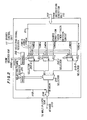
- Fig. 2 shows the branch control unit 111 in more detail, wherein it includes a branch condition taken/non-taken decoder 211, eight first selectors 213-0 to 213-7, a second selector 214, two selecting signal registers (BRCHSEL, and BASEL) 212 and 215, and an AND gate 216.
- the decoder 211 the information indicating the value and state of the internal resources supplied through the bus 1101 from the instruction execution unit 110 is decoded, so that branch condition taken/non-taken signals COND 00 to COND 42 are generated therein.
- the branch condition taken/non-taken signal COND 00 relates to a signal for detecting zero in an arithmetic result which is generated at each time when an arithmetic is carried out in an arithmetic and logic unit (not shown) in the instruction execution unit 110.
- the signal COND 00 becomes an active level to provide the taken of a conditional branch
- the signal COND 00 becomes an inactive level to provide the non-taken of the conditional branch.
- the signal COND 00 is referred in a micro-branch instruction which is executed, thereby resulting in a branch, where the zero detecting signal is zero.
- the signals COND 01 and COND 02 are referred as branch condition taken/non-taken signals relating to carry and sign detecting signals which are generated at each time when an arithmetic is carried out in the arithmetic and logic unit.
- the other signals COND 03 to 42 are also referred as branch condition taken/non-taken signals relating, respectively, to other state signals of the arithmetic and logic unit, and to the value and state of the internal resources thereof.
- a number of the branch condition taken/non-taken signals are generated in the decoder 211.
- the information of the identifying field in the microinstruction for instance, consisting of four bits to designate sixteen signals is stored through a bus 1111 connected to the bus 1082 from the decoder 108 into the register (BRCHSEL) 212.
- a content of the register 212 is commonly supplied to the eight first selectors 213-0 to 213-7, so that each of the selectors 213-0 to 213-7 is controlled to receive the branch condition taken/non- taken signal at a selected node from input nodes SI0 to SI15 dependent on the content of the register 212, and to supply the received signal from an output node SO to the second selector 214.
- the three branch condition taken/non-taken signals COND00, COND 01, and COND 02 are commonly received at the input nodes SI0 to 2.
- the signals COND 00, COND 01 and COND 02 are referred as branch condition taken/non-taken signals relating, respectively, to zero, carry, and sign detecting signals in the arithmetic and logic unit. Therefore, these signals are frequently used as micro-branch conditions.
- the register (BRCHSEL) 212 If it is assumed that the four bit information of, for instance, "0000", by which the signal COND 00 is designated, is stored in the register (BRCHSEL) 212, all of the first selectors 213-0 to 213-7 select the signal COND 00 to be supplied from the output node SO to the second selector 214. In the same manner, where the information stored in the register (BRCHSEL) 212 designates the signal COND 01 or COND 02, all of the first selectors 213-0 to 213-7 supplies the signal COND 01 or COND 02 to the second selector 214.
- the second selector 214 is controlled to select one of the branch condition taken/non-taken signals supplied from the eight first selectors 213-0 to 213-7 dependent on a content of the register (BASEL) 215, in which a three bit information is stored by executing a bank selection microinstruction read from the microinstruction memory 106.
- An output of the selector 214 is a designated branch condition taken/non-taken signal (MTAKEN), which is supplied to a first input terminal of the AND gate 216.
- MTAKEN branch condition taken/non-taken signal
- the signal (MTAKEN) 1110 becomes an active level, so that the multiplexer 104 selects the branch destination address to be transferred to the address register (MA) 105.
- the signal (MTAKEN) 1110 is a signal selected from the signals COND 00, COND 01 and COND 02, as long as an executing micro-branch instruction is a branch condition taken/non-taken signal selected from the signals COND 00, COND 01 and COND 02, even if any of the banks is designated by the content of the register (BASEL) 215. Therefore, it is not necessary to execute a bank selection (switching-over) micro instruction. Consequently, the step number of microprograms is largely decreased, because a branch instruction which refers to the signals COND 00, COND 01, and COND 02 is frequently used.
- a bit length of an identifying field in a micro-branch instruction is not increased, because the designation of the selectors 213-0 to 213-7, that is, the switching-over of the banks is carried out by the selecting signal register (BASEL) 215 and the second selector 214, although the number of selectors is increased as compared to an apparatus in which all the signals are supplied to a single selector.
- BASEL selecting signal register
- Fig. 3 shows a branch control unit 111 which is used in a microprogram control apparatus in a second preferred embodiment according to the invention, wherein like ports are indicated by like reference numerals as used in Fig. 2, except that the signal (BEGINE) is supplied to the register (BASEL) 215 which is thereby initialized.
- the register 215 is initialized at the executing beginning time of a series of microinstruction routines for each macroinstruction, thereby designating the bank of the selector 213-0 in accordance with the initialized content of, for instance, "000".
- micro-branch instructions which are at the next highest order in referred frequency to those assigned to the signals COND 00 to COND 02, are assigned to the branch condition taken/non-taken signals COND03 to COND 15, the step number of microprograms is decreased as compared to that in the first preferred embodiment.
- the signal COND 03 to 15 are used as branch condition taken/non-taken signals for micro-branch instructions to execute a macroinstruction in a category, in which a referred frequency is large as compared to other categories, and into which microinstructions are divided, the same advantage as decreasing the step number is obtained.
- the step number of microinstructions is decreased to realize a macroinstruction, so that the executing time of the macroinstruction is shortened, because at least one branch condition taken/non-taken signal is common to plural micro-branch condition banks.
Landscapes
- Engineering & Computer Science (AREA)
- Software Systems (AREA)
- Theoretical Computer Science (AREA)
- Physics & Mathematics (AREA)
- General Engineering & Computer Science (AREA)
- General Physics & Mathematics (AREA)
- Executing Machine-Instructions (AREA)
- Advance Control (AREA)
Applications Claiming Priority (2)
| Application Number | Priority Date | Filing Date | Title |
|---|---|---|---|
| JP3145989 | 1989-02-09 | ||
| JP31459/89 | 1989-02-09 |
Publications (2)
| Publication Number | Publication Date |
|---|---|
| EP0382235A2 true EP0382235A2 (de) | 1990-08-16 |
| EP0382235A3 EP0382235A3 (de) | 1992-12-30 |
Family
ID=12331846
Family Applications (1)
| Application Number | Title | Priority Date | Filing Date |
|---|---|---|---|
| EP19900102567 Withdrawn EP0382235A3 (de) | 1989-02-09 | 1990-02-09 | Mikroprogramm-Steuervorrichtung |
Country Status (3)
| Country | Link |
|---|---|
| US (1) | US5124910A (de) |
| EP (1) | EP0382235A3 (de) |
| JP (1) | JPH031231A (de) |
Families Citing this family (9)
| Publication number | Priority date | Publication date | Assignee | Title |
|---|---|---|---|---|
| CA2045735A1 (en) * | 1990-06-29 | 1991-12-30 | Richard Lee Sites | Computer performance by eliminating branches |
| US5377335A (en) * | 1991-08-30 | 1994-12-27 | Unisys Corporation | Multiple alternate path pipelined microsequencer and method for controlling a computer |
| GB2266606B (en) * | 1992-04-27 | 1996-02-14 | Intel Corp | A microprocessor with an external command mode |
| GB2266605B (en) * | 1992-04-27 | 1995-10-11 | Intel Corp | Microprocessor having a run/stop pin for accessing an idle mode |
| US5941986A (en) * | 1993-04-30 | 1999-08-24 | Intel Corporation | Micro-code sequencer with branch-taken and branch-not-taken micro-code vectors sharing common address to eliminate taken branch penalties |
| US6016539A (en) * | 1997-11-03 | 2000-01-18 | Teragen Corporation | Datapath control logic for processors having instruction set architectures implemented with hierarchically organized primitive operations |
| JP3664473B2 (ja) * | 2000-10-04 | 2005-06-29 | インターナショナル・ビジネス・マシーンズ・コーポレーション | プログラムの最適化方法及びこれを用いたコンパイラ |
| US20060132449A1 (en) * | 2004-12-21 | 2006-06-22 | International Business Machines Corporation | System, apparatus, and method for displaying variable legends on key buttons |
| GB0617726D0 (en) | 2006-09-08 | 2006-10-18 | Atalla Naji A | Device (modifications) to improve efficiency of internal combustion engines |
Family Cites Families (4)
| Publication number | Priority date | Publication date | Assignee | Title |
|---|---|---|---|---|
| US4398243A (en) * | 1980-04-25 | 1983-08-09 | Data General Corporation | Data processing system having a unique instruction processor system |
| WO1985000453A1 (en) * | 1983-07-11 | 1985-01-31 | Prime Computer, Inc. | Data processing system |
| US4685058A (en) * | 1983-08-29 | 1987-08-04 | Amdahl Corporation | Two-stage pipelined execution unit and control stores |
| EP0221577B1 (de) * | 1985-11-08 | 1996-01-17 | Nec Corporation | Mikroprogrammsteuereinheit |
-
1990
- 1990-02-02 JP JP2023692A patent/JPH031231A/ja active Pending
- 1990-02-07 US US07/475,487 patent/US5124910A/en not_active Expired - Fee Related
- 1990-02-09 EP EP19900102567 patent/EP0382235A3/de not_active Withdrawn
Also Published As
| Publication number | Publication date |
|---|---|
| US5124910A (en) | 1992-06-23 |
| EP0382235A3 (de) | 1992-12-30 |
| JPH031231A (ja) | 1991-01-07 |
Similar Documents
| Publication | Publication Date | Title |
|---|---|---|
| EP0220684B1 (de) | Datenverarbeitungssystem | |
| US3949370A (en) | Programmable logic array control section for data processing system | |
| US5235686A (en) | Computer system having mixed macrocode and microcode | |
| US4131943A (en) | Microprogrammed computer employing a decode read only memory (DROM) and a microinstruction read only memory (ROM) | |
| US4179731A (en) | Microprogrammed control system | |
| EP0114304A1 (de) | Hardwarehilfe und Verfahren zur Vektorverarbeitung | |
| EP0148478A2 (de) | Datenprozessor mit Steuerung der signifikanten Bitlänge von Allzweckregistern | |
| US4954943A (en) | Data processing system | |
| CA1227578A (en) | Entry control store for enhanced cpu pipeline performance | |
| US4459666A (en) | Plural microcode control memory | |
| EP0377976A2 (de) | Mikroprogrammierte Steuervorrichtung mit programmierbaren logischen Anordnungen | |
| US4388682A (en) | Microprogrammable instruction translator | |
| US5008807A (en) | Data processing apparatus with abbreviated jump field | |
| US4541047A (en) | Pipelined data processing system | |
| US4821183A (en) | A microsequencer circuit with plural microprogrom instruction counters | |
| EP0093430A2 (de) | Nach dem Prinzip der Pipeline arbeitendes Datenverarbeitungssystem | |
| US5124910A (en) | Microprogram control apparatus for generating a branch condition signal to be designated by a micro-branch instruction | |
| US5032983A (en) | Entry point mapping and skipping method and apparatus | |
| US4320454A (en) | Apparatus and method for operand fetch control | |
| US5247624A (en) | Microprogram controller including leading microinstruction from a generator executed while succeeding microinstruction from memory is read out | |
| EP0140299B1 (de) | Vektormaskierungssteuerungssystem | |
| EP0010196A1 (de) | Kontrollschaltung und -verfahren für digitale Speicheranlagen | |
| US5203006A (en) | System for selecting next instruction address between unit incremented address and address from table specified by operating condition signals | |
| EP0107952A2 (de) | Informationsverarbeitungsapparat und seine Anordnung zur Befehlssteuerung | |
| EP0164418B1 (de) | Vom mikroprogramm gesteuertes system |
Legal Events
| Date | Code | Title | Description |
|---|---|---|---|
| PUAI | Public reference made under article 153(3) epc to a published international application that has entered the european phase |
Free format text: ORIGINAL CODE: 0009012 |
|
| 17P | Request for examination filed |
Effective date: 19900307 |
|
| AK | Designated contracting states |
Kind code of ref document: A2 Designated state(s): DE FR GB |
|
| PUAL | Search report despatched |
Free format text: ORIGINAL CODE: 0009013 |
|
| AK | Designated contracting states |
Kind code of ref document: A3 Designated state(s): DE FR GB |
|
| 17Q | First examination report despatched |
Effective date: 19941013 |
|
| STAA | Information on the status of an ep patent application or granted ep patent |
Free format text: STATUS: THE APPLICATION HAS BEEN WITHDRAWN |
|
| 18W | Application withdrawn |
Withdrawal date: 19950413 |