EP0383023A2 - Polymerisierbare N'-Polyhydroxy-N'-alkylharnstoffderivate, Verfahren zu ihrer Herstellung, deren Verwendung und daraus erhältliche Homo- oder Copolymeren - Google Patents
Polymerisierbare N'-Polyhydroxy-N'-alkylharnstoffderivate, Verfahren zu ihrer Herstellung, deren Verwendung und daraus erhältliche Homo- oder Copolymeren Download PDFInfo
- Publication number
- EP0383023A2 EP0383023A2 EP90100738A EP90100738A EP0383023A2 EP 0383023 A2 EP0383023 A2 EP 0383023A2 EP 90100738 A EP90100738 A EP 90100738A EP 90100738 A EP90100738 A EP 90100738A EP 0383023 A2 EP0383023 A2 EP 0383023A2
- Authority
- EP
- European Patent Office
- Prior art keywords
- monomers
- polyhydroxy
- preparation
- copolymers
- mono
- Prior art date
- Legal status (The legal status is an assumption and is not a legal conclusion. Google has not performed a legal analysis and makes no representation as to the accuracy of the status listed.)
- Granted
Links
Classifications
-
- C—CHEMISTRY; METALLURGY
- C07—ORGANIC CHEMISTRY
- C07H—SUGARS; DERIVATIVES THEREOF; NUCLEOSIDES; NUCLEOTIDES; NUCLEIC ACIDS
- C07H15/00—Compounds containing hydrocarbon or substituted hydrocarbon radicals directly attached to hetero atoms of saccharide radicals
- C07H15/02—Acyclic radicals, not substituted by cyclic structures
- C07H15/04—Acyclic radicals, not substituted by cyclic structures attached to an oxygen atom of the saccharide radical
-
- C—CHEMISTRY; METALLURGY
- C08—ORGANIC MACROMOLECULAR COMPOUNDS; THEIR PREPARATION OR CHEMICAL WORKING-UP; COMPOSITIONS BASED THEREON
- C08F—MACROMOLECULAR COMPOUNDS OBTAINED BY REACTIONS ONLY INVOLVING CARBON-TO-CARBON UNSATURATED BONDS
- C08F290/00—Macromolecular compounds obtained by polymerising monomers on to polymers modified by introduction of aliphatic unsaturated end or side groups
- C08F290/08—Macromolecular compounds obtained by polymerising monomers on to polymers modified by introduction of aliphatic unsaturated end or side groups on to polymers modified by introduction of unsaturated side groups
- C08F290/10—Polymers provided for in subclass C08B
Definitions
- the present invention relates to the new compounds listed in claim 1 according to formulas I or II, the preparation of these monomers from reducing mono- and oligosaccharides, alkylamines and vinyl or acrylic isocyanates, and the use of the monomers thus prepared for the preparation of surface-active polymers different HLB value and finally the homopolymers or copolymers obtainable from these monomers by redox initiation.
- N-alkylaminopolyols from reducing carbohydrates and N-alkylamines is mentioned in the literature (US Pat. No. 4,021,539, DE-OS 18 16 279, P 15 93 894).
- the monomers according to formulas I or II according to the invention are prepared from N-alkylaminopolyols by selective addition of substituted isocyanates in the presence of water and / or alcohols or an inert aprotic solvent, such as, for example, dioxane or tetrahydrofuran, especially at temperatures between 0 and 25 ° C.
- aminopolyols which can be used are: maltamine, isomaltamine, glucamine and mixtures thereof. The following may be mentioned within the alkyl radicals having 4 to 21 carbon atoms: hexyl, octyl, decyl.
- isocyanatoethyl acrylate and isocyanatoethyl methacrylate are used as reaction components with the N-alkylaminopolyols.
- IEM alkyl monomer is recommended as a short form. 1) In the following, VIC is used as a short form for vinyl isocyanate. 2) VIC alkyl monomer is recommended as a short form. 3) IEM is used below as a short form for isocyanatoethyl methacrylate.
- the designation for the monomers according to formulas I and II according to the invention differs depending on the isocyanate used: - When using vinyl isocyanate 1) as a suitably substituted isocyanate, the name N-vinyl-N ', N'-alkyl deoxysaccharide alcohol urea 2) is recommended. - When using isocyanatoethyl methacrylate 3) as a reaction partner, the name N-ethyl methacrylato-N ', N'-alkyl deoxysaccharide alcohol urea 4) is recommended.
- substituted reactive isocyanates for example acryloyl isocyanate and methacryloyl isocyanate, can also be suitable for addition (EP 0204497).
- the monomers produced according to the invention differ in their HLB values (hydrophilic / lipophilic balance, "The Atlas HLB System, Atlas Chemie GmbH, Essen, 1968") in accordance with the choice of the alkylamines used and the reducing carbohydrates.
- HLB values hydrophilic / lipophilic balance, "The Atlas HLB System, Atlas Chemie GmbH, Essen, 1968
- the surface tension of aqueous solutions of the monomers according to the invention, but also of the polymers produced therefrom, is different (for examples see Table 1).
- the products are also different in other polymer characterization data (see Table 2 for examples).
- the homo- or copolymerization of the monomers according to the invention is preferably carried out by initiation with peroxides or azo derivatives in an aqueous medium at temperatures between 0 and 100 ° C.
- Table 1 Interfacial tensions of aqueous solutions of some monomers and polymers according to the invention, as well as of some starting compounds at 25 ° C substance Molecular weight (g / mol) Interfacial tension 0.1% solution (mN / m) Water* 18th 72 Maltose 342 72 1-amino maltitol 343 72 N-butylaminomaltitol 397 71 IEM butyl aminomaltitol monomer 554 64 Butyl aminomaltitol polymer > 106 66 N-hexylaminomaltitol 425 56 IEM hexylamino isomaltitol monomer 582 51 Hexyl aminomaltitol polymer > 106 55 N-hexylamino isomal
- N-alkylaminopolyols produced by reductive amination of reducing carbohydrates with N-alkylamines, can be reacted with substituted isocyanates to give the corresponding monomers according to the invention, which surprisingly could be polymerized without problems to give high molecular weight hydrophilic surface-active products.
- Hydrophilic surface-active polymers based on carbohydrates have hitherto usually been obtained by polymer-analogous conversion, for example of cellulose (Ullmanns Encyklopadie der techn. Chemie, 4th ed., Vol. 9, p. 199 ff).
- their surface activity is lower than that of the monomers according to the invention or the polymers produced therefrom when using alkyl chains (R3 in formulas I and II) with more than 6 carbon atoms.
- a simultaneous optimization of parameters that are important for the application such as solubility, surface activity and viscosity, is less controllable in a polymer-analogous implementation than in a targeted polymerization.
- the range of variation of the monomers according to the invention allows a wide range of surface-active polymers of different HLB values to be produced in a targeted manner.
- surface-active polymers for example block copolymers (so-called Pluronics, Ullmanns Encyklopadie der Technische Chemie, 4th edition, vol. 22, p. 498, 1982) are not obtained by radical polymerization. Their molecular weights are usually lower in comparison to the polymers or copolymers prepared from the monomers according to the invention.
- Water-soluble or hydrophilic polymers have a wide range of applications. They are required as thickeners in technology, the pharmaceutical and food industries, for the tertiary production of petroleum, but also as auxiliary materials for textile and paper production (see, for example, Chemistry and Technology of water-soluble Polymers, edited by CA Finch Plenum Press New York 1983, pp. 11 ff.). Different surface activities are required in many areas of these applications. This applies in particular to the production of tertiary oil, paper and emulsion paint production (Kessel, DG: Erdöl, Erdgas, Kohlen (1986), 102, pp. 504-508). Another important area of application for surface-active substances is polymer production by emulsion polymerization. Stable emulsions can be prepared with the monomers produced according to the invention, so that no further surface-active substances need be added when the monomers according to the invention are used in an emulsion polymerization.
- monomers produced according to the invention are particularly suitable for the targeted preparation of polymers with a wide range of applications.
- the slightly yellow solution is introduced into a 1 liter high-pressure autoclave together with 25 g of aqueous Raney nickel suspension (MERCK). Before the reductive amine The reactor is flushed three times with hydrogen (30 bar) and thus made oxygen-free. The reductive amination is carried out under the conditions listed above.
- MERCK aqueous Raney nickel suspension
- the autoclave For working up, the autoclave is relaxed and emptied after 24 hours.
- the aqueous phase is separated from the catalyst and the amine is removed azeotropically with the water on a rotary evaporator. Amine residues are removed by adding water and subsequent ether extraction; freeze-drying of the aqueous phase gives the product (mixture of isomers) in good yield.
- a wide molecular weight range is covered by varying the polymerization conditions (monomer and initiator concentration, temperature). It is initiated with the water-soluble redox system ammonium peroxodisulfate in conjunction with sodium bisulfide.
- the advantage of the chosen redox system compared to other initiators lies in its suitability even at low temperatures, which means that particularly high degrees of polymerization can also be obtained.
- other peroxide initiators such as H2O2
- the polymerization takes place at higher temperatures (70-90 ° C), whereby shorter-chain polymers are obtained.
- the polymerizations carried out were carried out in bidistilled water. To remove the oxygen, nitrogen is passed over the solution.
- the stirring speed is chosen so high that a nitrogen purge of the monomer solution is ensured by the introduction of bubbles.
- the polymerization was started by injecting the initiators dissolved in water at the desired temperature. The polymerization is terminated by venting the reactor and adding 5 ml of deionized, not degassed Water. In the examples given, the polymerization was mostly terminated at low conversions in order to obtain polymers which could be clearly characterized. As shown in Example P 206, high polymer yields can be achieved without problems. To precipitate the polymer, 10-20 times the amount of methanol / acetone (ratio 1: 1) is added to the solution and the precipitated polymer is separated off.
- the aqueous polymer solution is dialyzed and recovered by freeze-drying as a cotton-like substance.
- the polymerization is carried out in the same way as in point 5 described above.
- the monomers are weighed out dry, dissolved in bidistilled water and passed through a filter into the nitrogen-flushed polymerization reactor. To remove the residual oxygen, nitrogen is passed over the solution for a further four hours, the temperature being 5 ° C. to avoid self-initiation. The temperature is only set to 38 ° C. shortly before initiation with ammonium peroxodisulfate.
- the polymerization parameters are listed in Table 8. Table 8 Polymerization parameters for the AAm / IEM octyl maltitol copolymer (CAOl) Monomer weight Total monomer conc. [Minor] Init. [Mol / l] T ° C t min. Yield% AAm [g] Octyl. [G] 1.4 0.7 0.88 8.7 ⁇ 10 ⁇ 3 38 10th 34
- Table 9 shows the composition of the monomer mixture and the polymer. 13 C-NMR spectroscopy made it possible to make a statement about the composition of the copolymer based on the different carbonyl signals of the monomer components of the polymer. It turned out that the octyl monomer is statistically incorporated into the AAm chain. Table 9 Composition of the monomer mixture and the polymer relationship AAm Octyl monomer Weight v. of the monomers in the reaction solution 2nd 1 Molar ratio of the monomers in the reaction solution 18th 1 Molar ratio of the monomers in the polymer 19th 1
- the surface activity property of the octyl monomer was transferred to the copolymer.
- the measurement after dialysis and freeze-drying gave a value of 53 mN / m (see Table 1). This shows that even small amounts of amphiphilic monomers, copolymerized with conventional non-surface-active substances, lead to surfactant-like polymers.
- Table 10 shows the molecular and macroscopic properties of the pure octyl polymer, the copolymer CAOl and PAAm. Table 10 Comparison of the copolymer CAOl with PAAm and the octyl polymer polymer Mole% octylm. % By weight of octylm. M W g / mol [ ⁇ ] ml / g A2 R G nm dn / dc ml / g o * mN / m Octylp.
- the copolymer was polymerized in a bomb tube at 67 ° C.
- the polymerization parameters are listed in Table 11.
- Table 11 Polymerization parameters of the VIC-Hexyl / VP copolymer Monomer weight Total monomer conc. Minor Init. * Mol / l T ° C th Yield% VIC / Hexylm. [G] VP [g] 3.5 1.5 3.44 1.1 ⁇ 10 ⁇ 3 67 16 25th * 2,2'-Azobis-2-amidinopropane hydrochloride
- composition of the polymers was again determined via 13 C-NMR spectroscopy.
- Table 12 shows the composition of the monomer mixture and the composition of the copolymer. With this copolymer too, the surface-active saccharide monomer is statistically incorporated into the PVP chain.
- Table 12 Composition of the monomer mixture and the polymer relationship VP VIC hexyl monomer in g 3.5 : 1.5 Weight ratio 2.3 : 1 Molverh. 11 : 1 Molverh. in the polymer 12 : 1 by 13 C-NMR
Landscapes
- Chemical & Material Sciences (AREA)
- Organic Chemistry (AREA)
- Health & Medical Sciences (AREA)
- Genetics & Genomics (AREA)
- Engineering & Computer Science (AREA)
- Biochemistry (AREA)
- Biotechnology (AREA)
- General Health & Medical Sciences (AREA)
- Life Sciences & Earth Sciences (AREA)
- Molecular Biology (AREA)
- Crystallography & Structural Chemistry (AREA)
- Chemical Kinetics & Catalysis (AREA)
- Medicinal Chemistry (AREA)
- Polymers & Plastics (AREA)
- Addition Polymer Or Copolymer, Post-Treatments, Or Chemical Modifications (AREA)
- Organic Low-Molecular-Weight Compounds And Preparation Thereof (AREA)
Abstract

R₂ = H oder ein Mono- oder Oligosaccharid
R₂ = H oder ein Mono- oder Oligosaccharid
R₃ = CnH2n+1 mit n = 4 bis 21 sowie
R₄ = - Alkylmethacrylat-Gruppe
- Alkylacrylat-Gruppe oder
- Vinyl-Gruppe,
und deren Mischungen. Alsdann ist Gegenstand der Erfindung die Herstellung dieser Verbindungen durch Reaktion von N-Alkylaminopolyolen (gewonnen durch reduktive Aminierung von reduzierenden Mono- oder Oligosacchariden mittels Alkylaminen) mit geeignet substituierten Isocyanaten, wie Vinylisocyanat oder Isocyanato-ethyl-(meth)acrylat. Schließlich betrifft die Erfindung noch die Verwendung der bestimmten Verbindungen entsprechend ihren HLB-Werten als Monomere oder Comonomere zur Herstellung von grenzflächenaktiven Homo- oder Copolymeren sowie die aus den Monomeren gemäß den Formeln I oder II durch Redox-Initiation erhältlichen Homo- oder Copolymeren.
Description
- Die vorliegende Erfindung betrifft die im Anspruch 1 aufgeführten neuen Verbindungen entsprechend den Formeln I oder II, die Herstellung dieser Monomeren aus reduzierenden Mono- und Oligosacchariden, Alkylaminen und Vinyl- bzw. Acrylisocyanaten, sowie die Verwendung der derart hergestellten Monomeren zur Darstellung von oberflächenaktiven Polymeren unterschiedlichen HLB-Wertes und schließlich die aus diesen Monomeren durch Redox-Initiation erhältlichen Homopolymere oder Copolymere.
- Die Konstitution der beanspruchten monomeren Verbindungen gemäß den Formeln I und II ist durch ¹³C-NMR-Spektroskopie gesichert.
- Die Herstellung von N-Alkylaminopolyolen aus reduzierenden Kohlenhydraten und N-Alkylaminien ist in der Literatur erwähnt (US-PS 4,021,539, DE-OS 18 16 279, P 15 93 894). Die Herstellung der erfindungsgemäßen Monomeren entsprechend den Formeln I oder II erfolgt aus N-Alkylaminopolyolen durch selektive Addition von substituierten Isocyanaten in Gegenwart von Wasser und/oder Alkoholen oder einem inerten aprotischen Lösungsmittel, wie beispielsweise Dioxan oder Tetrahydrofuran, besonders bei Temperaturen zwischen 0 und 25°C.
- Als Aminopolyole können zum Beispiel eingesetzt werden: Maltamin, Isomaltamin, Glucamin und deren Mischungen. Innerhalb der Alkylreste mit 4 bis 21 C-Atomen seien genannt: Hexyl-, Octyl-, Decyl-. Als Reaktionskomponenten mit den N-Alkylaminopolyolen dienen außer Vinylisocyanat in der Gruppe der acrylierten Isocyanate besonders Isocyanatoethylacrylat und Isocyanatoethylmethacrylat. 4) Als Kurzform emfiehlt sich IEM-alkylmonomer.
1) Als Kurzform wird im folgenden für Vinylisocyanat VIC benutzt.
2) Als Kurzform empfiehlt sich VIC-alkylmonomer.
3) Als Kurzform wird im folgenden für Isocyanatoethylmethacrylat IEM benutzt. - Die Bezeichnung für die erfindungsgemäßen Monomeren gemäß den Formeln I und II ist je nach dem verwendeten Isocyanat unterschiedlich:
- Bei Verwendung von Vinylisocyanat1) als geeignet substituiertes Isocyanat empfiehlt sich als Bezeichnung N-Vinyl-N′,N′-alkyldesoxysaccharidalkohol-harnstoff2).
- Bei Verwendung von Isocyanatoethylmethacrylat3) als Reaktionspartner empfiehlt sich die Bezeichnung N-Ethylmethacrylato-N′,N′-alkyldesoxysaccharidalkohol-harnstoff4). - Zur Addition können auch andere substituierte reaktionsfähige Isocyanate, zum Beispiel Acryloylisocyanat und Methacryloylisocyanat, geeignet sein (EP 0204497).
- Die erfindungsgemäß hergestellten Monomeren unterscheiden sich in ihren HLB-Werten (Hydrophilic/lipophilic balance, "Das Atlas HLB System, Atlas Chemie GmbH, Essen, 1968") entsprechend der Wahl der verwendeten Alkylamine und der reduzierenden Kohlenhydrate. In entsprechender Weise ist die Oberflächenspannung von wäßrigen Lösungen der erfindungsgemäßen Monomeren, aber auch der daraus hergestellten Polymeren, unterschiedlich (Beispiele siehe Tabelle 1). Auch in anderen polymertypischen Charakterisierungsdaten sind die Produkte verschieden (Beispiele siehe Tabelle 2).
- Die Homo- oder Copolymerisation der erfindungsgemäßen Monomeren erfolgt bevorzugt durch Initiation mit Peroxiden oder Azo-Derivaten in wässerigem Medium bei Temperaturen zwischen 0 und 100°C.
Tabelle 1 Grenzflächenspannungen von wäßrigen Lösungen von einigen erfindungsgemäßen Monomeren und Polymeren, sowie von einigen Ausgangsverbindungen bei 25°C Substanz Molekulargewicht (g/mol) Grenzflächenspannung 0,1%-ige Lsg (mN/m) Wasser* 18 72 Maltose 342 72 1-Aminomaltit 343 72 N-Butylaminomaltit 397 71 IEM-butyl-aminomaltitmonomer 554 64 Butyl-aminomaltitpolymer > 10⁶ 66 N-Hexylaminomaltit 425 56 IEM-hexylaminoisomaltitmonomer 582 51 Hexyl-aminomaltitpolymer > 10⁶ 55 N-Hexylaminoisomalt 425 54 IEM-hexylaminomaltmonomer 582 51 Hexyl-aminoisomaltpolymer > 10⁶ 52 N-octylaminomaltit 453 50 IEM-octyl-aminomaltitmonomer 610 46 Octyl-aminomaltitmonomer < 10⁶ 47 PAAm1) > 10⁶ 73 CAOl2) > 10⁶ 53 N-Decylaminomaltit 481 37 IEM-decyl-aminomaltitmonomer 636 36 Decyl-aminomaltitmonomer 0,8 x 10⁶ 35 VIC-hexyl-monomer 496 55 PVP3) > 10⁵ 70 VIC-hexyl/VP-polymer4) > 10⁵ 58 * Lösungsmittel 1) Polyacrylamid 2) Polyacrylamidcopolymer mit IEM-Octylaminomaltit 3) Polyvinylpyrrolidon 4) Vinylpyrrolidoncopolymer Tabelle 2 Charakterisierungsdaten von einigen synthetisierten wasserlöslichen Polymeren Pol.Nr. Mw [g/mol] Pw [n] [ml/g] dn/dc [ml/g] Poly-N-ethylmethacrylato-N′,N′-butyl,1-desoxy-maltit-harnstoffe P 101 1.04·10⁶ 1888 37.3 0.156 P 102 1.78·10⁶ 3231 60.8 0.158 P 103 3.30·10⁶ 5976 83.5 0.157 P 104 4.07·10⁶ 7500 98.5 0.157 P 105 4.47·10⁶ 8097 107.0 0.156 P 106 9.47·10⁶ 17172 151.7 0.157 Poly-N-ethylmethacrylato-N′,N′-hexyl,1-desoxy-maltit-harnstoffe P 201 0.79·10⁶ 1360 22.2 0.145 P 202 2.90·10⁶ 4991 42.1 0.146 P 203 3.91·10⁶ 6729 56.0 0.147 P 204 4.87·10⁶ 8382 62.0 0.146 P 205 18.36·10⁶ 31546 136.0 0.146 Poly-N-ethylmethacrylato-N′,N′-octyl,1-desoxy-maltit-harnstoffe P 301 0.77·10⁶ 1264 17.4 0.112 P 302 0.83·10⁶ 1362 21.5 0.113 Poly-N-ethylmethacrylato-N′,N′-decyl,1-desoxy-maltit-harnstoff P 401 0.73·10⁶ 998 14.3 0.108 Poly-N-ethylmethacrylato-N′,N′-hexyl,2-desoxy-isomalt-harnstoff P 501 1.2 ·10⁶ 2058 26.1 0.145 - Überraschenderweise unterscheiden sich die Oberflächenspannungen wässeriger Lösungen der N-Alkylaminopolyole, aus ihnen hergestellte Monomere, Homopolymere und selbst Copolymere kaum (siehe Tabelle 1). Mit zunehmender Alkylkette bei gleichbleibendem hydrophilen Teil (Kohlenhydrat) sinkt die Oberflächenspannung wäßriger Lösungen erwartungsgemäß.

- Polymerisationsfähige Monomere auf Basis von Aminopolyolen, die durch reduktive Aminierung aus reduzierenden Zuckern erhalten wurden, sind in neuerer Zeit mehrfach beschrieben (zum Beispiel DE 36 25 931 C2 und J. Klein, D. Herzog, Makromol. Chem. 188, 1217-1232 (1987)).
- Diese Monomeren sind nicht oberflächenaktiv (zum Beispiel Abb. 1, R₃ = 0). Sie eignen sich daher nicht zur Darstellung von oberflächenaktiven Polymeren. Die direkte Umsetzung von N-Alkyl-N-aminopolyolen mit zum Beispiel Methacrylsäure zu den entsprechenden Amiden ist zwar möglich, aber eine Polymerisation zu Homo- oder Copolymeren gelang nicht (J. Klein, S. Engelke: unveröffentlichte Ergebnisse aus dem Institut für Technische Chemie der TU Braunschweig; siehe auch Diplomarbeit S. Engelke, TU Braunschweig, 1985). N-Alkylaminopolyole, hergestellt durch reduktive Aminierung von reduzierenden Kohlenhydraten mit N-Alkylaminen, lassen sich mit substituierten Isocyanaten zu den entsprechenden erfindungsgemäßen Monomeren umsetzen, die sich überraschenderweise problemlos zu hochmolekularen hydrophilen oberflächenaktiven Produkten polymerisieren ließen. Auch Copolymerisation mit hydrophilen Monomeren, beispielsweise Acrylamid, gelingt ohne Schwierigkeiten.
- Hydrophile oberflächenaktive Polymere auf Basis von Kohlenhydraten werden üblicherweise bisher durch polymeranaloge Umsetzung beispielsweise von Cellulose erhalten (Ullmanns Encyklopädie der techn. Chemie, 4. Aufl., Bd. 9, S. 199 ff). Deren Oberflächenaktivität ist aber geringer als die der erfindungsgemäßen Monomeren bzw. daraus hergestellten Polymeren bei Verwendung von Alkylketten (R₃ in Formeln I und II) mit mehr als 6 Kohlenstoffatomen. Daneben ist eine gleichzeitige Optimierung von für die Anwendung wichtigen Parametern, wie Löslichkeit, Oberflächenaktivität und Viskosität bei einer polymeranalogen Umsetzung schlechter steuerbar als bei einer gezielten Polymerisation. Die Variationsbreite der erfindungsgemäßen Monomeren erlaubt bei geeigneter Wahl der Rohstoffe, zum Beispiel der reduzierenden Kohlenhydrate und/oder der N-Alkylamine, aber auch der substituierten Isocyanate und der Comonomeren, ein weites Spektrum von oberflächenaktiven Polymeren unterschiedlichen HLB-Wertes gezielt herzustellen.
- Andere oberflächenaktive Polymere, zum Beispiel Blockcopolymere (sog. Pluronics, Ullmanns Encyklopädie der technischen Chemie, 4. Auflage, Bd. 22, S. 498, 1982) werden nicht durch radikalische Polymerisation gewonnen. Ihre Molekulargewichte sind meistens im Vergleich zu den aus den erfindungsgemäßen Monomeren hergestellten Polymeren bzw. Copolymeren geringer.
- In neuerer Zeit wurde über die Synthese von amphiphilen Kohlenhydratpolymeren durch Ringöffnungspolymerisation von octadecylsubstituierten Anhydrozuckern berichtet (Makromol. Chem. 189, 1019-1026, 1988).
- Die Darstellung dieser Polymere im technischen Maßstab erscheint wegen der aufwendigen Synthese der substituierten Anhydrozucker eher unwahrscheinlich. Darüber hinaus ist die Übertragung des Syntheseweges auf Oligosaccharide kaum praktikabel.
- Wasserlösliche bzw. hydrophile Polymere haben vielseitige Anwendungsmöglichkeiten. Sie werden als Dickungsmittel in der Technik, Pharma- und Nahrungsmittelindustrie, zur Tertiär-Förderung von Erdöl, aber auch als Hilfsmittel zur Textil- und Papierherstellung benötigt (vergleiche zum Beispiel Chemistry and Technology of water-soluble Polymers, edited by C. A. Finch Plenum Press New York 1983, S. 11 ff.). In vielen Bereichen dieser Anwendungen sind unterschiedliche Oberflächenaktivitäten erforderlich. Insbesondere gilt dieses bei der Tertiärerdölförderung, der Papier- und Dispersionsfarbherstellung (Kessel, D. G. : Erdöl, Erdgas, Kohle (1986), 102, S. 504-508). Ein weiteres wichtiges Anwendungsgebiet für oberflächenaktive Substanzen ist die Polymerherstellung durch Emulsionspolymerisation. Mit den erfindungsgemäß hergestellten Monomeren lassen sich stabile Emulsionen darstellen, so daß bei Verwendung der erfindungsgemäßen Monomere in einer Emulsionspolymerisation keine weiteren oberflächenaktiven Substanzen zugesetzt werden müssen.
- Aus diesen Gründen sind erfindungsgemäß hergestellte Monomere für die gezielte Darstellung von Polymeren mit einem weiten Anwendungsbereich besonders geeignet.
- Die nachstehenden Beispiele dienen zur weiteren Erläuterung der Erfindung, wobei zunächst am Beispiel von N-Alkyl-isomalt die Herstellung von N-Alkyl-saccharidalkoholen gezeigt wird.
- Allgemeine Reaktionsbedingungen für die reduktive Aminierung.
- Wasserstoffdruck: 100 - 200 bar
- Temperatur: 45 - 60°C
- Rührgeschwindigkeit: 500 - 1500 Upm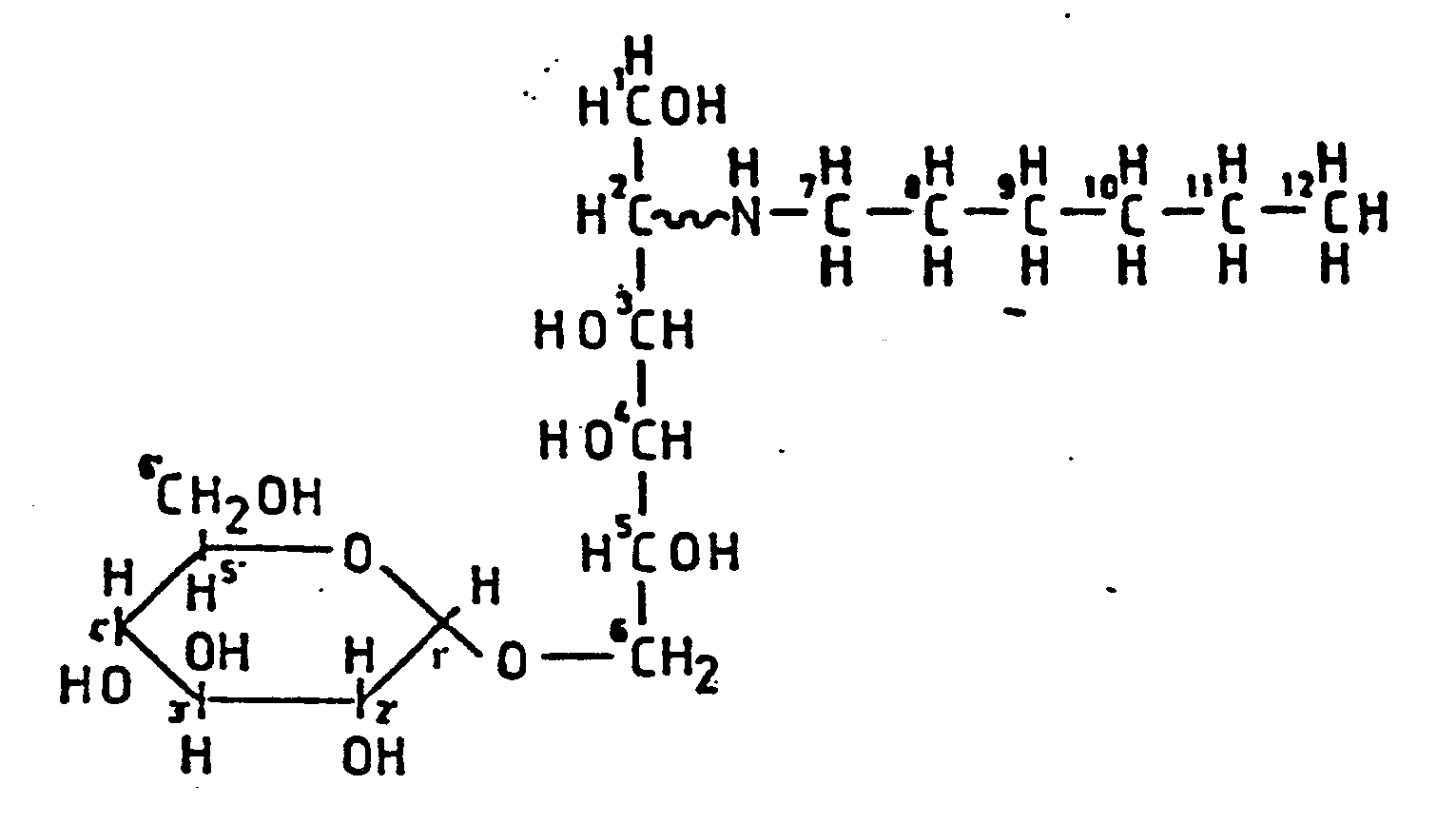
- 100 g (0,272 mol ) Palatinose (Fa. SÜDZUCKER AG) werden in 350 ml destilliertem Wasser und 25 ml Methanol gelöst. Bei 5°C tropft man 200 ml (1,66 mol ) Hexylamin zu und rührt weitere 18 Stunden bei dieser Temperatur.
- Die leicht gelbe Lösung wird zusammen mit 25 g wäßriger Raney-Nickel-Suspension (Fa. MERCK) in einen 1-Liter Hochdruckautoklaven eingefüllt. Vor der reduktiven Aminie rung wird der Reaktor dreimal mit Wasserstoff (30 bar) gespült und so sauerstofffrei gemacht. Die reduktive Aminierung wird unter den oben aufgeführten Bedingungen durchgeführt.
- Zur Aufarbeitung wird der Autoklav nach 24 Stunden entspannt und entleert. Die wäßrige Phase wird vom Katalysator getrennt und das Amin azeotrop mit dem Wasser am Rotationsverdampfer abgezogen. Durch Zugabe von Wasser und anschließende Etherextraktion werden Aminreste entfernt; eine Gefriertrocknung der wäßrigen Phase liefert das Produkt (Isomerengemisch) in guter Ausbeute.
- 1. Herstellung von N-Ethylmethacrylato-N′,N′-decyl,1-desoxymaltit-harnstoff, dem die Formel

- Zu einer Suspension von 8 g (16,5 mmol ) N-Decylaminomaltit in 40 ml destilliertem Wasser tropft man unter Kühlung bei 5°C unter starkem Rühren 2,5 g (16,5 mmol ) IEM. Nach Beendigung der Zugabe rührt man eine Stunde bei der gleichen Temperatur und weitere zwei Stunden bei 10°C. Die klare Reaktionslösung wird langsam auf Raumtemperatur erwärmt und dreimal mit peroxidfreiem Ether extrahiert. Das Produkt wird durch schonende Trocknung der wäßrigen Phase isoliert.
- 2. Herstellung von N-Vinyl-N′,N′-hexyl,1-desoxy-maltit-harnstoff, dem die Formel
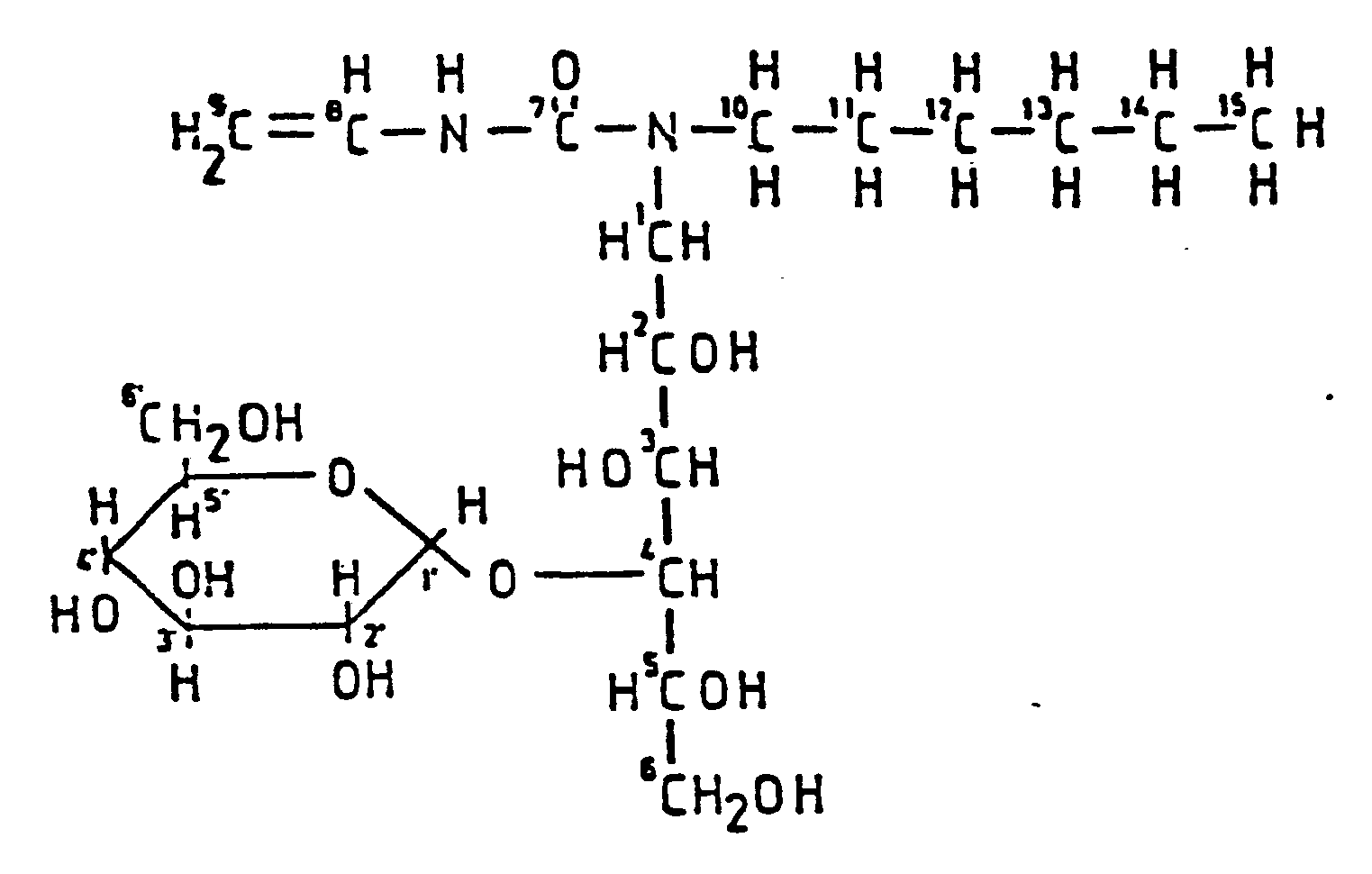
- 5 g (11,7 mmol) N-Hexylaminomaltit werden in 30 ml entionisiertem Wasser suspendiert. Bei einer Temperatur von 10°C tropft man 0,82 g (11,7 mmol ) frischdestilliertes Vinylisocyanat so langsam zu, daß die Temperatur nicht über 12°C ansteigt. Nach Beendigung der Zugabe wird 12 Stunden bei dieser Temperatur, anschließend zwei Stunden bei 15°C weitergerührt. Danach läßt man die Reaktionslösung sich auf Raumtemperatur erwärmen und entfernt durch dreimalige Extraktion mit Diethylether unverbrauchtes VIC. Durch Trocknen der wäßrigen Phase erhält man das weiße Produkt.
- 3. Herstellung von N-Ethylmethacrylato-N′,N′-hexyl,2-desoxyisomalt-harnstoff mit der Formel
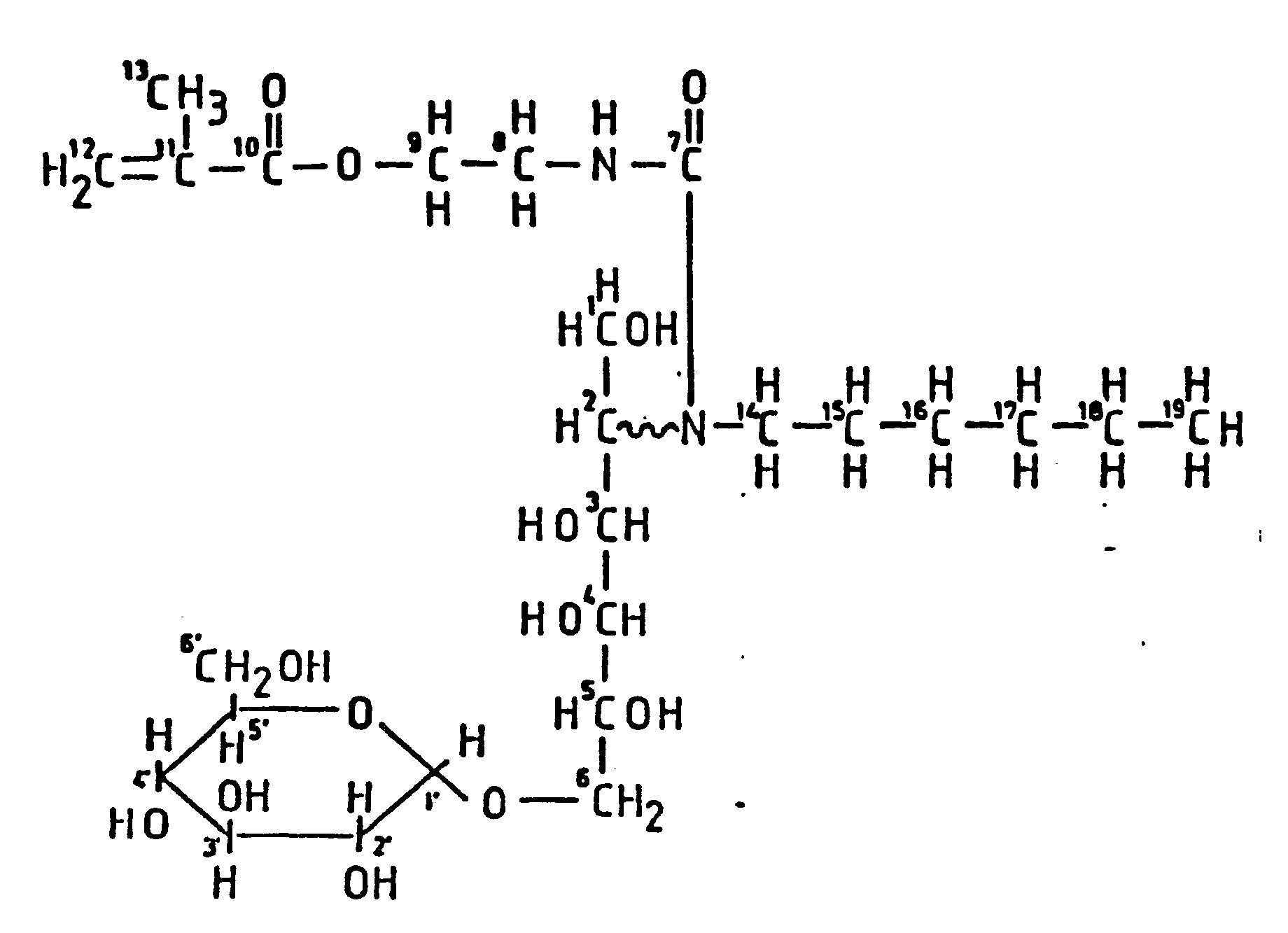
- 10 g (23,5 mmol ) N-Hexylisomalt werden in 50 ml destilliertem Wasser gelöst und auf 0°C gekühlt. Unter kräftigem Rühren tropft man 3,7 g (23,5 mmol ) IEM zu, rührt eine Stunde bei der gleichen Temperatur und weitere zwei Stunden bei +5°C. Danach läßt man die Lösung sich auf Raumtemperatur erwärmen, extrahiert mit peroxidfreiem Ether, trennt die wässerige Phase ab und isoliert das Produkt durch Gefriertrocknung.
Ausbeute: 89%Elementaranalyse %C %H %N Ber.: 51,63 7,75 4,82 Gef.: 51,55 7,83 4,87 - 4. Herstellung von N-Ethylmethacrylato-N′,N′-octyl,1-desoxy-maltit-harnstoff, dem die Formel

- In einem thermostatisierbaren 150 ml-Reaktor mit Magnetrührer und Innenthermometer werden 6,2 g (13,6 mmol ) N-Octylaminomaltit in 50 ml Dioxan suspendiert und bei 15°C tropfenweise mit 2,11 g (13,6 mmol ) IEM versetzt. Nach vollständiger Zugabe des Isocyanates rührt man eine Stunde bei dieser Temperatur weiter und zur Vervollständigung der Reaktion noch weitere 16 Stunden bei 25°C. Mit fortschreitender Reaktionsdauer geht die Suspension in eine homogene Lösung über. Die Isolierung des Produktes erfolgt durch Ausfällung in 600 ml Diethylether. Um die Fällung zu vervollständigen, wird die Lösung 24 Stunden bei -30°C aufbewahrt. Anschließende Filtration, dreimaliges Waschen mit Diethylether und Lösungsmittelentfernung an der Hochvakuumanlage liefern das gewünschte weiße Produkt.
- 5. Im nachstehenden wird die Herstellung von oberflächenaktiven Homopolymeren erläutert.
- Durch Variation der Polymerisationsbedingungen (Monomer- und Initiatorkonzentration, Temperatur) wird ein breiter Molekulargewichtsbereich abgedeckt. Die Initiierung erfolgt mit dem wasserlöslichen Redox-System Ammoniumperoxodisulfat in Verbindung mit Natriumbisulfid. Der Vorteil des gewählten Redox-Systemes gegenüber anderen Initiatoren liegt in der Eignung auch bei niedrigen Temperaturen, wodurch auch besonders hohe Polymerisationsgrade erhalten werden können. Bei Verwendung von anderen Peroxid-Initiatoren, wie zum Beispiel H₂O₂, erfolgt die Polymerisation bei höheren Temperaturen (70-90°C), wobei kürzerkettige Polymere anfallen. Die durchgeführten Polymerisationen erfolgten in bidestilliertem Wasser. Um den Sauerstoff zu entfernen, wird Stickstoff über die Lösung geleitet. Die Rührgeschwindigkeit wird hierbei so hoch gewählt, daß durch Blaseneintrag eine Stickstoffspülung der Monomerlösung gewährleistet ist. Die Polymerisation wurde durch Injektion der in Wasser gelösten Initiatoren bei der gewünschten Temperatur gestartet. Der Abbruch der Polymerisation erfolgt durch Belüften des Reaktors und Zugabe von 5 ml entionisiertem, nicht entgastem Wasser. In den aufgeführten Beispielen wurde die Polymerisation meistens bei niedrigen Umsätzen abgebrochen, um eindeutig charakterisierbare Polymere zu erhalten. Hohe Polymerausbeuten sind, wie Beispiel P 206 zeigt, problemlos zu erreichen. Zur Ausfällung des Polymers wird zur Lösung die 10 - 20-fache Menge Methanol/Aceton (Verhältnis 1:1) zugegeben und das gefällte Polymer abgetrennt.
- Um gegebenenfalls nicht umgesetztes Monomer von Polymer abzutrennen, was bei der Polymercharakterisierung und bei der Messung der Oberflächenspannung die Ergebnisse verfälschen könnte, wird die wässerige Polymerlösung dialysiert und durch Gefriertrocknung als watteähnliche Substanz zurückgewonnen.
- Die genauen Polymerisationsbedingungen sind den folgenden Tabellen und Erläuterungen zu entnehmen.
Tabelle 3 Polymerisation von N-Ethylmethacrylato-N′,N′-hexyl,-1-desoxy-glucit-harnstoff Pol.Nr. Mon.konz. Mol/l Oxid.konz. Mol/l Red.konz. Mol/l t h T °C Ausb. % P.IB.1 0.238 5.9·10⁻⁴ 7.1·10⁻⁴ 0.5 3 14 P.IB.2 0.119 5.9·10⁻⁴ 7.1·10⁻⁴ 0.5 10 19 Tabelle 4 Polymerisation von N-Ethylmethacrylato-N′,N′-butyl,1-desoxy-maltit-harnstoff Pol.Nr. Mon.konz. Mol/l Oxid.konz. Mol/l Red.konz. Mol/l t h T °C Ausb. % P 101 0.181 1.8·10⁻³ 2.2·10⁻³ 5.0 25 82 P 102 0.181 9.0·10⁻⁴ 1.1·10⁻³ 4.0 4 80 P 103 0.181 4.5·10⁻⁴ 5.4·10⁻⁴ 4.0 15 88 P 104 0.181 4.5·10⁻⁴ 5.4·10⁻⁴ 4.0 4 61 P 105 0.226 4.1·10⁻⁴ 4.9·10⁻⁴ 1.5 3 67 P 106 0.271 4.5·10⁻⁴ 5.4·10⁻⁴ 2.0 3 57 Tabelle 5 Polymerisation von N-Ethylmethacrylato-N′,N′-hexyl,1-desoxy-maltit-harnstoff Pol.Nr. Mon.konz. Mol/l Oxid.konz. Mol/l Red.konz. Mol/l t h T °C Ausb. % P 201 0.129 6.6·10⁻⁴ 7.9·10⁻⁴ 1.0 12 27 P 202 0.129 6.4·10⁻⁴ 7.7·10⁻⁴ 6.0 4 26 P 203 0.172 4.4·10⁻⁴ 5.2·10⁻⁴ 4.0 5 19 P 204 0.172 3.9·10⁻⁴ 4.7·10⁻⁴ 1.0 5 45 P 205 0.215 3.9·10⁻⁴ 4.7·10⁻⁴ 0.5 3 42 P 206 0.215 2.7·10⁻⁴ 3.3·10⁻⁴ 2.0 7 86 Tabelle 6 Polymerisation von N-Ethylmethacrylato-N′,N′-octyl,1-desoxy-maltit-harnstoff Pol.Nr. Mon.konz. Mol/l Oxid.konz. Mol/l Red.konz. Mol/l t h T °C Ausb. % P 301 0.082 2.9·10⁻⁴ 3.5·10⁻⁴ 0.5 10 25 P.302 0.082 1.6·10⁻⁴ - 1.0 50 33 Tabelle 7 Polymerisation von N-Ethylmethacrylato-N′,N′-hexyl,2-desoxy-isomalt-harnstoff Pol.Nr. Mon.Konz. Mol/l Oxid.Konz. Mol/l Red.Konz. Mol/l t h T °C Ausb. % P 501 0.129 6.6·10⁻⁴ 7.9·10⁻⁴ 2 10 48 - Aufgrund der schlechten Wasserlöslichkeit des N-Octyl- und N-Decylmonomers (Tabelle 6) wurden diese Polymere in dem Lösungsmittelsystem Wasser/Methanol (Verhältnis 2:1) hergestellt. Polymer P 301 wurde durch Fällungspolymerisation bei 10°C synthetisiert. Bei Temperaturerhöhung auf 48 - 50°C ging das Polymer in Lösung. Aus diesem Grunde konnte Polymer P 302 bei 50°C durch Lösungspolymerisation hergestellt werden. Nach Abziehen des Methanols aus dem Lösungsmittelsystem waren beide Polymere auch bei tieferen Temperaturen wasserlöslich.
- 6. Im nachstehenden wird die Herstellung von oberflächenaktiven Copolymeren erläutert.
- Copolymerisation von N-Ethylmethacrylato-N′,N′-octyl-desoxy-maltit-harnstoff mit Acrylamid.
- Die Polymerisation erfolgt in gleicher Weise wie in dem zuvor beschriebenen Punkt 5.
- Die Monomeren werden trocken eingewogen, in bidestilliertem Wasser gelöst und durch einen Filter in den mit Stickstoff durchspülten Polymerisationsreaktor gegeben. Um den Restsauerstoff zu entfernen, wird weitere vier Stunden Stickstoff über die Lösung geleitet, wobei die Temperatur 5°C beträgt, um eine Selbstinitiierung zu vermeiden. Erst kurz vor der Initiierung mit Ammoniumperoxodisulfat wird die Temperatur auf 38°C eingestellt. Die Polymerisationsparameter sind in Tabelle 8 aufgeführt.
Tabelle 8 Polymerisationsparameter beim AAm/IEM-Octylmaltit-Copolymer (CAOl) Monomereinwaage Monomergesamtkonz. [Mol/l] Init. [Mol/l] T °C t min. Ausbeute % AAm [g] Oktylm. [g] 1.4 0.7 0.88 8.7·10⁻³ 38 10 34 - Tabelle 9 zeigt die Zusammensetzung des Monomerengemisches und des Polymeren. Durch ¹³C-NMR-Spektroskopie konnte anhand der unterschiedlichen Carbonylsignale der Monomerkomponenten des Polymers über die Zusammensetzung des Copolymers eine Aussage gemacht werden. Es stellte sich heraus, daß das Octylmonomer statistisch in die AAm-Kette eingebaut wird.
Tabelle 9 Zusammensetzung des Monomergemisches und des Polymeren Verhältnis AAm Octylmonomer Gewichtsv. der Monomeren in Reaktionslösung 2 1 Molverhältnis der Monomere in Reaktionslösung 18 1 Molverhältnis der Monomere im Polymer 19 1 - Die Eigenschaft der Oberflächenaktivität des Octylmonomers wurde auf das Copolymer übertragen. Die Messung nach Dialyse und Gefriertrocknung ergab einen Wert von 53 mN/m (siehe Tabelle 1). Dies zeigt, daß schon geringe Mengen an amphiphilen Monomeren, copolymerisiert mit üblichen nicht oberflächenaktiven Substanzen, zu tensidartigen Polymeren führen.
- Tabelle 10 zeigt die molekularen und makroskopischen Eigenschaften des reinen Octylpolymers, des Copolymers CAOl und PAAm.
Tabelle 10 Vergleich des Copolymers CAOl mit PAAm und dem Octylpolymer Polymer Mol% Octylm. Gew.% Octylm. MW g/mol [η] ml/g A₂ RG nm dn/dc ml/g o* mN/m Octylp. 100 100 0.8·10⁶ 22 1.3 40 0.113 47 CAOl 5 34 5.3·10⁶ 270 3.7 129 0.172 53 PAAm** 0 0 5.7·10⁶ 821 4.6 183 0.175 73 * Oberflächenspannung 0.1%iger Lösungen in destilliertem Wasser ** Vergleichssubstanz - 7. Copolymerisation des VIC-Hexylmonomers mit 1-Vinyl-2-pyrrolidon (VP)
- Vorversuche hatten gezeigt, daß 1-Vinyl-2-pyrrolidon in 40%-iger wäßriger Lösung bei erhöhten Temperaturen (65°C) polymerisiert und Molekulargewichte > 1 · 10⁵ g/mol erzielt wurden.
- Die Polymerisation des Copolymers erfolgte im Bombenrohr bei 67°C. Die Polymerisationsparameter sind in Tabelle 11 aufgelistet.
Tabelle 11 Polymerisationsparameter vom VIC-Hexyl/VP-Copolymer Monomereinwaage Monomergesamtkonz. Mol/l Initi.* Mol/l T °C t h Ausbeute % VIC/Hexylm. [g] VP [g] 3.5 1.5 3.44 1.1·10⁻³ 67 16 25 * 2,2′-Azobis-2-amidinopropanhydrochlorid - Die Zusammensetzung der Polymeren wurde wieder über ¹³C-NMR-Spektroskopie ermittelt. Tabelle 12 zeigt die Zusammensetzung des Monomerengemisches und die Zusammensetzung des Copolymeren. Auch bei diesem Copolymer wird das oberflächenaktive Saccharidmonomer statistisch in die PVP-Kette eingebaut.
Tabelle 12 Zusammensetzung des Monomergemisches und des Polymeren Verhältnis VP VIC-Hexylmonomer in g 3.5 : 1.5 Gewichtsverh. 2.3 : 1 Molverh. 11 : 1 Molverh. im Polymer 12 : 1 durch ¹³C-NMR
Claims (4)

R₁ = H oder ein Mono- oder Oligosaccharid,
R₂ = H oder ein Mono- oder Oligosaccharid,
R₃ = CnH2n+1 mit n = 4 bis 21, sowie
R₄ = - Alkylmethacrylat-Gruppe,
- Alkylacrylat-Gruppe oder
- Vinyl -Gruppe
und deren Mischungen.
Applications Claiming Priority (2)
| Application Number | Priority Date | Filing Date | Title |
|---|---|---|---|
| DE3904246A DE3904246A1 (de) | 1989-02-13 | 1989-02-13 | Polymerisierbare n'-polyhydroxy-n'-alkylharnstoffderivate, verfahren zu ihrer herstellung, deren verwendung und daraus erhaeltliche homo- oder copolymeren |
| DE3904246 | 1989-02-13 |
Publications (3)
| Publication Number | Publication Date |
|---|---|
| EP0383023A2 true EP0383023A2 (de) | 1990-08-22 |
| EP0383023A3 EP0383023A3 (de) | 1991-03-20 |
| EP0383023B1 EP0383023B1 (de) | 1994-04-13 |
Family
ID=6373963
Family Applications (1)
| Application Number | Title | Priority Date | Filing Date |
|---|---|---|---|
| EP90100738A Expired - Lifetime EP0383023B1 (de) | 1989-02-13 | 1990-01-15 | Polymerisierbare N'-Polyhydroxy-N'-alkylharnstoffderivate, Verfahren zu ihrer Herstellung, deren Verwendung und daraus erhältliche Homo- oder Copolymeren |
Country Status (5)
| Country | Link |
|---|---|
| EP (1) | EP0383023B1 (de) |
| AT (1) | ATE104308T1 (de) |
| DE (2) | DE3904246A1 (de) |
| DK (1) | DK0383023T3 (de) |
| ES (1) | ES2052978T3 (de) |
Cited By (9)
| Publication number | Priority date | Publication date | Assignee | Title |
|---|---|---|---|---|
| EP0618216A1 (de) * | 1993-03-27 | 1994-10-05 | Südzucker Aktiengesellschaft Mannheim/Ochsenfurt | 1-N-Alkylaminoisomalt, ihre Herstellung aus Isomaltulose sowie ihre Verwendung als oberflächenaktive Mittel |
| WO1996013511A1 (en) * | 1994-10-27 | 1996-05-09 | Novartis Ag | Poly-unsaturated carbohydrate derivatives, polymers thereof and their use |
| US5563252A (en) * | 1995-06-05 | 1996-10-08 | National Starch And Chemical Investment Holding Corporation | Polymerizable saccharide monomers which contain a single, polymerizable, α-methyl styryl moiety |
| US5627273A (en) * | 1995-01-31 | 1997-05-06 | National Starch And Chemical Investment Holding Corporation | Method for preparing hydrophobically-terminated polysaccharide polymers and detergent compositions comprising the polysaccharide polymers |
| US5654198A (en) * | 1995-06-05 | 1997-08-05 | National Starch And Chemical Investment Holding Corporation | Detectable water-treatment polymers and methods for monitoring the concentration thereof |
| US5719244A (en) * | 1995-06-05 | 1998-02-17 | National Starch And Chemical Investment Holding Corporation | Latex binders and coatings containing polymers derived from polymerizable saccharide monomers |
| US6040406A (en) * | 1995-06-05 | 2000-03-21 | National Starch And Chemical Investment Holding Corporation | Detectable water-treatment polymers and methods for monitoring the concentration thereof |
| WO2012036838A3 (en) * | 2010-09-15 | 2012-06-21 | 3M Innovative Properties Company | Substituted saccharide compounds and dental compositions |
| US8445558B2 (en) | 2006-09-13 | 2013-05-21 | 3M Innovative Properties Company | Dental compositions including organogelators, products, and methods |
Families Citing this family (2)
| Publication number | Priority date | Publication date | Assignee | Title |
|---|---|---|---|---|
| EP0668294B1 (de) * | 1994-02-15 | 1999-08-18 | Novartis AG | Ungesättigte Kohlenhydratderivate, Polymere davon und deren Verwendung |
| TW307775B (en) * | 1994-02-15 | 1997-06-11 | Novartis Erfind Verwalt Gmbh | Unsaturated carbohydrate derivatives, polymers thereof and their use |
Family Cites Families (8)
| Publication number | Priority date | Publication date | Assignee | Title |
|---|---|---|---|---|
| US2834775A (en) * | 1954-08-19 | 1958-05-13 | Rohm & Haas | Carbamate compounds |
| DE1125905B (de) * | 1957-08-05 | 1962-03-22 | Akad Wissenschaften Ddr | Verfahren zur Herstellung nichtionogener, grenzflaechenaktiver Polyoxyharnstoffe |
| US2922784A (en) * | 1958-02-27 | 1960-01-26 | Rohm & Haas | N-alkyl-n-sorbitylureas |
| DE1816279A1 (de) * | 1968-12-21 | 1970-07-16 | Henkel & Cie Gmbh | Mittel zum Nachbehandeln gewaschener Waesche |
| US4320221A (en) * | 1980-12-12 | 1982-03-16 | The Dow Chemical Company | Addition polymerizable isocyanate-polyol anaerobic adhesives |
| DE3538451A1 (de) * | 1985-10-29 | 1987-05-07 | Sueddeutsche Zucker Ag | Fettsaeureamide von aminopolyolen als nichtionogene tenside |
| EP0243890A3 (de) * | 1986-04-30 | 1988-08-03 | EASTMAN KODAK COMPANY (a New Jersey corporation) | Diolmonomere und deren Polymere |
| DE3625931A1 (de) * | 1986-07-31 | 1988-02-04 | Sueddeutsche Zucker Ag | Isomaltamine sowie deren n-acylderivate, verfahren zu deren herstellung und ihre verwendung |
-
1989
- 1989-02-13 DE DE3904246A patent/DE3904246A1/de not_active Withdrawn
-
1990
- 1990-01-15 DK DK90100738.5T patent/DK0383023T3/da active
- 1990-01-15 AT AT90100738T patent/ATE104308T1/de not_active IP Right Cessation
- 1990-01-15 EP EP90100738A patent/EP0383023B1/de not_active Expired - Lifetime
- 1990-01-15 DE DE59005302T patent/DE59005302D1/de not_active Expired - Fee Related
- 1990-01-15 ES ES90100738T patent/ES2052978T3/es not_active Expired - Lifetime
Cited By (15)
| Publication number | Priority date | Publication date | Assignee | Title |
|---|---|---|---|---|
| EP0618216A1 (de) * | 1993-03-27 | 1994-10-05 | Südzucker Aktiengesellschaft Mannheim/Ochsenfurt | 1-N-Alkylaminoisomalt, ihre Herstellung aus Isomaltulose sowie ihre Verwendung als oberflächenaktive Mittel |
| WO1996013511A1 (en) * | 1994-10-27 | 1996-05-09 | Novartis Ag | Poly-unsaturated carbohydrate derivatives, polymers thereof and their use |
| US5939466A (en) * | 1994-10-27 | 1999-08-17 | Novartis Ag | Poly-unsaturated carbohydrate derivatives, polymers thereof and their use |
| US5627273A (en) * | 1995-01-31 | 1997-05-06 | National Starch And Chemical Investment Holding Corporation | Method for preparing hydrophobically-terminated polysaccharide polymers and detergent compositions comprising the polysaccharide polymers |
| US5654198A (en) * | 1995-06-05 | 1997-08-05 | National Starch And Chemical Investment Holding Corporation | Detectable water-treatment polymers and methods for monitoring the concentration thereof |
| US5719244A (en) * | 1995-06-05 | 1998-02-17 | National Starch And Chemical Investment Holding Corporation | Latex binders and coatings containing polymers derived from polymerizable saccharide monomers |
| US5563252A (en) * | 1995-06-05 | 1996-10-08 | National Starch And Chemical Investment Holding Corporation | Polymerizable saccharide monomers which contain a single, polymerizable, α-methyl styryl moiety |
| US6040406A (en) * | 1995-06-05 | 2000-03-21 | National Starch And Chemical Investment Holding Corporation | Detectable water-treatment polymers and methods for monitoring the concentration thereof |
| US8445558B2 (en) | 2006-09-13 | 2013-05-21 | 3M Innovative Properties Company | Dental compositions including organogelators, products, and methods |
| US8552086B2 (en) | 2006-09-13 | 2013-10-08 | 3M Innovative Properties Company | Dental compositions including organogelators, products, and methods |
| WO2012036838A3 (en) * | 2010-09-15 | 2012-06-21 | 3M Innovative Properties Company | Substituted saccharide compounds and dental compositions |
| CN103119050A (zh) * | 2010-09-15 | 2013-05-22 | 3M创新有限公司 | 取代的糖类化合物和牙科用组合物 |
| US8557893B2 (en) | 2010-09-15 | 2013-10-15 | 3M Innovative Properties Company | Substituted saccharide compounds and dental compositions |
| CN103119050B (zh) * | 2010-09-15 | 2016-08-24 | 3M创新有限公司 | 取代的糖类化合物和牙科用组合物 |
| RU2605097C2 (ru) * | 2010-09-15 | 2016-12-20 | 3М Инновейтив Пропертиз Компани | Соединения замещенных сахаридов и стоматологические композиции |
Also Published As
| Publication number | Publication date |
|---|---|
| EP0383023B1 (de) | 1994-04-13 |
| DK0383023T3 (da) | 1994-08-29 |
| ATE104308T1 (de) | 1994-04-15 |
| DE59005302D1 (de) | 1994-05-19 |
| DE3904246A1 (de) | 1990-08-16 |
| EP0383023A3 (de) | 1991-03-20 |
| ES2052978T3 (es) | 1994-07-16 |
Similar Documents
| Publication | Publication Date | Title |
|---|---|---|
| EP0413953B1 (de) | Als Verdickungsmittel für wässrige Zubereitungen eines pH-Wertes 5,5 wirkendes Copolymerisat, Verfahren zu seiner Herstellung und seine Verwendung als Verdickungsmittel | |
| DE2528202C2 (de) | ||
| EP0383023B1 (de) | Polymerisierbare N'-Polyhydroxy-N'-alkylharnstoffderivate, Verfahren zu ihrer Herstellung, deren Verwendung und daraus erhältliche Homo- oder Copolymeren | |
| DE1103027B (de) | Verfahren zur Herstellung praktisch wasserfreier Massen, die in waessrigen Medien glatte Schleime bilden koennen | |
| DE10059830A1 (de) | Kationisch modifizierte Kammpolymere auf Basis von Acryloyldimethyltaurinsäure | |
| DE69306334T2 (de) | Verbesserung in der Herstellung von superabsorbierenden Polyacrylaten | |
| DE2255263B2 (de) | Verfahren zur Herstellung von unlöslichen, vernetzten, nur wenig quellbaren Polymerisaten des N-Vinylpyrrolidon-© | |
| DE2952507C2 (de) | Hochpolymere Substanz mit Saccharidseitenketten | |
| DE2546242A1 (de) | Hochpolymere, die nicotinsaeure enthalten, verfahren zu ihrer herstellung und sie enthaltende mittel | |
| DE3029307A1 (de) | Haemoglobin enthaltendes blutersatzmittel | |
| DE10104740B4 (de) | Herstellungsverfahren für ein Vinylpyrrolidon-Polymer | |
| US4465827A (en) | Process for preparing high polymeric substance having saccharide side chains | |
| EP0002804A2 (de) | Biologisch abbaubare Vinylpyrrolidonpolymerisate, ihre Herstellung und Verwendung | |
| DE1110422B (de) | Verfahren zur Herstellung von in Wasser und wasserhaltigen Alkoholen loeslichen Mischpolymerisaten | |
| DE1570710B2 (de) | Verfahren zur herstellung von propfpolymerisaten durch umsetzung polymerer n-vinyllactame, vinylester oder acrylatester mit einem alpha-omega-diolefin | |
| EP0032251B1 (de) | Vinylpyrrolidonpolymerisate, ihre Herstellung, ihre Verwendung zur Herstellung von Blutersatzflüssigkeiten und diese Blutersatzflüssigkeiten | |
| DE69011487T2 (de) | Polymerisationsinitiator vom Polymertyp. | |
| DE2645128A1 (de) | N-substituierte acrylamidine, daraus gebildete copolymere und deren verwendung | |
| DE69928849T2 (de) | Verfahren zur Herstellung von Polymeren aus N-Vinylformamid-Monomeren | |
| EP0764655B1 (de) | Kationische, ungesättigte Saccharide sowie daraus hergestellte Polymerisate und deren Verwendung | |
| DE2852431C2 (de) | Ungesättigte Sulfitobetaine und Verfahren zu deren Herstellung | |
| DE1207630B (de) | Verfahren zur Herstellung von wasserloeslichen Mischpolymerisaten des Acrylamids | |
| DE3430676C2 (de) | Verfahren zur Herstellung von im wesentlichen homopolymerisatfreien Saccharid-Pfropfpolymeren und danach erhältliche Saccharid-Pfropfpolymere | |
| EP0634393A1 (de) | Polymerisierbare Enamine | |
| DE2806044A1 (de) | Vernetzte, mit wasser quellbare polymerisate aus inden und maleinsaeureanhydrid |
Legal Events
| Date | Code | Title | Description |
|---|---|---|---|
| PUAI | Public reference made under article 153(3) epc to a published international application that has entered the european phase |
Free format text: ORIGINAL CODE: 0009012 |
|
| AK | Designated contracting states |
Kind code of ref document: A2 Designated state(s): AT BE CH DE DK ES FR GB GR IT LI LU NL SE |
|
| PUAL | Search report despatched |
Free format text: ORIGINAL CODE: 0009013 |
|
| AK | Designated contracting states |
Kind code of ref document: A3 Designated state(s): AT BE CH DE DK ES FR GB GR IT LI LU NL |
|
| 17P | Request for examination filed |
Effective date: 19910918 |
|
| 17Q | First examination report despatched |
Effective date: 19920403 |
|
| GRAA | (expected) grant |
Free format text: ORIGINAL CODE: 0009210 |
|
| AK | Designated contracting states |
Kind code of ref document: B1 Designated state(s): AT BE CH DE DK ES FR GB GR IT LI LU NL SE |
|
| PG25 | Lapsed in a contracting state [announced via postgrant information from national office to epo] |
Ref country code: GR Free format text: LAPSE BECAUSE OF FAILURE TO SUBMIT A TRANSLATION OF THE DESCRIPTION OR TO PAY THE FEE WITHIN THE PRESCRIBED TIME-LIMIT Effective date: 19940413 |
|
| REF | Corresponds to: |
Ref document number: 104308 Country of ref document: AT Date of ref document: 19940415 Kind code of ref document: T |
|
| REF | Corresponds to: |
Ref document number: 59005302 Country of ref document: DE Date of ref document: 19940519 |
|
| ITF | It: translation for a ep patent filed | ||
| REG | Reference to a national code |
Ref country code: ES Ref legal event code: FG2A Ref document number: 2052978 Country of ref document: ES Kind code of ref document: T3 |
|
| ET | Fr: translation filed | ||
| GBT | Gb: translation of ep patent filed (gb section 77(6)(a)/1977) |
Effective date: 19940727 |
|
| REG | Reference to a national code |
Ref country code: DK Ref legal event code: T3 |
|
| EAL | Se: european patent in force in sweden |
Ref document number: 90100738.5 |
|
| PLBE | No opposition filed within time limit |
Free format text: ORIGINAL CODE: 0009261 |
|
| STAA | Information on the status of an ep patent application or granted ep patent |
Free format text: STATUS: NO OPPOSITION FILED WITHIN TIME LIMIT |
|
| 26N | No opposition filed | ||
| PGFP | Annual fee paid to national office [announced via postgrant information from national office to epo] |
Ref country code: LU Payment date: 19951201 Year of fee payment: 7 |
|
| PGFP | Annual fee paid to national office [announced via postgrant information from national office to epo] |
Ref country code: DK Payment date: 19960116 Year of fee payment: 7 |
|
| PGFP | Annual fee paid to national office [announced via postgrant information from national office to epo] |
Ref country code: NL Payment date: 19960131 Year of fee payment: 7 Ref country code: ES Payment date: 19960131 Year of fee payment: 7 |
|
| PGFP | Annual fee paid to national office [announced via postgrant information from national office to epo] |
Ref country code: CH Payment date: 19960201 Year of fee payment: 7 |
|
| PG25 | Lapsed in a contracting state [announced via postgrant information from national office to epo] |
Ref country code: LU Free format text: LAPSE BECAUSE OF NON-PAYMENT OF DUE FEES Effective date: 19970115 Ref country code: DK Effective date: 19970115 |
|
| REG | Reference to a national code |
Ref country code: DK Ref legal event code: EBP |
|
| PG25 | Lapsed in a contracting state [announced via postgrant information from national office to epo] |
Ref country code: ES Free format text: LAPSE BECAUSE OF NON-PAYMENT OF DUE FEES Effective date: 19970116 |
|
| PG25 | Lapsed in a contracting state [announced via postgrant information from national office to epo] |
Ref country code: LI Effective date: 19970131 Ref country code: CH Effective date: 19970131 |
|
| PG25 | Lapsed in a contracting state [announced via postgrant information from national office to epo] |
Ref country code: NL Effective date: 19970801 |
|
| REG | Reference to a national code |
Ref country code: CH Ref legal event code: PL |
|
| NLV4 | Nl: lapsed or anulled due to non-payment of the annual fee |
Effective date: 19970801 |
|
| PGFP | Annual fee paid to national office [announced via postgrant information from national office to epo] |
Ref country code: DE Payment date: 19980109 Year of fee payment: 9 |
|
| PGFP | Annual fee paid to national office [announced via postgrant information from national office to epo] |
Ref country code: FR Payment date: 19980112 Year of fee payment: 9 |
|
| PGFP | Annual fee paid to national office [announced via postgrant information from national office to epo] |
Ref country code: AT Payment date: 19980115 Year of fee payment: 9 |
|
| PGFP | Annual fee paid to national office [announced via postgrant information from national office to epo] |
Ref country code: SE Payment date: 19980116 Year of fee payment: 9 |
|
| PGFP | Annual fee paid to national office [announced via postgrant information from national office to epo] |
Ref country code: GB Payment date: 19980121 Year of fee payment: 9 |
|
| PGFP | Annual fee paid to national office [announced via postgrant information from national office to epo] |
Ref country code: BE Payment date: 19980205 Year of fee payment: 9 |
|
| PG25 | Lapsed in a contracting state [announced via postgrant information from national office to epo] |
Ref country code: GB Free format text: LAPSE BECAUSE OF NON-PAYMENT OF DUE FEES Effective date: 19990115 Ref country code: AT Free format text: LAPSE BECAUSE OF NON-PAYMENT OF DUE FEES Effective date: 19990115 |
|
| PG25 | Lapsed in a contracting state [announced via postgrant information from national office to epo] |
Ref country code: SE Free format text: LAPSE BECAUSE OF NON-PAYMENT OF DUE FEES Effective date: 19990116 |
|
| PG25 | Lapsed in a contracting state [announced via postgrant information from national office to epo] |
Ref country code: BE Free format text: LAPSE BECAUSE OF NON-PAYMENT OF DUE FEES Effective date: 19990131 |
|
| REG | Reference to a national code |
Ref country code: ES Ref legal event code: FD2A Effective date: 19990201 |
|
| BERE | Be: lapsed |
Owner name: SUDZUCKER A.G. MANNHEIM/OCHSENFURT Effective date: 19990131 |
|
| GBPC | Gb: european patent ceased through non-payment of renewal fee |
Effective date: 19990115 |
|
| PG25 | Lapsed in a contracting state [announced via postgrant information from national office to epo] |
Ref country code: FR Free format text: LAPSE BECAUSE OF NON-PAYMENT OF DUE FEES Effective date: 19990930 |
|
| PG25 | Lapsed in a contracting state [announced via postgrant information from national office to epo] |
Ref country code: DE Free format text: LAPSE BECAUSE OF NON-PAYMENT OF DUE FEES Effective date: 19991103 |
|
| REG | Reference to a national code |
Ref country code: FR Ref legal event code: ST |
|
| PG25 | Lapsed in a contracting state [announced via postgrant information from national office to epo] |
Ref country code: IT Free format text: LAPSE BECAUSE OF NON-PAYMENT OF DUE FEES Effective date: 20050115 |