EP0383961B1 - Méthode et appareil pour l'analyse de masses avec un quistor - Google Patents
Méthode et appareil pour l'analyse de masses avec un quistor Download PDFInfo
- Publication number
- EP0383961B1 EP0383961B1 EP89102850A EP89102850A EP0383961B1 EP 0383961 B1 EP0383961 B1 EP 0383961B1 EP 89102850 A EP89102850 A EP 89102850A EP 89102850 A EP89102850 A EP 89102850A EP 0383961 B1 EP0383961 B1 EP 0383961B1
- Authority
- EP
- European Patent Office
- Prior art keywords
- field
- ions
- quadrupole
- inharmonic
- mass
- Prior art date
- Legal status (The legal status is an assumption and is not a legal conclusion. Google has not performed a legal analysis and makes no representation as to the accuracy of the status listed.)
- Expired - Lifetime
Links
- 238000000034 method Methods 0.000 title claims abstract description 35
- 150000002500 ions Chemical class 0.000 claims abstract description 73
- 238000001819 mass spectrum Methods 0.000 claims abstract description 4
- 230000005405 multipole Effects 0.000 claims description 9
- 238000013016 damping Methods 0.000 claims description 5
- 239000000523 sample Substances 0.000 claims 2
- 230000000694 effects Effects 0.000 abstract description 5
- 238000005259 measurement Methods 0.000 abstract description 3
- 230000005284 excitation Effects 0.000 abstract description 2
- 230000010355 oscillation Effects 0.000 description 12
- 238000010586 diagram Methods 0.000 description 5
- 239000007789 gas Substances 0.000 description 5
- 238000005040 ion trap Methods 0.000 description 3
- 238000001228 spectrum Methods 0.000 description 3
- FYGHSUNMUKGBRK-UHFFFAOYSA-N 1,2,3-trimethylbenzene Chemical compound CC1=CC=CC(C)=C1C FYGHSUNMUKGBRK-UHFFFAOYSA-N 0.000 description 2
- 238000010894 electron beam technology Methods 0.000 description 2
- 238000007792 addition Methods 0.000 description 1
- 230000008878 coupling Effects 0.000 description 1
- 238000010168 coupling process Methods 0.000 description 1
- 238000005859 coupling reaction Methods 0.000 description 1
- 230000001419 dependent effect Effects 0.000 description 1
- 230000001687 destabilization Effects 0.000 description 1
- 239000001307 helium Substances 0.000 description 1
- 229910052734 helium Inorganic materials 0.000 description 1
- SWQJXJOGLNCZEY-UHFFFAOYSA-N helium atom Chemical compound [He] SWQJXJOGLNCZEY-UHFFFAOYSA-N 0.000 description 1
- 239000012212 insulator Substances 0.000 description 1
- 238000004949 mass spectrometry Methods 0.000 description 1
- 239000002245 particle Substances 0.000 description 1
- 238000005173 quadrupole mass spectroscopy Methods 0.000 description 1
Images


Classifications
-
- H—ELECTRICITY
- H01—ELECTRIC ELEMENTS
- H01J—ELECTRIC DISCHARGE TUBES OR DISCHARGE LAMPS
- H01J49/00—Particle spectrometers or separator tubes
- H01J49/26—Mass spectrometers or separator tubes
- H01J49/34—Dynamic spectrometers
- H01J49/42—Stability-of-path spectrometers, e.g. monopole, quadrupole, multipole, farvitrons
- H01J49/4205—Device types
- H01J49/424—Three-dimensional ion traps, i.e. comprising end-cap and ring electrodes
-
- H—ELECTRICITY
- H01—ELECTRIC ELEMENTS
- H01J—ELECTRIC DISCHARGE TUBES OR DISCHARGE LAMPS
- H01J49/00—Particle spectrometers or separator tubes
- H01J49/26—Mass spectrometers or separator tubes
- H01J49/34—Dynamic spectrometers
- H01J49/42—Stability-of-path spectrometers, e.g. monopole, quadrupole, multipole, farvitrons
- H01J49/426—Methods for controlling ions
- H01J49/427—Ejection and selection methods
- H01J49/429—Scanning an electric parameter, e.g. voltage amplitude or frequency
Definitions
- the present invention presents a method and an instrument for the fast measurement of mass spectra from sample molecules, a so-called “scanning procedure", using a QUISTOR mass spectrometer.
- the QUISTOR usually consists of a toroidal ring electrode and two end cap electrodes.
- a high RF voltage with amplitude V stor and frequency f stor is applied between the ring electrode and the two end caps, possibly superimposed by a DC voltage.
- the hyperbolic RF field yields, integrated over a full RF cycle, a resulting force on the ions directed towards the center.
- This central field of force forms, integrated over time, an oscillator for the ions.
- the resulting oscillations are called the "secular" oscillations of the ions within the QUISTOR field.
- the secular movements are superimposed by the oscillation impregnated by the RF storage field.
- the r direction In general cylindrical coordinates are used to describe the QUISTOR. As indicated in figure 2 the direction from the center towards the saddle line of the ring electrode is called the r direction or r plane. The z direction is defined to be normal to the r plane, and located in the axis of the device.
- the secular oscillations can be calculated.
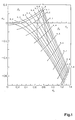
- the frequencies are usually plotted as “beta” lines in a so-called “a/q” diagram, where "a” is proportional to the DC voltage between ring and end electrodes, and "q” is proportional to the RF voltage.
- the secular oscillations of the ions are stable. Outside this stability area, the forces on the ions are directed away from the field center, and the oscillations are unstable.
- US-A-4 540 ⁇ 884 (George C. Stafford, Paul E. Kelley, and David R. Stephens, filed 1982; EP-A-0 ⁇ 113 20 ⁇ 7) describes a "mass selective instability scan".
- US-A-4 736 10 ⁇ 1 (John E.P. Syka, John N. Louris, Paul E. Kelley, George C. Stafford, Walter E. Reynolds, filed 1987; EP-A-0 ⁇ 20 ⁇ 2 943) describes a scan method making use of the mass selective resonant ion ejection by an additional RF voltage across the end electrodes which is well-known from e.g. J. E. Fulford, D.-H. Hoa, R. J. Hughes, R. E. March, R. F. Bonner, and G. J. Wong, J. Vac. Sci. Technol., 17, (1980 ⁇ ), 829: "Radio-frequency mass selected excitation and resonant ejection of ions in a three-dimensional quadrupole ion trap".
- This invention is directed to a third basically different scanning procedure making primary use of the sharp natural resonance conditions in inharmonic QUISTORs.
- inharmonic QUISTOR fields the distortion of the field can be described as a finite or infinite sum of coaxial rotation-symmetric three-dimensional multipole fields.
- Such an inharmonic QUISTOR field can be generated by distortions of the ideal electrode geometry or by distortions of the applied RF voltage (e. g. by odd harmonics of the sine oscillation of thr RF voltage) or by a combination of both.
- a first embodiment of the invention is obtained by the features of the claims 1 and 21.
- the invention therefore, provides an additional method of producing the ions in a small volume located outside the center of the storage field. If ions are produced in such a way, they show very similar secular movement amplitudes. This method requires a good vacuum within the QUISTOR so that the ion secular movements are not damped by collisions with residual gas molecules.
- the invention provides a second additional method to enhance the resolution during ion ejection: Ions are either generated in the field center (for a method see DE-A-37 0 ⁇ 0 ⁇ 337.2; J. Franzen, and D. Koch; filed 1987), or damped by a gas added to cause the ion secular movements collapse into the center by repeated collisions. The secular oscillations of the ions to be ejected are then increased selectively by resonance with an additional RF field across the center, a short time before they encounter the sum resonance by the scanning RF quadrupole storage field.
- the ions of a selected mass-to-charge ratio first start to resonate within the additional RF field. They increase thereby their secular movement amplitudes synchronously. In the progress of the scan, and eventually before the ion movements are damped again by the damping gas, the ions encounter the sum resonance condition, and leave the QUISTOR field synchronously.
- a hitherto best inharmonic QUISTOR mass spectrometer (fig. 2) can be designed by ring (4) and end electrodes (3), (5), formed precisely hyperbolically with an angle 1:1.385 of the hyperbole asymptotes. The electrodes are spaced by insulators (7) and (8).
- Ions may be formed by an electron beam which is generated by a heated filament (1) and a lens plate (2) which focuses the electrons through a hole (10 ⁇ ) in the end cap (3) into the inharmonic QUISTOR during the ionization phase, and stops the electron beam during other time phases.
- the latter can be advantageously generated from the oscillator which produces the frequency of the storage voltage, by a frequency division.
- the optimum voltage of the exciting frequency depends a little on the scan speed, and ranges from 1 Volt to about 20 ⁇ Volts.
- ions are ejected through the perforations (9) in the end cap (5), and measured by the multiplier (6).
- a scan of the high frequency storing voltage V stor from a storage voltage upwards to 7.5 kV yields a spectrum up to more than 50 ⁇ 0 ⁇ atomic mass units in a single scan (Fig. 3).
- a full scan over 50 ⁇ 0 ⁇ atomic mass units can be performed in only 10 ⁇ milliseconds. This is the fastest scan rate which has been reported for a QUISTOR.
Landscapes
- Chemical & Material Sciences (AREA)
- Analytical Chemistry (AREA)
- Other Investigation Or Analysis Of Materials By Electrical Means (AREA)
- Electron Tubes For Measurement (AREA)
Claims (25)
- Procédé permettant de mesurer, au moyen d'un QUISTOR, le spectre de masse d'une matière échantillon, qui comprend les opérations suivantes :
définir un champ électrique de stockage d'ions à trois dimensions, dans lequel des ions dont les rapports masse-charge se trouvent dans un intervalle considéré peuvent être simultanément piégés ;
introduire ou créer des ions échantillons dans le champ quadrupolaire, grâce à quoi des ions considérés sont simultanément piégés et effectuent des mouvements séculaires spécifiques aux rapport masse-charge ;
modifier le champ quadrupolaire de façon que des ions piégés de manière simultanée et stable qui présentent des rapports masse-charge consécutifs rentrent dans une résonance somme de leurs mouvements séculaires, augmentent ainsi les amplitudes de leurs mouvements séculaires, et quittent le champ de piégeage ;
et détecter les ions qui possèdent des rapports masse-charge séquentiels lorsqu'ils quittent le champ de piégeage,
caractérisé en ce que le champ de stockage d'ions consiste en un champ quadrupolaire non harmonique. - Procédé selon la revendication 1, dans lequel le champ quadrupolaire non harmonique de stockage d'ions est produit par des distorsions de la géométrie idéale des électrodes ou par des distorsions de la forme d'onde de la tension RF appliquée, ou bien par une combinaison des deux.
- Procédé selon la revendication 1 ou 2, dans lequel le champ quadrupolaire non harmonique de stockage d'ions est produit par la superposition d'un champ quadrupolaire exact avec une somme finie ou infinie de champs multi-polaires coaxiaux.
- Procédé selon la revendication 1, 2 ou 3, dans lequel le champ de stockage est produit par un QUISTOR du type possédant une électrode annulaire et des électrodes terminales séparées, où le champ quadrupolaire non harmonique est produit par des électrodes supplémentaires se trouvant entre l'électrode annulaire et les électrodes terminales.
- Procédé selon la revendication 1, 2 ou 3, dans lequel le champ de stockage est produit par un QUISTOR du type possédant une électrode annulaire et des électrodes terminales séparées, où le champ quadrupolaire non harmonique est produit par la forme des surfaces des électrodes.
- Procédé selon la revendication 5, dans lequel le QUISTOR présente la forme de deux couvercles terminaux hyperboliques à symétrie de rotation et un toroïde hyperbolique à symétrie de rotation, l'angle du cône double asymptotique inscrit s'écartant de 1:1,414.
- Procédé selon la revendication 6, l'angle du cône étant compris entre 1:1,34 et 1:1,410.
- Procédé selon l'une quelconque des revendications 1 à 7, caractérisé en ce que les ions stockés dans le champ sont produits à l'extérieur du centre exact du champ.
- Procédé selon la revendication 8, dans lequel les ions sont produits en un emplacement distinct qui est externe au centre du champ.
- Procédé selon la revendication 9, dans lequel la production d'ions a lieu dans le plan r à une distance du centre du champ d'environ 1/8 à 1/6 du diamètre interne de l'électrode annulaire.
- Procédé selon la revendication 9, dans lequel la production d'ions a lieu dans l'axe du champ à une distance d'environ 1/8 à 1/4 de la distance entre les électrodes terminales.
- Procédé selon l'une quelconque des revendications précédentes, dans lequel le champ quadrupolaire non harmonique supporte la condition de résonance somme

- Procédé selon l'une quelconque des revendications 1 à 12, caractérisé en ce que les ions stockés dans le centre du champ de stockage sont modulés par un champ RF supplémentaire, de sorte que la fréquence du champ RF supplémentaire diffère de la fréquence du mouvement séculaire axial des ions entrant dans la résonance somme.
- Procédé selon l'une quelconque des revendications 4 à 12, dans lequel le champ RF supplémentaire associé à la modulation des ions (qui a été introduit dans la revendication 13) est produit par une tension RF supplémentaire entre les électrodes terminales.
- Procédé selon la revendication 13 ou 14, dans lequel les ions entrent en résonance avec le champ RF supplémentaire juste avant qu'ils ne rencontrent la condition de résonance somme pendant la variation du champ de stockage RF.
- Procédé selon l'une quelconque des revendications 13 à 15, dans lequel la fréquence du champ RF supplémentaire vaut exactement 1/n de la fréquence du champ de stockage RF, n étant un nombre entier supérieur à 2.
- Procédé selon la revendication 16, dans lequel la fréquence du champ RF supplémentaire est verrouillée en phase sur la fréquence du champ de stockage RF.
- Procédé selon l'une quelconque des revendications 13 à 17, dans lequel les ions sont produits dans le centre du champ.
- Procédé selon l'une quelconque des revendications 13 à 17, dans lequel les mouvements séculaires des ions dans le champ de stockage sont amortis par un gaz d'amortissement.
- Procédé selon l'une quelconque des revendications précédentes, caractérisé en ce que la dérive de la fréquence de la résonance somme, qui est provoquée par la variation du champ de stockage, est égale à la dérive de la fréquence des ions résonants qui est provoquée par la croissance des amplitudes de leurs mouvements séculaires dans le champ quadrupolaire non harmonique de stockage d'ions.
- Spectromètre de masse comprenant un QUISTOR doté de moyens pour produire un champ de stockage d'ions, de moyens permettant d'introduire ou de produire des ions à l'intérieur du champ de stockage, de moyens permettant de détecter les ions qui quittent le champ de stockage, et de moyens pour faire varier le champ de stockage afin d'amener les ions ayant des rapports masse-charge qui se suivent à quitter séquentiellement le champ par le simple fait de l'augmentation de leurs amplitudes séculaires induites par des résonances sommes de leurs mouvements séculaires, caractérisé en ce que le champ de stockage d'ions consiste en un champ quadrupolaire non harmonique.
- Spectromètre de masse selon la revendication 21, où le champ quadrupolaire non harmonique produit par un champ quadrupolaire idéal se voit superposer une somme de champs multipolaires coaxiaux.
- Spectromètre de masse selon la revendication 22, caractérisé en ce que le champ de stockage quadrupolaire non harmonique est produit par une électrode annulaire et deux électrodes terminales conformées de façon à produire le quadrupôle de base et des champs multipolaires coaxiaux s'y superposant.
- Spectromètre de masse selon la revendication 23, où il existe des électrodes hyperboliques à symétrie de rotation ayant un angle du cône asymptotique qui s'écarte de 1:1,414.
- Spectromètre de masse selon la revendication 24, où l'angle est compris entre 1:1,34 et 1:1,40.
Priority Applications (5)
| Application Number | Priority Date | Filing Date | Title |
|---|---|---|---|
| DE68913290T DE68913290T2 (de) | 1989-02-18 | 1989-02-18 | Verfahren und Gerät zur Massenbestimmung von Proben mittels eines Quistors. |
| EP89102850A EP0383961B1 (fr) | 1989-02-18 | 1989-02-18 | Méthode et appareil pour l'analyse de masses avec un quistor |
| AT89102850T ATE101942T1 (de) | 1989-02-18 | 1989-02-18 | Verfahren und geraet zur massenbestimmung von proben mittels eines quistors. |
| US07/459,156 US4975577A (en) | 1989-02-18 | 1989-12-29 | Method and instrument for mass analyzing samples with a quistor |
| CA002010234A CA2010234C (fr) | 1989-02-18 | 1990-02-16 | Methode et instrument pour determiner la masse d'echantillons a l'aide d'un quistor |
Applications Claiming Priority (1)
| Application Number | Priority Date | Filing Date | Title |
|---|---|---|---|
| EP89102850A EP0383961B1 (fr) | 1989-02-18 | 1989-02-18 | Méthode et appareil pour l'analyse de masses avec un quistor |
Publications (2)
| Publication Number | Publication Date |
|---|---|
| EP0383961A1 EP0383961A1 (fr) | 1990-08-29 |
| EP0383961B1 true EP0383961B1 (fr) | 1994-02-23 |
Family
ID=8200978
Family Applications (1)
| Application Number | Title | Priority Date | Filing Date |
|---|---|---|---|
| EP89102850A Expired - Lifetime EP0383961B1 (fr) | 1989-02-18 | 1989-02-18 | Méthode et appareil pour l'analyse de masses avec un quistor |
Country Status (5)
| Country | Link |
|---|---|
| US (1) | US4975577A (fr) |
| EP (1) | EP0383961B1 (fr) |
| AT (1) | ATE101942T1 (fr) |
| CA (1) | CA2010234C (fr) |
| DE (1) | DE68913290T2 (fr) |
Cited By (2)
| Publication number | Priority date | Publication date | Assignee | Title |
|---|---|---|---|---|
| US7656236B2 (en) | 2007-05-15 | 2010-02-02 | Teledyne Wireless, Llc | Noise canceling technique for frequency synthesizer |
| US8179045B2 (en) | 2008-04-22 | 2012-05-15 | Teledyne Wireless, Llc | Slow wave structure having offset projections comprised of a metal-dielectric composite stack |
Families Citing this family (33)
| Publication number | Priority date | Publication date | Assignee | Title |
|---|---|---|---|---|
| DE4017264A1 (de) * | 1990-05-29 | 1991-12-19 | Bruker Franzen Analytik Gmbh | Massenspektrometrischer hochfrequenz-quadrupol-kaefig mit ueberlagerten multipolfeldern |
| US5206507A (en) * | 1991-02-28 | 1993-04-27 | Teledyne Mec | Mass spectrometry method using filtered noise signal |
| US5134286A (en) * | 1991-02-28 | 1992-07-28 | Teledyne Cme | Mass spectrometry method using notch filter |
| US5196699A (en) * | 1991-02-28 | 1993-03-23 | Teledyne Mec | Chemical ionization mass spectrometry method using notch filter |
| US5381007A (en) * | 1991-02-28 | 1995-01-10 | Teledyne Mec A Division Of Teledyne Industries, Inc. | Mass spectrometry method with two applied trapping fields having same spatial form |
| US5436445A (en) * | 1991-02-28 | 1995-07-25 | Teledyne Electronic Technologies | Mass spectrometry method with two applied trapping fields having same spatial form |
| US5274233A (en) * | 1991-02-28 | 1993-12-28 | Teledyne Mec | Mass spectrometry method using supplemental AC voltage signals |
| US5451782A (en) * | 1991-02-28 | 1995-09-19 | Teledyne Et | Mass spectometry method with applied signal having off-resonance frequency |
| US5256875A (en) * | 1992-05-14 | 1993-10-26 | Teledyne Mec | Method for generating filtered noise signal and broadband signal having reduced dynamic range for use in mass spectrometry |
| US5449905A (en) * | 1992-05-14 | 1995-09-12 | Teledyne Et | Method for generating filtered noise signal and broadband signal having reduced dynamic range for use in mass spectrometry |
| US5200613A (en) * | 1991-02-28 | 1993-04-06 | Teledyne Mec | Mass spectrometry method using supplemental AC voltage signals |
| US5173604A (en) * | 1991-02-28 | 1992-12-22 | Teledyne Cme | Mass spectrometry method with non-consecutive mass order scan |
| US5248883A (en) * | 1991-05-30 | 1993-09-28 | International Business Machines Corporation | Ion traps of mono- or multi-planar geometry and planar ion trap devices |
| DE4139037C2 (de) * | 1991-11-27 | 1995-07-27 | Bruker Franzen Analytik Gmbh | Verfahren zum Isolieren von Ionen einer auswählbaren Masse |
| DE4142871C1 (fr) * | 1991-12-23 | 1993-05-19 | Bruker - Franzen Analytik Gmbh, 2800 Bremen, De | |
| DE4142869C1 (fr) * | 1991-12-23 | 1993-05-19 | Bruker - Franzen Analytik Gmbh, 2800 Bremen, De | |
| DE4142870C2 (de) * | 1991-12-23 | 1995-03-16 | Bruker Franzen Analytik Gmbh | Verfahren für phasenrichtiges Messen der Ionen aus Ionenfallen-Massenspektrometern |
| US5198665A (en) * | 1992-05-29 | 1993-03-30 | Varian Associates, Inc. | Quadrupole trap improved technique for ion isolation |
| US5302826A (en) * | 1992-05-29 | 1994-04-12 | Varian Associates, Inc. | Quadrupole trap improved technique for collisional induced disassociation for MS/MS processes |
| DE4316738C2 (de) * | 1993-05-19 | 1996-10-17 | Bruker Franzen Analytik Gmbh | Auswurf von Ionen aus Ionenfallen durch kombinierte elektrische Dipol- und Quadrupolfelder |
| US5378891A (en) * | 1993-05-27 | 1995-01-03 | Varian Associates, Inc. | Method for selective collisional dissociation using border effect excitation with prior cooling time control |
| DE4324224C1 (de) * | 1993-07-20 | 1994-10-06 | Bruker Franzen Analytik Gmbh | Quadrupol-Ionenfallen mit schaltbaren Multipol-Anteilen |
| DE4324233C1 (de) * | 1993-07-20 | 1995-01-19 | Bruker Franzen Analytik Gmbh | Verfahren zur Auswahl der Reaktionspfade in Ionenfallen |
| DE4326549C1 (de) * | 1993-08-07 | 1994-08-25 | Bruker Franzen Analytik Gmbh | Verfahren für eine Regelung der Raumladung in Ionenfallen |
| JPH095298A (ja) * | 1995-06-06 | 1997-01-10 | Varian Assoc Inc | 四重極イオントラップ内の選択イオン種を検出する方法 |
| DE19751401B4 (de) * | 1997-11-20 | 2007-03-01 | Bruker Daltonik Gmbh | Quadrupol-Hochfrequenz-Ionenfallen für Massenspektrometer |
| US6124592A (en) * | 1998-03-18 | 2000-09-26 | Technispan Llc | Ion mobility storage trap and method |
| US6469298B1 (en) | 1999-09-20 | 2002-10-22 | Ut-Battelle, Llc | Microscale ion trap mass spectrometer |
| DE10028914C1 (de) * | 2000-06-10 | 2002-01-17 | Bruker Daltonik Gmbh | Interne Detektion von Ionen in Quadrupol-Ionenfallen |
| US20050253059A1 (en) * | 2004-05-13 | 2005-11-17 | Goeringer Douglas E | Tandem-in-time and-in-space mass spectrometer and associated method for tandem mass spectrometry |
| US7034293B2 (en) * | 2004-05-26 | 2006-04-25 | Varian, Inc. | Linear ion trap apparatus and method utilizing an asymmetrical trapping field |
| US8505382B2 (en) | 2011-02-10 | 2013-08-13 | Ut-Battelle, Llc | Nonlinear nanomechanical oscillators for ultrasensitive inertial detection |
| US9202660B2 (en) | 2013-03-13 | 2015-12-01 | Teledyne Wireless, Llc | Asymmetrical slow wave structures to eliminate backward wave oscillations in wideband traveling wave tubes |
Family Cites Families (5)
| Publication number | Priority date | Publication date | Assignee | Title |
|---|---|---|---|---|
| US4540884A (en) * | 1982-12-29 | 1985-09-10 | Finnigan Corporation | Method of mass analyzing a sample by use of a quadrupole ion trap |
| DE3688215T3 (de) * | 1985-05-24 | 2005-08-25 | Thermo Finnigan Llc, San Jose | Steuerungsverfahren für eine Ionenfalle. |
| US4755670A (en) * | 1986-10-01 | 1988-07-05 | Finnigan Corporation | Fourtier transform quadrupole mass spectrometer and method |
| US4818869A (en) * | 1987-05-22 | 1989-04-04 | Finnigan Corporation | Method of isolating a single mass or narrow range of masses and/or enhancing the sensitivity of an ion trap mass spectrometer |
| ATE99834T1 (de) * | 1988-04-13 | 1994-01-15 | Bruker Franzen Analytik Gmbh | Methode zur massenanalyse einer probe mittels eines quistors und zur durchfuehrung dieses verfahrens entwickelter quistor. |
-
1989
- 1989-02-18 EP EP89102850A patent/EP0383961B1/fr not_active Expired - Lifetime
- 1989-02-18 DE DE68913290T patent/DE68913290T2/de not_active Expired - Lifetime
- 1989-02-18 AT AT89102850T patent/ATE101942T1/de not_active IP Right Cessation
- 1989-12-29 US US07/459,156 patent/US4975577A/en not_active Expired - Lifetime
-
1990
- 1990-02-16 CA CA002010234A patent/CA2010234C/fr not_active Expired - Lifetime
Cited By (2)
| Publication number | Priority date | Publication date | Assignee | Title |
|---|---|---|---|---|
| US7656236B2 (en) | 2007-05-15 | 2010-02-02 | Teledyne Wireless, Llc | Noise canceling technique for frequency synthesizer |
| US8179045B2 (en) | 2008-04-22 | 2012-05-15 | Teledyne Wireless, Llc | Slow wave structure having offset projections comprised of a metal-dielectric composite stack |
Also Published As
| Publication number | Publication date |
|---|---|
| DE68913290D1 (de) | 1994-03-31 |
| EP0383961A1 (fr) | 1990-08-29 |
| DE68913290T2 (de) | 1994-05-26 |
| ATE101942T1 (de) | 1994-03-15 |
| CA2010234C (fr) | 1998-05-12 |
| CA2010234A1 (fr) | 1990-08-18 |
| US4975577A (en) | 1990-12-04 |
Similar Documents
| Publication | Publication Date | Title |
|---|---|---|
| EP0383961A1 (fr) | Méthode et appareil pour l'analyse de masses avec un quistor | |
| EP0336990B1 (fr) | Procédé d'analyse de masse d'un échantillon à l'aide d'un quistor et un quistor réalisé pour la mise en oeuvre de ce procédé | |
| US7034293B2 (en) | Linear ion trap apparatus and method utilizing an asymmetrical trapping field | |
| EP0793256B1 (fr) | Méthode de balayage en masse pour spectromètre de masse du type piège à ions | |
| US5420425A (en) | Ion trap mass spectrometer system and method | |
| US6998610B2 (en) | Methods and apparatus for switching ion trap to operate between three-dimensional and two-dimensional mode | |
| US6897438B2 (en) | Geometry for generating a two-dimensional substantially quadrupole field | |
| EP1614142B1 (fr) | Ejection axiale a geometrie amelioree pour generer un champ bidimensionnel sensiblement quadripolaire | |
| US7141789B2 (en) | Method and apparatus for providing two-dimensional substantially quadrupole fields having selected hexapole components | |
| US5298746A (en) | Method and device for control of the excitation voltage for ion ejection from ion trap mass spectrometers | |
| JPH0689696A (ja) | イオン単離のための四重極トラップの改良方法 | |
| Huang et al. | A combined linear ion trap for mass spectrometry |
Legal Events
| Date | Code | Title | Description |
|---|---|---|---|
| PUAI | Public reference made under article 153(3) epc to a published international application that has entered the european phase |
Free format text: ORIGINAL CODE: 0009012 |
|
| 17P | Request for examination filed |
Effective date: 19900103 |
|
| AK | Designated contracting states |
Kind code of ref document: A1 Designated state(s): AT BE CH DE ES FR GB IT LI NL SE |
|
| 17Q | First examination report despatched |
Effective date: 19920911 |
|
| GRAA | (expected) grant |
Free format text: ORIGINAL CODE: 0009210 |
|
| AK | Designated contracting states |
Kind code of ref document: B1 Designated state(s): AT BE CH DE ES FR GB IT LI NL SE |
|
| PG25 | Lapsed in a contracting state [announced via postgrant information from national office to epo] |
Ref country code: IT Free format text: LAPSE BECAUSE OF FAILURE TO SUBMIT A TRANSLATION OF THE DESCRIPTION OR TO PAY THE FEE WITHIN THE PRE;WARNING: LAPSES OF ITALIAN PATENTS WITH EFFECTIVE DATE BEFORE 2007 MAY HAVE OCCURRED AT ANY TIME BEFORE 2007. THE CORRECT EFFECTIVE DATE MAY BE DIFFERENT FROM THE ONE RECORDED.SCRIBED TIME-LIMIT Effective date: 19940223 Ref country code: NL Effective date: 19940223 Ref country code: AT Effective date: 19940223 Ref country code: ES Free format text: THE PATENT HAS BEEN ANNULLED BY A DECISION OF A NATIONAL AUTHORITY Effective date: 19940223 Ref country code: BE Effective date: 19940223 Ref country code: SE Effective date: 19940223 |
|
| REF | Corresponds to: |
Ref document number: 101942 Country of ref document: AT Date of ref document: 19940315 Kind code of ref document: T |
|
| REF | Corresponds to: |
Ref document number: 68913290 Country of ref document: DE Date of ref document: 19940331 |
|
| ET | Fr: translation filed | ||
| NLV1 | Nl: lapsed or annulled due to failure to fulfill the requirements of art. 29p and 29m of the patents act | ||
| PLBE | No opposition filed within time limit |
Free format text: ORIGINAL CODE: 0009261 |
|
| STAA | Information on the status of an ep patent application or granted ep patent |
Free format text: STATUS: NO OPPOSITION FILED WITHIN TIME LIMIT |
|
| 26N | No opposition filed | ||
| REG | Reference to a national code |
Ref country code: GB Ref legal event code: IF02 |
|
| PGFP | Annual fee paid to national office [announced via postgrant information from national office to epo] |
Ref country code: GB Payment date: 20080228 Year of fee payment: 20 Ref country code: DE Payment date: 20080222 Year of fee payment: 20 |
|
| PGFP | Annual fee paid to national office [announced via postgrant information from national office to epo] |
Ref country code: FR Payment date: 20080225 Year of fee payment: 20 Ref country code: CH Payment date: 20080423 Year of fee payment: 20 |
|
| REG | Reference to a national code |
Ref country code: CH Ref legal event code: PL |
|
| REG | Reference to a national code |
Ref country code: GB Ref legal event code: PE20 Expiry date: 20090217 |
|
| PG25 | Lapsed in a contracting state [announced via postgrant information from national office to epo] |
Ref country code: GB Free format text: LAPSE BECAUSE OF EXPIRATION OF PROTECTION Effective date: 20090217 |